“There is nothing like looking, if you want to find something. You certainly usually find something, if you look, but it is not always quite the something you were after.” ― J.R.R. Tolkien, “The Hobbit, or There and Back Again“
My Dearest Young Friend,
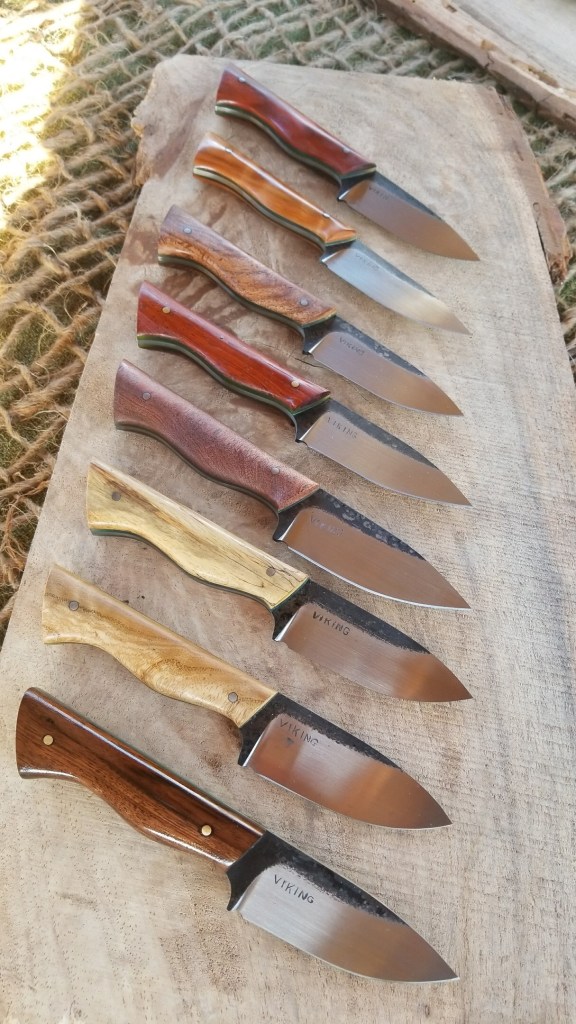
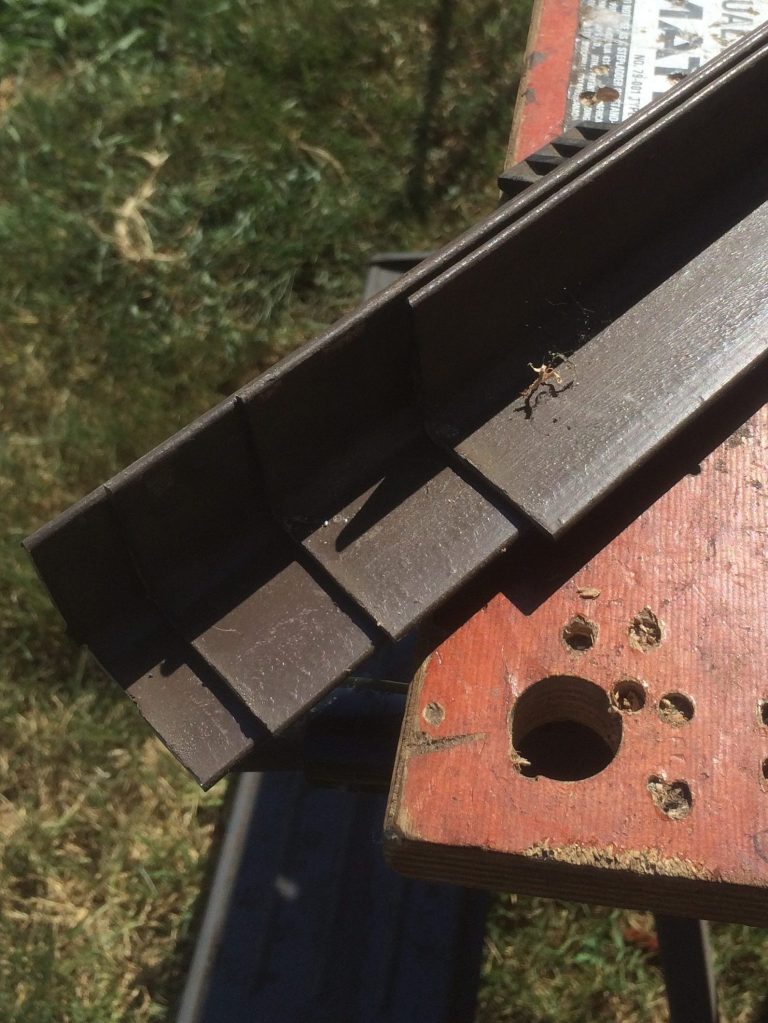
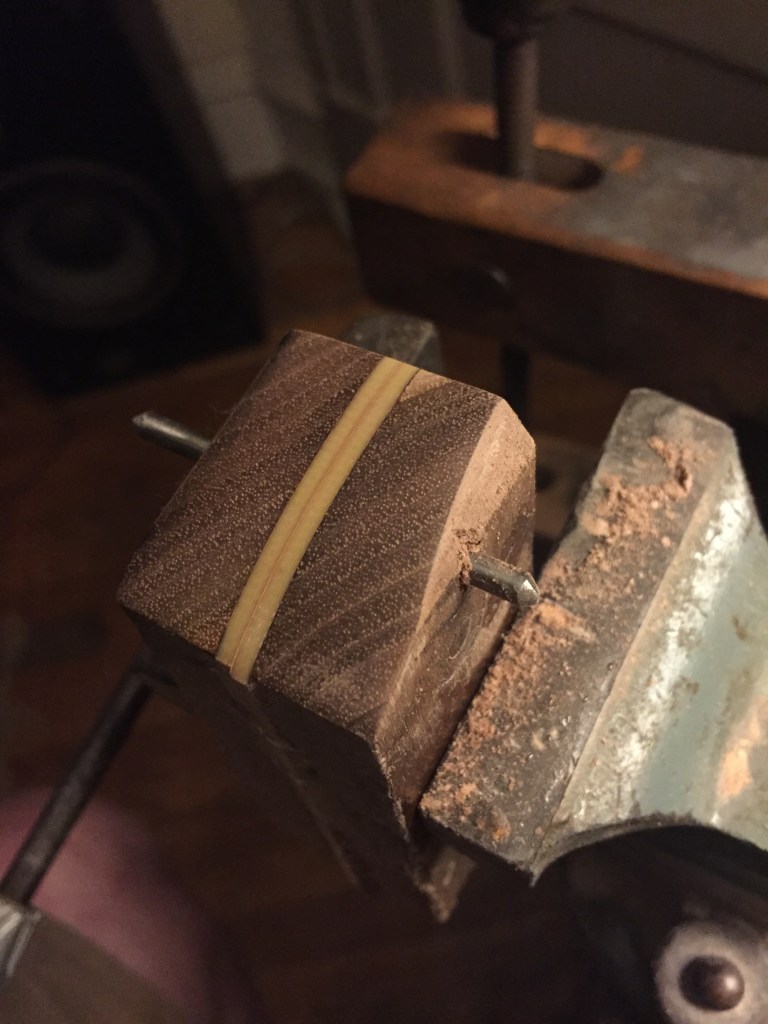
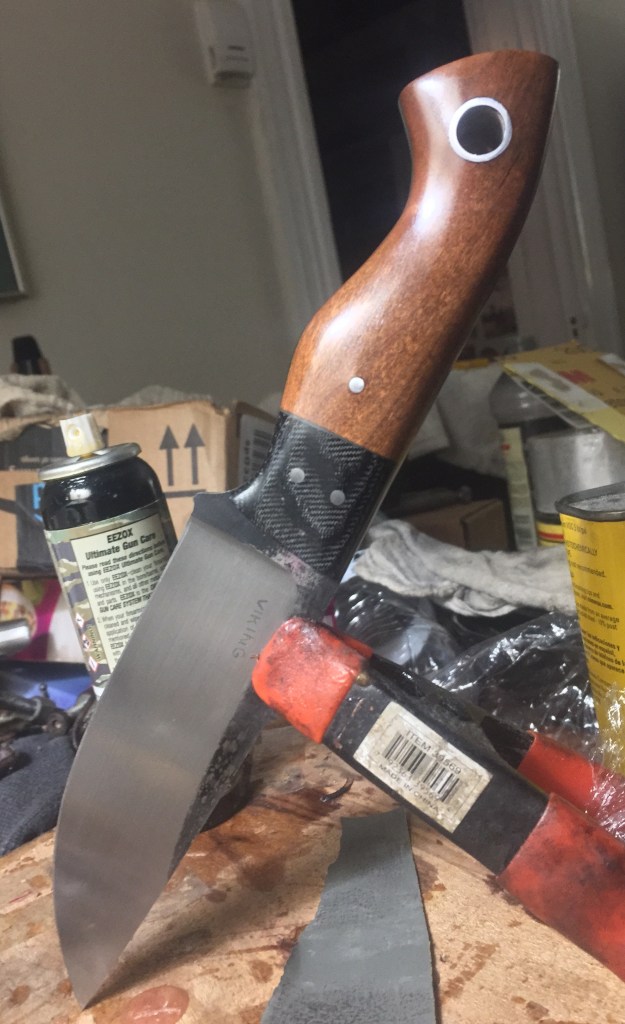
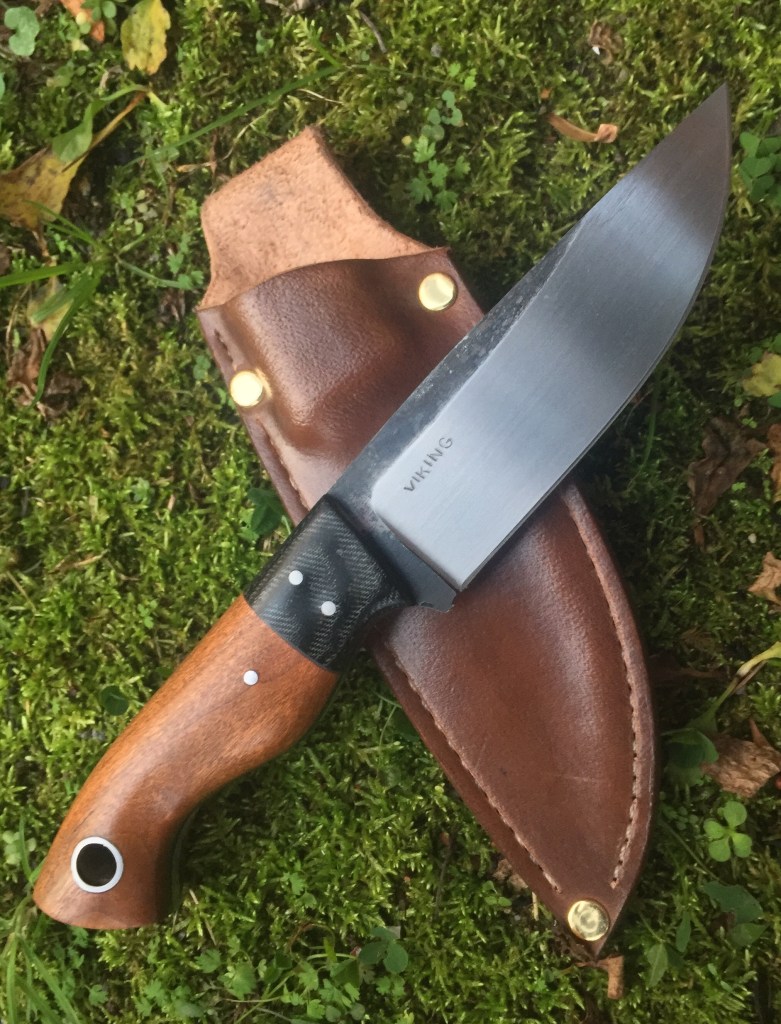
I was told you have made it eleven times around the sun this year. Eleven! In celebration of this, your dad commissioned me to make you a special knife, which was convenient because I prefer to make knives that are special regardless! I like to make them out of things I find- in fact, the knife I made you was made out of materials that I found in the garbage. The blade is made out of an old bedframe that I can harden and the handle is made from walnut pulled out of an abandoned house.
I make a lot of these particular knives. Anytime I see a bedframe in the trash, I pick it up and take it to my shop. Not all bedframes make good little knives but enough of them do so that it becomes worth my while to pick them up. It is through these little knives that I can explore and just be curious. I use whatever I have lying around the shop for the handles, or I try out ideas, or I just tinker around with no particular goal in mind to see what will happen. Sometimes nothing happens, but sometimes I can make something special that didn’t exist before I made it.
This creates a wonderful feeling that starts in my head, and goes through my arms and out my fingers, and keeps on going down my legs out my toes. I think you know this feeling. Perhaps you get this feeling when you read your books by Mr. Tolkien, or when you play Breath of the Wild. There’s always something good on the next page or just down the way- you only have to go looking for it. Even if you don’t find anything you might have made a new friend, or learned something about yourself, or your brothers and sisters. That is something special and should be celebrated- because sometimes the best party is the unexpected one.
As a grownup I sometimes forget that the unexpected and unknown can be good things- I started making knives to remind myself of this. It takes courage to be curious and explore and it’s important to remember that there’s a big world out there.
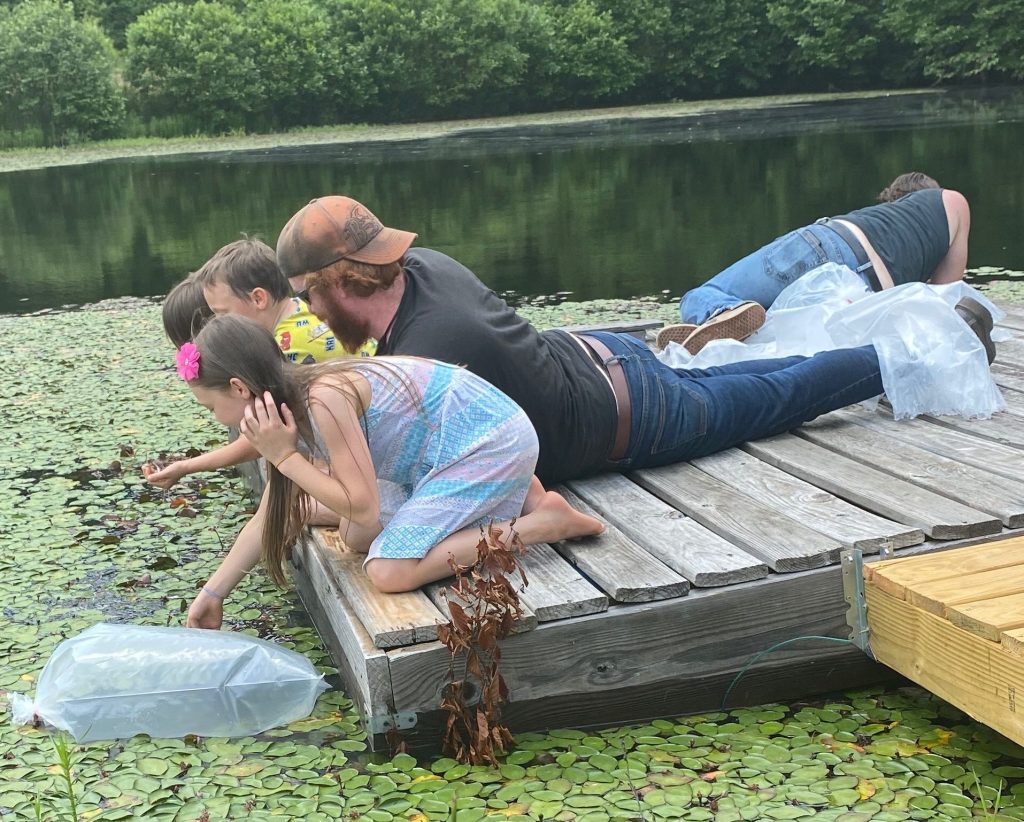
Some days I wake up and have no idea what the world will bring me so I try to approach most every day as an adventure. I spent a couple days each week of the past year helping your dad out at his work. One day I showed up and he told me we were going to stock the pond at your house with fish. We got in his truck and went to the farm supply store and your dad got something to the effect of a thousand minnows. That was a fun day, and you guys were all there. You never know what may happen if you don’t explore a bit. Thank you for sharing that adventure with me- your mom took this picture:
I hope you have a fantastic birthday and you keep reading and exploring!
The knife I made you begins with a piece of bedframe that I cut into smaller pieces:
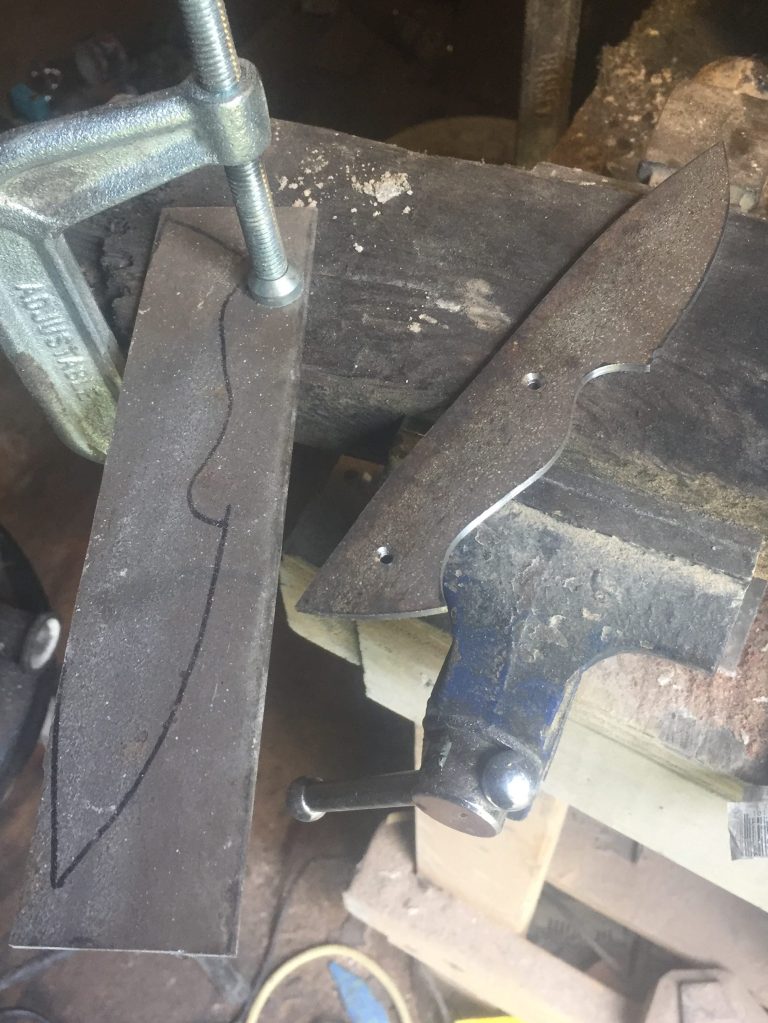
I trace my design onto the steel:
Then it’s just a process of cutting it out- I have special tools for this.
I always try to have a couple of these going and I’m usually working on more than one at once-
Once I get the shape right, I grind the bevel in-
Then they go into the forge, a controlled fire that gets the steel very hot and hardens the blade. It gets so hard that sometimes it’s difficult to drill holes for the handle pins-
After that I use sandpaper to get the bevels nice and smooth. This helps the knife to cut better-
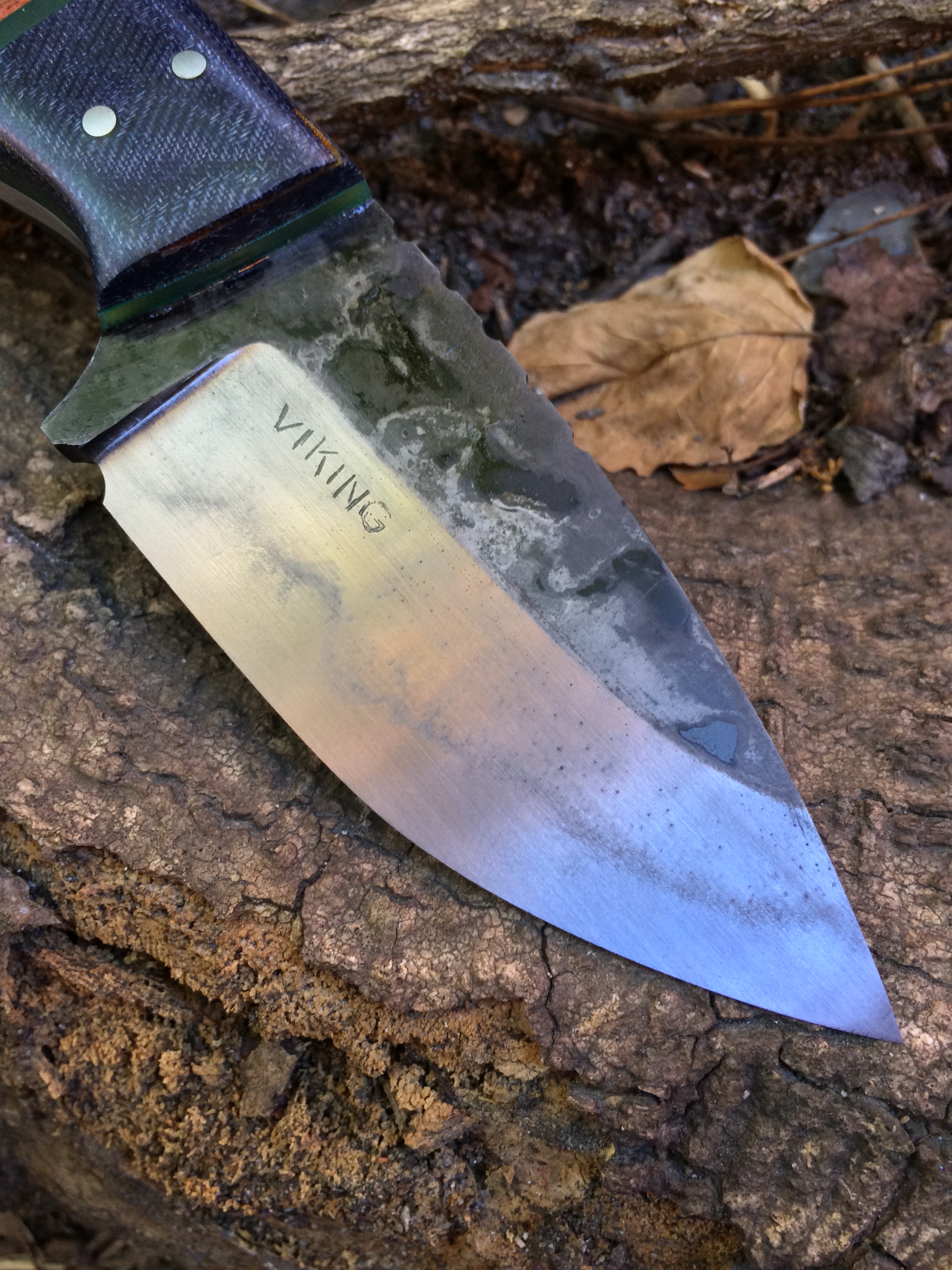
This one is blunted for you, so you can learn the feel and what it’s like to carry a knife-
Here is a piece of Black Walnut. It was pulled out of an abandoned house in North Carolina-
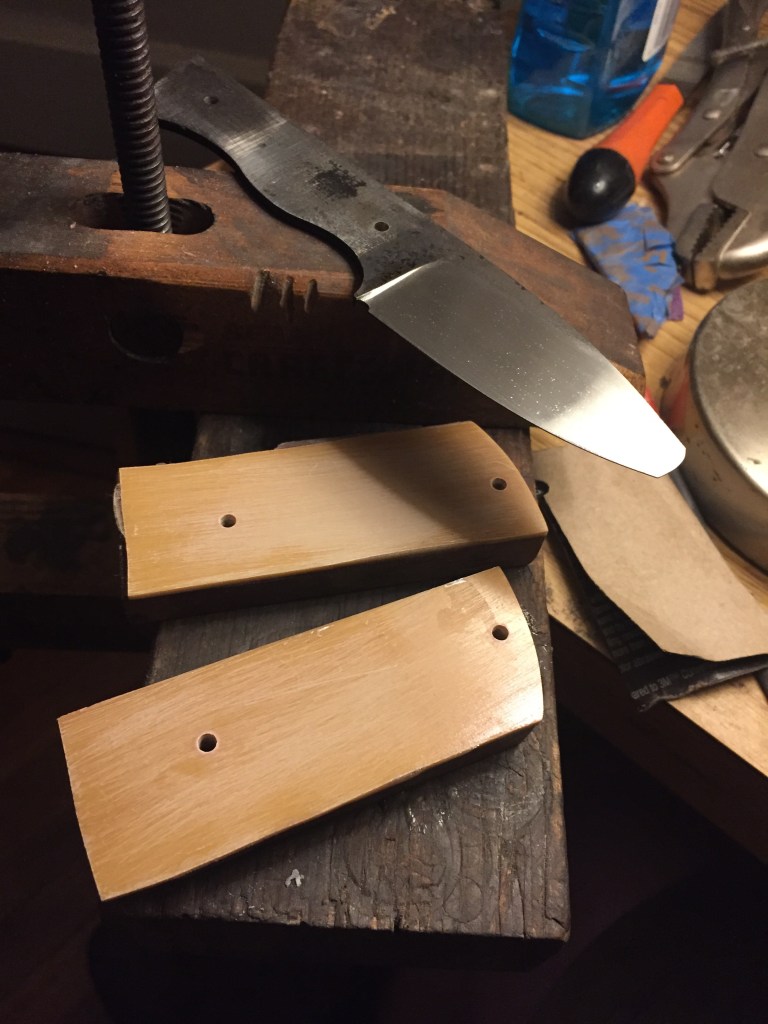
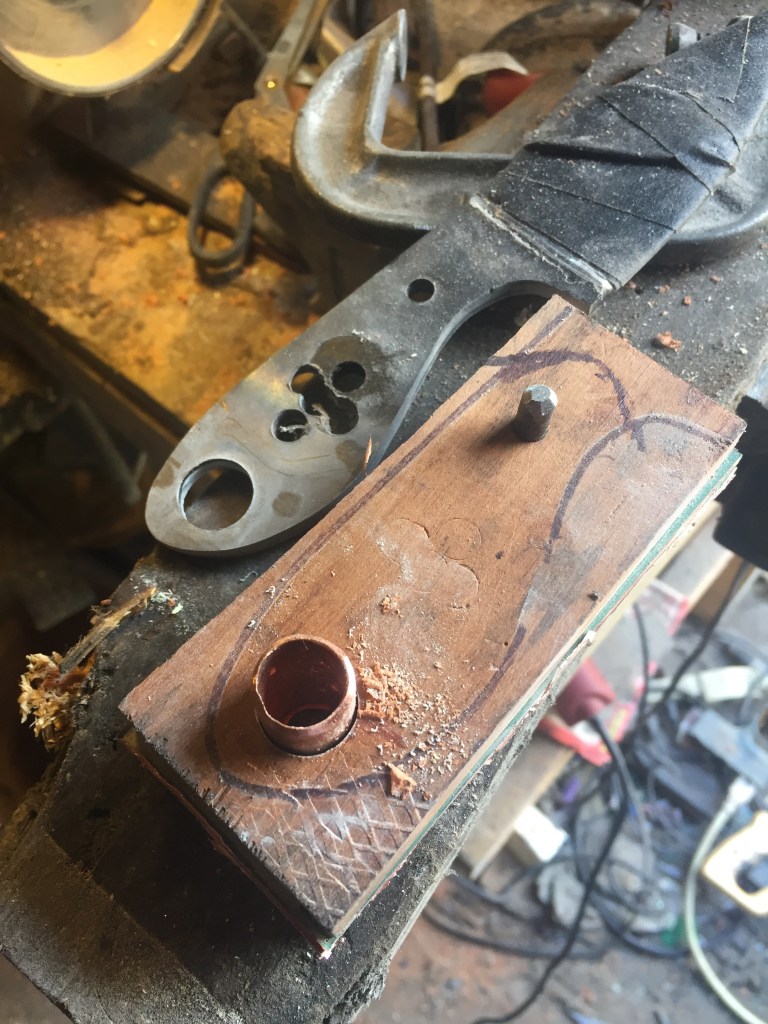
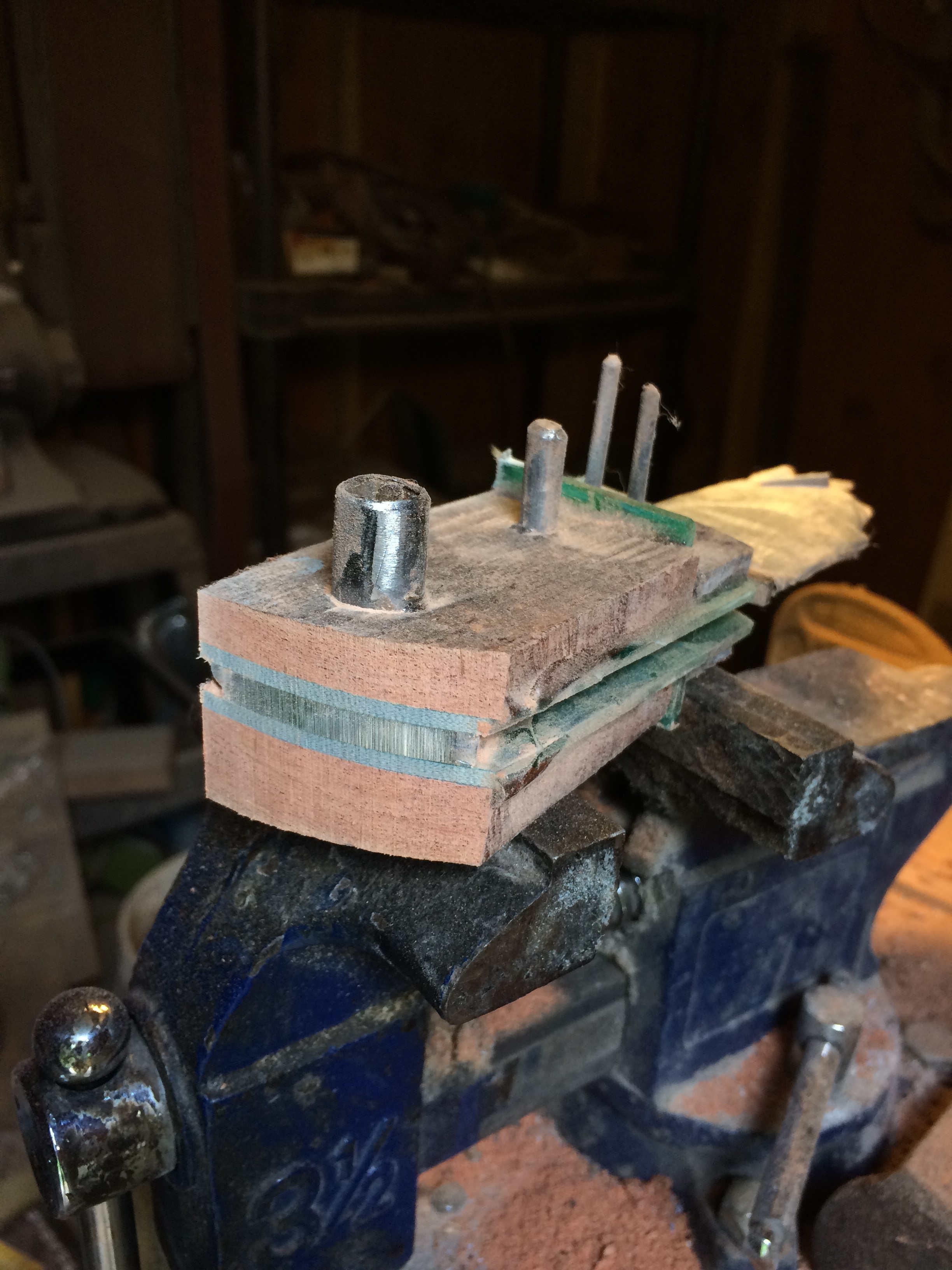
I cut two pieces of it and fit it to the knife. For a bit of color contrast, I use a bit of fiberglass computer board blanks that I rescued from a dumpster-
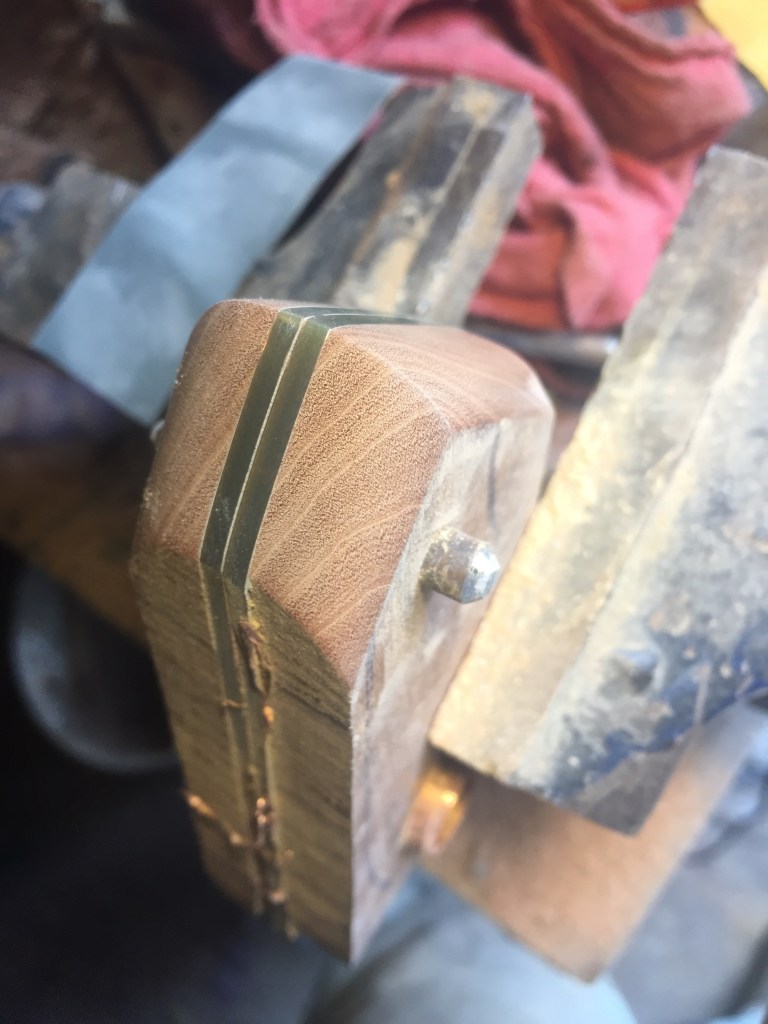
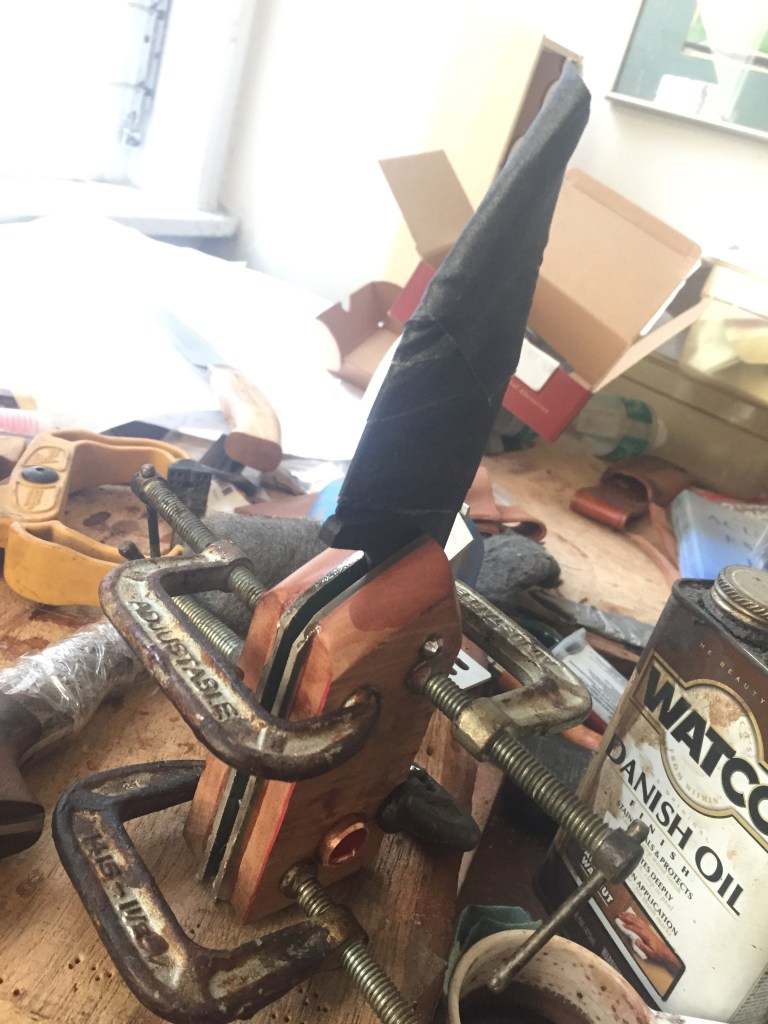
Now it is pinned and glued to the knife handle-
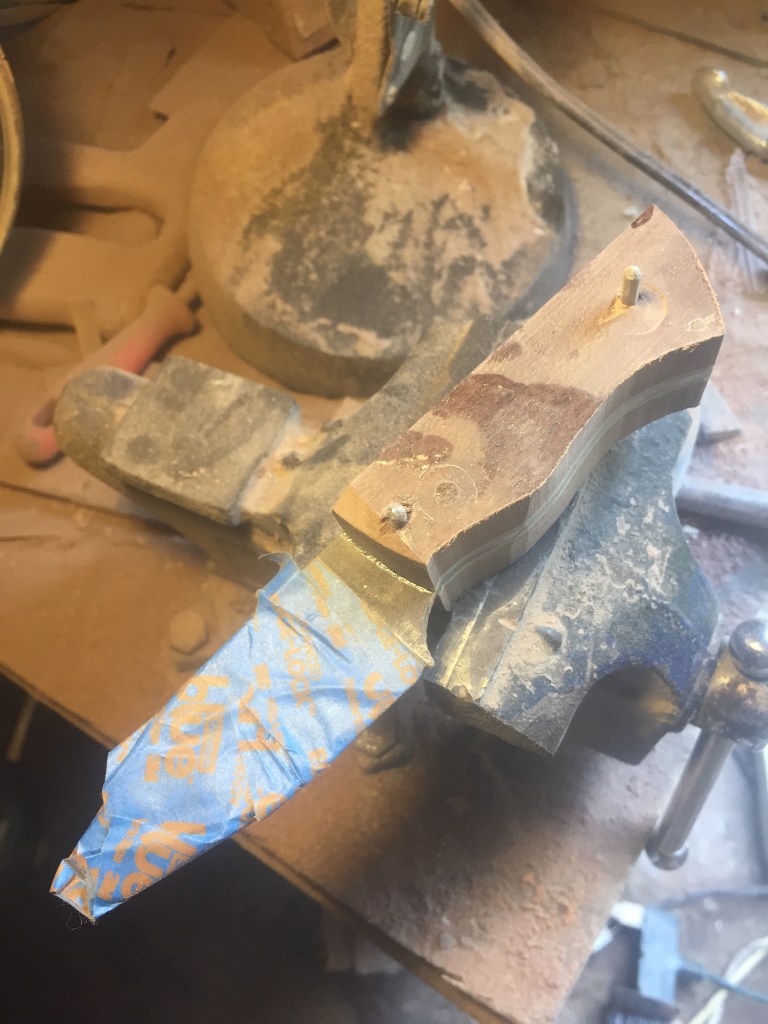
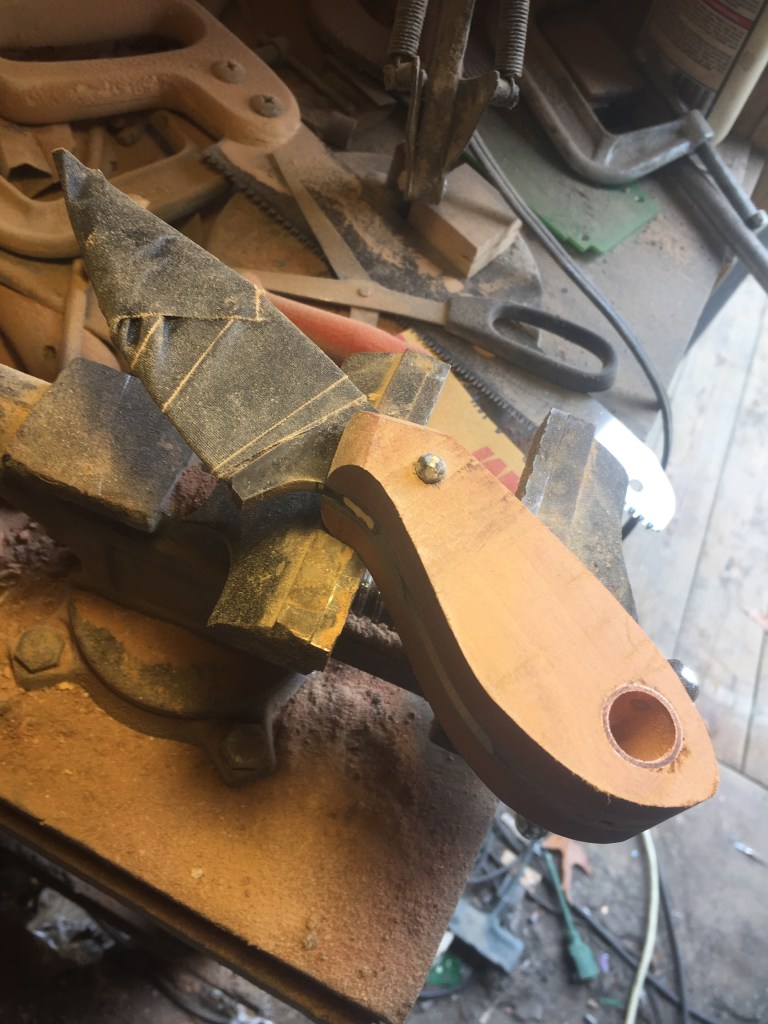
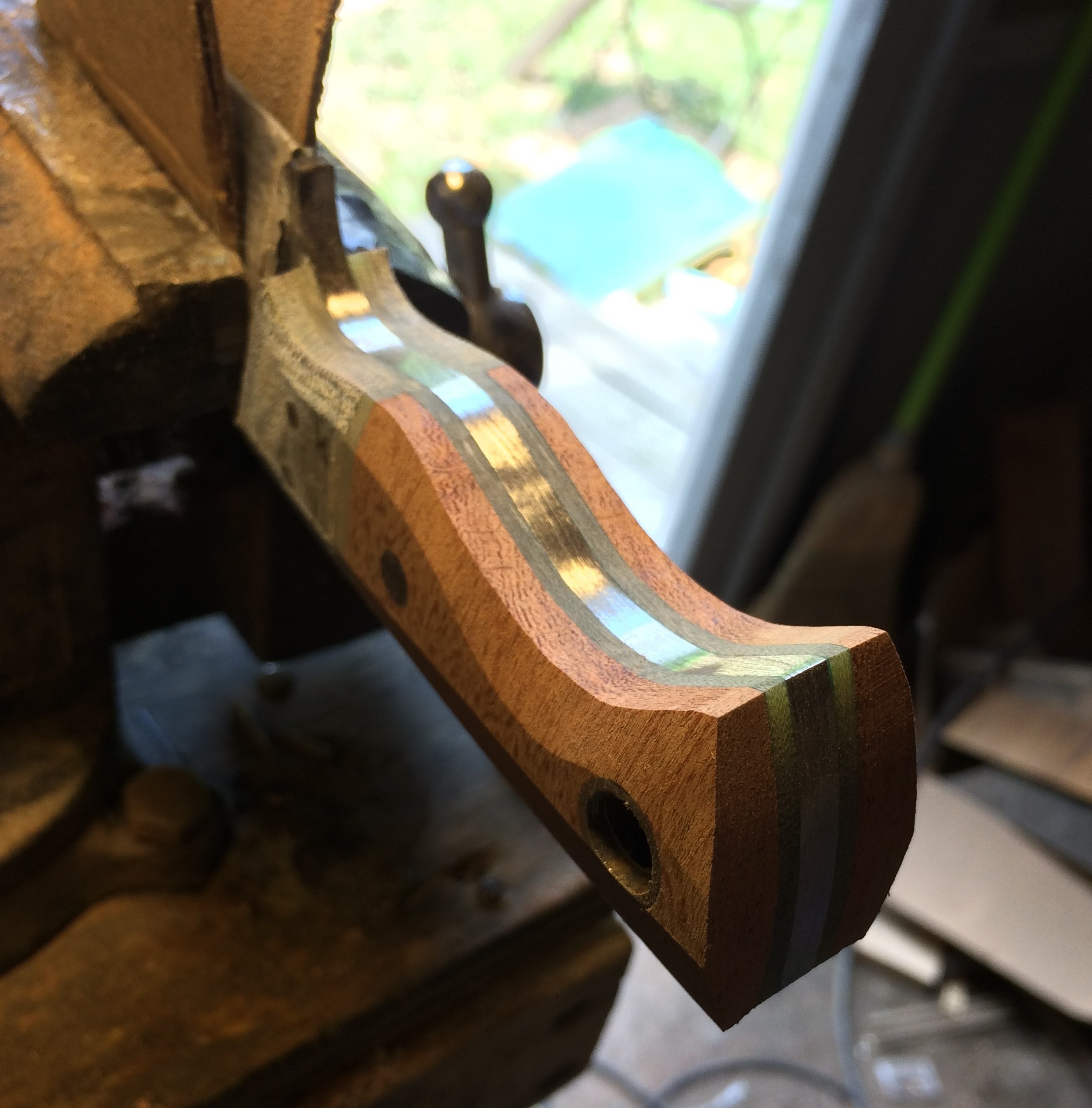
Here is where I shape it….
…..and shape it some more-
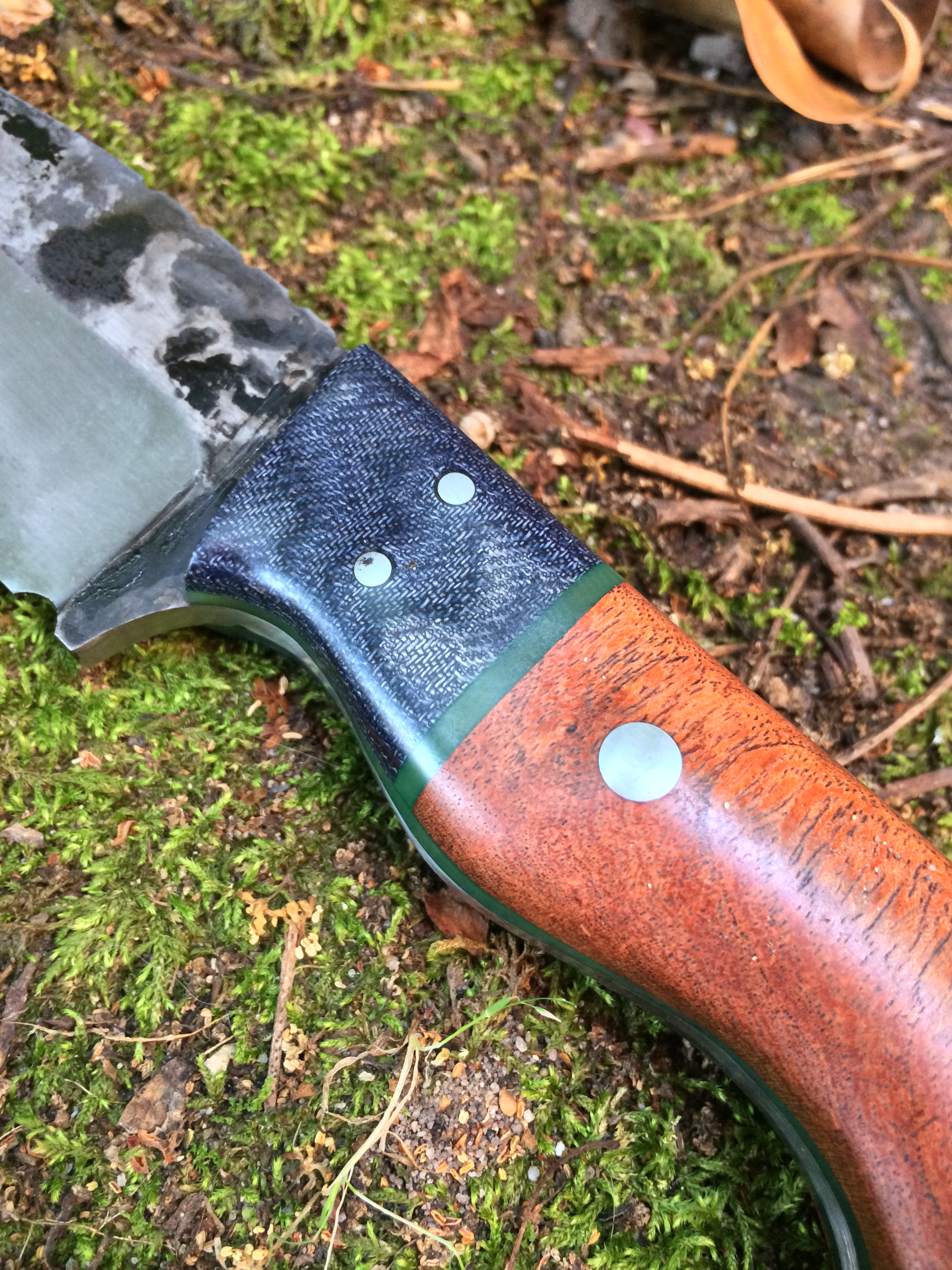
And now I sand it till it is shiny-
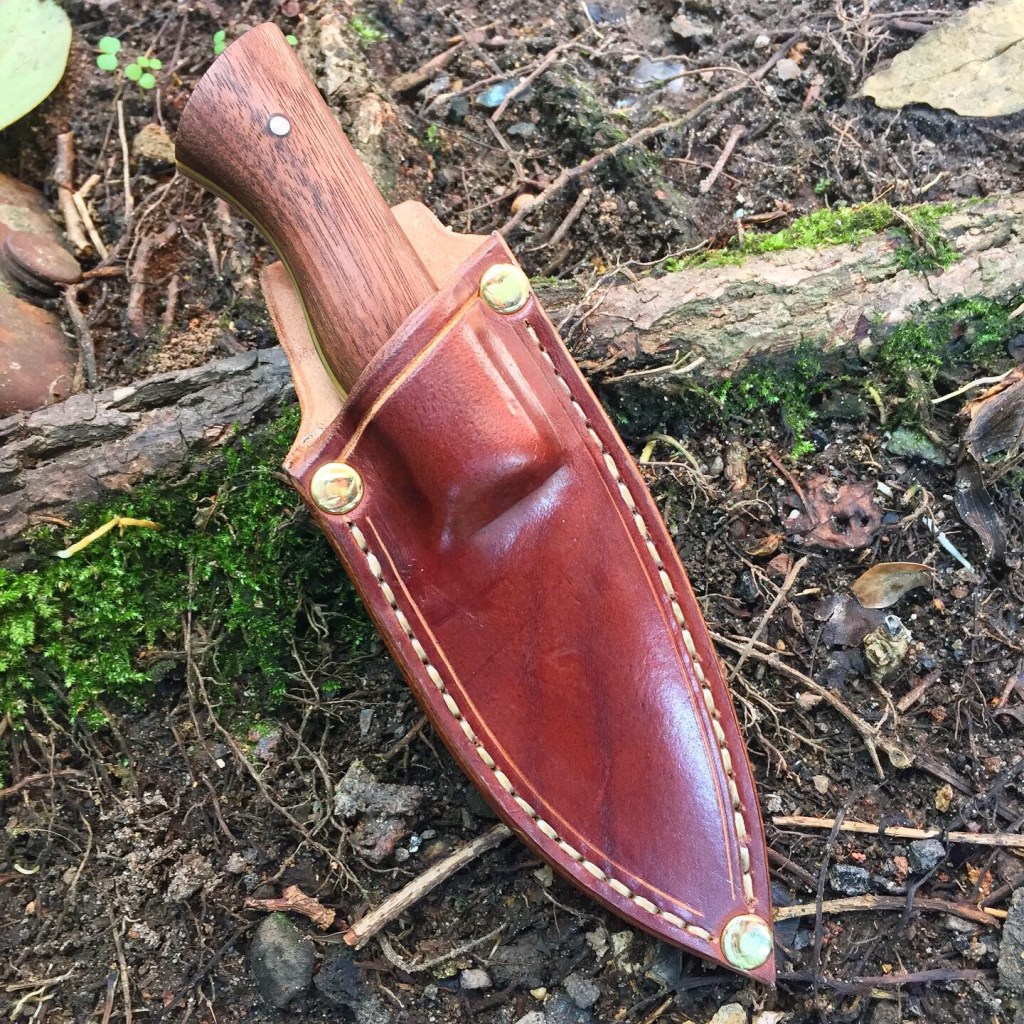
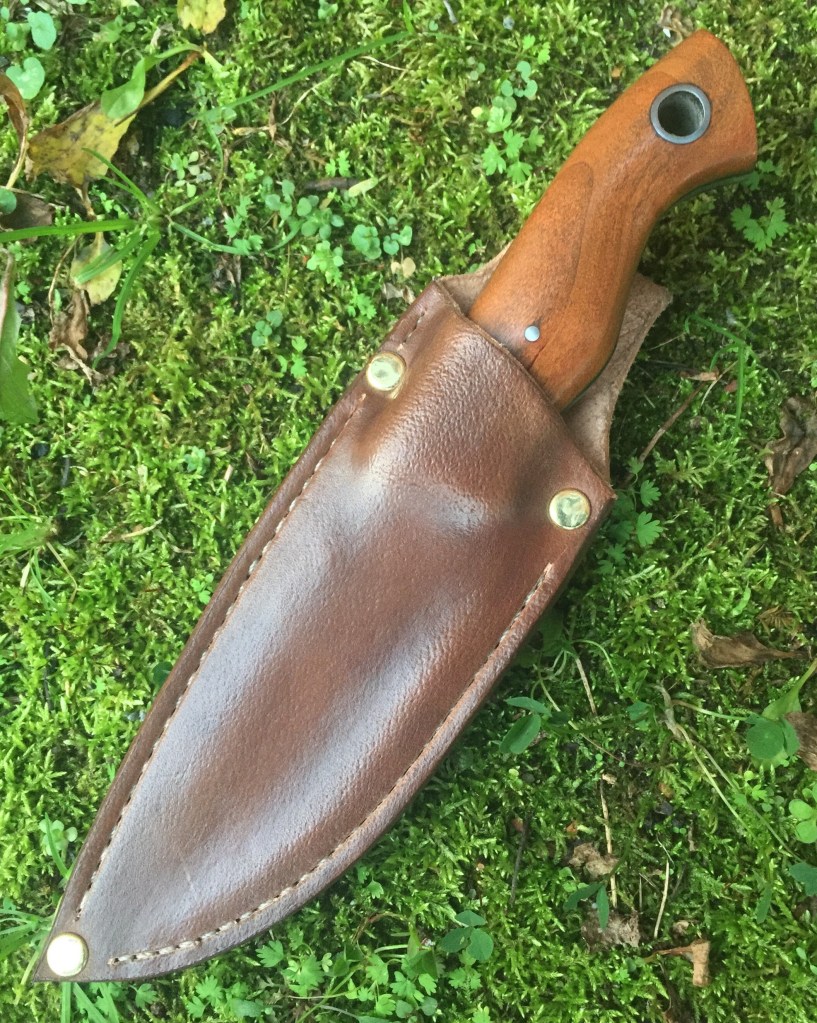
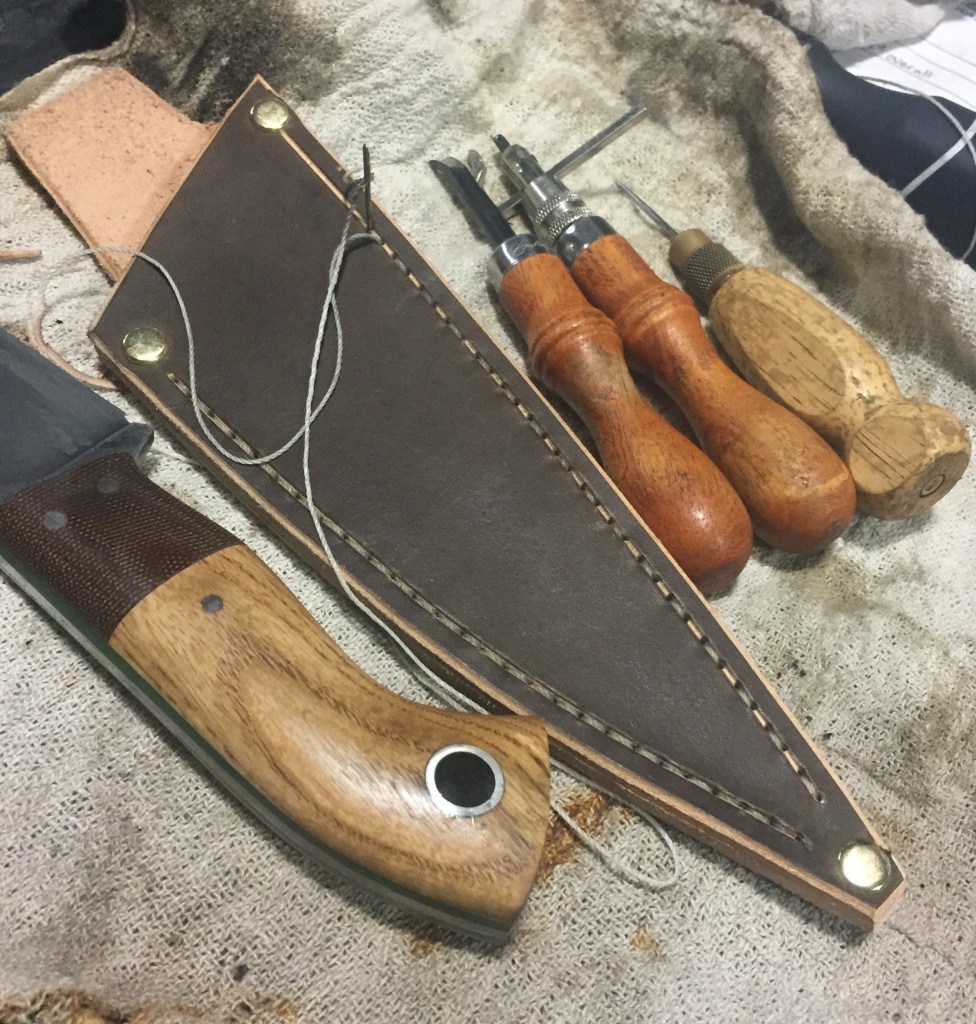
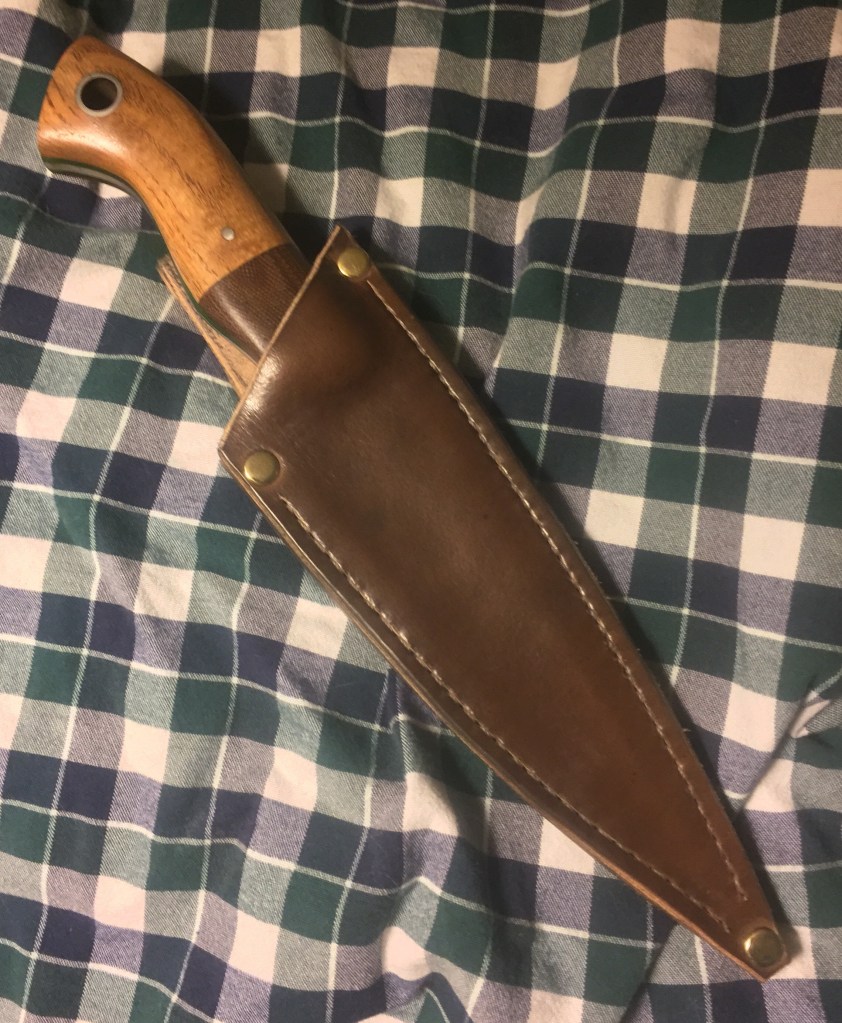
I made you a nice sheath for it so you can carry it around-
I remember, at the age of fourteen, running around my grandmother’s backyard and pretending to have a lightsaber and desperately attempting to feel the Force flowing through me. It was around 1998 or 1999, and I had just seen the special edition of “Return of the Jedi”. Other fourteen year-olds I knew were busy with sports, or having girlfriends, or smoking cigarettes, drinking, or doing drugs. In other words, doing nearly anything but pantomiming a nearly fifteen-year-old sci-fi-fantasy film in a relative’s backyard, but there I was. By that point I had been neck deep in the lore of Star Wars for years. I had all the books- from the Jedi Academy series and Tales of the Bounty Hunters, to the books detailing the technical specifications of the weapons, technology, vehicles, and alien races. I played Dark Forces and Dark Forces II: Jedi Knight, Jedi Knight II, Shadows of the Empire, and half a dozen others. I knew the legacies of Dash Rendar, Kyle Katarn, and how to make a Ruby Bliel. I had the soundtrack to all three films, each on double cassette. I hadn’t tasted the kool-aid: I had dove headfirst into a vat of the stuff.
What this type of fixation does in younger people, as any nerd-dom member will tell you, is allows one to cultivate a rich inner life and vivid imagination for things. It also teaches one to see the magic where one would not normally expect to see it. This is why many nerds grow up to be incredibly interesting and capable adults.
On top of this, everyone experiences times when they find it difficult to see the magic in life. Falling down rabbit holes teaches you how to nurture yourself when everything might not be so inspiring. The thing that has always saved me is remembering what it is to feel the mystery of it all. The past year has been an exercise in this. Most of my work has been cancelled due to Covid and as of yet has not come back. No knife shows, no gigs, minimal commissions. One of the bright spots of this whole debacle has been season two of the Mandalorian in the fall and winter of 2020. When you’ve been stuck at home doing menial pandemic work just trying to pay the bills, there are few things like a person of a mysterious creed and badass armor having interstellar adventures with Carl Weathers and Bill Burr and a Force-sensitive baby Yoda. Every week I tuned in like I was fourteen. It’s deeply reassuring to know that during such troubled times there are things to make you remember why you pursue that which you value and help you to feel the magic in everything.
For me this is the beauty of having a small custom knife shop. You can do anything you like. There are limitations, the greatest being time, but almost anything that you can think of you can usually do (provided you have the patience.) In this respect, it’s important to keep the mind limber and receptive to creativity for when the muse strikes us. If I am not inspired, I know how to find those things because I’ve been doing it since I was little. Sometimes it’s podcasts, or a song, or a line from a book, or perhaps even a conversation or something I’ve eaten. Because of the pandemic and not going out into the world in my accustomed fashion, this has been quite challenging most days. If I can stir myself, then i can certainly stir someone with a knife I’ve built. If I’ve done that, then my job is complete.
But sometimes we get commissions where WE are the ones who get stirred. We prefer to do everything in house and make sure the work comes from our own hand. While we don’t outsource tasks very often, occasionally we’ll get a commission that is interesting to us and requires that we do so. I received and email from a very good customer asking if I could get a Mythasaur skull on a custom blade and sheath. I thought of how the Mandalorian was such an oasis during a tough time; my own personal magic-hand-thing. I came up with a design that I hoped could fit a Mandalorian bounty hunter and found a laser engraving company in town. Chase your muse, do the work, and walk your path, don’t give up. It’s a journey but this is the way.
A quick schematic
Roughing out the profile
Removing a bit of weight and putting in rivet holes
Properly profiled
Bevels ground in
Pre-heat treat sanding
Out of the quench and cooling
Beginnings of a satin finish
…and we’re there.
A technical schematic for the laser people: precision is the name of the game.
Proofs showing how the engraving will look- the blue is for contrast.
And it came out just like the picture
The handle is made from a pair of Carhartt Dungarees I got too fat for….
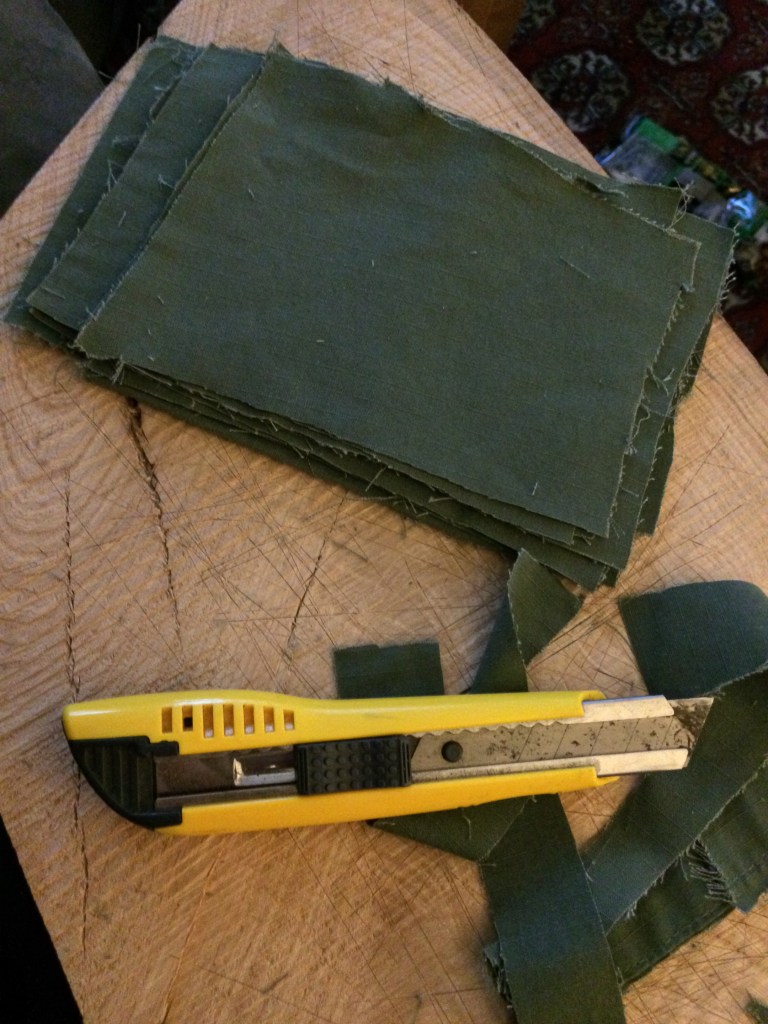
Cut into strips….
…layered into strips….
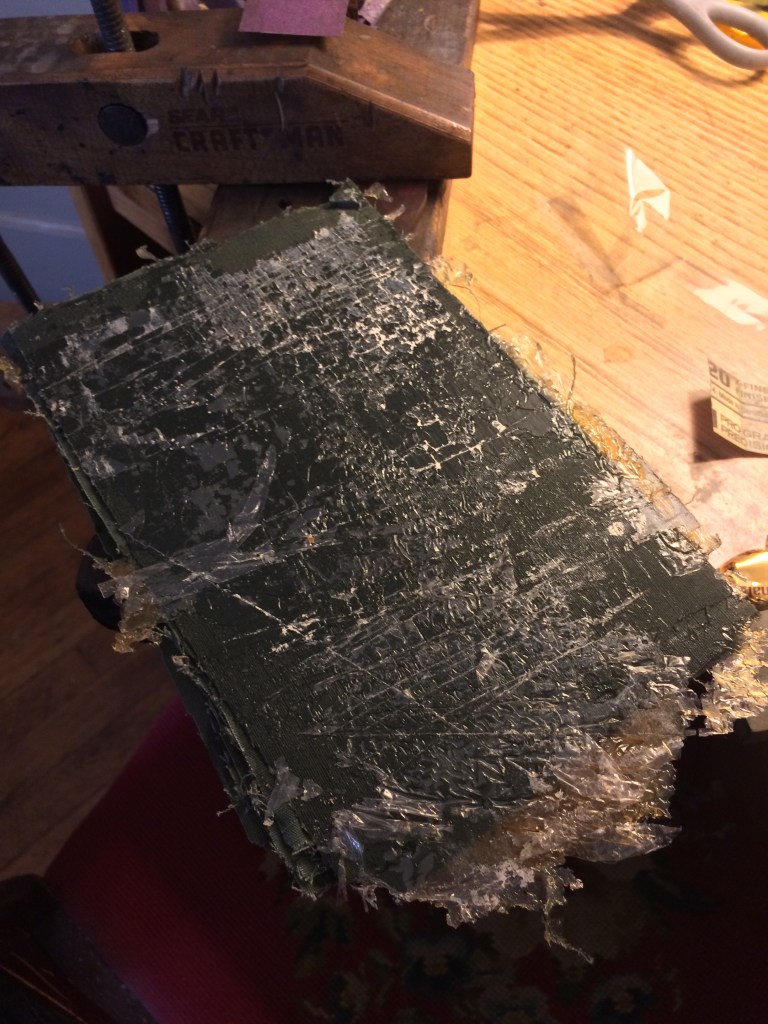
…with the resin…
And this is the raw material, about 3/16″ to 1/4″ thick.
A PCB filler blank, rescued from a dumpster.
Everything gets drilled and glued/riveted together.
Ready for shaping.
Profiled
Shaped to fit the hand. This is off the grinder at 60 grit. The rest will be done by hand to help the material speak.
At around 120 grit you can see the “grain” start to speak. The higher you polish it, the more pronounced it will be.
“Some may have, and some may not God, I’m thankful for what I got“
Warren Zevon- “Hasten Down the Wind”
Ever since I was a little boy, I was always interested in people who did things. Everyone likes to ask children what they want to be when they grew up, but when asked I never really had an answer. I always wanted to know how to do things and why things worked the way they did. I use to spend hours in the how-to section of the library, and record songs I liked off the radio to cassettes. I’d listen to them over and over again to see if I could figure out what made them move me so, all the while wondering how the person who wrote it pulled it out of themselves. For hours and hours I would listen. To nurture this, I was given painting and music lessons. As I got older, though I couldn’t have articulated it at the time, I realized I wanted to be a professional doer-of-things. Unfortunately, there is no specific vocation for that, no box that school guidance counselors can check off or program that they can put you in. I did my best to fit in and do as well as I could in school. School administrators want to see you be a productive member of society and we were all nudged toward that goal, but it all felt boring to me.
Fortunately the curious parts of me were nurtured by band directors, private music instructors, and Boy Scout leaders. I studied jazz and dissected chord changes and figured out what made things sound the way they did. I played in concert bands, jazz groups, and marching band. If it weren’t for marching band I never would have had any dates to school dances. On the weekends I’d go on camping trips and figure out different ways to set things on fire with a bunch of other wild ass kids. In the summer I would go to the local camp and sail boats, shoot guns, practice archery, and continue to set things on fire.
When most kids were saving up for beach week, I bought a Tascam 414 MkII four track cassette recorder. I taught myself guitar and wrote songs in a seven member rock outfit with metalheads, grungers, and punk rockers. Over the years we would play battle of the bands and anywhere that would have us. We rocked middle school dances like nobody’s business.
I went to college and studied music. In the summers I built commercial cabinets in a cabinet shop and tiled kitchens and bathroom working an apartment maintenance gig. Technically these could qualify as shit jobs but I really enjoyed seeing a re-done bathroom that was made nice by my own hands, or driving by a high-powered lawyer’s office and knowing I built all their reception desks. It’s empowering to know that it’s within your power to make beautiful things.
I graduated from college just shy of the 2008 financial collapse. I had figured I would land in some sort of interesting vocation and somebody would just hand me a bag of money, but the country was a wasteland for anyone getting out into the world at that time. People were losing everything they had worked for and the system couldn’t give less of a fuck about a whole batch of college grads who were ready and willing to be functioning members of society. Everything I had heard growing up about the metrics of success turned out to be out of sync with what the world was becoming. Suffice to say expectations were non-existent. I decided I would just continue to do things that I found interesting. If I was going to be poor, I might as well do the things that spoke to me.
I worked just about everything that seemed interesting. When you’re curious about things you tend to say yes to things that come your way. I played gigs and wrote and arranged music. I worked in operations for the local symphony, ballet, and various concert venues or arenas. I was a shipping clerk for a hot minute, a summer camp head of resident life, and managed a warehouse for an auction house. I don’t think I’ve ever been bored and met a lot of other curious people who had appreciation for the mystery of it all. People that you would call renaissance men (or women), who were off the beaten path. Universal spirits who understand the magic that comes from being curious and chasing the muse.
The Esperto Universale was built for one such man I met a few years ago. I was at a friend’s farm for thanksgiving, a potter and musician and overall curious man. He had some of his friends over who were also curious and interesting people. I struck up a conversation with a gentleman about working for Taylor Swift’s Red tour- it turns out he had built the steampunk piano for her show. He was neighbors with Michael McDonald and played porch concerts with him. He and his wife founded the Blackberry Jam Music Festival in Tennessee and perform on it as well. He’s also an inventor and has patents on products you can get at Home Depot.
There’s no roadmap for anything in this life and while I am use to being the odd man out in most situations, it’s always reassuring to meet others that have made being off the beaten path a successful lifestyle. In a brutal world, these sorts of souls you meet along the way help you to feel me connected and seen.
This knife was commissioned by his loving wife. This gentleman is a woodworker and musician, among other things, so I used some reclaimed Cherrywood that came off an old mantlepiece. The bolster is a micarta made from black jeans that I used to wear for a weekly big band gig. Something one of a kind for a unique man.
A quick sketch,
Profiled in O1 Tool Steel.
Refining the profile.
Ready to grind the bevels.
Bevels ground. The drawing showed a swedge, but that was out of concern that the tip would be too thick. The knife ended up not needing it.
Removing the rough machine marks by hand before heat treatment
Final profiling before hardening
After the quench.
Tempered to remove stress from the steel after tempering.
Satin finish.
Gig pants to be cut up and layered in fiberglass resin.
The raw material.
Furniture grade Cherry.
Bookmatched.
PCB board from network chassis. Rescued from a dumpster.
Finishing the handle.
The Esperto Universale
The Esperto Universale is made of high carbon steel, which means it will take a keen edge, hold it a good while, and will be easy to sharpen. It will stain and patina and tell the stories of the places you’ve been- this natural and characteristic of the steel. Your knife is made to be used so don’t be shy about getting it dirty. Be sure to keep your knife clean and oiled when not in use. Should you find any unpleasant surface oxidization you can remove it easily with a lightly oiled bit of 0000 steel wool, or a coarse rag with a bit vinegar on it.
“No member of a crew is praised for the rugged individuality of his rowing.” ― Ralph Waldo Emerson
For the past thirteen years I’ve worked off and on in the operations department for the symphony orchestra we have in town. What many people may not be aware of is that there are a lot of logistical factors and people involved in getting an 80-person orchestra on stage to perform Beethoven: more so to perform Ravel. Risers need to be built and installed, specialized percussion needs to be rented or even custom made, guest artists need to be booked and accommodated. None of this even includes the years of training on the part of the musicians, or the planning and learning of the repertoire. Outside of this, there is a whole team of people running youth programs and community choruses, each with their own logistical needs. As one can imagine, it is tremendously expensive to run an orchestra and a great many people work very hard so that the classics can be heard as they were meant to be heard. In a complicated and difficult world, it’s deeply comforting to know that there are people working tirelessly with sole intent of putting good work out into the world.
In recent years, however, people haven’t been going to orchestra concerts as they have in the past. All over the country, symphonies have been closing down.
A few years ago a decision was made by the upper administration of the symphony in town to invest in a mobile tent big enough to put a stage and orchestra under. This would allow the orchestra to be mobile and to perform concerts anywhere. With the community just not going to the symphony as it once did, it was decided that the symphony would go to the community.
A large tent was purchased from a Canadian company and staging from a different company. Two 24-foot box trucks were purchased to carry around the tent and stage, as well as all the accoutrements necessary for construction: wrenches and sockets, a jackhammer named Petunia, stake pullers, sledgehammers, a laser leveling system, and several tons of trusses, scaffolding, and hardware.
A crack team of theatre and stage professionals was assembled for crew. At the helm of this endeavor was a husband-and-wife team, the Operations Manager and Production Manager of the Orchestra, who oversaw everything from site surveying to maintenance of the trucks to making sure everybody got paid. The assembled crew included a gentleman from the IATSE Local 87, who was an ace electrician, lighting operator, and rigger. There was also a gentleman who was the technical director of a university-run theatre and a deus ex machina of lighting design, sound, carpentry, and all aspects of building and running a production. Then there was a gentleman who did sound and logistical transport on motion picture and television sets for the Teamsters, and another gentleman, a math whiz working in IT and a veteran stagehand and crewperson. Finally there was me, a generally nice guy who always showed up on time and happened to be extremely proficient at moving heavy things. More people would come over the years but this is what it started with.
At some point or another I had worked with all of these people extensively, or helped them move, or gone to happy hour and had one or ten drinks with them. As this project was getting started, I found myself really happy to be working with proper criminals of the theatre and entertainment industry.
A weekend was booked for training on how to put the tent up. The owner of the tent company came down to train us on how to put it up and take it down. He was a Canadian septuagenarian, who was formally an engineer for a railroad company in Winnipeg. I’m not sure how much the tent cost but it must have been significant for the elderly owner to fly down from Canada. As it turns out he wasn’t as elderly as he looked. We set it up and took it down twice.
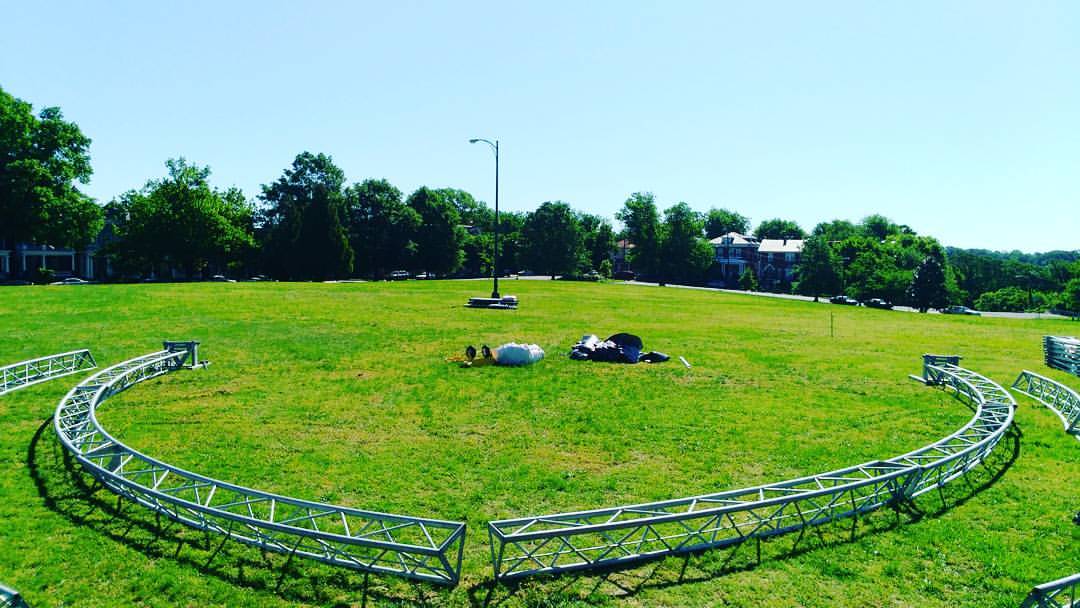
As with any large task, the crux of the build was built on many tiny steps. Permits for a temporary building structure are obtained for whatever county the performance is happening in. The site is scouted and surveyed, locating the flattest area possible. Locations for the load-bearing stakes are marked out according to the tent schematics. There is a single truck that contains all the parts and pieces for the tent- trusses, skins, poles, spansets, straps, stakes, the lot. Building it involved doing each of those tiny steps really well, and in the proper order. At first it was overwhelming.
Photo credit Tim Posey
What makes this job different from a theatre or arena is that everybody pretty much knows how to do everything. No job is more important than another and we were trained to be able to do it all. With the exception of driving the trucks, which requires a CDL due to weight, or operating the Lowell boom lift, which is an issue of insurance, anybody can jump on wherever there are tasks to be done. We all hang the lights and wire them up. We all move everything and everybody tightens bolts, hammers in stakes, and skins the frame. In the hierarchy of the job we always defer to the crew chief, but there is a level of trust that comes from having worked with everyone on a plethora of different jobs over many years. In this line of work there is an Esprit de Corps that is hard to explain to anyone who isn’t in the industry. We can put this thing up in our sleep and feel confident that the job was executed to the highest standards. If someone misses something there are at least three other guys (or gals) there to catch them.
While everyone can do everything, over the years we’ve all settled into leadership specialties within the scope of the job. There are two gentleman handle the business of getting the tent in the air, and everyone else knows to fall in to take orders. There are two other gentleman who take the helm of leveling the scaffolding for the massive stage that goes in the tent. I found myself managing the loading and unloading the stage truck which involves about fifteen tons of decking, railing and step units- everything having to be unloaded by hand. One gentleman is really good at getting the tension on the support lines really dialed in, giving the tent it’s sleek look.
Photo credit Tim Posey
Photo credit Tim Posey
It’s a good feeling to know that you were part of a crack team of professionals making something special happen. There aren’t any corporate teambuilding exercises or classes that comes anywhere close to making live entertainment productions happen.
Photo credit Dave Parrish Photography
Not everything goes according to plan and training isn’t going to prepare you for every contingency that is bound to happen. There was one time we had to drive all of the four foot stakes by hand when the hardened metal stake driver tip on Petunia the Jackhammer shattered. It took forever and put us behind. We have loaded everything wet in the pouring rain before and it is deeply miserable. Sometimes the industrial grade rental generator shows up late and we have no power till it gets there.
I was riding to an out of town tent gig with a couple of the guys. We were on the interstate and I saw the freshly-removed tread of a truck tire in the middle of the right-hand lane. “Somebody’s having a bad day,” I thought to myself. About three minutes later we passed one of our trucks on the side of the road, with our driver on his phone besides, and a bald rear exterior tire. Ahh, we were the ones having a bad day. So everybody gets on their phone to figure out who we can get out there to change the tire on a truck loaded with 20,000lbs of gear at 7am on a Saturday morning. We had to rent a Uhual to start getting tent trusses to the site so we could get started. We didn’t get our truck tire fixed till noon because the lugs were so rusted that they were frozen to the bolts.
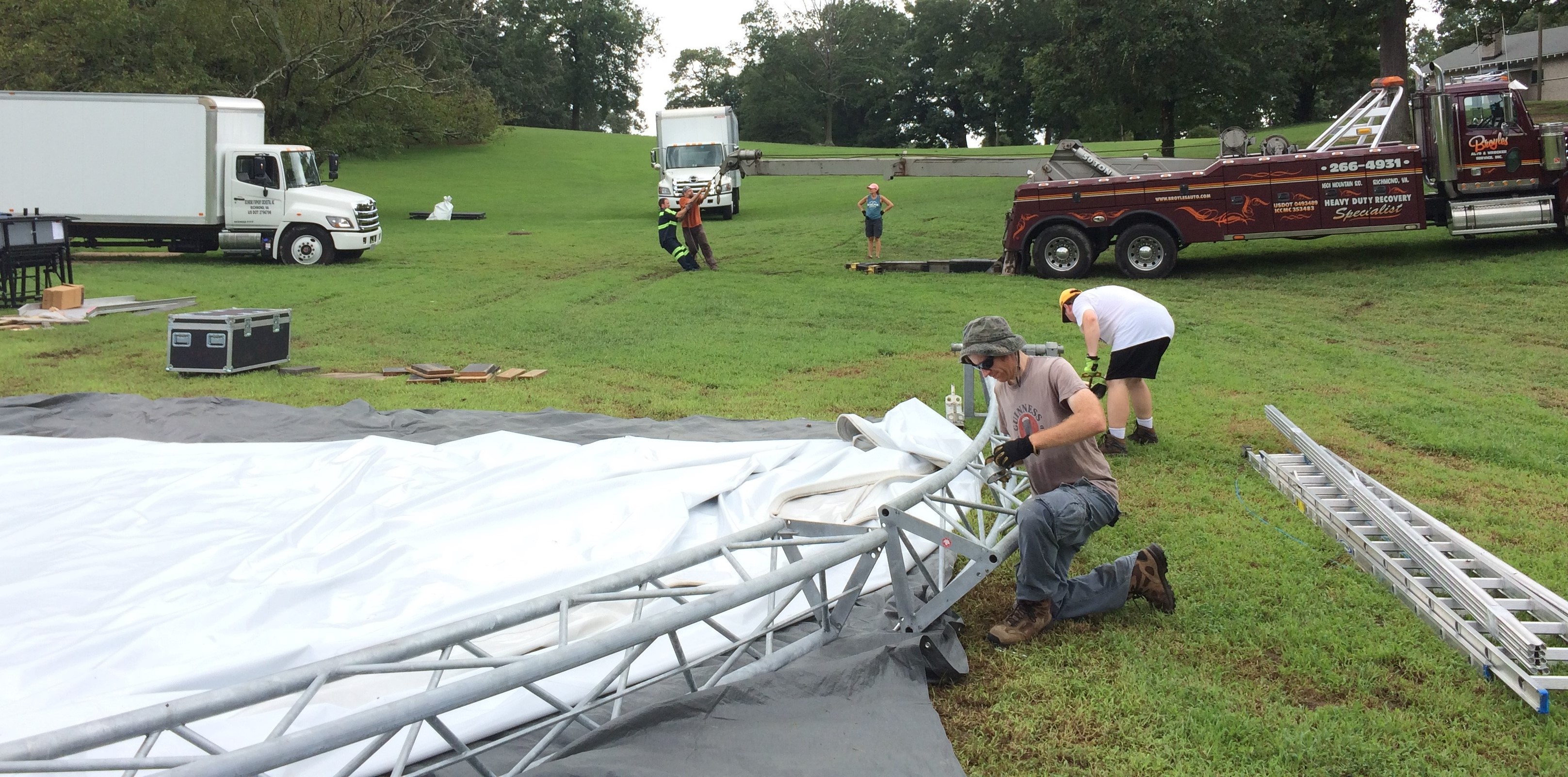
Blowing tires is a pain but it doesn’t happen too often. The biggest single pain is when the trucks get stuck and it happens all the time. Usually we know when the ground is saturated and we can lay out a track of plywood decking. We have to move them Egyptian-style as the truck moves and it is exhausting but a huge time saver. One time our stage truck got stuck so badly we had to call the biggest wrecker I have ever seen to pull it out. Then the wrecker got stuck. There was a season where the truck got stuck almost every other job and sometimes there just any other way around it.
Leveling the truck to the stage: the shims also make it easier for the truck to pull off without spinning into the ground.
Note the truck in the top left corner with front wheel buried to the rim in soft ground
Photo credit Tim Posey
Puttin’ on the Fritz was commissioned by an old friend of mine that I went to music school with. It was built for his brother, a member of the Army Special Forces. My friend and I have worked in similar industries where teamwork at a high level is essential, and this is no doubt the case for his brother. I designed a beefy fighting/utility knife with a harpoon point and a hardened skullcrusher on the butt of the blade. “Puttin’ on the Fritz” is a nod to the things that go wrong, and how we respond to them. It’s not a matter of if but when. Having a really good team helps you to accomplish things bigger than yourself and move through the adversities.
A quick sketch
Roughing out the profile
Profile dialed in.
That scribed line will become the final cutting edge.
Bevels are ground in.
Removing the machine marks.
Hardening- this is almost hot enough.
A little blurry after tempering
Laying down a satin finish.
600 grit
Skullcrusher
An old pair of work dungarees
Cutting the material for layering
These pieces will be layered in fiberglass resin.
Ready to be smashed together.
The raw material.
PCB fiberglass from a computer board blank that was rescued from a dumpster.
220 grit.
1000 grit.
Ready to be riveted and glued.
Clamped.
Ready to shaped
Ready to be contoured
Contoured
This is polished to 120 grit. The higher the grit you go, the more the material speaks.
Etching in the maker’s mark
Puttin’ on the Fritz
Puttin’ on the Fritz is made of high carbon steel, which means it will take a keen edge, hold it a good while, and will be easy to sharpen. It will stain and patina and tell the stories of the places you’ve been- this natural and characteristic of the steel. It came to you coated in EEZox gun oil, an oil based film that protects the finish. Your knife is made to be used so don’t be shy about getting it dirty. Be sure to keep your knife clean and oiled when not in use. Should you find any unpleasant surface oxidization you can remove it easily with a lightly oiled bit of 0000 steel wool, or a coarse rag with a bit vinegar on it.
“Each arrow leaves a memory in your heart, and it is the sum of those memories that will make you shoot better and better.”
Paulo Coelho- The Archer
A few years ago I went to go see a modern dance piece with my girlfriend. It was called “Tensegrity” and was based on the idea of tension in cells: wherein the structure of the cell is maintained through continuous tension in some of it’s supports and continuous compression in others. When any one of those tensions or compressions are interrupted the cell falls apart, or at least that’s my understanding of it. This idea has been around since the 1960’s, and is a portmanteau of “tensile” and “integrity”. These days the idea is used a lot in contemporary architecture and to make coffee tables and other furniture. There are loads of these tensegrity tables and sculptures on Pinterest, but the first I had ever heard of this was at that performance.
The choreographer of this piece is a good friend of of ours and after the performance we went to get a drink with him. I’ve always admired how prolific he is, constantly moving from piece to piece, work to work, and the way each performance had it’s own voice and character. I was a bit stuck at the time and was curious how this man could take shot after shot and always hit his target. So I asked him.
He told me that whatever you do, you have to do a lot of it, and sometimes badly. Everything is connected, he told me, and each piece builds off what you have done before and is fed by your collective experience. Always keep going, and always be thinking of what’s next. At least I think that’s what he said; a fairly liberal number of martinis and fireball shots were consumed and things started to get a little fuzzy…
Over the years I’ve thought about that night, and how seemingly incongruous disciplines fit together to propel a skill or craft forward. You hear about football players taking ballet but I met an orthopedic surgeon who was an ace pickle maker, and one of my favorite knifemakers is an avid botanist. So when you find choreographers exploring contemporary cell biology or bowhunters dabbling in Vipisanna meditation, you will probably find that they are drawing connections that are deepening and balancing something. Whenever I talk to people who are really good at what they do, I find there is an ocean of eclectic and varied experiences just beneath the veneer of whatever it is they practice that adds something special to their work. The sum of our experiences can always help us hit our mark.
The Crack Shot is a nod to this idea that the sum of our experiences can always help us hit our mark. It was built for a hunter and a woodsman. “Crack Shot” is an homage to his grandfather, the original Crack Shot, who taught him about being with nature, shooting, and how to hit your mark. It is the intention of this knife, with it’s blend of handmade and reclaimed material, to help it’s recipient remember the man who helped him be where he is today.
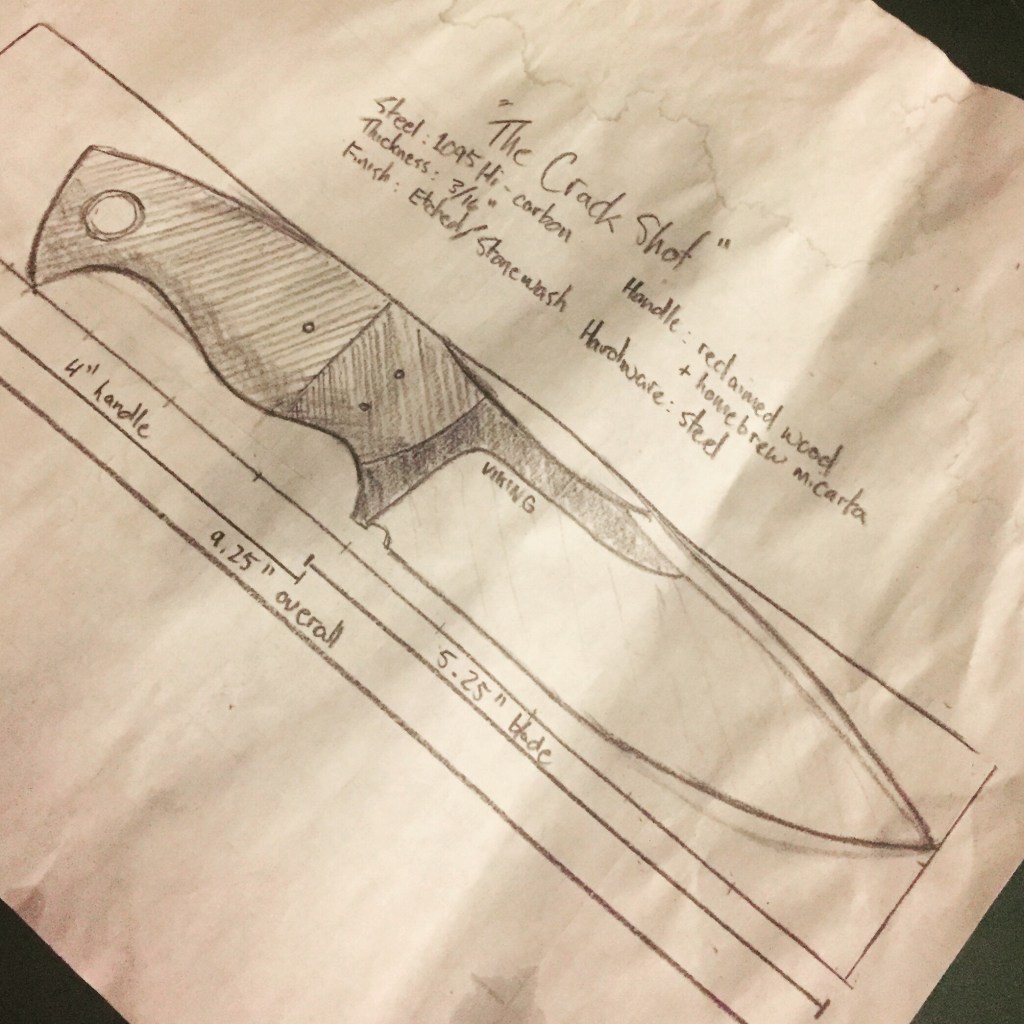
A quick sketch
Roughing out the profile
Grinding in the bevels and swedges. Since this is thick stock, the swedge will make a finer point for piercing.
Removing the machine grinds by hand. This will make polishing easier after heat treatment.
Almost there…
Post-quench cooling.
After tempering- note the faint straw colors. This has drawn much of the stress out of the blade that built up during quench, making it much more durable.
Hand sanding….
…to a nice satin.
Etching in the namesake.
The client wanted something masculine and woodsy. I find there are few things more timeless that flannel and denim.
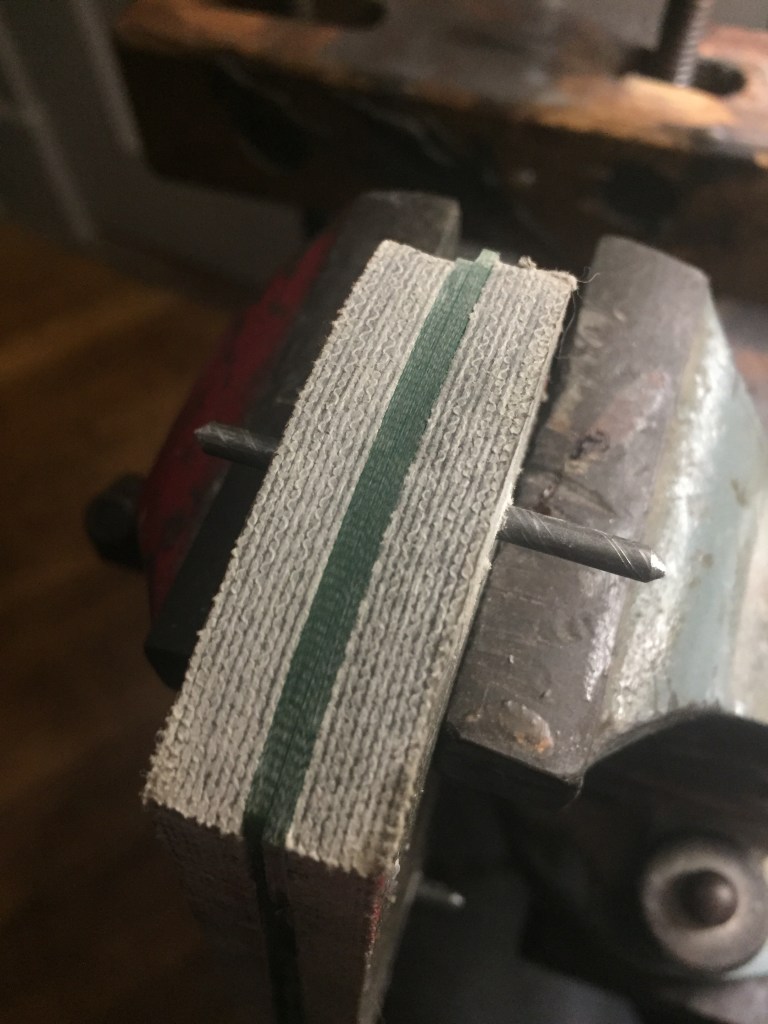
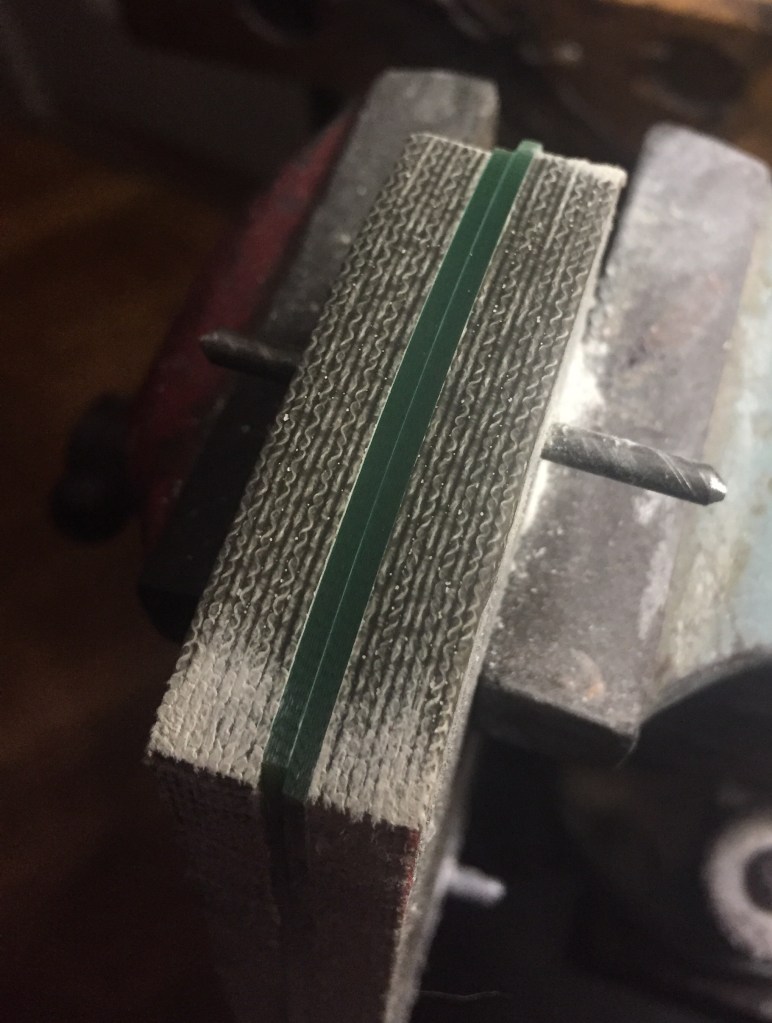
Alternating layers, so each piece should form a grain and be able to speak more articulately.
Prepped.
Each layer of clothes is smothered in fiberglass resin.
Now to smach everything together.
This is the raw material. All the layer have been permeated with resin, making everything a solid block.
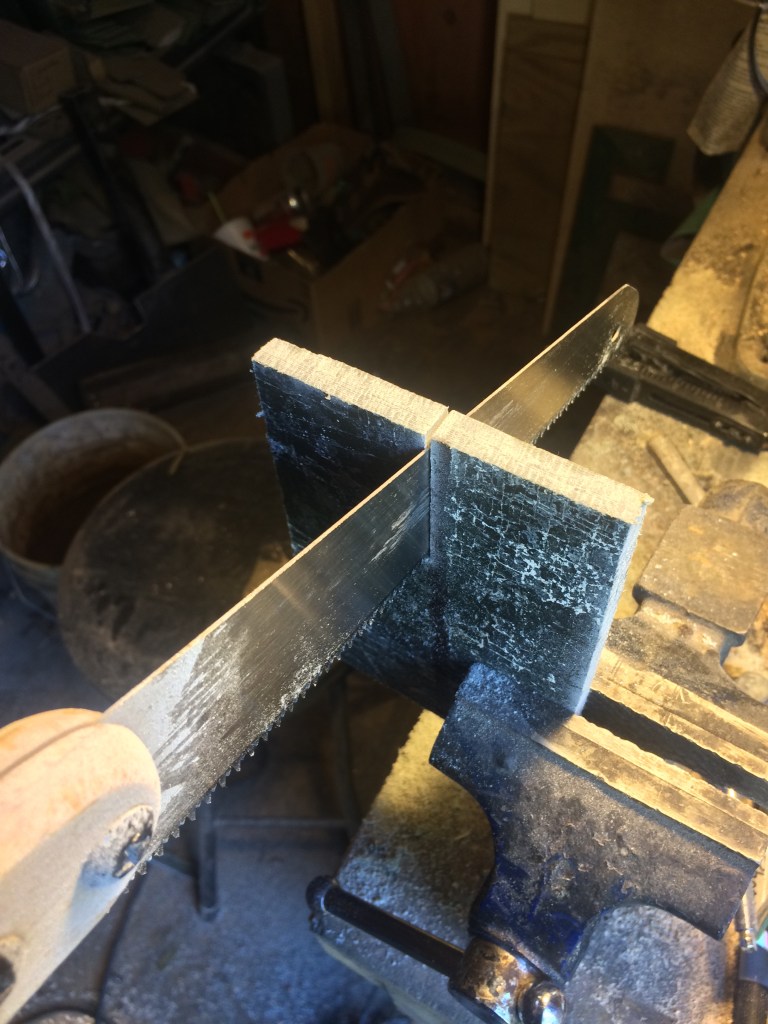
Cutting out the bolsters.
Drill rivet holes.
A rough mockup so I know how everything fits together.
This gets sanded before glue up. I won’t be able to get to this part after everything is glued and riveted together.
All sanded up.
A piece of block walnut. I was doing tree work at an artist’s house in Charlotte Court House, Virginia. He had loads of this stuff. It was milled by his neighbor, a retired parishioner who started an abbey in South Korea in the late 1990’s to help North Korean defectors acclimate to a free country. It is very beautiful wood.
Bookmatched.
A fiberglass PCB blank for a network chassis full of hardware that runs your internet. This was rescued from a dumpster.
All laid out and everything fits together.
Two-ton epoxy resin.
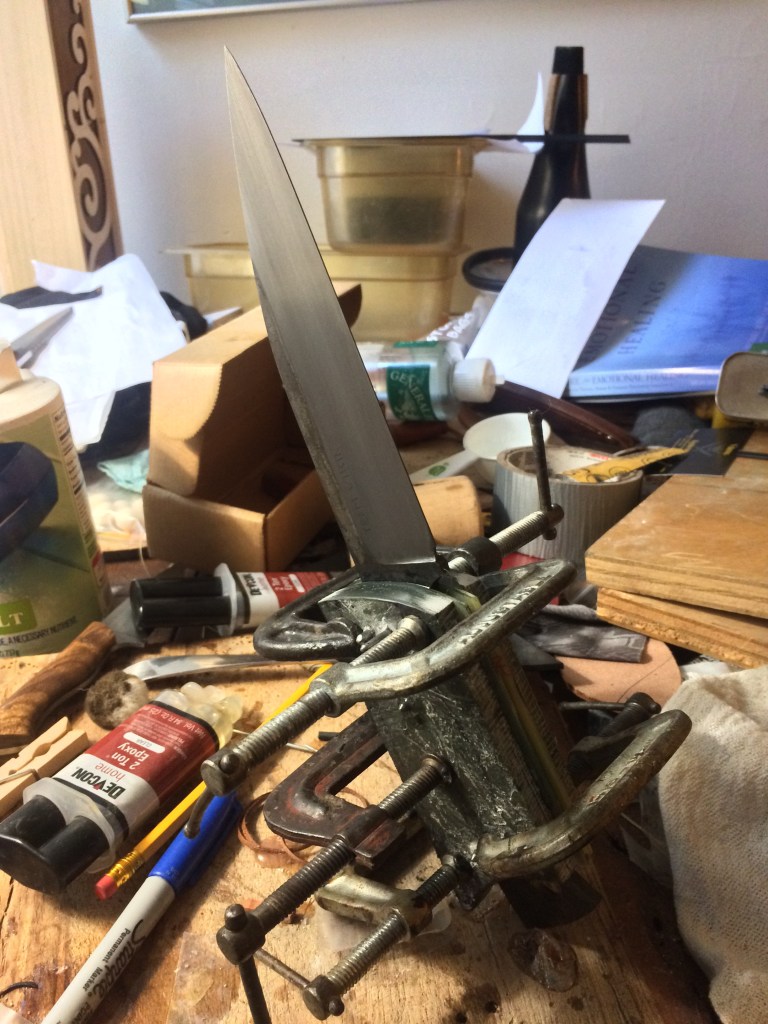
Clamped.
Now for shaping.
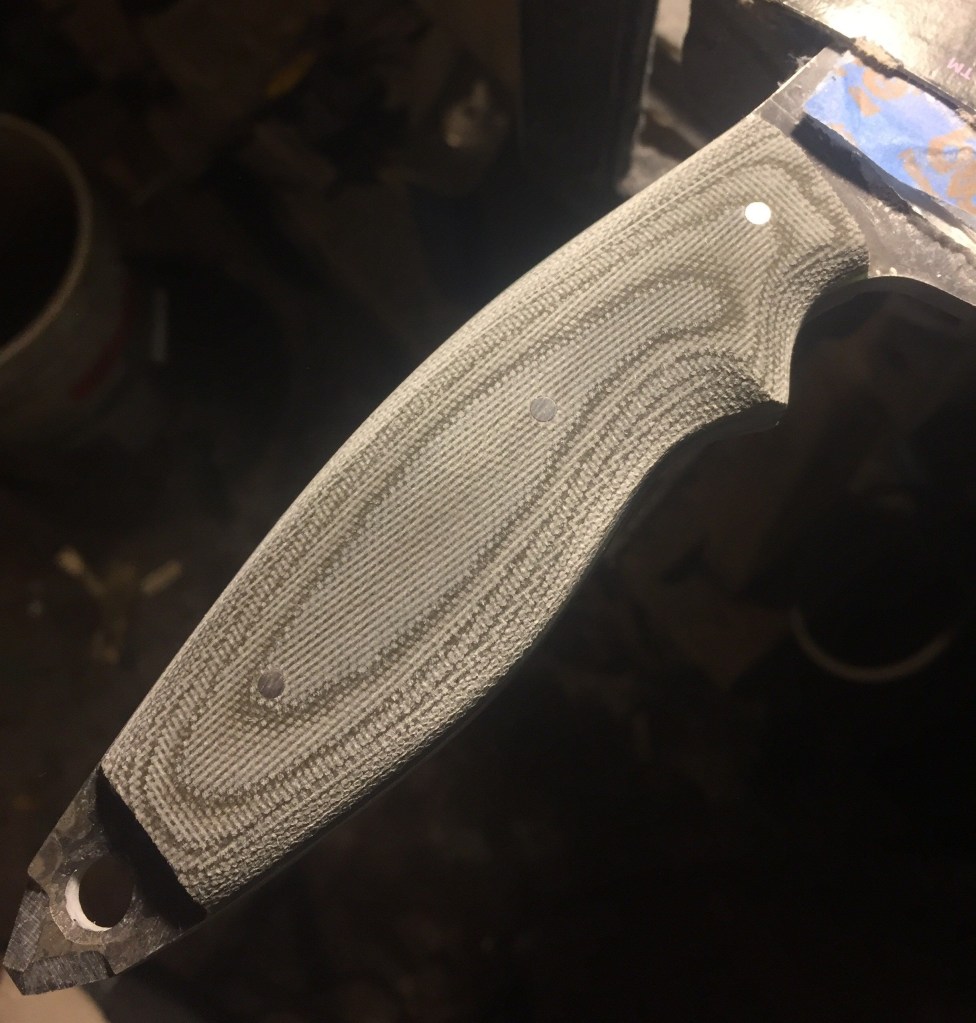
The Crack Shot.
The Crack Shot is made of high carbon steel, which means it will take a keen edge, hold it a good while, and will be easy to sharpen. It will stain and patina and tell the stories of the places you’ve been- this natural and characteristic of the steel. Your knife is made to be used so don’t be shy about getting it dirty. Be sure to keep your knife clean and oiled when not in use. Should you find any unpleasant surface oxidization you can remove it easily with a lightly oiled bit of 0000 steel wool, or a coarse rag with a bit vinegar on it.
Some further reading on cellular tensegrity referenced in the text body above:
A few years ago I got a call from a gentleman about a knife that needed a new handle. He had a thick Australian accent and told me one of his friends was redoing some walls and ceilings in her house and had found an old cleaver behind the drywall. He asked if I would be able to put a new handle on it, and by the way it was also going to be a wedding present for his friend who found it.
A mysterious butcher’s tool in the walls? A wedding gift? Nuptials without knives are nuptials not worth having. Besides that, certain things in life have a habit of being found when we need them the most. This all sounded extraordinarily auspicious to me. Of course I took the job. I couldn’t have made this up if I tried.
I met my new Australian friend, who at the time was raising Alpacas (because of course he was), at a country bazaar just outside the city and picked up the cleaver. It was important to me to honor the found-nature of this deeply immodest blade of humble origins, so all the material save for the pin stock and adhesives came from refuse dumpsters or abandoned houses. I named the cleaver Wallace, and returned him to my Australian Alpaca friend. As with any other job I dropped the work off, made sure the person paying me was happy, and didn’t think much of it.
I did finally met the lady who found the cleaver at one of our shows, and she has bought a knife almost every year around Christmas time. She got in touch this year about having a knife made, and I realized that her and her husband had never seen how the cleaver was built.
I think the things that find their way into our lives are so much more interesting than the things we seek out. While it’s good to have a plan, it’s also important to acknowledge that plans fail, often spectacularly, and the best things happen to us while we’re planning something else. We stumble into to deep love, or fall into a career, and despite our best calculations, the special moments and deepest connections in our lives seem to occur solely at the whims of the universe. Very much like Wallace the Cleaver and his handle made from garbage that somehow found it’s way into our shop, it’s up to us to choose what to do with the things we find ourself with.
The Foundling was a commission for her husband, who was always stealing her knife, and was built using all sorts of materials that found their way to me.
The Foundling starts with a quick sketch
The scribe lines show where the final cutting edge will be
Jimping is filed in on the spine for grip
The grind at the top of the spine is called a swedge, and give the blade more of a point
Wet sanding before hardening
Into the forge
After the quench
…and after tempering
More polishing
A quick etch in acid
A piece of Cherry wood, which came off an old mantlepiece
“How we fall into grace. You can’t work or earn your way into it. You just fall. It lies below, it lies beyond. It comes to you, unbidden.” ― Rick Bass, Colter: The True Story of the Best Dog I Ever Had
I wouldn’t have ever really considered myself a dog person, not really. There is an appreciation and respect for all animals, both wild and domesticated, and whatever creature I meet I try to let them know that I see them- a deep namaste and acknowledgement of being. But as far “being a dog person”… I’m just not sure I have whatever that is.
A couple of years ago my girlfriend said she was thinking about getting a dog. I told her don’t do it. My only reasoning was that we were all very busy doing interesting and challenging work, her kids were getting older and doing more things, and everyone was tired all the time. I figured it would probably be best if we held onto every ounce of emotional energy that we could.
In spite of my reasons, which themselves came from a lovingly practical and pragmatic place, she did not listen to me. This lady is one of the most unfailingly capable people I know, a wonderful mother, with the uncanny ability to make everything around her better than it was before, even on her worst days. It was no surprise when she brought home a several-month-old rescue puppy. This dog was a lemon drop beagle mix with the biggest ears I’d ever seen. She seemed to be equal parts fruit bat, luck dragon, and polar bear.
The local animal league had told my girlfriend that this dog and her sister had been found abandoned in a barn. The puppy’s sister had some sort of severe muscular dysplasia and had found a home. My girlfriend’s puppy had a little bit of this, but much less so. She moved around fine but a closer look showed her front half didn’t quite work together with her back half.
When I met her she was still adjusting to her new home. She was terrified of doorways and dinner plates. She didn’t want to leave whatever room she was in and when she did she scuttled through like something was going to get her. If you were to put down a plate of puppy chow in front of her she would back away as if it were going to bite her. In spite of all of this she was a deeply loving and affectionate dog which was amazing considering the shit sandwich of a beginning she had been given. At that moment, shortly after meeting this dog, I felt something soften toward this wonky little barn dog that was part fruit bat, luck dragon, and polar bear; this sweet little creature that I told my girlfriend not to get.
Over the next few years I would tell this dog that I was sorry I told her mom not to get her. She had grown into a rather stunning animal, and her front half worked together much better with her back half. Doorways weren’t too much of a problem though her old nemesis the dinner plate still gave her pause. I found myself very attached to her and, though she was very much a lady dog and a product of my girlfriend’s deep nurture, I would find her to be the loving presence that I didn’t know I needed. The dog just loved everybody.
A couple of years ago I had a table saw accident that left me needing reconstructive hand surgery. It was incredibly stressful and emotionally grueling. All of my work and projects and everything I was so busy with would come grinding to a halt for the next few months. My girlfriend moved me into her house for a week and took time off work- thankfully the kids were away at summer camp. My girlfriend’s dog never really left my side. I remember the dog licking my gimpy hand every so often and then pressing in to me and going to sleep, which prompted me go to sleep. I don’t remember much of that week, except my girlfriend smiling and her really sweet dog. It sounds really silly, and perhaps it was the massive amount of post-op hyrdromorphone I was prescribed, but I figured I should probably take the example of the dog that I told my girlfriend not to get and find a way to dig in a little deeper with her and the kids.
Connection can be a struggle and there’s no manual on the right way to go about it. Sometimes it takes a sweet dog after a traumatic event to help you see what you should be doing. Part fruit bat, part luck dragon, part polar bear (everybody is good and healthy, including my hand and the dog I told my girlfriend not to get). If a responsible adult in your life tells you they want a dog, you should tell them to go right ahead.
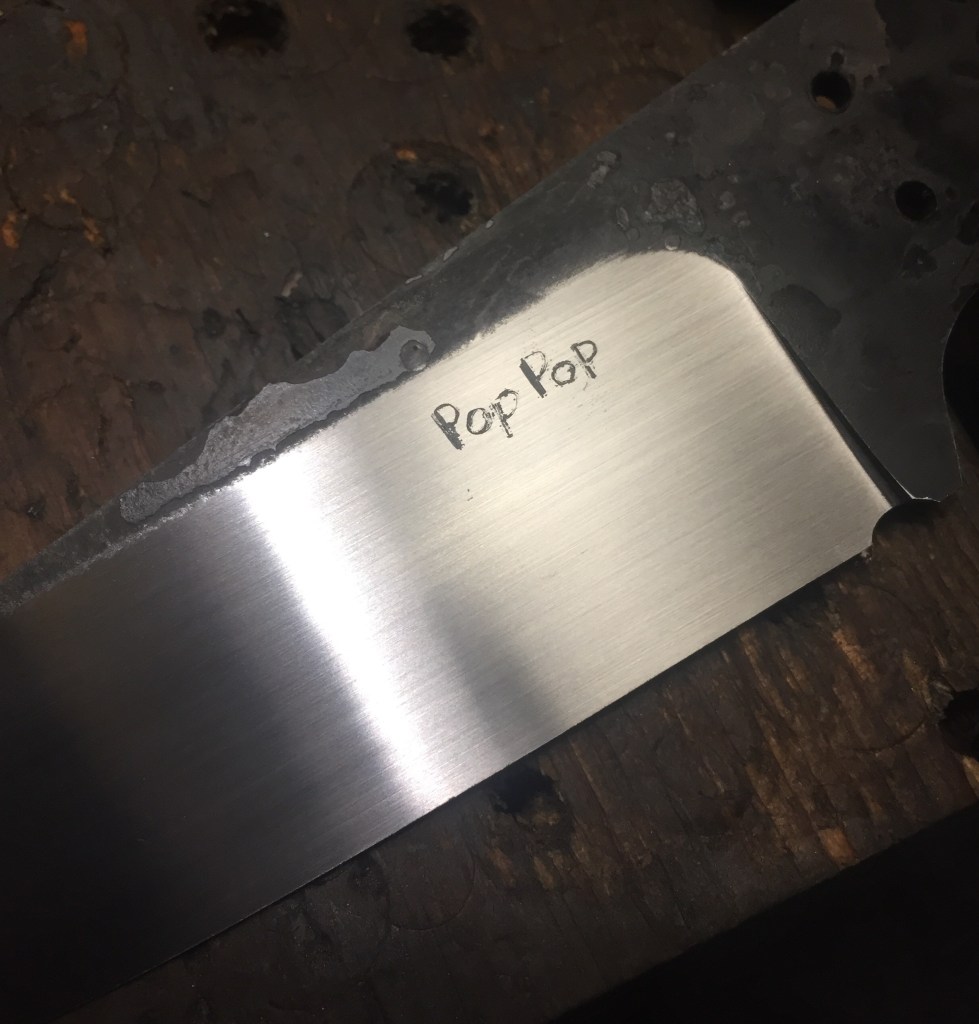
This knife was commissioned for a retired gentlemen who trains English Setters for hunting. Hunting Dogs, or Gun Dogs as they are called have been around for centuries. Particularly, the training of Setters can be traced back to Robert Dudley, the Earl of Leicester in the 1500’s. It was commissioned by a loving daughter, and has “Pop Pop” etched on the flat of the blade from his grandchildren.
A quick sketch.
Removing material in the handle make for a more balanced blade.
Everything profiled out. Being that it is made from thinner stock, it will go in the forge as is to prevent warping during hardening.
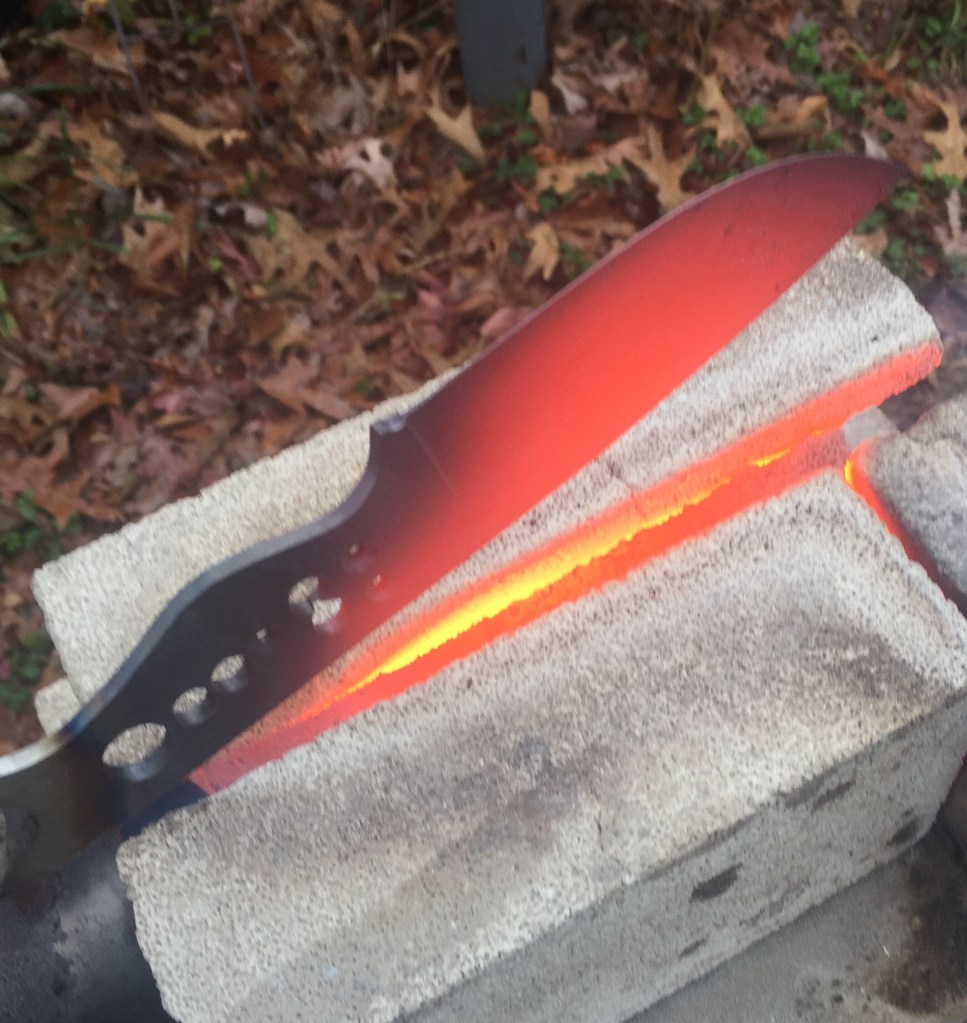
The blade needs to come to critical temperature, which is around 1500F. By the colors you can see that it is almost there.
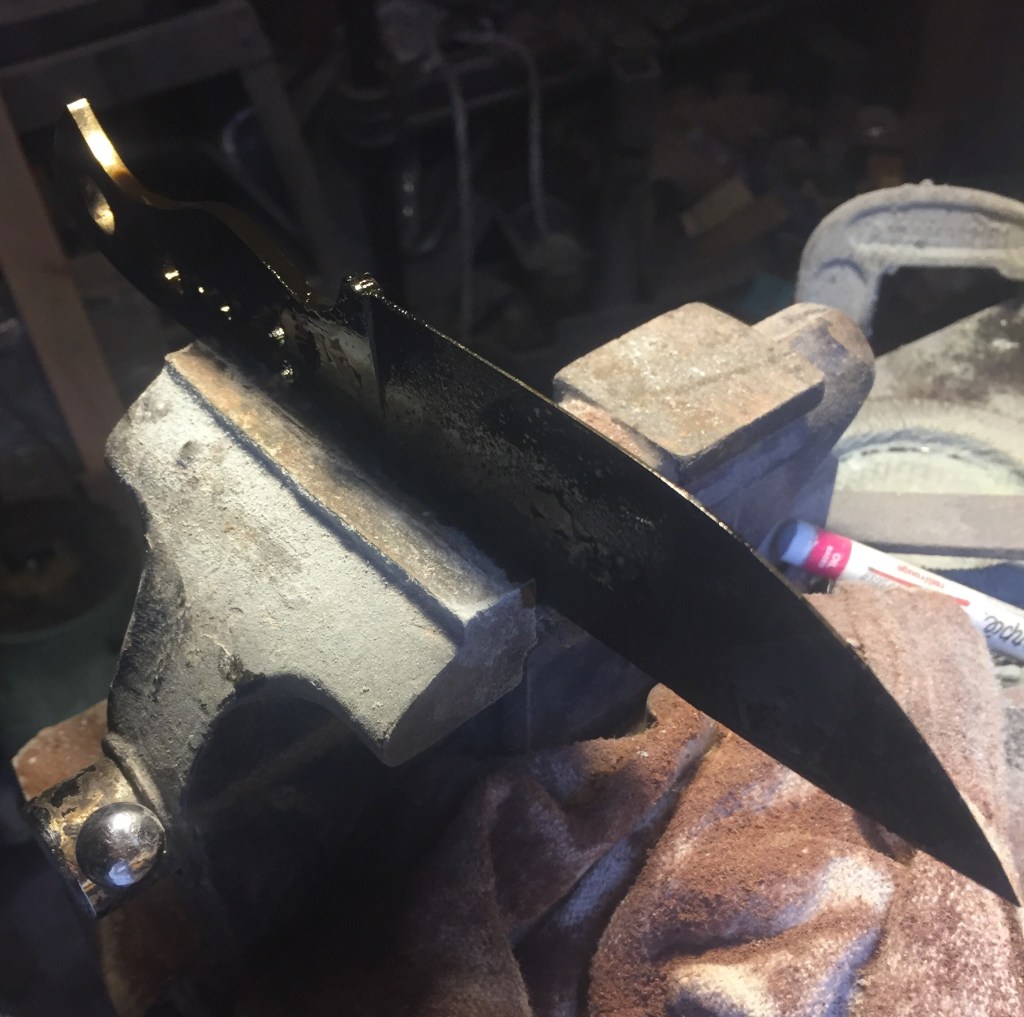
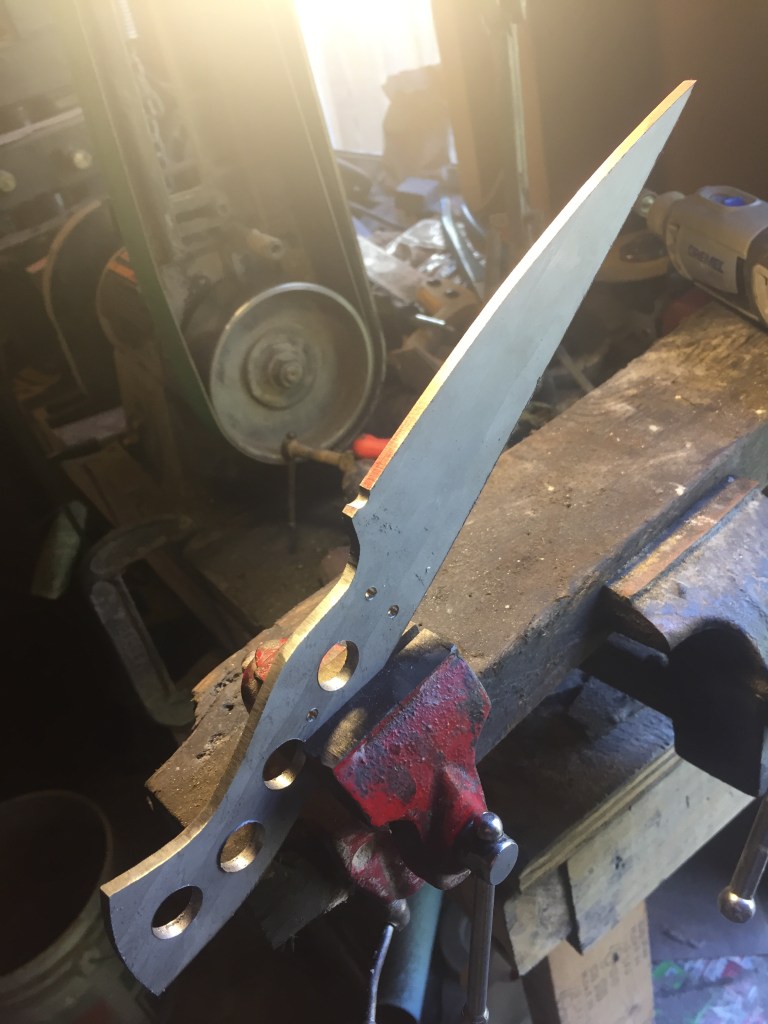
After the quench. There wasn’t warpage but I still clamp it in the vise at the areas where it would typically bend. When it comes out of the oil it is around 300-400F, and during this time any major warps can be corrected before it cools.
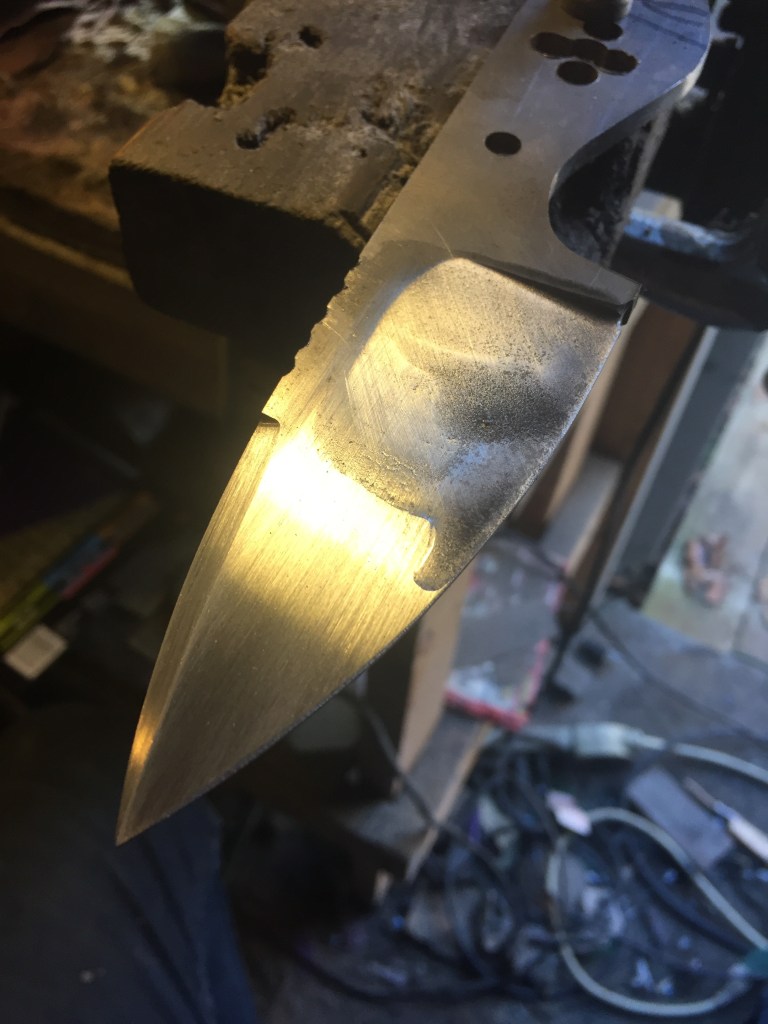
The bevels have been ground in and machine finished to 120 grit.
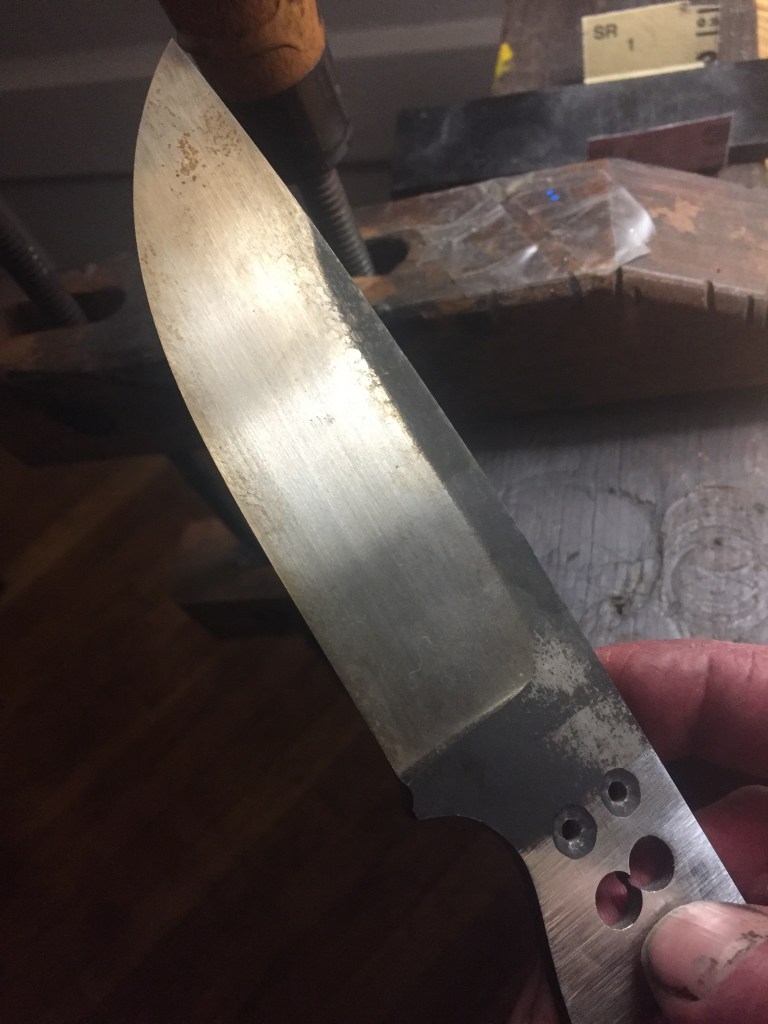
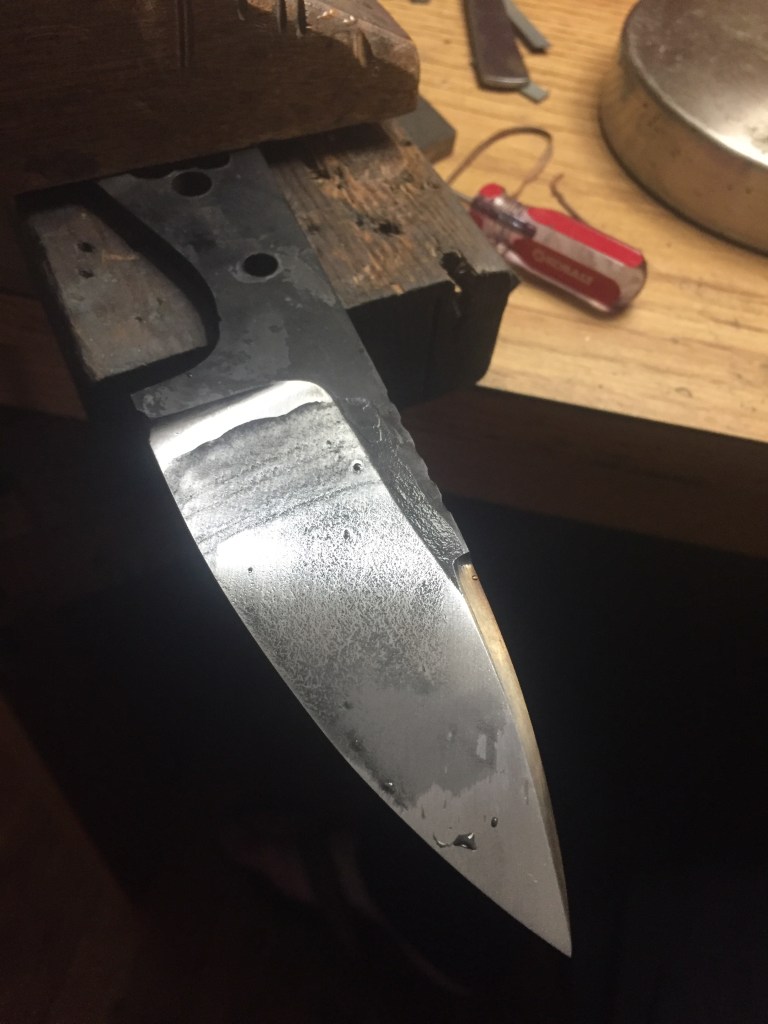
This has been hand sanded up to 600 grit, finishing with vertical pulls. This will get etched in acid to provide a scaffold for the patina to build, and also give it a more rustic look.
Electro-chemical etching using nail polish, some salted vinegar and a nine volt battery with some alligator clips. This allows me to essentially burn text onto the steel.
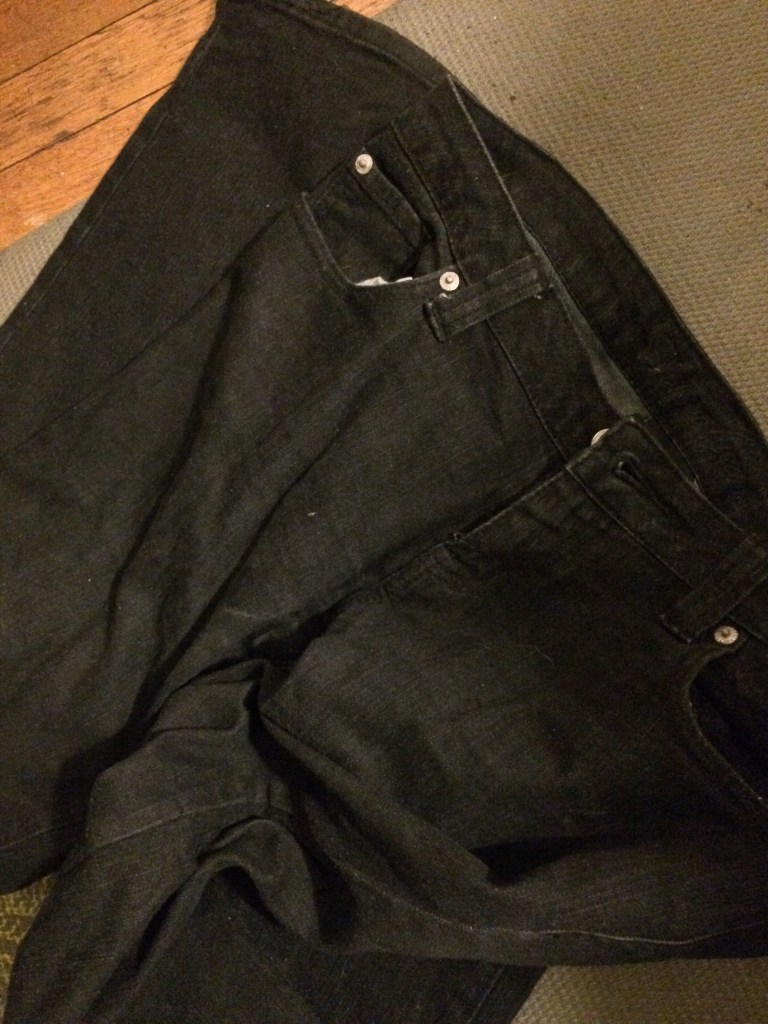
A pair of Carthartt work dungarees, probably about 10 years old.
Instructions for Care:
Your knife is made of high carbon steel, which means it will take a keen edge, hold it a good while, and will be easy to sharpen. It has been etched in acid and shipped to you coated in food safe mineral oil. It will stain and patina and tell the stories of the places you’ve been. Be sure to keep your knife clean and oiled when not in use. Should you find any unpleasant surface oxidization you can remove it easily with a lightly oiled bit of 0000 steel wool, or a coarse rag with a bit vinegar on it. She is built to be used, so don’t be shy about getting her dirty.
You can read more about Gun Dogs here, as well as find more resources on this very old tradition
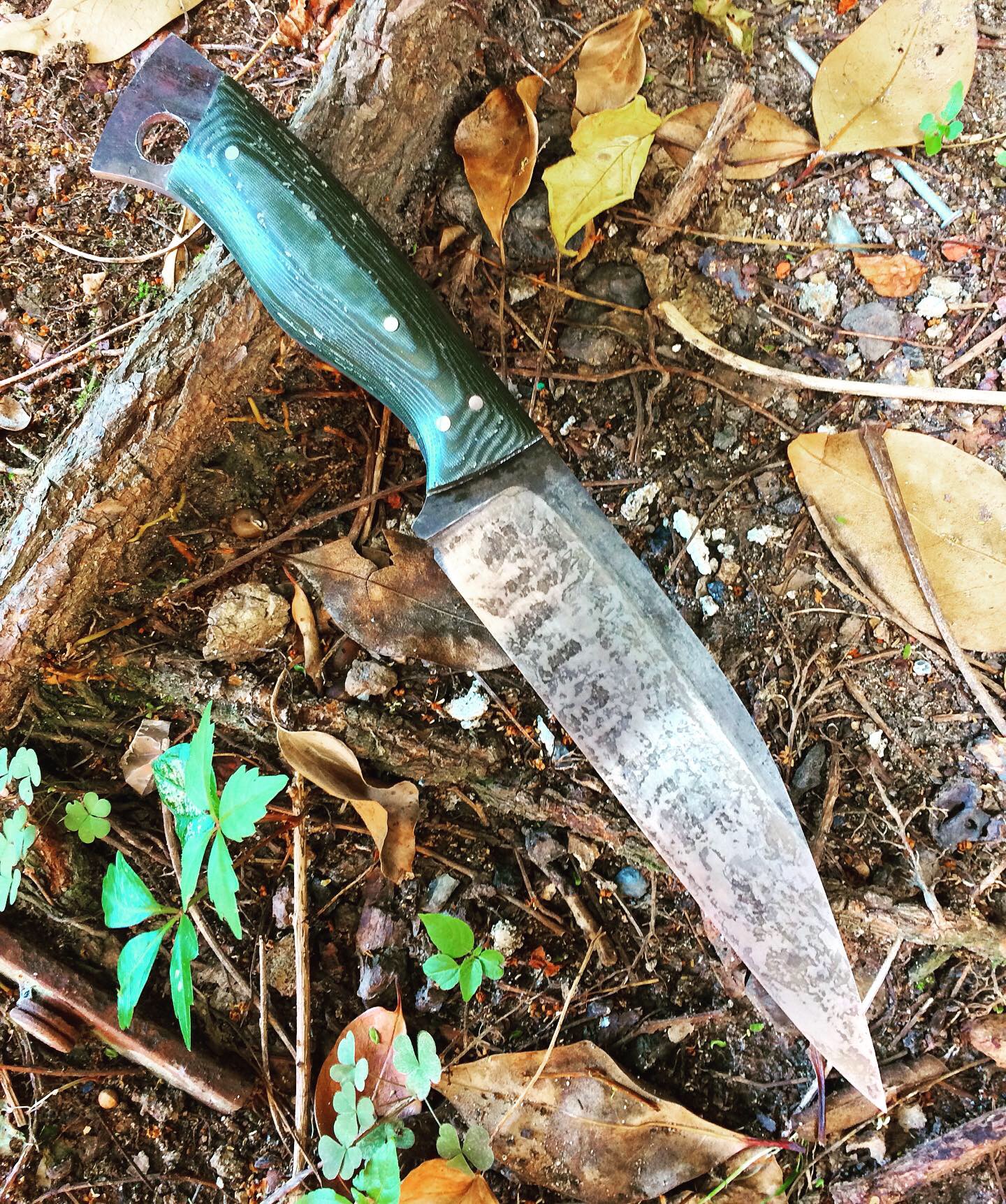
The Halvard was built for a retiring military commander and commissioned by his crew. A battle ready knife, built to use, but equally at home on display with merits of a successful career.
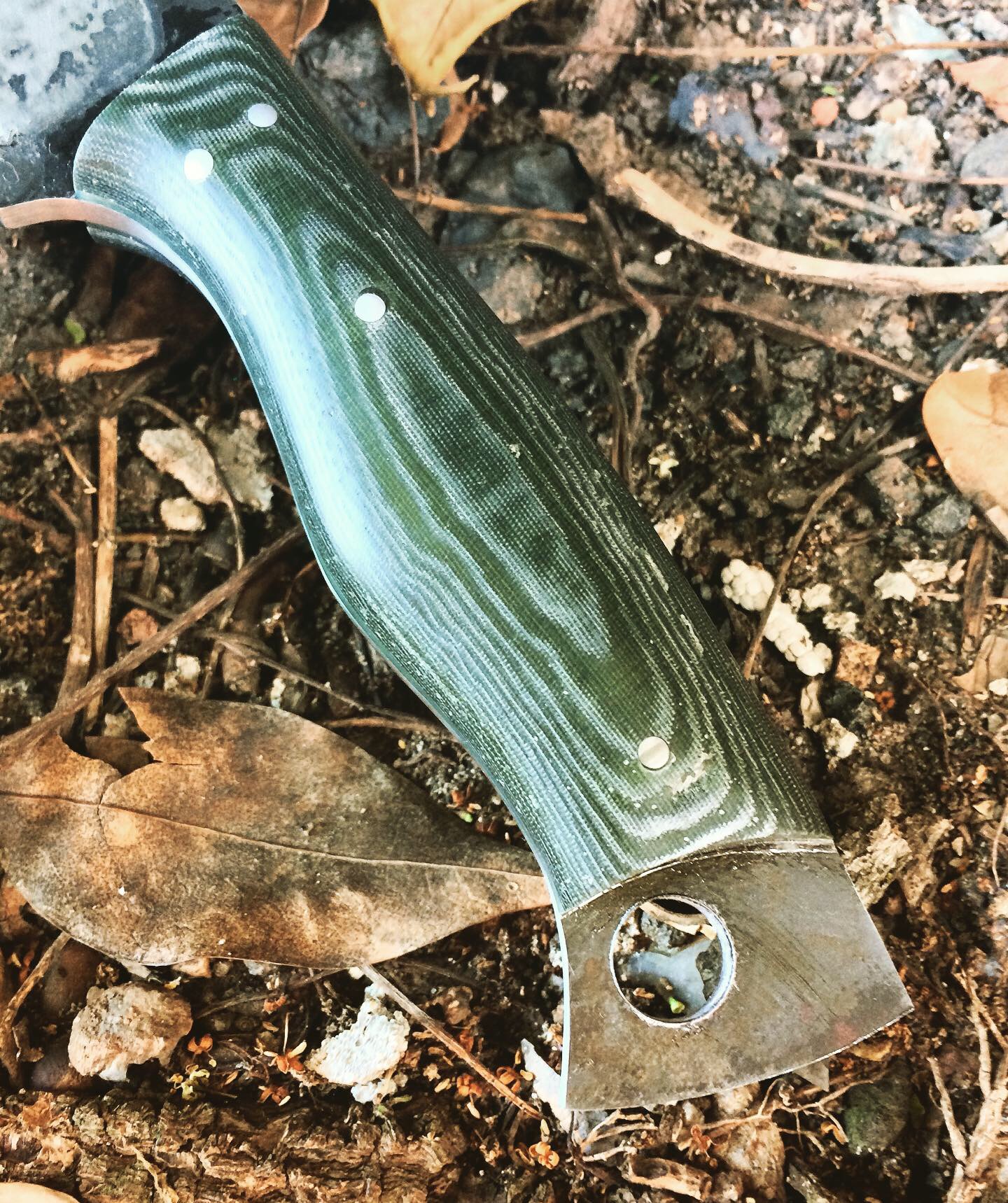
Made from 1095 hi-carbon steel with a forced patina: a rugged appearance lending itself to rugged tasks. The handle is made from a pair of BDU trousers, a nod to service, and a reminder that, though he may no longer wear the uniform, the uniform is always with him.
This knife took a long time to build. About midway through the build we had to shutdown our shop due to a global pandemic, and getting back into the swing of things hasn’t been easy. Nevertheless as we build these knives, we find that the knives also build us. Halvard is a Norse name meaning “rock guardian”: solid, unbending, and steadily dedicated to the task at hand.
It was a pleasure building this knife for a group of Vikings.
Some very dear friends of mine asked me to make a knife for you. These friends of mine are wonderful people that I have known for quite some time, and shared many adventures. They told me they have known your parents for a long time as well, so I can infer that your parents are wonderful people too. They have also known you since you were born and, if I may be so bold, I can only assume that you are a wonderful person as well, and that we are well met.
I was also told you have completed your secondary studies and are going out into the world- congratulations! My very dear friends asked me to make you something special, but also something that was functional and practical. Something that would serve you well on outdoor adventures; an elegant tool and faithful companion. Something to remind you of where you have grown up. A security blanket that doubles as a prayer rosary and, if I may say so, a bold fashion statement.
As you may have noticed, Younger-Person-Whom-I’ve-Never-Met-Before, the situation of the world is a bit spicier than usual. To be honest, the only thing that has gotten me out of the house most days in this great year of 2020 is knowing that I will be coming back home as soon as possible. In spite of my trepidations of late, I’ve found that time marches on and life stops for no one, and there’s no point in staying home and being afraid while life passes you by. The world cares not for our anxieties, worries, or fears, Younger-Person-Whom-I’ve-Never-Met-Before, and the sooner this is understood the freer we become. Be sure to wear a mask, practice social distancing, and listen to the experts. That is what they are here for.
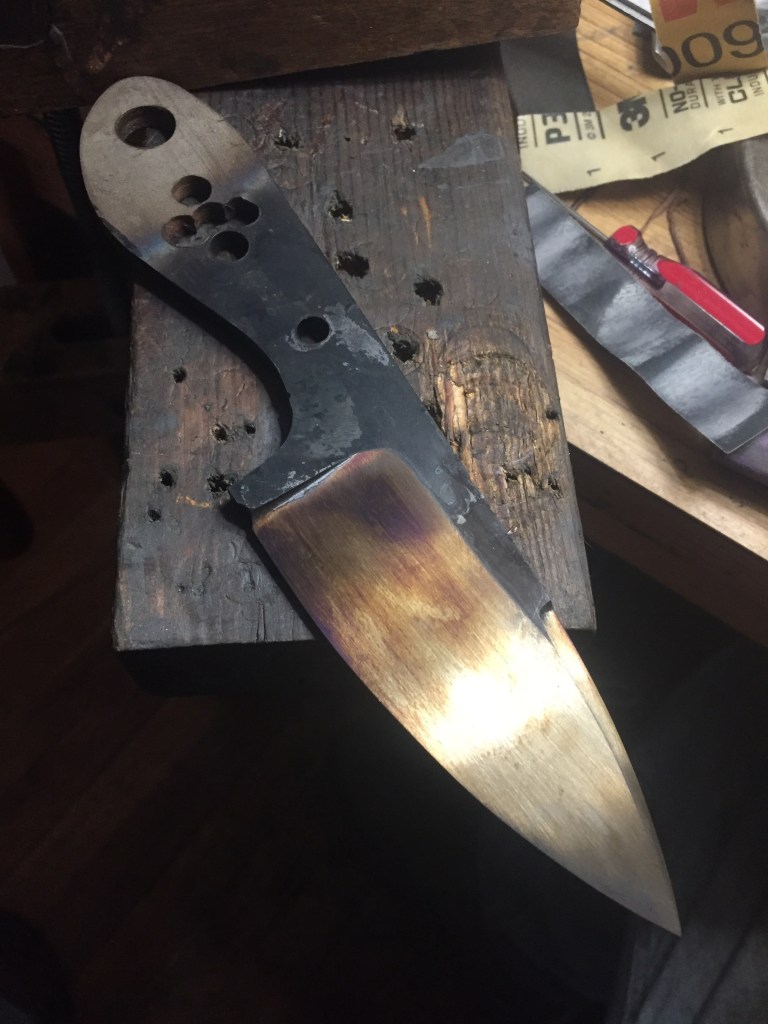
I have designed and built you a bushcraft knife. She is made from 1095 hi-carbon steel, which has been differentially hardened. What this means is, while the whole blade is hardened, the cutting edge is the only part of the blade at full hardness and the spine is just slightly softer. This offers durability and a slight bit of give, like a samurai sword. There is a smoky line along the edge of the blade and a slight color change where you can see the differences in hardness.
The handle contains a piece of bookmatched Texas Mesquite. It comes from a cousin of mine near Big Springs, milled on his property. The bolster is made from a pair of lady jeans that belonged to my girlfriend- vintage Levi’s 501’s, something strong and deeply feminine. Your knife is stout and sturdy; strong enough to baton firewood but lithe enough to prepare dinner.
I named her Masilda, which is an old Romany-Traveller name that means ‘battle-ready’. And while I am no authority on anything, your knife does contain a few truths and values in which I strongly believe. Having a knife named battle-ready is no empty moniker and I have consolidated a trifecta of practices and that you may find useful in navigating a complicated world. When you use your knife I hope that you think of them:
-Speak your truth. The media says that we are in the post-truth era, an age of alternative facts, and other dressed-up horseshit designed to keep you from critically analyzing what’s going on around you. The reality is that the truth always matters, and always will. Make sure you know your own truths- the things you know to be right and good about yourself and how you see yourself in the world. Clothe yourself in them. Should you ever feel lost you’ll know exactly where they are- they will help you find your bearings.
-You can always make more money, but you can’t make more time. Time is the currency of our terminal human experience. While making a living is necessary, be aware of how much of your time you sell to a job that only cares about profit margins and what they can squeeze out of you. If you ever have any doubts about what you should be doing with the time you have been given, refer to the above bullet point. You’ll know what to do and you’ll be able to hold yourself in esteem while doing it.
Be kind. It’s sounds cliche, like something written on a shoddy mass-market pressboard wall decoration in the Housewares Section of Target, but do your best to be kind. It’s the connective fiber of our collective human experience during our brief time on this lovely little world. If you can, you will find that the world opens up to you a bit easier, and is perhaps a bit richer and more vibrant. There may be situations you need to tell someone to eat a big bag of shit. Only do so out of kindness.
Wishing you many happy years with the Masilda.
The Masilda started with a drawing, a drop point style:
I had a bigger piece of steel than I thought, so the actual knife is a bit longer than the drawing:
Jimping- to prevent slipping when choking up on the blade:
Rough grinds:
Wet-sanding out the machine marks:
The hardening process:
After quench:
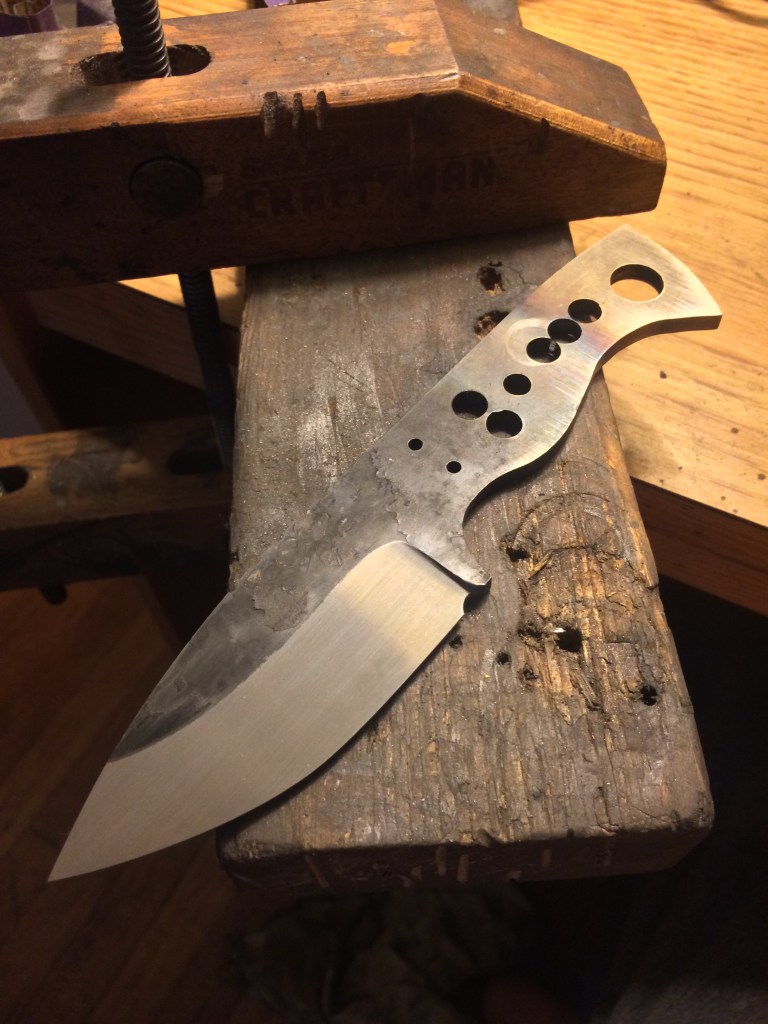
After tempering, a satin finish:
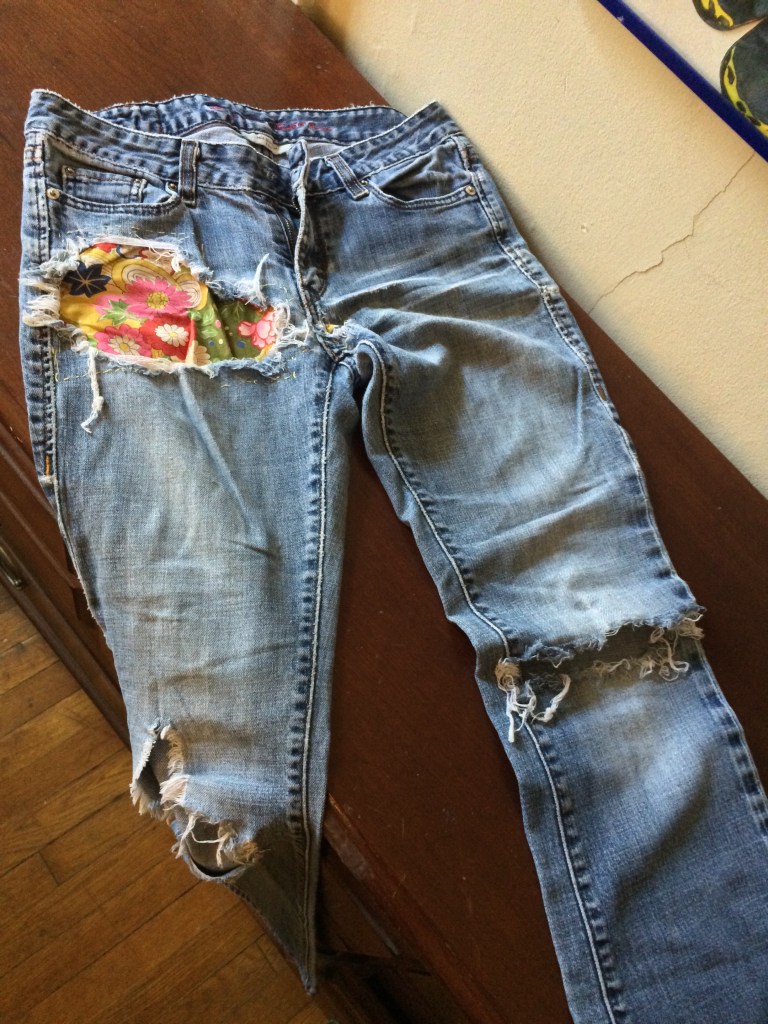
A pair of vintage lady jeans from my partner, deeply-loved and well-worn:
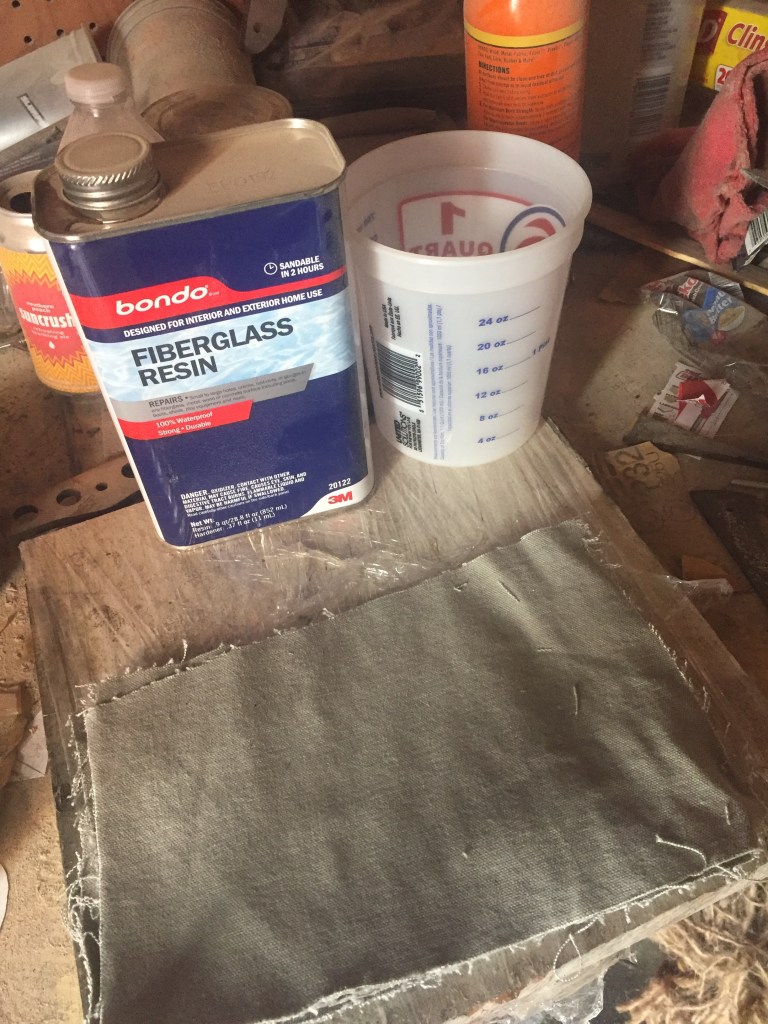
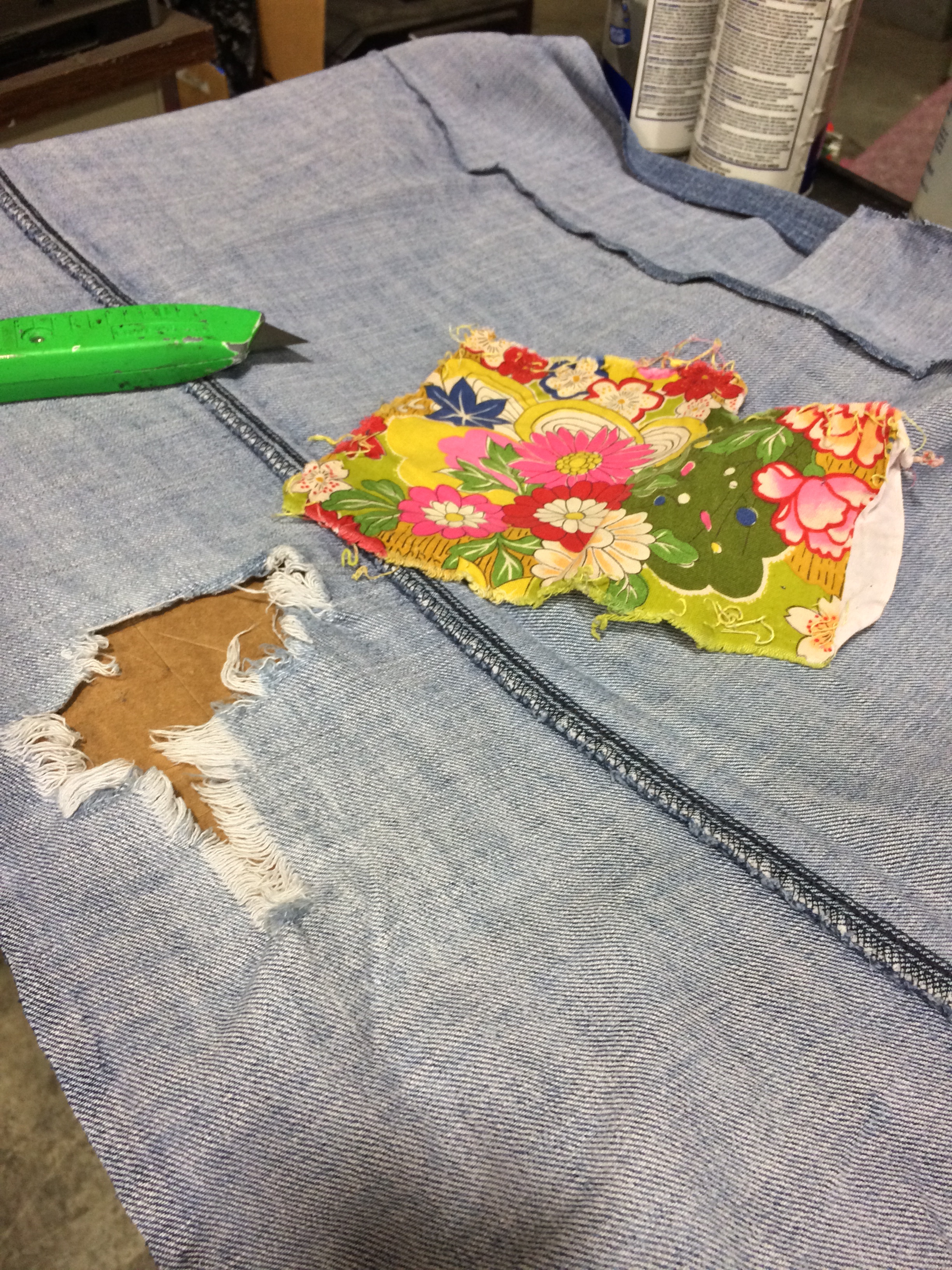
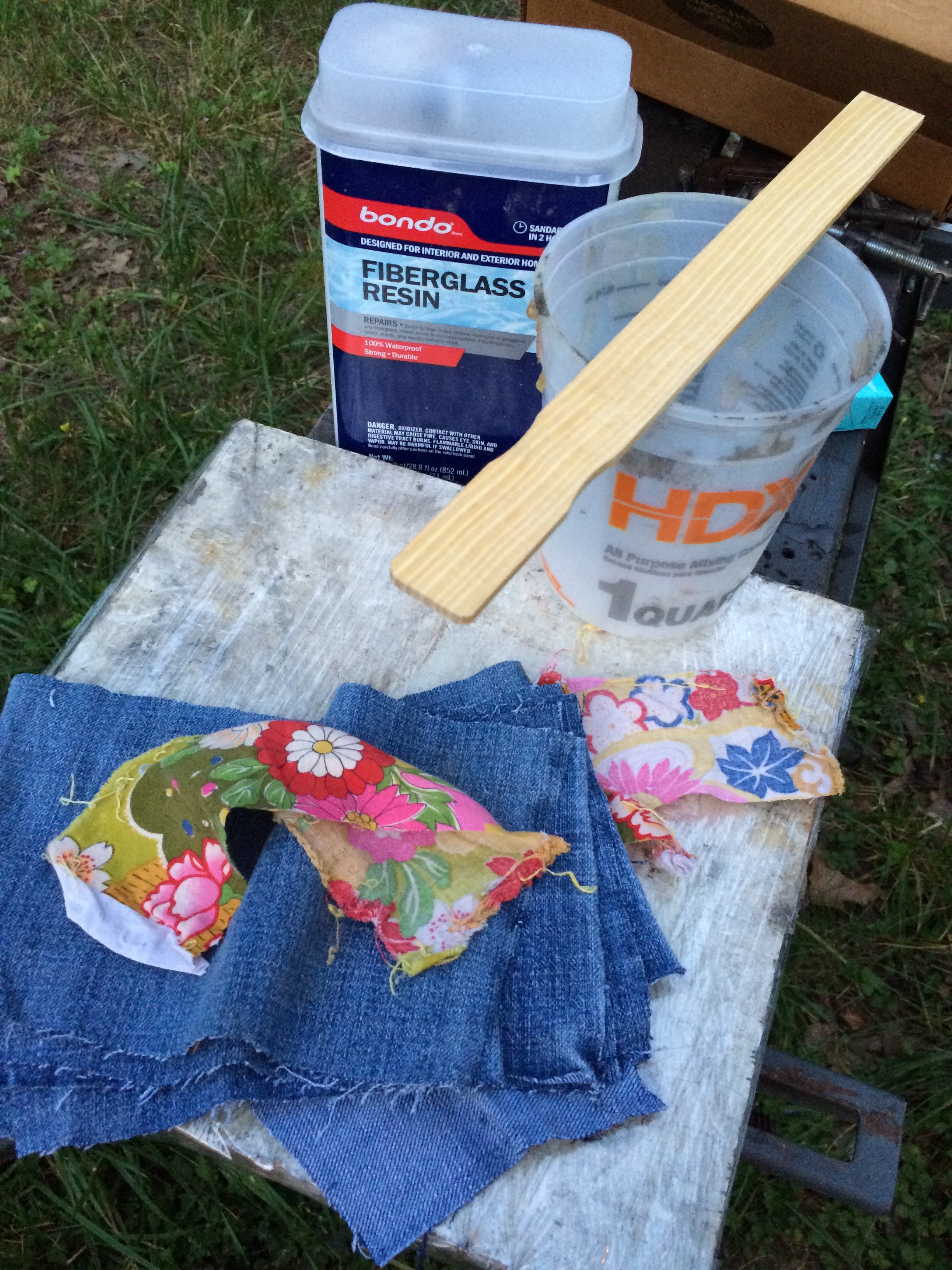
Fiberglass resin will be layered between pieces of denim, like a lasagna. The pathc will go in as well:
Now smash the whole thing together:
The raw material:
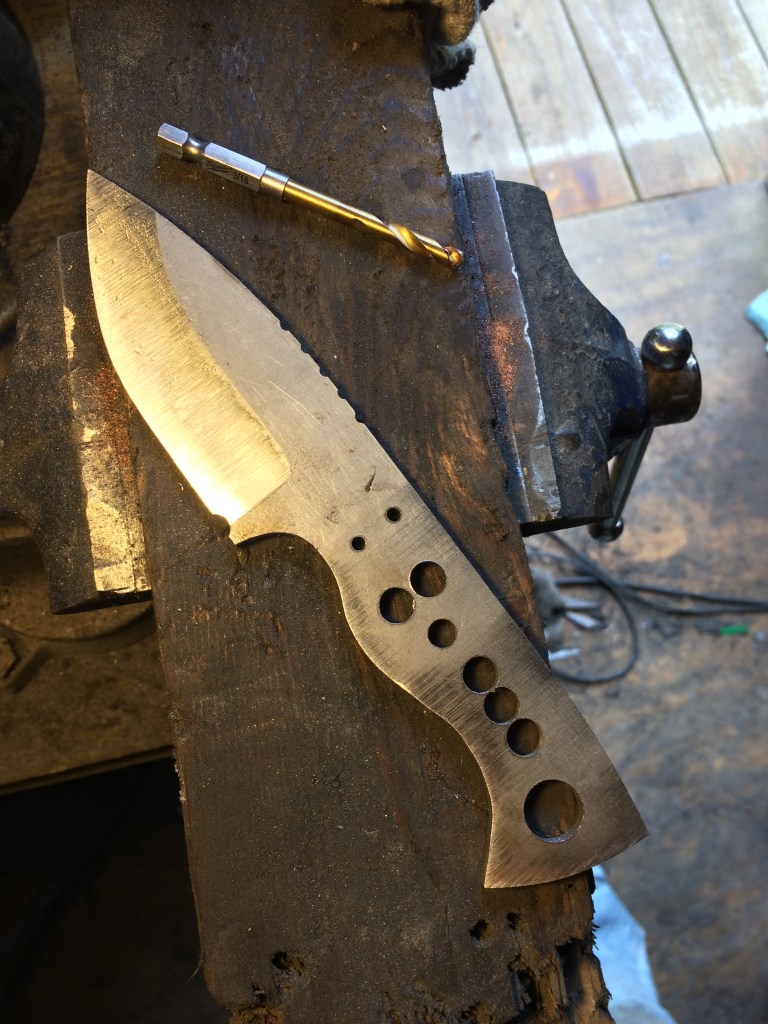
Cut and drilled in, with the blade profile traced in so that i know where everything is:
Texas Mesquite:
It smells really good:
Computer board blank rescued from a dumpster. It’s just a thin piece of fiberglass board:
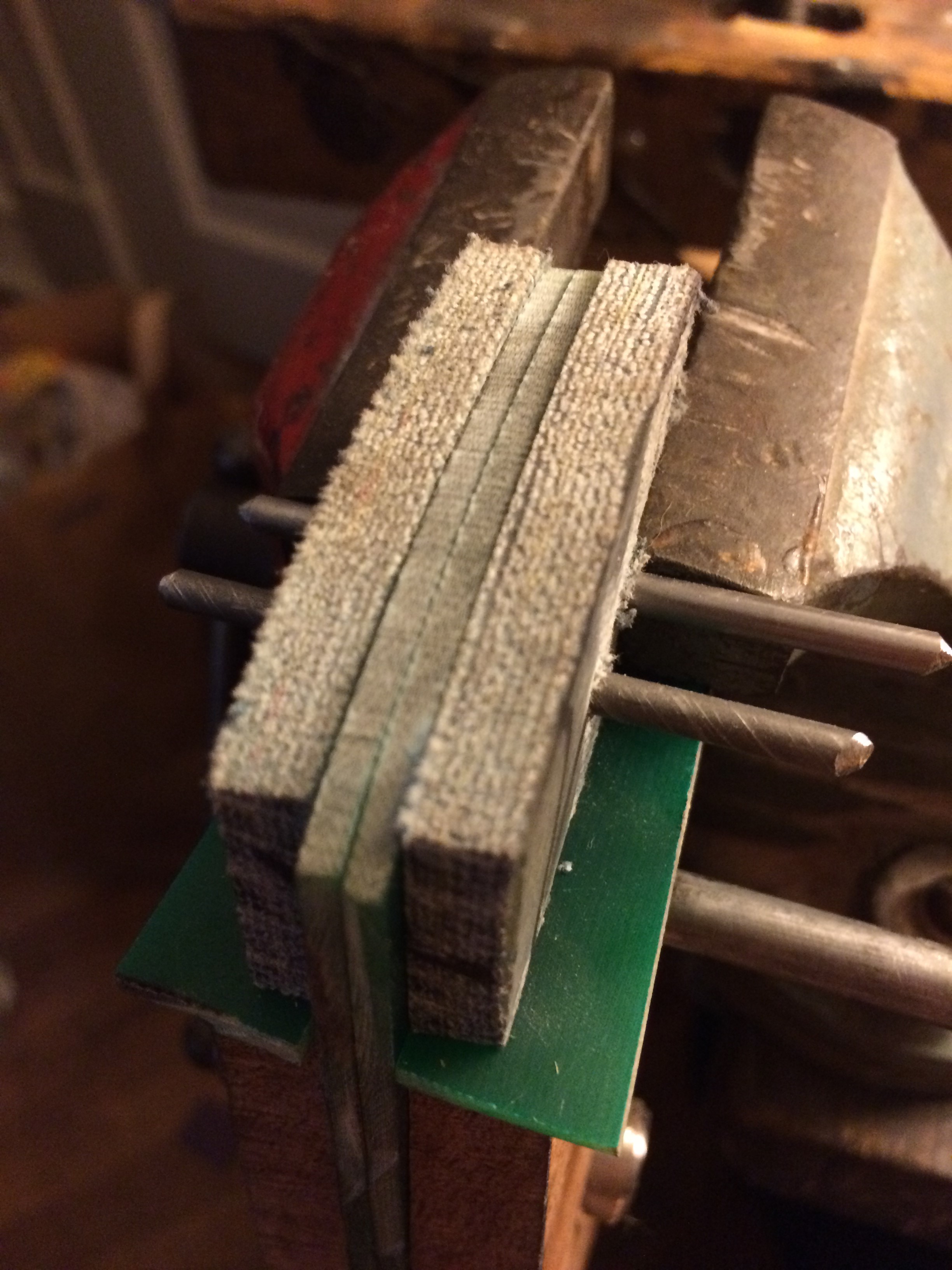
Denim and computer board at 60 grit:
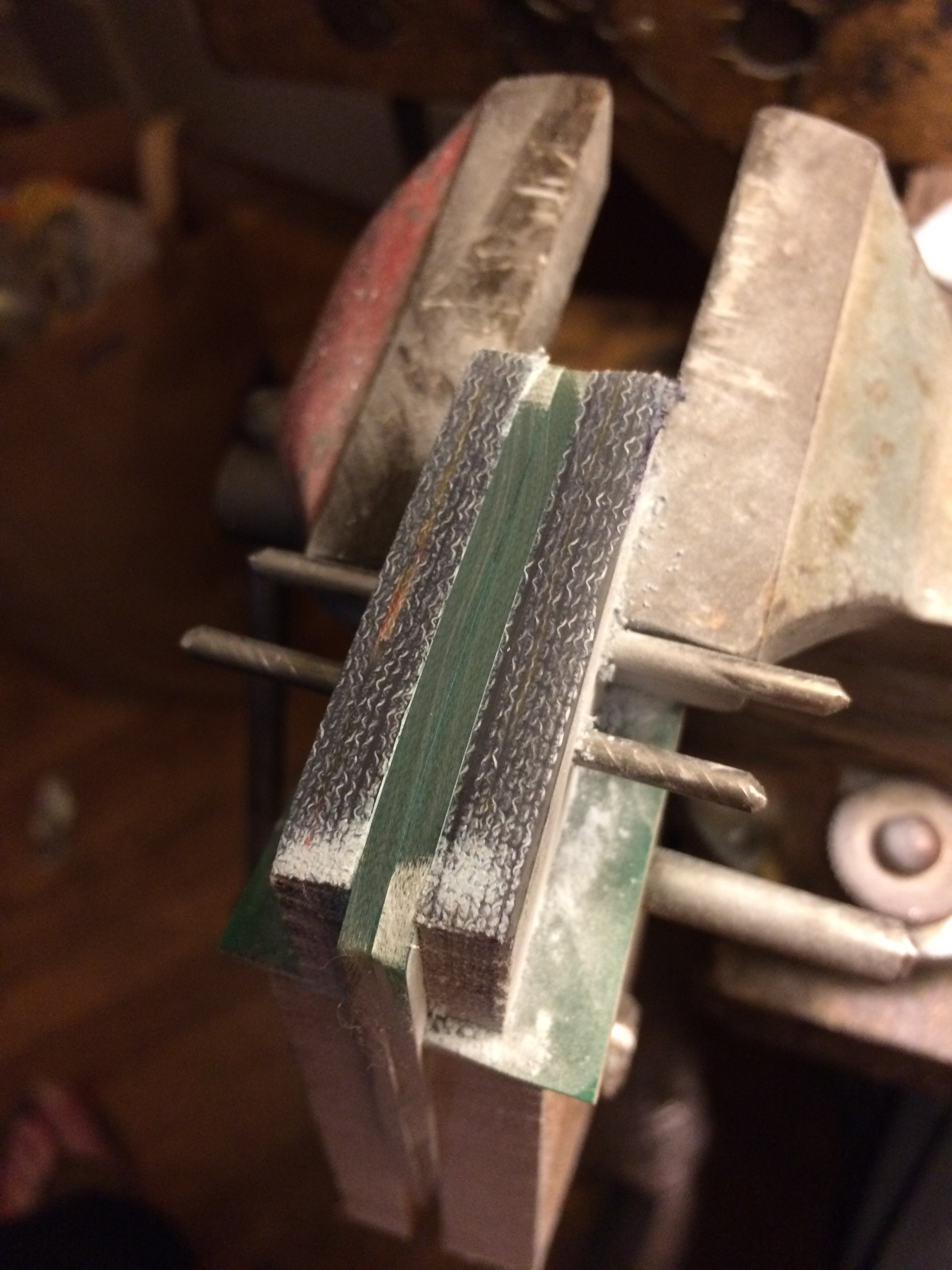
At 800:
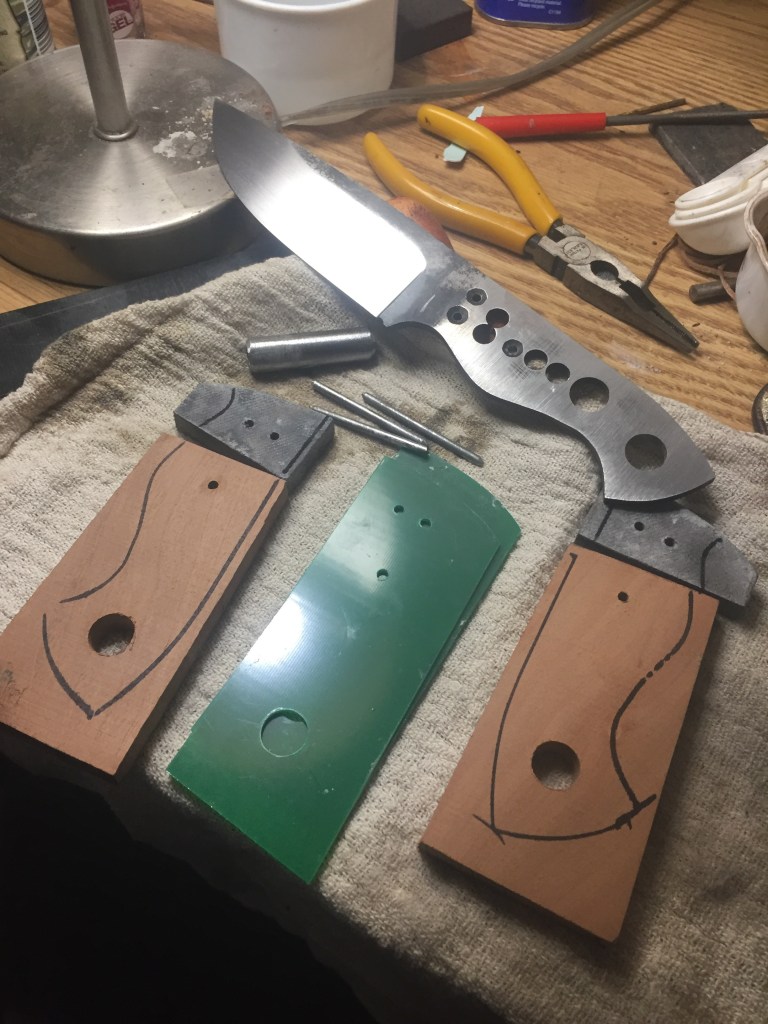
All ready for glue up:
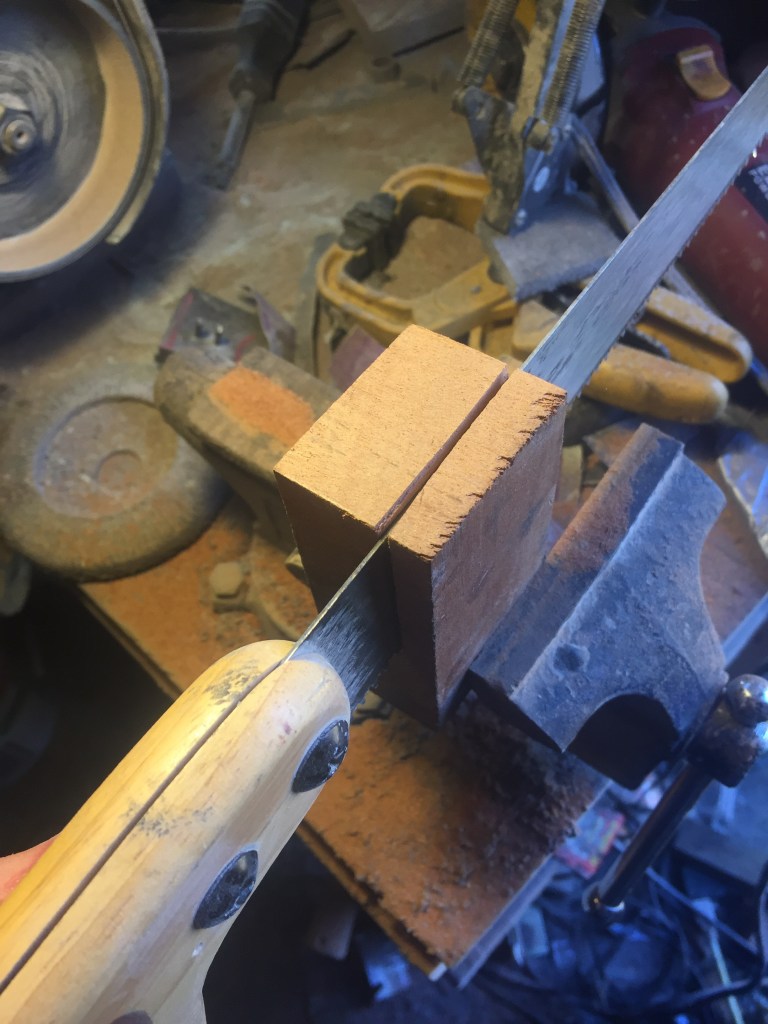
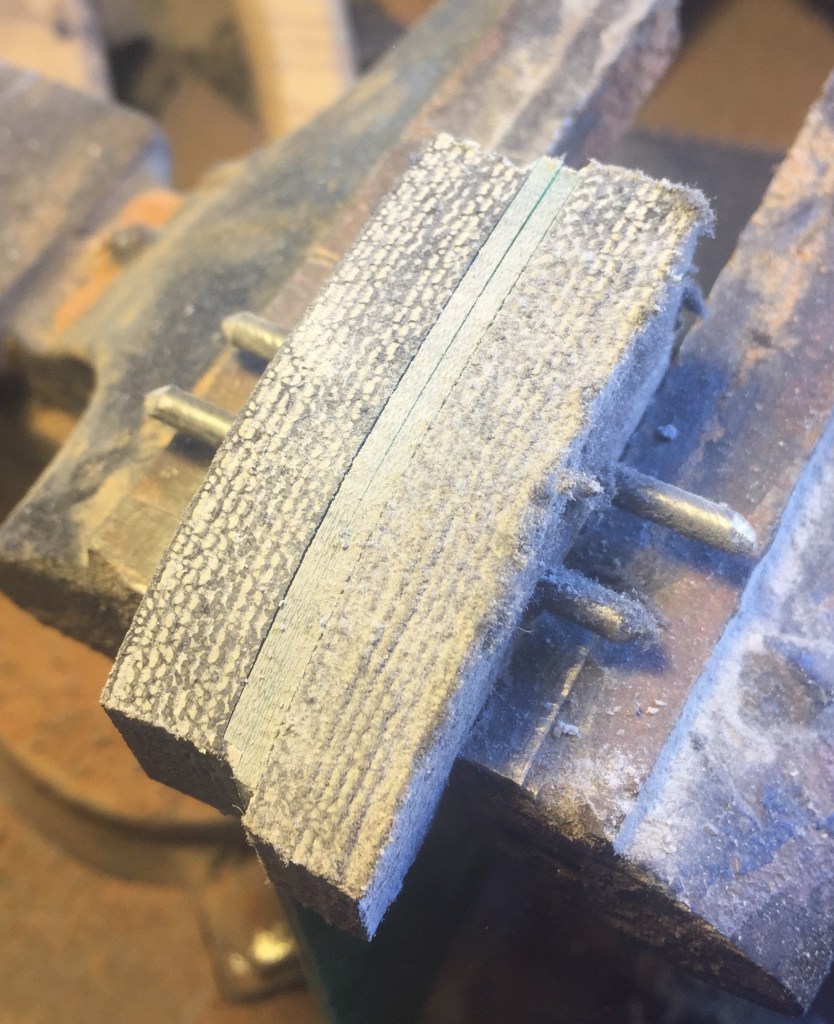
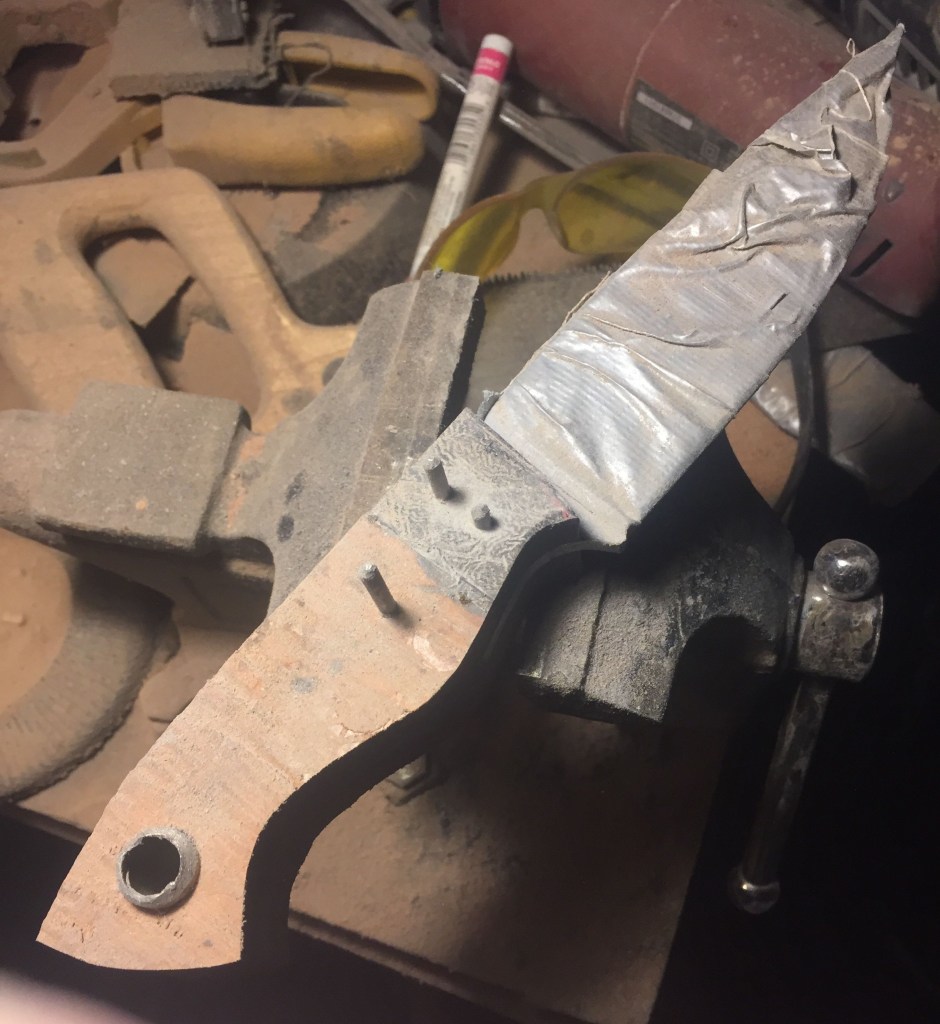
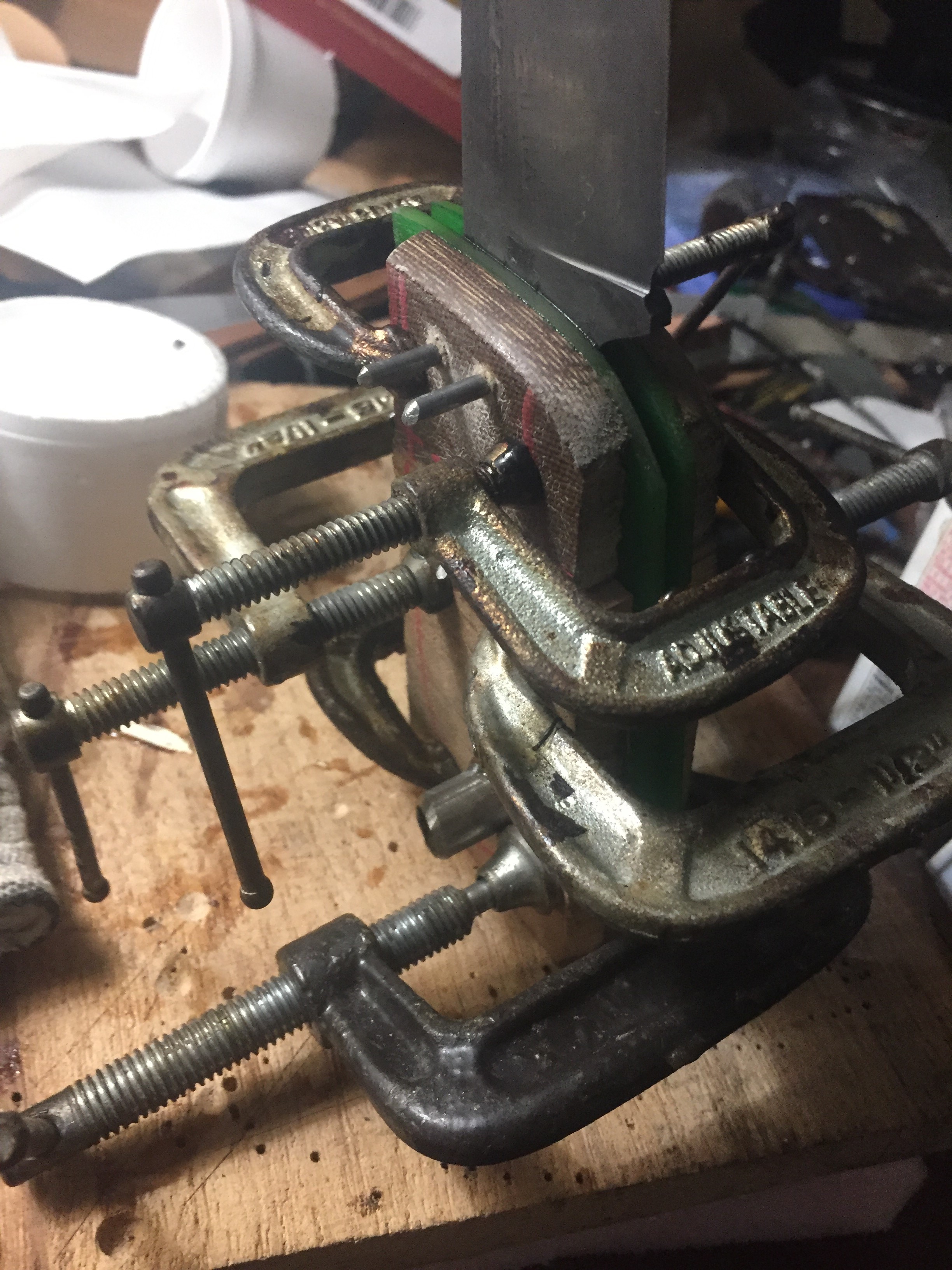
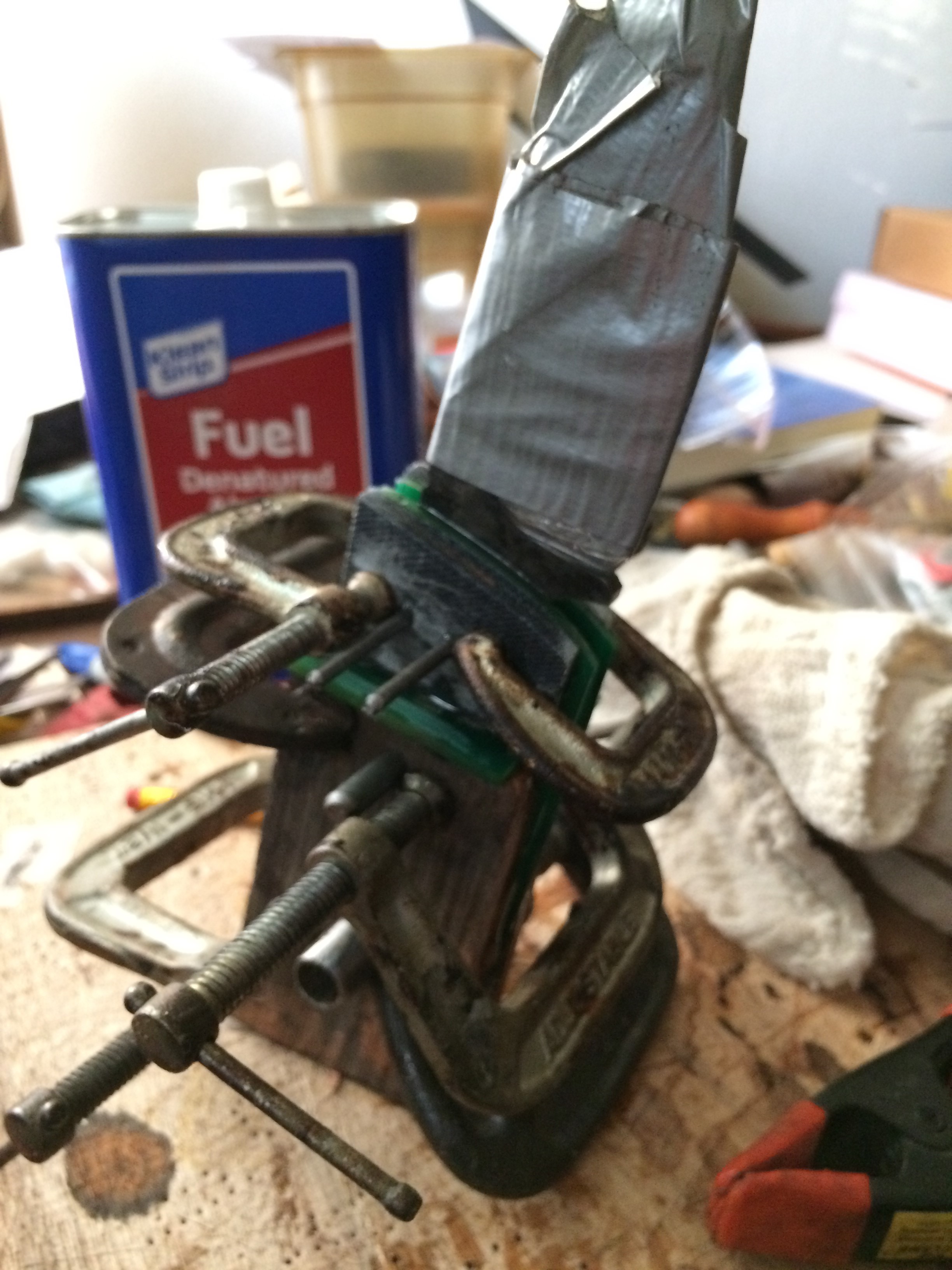
Glued and clamped
Shaping up:
From here, all the sanding is done by hand:
The higher the grit you go, the more pronounced the grain and fiber:
The Masilda:
Instructions for Care:
Your knife is made of high carbon steel, which means it will take a keen edge, hold it a good while, and will be easy to sharpen. It will stain and patina and tell the stories of the places you’ve been. Be sure to keep your knife clean and oiled when not in use. Should you find any unpleasant surface oxidization you can remove it easily with a lightly oiled bit of 0000 steel wool, or a coarse rag with a bit vinegar on it. She is built to be used, so don’t be shy about getting her dirty.
“What is success?” poses the Copt. “It is being able to go to bed each night with your soul at peace.” ― Paulo Coelho, Manuscript Found in Accra
As a grown person, you are rarely ever told that you’re doing a good job. Many times we don’t have a frame of reference for how we’re doing until we’ve screwed something up and gotten yelled at…or fired. Or dumped. Or sued. Or arrested.
As a result, most of us move through life feeling like we might not be doing such a great job. While uncomfortable, this is not entirely unhealthy because it helps to cultivate a growth mindset. If you are cognizant enough to know that you might not be doing so well at whatever it is you are doing, then you are probably aware that this means there is room to grow and get better.
Ironically, the people thinking this way are probably doing just fine. Self-doubt in large quantities can be debilitating, but small doses can be a great tool. In questioning what we are doing, we have a chance to grow.
After I got out of music school, I did my best to make a living as a musician. That lingering bit of self-doubt was fuel that helped keep me sharp and at my best. I wrote music for tiny indie films, did instrumental arrangements for church Christmas programs, played on recording sessions, and took any gig I could get. Many of the best paying jobs were church gigs, especially around Christmas and Easter. I am not religious, and probably an excellent candidate for bursting into flames upon crossing the threshold of any religious building. That being said, the people are always kind, the checks always clear, and there is about a thousand years of badass sacred music written by the rockstars of the classical music world. This is partly why big churches typically end up with killer instrumental and choir directors. They are usually competitive jobs.
One Easter I got a call for a job at a massive Baptist church about 20 miles outside of the city. On Easter Sunday I showed up for a small rehearsal before playing two services. I was the only hired musician- everyone else was from the congregation or community. Immediately it was not good. The instrument parts were in different keys and the director didn’t know the cues for the giant video projector and how our music was supposed to line up. Easter is the Woodstock of church music and this was a mish-mash of cacophony. As a professional, this situation feels like being on a burning ship with no way off. Two services and four hours of this for a congregation of a thousand and no way to fix it made me want to rip my hair out.
Nobody else seemed to notice or care- and ultimately that was ok. Because in the end, voices were raised, offerings were offered, tithes were tithed, and the faithful answered the call. I got paid and went home. The takeaway, besides being able to pay my health insurance, was that, while it’s important to do the best you can, sometimes the best thing you can do is let things be what they are and sleep well at night.
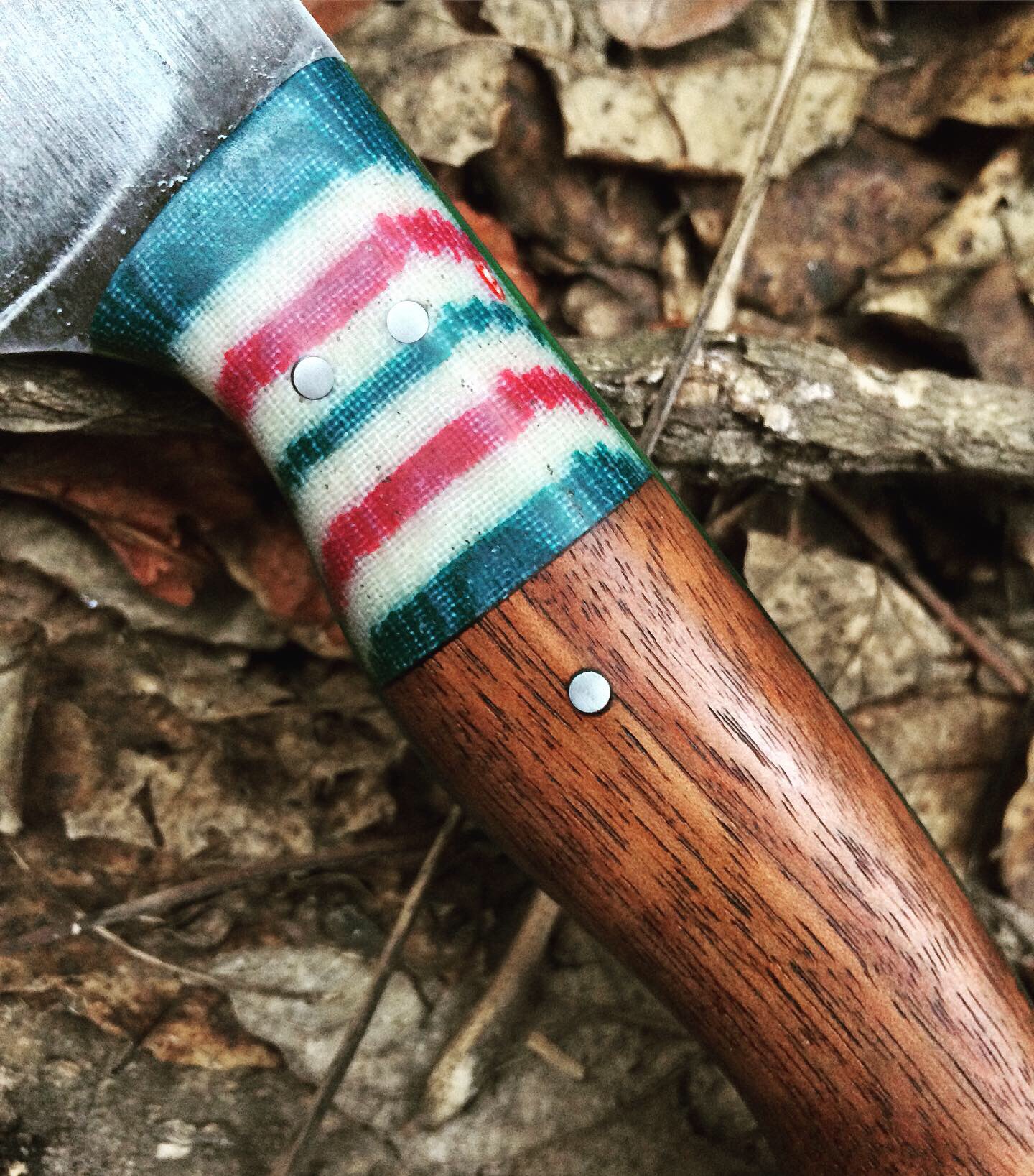
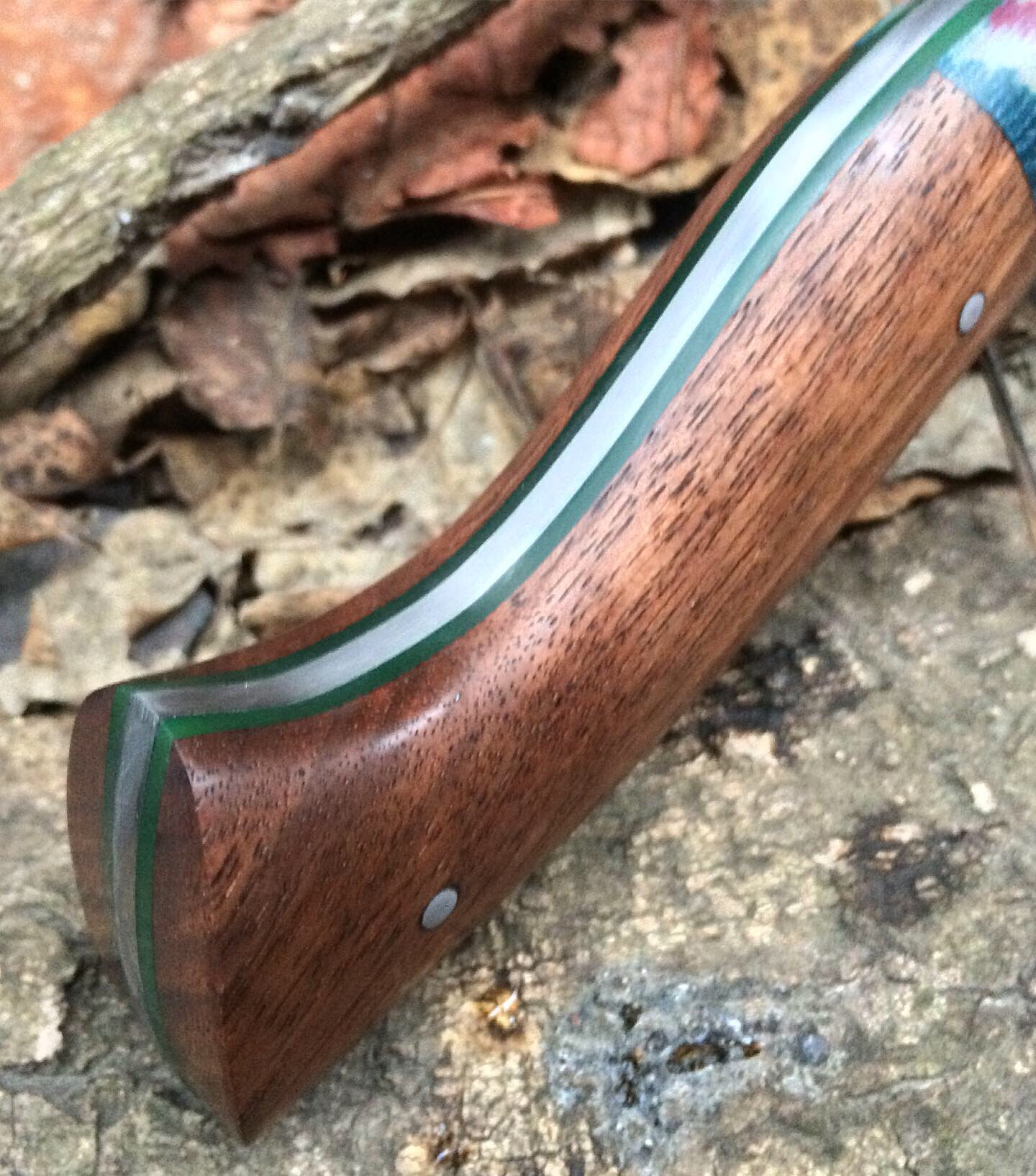
This knife was commissioned by a lady I went to college with for her husband, a former Cavalier Scout in the Army and a new father. I don’t have children but I imagine being a new father, where there are so many things out of your control, can be at odds with the capable nature of a military mindset. The intent of this knife, the Scout, is to put some of that at ease. I tried to capture that duality by marrying those two parts together. The handle was made from an old piece of Black Walnut trim molding- solid, seasoned, and strong. The bolster was made from their child’s blanket, which required a lot more care and work. The blanket contained a bit more uncertainty because I didn’t know how it would turn out till it was finished. Peppered in the blanket was one of the gentleman’s old Boy Scout badges to act as a guardian to that uncertainty.
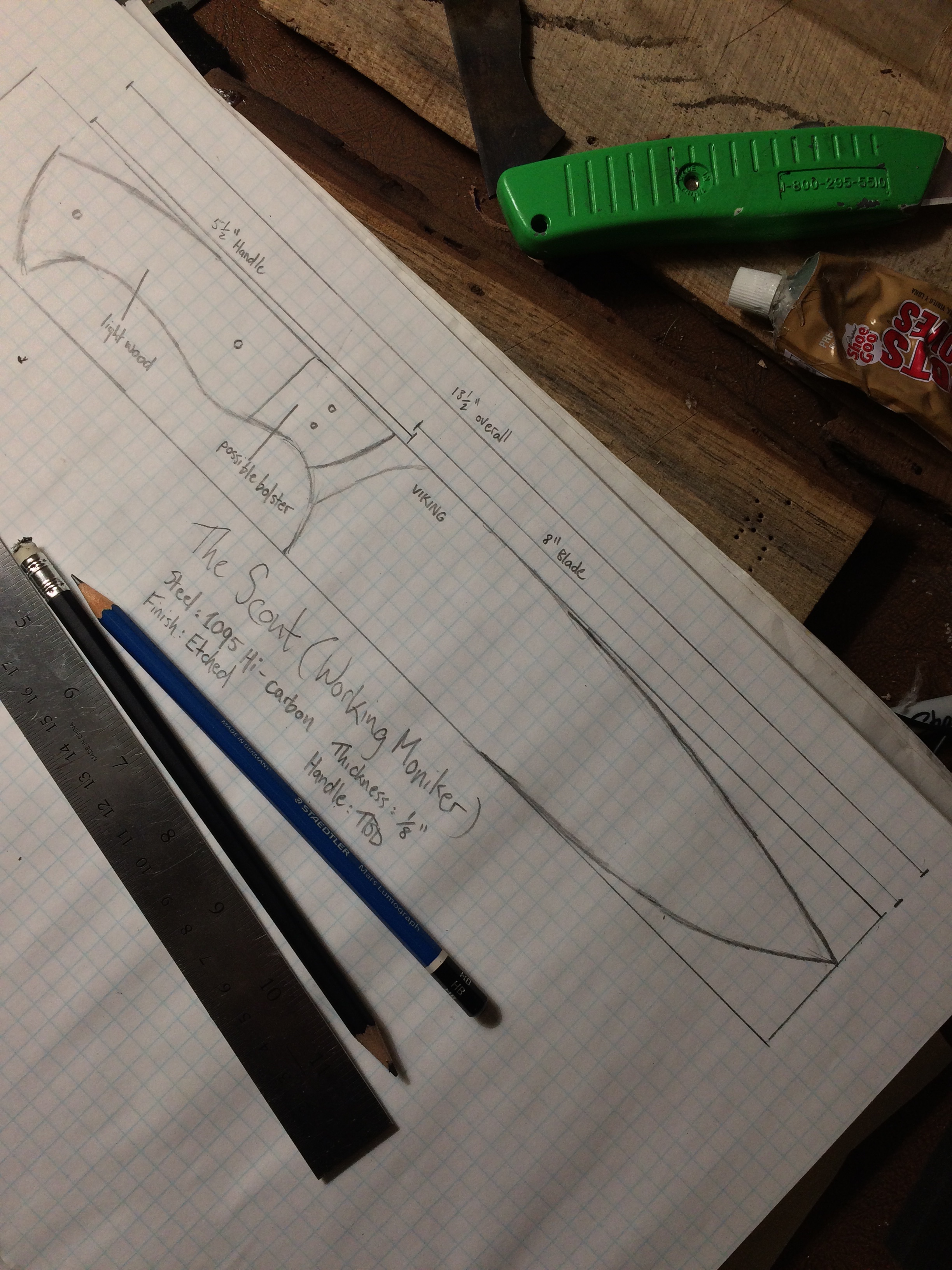
The Scout starts with a drawing:
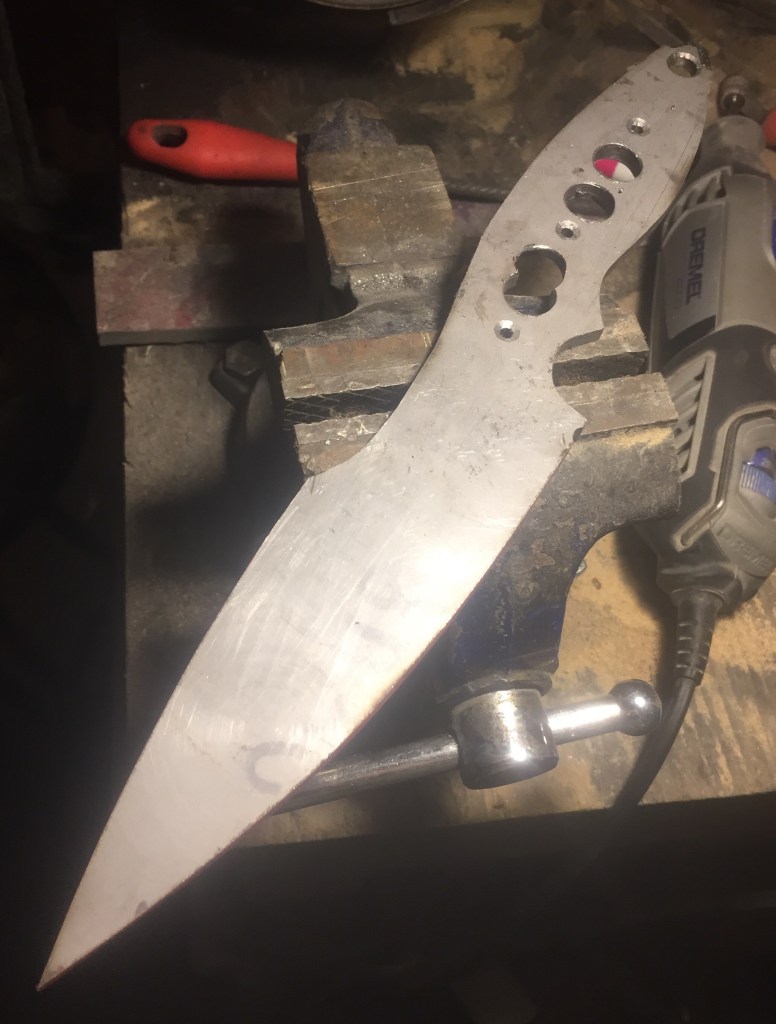
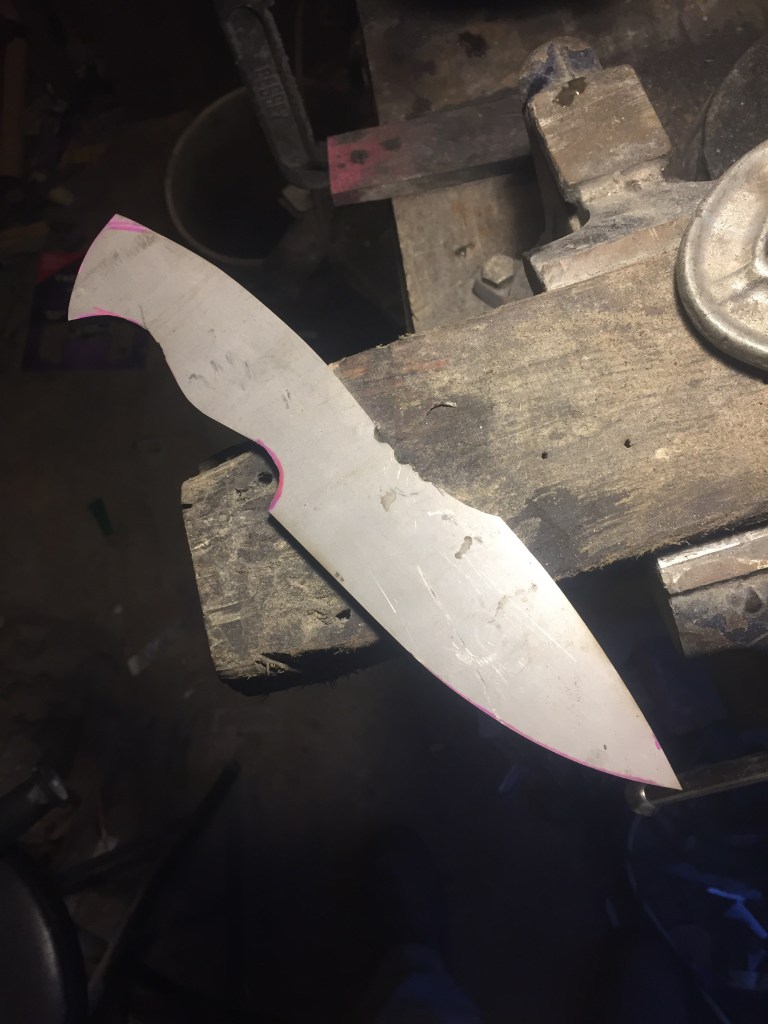
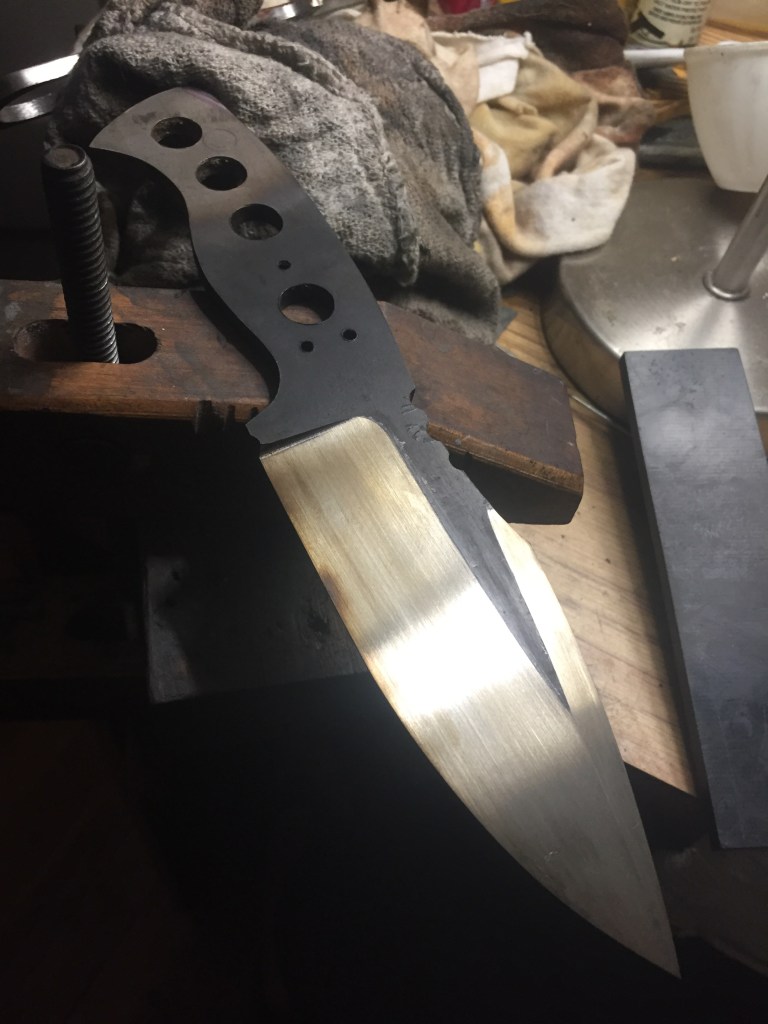
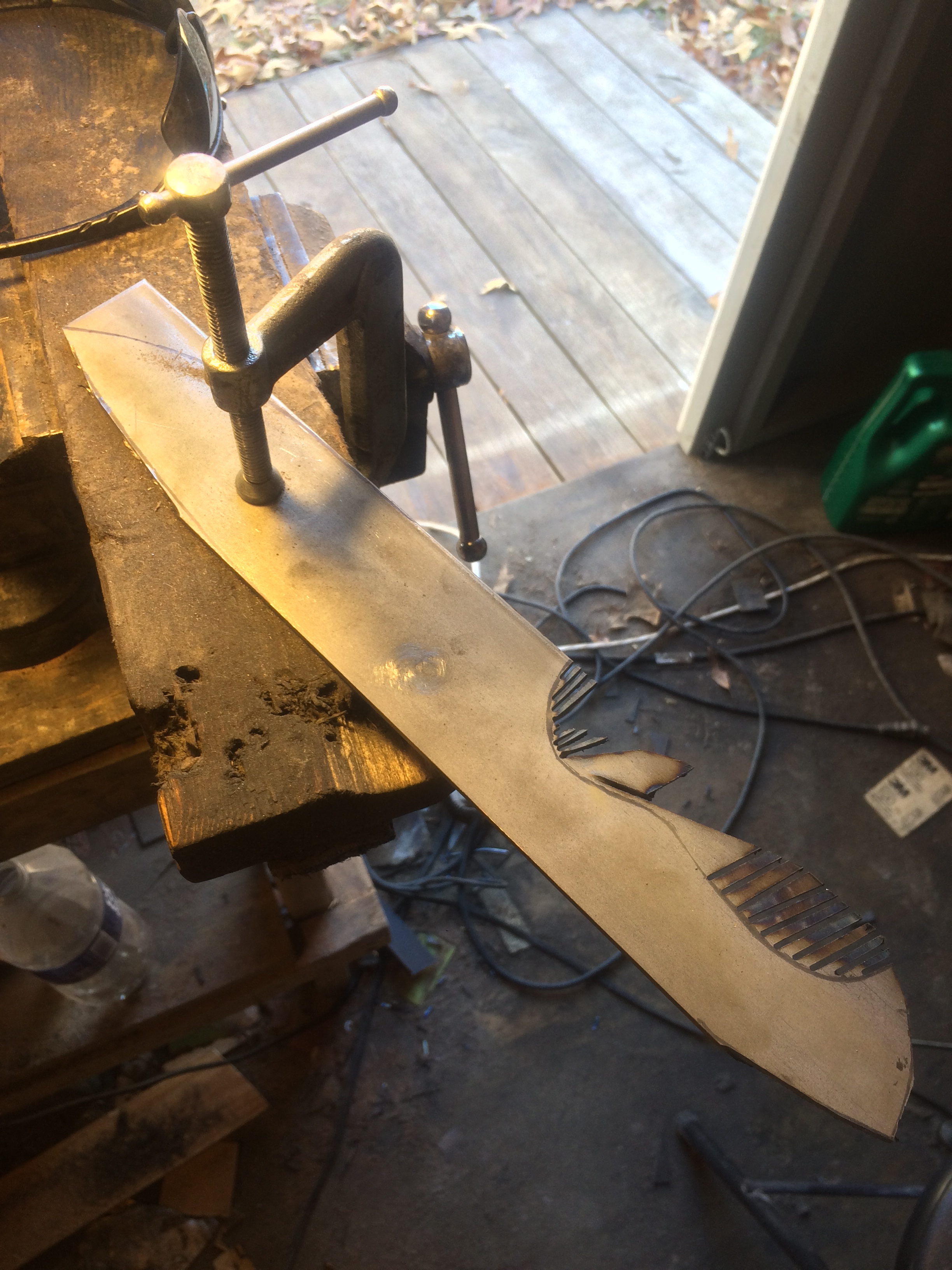
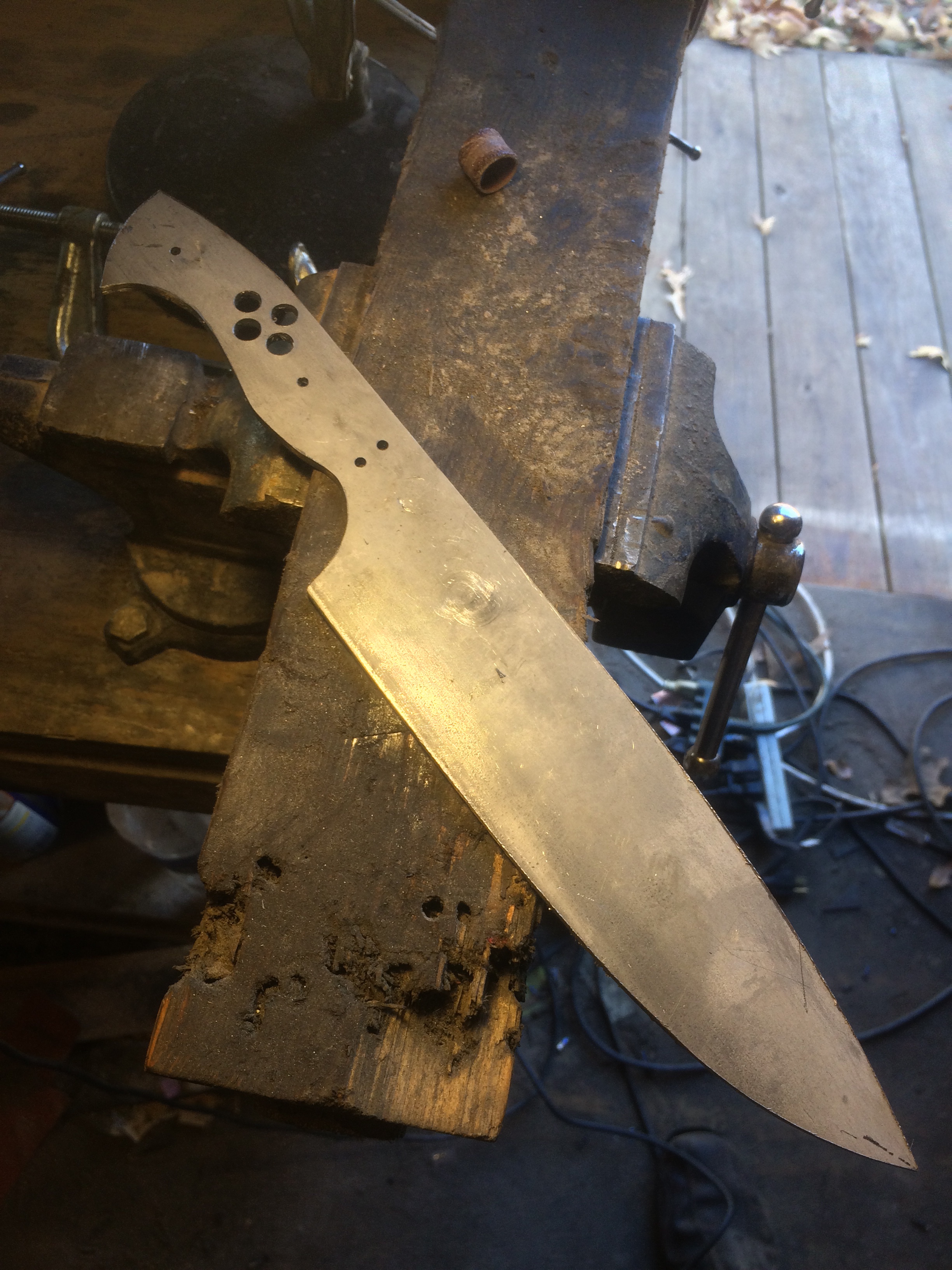
Profiled and drilled. The four larger holes reduce weight to improve balance:
Centerline scribed on the blade. This is where the cutting edge will be:
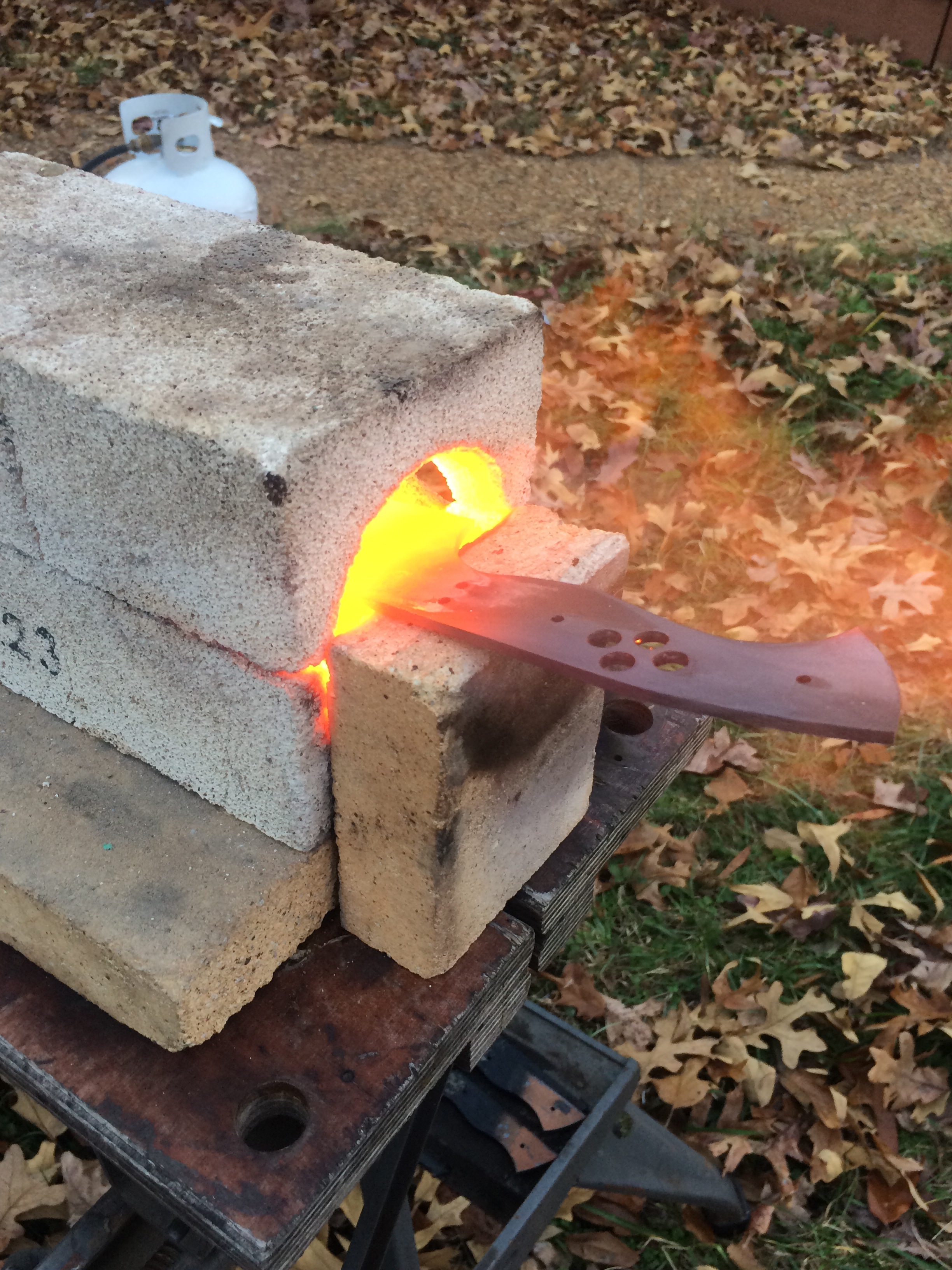
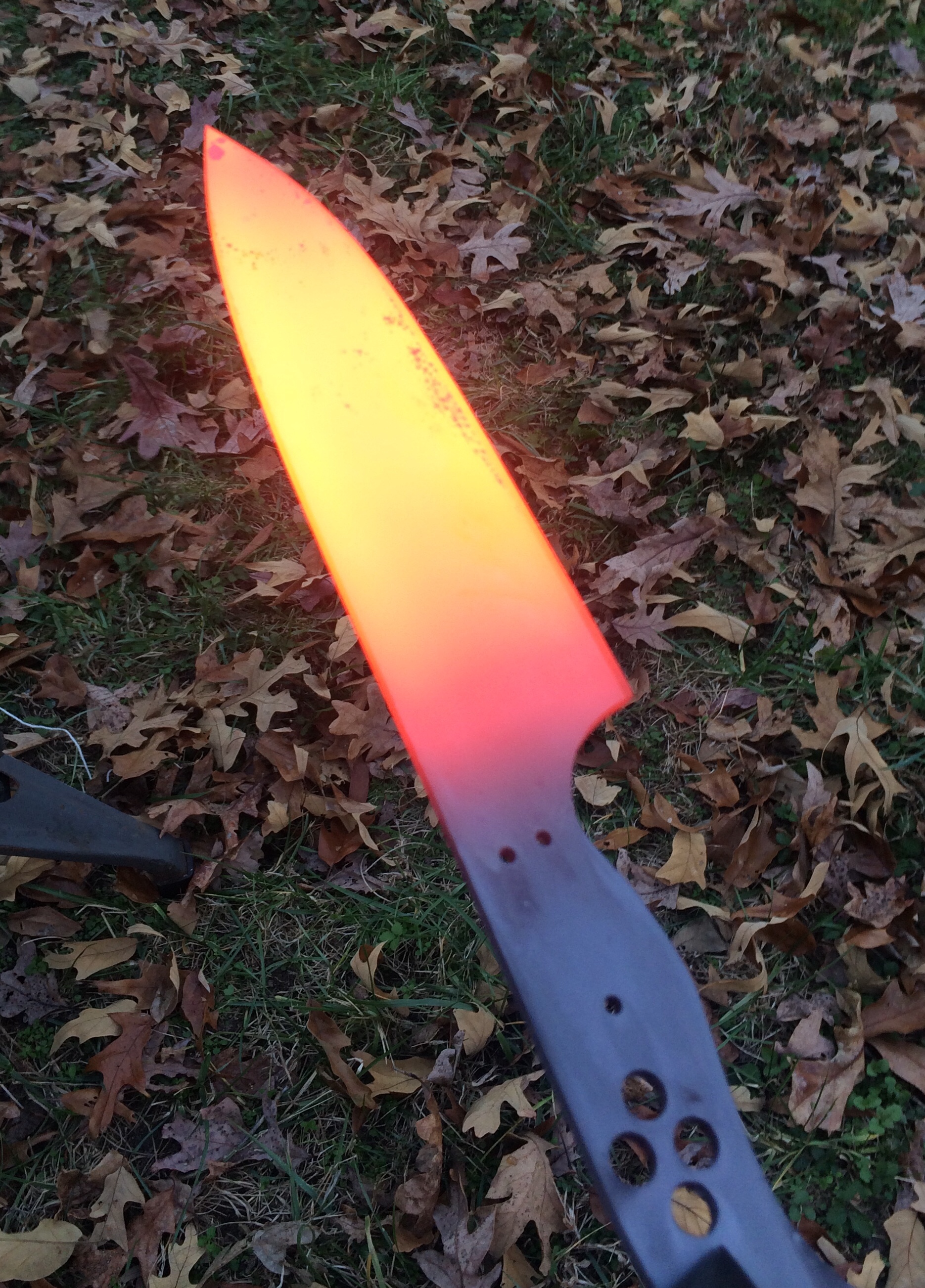
The whole thing gets hardened before grinding. This helps prevent warping:
….and despite our best efforts, warping does occur. Since the blade is still hot from the oil quench we have some time to correct it:
Tempering- this gives the blade flex and bend, while also relieving stress incurred during the quench:
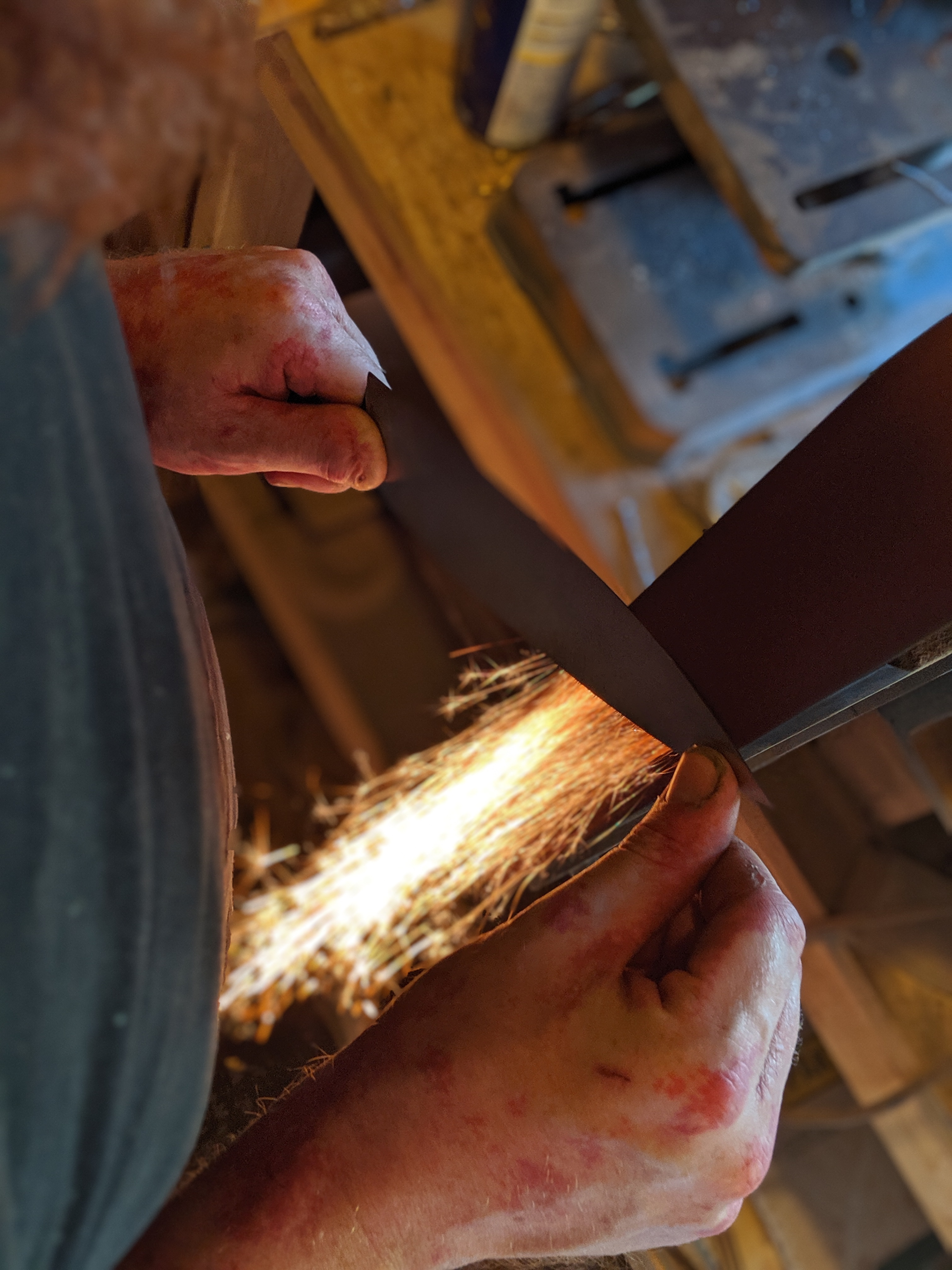
Grinding the bevels:
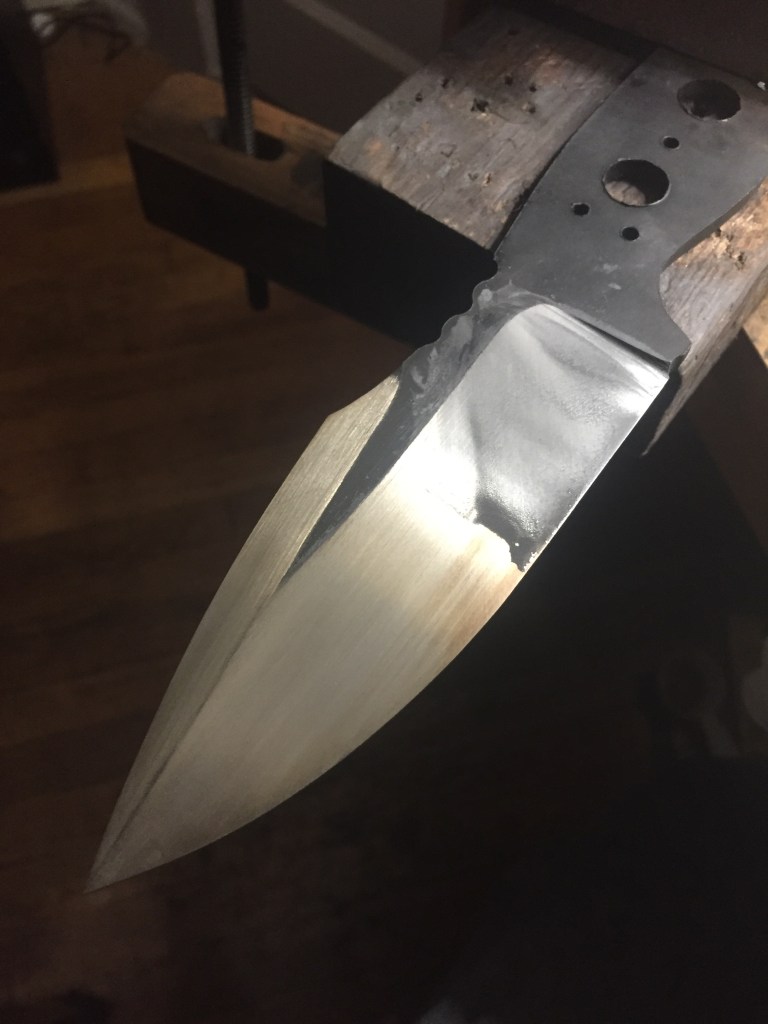
A full flat grind at 36 grit:
Removing the machine marks:
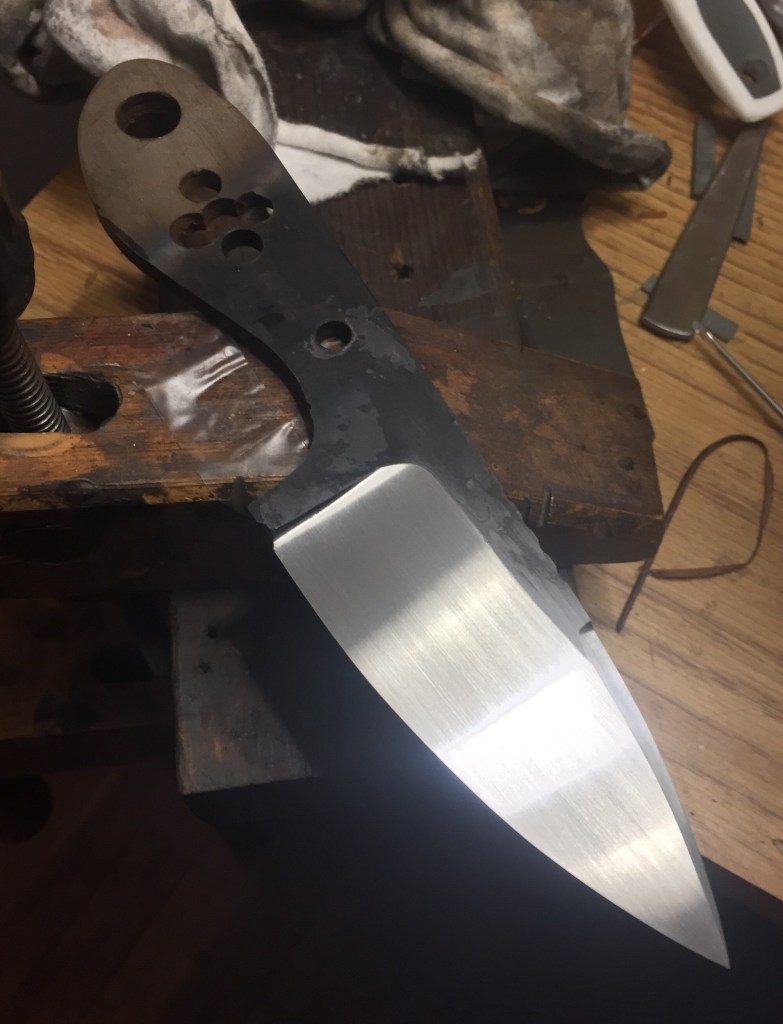
Satin at 320 grit. This took about three hours of handwork. Now on to the other side…
Electrochemical etching of the makers mark:
A baby blanket. I like the stripes. This will become the bolster.
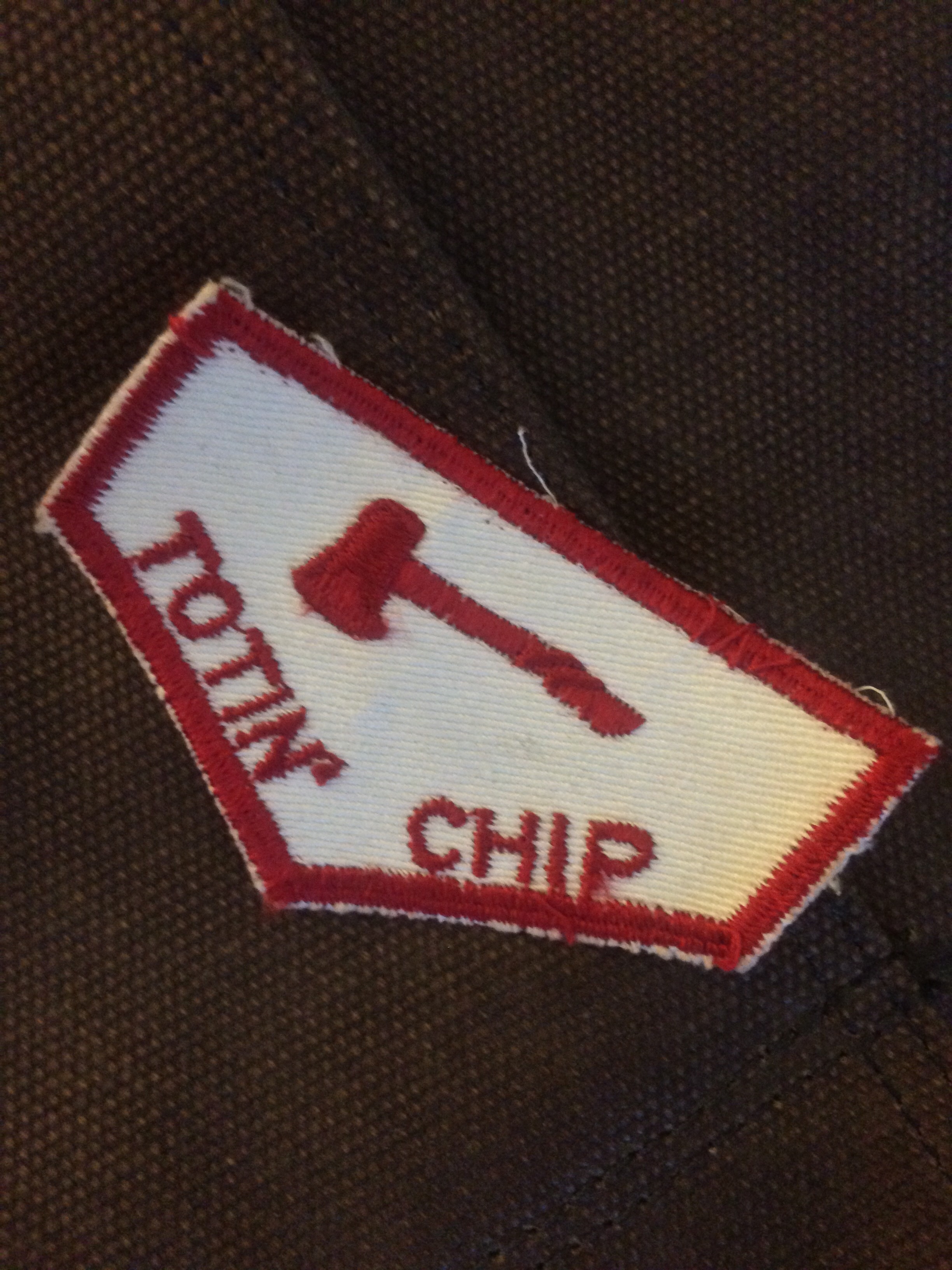
It wouldn’t be a scout without a Boy Scout Badge. This particular badge shows that the younger scout has demonstrated proficiency with and is allowed to carry a knife:
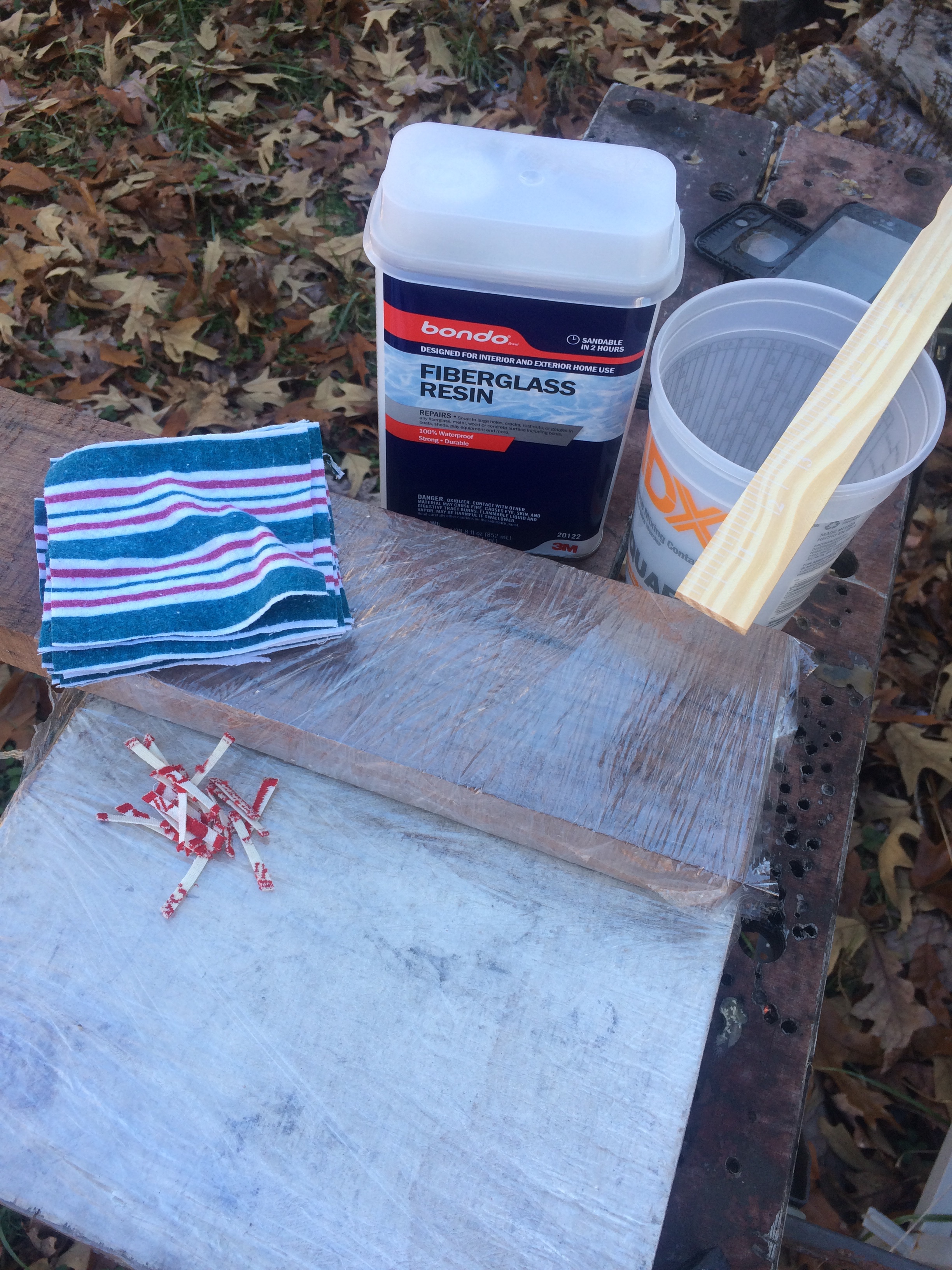
The blanket is cut into equi-sized pieces and the badge into slivers. Everything will be layered with fiberglass resin and smashed together:
After the resin has cured:
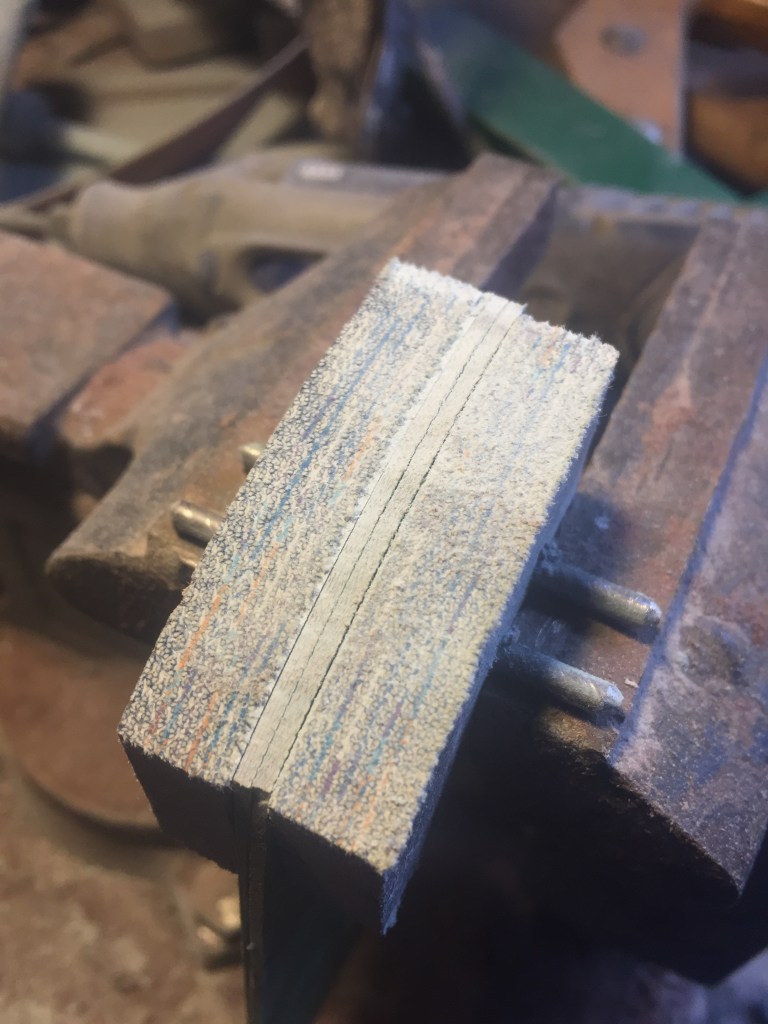
A cross-section of the material and you can see the scout badge slivers. This has become one piece of material:
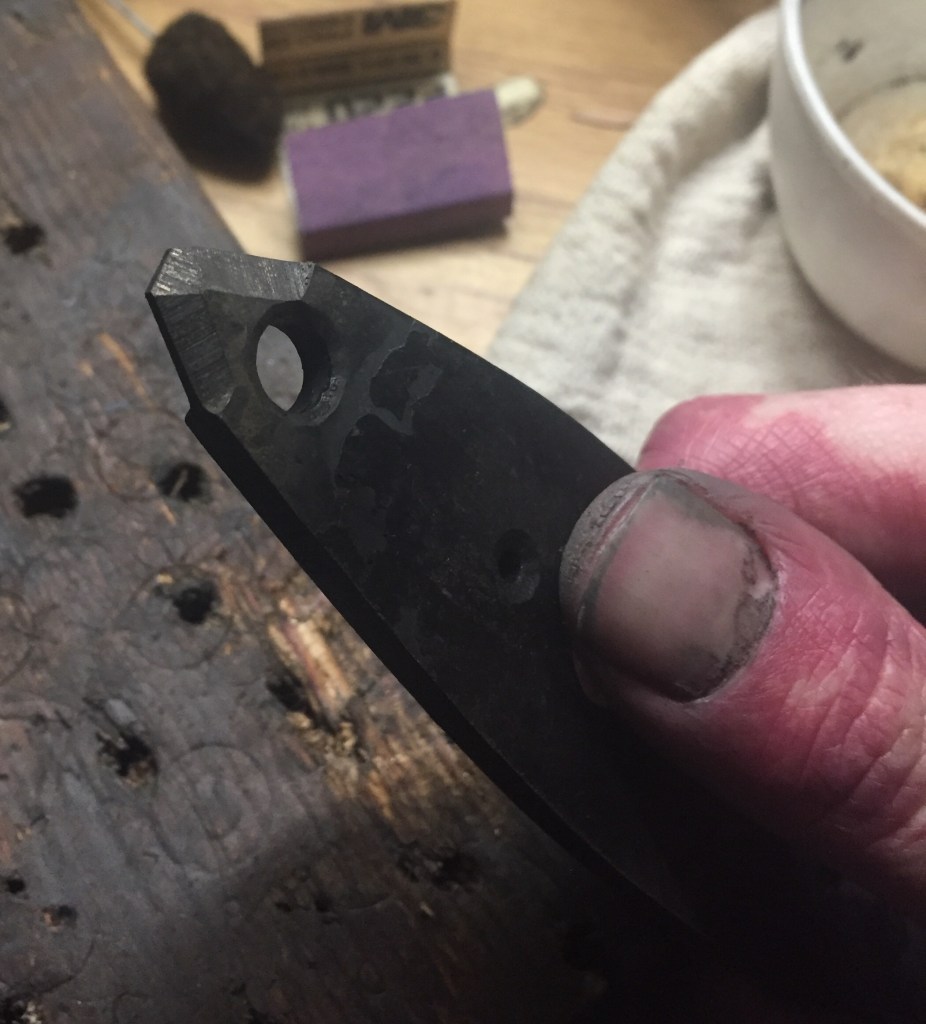
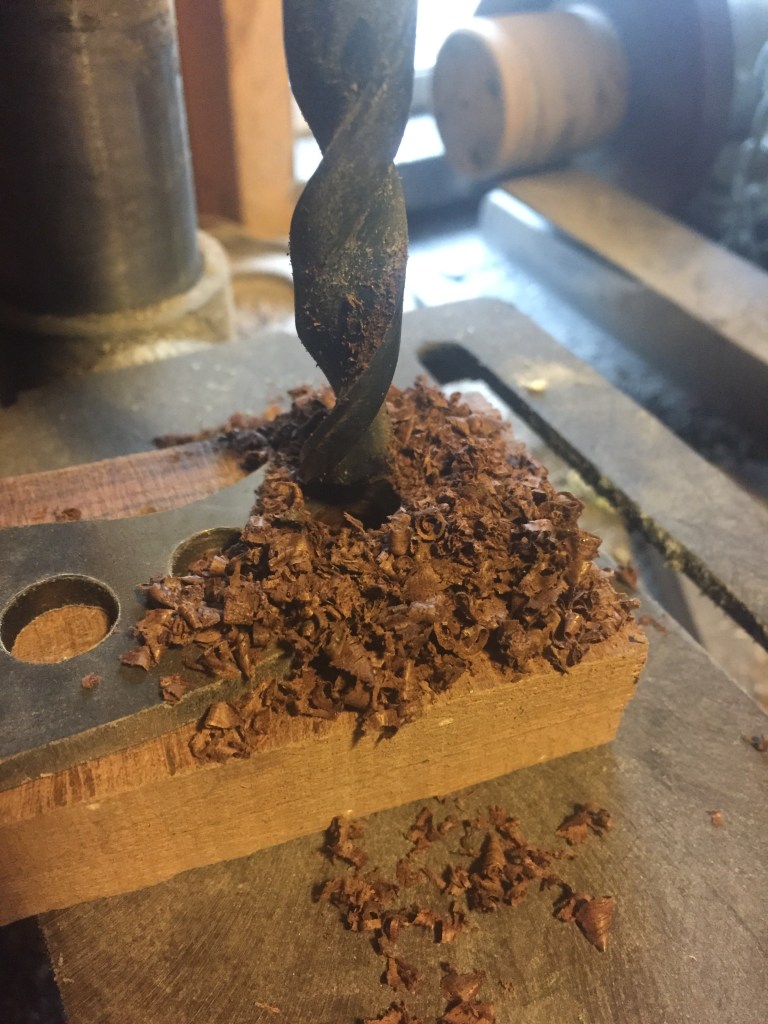
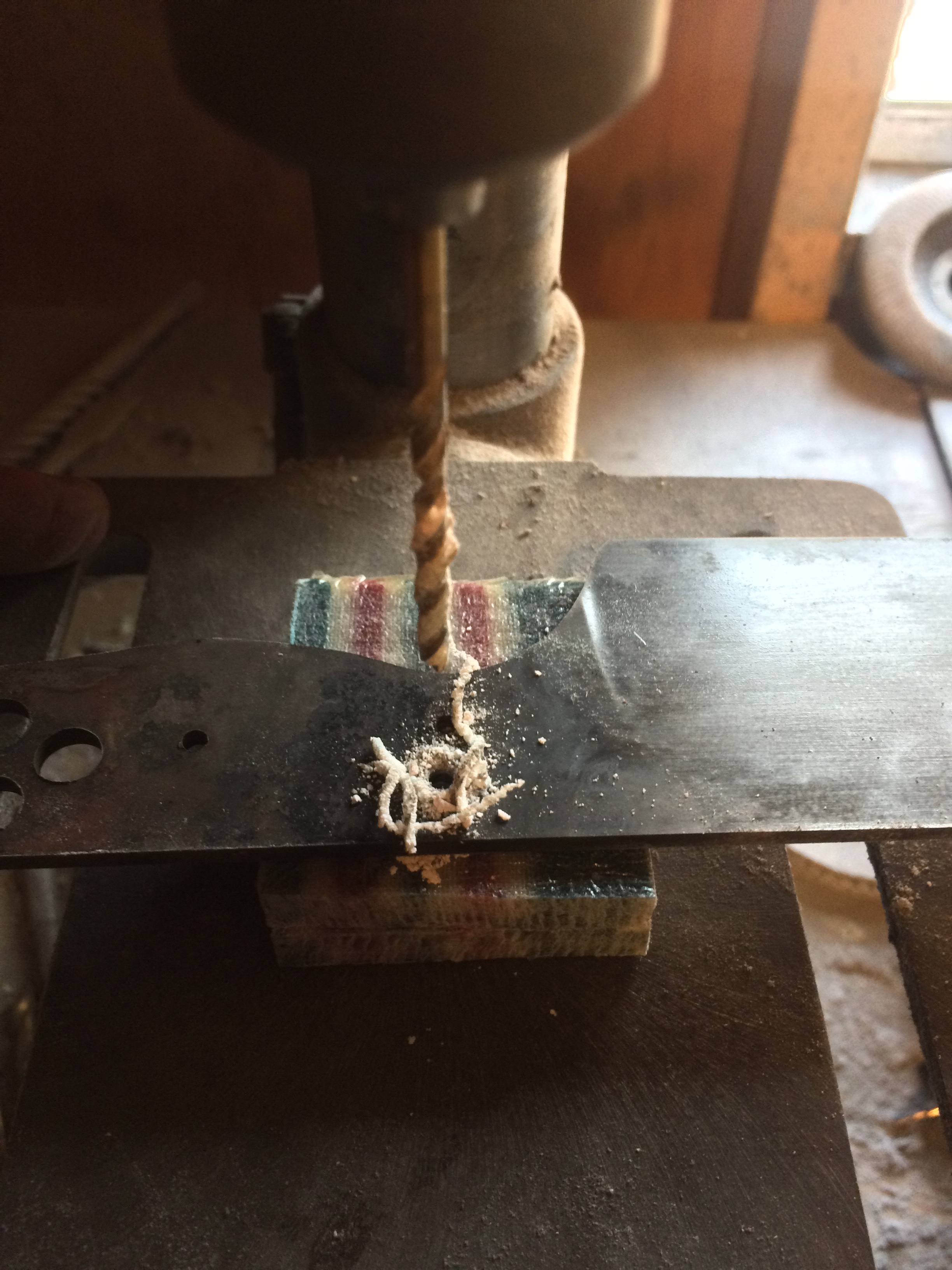
Drilling rivet holes after the bolsters are cut:
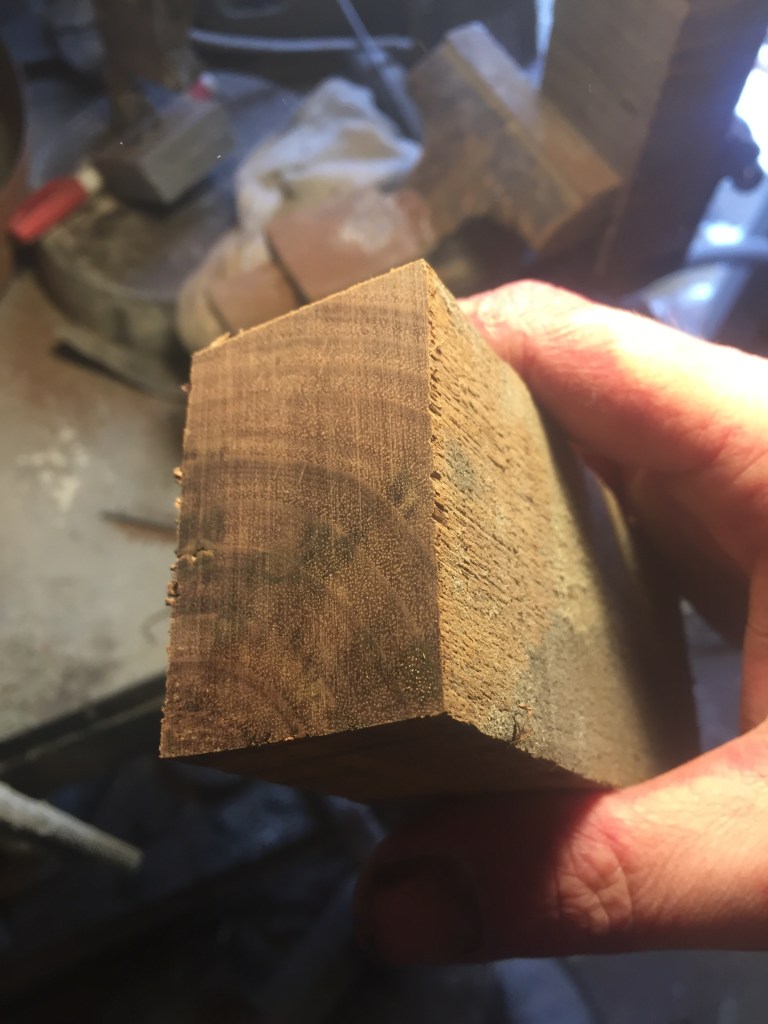
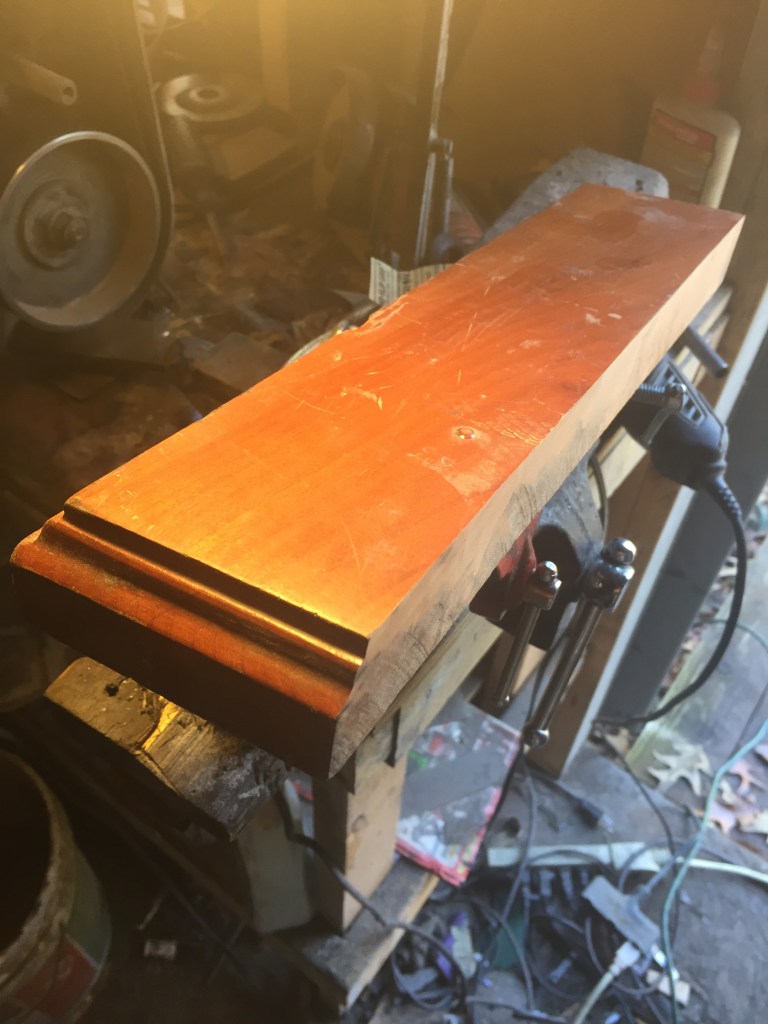
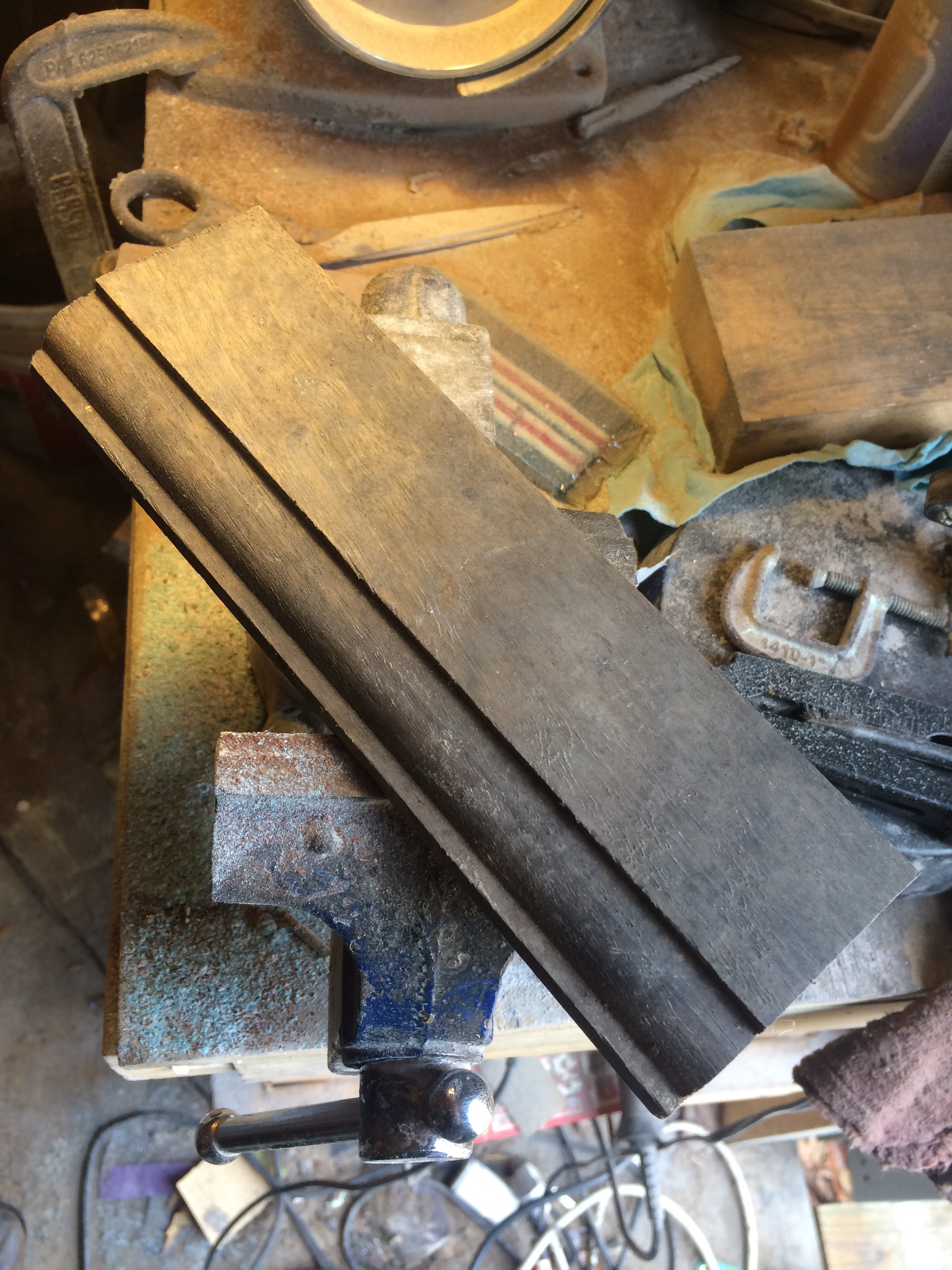
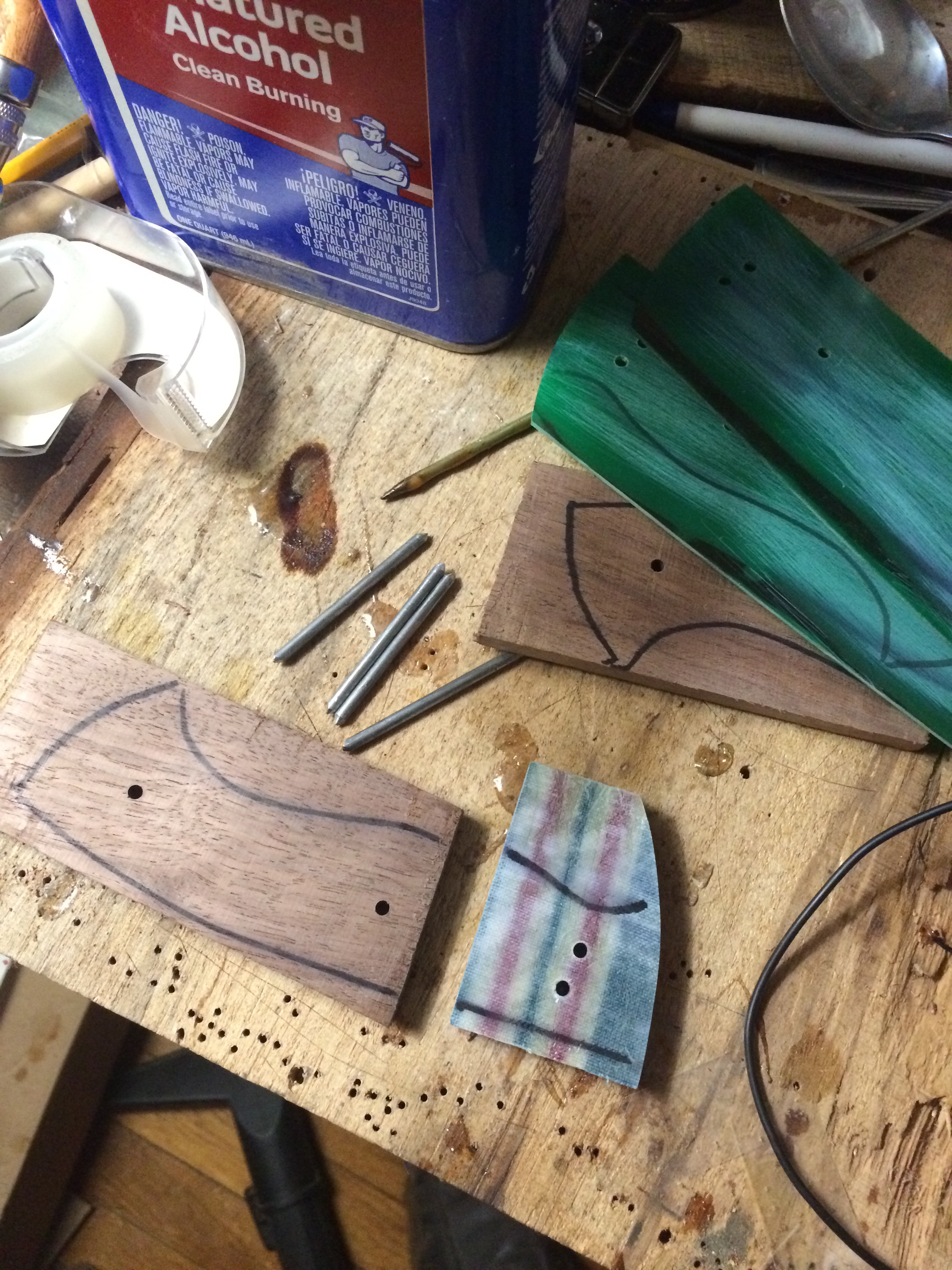
This piece of trim molding came from an abandoned house and is made of Black Walnut. It doesn’t look like much right now:
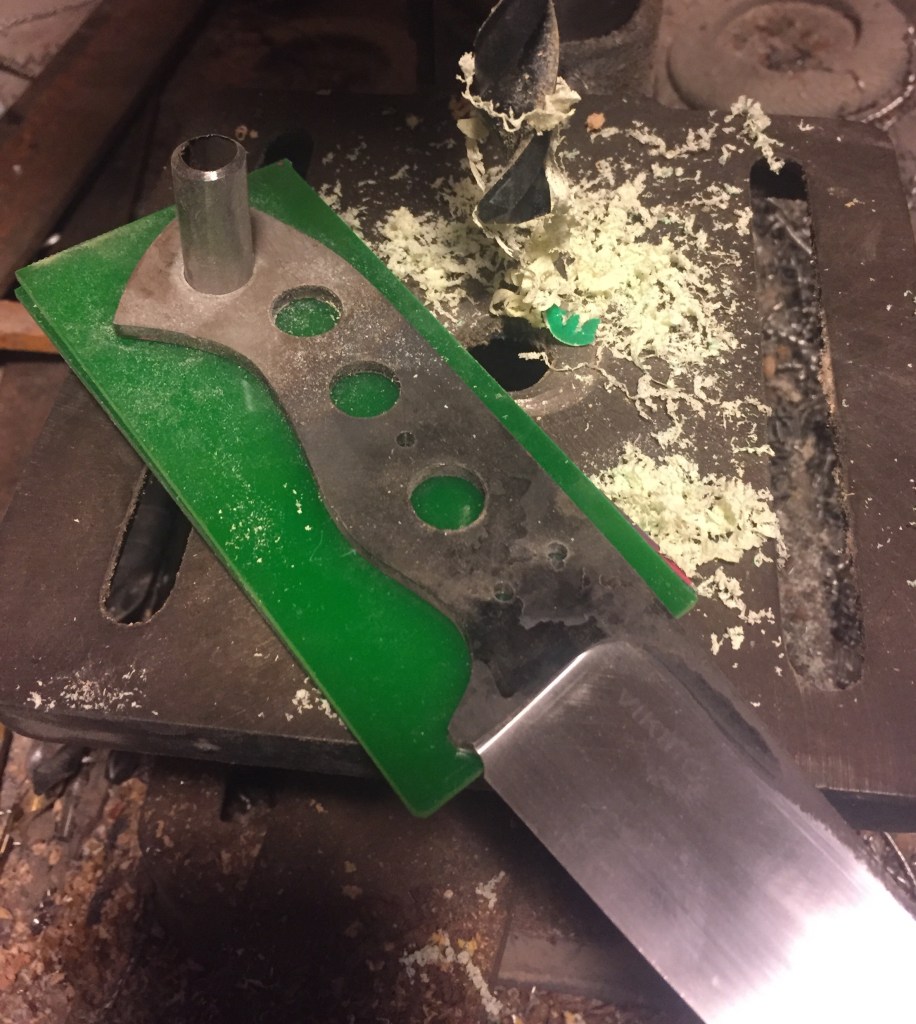
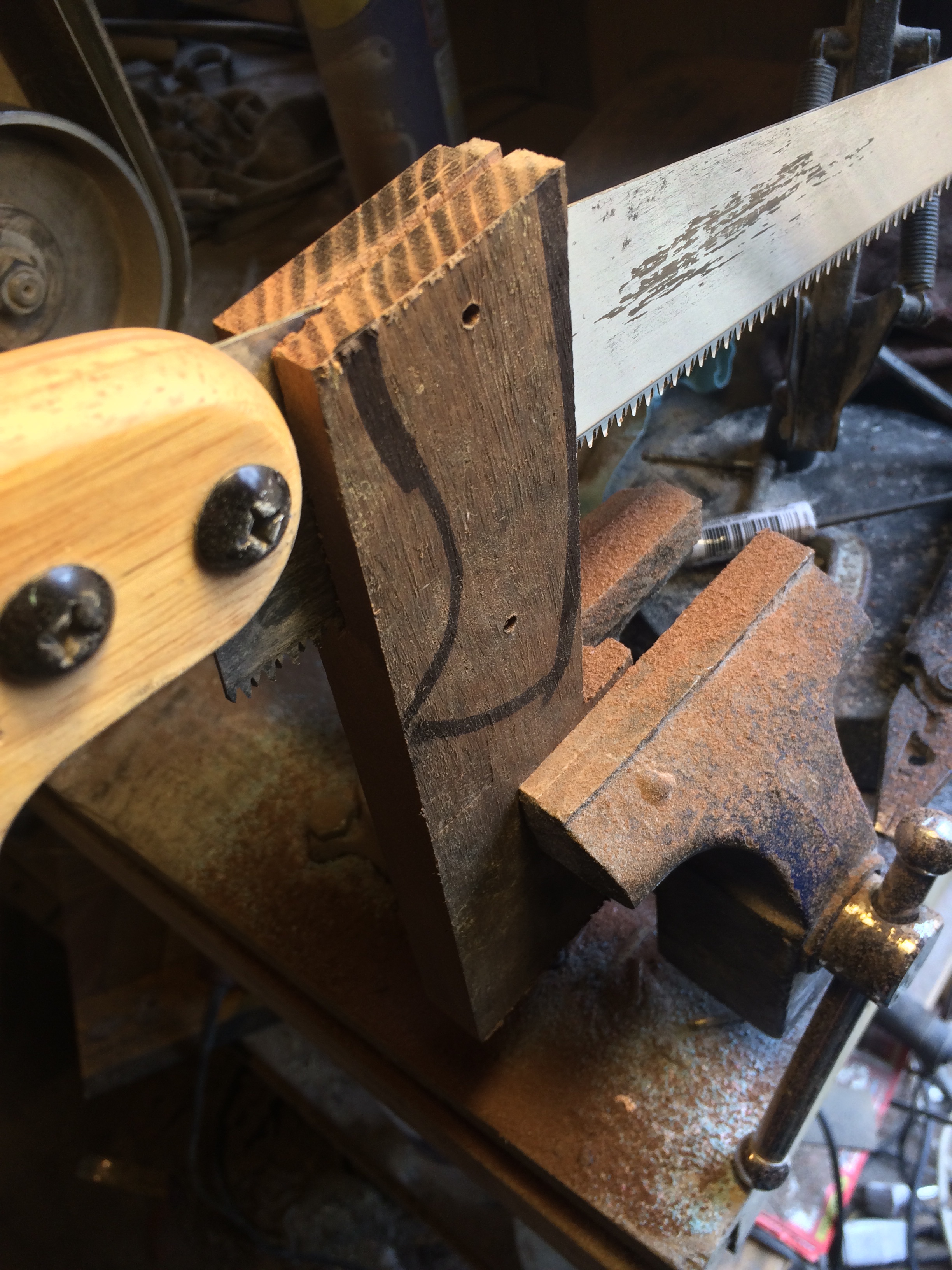
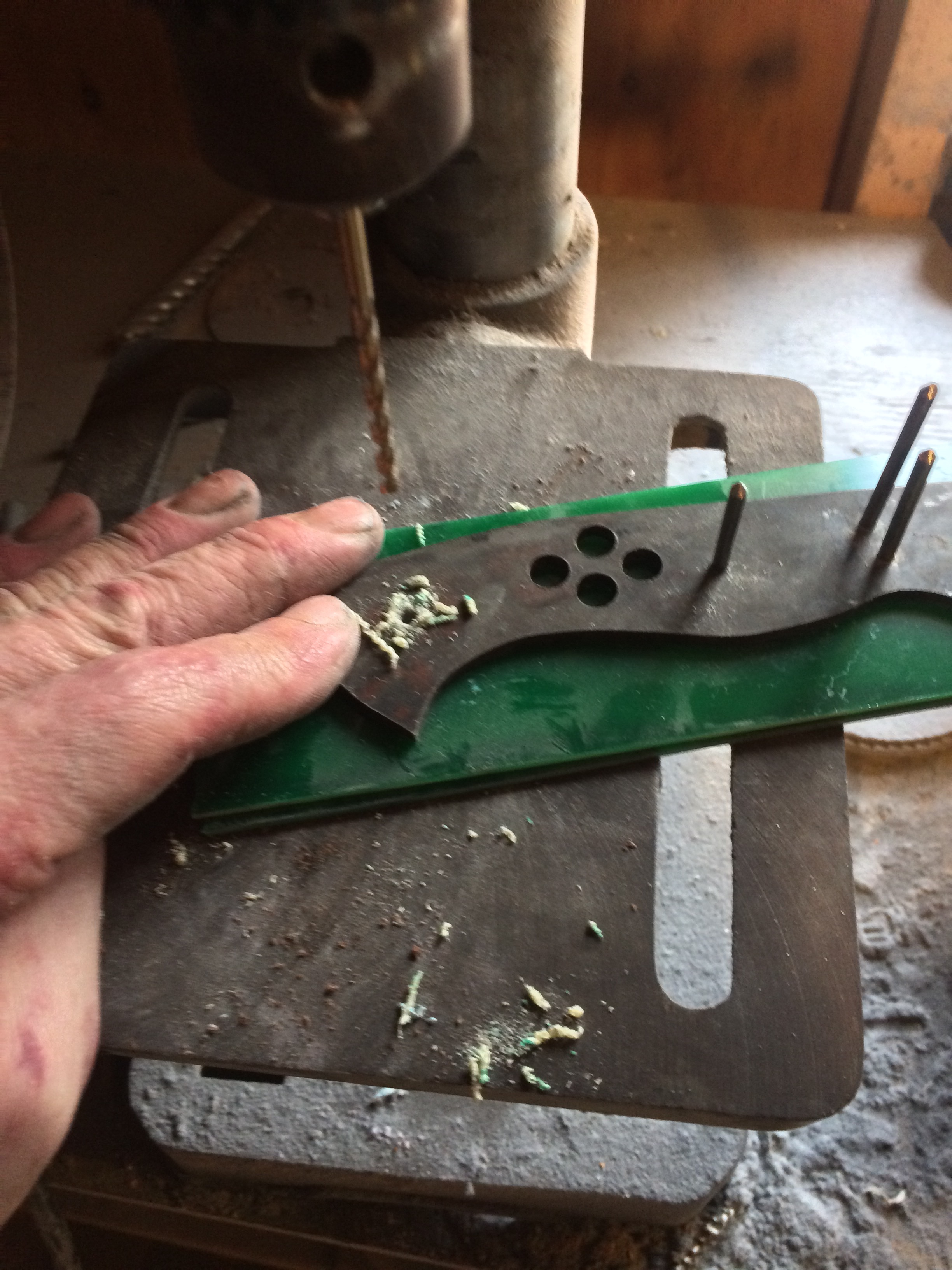
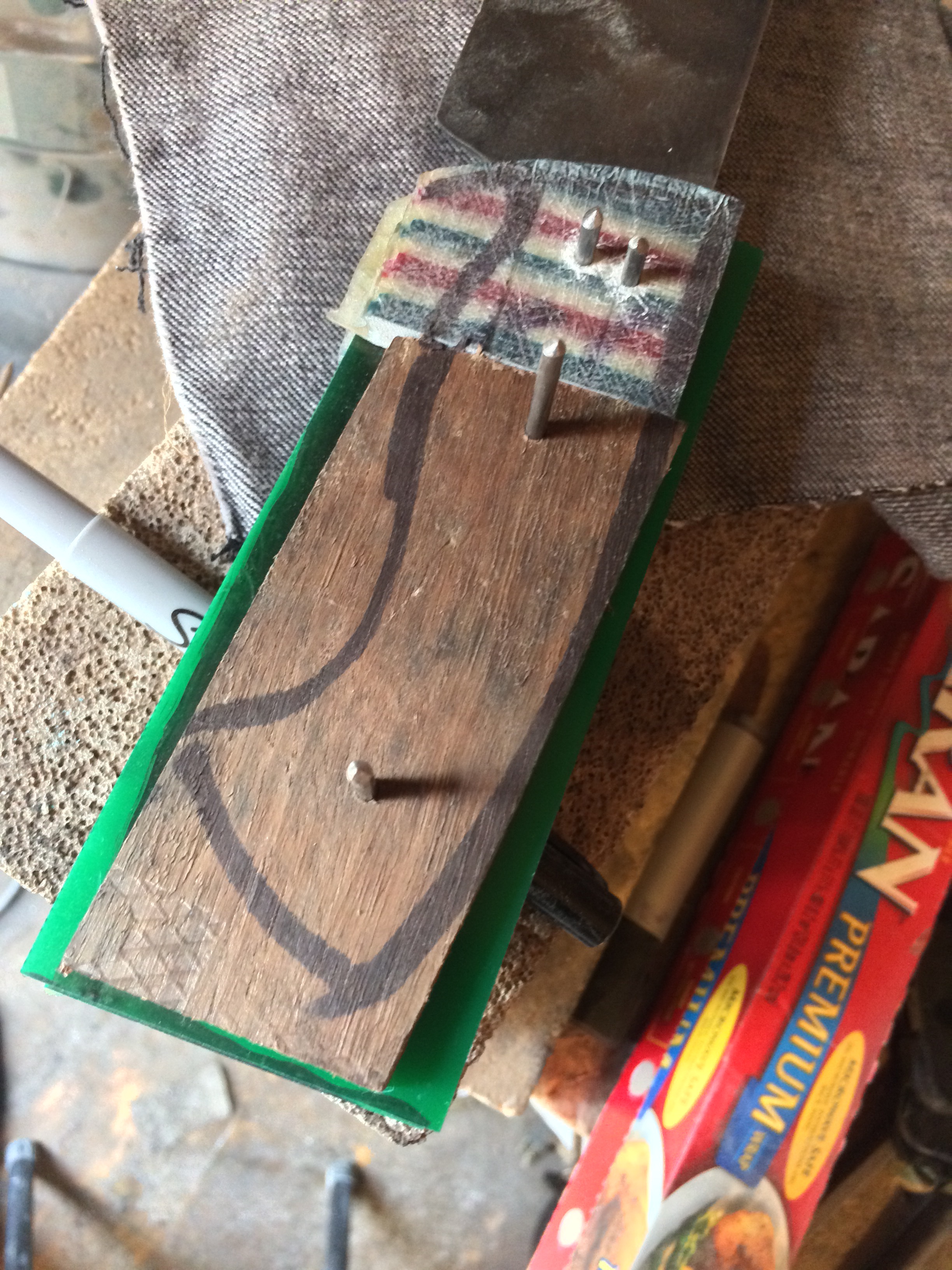
It makes for a better fit if the holes are drilled now before the scales are cut:
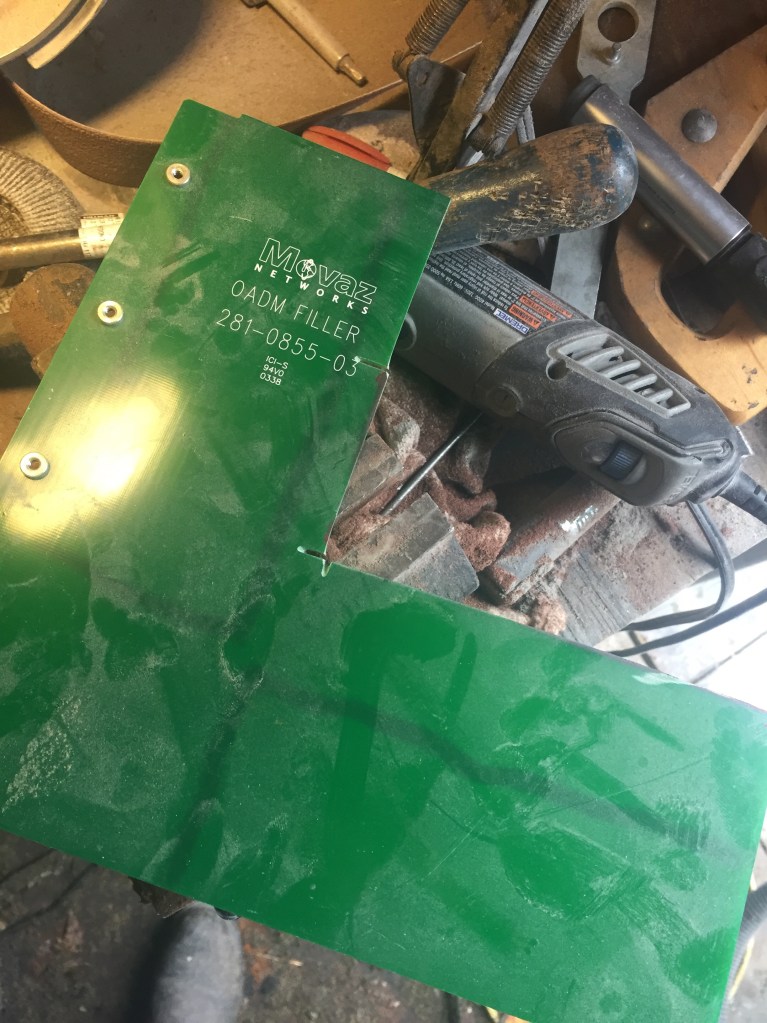
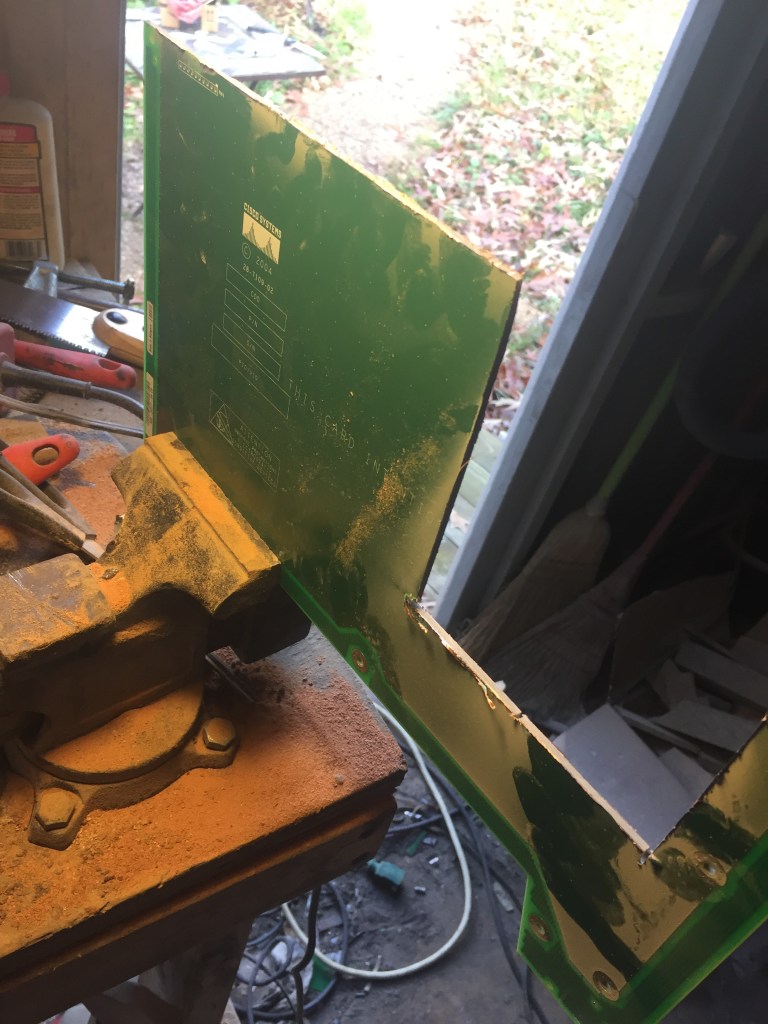
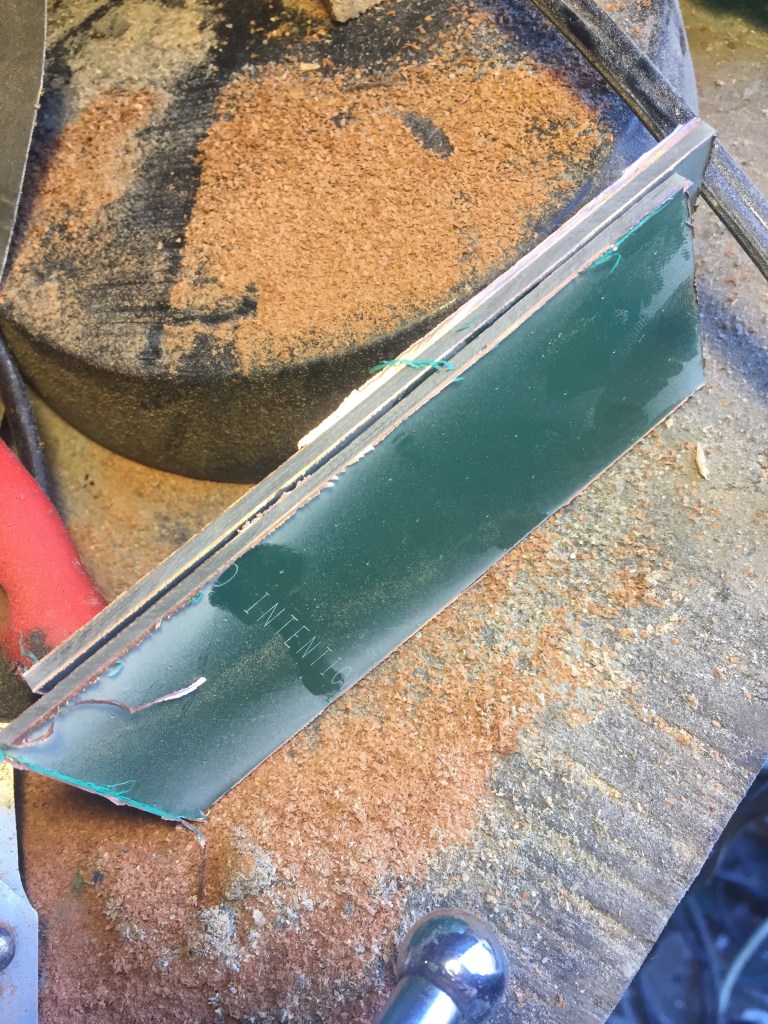
Circuit board blank for spacers:
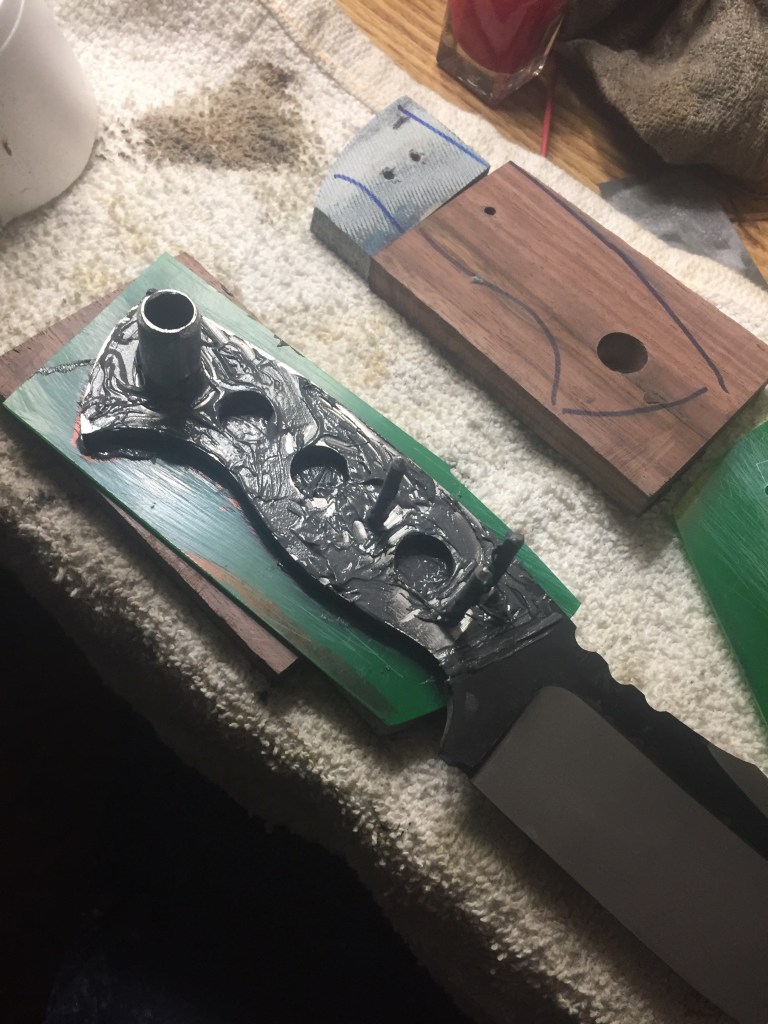
Finally everything fits:
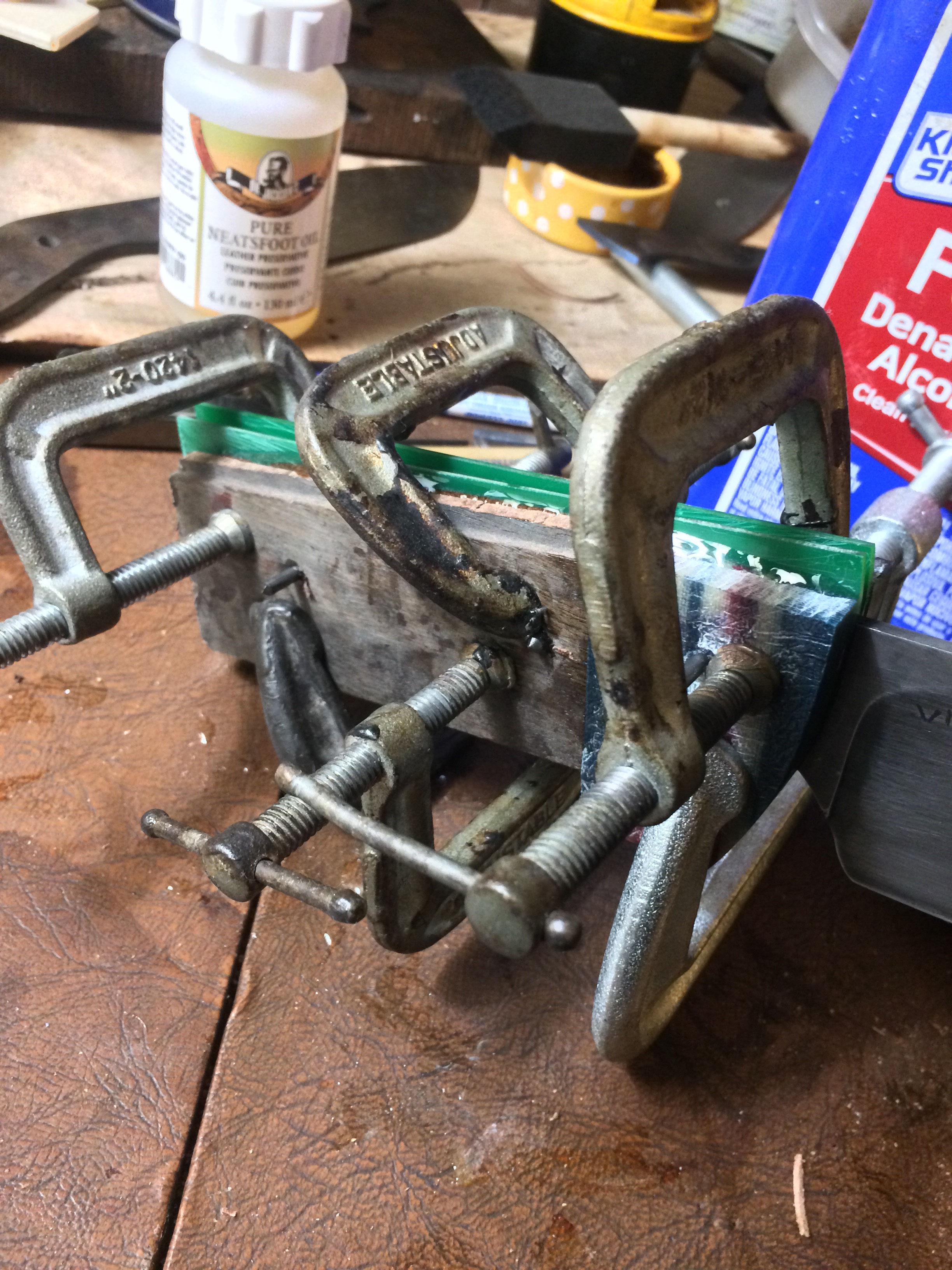
Prepping for glue-up:
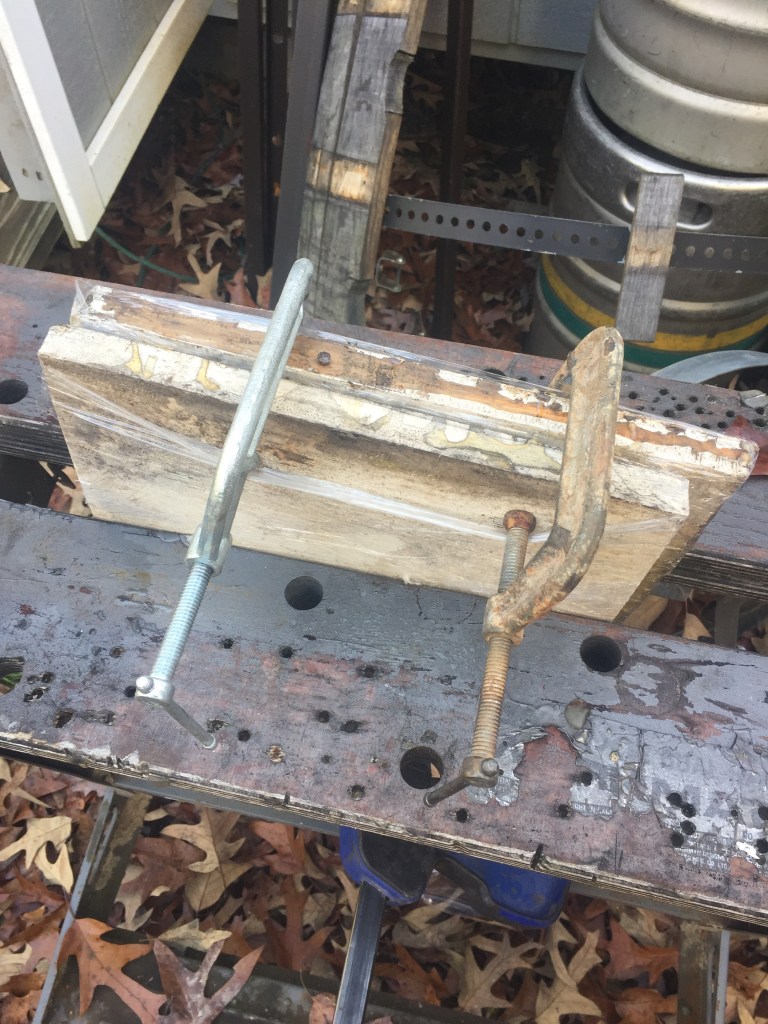
Glued and clamped:
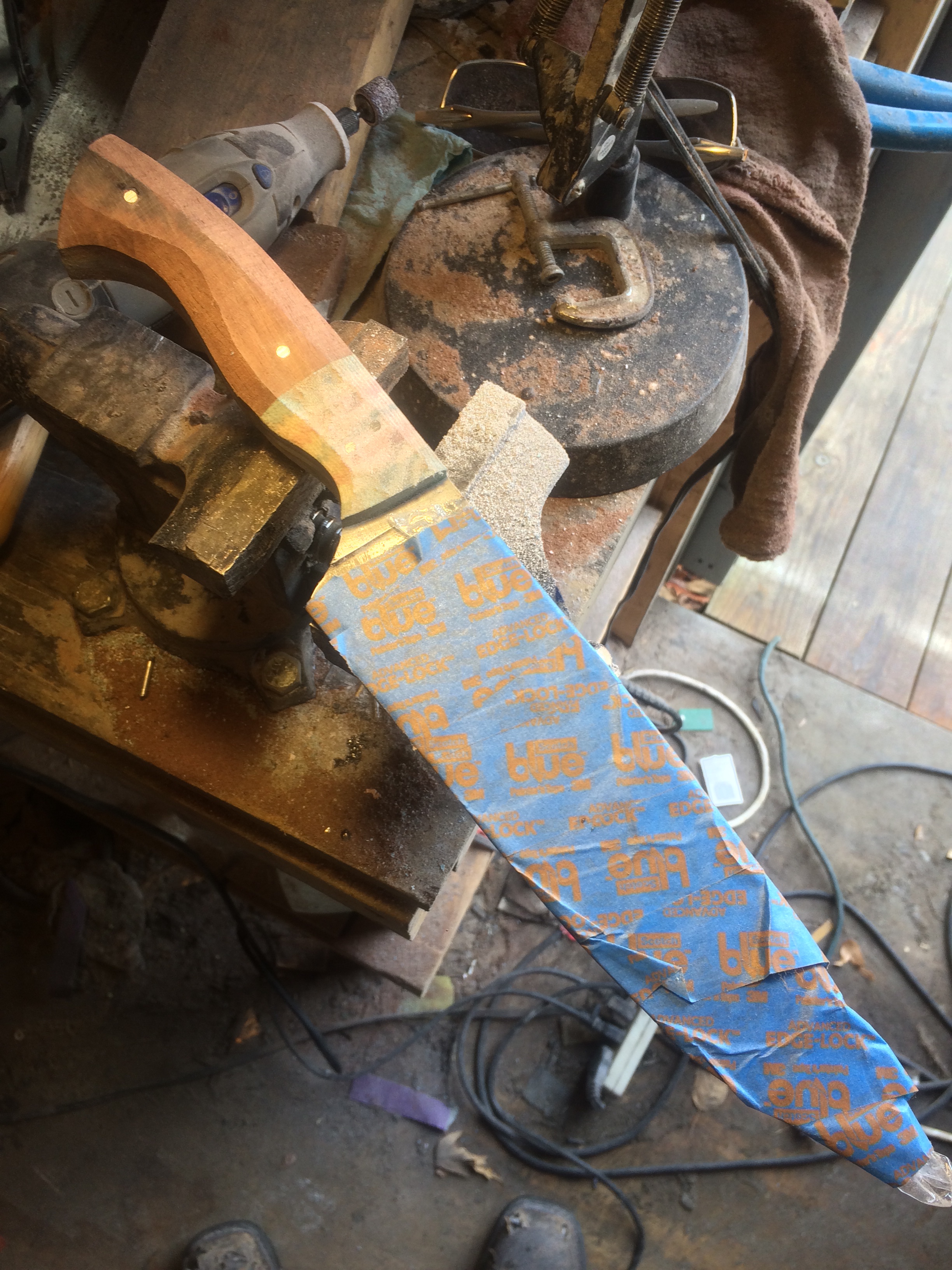
Profiling the handle:
Contouring for a comfortable fit. All sanding after this is done by hand:






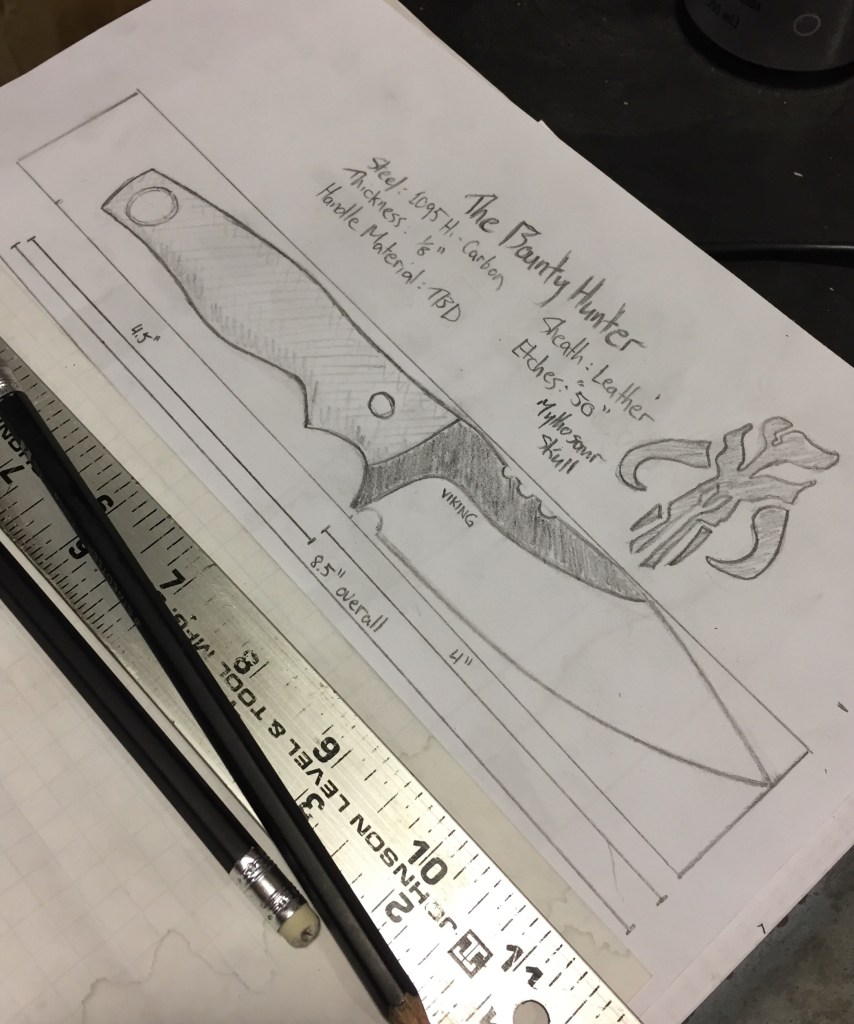


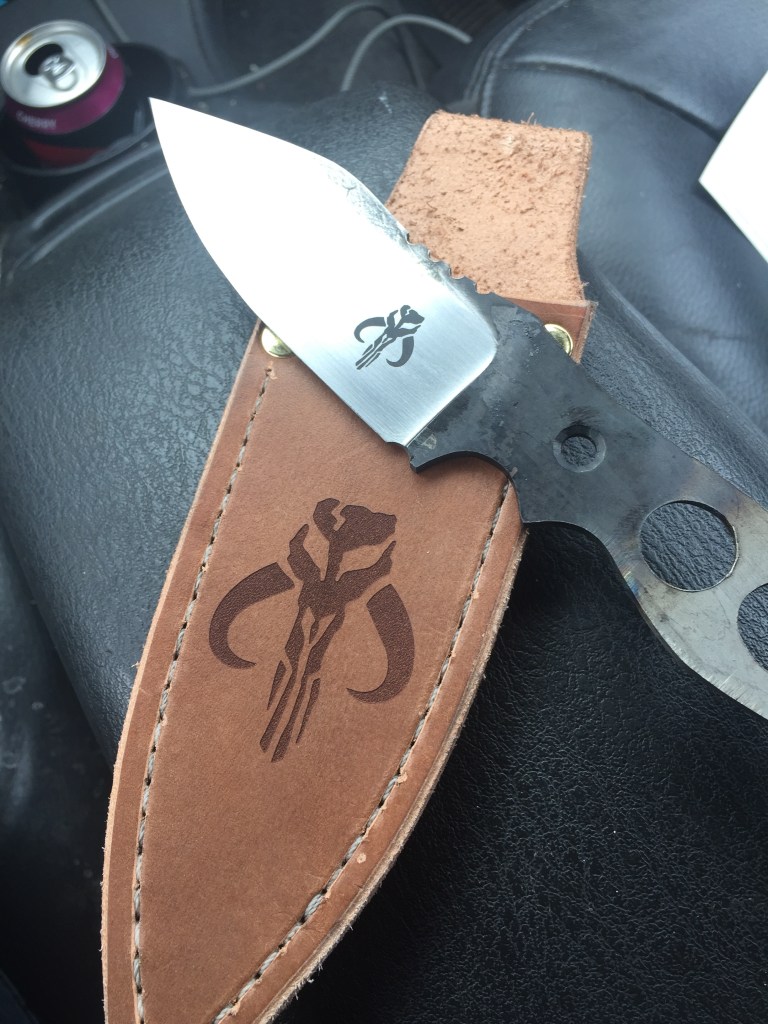


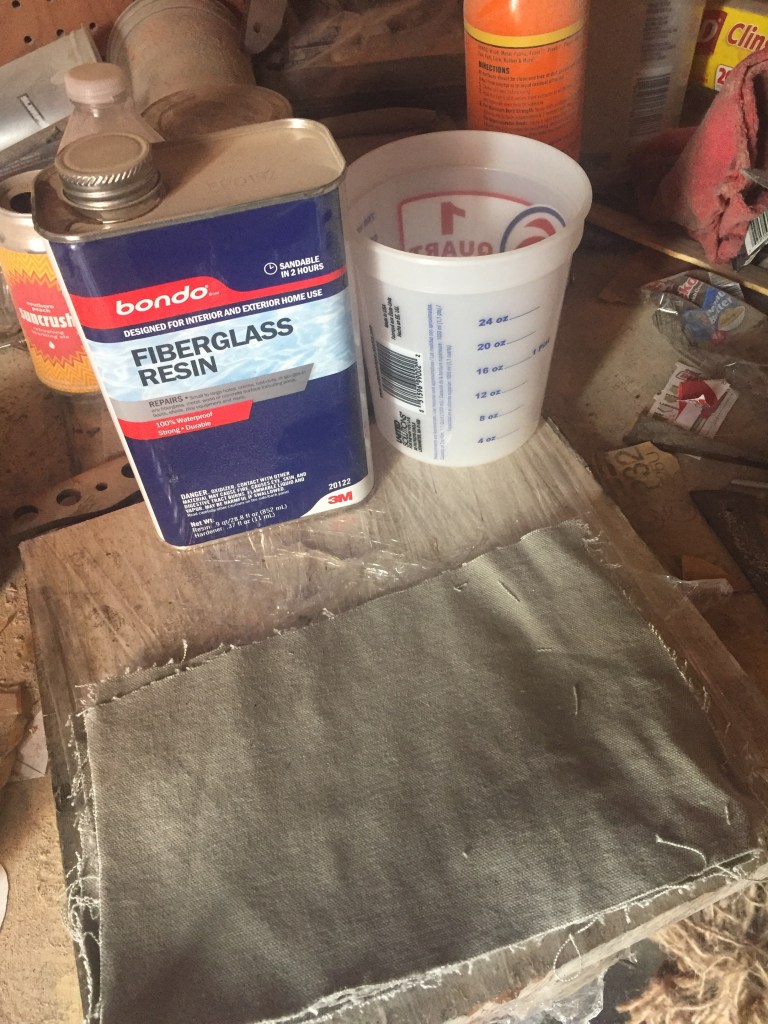

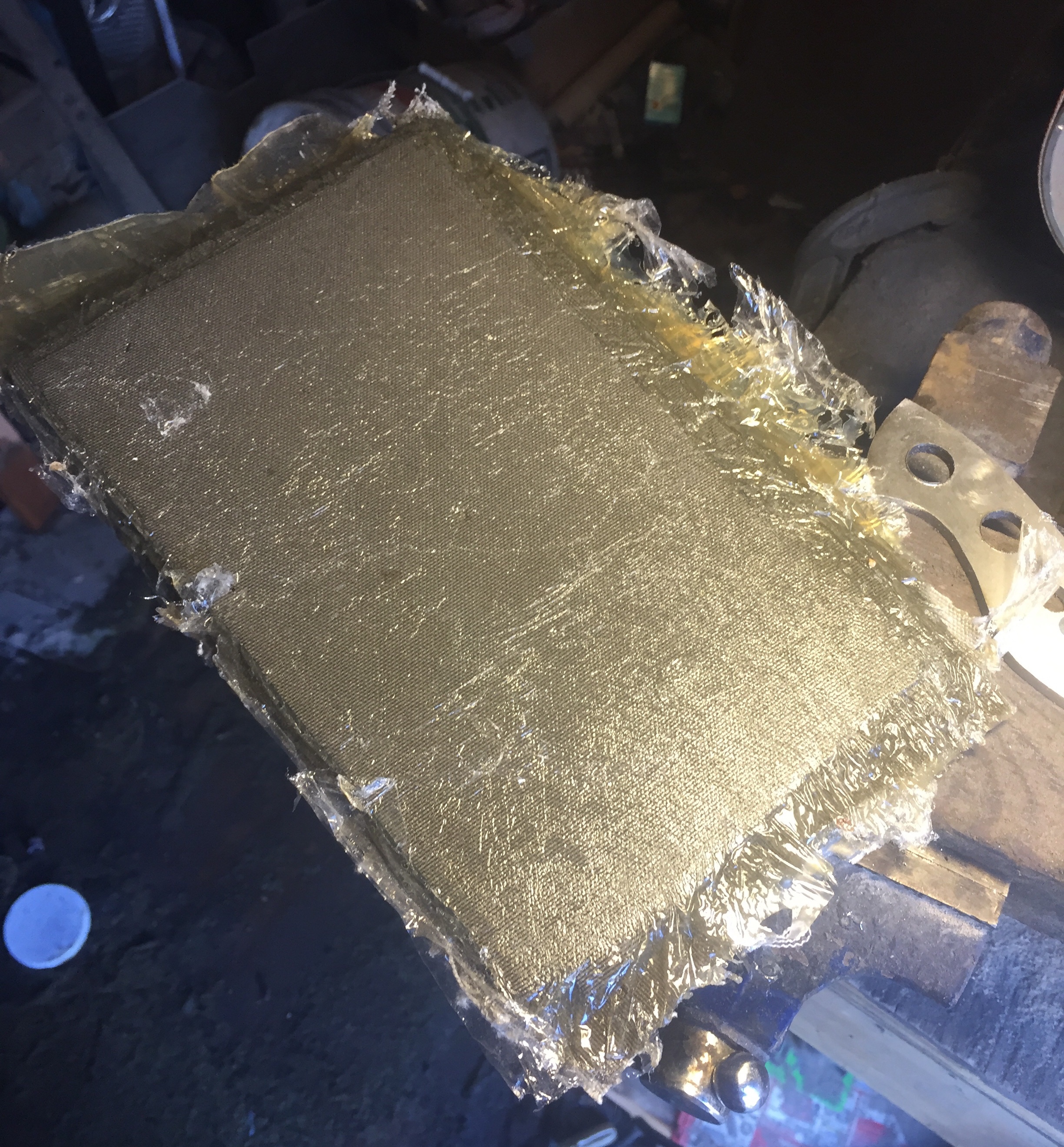







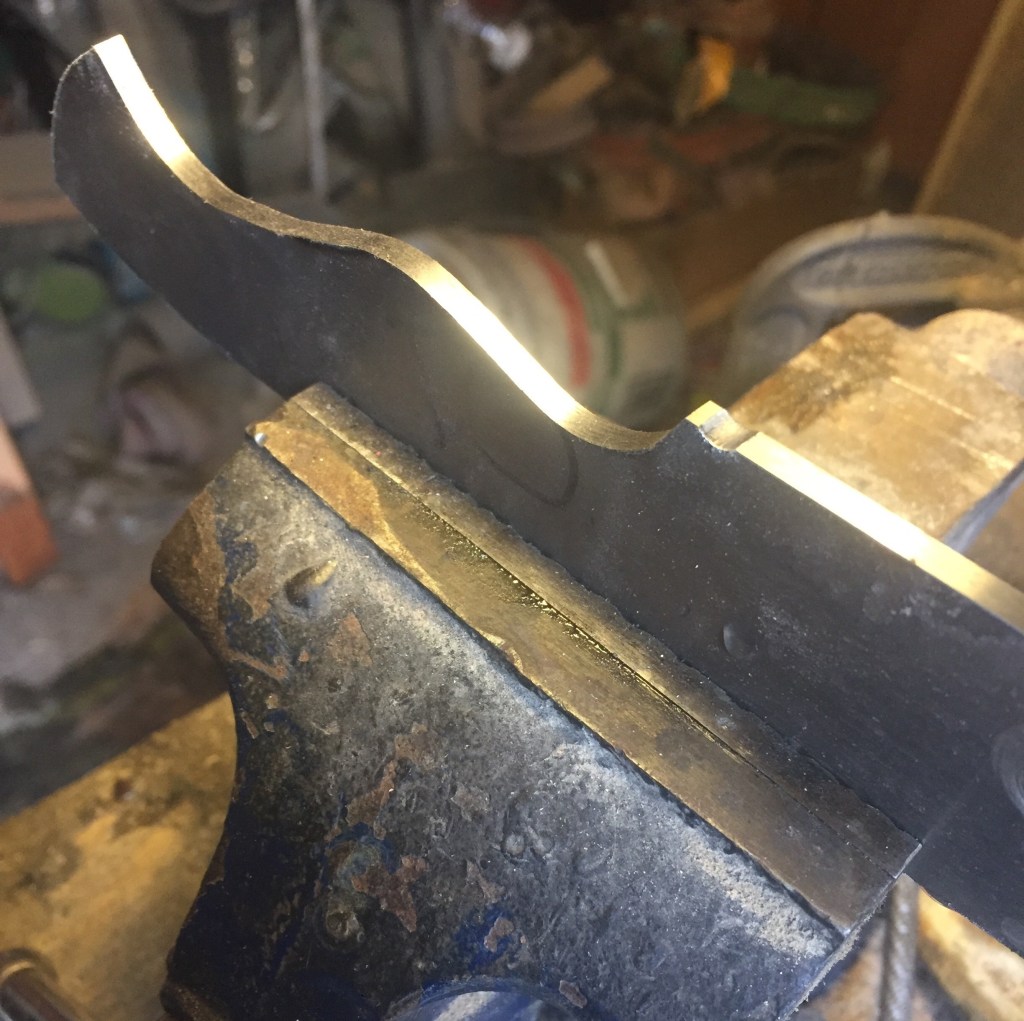


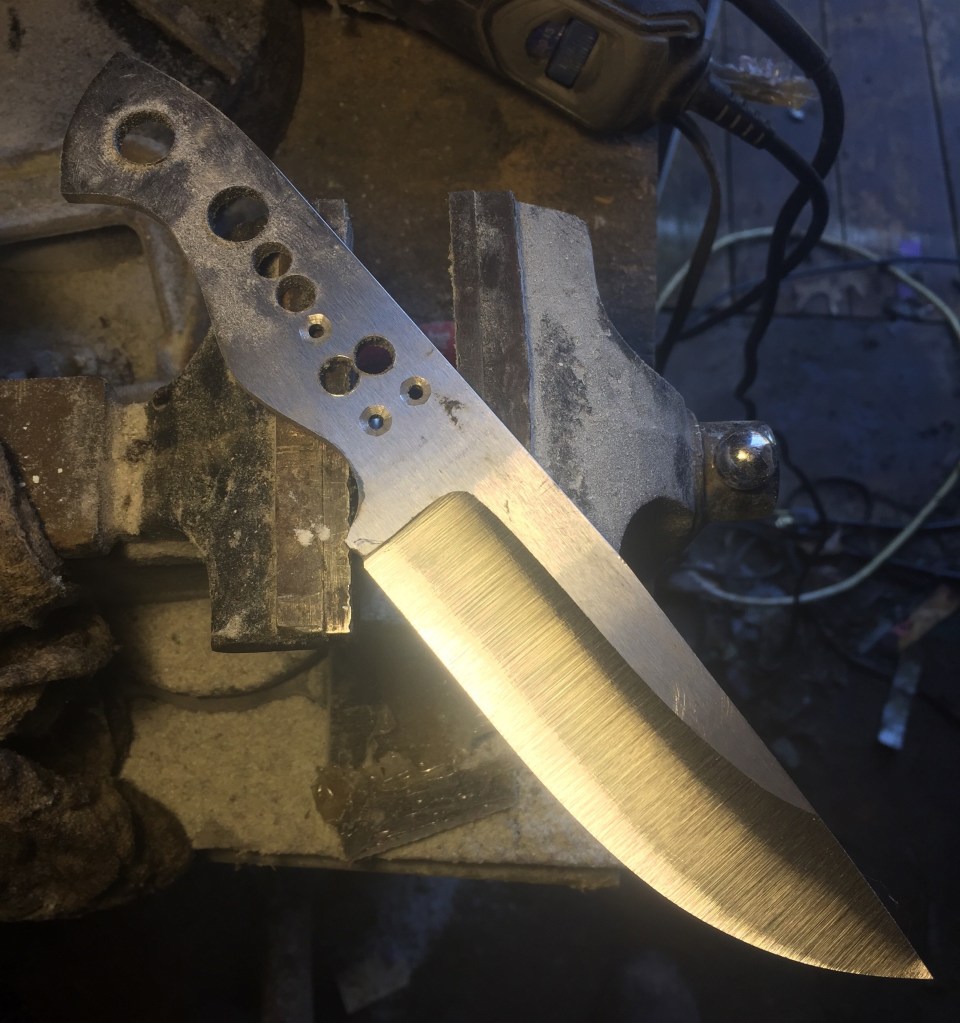
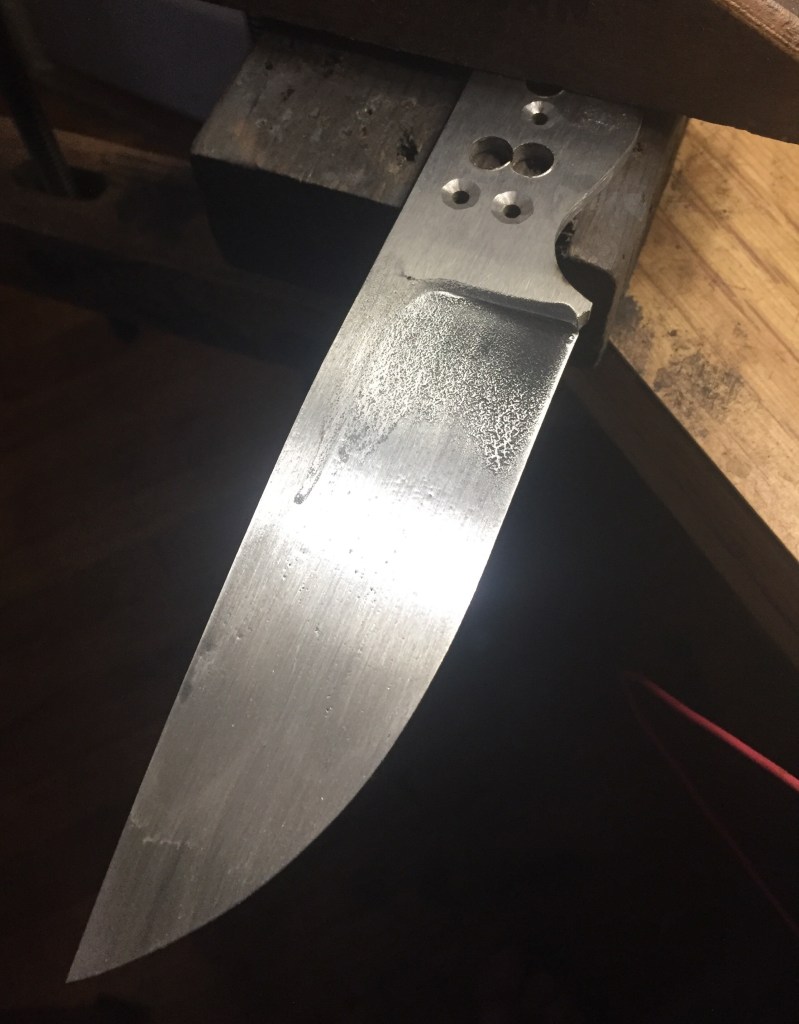
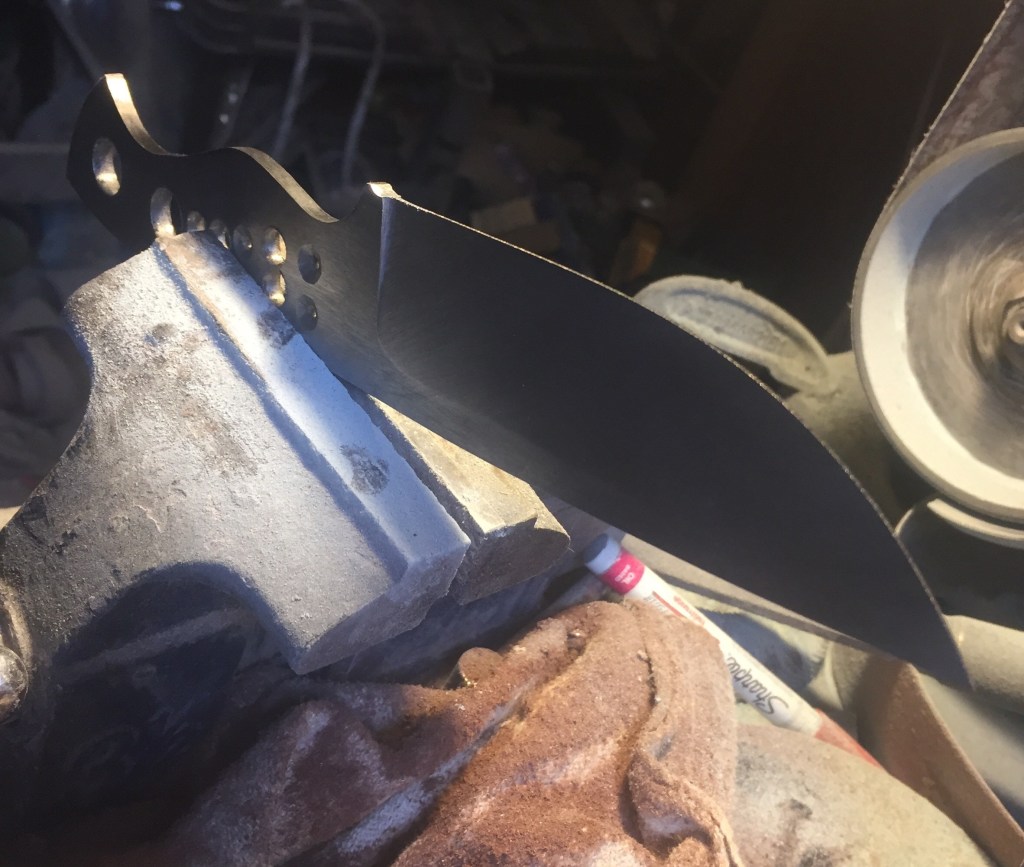














































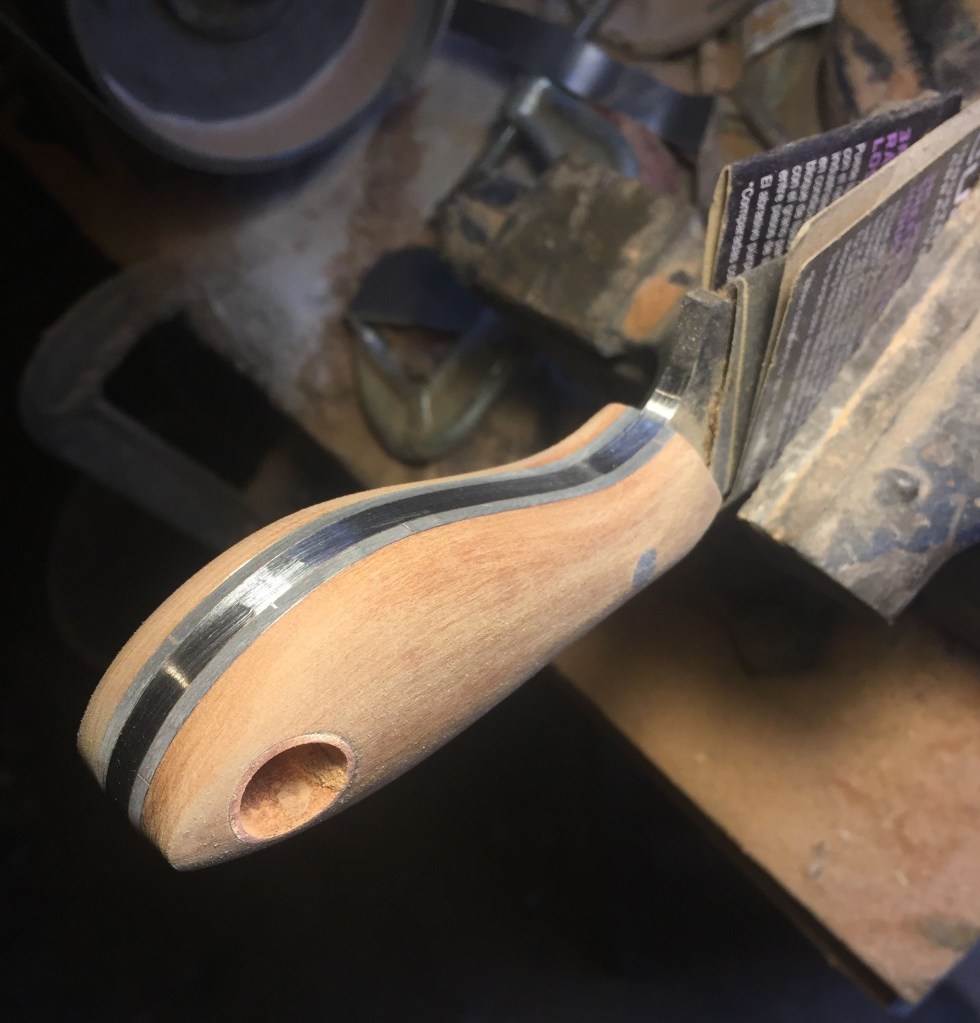

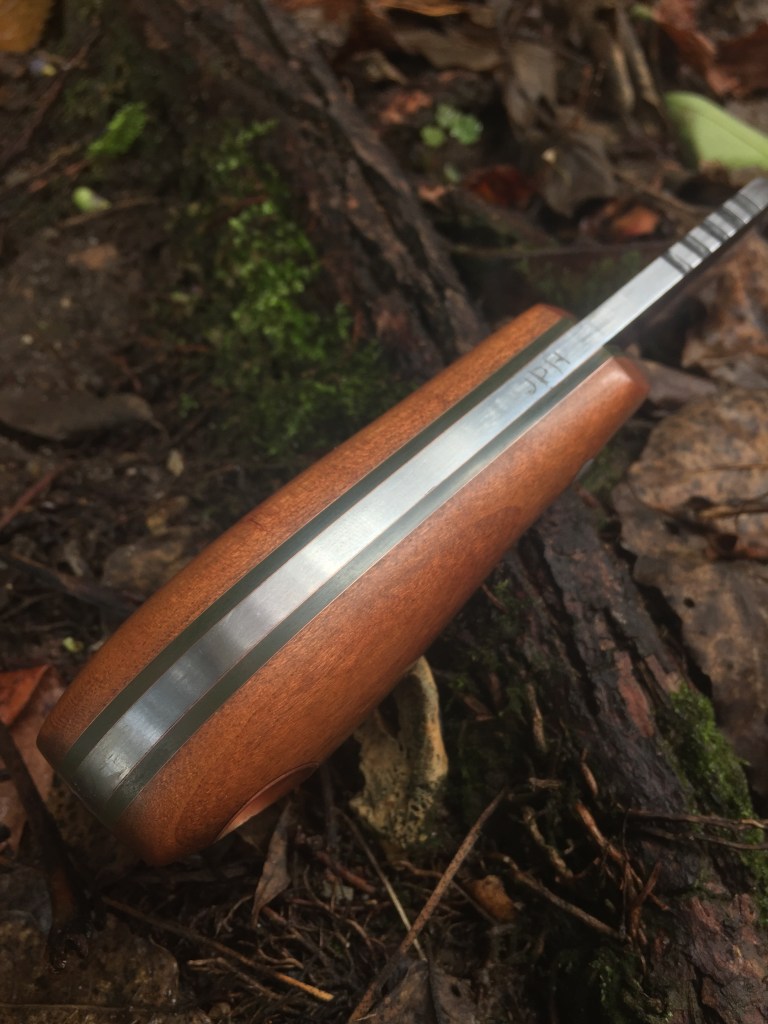
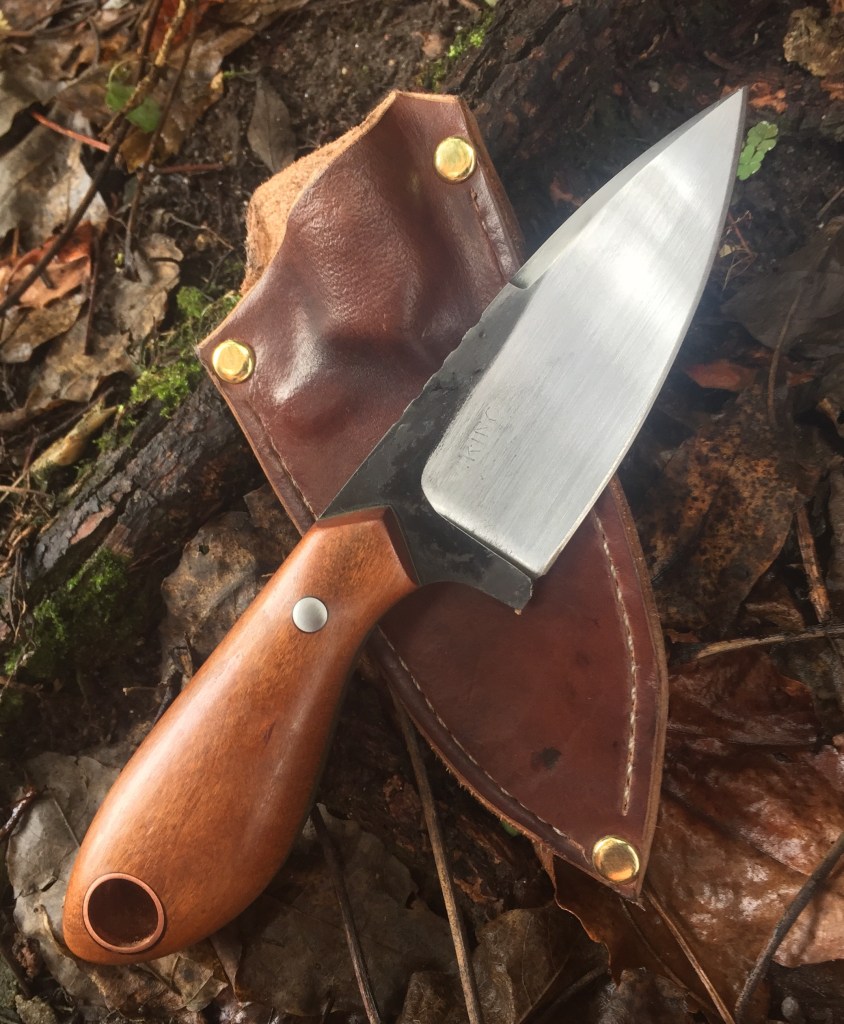

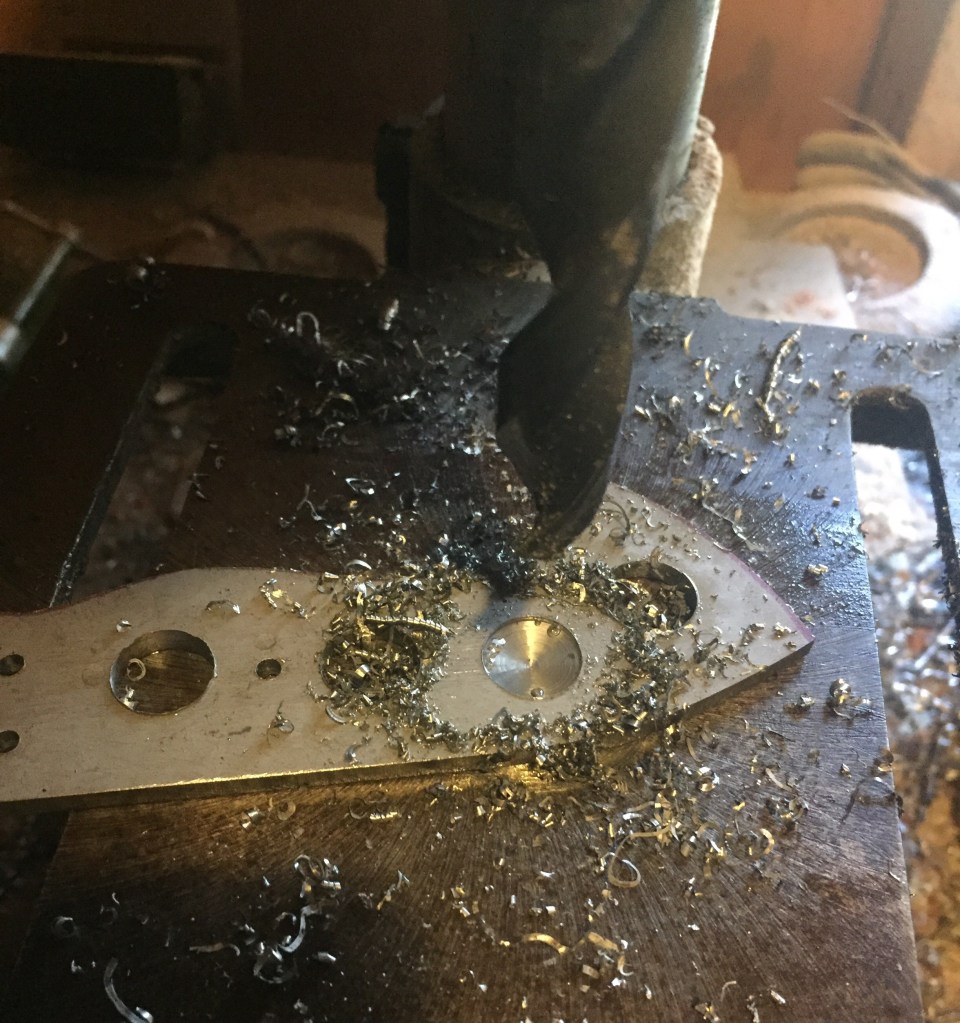









































 groundedinfire