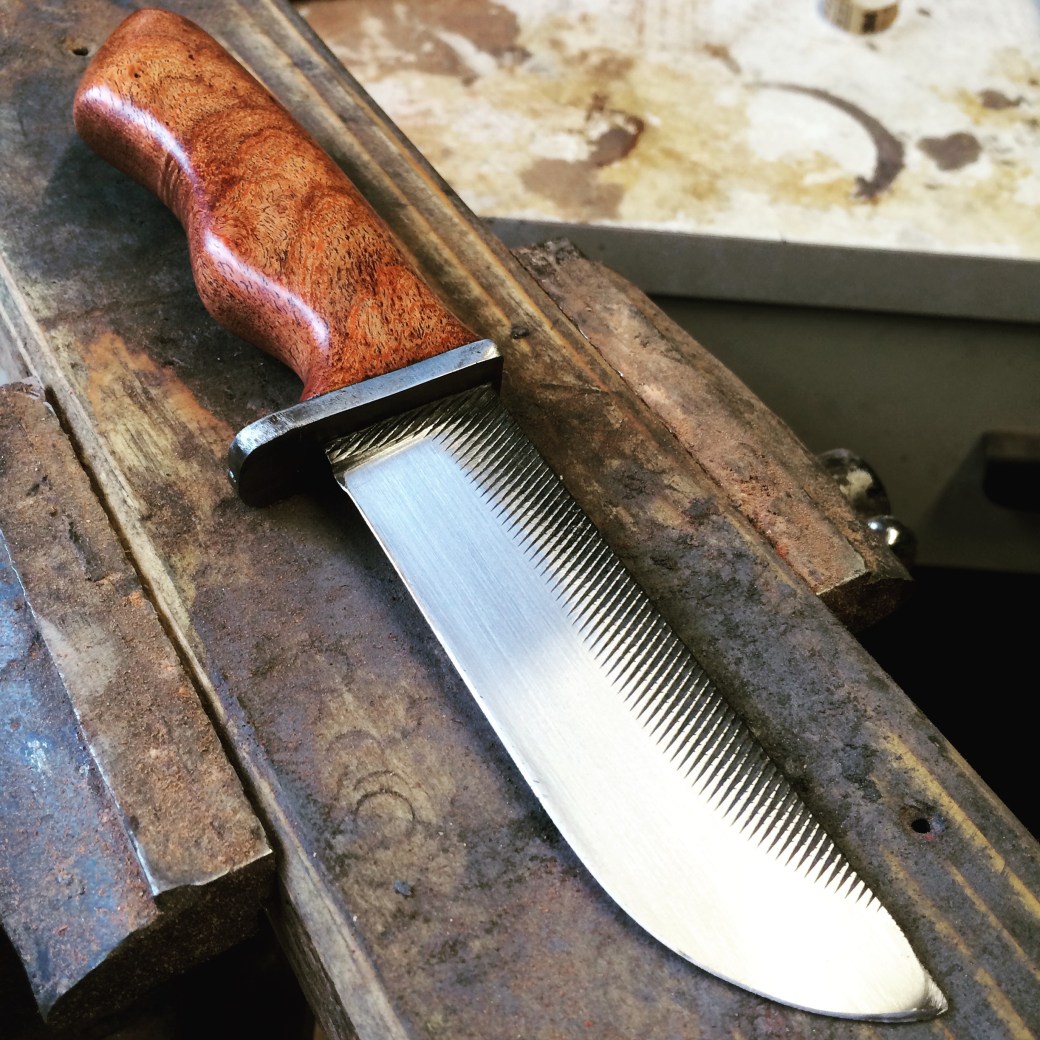
Knifemaking: hardening and tempering and the Hound, Mark III

“Only people who are capable of loving strongly can also suffer great sorrow, but this same necessity of loving serves to counteract their grief and heals them.”

― Leo Tolstoy

One of the main things that drew me to the craft of bladesmithing is the process of heat treating- the process that hardens and strengthens the steel into something strong and functional.  I find it to be a reflection of the male psyche.  The steel comes to you soft and impressionable- just as we are when we are young.  It’s much easier to work the steel when it is soft, or annealed, than when it is hardened.  You then shape and grind the steel as you see fit- this is growing up and finding your place in the world.  Depending on how well you are or are not equipped, it could take a long time.  Through a process of slow heating and quick cooling the steel becomes hardened- our adult selves.  Though it is extremely hard, it also extremely brittle- it will shatter if dropped.  This is where the process stops for some people.  A brittle blade looks like a knife, feels like a knife, and will cut like a knife.  Appearances are deceiving and without proper tempering this piece of metal that resembles a knife will crumble under stress and will be unsalvageable.  So it is with some men.  When crafting a blade, you don’t let it crumble- it goes straight into low heat for several hours to draw out the stress from the hardening process and becomes flexible and durable.  In the male pysche, crumbling is part of the tempering process.  This is where our flex and bend comes from.  Like the tempering process of a blade it takes a long time.  This is the ethos behind my craft.

I also find it to be a reflection of the healing process from pain, trauma, and grief.  When any of these occur it is important to be with these things, and to be with those close to you who may be struggling to be with these things.  There is a really beautiful blog by Tim Lawrence.  He says these things are meant to be carried, and that this process of carrying our pain and trauma and grief can harden us.  I’ve experienced this in dealing with my own areas of grief, and trauma, and pain.  In this hardening it felt like I lost some things.  There were times when I couldn’t find my hope, or my light, or my path.  There were times when I couldn’t find my love, my self-worth, or my joy.  Everything was brittle.  Like the steel, these things you have experienced have hardened you, affecting you deep down into the molecules of your being.  This is where tempering can happen.  It takes time.  There was an awful bout of hardening I went through about a decade ago and I couldn’t get off the couch.  For about six months on that couch I watched nothing but the Food Network.  One day, after six months of Jamie Oliver, Curtis Stone, and Mario Batali, something made me get up and start cooking.  There were roux’s of many different varieties, soups, stews, crepes, and dim sum.  I started baking bread.  I invited friends over.  I worked more, found joy, and ways to laugh again.  Pain was still there, and would come again as it always does.  Hardness was still there but there was a bit more flex and bend and less brittleness.  Those things I thought were lost had never left, most especially not the love.

I still like to cook.

There can be many things that help to temper us after a hardening.

This is the lesson of this incarnation of the Hound.  The hardness doesn’t go away- but it can be tempered into something with the ability to bend without breaking.  This is the mark of a Warrior.  Be the Knife.

Shaping and rough grinding: To create a strong blade, I took a page from the Japanese swordsmiths who crafted the weapons and tools of the Samurai.  For these swordsmiths, the process was a spiritual experience.  Every authentic Japanese blade features a temper line, called a Hamon, which translated from Japanese means “blade pattern”.

The spine of the blade is covered in clay while the cutting edge is left bare.  The blade is then hardened.  When in the fire, the bare cutting edge will reach critical temperature for hardening while the clay coated spine does not.  What results is a differentially hardened blade.  The softer spine has more flex and bend while the blade edge is fully hardened.  This makes for an incredibly tough sword that is far less likely to break but just as deadly as a fully hardened blade.

I cheated a bit and used furnace mortar instead of clay….

I gooped it onto the parts of the blade not crucial to slicing and stuck it in the oven to cure:
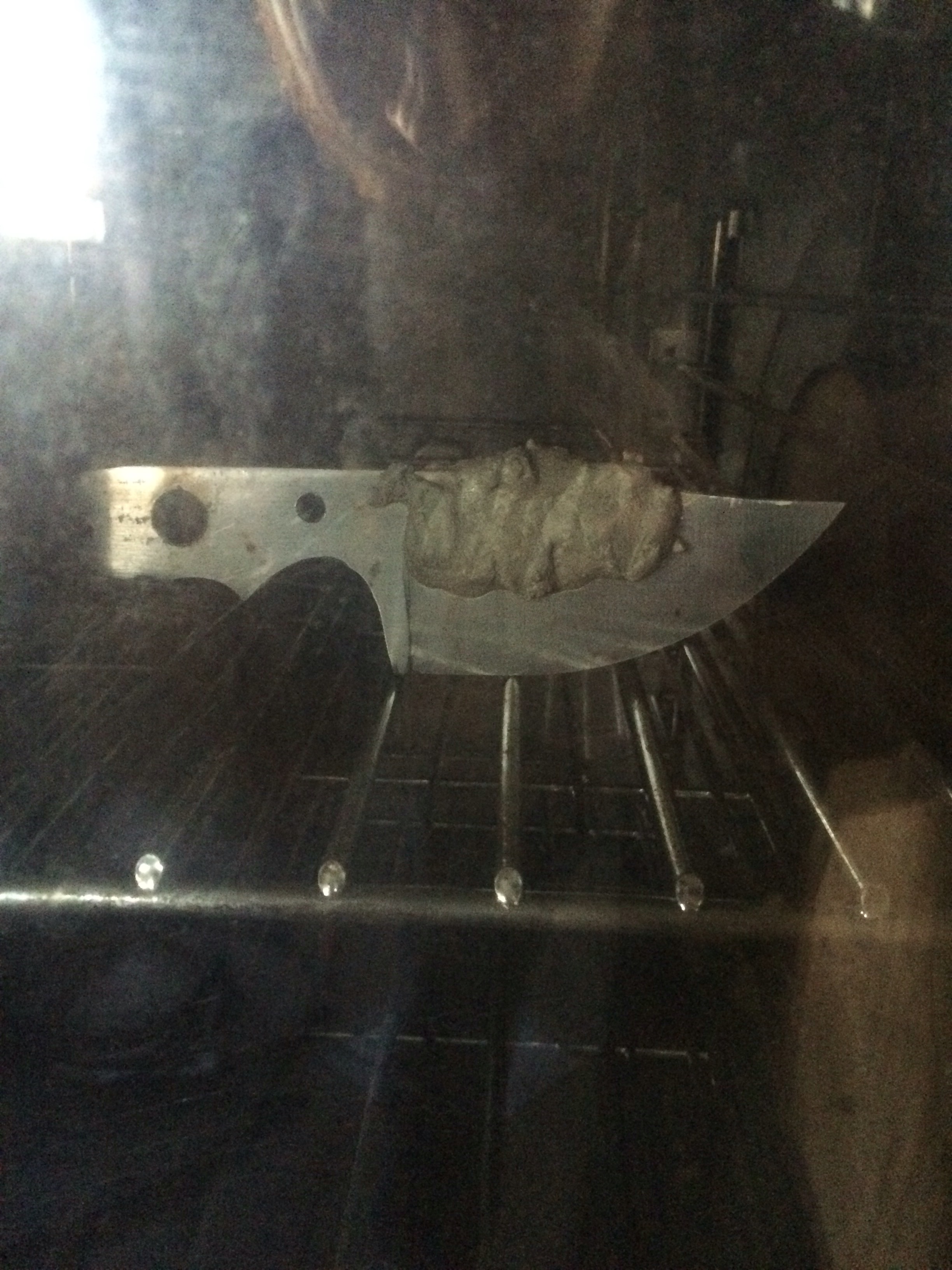
After the mortar is cured, she goes into the forge.

Hardened: 
  That tempering part, for flex and bend…
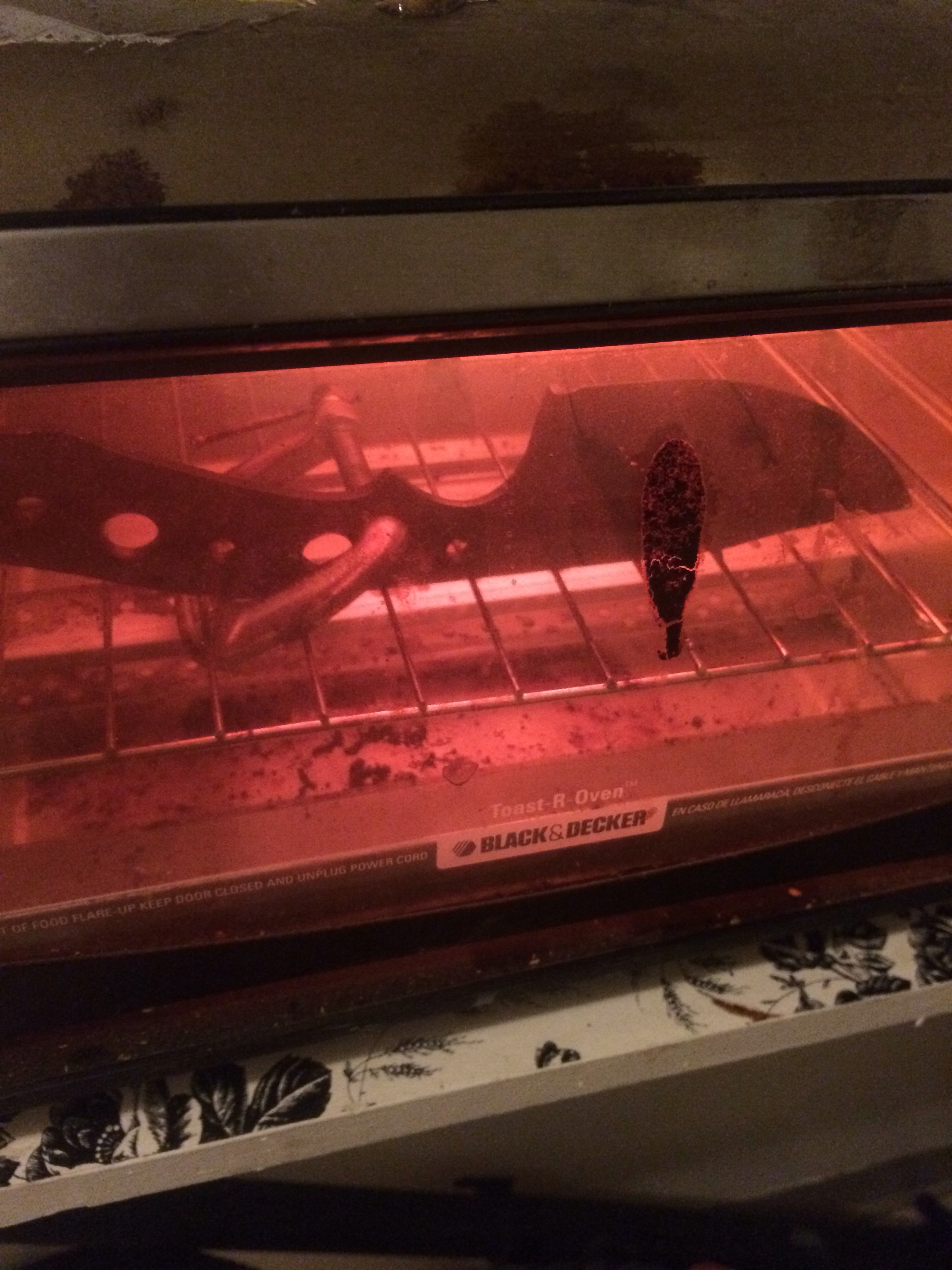
Thumb for scale….

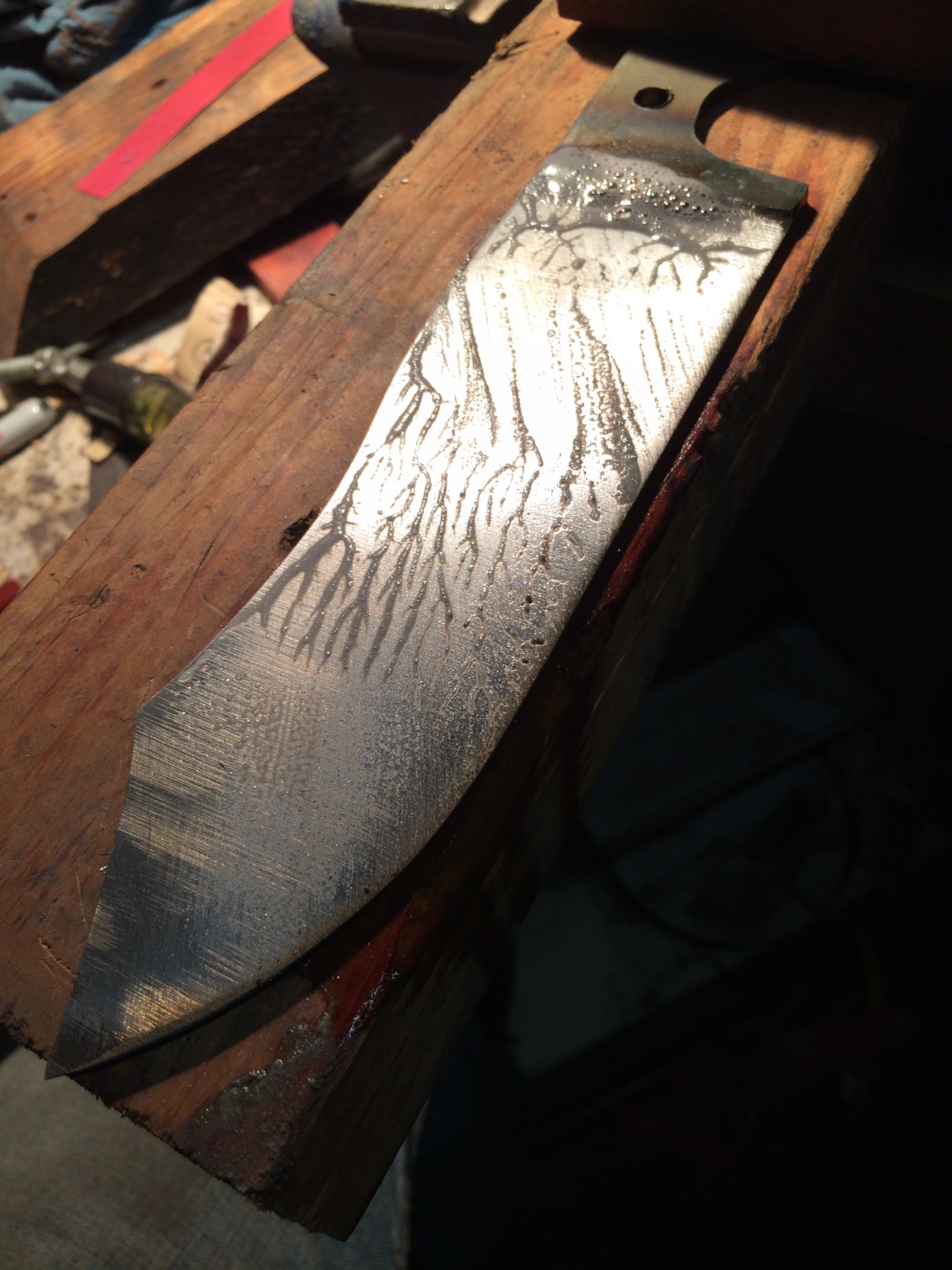
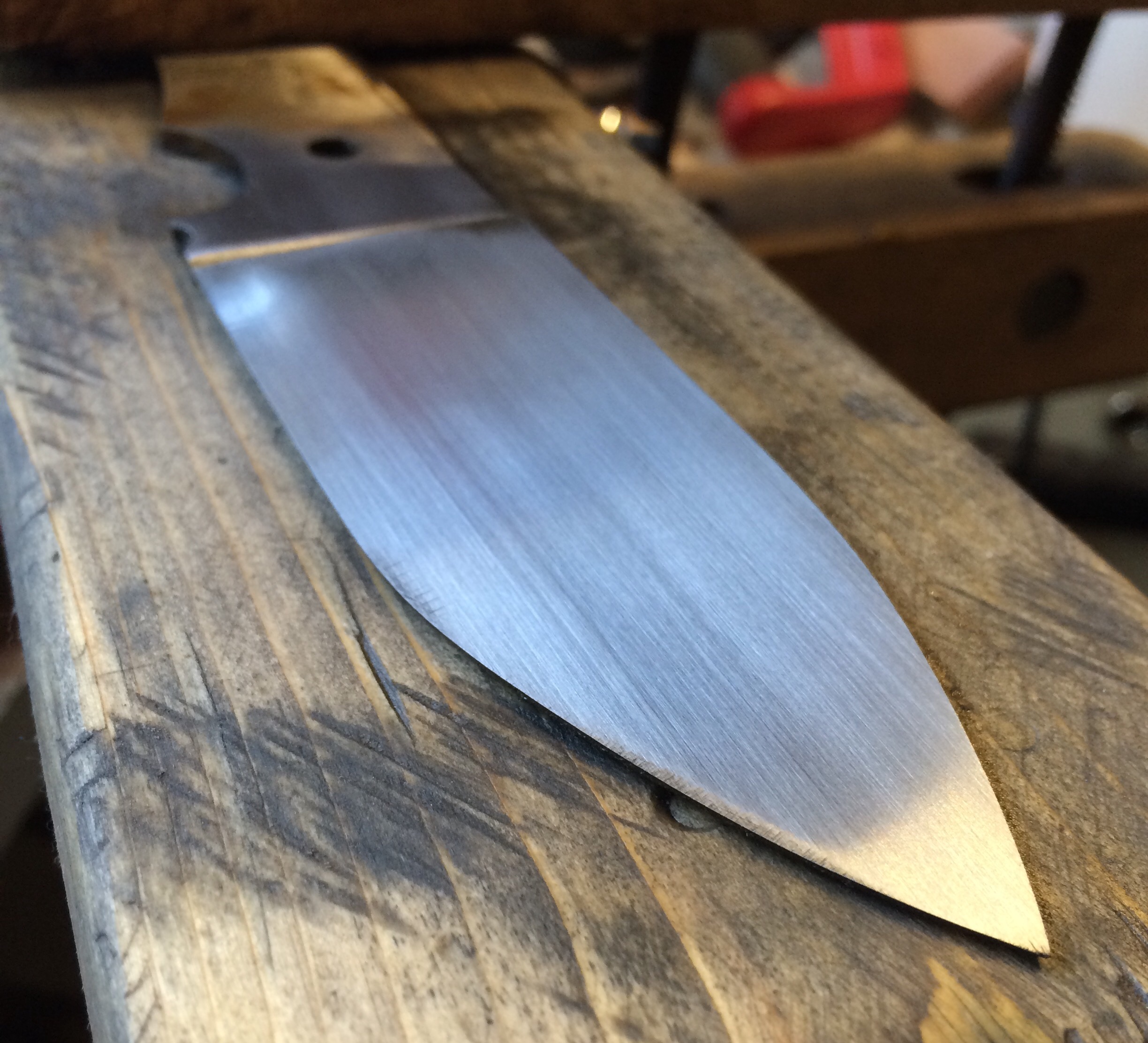
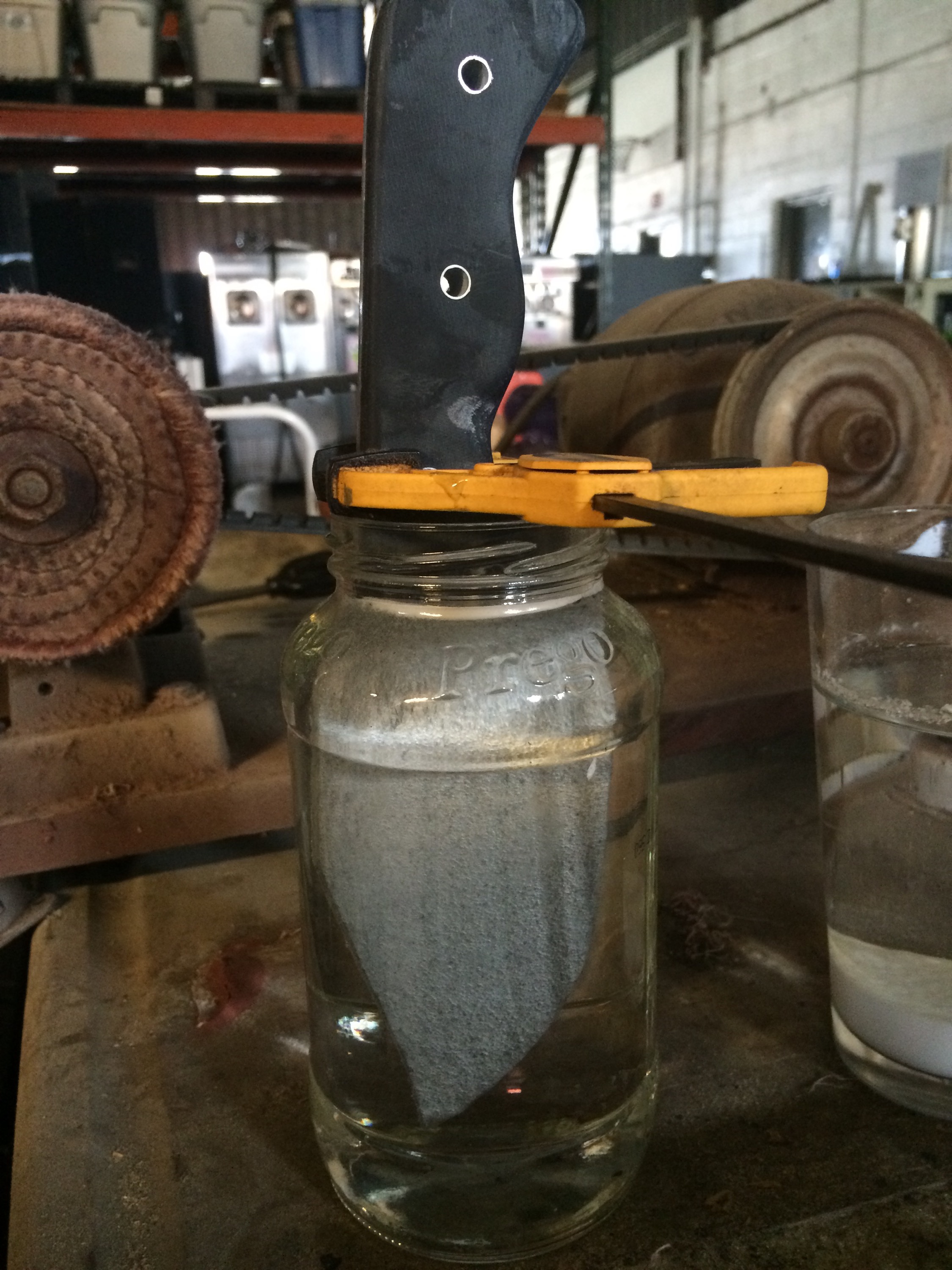
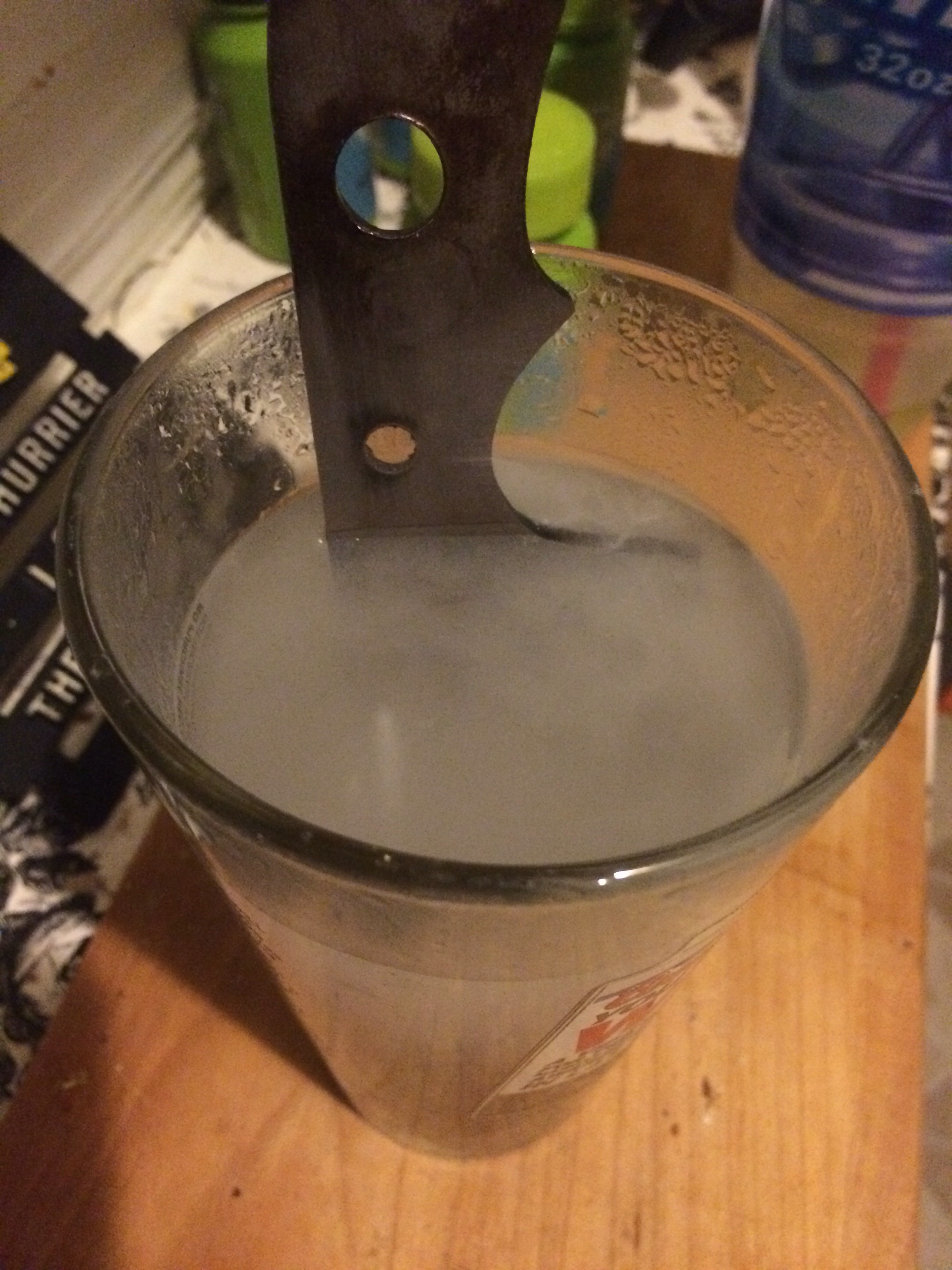
Into nearly boiling vinegar.  The vinegar eats away at the softer steel of the spine faster than it does the harder steel of the blade.  What results is a gorgeous line where the softer steel meets the harder…  Handle…


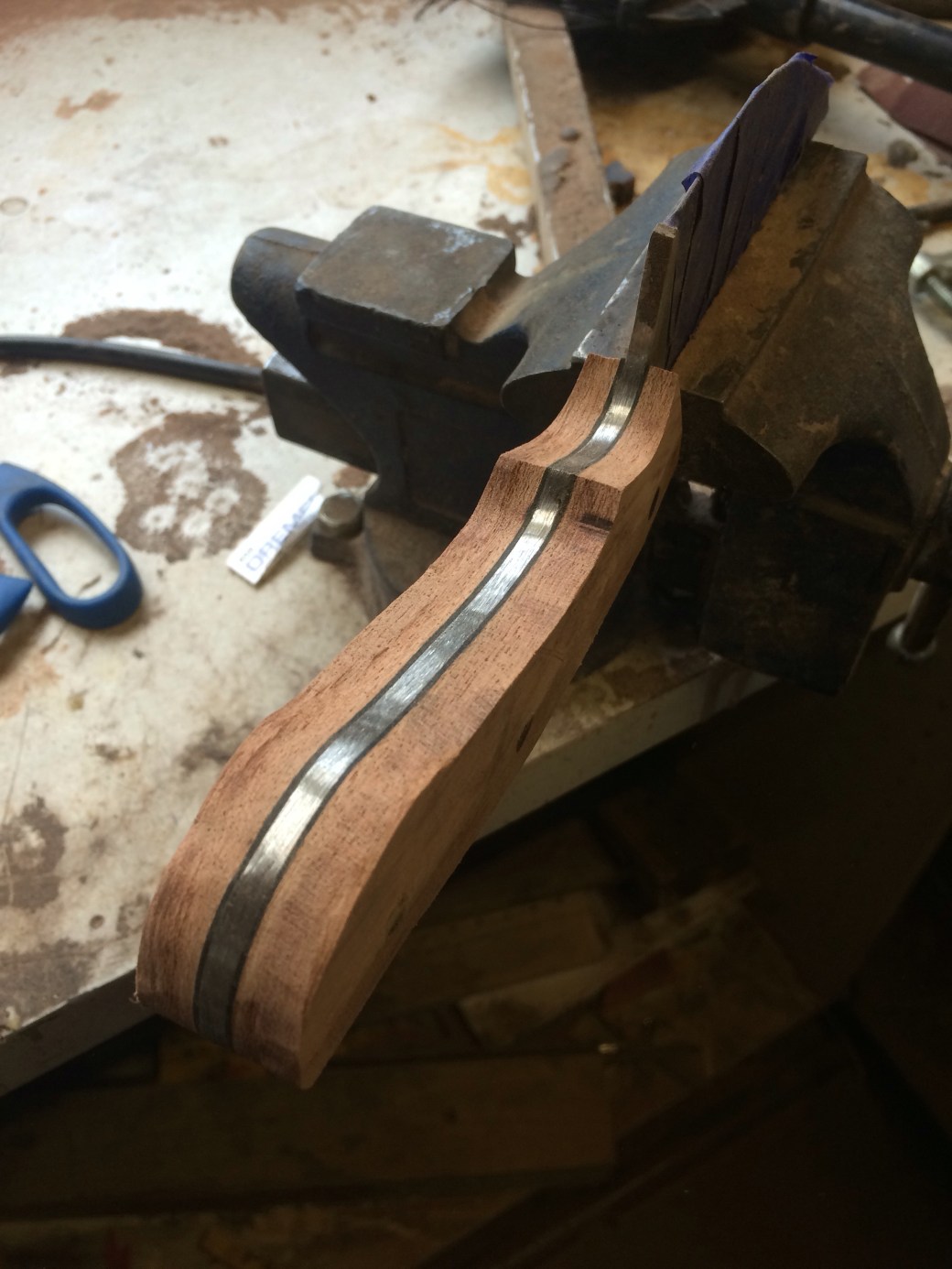
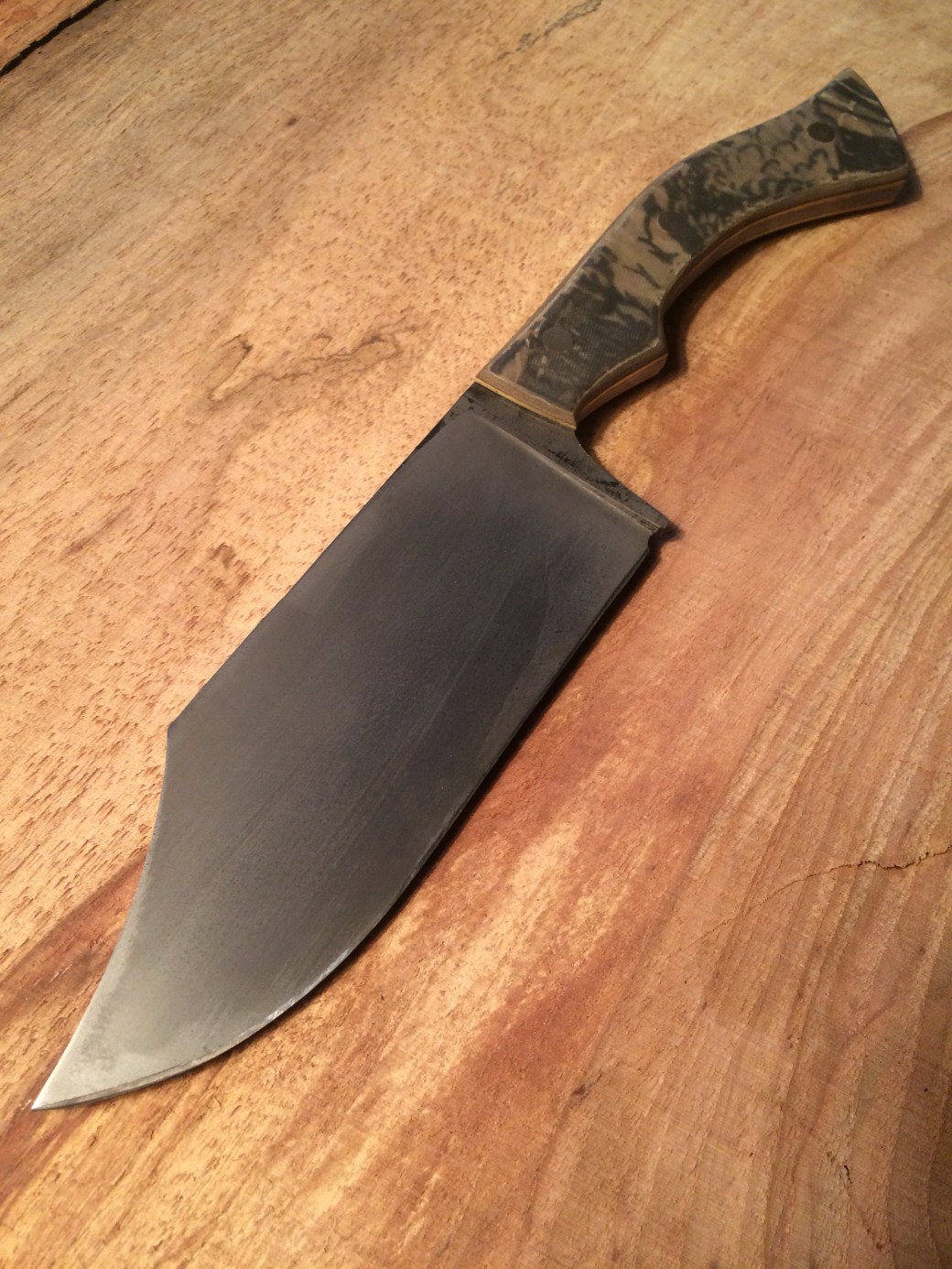
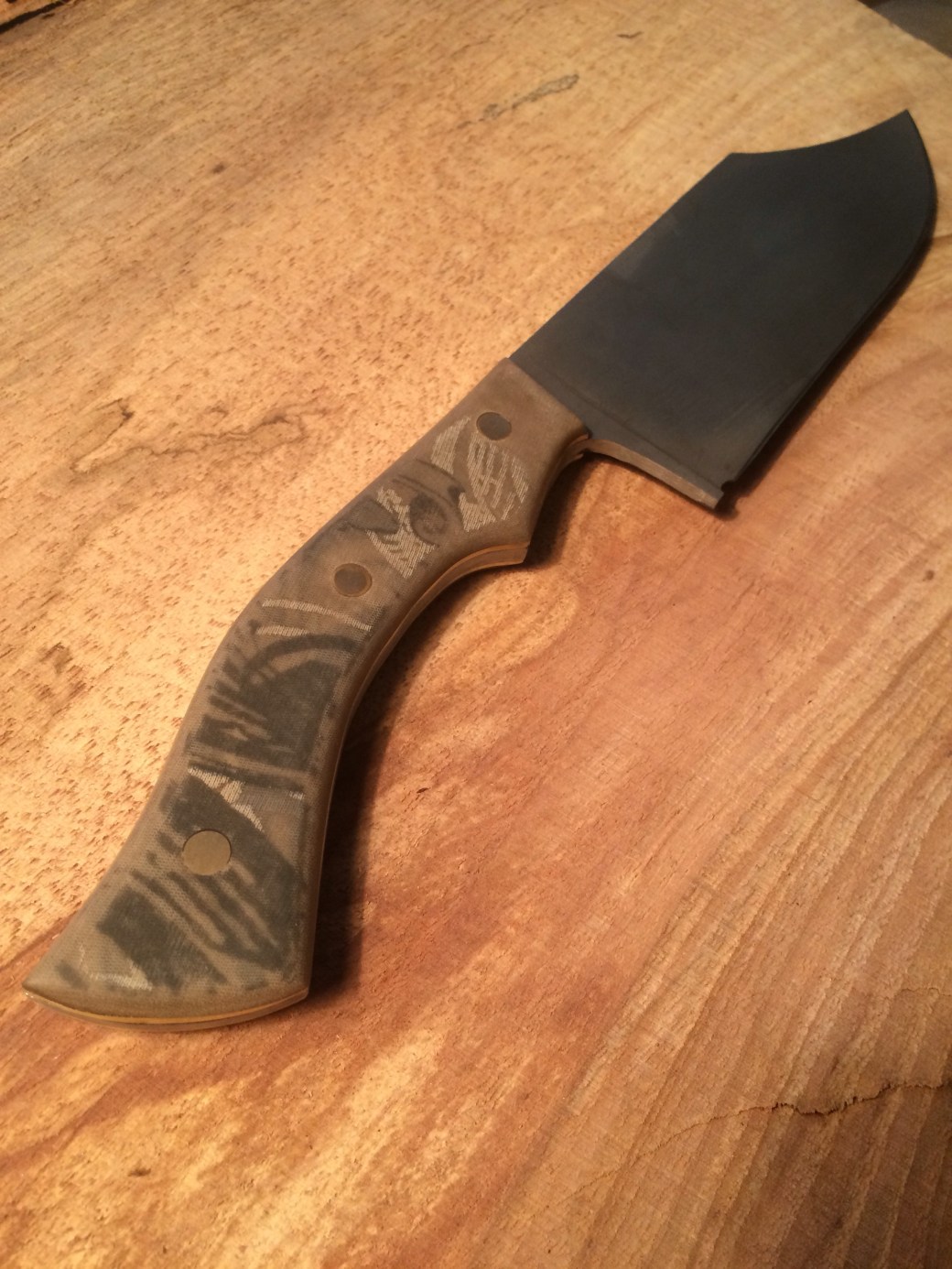
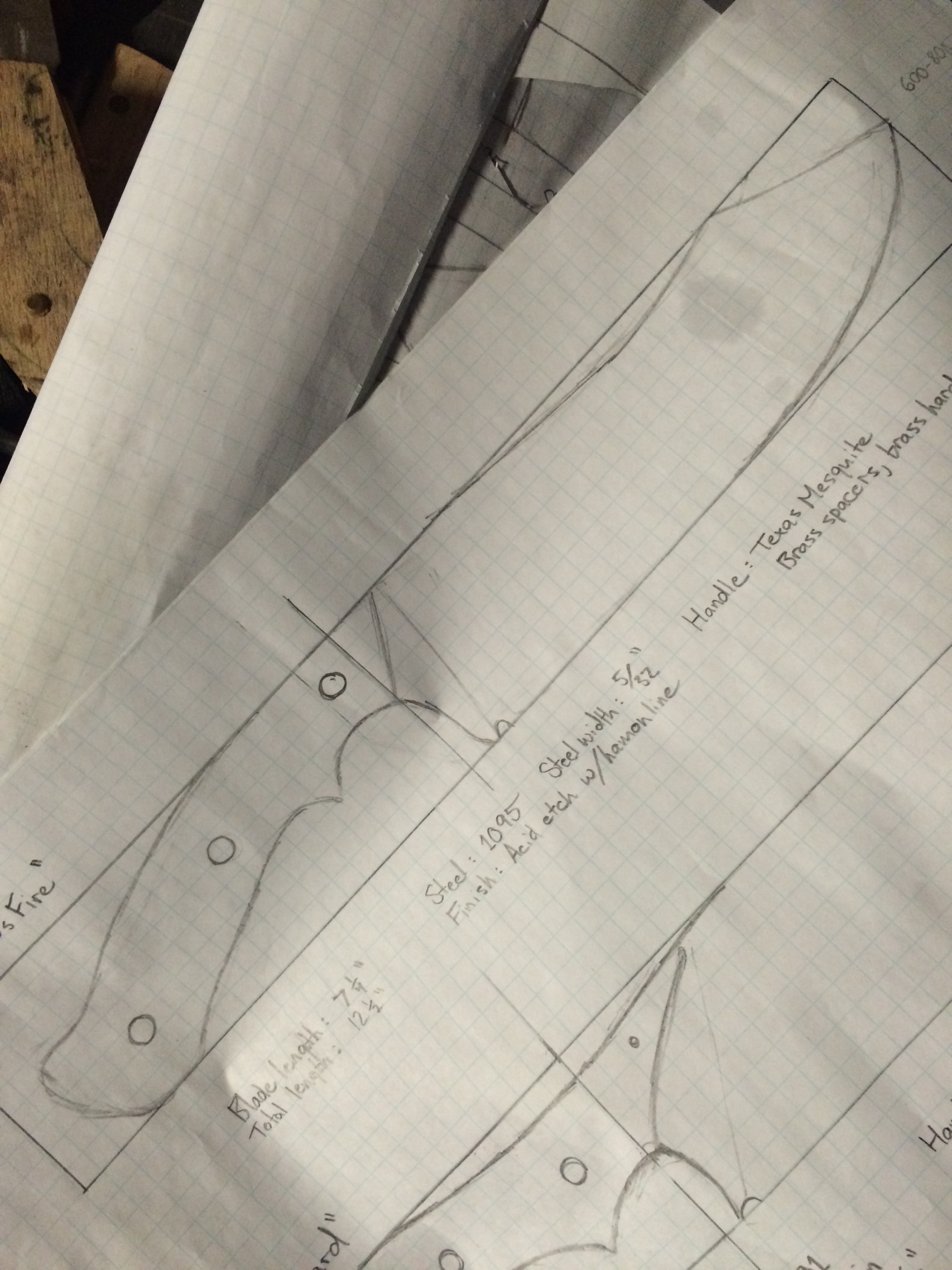
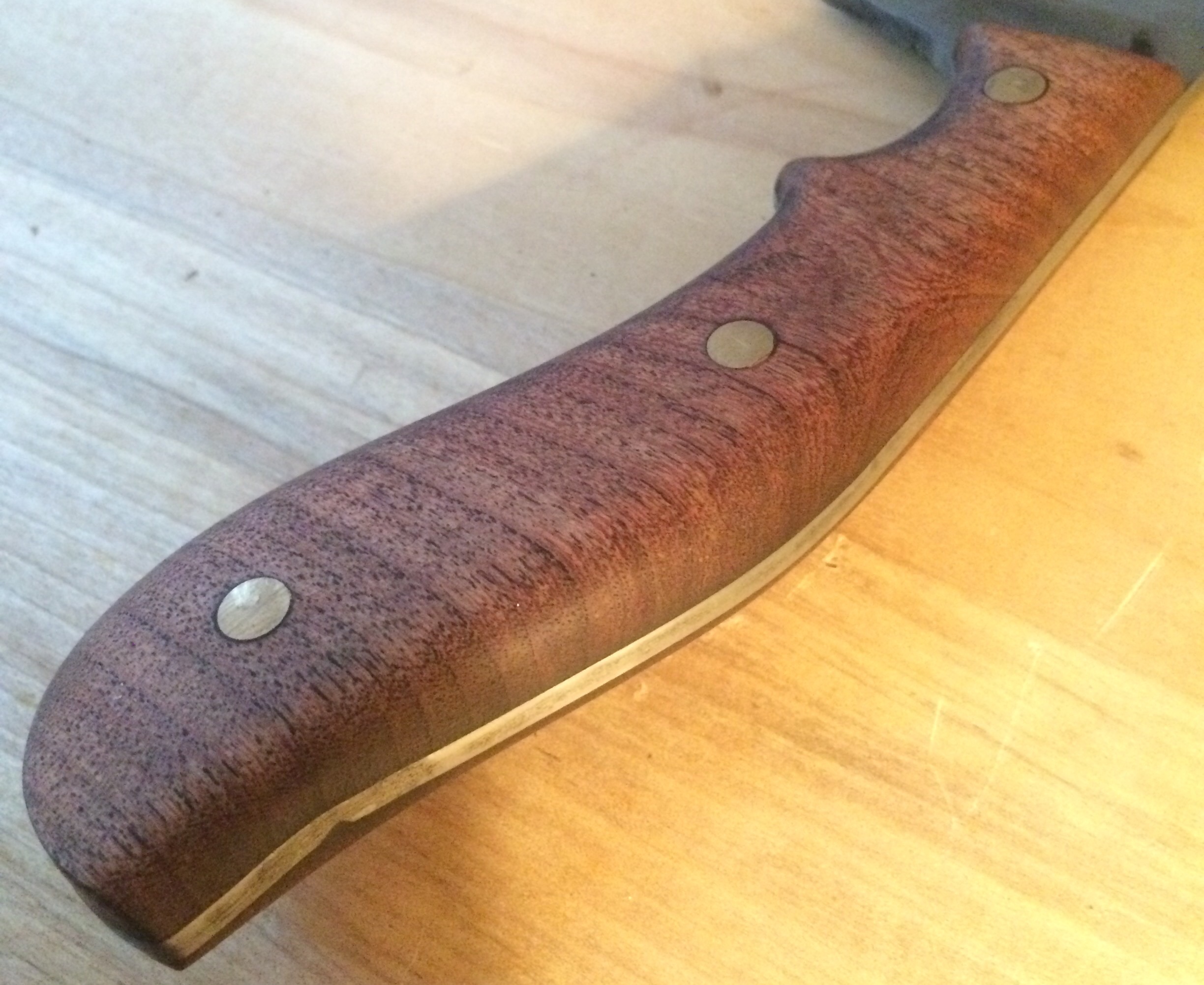
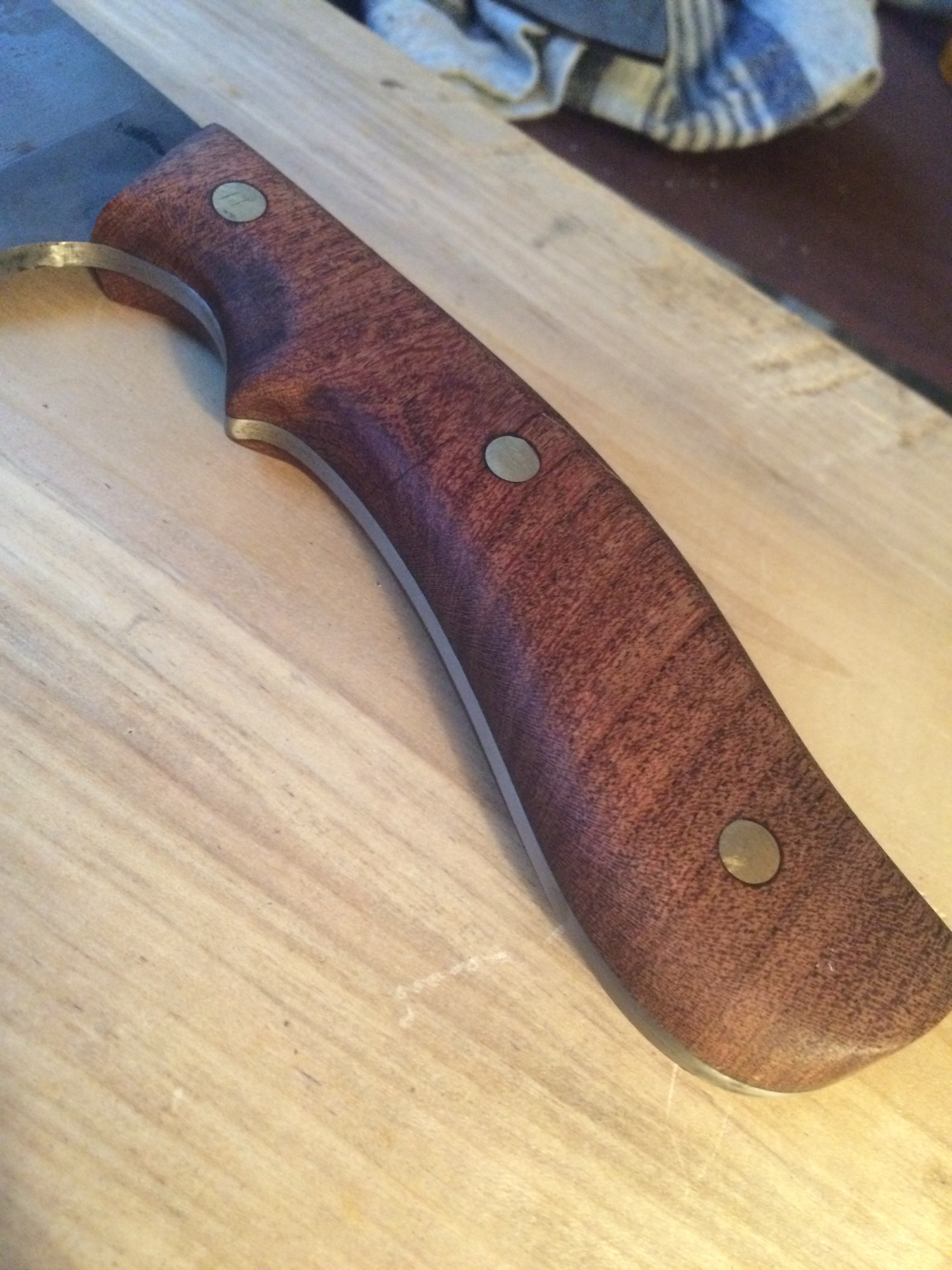
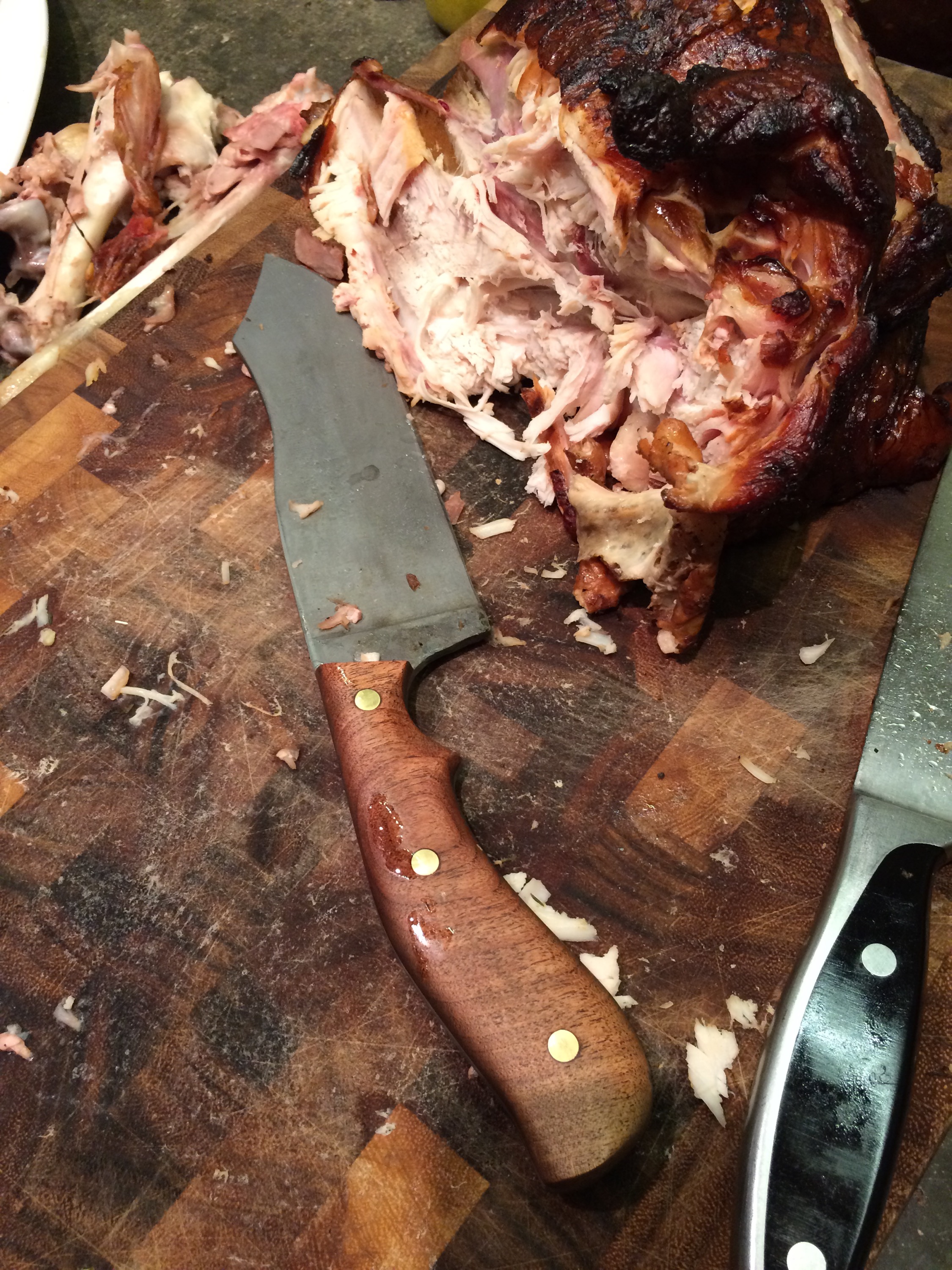
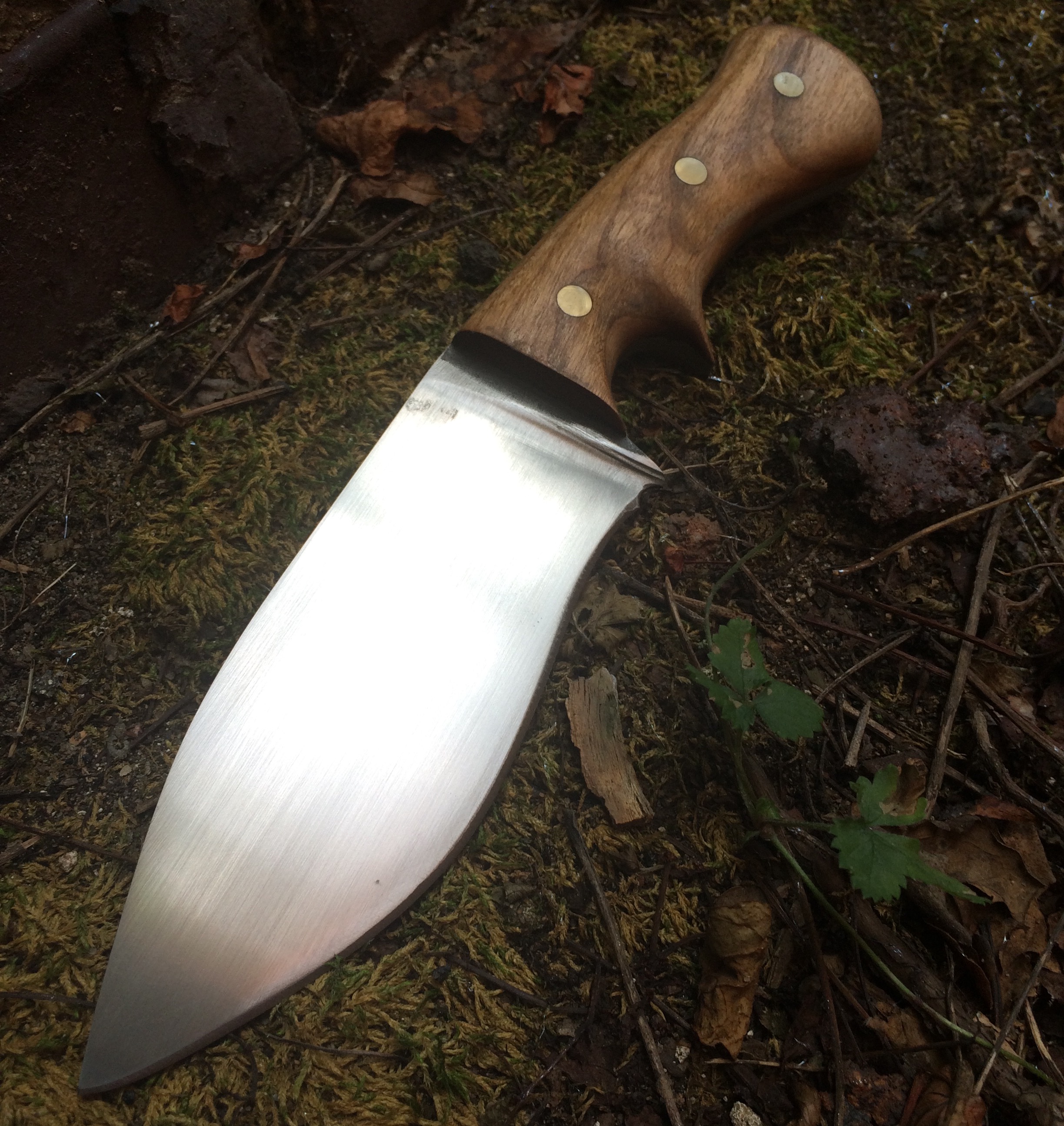
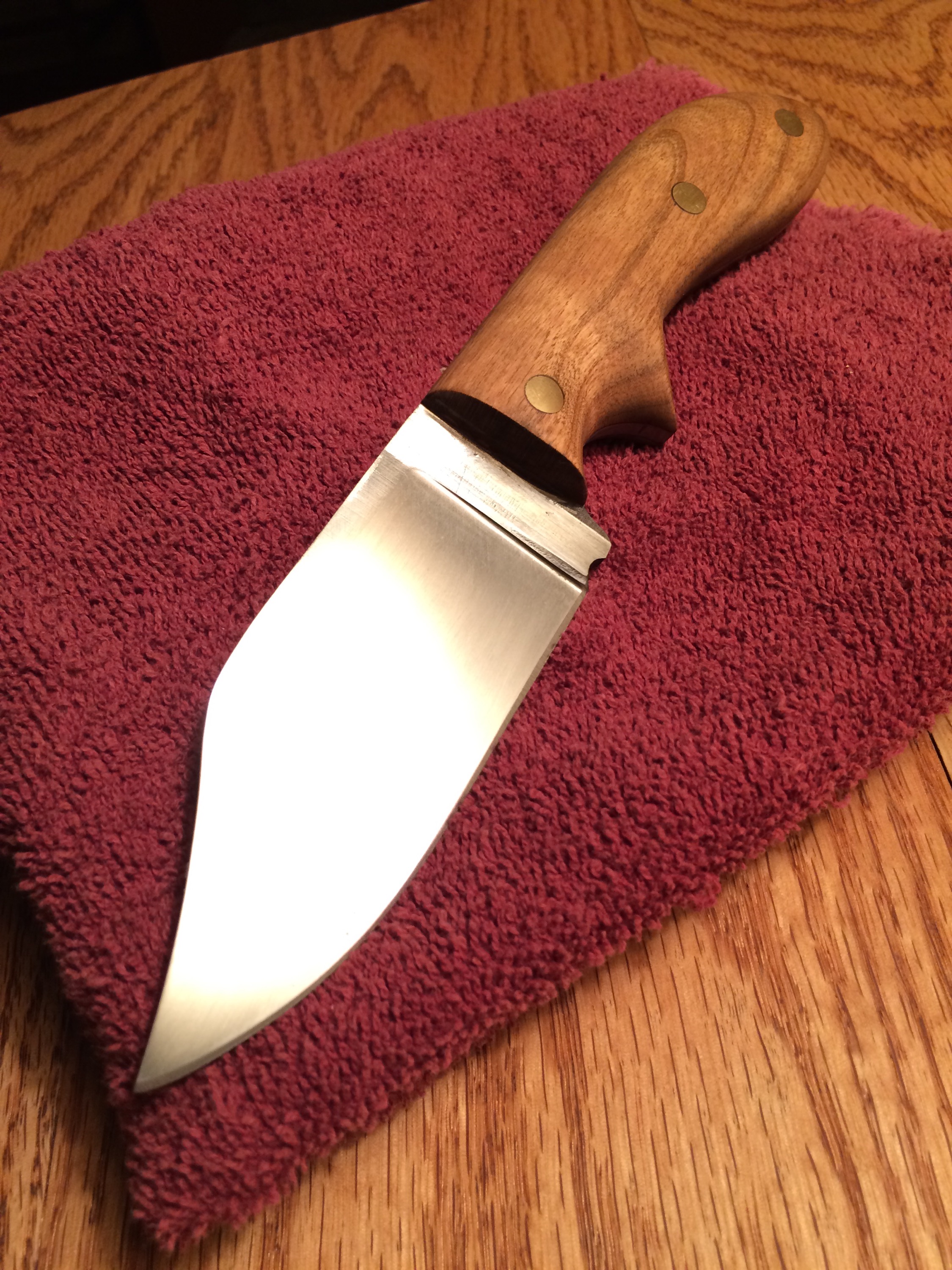
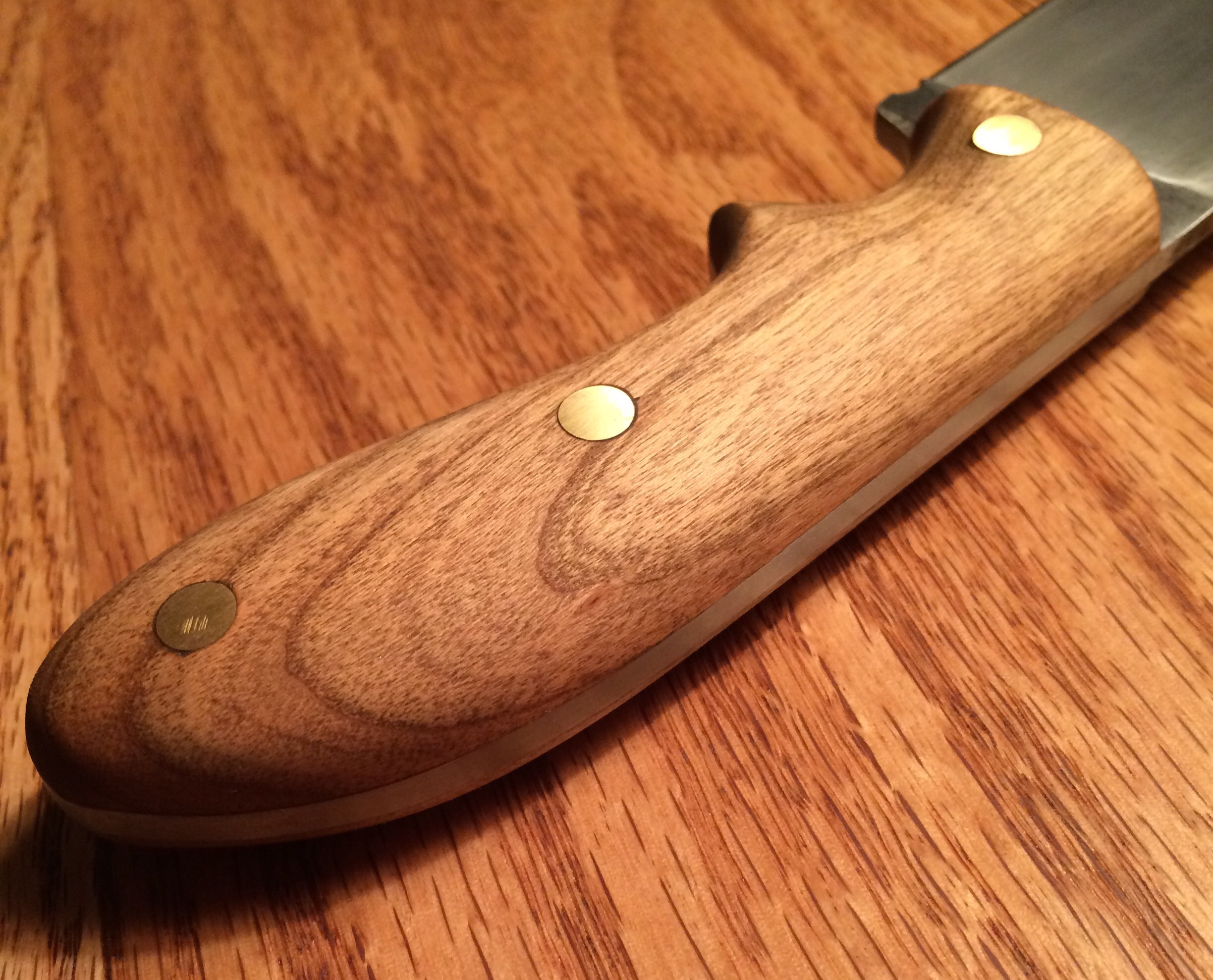
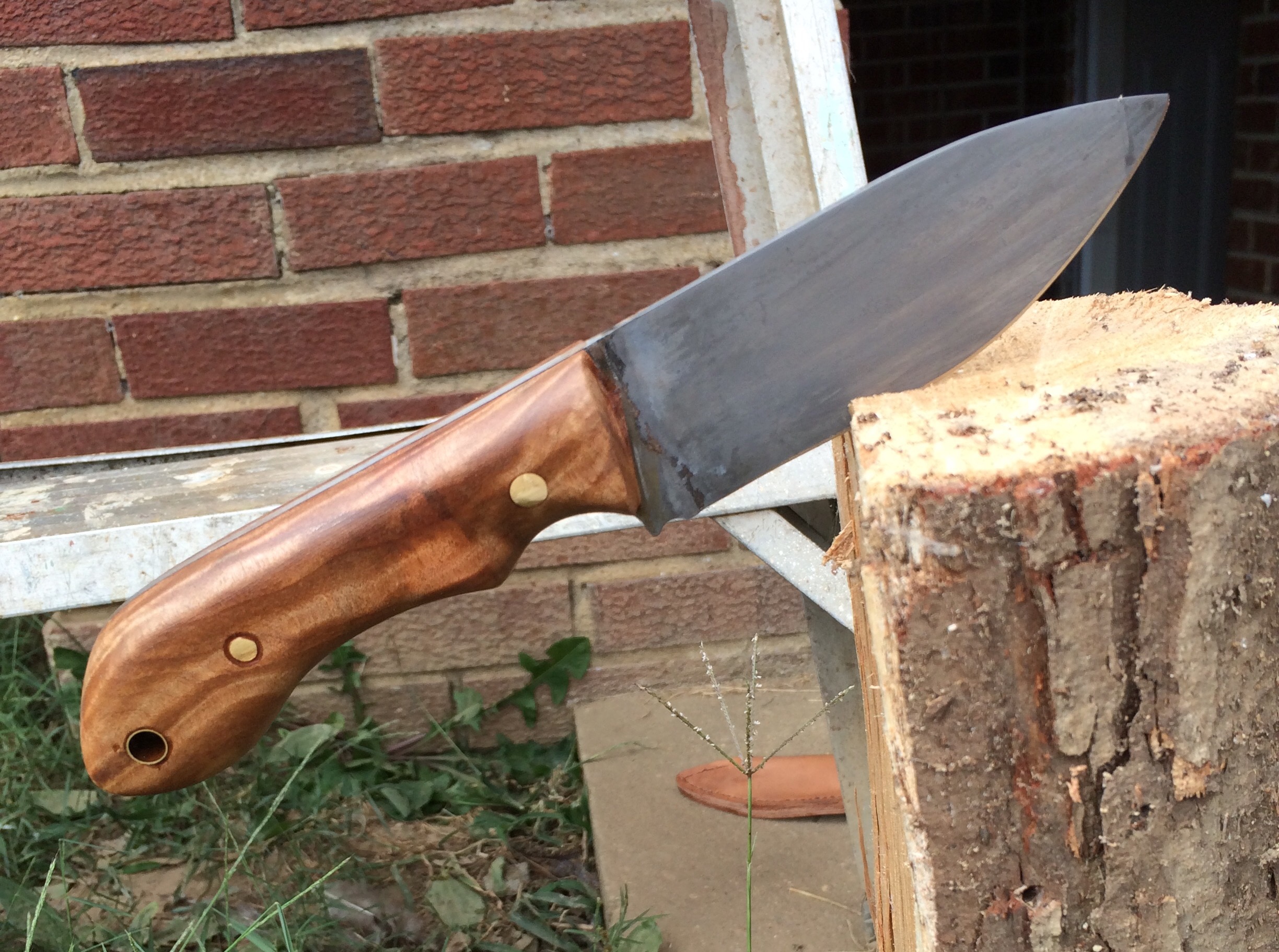
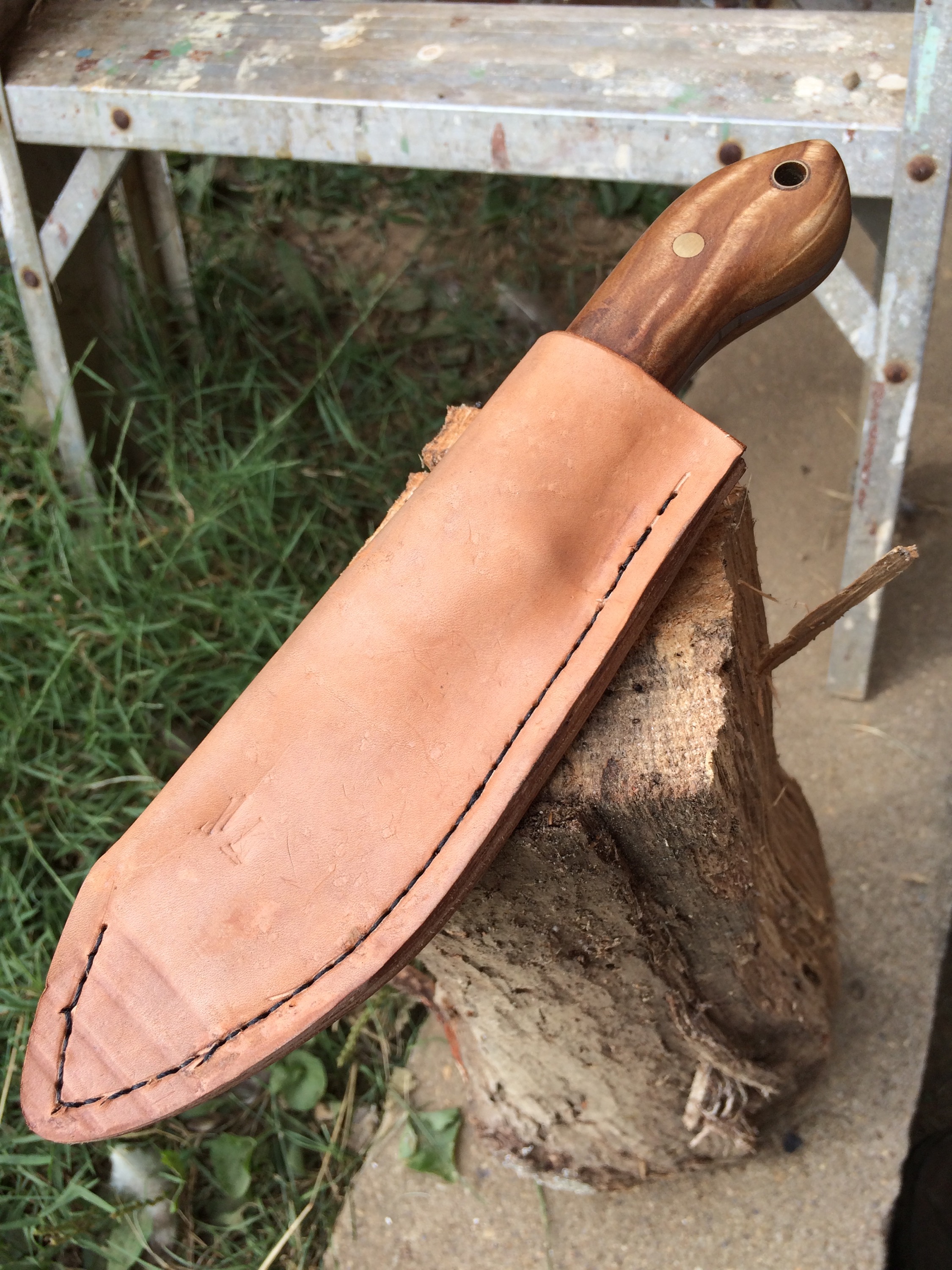
The Hound, Mark III.  Etched 1095 spring steel, Texas Mesquite handle, Kydex spacers, and brass hardware.

This blade was a commission for a very dear friend of mine who waited patiently for almost a year while I got my shit together.

Be the Knife

a2840520d4cba64df3cf736025cb084a

Knifemaking: prayer, calm, and the Snowjumper

“Blessings always beg for calm
In spite of their silvery arms”

Maritime- Calm

I pray a lot.  I really started about a year ago.  Growing up I thought it went along the lines of “Dear Jesus, please give me a pony.” I didn’t really understand prayer until pretty recently.  You can pray to Jesus, or whatever divine being you have faith in so long as it is bigger than yourself.  I talk to the Universe.  I didn’t talk to the Universe for a long time.  I found that I really needed help with the simple things.  There was little help in books, on the internet, or from people (books and internet both come from people, and nobody REALLY knows what’s going on).  So I started asking the universe for help.  This has never been easy for me because I try to do everything myself.  Instead of powering through everything, I would try (the operative word is try) to be quiet and still and ask.  The first thing I asked the universe for was guidance.

“Universe, please give me guidance.”

A week later I lost my job.

You have to be careful what you ask for because if you are expecting something specific you are probably going to be disappointed.  Once I got over the shock I tried to find more quiet spaces and ask for more simple things that could help me.  Universe, please help find peace.  Universe, please help me to trust.  Universe, please help me to know strong boundaries.  In certain situations I kindly ask the Universe to help me not fuck up.  And so on and so forth.

Most recently I have been asking the Universe for calm.  And the Universe has given me calm but something hasn’t been quite right.    The calm is there, I can project it, but I don’t feel it in me.  In areas where I find the calm but don’t feel it, I gently ask the Universe to help me to accept it.

None of this is overnight.  There is no flash of enlightenment or instant nirvana.  So I ask the Universe to help me find patience.

A few weeks ago we had a giant snowstorm.  There was somewhere between 12 and 18 inches.  I love snowstorms.  It is calm embodied.  Everything slows down and gets very quiet.  Many people stay home, the city shuts down, and nothing has to happen.  It happened on a Friday and all of my work got cancelled.  My girlfriend and I decided to get snowed in together.  We went to the store and stocked up on supplies and then headed to her place to batten down the hatches.  Then after a little while we noticed the heat wasn’t working.

I love this woman deeply.  I love how she makes things nice.  I love how she plans things.  She is talented and good at many things I am not, and will help me with those things.  She owns every bit of herself.  She is vulnerable and I see how empowering that is.  She is kind to my various maladjustments and occasional dysfunctions and the other parts of my being that I don’t love so much.  It’s far from perfect but it continues to bloom and makes me a better man.  Throughout all of this she is exquisitely beautiful and profoundly elegant and quite often gives me butterflies.  There are also things I am good at that help her.  Situations like heat and snowstorms are two of those things.

Back to the heat.  It was a full on snowstorm and it was glorious.  We went and picked up a kerosene heater from the warehouse where my workshop is.  We helped a couple of people get their cars unstuck.  We saw how beautiful everything was.  I have a 1997 Nissan Pathfinder with good four wheel drive and strong heat and we slid around a bit.  I found it to be very calming.

IMG_3016

I have a friend who does heating and HVAC work and he is a great guy.  He is also a workaholic.  I gave him a call to see if he could talk me through troubleshooting the system and he was actually up the street working.  He said he would be right over.  His wife must be a very patient woman.

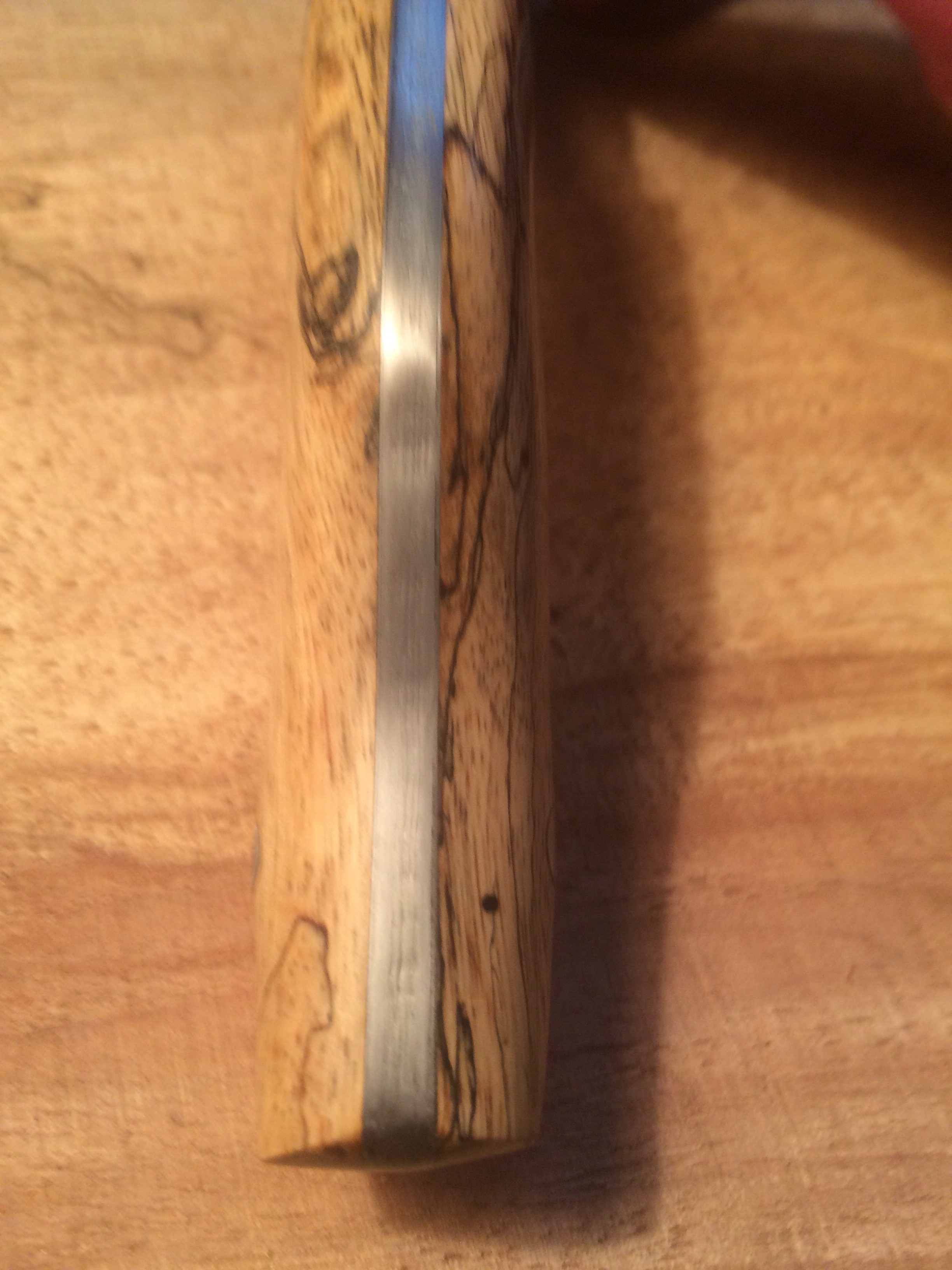
Sure enough he got the furnace fired up.  I asked him what his price was for coming over and all he asked for was a couple bucks for gas.  That didn’t feel right so I offered to make him a knife.  He was down.  He likes to hunt and seems rather unfazed by the elements so I designed a skinner and named it the Snowjumper.  It is a winter blade.  I found some spalted Tamarind, which is a bright wood.  I used tin spacers: they are nearly the same color as the steel of the tang and are concealed in the way that the snow conceals the earth.  I also used steel rivets to match the spacers.

1095 spring steel:


    Hardened

Tempered:
Spalted Tamarind:  Those dark lines are actually where a fungus has eaten it’s way through the wood.

Time lapse of the handle fitting:


The Snowjumper:  1095 spring steel with a phosphoric acid etch, Spalted Tamarind handle, tin spacers, and steel hardware:


  Hidden tin spacers…

Be careful what you pray for.  Calm may come in a way you least expect it.  Accept it.

This is the lesson of the Snowjumper.

Knifemaking: being where you are and the Whiskey Jack

 ‘There are a lot of good places,’ said Whiskey Jack. ‘That’s kind of the point. Listen, gods die when they are forgotten. People too. But the land’s still here. The good places, and the bad. The land isn’t going anywhere.’ 

Neil Gaiman- American Gods

A couple months ago I was working a Christmas show for the Ballet in town.  About midway through the three week run they started planning for next years show.  They were redoing some of the backdrops, which are gorgeous, and they had flown in an artist who paints them.  I was the one to pick him up from the airport.

I didn’t know any of this.  I was told to go pick up a gentleman at the airport and given a phone number.  A large French gentleman got into my rental car.

He apologized for his delayed flight.  I’ve heard that the French appreciate bluntness so I asked him what he was here for.

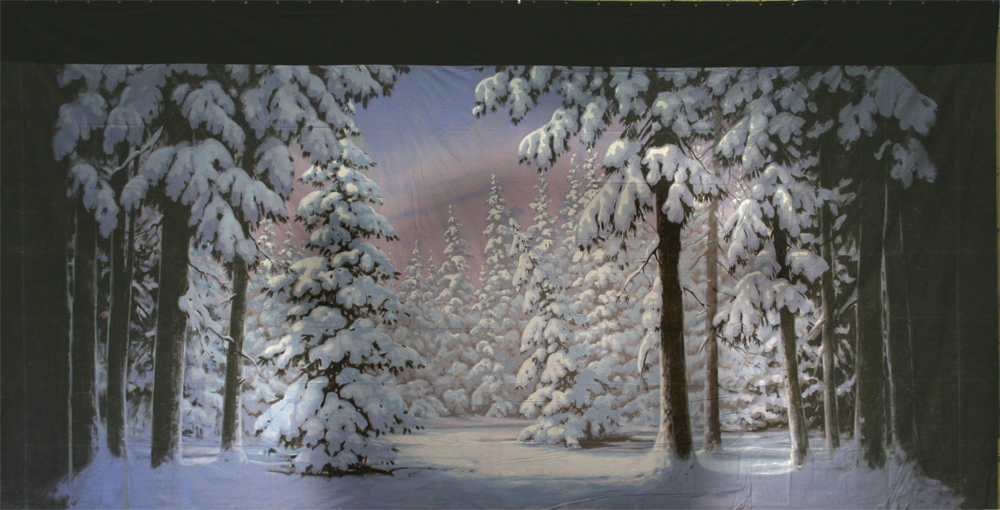
He told me he was a painter and that he was here to look at the scenery backdrops.  A backdrop is a large painted background that the dancers perform in front of.  They set the scene for the different locations in the ballet’s story.  Here is one from an opera rental company in Utah:

drop

The French gentleman said he sort of stumbled into this profession.  He was a painter living in France.  He fell in love with a ballerina and they married.  Sometime after this he was asked if he would paint for the scenery department.  Gradually this became his livelihood- painting settings for the theatre.  He now lives in New York.

He told me that it wasn’t always like this.  He said his passion was painting monsters- not the horror movie kind but something a bit more fantastical.  Since he was a child he said he’s always loved monsters.  He struggled to sell his work.  He went through a divorce.  He moved to a new country.  But he was always painting, be it monsters or backdrops.  He said that he went ten years without doing any scenic design, but he was always painting.

It’s these things that help keep us sane and help us to be where we are and to get through the hard things that we need to go through to grow as people.  They help us to remember that we don’t have to go anywhere or shy away from our experience as long as we have something to ground ourselves in.  This is what I got from that conversation with that gentleman.  This idea is also where the namesake of this blog comes from.

This is also the lesson of the Whiskey Jack.  ‘Whiskey Jack’ is an anglicized version of Wisakedjak, a trickster deity with a strong heart in Native American Folklore, specifically of the Cree tribe.  Whiskey Jack is a character in American Gods by Neil Gaiman, believing that no matter what happens the land is still there regardless of what we do to ourselves or others.  There are things we do and make and say and write that exist outside of the tedium and mental minutiae of our modern world.  Things that help us to keep our center when our hearts are breaking or it feels like everything is crumbling.  Things to help us be with our joy and to be with our grief.  They don’t go anywhere.  Remember these things, the beautiful things we do, when the world has made you weary.  I try to remember this when I am exhausted, when I don’t want to get out of bed, or if there are jobs or conversations that I really don’t want to do or have.

This large French gentleman’s name is Alain Vaes.  Please check out his work.

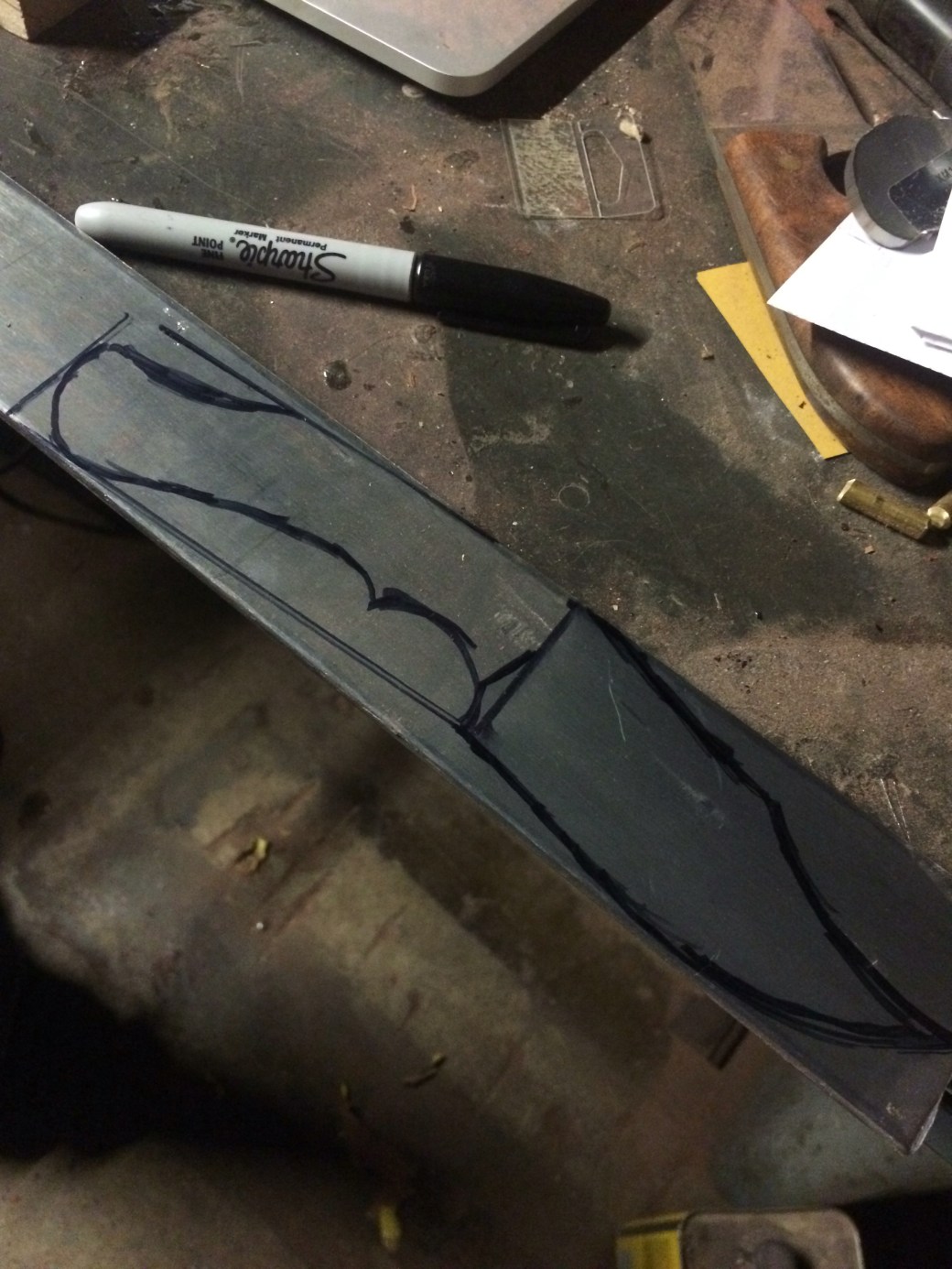
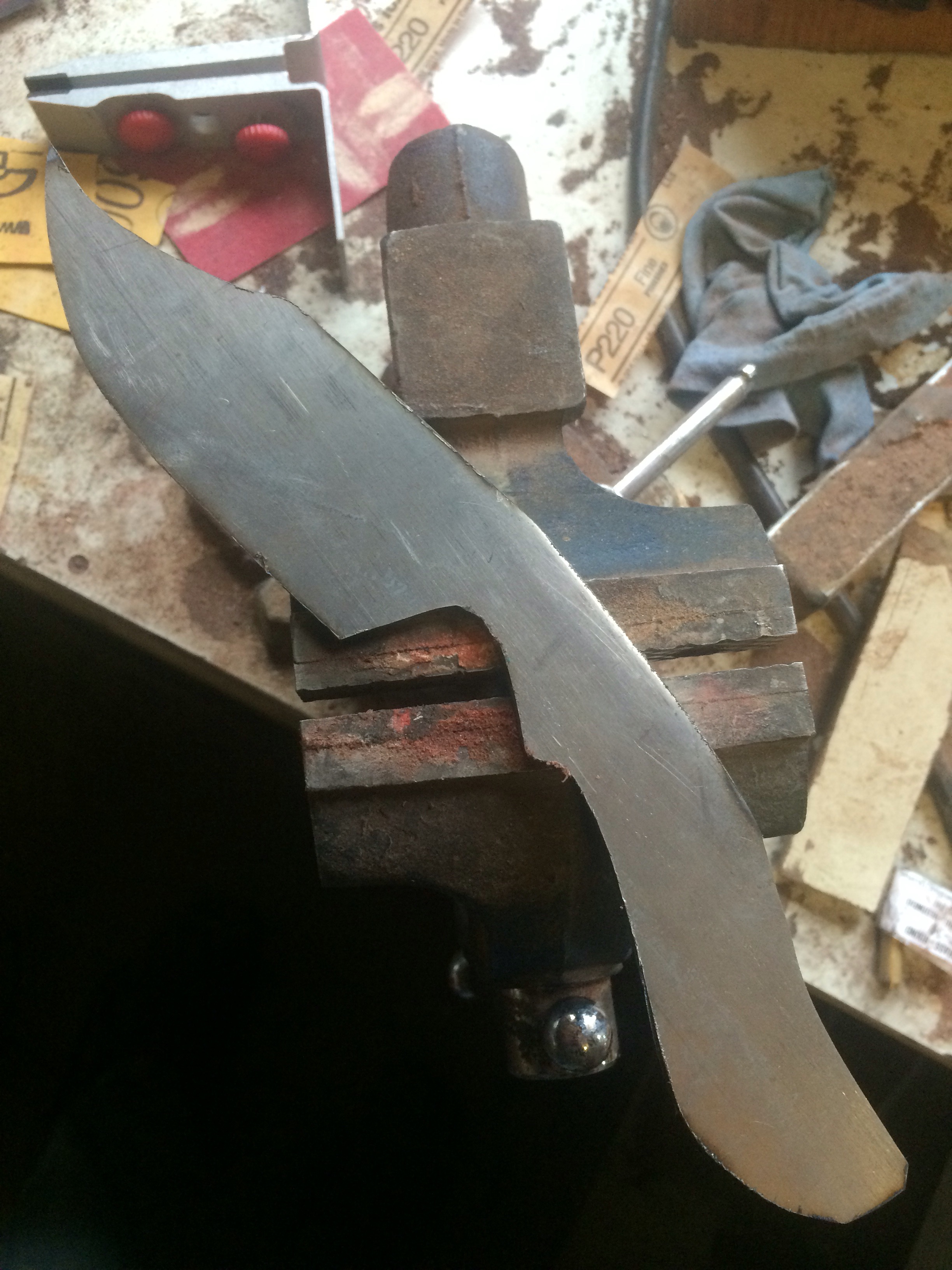
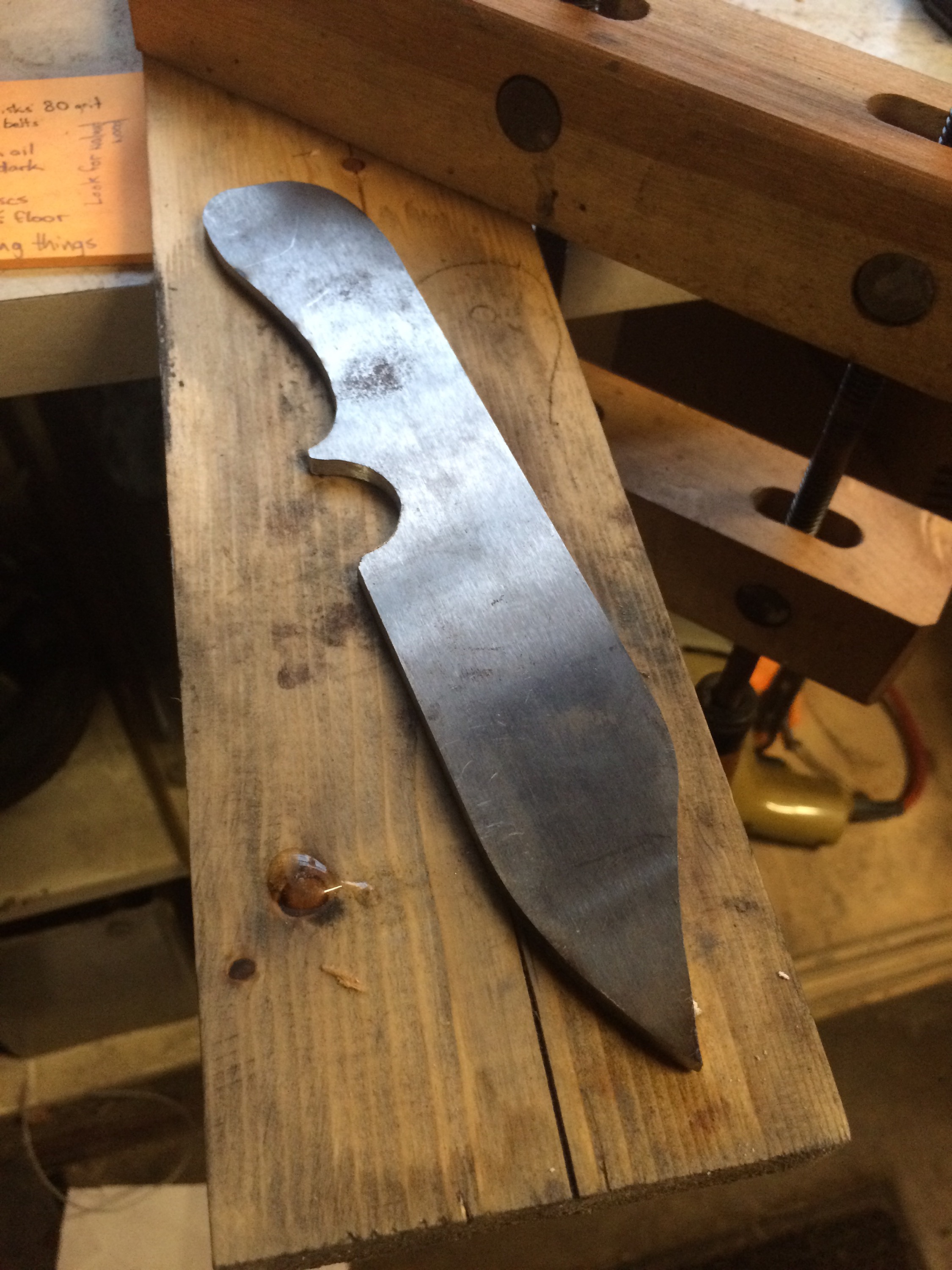
I started with 1095 steel and worked out a 6in bowie style blade:

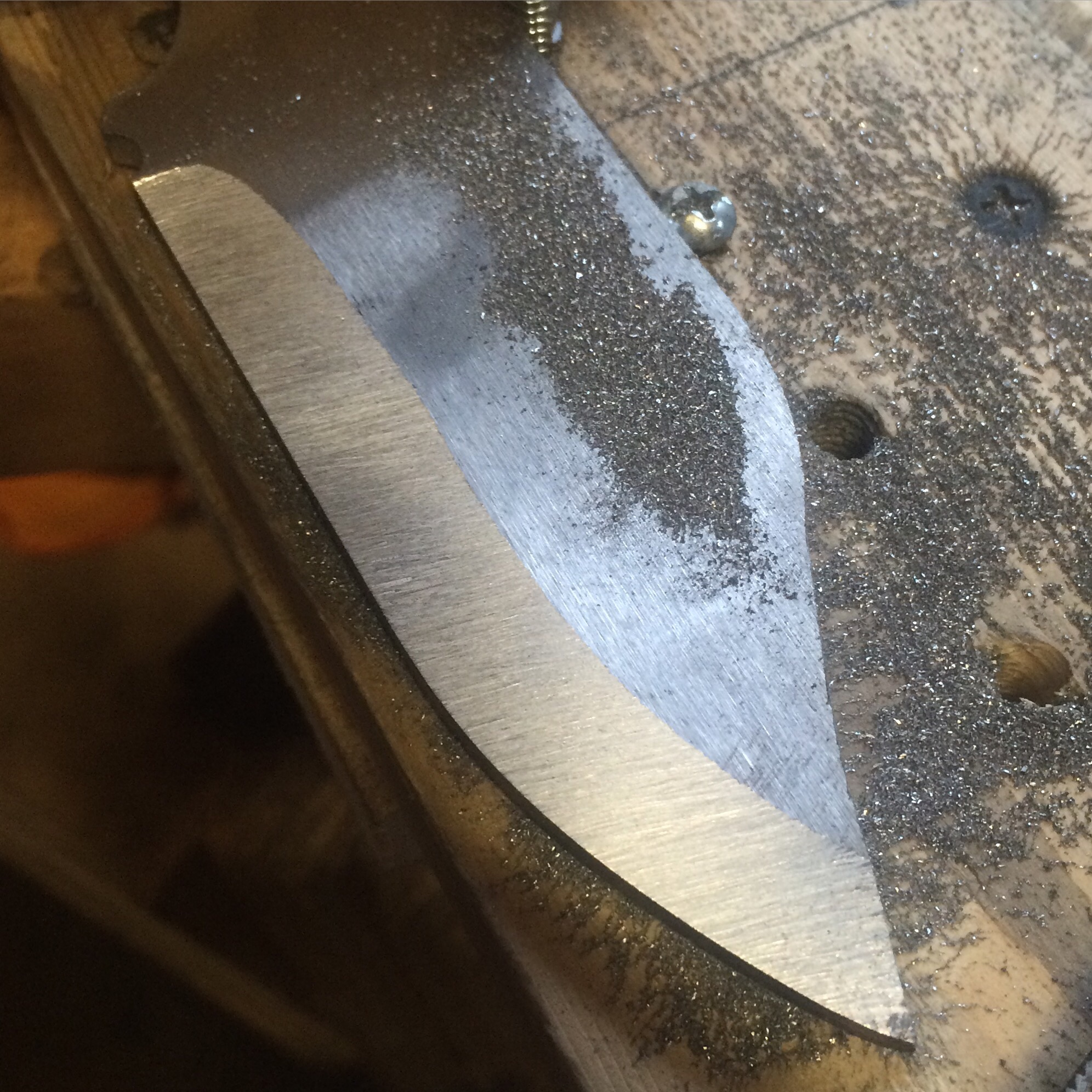
 Full flat grind


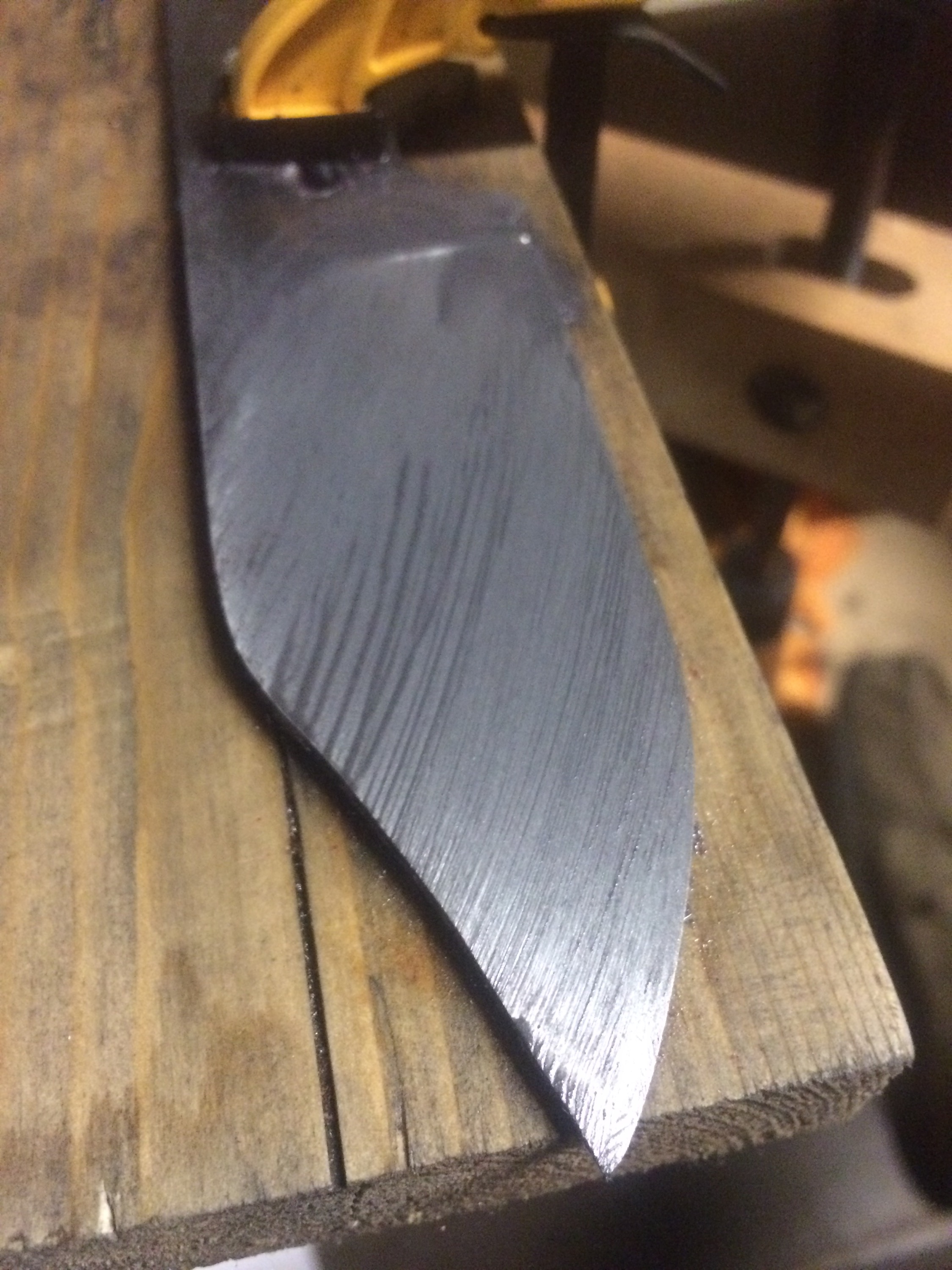
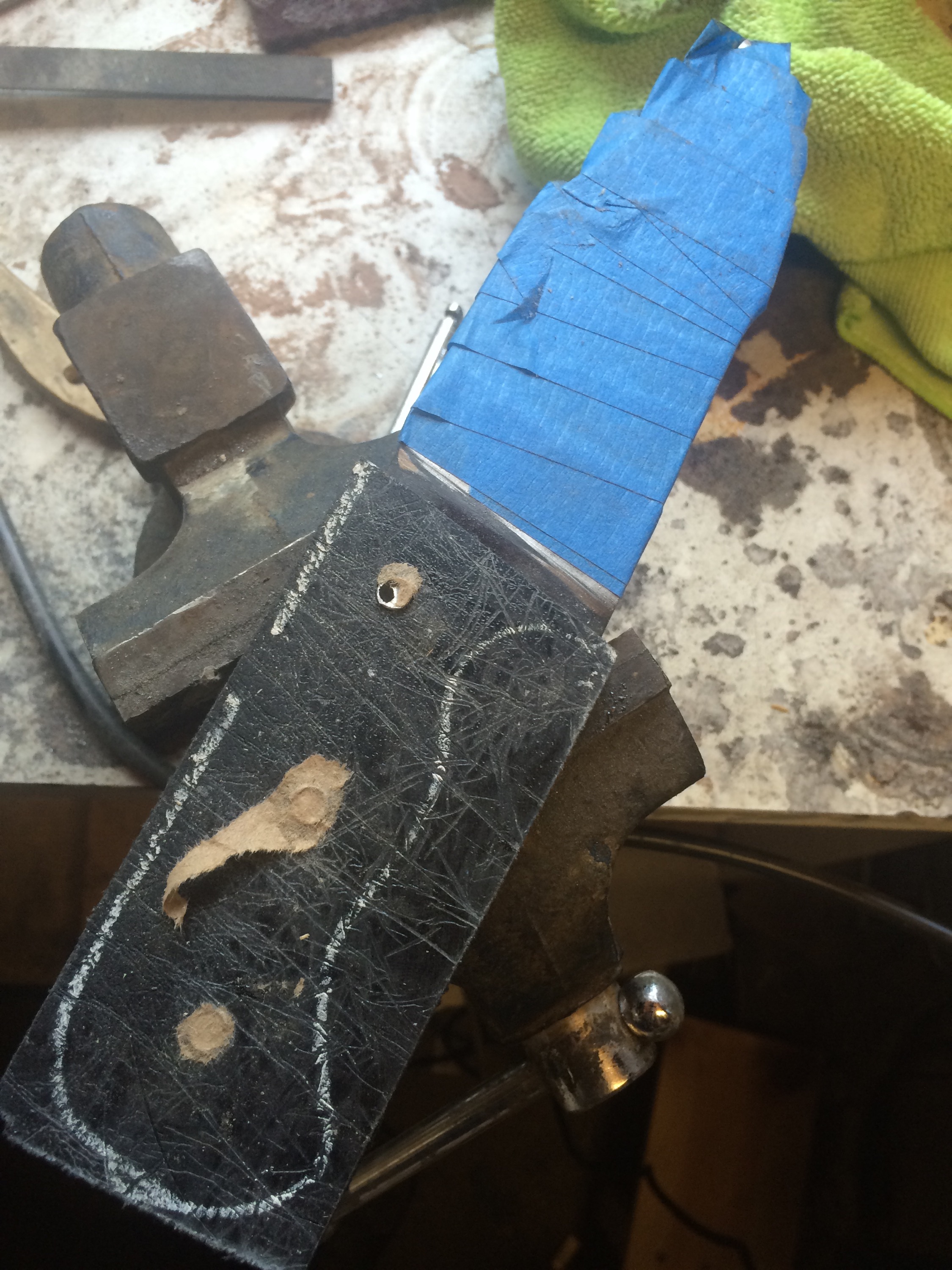
HardenedLots of sanding… 
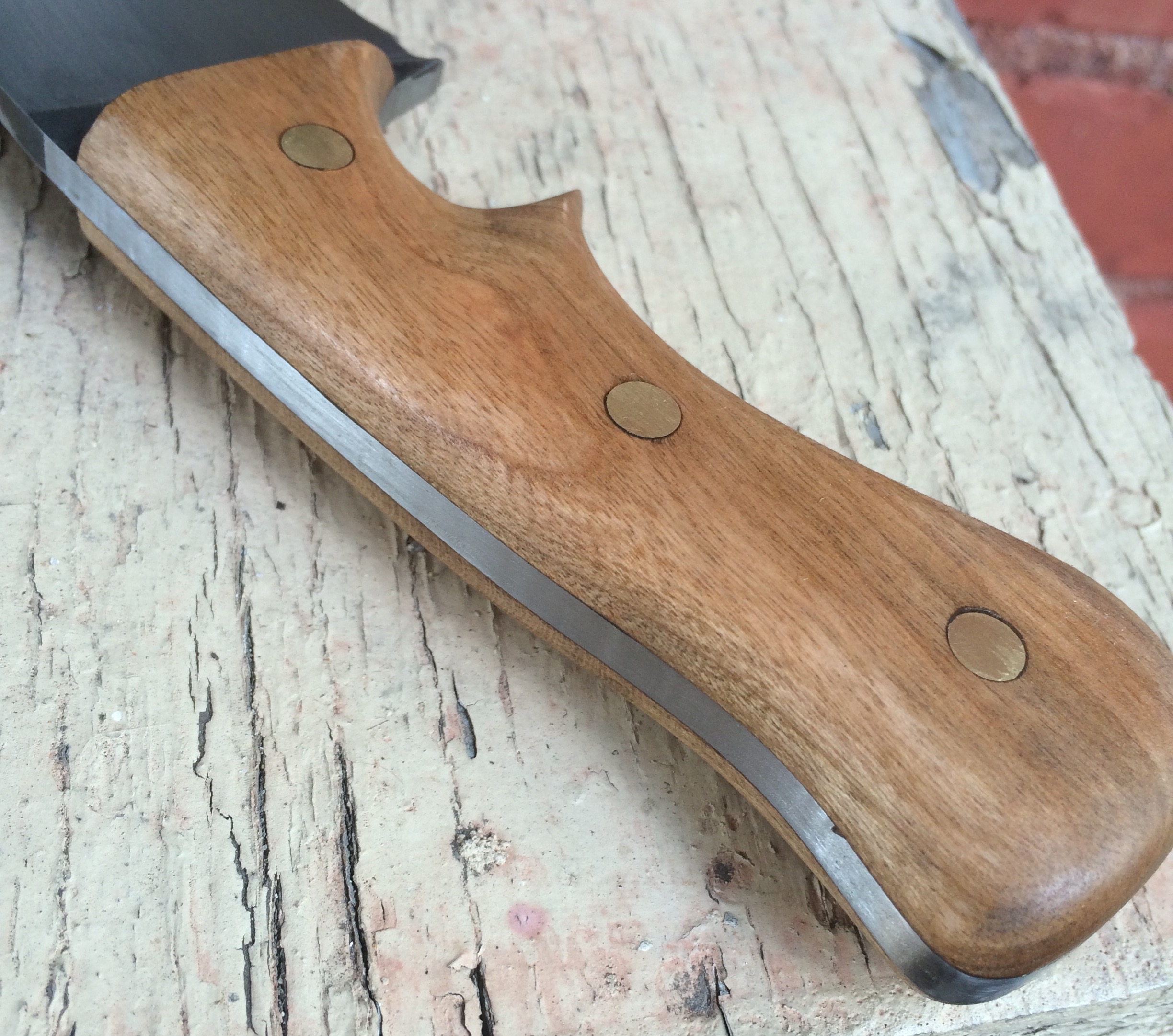
I like a heavy blade but I put these big holes in to lighten it just a bit.

This is one of my absolute favorite shirts.  I’ve worn it all over the country.  There are kind souls in my life that told me while the armpit stains are endearing, I probably shouldn’t where it out in public lest I scare small children….

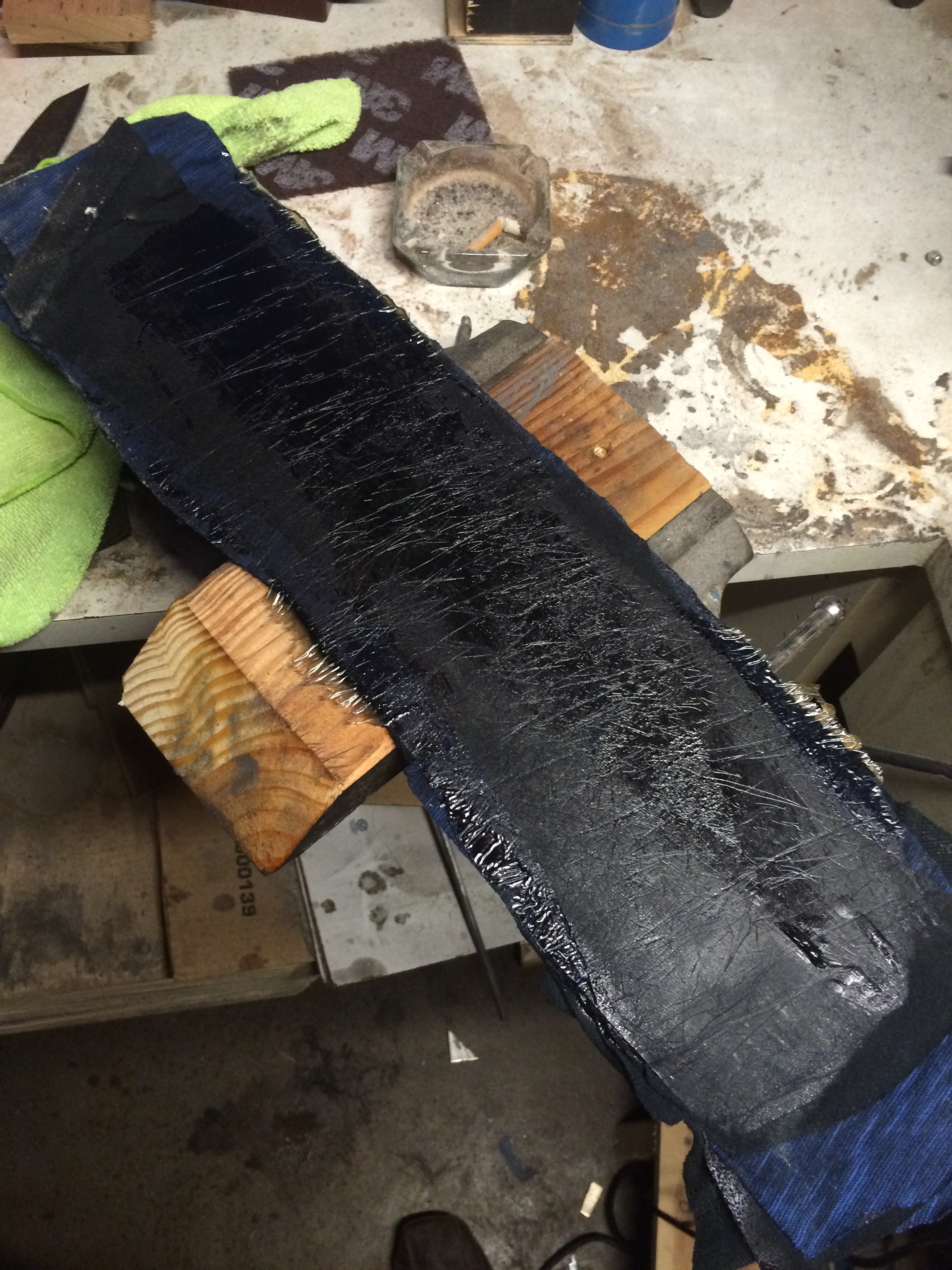
….so I made it into handle material.  It’s not going anywhere either.

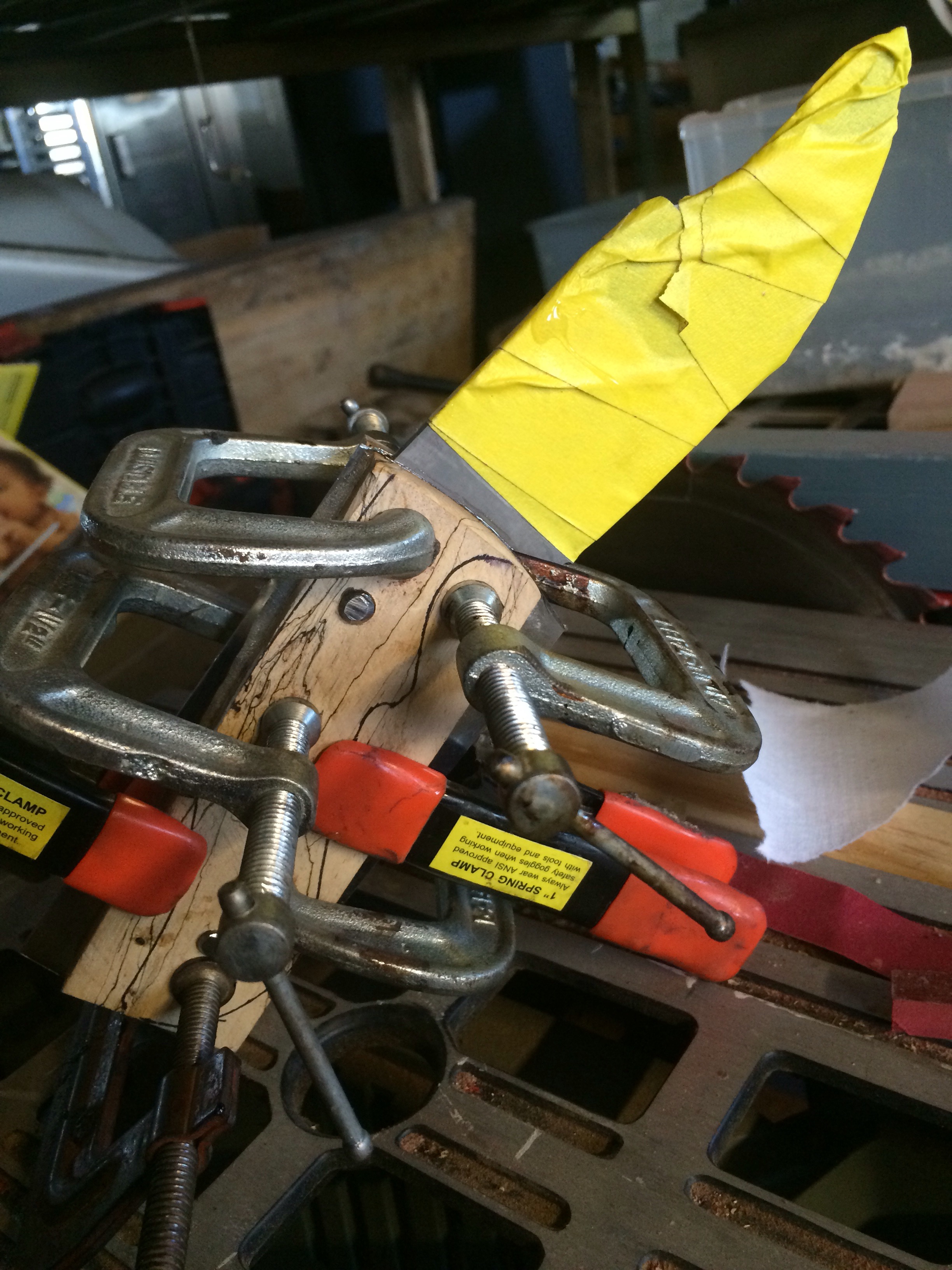
Clamped

The Whiskey Jack: etched 1095 spring steel, homebrewed Micarta scales, brass liners and hardware.  Shaving sharp, he is built to be used.


Be where you are, and keep doing whatever it is that helps you to stay there.  This is the lesson of the Whiskey Jack.

Knifemaking: braving the storm and St. Elmo’s Fire

“I have seen many storms in my life. Most storms have caught me by surprise, so I had to learn very quickly to look further and understand that I am not capable of controlling the weather, to exercise the art of patience and to respect the fury of nature.”

Paulo Coelho

St. Erasmus, or St. Elmo, is known as the patron saint of sailors.   The namesake of this blade refers to a meteorological phenomenon that results from an electrically charged atmosphere that occurs during thunderstorms.  It manifests itself as a series of blue sparks, with the mast of the ship acting as a conductor.  During storms at sea, sailors would often observe St. Elmo’s Fire.  It has always been symbolized as a sign of the Divine, and sailors knew that they were looked after when it appeared.

stelmo

I made this blade with idea of it being a seaworthy vessel- something that has braved many storms and still has its spirit intact.  Sometimes we brave so many storms that we forget how to enjoy the calm.  Instead of having a life of calm punctuated by storms, it becomes a life of storms punctuated by calm.

The important thing to realize is that beneath the churning waves and far beneath the thunder, lightning and winds is an entire body of calm.  And that there was calm before the storm and there will be calm after.

This isn’t to say that storms aren’t dangerous but they do come with their lessons.  I’ve spent a good amount of life in a state of anxiety anticipating storms.  Some of us have been conditioned to live in constant turbulence, lest we not be prepared for the foul weather.  Over time, we stop differentiating between the calm and the turbulent seas and create a maelstrom where there is none because we haven’t ever known what that calm feels like.  Shifting this type of thinking takes time and a good deal of work.  To be perpetually worried of the storms robs you from fully enjoying the moment and the beautiful things that occupy the vast majority of time between.  Ultimately you can’t control the Nature but you can control yourself.

This the lesson of St. Elmo’s Fire.  To allow the storms to pass and to have faith that you will find safe passage through the rough waters.  To feel your own calm in the midst of chaos.  Oftentimes you can find out what you are really made of within that chaos.

This blade was a commission for a very old friend who did a lovely photoshoot for me.  We’ve often talked about storms and how to get through them.

I did a series of kitchen knife designs and this one was sort of a wild card.  Functionally she is a German style chef’s knife.  The clip in the blade gives her some forward momentum.  The drop in the handle rests comfortably in the heel of the hand, and also follows the natural line of the forearm through the wrist.  The finger choil provides a comfortable resting place for the lower three fingers if a traditional chef’s grip is preferred.

The blade is 7.25″ long.  Blades these long are a continual challenge for me to grind.  If ground too thin they will warp and possibly crack during heat treat.  On blades this large there is grinding before and after hardening and tempering.

  I love working with Mesquite.  It has a fiery bouquet.
  St. Elmo’s Fire: 1095 spring steel with a phosphoric acid etch, Texas Mesquite handle and brass hardware.

  
There was some turkey involved on this past Thursday  

Trust that the storm will pass.

Be sure to check out Lauren Serpa and her beautiful work.

Knifemaking: the Lioness, revisited

“The stuff we make don’t go bad”

“The ugly dog barks the longest”

Tray Eppes: potter, musician, fully present citizen of the Universe

(you can find the initial crafting of the Lioness here)

So a number of years ago one of my best friends asked me if I wanted to play a gig with him and his godfather.  It was a Christmas parade in a small town about two hours away.  We were both in music school and played near any gig we could get.  Neither of had cars at the time and a big ass Dodge truck piloted by a gentleman with a large beard pulled up.  This was Tray.  On the way we stopped at a jazz club, had a few cold ones, and heard some badass tunes.  We got to Tray’s farm at around 2am and he showed me his guitar rig (at full blast).  I went to sleep to the sound of coyotes howling.  I got up and Tray’s wife had made us smoked venison with Hollandaise sauce on a lightly toasted English muffin.  We drove to town and played brass band versions of Christmas songs and it was a blast.

We played those parades for the next couple of years.  We spent a New Years out there.  As I recall we drank gin and sat in the outdoor hot tub in front of a fire the size of Rhode Island.  I make sure to keep in touch with Tray and his wife.

A couple months ago I was standing in the middle of a field working security for a country music concert, alone with my thoughts due to the fact that most of the audience was in the beer tent and there wasn’t much securing to do.  In those moments I often find myself thinking about places I’d rather be and in this case I would have rather been, well, almost anywhere else.  I decided I would call Tray and see how he made a living making the things he makes: killer pottery.

He told me about selling pottery to the Amish.  The Amish don’t have any possessions that are purely decorative. If there are pictures on the wall, it is most likely a Bible verse written in a modest calligraphy.  Likewise, nothing is frivolously decorated.  This particular group, Tray was telling me, used white dishes.  Tray also told me that white pottery is a bit more labor intensive than his normal work and the Amish are the only ones who ask for it.  So he can make a large batch of it and have it on hand and not have to fool with it for awhile.  He was explaining to the Amish man he can make it and sell it years later.

“Ahh”, said the Amish man.  “Not like spoilt cow’s milk.”

This was when he told me the stuff we make doesn’t spoil.  You can go back and rework things that you aren’t happy with.  I’ve had a few proverbial ugly dogs barking at me and recently I’ve been reworking those.   And it’s not limited to just pottery, or knives, or music…just because you were one way yesterday doesn’t mean that’s how you have to be today.

Tray also ordered a knife and a sheath.  I made him this:

11865294_1446420832353922_2449722474390312358_o

For the Lioness I found the blade to be too thick.  I went and ground down the bevel, which in turn improved the balance of the blade.  I wasn’t happy with the finish so I took care of that as well.  All of this came from a gentle place.  Nothing is going to spoil.

FullSizeRender 29

O1 tool steel, Cherrywood handle, and brass hardware

FullSizeRender 30

FullSizeRender 31

The nice thing about refinishing a wooden handle (or wooden anything) is that the grain is so much more prominent due to the permeation of the finishing oil.  The grain pops much more grandly than it did the first time around.  I see it as a little gift for going back and trying to make it better.

FullSizeRender 32

I also smoothed and polished up the tang.

Tray and a much younger me

Tray and a much younger me

Check out Tray’s site at here and drop him a line

Knifemaking: honor, integrity, and the Hound

Both sides of my family were landless sharecroppers and mountain people from as far back as I can remember…What did I receive from this lineage?  Things I believe to be very valuable: a good raw intellect and a good tough body…A sense of honor that results in a touchiness common to our people…When the only thing you own is your sense of personal honor, you tend to protect it at all costs.

Eric L. Haney, Inside Delta Force

This blade was initially a commission from another very dear friend of mine.  He asked for a knife that was based in a sort of old-world honor.  A sort of honor that is maybe not seen so much today, at least not on the surface of things.  Something that may get lost in performance reports and email threads.  Something that isn’t tied to how much money you do or do not make, what deity you do or do not pray to, what color your skin may or may not be, and completely independent of whatever gender with which you happen to identify.  A sort of goodness that comes from having a place in this world, of knowing deep within your being that you deserve to be here and that no one can take that away from you.  He asked that it be called the Hound and I got to work.

There are times in my life when I have felt empty and hollow, like something was missing.  I tried filling this with all sorts of things- material things, a busy schedule, pharmaceuticals, and overindulgences of food and drink.  What was actually missing at those times was a personal bearing.  In more difficult times I had traded my honor for things that were fleeting, for a sense of security, and for a feeling of belonging.  When you have something to ground yourself in and can carry yourself in esteem, the aforementioned things will find their way to you, though at times it may feel like you are a thousand miles away from any of them.  No one gives this feeling to you.  Some people have this from an early age, others have to find it, and still others go through hell and many trials by fire to figure out what it is for them.  Some people have been beaten down so far that they aren’t aware that it even exists- but still it can be theirs.

When you act and speak from this place it brings an integrity and truth to the things you do.  A resonance that permeates everything- like an orchestra, where a balance of intonation, volume, harmony, and depth of emotion makes a gorgeous sonic mass.  There may be chaos all around you but within you everything moves in synch, just like the bows of a symphony orchestra.

I “finished” this blade some months ago and was never quite happy with it.  I’ve since made a blade of the same bearing for my friend, the Hound Mark II (here is a picture).  I didn’t find the initial bevel work on this knife to be satisfactory and I didn’t come to this conclusion till after I had hardened the steel.  One has to be careful grinding on hardened steel: if it gets too hot the steel loses it’s temper.  So with a cup of ice water I took the bevel to where I was happy with it.

It’s important to not give away our honor, as it can be the thing that gets us through when there may not be anything else.  As it follows, I added a sturdy grip on the Hound.  I wanted it to melt into the hand and hold fast for times when holding anything may be challenging.  
  
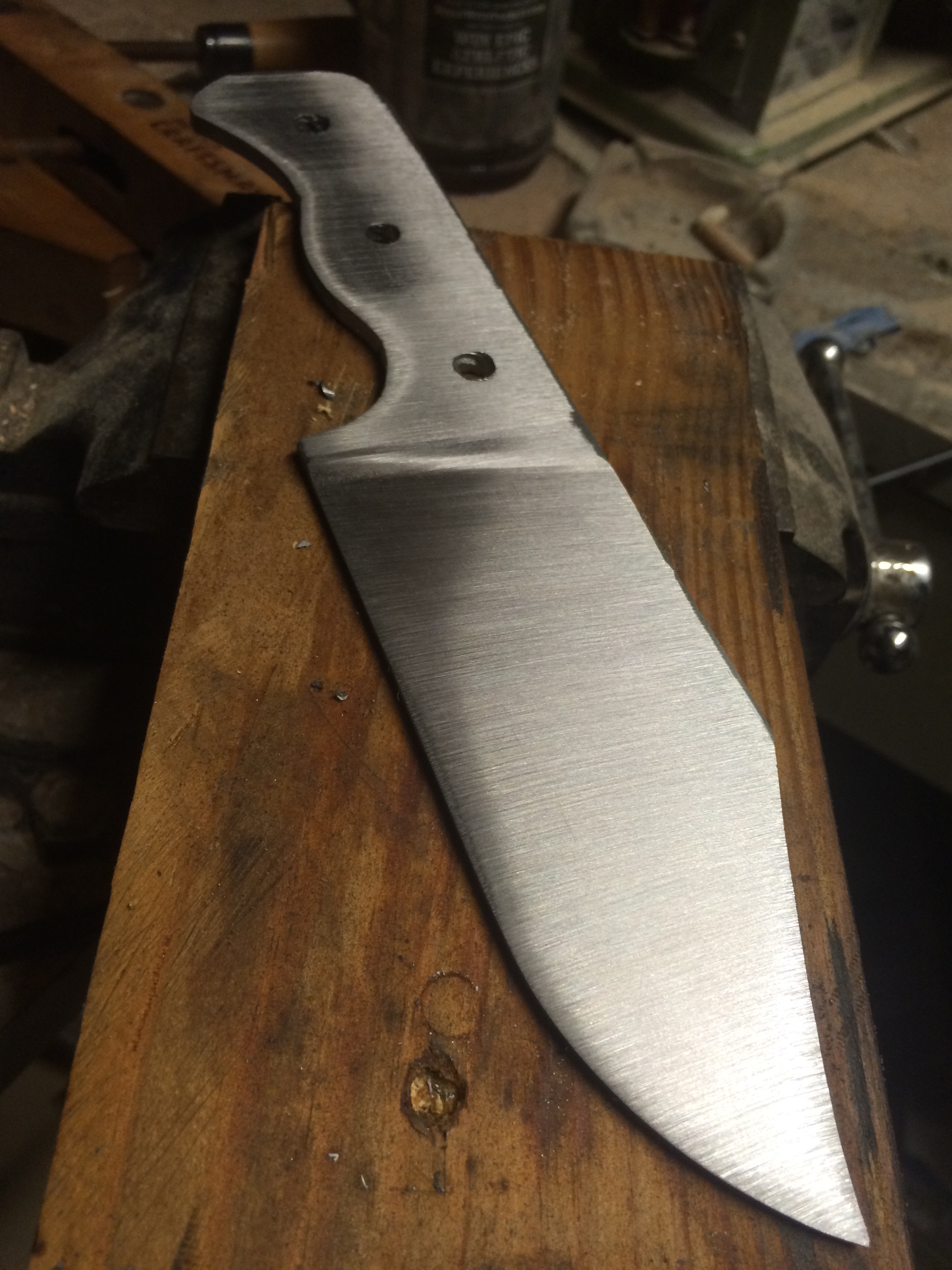
Profiled, ground, and sanded  After hardening…
During tempering…    Roughing in contours…Cherrywood for balance….
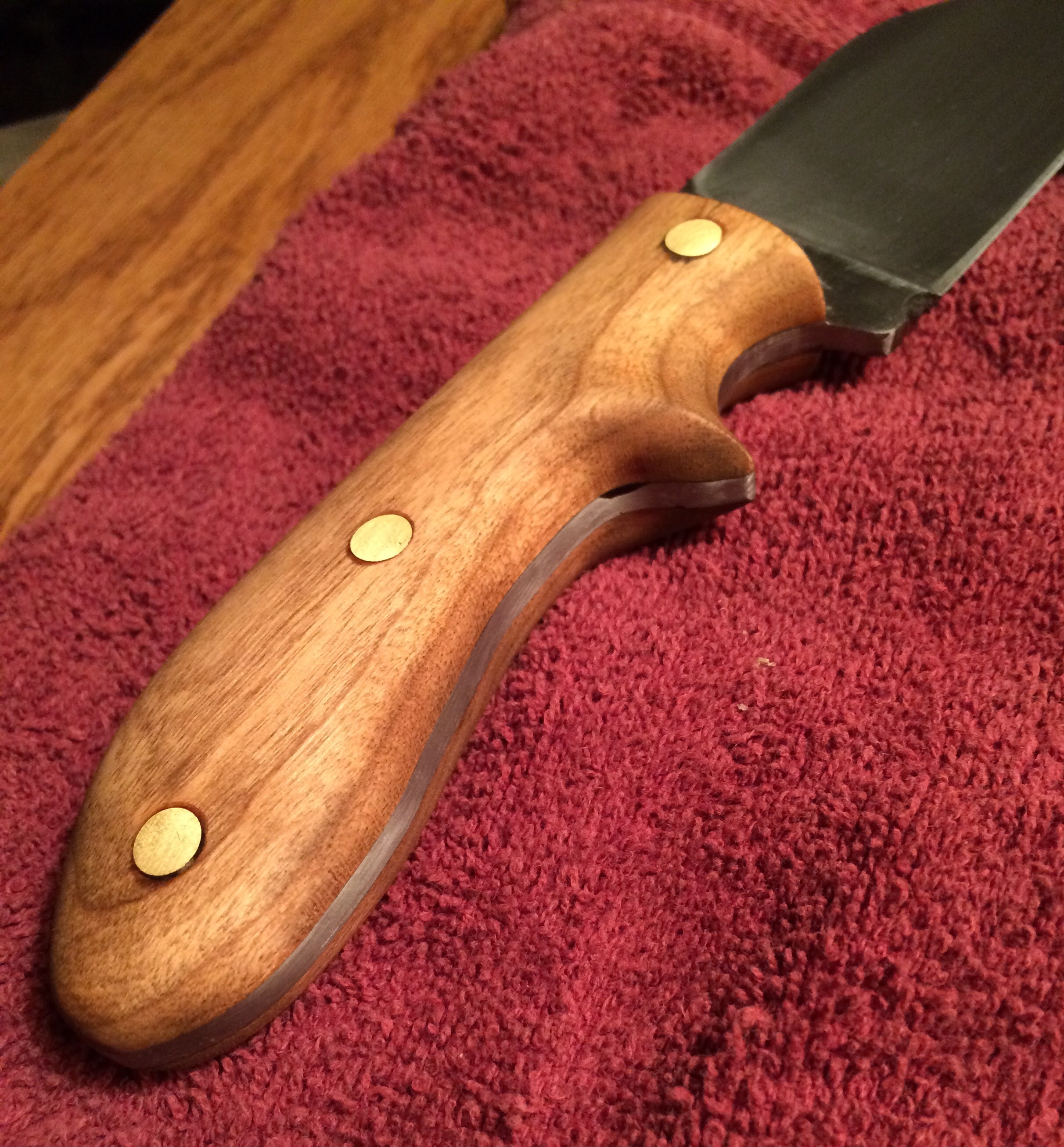
Mostly sanded…  The Hound


The Hound was made from O1 tool steel with a Cherrywood handle and brass rivets.  Hold to your honor.

If you find you would like to purchase one of my blades or have me craft one for you, email me or check out my Etsy store.   It may end up on this blog…

Knifemaking: gentleness, boundaries, and the Maiden

“I was only fifteen years old and full of fire
I was a half a pound of bacon and an egg on the side
She got all the good looks, and I got all the war
She was everything I asked for, and a little more”

Francis Dunnery, Give Up and Let it Go (The Gulley Flats Boys)

This blade was a commission from a very good friend of mine.  I’ve known him and his wife for quite a few years, worked for his company, and spent much time with his family.  He lives in Maidens, Virginia, so coming up with an idea for this blade sort of took care of itself.

The inspiration for the Maiden comes from most all of the women I am close to.  Elegant, beautiful, strong, full of love, and most definitely not having any of your shit.  Or put another way, immaculately clothed but with a sword hidden beneath beneath their cloak.  Or sun dress.  Or whatever houndstooth scarf or coat is in season.  You get the idea.

No man is an island.  Sometimes it’s really healthy to have someone to tell you “hey, see that stupid thing you’re about to do?  Maybe think twice about that- you don’t need to impress anyone.” Or,

“Hey, it’s time to stand on your own feet.  No, I’m not going to carry you through this.  Don’t worry, you’ve got this.”  Or even,

“Whether you fail or succeed, I love you.”

These are strong statements but they are held by a gentleness that we don’t often give ourselves, or at least I don’t.  I’ve been known to on occasion, when left to my own devices, done that stupid thing to impress someone insignificant and not stood on my own feet and felt like love was conditional on whether I failed or succeeded.  Because whether we like it or not, at some point or another we all have moments of neediness and insecurity, self-doubt and self-sabotage, and the story-hour from hell where we ruminate on our screw-ups.  As social creatures it’s important to hear these things from others close to us.  This doesn’t necessarily mean there are dependency issues at play.  It means that we are human.  And whether we are aware of it or not, we are often giving the same support to those who help support us.

To me, these statements also represent strong boundaries- saying what is felt without expectation or condition.  Without (or in spite of) fear of a negative reaction.  Spoken not to coerce or manipulate an outcome but to help us to be ourselves.

That is the lesson of the Maiden- an elegant tool that is close in good times and the rougher times, beautifully dressed with no fucks to give.  I’ll drink to that….

I designed four of these lovely ladies and had my friend pick which on he liked best.  These three didn’t quite make the cut and that’s ok.  I went with a drop point blade- the right balance of tip strength, belly, and piercing ability.  Good for farm work.

  finish sanding

The Maiden: 1095 spring steel with an acid etch, Curly Maple handle, and brass hardware.


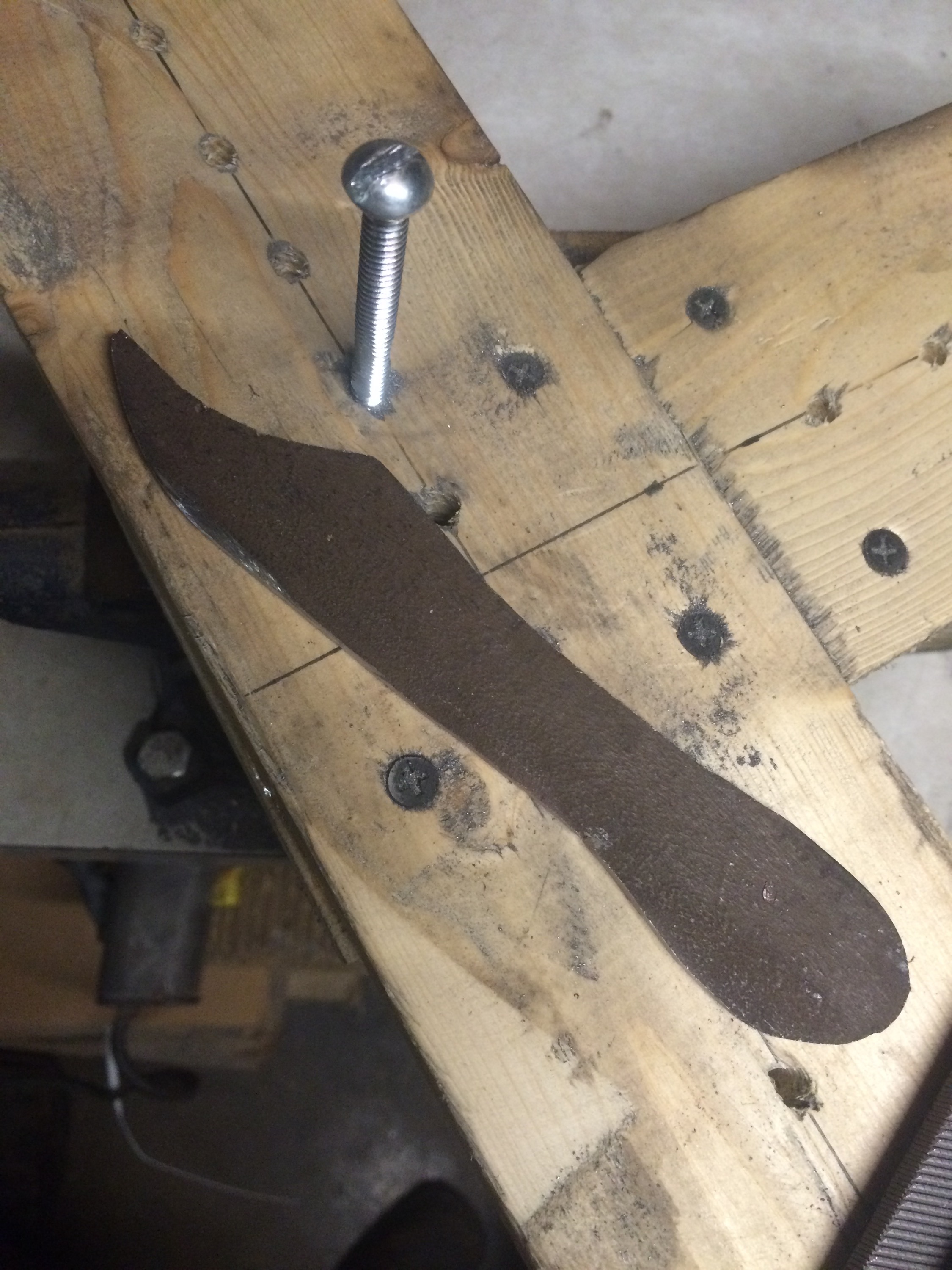
I also made her a sheath.  Wet formed for a snug fit.


I actually made two of these- in case I screwed up the finish on the Curly Maple.  This is the first one, with a satin finish.

Knifemaking: embracing your journey and the Spark

Watch my back and light my way 
Watch over all of those born St. Christopher’s Day”

James Taylor- “My Traveling Star”

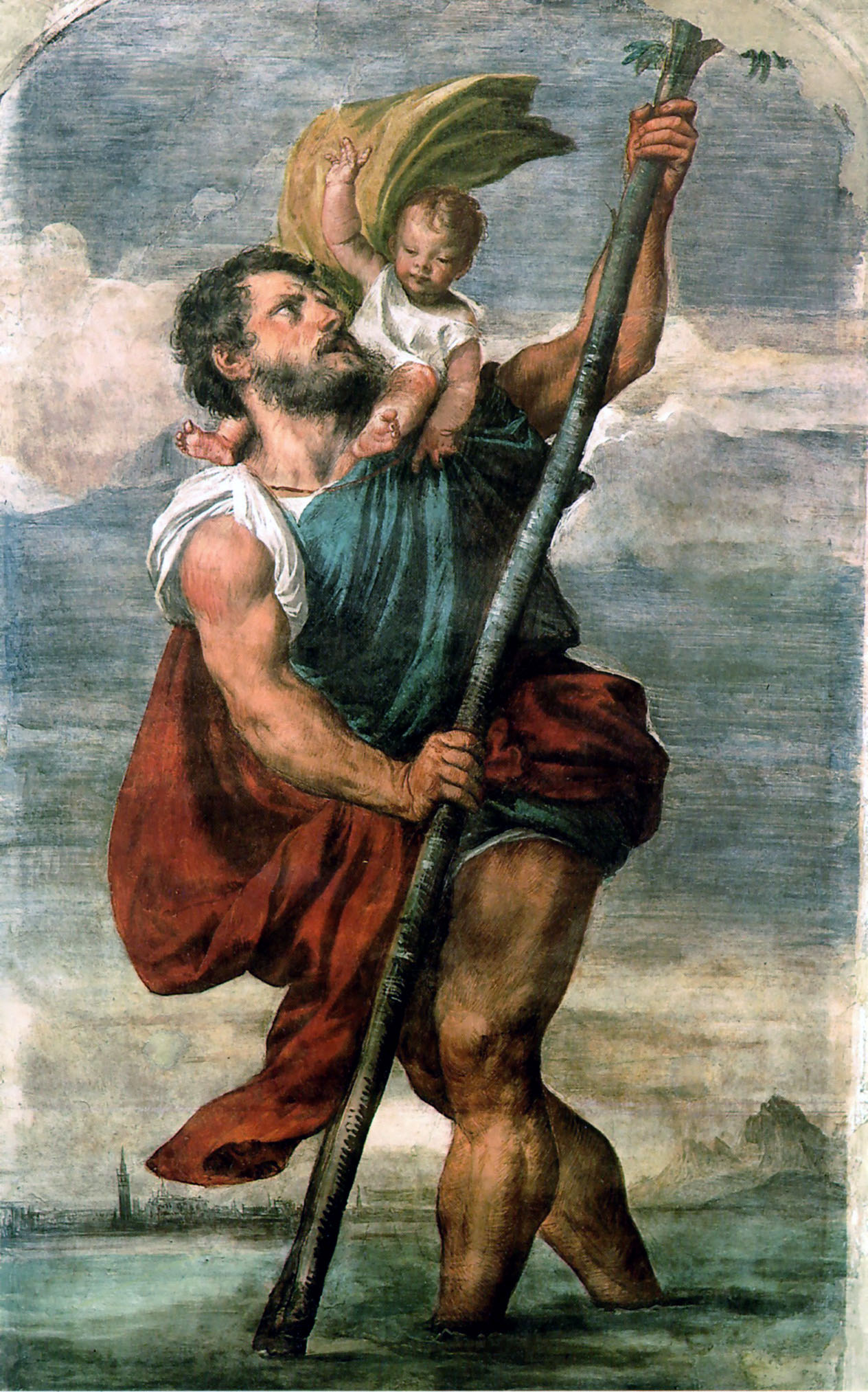
St. Christopher is known to be the patron saint of travelers.  There isn’t a whole lot outside of speculation on who he really was.  “The Passion of St. Christopher”, found in a manuscript called the Nowell Codex (most famous for containing Beowulf) speaks of how he is put to death while trying to convert the heathen king Dagnus to Christianity.  This may be based on the 6th century Greek legend of Offerus, who helped travelers cross a river with strong currents.  The name “Christopher” is of Greek origin and means Christ-bearer.

In 1969 there was a bit of reform to the Roman Calendar and St. Christopher’s Day didn’t make the cut.  The lack of unsubstantiated origins of St. Christopher, though not explicitly stated as the reason for the removal, didn’t help his cause.  On top of that he is not a formally canonized saint.  My Catholic friends may have something different to say and that’s cool.  I’m just an observer.

None of this detracts from the spiritual impact, or that we are looked after and cared for in our travels.

(I read quite a few journals, articles, and blogs.  I put links to the most significant ones at the end of this)

offero

“Saint Christopher”- Titian Vicilli

I have a chef friend, a very gentle man and kind man.  Under that cloak is a no-bullshit attitude that originates from growing up in Brooklyn in the late 1960’s.  He always told me that when travels are tough you should always pat yourself on the back and keep moving.  Sometimes the currents will pull you off your center and you need help.

I started this little knife quite a few months ago.  I was in a place where I felt my fire had gone out.  Travels were tough.  I wasn’t sure where I was going and I didn’t like where I had been.

Even though at that particular moment I couldn’t maintain a roaring fire of my being, I could at least carry a candle, a small flame, till I could get my fire going again.  So I made one.  Something to give me a bit of light, warmth, and comfort.  Something to watch over me when I was having a tough time watching over myself.  The blank for this knife sat on my bench for a long time.  I finished it a couple days ago.  My fire is stronger.  I like where I’m going and I’m not ashamed of where I’ve been.

The lesson here is to not forget where you came from and to not lose sight of where you are going.  Remember the brutal parts especially because those are the most sacred.


The Spark.  High-carbon steel, cherry handle and brass hardware


Wishing you the safest of travels

Anglo-Saxon Poetry: Saint Christopher

10 Beloved Saints The Church Just Made Up

A Catholic Citizen in America

Did the Church declare that St. Christopher is a myth?

Knifemaking: expansion within limitations and the Operator

“When forced to work within a strict framework the imagination is taxed to its utmost and will produce its richest results.  Given total freedom the work is likely to sprawl.”

T.S. Eliot

I’ve found there are two types of people in the world: the Administrator and the Operator.  The Dispatcher and the Dispatched.  No person is completely one of the other.  Some people intermingle beautifully in both worlds.  Some people are better at delivering orders and others are better at executing them but no one is completely one or the other.

I find myself more in the realm of the Operator.  What needs to be done?  When does it need to be done?  Within these sorts of parameters I find that I laugh a bit easier, creativity is much more present, ideas flow better, and there is a general ease about me that might not be there if I am left totally to my own devices.  Within these sorts of parameters I am most productive.

Expansion within limitations.  We are all limited at some capacity.  Miles Davis was limited by the physical limitations of the trumpet, Mary Lou Retton by gravity, and Socrates by the political constraints of his time.  These limitations didn’t mean that they weren’t going to reach like hell for what they believed in.  No work is totally free because we are all coming from somewhere.  And it’s not about consciously limiting yourself or your potential; it’s about pushing through to find how far you can go with your craft before you hit a barrier that prevents you from going any further.  And honestly I don’t think there are many, if any, people who have hit that point.  The rub is getting through the limitations we put on ourselves.  Sometimes they sound like this:

“I’m not allowed to be this good”

“If I’m this good it might offend someone who has worked harder than I have”

“I don’t deserve to be this good”

“It’s too much work to be this good”

Those are unhealthy limitations.  Healthy limitations push us.  Money constraints, time constraints, resources, naysayers, things of that nature.  Nothing is totally free and this is a very beautiful thing: we are all coming from somewhere.  We have notions, perspectives, opinions, and options.  We all work within mediums.  Even accountants manage to be creative within what I consider to be a dry and sterile set of parameters.  Accountants might disagree and that is part of what makes the world go round.

This is how things get done and was the inspiration for the Operator.

The lesson of the Operator is to do your tasks beautifully and fully, to the best of your abilities, and within whatever parameters have been set for you or that you have set for yourself.  Whatever those tasks may be.

I felt I was limiting myself and wanted to use a different steel.  1095 steel is a tried and true material for knives and many other things.  Lawn mower blades, files, coil springs for suspension systems, and many other things.  It’s easy to work with, hardens up beautifully, and takes a razor’s edge.  It’s super tough.  And cheap.  I like all of these parameters…
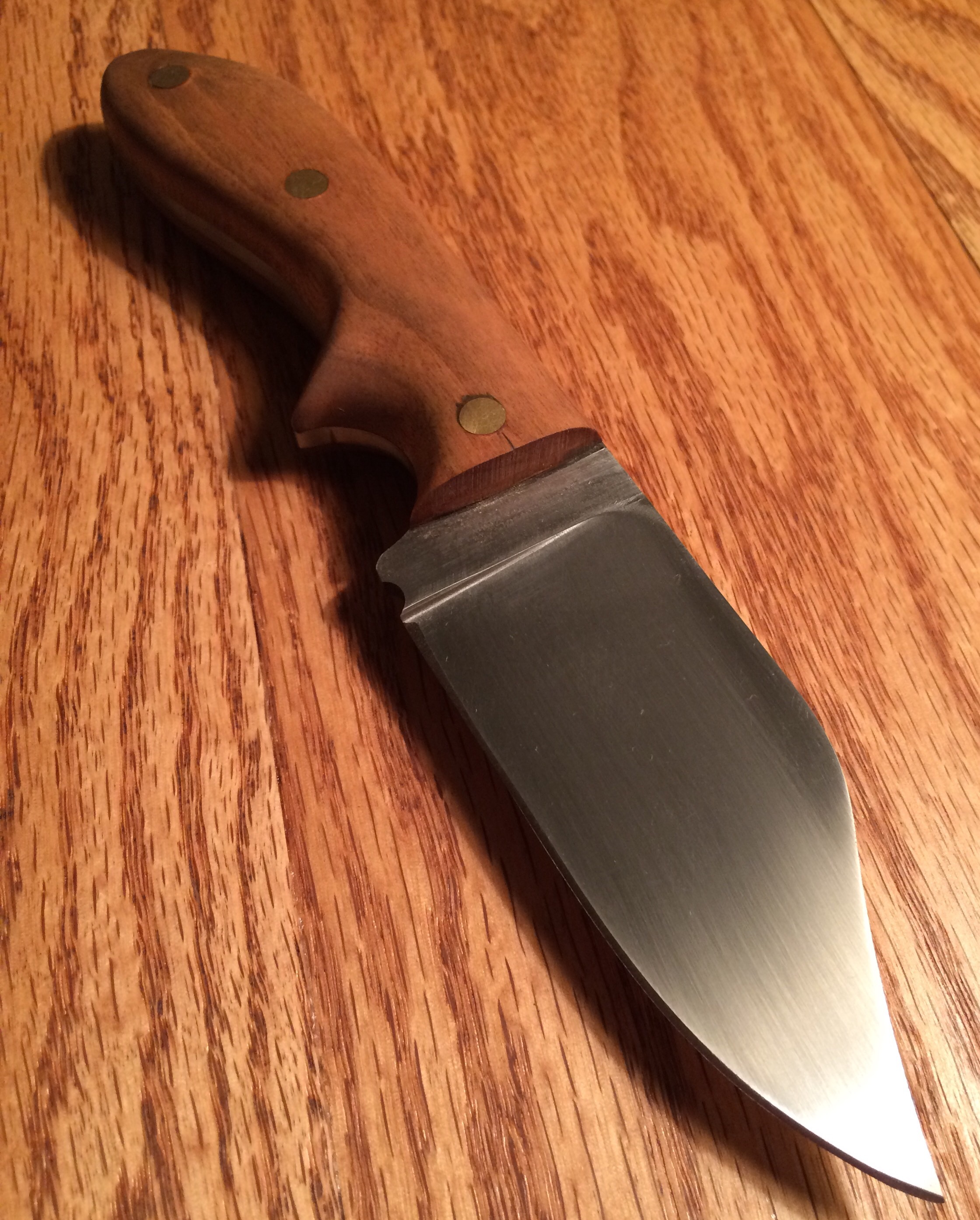
FullSizeRender 7The Operator
IMG_2275

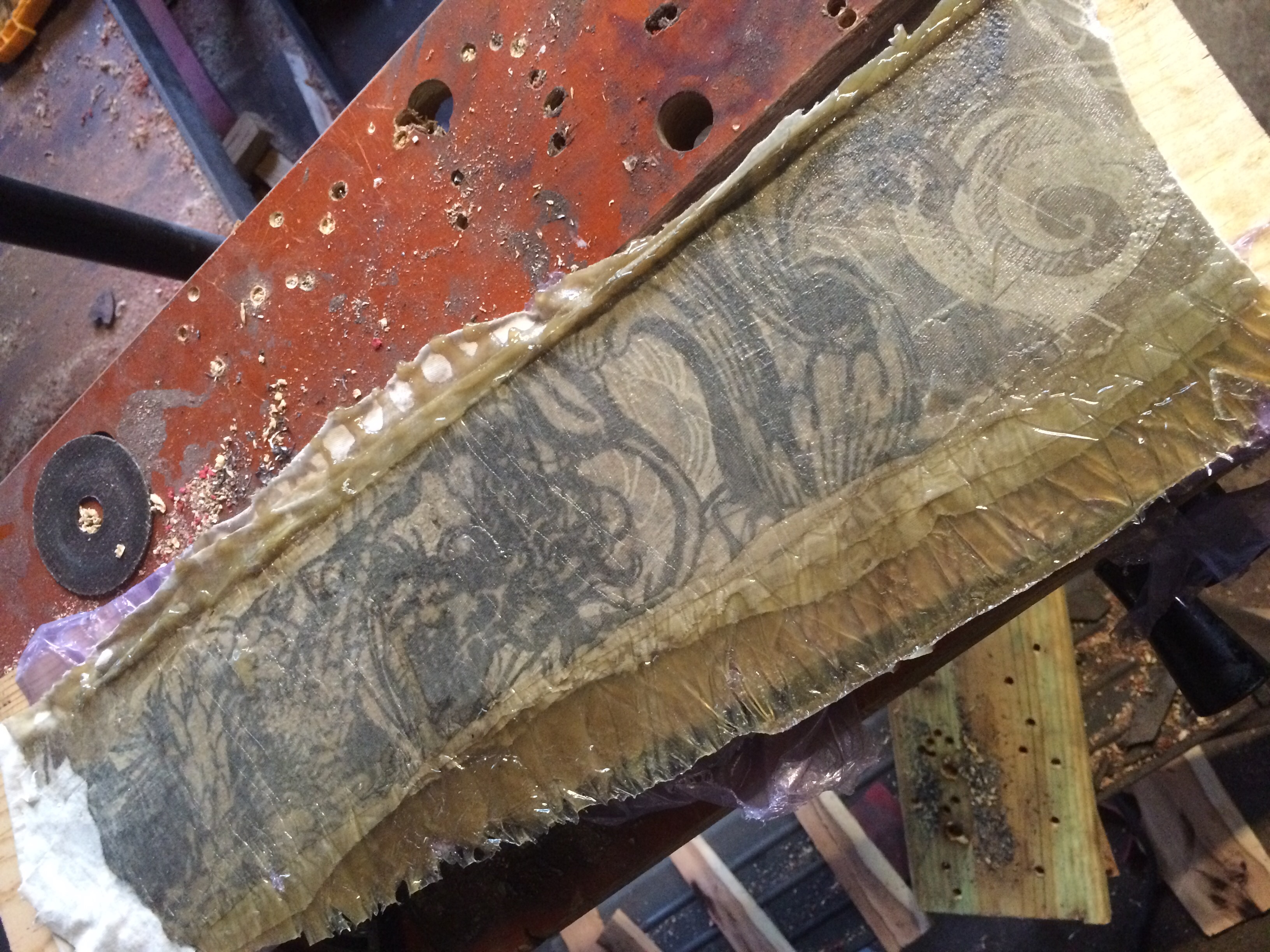
I ground this freehand on my cheap little belt grinder.  It’s a process. IMG_2289Here’s where I make the handle material.  I used fabric, fiberglass resin, pressure, time, and patience.  You can buy the stuff commercially (it’s primarily used in industrial electrical insulation practices) but it’s a lot more exciting to make your own.  I’ve done this several times and I’m never entirely sure if it will turn out as expected…This is a quick and interesting read on how this stuff works and why it’s ultimately great for knife handles. IMG_2291I used two of my favorite shirts- shirts I had worn up and down the East Coast and had adventures in.  It was time to retire them and this was a good way to honor their Operator spirit…
IMG_2292the raw material…IMG_2294 cut to shape…IMG_2296

 
I probably spent three hours sanding the stuff…  Sanding is finished.  He goes into phosphoric acid.  This etches the surfaces of the steel and helps protect against rust.  It also makes the blade non-reflective, for those who may wish to operate clandestinely…I wish the blue material would have been more prominent but it turned out wonderfully nonetheless.  

Work within whatever parameters you may have but don’t limit yourself.  The Operator in action:

Knifemaking: softening, sturdiness, and the Finn

“”Fire will not burn you once it has
made your acquaintance,
will not abuse its kin.
When you come to fire’s dwellings,
to the bright one’s barricade,
there you will become beautiful,
rise up to be magnificent
as men’s fine swords.””

-Rune IX, The Kalevala

I based this blade loosely on the puukko, the traditional knife of Finland.  Carried for centuries by outdoorsman, this simple and unassuming knife has been the backbone of many livelihoods forged in a harsh enviroment.  It is characterized by a blade with a deeply curved edge and straight spine.  In order for the puuko to be authentic, it must be made in Scandinavia.  The handles are traditionally made of Curly Birch and the blade is made with Finnish Ovako 100Cr6 steel- although other materials are most certainly used.

 There is a fantastic Finnish knife blog called Nordiska Knivar.  They speak a lot more on the matter.  These dudes love their puukkos….

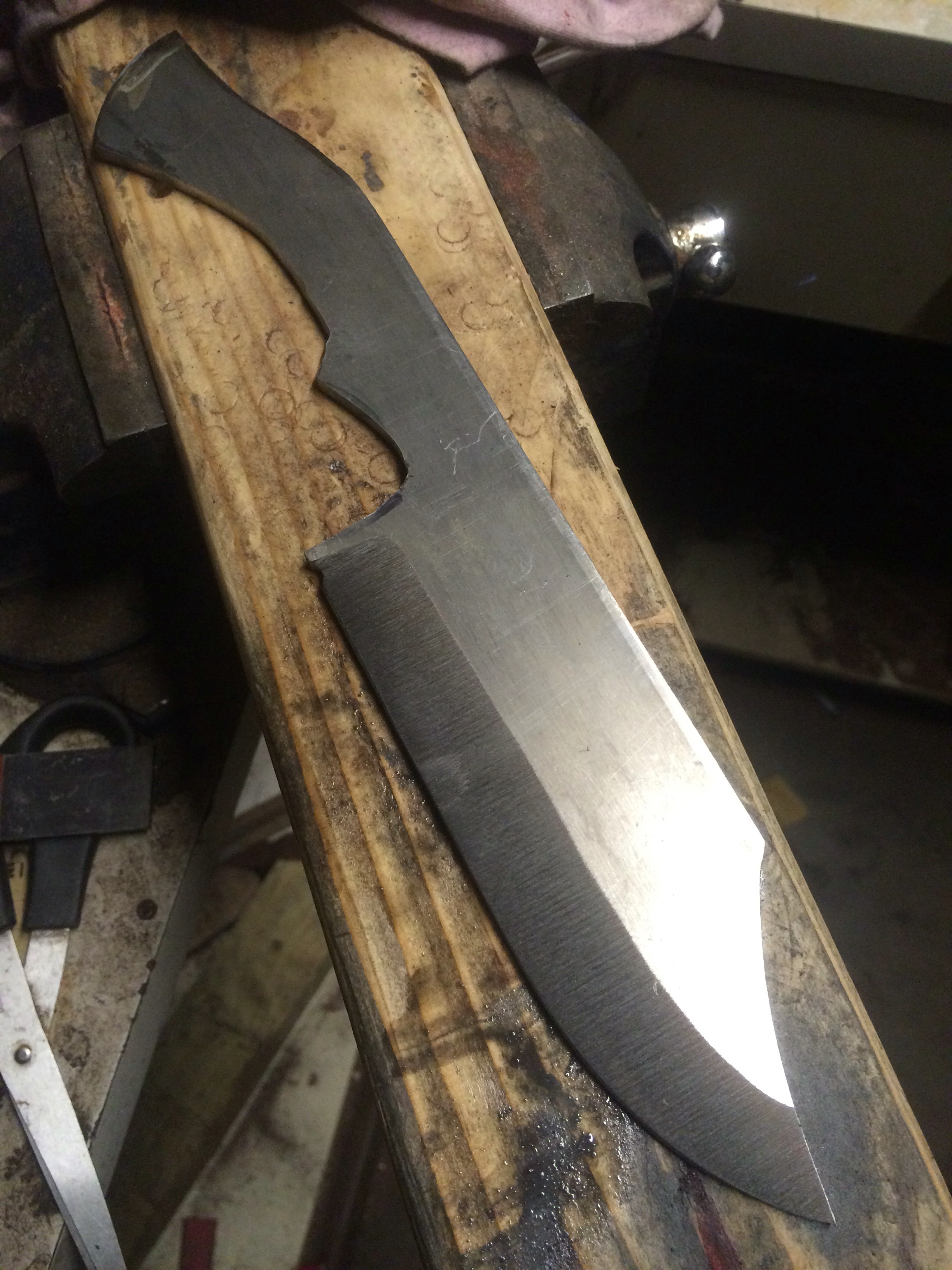
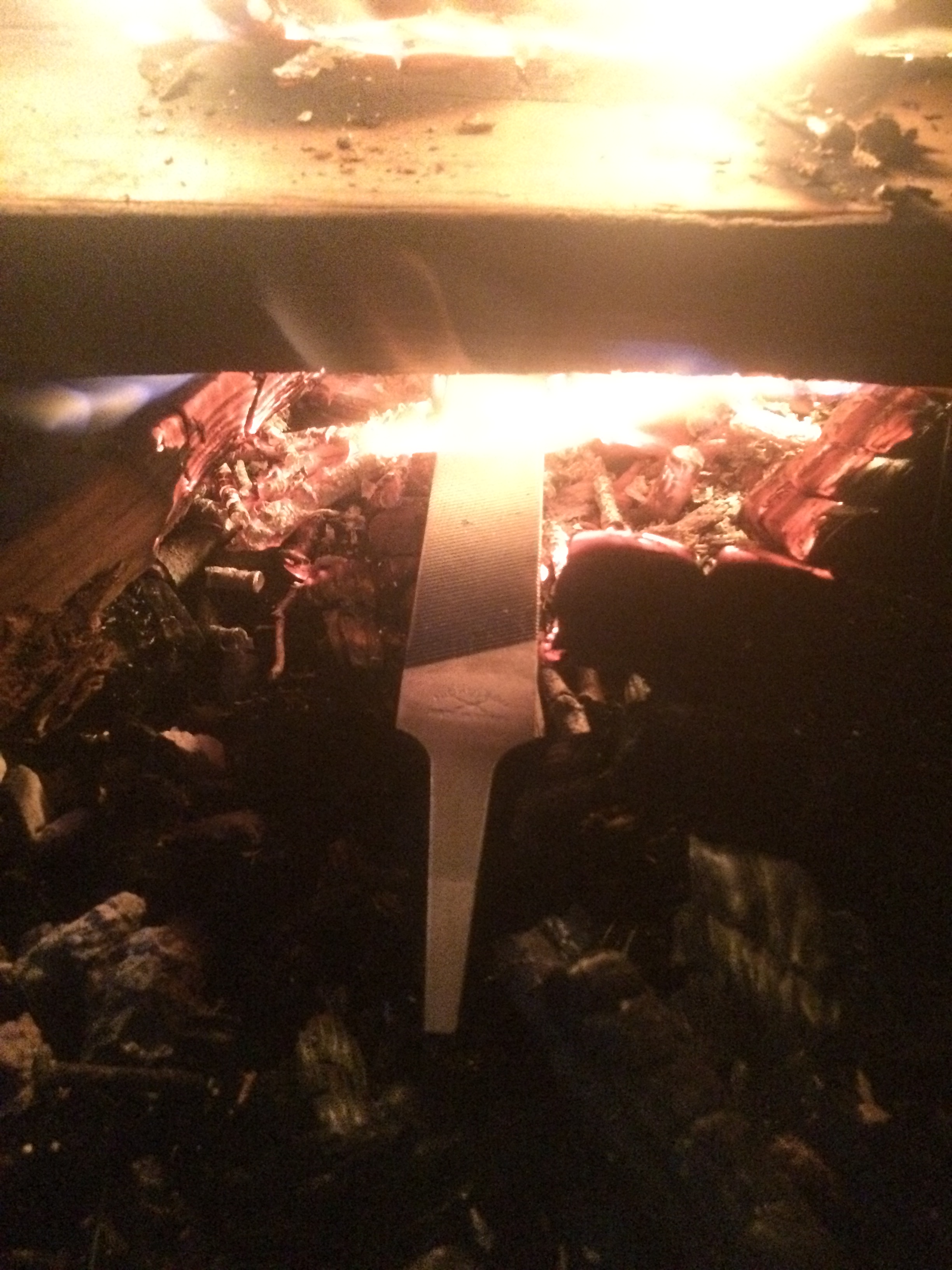
I had an old Nicholson file that I wanted to craft a blade from.  There are several sources that say they are made of either 1095 or W1 steel.  Both of these will make a good blade.  I had to soften it first- otherwise it would just eat through all my cutting discs, sanding belts, and ruin my other files.  To do that I let it sit in hot coals for several hours, letting it glow red and then cool slowly…

IMG_1960The reason we soften things is that they become easier to work with.  A set of knowing hands can work soft clay into something beautiful.  Mistakes (and there are always mistakes) are easier to fix in this way.  In this place it’s easier to be free, to let go and go for it.  Just as it’s very difficult to work with clay that has been fired in a kiln, metal that has been hardened, or paint that has cured, it can be difficult to be with ourselves in a hardened state.   Softening gives a chance to freak out at all the work we have to do, to look at things objectively, to make a plan, and to deviate from that plan as we sometimes have to do.  Softening gives us space to work, to breathe and to live.

 And then sometimes things warp in the softening process.  This is ok.  In this instance I just heated it back up and hammered it straight, as we do…. I came up with this:  a nod to Scandinavian sensibilities and a hidden tang, something I haven’t done before.
IMG_2197

There she is…
IMG_2198 I put a saber grind on this blade.  In this grind the bevel starts about midway through the width of the blade so that the spine retains full thickness.  It also left the remains of the file.  It’s important to remember where you came from.IMG_2199Ready to hardened and tempered again:
IMG_2202

Handle fittings- mesquite and steel.

IMG_2203 After sanding, filing, hammering, and swearing…he’s in.IMG_2205

IMG_2206Almost there…IMG_2210

The Finn

He is sturdy, beautiful, and capable.  It takes some time but the work we do in our softening does not go unrewarded.

ead793bd-441e-48df-b986-c240d88d484a

The lesson here is to not be afraid to soften, to not worry about how long it will all take, and to definitely not compare yourself to where others are in all of this.  There is ample time to jump in the forge and find our sturdiness.