Knifemaking: learning your craft and the Maestro

“This is Mr. Beethoven.  Do you hear that?  You don’t?  This doesn’t move you?  Well that’s ok baby, you can always go sell shoes.”

-Doug Richards

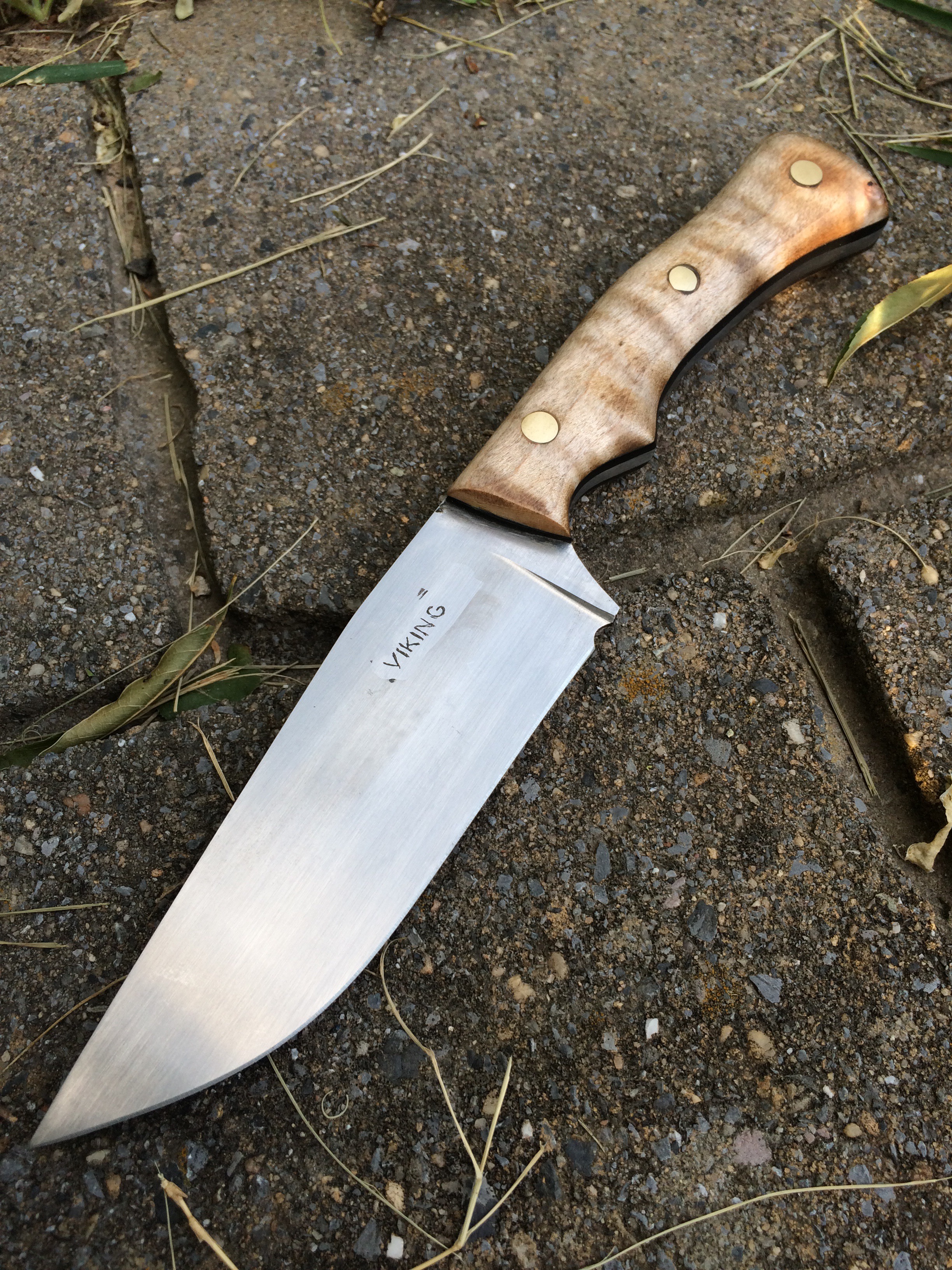
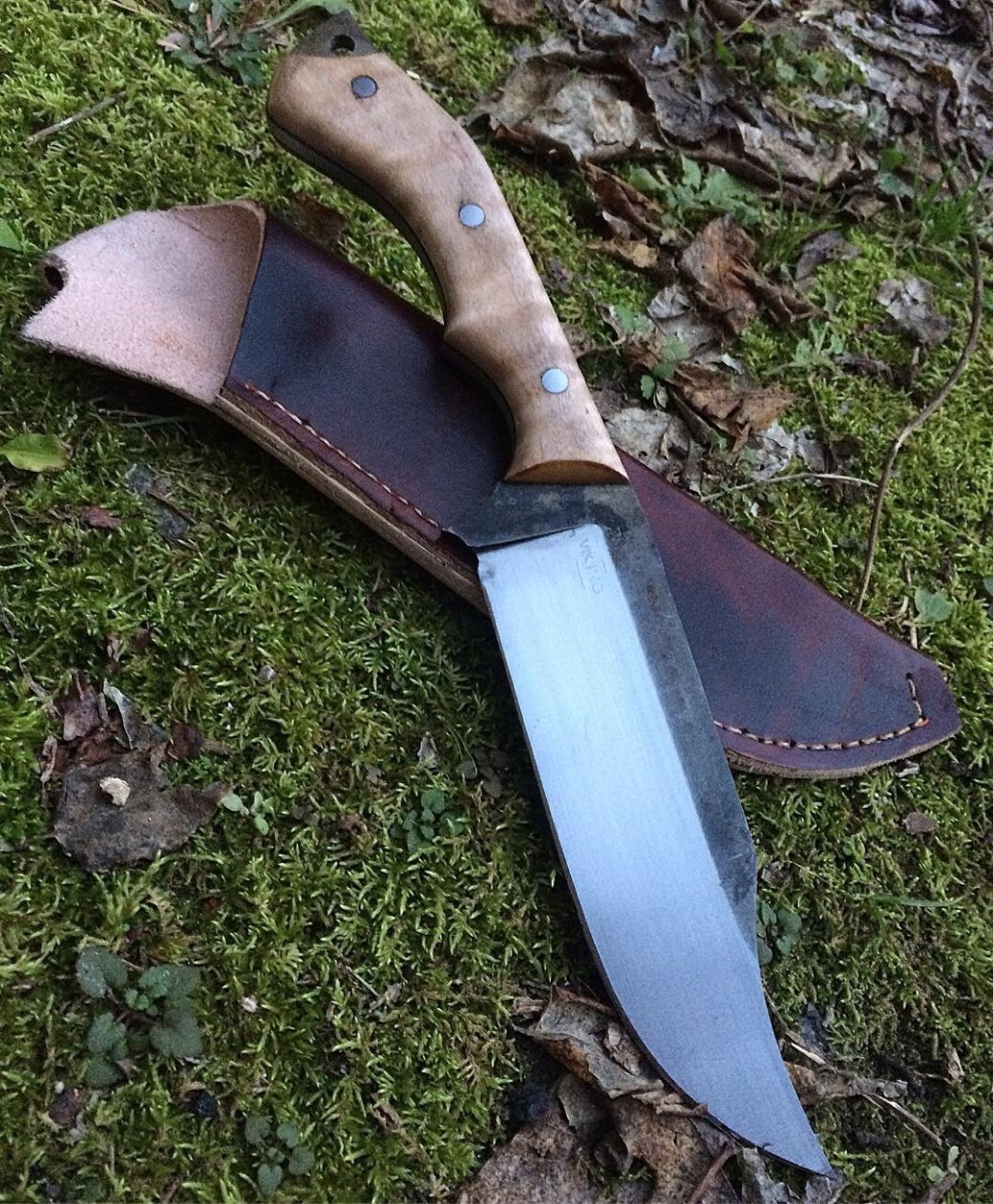
This knife was a commission for one of my former teachers and good friends, Doug Richards.  I first met Doug when I was fifteen.  I had been accepted to a summer residential arts program and went to study music and trombone.  I was there with about 50 other musicians and vocalists from across the state.  One of the classes I took was run by a jazz saxophonist, who also played every wind instrument known to man.  To help us learn about jazz he brought in a very passionate man to speak to us about Duke Ellington, one of the great American composers.  This man was Doug.

This particular class was at 8am and we had all been up late doing God knows what, as teenagers away from home living on a college campus are wont to do.  Doug noted this and suggested that if we were tired and didn’t have time for the Duke then we could leave and take a nap.

This took us all aback.  We all paid attention as Doug put on an Ellington video and proceeded to dance around the room, deigning us with the story of the music and the man…and every member of the band.  The man has an encyclopedic knowledge of music and the lore around it.

I ended up coming to university to study with him.  He taught a two year course of study on how to write big band music.  That was the course description anyway but it was so much more than that.  In this class I learned how to listen, really listen, to music.  I learned how to discern the masters from the dilettantes.  I learned what moved me and the mechanisms of the sounds that held me in those places.  Amidst all of this I learned how to compose and arrange music that sounded like me, and no one else.

What I learned most from Doug was the importance of craft.  Craft encapsulates art.  Without it, your art isn’t as articulate as it could be and your vocabulary to put what you want to say out into the world is stunted.  I started to see this all over in my world- in the people I would work with, in the music I listened to, in the food I ate, and the films I would watch.  I paid attention to the manner in which things were put together.  I spent hours working on assignments from Doug, exercises in craft, to the point where I would seriously question my life decisions.  Often times I felt that these exercises didn’t leave room for any emotion.  Over and over I heard “Do not emote” when we approached these exercises, but then I would hear something that Doug had written and it dripped with emotion.  Was this some cruel joke?

It was not.  In time we were told to write things.  I would think of what I wanted to say, write it down, and the craft I applied would make it blossom.  Almost without even thinking about it.  You just know what to do.  The way that a warrior knows to make the kill, or a seventh grade guitar player knows to hit the distortion button.  And so I started devouring the craft.  I studied classical orchestration with Doug, orchestrating Ravel piano scores for wind ensembles.  I played in a Stravinsky ensemble he ran and we worked through pieces the likes of which I’d never heard. 

As an adult I remember all the lessons from this man.  I always try to remember craft, and to practice it.  Like a good meal, or good music, or good love, craft is not something that is easily bullshitted.  In a world where quality is often compromised for time and quantity, craft stands out.  This is the lesson of the Maestro.       

The stories of this man are legendary.  Here are a few:

-Most of us had heard of Doug doing one-handed pushups before rehearsals back in the day.  Somebody mentioned it to him one day before a rehearsal and he dropped down and did 17.  None of us could do any…

-When we were rushing the tempo on a piece of music in rehearsal, Doug told us to slow down or we would get a reputation with the ladies.

-There was a limited edition of a recording re-released and Doug told me that I needed to have it.  When I told him I didn’t have the money he suggested I get a paper route…

– Before one performance, Doug made an announcement: “Ladies and Gentleman, please take your cell phones, pagers, and all of your other electronic jive out into the lobby, throw them onto the ground and step on them because I don’t want to hear any of them during this performance.  Thank you.”


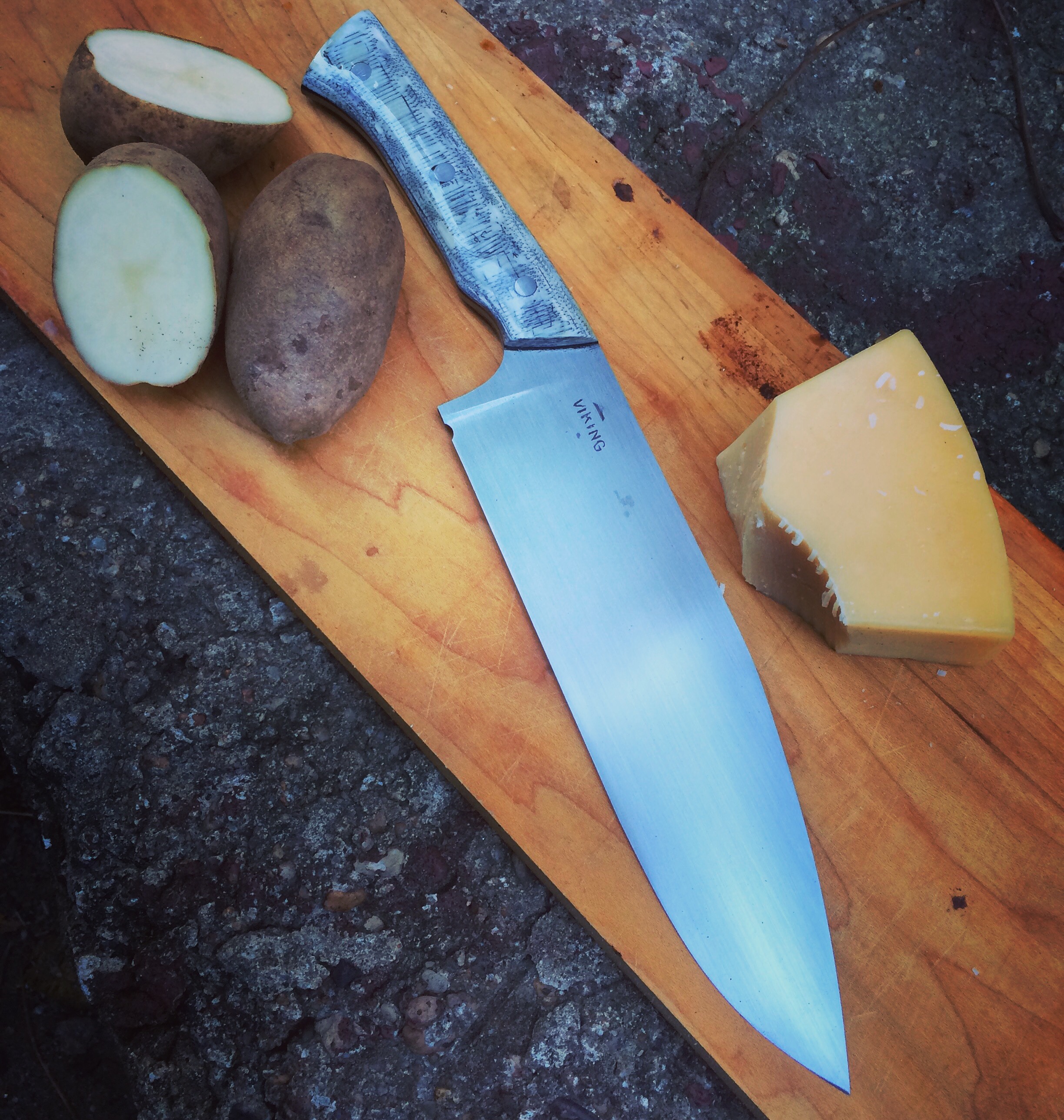
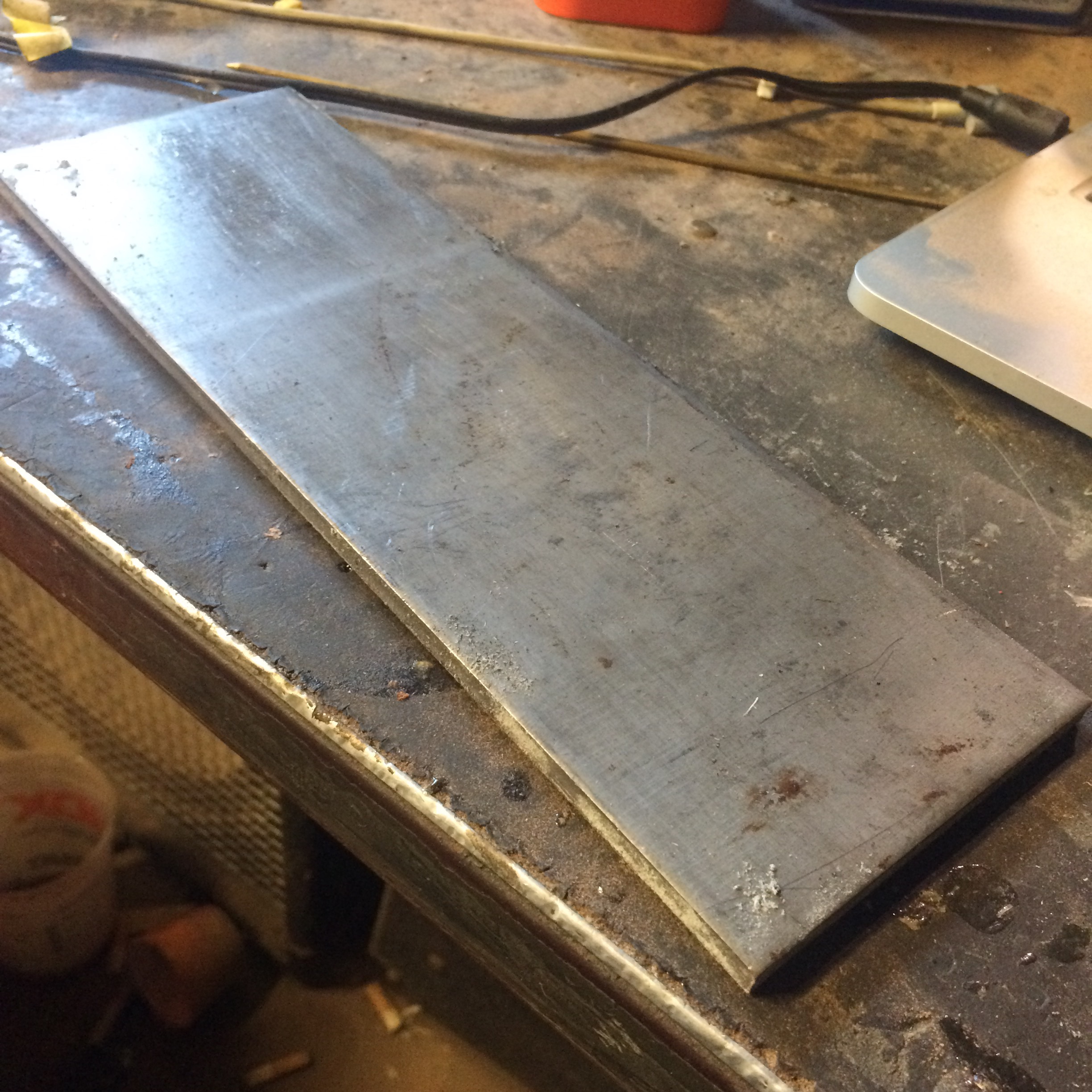
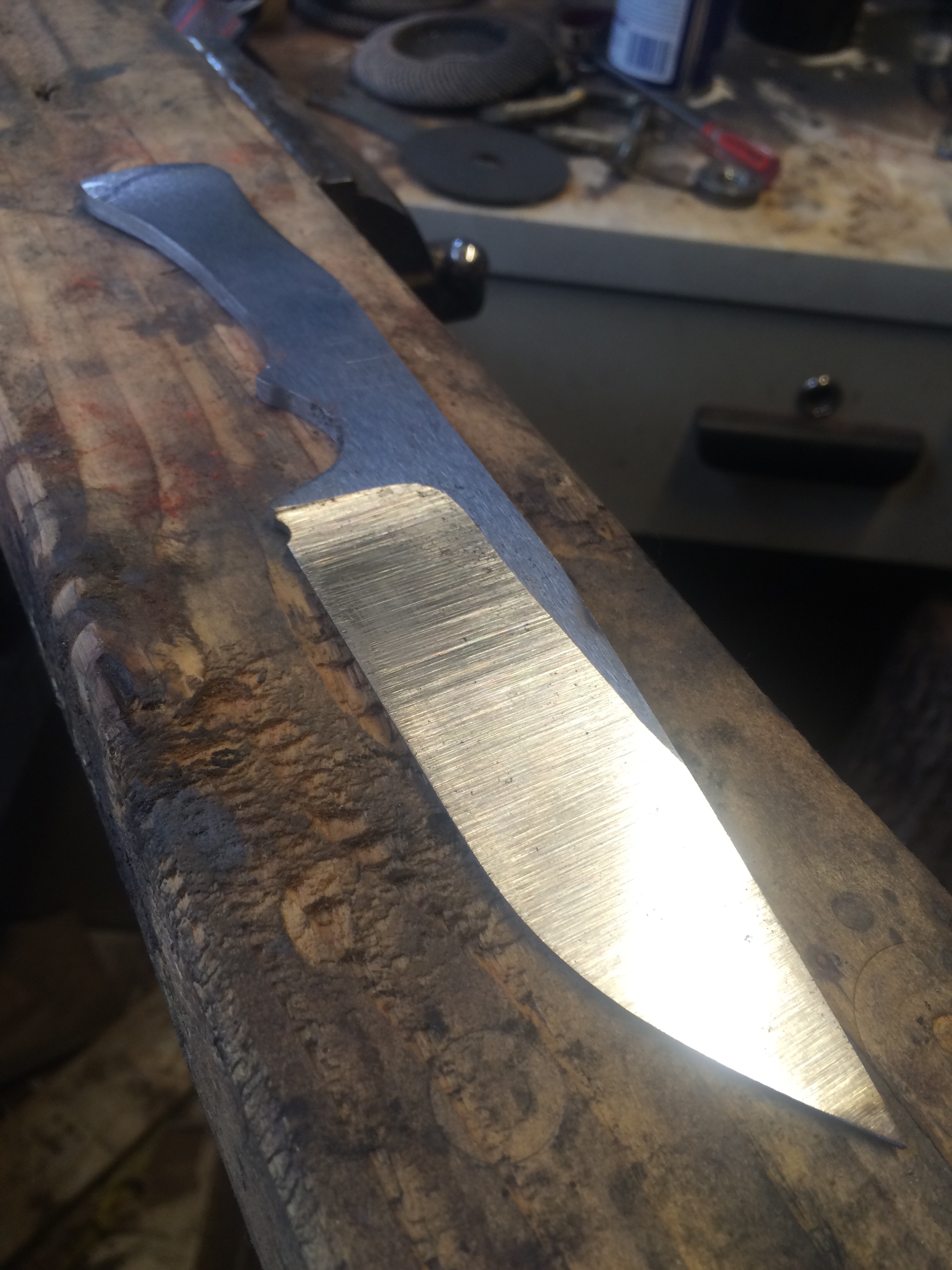
Doug asked for a chef’s knife, for the kitchen.  I started with a piece of thin stock O1 tool steel:

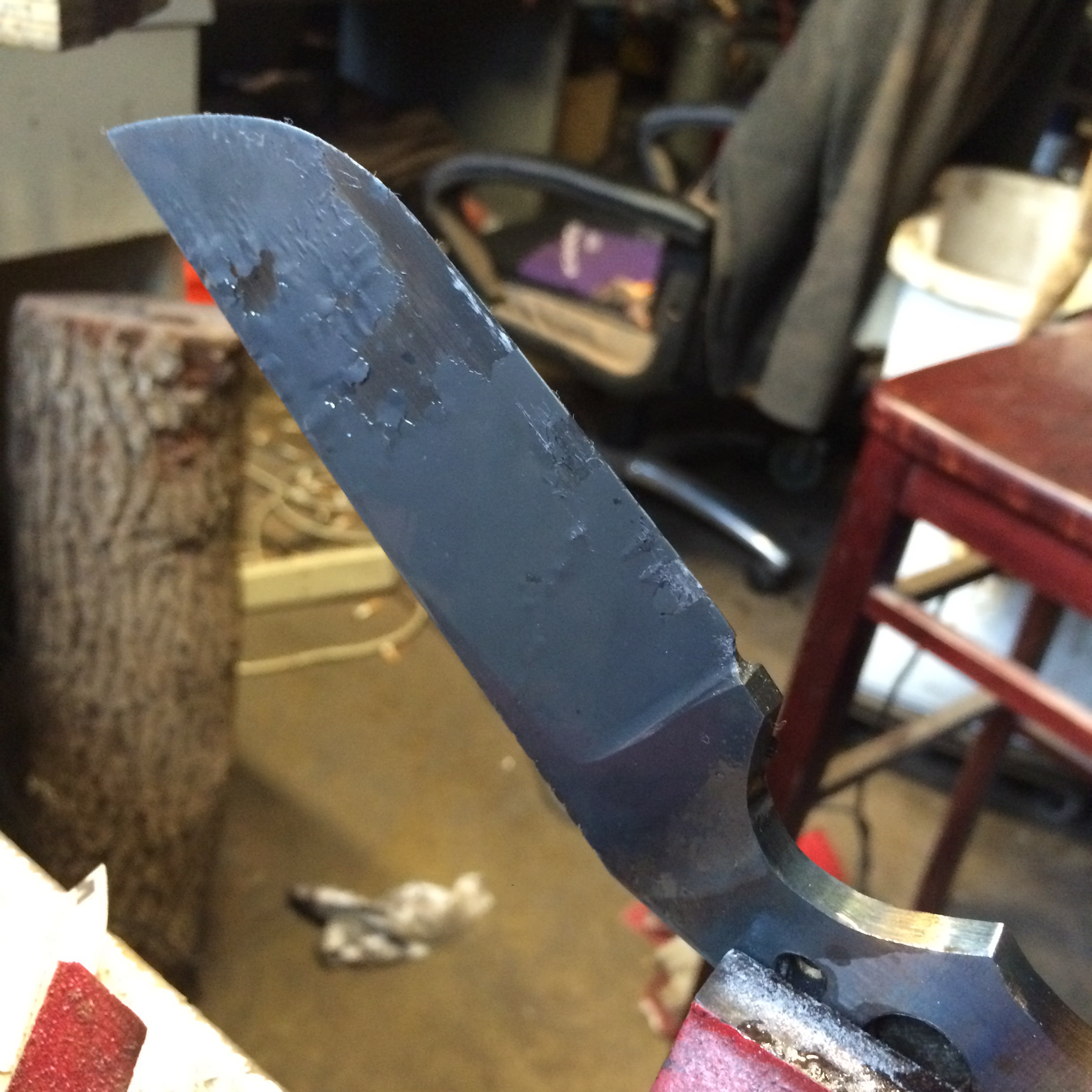
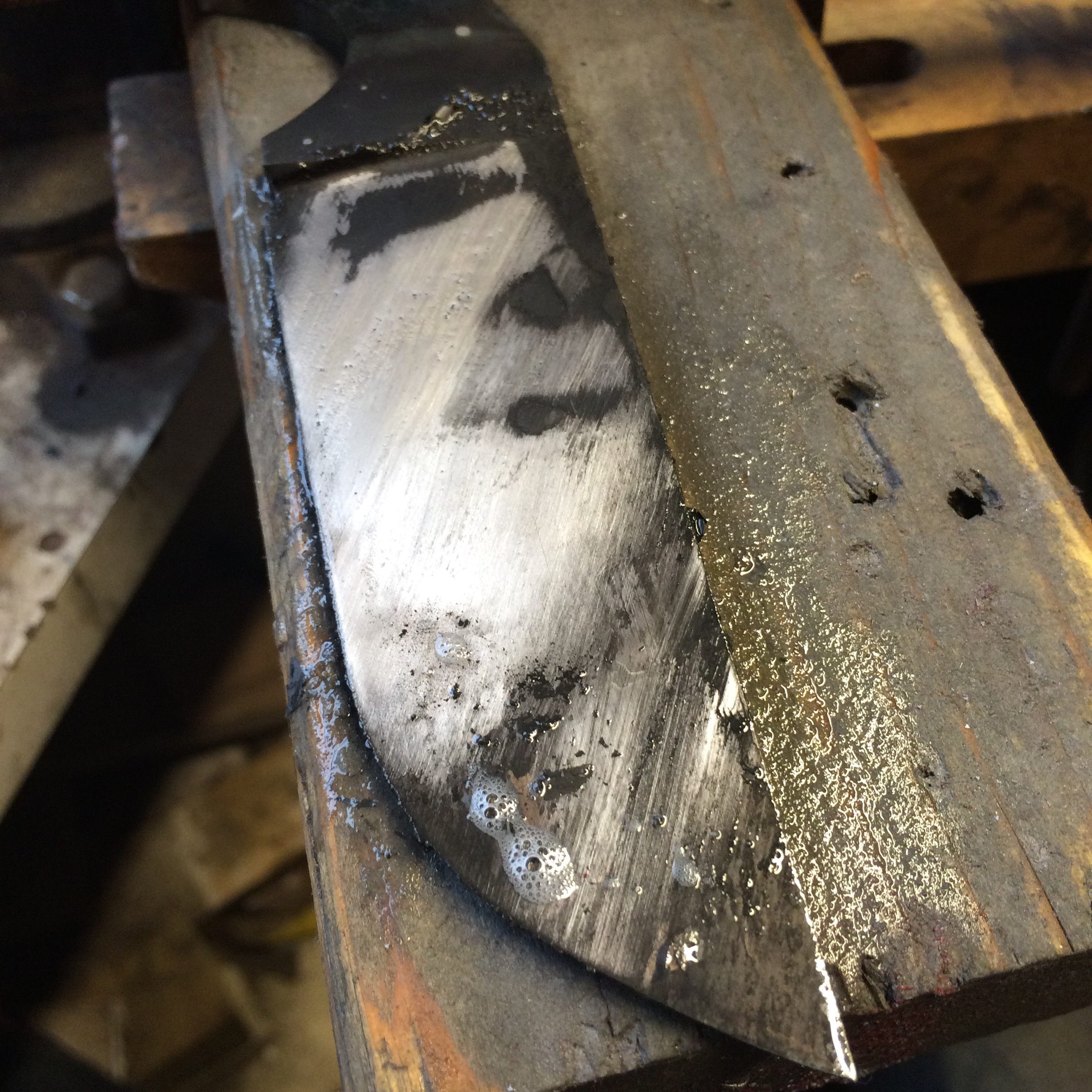
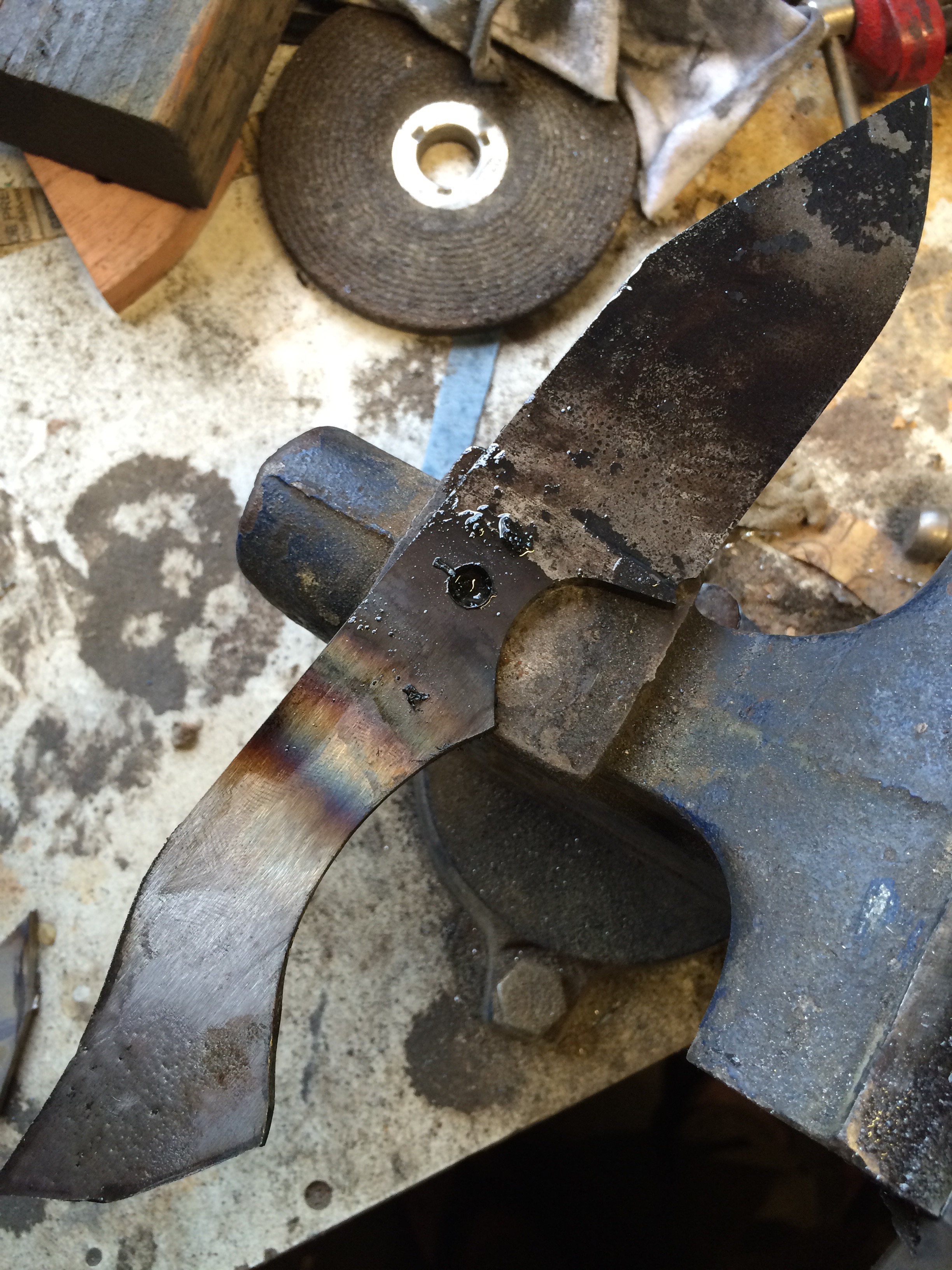
Hardened:
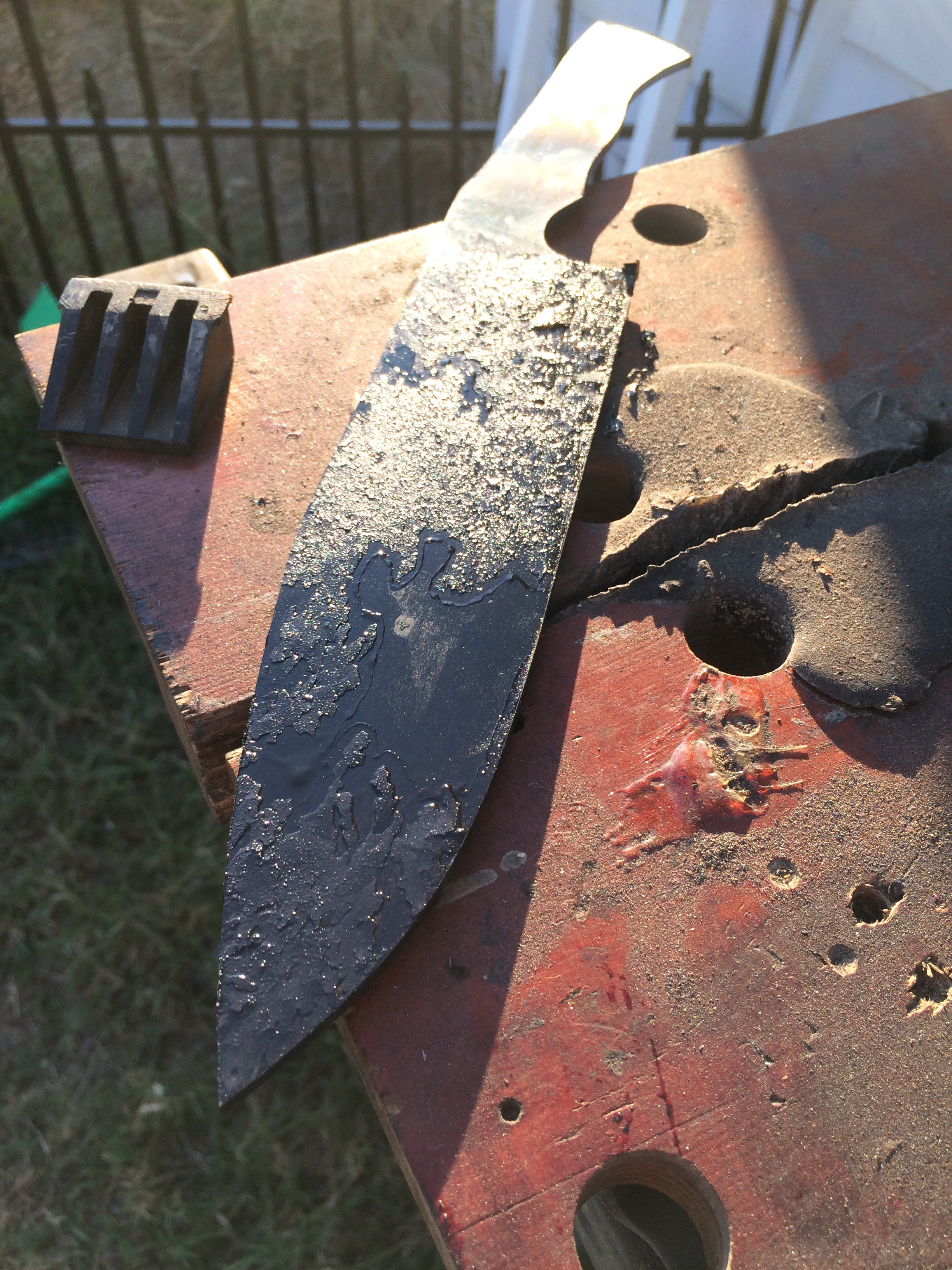
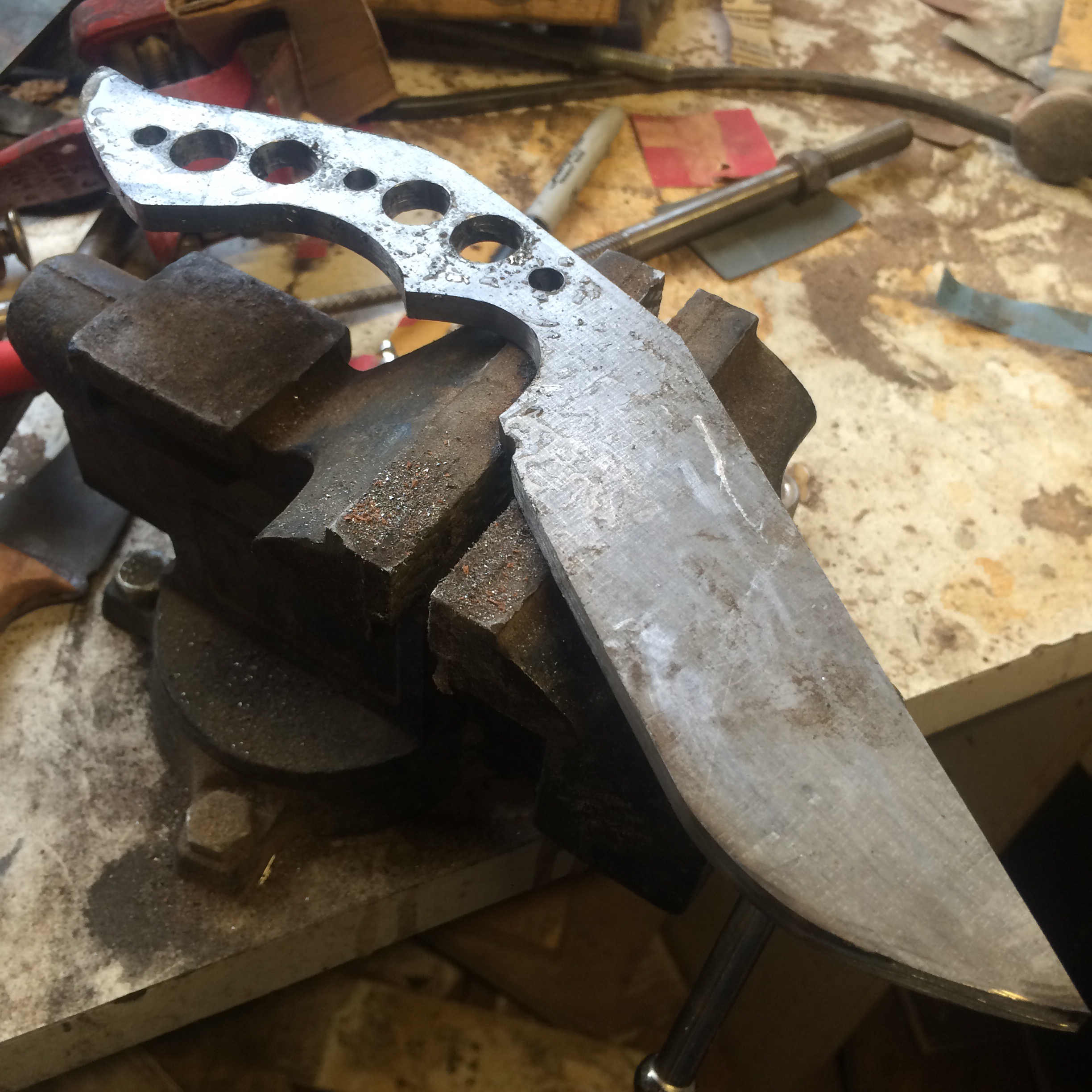
Grinding:

More grinding:

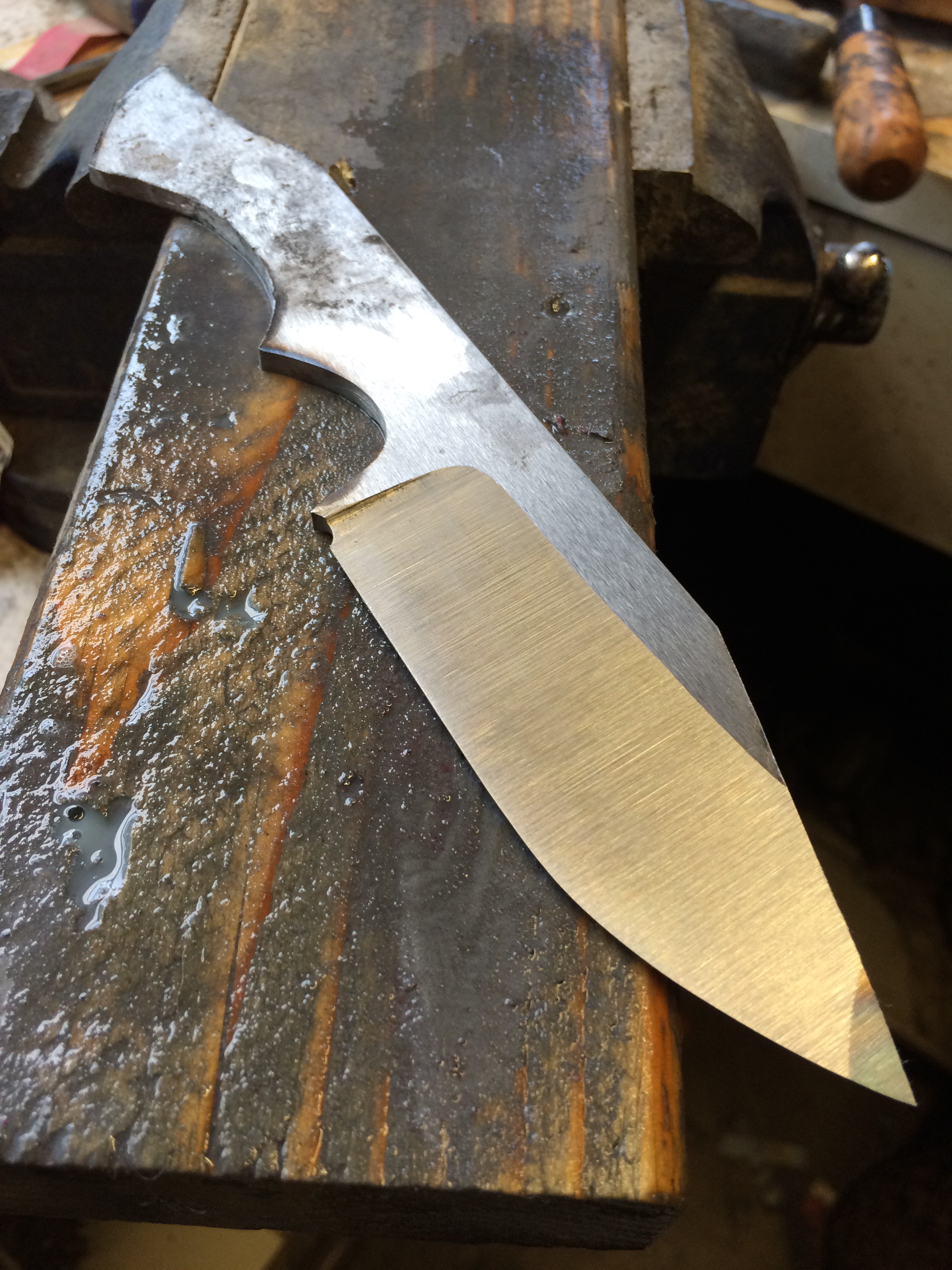
That’s about right…off the grinder at 40 grit:

Hand sanding station:

handwork starts at 80 grit:

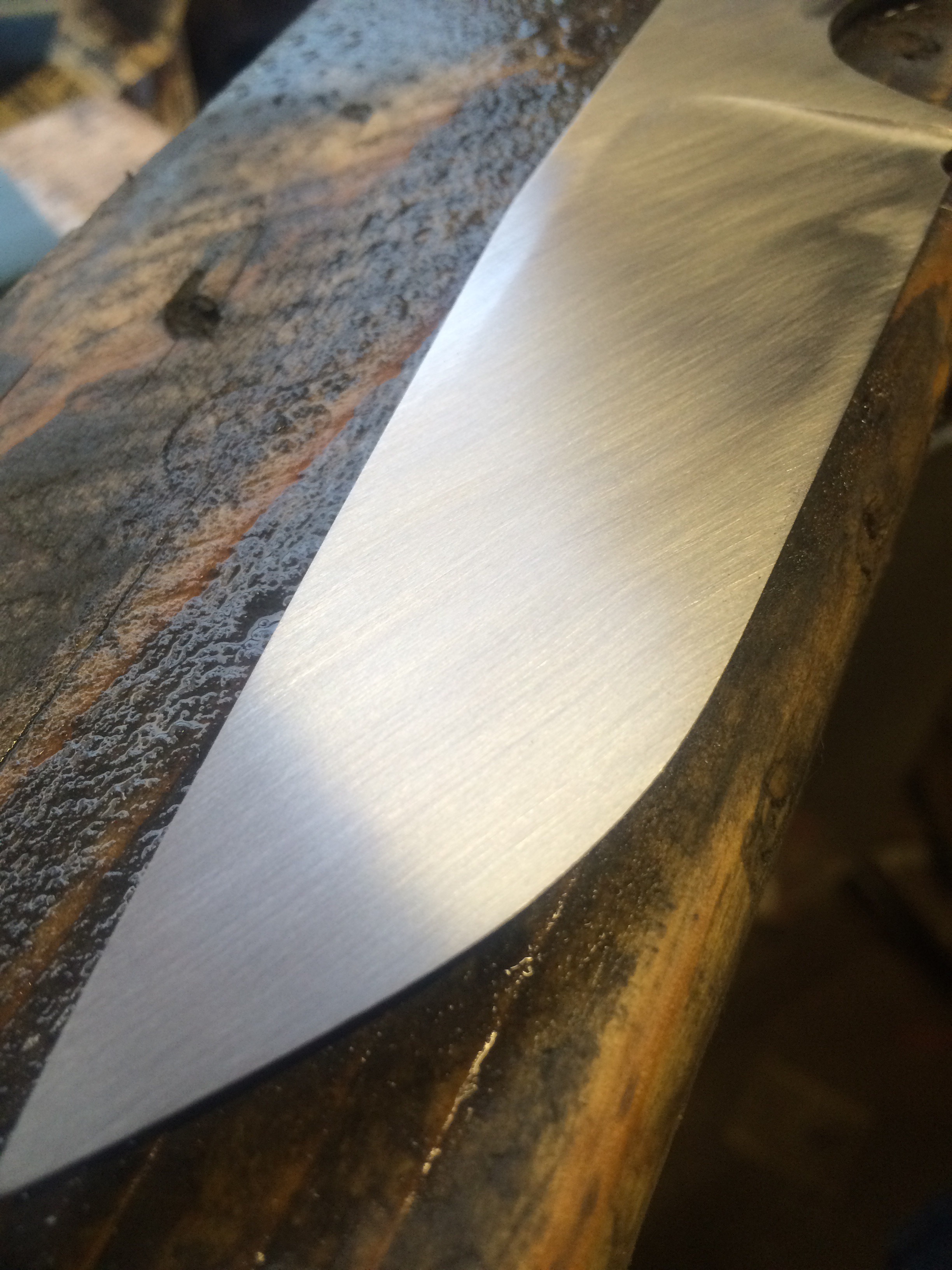
120 grit:

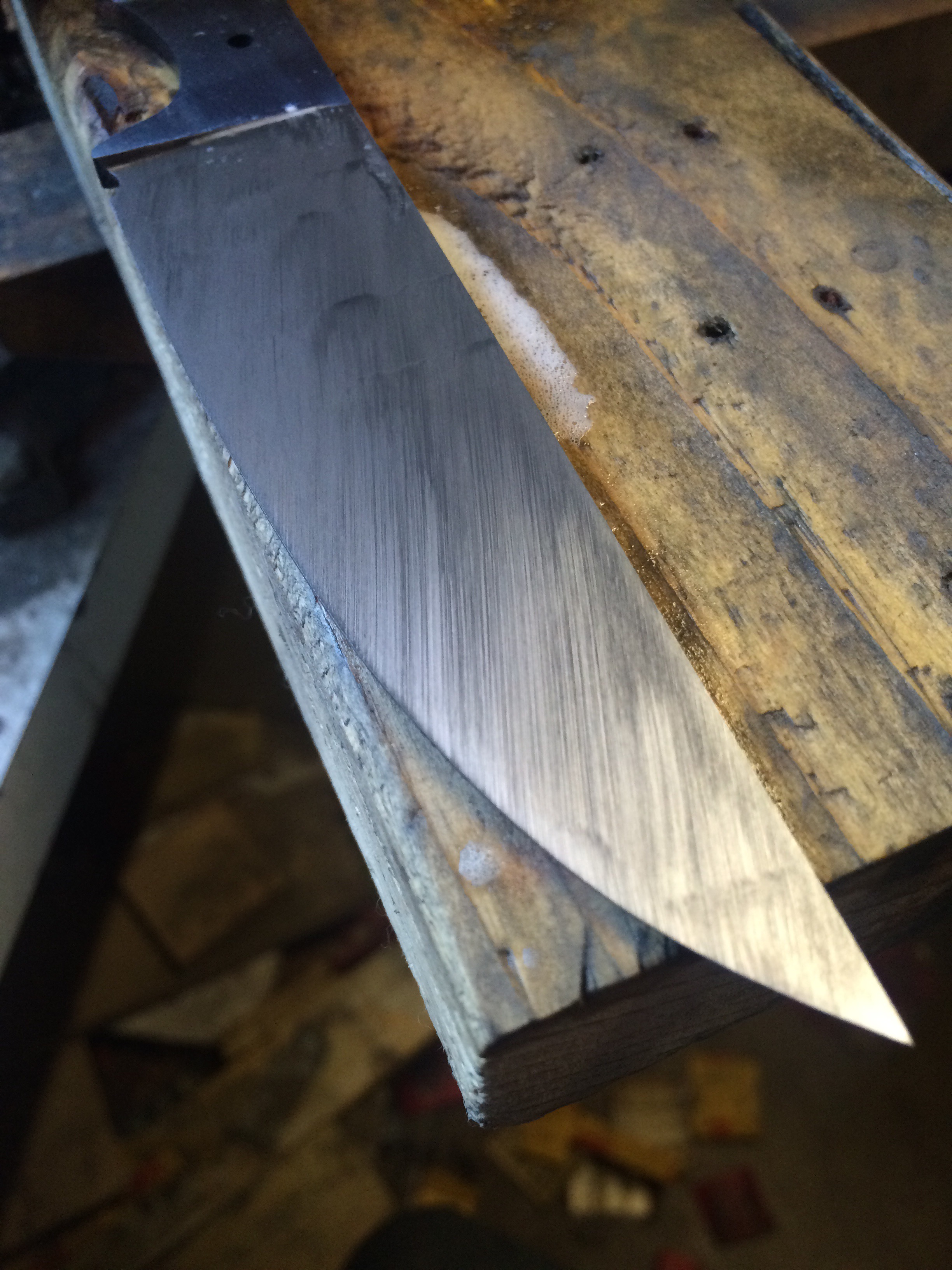
220 grit:

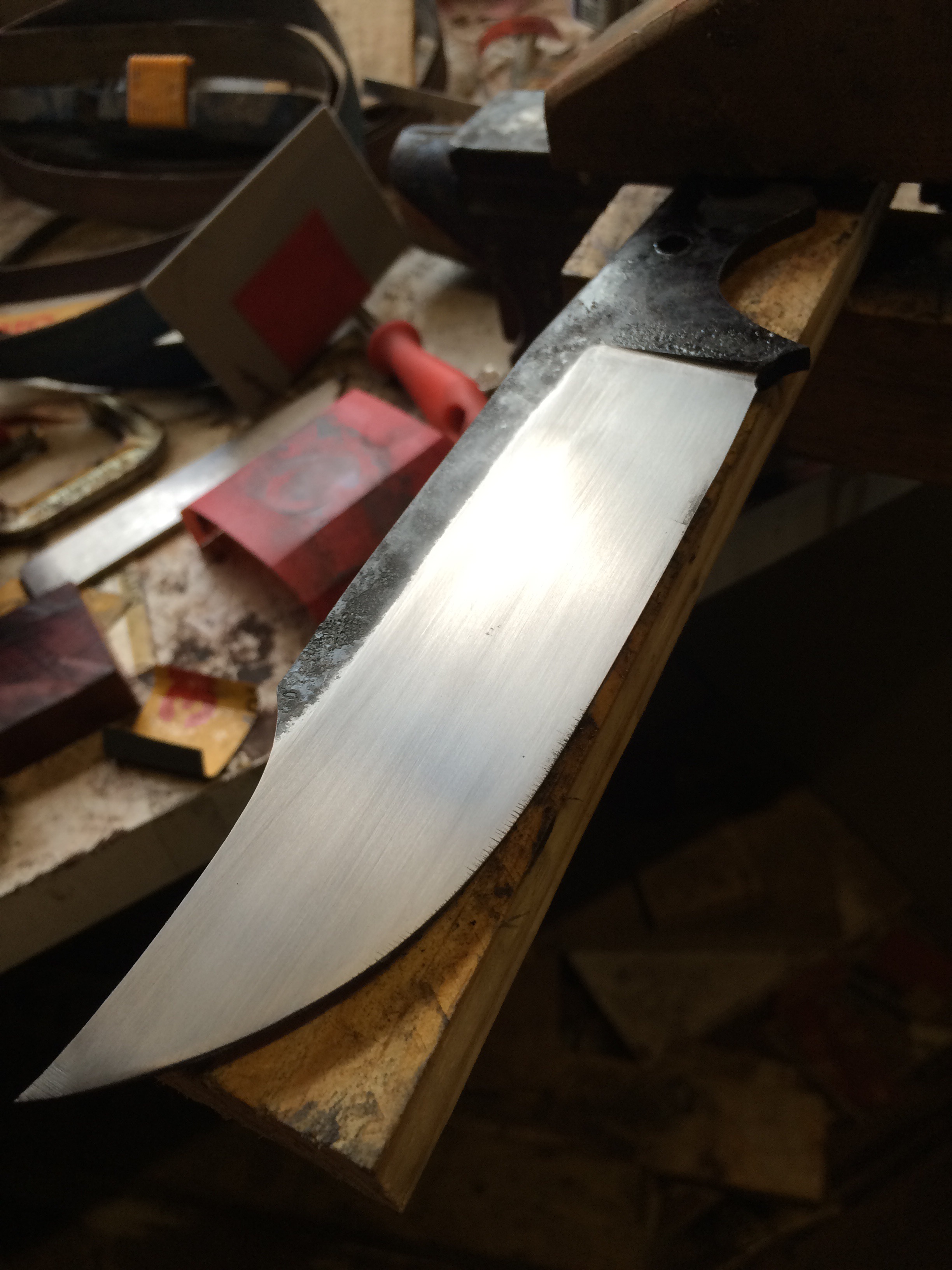
Hours later at 320 grit….

This is a score of Doug’s, meticulously handwritten and every note exactly where it should be, articulated just so…
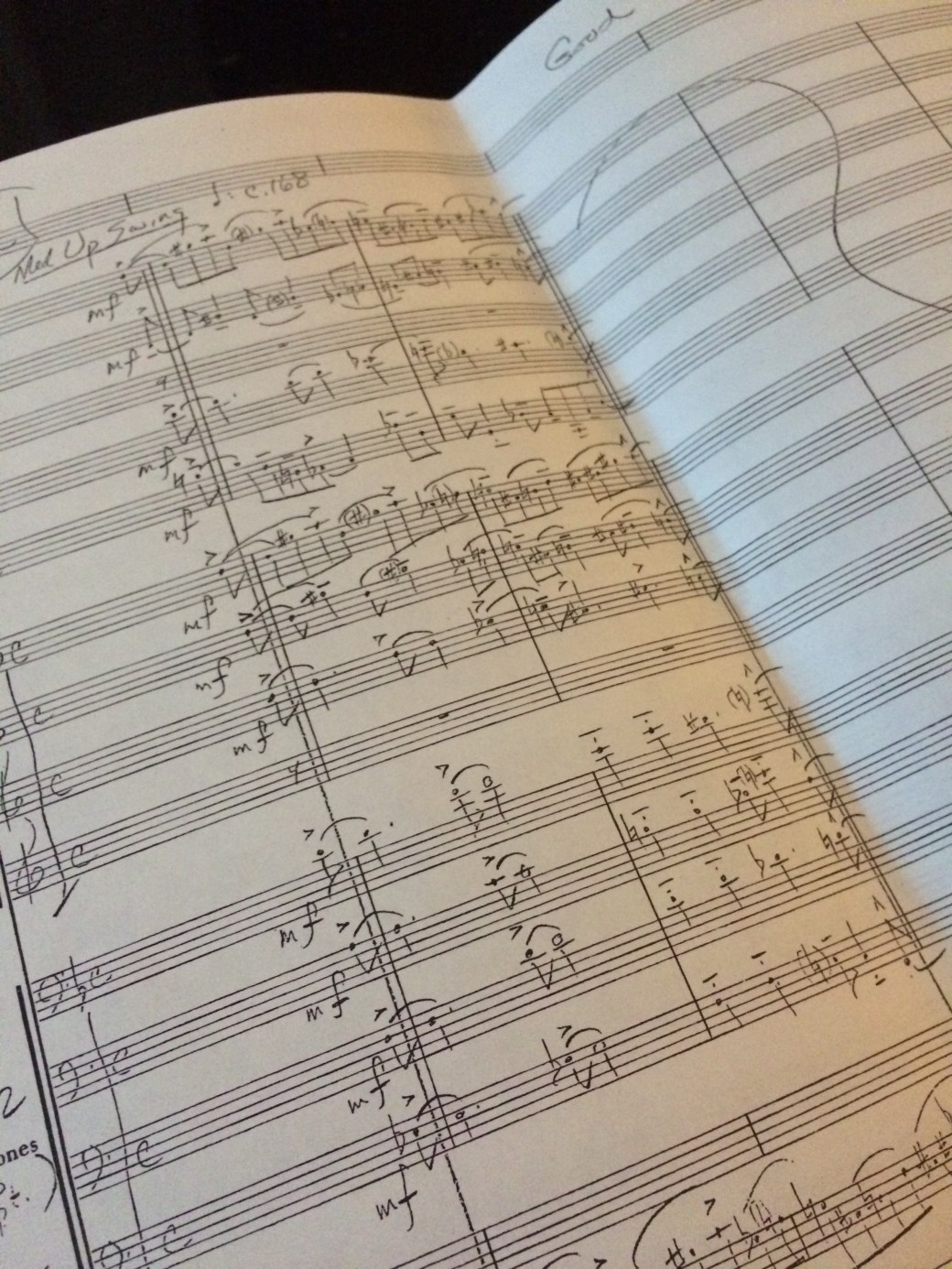
…so of course I cut it up…

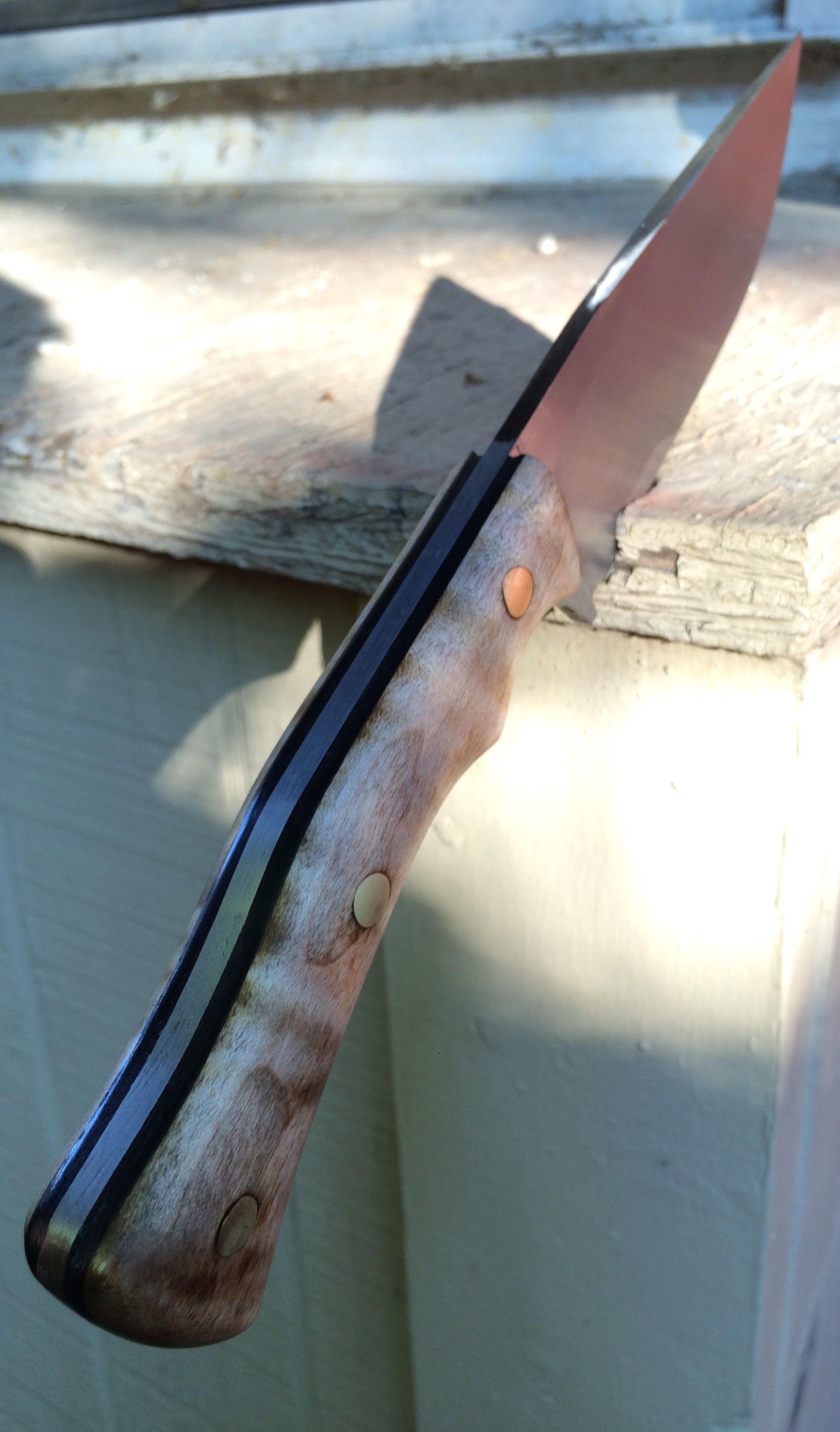
Ready to be made into a handle:
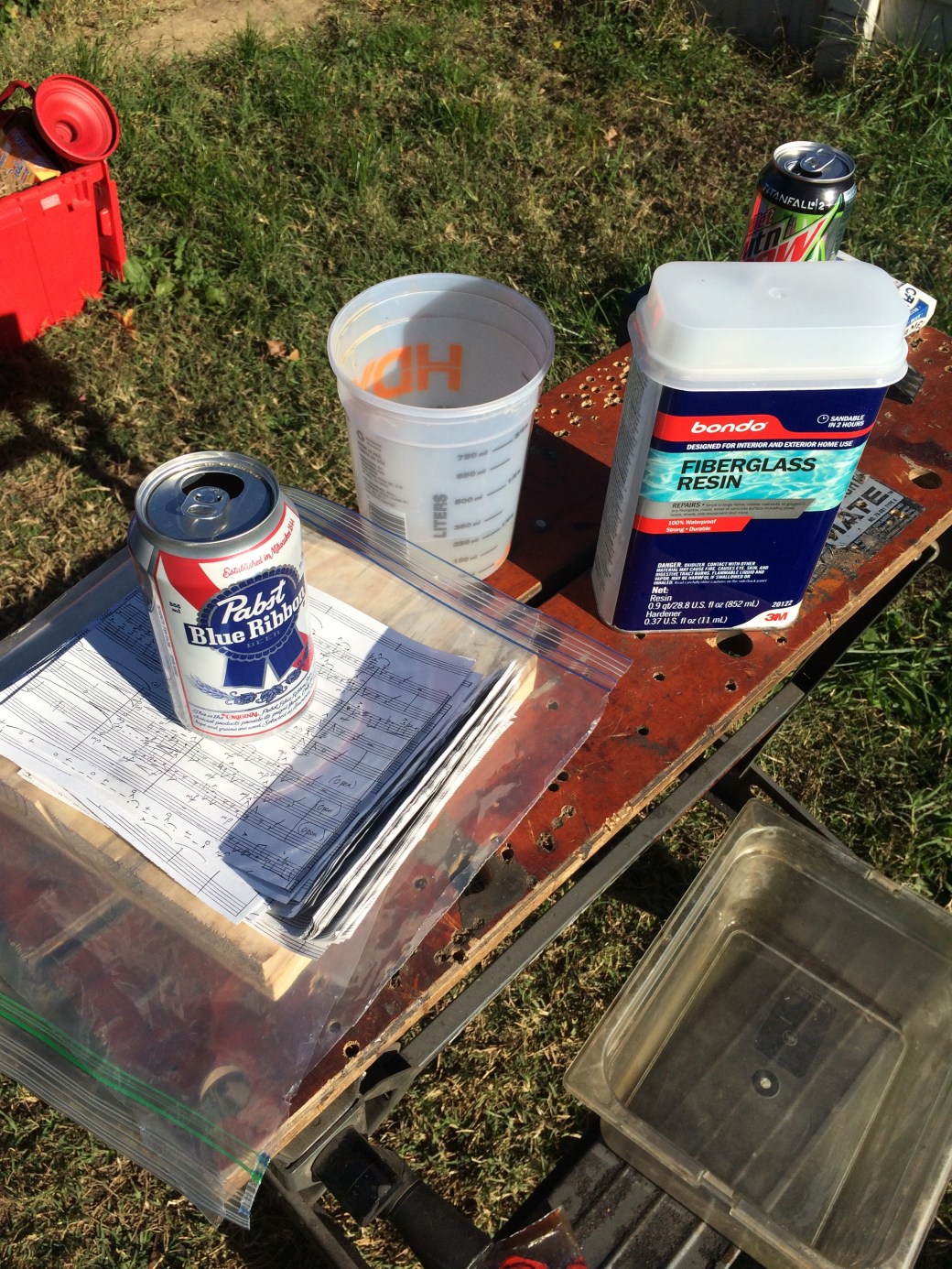
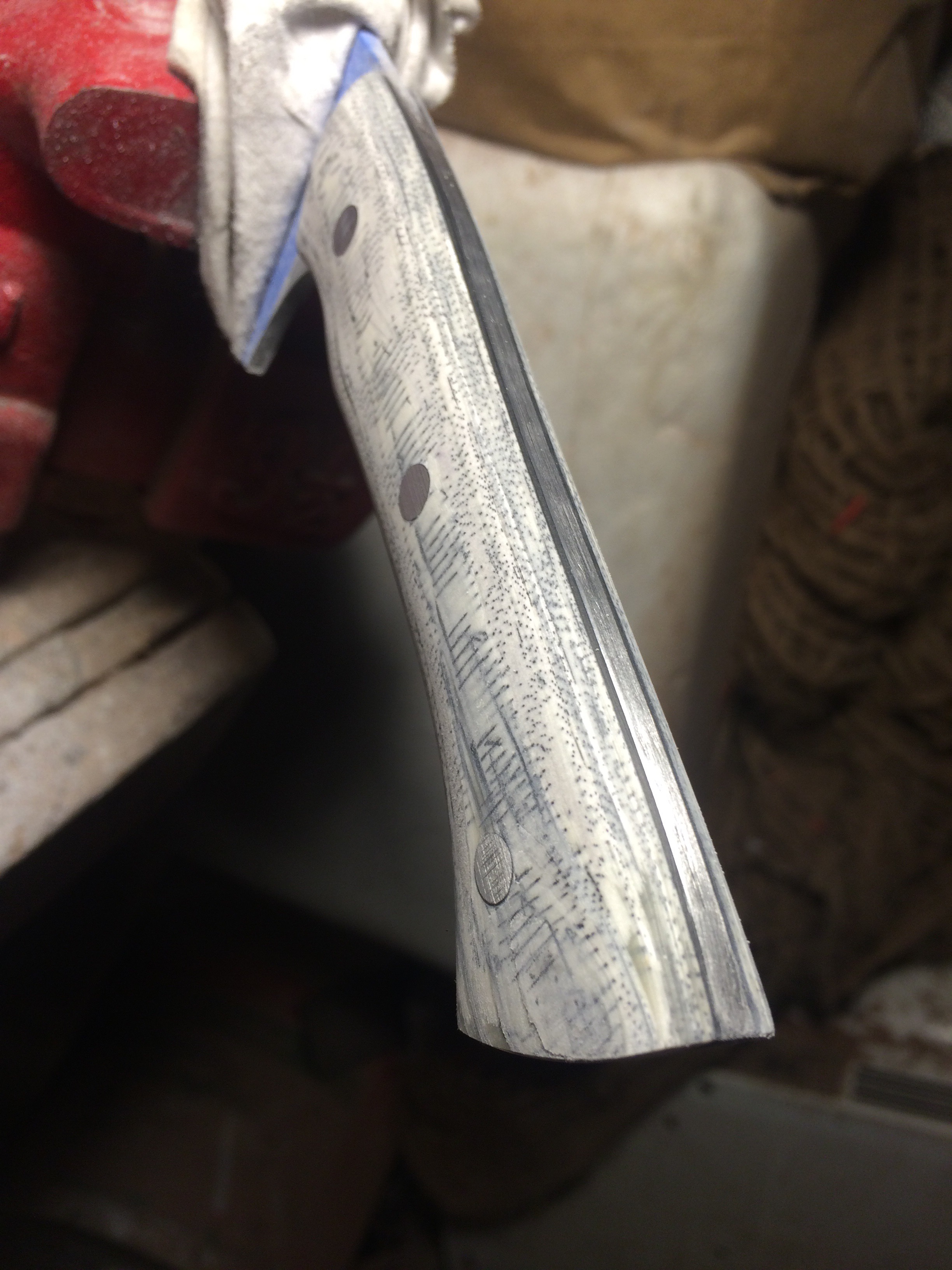
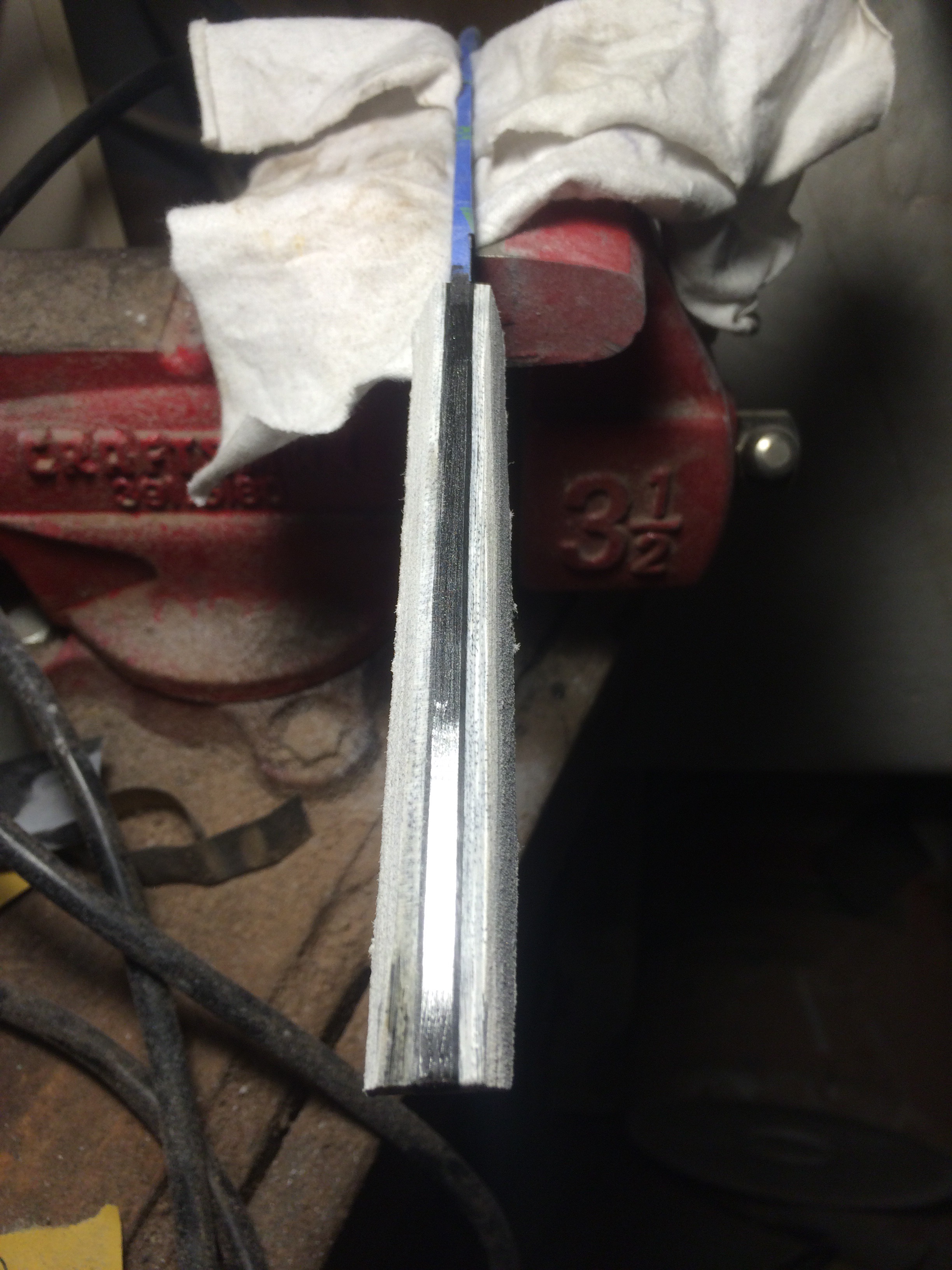
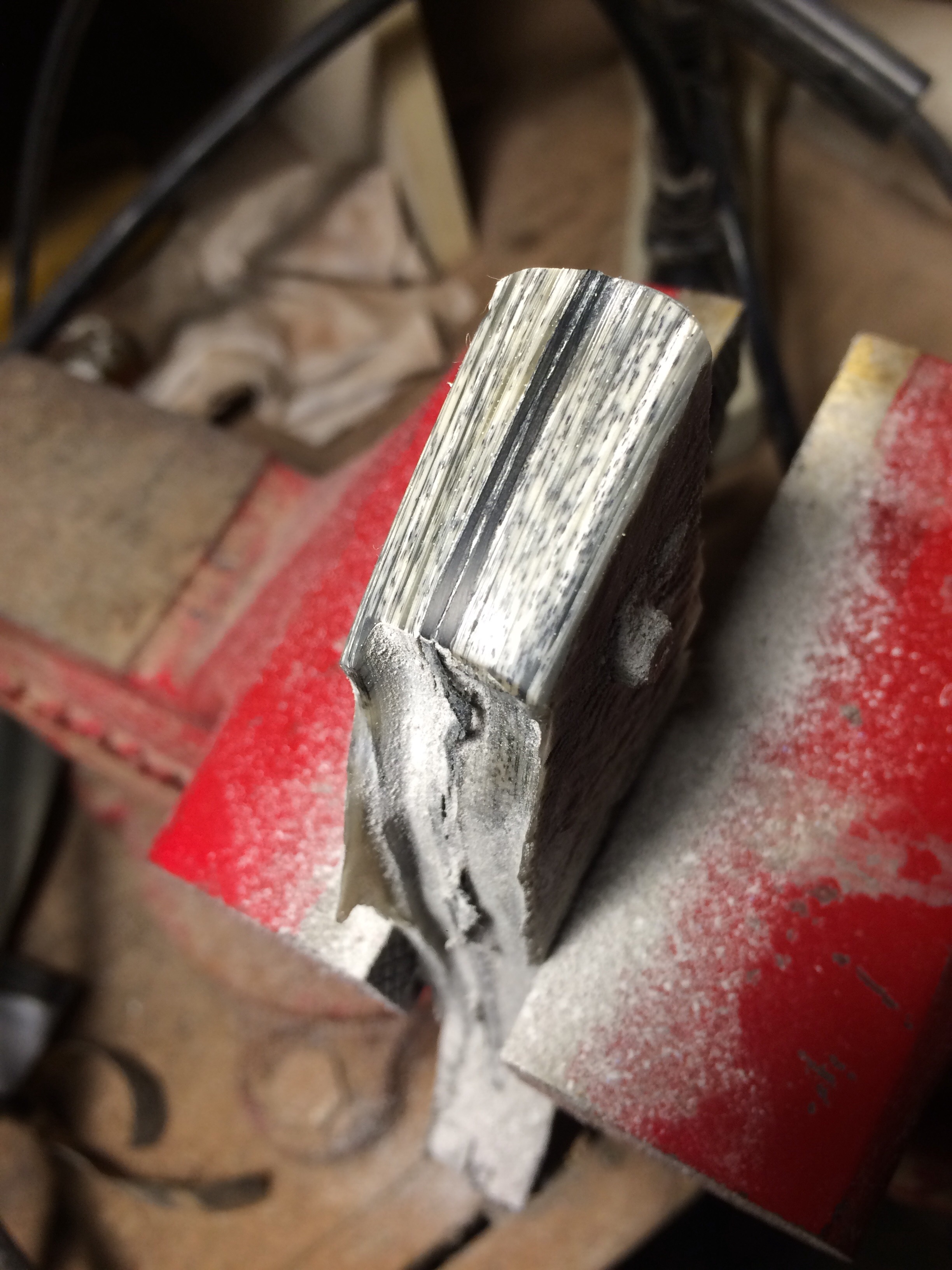
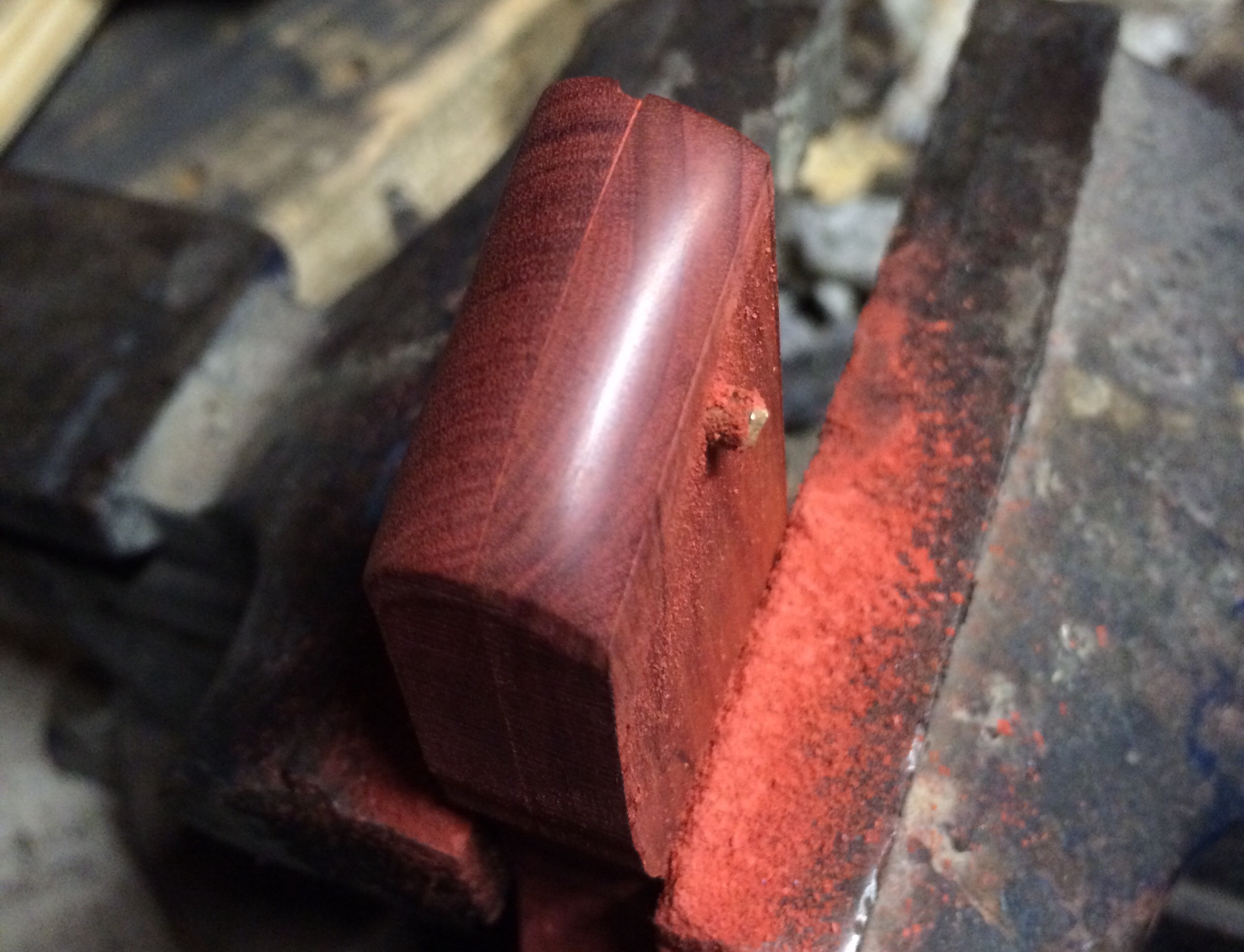
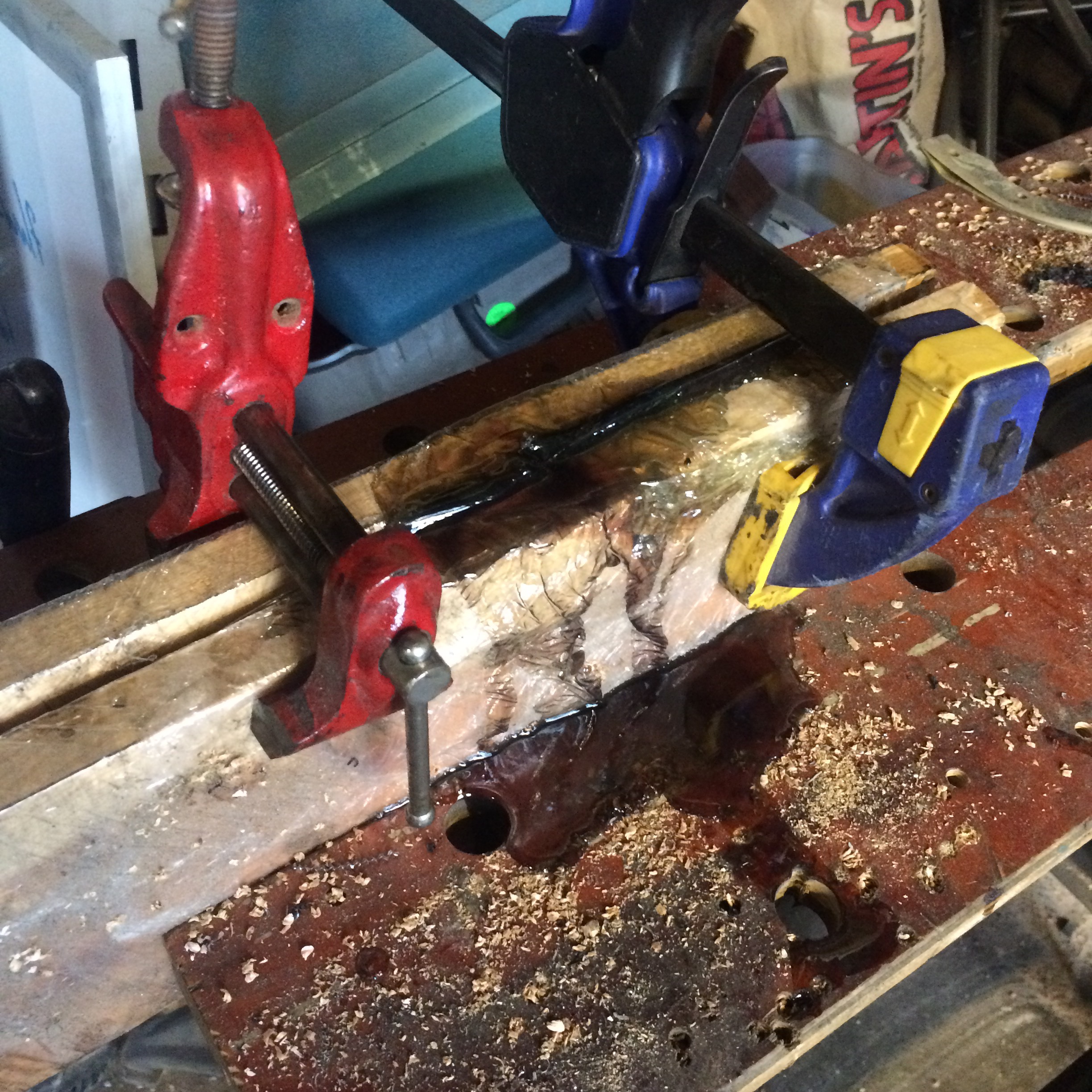
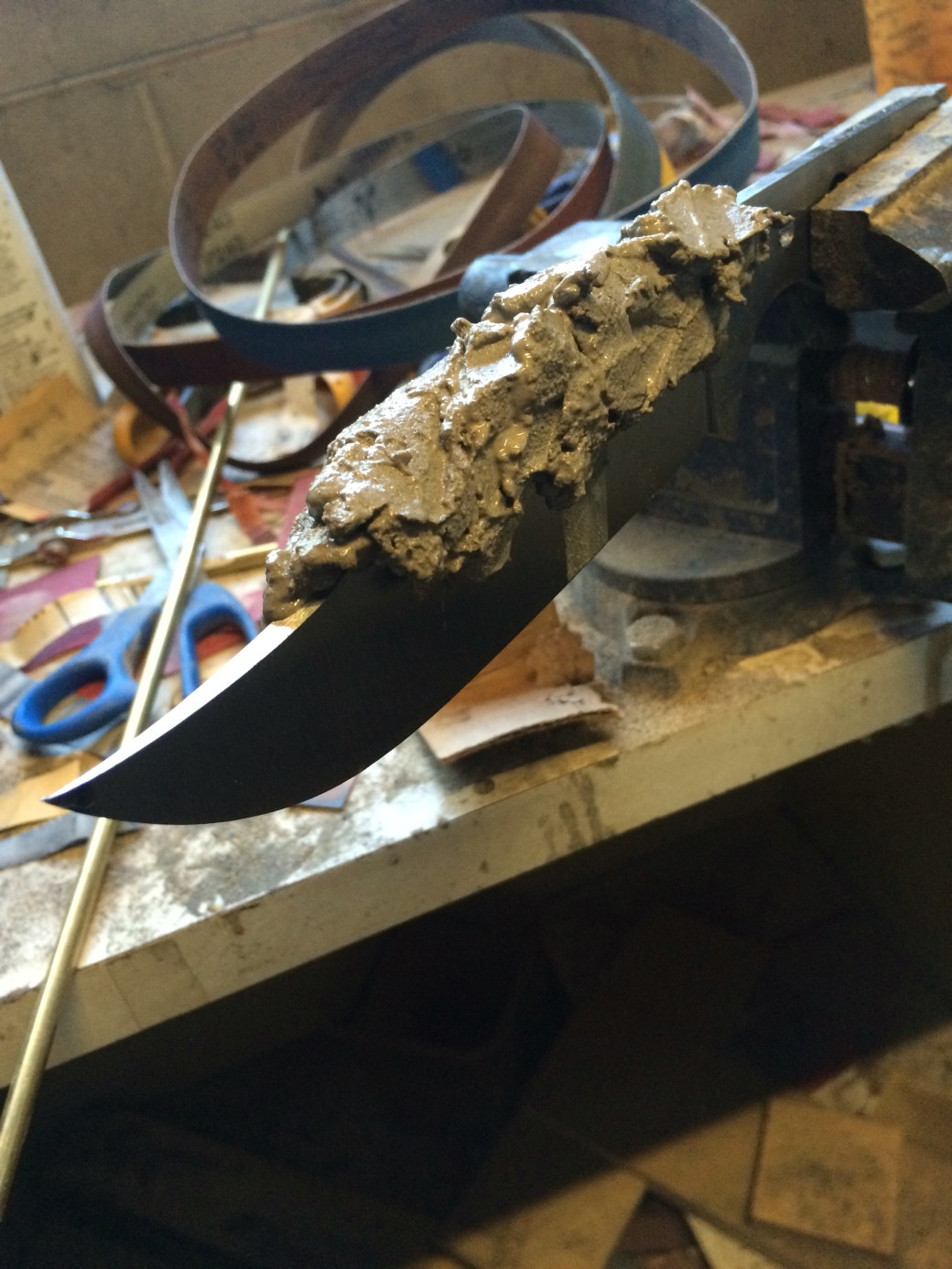
Soaked in fiberglass resin:
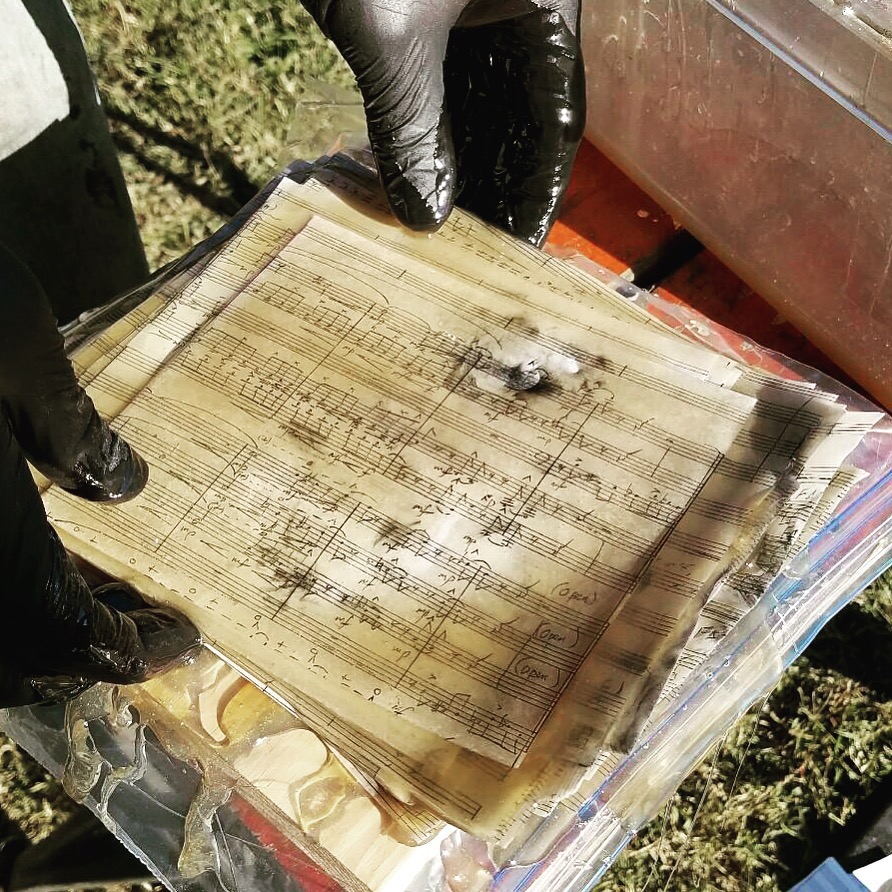
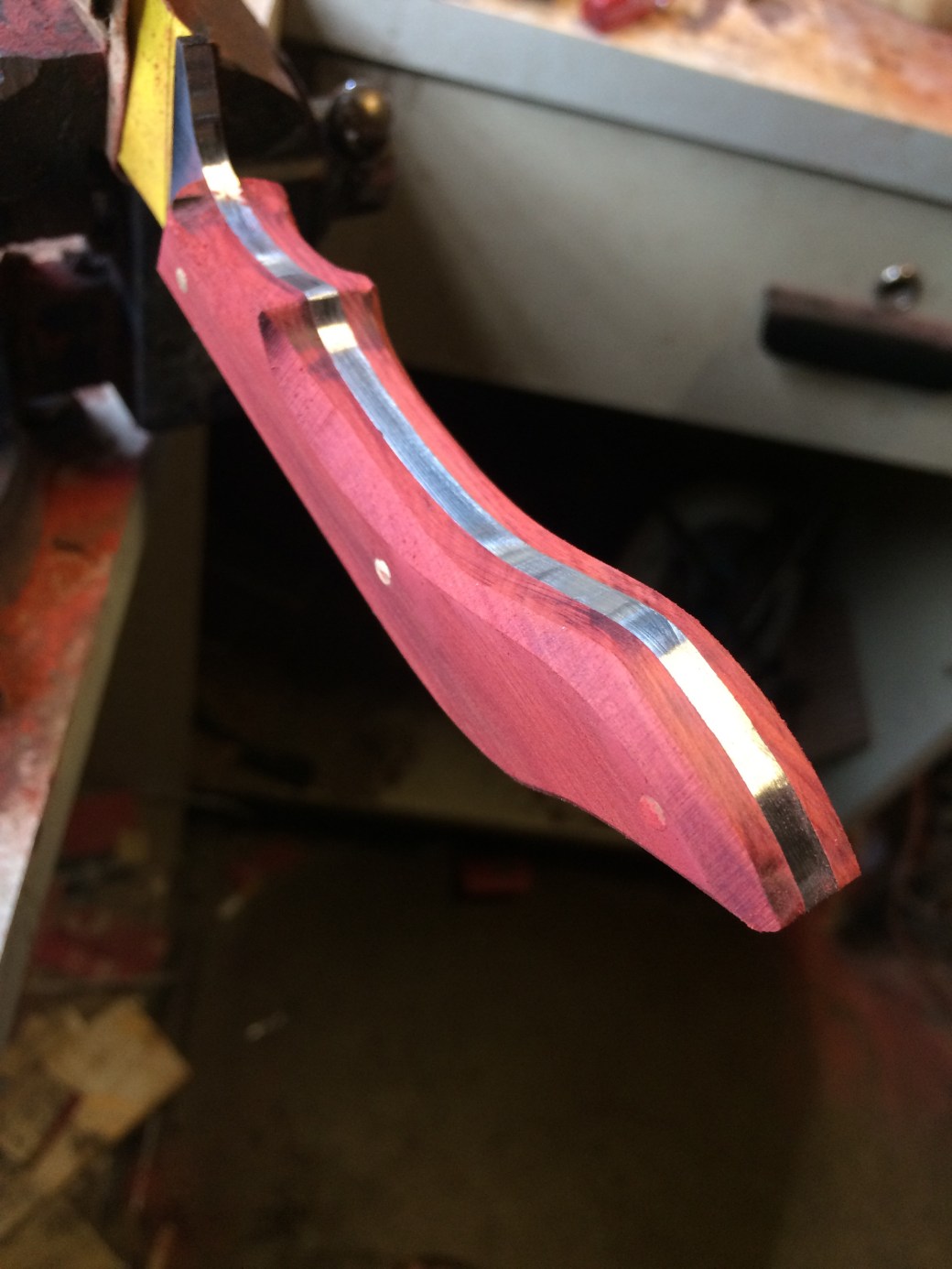
I think I can work with this…

Be sure to learn your craft.

Also be sure to check out Doug’s record– it’s really fantastic.

Knifemaking: past things made present and a restoration project

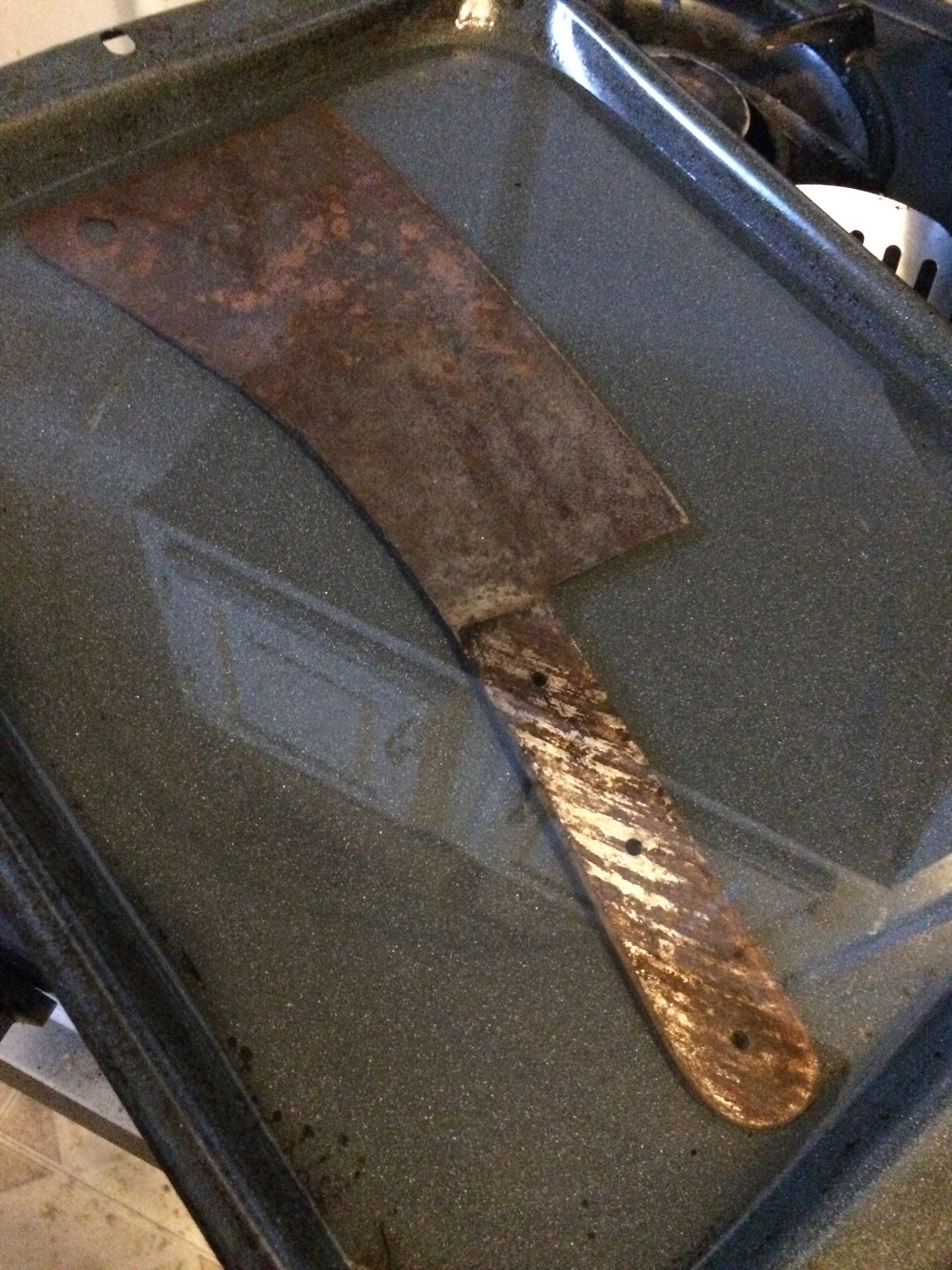
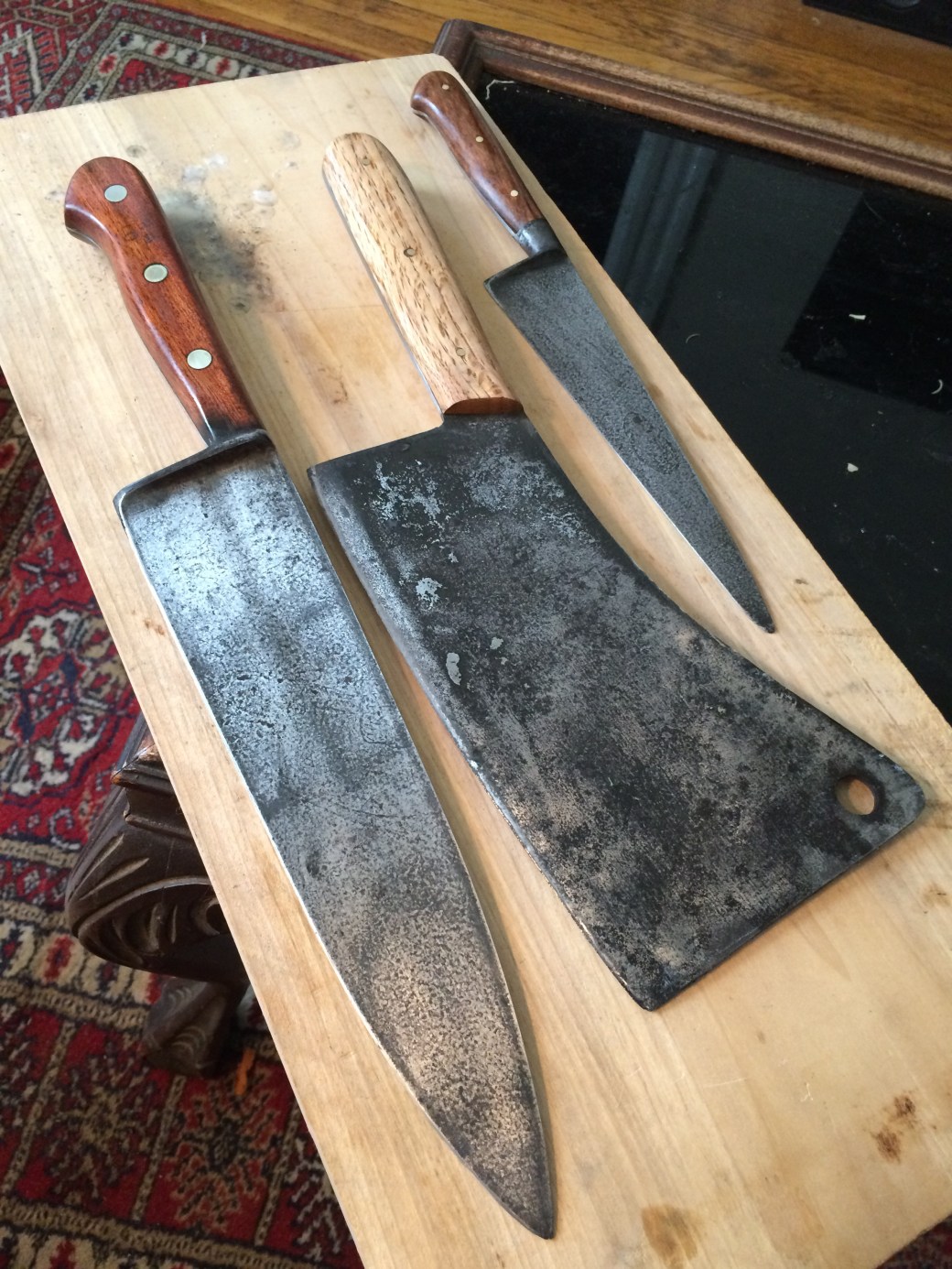
An acquaintance brought me three knives to be restored: three beautiful old kitchen knives, a trifecta of culinary efficiency.  There is a massive cleaver, a 10″ German style chef’s knife, and a 6″ French style utility knife:

They have been through the paces.

Everything breaks down at some point.  As someone who will push himself to the point of exhaustion I find this to be a strangely comforting and, paradoxically, terrifying idea.  There are times in life when the only way to get to the beauty that once was is to go through the worn out parts.

Wait…how did these things get worn out in the first place?

I’ve found that there are seasons of life when it feels as if the universe is screaming at you to make something happen, to make changes, to do better, and to seize opportunity.  And suddenly inside yourself you can see a path to these things.  You begin to feel a sense of urgency so strong that it feels like the whips are being cracked.

And so whatever your task at hand is becomes an insatiable vixen.  At least this is what it can feel like.

In these moments we often neglect to take care of ourselves and then wonder why things aren’t working as they should.  But still we keep pushing.  And in our zeal to accomplish we can end up depleted- physically, emotionally, and spiritually, appear as shells of the amazing things that we are.

Sort of like these knives…

Restorative processes are not always pretty.  Sometimes they hurt a little or a even a lot.  They can be alienating to the people we care most about.  And they come with the moments of hesitation and questioning and reluctance.  These things are still functioning so why mess with them?  Is it worth the time and work?  Maybe it’s ok the way it is.  Maybe if I pretend that there isn’t an issue it will all be fine.  These are healthy things to ask.  But are they working at their best?  Are they past their prime?  Are they getting any better?  Absolutely not. And in this life, leaving something better than you found it is one of the sweeter things we can experience.

So you strip away the layers of rust that came from daily exposure to the elements.  The wood that has become cracked from moisture exposure after years of washings has to come off.  New wood is put on and sanded and finished with the deepest of love.  The dull edges are honed sharp again.  Everything thing is oiled and brought back to life.  When you start these processes, and they are processes which can take awhile, it requires a commitment and a degree of tenacity to stick to it.

These knives were out of commission for a bit but it was necessary in order for them to function at their best.  Similar things happen in us when we take the time to look after ourselves.  It’s always a process and there isn’t necessarily a discernable timetable.  In this particular instance the restoration took me several days.

I started by removing two of the handles:

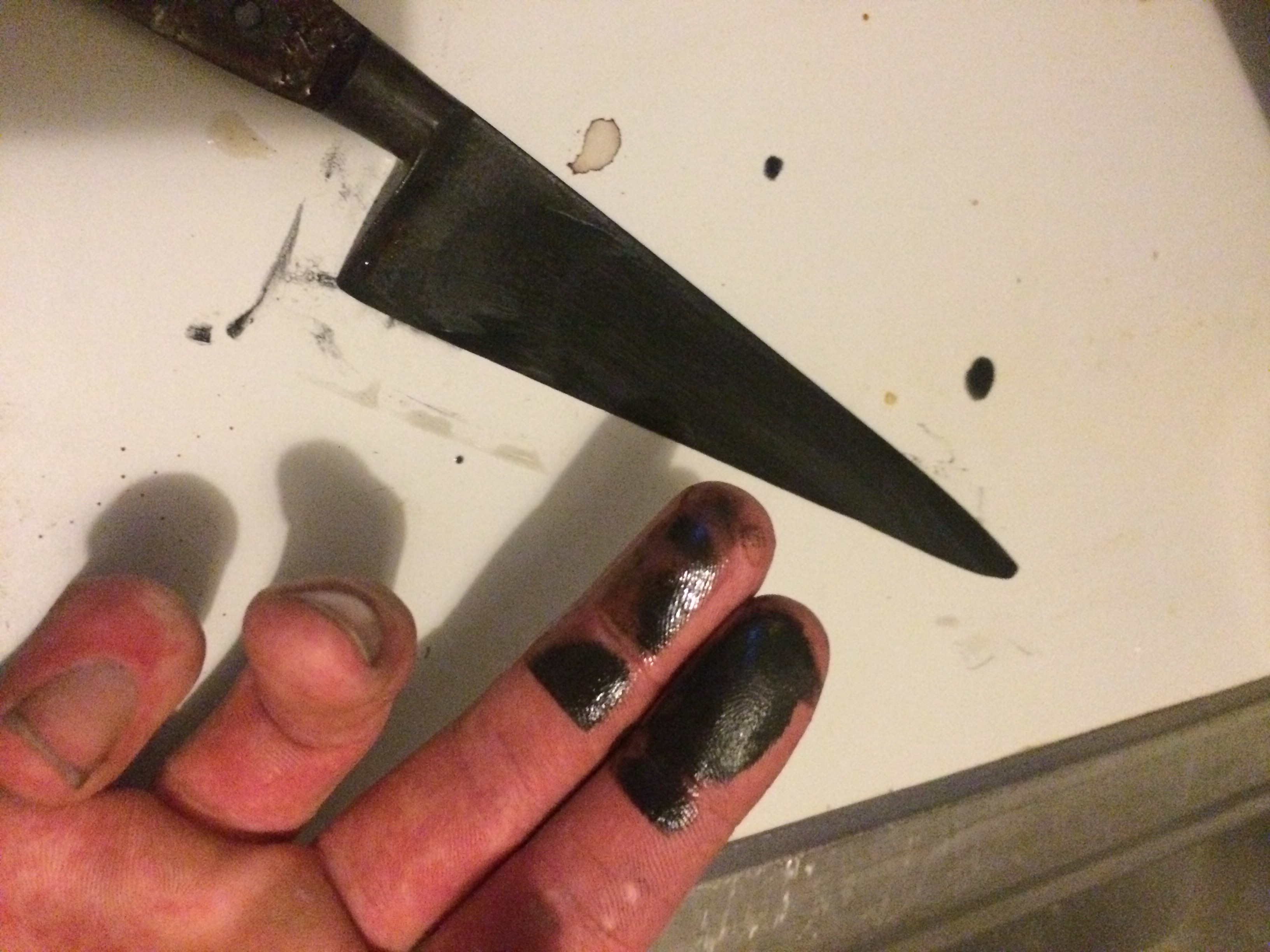
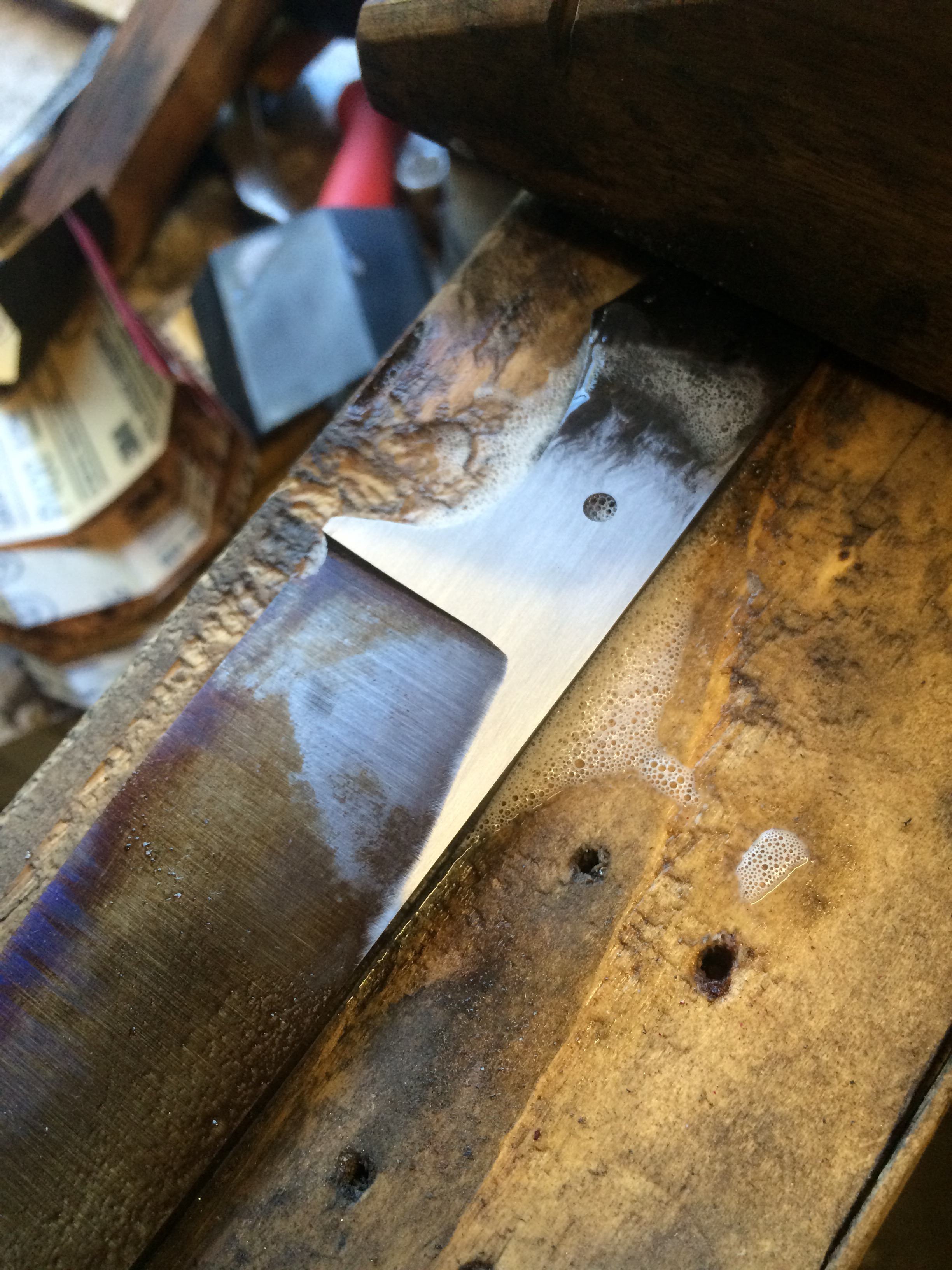
I soaked the small French knife in vinegar for about two days.  The vinegar eats away rust and corrosion but doesn’t harm the integrity of the blade.  It does create a reaction with the steel that leaves this residue on the blade.

She gets a sanding with high grit paper to make sure all the corrosion is gone.

Ready for a handle:

Glued and clamped:

Ready for shaping:

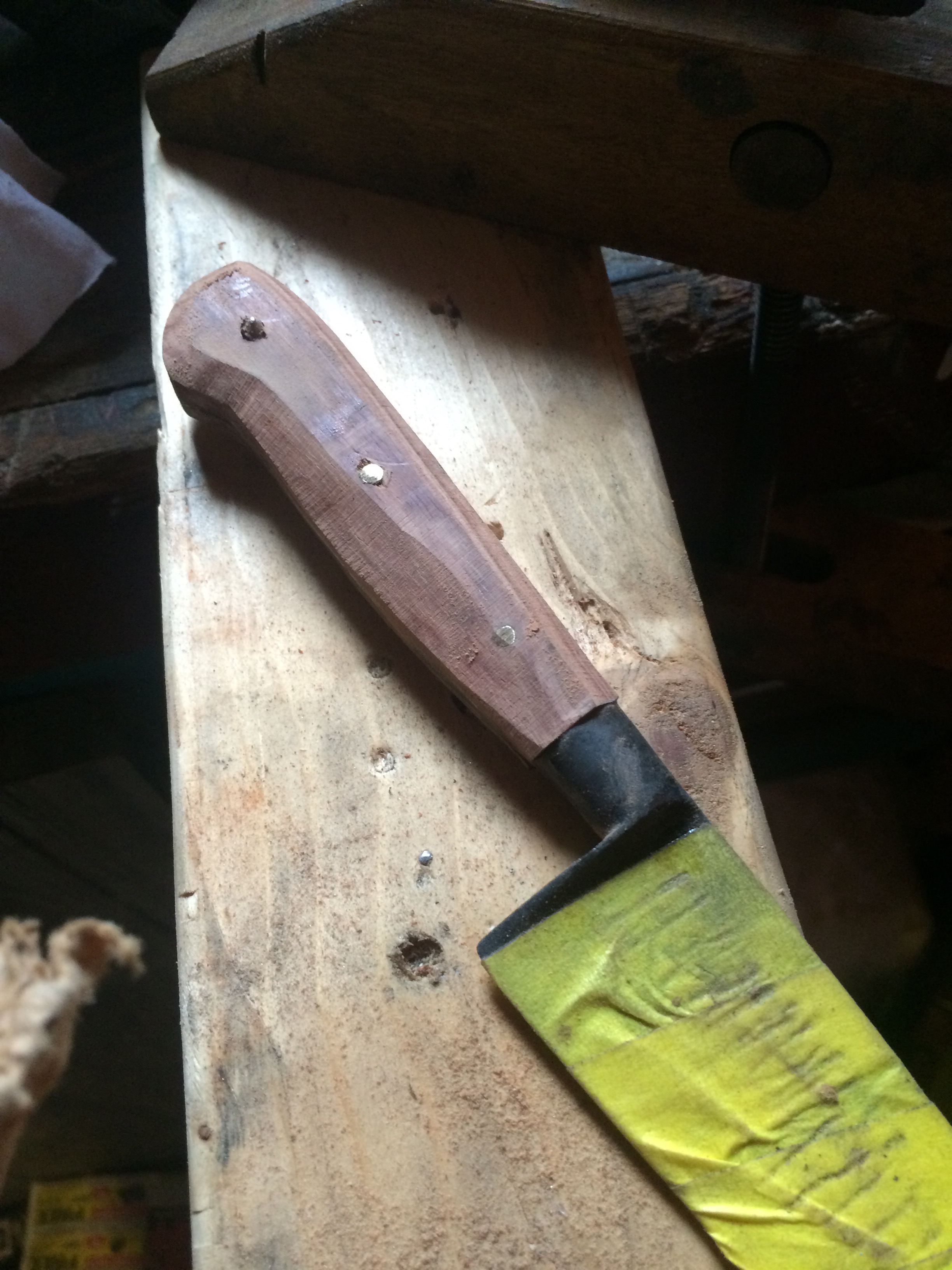
Shaped:

On the initial sanding I stopped at 220 grit and applied a liberal coat of oil and let it dry overnight.  Doing this makes for a more pronounced, nuanced, and beautiful grain pattern.

Working through the grits, up to 2000.  I think this is 600:

Our friend the cleaver:

A vinegar bath for a couple of days:

The spine was pretty roughed up:

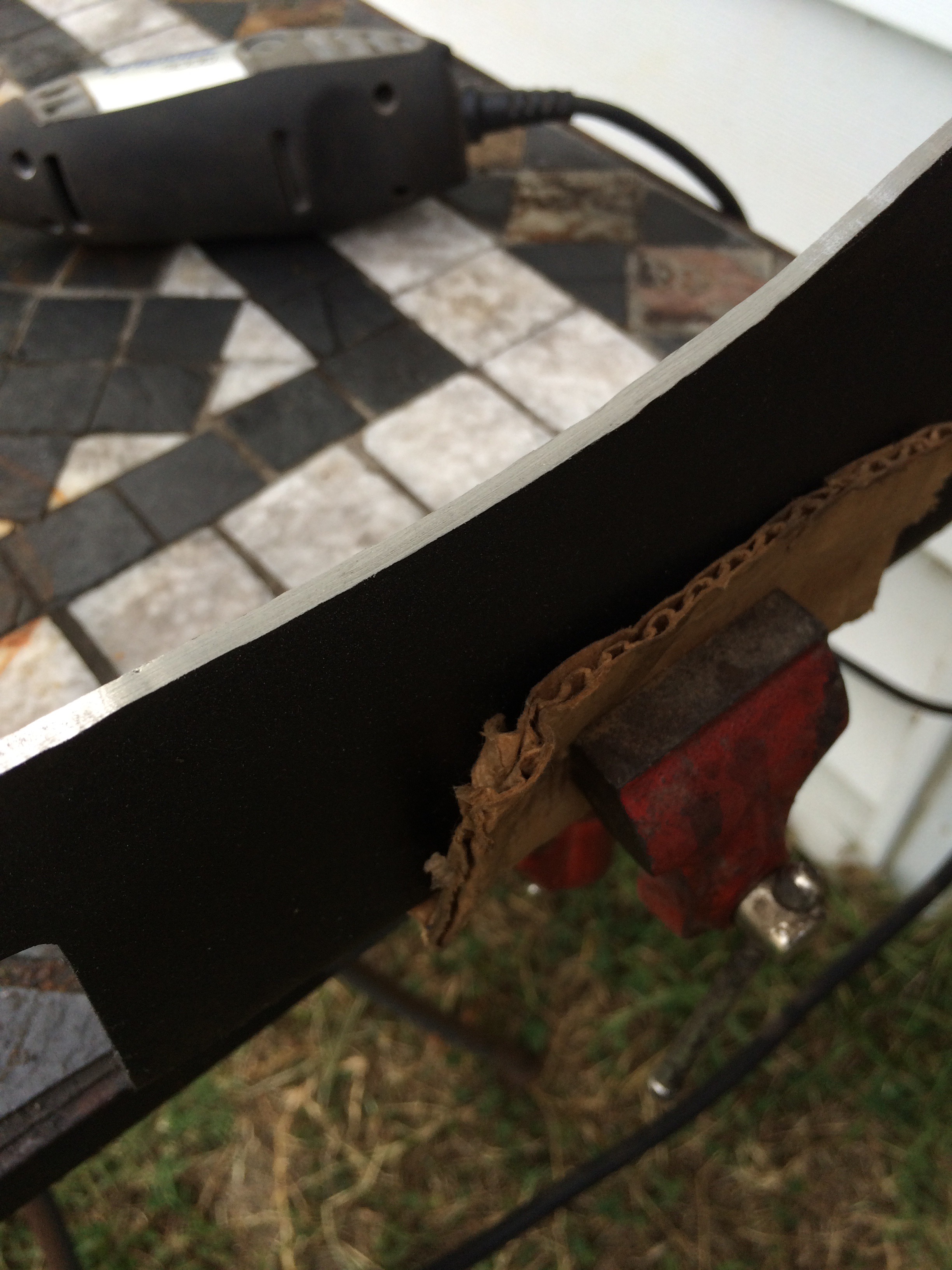
So I smoothed and deburred it:

Quarter sawn white oak:

The customer asked to keep the original handle for the 10″ chef’s knife.  Here it is at about 120 grit:

Here it is at 2000 grit.  I believe it is Mahogany:

Oiled, of the Tung variety:

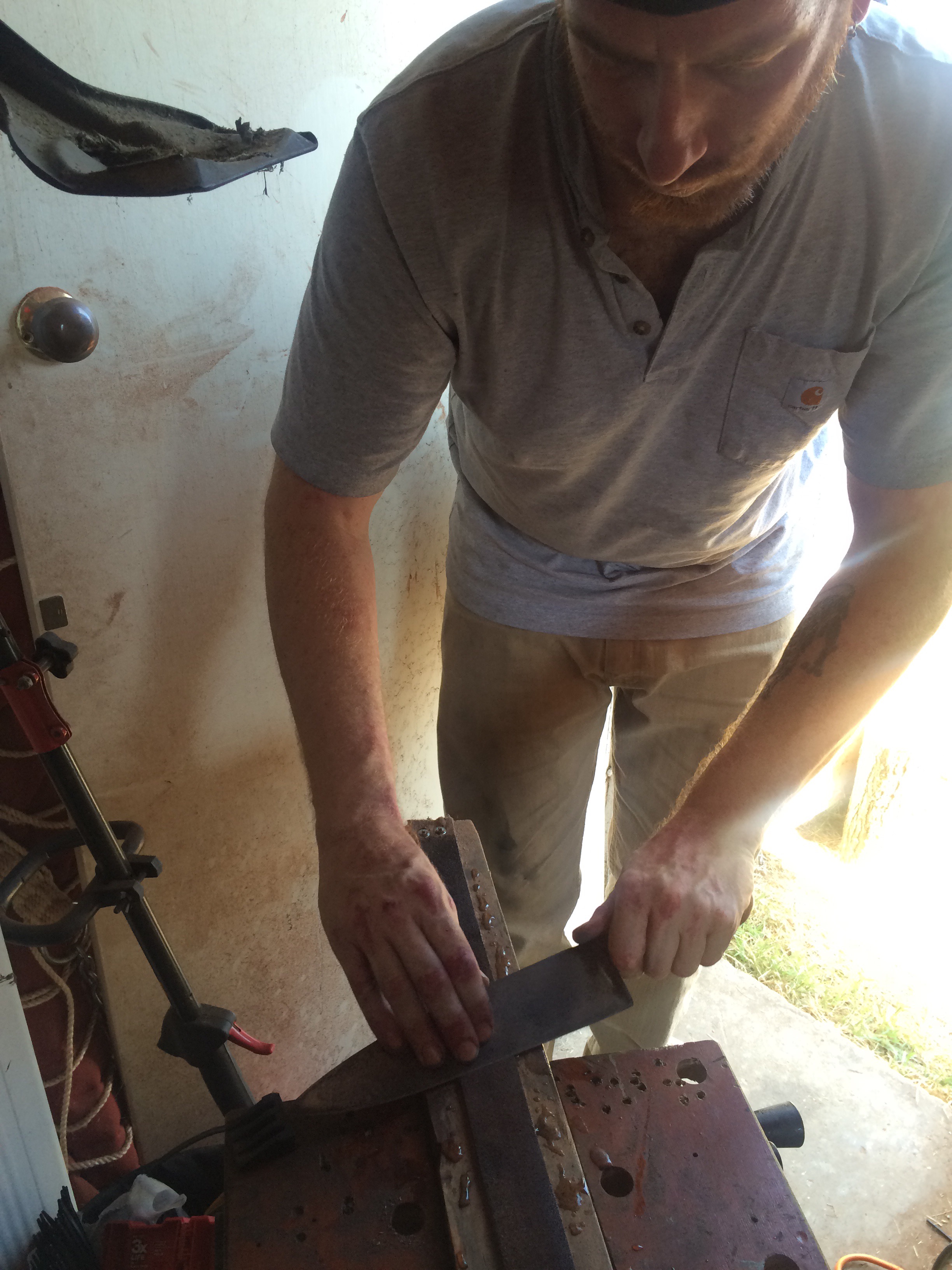
Sharpening:

Stropping:

Past things made present.  All restoration does is enhance the beauty within.  These are ready for the kitchen:

Knifemaking: Conflict, Trust and the Vixen

Conflict is essential to evolution

-Paulo Coelho, Aleph

The thing is that love gives us a ringside seat on somebody else’s flaws, so of course you’re gonna spot some things that kinda need to be mentioned…

-Alain de Botton


Conflict is an inevitable part of life.  We find it in our professional and romantic relationships, in the work we do, in our places of joy and sorrow, and just about everywhere in between.  We even find it in ourselves. 

Merriam-Webster defines conflict as an “antagonistic state or action (as of divergent ideas, interests, or persons)”.  This sounds about right.

Depending on how we were raised, conflict can make us feel unsafe and insecure because we equated conflict to something being deeply wrong with us.  Often we’re raised to be agreeable, to not make a fuss, to put on a happy face, and to be seen and not heard.  Because of this there can be a tendency to submit to the incompatibles that arise and completely lose ourselves during moments of heated conflict.  We give away all of our power and ignore our needs for the sake of resolution.  There can also a tendency to run, to check out mentally and emotionally, and to avoid; all for the purpose of not having to deal with the conflict at all.  Ancient fears arise during conflict: fears of not having enough, fears of not being heard, fears of being seen as less than, fears of asking for help, or fears of our needs not being acknowledged or met.  Conflict can take us right back into the terror of our smaller selves.

Fear often makes us do the complete opposite of what is best for us.  But in a world of incompatibles, of yes’s and no’s that are always at odds with each other, conflict will always remain.  I’ve always wondered about this in the way I’ve wondered why deep sadness exists, and why pain and suffering are so prevalent.   

Conflict helps us to be active participants in our lives.  It seems counter-intuitive but conflict helps us to grow and be seen.  In the same way that deep sadness and pain can be teachers, conflict can take us to school on how to be a decent human being. 

Conflict in romantic relationships can be one of the more challenging arenas because it forces us to show and acknowledge things we may prefer to not acknowledge.  It occurs when any number of our maladjustments that we haven’t dealt with or are still processing rubs up against our partner’s.  Or when our partner’s maladjustments rub up against us.  In many instances things are simply going to rub us the wrong way and we may not be able to articulate exactly why.  

This is particularly unique to romantic conflict because there is nowhere to hide.  In other arenas we can veil ourselves with busy-ness and obligations.  We can keep our own counsel, hide our feelings, hold everything at a distance, and still uphold our responsibilities and navigate life somewhat successfully.  Doing this with someone whose heart you occupy is likely to be catastrophic.  The best thing to do is to let all of yourself be seen and work from there.

Though it may not feel like it, this is one of the healthiest things anyone can do.  We are built to be close to one another and we are all flawed.   To be able to say ‘I was only a jackass because I was deeply afraid and I’m working to be better because I care about this’ gains so much more mileage for trust and intimacy than pretending like nothing is wrong or powering through a conflict.   When someone you love knows where you are coming from it creates a sense of safety for that person, even though it may be uncomfortable for you.  Eventually you may find a sense of safety because in allowing all of yourself to be seen, it allows all of you to be loved.  Trust deepens on both ends and allows for everything to blossom.  This is something to stay on top of and it’s important to be ever mindful.
This blade was made after a conflict with someone I love.  It was a reminder to myself to lean into conflict.  Conflict is a Vixen, a lady in red, shining, beautiful, and also extremely sharp and ready to slice the hell out of you if you aren’t on top of it….

O1 tool steel, profiled:

Scribed for grinding the bevels, and a notched blade choil:

Rough grinding:

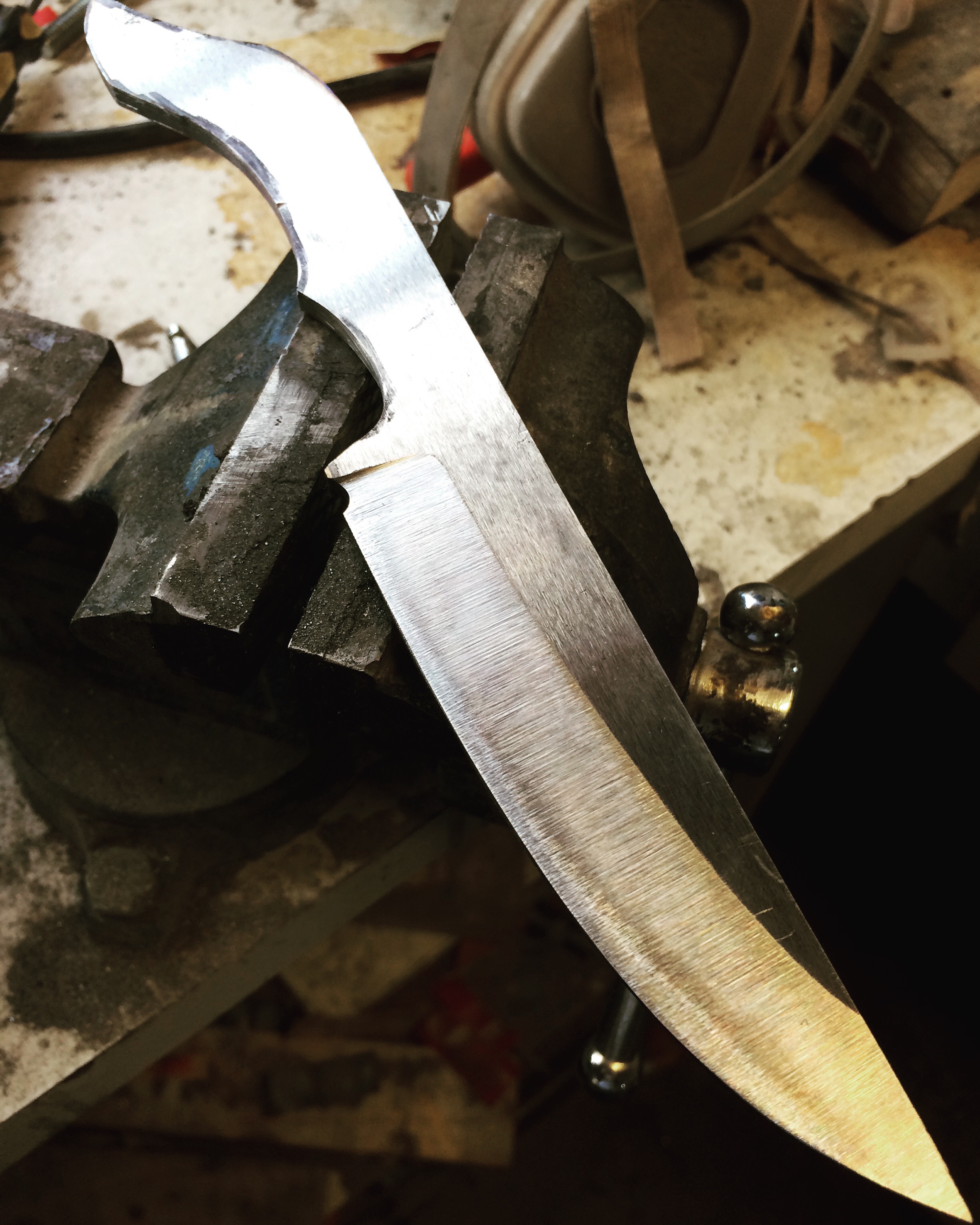
Full flat grind:

Hardened:

Sanding the ricasso after tempering:

Many hours later…

Redheart:

The Vixen:

IMG_3445_sRGB

Many things will often be at odds with each other but being able to be with all of them is at the heart of doing conflict well, and ultimately at navigating the world.  This is the lesson of the Vixen.

Knifemaking: finding your roots and the Treethrower

‘In their highest boughs the world rustles, their roots rest in infinity; but they do not lose themselves there, they struggle with all the force of their lives for one thing only: to fulfill themselves according to their own laws, to build up their own form, to represent themselves. Nothing is holier, nothing is more exemplary than a beautiful, strong tree.’

Hermann Hesse, Bäume. Betrachtungen und Gedichte

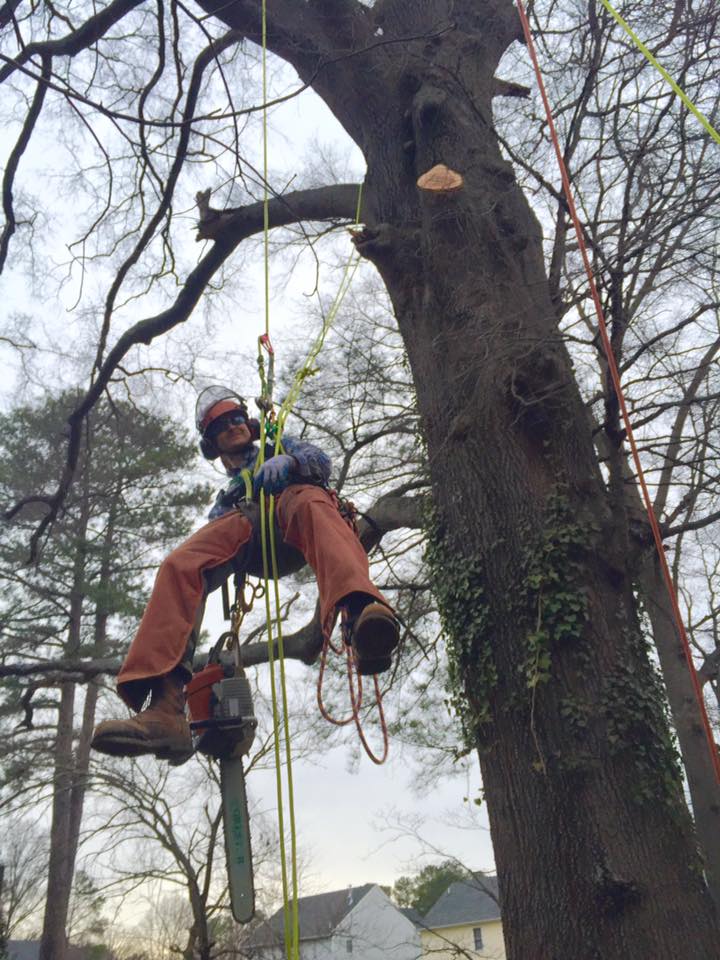
I have an old friend and his name is Joe.  Joe is a fascinating guy.  We went to music school together.  Joe is a killer rock musician, a badass chef, and is also really good at climbing trees.

This is Joe:

12646998_10102981413934626_3333592218995759607_n

Joe does tree work full time at the moment.  On weekends and his off days he does side work for friends.  Sometimes he calls me to give him a hand.  Sometimes the money is good and sometimes it is not but it’s refreshing work to do and it’s nice to be along for the ride.  His clients are always happy with his work.

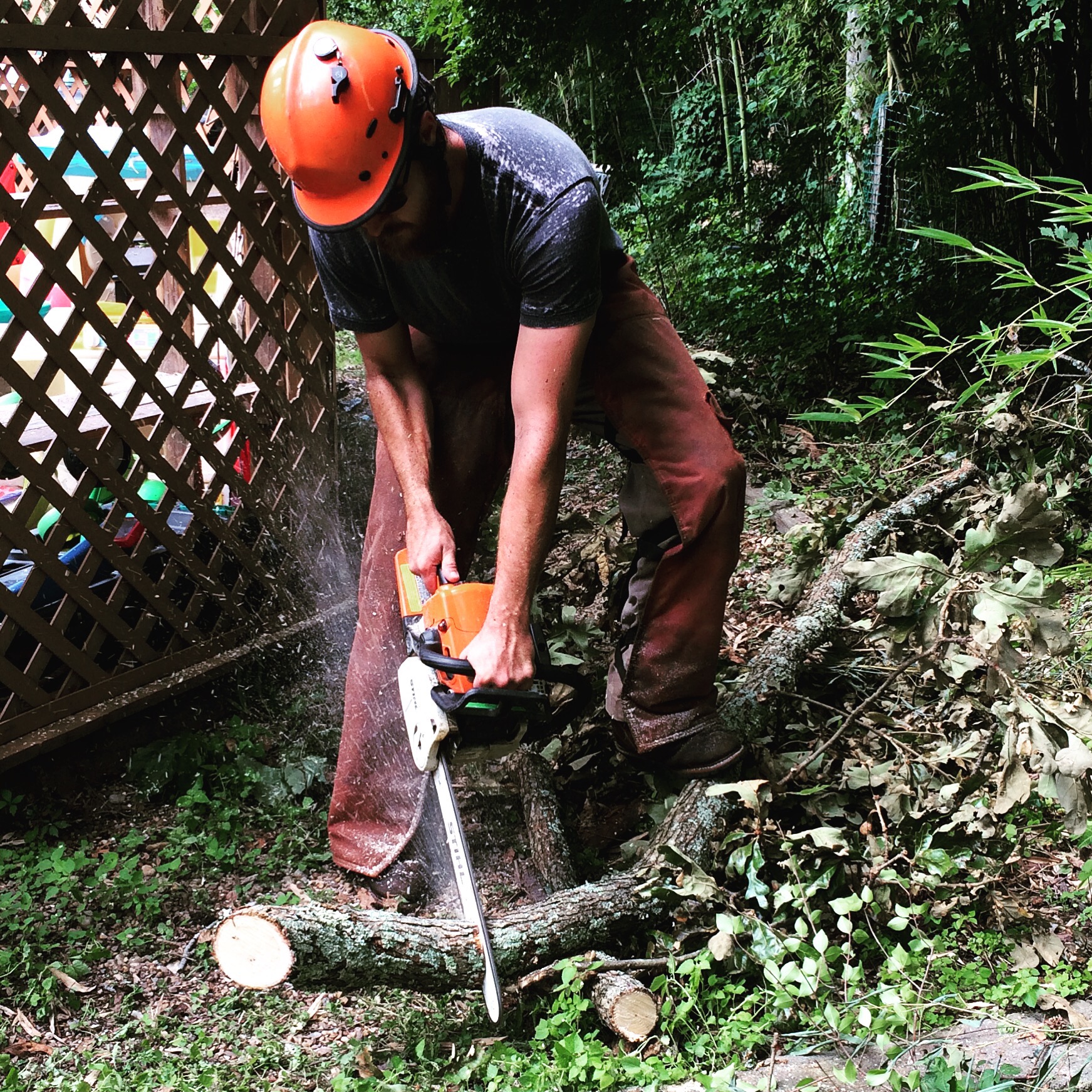
The work I did with Joe consisted of removing dead or sick branches and limbs, and removing branches or limbs in order to open up a client’s yard to sun.  Any part of the tree extruding over a client’s house was also removed, by way of a block and tackle pulley system rigged to the tree so the branch could be slowly and safely lowered to the ground.  All of this was done with regard for the tree, with chainsaw cuts executed in such a fashion so that limbs could healthily grow back.  Deadwood was removed and cut flush at the trunk.

There was a quiet and zen process to a lot of this.  It all started with laying all of our tools out.  Joe would put on his rigging gear and I would fuel up and oil the chainsaws.  He would then set a climb line high in the tree and start to ascend, lugging a chainsaw, some handsaws and some tools.  The zen in this work comes from ritual.  All ropes and lines are kept coiled and tidy.  All brush is cut, cleared and neatly piled as soon as it comes down from the tree.  If you are using a chainsaw then you are wearing kevlar chaps and the chainsaw stops as soon as you are through cutting and before you move to the next cut.  If you are using the chainsaw in a tree then you have set at least three independent safety points, in case you accidentally cut your support line.  These little rituals and protocols help to remove some of the thinking from the process.  It creates a sort of space to be present with yourself and really feel what you are doing.  In this space you can start to feel a grounding and calm in the process.  It also allows you to really focus on what you are doing and helps to keep you safe.  All these things gently coerce you into slowing down and this is a good thing.  Tree work is pretty dangerous after all.

This space that has been created allows more mental real estate for when things get a bit hairy.  There was a the time when a line came loose and giant log cut from a tree fell and put a giant hole in the client’s deck.  Or the ‘how the fuck are we going to get all of this done?’ moments.  Or it’s rainy or icy and you feel extra unsafe.

It’s really refreshing to feel this because it’s a microcosm of life I forget to feel at times.  In this season of life, for myself and many of those close to me, sometimes you forget to ground yourself and everything feels uncertain.  Life changes quickly, living gets more expensive, and what worked yesterday doesn’t necessarily work today.  Focus wanes, a feeling of security becomes a commodity, and one can find themselves feeling a bit daft and inadequate.  This can be remedied by practices and rituals.  Keeping your ropes and lines tidy, in a spiritual and emotional sense.  This can be a bit of a process, especially if you come from a place where roots were shallow and conditional on things outside of yourself.

This is the lesson of the Treethrower.  I came to this idea while tossing massive logs we had cut down into a firewood pile.  It’s important to find roots in what you are doing.  When this doesn’t happen everything can feel daunting.  Often times these rooting things are right beneath your nose and, paradoxically, the last place we tend to look.  Finding them, even for a moment each day, can make a world of difference in your life.

It starts with a massive bar of 1/4″ 1095 spring steel.  My good friend and partner picked this up at a steel mill in North Carolina.

The angle of the blade on this design allows for much more leverage during large cutting chores.

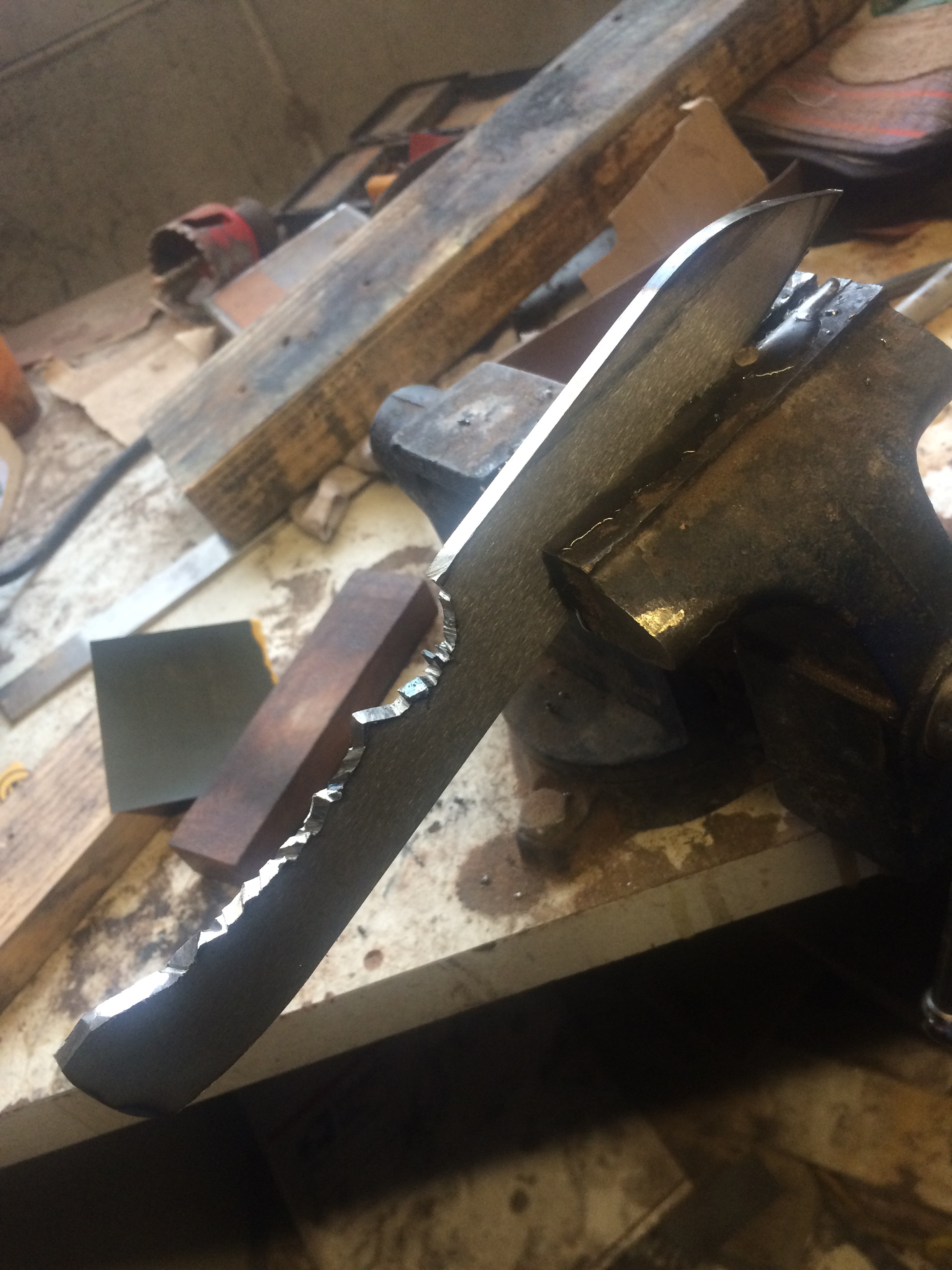
I burned through about 8 cut off discs cutting this out:

Some half inch holes to remove weight.

Several hours later…

There is a lot of material to remove…

Full flat grind

Hand sanding before heat treatment

Into the forge:

Tempering…

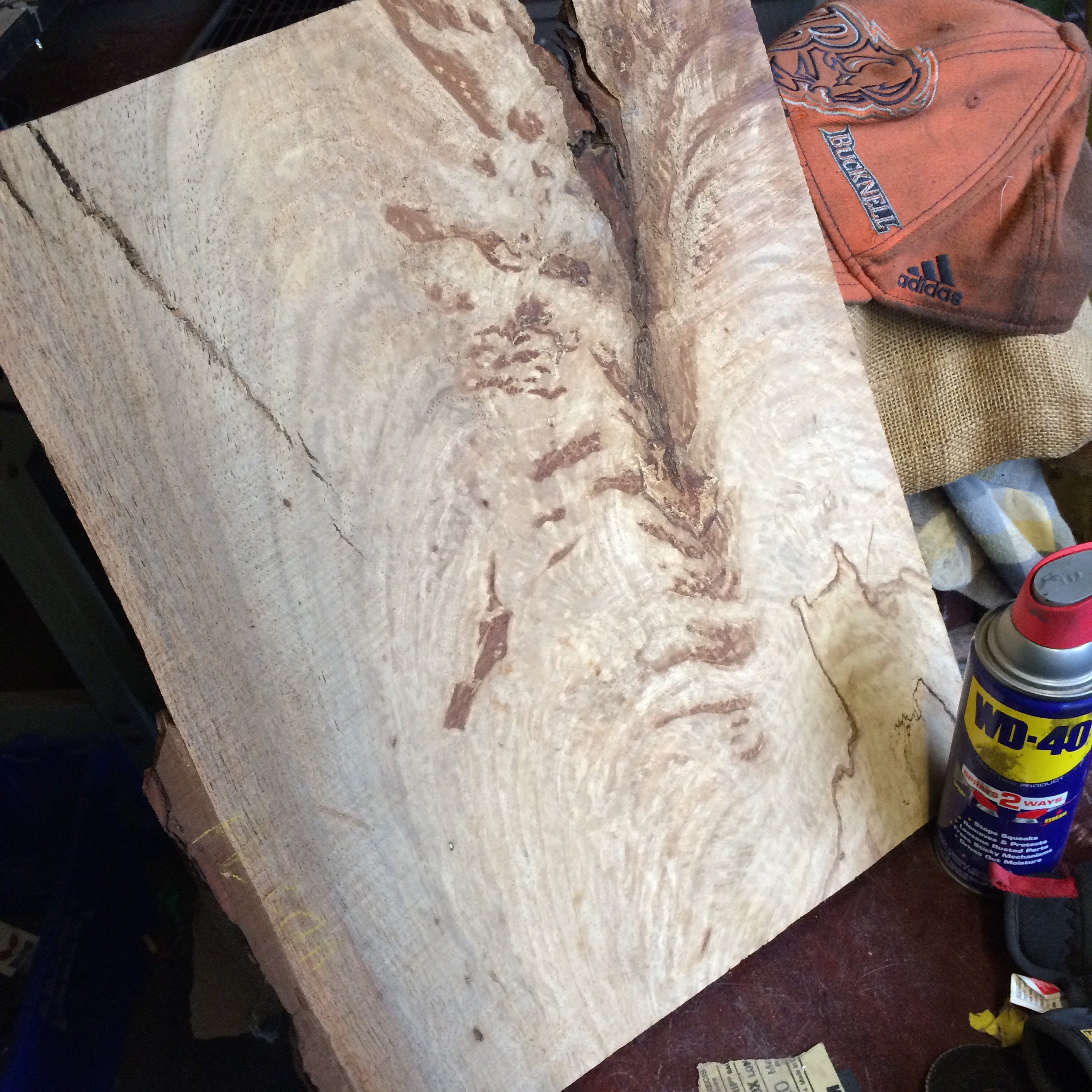
This is a large piece of spalted pecan, sent to me by my wonderful cousin in Texas.

Up to 2000 grit

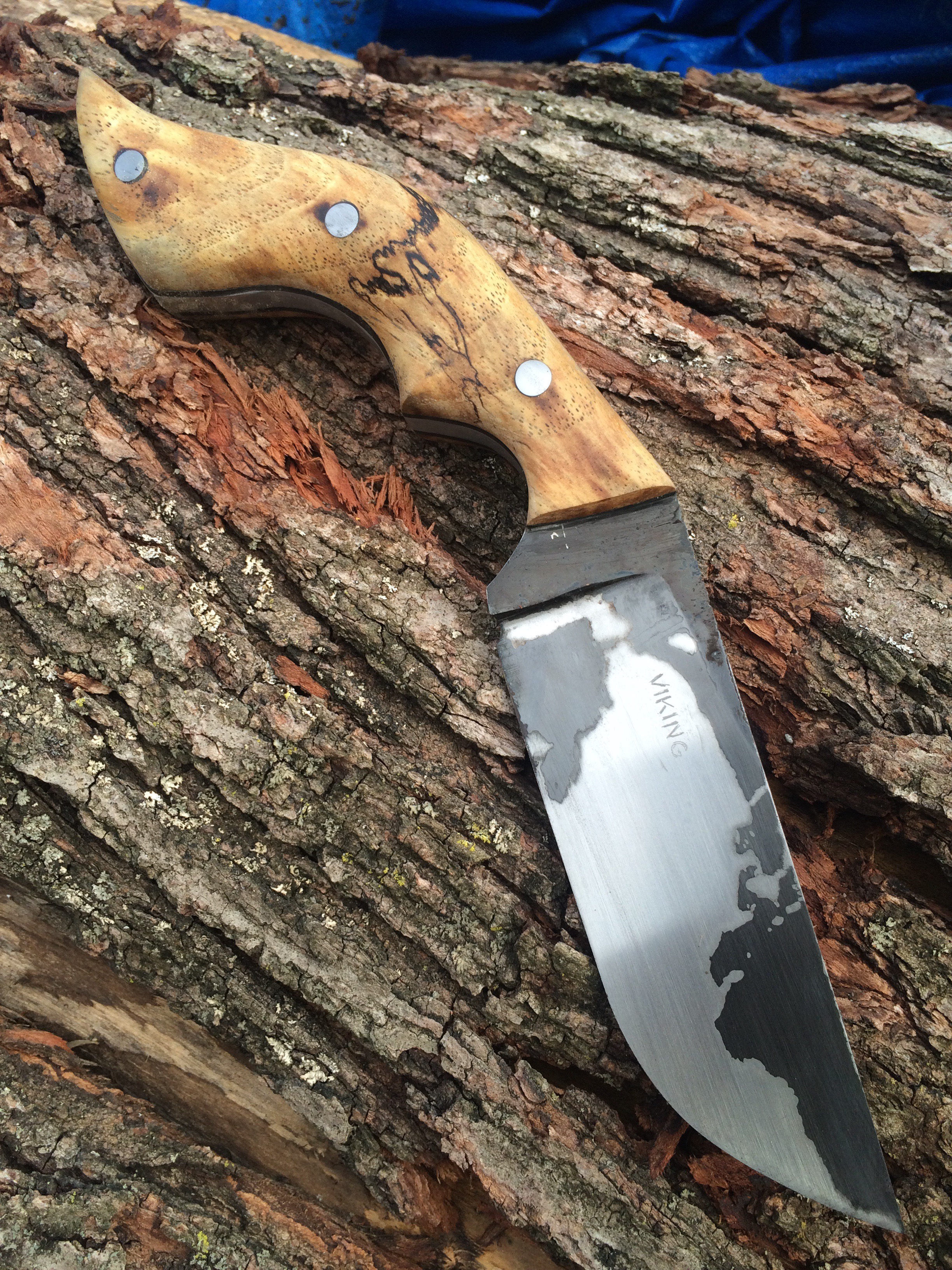
The Treethrower:  1095 spring steel, spalted Pecan handle scales, kydex spacers and steel hardware.

Thanks for the lessons, Joe.

Knifemaking: love, mixed martial arts, and the Lightbringer

“Love suffereth long, it is bountiful; love envieth not; love doth not boast itself, it is not puffed up

It doth no uncomely thing, it seeketh not her own things, it is not provoked to anger, it thinketh no evil

It rejoiceth not in iniquity, but rejoiceth in the truth;

It suffereth all things, it believeth all things, it hopeth all things, it endureth all things.

Love doeth never fall away, though that prophesyings be abolished, or the tongues cease, or  knowledge vanish away.”

I Corinthians 13, The Geneva Bible

On the other side of fear there is love.  We often here about labors of love, tough love, and doing what we have to do out of love.  These are the things that are easy to talk about but much harder to describe what they actually feel like when one finds themselves in the midst of them.  These are the things that are hard to deliver if your heart is not truly in them.  Like a good meal, love is not something that can be bullshitted, and certainly not for an extended period of time.

Love is connection.  It’s what holds things together through good and bad.  It helps us to feel our light when it feels like the universe is doing it’s best to crush us.  Most of us probably have parts of our lives that we look back on and wonder ‘how did I get through that?’  It’s love.

We all know romantic love with its intoxicating and consuming nature.  It puts the color in our world.  But beyond the rainbows and butterflies it takes a warrior to love someone deeply, to do the hard things, to fight for what is dearest to them.  This is what makes the world shine.

Then there are the times in life when the light of love can go dim and your world goes dark.  I found myself in one of those places a couple years ago.  It was bad.  I talked to a therapist who told me I was absorbing chaos.  Those close to me said it felt like there was a hole in my heart.  I got ultra New Age-y and talked to several light healers who told me my energies were out of alignment with love and that my heart chakra was blocked.

Though it was helpful to hear these things, it shed no light on what I was supposed to do to fix them or how difficult it would be.

It all came to head sometime after Christmas.  I had lost quite a bit of weight.  My friends said that I looked great but I felt awful.  I was getting up and going to work and going through the motions but it felt like moving mountains.  I had to get the office lady to remind me to eat.

There was a gentleman who had been coming in to pick up our scrap metal at our work for quite awhile.  He was a big Puerto Rican gentleman who used to be an MMA fighter.  His name was Jose and he is one of the happiest and most grateful people I’ve ever met.  He used to get into a lot of fights when he was a kid and then he made it into a career.  He said he stopped because he was tired of beating people up.  He had dated a lady who was a Brazilian fighter.  He always told me never to date an MMA fighter.  I told him not to worry.

So it was around this time that I was having all these problems and he came in and just looked at me.

‘Brother what happened?’

I asked what he meant.

‘You used to be BIG and HAPPY, but now you little and sad.  What happened, brother?’

We talked for a bit.  Jose is a really good man.  He told me to not stop loving, no matter what, that love always comes through.  He told me to look up the Bible verse (copied at the top of this post), which I reluctantly did.  I knew it from having it drilled into my head as a kid in Sunday school and I always thought it was cheesy.  I had heard it so many times under such superficial bumper sticker circumstances that I almost forgot how really elegantly composed it is.

So I made it a point to start doing things out of love, in a way that I had never really done before.  I started showing up for myself.  It was really hard and it wasn’t pretty.  In fact it was about as far from rainbows and butterflies as one could possibly get and still be in the realm of love.  Sometimes it’s still hard and not the prettiest to look at but I had made a promise to myself that I wouldn’t let it ever get that dim again.

This is the lesson of the Lightbringer.  It was through that process that I learned that love is something you have to stay on top of and nurture even when, no, especially when it’s hard.   It is living and breathing and a sort of life force that keeps the world beautiful.  Even when the world makes it difficult to love, it doesn’t mean you should stop.  Without it, everything can lose it’s meaning and your world can go dark.

 O1 tool steel, in the process of roughing out the blank

Off the grinder at 80 grit

She is ready for heat treat

Hardened and tempered and sanded to 120 grit at a 45 degree angle

220 grit, cutting in at the opposite 45 degrees…

32o grit straight down the blade for a nice satin finish.  These lines are one of the signatures of a hand finished knife blade.  On the subject of labors of love, hand sanding hardened steel is no joke…

Curly Maple attached to the blade

Toward the end of the shaping, sanding, and bursting process…

The Lightbringer:  O1 tool steel, bursted Curly Maple, Kydex spacers, and brass hardware


I ran into Jose at a gas station the other week.  He told me I looked big again.  I just gave him a hug.

Knifemaking: being in the know, Hobart mixers, and the Gunny

“If, then, I were asked for the most important advice I could give, that which I considered to be the most useful to the men of our century, I should simply say: in the name of God, stop a moment, cease your work, look around you.”
Leo Tolstoy 


A few months ago I did a job for my friends who run an auction company.  There was an auction happening at a school out in the country and they needed someone to go out and bid on two gigantic dough mixers.  They weigh a little more than half a ton and are very expensive.

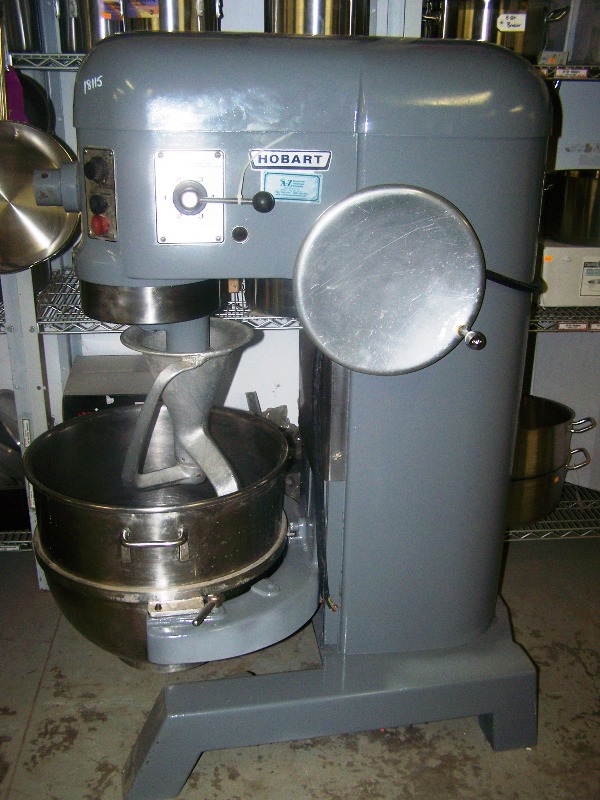
They  look like this:

18115

The only issue was that they didn’t know what voltage they were.  Sometimes these machines have a 460 voltage requirement.  These higher voltages exist to reduce wiring requirements and the need for additional electrical equipment facilities with large power requirements.  The facilities that have these requirements are usually nuclear submarines or large government or corporate campuses.  Most houses only go as high as 220 volts, and that’s only for the washer and dryer hook up.  Unless you are operating a nuclear submarine, anything running on 460 volt power is generally going to be used as a boat anchor or scrapped.

My job was to go out and look at the specs and see what voltage they were.  Anything under 460 voltage would be good to bid on and able to be resold for a profit.

I drove out to the school on an early November morning.  Everything was spread out in front of a storage shed across the street from the school, separated by a two lane highway.  What I saw when I got there was a cornucopia of ancient office equipment, school lockers, floor buffers, and cafeteria equipment from an era gone by.  A lot of the town folk came out to see the festivities and they looked as one would expect the residents of a peanut farming community to look.  I went and looked in the shed and there was even more junk- desks, old computer printers, and large pieces of cafeteria equipment designed to feed the hungry masses.  It was here I found my mixers, alone with no attention from the farming community (they were busy picking over everything outside).  Nobody knew there was a potentially profitable business endeavor here.  Nobody else was in the know.

I went over and found the spec label.  Under power requirements it said 460V.  Son of a bitch.

There were two other gentleman eyeing the mixers as well.  They did not look like members of the peanut farming community.  They arrived in a box truck and a dually pick-up with a trailer attached.  This was the competition and they meant business.  These gentleman were definitely in the know with these mixers.

We said formal hellos.  They asked what the voltage was and I told them, expecting them to pack up and leave.

I called Fred the service tech.  He told me that some of these particular models of mixer were dual voltage and I would need to remove the top cover and look at the motor.  I waited till nobody else was around, and had a peak at the motor.  They were indeed dual voltage- 220v/460V.  So they were worth money.  They were as good as mine.

The other gentlemen did not leave.  We stood off to the side waiting for the auctioneer to make his way to the shed.

When it came time to bid these gentlemen matched every bid I made.  It was just me and them.  We got up to 2000 dollars and the bidding slowed down a bit.  The farming community were both entertained and dumbfounded.  Everything else sold for next to nothing but here were these people who did not belong, wagering thousands of dollars on two hunks of metal.

As per my instructions, I stopped at 3,000 dollars.  The gentleman backed their box truck up and loaded up these two pieces of equipment.  They had been in the know the whole time and they came to win.

With a bit of awareness you can start to see that there is more going on in the world than you ever imagined.  This sort of awareness usually helps me to be a better citizen of the universe.

There is the gentleman you may work with who tries to be everything to everyone.  It is profoundly annoying.  Spend 18 hours with him on a business trip and you find his brother died of a heroin overdose.  All he is doing is trying to keep everyone safe in the only way he knows how.  Being in the know of this helps you to cultivate a bit of compassion toward this man.

Or there is the person who is raising hell in Starbucks.  You know for a fact that that person did not wake up with the sole intention of making an entire coffee shop miserable- possibly because you may have done the same thing at one point or another.  There is probably something else going on that is causing this person to act this way.  Being in the know helps create space for empathy for this person.

There are thousands of situations like the auction or the other two incidents.  Having a bit of knowledge of things can help to create a richer existence or at least help you to know what you are missing out on at a country auction.  Sometimes all this takes is slowing down and having a look around.

This is the lesson of the Gunny.  It gets its name from the Gunnery Sergeant, and NCO in the Marine Corps whose job is to be in the know.  Sometimes just being aware is enough to make a difference.

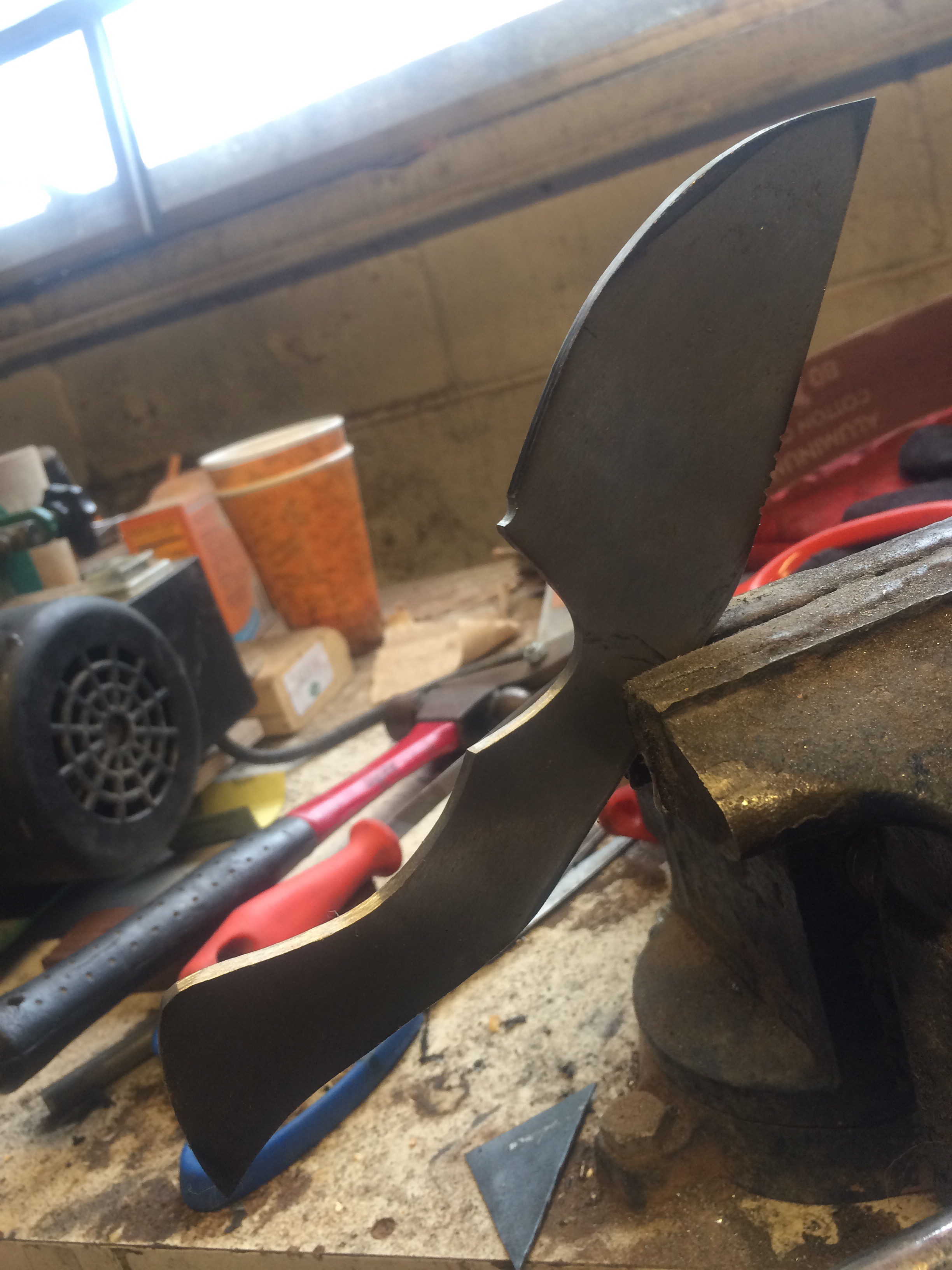
I started working on this knife as part of a demonstration at a show, and it was at this stage when I got back to the shop.  He is made from O1 tool steel.

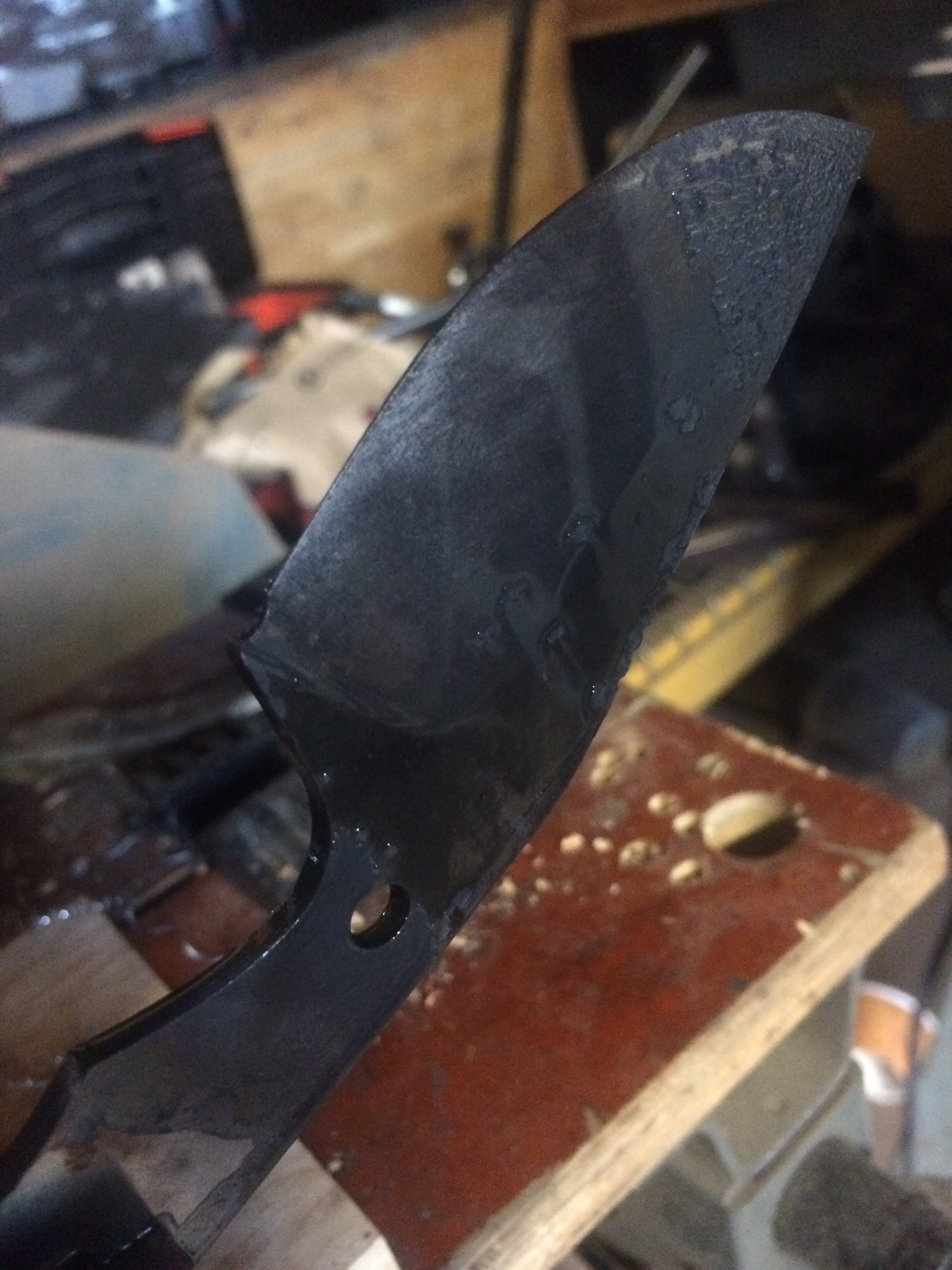
After hardening…

After hours of hand sanding…

Three shirts that no longer fit- in black, brown, and green

Cut into strips…

….and then pieces

Fiberglass resin…

….for a stinky salad

Put into a bag and clamped:

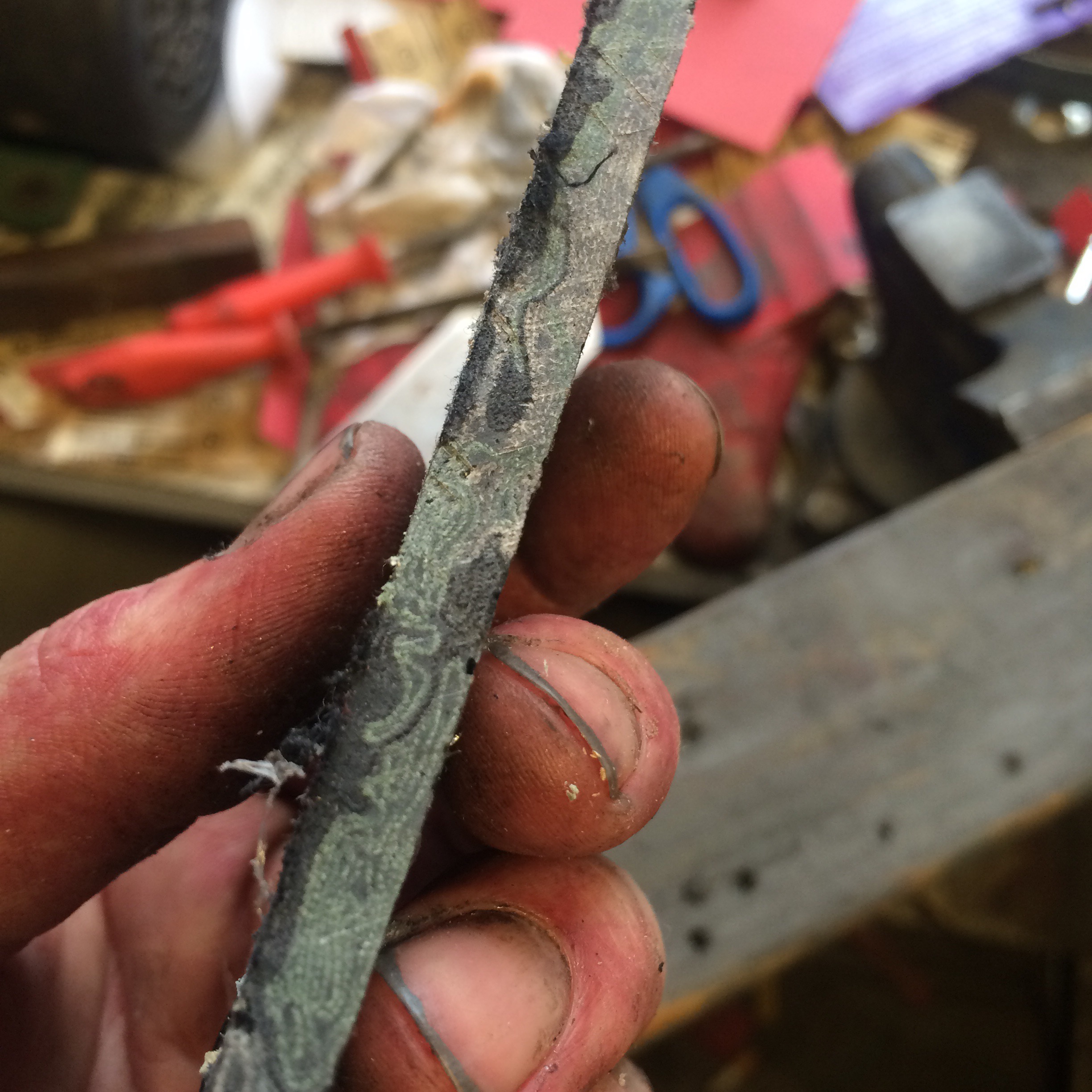
It comes out looking like this:


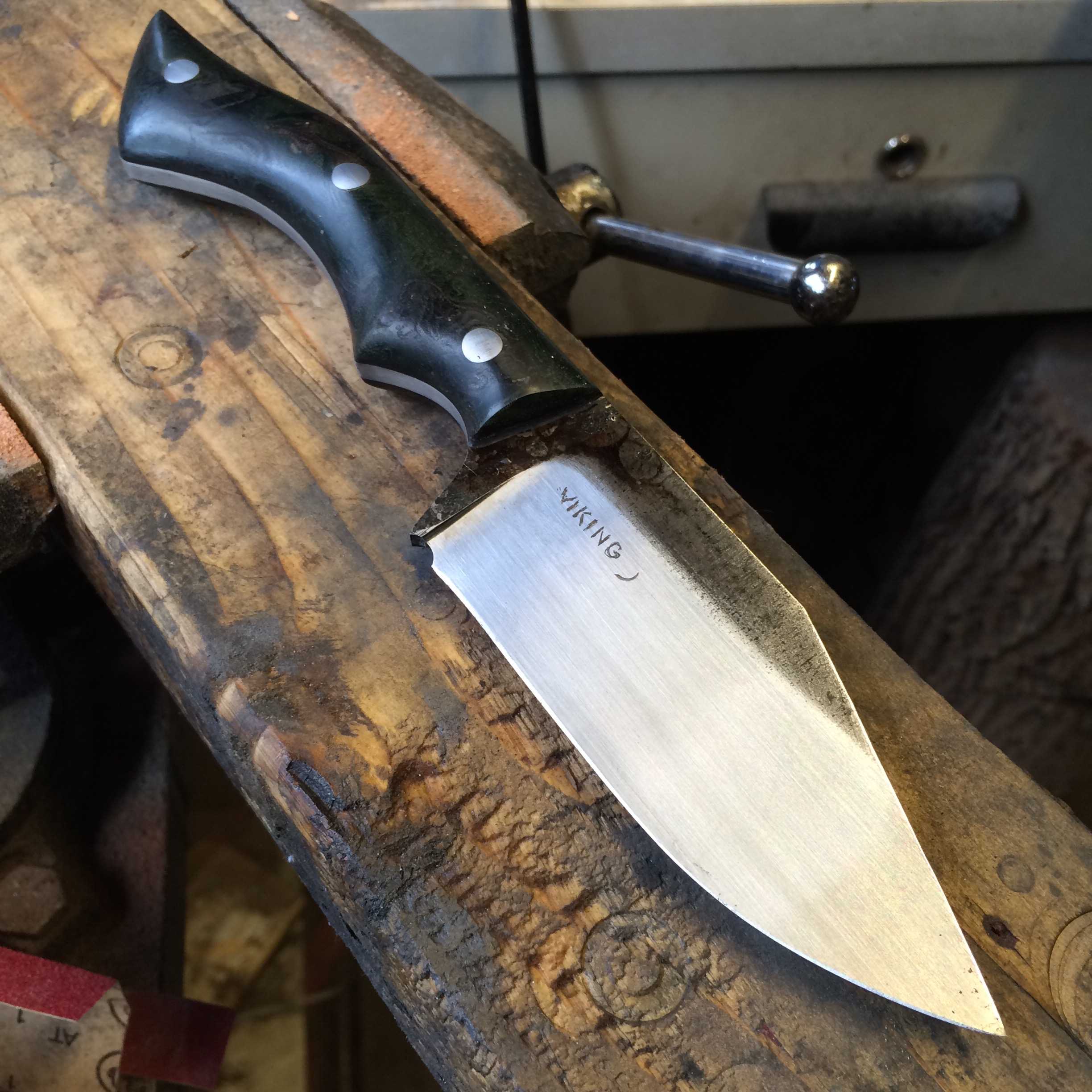
The Gunny: O1 tool steel, homebrewed camo micarta, kydex spacers, and steel hardware.


In finding a bit of awareness there can be a deeper connection to the world around us.  This is the lesson of the Gunny.

Knifemaking: when things break down and the Skin Yer Dinner

“The place to improve the world is first in one’s own heart and head and hands and then work outward from there”

Robert M. Persig- Zen and the Art of Motorcycle Maintenance

One of the major lessons of life is that things are going to break down.  It doesn’t matter how well the schedule of maintenance is managed, no matter how well oiled and lubricated all the moving parts are, or how diligently things are inspected.

At some point or another things just aren’t going to work the way that they are supposed to and sometimes it takes more than just ourselves to get them repaired.

As I’ve gotten older I’m a little more mindful of this.  Sort of.  It’s been a bit of a process actually.  I do my best to not let my things go to shit.  Some of those things are easier for me to do than others but it’s definitely better than it has been in the past.  Part of this tendency to let things go to shit comes from living in a consumer society.  Things aren’t necessarily built to be repaired.  They are meant to be consumed and thrown away.   If it breaks, buy something newer and shinier and better.  Fixing things takes time and often it is very appealing to go and buy a new one rather than repair what you have as best you are able.  This notion goes for more than just our material possessions.

Sometimes I find myself having to repair things that I have let completely go to shit.  Sometimes it’s in my professional life, sometimes it’s in my relationships, sometimes it’s my truck.  It’s important to not beat yourself up (or anybody else) when something goes to shit, which it inevitably will.

My truck.  I like to drive mid to late ’90s Japanese midsize SUVs because they perform really well, are built on truck chassis, and are relatively easy to fix and find parts for.  Sometimes it’s a little stressful because I don’t always know what I am doing and turns into an exercise in not over-thinking.  It’s also an exercise in observing how you operate when things aren’t working as they should.  I did a brake job the other month.  I’ve never done my own brakes before but the idea of saving a couple hundred dollars sounded good.  The passenger side wheel took me two and a half hours- during which time I removed the entire brake caliper by mistake, and accidentally drained all of the brake fluid.  The driver side wheel took me 45 minutes.  After several attempts to bleed my brake lines of the air inside on my own, I had to take my truck to my mechanic who talks to me like I am ten years old (‘Son, why the hell did you disconnect the brake line?’).

In taking on these sorts of projects, I go through the entire spectrum of human emotion and always become more intimate with myself.  It’s important to trust yourself, and to let go of the fear that you will screw something up more than it already is.  To take that intention of helping something to do what it does and to manifest that into whatever you are working on.

The intimacy thing- it goes for more than knowing just yourself.  Sometimes I have help on these projects.  Sometimes I help those close to me on their things.  It’s good to have someone who can pick up on something you may have missed, who can help you laugh, and help ease your anxieties.  In these situations a lot of the masks come off and you can really get to know someone without pretense or pontification because there is a common goal.  It’s reassuring knowing that when something goes wrong you can help yourself, or help somebody else, or be helped.  The deeper lesson is that things will always break down, ourselves included, but they don’t have to stay that way.

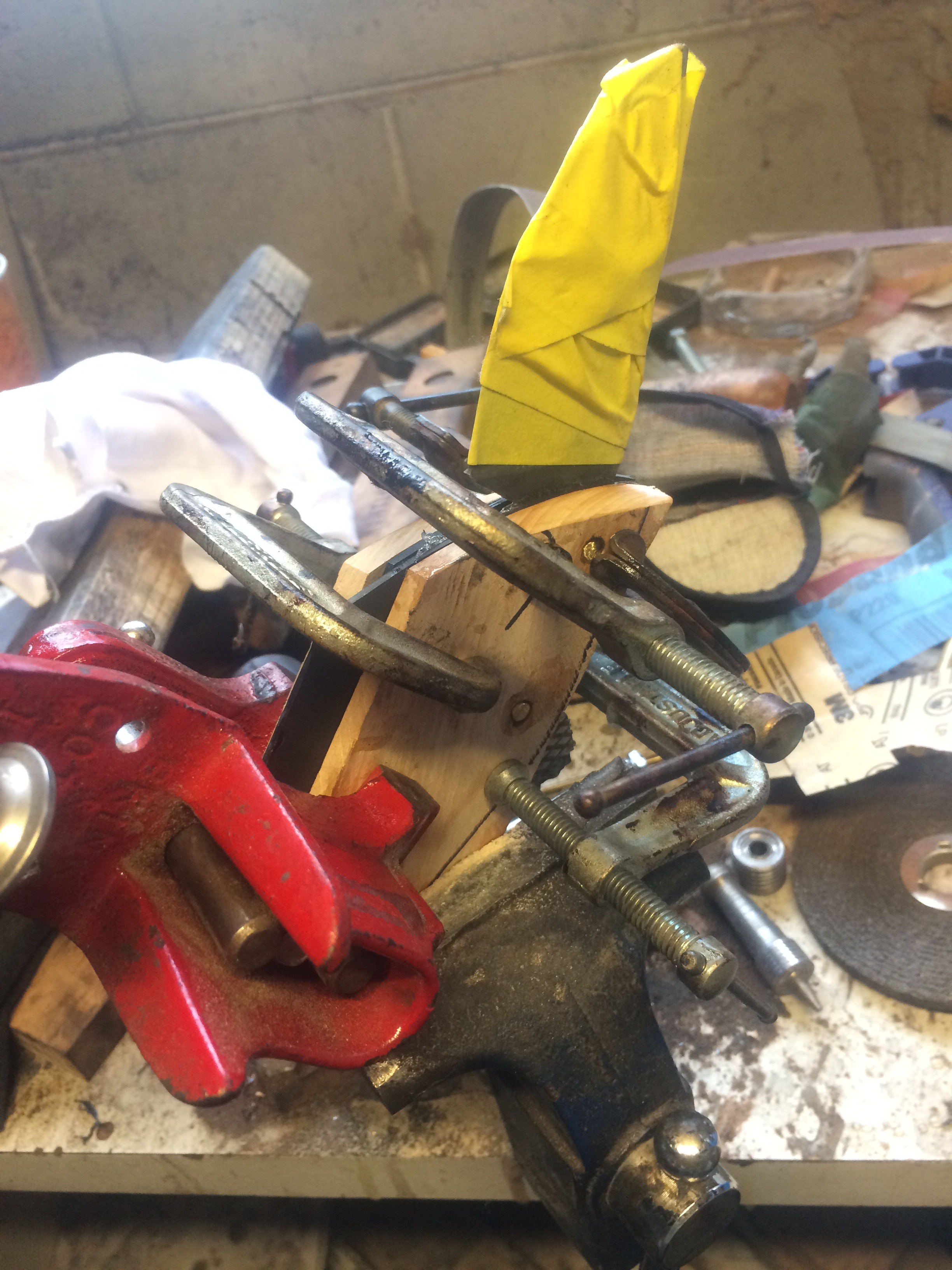
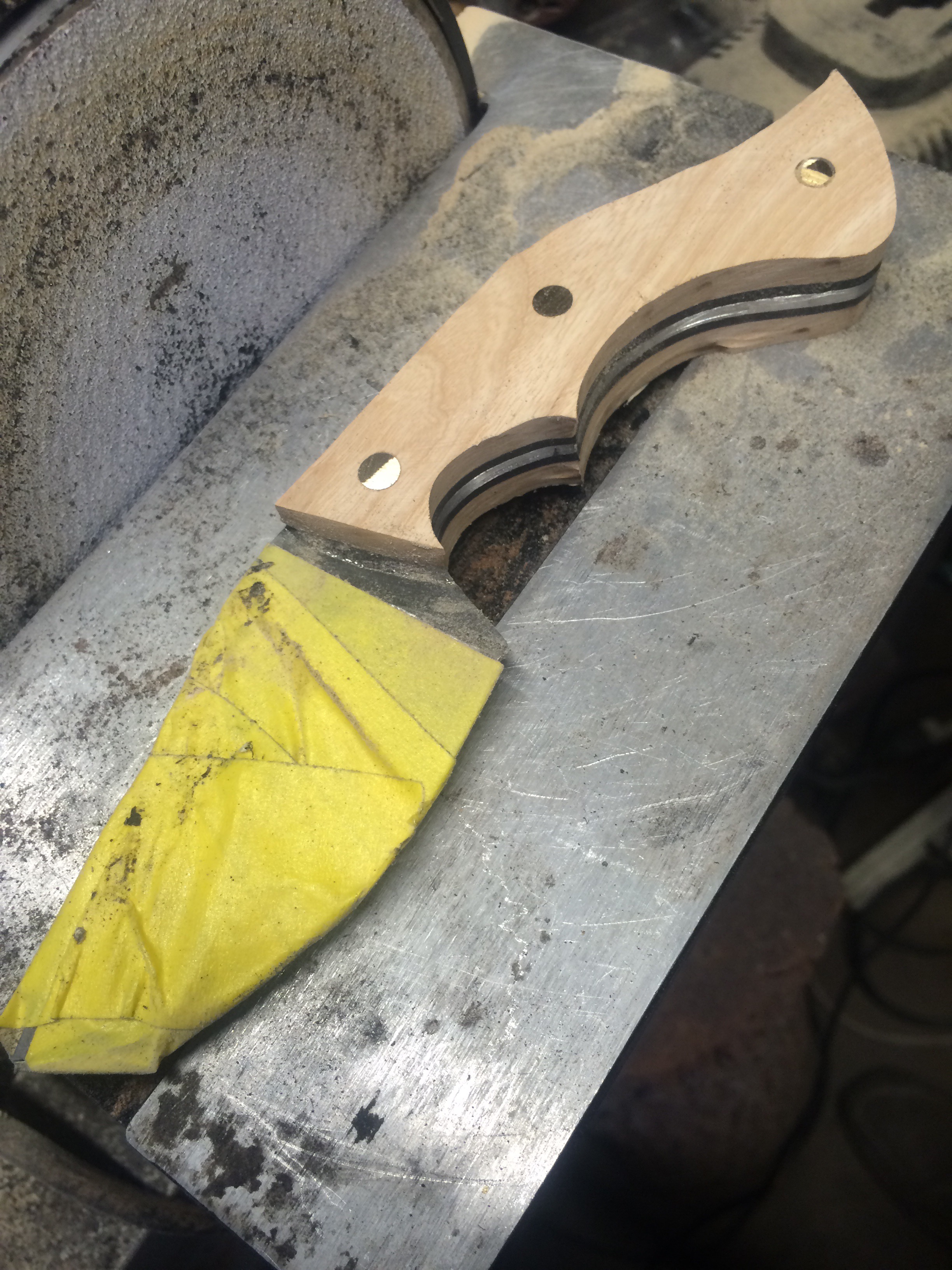
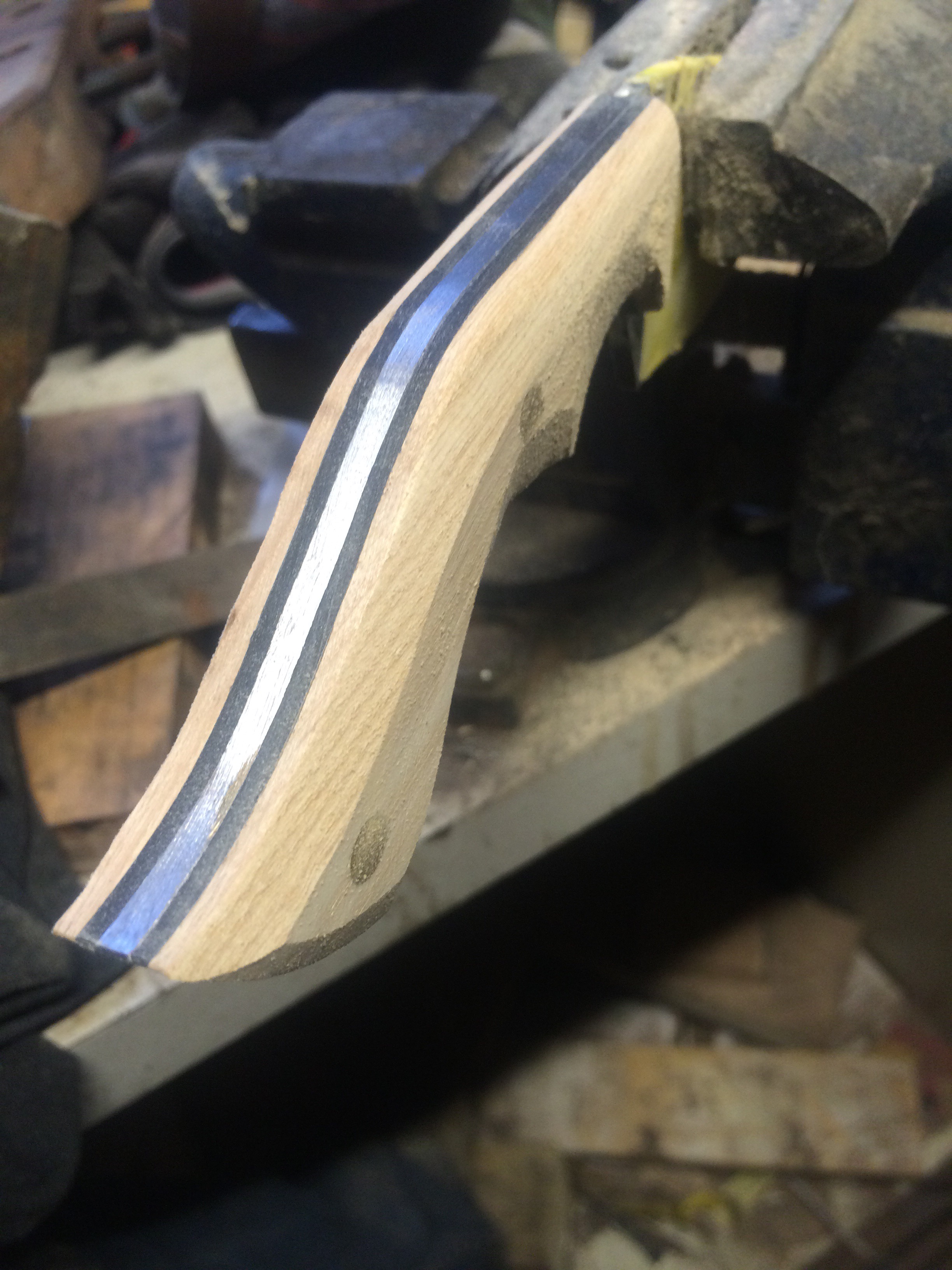
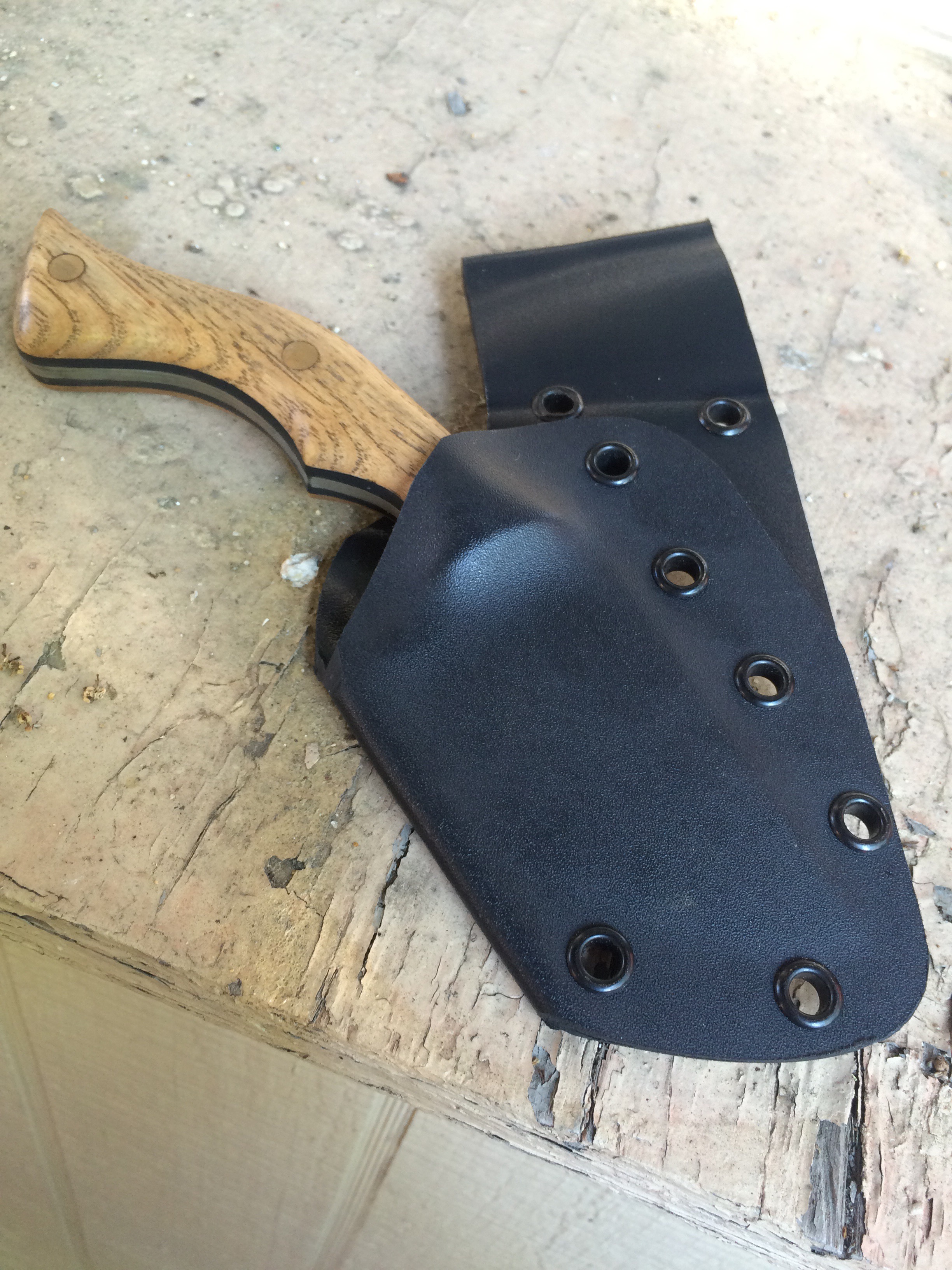
This blade was a commission for a fourteen year-old boy, the son of a really wonderful friend of mine who is an HVAC technician, someone who in his professional life brings the broken and neglected into good working order.  The other week my girlfriend and I were working on her HVAC system which had gone out.  We put a new fan motor in and were a bit hesitant on the wiring.  I called my friend, who came over and wired up the motor and rewired the thermostat on pretty short notice.  His son was with him and asked me for a knife… and also asked that it be called the Skin Yer Dinner…

I started with a piece of 1095 spring steel…

Hardened

A bit of Texas River Ash…

The Skin Yer Dinner:  Etched 1095 spring steel, Texas River ash handle, Kydex spacers, and brass hardware.  I also threw in a custom Kydex sheath…


IMG_3617

IMG_3614

Things break down and it’s a part of life…but so is figuring out how to get them working again.

Knifemaking: a little bit at a time and the Scout

“Ready or not
I hear a clock tock ticking away
Though I’d asked for those hands to stay in place”

Correatown- “Everything, All at Once”

I wake up most mornings and wonder how I am going to get everything done.  I think about all the things I need to do, the things I want to do, and feel a little bit of shame over the things I’ve been meaning to do but haven’t done yet.  There is this mental space where I run through my entire life- where I’m born, I live, and I die, all before I even get out of bed.

At the bottom of all of the mental chatter there is a gentle little voice that says to do it a little bit at a time.  It also says that there is plenty of time.  Sometimes it gets drowned out but I know it’s there if I listen for it.  This is what gets me going.

For the past ten or so years I’ve taken walks in the woods.  As things get busier I don’t get out there as often as I’d like.  It’s an exercise in not trying to do everything all at once.  You walk the woods a little bit at a time, and the notion of trying to do anything other than that feels rather asinine.  I try to approach the things I have to do in this fashion.  It doesn’t always work and I get frustrated a lot.  A lot.  Sometimes the feeling of there not being enough time screams at me so loudly that I have to go home and take a nap.  Most times I’m not able to do that, in which case I try to take it back to the forest.  In being with that feeling I find that there usually is enough time.  If not, I try to remember that I am human being and not a human doing.

Attempting to do everything all at once is a sort of self-defeating behavior.  This type of all-or-nothing thinking tends to overwhelm and makes the idea of quitting into a rather attractive proposition.  Buying into this thinking gets you regret and remorse, but only after it has robbed you of your precious moments and there literally isn’t enough time.

This is the lesson of the Scout.  To walk your forest one step at a time.  It’s easy to get pulled off your path.  There are a thousand things that demand our attention and can pull us off of our center.  We can’t always give what we love the attention and care we would like and sometimes it’s easier to give up.  Don’t give up.  Do it a little bit at a time and it will all get done.

I wanted to make something that reminded me of this little area where I like to walk:

IMG_3400.JPG

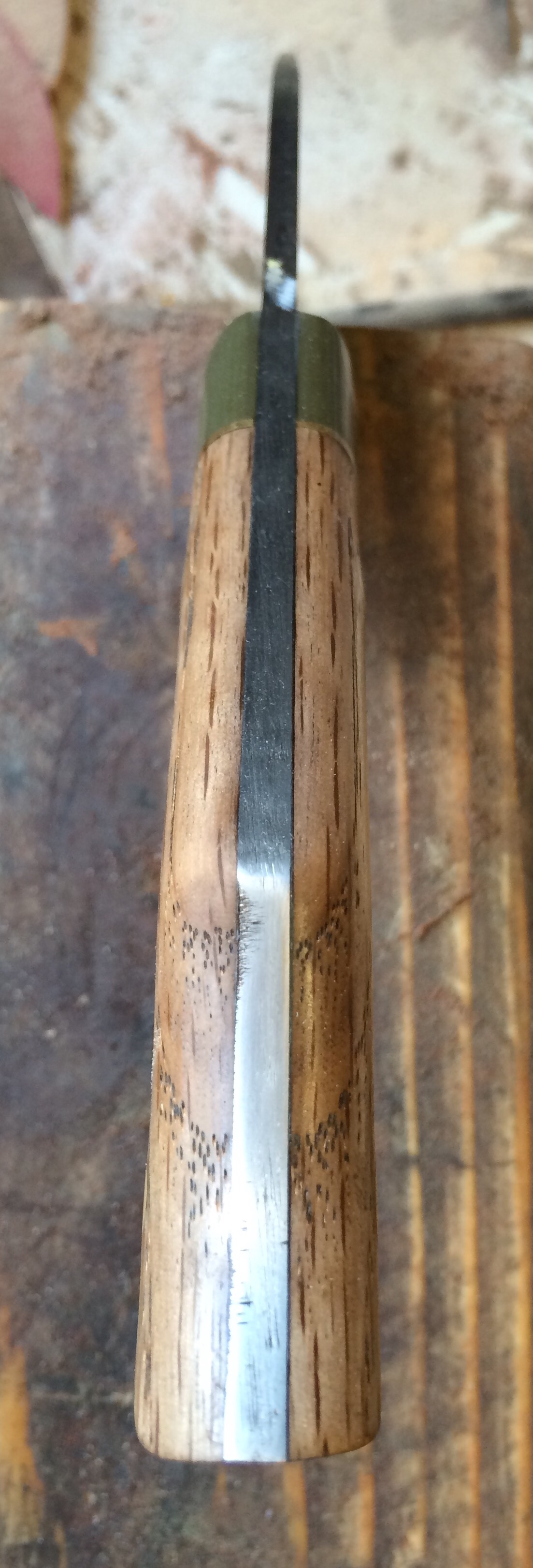
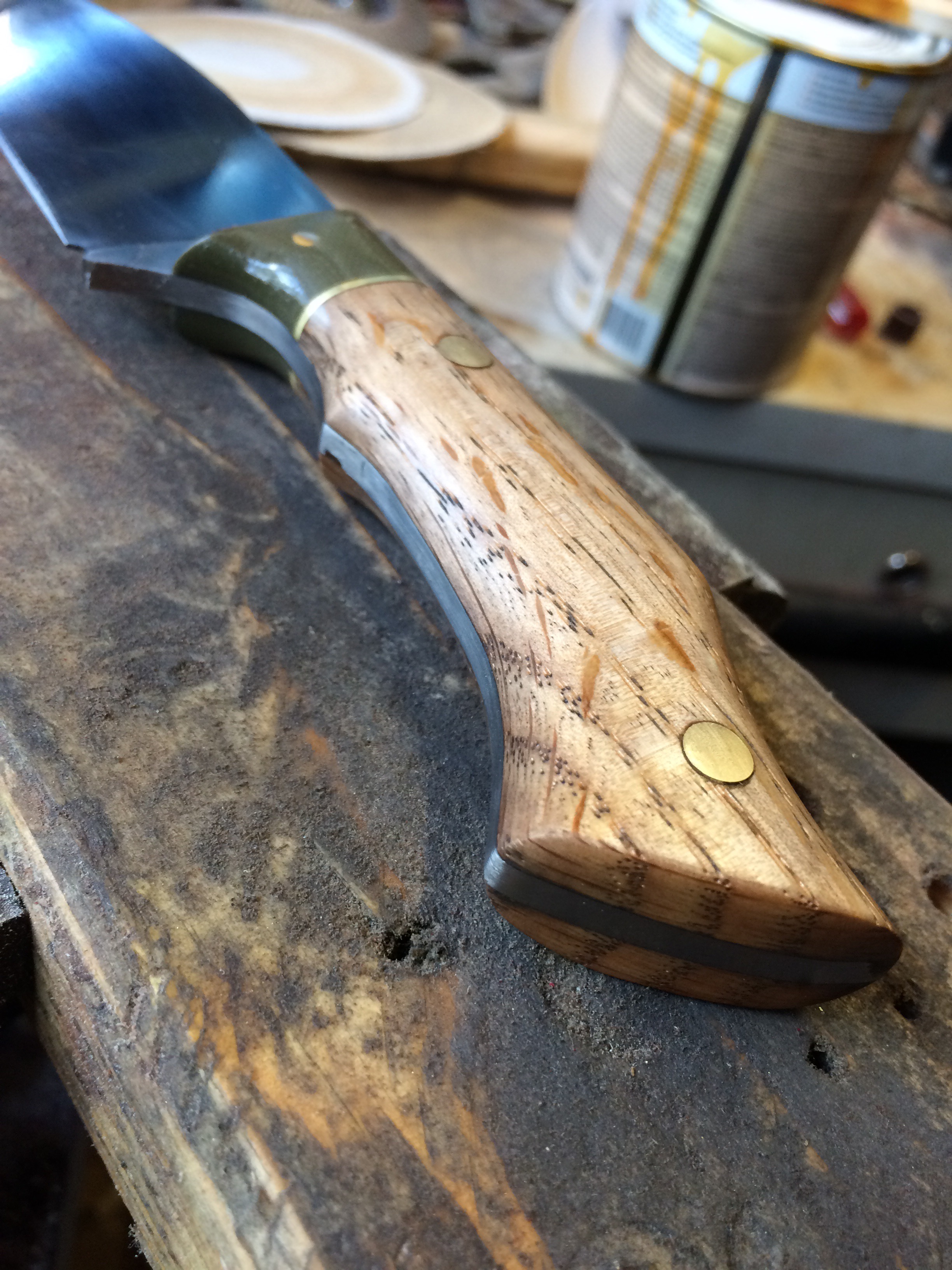
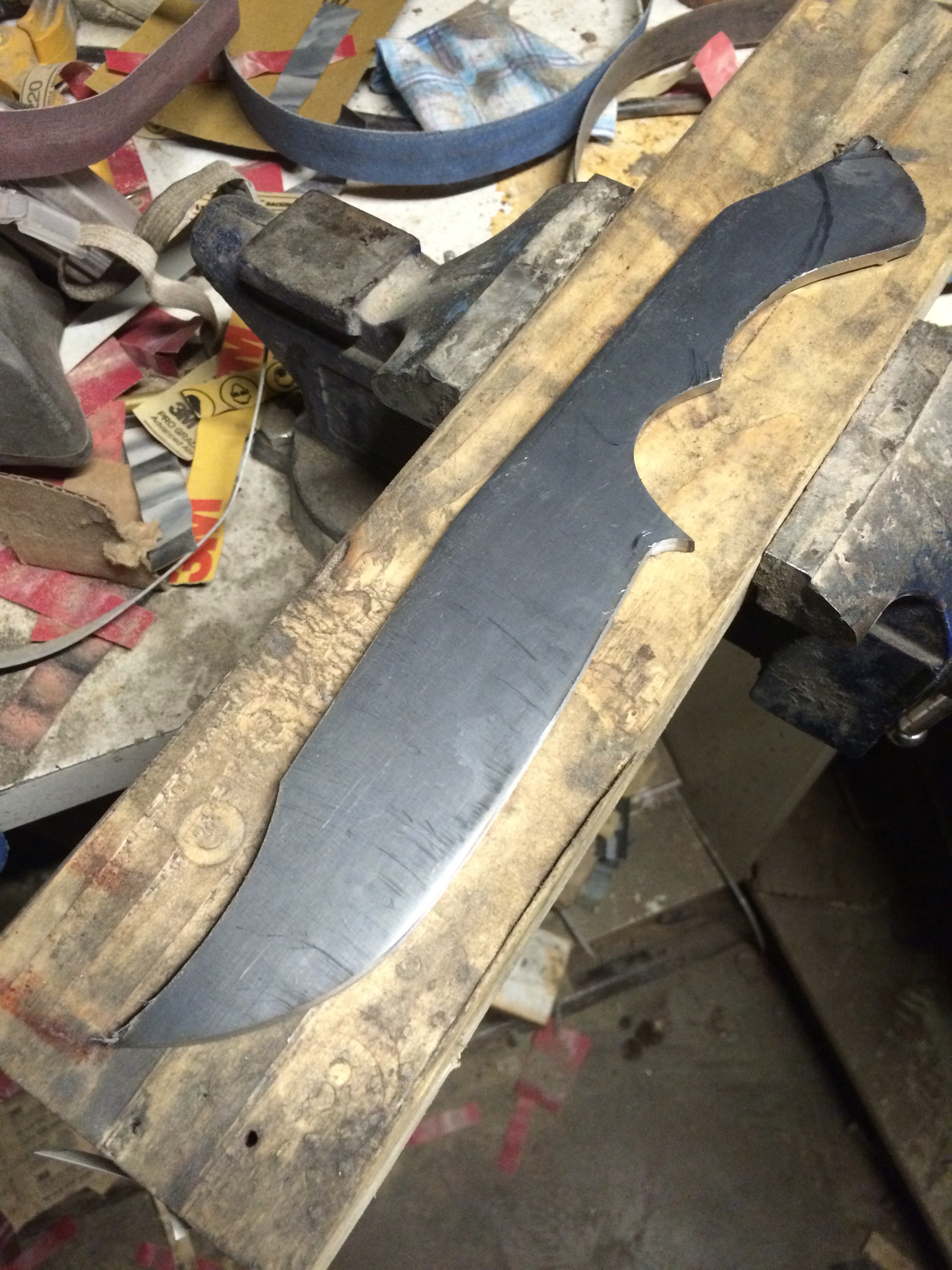
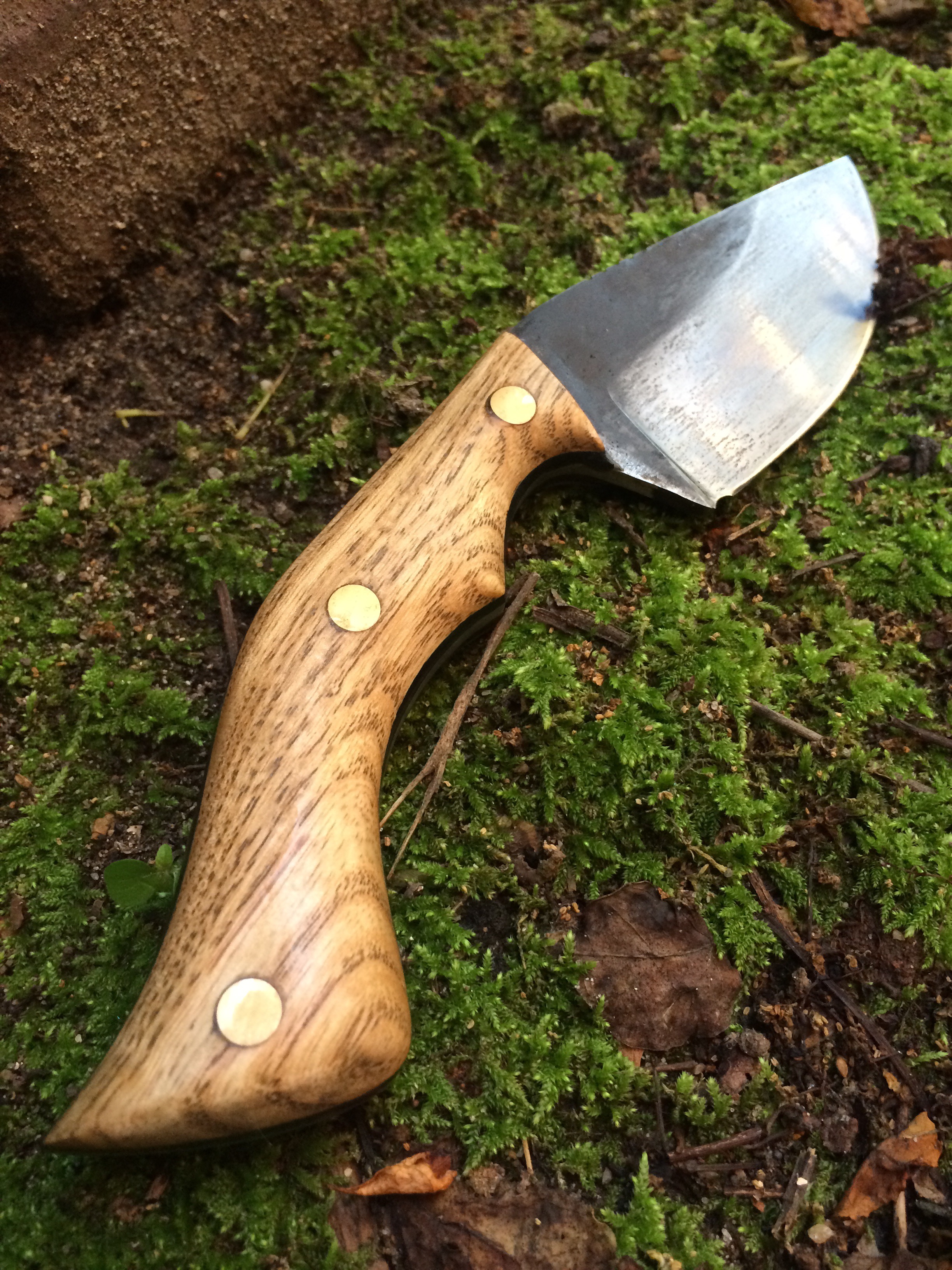
I started with O1 tool steel and bushcraft style design with a handle that winds like the stream above.  I usually use 1095 because it’s cheap and I have a lot of it but I like using O1 for the Chromium in it- it polishes up nicely

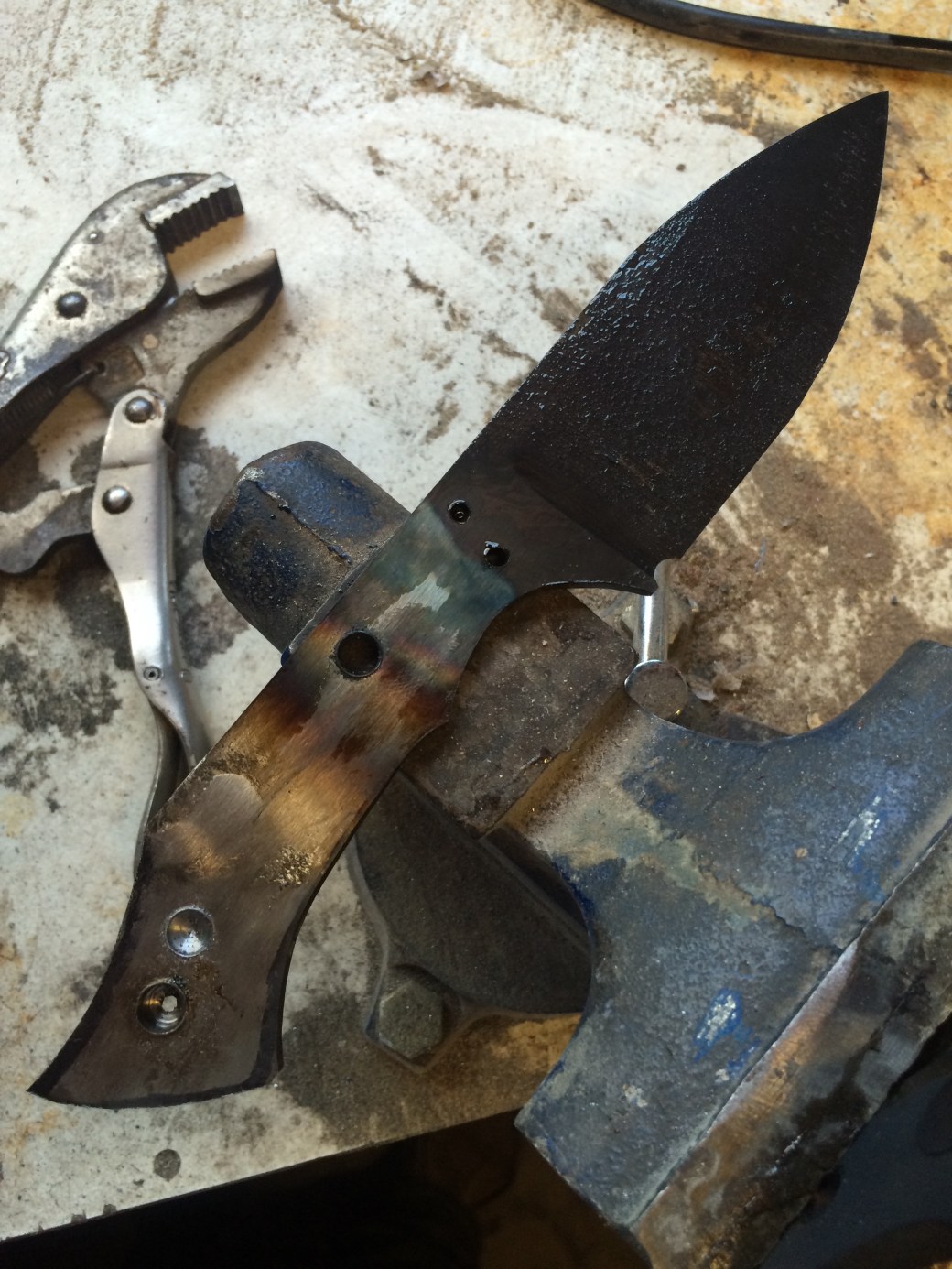
Hardened:

FullSizeRender 8

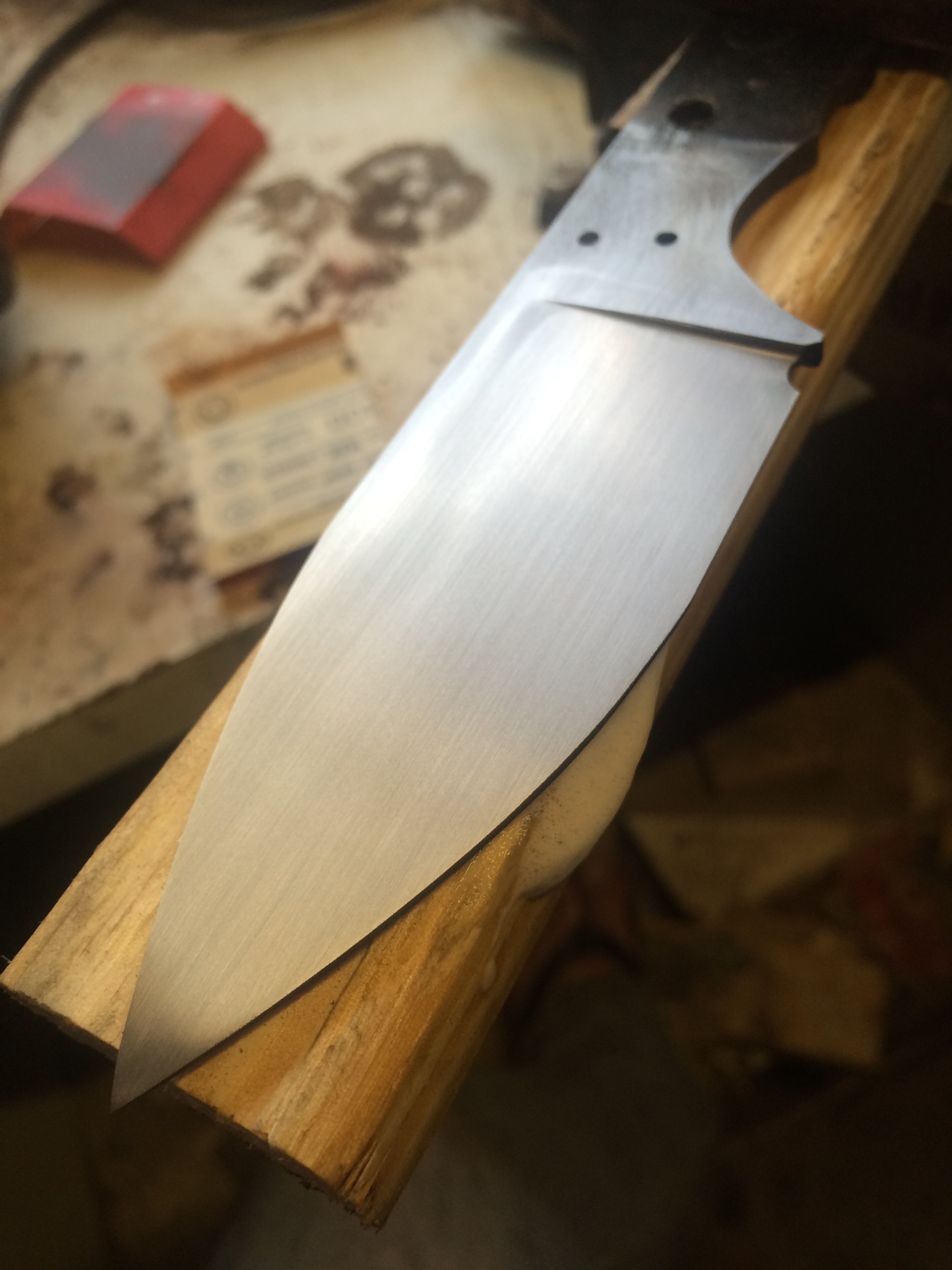
Sanded.  Not too shiny because he is built to be used:

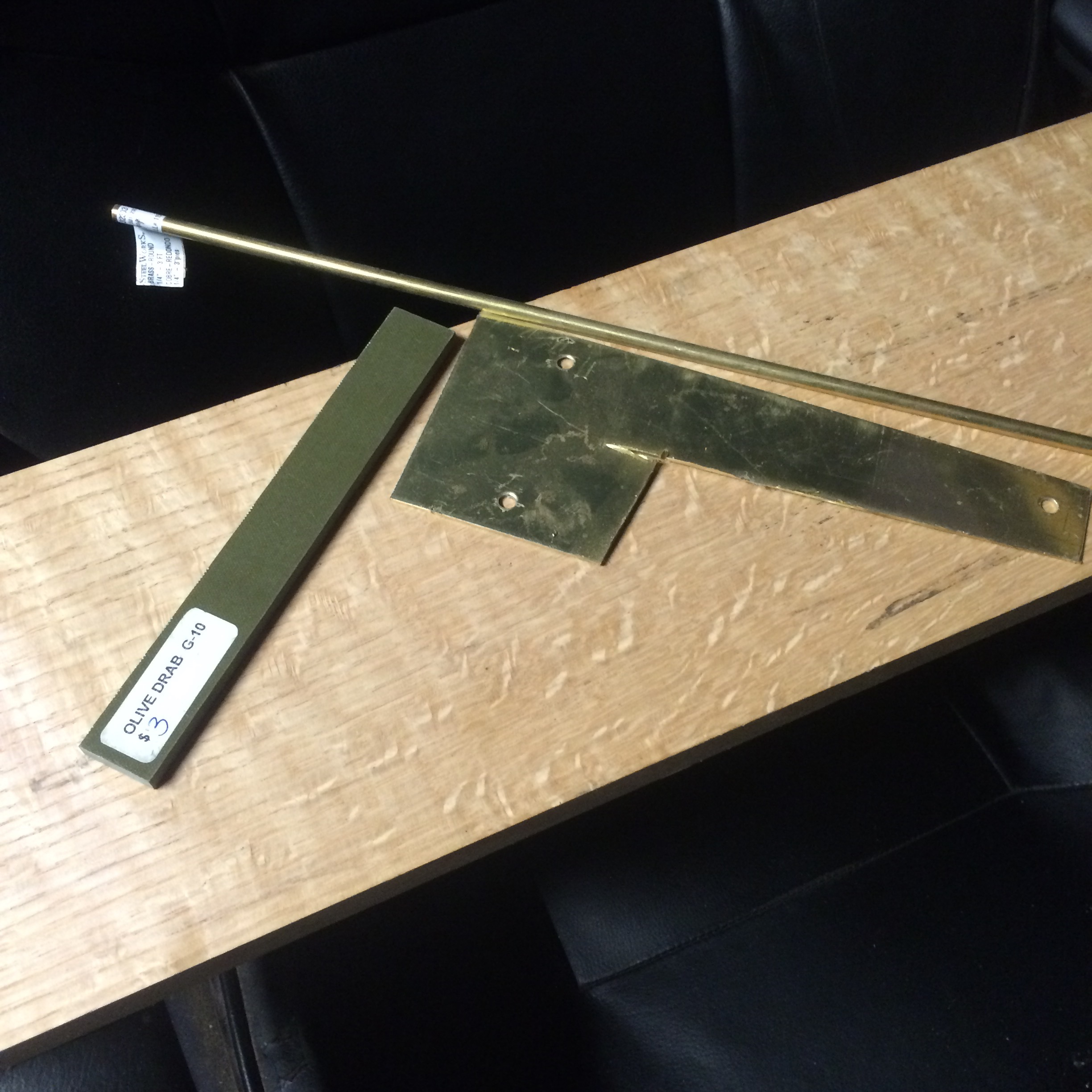
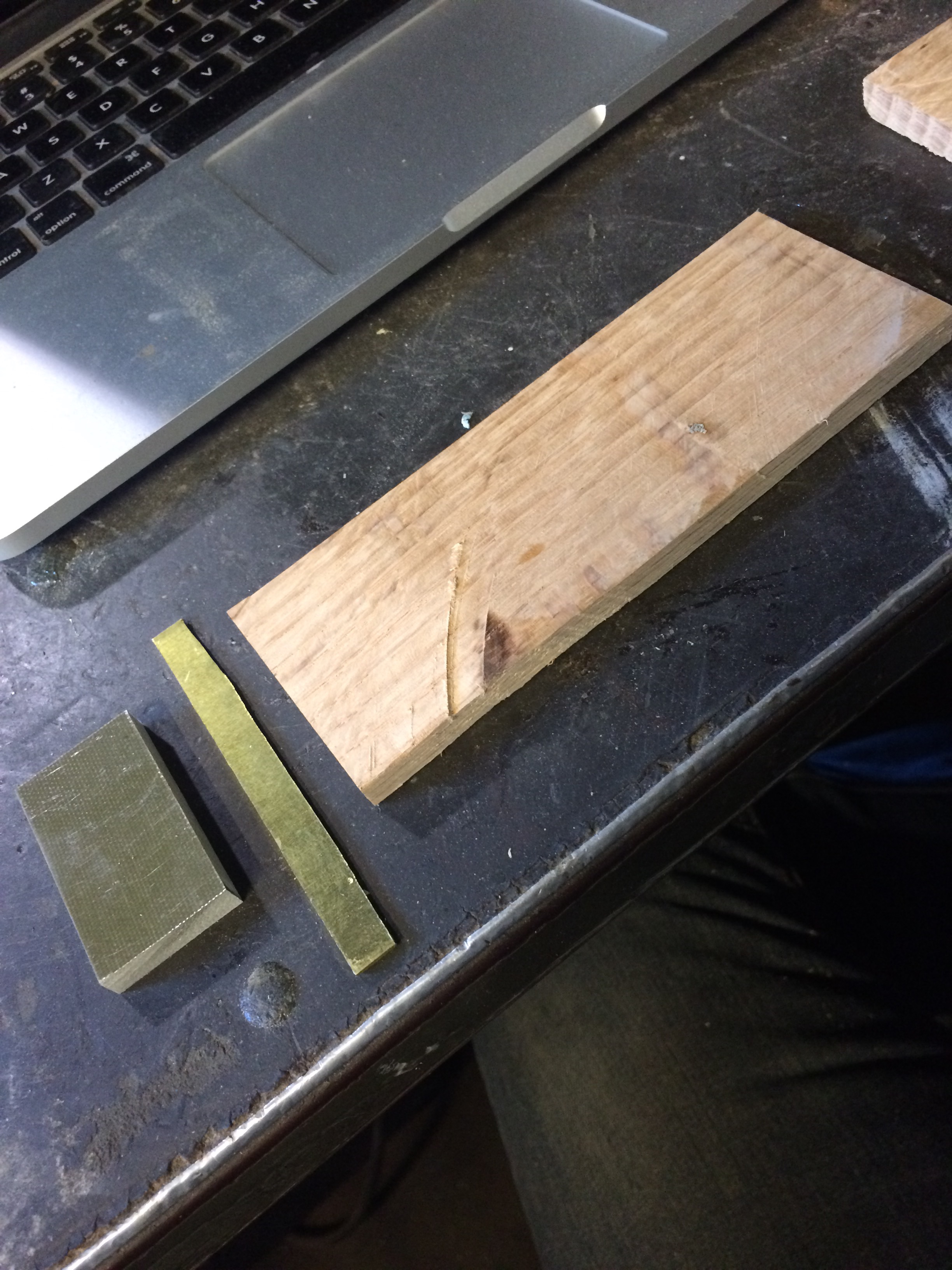
Here is what I used for the handle- quartersawn white oak, olive drab g-10, and brass.  It was a bit of an undertaking and there was some improvising because some things didn’t go as planned.  One step at a time…

Cut.

Glued.  This came apart soon after.  I tried to keep the brass cool when cutting it but it got too hot and melted the epoxy.  More steps, keep moving…

Clamped…finally

Glue is set.

Rough shaping.

Cleaned up.  Now to sand…

The Scout:


A little bit at a time.  Keep moving, even when it feels like everything is impossibly slow and it will never get done.  Challenge that, and walk your forest.  There’s plenty of time.

Knifemaking: playing your hand and The Wild Card

“Like I said, I’ve got mixed emotions about wild card games.  In one sense, they tend to bring out the gamble in your opponents.  They often create a carnival of excitement in which players give away a lot of money painlessly.  On the other hand, it’s hard to calculate a strategy for a game the dealer has just invented.”

Doyle Brunson- According to Doyle

I think the best definition of a wild card is something that can be what you need it to be, when you need it to be.  I have a friend like this- his name is Fred and I’ve written about him before.  I worked with Fred at the warehouse dealing with restaurant equipment.  During the tenure of our professional and personal relationship, Fred has set me on fire, twice, helped me fix my car, helped me fix my friends’ cars, helped me fix my girlfriend’s house, and showed me how to fix things I had no idea could be fixed.  The man has infuriated me beyond belief and has also made me laugh till I cried.  Fred is a wild card, a deus ex machina, the kind of person who can accomplish incredible things and can do it, most of the time, without having any sort of concrete plan.  Which makes it that much more infuriating to work with him and can also result in being set aflame…

I’ve always had this paradoxical sense of simultaneously feeling incredibly safe and slightly on edge whenever I worked with Fred.  We would go into jobs and everything that could go wrong would absolutely go wrong.  Somehow Fred would figure it out.  There was the time a one day job turned into three at a federal office building near downtown Washington DC.  A Japanese restaurant on the floor level of a building on Glebe Rd was going out of business and they had a very short amount of time to have everything removed.  The loading dock was in the basement and the bay door was two inches too short to get our tractor trailer in to load all the equipment out.  The only way to get everything out was through a single door at the front of the building onto the sidewalk.  We couldn’t get the truck there till two days later and we had to hot load it on the street, one of the busiest streets on the east coast.  The truck would be there at 3am.  In the mean time we had to dismantle everything in the restaurant, including a walk-in freezer, a walk-in cooler, fifty tables, and twenty hibachi grills.  I never want to move another hibachi table ever again.  Fred orchestrated the truck to get there half an hour after the door people removed the five thousand dollar custom glass door so we could get everything out of the building.  The truck was late and there was maybe two hours before the police would get there and make us move, but not before they asked up why we had a semi-truck, a forklift, and a truck with a tilt deck trailer in front of a government building with no permits.  Fortunately that didn’t happen and we got out of there in an hour and a half, smelling of old fish and rotten bok choy.

A lot of jobs happened this way.  None of this is an exact science.  On my better days I felt like a part of a black ops crack team.  On my not so better days I seriously questioned my life decisions.  None of it was ever boring, though.  Not with Fred.

There was an Italian man who had a few restaurants around town.  Crazy Frank we called him.  He had just opened up a new restaurant and had an emergency with his ice machine and a pizza oven we rebuilt for him.  Fred and I head over there at lunch.  The kitchen is insane.  I go over to the the oven and start to drill out holes on the door to put a handle on- bear in mind the oven is roaring at 600 degrees and has pizza in it.  Fred is reprogramming the thermostat on the ice machine.  It is the lunch rush and there are ten people running around, screaming in Italian.  Fred asked me if I had a ‘big ass college word’ to describe the situation.  I told him that I believed the word he was looking for was ‘asinine’.

“Right,” he says.  “This shit is asinine”

The most memorable job I was on with Fred was a three day bakery extraction.   Fred, myself, and our colleague and good friend Aaron were to fly to Nebraska, load an entire bakery into two tractor trailers, and then fly home.  Adventures started at the airport.  Fred and I are not fans of flying.  At the airport bar I had forty dollar margarita with a cornucopia of liquor in it and Fred had two double shots of Jack Daniels.  We got on the plane and promptly went to sleep.  We arrived in Nebraska that evening, picked up a swanky rental car and went to look at the job.

The first thing I noticed was that it was cold.  Like unbelievably cold.  It hadn’t really hit me at the airport.  This was January and I had never been anywhere that flat, windy, and cold before.  The second thing I noticed was a gigantic rotating bread oven.  Our client told us that it bakes 100 loaves an hour when loaded to capacity.  We would spend the majority of our time dismantling that hulking behemoth.  We got steaks for dinner, because that is what you do in Nebraska, and went to the hotel.

The next couple of days were stupidly cold.  The forklift we rented wouldn’t start most of the mornings until the sun came out.  We had to disconnect and extract the oven exhaust system, which meant going onto an icy sheet metal room.  We had to take that oven apart, which had nearly a thousand 3/4″ screws holding it together.  Fred was confident in his ability to get it all back together.

Everything went as it should, got loaded, and sent back to Virginia.  Our travels were slightly rockier.  There was an ice storm that closed the Chicago Midway Airport and we got diverted to Indianapolis where we sat on the tarmac for seven hours.  Seven hours of Fred without a cigarette.  Seven hours of Fred saying we should have rented a truck and driven to Nebraska.  Seven hours of Fred telling anyone who would listen that no one could keep him on that plane.  I was sitting next to a mother and her small child on their way to Disney World.  The husband and another little one were sitting behind me with Fred.  These little ones had a better grip on the situation than Fred.  Finally they let us off to catch a different flight, on a plane that wasn’t covered in ice.  It was all Aaron and I could do to keep Fred from using the company card to rent a truck and drive back to Virginia from Indianapolis.  Two double shots of Jack got Fred back on a plane.

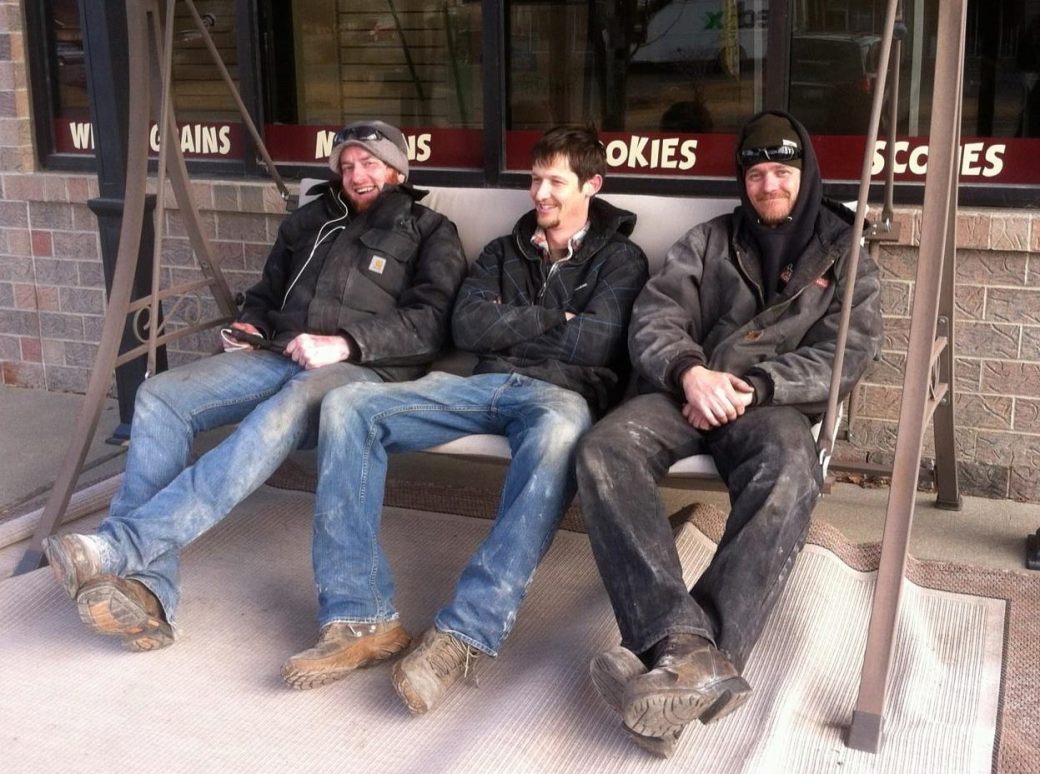
Left to right here is myself, Aaron, and Fred after three long, flour covered days in the cold.  Happy to be finished, thank you very much.

nebraska

Wild cards only work when you play them.  They do what you need them to do when you need them to be done.  This is Fred, and also the lesson of the Wild Card.  I wanted to build something to be sent in when the job needed to be done.

I started with a big hunk of 1095 spring steel- 3/16″ thick

The blade is close to 8 inches long…
 Rough grind:   

I used a clay hardening technique to create a Hamon

  Hardened…

…and tempered

Sanded to about 600 grit and ready to for a dip in the acid….

Curly Maple.  You can faintly see the wavy bits of curl…

Clamped.

To get the curls to burst I had to go through many cycles of sanding and staining and sanding again.  With each cycle the stain becomes more stable and prominent.

I cooked up a concoction using various finishes I have…

You can start to see the curls as the grain becomes more stable.  This is after maybe two cycles of sanding and staining

This is after maybe 8…

The Wild Card:

It’s always good to have a Wild Card in your hand- even when you want to kill them sometimes.

Thanks for the lessons, Fred.