Knifemaking: reaction, the sacred pause, and the Querencia

“In bullfighting there is an interesting parallel to what I call the art of pausing, as a place of refuge and renewal. It is believed that in the midst of a fight, a bull can find his own particular area of safety in the arena. There he can reclaim his strength and power. This place and inner state are called his querencia. As long as the bull remains enraged and reactive, the matador is in charge. Yet when he finds querencia, he gathers his strength and loses his fear. From the matador’s perspective, at this point the bull is truly dangerous, for he has tapped into his power.”

Tara Brach, Radical Acceptance


Up until this point I noticed my knives were relatively polite and concise.  Maybe there was a reaction to some imagined expectation of what this undertaking should be.  Sometimes we might restrain ourselves for fear of how others may react to us.  It could manifest itself in muting our truest selves or limiting our potential so we don’t have to deal with any unpleasantness that may arise from this.  We build ourselves around others’ expectations of us and brace ourselves for negative reactions when we inevitably fail to meet those expectations.  It continues in a cycle.  This is no way to live.

This is where the sacred pause comes in.  Where you are in a position to just observe everything you are doing to hold yourself back.  I like to think of this as creating some space- and this is what I’ve found meditation to be helpful with, however you choose to approach meditation.  You take a step back and survey everything.  At first it’s a bit painful and the tendency may be to freak out but once you get past those waves you can start to find yourself.

In this space I gave myself permission to be wild, large and maybe a bit scary.  In this blade I wanted something a bit more unbuttoned, unbridled.

With this blade I also wanted to capture the essence of a being that has come out of his reactionary rage, found his power, and become something shining and beautiful.  A being that is no longer dangerous and unpredictable but a force to be reckoned with.  These are things I’ve looked for in myself.  This is the lesson of the Querencia.

I ordered a thicker gauge of steel.  It’s much wider as well.

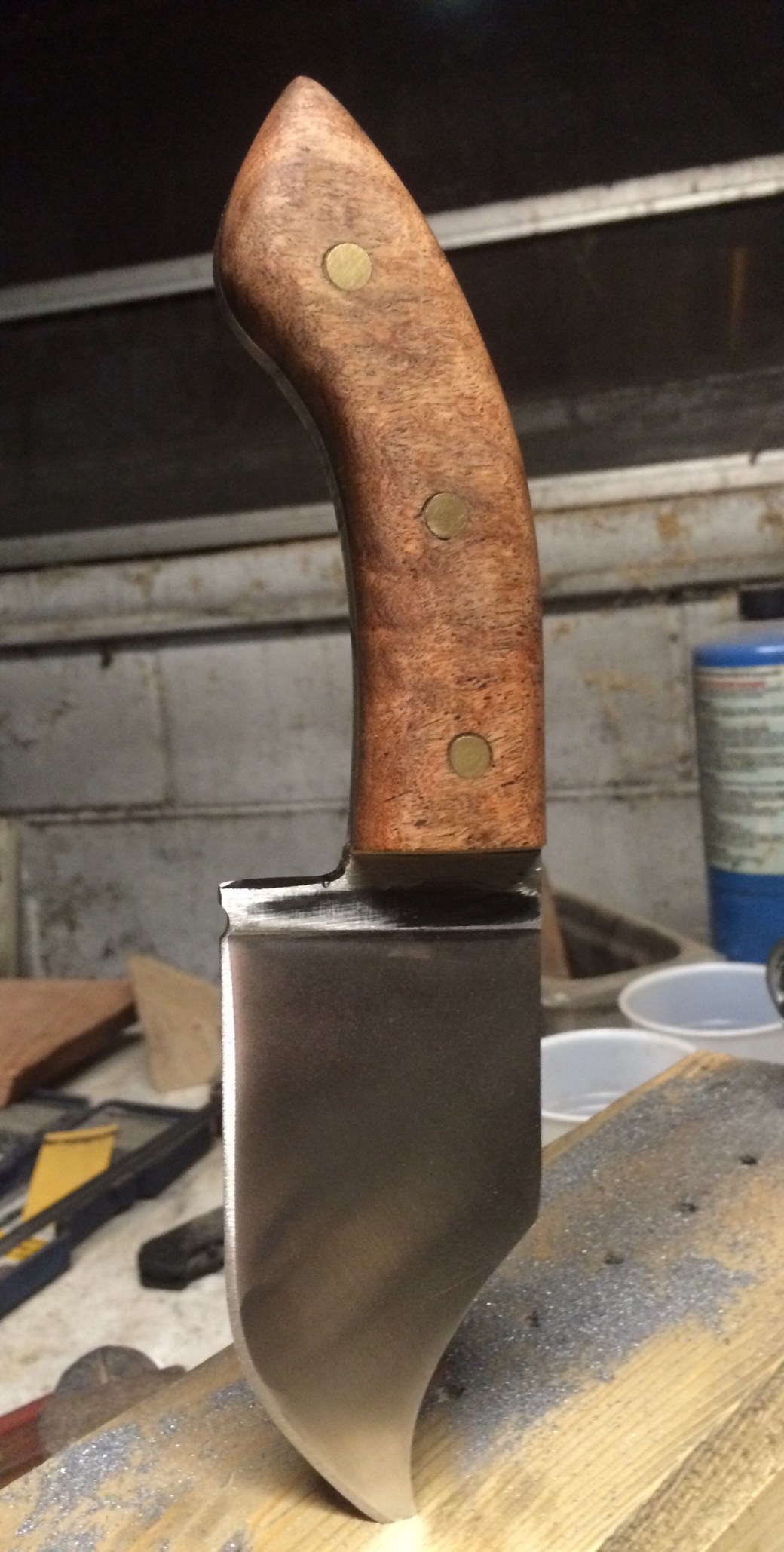
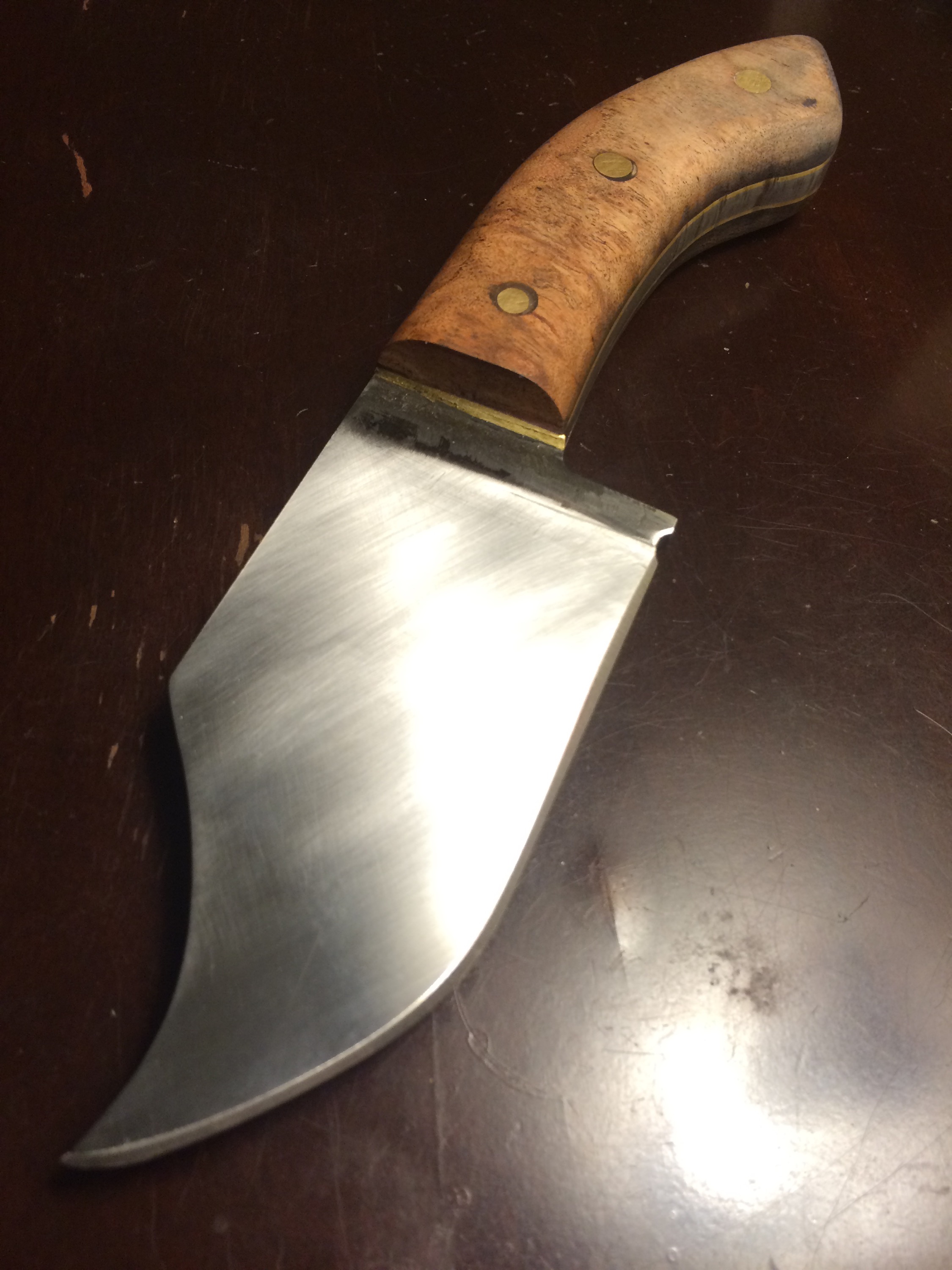
I wanted something bull-like with a forward momentum.  Muscle in the front end and a set of horns.  This is what I came up with:  
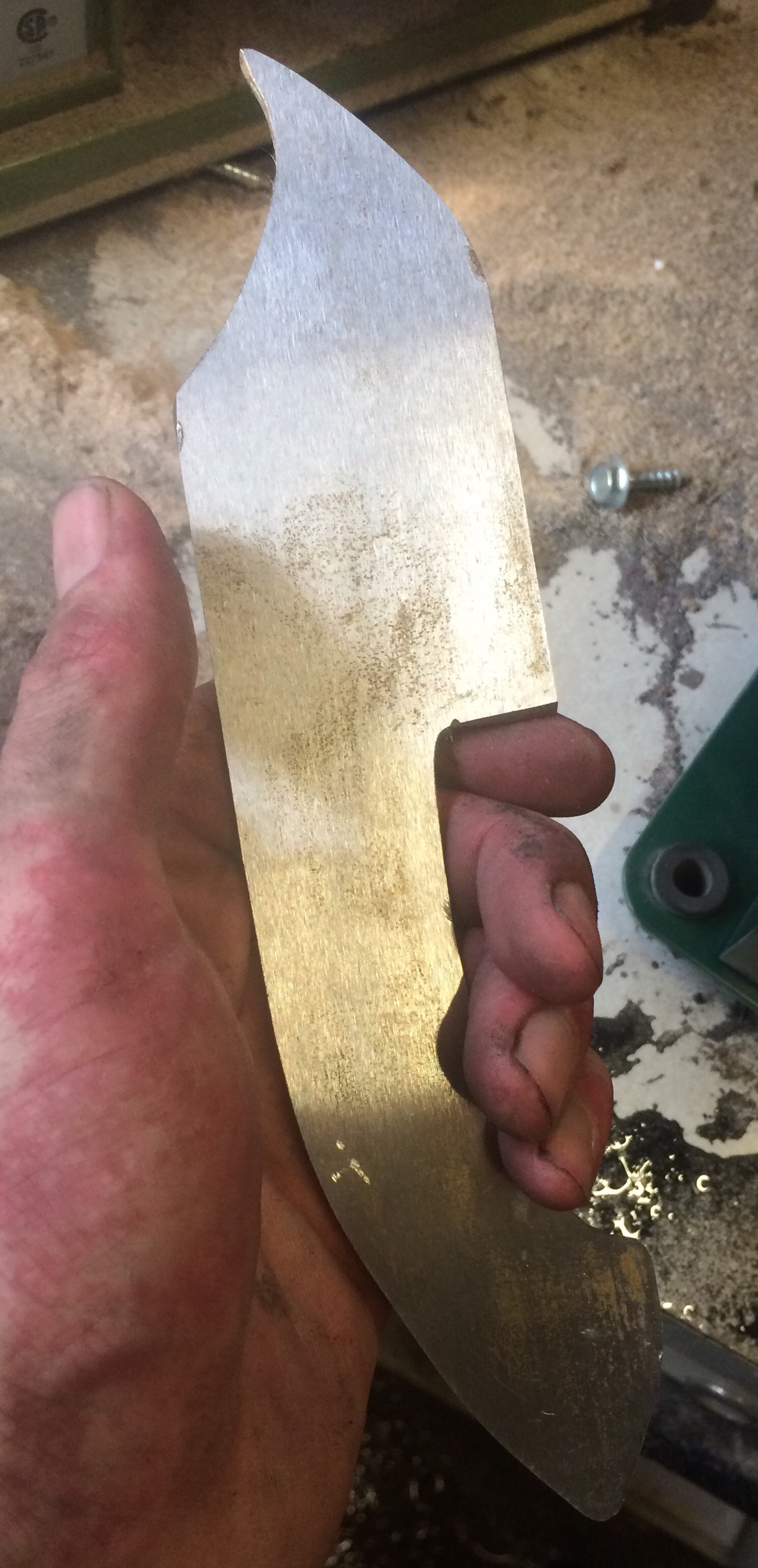
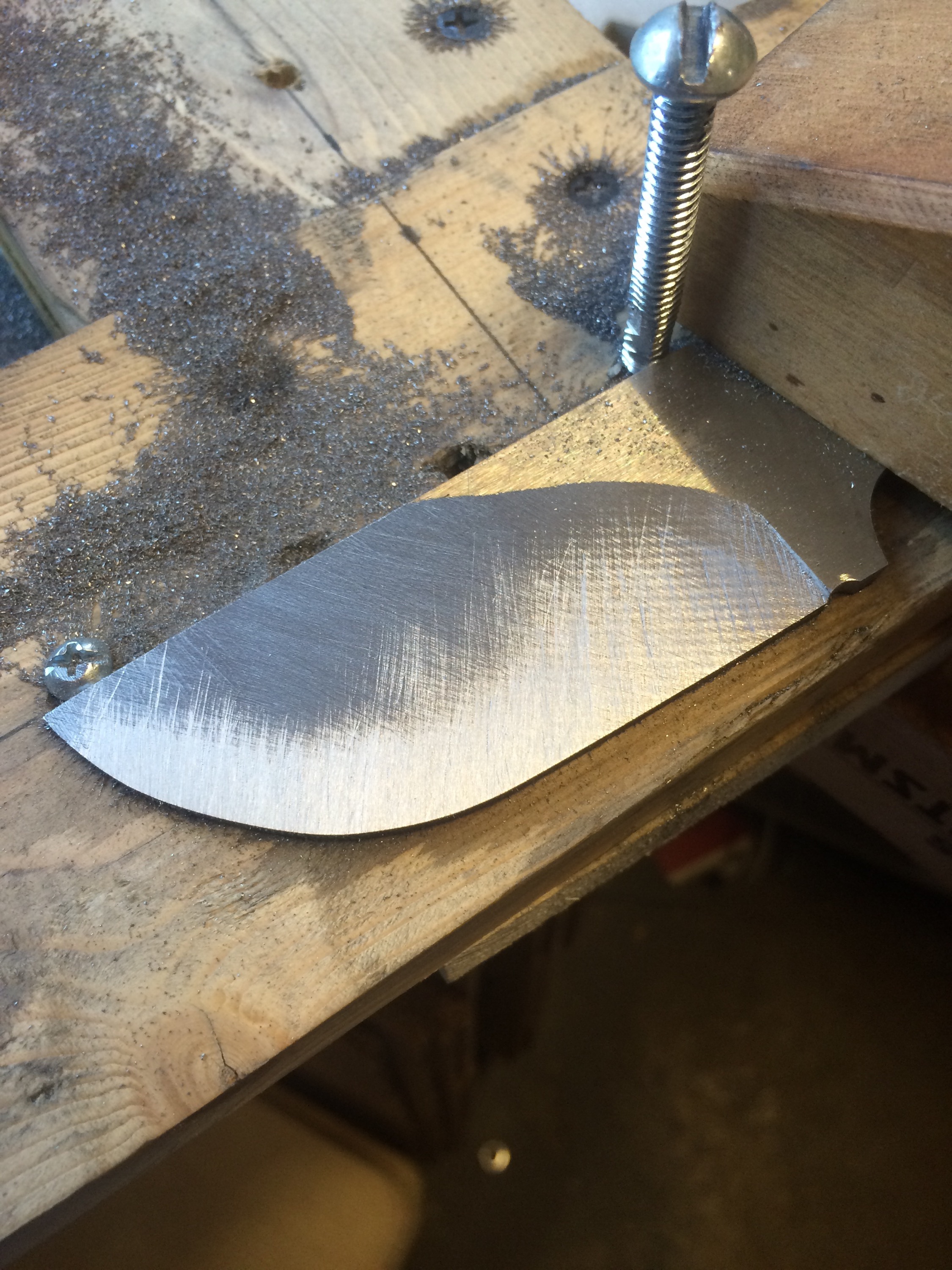
  Full flat grind and it took a long time…
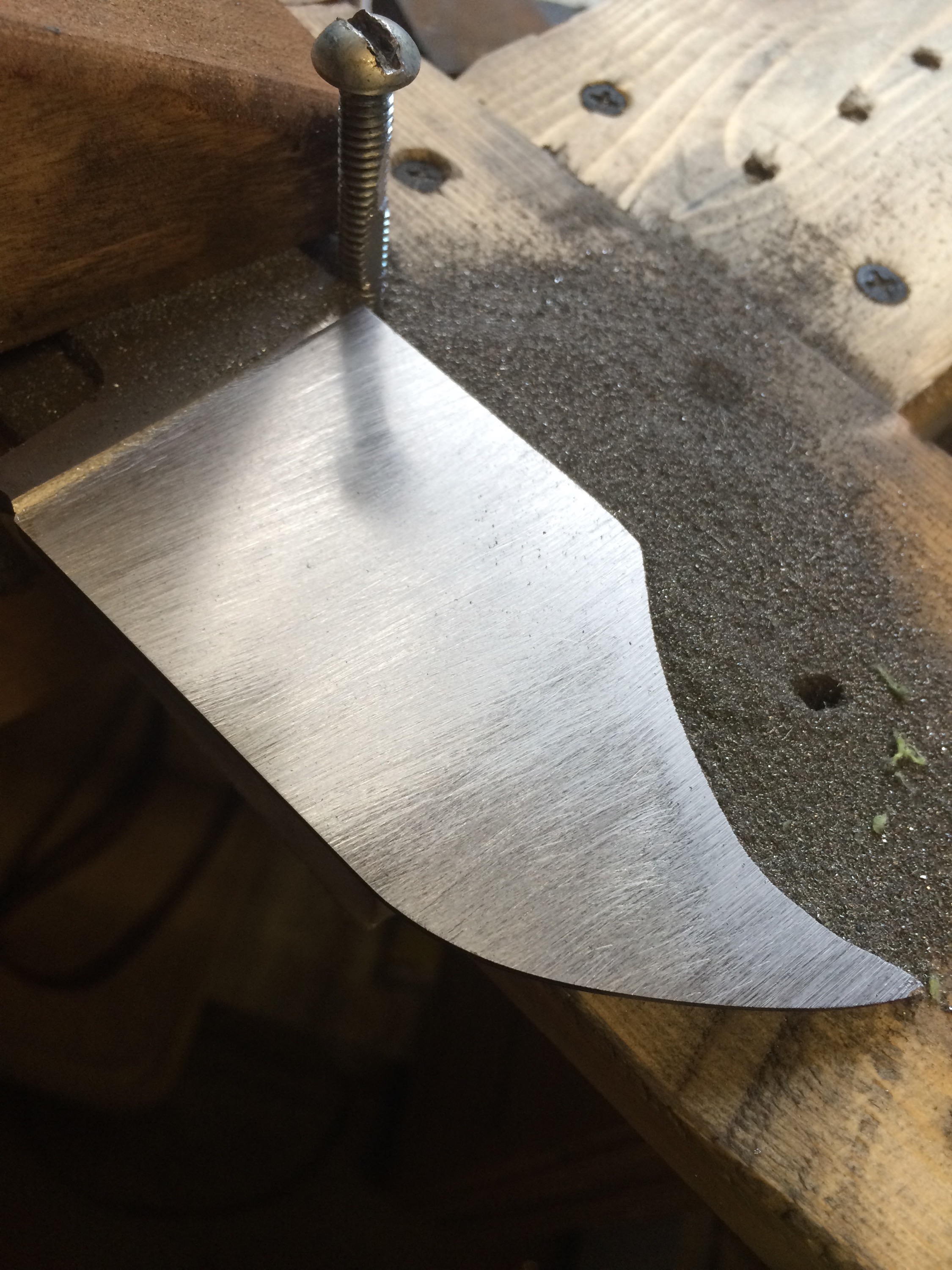
  Flattening the blade with some draw filing
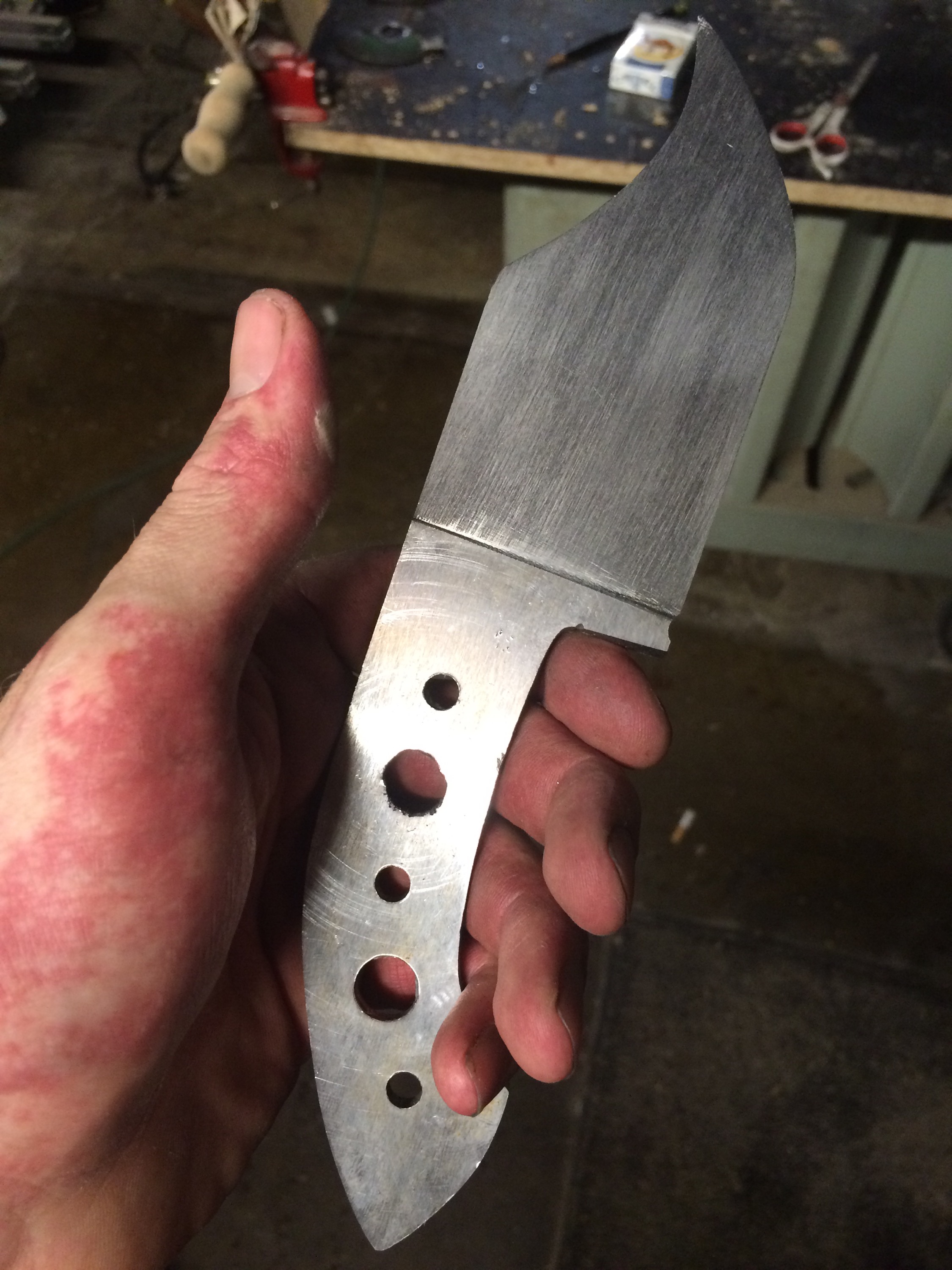
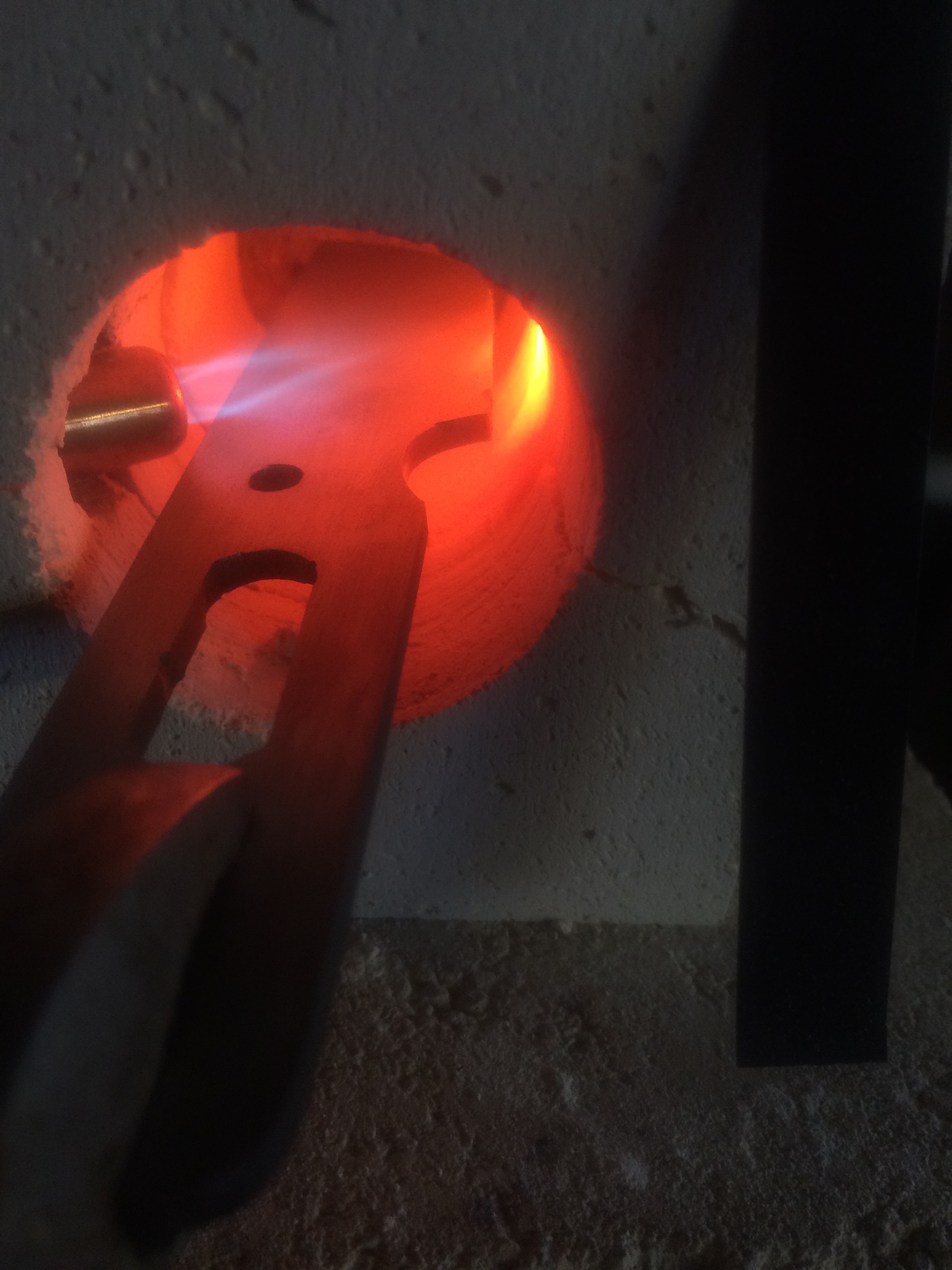
Heat treat…

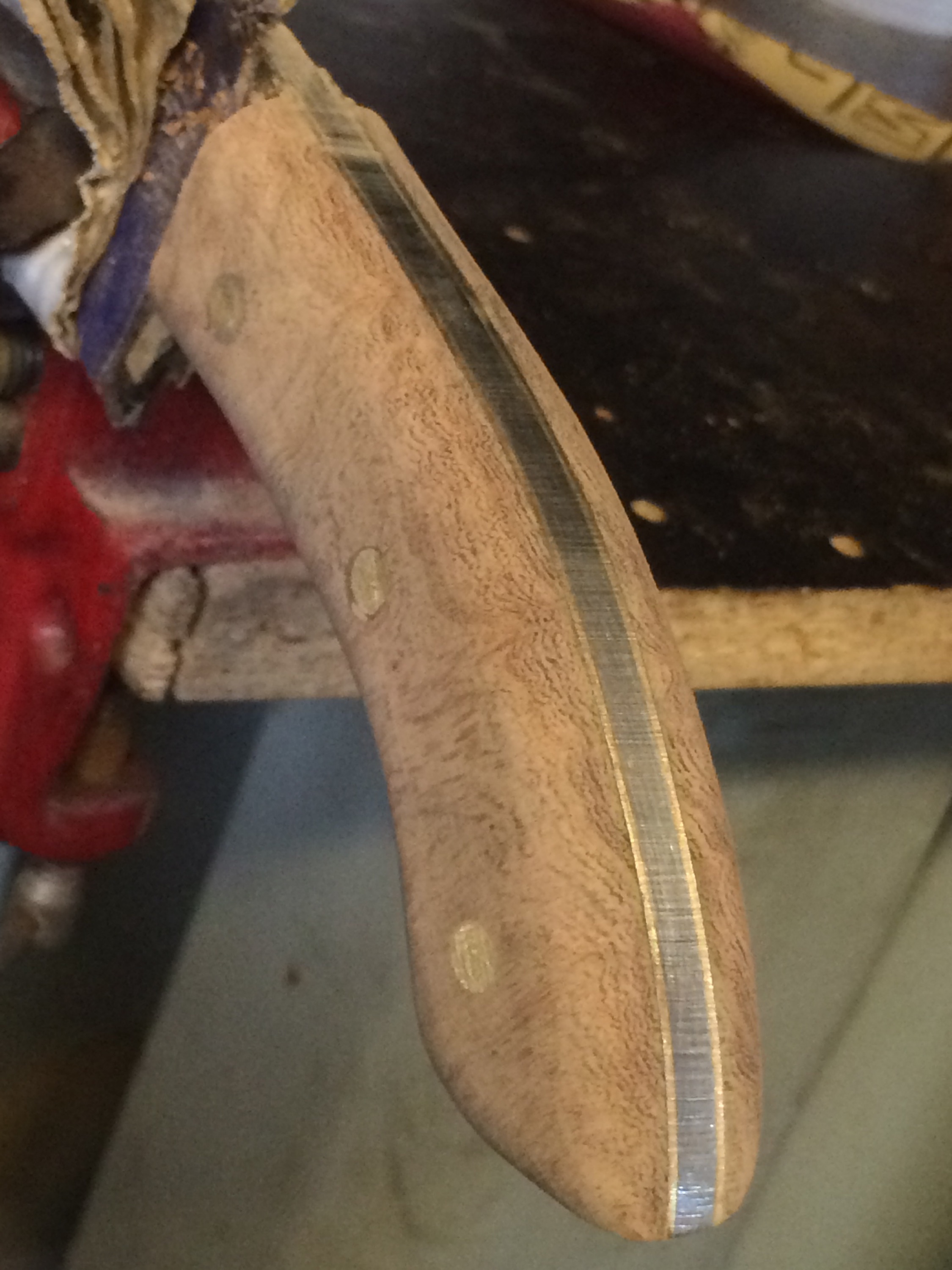
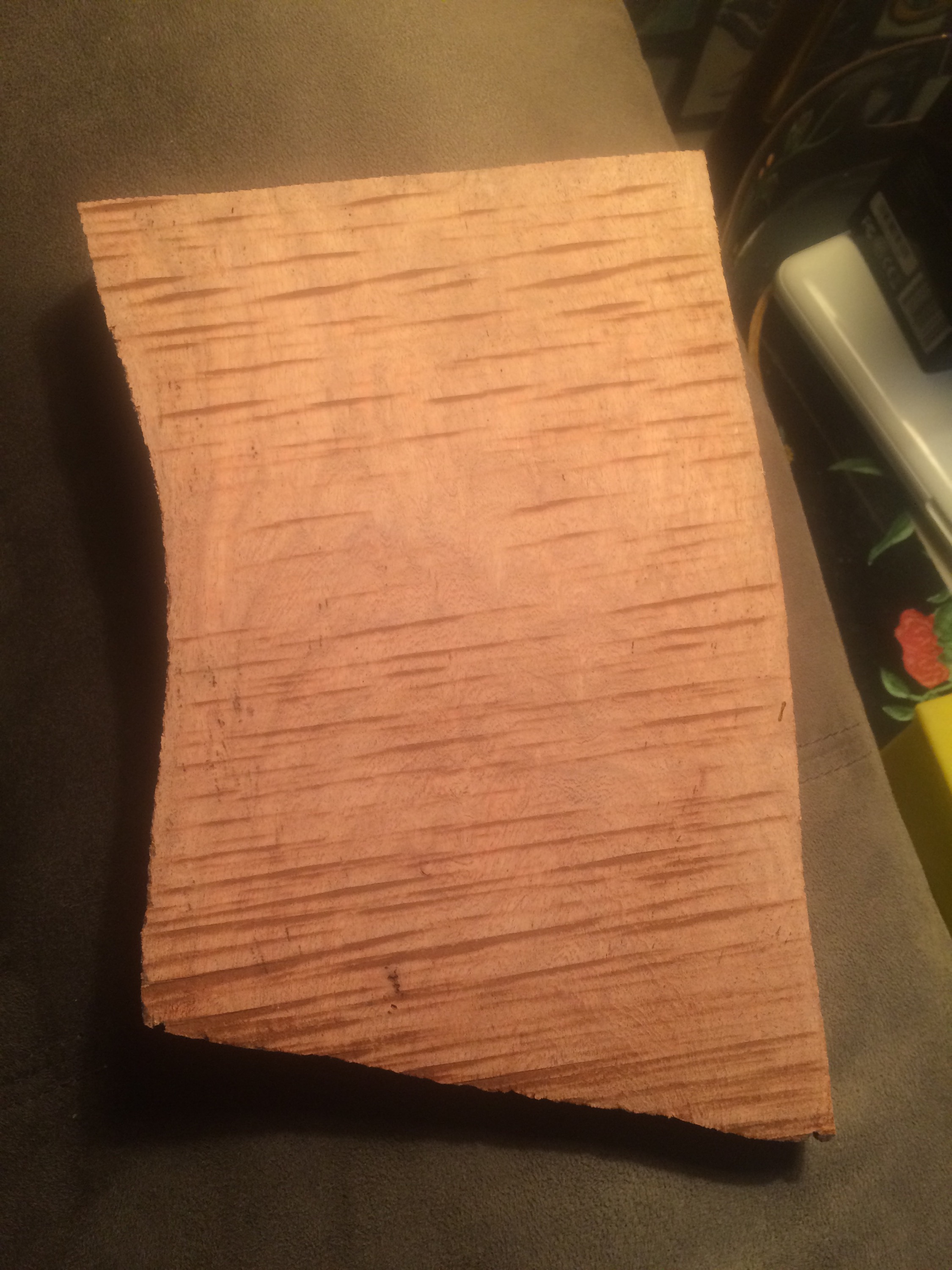
 Lovely mesquite wood, milled by my cousin from Texas…
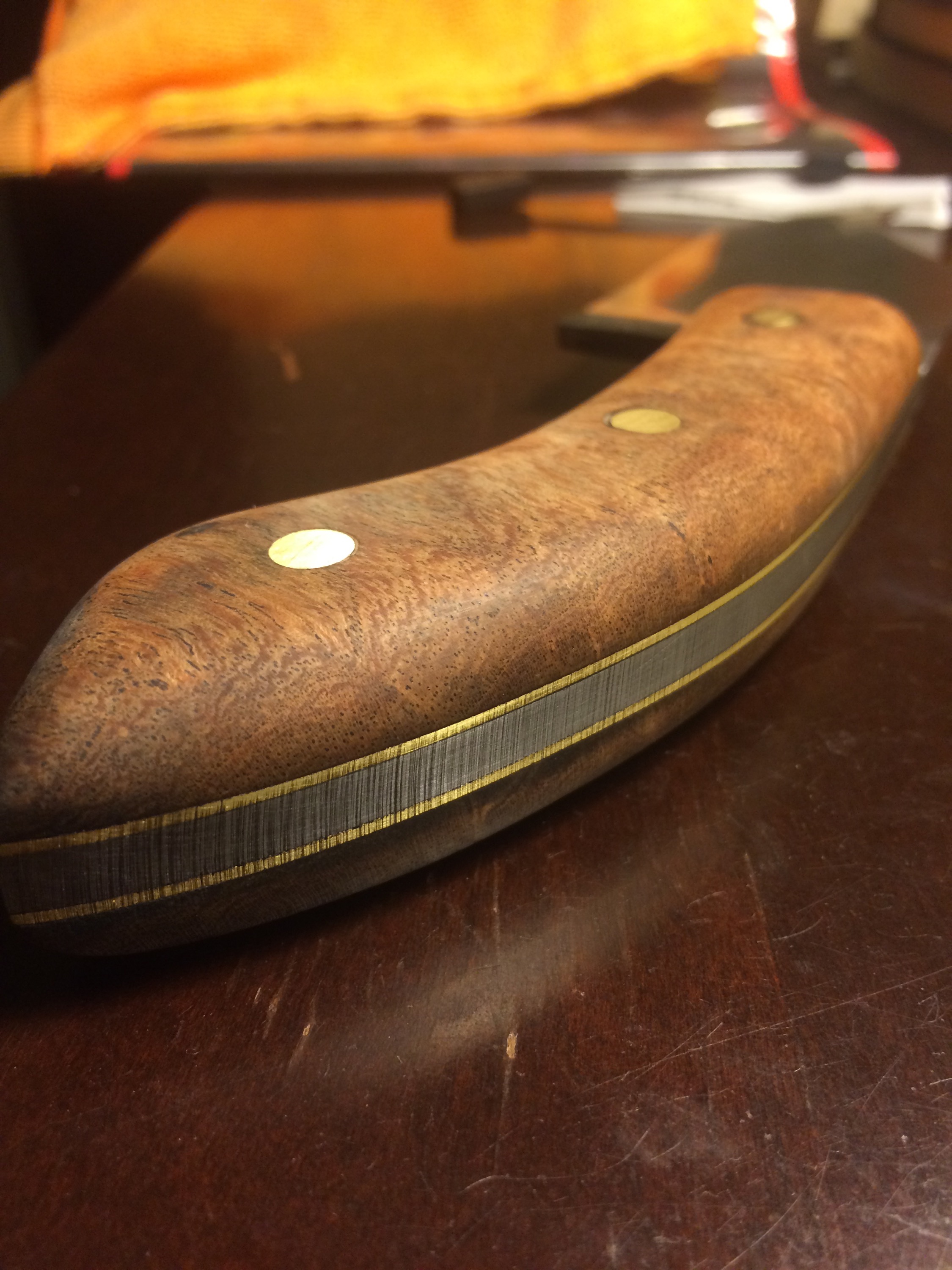
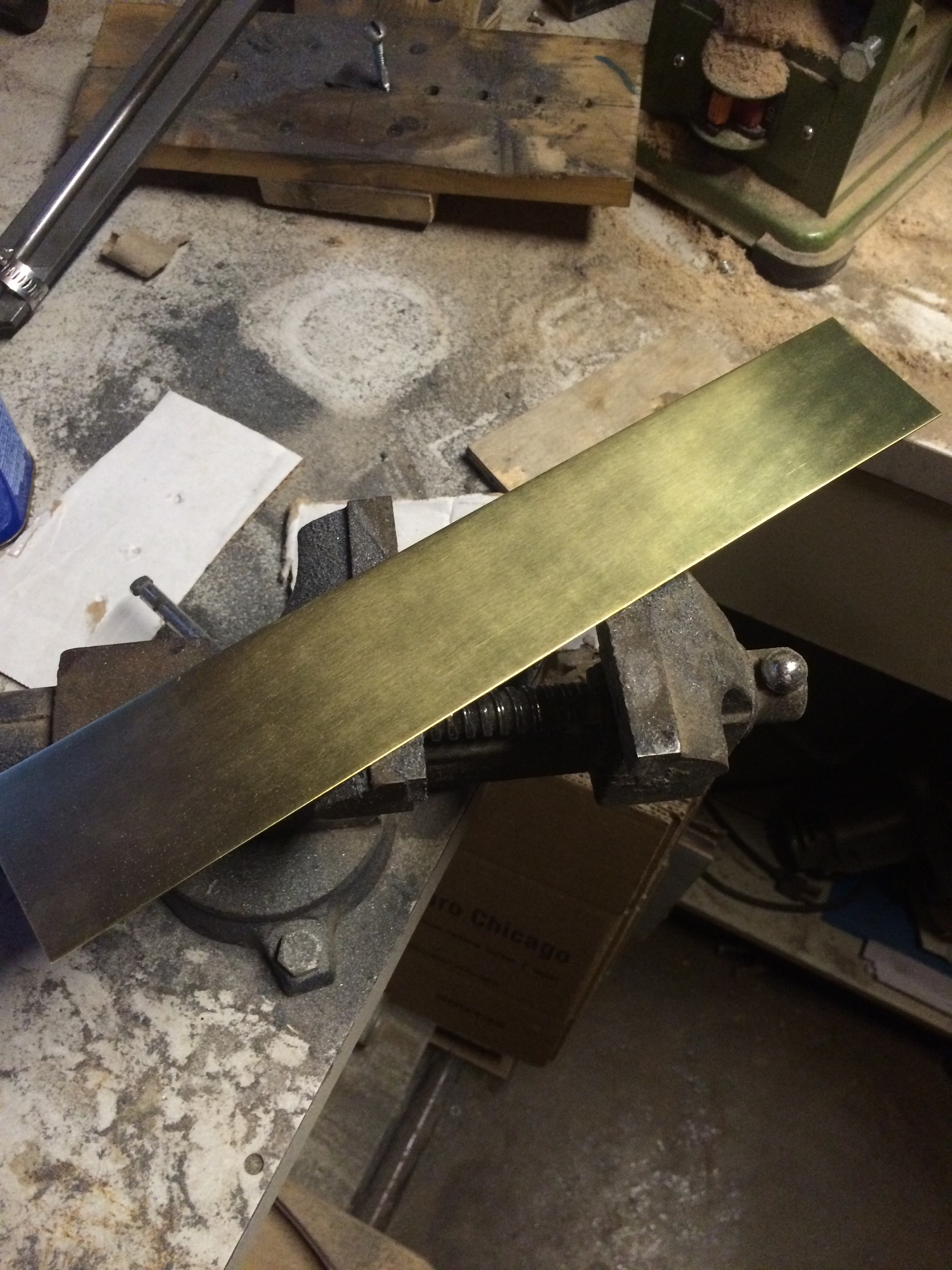
In keeping with the idea of letting oneself shine, I picked up some brass for a golden lining:
My lovely millwork…  After grinding off the excess, this was revealed:

  He got rather warm whilst trimming the brass and I was afraid the epoxy would lose it’s bond or worse, the blade would lose its temper.  So we took a sandwich break to cool off….


 Sometimes you have to take a break from everything before you can find yourself, your real self.  Take all the time you need.  This is the lesson of the Querencia.

Knifemaking: being content, releasing, and the Minimalist

“Elegance is achieved when all that is superfluous has been discarded and the human being discovers simplicity and concentration: the simpler and more sober the posture, the more beautiful it will be.”

Paulo Coelho, Manuscript Found in Accra

Originally, I wanted to call this blade The Monk.  When I see images or videos of Buddhist monks, or anyone living in a monastic setting, I used to wonder how they survive on so little.  Recently it was explained to me that they aren’t choosing a life of poverty.  They are choosing a life of contentment.  The idea as I’ve come to understand it is that they have enough and this brings contentment.  Enough, but in a gentle and satisfactory way.  This is pretty much counter to most of the ideas of what we are taught about being successful in Western society.

That was the inspiration for this blade.  Something simple.  Enough.  Content to just be.

There is an elegance in the simple.  Simple is difficult to pull off well.  Think of the best things.  Bach is simple but by no means easy to perform and certainly not lacking in beauty or depth.  Then there is steak- the best steak needs nothing but salt, pepper and a hot grill.  The list can go on.

This is where the beauty is.  An idea or tool or work of art or meal that has everything it needs and nothing it doesn’t.

There is a practice in many Buddhist temples that consists of tidying and cleaning.  It is believed that a tidy workspace helps with concentration.  There are books on the matter of getting rid of clutter.  Behind this is the idea that when we release the material things that are no longer serving us it will follow that we also release the emotional things that hold us back from being our naturally vibrant selves.

Ultimately I find this blade to be a reflection of how I desire to be.  In a way I am this blade.  As I was slowly removing the things that ultimately didn’t serve the purpose, function, being, beauty or existence of this knife I thought of the things that don’t serve me that I desire to release.  Like the grinding of this blade, release doesn’t happen all at once and if I tried to do it all at once I would be an overwhelmed, anxious, and contracted human being.  I’ve been there.  I think we all have.  Breathe deeply and appreciate how beautiful the simplicity of something can be.

I started this blade with a bit of O1 tool steel stock:

I wanted to make something simple and functional and beautiful.  This is what I came up with:


And a flat grind…


In keeping with the idea of not having anything unnecessary, I removed some of the stock in the handle.  It also makes it lighter.  Here he is after filing and sanding….


Hardening and tempering.  It took some tries but I got a forge built that gets plenty hot: the Brigid Marsal 3.0…


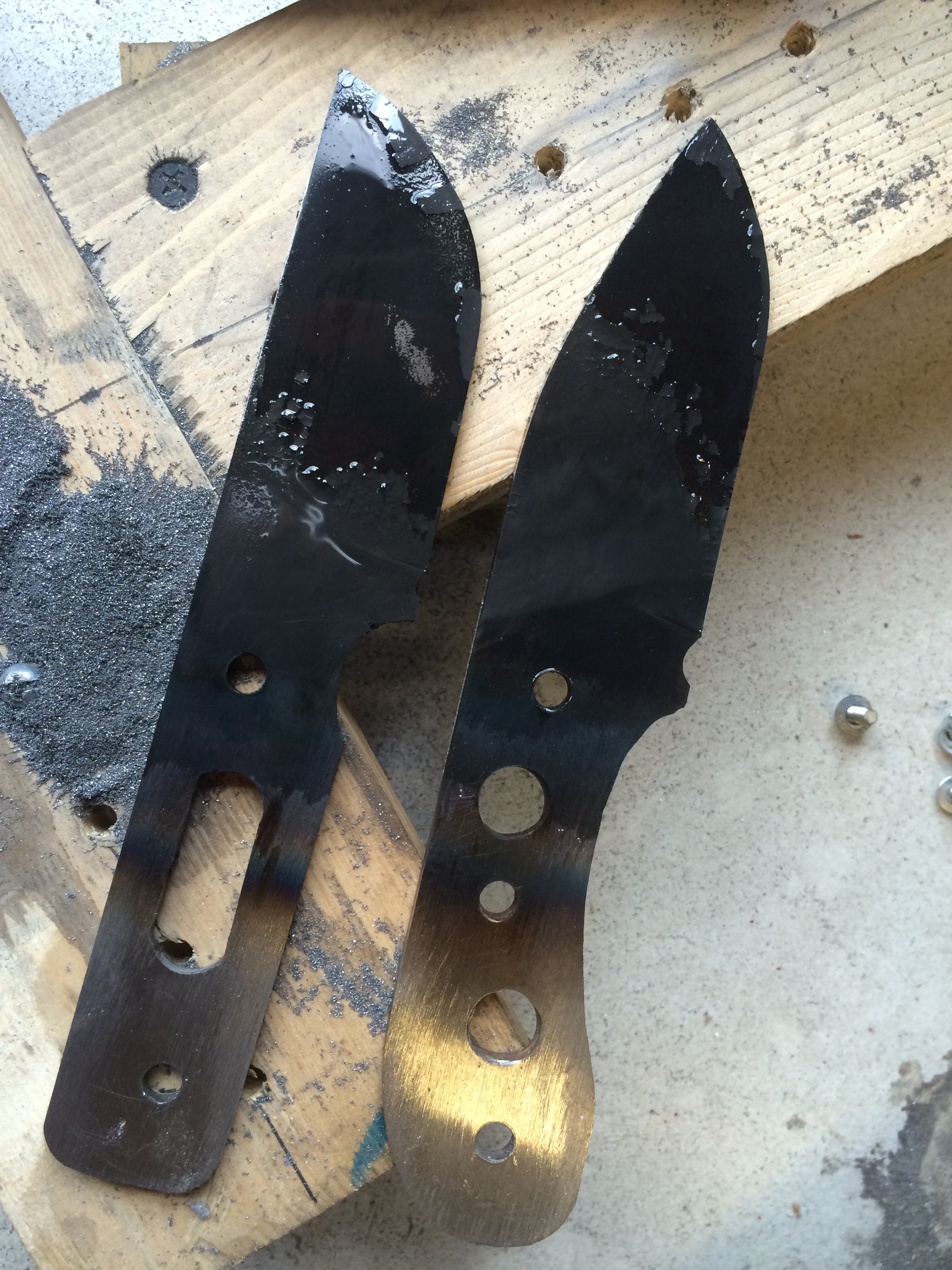
And after a dunk in some warm cooking oil…


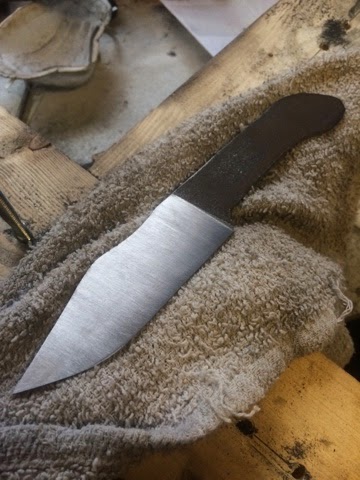
He cleans up nice:


So for the handle I went back to the idea of the monk- enough clothes to keep you warm and decent, a safe place to sleep, and enough to eat.  Having just enough to help you really feel your inner being.  I found a dough proofing board used by bakers.  I made the handle out of that, one’s proverbial daily bread.  A simple coat of Danish Oil protects the handle and brings out it’s beauty.


 And the secondary bevel…

Handle detail.  So much love…. 

As I learn and grow, I find that some of the things I thought I needed aren’t serving me.  It’s ok to release these things.  This is the lesson of the Minimalist.

Knifemaking: befriending what tries to hurt you, process and mistakes, and Brigid Marsal

“I build the road and the road builds me”

-African Proverb

I think about this saying often.  Sometimes you work and it’s hard to see progress until you look back and see how much road you’ve built.  Maybe you think about giving up until you look back and realize the only way to go is forward.  Parts of the road may be shoddy or weak or bumpy but it came from you and that is a beautiful thing.  It’s a process and sometimes parts of the process are bumpy and shoddy.  I’ve found the bumpy parts are the most sacred because that’s where the deepest lessons are.  It’s important to not skip or ignore the bumpy parts and to be with them as fully as you are able.  This is sometimes difficult or even painful but it is often times the only way to move forward.

I started building a forge to harden my knives.  Her name is Brigid Marsal.  In Celtic folklore, Brigid is the goddess of fire and fertitlity among many other things.  Marsal is a make of pizza ovens.

This is not my first attempt at making a forge.  Brigid 1.0 was a woodstove at the warehouse that I fueled with charcoal and bellowed with a shop vac on reverse.  It was loads of fun but never quite did the job.

Funny story.  This summer I was on a pretty hellacious job with Fred and Mr. Al in a mall in Kensington, Maryland.  The mall was set to be demolished and we were there to extract some safe deposit boxes, some dental equipment, and a gigantic Marsal double stack pizza oven.  One of these stacks alone weighed about two thousand pounds and they were covered in a brick facade.  There really wasn’t a lot of room to work because the kitchen was built around the ovens.  So here are Fred, Mr. Al and I trying to wrestle this monstrosity onto our crank lift which is really only rated for maybe eight hundred pounds.  The lift breaks, the monster of an oven comes crashing down and I had to dive onto the counter to avoid being crushed.

We all collected ourselves and found that there wasn’t any way to move these ovens without help.  It took another trip up there to get the ovens and thankfully I was not invited to go.  The ovens came back, were rebuilt, and sold.  There were a few of the heat stones left over.  Fred gifted two of the unbroken stones to me to build a forge.  Turning something that nearly kills you into something that works for you- I like this idea.

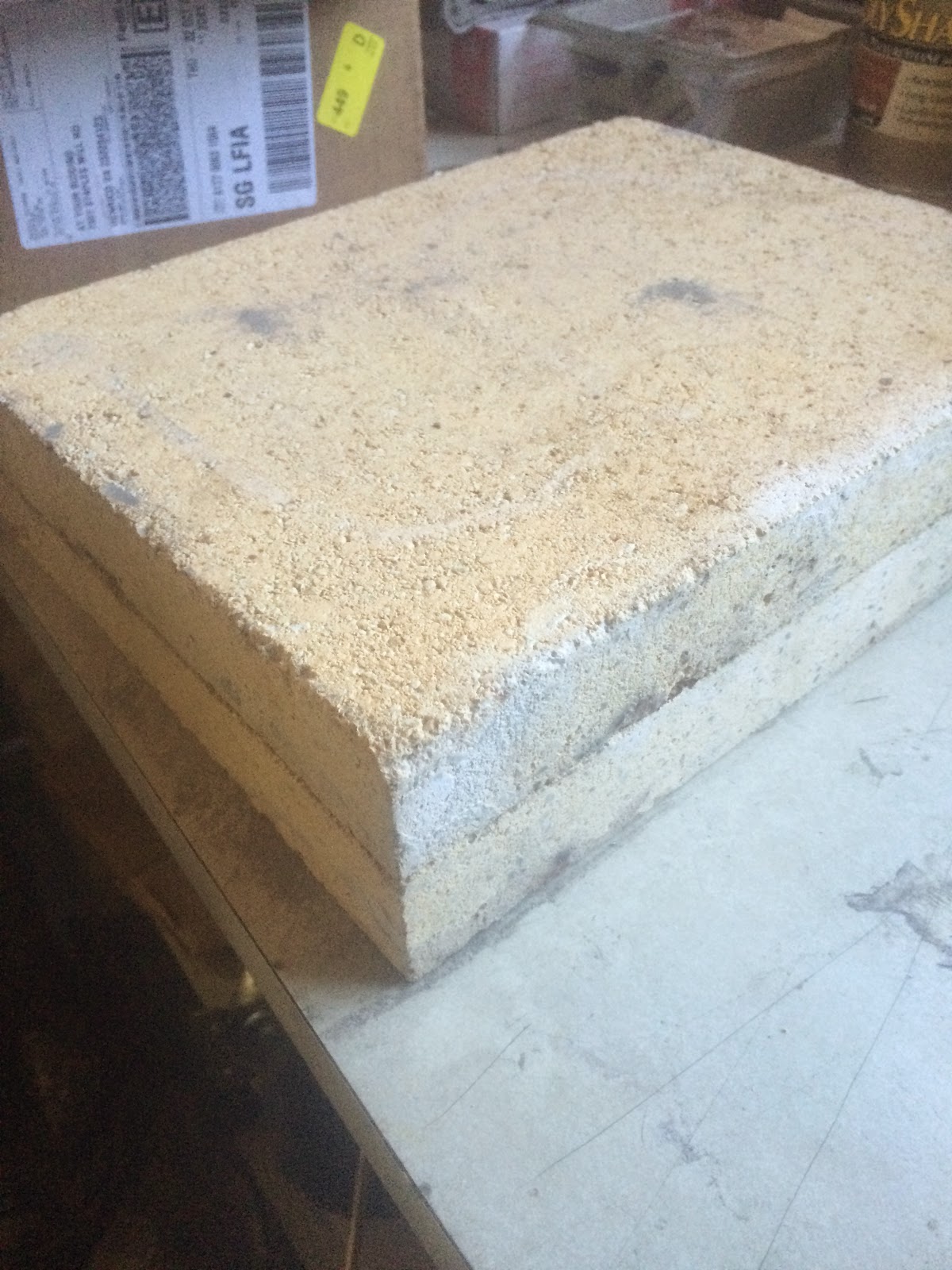
Here are the devil stones:

According to Fred they are liquid poured and can handle temperatures of up to “infinity degrees.”

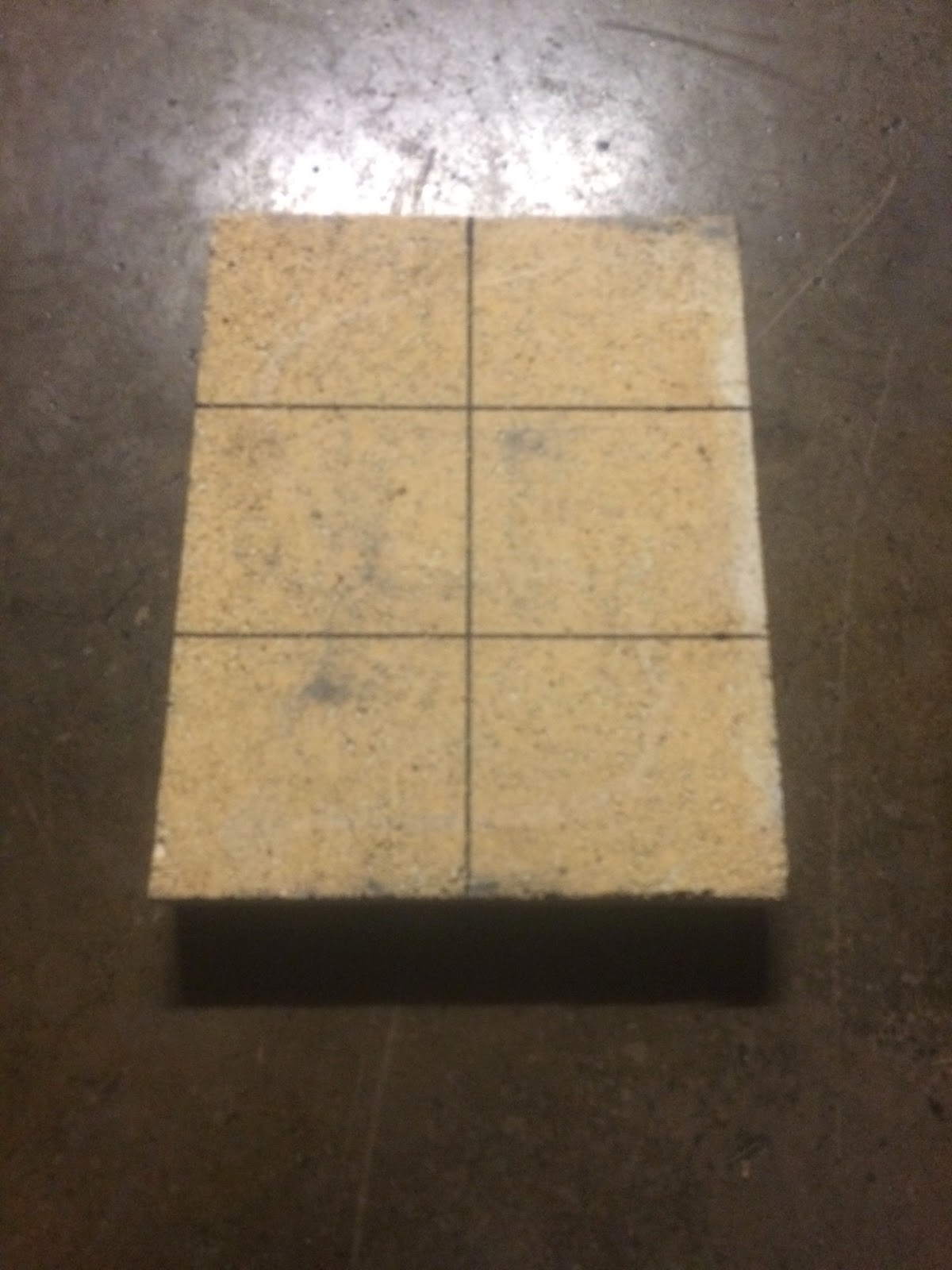
They are also ridiculously difficult to cut.  They are dense and stubborn and have a tendency to crack if you don’t go slowly and patiently.  The satisfying part is to see how far you’ve come.

What starts as this:

Becomes slowly cut away into this:

And you have to do it one pass at a time, evenly.

The idea with this particular design is to create a vortex of heat to bring the knives evenly up to critical temperature- about 1500 degrees.  To do this I cut the stone into square- or as close to squares as I could get them.

many hours later…

I put a two inch hole into three of them.  There is no quick way with stone.

On one of the pieces I added a half inch hole in the side for the blow torch.

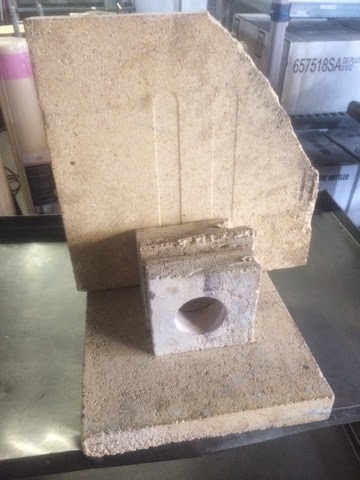
I lined the stones up to give it a go….

Pretty, but not quite vortexing the way I would like…

So the forge doesn’t work the way I had planned.  What I found was that the stones, which hold heat very well, are not so good at reflecting the heat, which is what I need.  There is still another forge to build but I am going to use the Marsal stones somehow- to remind them that I am not so easily crushed…reminders of bumps in the road you build and sacred lessons along the way.

Knifemaking: fear, flaws, and the Precedent

I must not fear. Fear is the mind-killer. Fear is the little-death that brings total obliteration. I will face my fear. I will permit it to pass over me and through me. And when it has gone past I will turn the inner eye to see its path. Where the fear has gone there will be nothing. Only I will remain.”

Ah fear.  What I’ve learned about fear is that, contrary to what Mr. Herbert says, fear makes one human.  Fear means you are feeling the proper spectrum of emotions.  Fear helps you to think through things rather than blindly charging into them.  Fear keeps you alive.

The real mind-killer is resistance to fear.  Not doing what you know is right because you are afraid.  In my life this resistance is what keeps me feeling stuck, keeps me going in circles, and keeps me from loving at my full capacity.  It is this resistance that leads to patterns of negative thought, that fear is wrong, and that at the bottom of it you are somehow wrong or flawed.

The idea of being flawed is something that operates on a deep level.  A flaw by definition is something that is marked as a fault or imperfection.  In my own life I tend to find the flaws in things.  Maybe I am am looking for validation of my own flaws.  Lately I have been pausing with this and I find that I can reframe it into something else.  As long as I can operate from the level of my heart I find that I am not flawed, that what I perceive to be flaws are beautiful little signatures of being human, of lessons I am still learning, of ways to move forward.

When one gets to the bottom of what they find their flaws to be and sees the beauty in them this provides a springboard to move forward.  It doesn’t mean that the fear is gone.  There is fear of making mistakes, fear of failure, fear of letting people down, fear of letting yourself down.  This is all ok.  I breathe all of that in and step forward.  This sets a Precedent and is the inspiration for this blade.

Part of moving forward was to order a bar of O1 Tool steel.  I found this bar in itself was rather exquisite.  As far as steel goes he is soft and forgiving to work with.  He can be hardened up to be very strong and tempered to be flexible.  It’s not a stainless steel.  He can rust so care and love are a requisite.

I wanted to make a knife that I felt would cut through the resistance of fear.  I found this to be a microcosm of my being at the moment and my intention was to remove from the bar everything that was not me.  It came out looking like this:
I found some plans for a filing setup to help guide me in making a clean grind.  It is a slow process but also a meditation.  Slowly removing that which doesn’t need to be there and finding the beauty in that which is slowly revealed.  Often I find myself counting the strokes of the file….
This where the blade is planed level by drawing a file across.  Here is where I find out how even my grind is.  What I’ve learned is that if I hurry through filing on the jig then I spend that much more time draw filing the blade level.  Best to take that extra time counting file strokes on the jig and spend less time draw filing.
After that comes sanding to polish up the blade before heat treat.  I’ve found that I don’t mind a rougher finish.  I like seeing rogue file blemishes and the grind on the steel.
So here is the Precedent, ready for heat treat (which is a lesson I’m still learning….)

The lesson of the Precedent is to find courage in your fear and beauty in your own human condition.

Knifemaking: the supernatural, matters of faith, and the Spellcaster

That is supernatural, whatever it be, that is either not in the chain of natural cause and effect, or which acts on the chain of cause and effect, in nature, from without the chain. [Horace Bushnell, “Nature and the Supernatural,” 1858]

Of late there have been lots of areas in my life that require a bit of faith.  I’ve spent a good amount of time looking into matters of faith and where my own faith lies.  What I’ve found is that even in the simplest things there is faith.  Getting in your car is an act of faith…because honestly every time you do you are stepping into a motorized death machine.  Our cars operate on thousands of tiny explosions, fueled by a fluid of combustible vapors that even static cling can ignite.  Then there are the people operating these machine- people facing hundreds of distractions from screaming children to phone calls to just plumb not paying attention.  What is it that allows one to arrive at their destination unscathed?  A well regulated auto industry?  The due diligence of traffic enforcement?  Our expert driving skills?  A combination of all three?  Yes.  But maybe there is something outside of the normal chain of cause and effect that could be at play.  Maybe arriving at your destination could be considered a blessing or a miracle, be it the grocery store, a wedding, a funeral, a job you love, a job you hate, or anyplace.  Maybe there should be a bit more celebration.  Maybe what we perceive as mundane is actually quite profound.  Maybe I am over-thinking all of this….
It is with this overactive frame of mind that I approached the Spellcaster.  She is made from a piece of carbon steel that came from a bedframe, which I think is a beautiful story.  Essentially she comes from the dream realm, something supernatural in it’s own right.

At work there are people of many different ethnicities and cultures- Sikhs, Sicillians, Greeks, Ghanaians, the whole spectrum.  The other month at work I was running an auction pickup at a job site and several customers with a large order showed up at 4:30p- precisely the time i was scheduled to leave.  These gentleman were devout Muslims- shrewd businessmen but very sweet people.  I was a bit cranky at having to stay late on a Friday.  That crankiness was exacerbated when at 5p two of the three gentleman slipped off to pray which substantially slowed the loading of their many wares.  I had to pause and after that pause I became aware of my crankiness and realized it might be because I felt there might be a lack of faith and devotion in my own life.  I was witness to a tremendous act of faith and devotion, even though they had slipped off to pray in a place unseen.
The Spellcaster is also a prayer and an act of faith, it’s namesake drawing inspiration from entities and beings that operate far outside of the normal chain of cause and effect.
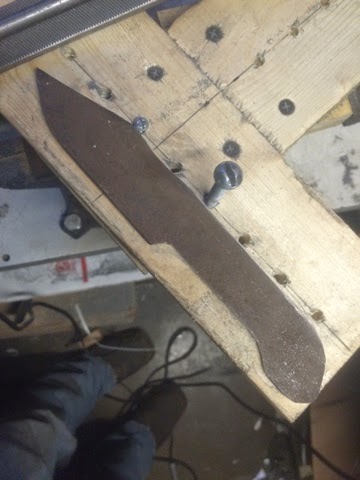
This is pre-heat treat, no rivet holes, raw stages.
The lesson of the Spellcaster is to allow oneself to witness and experience acts of faith, not in spite of but within different religions or creeds.  This sharpens my own faith.

Knifemaking: kindness, sleeping at night, and the Saj

“Kindness is a facet of the jewel of compassion.  It is the desire to help that arises when we remember that we are connected with every living being we meet.  Each person is precious, each person is fragile, each person matters.”

 Tara Brach, Radical Acceptance

So the warehouse is a capitalistic free-for-all.  Pretty much everything is for sale and a deal can be brokered on almost anything.  It’s mostly restaurant equipment and a lot of the customers are trying to get a deal on equipment to outfit their restaurant or food cart or other culinary venture.  Some of the people who come in are people trying to flip equipment to make a little profit.  The avenue of hustle travels both ways.

There is a gentleman who comes into the warehouse.  His name is Saj and he is one of my favorite people.  Saj is one of those hustlers.  Saj always has something going on.  Whenever he buys things I always help him load his wares and I always wonder what exactly he intends to do with all the crap he bought.  So one day I asked him.  He gave me an example.

“I bought a pallet of paper coffee cups for twenty dollars.  There is a coffee shop I like to go to and I asked the owner how much she pays for a case of her coffee cups.  Fifty dollars she says.  So I make her an offer of twenty dollars a case for the coffee cups I have, she accepts and buys them all.  In the end I make a profit, she saves money and the prices of the coffee at the shop I enjoy stay the same.  These are the things that help me sleep at night.”

To me this is a very kind way of doing business.  I’ve been very much into the practice of kindness and it is very much a practice, and often bumpy at that.  Oftentimes it seems that kindness is synonymously associated with being nice.  This is not so.  Kindness can exist within pleasantries but pleasantries might not always be used in kindness.  Whereas being nice is sometimes necessary at work or play or to get through certain difficulties, it can also be a facade used to coerce, manipulate, or to help us get what we think we desire, leading to resentment, bitterness and feeling unfulfilled.  This is not kind. To me kindness is always helpful, even when it hurts.  Kindness allows us to grow.  Always.  In practicing this, really practicing, I find I sleep better at night.

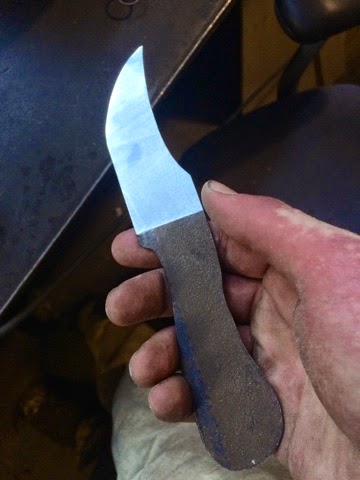
I based this knife loosely on what Saj called a Kolhapuri knife, coming out of Kolhapur, India.

Sometimes kindness is saying the hard things, especially to yourself.

Kindness is also saying no, most importantly to things that don’t serve you spiritually, physically, fiscally.  Kindness is saying no to things that keep you from growing as an occupant of this universe.

Kindness is accepting and honoring all of your being, including those feelings that are painful or difficult or that you wish would go away.  Be kind to those things.

Kindness is also respecting, accepting, and honoring others who might be experiencing pain.  Be kind to them always.  Sometimes the kindest thing you can do is not say anything at all.

Kindness is also allowing others to make their own mistakes and find their own way.  Allowing others to be true to themselves is extraordinarily kind.

Above all, kindness is being true to yourself.  Even if you aren’t sure exactly who you are.  Be kind to that too.