Knifemaking: softening and connection; and the Gun Dog

“How we fall into grace. You can’t work or earn your way into it. You just fall. It lies below, it lies beyond. It comes to you, unbidden.”
― Rick BassColter: The True Story of the Best Dog I Ever Had

I wouldn’t have ever really considered myself a dog person, not really. There is an appreciation and respect for all animals, both wild and domesticated, and whatever creature I meet I try to let them know that I see them- a deep namaste and acknowledgement of being. But as far “being a dog person”… I’m just not sure I have whatever that is.

A couple of years ago my girlfriend said she was thinking about getting a dog. I told her don’t do it. My only reasoning was that we were all very busy doing interesting and challenging work, her kids were getting older and doing more things, and everyone was tired all the time. I figured it would probably be best if we held onto every ounce of emotional energy that we could.

In spite of my reasons, which themselves came from a lovingly practical and pragmatic place, she did not listen to me. This lady is one of the most unfailingly capable people I know, a wonderful mother, with the uncanny ability to make everything around her better than it was before, even on her worst days. It was no surprise when she brought home a several-month-old rescue puppy. This dog was a lemon drop beagle mix with the biggest ears I’d ever seen. She seemed to be equal parts fruit bat, luck dragon, and polar bear.

The local animal league had told my girlfriend that this dog and her sister had been found abandoned in a barn. The puppy’s sister had some sort of severe muscular dysplasia and had found a home. My girlfriend’s puppy had a little bit of this, but much less so. She moved around fine but a closer look showed her front half didn’t quite work together with her back half.

When I met her she was still adjusting to her new home. She was terrified of doorways and dinner plates. She didn’t want to leave whatever room she was in and when she did she scuttled through like something was going to get her. If you were to put down a plate of puppy chow in front of her she would back away as if it were going to bite her. In spite of all of this she was a deeply loving and affectionate dog which was amazing considering the shit sandwich of a beginning she had been given. At that moment, shortly after meeting this dog, I felt something soften toward this wonky little barn dog that was part fruit bat, luck dragon, and polar bear; this sweet little creature that I told my girlfriend not to get.

Over the next few years I would tell this dog that I was sorry I told her mom not to get her. She had grown into a rather stunning animal, and her front half worked together much better with her back half. Doorways weren’t too much of a problem though her old nemesis the dinner plate still gave her pause. I found myself very attached to her and, though she was very much a lady dog and a product of my girlfriend’s deep nurture, I would find her to be the loving presence that I didn’t know I needed. The dog just loved everybody.

A couple of years ago I had a table saw accident that left me needing reconstructive hand surgery. It was incredibly stressful and emotionally grueling. All of my work and projects and everything I was so busy with would come grinding to a halt for the next few months. My girlfriend moved me into her house for a week and took time off work- thankfully the kids were away at summer camp. My girlfriend’s dog never really left my side. I remember the dog licking my gimpy hand every so often and then pressing in to me and going to sleep, which prompted me go to sleep. I don’t remember much of that week, except my girlfriend smiling and her really sweet dog. It sounds really silly, and perhaps it was the massive amount of post-op hyrdromorphone I was prescribed, but I figured I should probably take the example of the dog that I told my girlfriend not to get and find a way to dig in a little deeper with her and the kids.

Connection can be a struggle and there’s no manual on the right way to go about it. Sometimes it takes a sweet dog after a traumatic event to help you see what you should be doing. Part fruit bat, part luck dragon, part polar bear (everybody is good and healthy, including my hand and the dog I told my girlfriend not to get). If a responsible adult in your life tells you they want a dog, you should tell them to go right ahead.

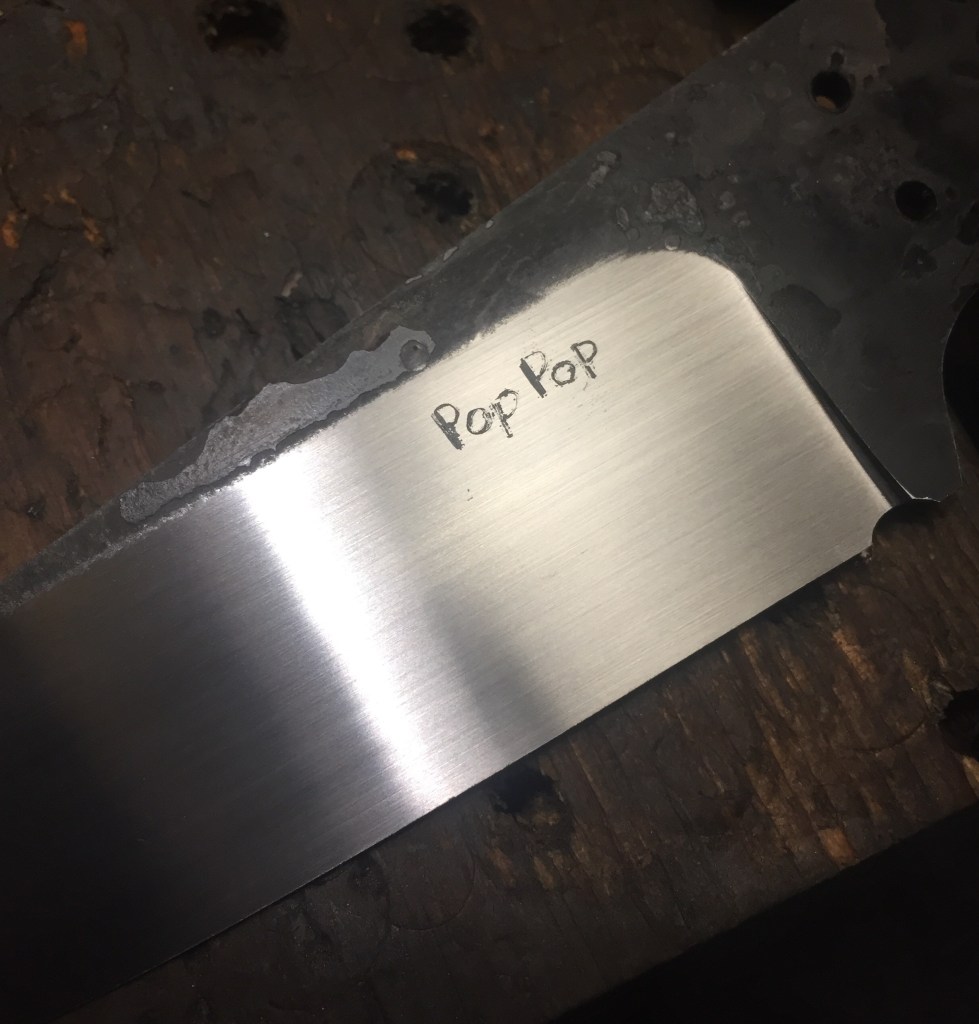
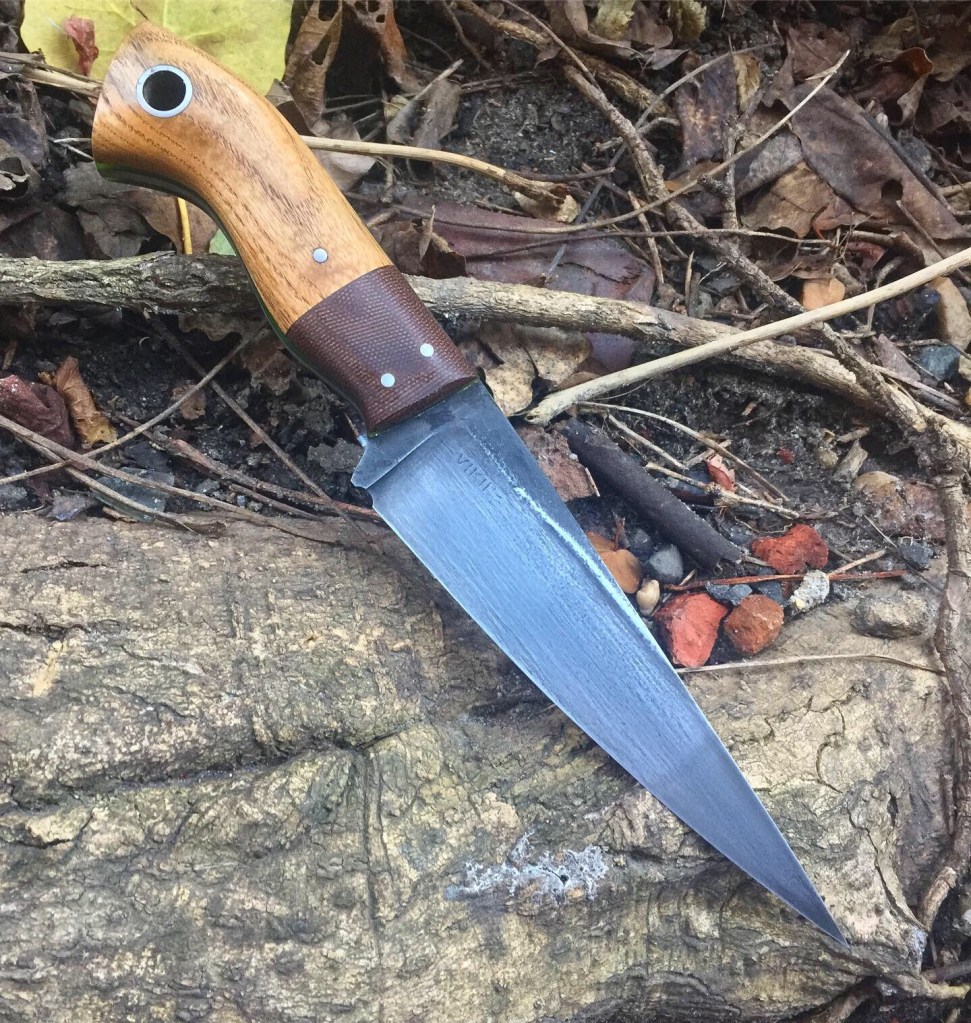
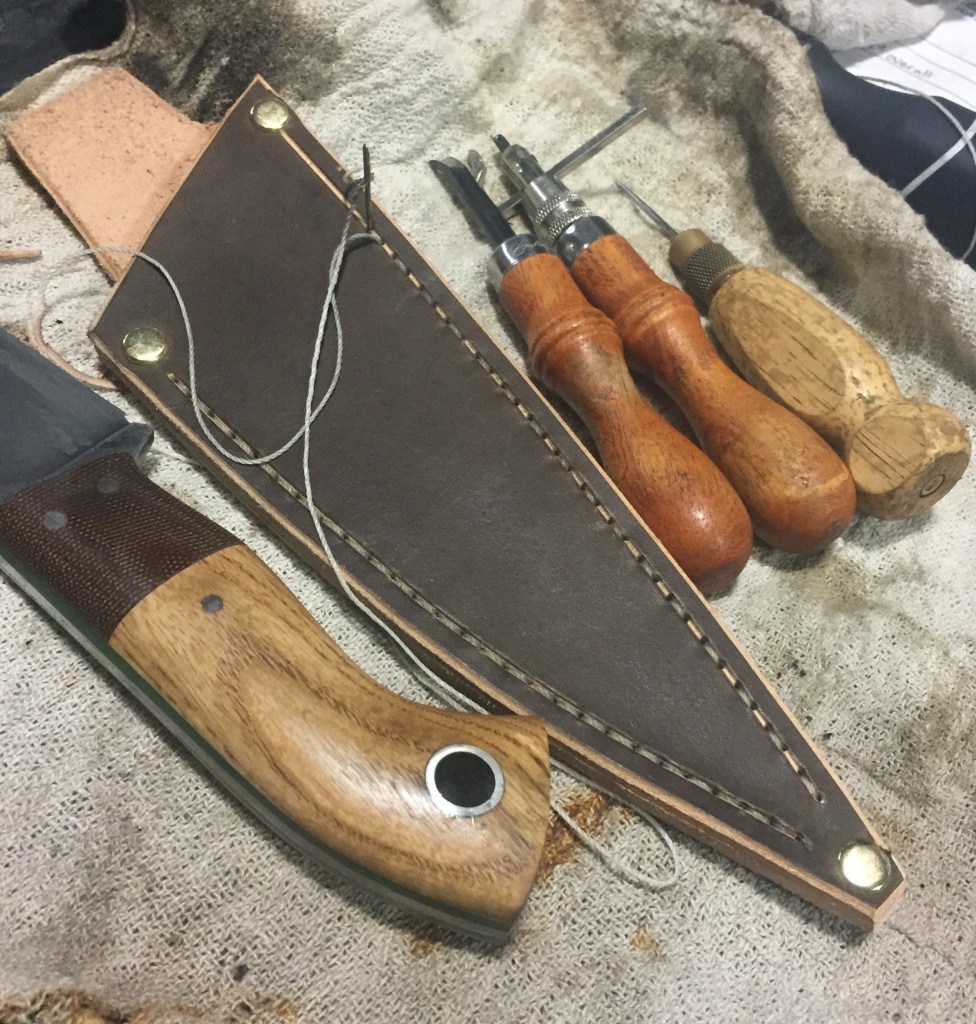
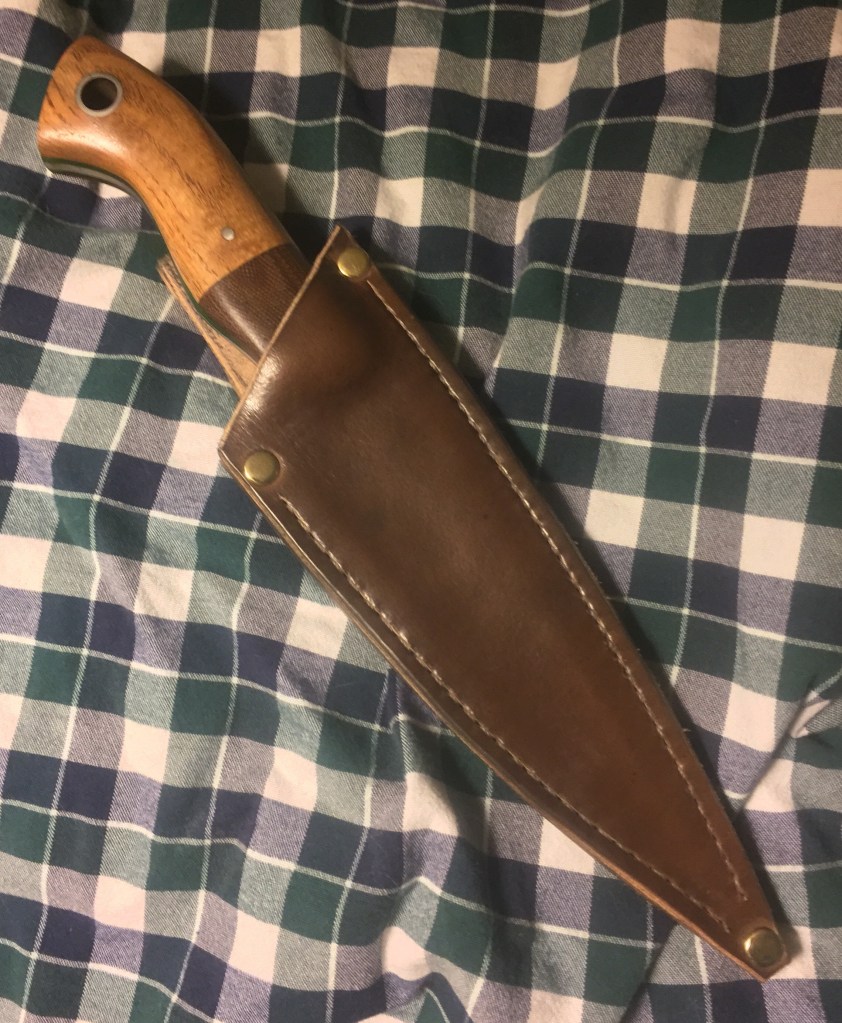
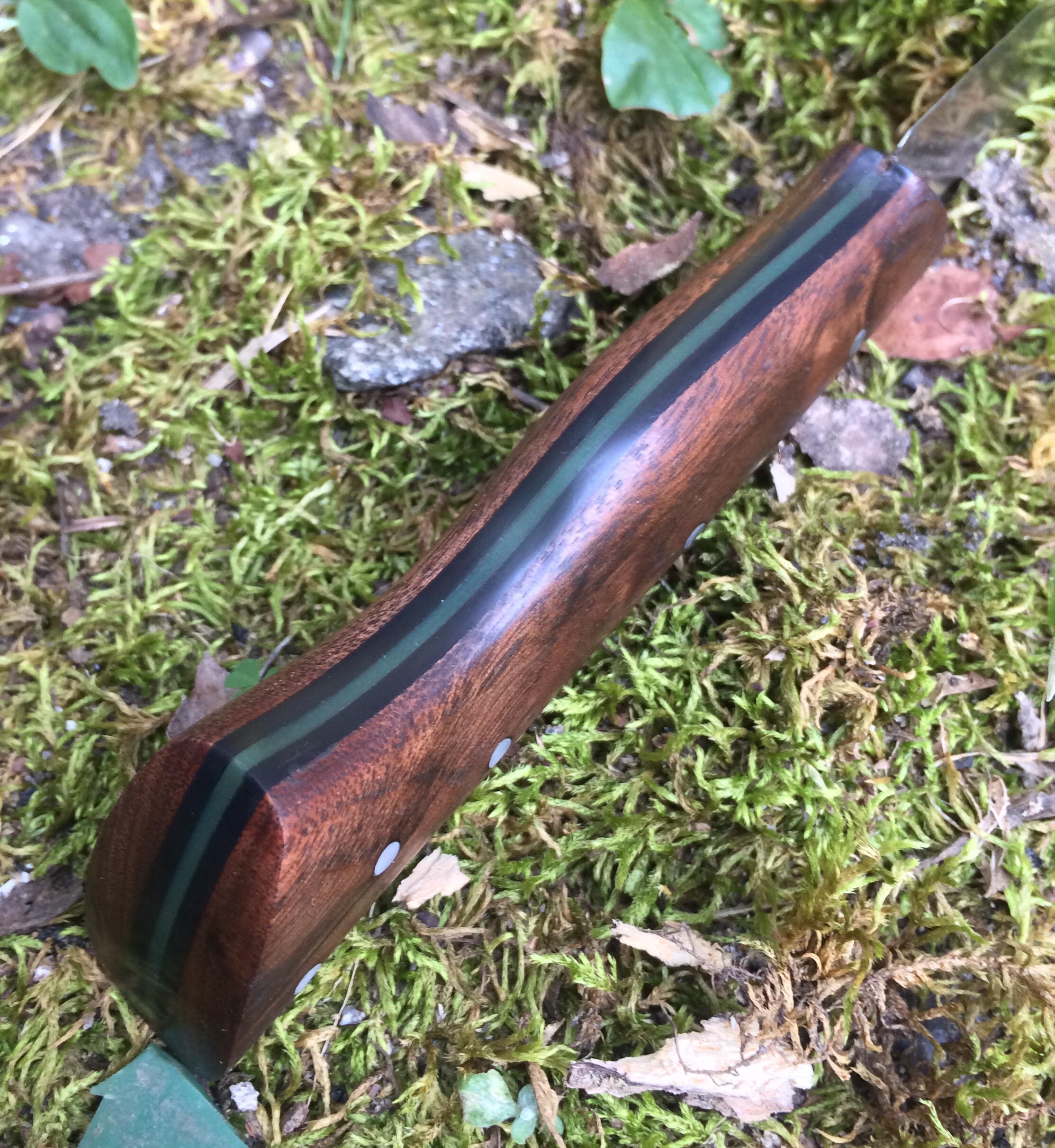
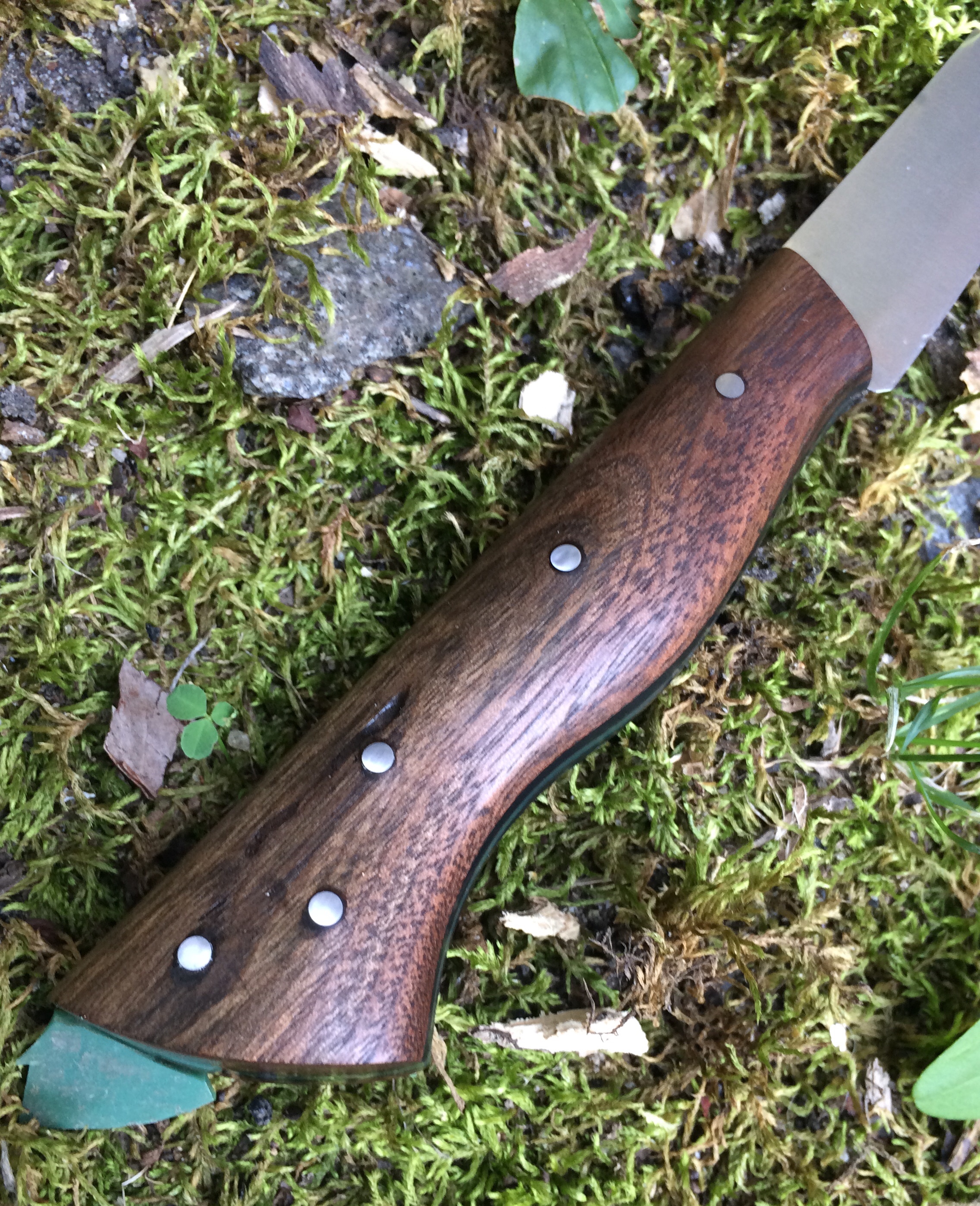
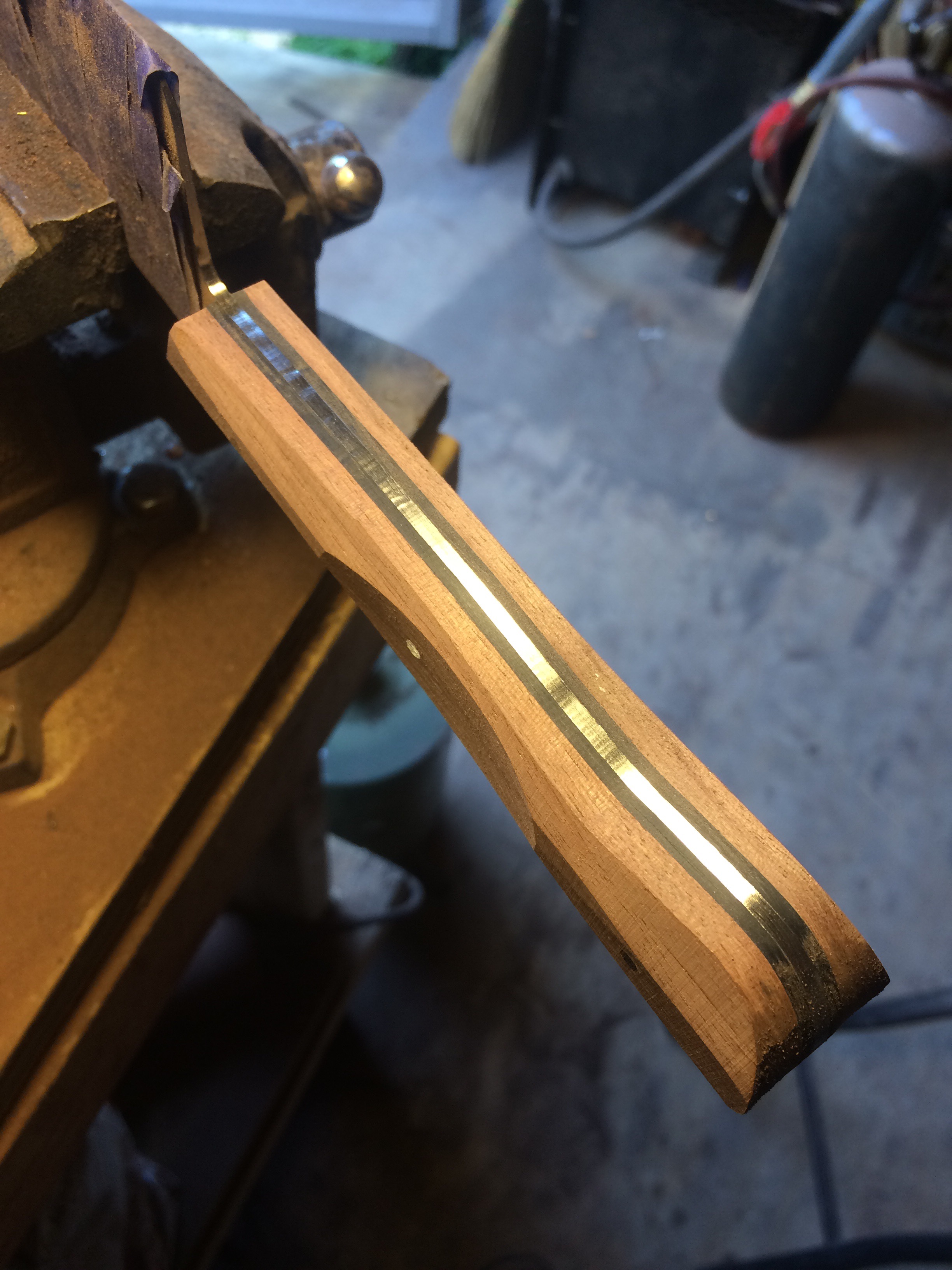
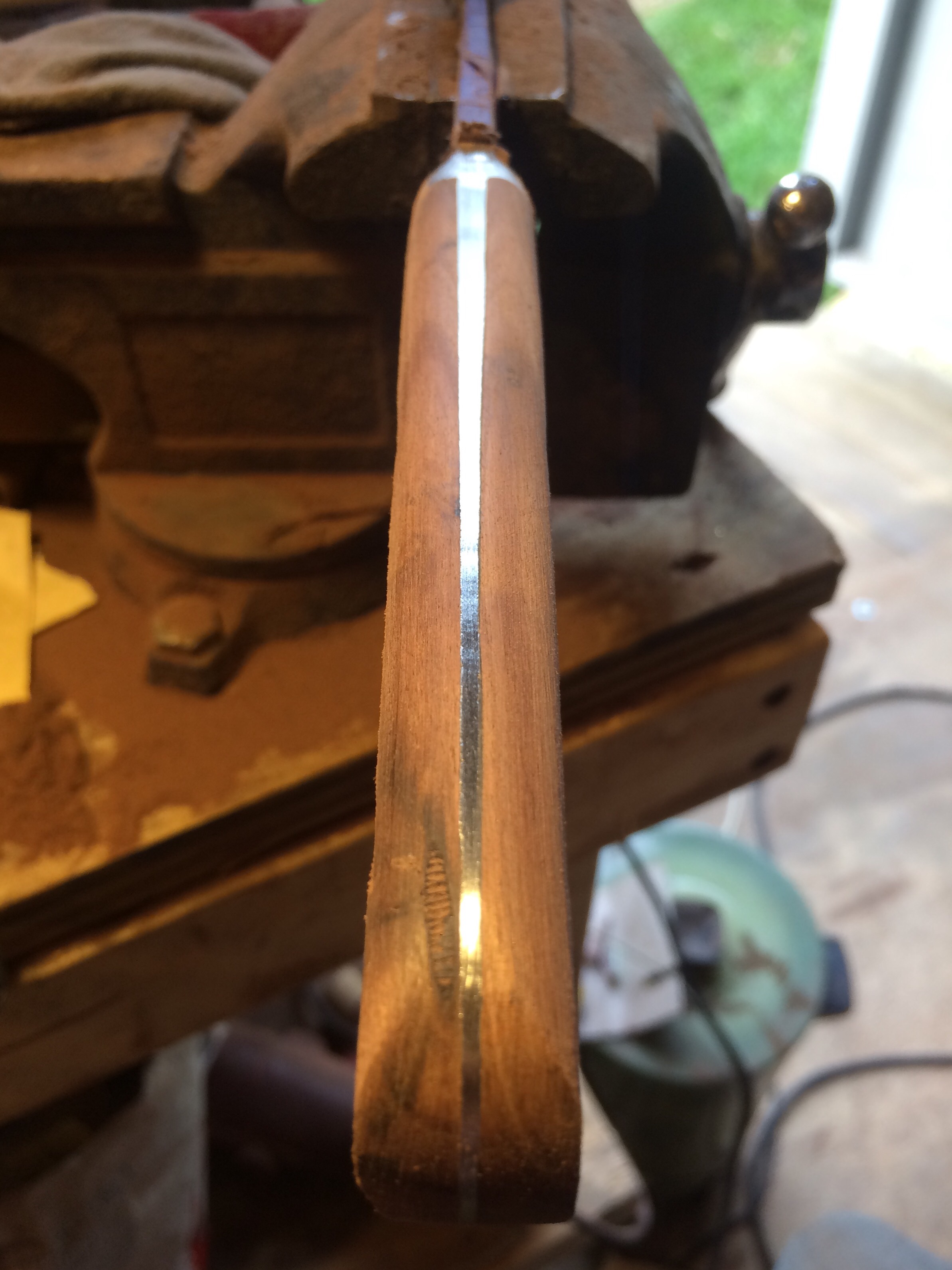
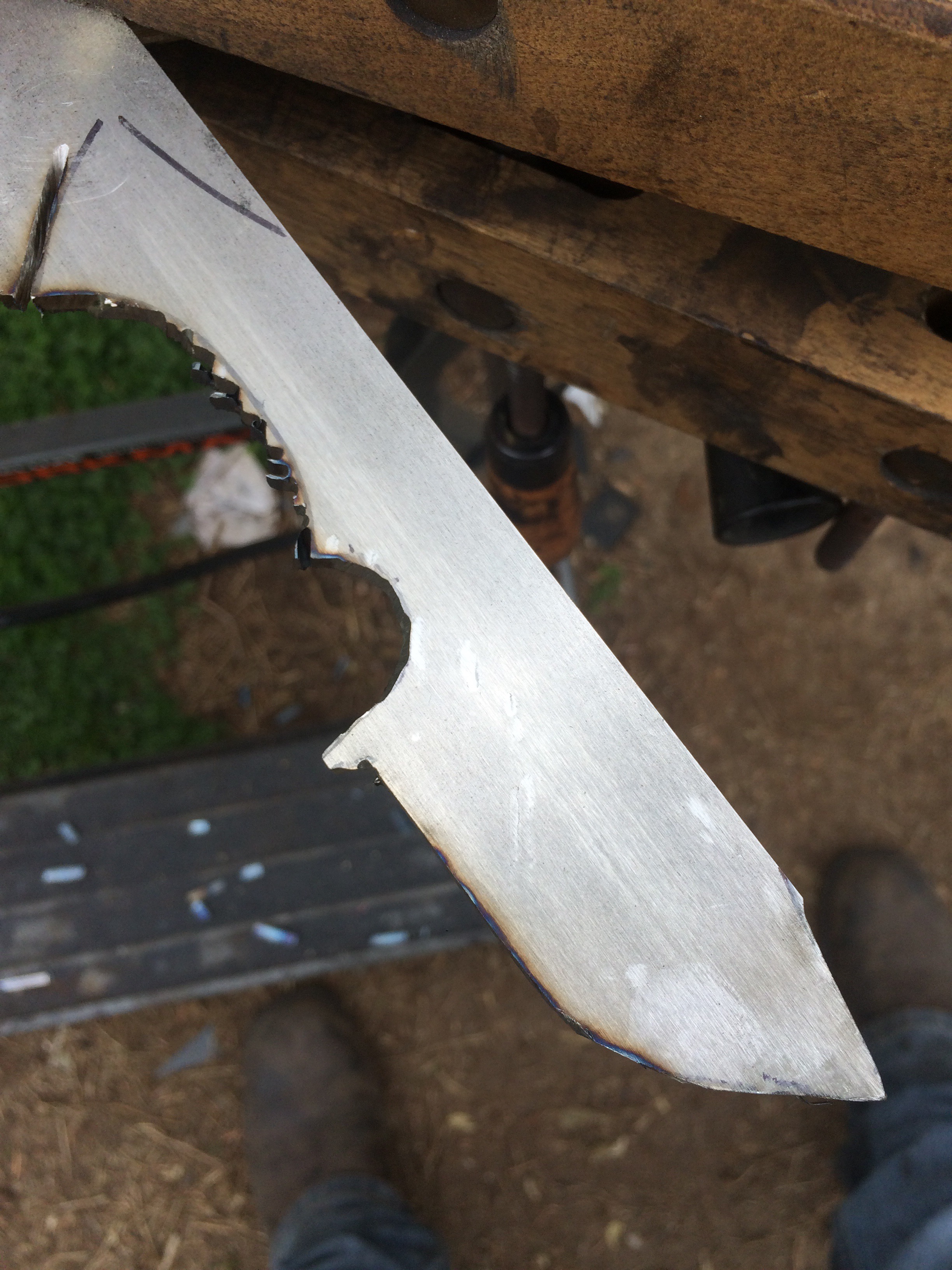
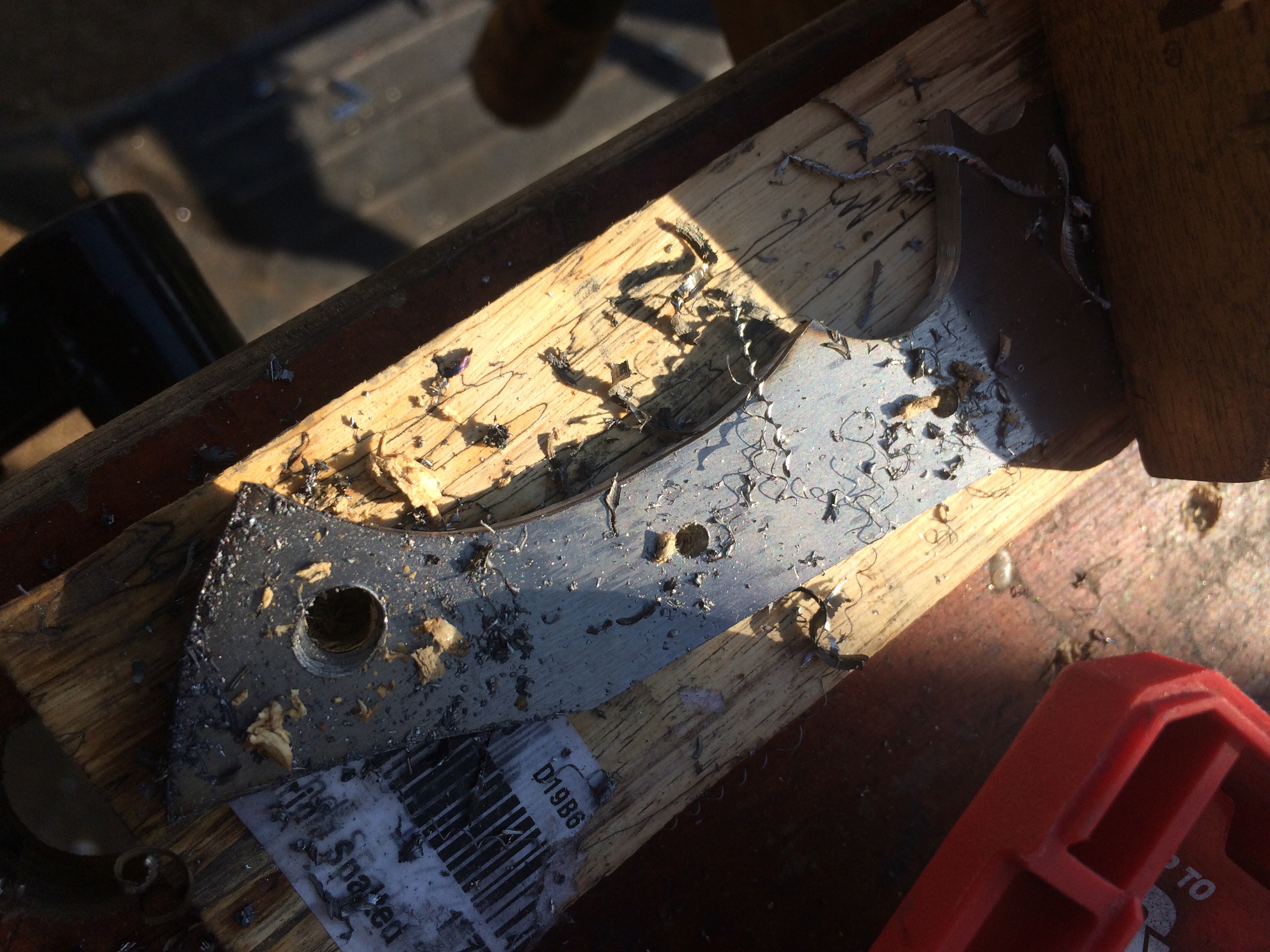
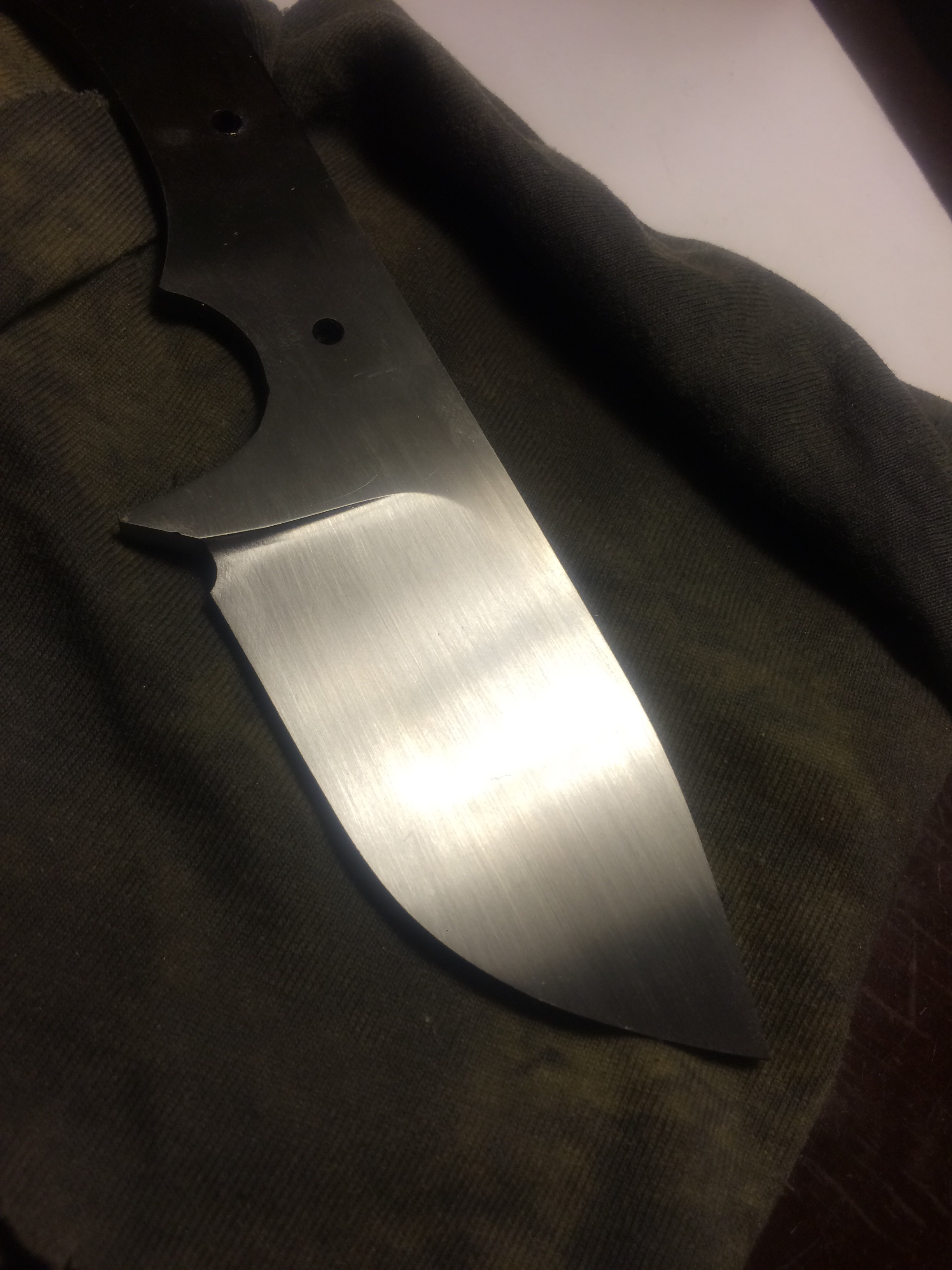
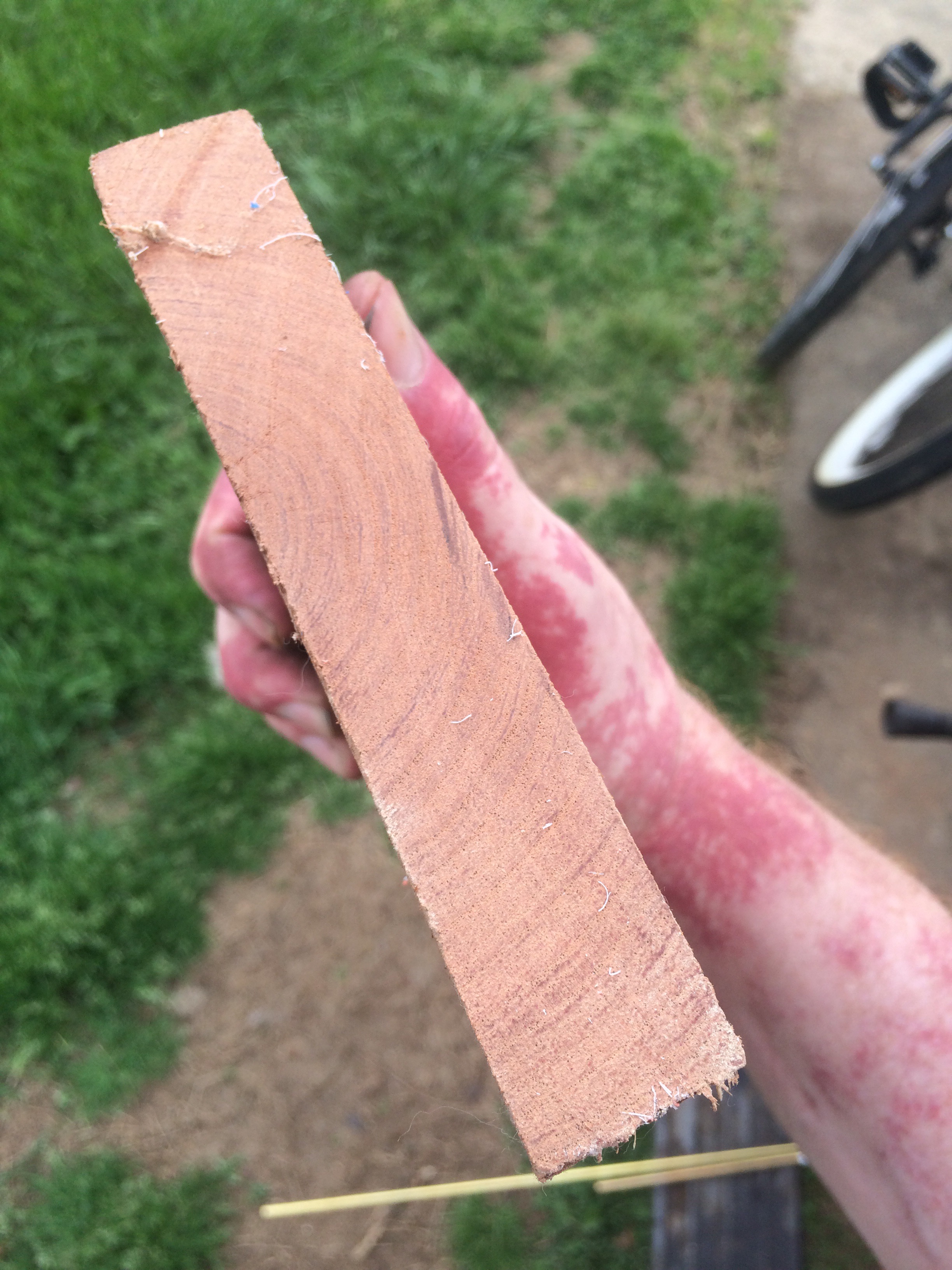
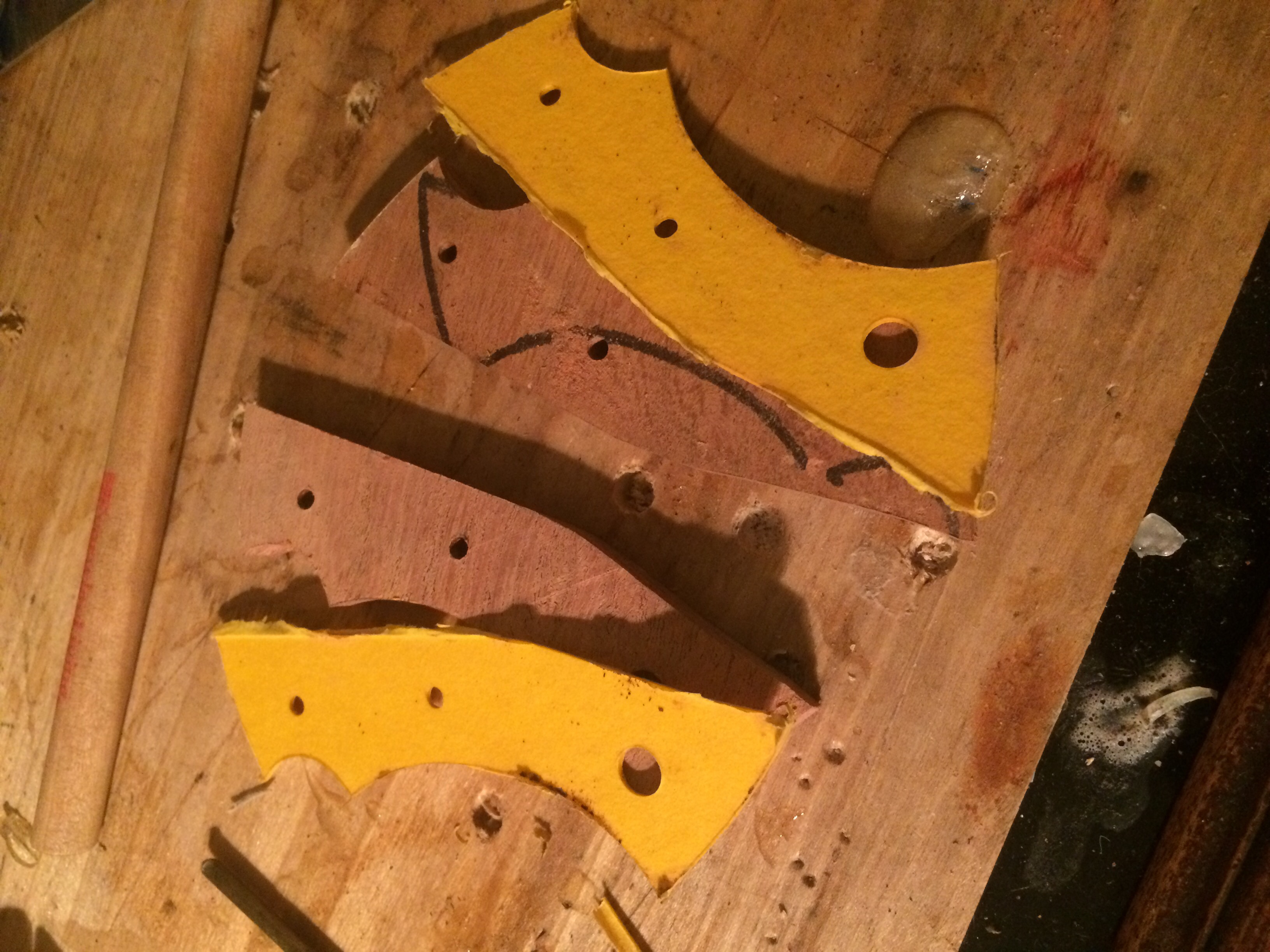
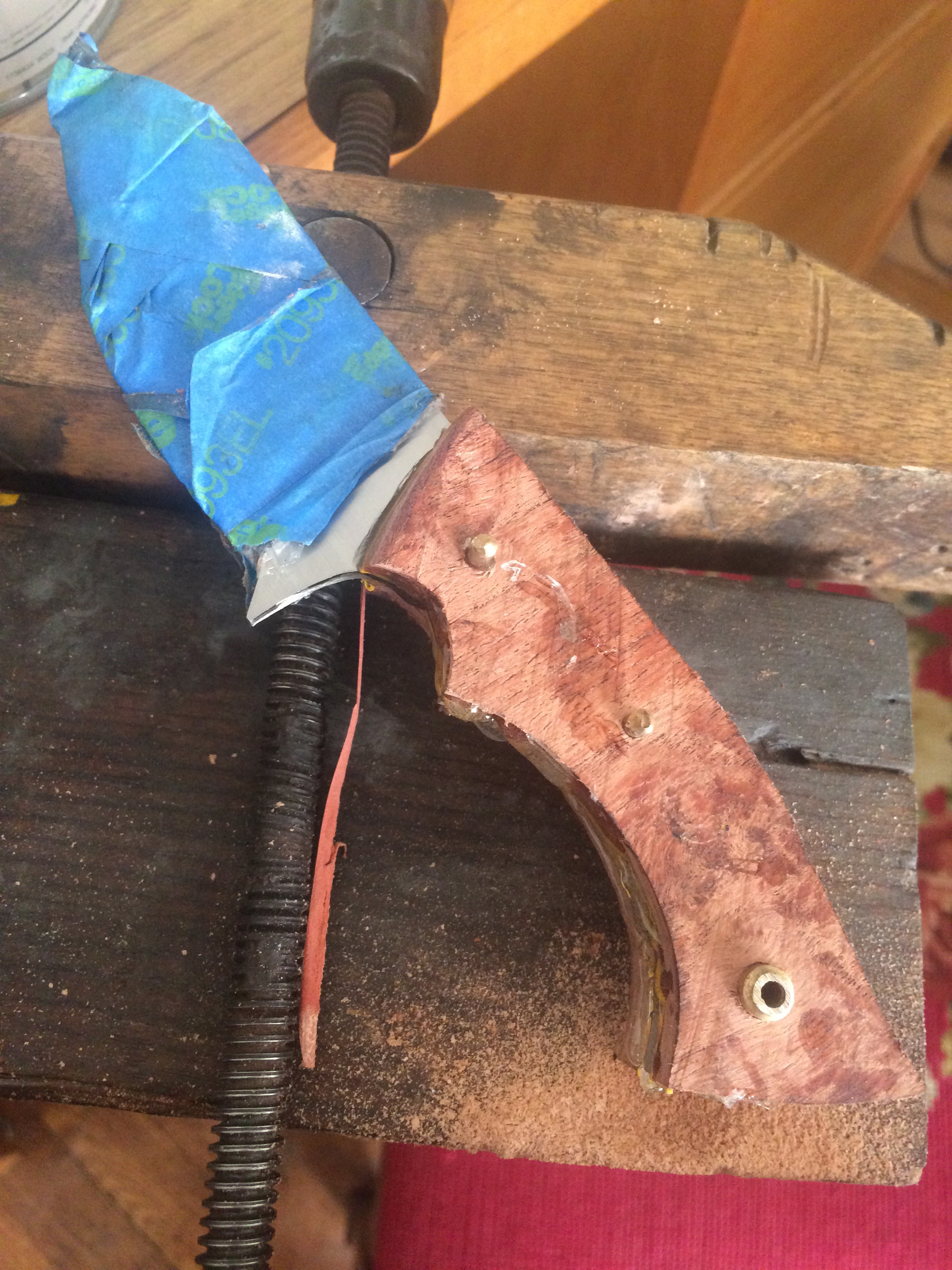
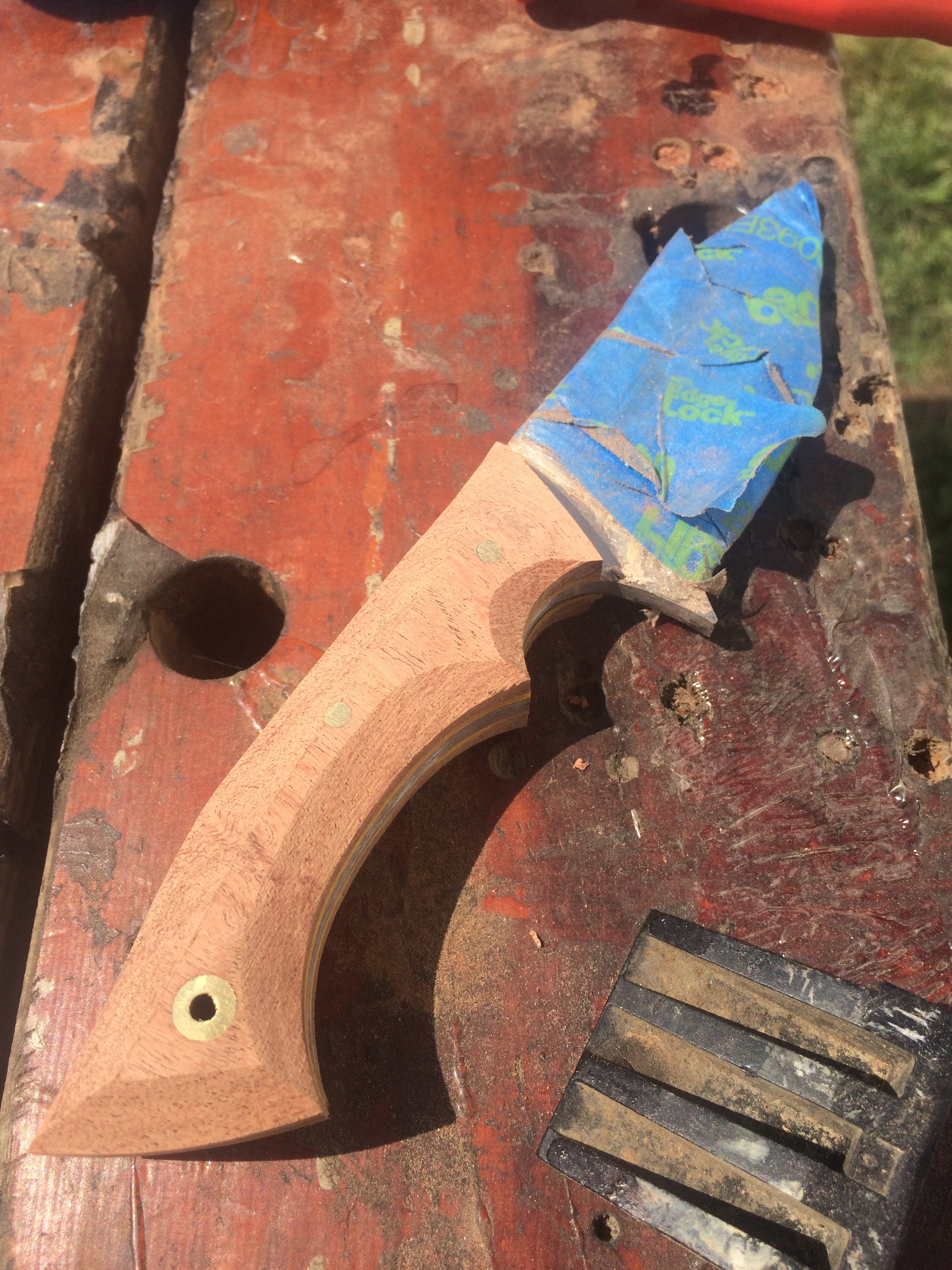
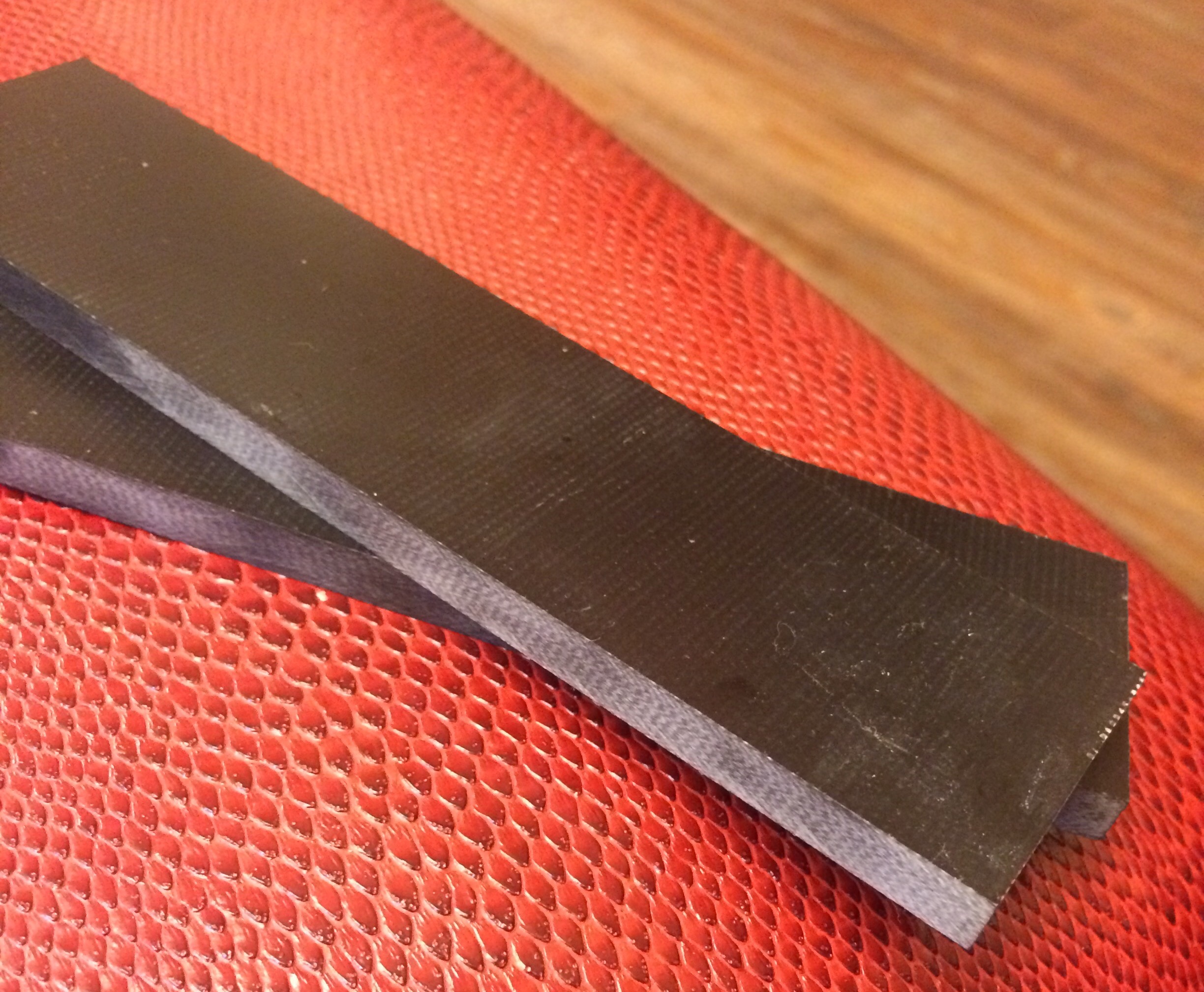
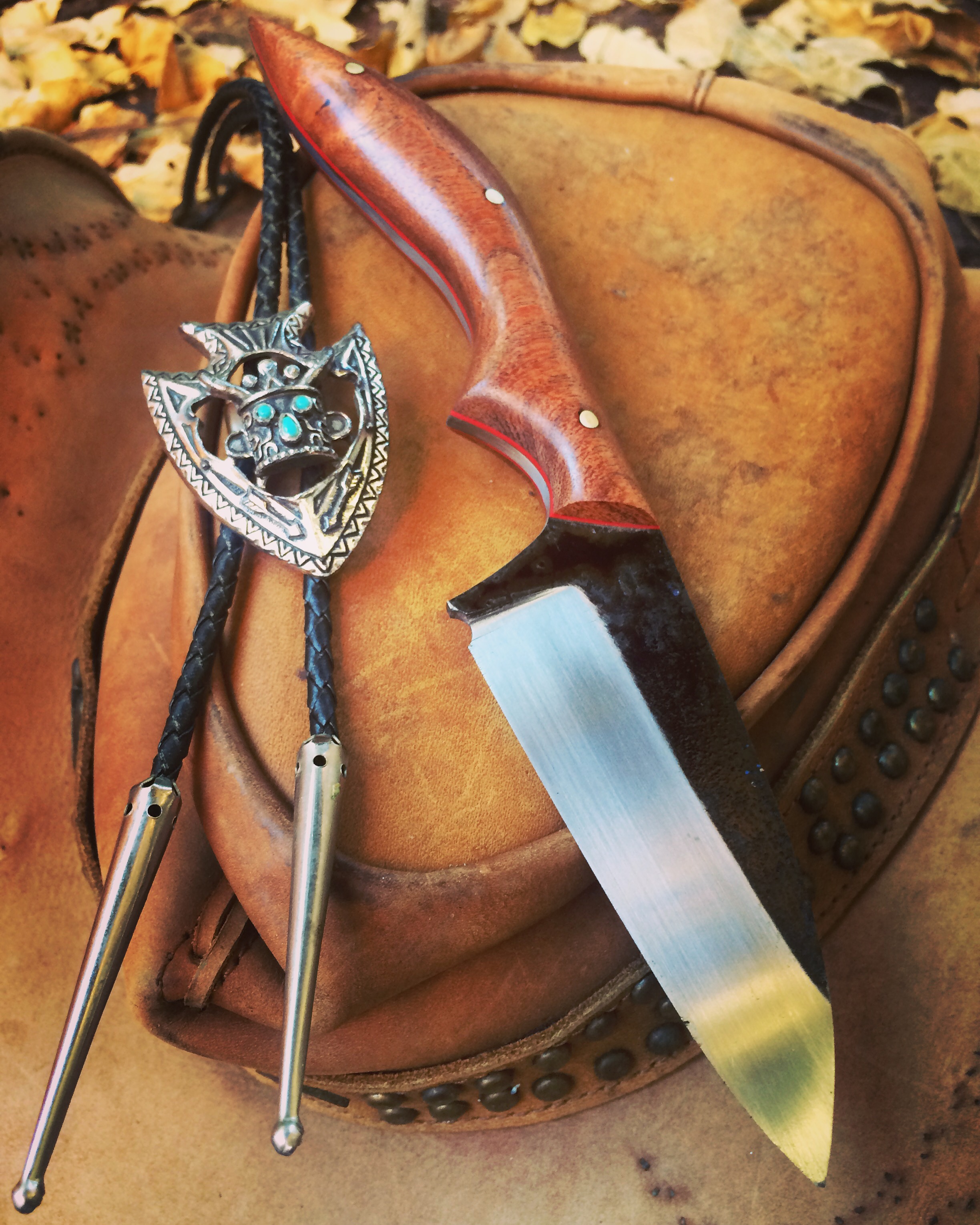
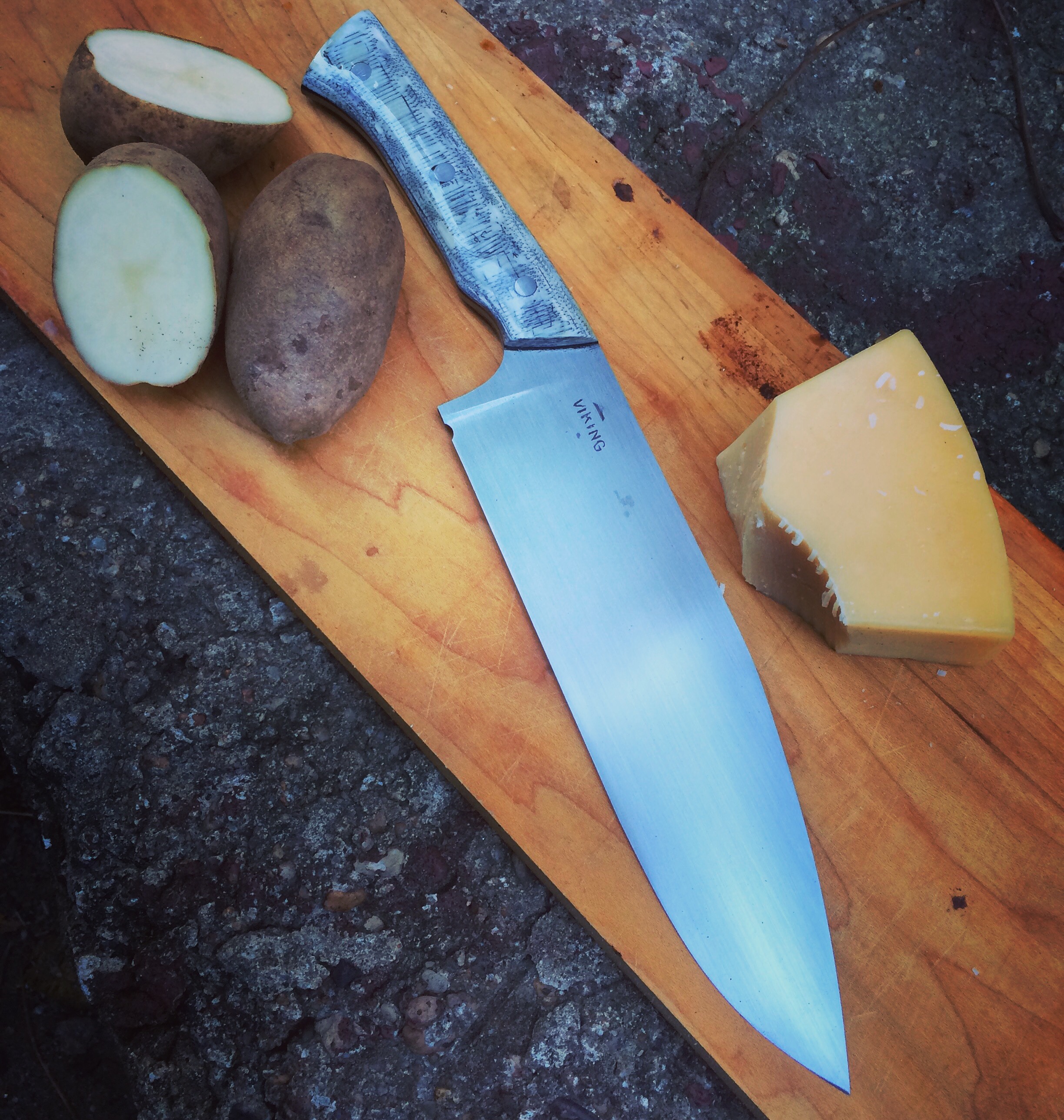
This knife was commissioned for a retired gentlemen who trains English Setters for hunting. Hunting Dogs, or Gun Dogs as they are called have been around for centuries. Particularly, the training of Setters can be traced back to Robert Dudley, the Earl of Leicester in the 1500’s. It was commissioned by a loving daughter, and has “Pop Pop” etched on the flat of the blade from his grandchildren.

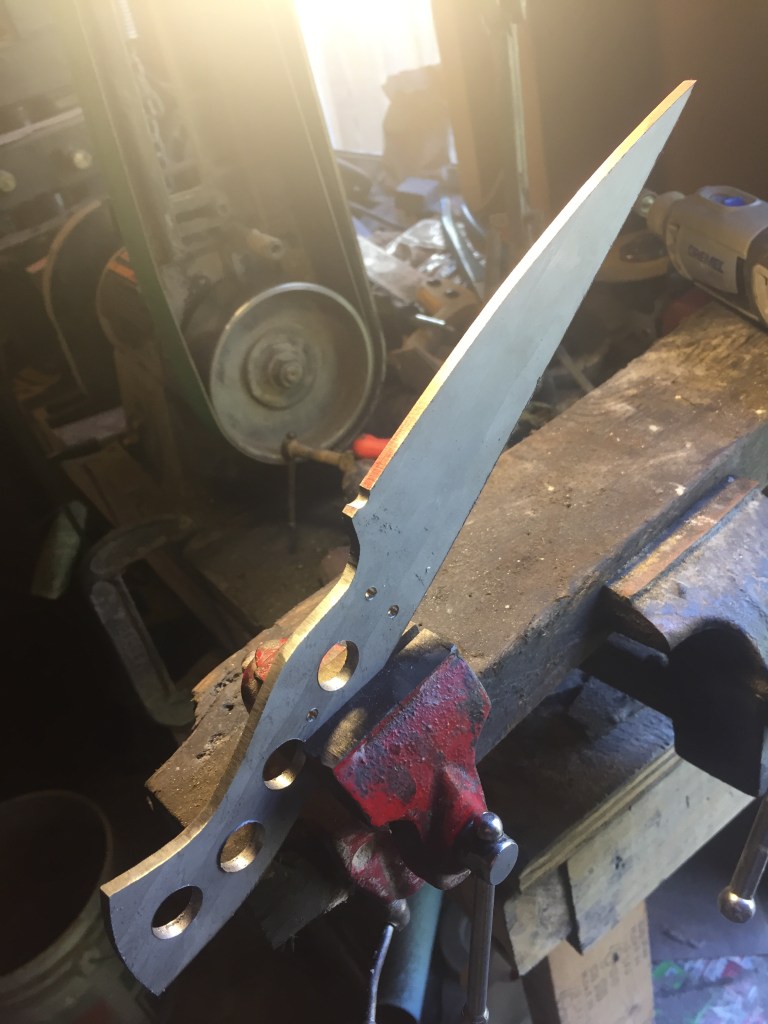
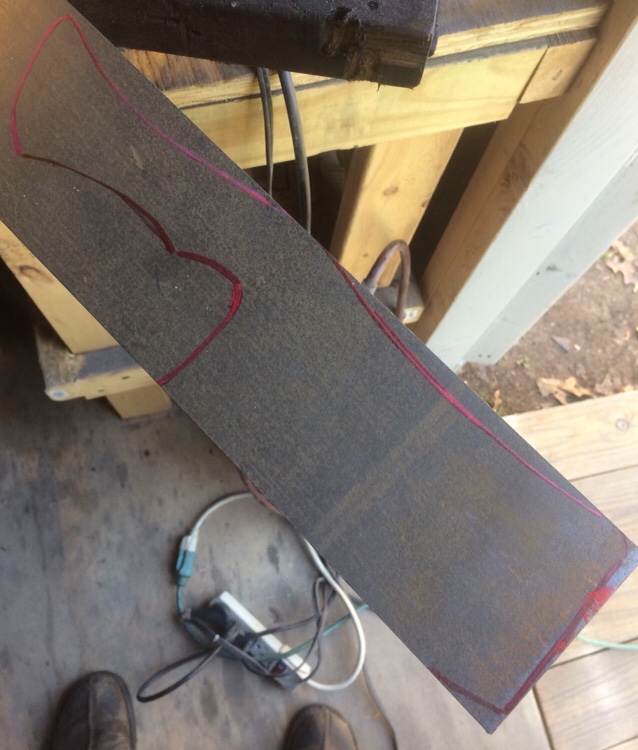
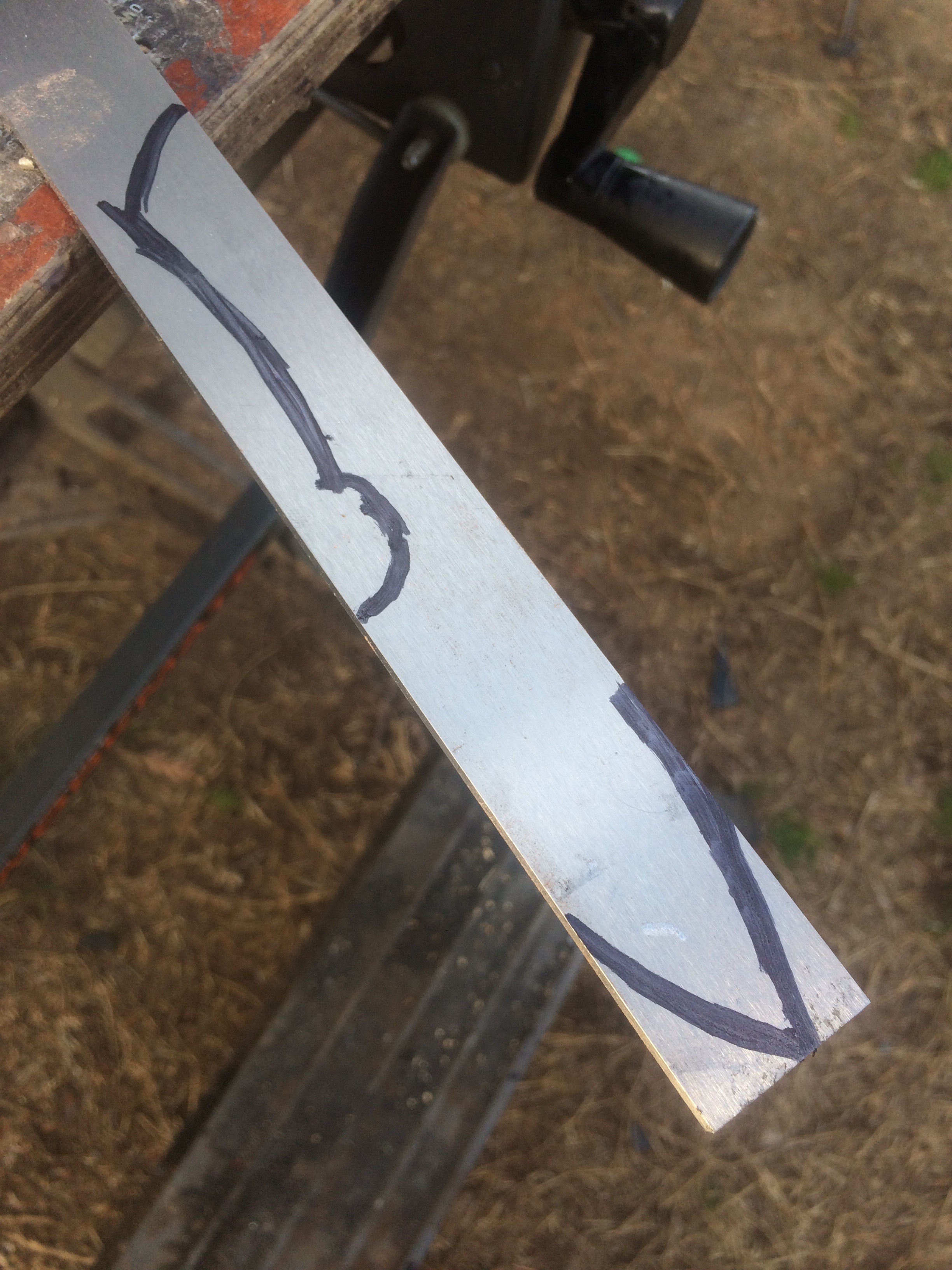
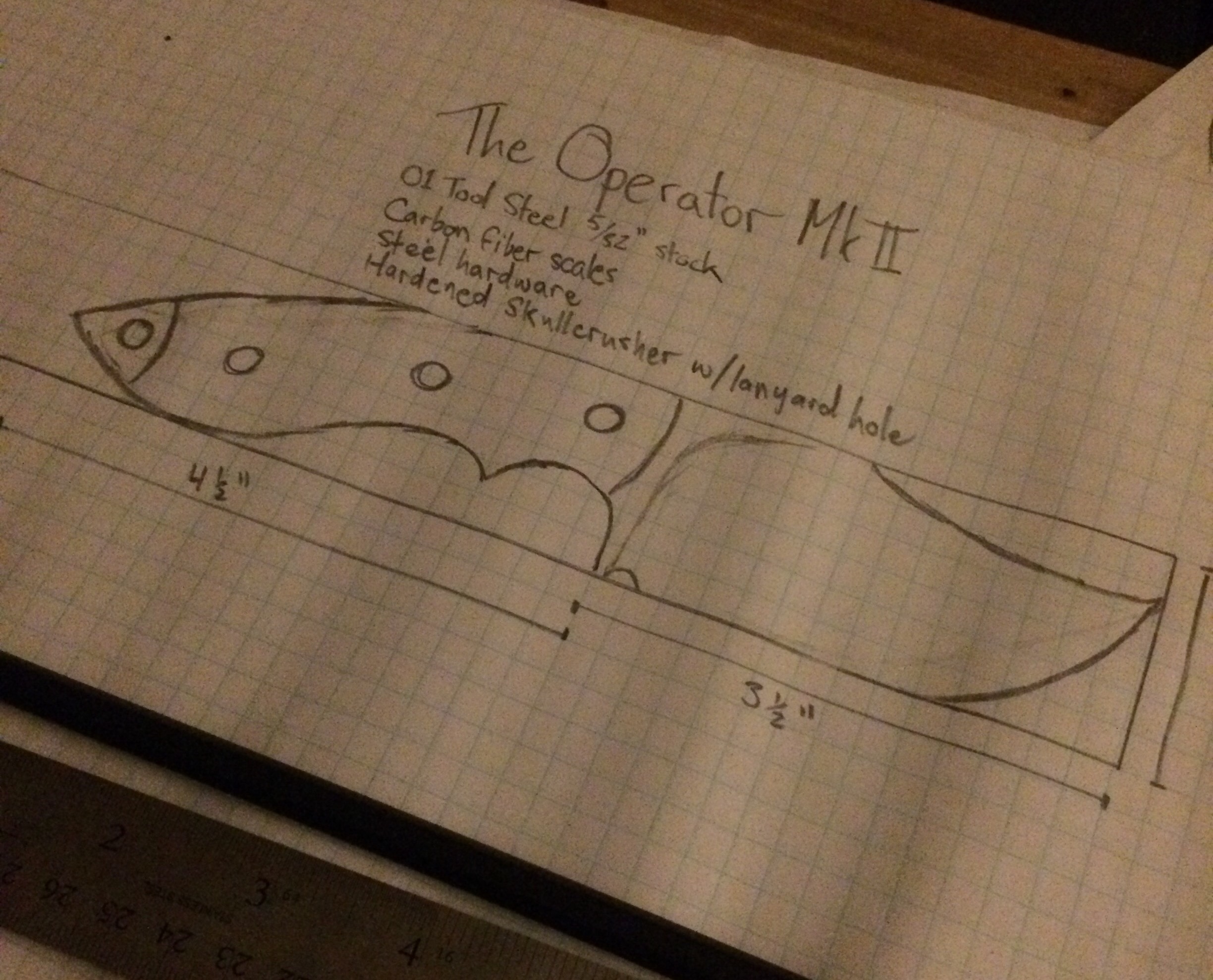
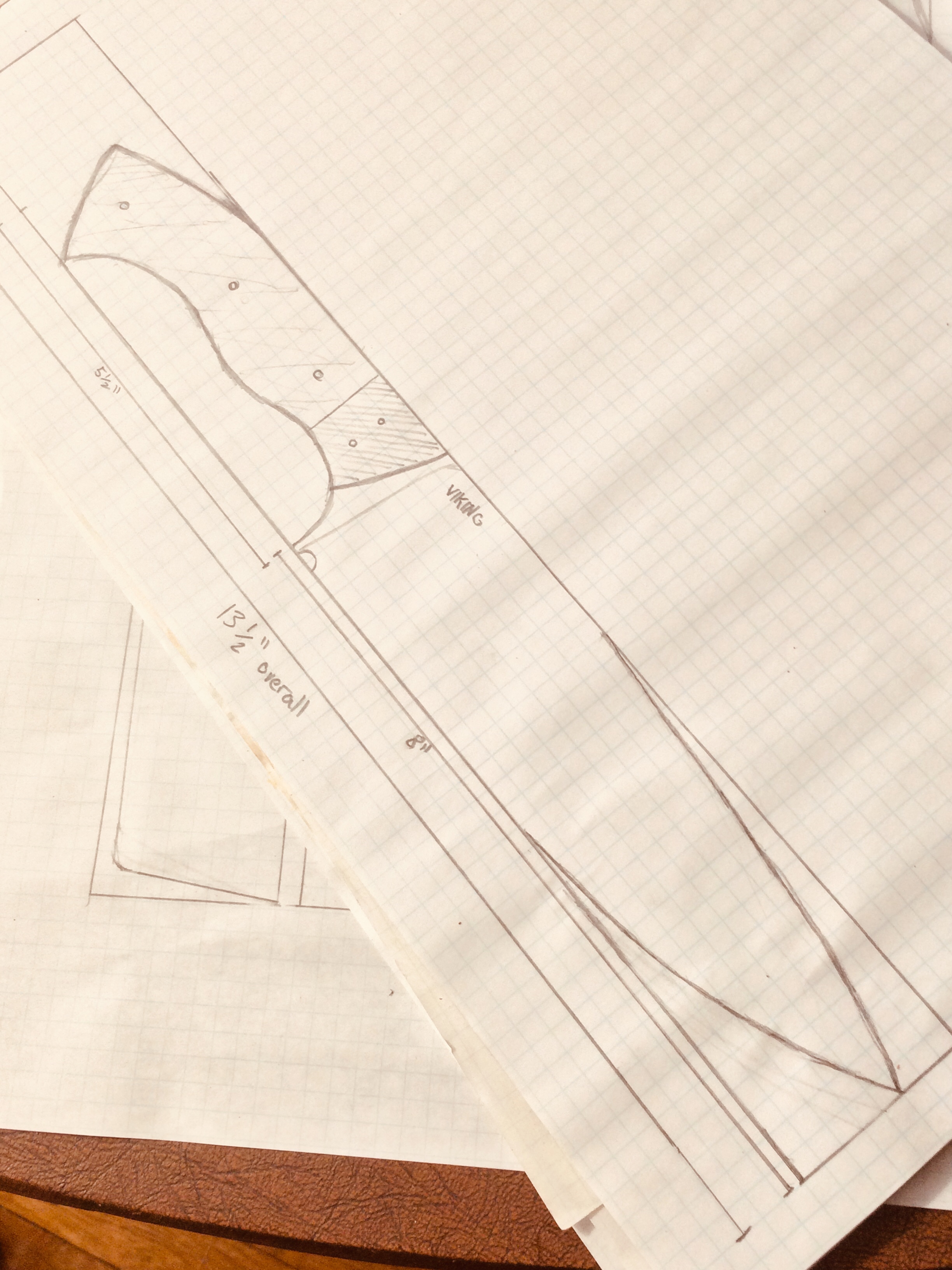
A quick sketch.
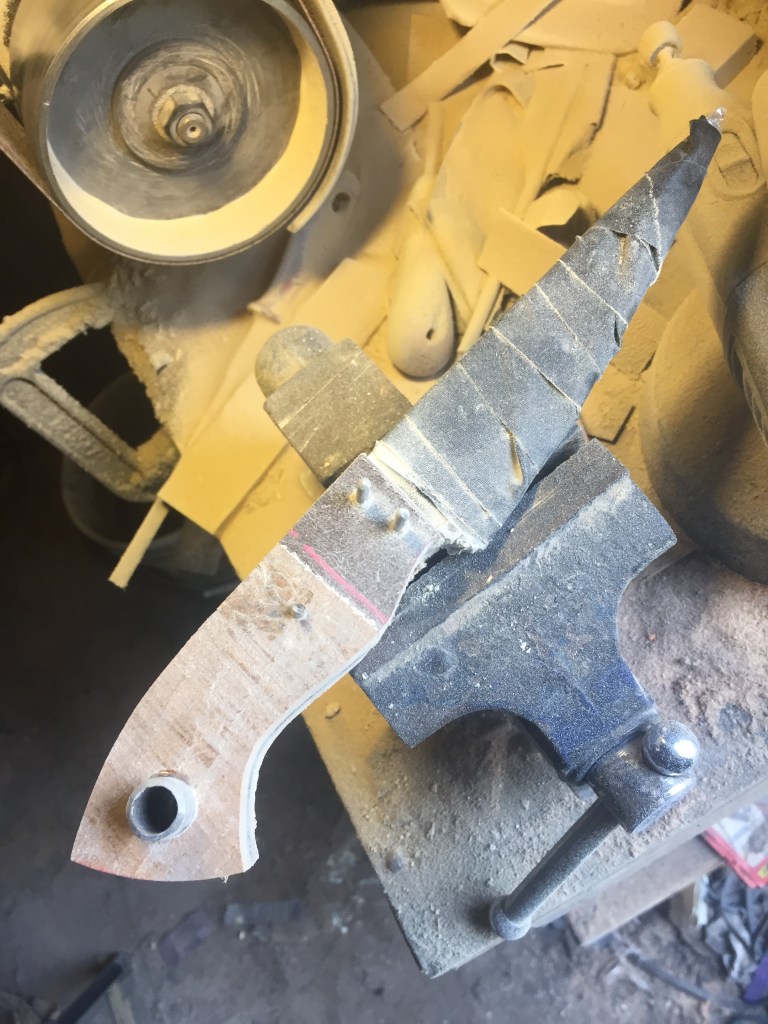
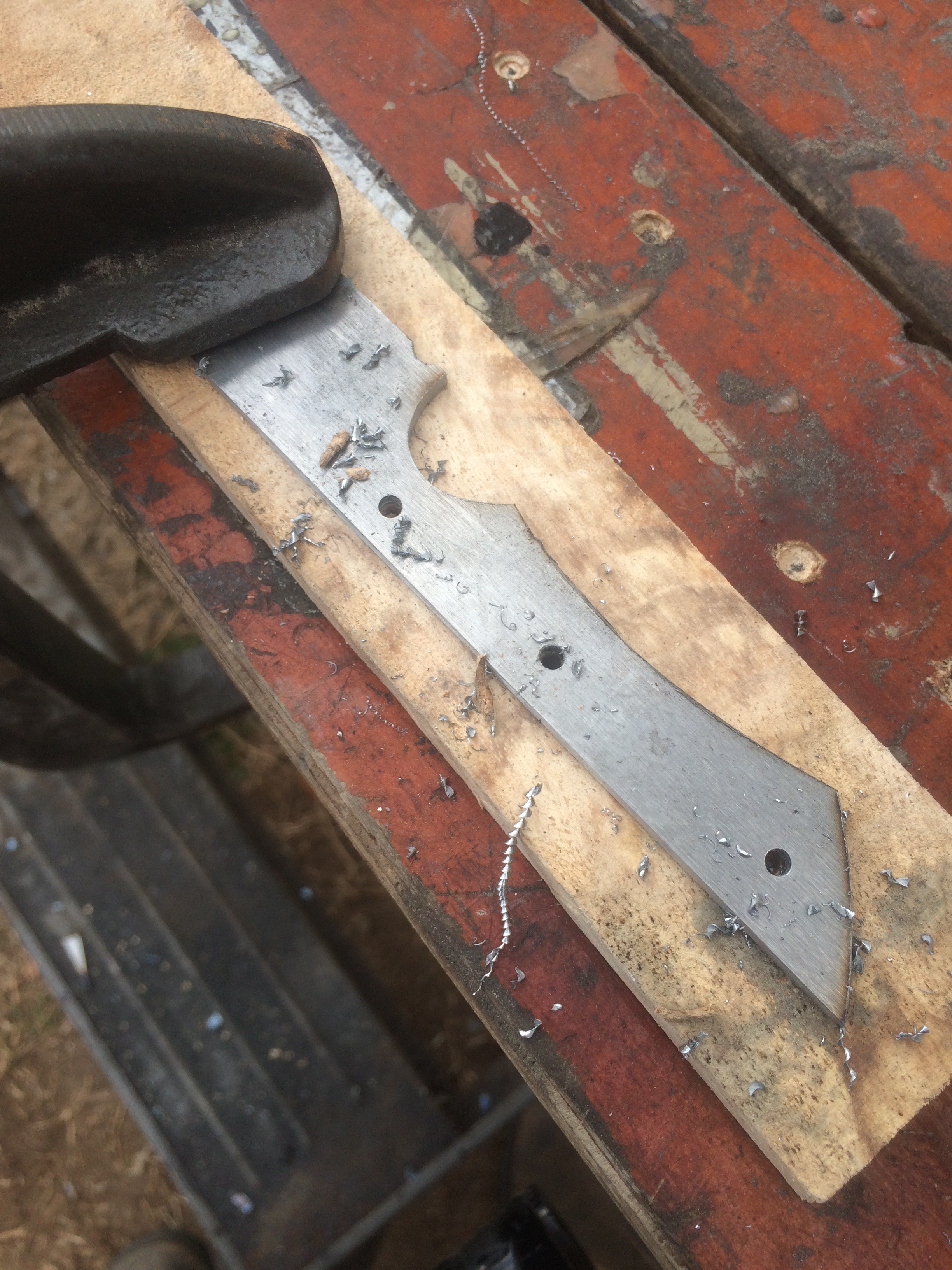
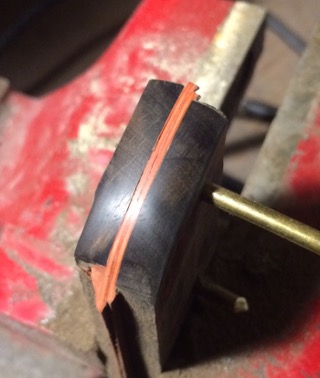
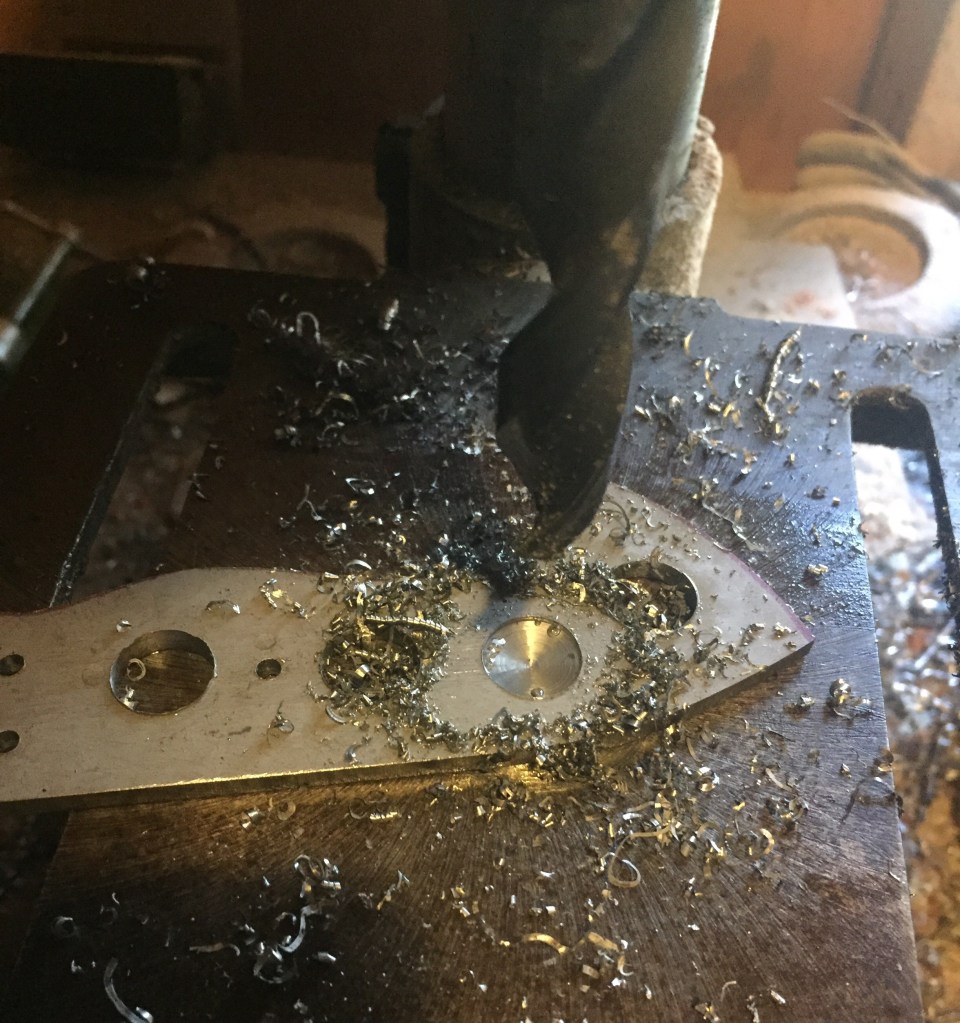
Removing material in the handle make for a more balanced blade.
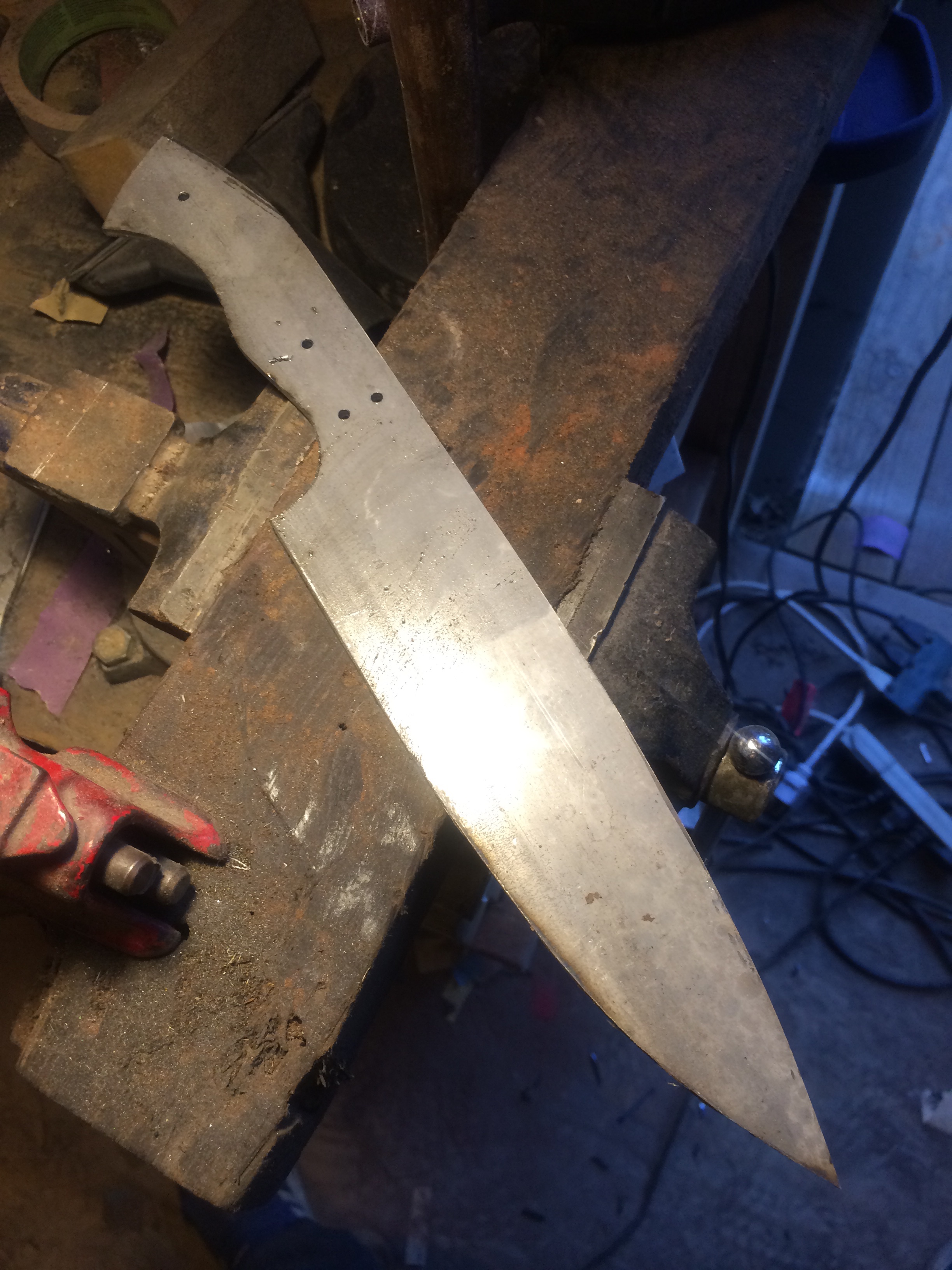
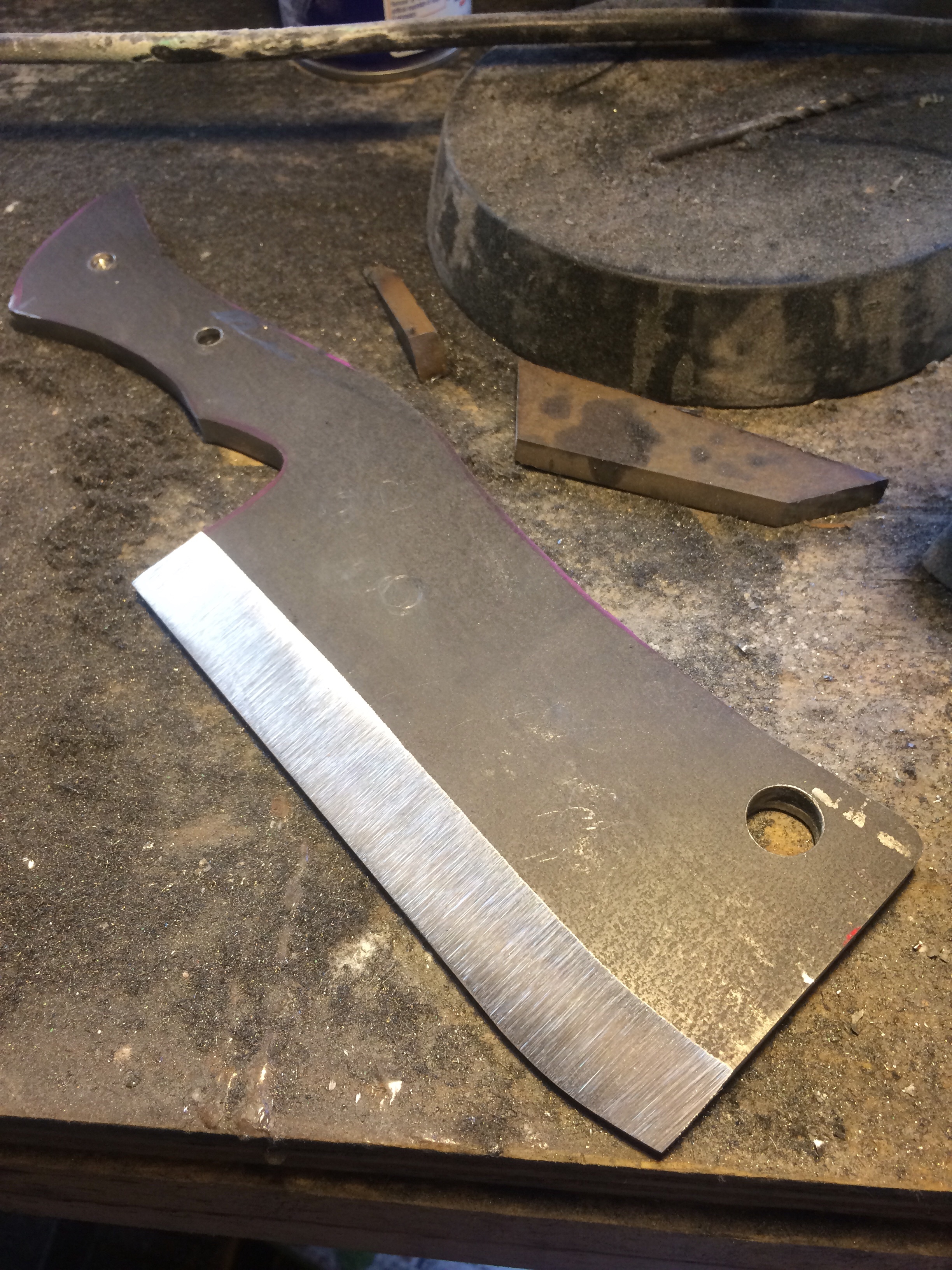
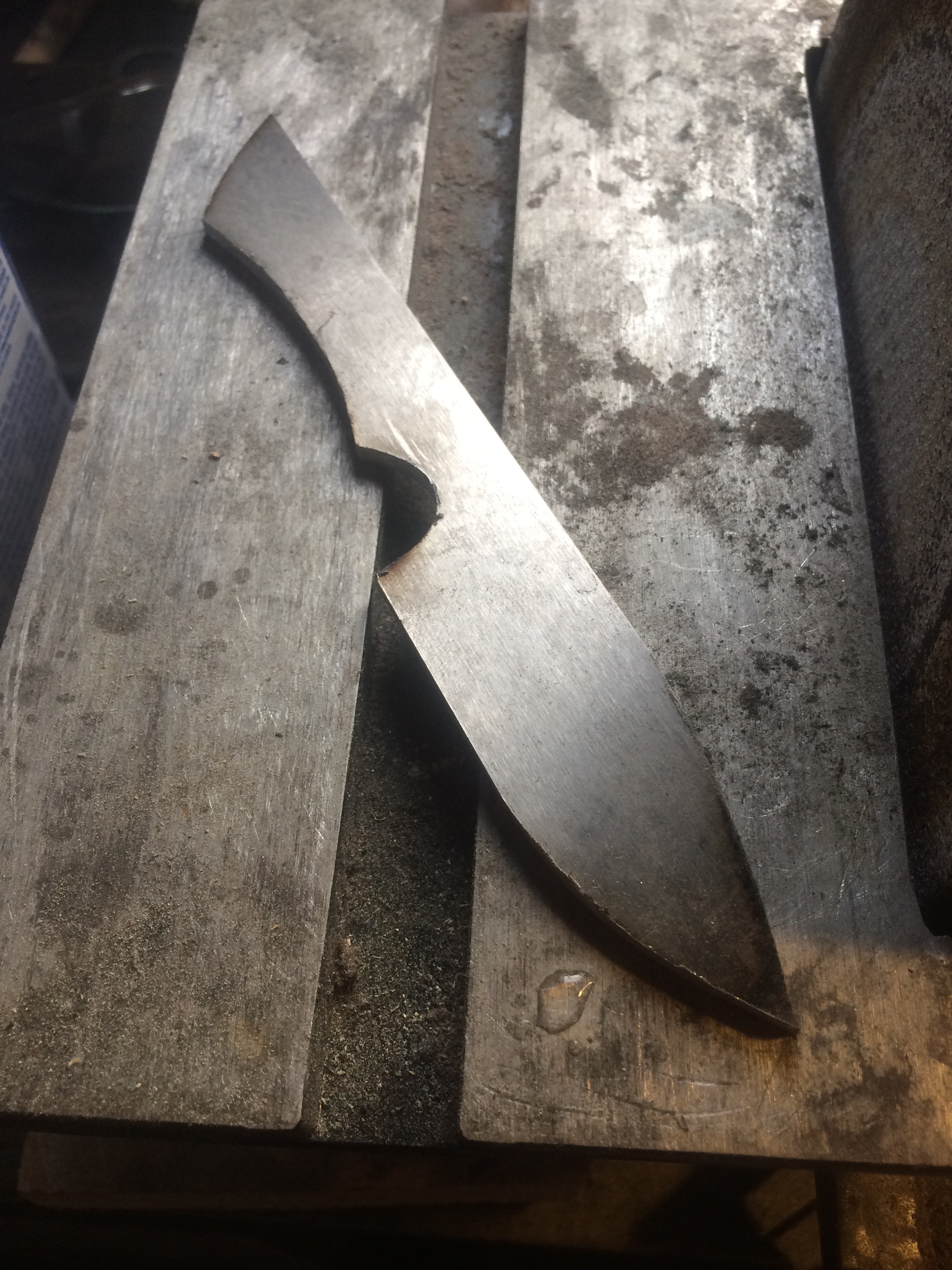
Everything profiled out. Being that it is made from thinner stock, it will go in the forge as is to prevent warping during hardening.
The blade needs to come to critical temperature, which is around 1500F. By the colors you can see that it is almost there.
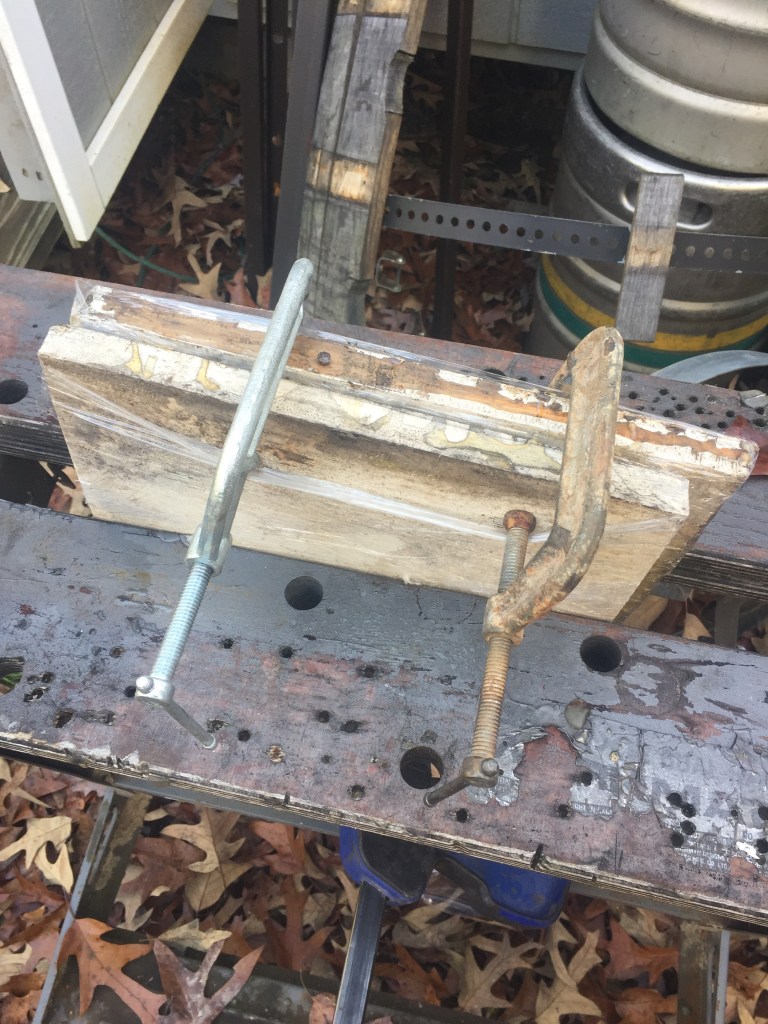
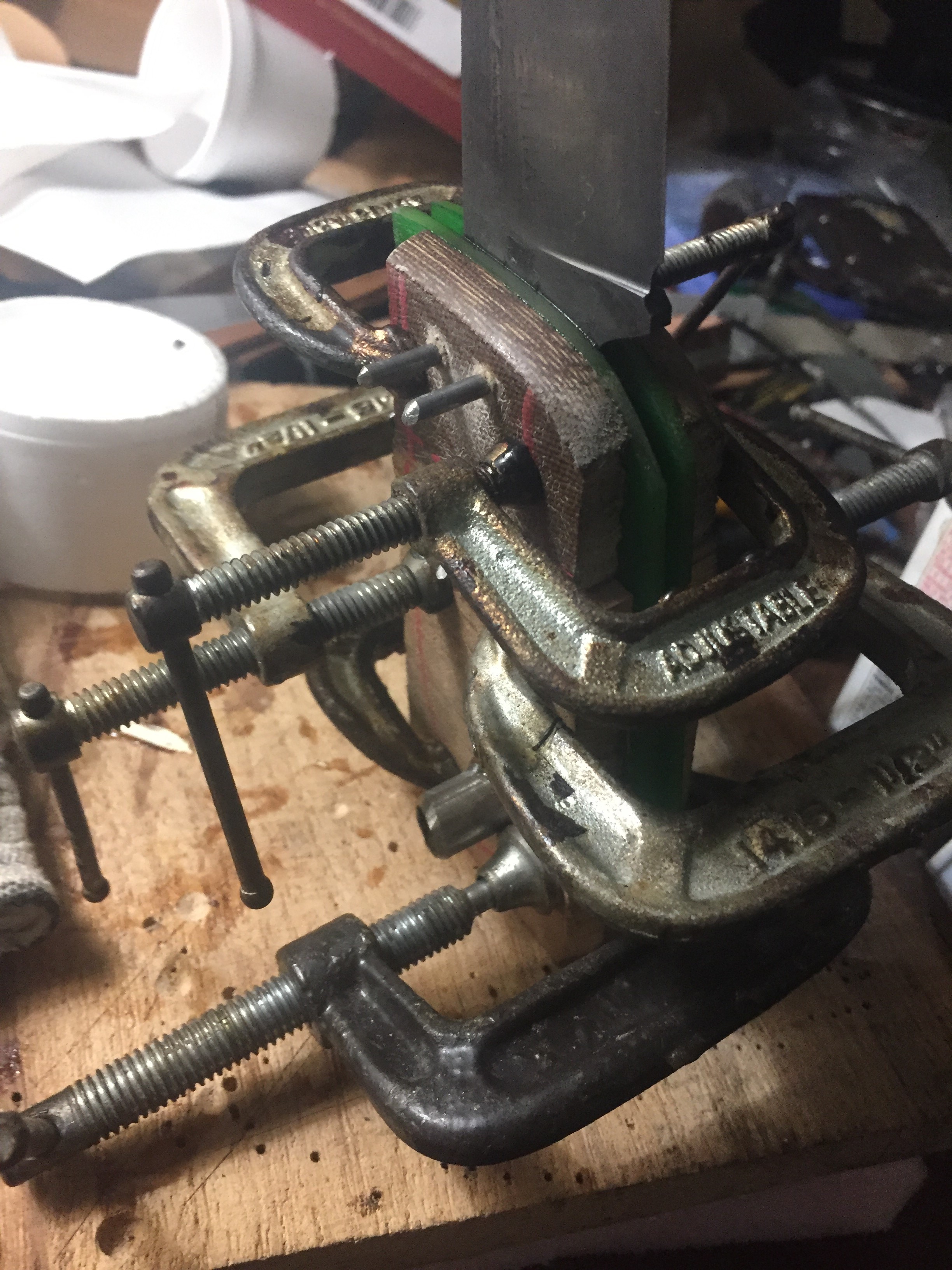
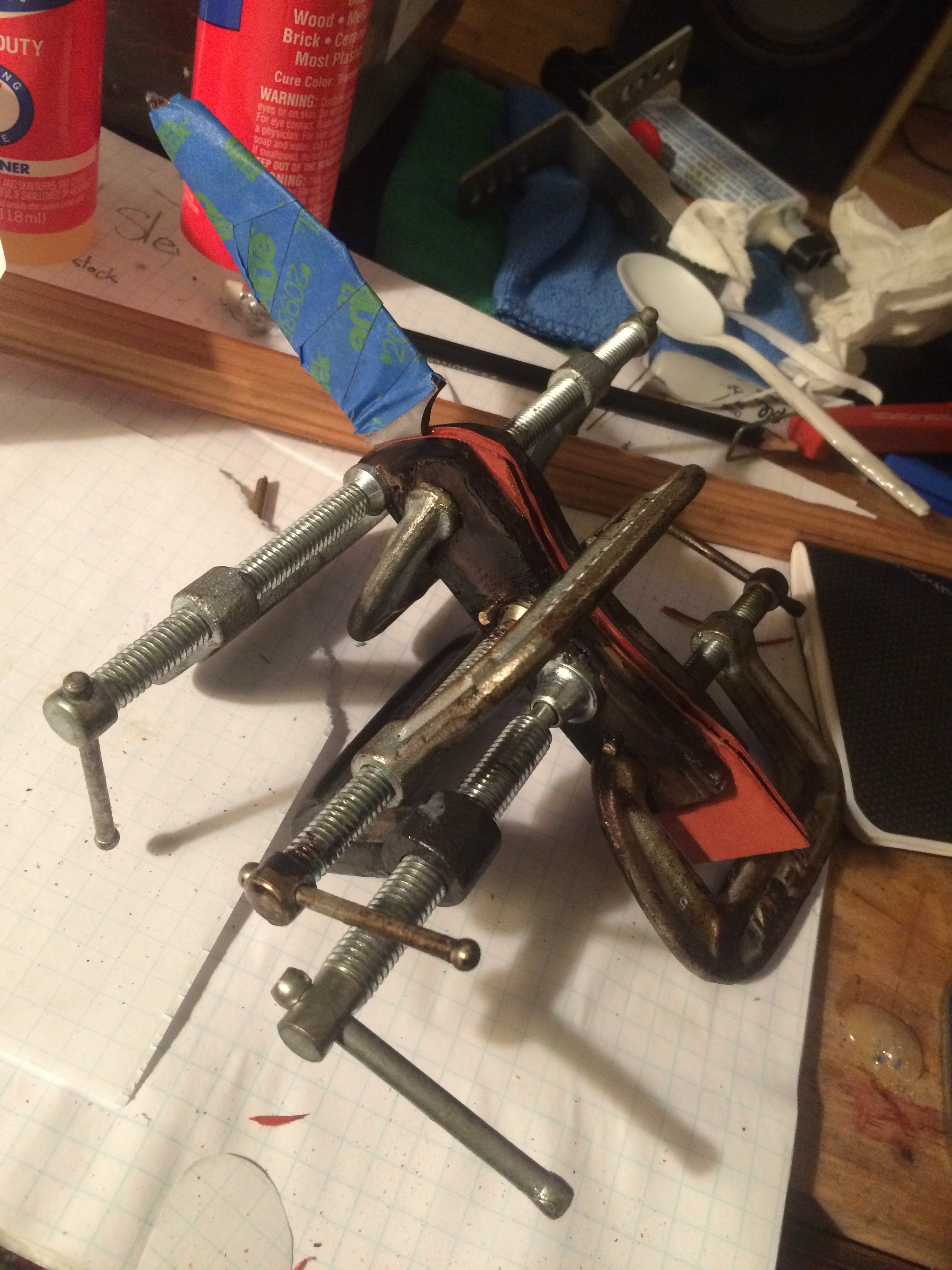
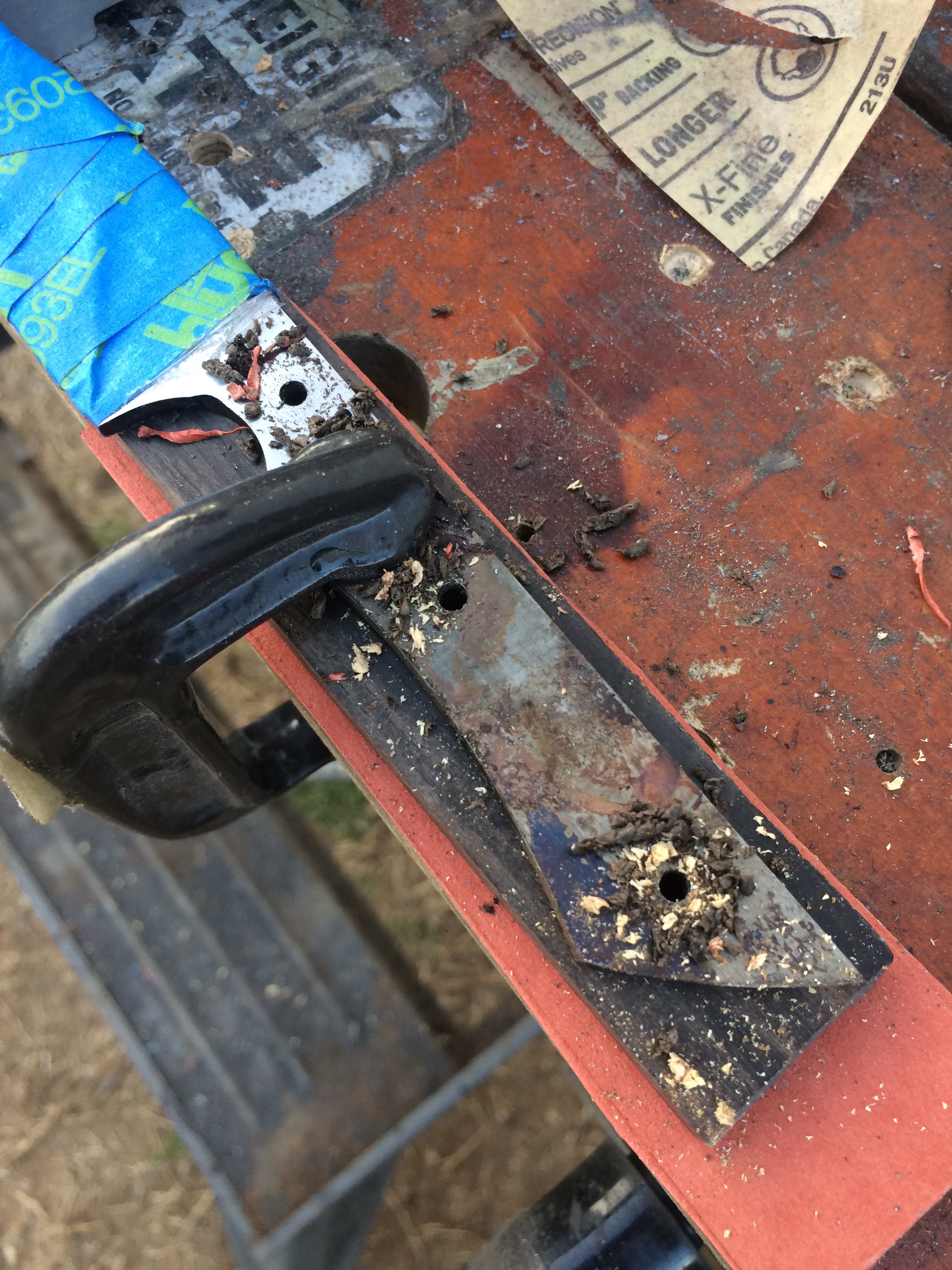
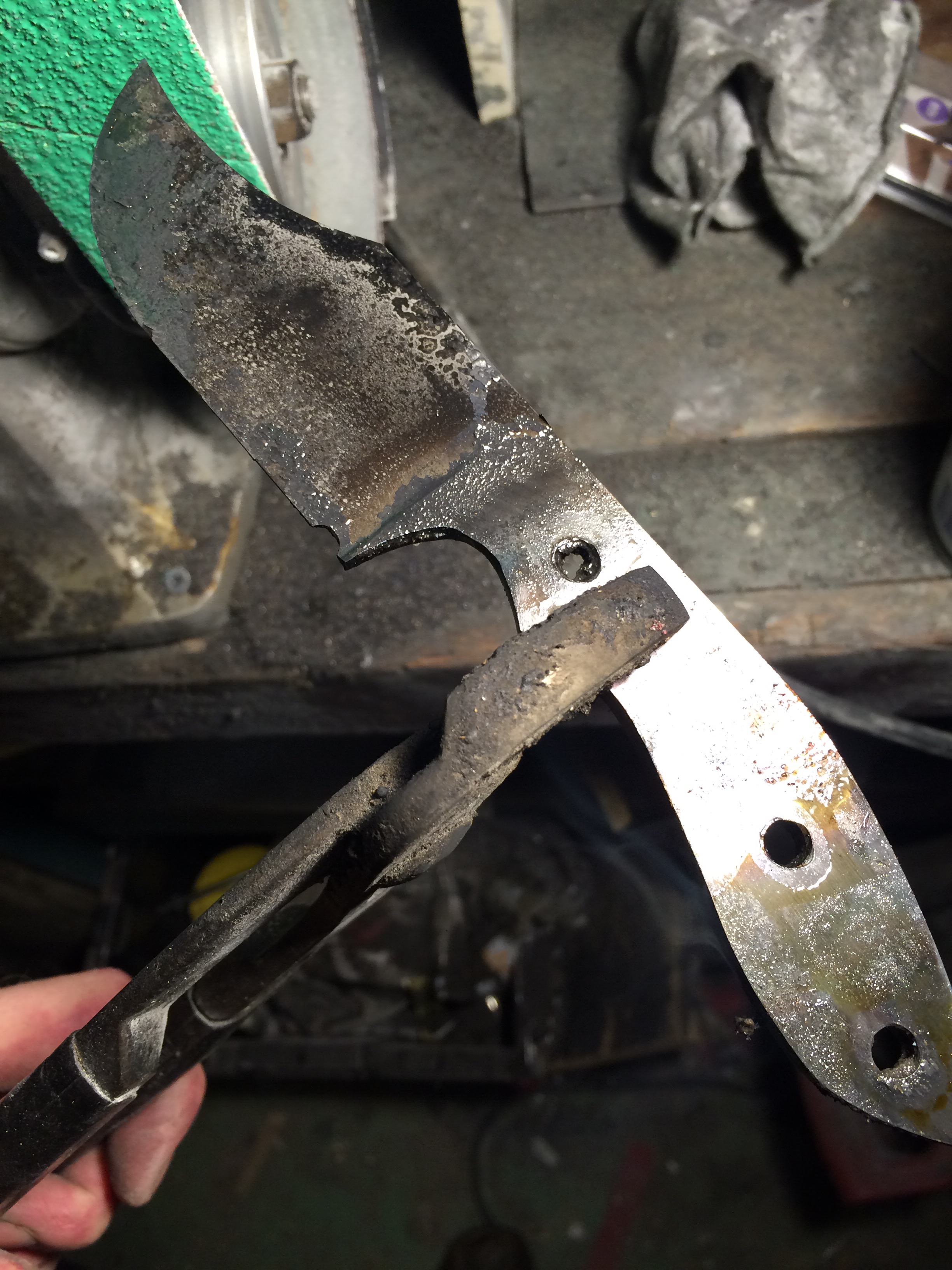
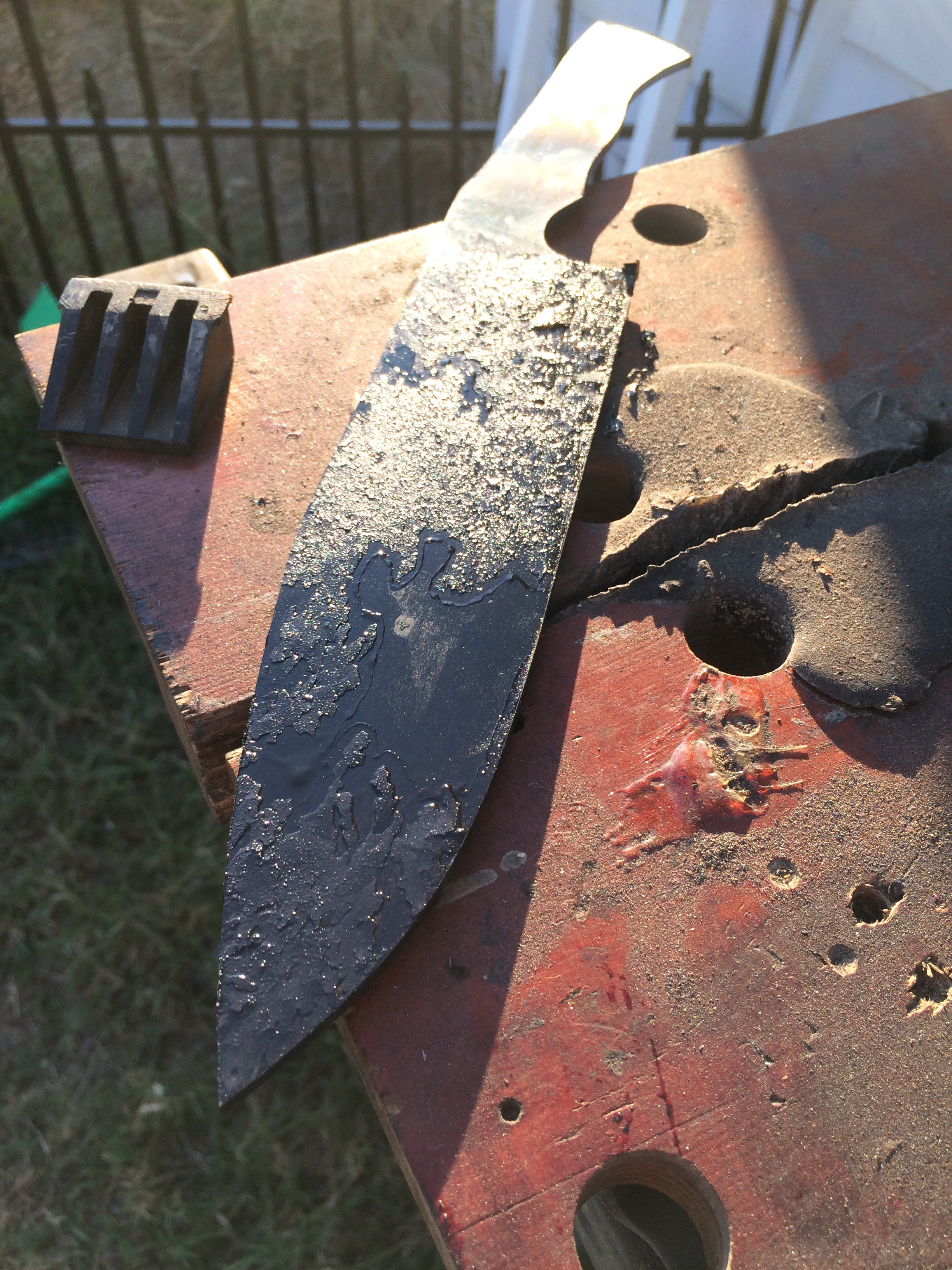
After the quench. There wasn’t warpage but I still clamp it in the vise at the areas where it would typically bend. When it comes out of the oil it is around 300-400F, and during this time any major warps can be corrected before it cools.
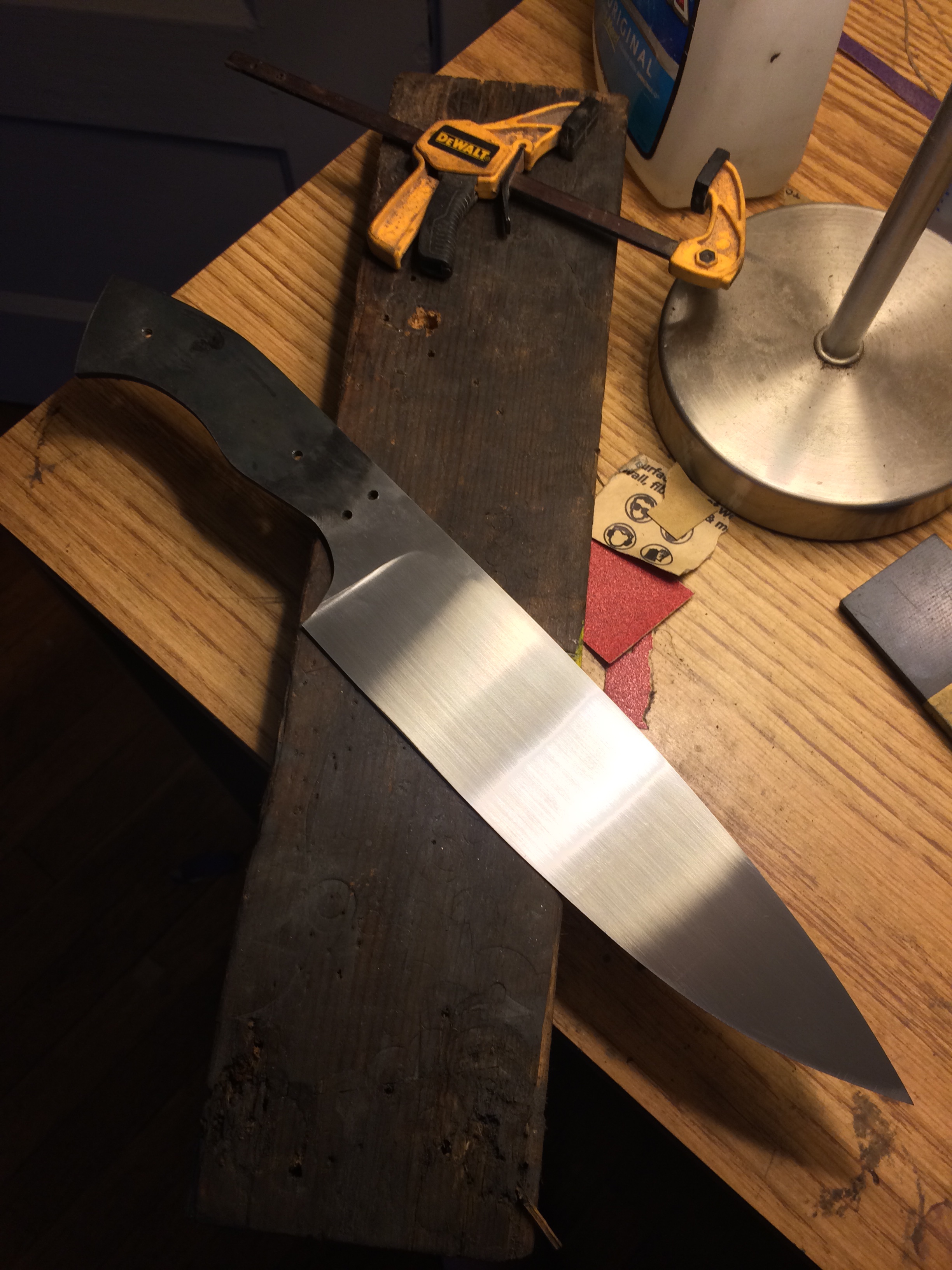
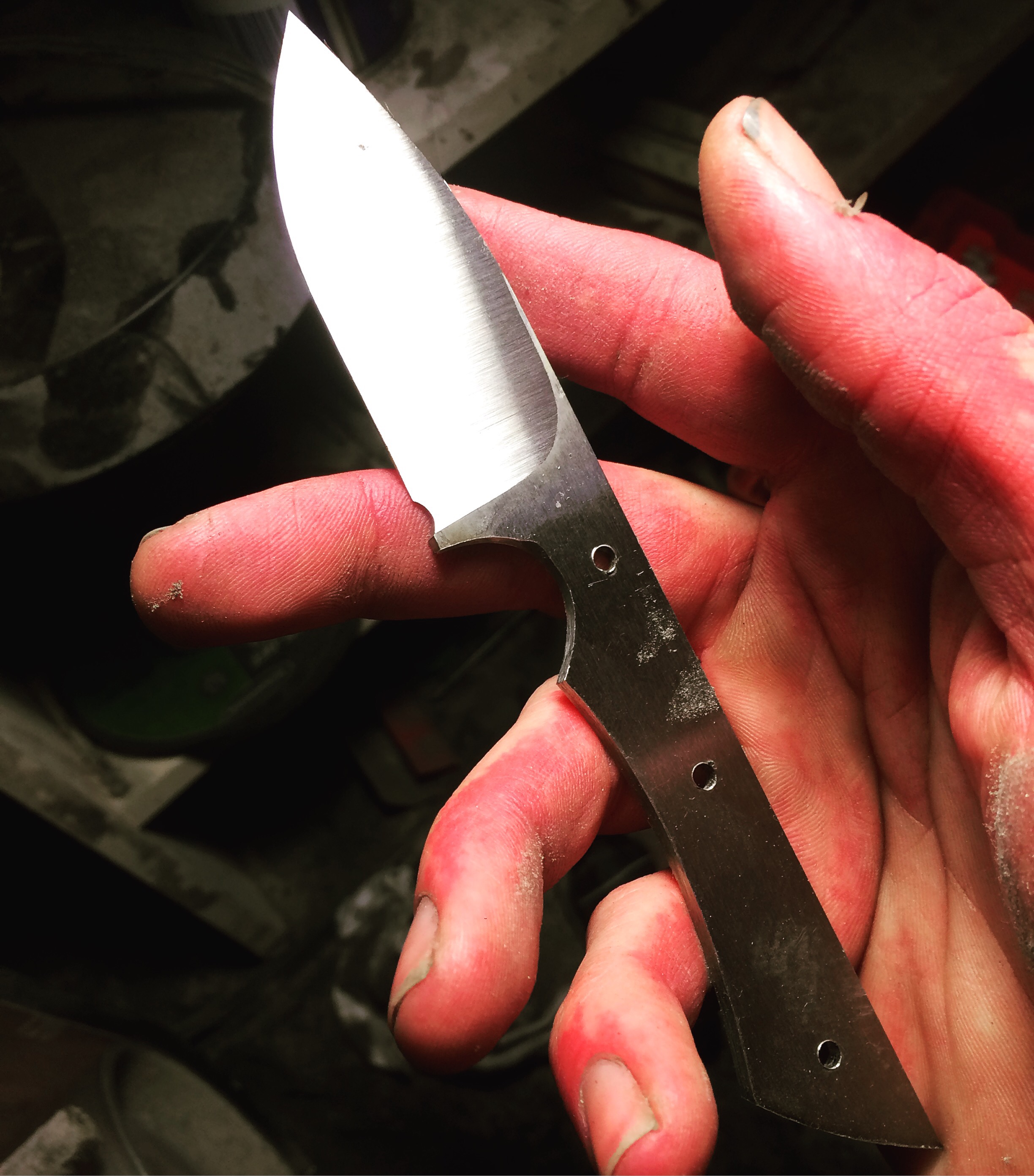
The bevels have been ground in and machine finished to 120 grit.
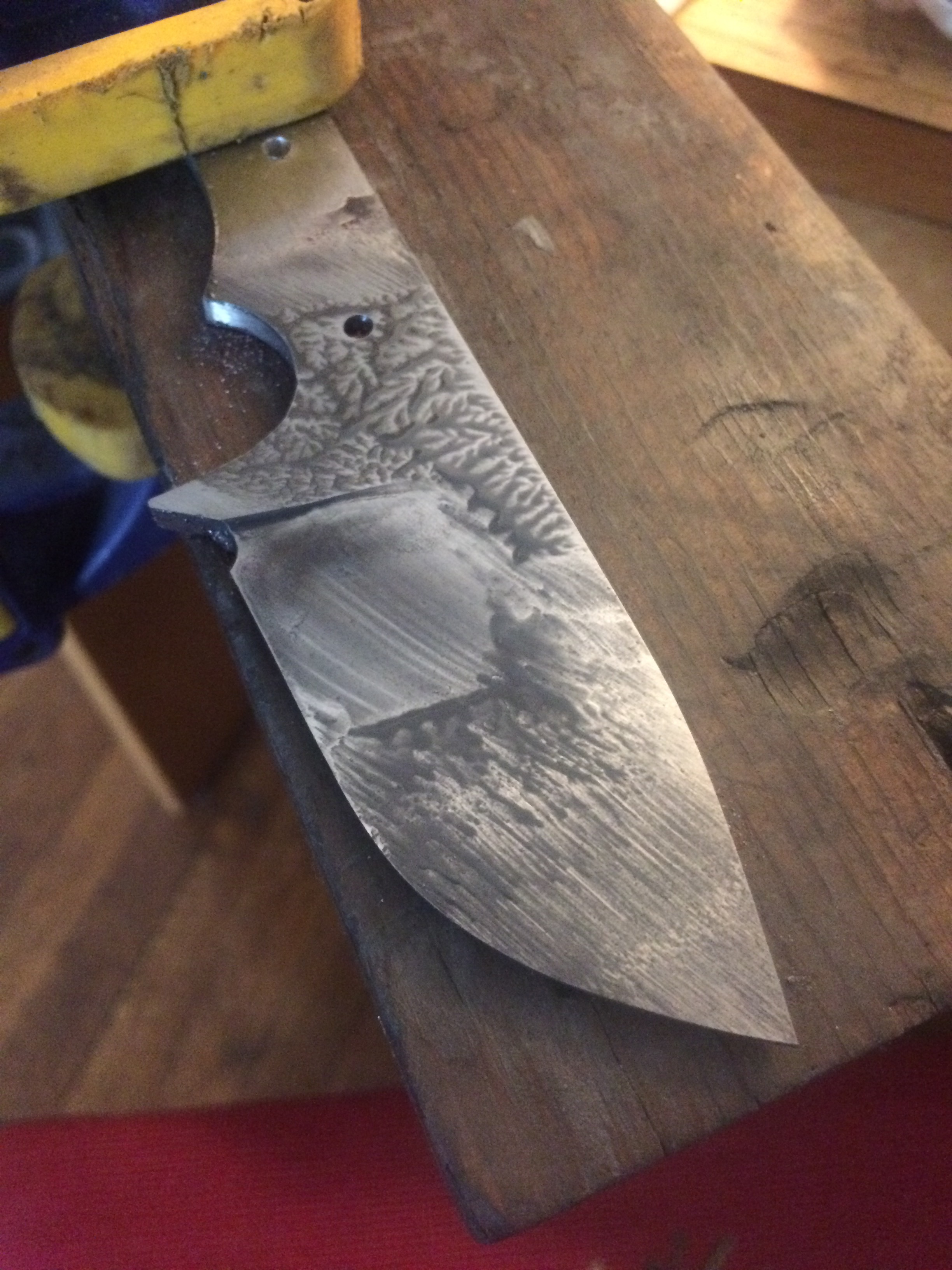
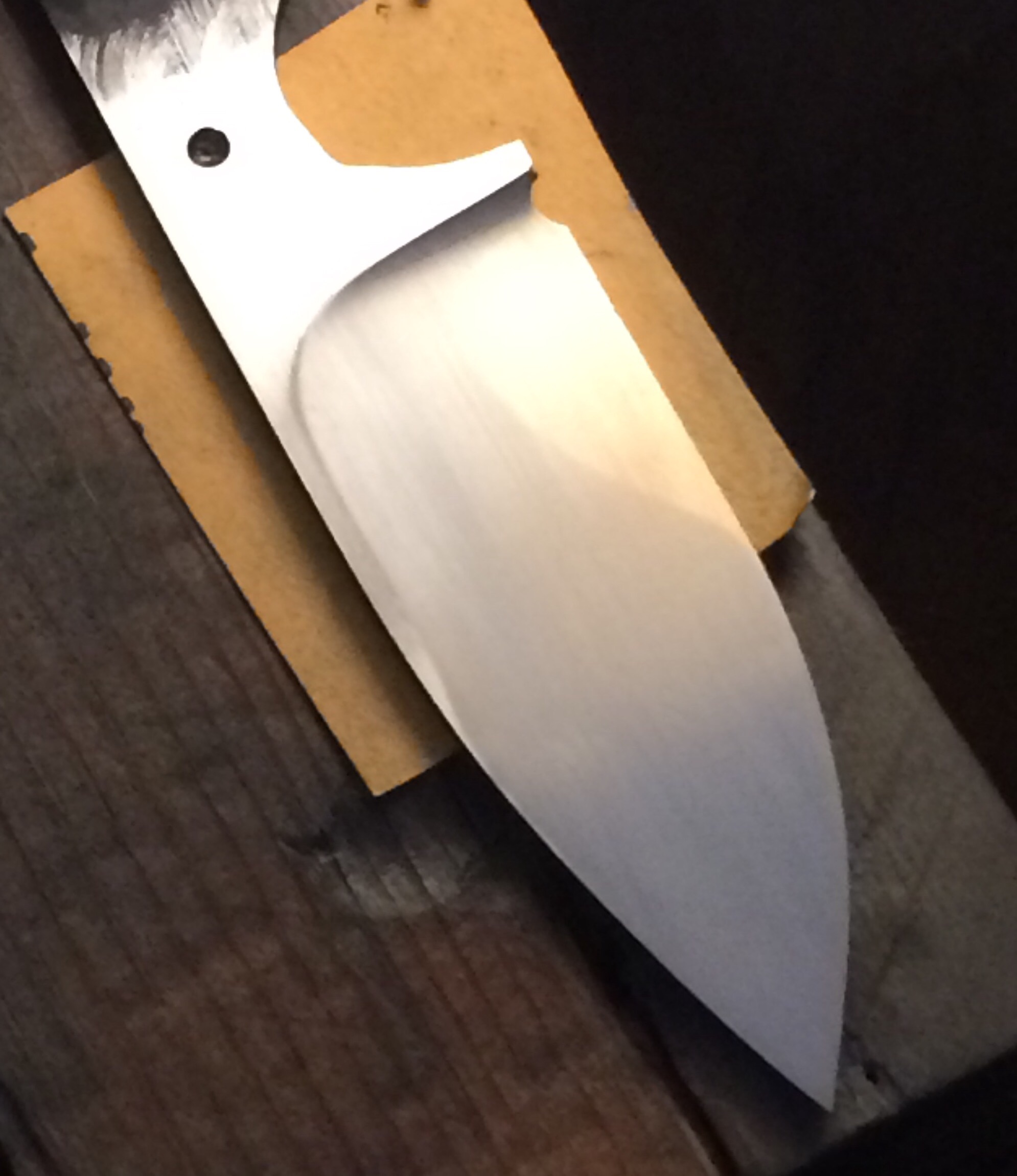
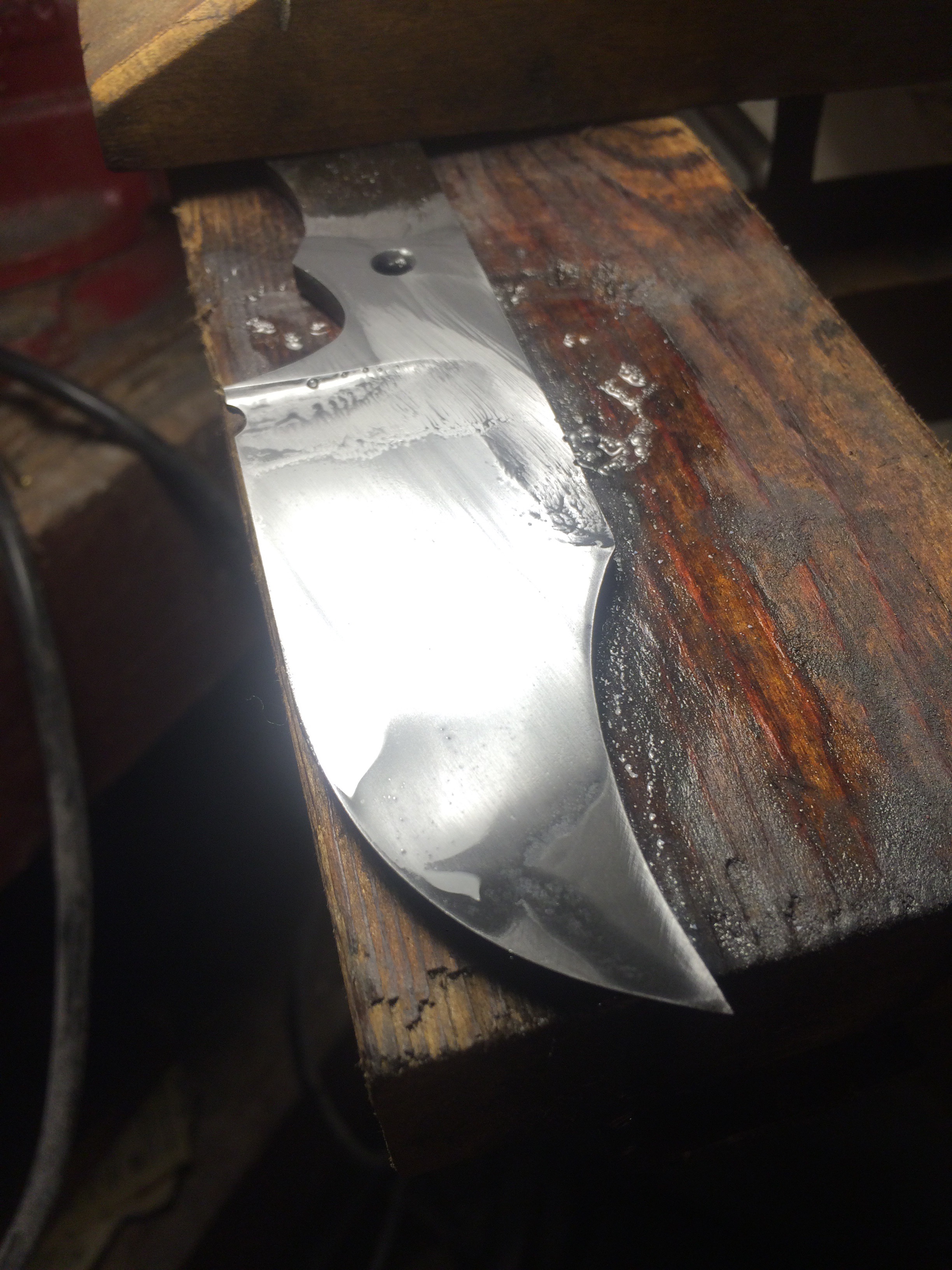
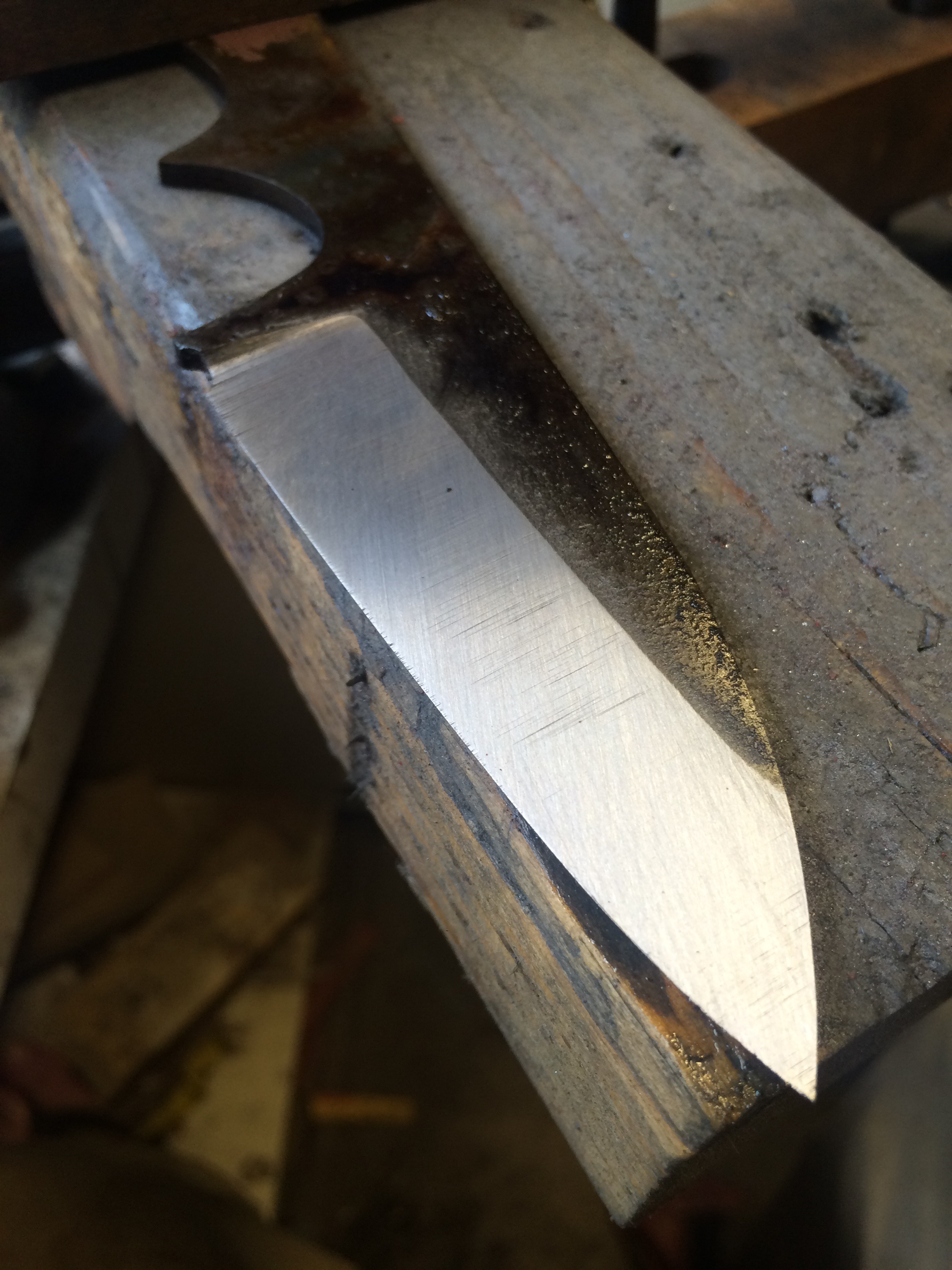
This has been hand sanded up to 600 grit, finishing with vertical pulls. This will get etched in acid to provide a scaffold for the patina to build, and also give it a more rustic look.
Electro-chemical etching using nail polish, some salted vinegar and a nine volt battery with some alligator clips. This allows me to essentially burn text onto the steel.
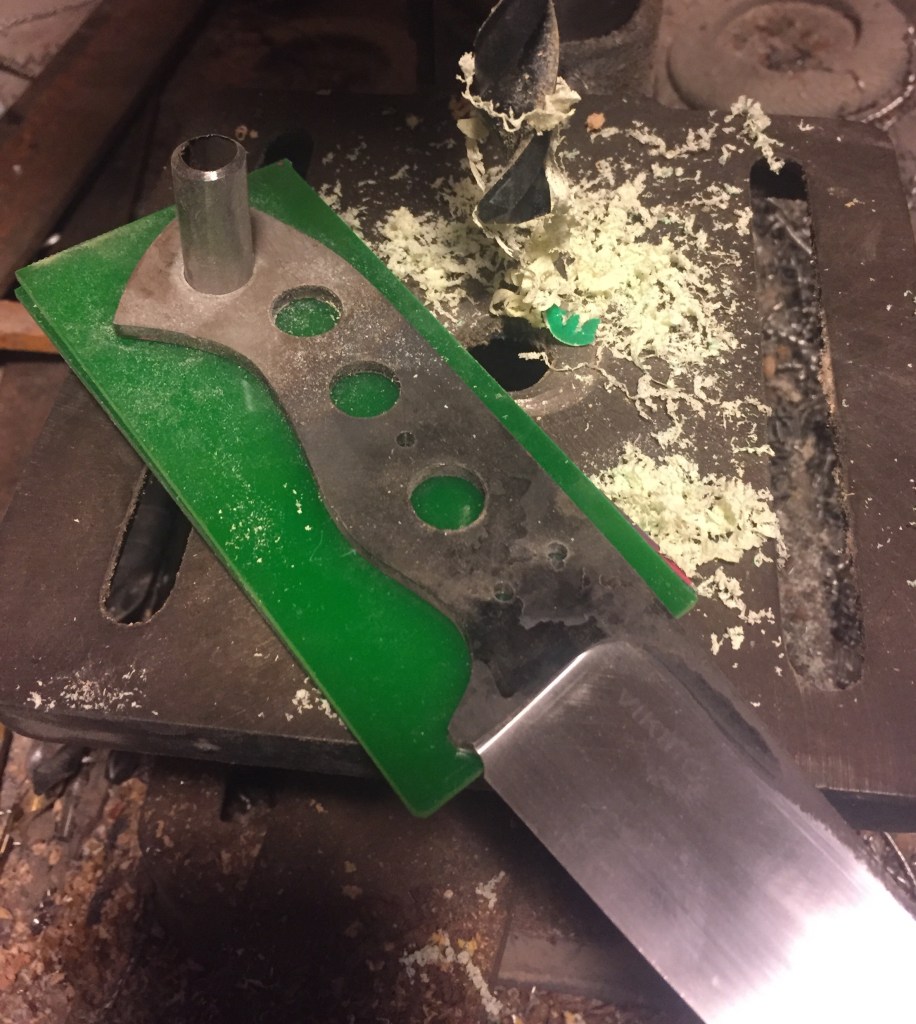
A pair of Carthartt work dungarees, probably about 10 years old.

Instructions for Care:

 Your knife is made of high carbon steel, which means it will take a keen edge, hold it a good while, and will be easy to sharpen.  It has been etched in acid and shipped to you coated in food safe mineral oil. It will stain and patina and tell the stories of the places you’ve been.  Be sure to keep your knife clean and oiled when not in use.  Should you find any unpleasant surface oxidization you can remove it easily with a lightly oiled bit of 0000 steel wool, or a coarse rag with a bit vinegar on it.  She is built to be used, so don’t be shy about getting her dirty.

You can read more about Gun Dogs here, as well as find more resources on this very old tradition
Knifemaking: the things that are ours and the Notre L’affaire

“But then I have always been somewhat of a square peg in a round hole.”

Cressida Cowell- How to Speak Dragonese


When I was five years old I had my first lesson in finding out that the world might not be built for me.  I was not in kindergarten yet because I had told my mother that numbers and letters had looked too hard for me.  Perhaps I really wasn’t ready, or perhaps I was just stubborn, but this would leave me a year older than all my classmates through my entire academic career.  So at five years old I was sitting with all the other five year old preschool kids who, for whatever reason, weren’t quite ready for kindergarten either.  It was around Thanksgiving time and we were making hand turkeys out of construction paper.  You are probably familiar with the process, where you trace your hand and your fingers become the tail feathers and your thumb becomes the head and then you cut the entire thing out and add all the plumage.   I was having an incredibly difficult time with it.  I couldn’t get my scissors to work and I had no idea why.

As it turns out I was, and still am, left-handed.  They had no left-handed scissors, and the poor ladies couldn’t explain why I was the only one who cut with my left hand.  The silver lining was that when I looked at the wall of hand turkeys for the next two weeks before we took them home I knew exactly which one was mine- the sort of mangled looking, Mattisse-inspired one with it’s shredded, soft edges and pastel color themes.  It might not have quite fit in, but that turkey belonged to me.

I think a major source of anxiety today comes from a pressure to fit in.  We are pack animals after all, social creatures, and there is a large degree of comfort and safety that comes with fitting in.  For whatever reason some of us just don’t fit.  Maybe our personal values don’t align with the metrics of what society calls success.  Maybe the things in the world that move us have been wrought and tempered in such a way that makes the mainstream feel incredibly dull and boring.  Maybe we were brought up in a fashion that causes us to question the rules and the people who make them.  Or perhaps our idiosyncrasies and the way we see the world simply makes others in the pack feel uncomfortable. 

Because the reality is that life is uncomfortable and existence is messy, and no amount of corporate team building exercises or ‘life is beautiful’ bumper stickers will change that fact.  The square pegs of the world know this, because things have probably always been uncomfortable.  The beauty of being a square peg that doesn’t fit into the circular opening of life is that you find a way of living that is unique and meaningful to you.  Usually that means crashing through more than a few romantic relationships, getting fired from a few jobs, making a whole lot of mistakes, and generally being a mess for awhile.

When you finally pop out on the other side of all that, you may find that what you’ve become is completely and totally your own, free of mimicry and imitation.   All those things that you’ve become- those belong to you and no one else.

(I taught myself to cut right-handed in elementary school to save myself and my teachers a lot of grief.  I cut better right-handed than I do left-handed.  You have to pick your battles.)

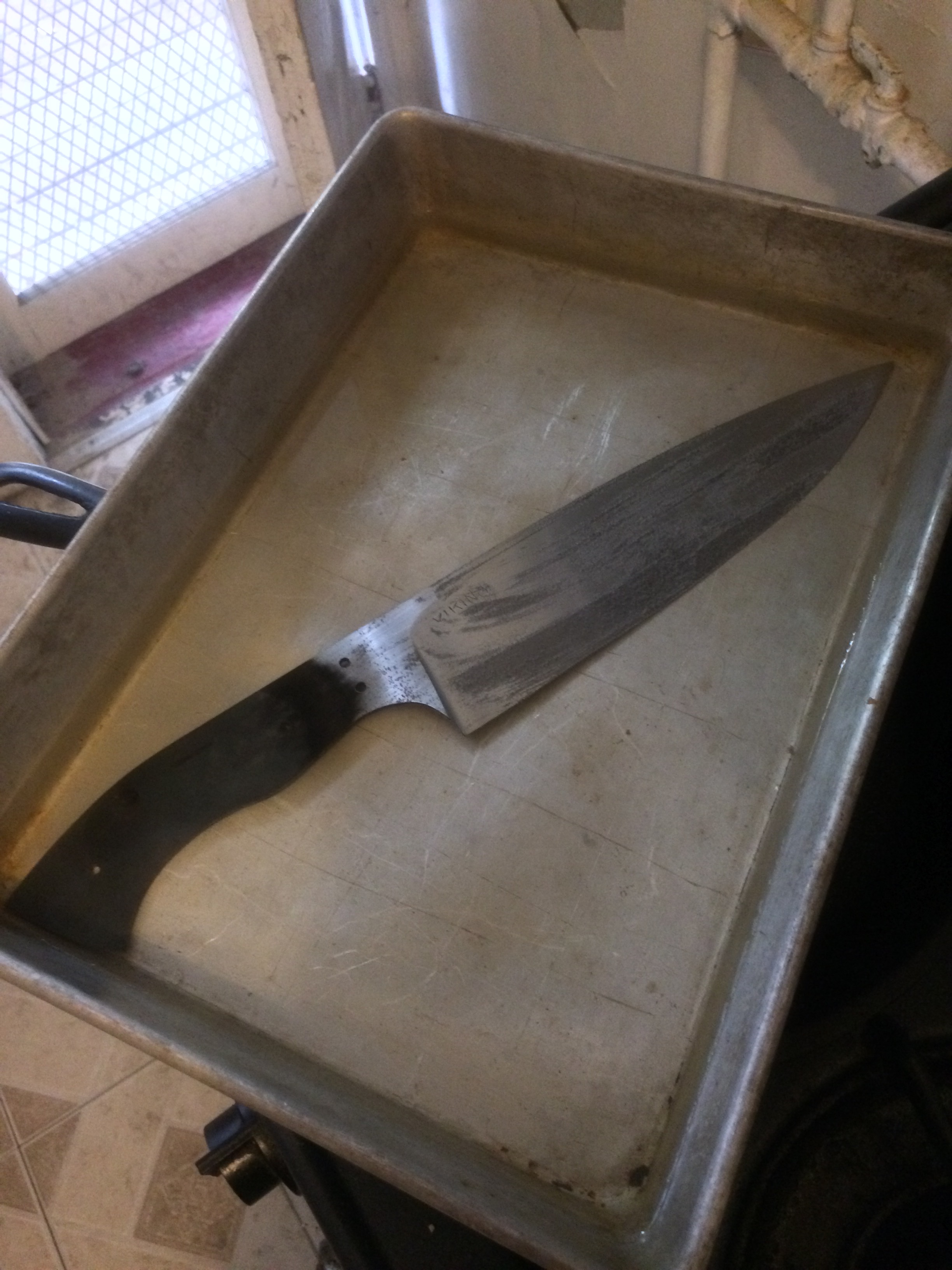
This knife was commissioned for a chef at a local restaurant by his girlfriend.  I love making knives for restaurant people- anyone who winds up in food service is totally a square peg.  In talking to the girlfriend, who works in hospitality, she told me that they were both a little crazy, which is part of what makes everything so interesting.  ‘Notre L’affaire’ roughly means ‘our thing’ in the sense of something intimate and personal, like a slightly rough-around-the-edges turkey made of construction paper hanging on a pre-school bulletin board.  You should always recognize and honor the things that are yours.


An 8″ chef in the German Style:

Hi-carbon American 1095 steel:

Profiled and drilled:

Into the forge:

Making sure everything is straight:

Grinding the bevels:

img_7555

a5882d54-3626-42c7-848a-b3b1a1c3a553

Hand sanding:

Satin finish:

An acid etch to help with corrosion resistance:

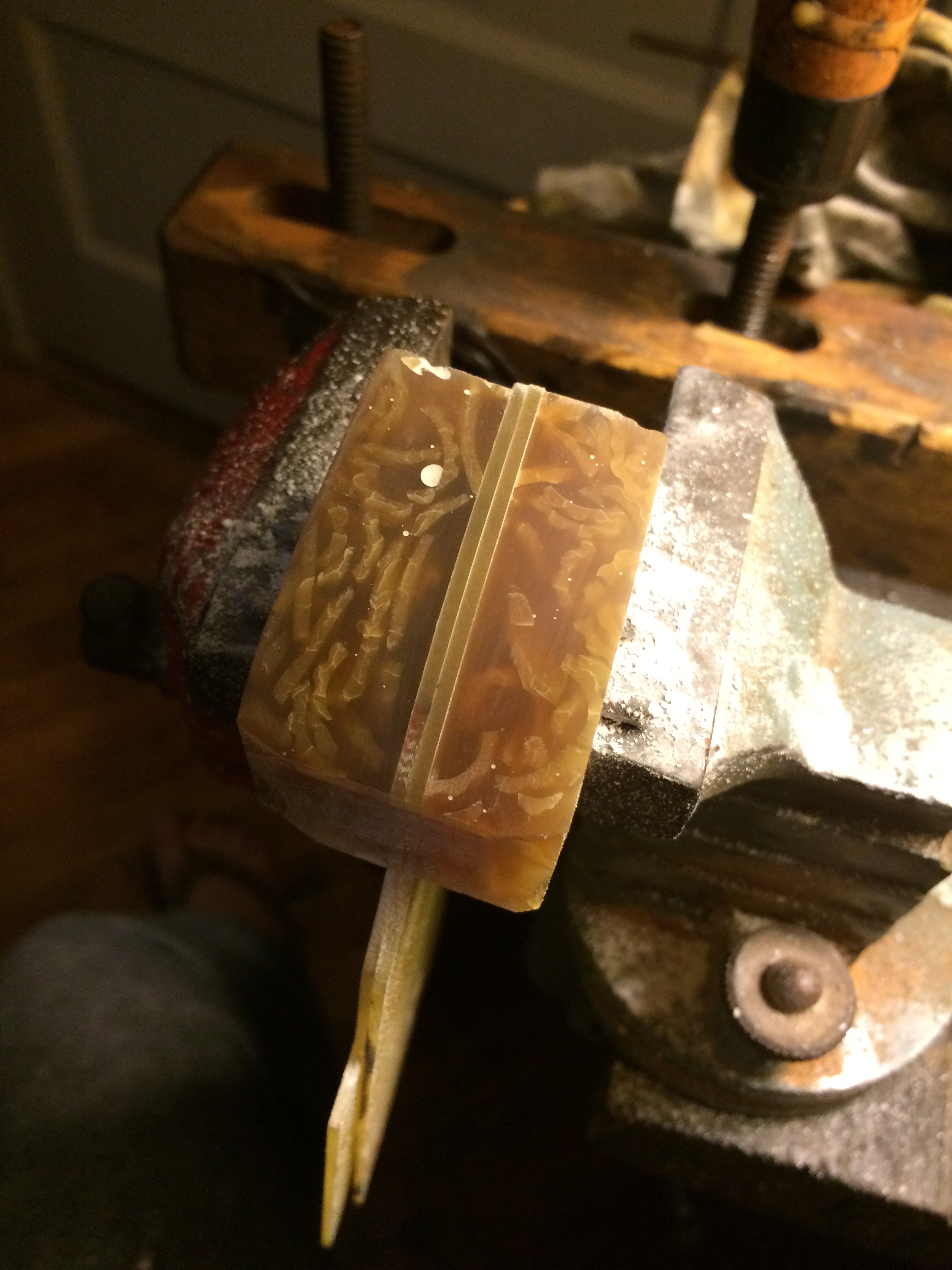
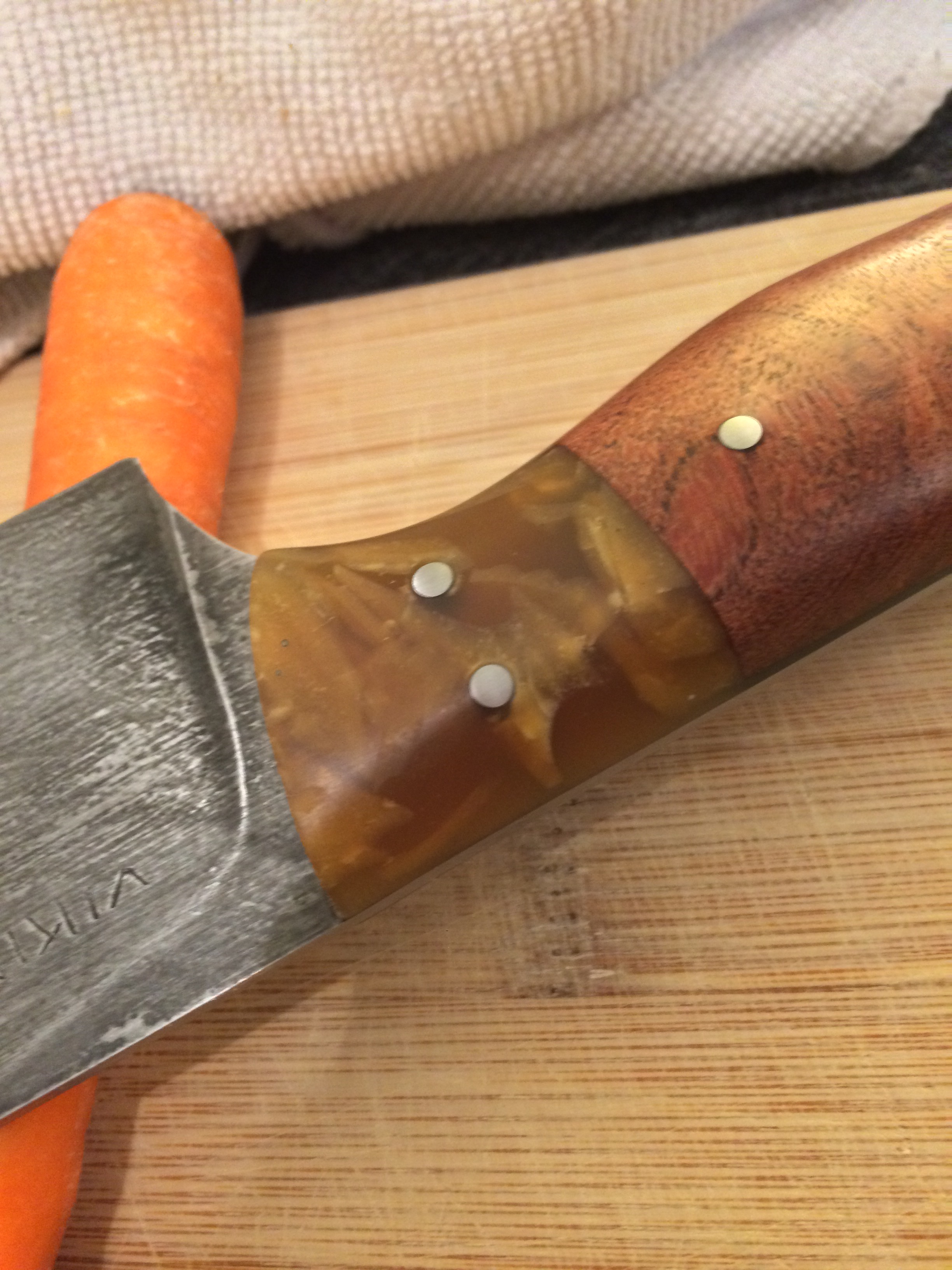
For the bolster we’ll make a material out of bow tie pasta:

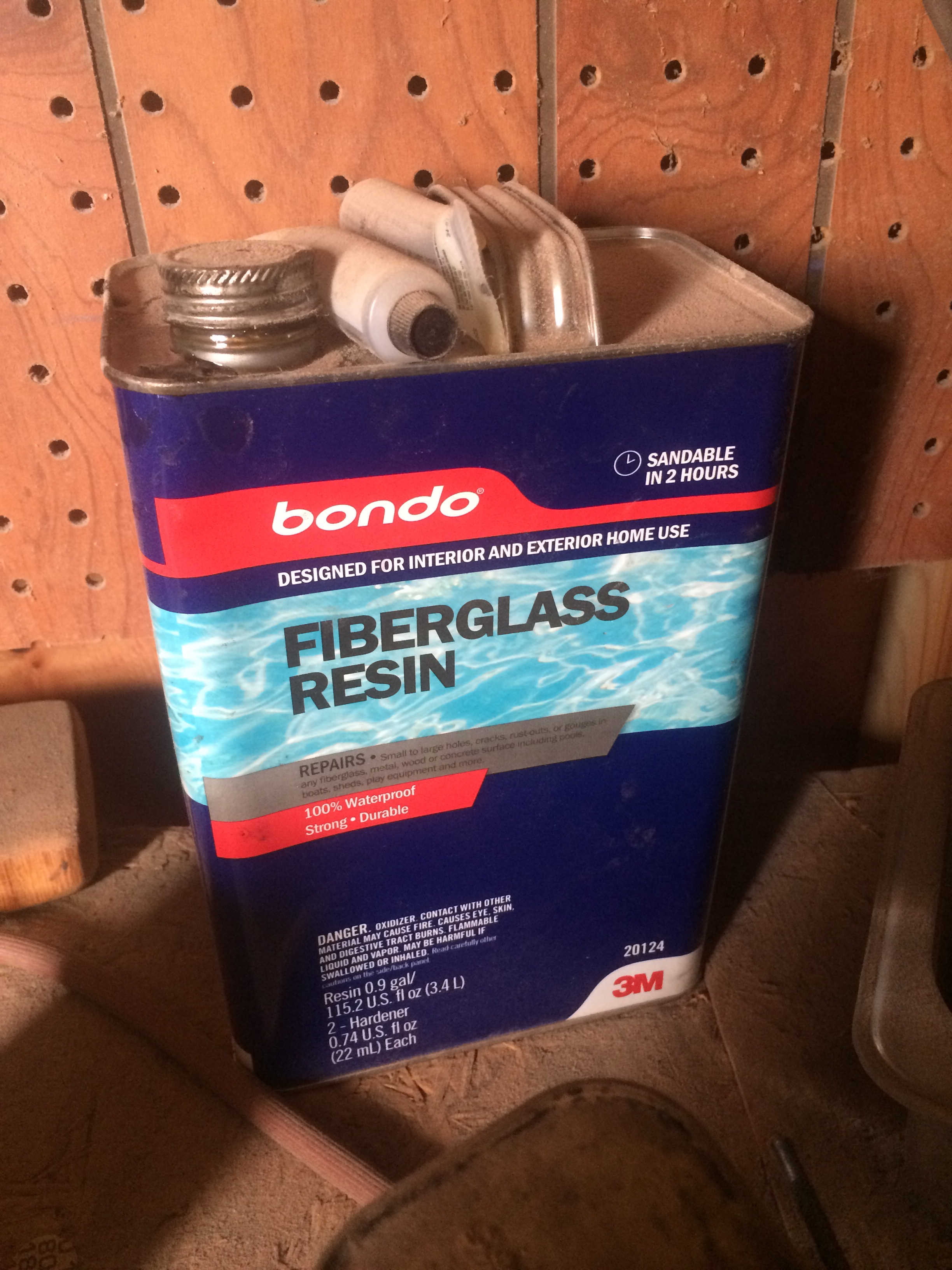
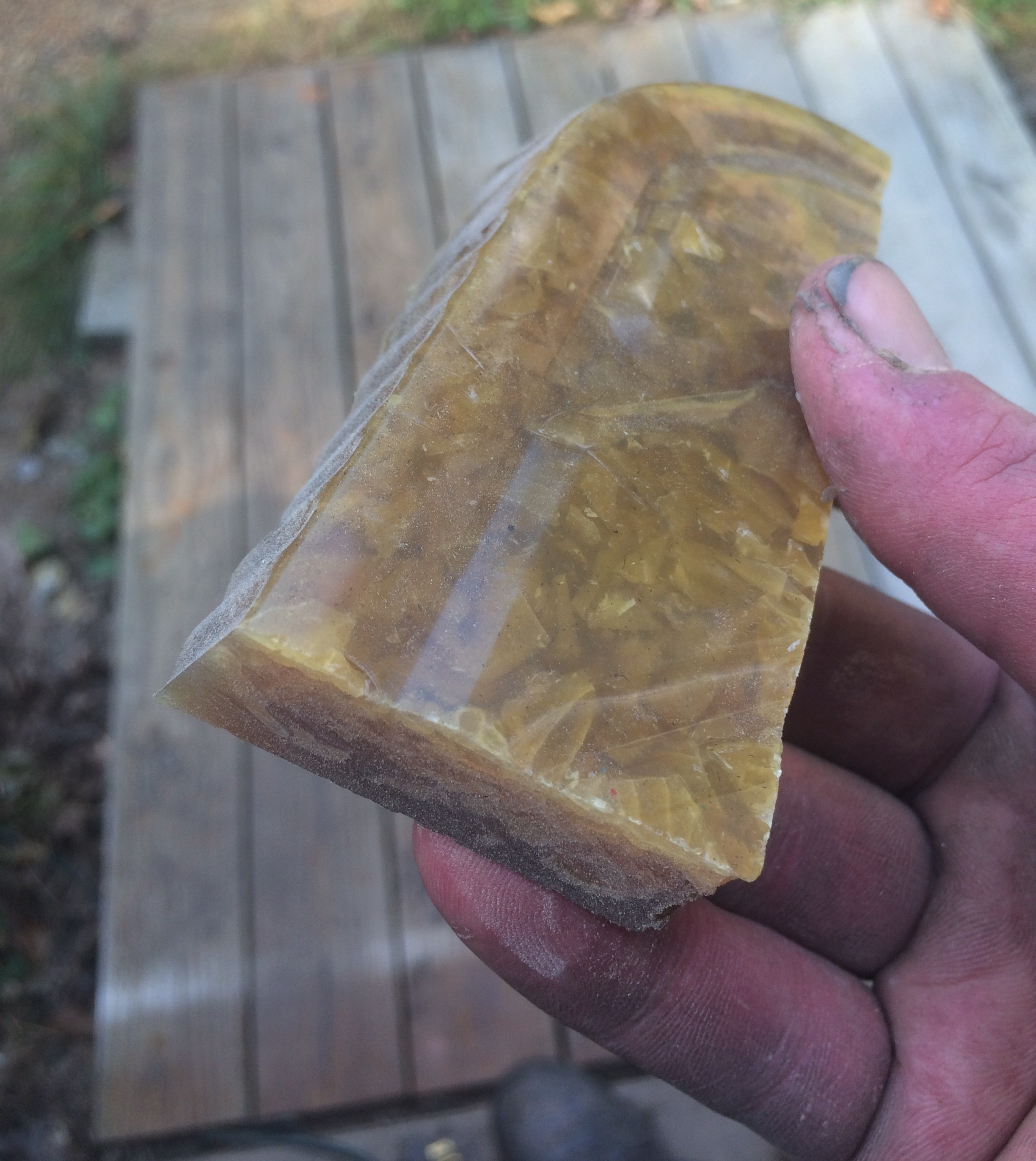
After it gets smashed up and set in fiberglass resin…

…you get something like this:

img_7586-e1568582334258.jpg

Texas Mesquite:

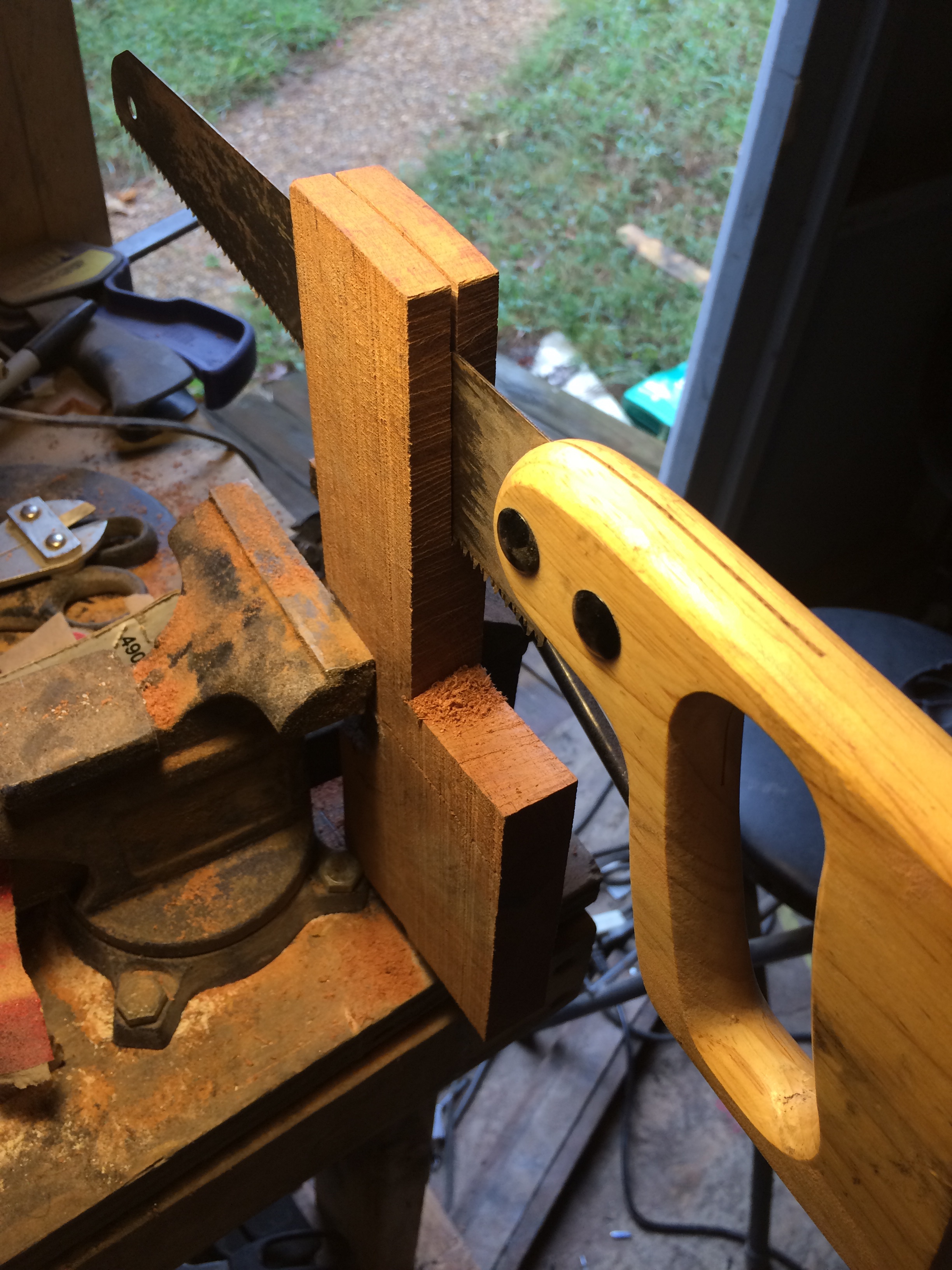
Glued:

The Notre L’affaire:

Knifemaking: a restoration

“You didn’t get the quest you wanted, you got the one you could do.”
Lev Grossman, The Magician King

Every so often our shop will get calls to put a new handle on an old knife.  We always make every effort to do as many of these as we can.  

The ability to make something broken work in the way that it once did is a virtue.  This is especially true when the something that was broken is special to someone.  In most instances it’s pretty easy to replace what was broken, but the sentiment becomes lost.  Whenever possible I always try to fix what is broken, especially in the shop.

I treat these repair jobs as an exercise in incorporating as many broken or discarded things as possible into the finished product- it gives something totally unique back to the client.   Our jobs as craftsmen are to give a voice to our materials, allowing them to speak for themselves.  Many times we don’t choose what comes to us but nonetheless it is our job to turn what comes our way into something beautiful.  Making something better than it was before-this is the goal of a skilled craftsman.  For those in the know, these are the things that put the color in our world.

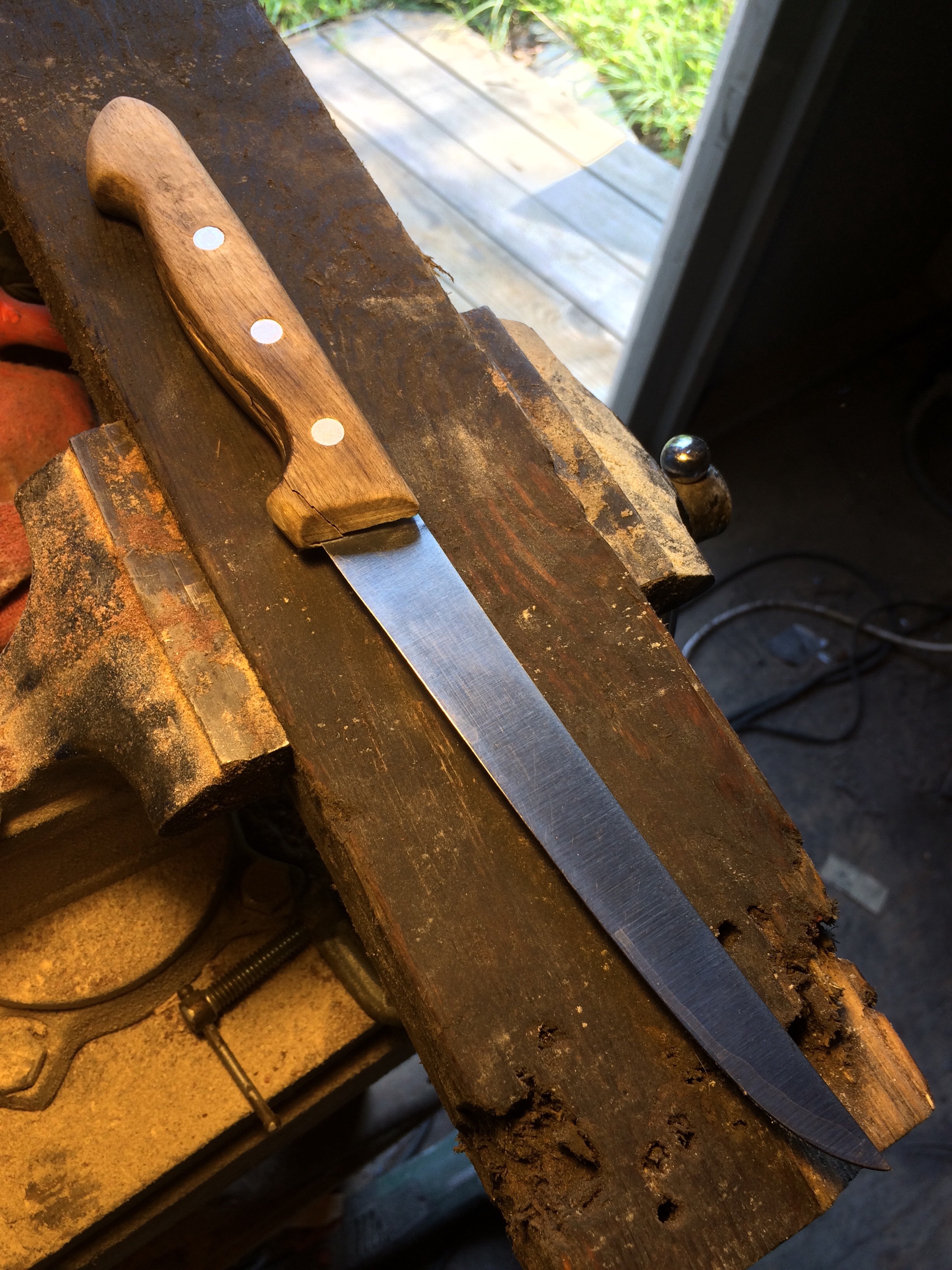
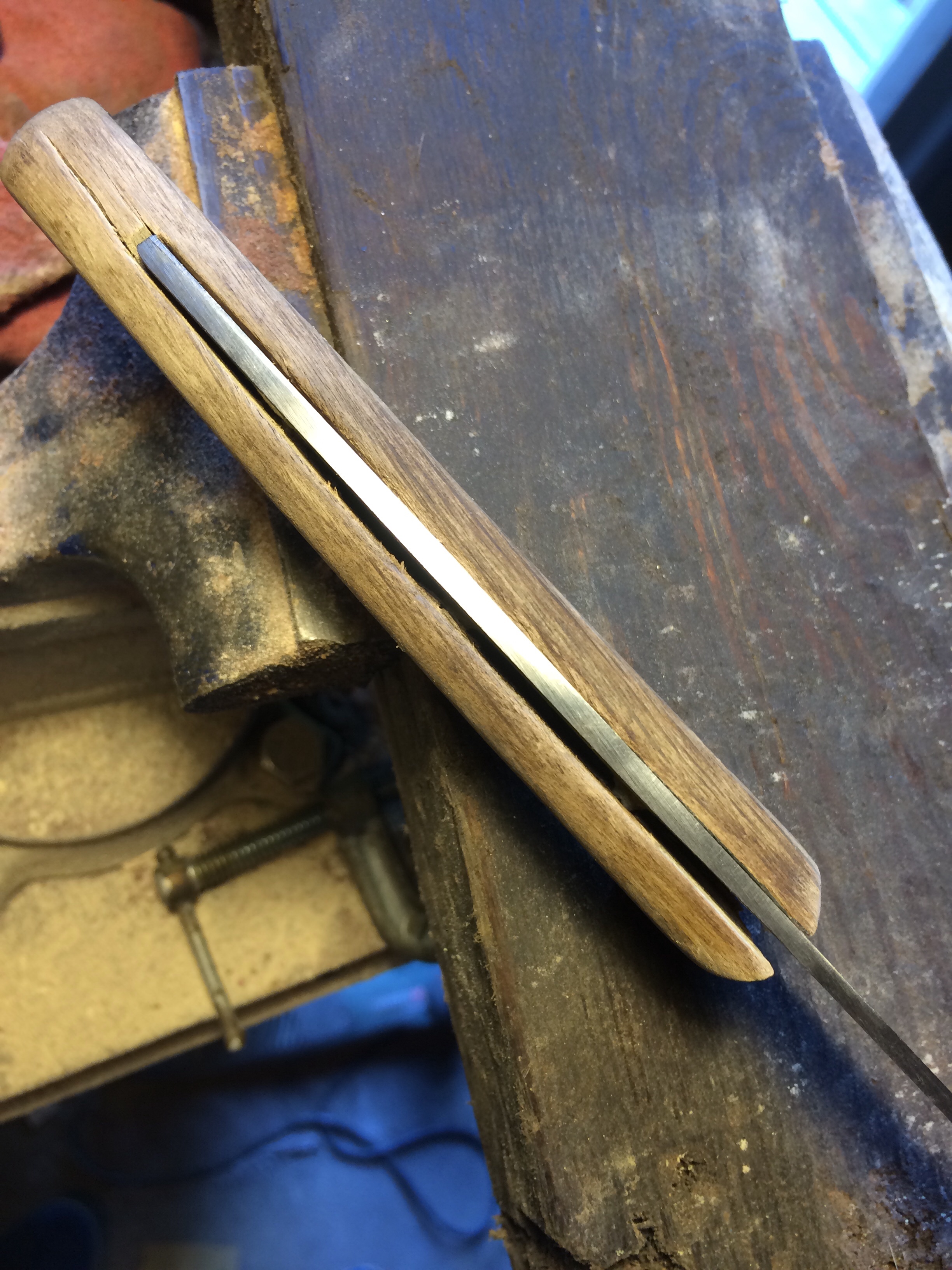
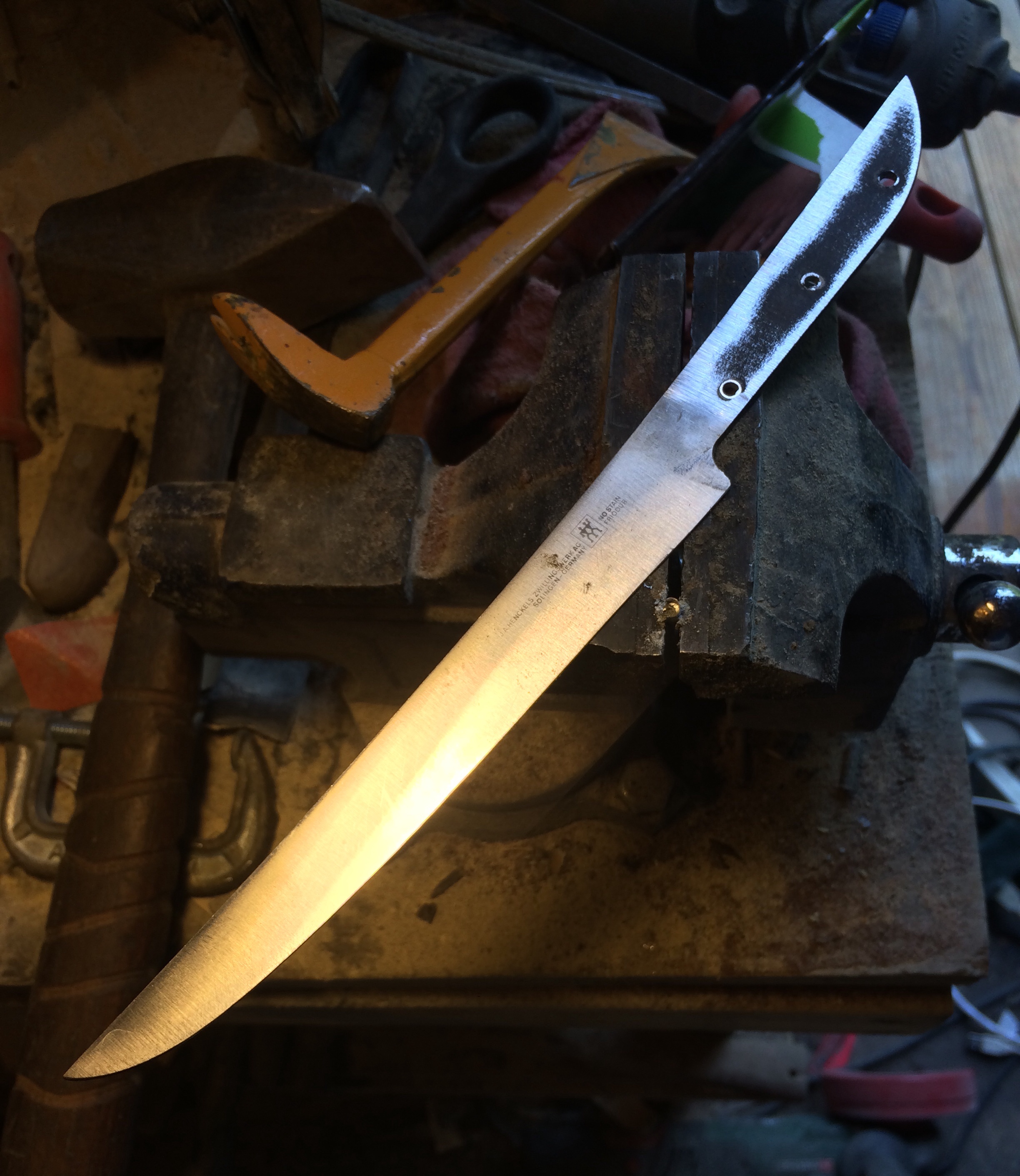
A gentlemen contacted us about re-handling an old boning knife he got in the 1970’s.  It was an old Zwilling knife, made from good Solingen steel, with Zwilling’s proprietary ‘Friodur’ subzero tempering process.  The handle had cracked, as natural materials tend to do over the years.

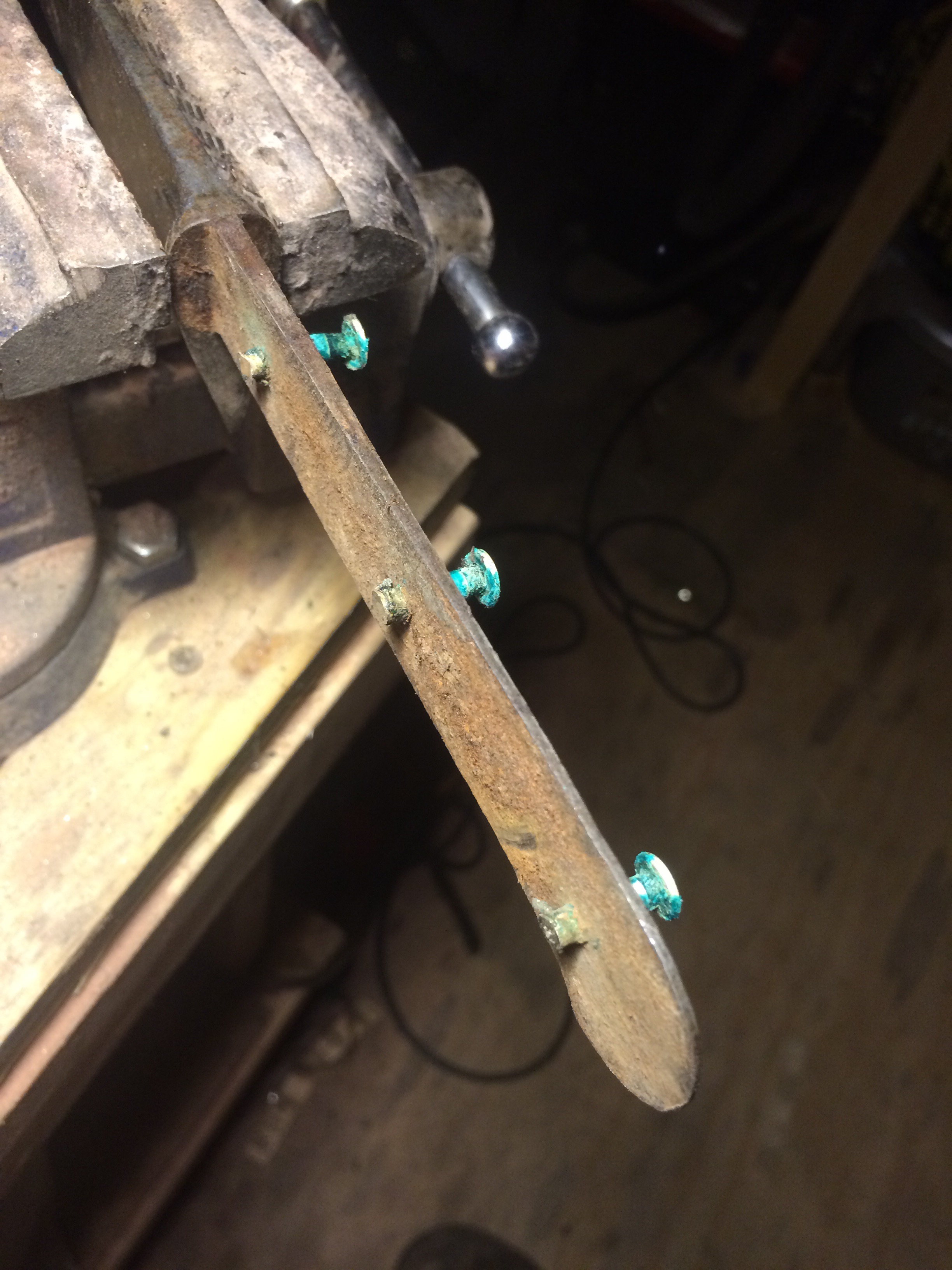
This one was partial tang, meaning the metal in the handle doesn’t run the complete length of the handle:

First, we remove the old handle and the rivets:

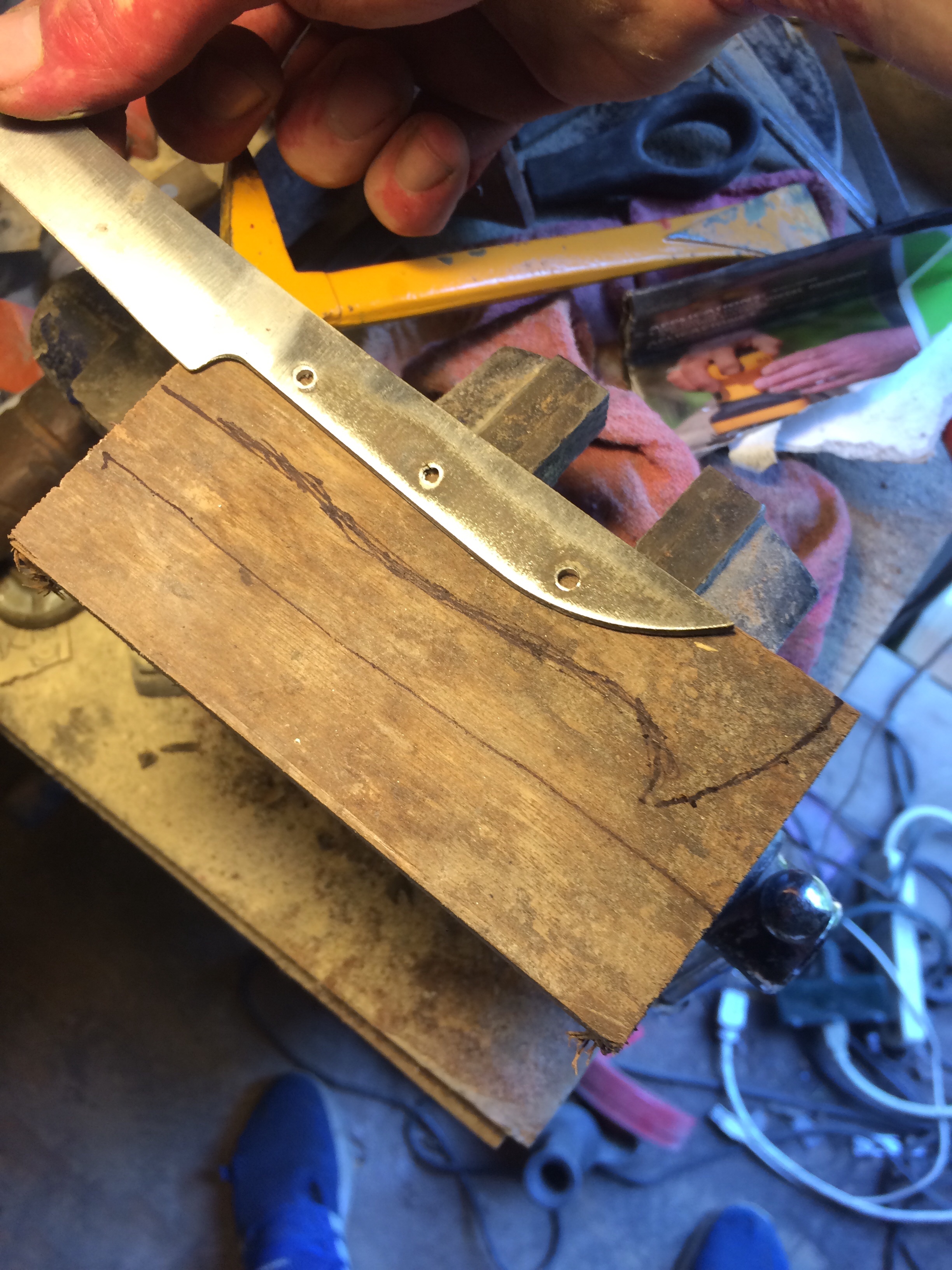
For the handle we’re going to use Black Walnut, which was formerly a baseboard salvaged from an abandoned house in North Carolina:

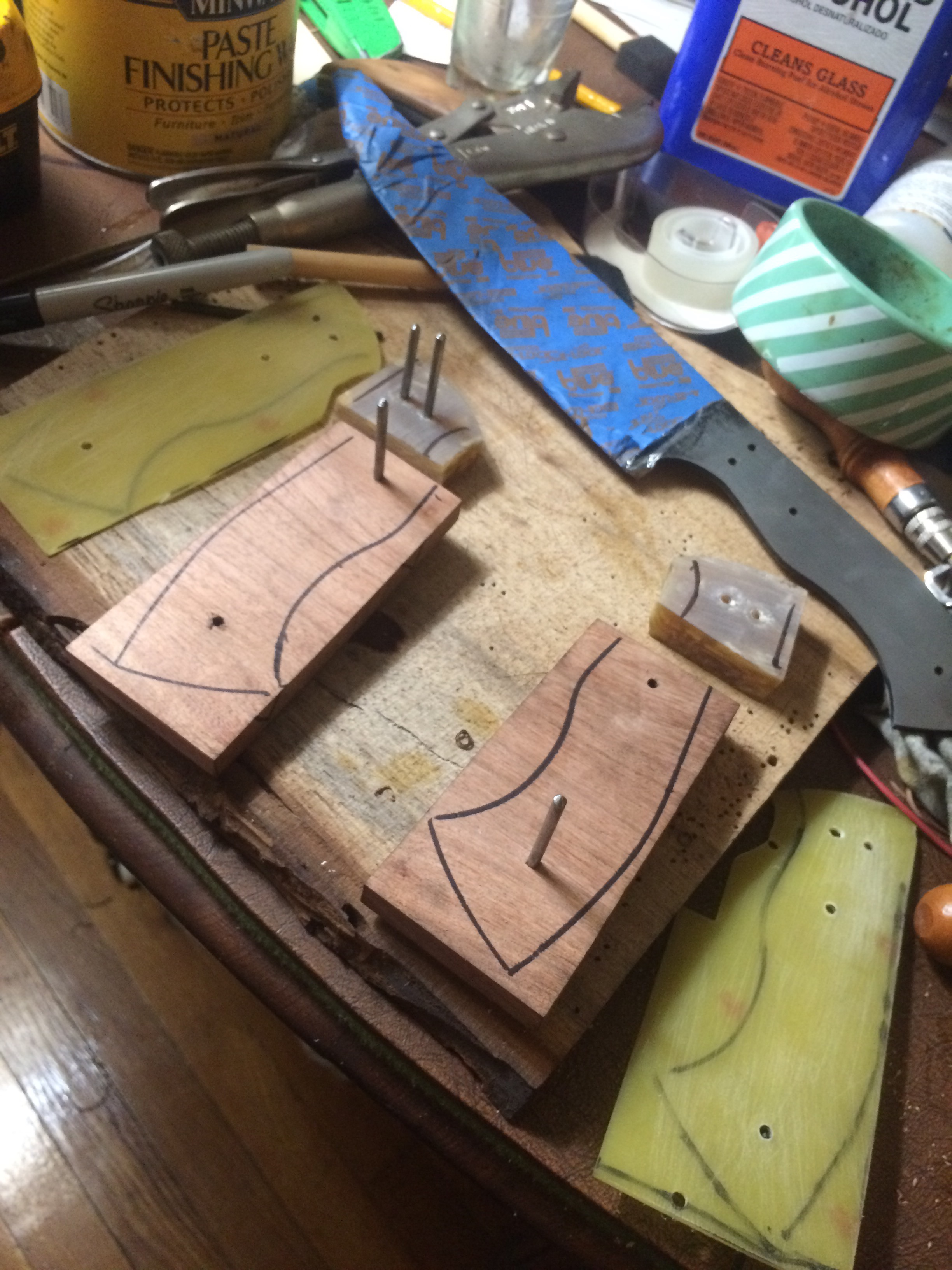
To extend the tang, we’re going to use a fiberglass computer board spacer which I dug out of a dumpster at one of my workplaces.  Though it looks yellow, it will turn green as it’s polished:

img_6337

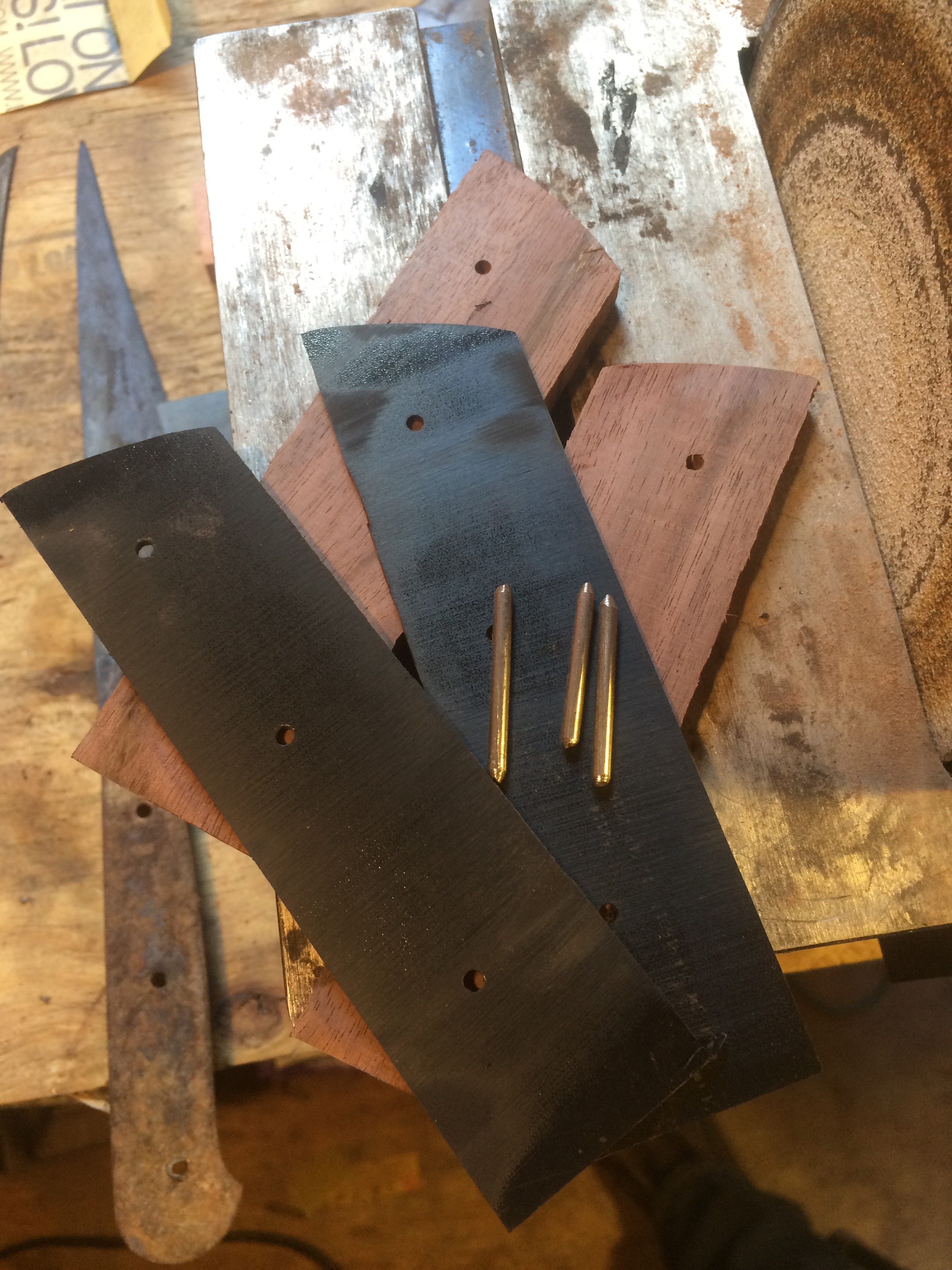
Drilling the rivet holes.  The black spacing material is a heavy plastic that came from an office mail separator:

This is the top of the handle, closest to the ricasso of the blade, of the belt sander at 40 grit:

Sanded from 60 to 800 grit:

Ready for glue up:

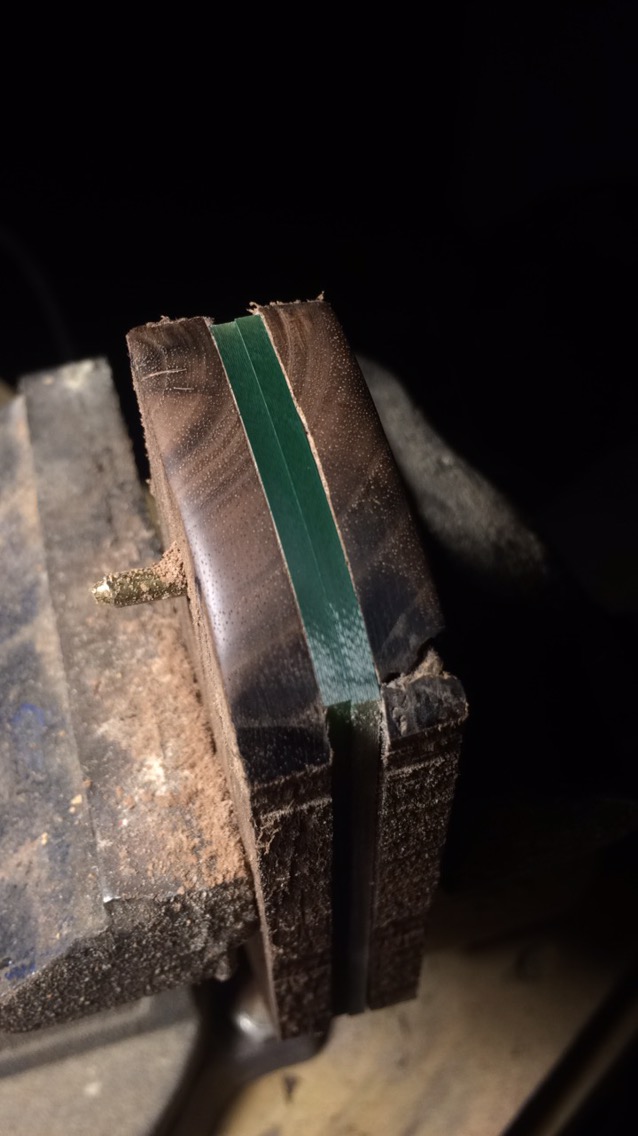
Glued and clamped:

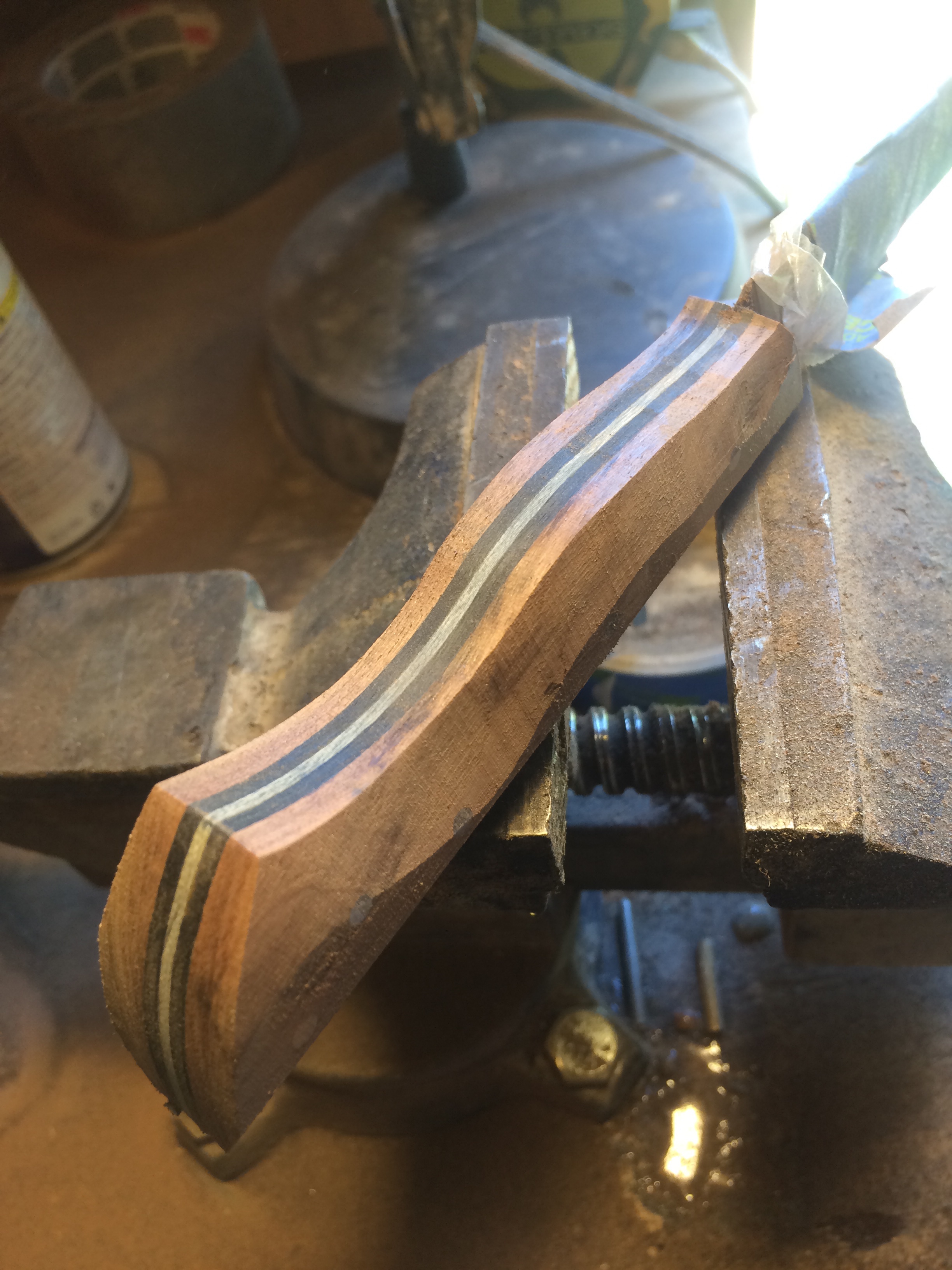
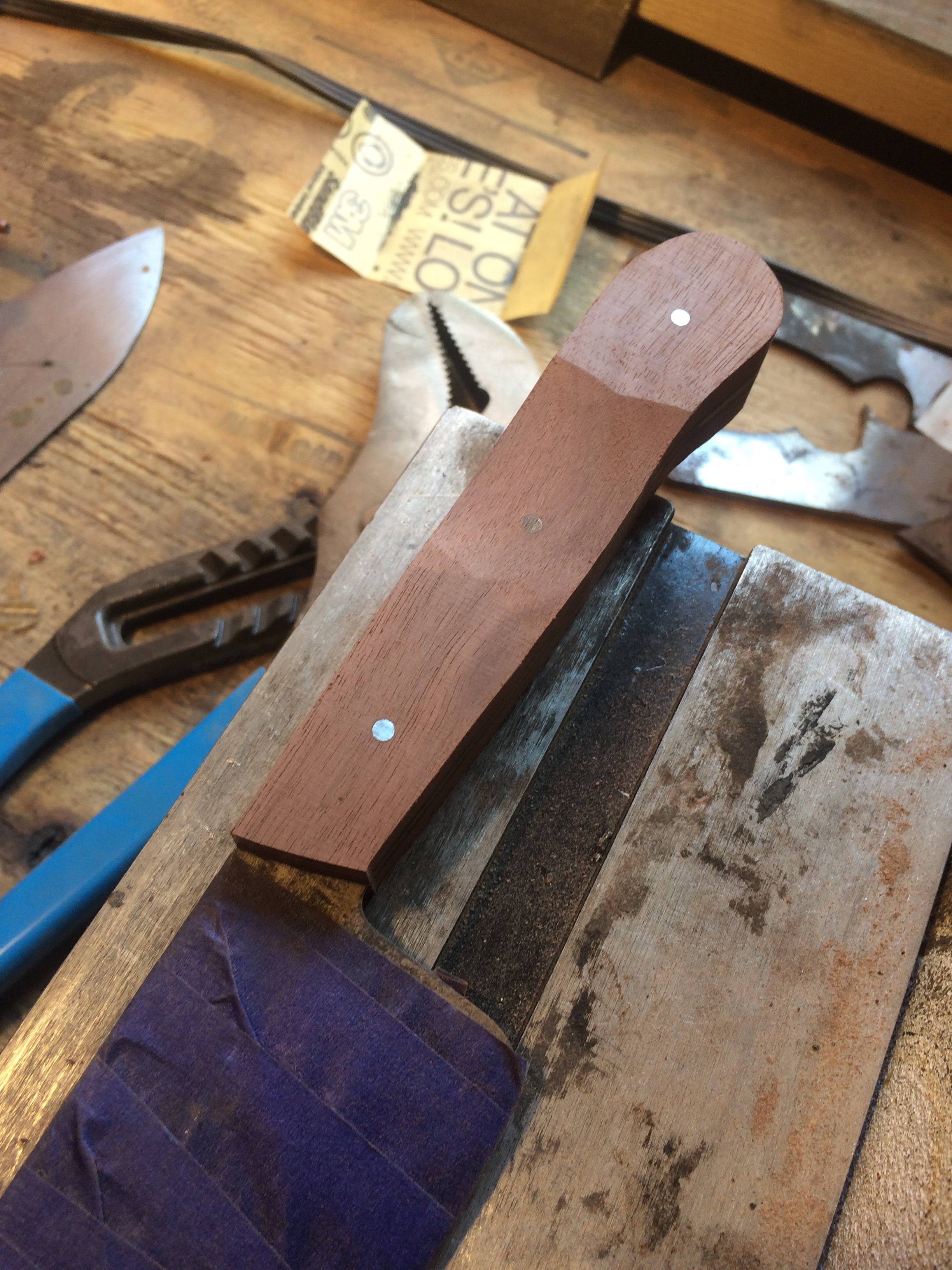
Roughly profiled:

Shaped to the desired shape.  The rest of the work will be done by hand, starting with 80 grit sandpaper and going up to 2000 grit.

Finished, sealed, and oiled:

Always take the opportunity to create something beautiful.

Knifemaking: the other side of things, and the Hippo

“Audi alteram partem.”

“Hear the other side.”

-St. Augustine of Hippo


The other side.  Sometime we’re so used to seeing everything from our own point of view that the other side can seem foreign, or even wrong.  But to truly live and to understand, sometimes we have to hear the other side, or even live over there for awhile. 

The “other side” can be just about anything.  St. Augustine’s quote can be applied to today’s politics- gun control, immigration, issues of gender identity- issues that are magnanimously polarizing and place many of us on one side or the other.  We simply don’t listen because we don’t think what the other side has to say has any use to us.

And it goes deeper.  We don’t hear the other side of what many parts of our life have to tell us.  Maybe they are unpleasant or painful, or we feel they don’t serve us, or they are extraneous and not needed, or they poke at a deep wound that we would rather leave alone.  So we go through our world pretending the other side doesn’t have anything to say to us.  This usually works until it doesn’t.  And then life will come and hand us a situation or circumstance that places us on precisely the other side of where we’d like to be.

Some of the happiest people I know have been through the greatest sorrow.  The most loving people I know have suffered losses so great that when I put myself in their shoes I’m not sure how I’d get out of bed in the morning.  But these are the people who have heard the other side, and know that the highs and lows are two sides of the same coin.  The other side of suffering is serenity; the other side of pain is pleasure; the other side of misery is joy; and the other side of grief is love.  In shutting ourself off from misery, we are effectively shutting ourself off from our greatest joy.

…….

It was the summer of 2004 and I had been invited to my first wedding.  A friend of mine was getting married.  We had grown up down the street from each other and had gone to high school together.  As an awkward and maladjusted teenager I had always been grateful that she had been such a good friend to me.  She had graduated a little before I did and liked to travel- she would send me postcards sometimes.  At this point I had been in college for a couple of years and had barely seen any of my friends I had grown up with, including her.  I was really happy for her and excited to see how she was doing, and glad she thought to invite me.  The service was going to be in a little chapel on her college campus, about four hours away. 

Then, about a week before I was going to head out, another friend I had grown up with died in an extremely traumatic car accident.  It was really bad.  It had been late at night and their car had crashed and caught fire.  There were three other passengers and no one could get out.  No one survived and they had to be identified by dental records.

The funeral was a day before I was headed out of town.  I took the day off of work from my summer job to go to the service.  I was much younger and pretty naive to a lot of the ways of the world but I noticed that nobody, not family or church clergy, had anything substantial to say to make any sense of it.  After a few years I would realize that this is the ultimate tragedy of a young person dying- there’s nothing anyone can say to make it better.  I grew up with this guy, we did church youth group together.  We weren’t particularly close but we had spent a lot of time together over the years.  Gradually I felt my emotions getting the better of me throughout the service.  I tried thinking about baseball, but during the eulogy it was all waterworks.  My father, who had come with me (and I was glad he did), handed me his handkerchief.

….

After the funeral, I packed a suitcase and drove four hours to attend a wedding the next day.  I remember that drive very clearly- blasting music and feeling a bit of grief but otherwise very happy to be alive.  I checked into my hotel and went out with a couple of friends that I hadn’t seen in forever.  Up to that point I don’t ever remember laughing so hard.  I stumbled back to my hotel room, which was a mile and a half away, and went to sleep, quite content with laughter and health.

The next day I went to the wedding service.  There was a string quartet playing processional music, I think it was Ravel, and lots of flowers.  It was a really happy and beautiful service, and I remember how incredible it was that one day you could go to a funeral and the next day a wedding, and that these were perfectly natural occurrences to have in one’s life.  I don’t know if I would have been nearly as grateful and present if I hadn’t had the previous day’s experience of being on the other side.

It’s a strange world we live in.  Be sure to hear what the other side has to say. 

…..

The Hippo was a commission from a gentleman for whom I often do contract work.  It was built for his wife, a lady who’s faith is extremely important to her.  She loves to cook and I was told the only kitchen tool she didn’t have was a cleaver, so I designed and built her one.  I named it the Hippo after St. Augustine, as a nod to the saint who’s writings influenced many subsequent saints, and because of it’s sheer size.  This thing is massive.

On 1/4″ stock, O1 tool steel:

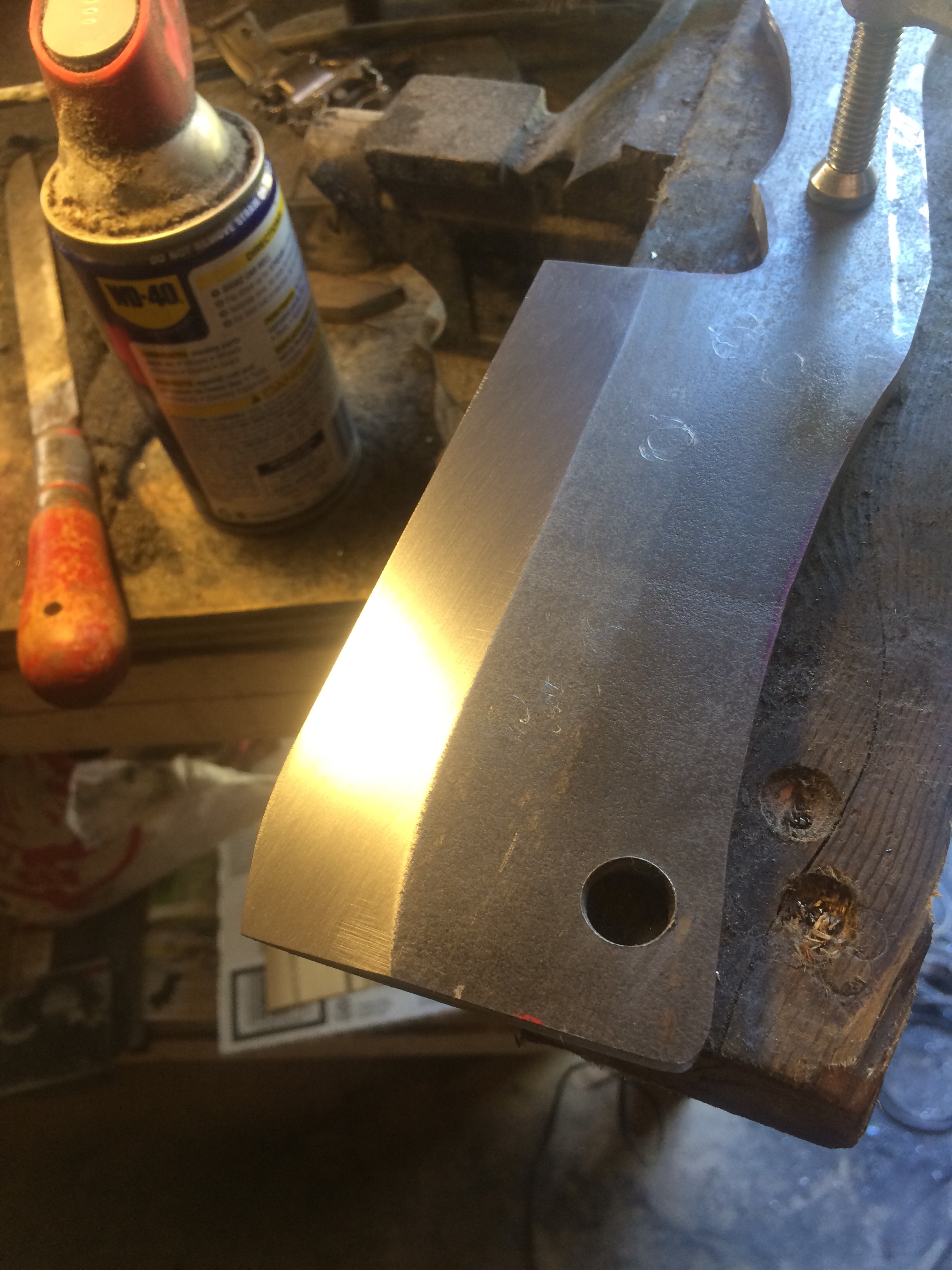
Boring out the hanger hole:

Profiled:

Bevelled:

img_5683-1

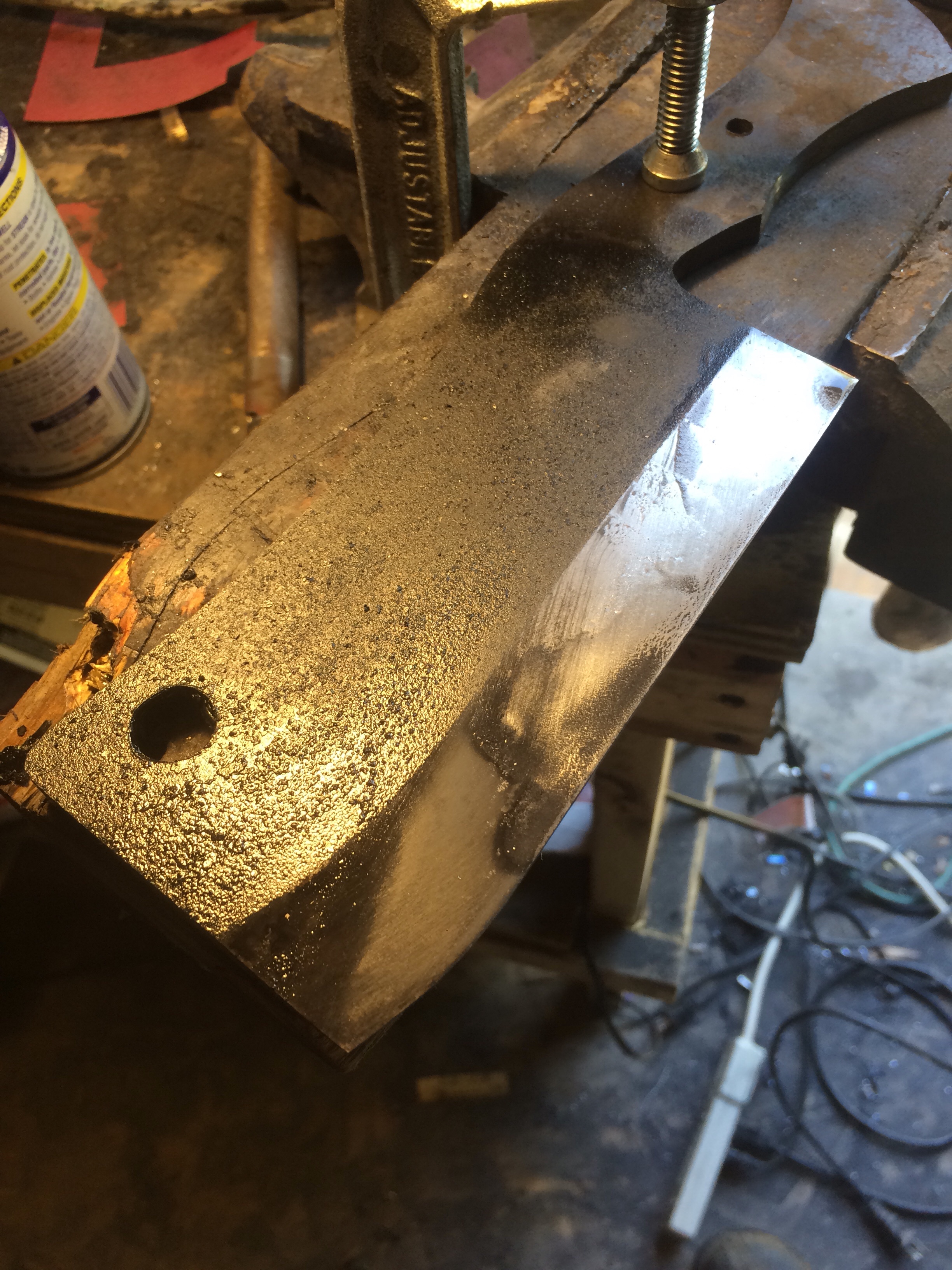
Polishing before heat treat.  Removing machine marks now will make polishing easier what this big boy has been hardened:

This thing barely fit in the forge:

Removing some of the firescale:

The business end is polished:

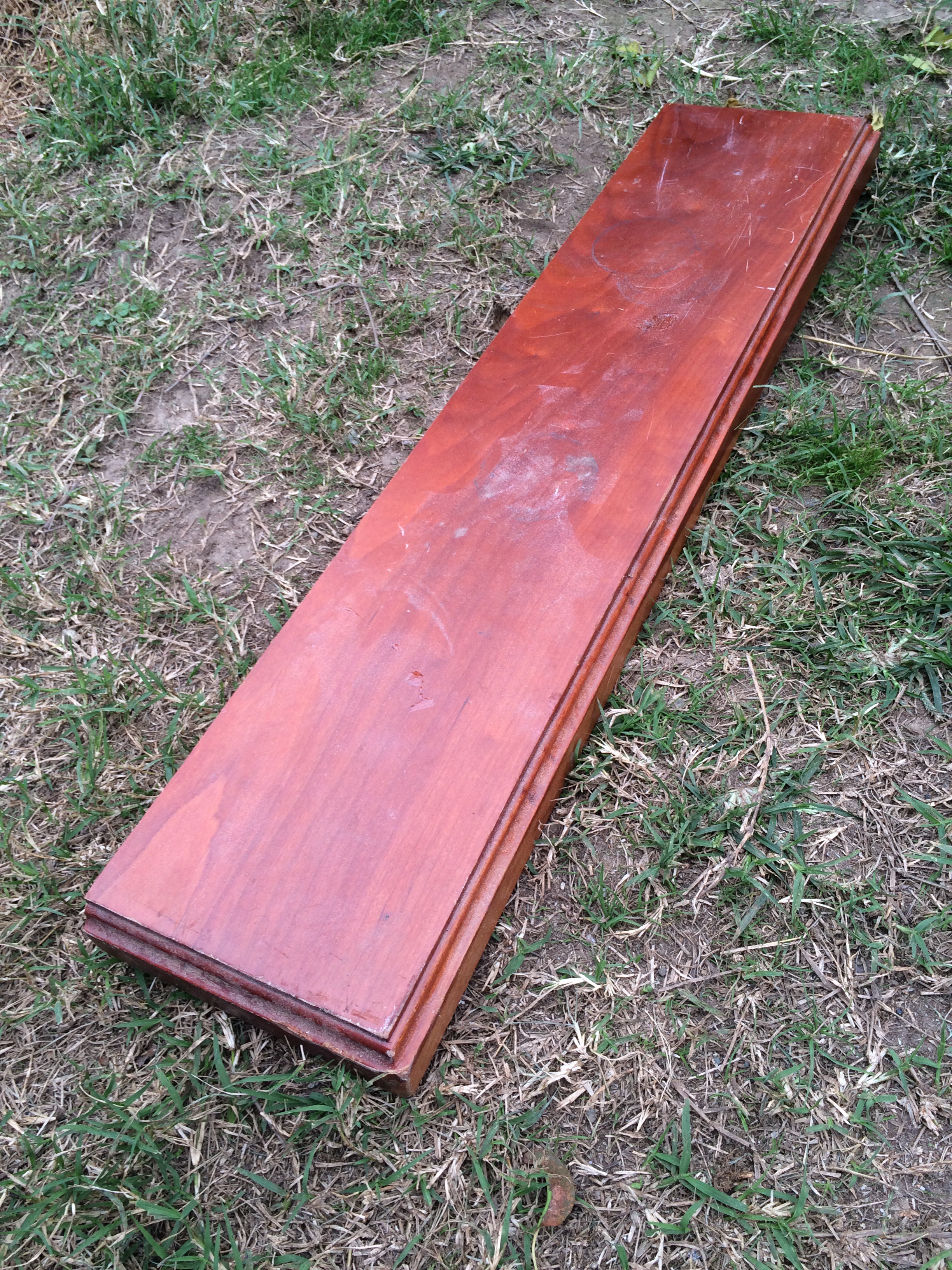
This is a piece of Cherry wood the came off the mantle of a fireplace:

img_4010

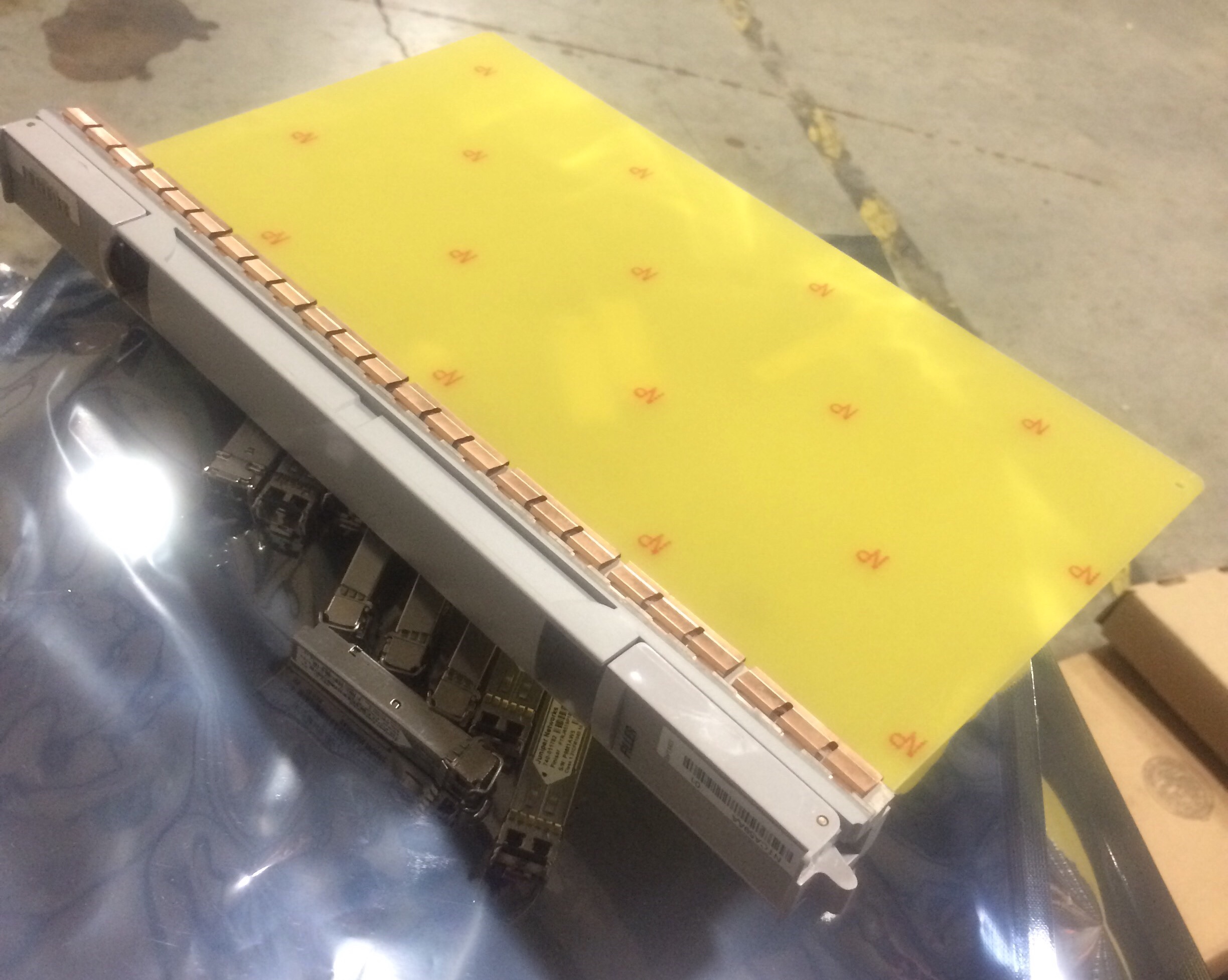
Computer board blank for spacing material:

img_4579-1

Drilling the rivet holes to attach to the tang:

The grain is quite lovely:

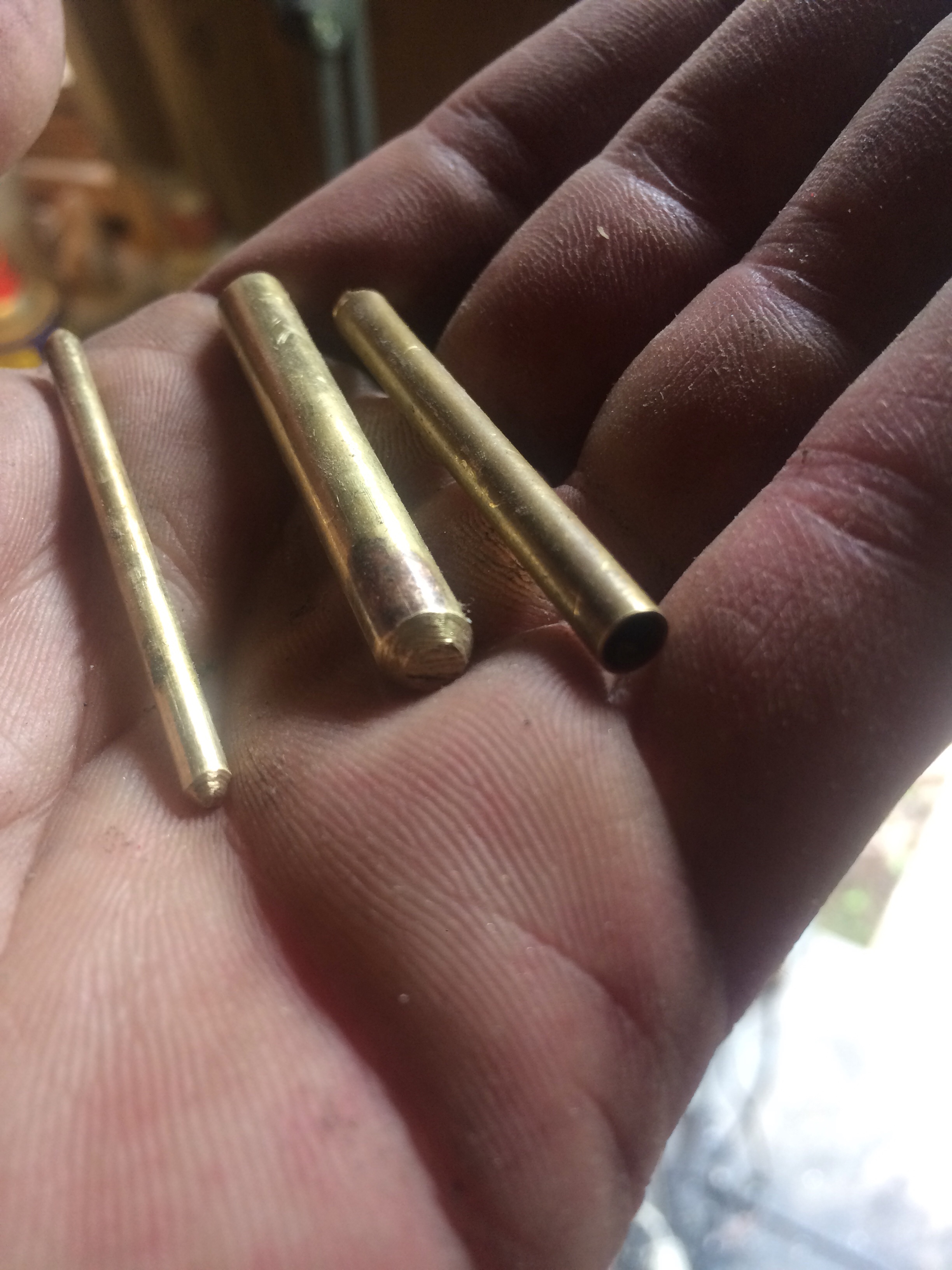
Brass rivets- the middle is the Father, the right is the Son, and the left is the Holy Ghost:

Clamped and glued up:

The Hippo:

Knifemaking: The Things That Come to Us- A Restoration

“i imagine that yes is the only living thing.”
― e.e. cummings


There are many things that come into our own personal worlds- children, possessions, problems, blessings and a myriad of others.  It’s not so important how or why they enter our lives, but what we do with them.  It expends a great amount of energy to ponder what we may have done to deserve the painful and traumatizing events that come to us, and an equal amount of energy is wasted when we wonder if we are worthy of the good things that are brought our way.

Because when we start dwelling on the why’s and how’s, we tend to become overwhelmed and lose sight of what best needs to be done with what comes into our lives.

And within that judgement of why and how, we start to say no to things.  We become afraid we may be hurt, or that we may fail ourselves or those we care about.  Perhaps we are afraid of making ourselves unsafe.  Whatever the reason, in saying no we shut ourselves out of the blessing may be inside of a painful situation.  We say no to what may be a path forward because it is dressed as something unpleasant.  It is then that we become prisoners in our lives instead of seeing the ways we can be shaped and grow.  We should say no to things that are harmful and do not better us, but it’s always good to say yes to what life brings us.

The summers are slow for me, and sometimes I have to get creative in the ways I support myself.  I end up saying yes to many opportunities that under normal circumstances I would decline, usually due to time constraints, time away from loved ones, or a high probability of bodily endangerment (or a combination of all three).  Over the years the things I’ve reluctantly said yes to have usually been the most rewarding.

One of the times I said yes this summer was to a tree job in rural Virginia.  I was on a crew to cut down a huge dead tree.  Removing dead trees can be dangerous.  Rotting can occur in any number of unseen places of the tree, causing structural instability, and the tree may not fall where or when you desire it to fall.  This particular tree, though dead as a doornail, fell exactly as it was supposed to.

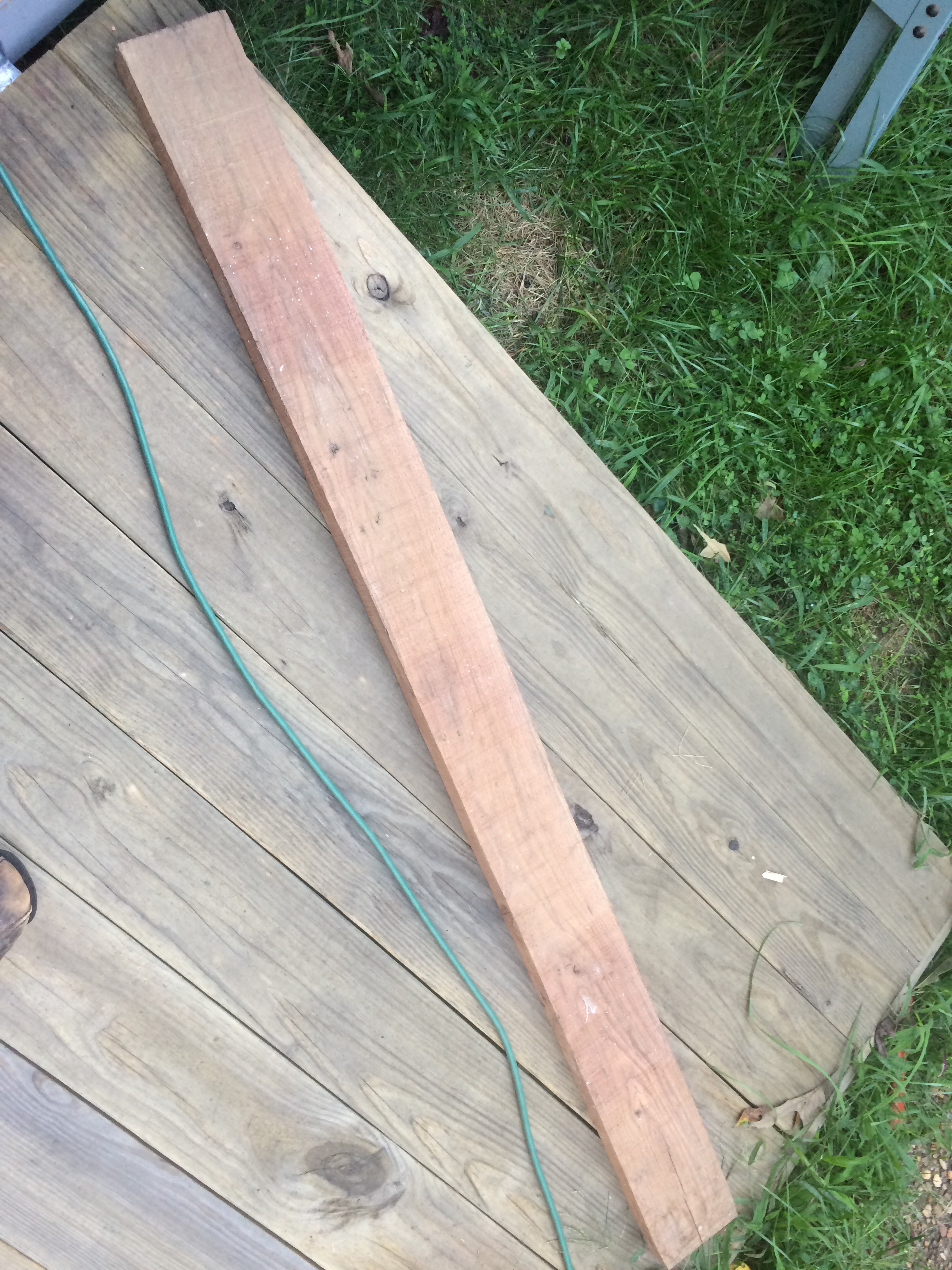
The client was an artist, and brought us French-pressed coffee.  We talked for a bit and I told him about making knives and how I got my materials.  He told me that he had some slabs of black walnut and that I was welcome to them.  They had been milled by a neighboring man who had run an abbey in South Korea, saying ‘yes’ to whatever fleeing defectors and dissidents from the North that the world brought their way.  Later he sent me an article about the man who cut the wood, you can find it here.  Black Walnut is expensive and isn’t something to normally fall into one’s path, so, in the practice of saying yes, I happily took some.

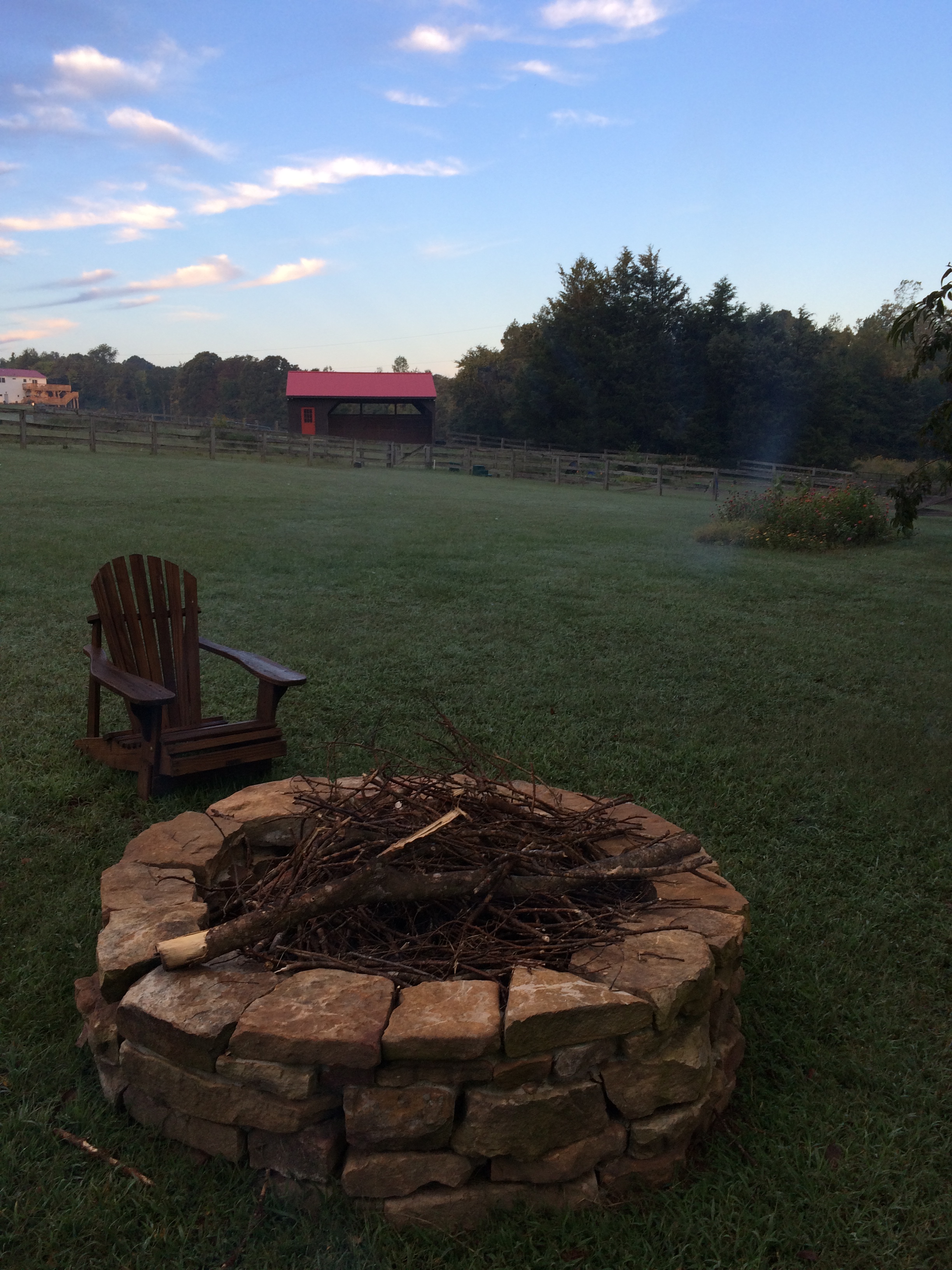
A week or so later I said yes to doing a bit of work on a good friend’s farm.  My friend is a busy lady and sometimes needs a hand with the upkeep of her property.  She and her family are good friends of mine.  I worked for her son for several years and like to get out to their property as often as I can.  It’s really beautiful:

IMG_2509

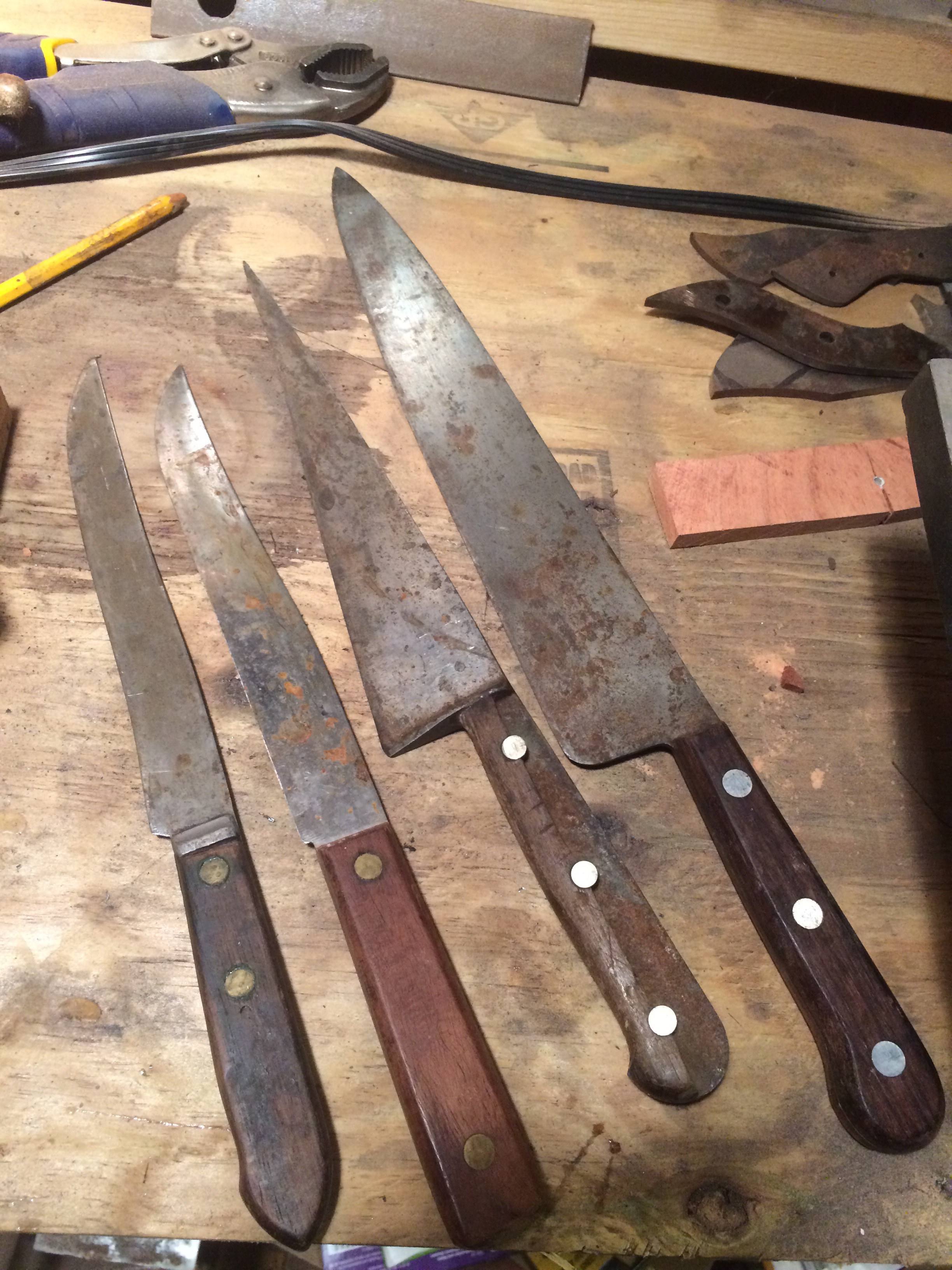
She had a set of knives she wasn’t sure what to do with.  They belonged to her late husband, and came to him from his grandfather, who was an Austrian immigrant.  He came to the United States in the early 1900’s and made his living as a chef, choosing to say yes to a new world and a new life.  She told me she’d like to have them restored so they can go to her children and stepchildren to remember their father.  I told her I would have a look at them and see what I could do.

Tools of the trade, from left to right:  A carving knife; a fish knife; a French slicing knife; and a 12″ chef’s knife

So these knives came to me, at least a hundred years old, and of deep sentimental value.   I started by removing the cracked and broken handles.

I cleaned up the corrosion and oxidization from the blades, but left much of the etched patina from their years in the kitchen.

In a continued practice of saying ‘yes’ I chose to use some of the Black Walnut I got from the tree job for the handle material.  It fit nicely into the story of these knives.  This is what it looks like sanded and polished.

All of the handles started as thin blocks cut from the Black Walnut.

Shaping.


The filet knife was only half-tang, so I extended it with mild steel from a sheet.

I added a G10 bolster and spacer for a bit of contrast.

After glueing and sanding.

Getting the fish knife ready for glueing and shaping.

The French slicer was tricky….

…but also an elegant challenge, with its tapered tang and integral bolsters.


Finished, they came out rather beautifully:

Say yes to the things that come to you whenever possible.  It’s always worth it on the other side.

Knifemaking: finding a way and the Desert Fox

“So many people live within unhappy circumstances and yet will not take the initiative to change their situation because they are conditioned to a life of security, conformity, and conservatism, all of which may appear to give one peace of mind, but in reality nothing is more dangerous to the adventurous spirit within a man than a secure future.”

John KrakauerInto the Wild


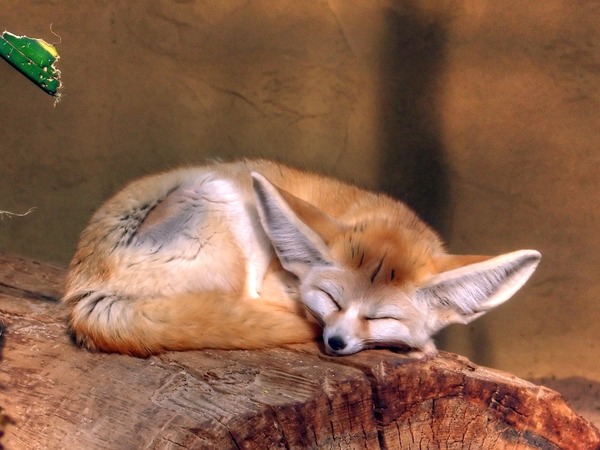
The Desert Fox, also known as the Fennec Fox is the smallest member of the species Canid.  They can be found in the Sahara Desert of North Africa.  Living in such averse conditions has allowed for some particular adaptations in order for them to find their way in their environment, most notably their prominent ears (I mean, look at those things):


The ears help them to dissipate heat, as desert temperatures can get up to 117 degrees Fahrenheit during the day. They also have a specially evolved set of kidneys allowing them to go without water nearly indefinitely and their required moisture can be obtained from their food.  Unlike other foxes or canines, they have fur on the bottoms of their feet.  This keeps them from burning their feet when traveling over hot sand.  Their cream-colored coat helps to reflect the heat of the sun.

They are omnivorous, eating insects, lizards, and birds, but are also known to eat roots, leaves and other vegetation.  The Desert Foxes are social creatures, live in groups, and mate for life.

I find this to be an incredibly encouraging little animal, finding home and company in a place where a large portion of its environment is actively trying to kill it.  On days where I’m not sure how to find my own way, I often think of the Desert Fox.  I find that I don’t have to worry about blistering heat, numerous birds of prey, even more numerous venomous snakes, or scarce food sources, and then I proceed to count my blessings and pray that I don’t become complacent in my station from lack of natural predators.

Because finding your way when there isn’t anything pushing you can be just as hard as navigating a desert full of bad things.

I was in Pittsburgh recently, taking an Uber to dinner.  I’ve never particularly cared for riding Uber; it always feels like there’s an expectation for conversation and an uncomfortable and resentful silence if that expectation is not met.  On one Uber ride in Manhattan there was a driver from the Caribbean who wouldn’t stop talking about his kid and showed my friend and I a video of him playing baseball.  All this while driving in rush hour traffic.  This most recent Uber ride was not that.

The man picked us up and the conversation was easy.  After a little while of talking about what we were doing in the ‘Burgh, I asked him what he did for a living.  He said that he had been a private investigator in Los Angeles for twenty years, from the early ’80’s to the late ’90’s.  He said he had seen it all: cheating spouses, runaway kids, you name it. He thought it was all hilarious.  He wanted to write a book.

His friends all thought his stories were great and they had been encouraging.  The only problem, he said, was when he sat down to write he couldn’t get anything on the page.  He just froze.

I know what this is.  This is the crippling self-doubt that almost every writer and creative person I know deals with.  Myself included.  I told him so.  Hell, I know a filmmaker who has a Crippling Self-Doubt Room in his house where he goes before he works on his projects.  If you don’t find a way forward, you get stuck, and your ideas aren’t heard.  Nothing happens and life goes on.  You have to live with the sting of unrealized potential.  That sting becomes more painful as the years go on and there is no more time to realize what could be.

The only thing to do, I told him, was to find a way to be with that debilitating feeling of self-doubt.  Find a way to get something, anything, on the page.  Once there is something on the page finding your way becomes much easier, and it can take you to surprising places.  There is meaning in those places, satisfaction, and everything becomes a bit deeper and beautiful.

This is the lesson of the Desert Fox, a creature that has an unforgiving place to call home yet finds a way to thrive in it, and makes an existence in the uncomfortable.  If there is something eating at you and calling to you, then you can always find a way to make it happen.


We start with flat stock O1 tool steel:

Roughing in the blade choil:

Profiled:

Rivet Holes:

Hand sanding the bevels before heat treat:

Hardened:

Tempered:

Hand-finished satin:

Texas Mesquite.  One of my most favorite materials to work with:

Shaped:

Sanded to 220 before giving the grain a burst:

The Desert Fox:

If you can find a way to exist in the uncomfortable, than you can almost always find a way forward.

fennec fox

Knifemaking: Rock and roll, privilege, and the Sir

“He who conquers himself is the mightiest warrior.”

-Confucious


Warrior, Merchant, Artisan, Farmer.  These are the four classical occupational archetypes of Feudal China.  These archetypes still ring true today.  There are variances and nuances but in the way we go through life, many of us find ourselves in all four of these occupations, even if only briefly:

-The Farmer understands the value of labor.  He is master of working within the seasons to sow his crop.

-The Artisan understands how different mediums and materials go together, and how to craft his goods within that understanding.  He is master of his tools.

-The Merchant understands business- buying low, selling high, and having a good product.  Business at it’s core level is the art of profit and the Merchant is master of this.

-The Warrior understands the above three archetypes.  He is master of himself and carries the weaponry of his choosing.  He serves society.

I have found myself, at various points in life, in all four occupations.  The Warrior intrigues me most.  Speaking as a man, I feel that most of us want to master ourselves, and the things that try to enslave us- our fears, our desires, and our insecurities.  In our occupations and work, obsessions and compulsions can develop, our fears can play out, and we can become consumed.  We can become obsessed with trying to squeeze the seasons dry, or maximizing profits, or with crafting a better and more beautiful mousetrap.  When these things become all that we see, we have failed to master ourselves and aren’t really serving anything except for what we are trying to achieve.  At this point, all the things that really matter get left in the dust.  We lose sight of the world we live in and are not present in our lives.

In order to master yourself you must know yourself.  Sometimes the best way to know yourself is to know others.  And sometimes the best way to do that is in service to others.

I was working a large arena rock and roll show, one of the largest I’ve ever worked.  The headliners had been around for decades, on the top of the charts, and darlings of video-era MTV.  They have recently been selling out arenas around the world.

I strolled into the production office to get my assignments for the day.  There was laundry, grocery shopping for the tour busses, FedEx and post office runs, prescriptions to be filled, and other bits of housekeeping errands that keep a massive touring operation on the road.  Not everything gets done.  Touring is a practice, not a science.  The most successful touring operations are predicated upon this notion.  My job is to take care of as many of these things as possible based on what the tour needs and the priorities of the show.  This doesn’t leave time for anything that may be superfluous or unnecessary.

After the day was laid out and I had my assignments, the tour manager asked if I could add another thing to my list.  There was a very large basket of toiletries- soaps, shampoos, and lotions- that had been collected from God knows how many swanky hotels.  The tour manager asked me if, time permitting, I could find a Women’s Shelter or a shelter for families in transition and drop them off there.  The band and the crew collect them from every place they stay for that explicit purpose.

I didn’t give it too much thought.  I had a lot of things to do and honestly this little task wasn’t real high on my list.  But the tour manager kept asking me about it and so I decided to make it a priority.  After all, I was in a position to take care of this.  I got on the internet and found a facility nearby.  It was a shelter for women leaving bad domestic situations- in many instances they showed up with nothing but the clothes on their back.

I called them and told them who I was and who I was with and asked if they accepted donations.  Yes we do, they said, please come by.

So I went by, even though I really didn’t have the time.  The people at this organization were really happy to get these things.  They wanted to take a picture for their social media page.  All smiles.  They thanked me for thinking of them and to remember them in the future because funding is always tight and every bit helps.

This was all really special to be a part of, even though it was a pretty small thing.  I wasn’t really expecting that and it was nice.  I don’t normally find myself in these sort of situations.  I’m usually wrapped up in my own affairs, serving the things I am trying to achieve rather than broadening my gaze.  I noticed a lightness in me and the rest of the day felt easier.

There’s a lot of talk about privilege- white privilege, gender privilege, and a myriad of others.  When all of the social justice orthodoxy is stripped away, I find privilege to be a form of power.  There’s nothing wrong with being privileged but it’s important to be aware of it.  Many of us aren’t aware that we have that power within ourselves.  It’s a noble thing to use that privilege, that power (which, honestly, many of us take for granted) to help those who may need it.  It’s a really special thing to give or share of your time and talents when it’s within you power to do so.  This type of service can help you to become more familiar and intimate with yourself, and also help to make the world around you a better place.  That is the mark of a Warrior, and the lesson of the Sir.

O1 tool steel, thin stock

Profiled:

Rough grinding:

This is how to heat up your quench oil on a cold day:

Hardened and tempered:

Handfinishing, at around 220 grit:

Hand finishing at around 320 grit:

Ebony wood:


img_4467

Clamped:

Shaped:

The Sir:

Don’t be afraid to look out for others every so often.  This is part of the path toward mastering oneself.

Just a Bunch of Roadies– This is an organization of Music Industry Professionals that use their time and talents to make a difference.  They facilitate larger operations, but also smaller projects, like the one written about in this story.  Be sure to check out their website if you would like to help.

Knifemaking: doing the work and the Operator, Mark II

“The sword has to be more than a simple weapon; it has to be an answer to life’s questions.”

Miyamoto Musashi, The Book of Five Rings

(you can read about the crafting of the original Operator here)

I’ve always been drawn to people who do things.  The people who speak through their work and translate knowledge and mastery through their particular skill set without having to say much.  This is a day and age where anyone can broadcast claims of mastery and experience to a large audience and it can be difficult to discern who has done the work to back up these claims and who is just trying to get to the bank.

In today’s vernacular, ‘operator’ commonly refers to military personnel who are at the pointy-end of things.  They are the ones who are taking the orders and quietly (or not so) doing the work out of a sense of duty and service.  ‘Operator’ is a title that gets tossed around and claimed where it doesn’t always belong, very similar to ‘genius’.  The ones who actually fit the bill generally eschew such titles.  This is usually a symptom that you are doing the work.

This blade was a commission for a military serviceman doing Ops work.  I wanted to build him a tool that would serve him in the work he was doing.

There was a summer about ten years ago where I was between semesters of study.  I had decided that I wanted to learn how to fix things.  Many of my friends were working at Blockbusters or car washes but I liked the idea of being able to take care of things myself.  I took a really awful job doing apartment maintenance for three and a half months and did just that.

It was not very satisfying.  The job I took was for a rental company who owned properties in my neighborhood so I could walk to work.  It was a pretty slummish company that rented to a lot of college kids.  I ended up having keys to half the apartments of what was called ‘Hell Block’ of a street close by to me.  The summer was when a lot of leases ended so there were many people moving in and out.  As a result the streets and alleys were full of discarded furniture for most of the summer, a lot of which was set ablaze by some of the rowdier tenants.  Sometimes my days started with cleaning up the ashes of incinerated love seats.

Other days started with hauling four-burner stoves up three flights of a fire escape.  Most of the time was spent flipping apartments from where someone had moved out so that someone else could move in.  There was a lot of painting.  Flat antique white for the walls and ceilings and semi-gloss eggshell white for the trim and kitchens.  The apartments weren’t very nice to begin with and after three days of work they still didn’t look very nice.  I tried to remind myself to just make it about the work.

I would spend hours gutting bathrooms- ripping out drywall, removing tiling, and replacing subflooring before redoing everything.  The best days were when I could work by myself and keep my own company.  Bathrooms were a bit more satisfying to do because they would actually look nice when you finished them.

There was one time when a new tenant couldn’t move into her apartment because a homeless person had moved in after we had flipped it.  We went in the apartment after the police took him away and found no less than eight bicycles, some smelly furniture, and a plethora of bizarre pornography.  There were also footprints all over the wall.  We had to repaint that one.

My boss was a middle-aged anomaly with claims of ties to the trash hauling unions of New York City.  I didn’t really believe anything he said.  There were four of us handling most of the work orders:

-Mark was in art school, a bit cranky, and liked to smoke a lot of pot.  Oftentimes it was hard to tell whether he was stoned or not.  I liked him.

-Scott had gotten back from several tours of Iraq, most recently Abu Ghraib.  He was a good guy but wouldn’t get anything done unless he was told exactly what to do.

-Mario was in his late thirties and from Guatemala.  He worked 7 days a week and sent most of his money home to his family.  He didn’t say much but I think he missed home.  The man could eat faster than anyone I’d ever met.  He said that in the Guatemalan Army they only gave you three minutes for lunch.

There was also a rotating cast of derelicts who would come in and work for a week and then disappear.  I never learned their names.

One of the happiest days I had was telling my jackass boss that I quit.  I gave myself a two week vacation before I went back to school.

What I learned at this job was that in order to get through many uncomfortable situations with a modicum of success you have to make it about the work.  It helps to find something bigger than yourself in what you are doing.  The skills I was learning would serve me well much later down the line, and the money would help me buy books and live through the school year and work on my education.  Everything else was just bullshit that came with the job.

To let yourself speak through the work you do, whether you are toppling Marxist empires or replacing toilets in shitty tenements- this is the lesson of the Operator.  In these situations our work speaks through us but also teaches us our lessons.

The recipient of this blade may find himself in harms way and needed a blade that would serve in such situations:

Rough cutting:


Bevels profiled:

Hardened:

Hand sanding:

img_4169_srgb

This is G10, a commercially manufactured synthetic material.  Normally I prefer to make my own handle material but in this instance I opted for something consistently fabricated that would be failsafe in a potentially tactical situation:


The Operator, MkII: O1 tool steel, G10 scales, fabric spacers, and steel hardware.

Let your work be your lessons.

Knifemaking: making your mark and the Cuchilla Pequita

“Control what you can control, maggot!  Let everything else take a flying fuck at you and if you must go down, go down with your guns blazing.”

Cort the Gunslinger, from Stephen King’s The Drawing of the Three

The Gauchos were a group of cowboys who worked on the grasslands of South America during the 18th and 19th century. They were a people without boundaries, solitary, and existing on the Pampas of Argentina, Uruguay and Southern Brazil.  The Gauchos were a pretty wild bunch and had a lifestyle that was similar to the gypsies and travelers of Europe.  Always moving from place to place, job to job, and always on the hustle.  Most were nomadic and had few possessions. 

They were a solitary people, yes, but when they did run into other gauchos there was usually high-proof alcohol involved.  Also gambling.  And prostitutes.  Those three things made for a trifecta of machismo, and that usually resulted in conflict which manifested as duels.  Guns were expensive and hard to come by so the weapons of choice were usually knives.

When Gauchos dueled the objective was not to kill (although fatalities most definitely occurred); it was to leave a mark, preferably on the face.  A gaucho with a scar on his face had lost a duel, and all the other Gauchos knew this.  He would carry this scar for the rest of his life, but looking a little deeper one can find that scars are not always a badge of shame.

There is an inherent drive to leave your mark on the world but sometimes the world leaves its mark on you.  Things aren’t always the way we think they should be and in taking a risk to make a difference we can fail spectacularly.  We all lose duels everyday and some of us carry many scars, both seen and unseen.  Some of the most powerful and profound people I know carry scars that are both large and deep, yet these people shine brightly and leave their mark on the world everyday.  They are beautiful even though life has done its damnedest to leave its mark on them.  How is this possible?

I had a teacher once tell me that no one is in control.  This is something that is a bit of a struggle for me almost daily, even though I know that in the grand scheme of things my sphere of control is very small.  It comes down to choosing how to react to the things in our lives.

So there is a choice.  You can choose to not get pissy about the holiday Starbucks cup.  You can choose to not to feel like a victim because your candidate didn’t win.  You can choose connection over isolation.  You can choose to do something about situations that don’t serve you.  You can choose to wear your scars proudly because whatever left its mark on you wasn’t strong enough to take you down.  You can choose to let the things beyond your control take a flying fuck at you and fall as they may.  Though we can’t always control the circumstances in our lives, we can choose how we respond to them.  This is where we make our mark and is also the lesson of the Cuchilla Pequita.

There are several types of knives carried by the Gauchos.  The Cuchilla Pequita is loosely based on the Cuchilla.  The Spanish word for knife is el cuchillo, a masculine noun in the vocabulary.  The Gauchos feminized cuchillo and applied it to their particular style of knives, which had a ‘pregnant’ blade belly and a slightly dropped point.  This design is based on that style and starts in 1095 spring steel:

After grinding and hardening:

Drilling rivet holes:

Texas Mesquite:

Fitting the handle:

Fiber spacers for a splash of contrast:

Clamped:

Profiled:

Sanded up to 2000 grit:

The Cuchilla Pequita:

How we choose to react in our lives affects the impact we can make.  This is the lesson of the Cuchilla Pequita

Here are some sources that were incredibly helpful:

A Short Essay About Gaucho Knives: Facón, Daga, Cuchilla and Puñal

Brittanica Online

Knifemaking: learning your craft and the Maestro

“This is Mr. Beethoven.  Do you hear that?  You don’t?  This doesn’t move you?  Well that’s ok baby, you can always go sell shoes.”

-Doug Richards

This knife was a commission for one of my former teachers and good friends, Doug Richards.  I first met Doug when I was fifteen.  I had been accepted to a summer residential arts program and went to study music and trombone.  I was there with about 50 other musicians and vocalists from across the state.  One of the classes I took was run by a jazz saxophonist, who also played every wind instrument known to man.  To help us learn about jazz he brought in a very passionate man to speak to us about Duke Ellington, one of the great American composers.  This man was Doug.

This particular class was at 8am and we had all been up late doing God knows what, as teenagers away from home living on a college campus are wont to do.  Doug noted this and suggested that if we were tired and didn’t have time for the Duke then we could leave and take a nap.

This took us all aback.  We all paid attention as Doug put on an Ellington video and proceeded to dance around the room, deigning us with the story of the music and the man…and every member of the band.  The man has an encyclopedic knowledge of music and the lore around it.

I ended up coming to university to study with him.  He taught a two year course of study on how to write big band music.  That was the course description anyway but it was so much more than that.  In this class I learned how to listen, really listen, to music.  I learned how to discern the masters from the dilettantes.  I learned what moved me and the mechanisms of the sounds that held me in those places.  Amidst all of this I learned how to compose and arrange music that sounded like me, and no one else.

What I learned most from Doug was the importance of craft.  Craft encapsulates art.  Without it, your art isn’t as articulate as it could be and your vocabulary to put what you want to say out into the world is stunted.  I started to see this all over in my world- in the people I would work with, in the music I listened to, in the food I ate, and the films I would watch.  I paid attention to the manner in which things were put together.  I spent hours working on assignments from Doug, exercises in craft, to the point where I would seriously question my life decisions.  Often times I felt that these exercises didn’t leave room for any emotion.  Over and over I heard “Do not emote” when we approached these exercises, but then I would hear something that Doug had written and it dripped with emotion.  Was this some cruel joke?

It was not.  In time we were told to write things.  I would think of what I wanted to say, write it down, and the craft I applied would make it blossom.  Almost without even thinking about it.  You just know what to do.  The way that a warrior knows to make the kill, or a seventh grade guitar player knows to hit the distortion button.  And so I started devouring the craft.  I studied classical orchestration with Doug, orchestrating Ravel piano scores for wind ensembles.  I played in a Stravinsky ensemble he ran and we worked through pieces the likes of which I’d never heard. 

As an adult I remember all the lessons from this man.  I always try to remember craft, and to practice it.  Like a good meal, or good music, or good love, craft is not something that is easily bullshitted.  In a world where quality is often compromised for time and quantity, craft stands out.  This is the lesson of the Maestro.       

The stories of this man are legendary.  Here are a few:

-Most of us had heard of Doug doing one-handed pushups before rehearsals back in the day.  Somebody mentioned it to him one day before a rehearsal and he dropped down and did 17.  None of us could do any…

-When we were rushing the tempo on a piece of music in rehearsal, Doug told us to slow down or we would get a reputation with the ladies.

-There was a limited edition of a recording re-released and Doug told me that I needed to have it.  When I told him I didn’t have the money he suggested I get a paper route…

– Before one performance, Doug made an announcement: “Ladies and Gentleman, please take your cell phones, pagers, and all of your other electronic jive out into the lobby, throw them onto the ground and step on them because I don’t want to hear any of them during this performance.  Thank you.”


Doug asked for a chef’s knife, for the kitchen.  I started with a piece of thin stock O1 tool steel:
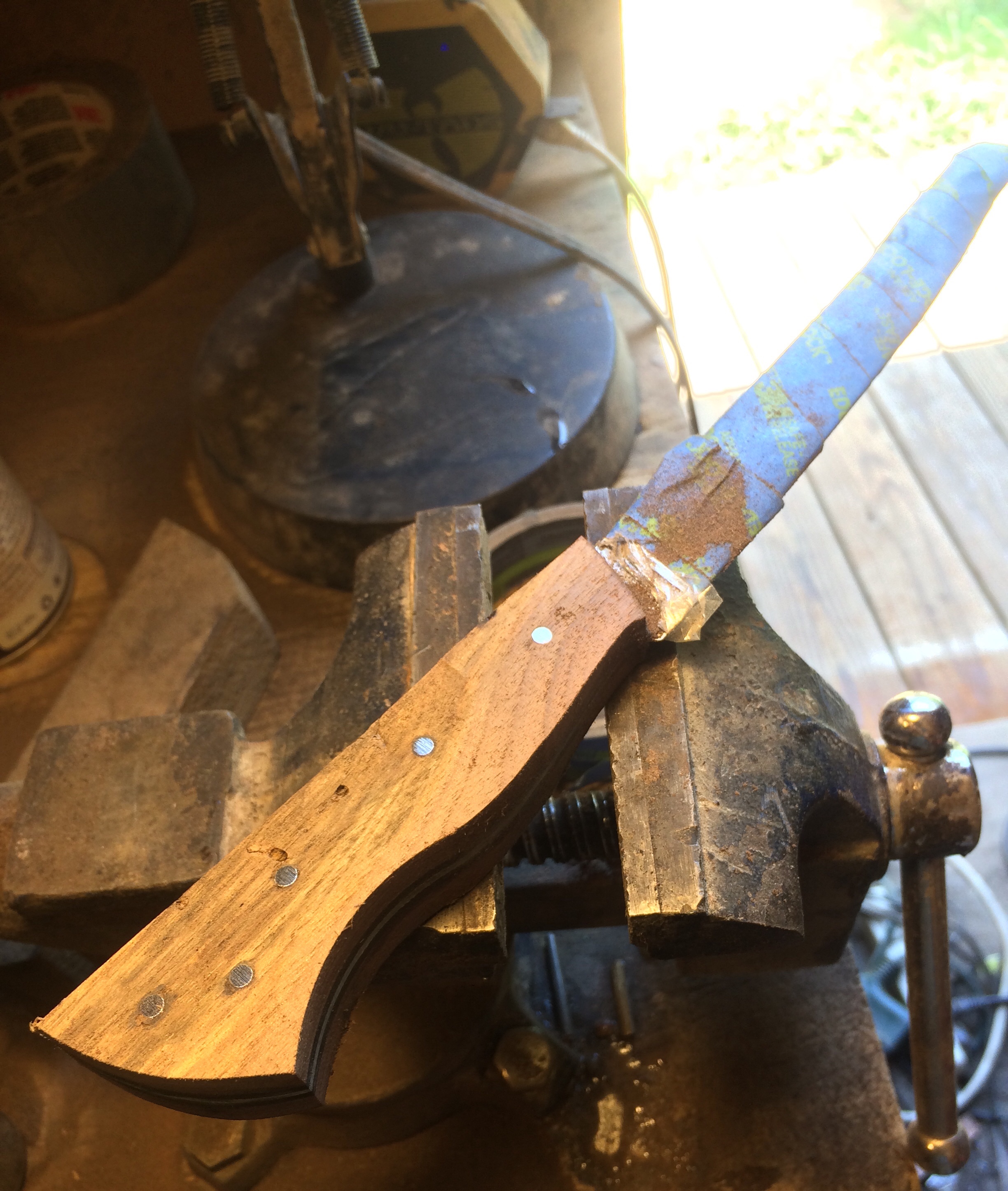
Hardened:

Grinding:

More grinding:

That’s about right…off the grinder at 40 grit:

Hand sanding station:

handwork starts at 80 grit:

120 grit:

220 grit:

Hours later at 320 grit….

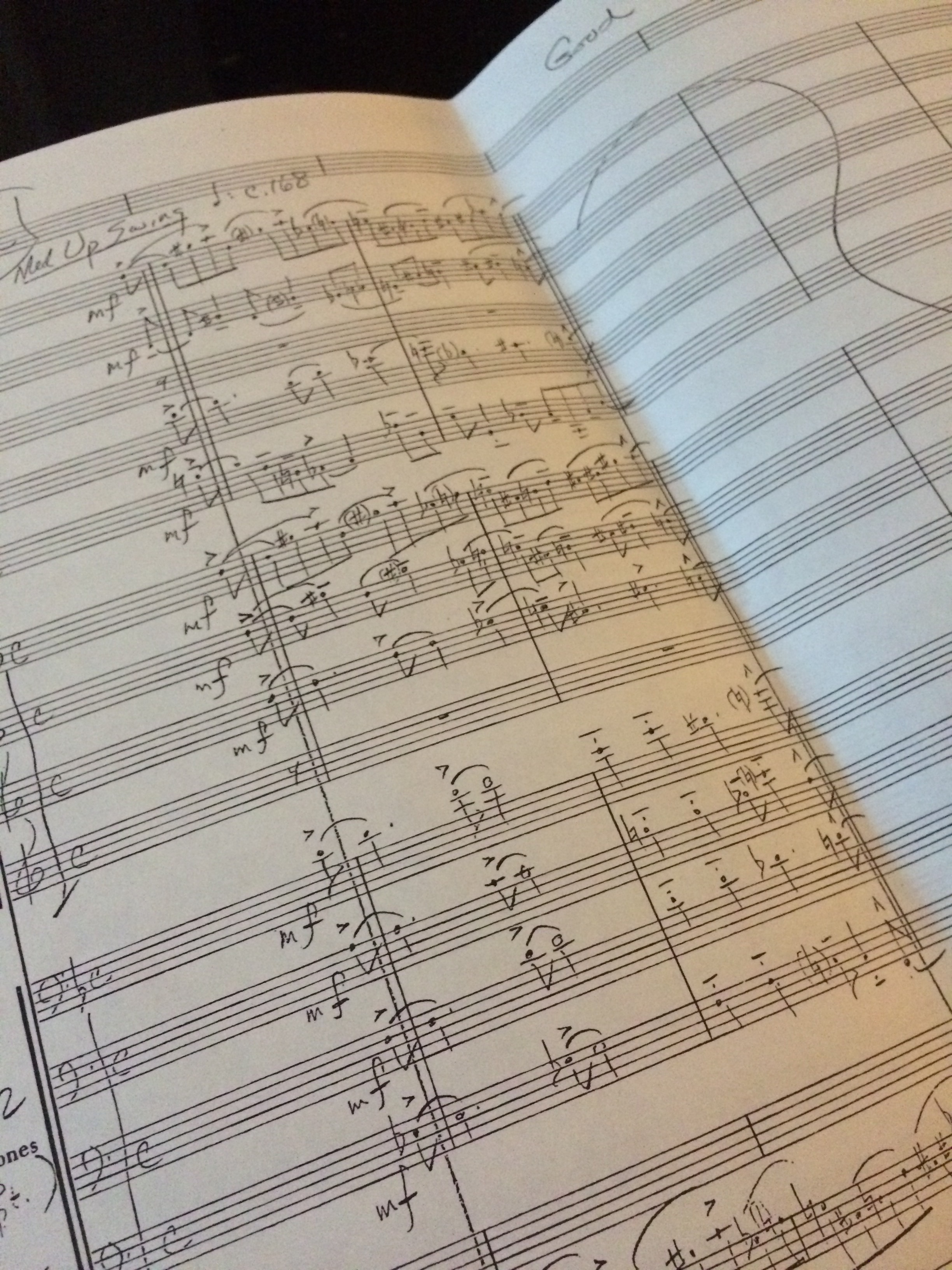
This is a score of Doug’s, meticulously handwritten and every note exactly where it should be, articulated just so…

…so of course I cut it up…

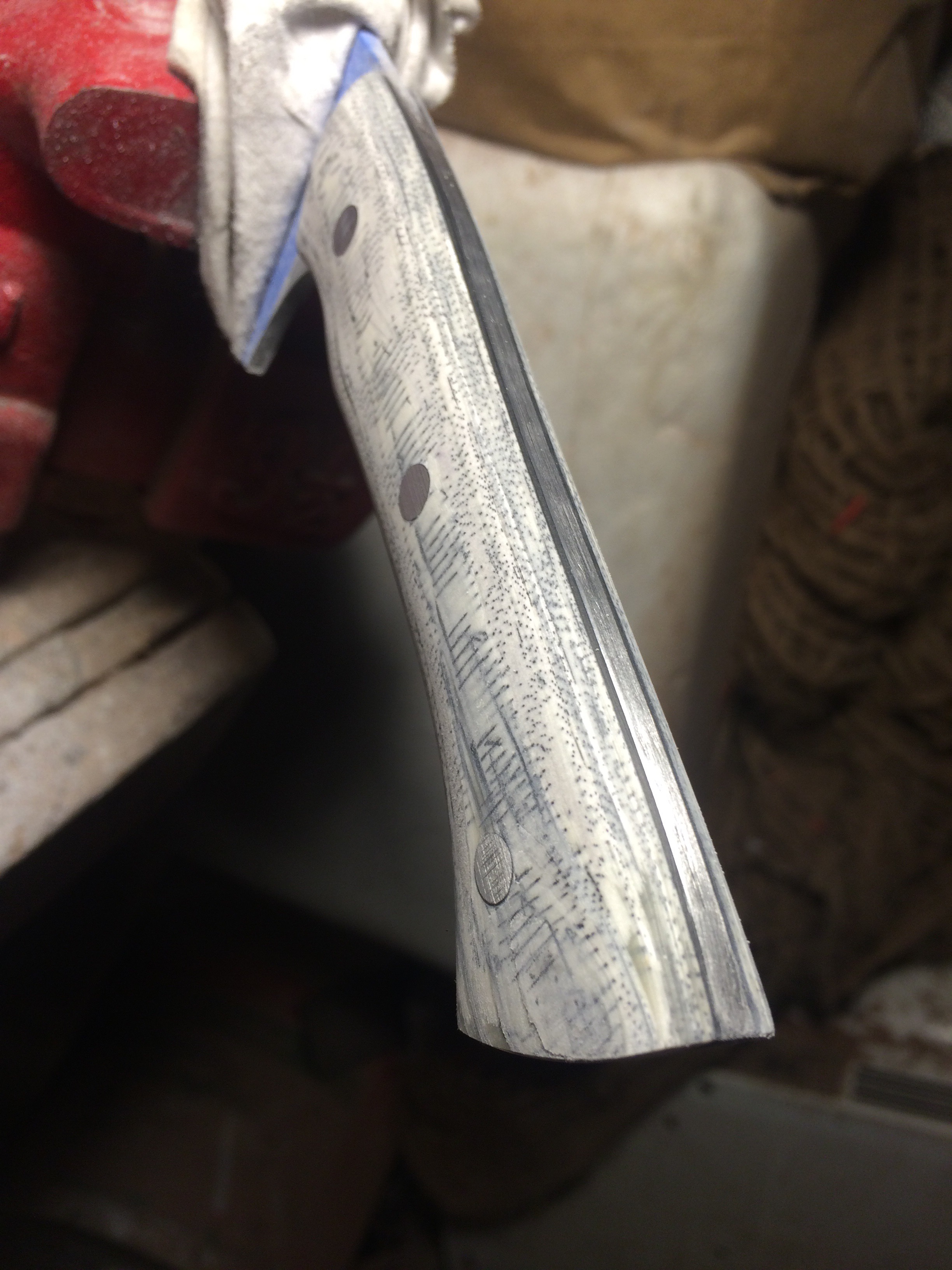
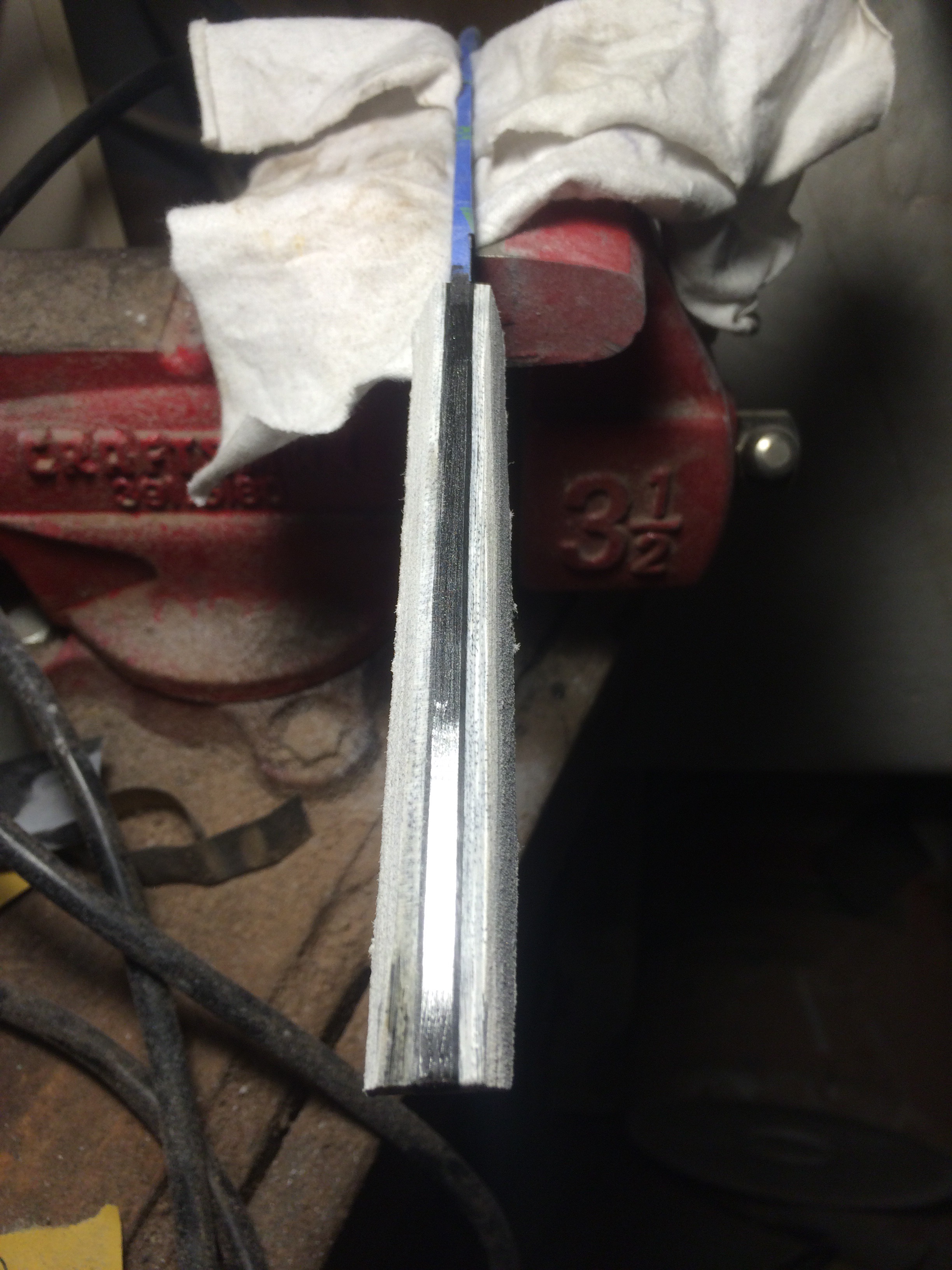
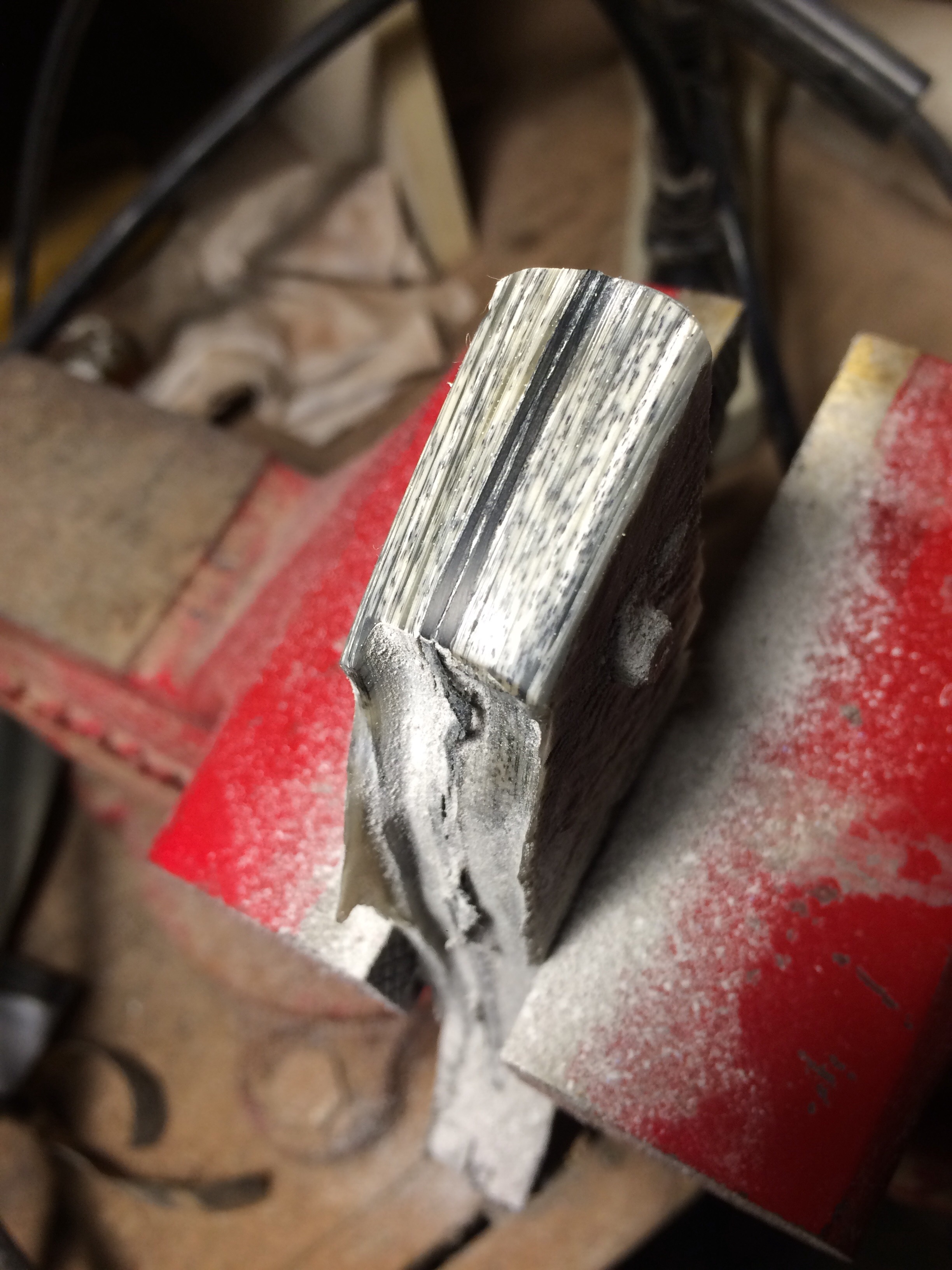
Ready to be made into a handle:

Soaked in fiberglass resin:

I think I can work with this…

Be sure to learn your craft.

Also be sure to check out Doug’s record– it’s really fantastic.