Knifemaking: courage in being gentle, and the Tennessee Gentlemen

Play that restless melody for me again
The one I’ve been so afraid of,
My sweet friend.
Maybe the little refrain will whisper inside the rain again
Play the one with all the changes
.”

Al Jarreau- “Something That You Said

Sometime in the beginning of the pandemic I started talking like Hulk Hogan. Just before everything got shut down I had been making combat daggers for spec ops guys. They had gotten in touch with me asking for “something that you can ram through somebody’s skull.” They all had a particular way of talking to me. The first time I talked to any of them they always addressed me as ‘sir’, and every interaction thereafter was ‘brother’. I really dug that. Even though they were paying me for a service, it made me feel like we were all on the same team and working together.

‘I APPRECIATE YOU, BROTHER!!!’

I found that to be immensely encouraging as I noticed it slipping into my vernacular. The irony of all this happening while I was building them tools of combat to rain down pain is not lost on me.

As Covid started shutting everything down and civil unrest led to riots, I found most of my means of livelihood shut down. Everything was a mess and I was broke trying to pay medical bills. The State Unemployment system was, and is still, a joke. With the murder of George Floyd, and everyone already agitated from lockdown, there was lots aggression and anger. Some of that aggression and anger manifested as marches through the streets, and some escalated to shopping centers being burned down. States of emergency were declared, riot police were dispatched, curfews were instilled, teargas was launched. Most all of this was happening less than a block from where I live, and occasionally it crossed over to the front yard of my building. There were nights where I was afraid someone was going to set my car on fire, which was how close this all was. My Buddhist vegetarian yoga teacher (who didn’t eat meat because it was unkind to animals) told me she was thinking about getting a gun and this did not seem unreasonable to me.

Everyone has the potential to fall prey to their baser of inclinations and move through life as a wrecking ball, especially when a private ambulance company is overdrawing your bank account because your livelihood is shut down like a high school keg party. It was my goal to not do that. During quiet moments at that time, I would check in with myself just to see what was hanging around. I found myself to be full primal rage, an ocean of grief, a profound sense of loss, and a hair-trigger response to any perceived threat. At such a reactive time as it was not too long ago, I found that it took a tremendous amount of courage to be kind and gentle.

During one such quiet moment I asked myself if we could break every interaction down to the very simplest parts of humanity and connection, and just not worry too much about the rest. Maybe we could find a way to let go of the weight of fear and uncertainty, and surrender to the simple joy of quietly going about one’s day. As a result of stripping everything down to the simplest parts of connection during a time of extreme duress, I found myself thinking of the Spec Ops guys for whom I was making daggers. I thought particularly of how in the course of our business I always felt seen and heard, and that my time and talents were respected and honored.

The crux of the Hulk Hogan technique is that it allows the people you interact with to also feel seen and heard. For me it was something that replaced a feeling of despair and hopelessness with a sense of community and belonging. It kept me safe and connected and prevented me from being a wrecking ball, which was what I felt like most of the time. In practice it started every morning with the gentleman selling me my coffee at the market down the street.

“IT’S GOOD TO SEE YOU, BROTHER!”

He got some encouragement and I got some coffee. Everybody feels better and has a bit more confidence for their day in a world that is on fire.

As I prepared for my days of shit work to keep myself from being sued by private medical companies, I did my best create disarming moments, as much for myself as the people I interacted with every day, starting with a cup of coffee. There is great power in gentleness, and after all the anger and violence I had experienced, I wanted to see what that practice looked like. Turns out it’s a bit like starting a chainsaw- a gentle but purposeful tug on the pulley cable gives you enough power to take a tree down. Pull too hard and you break the thing.

Ladies I talked to were always “Ma’am”, and anyone I believe to be identifying beyond the binary was always “Cousin”.

In focusing on my interactions with others, I found my crankiness and shit attitudes were curbed. They didn’t go away and I still found myself frustrated at the world, but those moments were much smaller and less consuming. It was much more than an affectation- I had absolutely fuck all going on and this was where I could direct my focus. After such a traumatizing time, this was a way that I could come back to myself and remember who I am and what I do.

Any sort of practice, when diligently observed and worked on, operates on a continuum. It meets you were you are and expands into everything. I was having a drink on my girlfriend’s porch one night when my girlfriend pointed out her neighbor struggling to get a washing machine off his pickup truck. Without thinking I got up and went over.

“BROTHER DO YOU NEED A HAND?!?”

…….

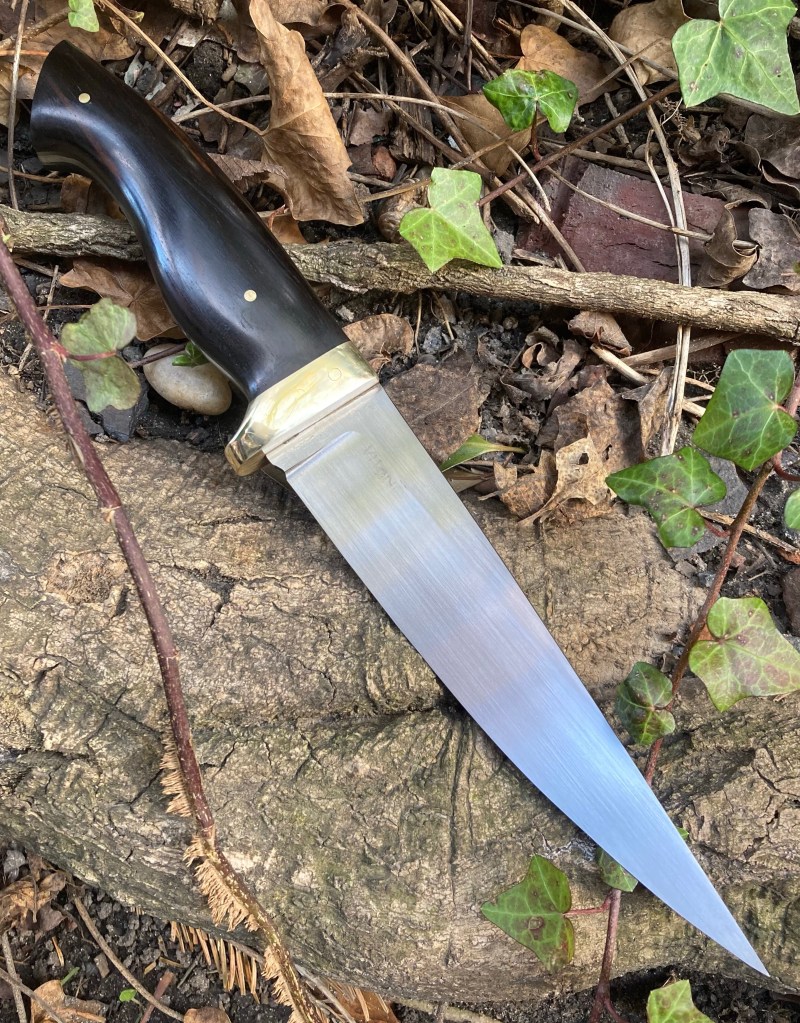
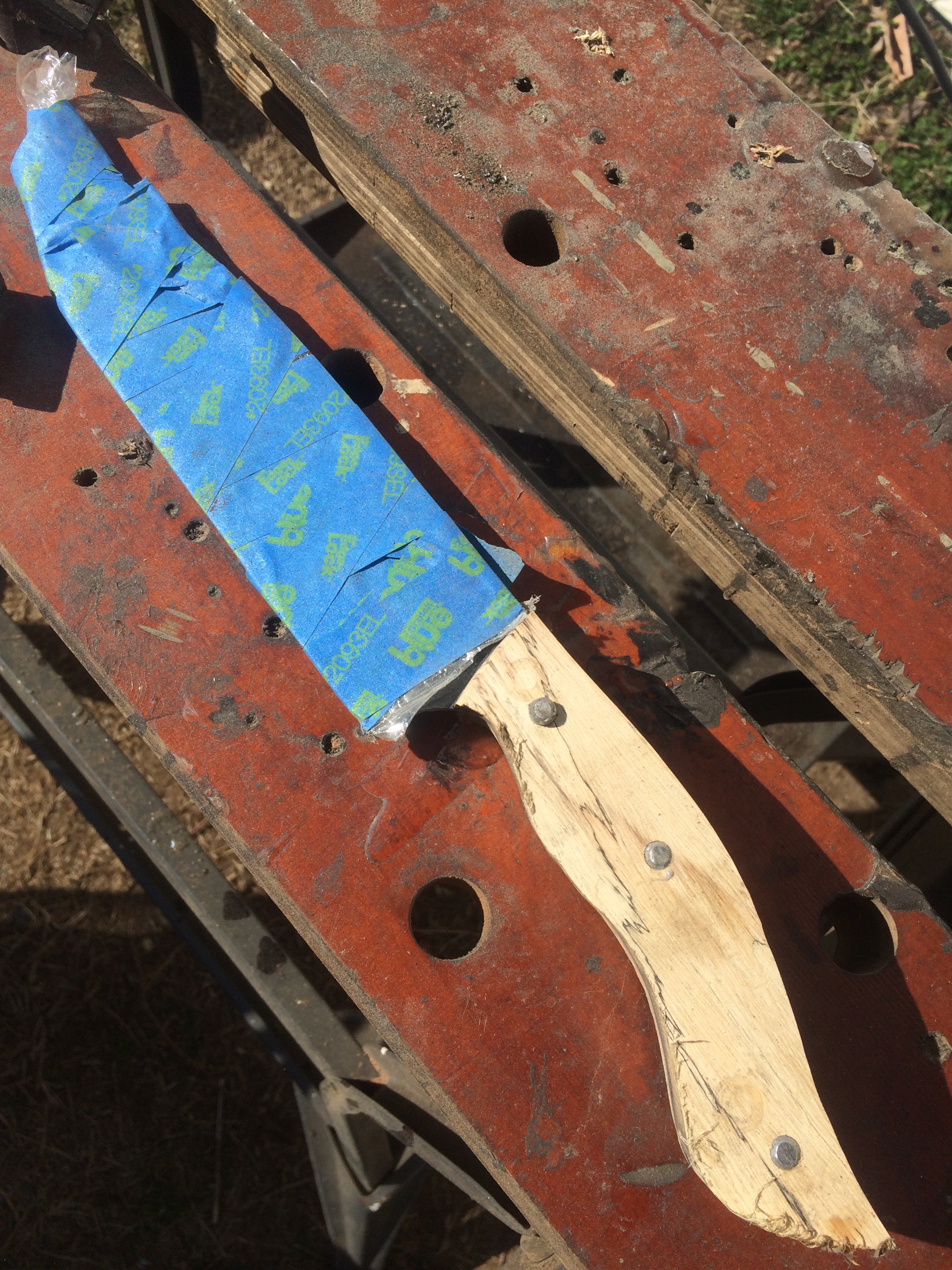
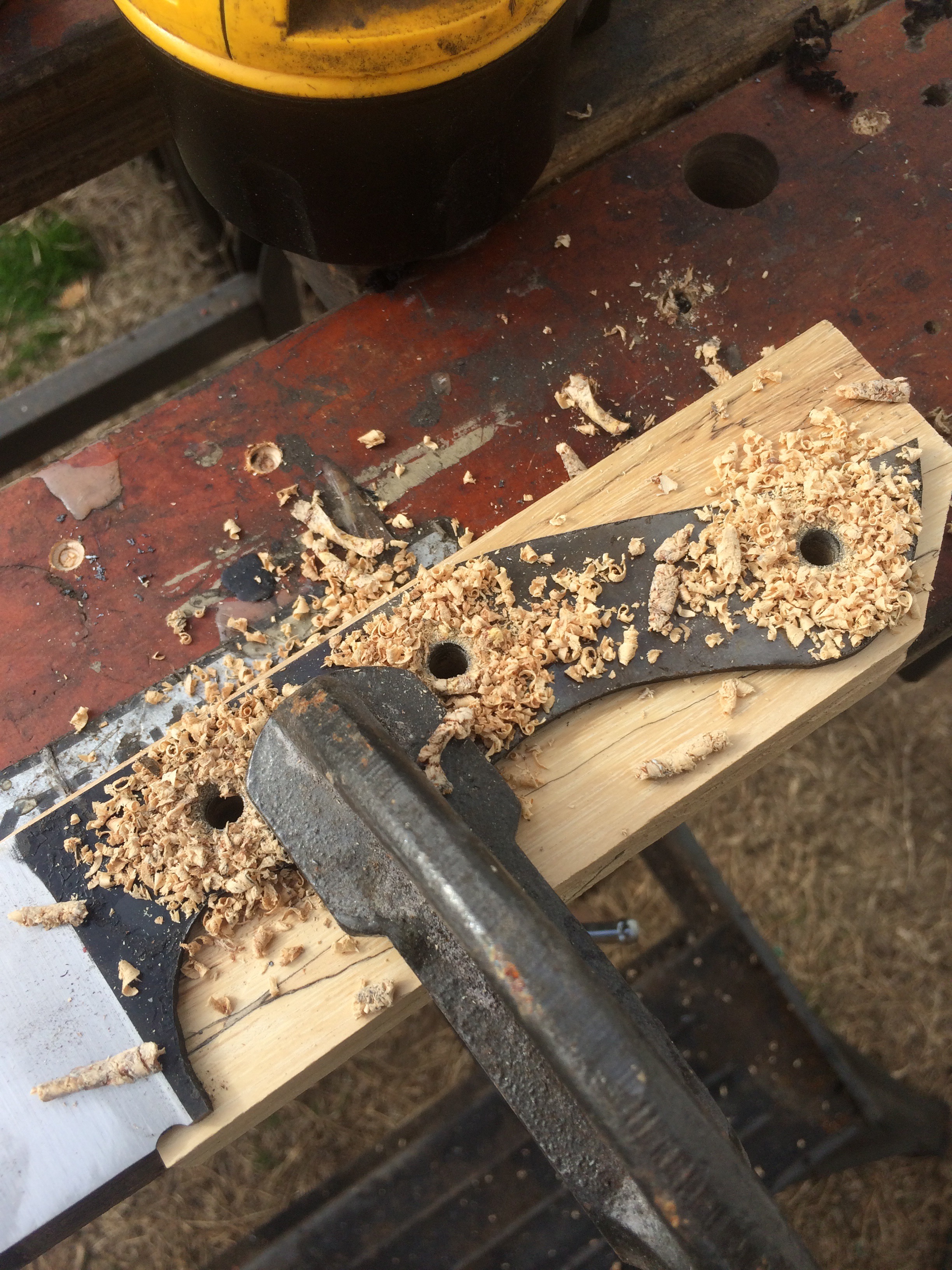
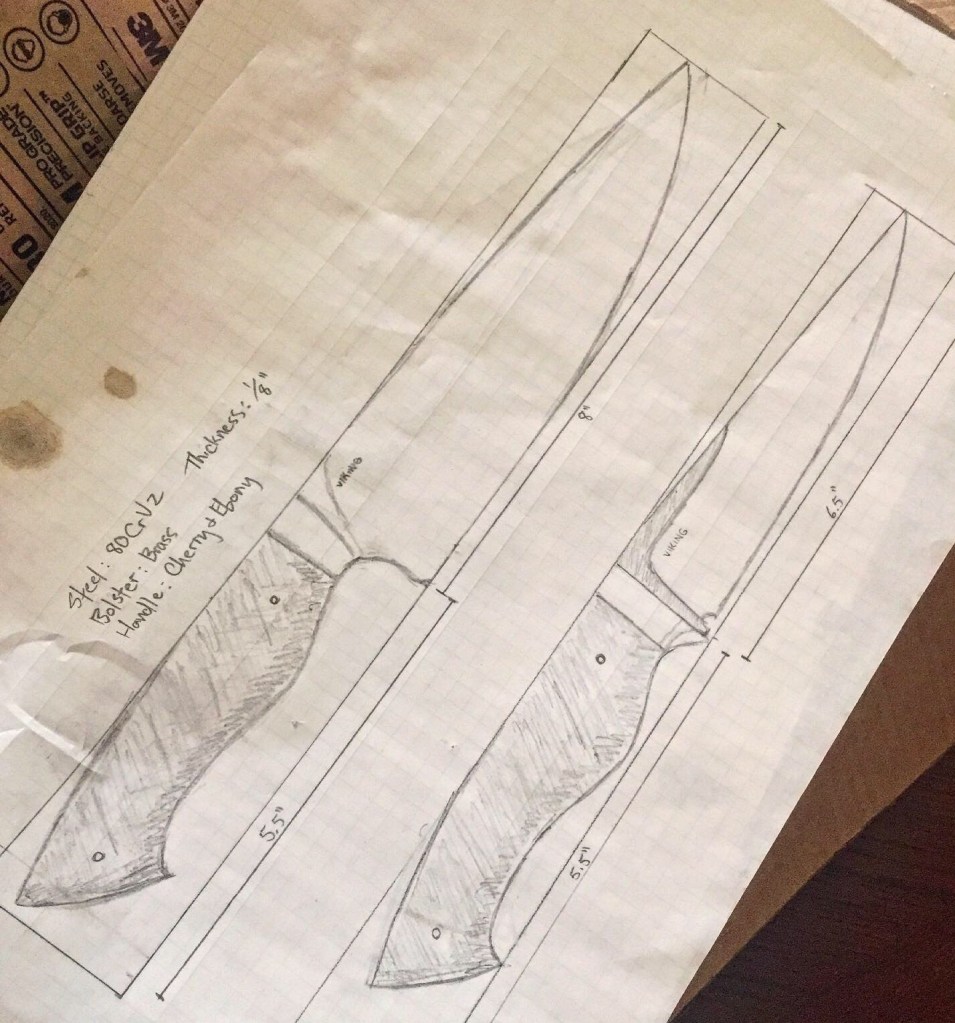
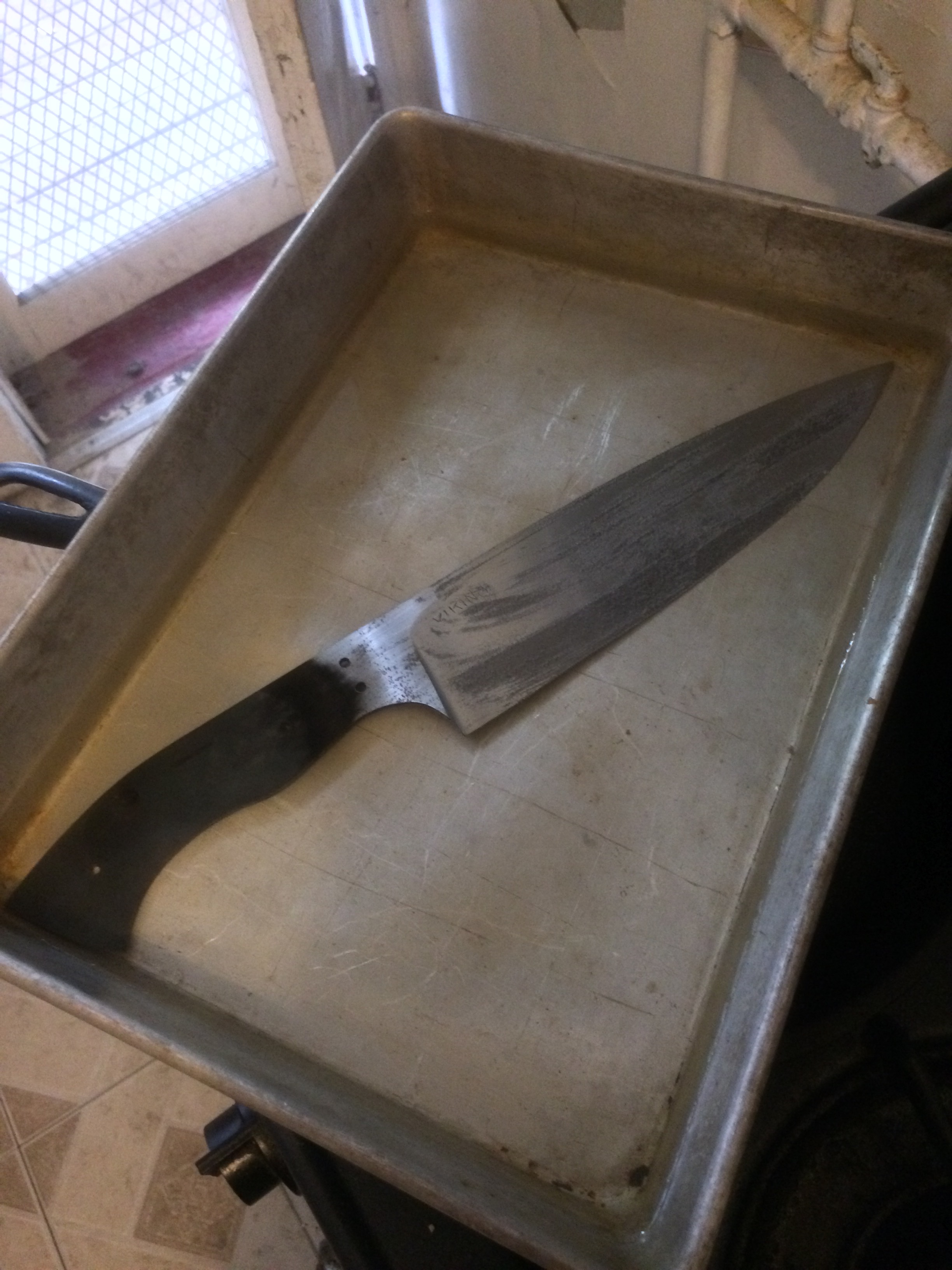
This two knife set was build for a good friend of mine in Tennessee. He got in touch needing something better for his kitchen. During hunting season he and his wife process a lot of deer. After field dressing, a good set of kitchen knives are good second-line tools.

When we spoke over the phone, he had said that while he had needed a set of knives, he had also wanted to throw me some business and help me to practice my craft. As a craftsman himself, he understood. He did to me what I had been doing to everybody else for the past two years, and this build was a lovely experience and testament to the courage of being gentle. I’ve detailed that experience below.
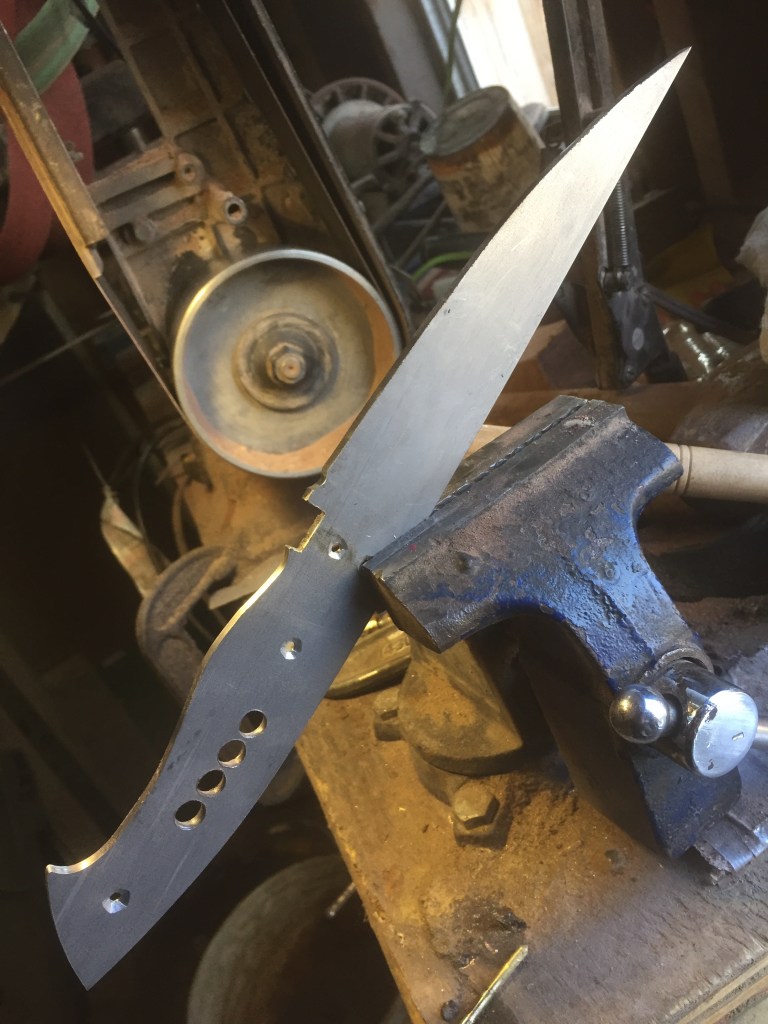
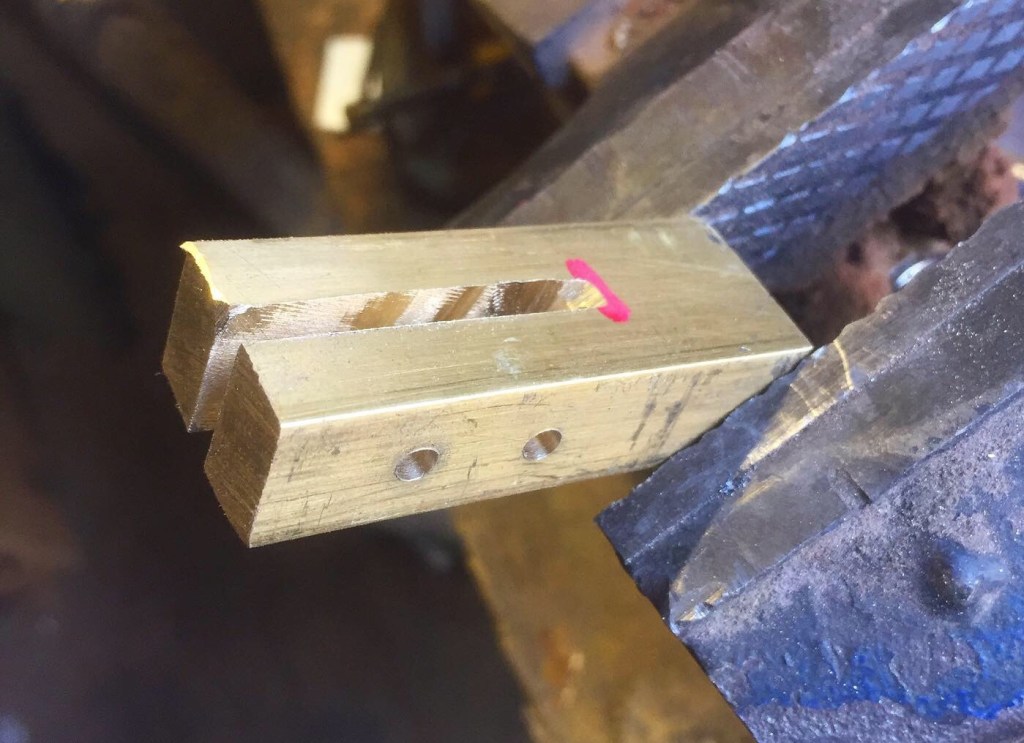
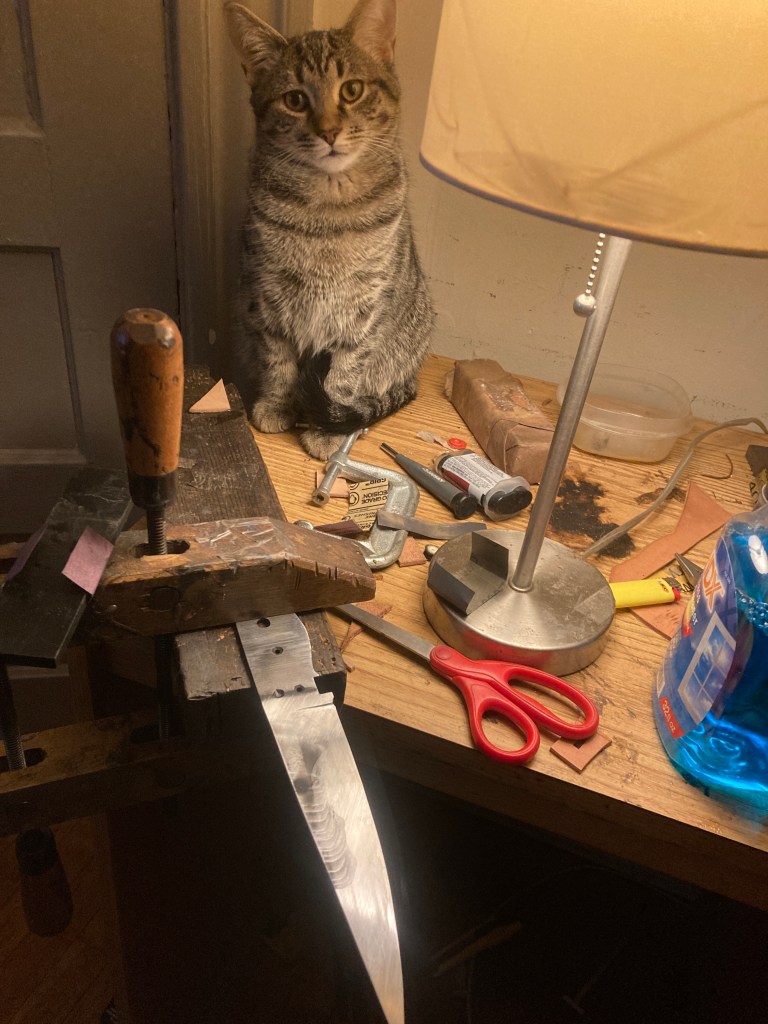
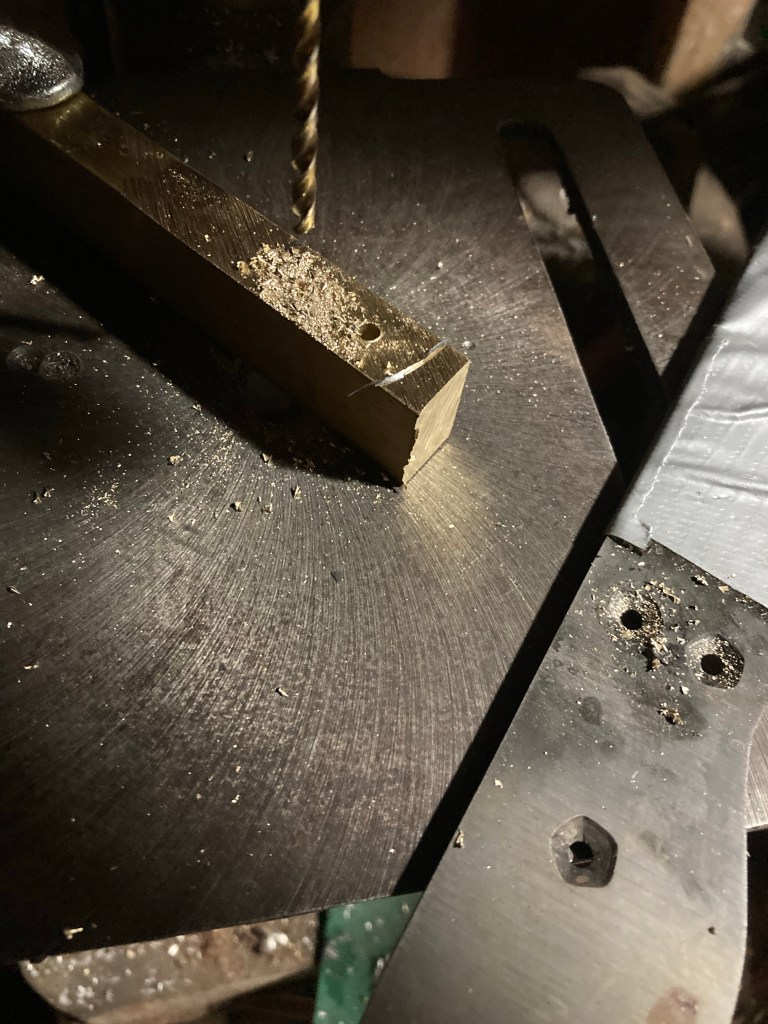
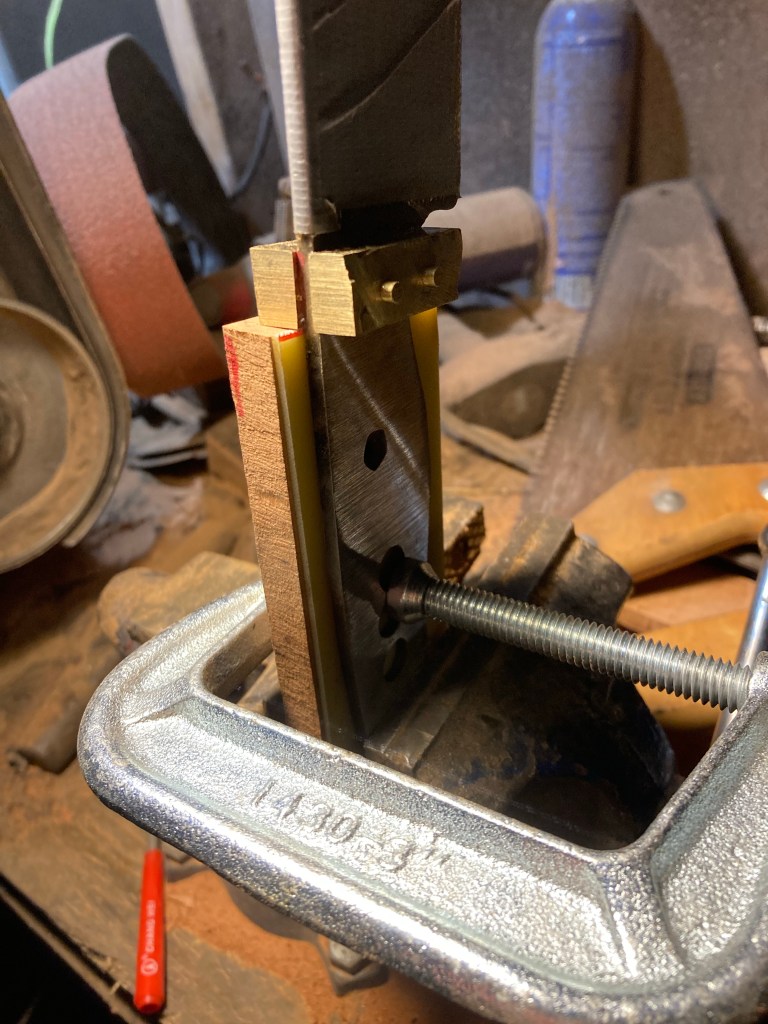
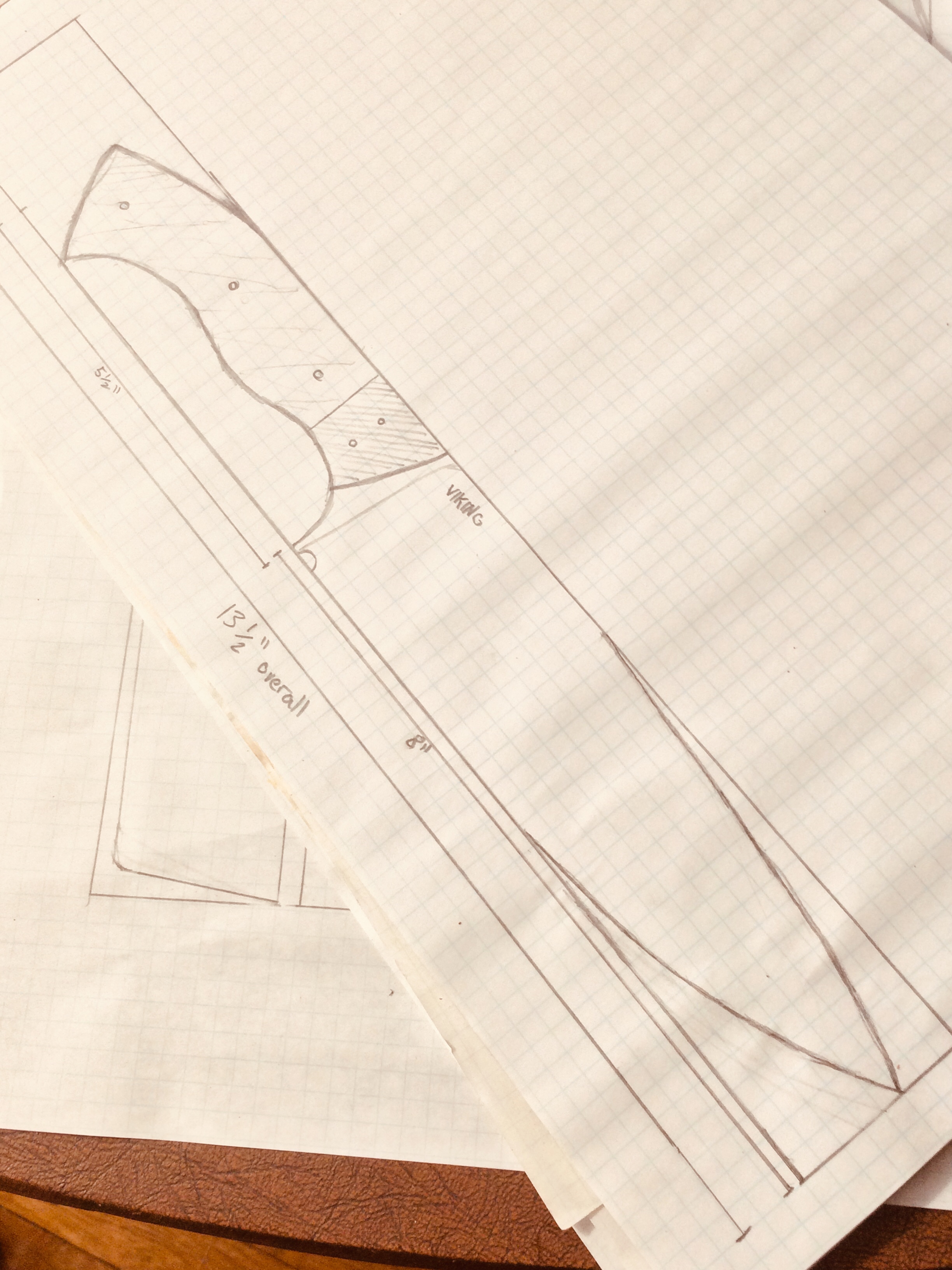
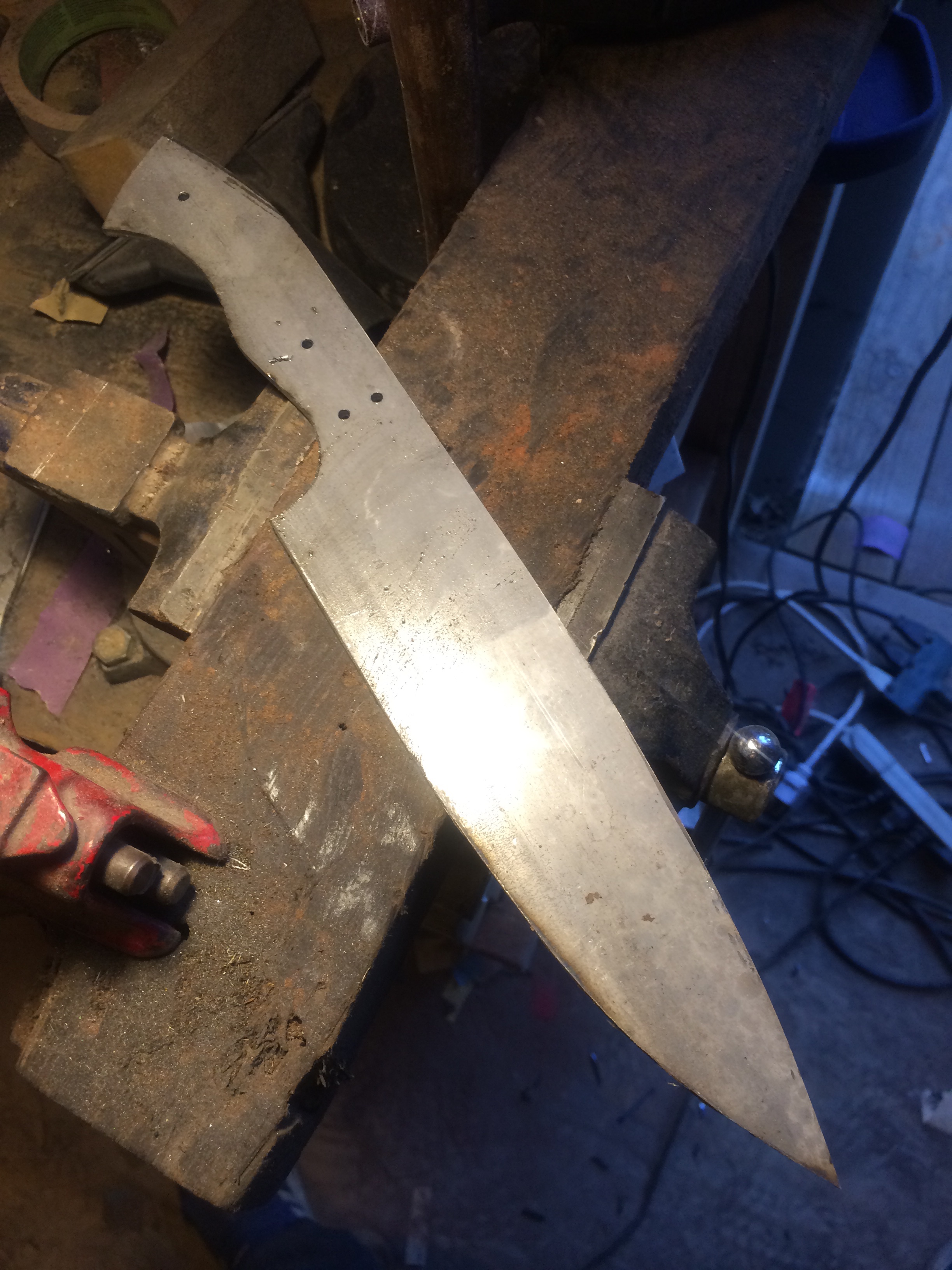
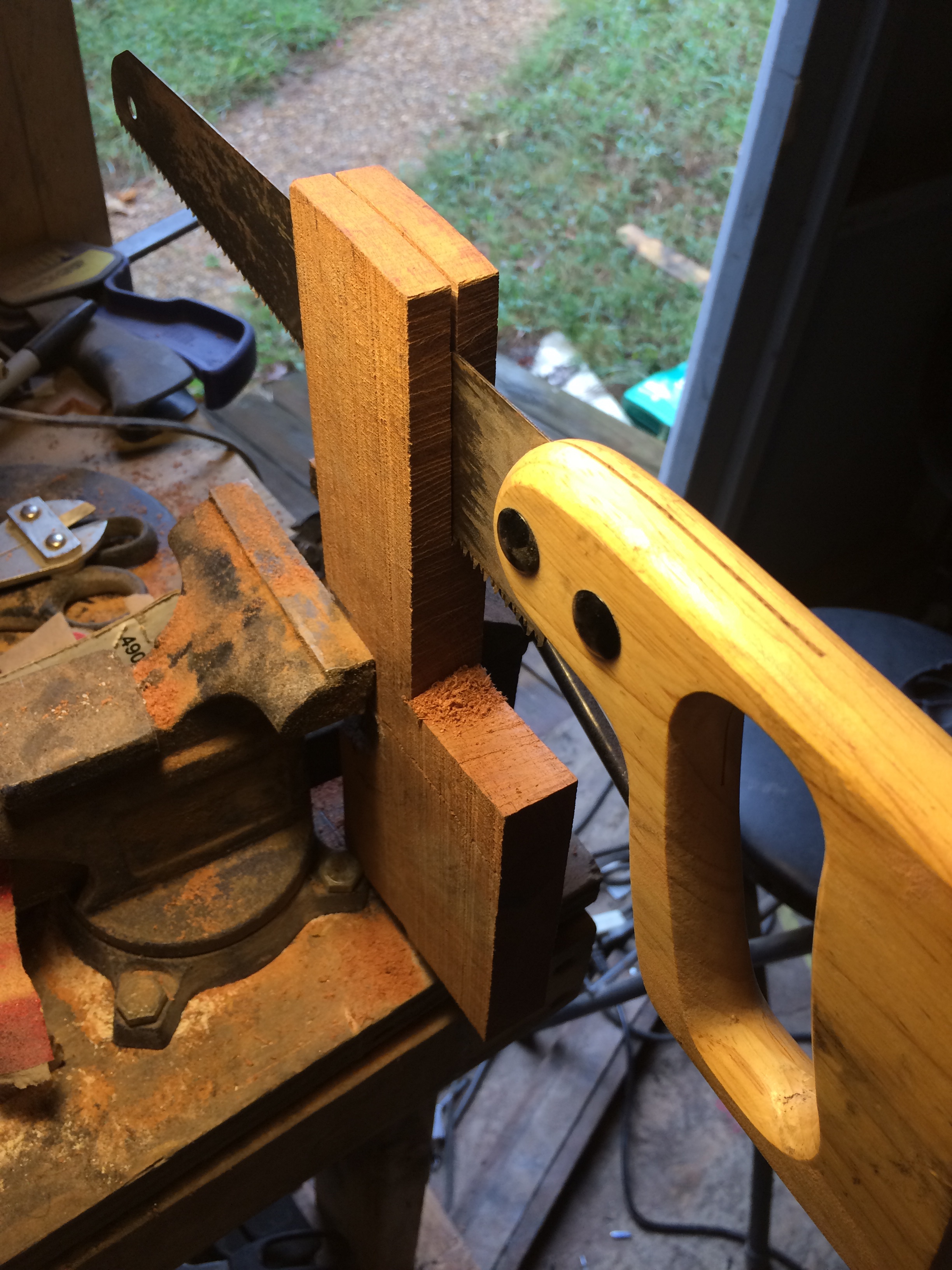
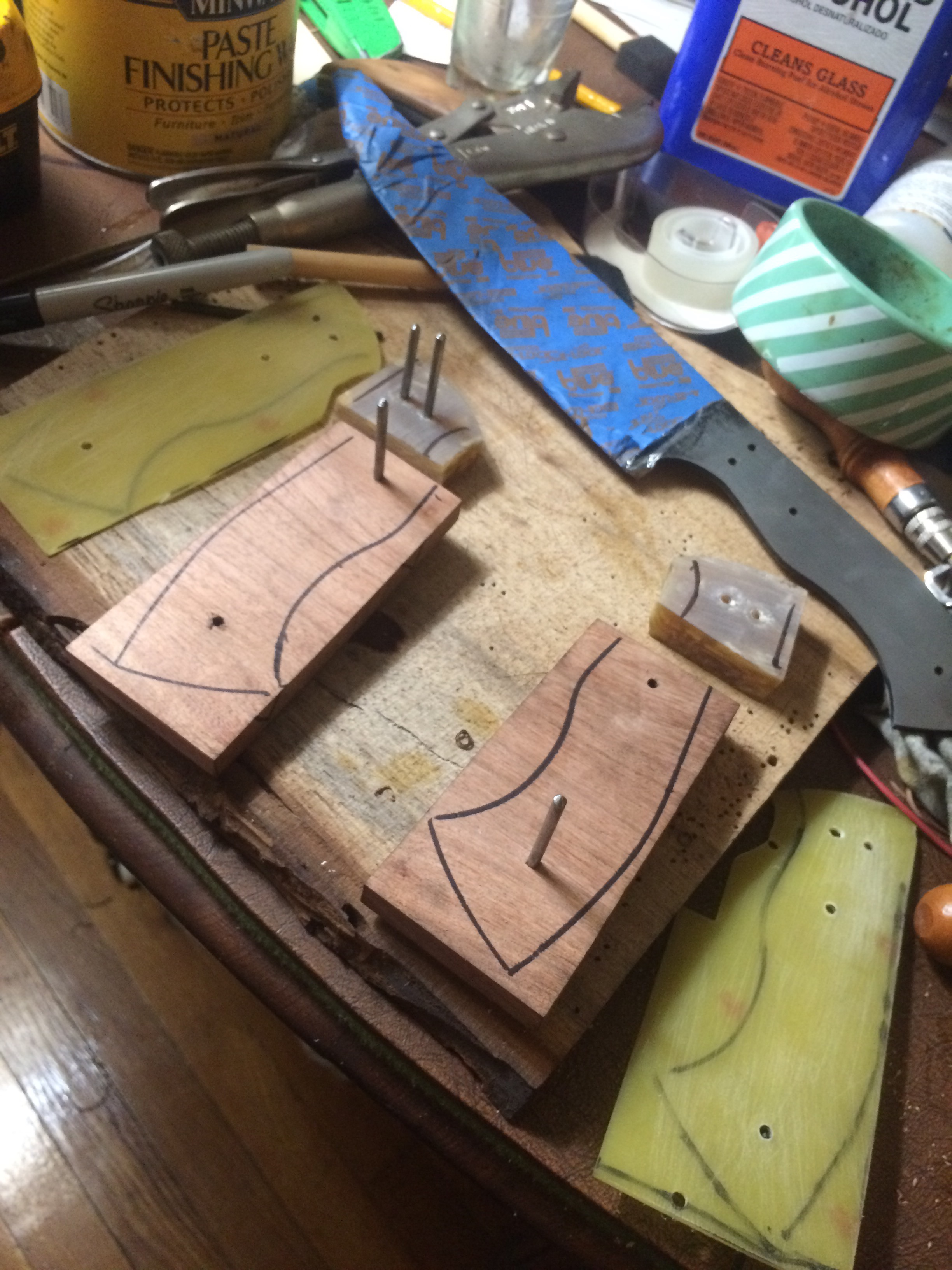
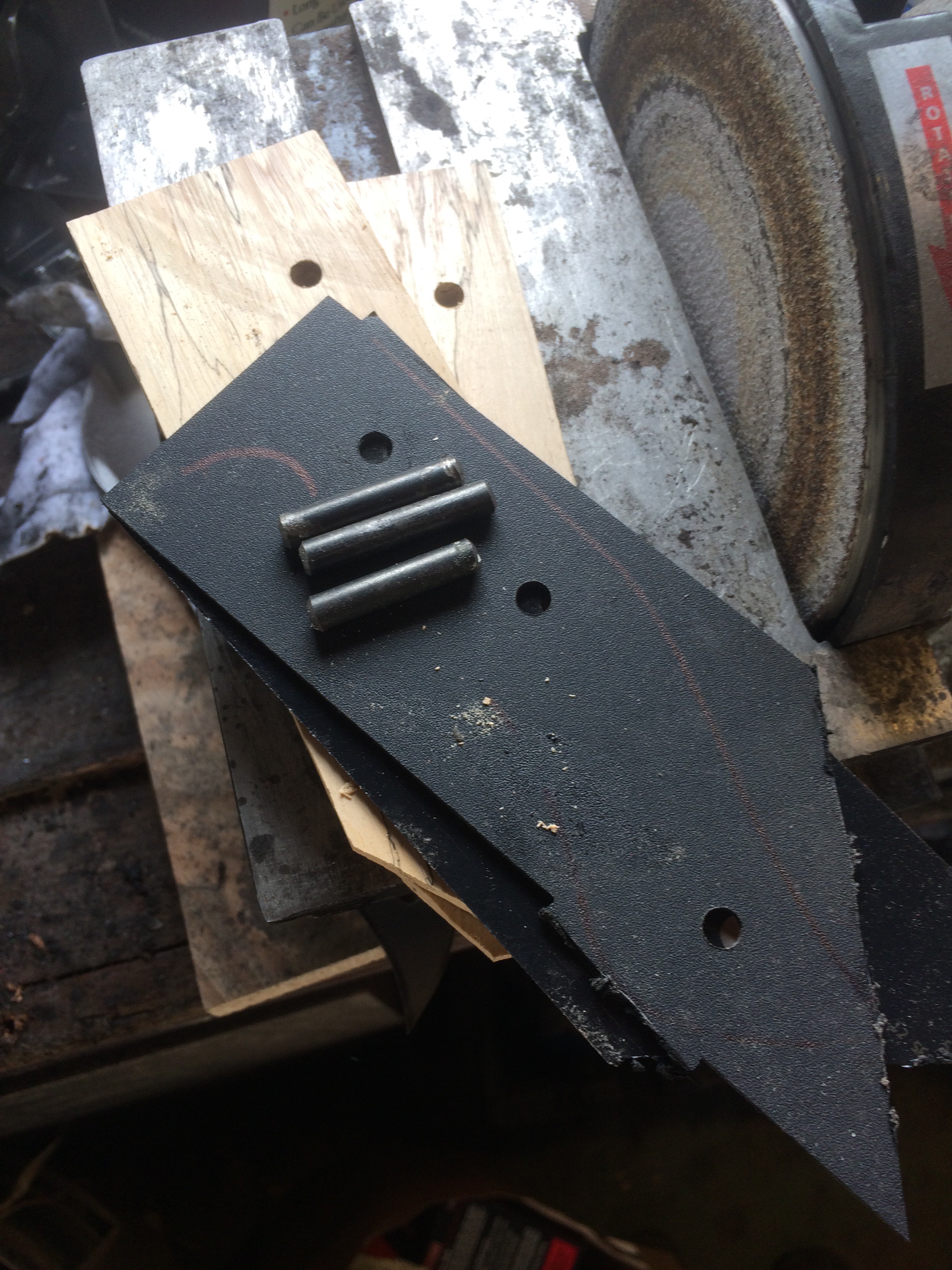
A critical mistake was made here. Rivet holes should always be drilled after the slot is cut and fitted. Lesson learned.
Fitted
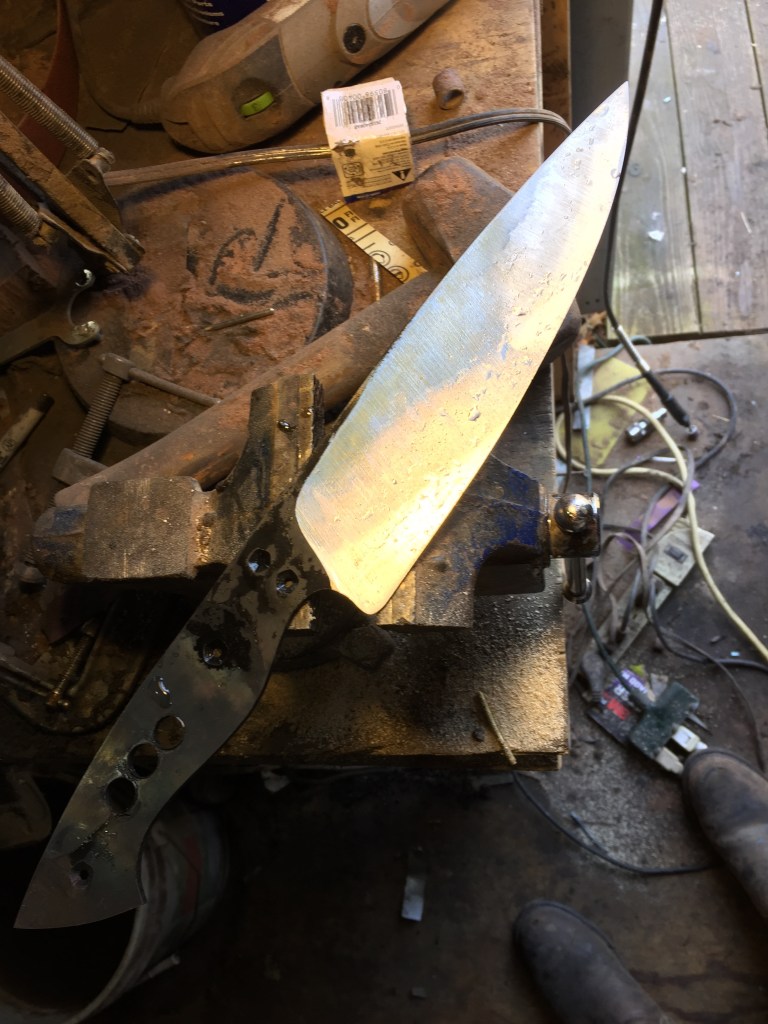
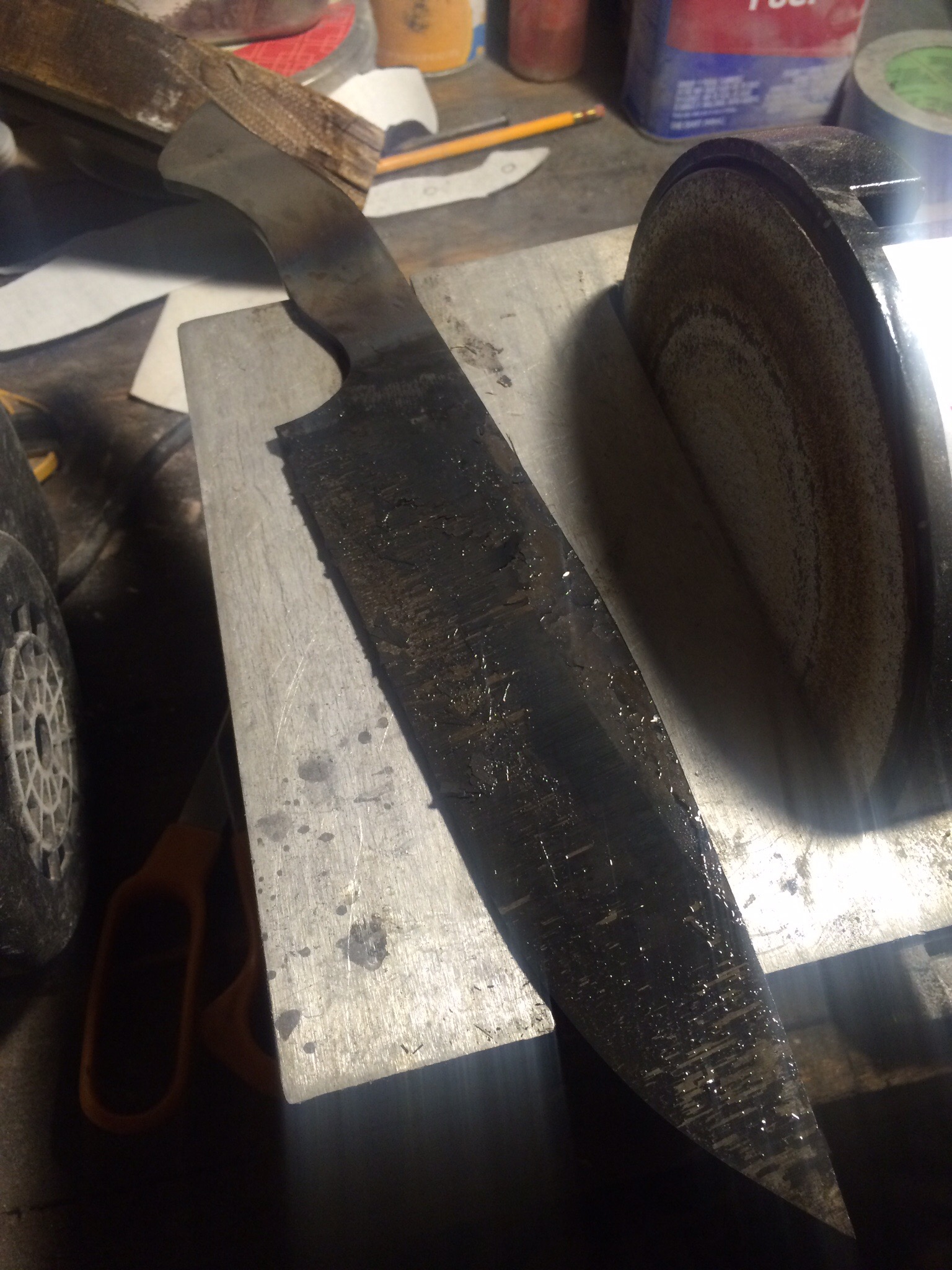
Hardening the Chef.
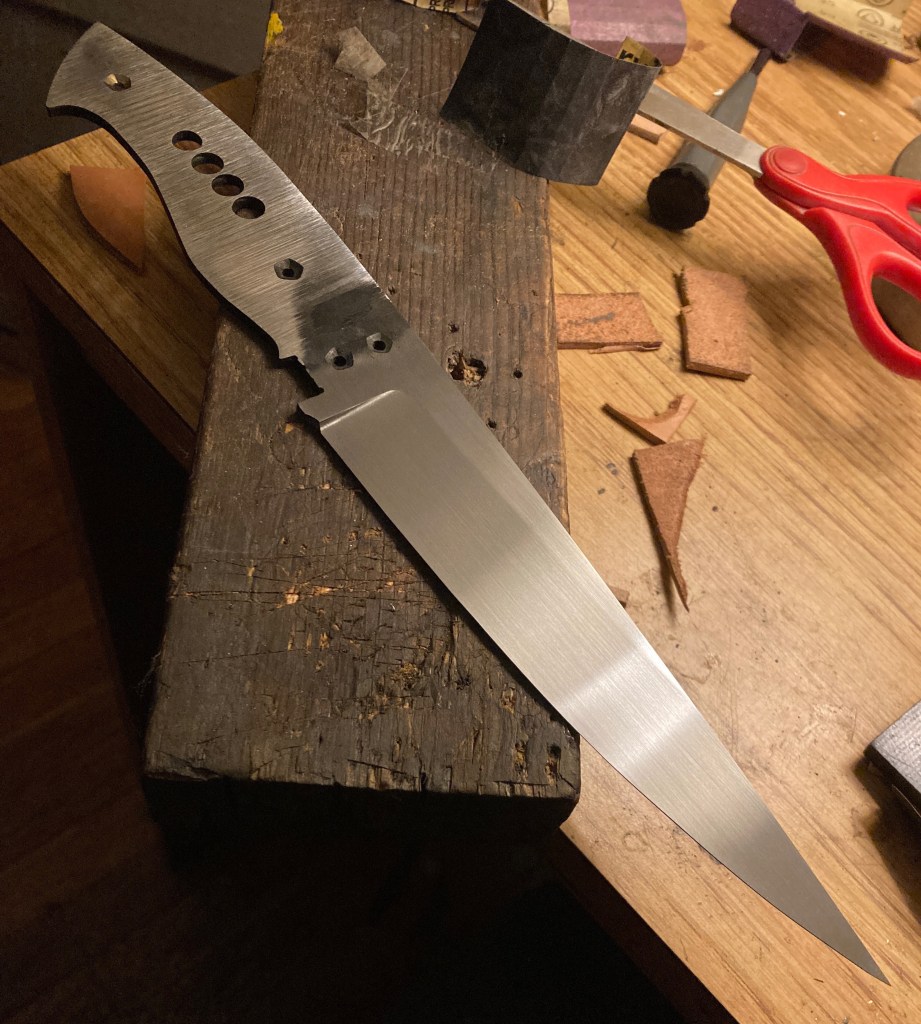
Rough grinding.
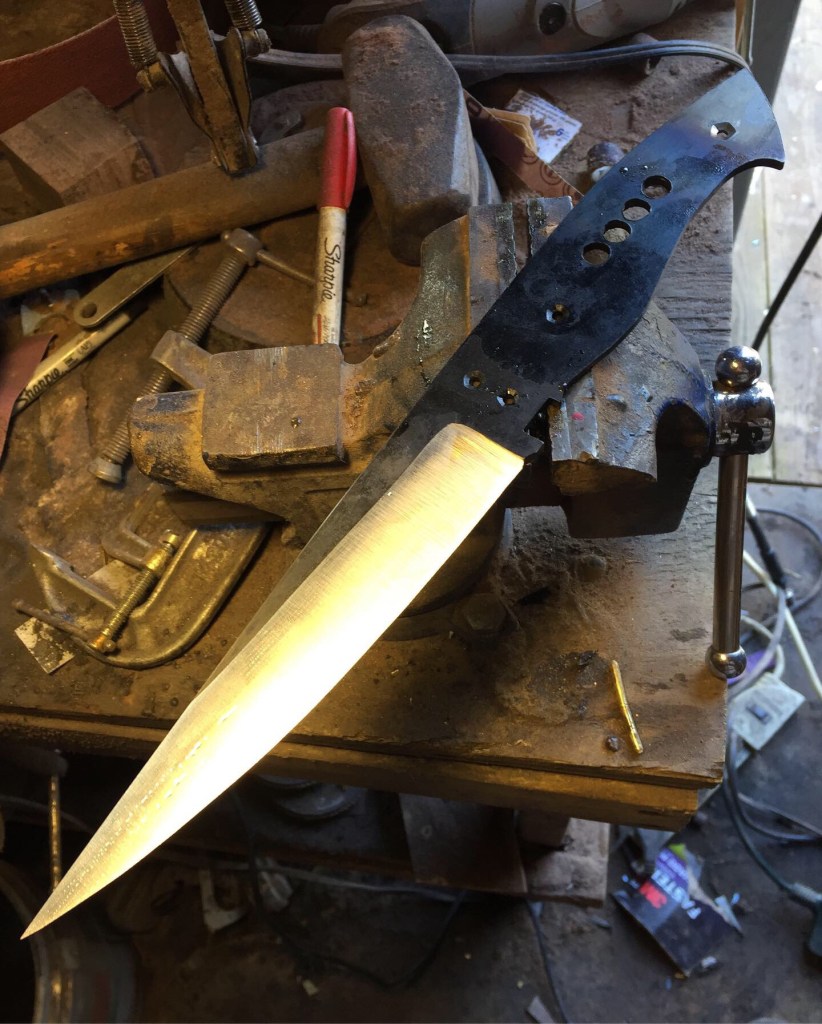
Rough grinding on the Boning knife after hardening.
A nice radius put on the spine.
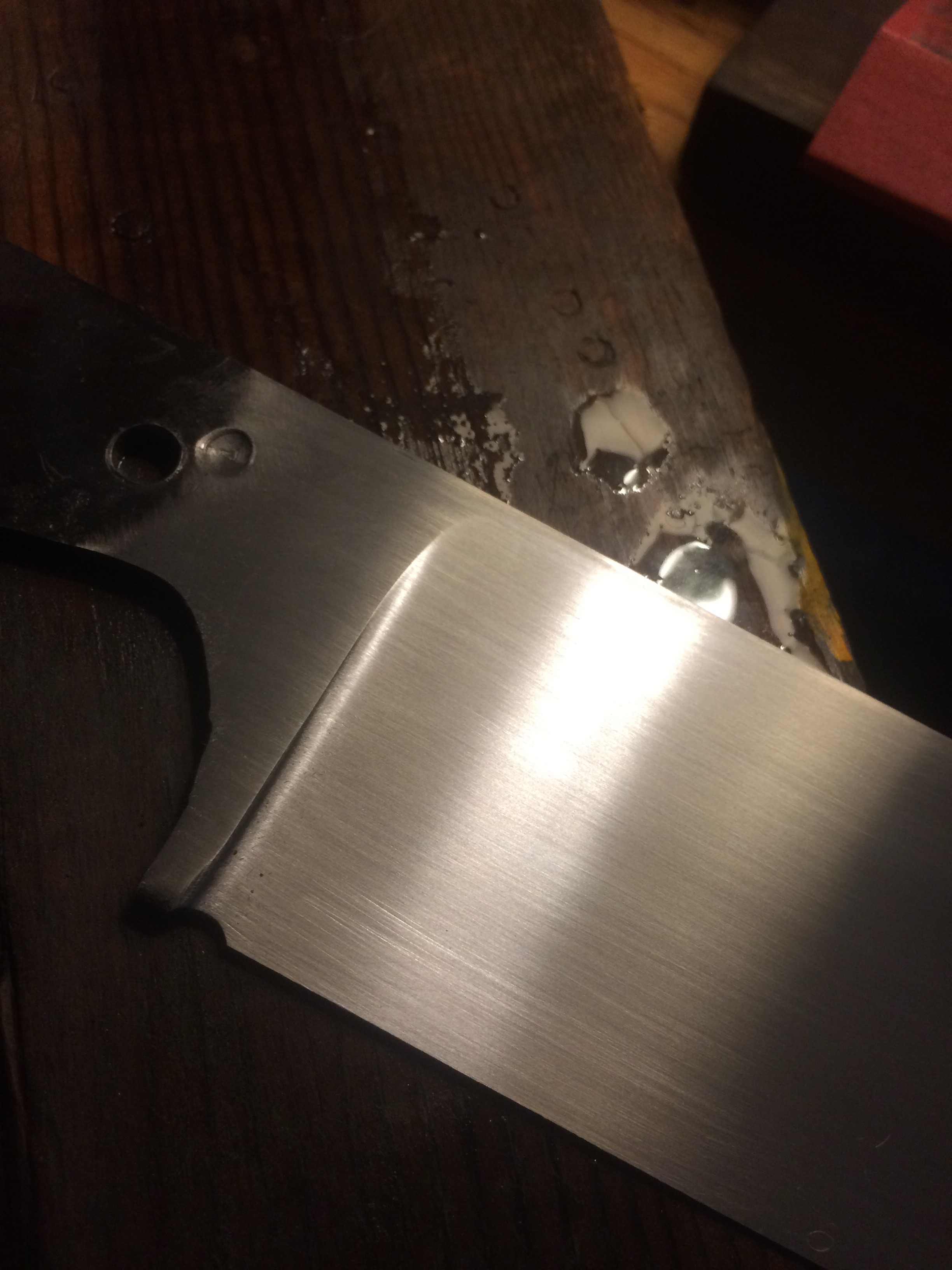
Laying down a hand rubbed satin finish.
600 grit.
Getting ready for fit up.
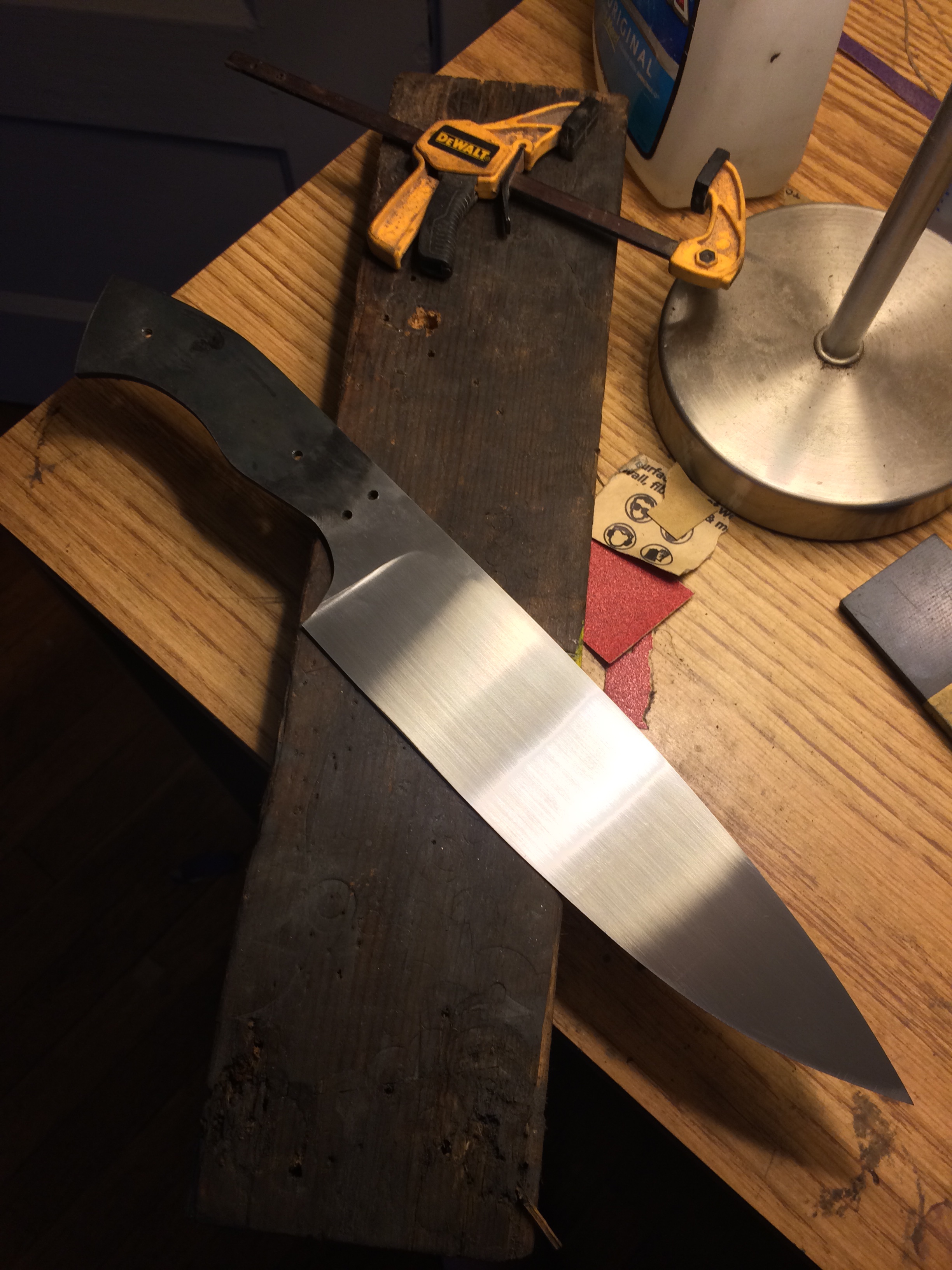
Sanding the Chef.
Satin.
Making sure everything lines up.
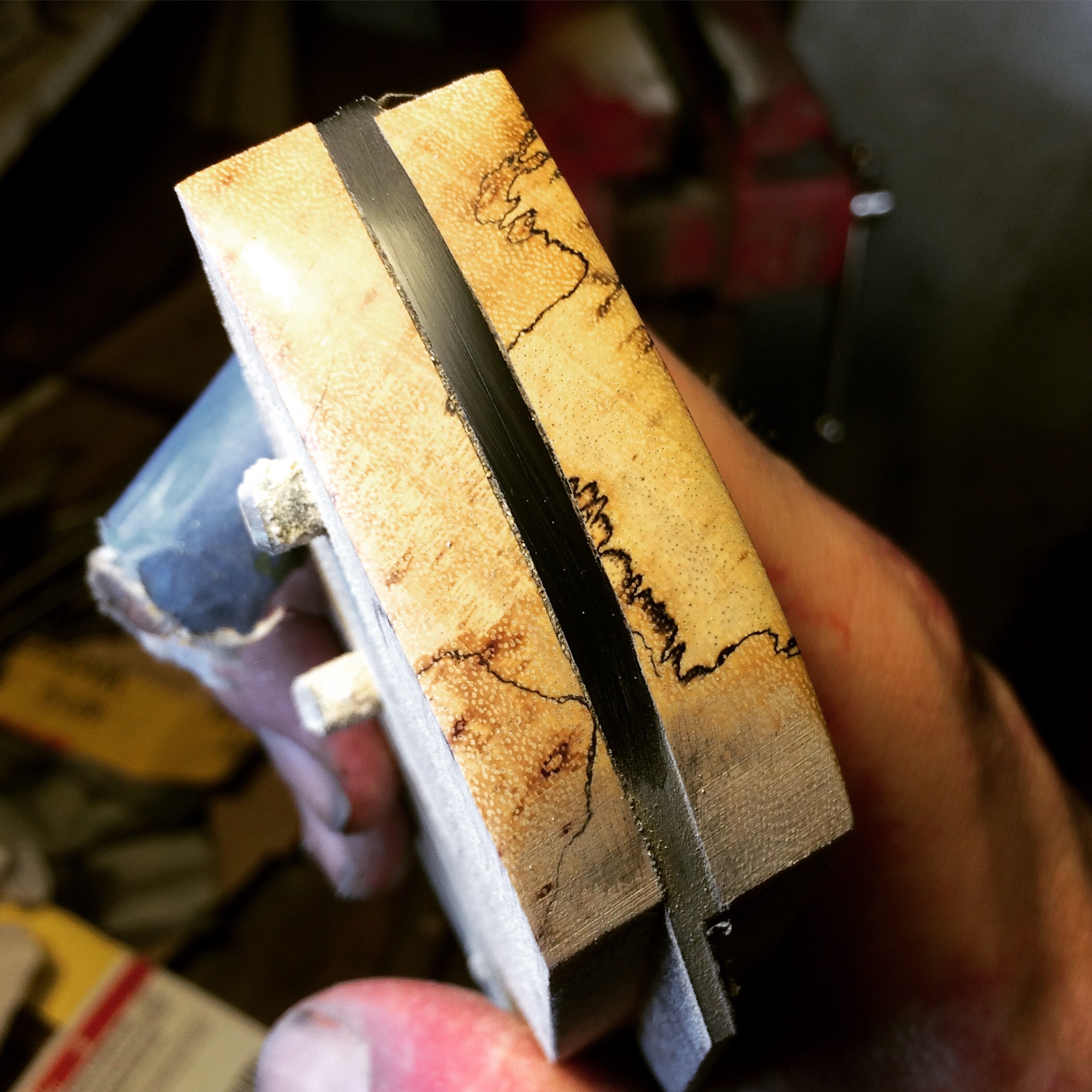
….and everything did not line up. I broke two drill bits trying to get everything lined up before epoxy cured. Epoxy cured and I have to rip everything apart and figure out what everything wasn’t lined up. This was the third attempt and everything finally went together.
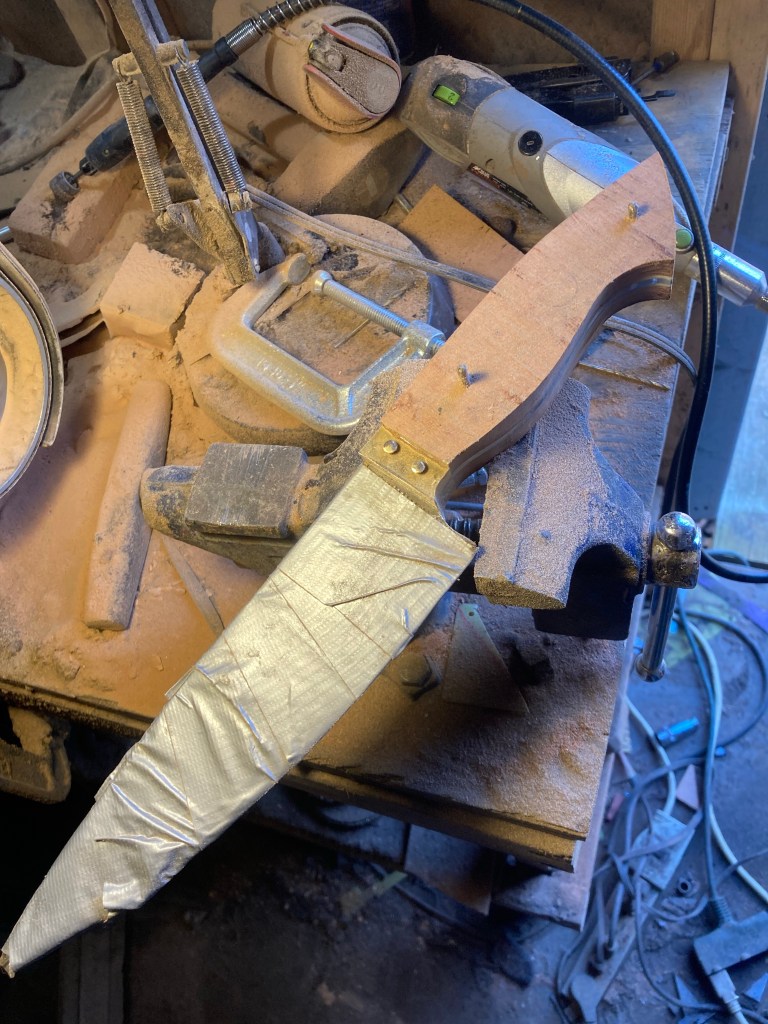
Hnadled up with Ebony.
Shaped.
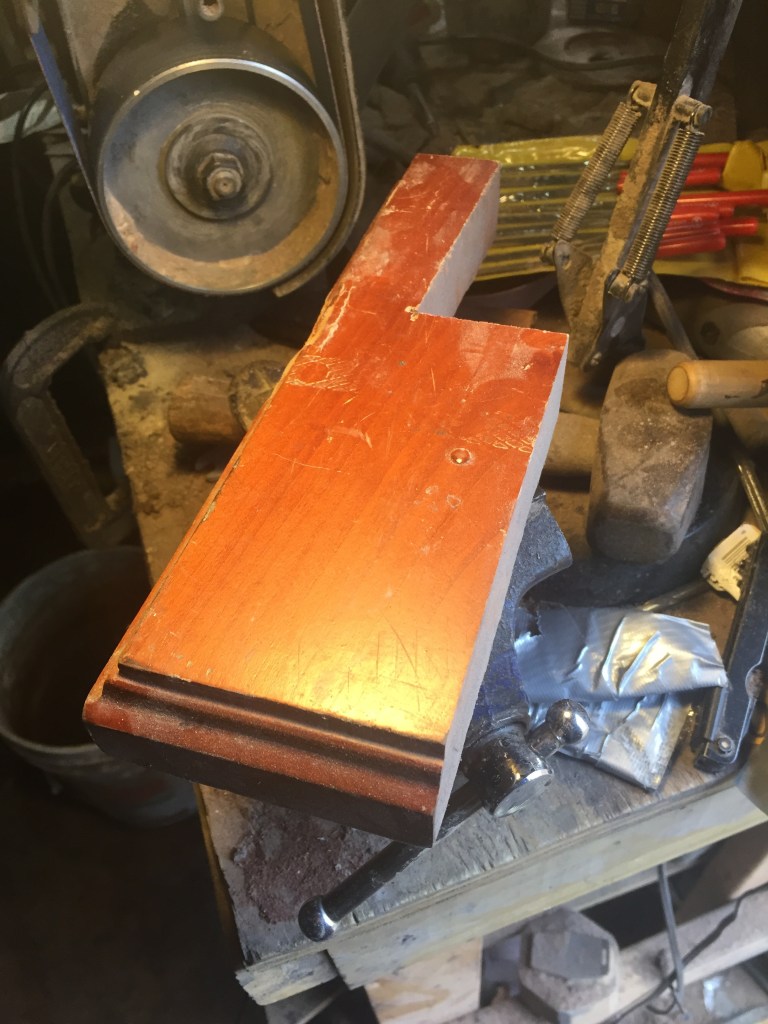
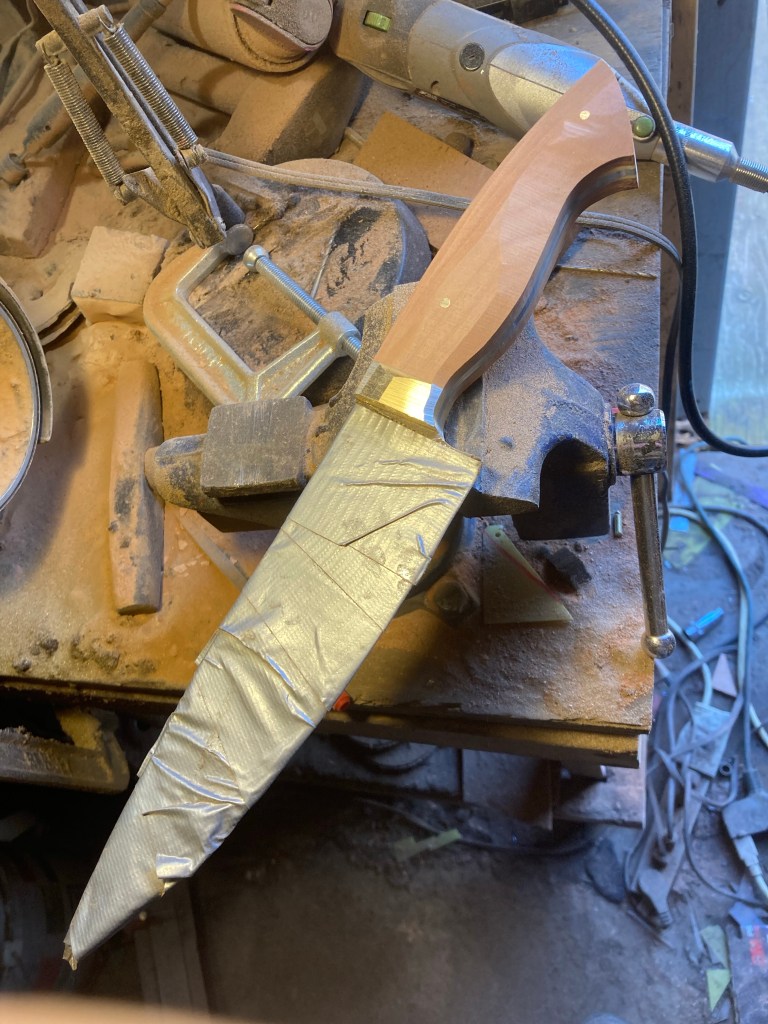
For the Chef we have reclaimed Cherry, recovered from an old mantlepiece.
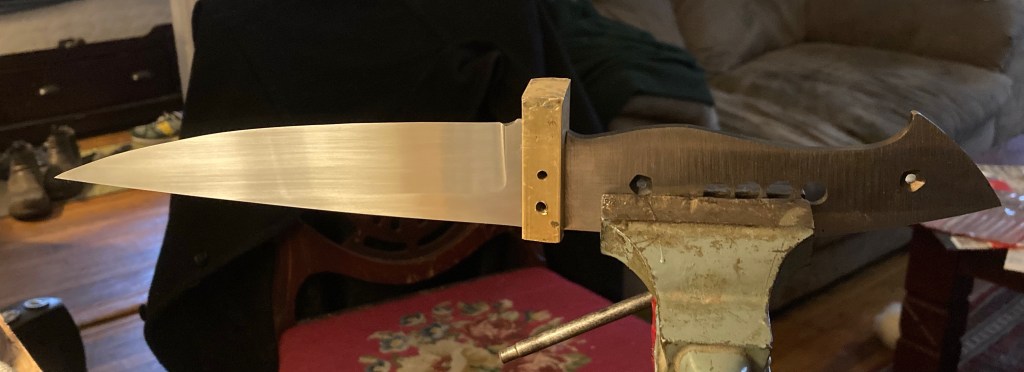
Preparing the brass bolster.
Peened and fitted.

Knifemaking: the things that are ours and the Notre L’affaire

“But then I have always been somewhat of a square peg in a round hole.”

Cressida Cowell- How to Speak Dragonese


When I was five years old I had my first lesson in finding out that the world might not be built for me.  I was not in kindergarten yet because I had told my mother that numbers and letters had looked too hard for me.  Perhaps I really wasn’t ready, or perhaps I was just stubborn, but this would leave me a year older than all my classmates through my entire academic career.  So at five years old I was sitting with all the other five year old preschool kids who, for whatever reason, weren’t quite ready for kindergarten either.  It was around Thanksgiving time and we were making hand turkeys out of construction paper.  You are probably familiar with the process, where you trace your hand and your fingers become the tail feathers and your thumb becomes the head and then you cut the entire thing out and add all the plumage.   I was having an incredibly difficult time with it.  I couldn’t get my scissors to work and I had no idea why.

As it turns out I was, and still am, left-handed.  They had no left-handed scissors, and the poor ladies couldn’t explain why I was the only one who cut with my left hand.  The silver lining was that when I looked at the wall of hand turkeys for the next two weeks before we took them home I knew exactly which one was mine- the sort of mangled looking, Mattisse-inspired one with it’s shredded, soft edges and pastel color themes.  It might not have quite fit in, but that turkey belonged to me.

I think a major source of anxiety today comes from a pressure to fit in.  We are pack animals after all, social creatures, and there is a large degree of comfort and safety that comes with fitting in.  For whatever reason some of us just don’t fit.  Maybe our personal values don’t align with the metrics of what society calls success.  Maybe the things in the world that move us have been wrought and tempered in such a way that makes the mainstream feel incredibly dull and boring.  Maybe we were brought up in a fashion that causes us to question the rules and the people who make them.  Or perhaps our idiosyncrasies and the way we see the world simply makes others in the pack feel uncomfortable. 

Because the reality is that life is uncomfortable and existence is messy, and no amount of corporate team building exercises or ‘life is beautiful’ bumper stickers will change that fact.  The square pegs of the world know this, because things have probably always been uncomfortable.  The beauty of being a square peg that doesn’t fit into the circular opening of life is that you find a way of living that is unique and meaningful to you.  Usually that means crashing through more than a few romantic relationships, getting fired from a few jobs, making a whole lot of mistakes, and generally being a mess for awhile.

When you finally pop out on the other side of all that, you may find that what you’ve become is completely and totally your own, free of mimicry and imitation.   All those things that you’ve become- those belong to you and no one else.

(I taught myself to cut right-handed in elementary school to save myself and my teachers a lot of grief.  I cut better right-handed than I do left-handed.  You have to pick your battles.)

This knife was commissioned for a chef at a local restaurant by his girlfriend.  I love making knives for restaurant people- anyone who winds up in food service is totally a square peg.  In talking to the girlfriend, who works in hospitality, she told me that they were both a little crazy, which is part of what makes everything so interesting.  ‘Notre L’affaire’ roughly means ‘our thing’ in the sense of something intimate and personal, like a slightly rough-around-the-edges turkey made of construction paper hanging on a pre-school bulletin board.  You should always recognize and honor the things that are yours.


An 8″ chef in the German Style:

Hi-carbon American 1095 steel:

Profiled and drilled:

Into the forge:

Making sure everything is straight:

Grinding the bevels:

img_7555

a5882d54-3626-42c7-848a-b3b1a1c3a553

Hand sanding:

Satin finish:

An acid etch to help with corrosion resistance:

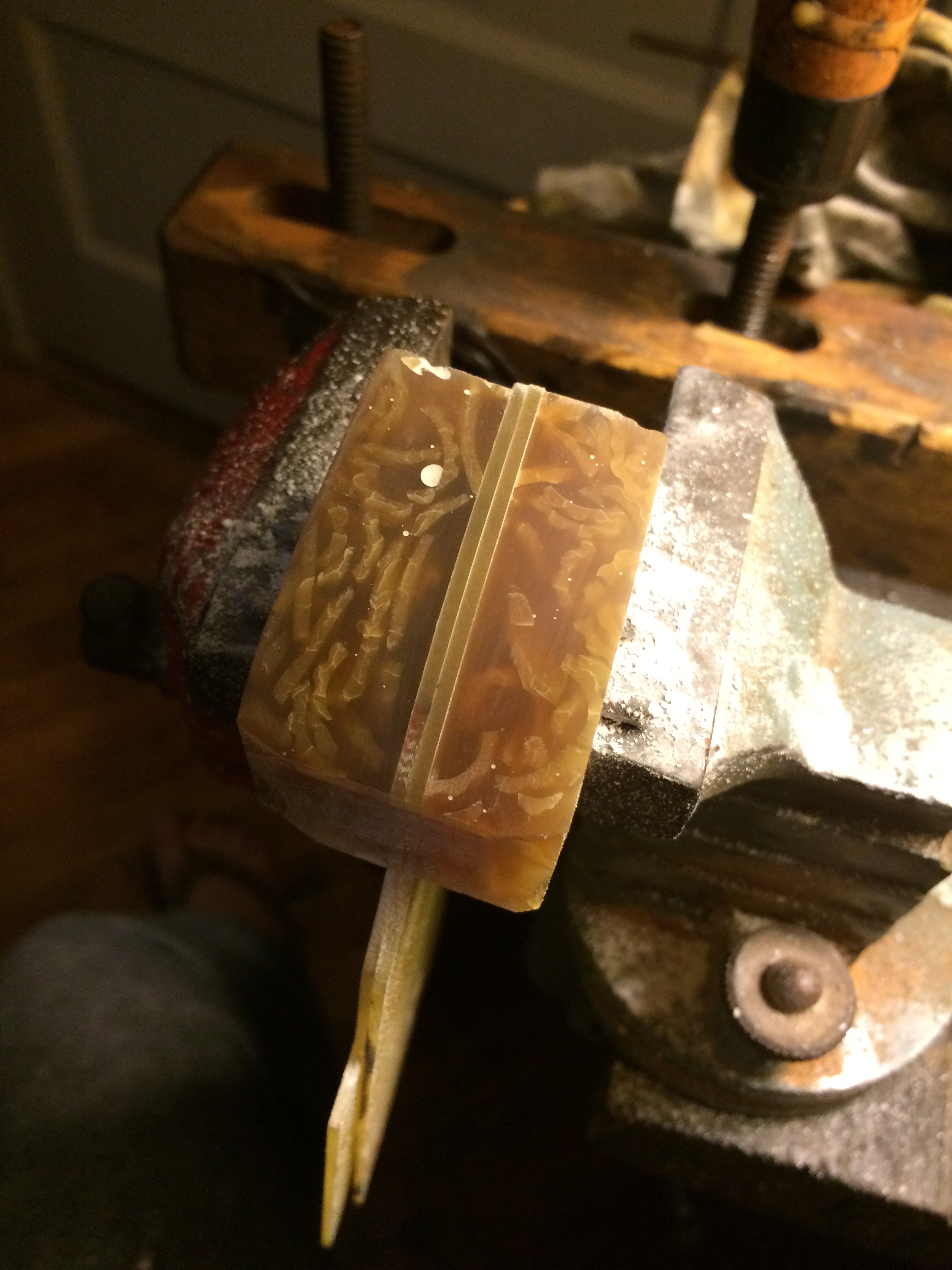
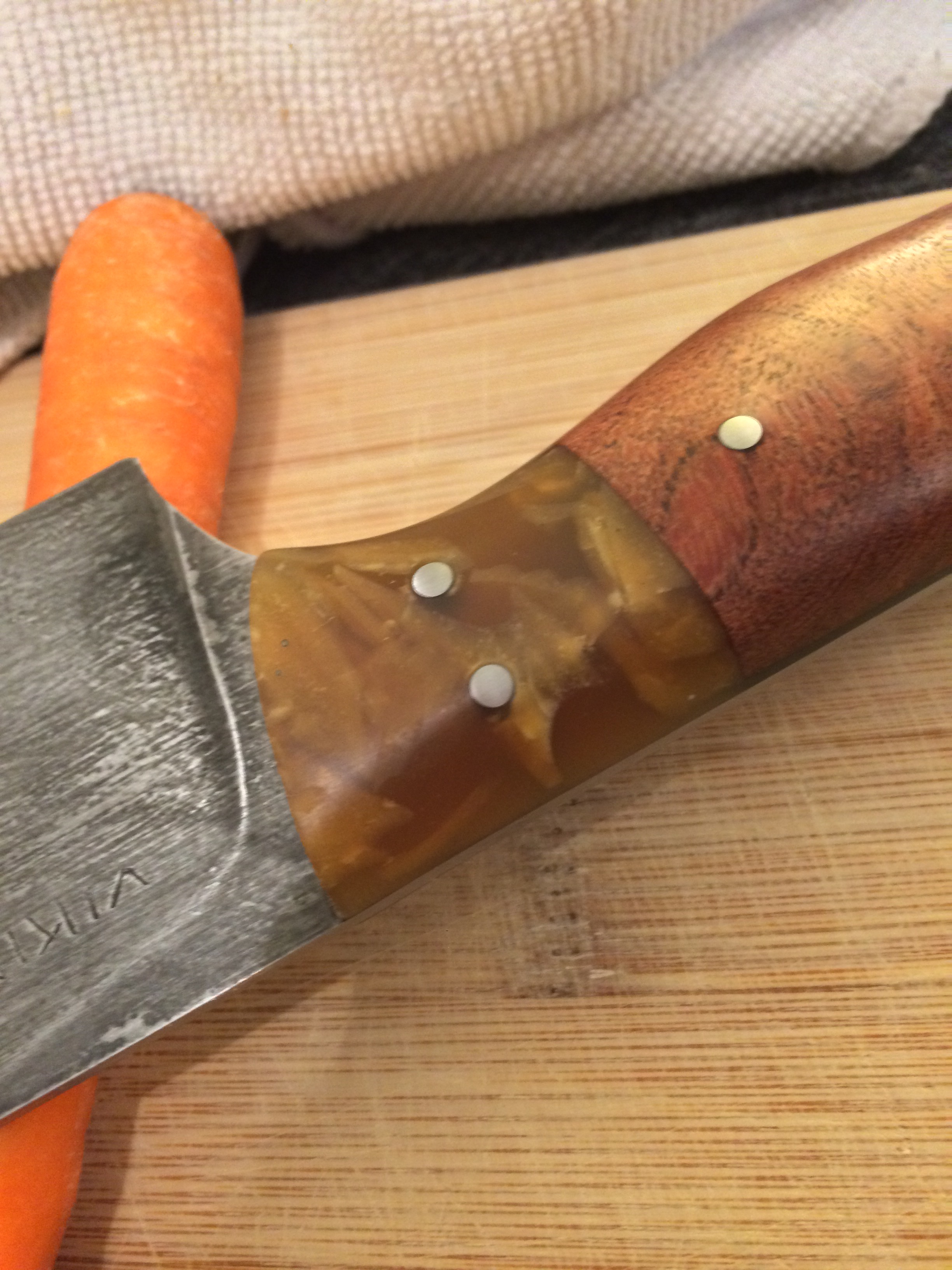
For the bolster we’ll make a material out of bow tie pasta:

After it gets smashed up and set in fiberglass resin…

…you get something like this:

img_7586-e1568582334258.jpg

Texas Mesquite:

Glued:

The Notre L’affaire:

Knifemaking: a restoration

“You didn’t get the quest you wanted, you got the one you could do.”
Lev Grossman, The Magician King

Every so often our shop will get calls to put a new handle on an old knife.  We always make every effort to do as many of these as we can.  

The ability to make something broken work in the way that it once did is a virtue.  This is especially true when the something that was broken is special to someone.  In most instances it’s pretty easy to replace what was broken, but the sentiment becomes lost.  Whenever possible I always try to fix what is broken, especially in the shop.

I treat these repair jobs as an exercise in incorporating as many broken or discarded things as possible into the finished product- it gives something totally unique back to the client.   Our jobs as craftsmen are to give a voice to our materials, allowing them to speak for themselves.  Many times we don’t choose what comes to us but nonetheless it is our job to turn what comes our way into something beautiful.  Making something better than it was before-this is the goal of a skilled craftsman.  For those in the know, these are the things that put the color in our world.

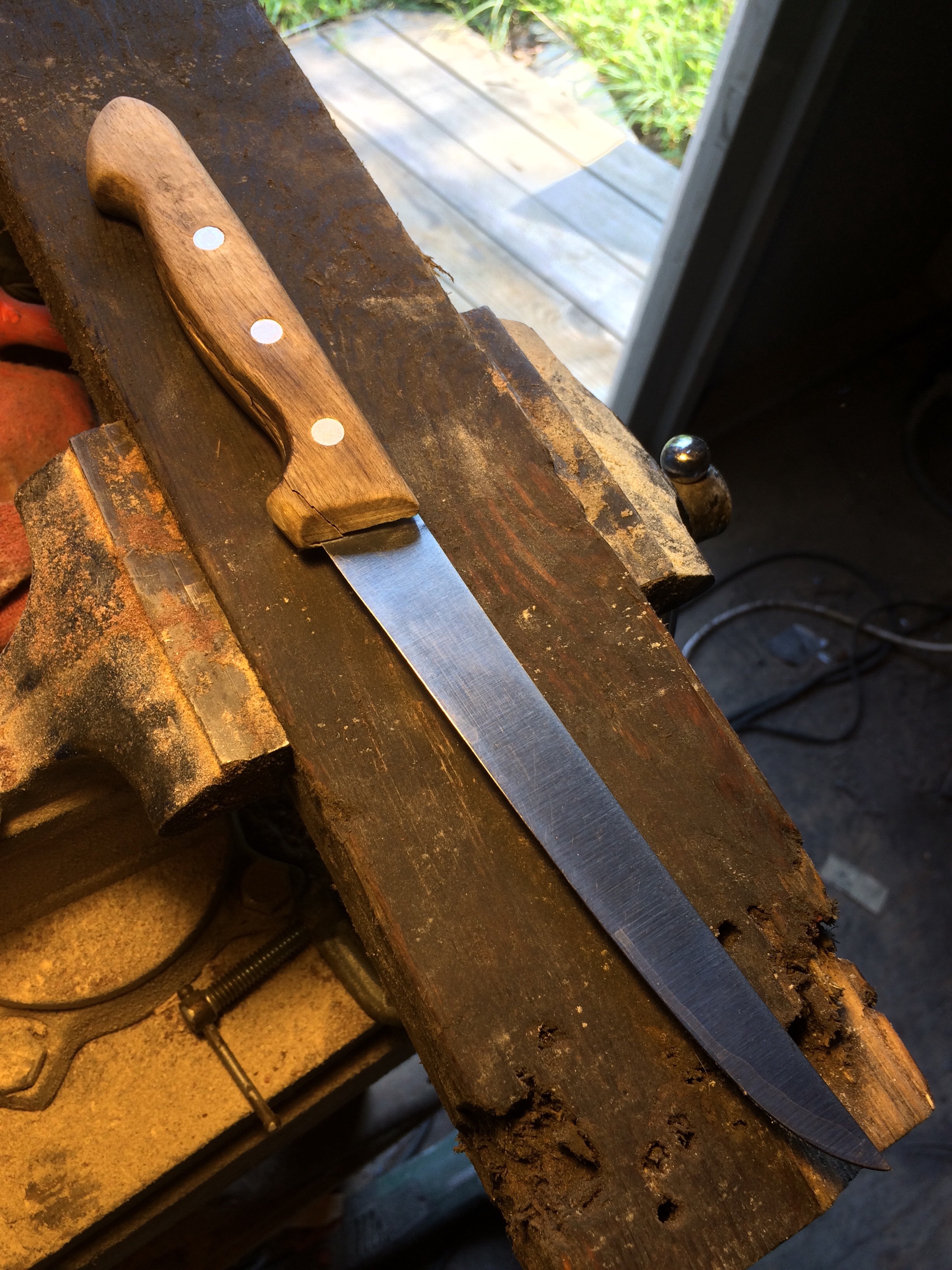
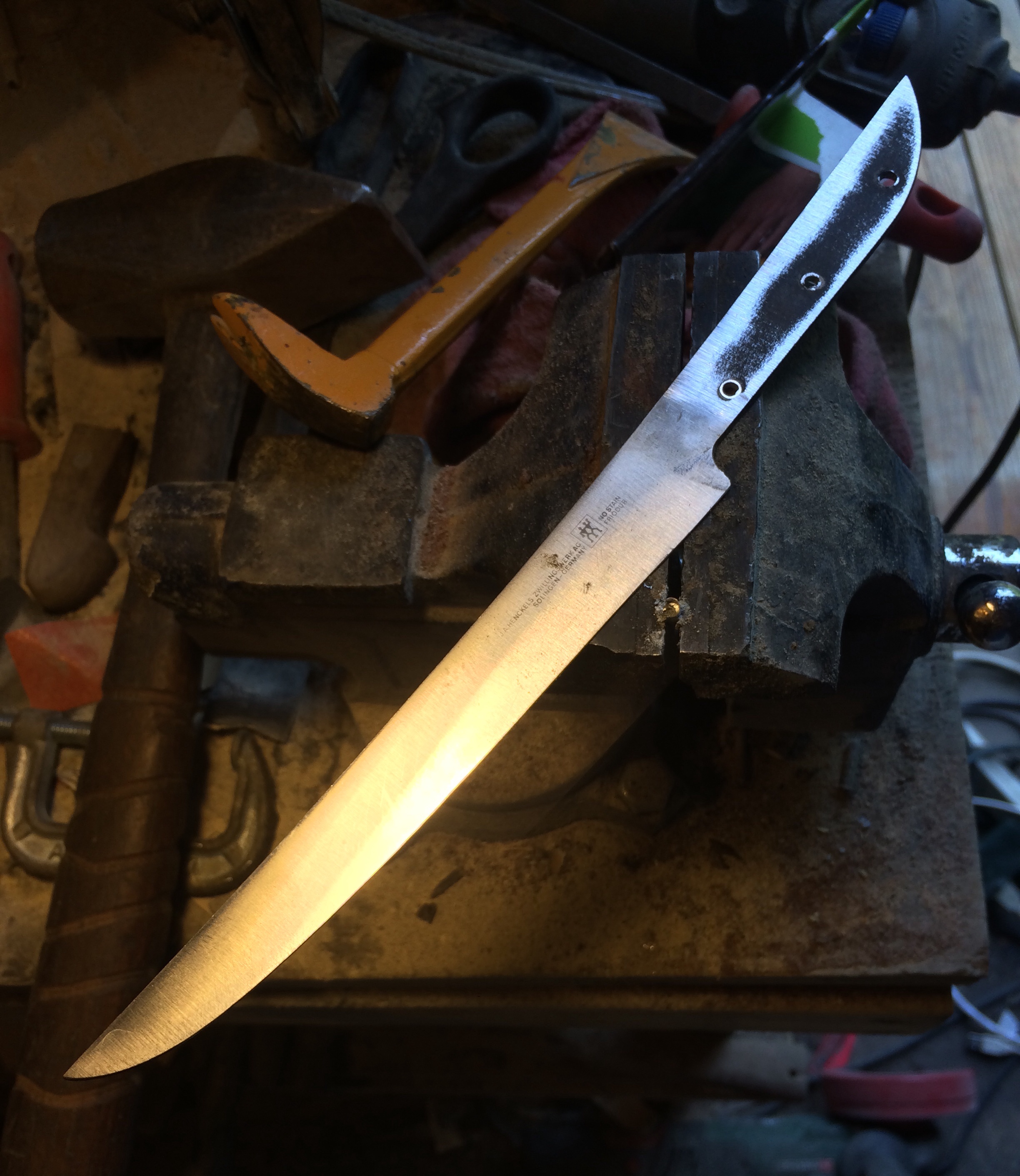
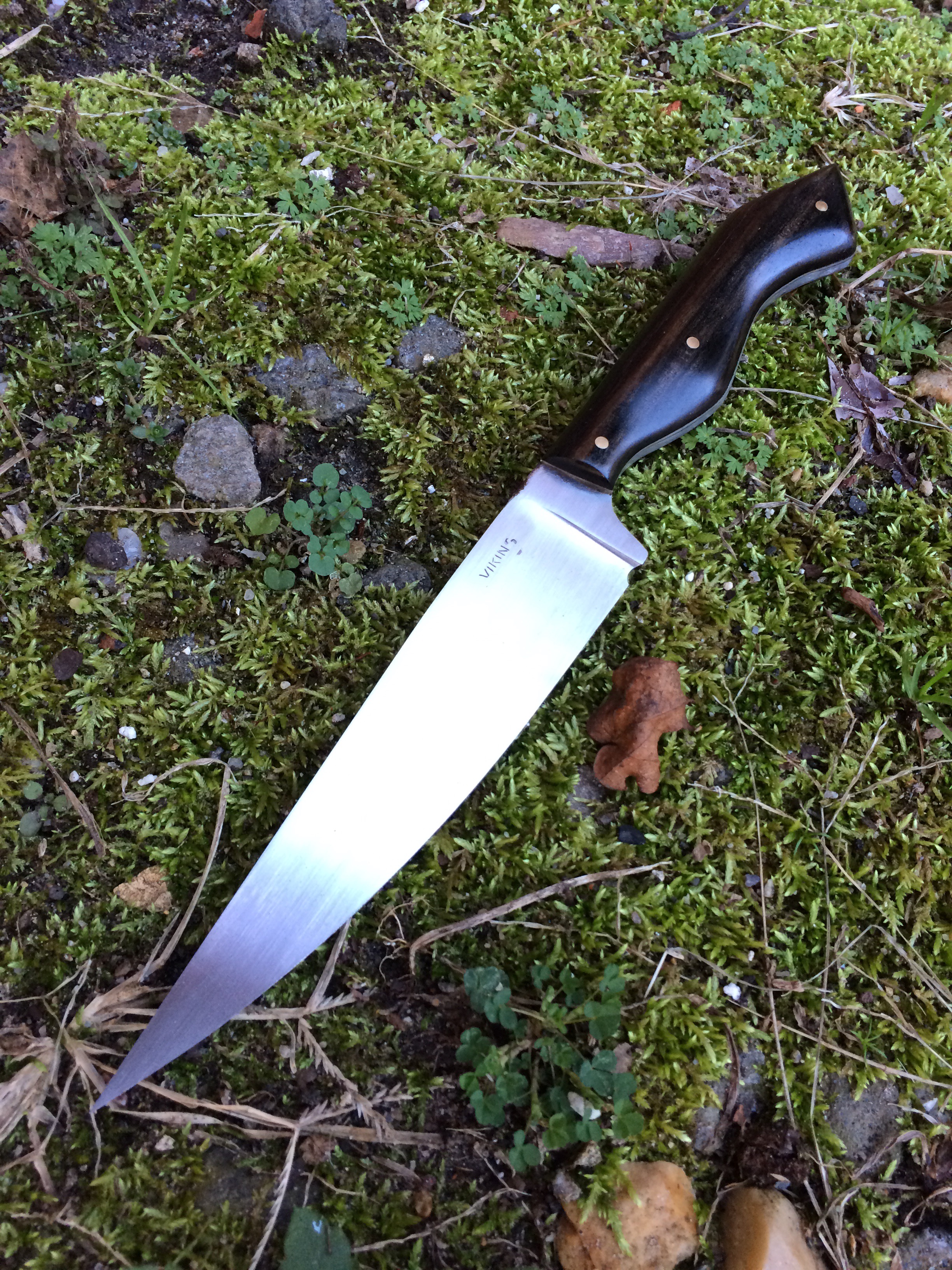
A gentlemen contacted us about re-handling an old boning knife he got in the 1970’s.  It was an old Zwilling knife, made from good Solingen steel, with Zwilling’s proprietary ‘Friodur’ subzero tempering process.  The handle had cracked, as natural materials tend to do over the years.

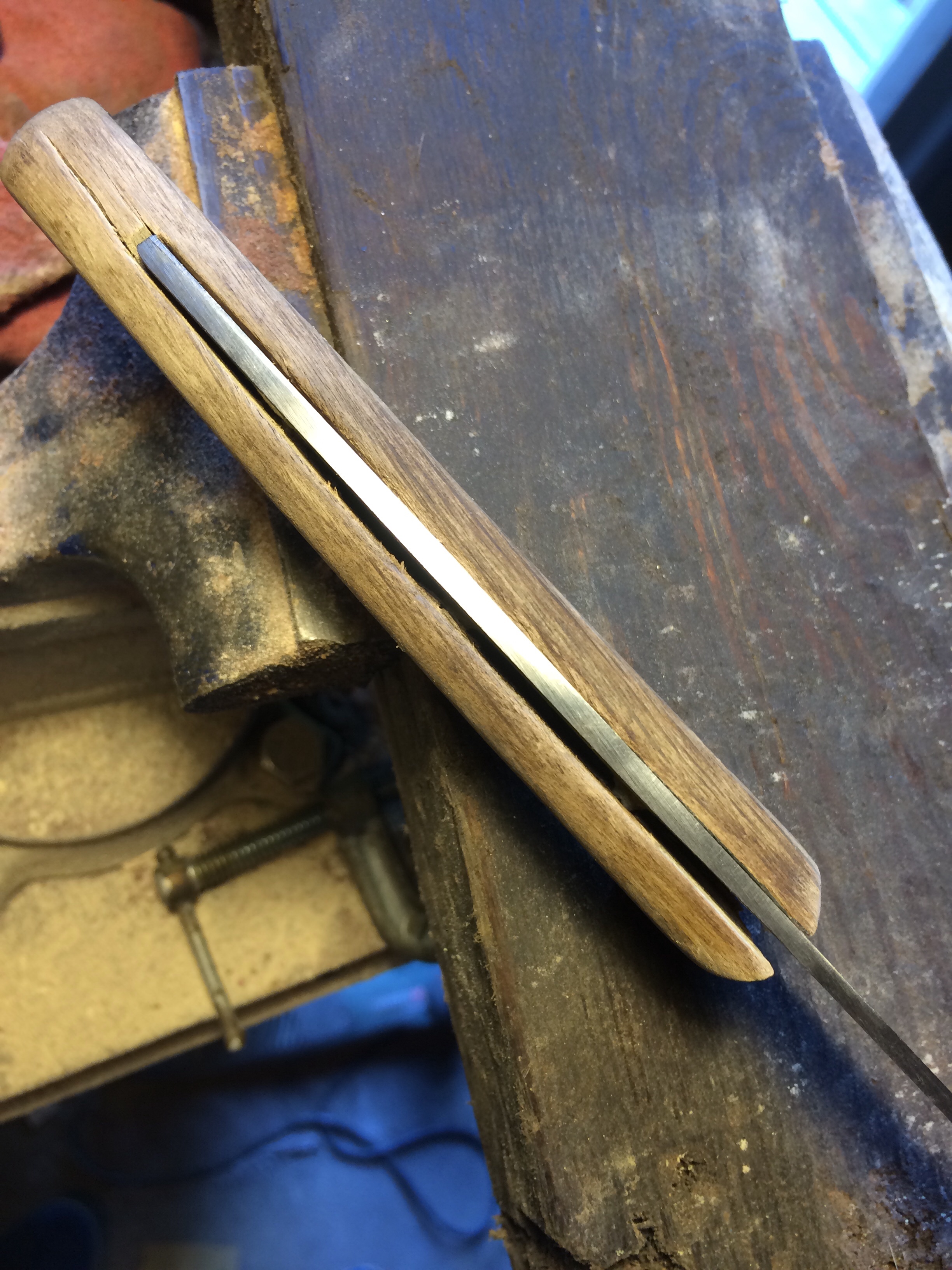
This one was partial tang, meaning the metal in the handle doesn’t run the complete length of the handle:

First, we remove the old handle and the rivets:

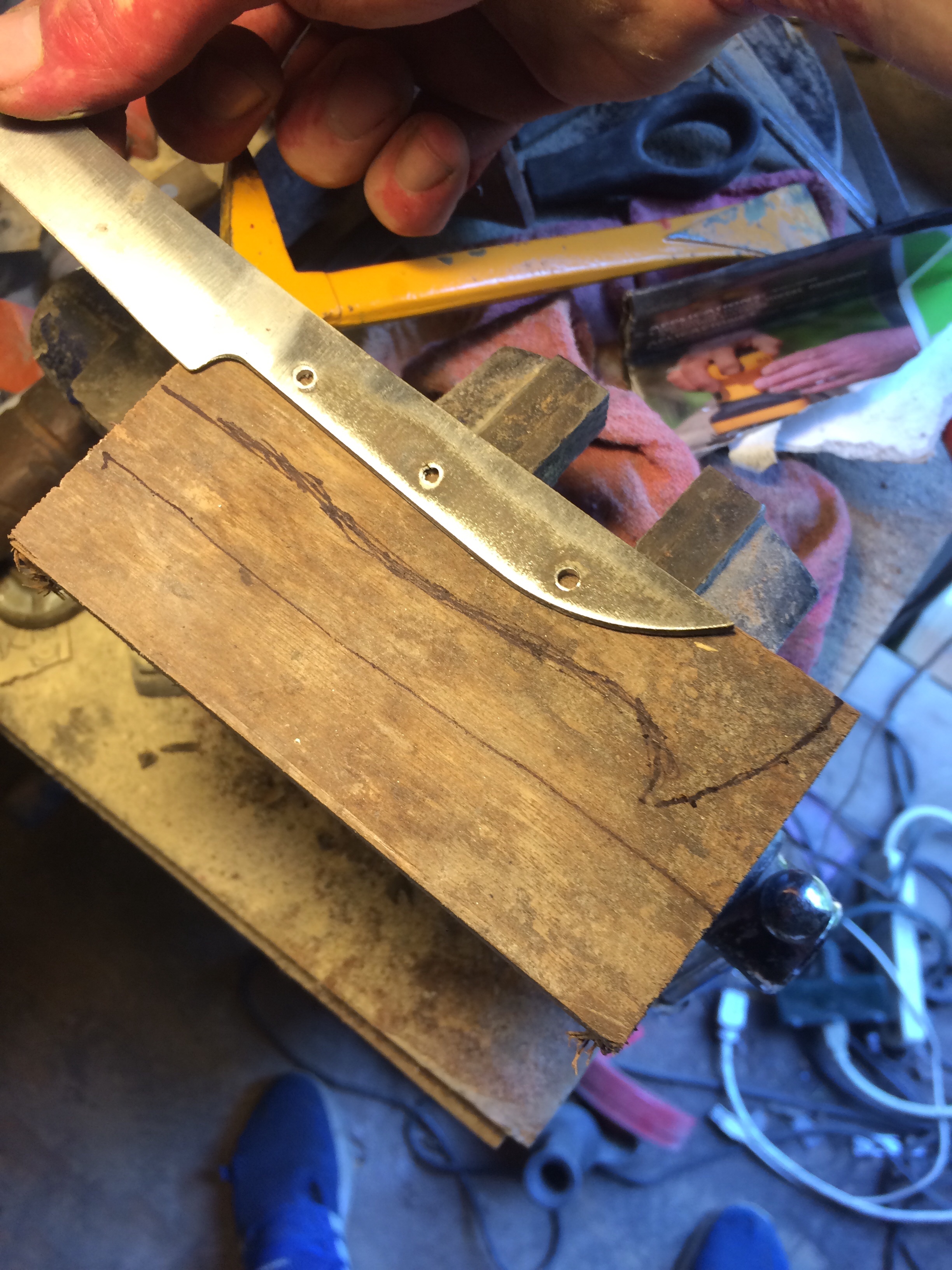
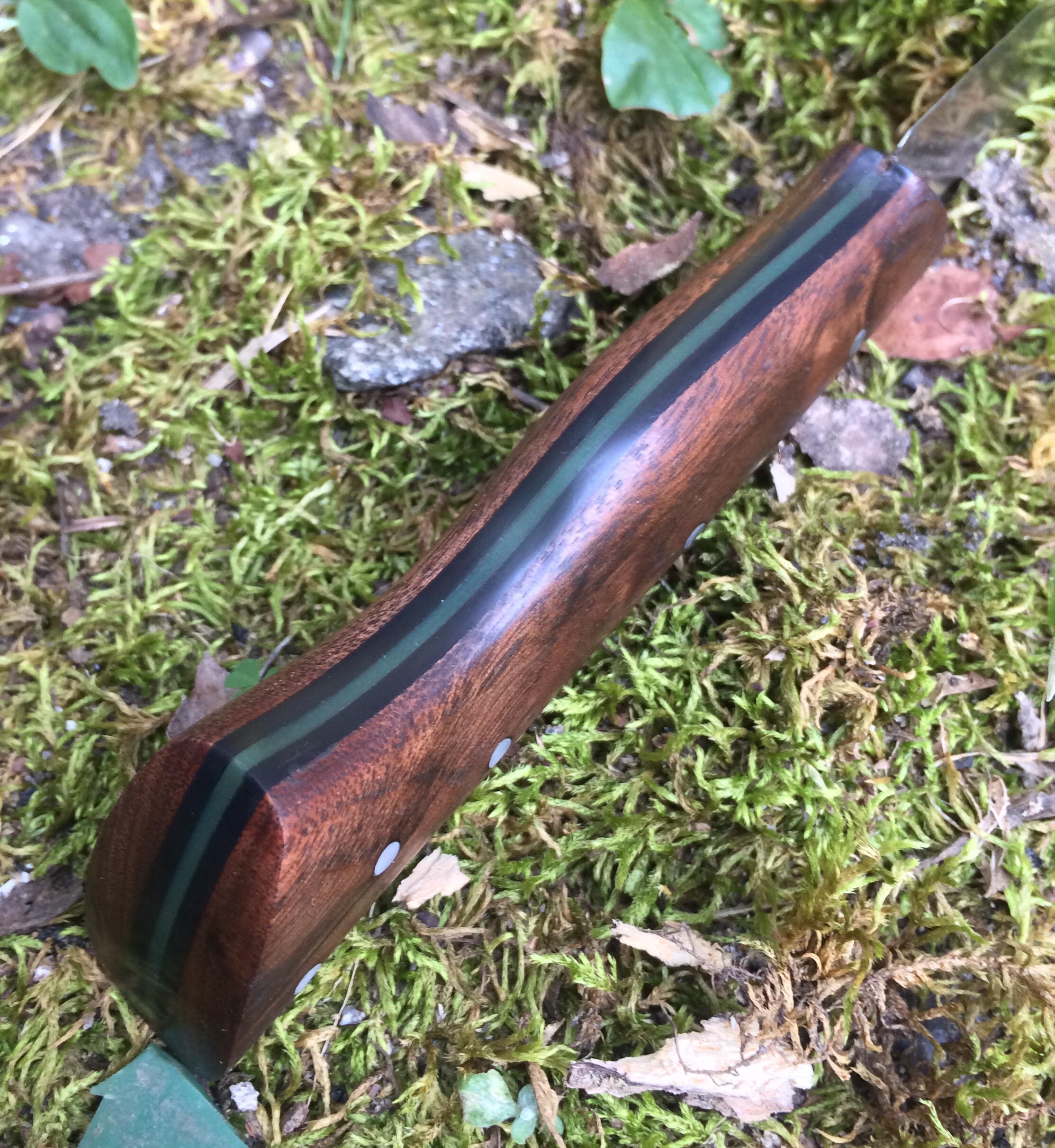
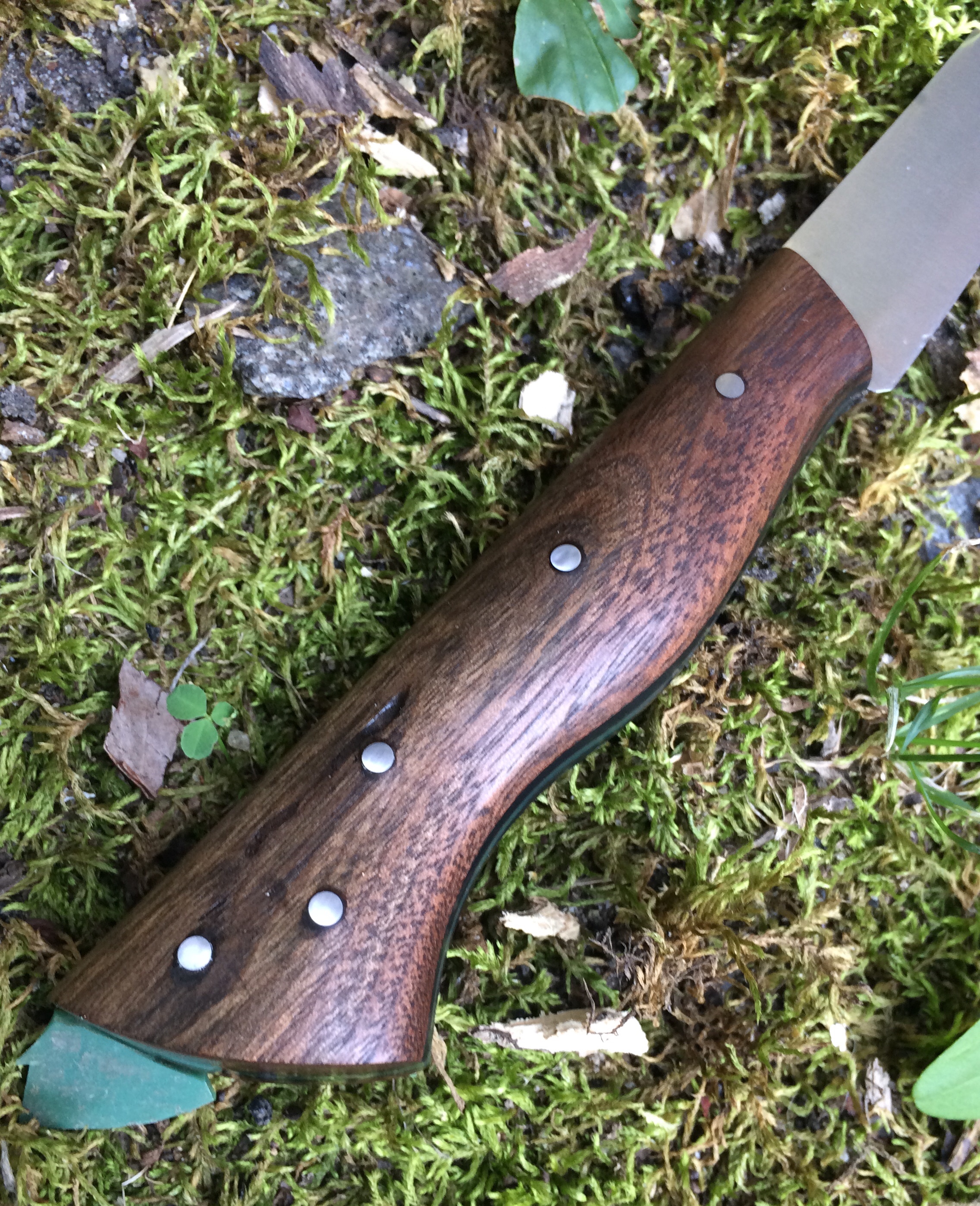
For the handle we’re going to use Black Walnut, which was formerly a baseboard salvaged from an abandoned house in North Carolina:

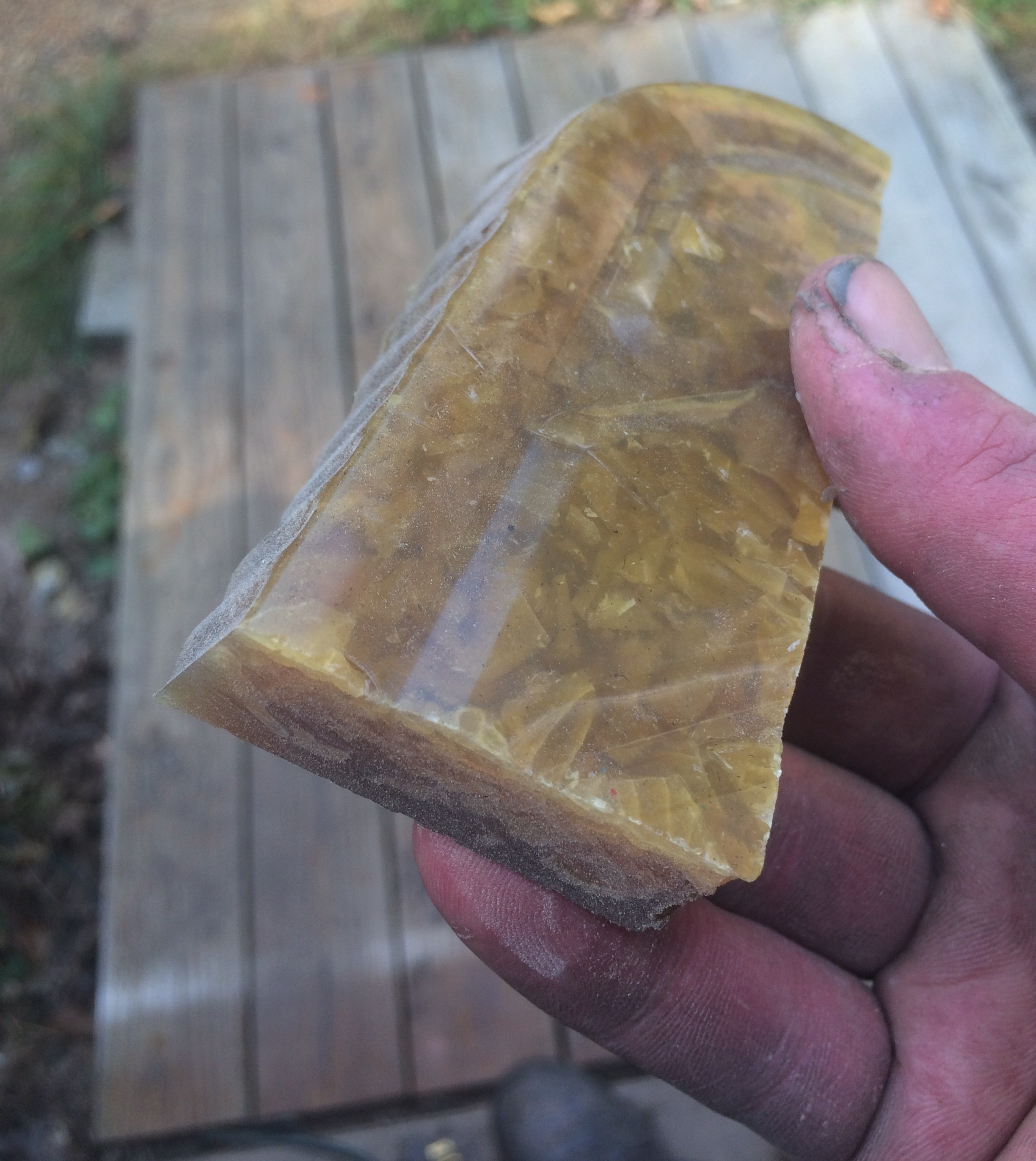
To extend the tang, we’re going to use a fiberglass computer board spacer which I dug out of a dumpster at one of my workplaces.  Though it looks yellow, it will turn green as it’s polished:

img_6337

Drilling the rivet holes.  The black spacing material is a heavy plastic that came from an office mail separator:

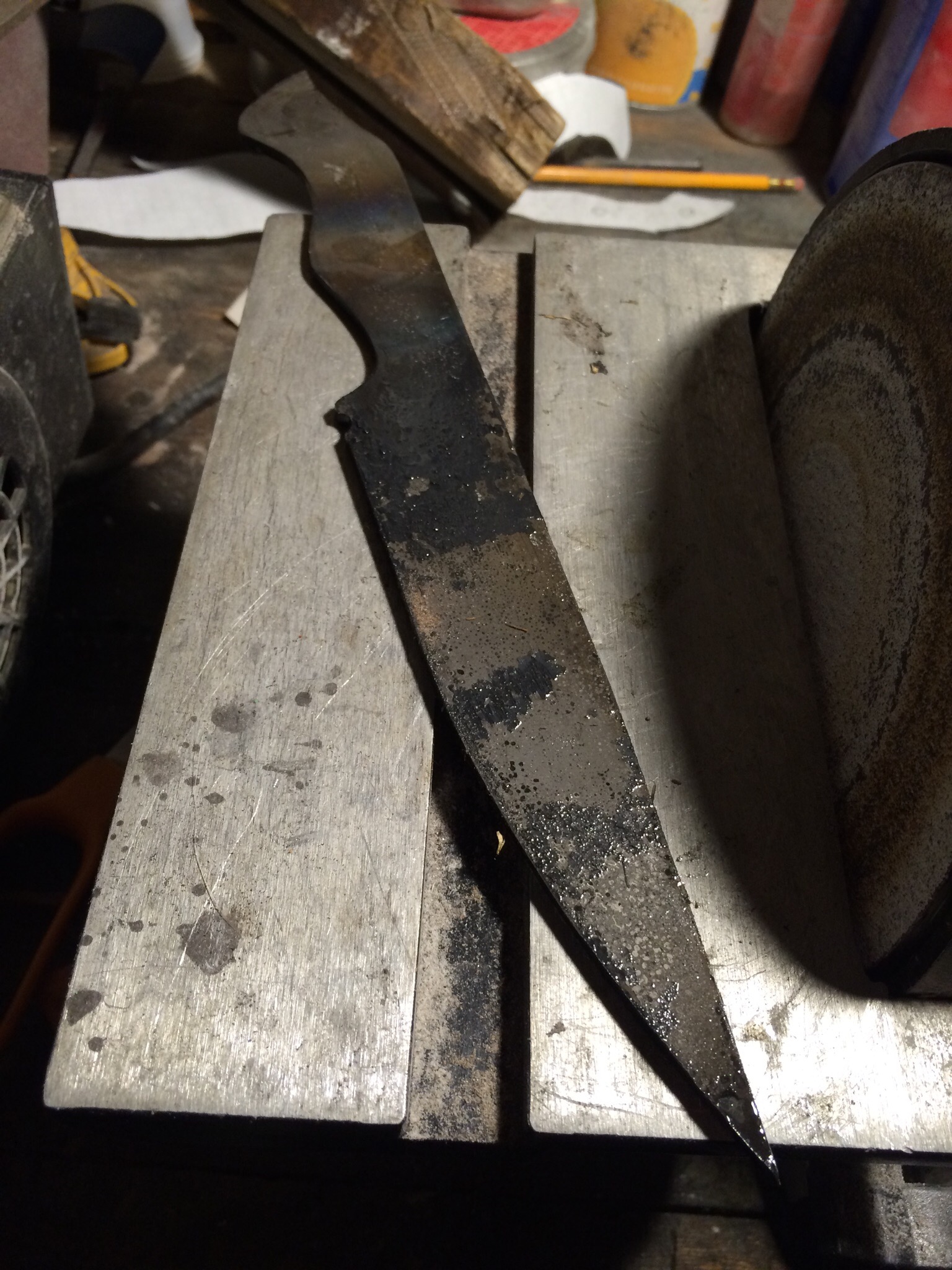
This is the top of the handle, closest to the ricasso of the blade, of the belt sander at 40 grit:

Sanded from 60 to 800 grit:

Ready for glue up:

Glued and clamped:

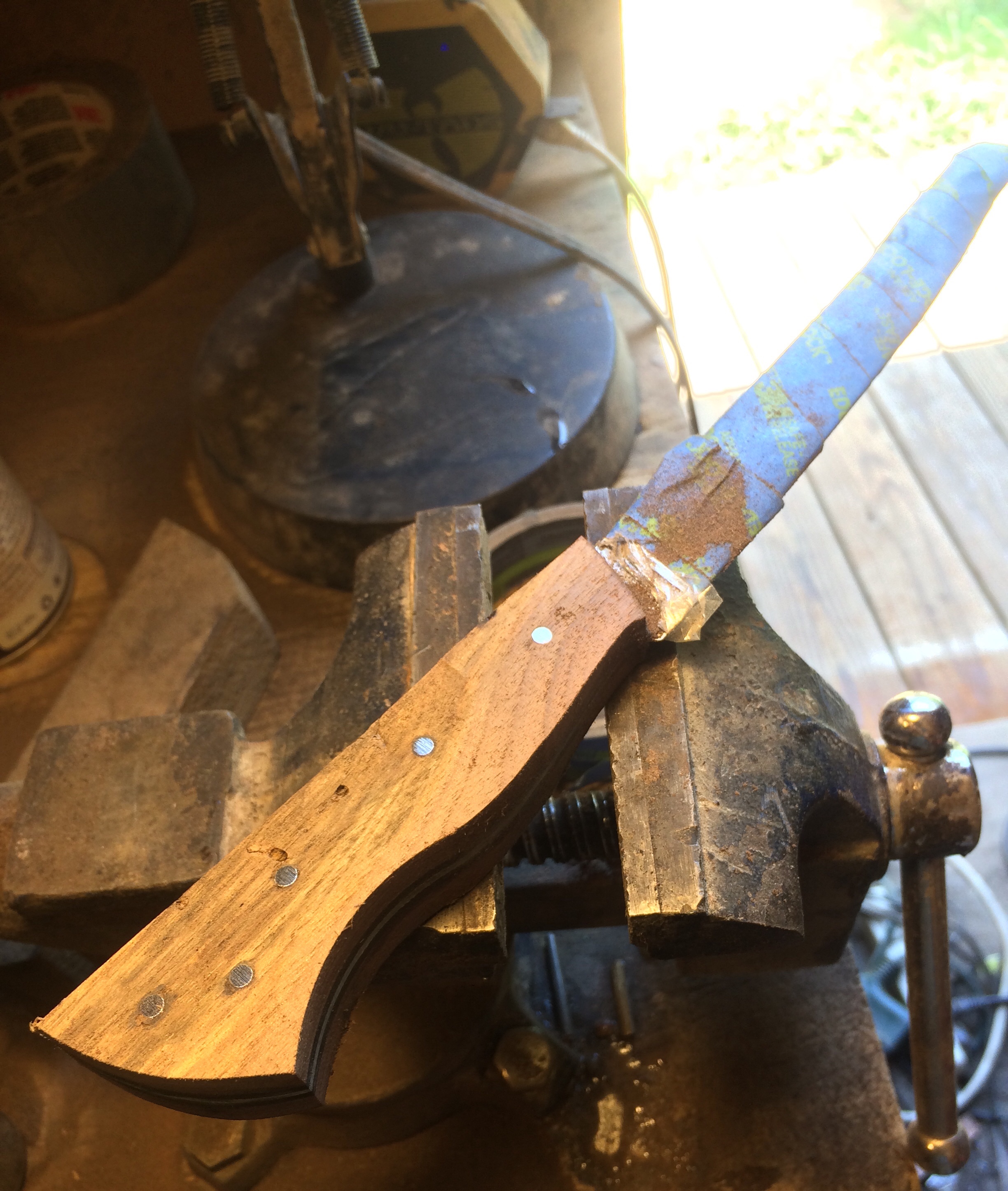
Roughly profiled:

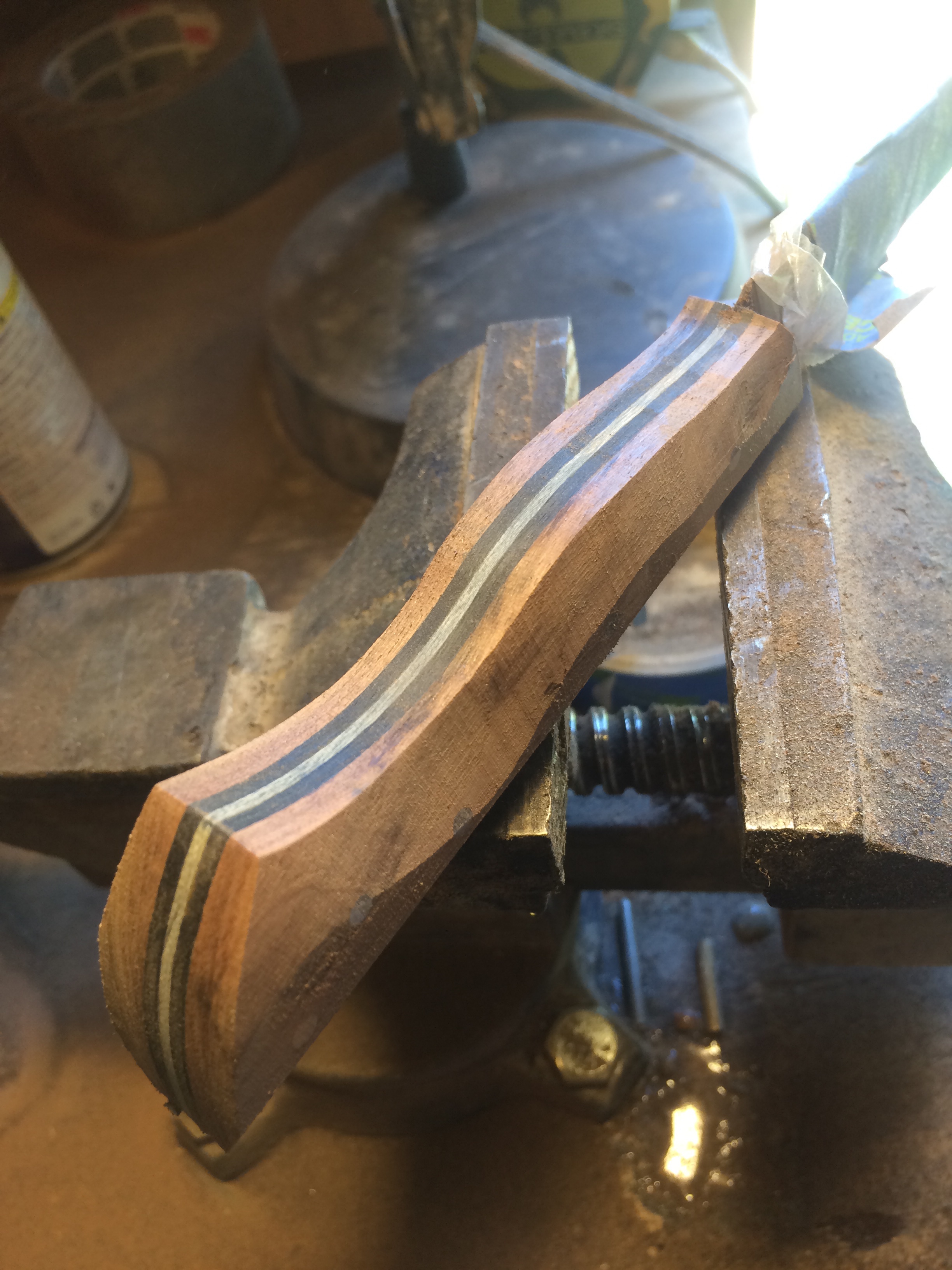
Shaped to the desired shape.  The rest of the work will be done by hand, starting with 80 grit sandpaper and going up to 2000 grit.

Finished, sealed, and oiled:

Always take the opportunity to create something beautiful.

Knifemaking: yes and no; and Urim and Thummim

“Take these,” said the old man, holding out a white stone and a black stone that had been embedded at the center of the breastplate. “They are called Urim and Thummim.  The black signifies ‘yes,’ and the white ‘no.’  When you are unable to read the omens, they will help you to do so.  Always ask an objective question.”

Paulo Coelho- The Alchemist

I took a philosophy class in college.  The professor was an older gentleman, and a bit mysterious.  He had us buy a very expensive textbook which we never used.  He was the one asking the questions and it was mostly us, the class, that did the talking.  We never learned much about him other that that he had had a bit of celebrity on the academic circuit several decades prior. In his younger days he practiced judo.  Later in life he discovered Tai Chi, and taught that as well.  He never elaborated on any of this.

I don’t remember much of what we talked about.  I was twenty-two and liked to go to class stoned.  I do remember there was some Kant in there, and some St. Augustine, and probably some ideas on relative morality versus universal morality.  I also remember one lesson we had, one about truth, and how all matters can be broken down into a yes or a no.

He gave an example: all cellular communication can be broken down into ‘yes’ or ‘no’.  ‘Yes I will fuse with this protein,’ or ‘No I will not fuse with this protein.’  ‘Yes I will bind to this synapse,’ or ‘No, I will not bind to this synapse.’  Matters that are gray in appearance only remain so until one goes deep enough to find a ‘yes’ or a ‘no’- and in many instances in our personal lives we never get to that point.  Sometimes the truth contains many yes’s and no’s.  Sometimes the truth is much larger than our own individual internal agreement or disagreements.  This is part of what gives life it’s mystery and beauty.

There was one particular assignment, a large one, that came up.  We had to write a 10 page paper on a topic we chose.  The professor had a list of topics to choose from.  We were to choose a topic with which we most disagreed.  I had found mine:

‘True virtue requires true religion’

He then flipped it around and told us that our paper had to argue in agreement with our chosen topic.  I didn’t know where to start.  I didn’t agree with this statement at all and was a bit stumped.  After many starts and stops I found a legal dictionary and first looked up the definition of truth, then of virtue.  I found a way to manipulate those very clean and sterile definitions to find agreement with a statement I didn’t agree with.  I don’t remember exactly what I wrote and I’m not sure how I got ten pages out of that but I was pleased with myself.

I got my paper back.  There were no corrections or suggestions.  Written at the top of the page in red ink was a little note saying that I had made my argument using a clever lawyer’s trick.  I got a C.

Over the past dozen or so years I’ve thought a lot about this.  Truth is something that just is.  It is the yes or the no.  The point is that the truth of things can’t be manipulated.  There is discordance in the world because all of us are trying to manipulate the truth to serve our needs, to pacify our fears and insecurities, to indulge our convictions, and to fit into the way we believe things should be.  In spite of these dances we do, at some point everything will break down into yes or no.  When things appear to be both yes and no at the same time it only means that the truth isn’t fully visible at that point.

This doesn’t mean things are clear or easy.   Black for one person may be white for another, and vice versa.  It won’t always fit into nice agreeable little boxes.  I was working with teenagers and there was a young girl who was acting out horribly.  After speaking with her mother, I found out that her father had left the family to go live his life as a woman.  The young girl had a very strong ‘no’ to her father’s insurmountable ‘yes’.

At some point decisions have to be made and assistance may be needed when one can’t always read the signs of which path to take.  Sometimes we can bring an external influence in to help us to get to our truth, our own personal “yes’s” and “no’s”.  This is the where Urim and Thummim come in.

This two-knife kitchen set was a commission for a good friend and former teacher. He is a man who taught me how to look at matters deeply and to think about things critically.  We were on a farm for this past Thanksgiving and I noticed that he had been reading The Alchemist by Paulo Coelho.  This is a book that is special to me, and was given to me during a time when I was having trouble reading the omens.  It was the inspiration for this set, and an exercise of gratitude for this man, a sort of alchemist himself, who has helped me to find my own truths over the years:

We start with Urim, a six-inch boning/filet knife

Because the stock is so thin, I hardened the blade before grinding the bevels:

Rough grinding at 40 grit:


Full flat grind:

Laying down a hand finished satin:

Detail work on the plunge lines:

Ebony Gaboon: the black symbolizes the ‘yes’:

The bit near the ricasso; sanded to 2000 grit:

Profiling on the handle:

Rough-shaped:

Sanded to 220 grit and then oiled.  I let this sit for a day or so and then sand the entire handle up to 2000 grit.  This process helps to burst the grain:

Urim:

To start on Thummim we need things that cut:

Once again the whole bit is hardened:

Rough grinding:

Full flat grind and finished on the grinder to 120 grit:

A lot of material was removed:

Laying down a hand finish.  A smoother finish makes for less resistance when doing knifework in the kitchen:


She goes into hot acid for an etch.  The etch helps to prevent corrosion and also makes for a more pronounced patina as the knife is used.  It will also darken the blade:

Spalted Tamarind:  the light color represents the ‘no’

With black spacers for contrast:

Once again, sanded to 2000 grit:

Clamped:

Profiled:

Shaped:

Thummim; the no to the yes:

Urim and Thummim:


The name of the professor mentioned in this story is Jonathan Shear, Ph.D., and you can find links to his publications here.