Knifemaking: yes and no; and Urim and Thummim

“Take these,” said the old man, holding out a white stone and a black stone that had been embedded at the center of the breastplate. “They are called Urim and Thummim.  The black signifies ‘yes,’ and the white ‘no.’  When you are unable to read the omens, they will help you to do so.  Always ask an objective question.”

Paulo Coelho- The Alchemist

I took a philosophy class in college.  The professor was an older gentleman, and a bit mysterious.  He had us buy a very expensive textbook which we never used.  He was the one asking the questions and it was mostly us, the class, that did the talking.  We never learned much about him other that that he had had a bit of celebrity on the academic circuit several decades prior. In his younger days he practiced judo.  Later in life he discovered Tai Chi, and taught that as well.  He never elaborated on any of this.

I don’t remember much of what we talked about.  I was twenty-two and liked to go to class stoned.  I do remember there was some Kant in there, and some St. Augustine, and probably some ideas on relative morality versus universal morality.  I also remember one lesson we had, one about truth, and how all matters can be broken down into a yes or a no.

He gave an example: all cellular communication can be broken down into ‘yes’ or ‘no’.  ‘Yes I will fuse with this protein,’ or ‘No I will not fuse with this protein.’  ‘Yes I will bind to this synapse,’ or ‘No, I will not bind to this synapse.’  Matters that are gray in appearance only remain so until one goes deep enough to find a ‘yes’ or a ‘no’- and in many instances in our personal lives we never get to that point.  Sometimes the truth contains many yes’s and no’s.  Sometimes the truth is much larger than our own individual internal agreement or disagreements.  This is part of what gives life it’s mystery and beauty.

There was one particular assignment, a large one, that came up.  We had to write a 10 page paper on a topic we chose.  The professor had a list of topics to choose from.  We were to choose a topic with which we most disagreed.  I had found mine:

‘True virtue requires true religion’

He then flipped it around and told us that our paper had to argue in agreement with our chosen topic.  I didn’t know where to start.  I didn’t agree with this statement at all and was a bit stumped.  After many starts and stops I found a legal dictionary and first looked up the definition of truth, then of virtue.  I found a way to manipulate those very clean and sterile definitions to find agreement with a statement I didn’t agree with.  I don’t remember exactly what I wrote and I’m not sure how I got ten pages out of that but I was pleased with myself.

I got my paper back.  There were no corrections or suggestions.  Written at the top of the page in red ink was a little note saying that I had made my argument using a clever lawyer’s trick.  I got a C.

Over the past dozen or so years I’ve thought a lot about this.  Truth is something that just is.  It is the yes or the no.  The point is that the truth of things can’t be manipulated.  There is discordance in the world because all of us are trying to manipulate the truth to serve our needs, to pacify our fears and insecurities, to indulge our convictions, and to fit into the way we believe things should be.  In spite of these dances we do, at some point everything will break down into yes or no.  When things appear to be both yes and no at the same time it only means that the truth isn’t fully visible at that point.

This doesn’t mean things are clear or easy.   Black for one person may be white for another, and vice versa.  It won’t always fit into nice agreeable little boxes.  I was working with teenagers and there was a young girl who was acting out horribly.  After speaking with her mother, I found out that her father had left the family to go live his life as a woman.  The young girl had a very strong ‘no’ to her father’s insurmountable ‘yes’.

At some point decisions have to be made and assistance may be needed when one can’t always read the signs of which path to take.  Sometimes we can bring an external influence in to help us to get to our truth, our own personal “yes’s” and “no’s”.  This is the where Urim and Thummim come in.

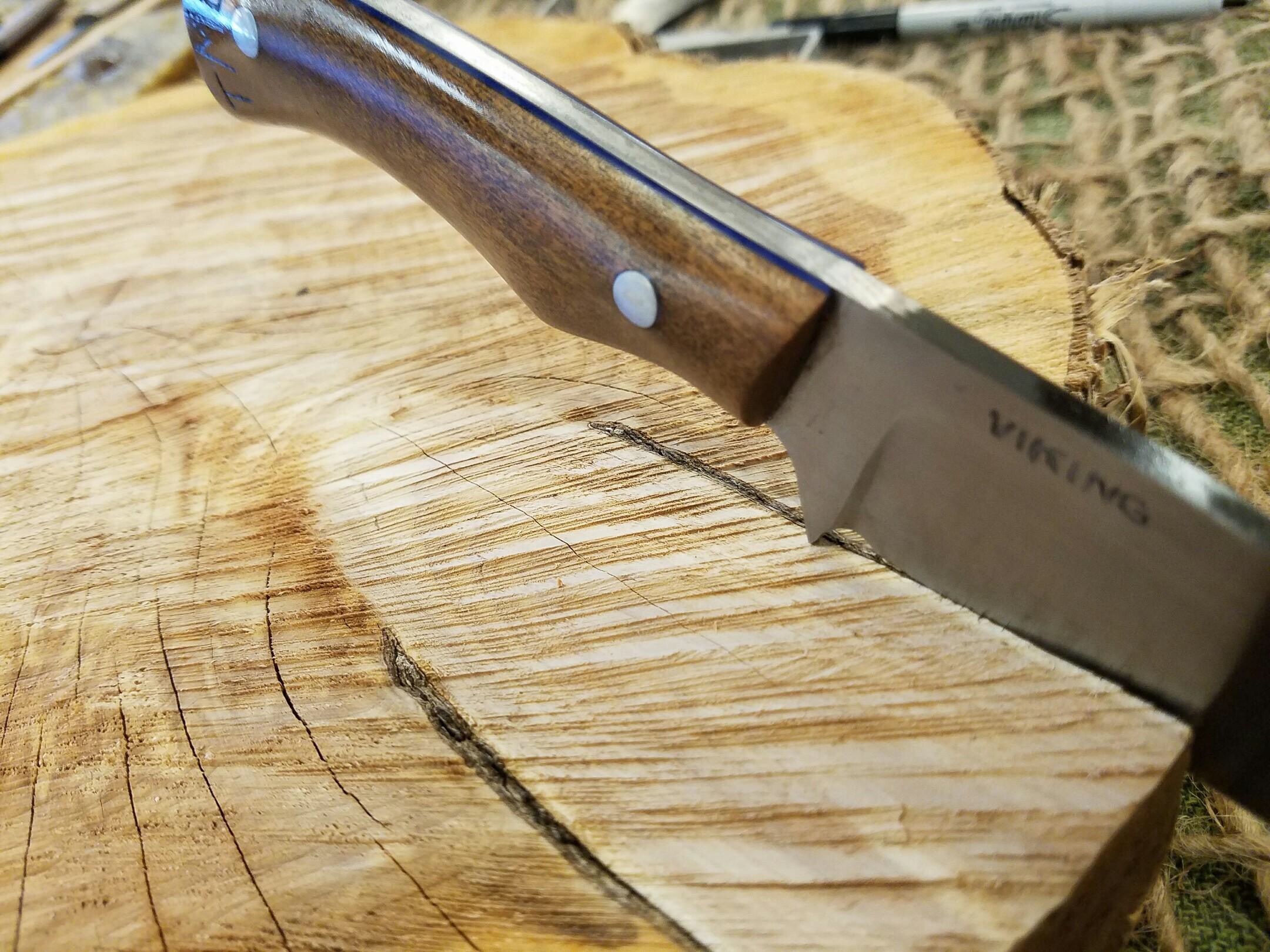
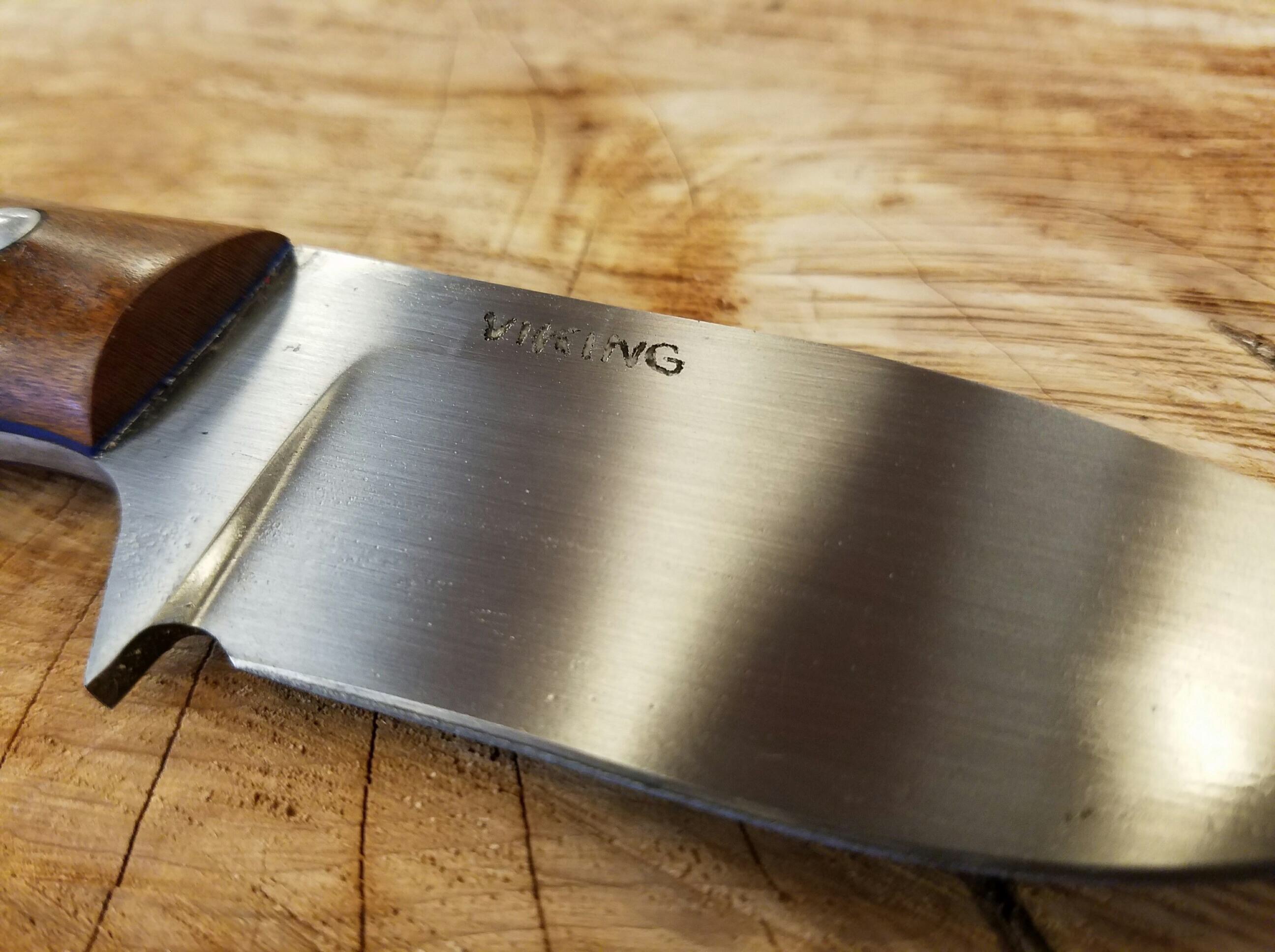
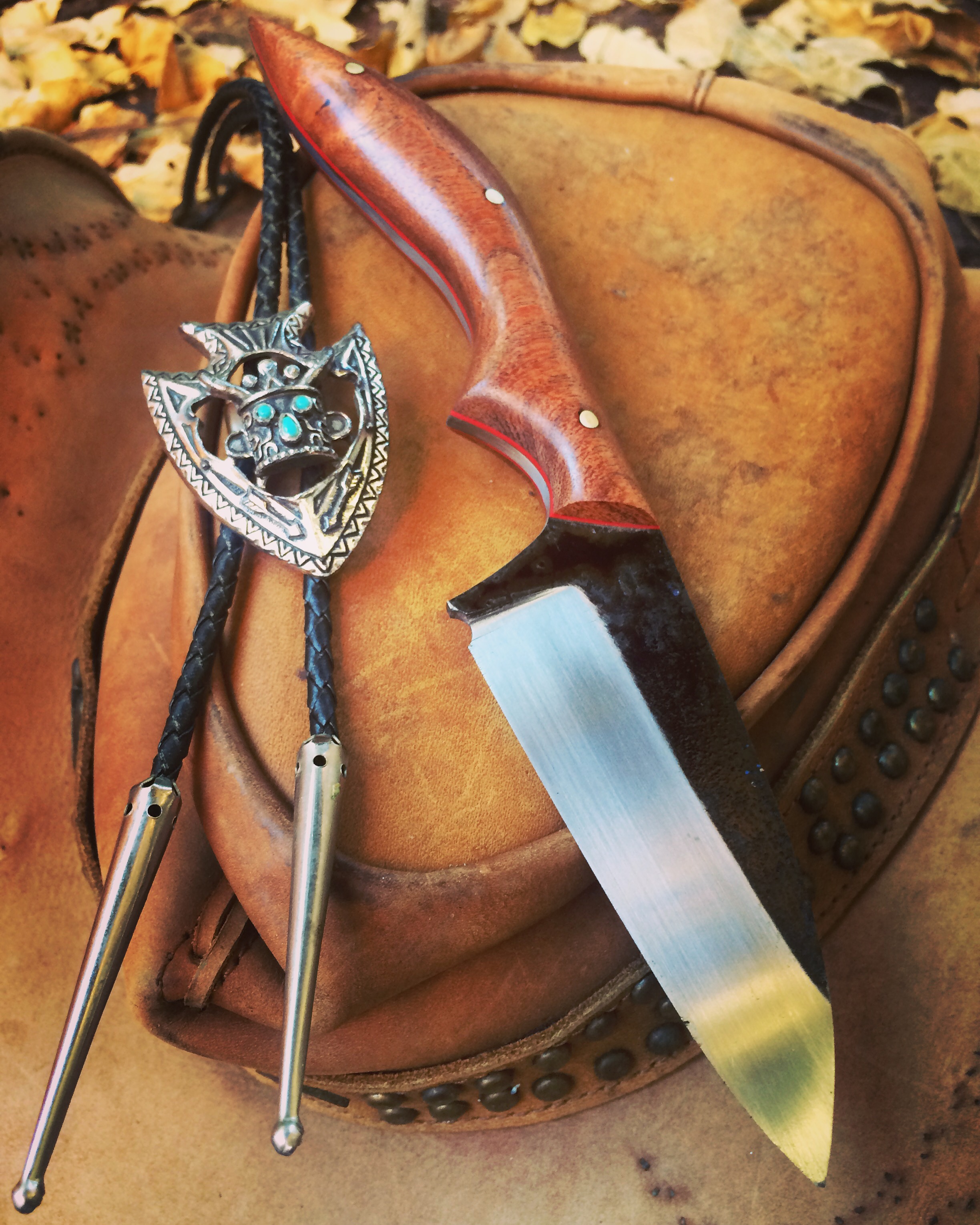
This two-knife kitchen set was a commission for a good friend and former teacher. He is a man who taught me how to look at matters deeply and to think about things critically.  We were on a farm for this past Thanksgiving and I noticed that he had been reading The Alchemist by Paulo Coelho.  This is a book that is special to me, and was given to me during a time when I was having trouble reading the omens.  It was the inspiration for this set, and an exercise of gratitude for this man, a sort of alchemist himself, who has helped me to find my own truths over the years:

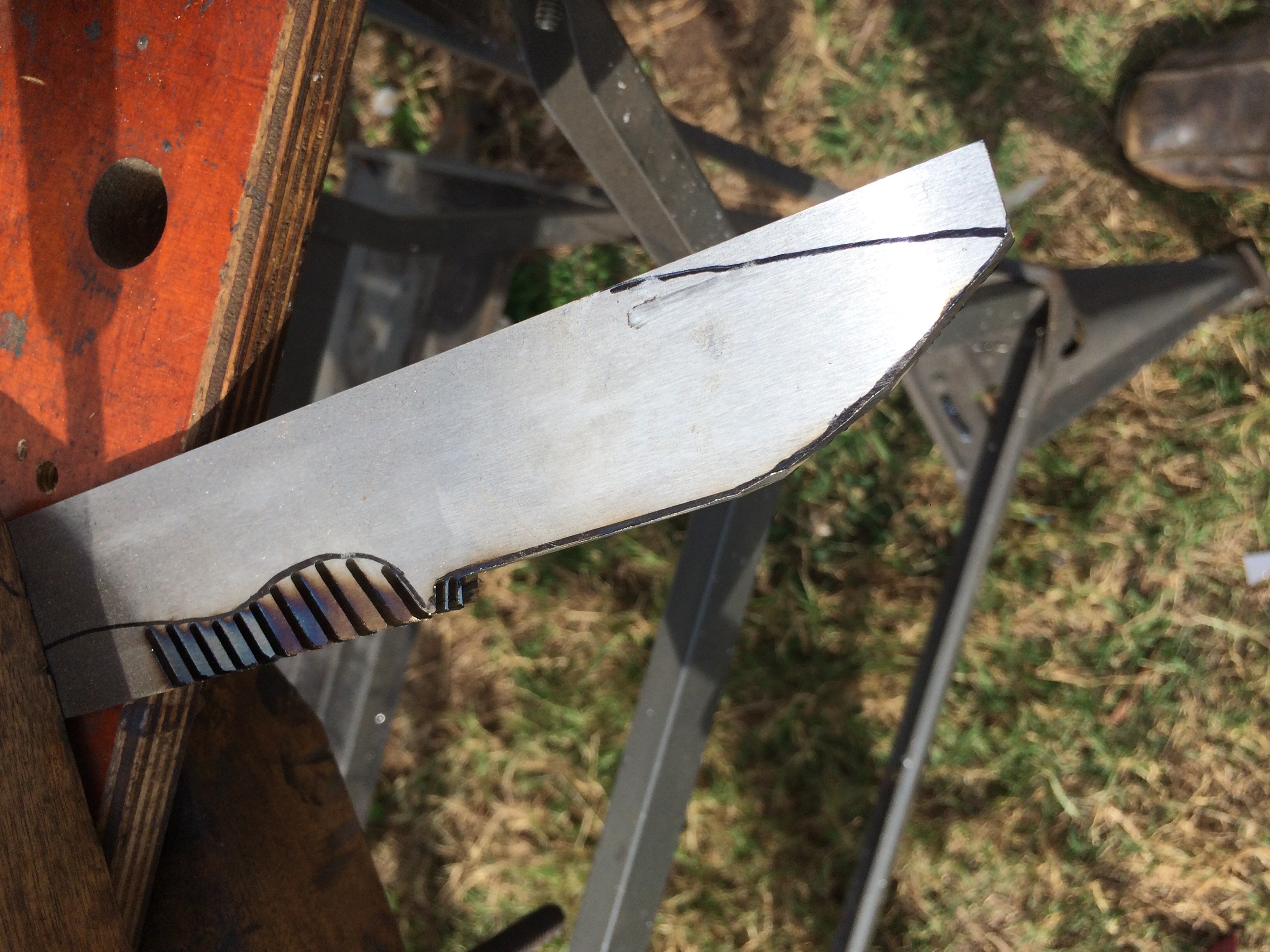
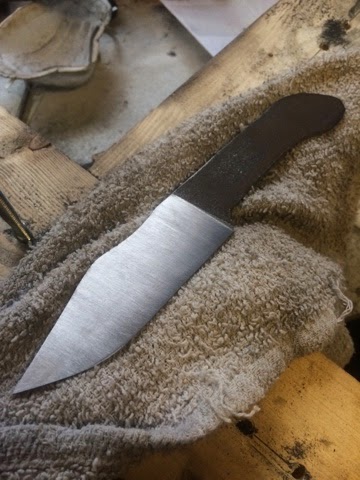
We start with Urim, a six-inch boning/filet knife

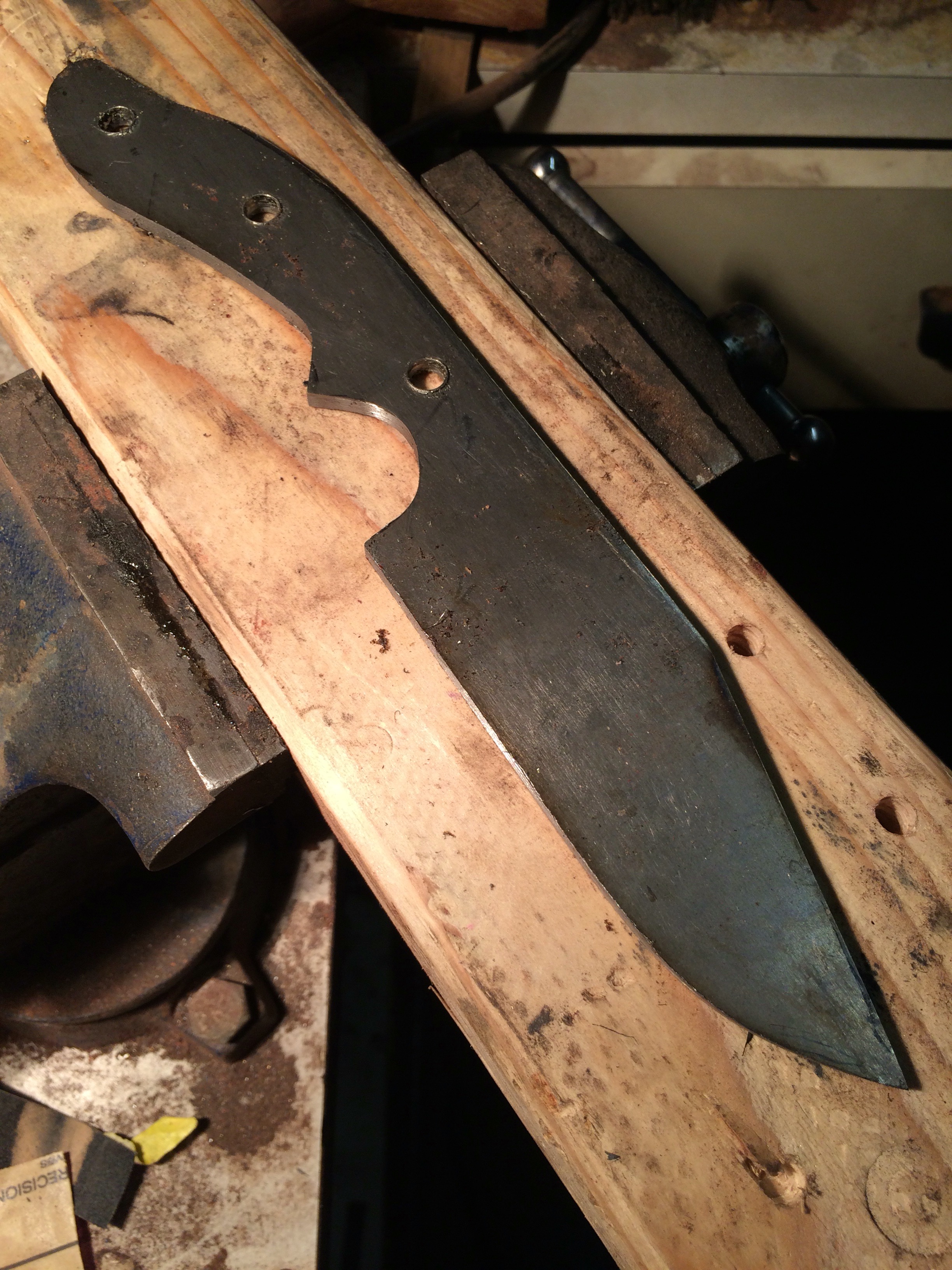
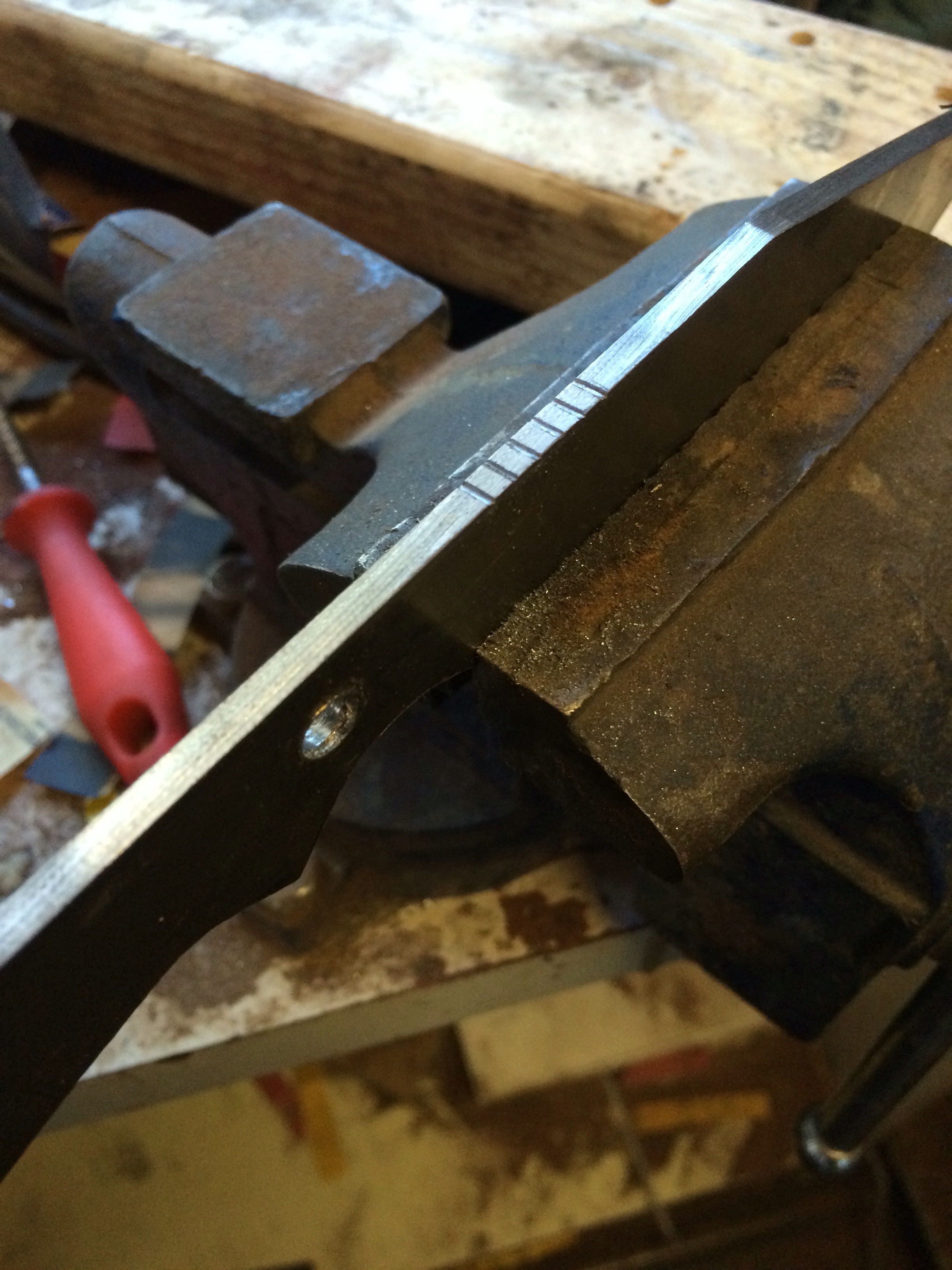
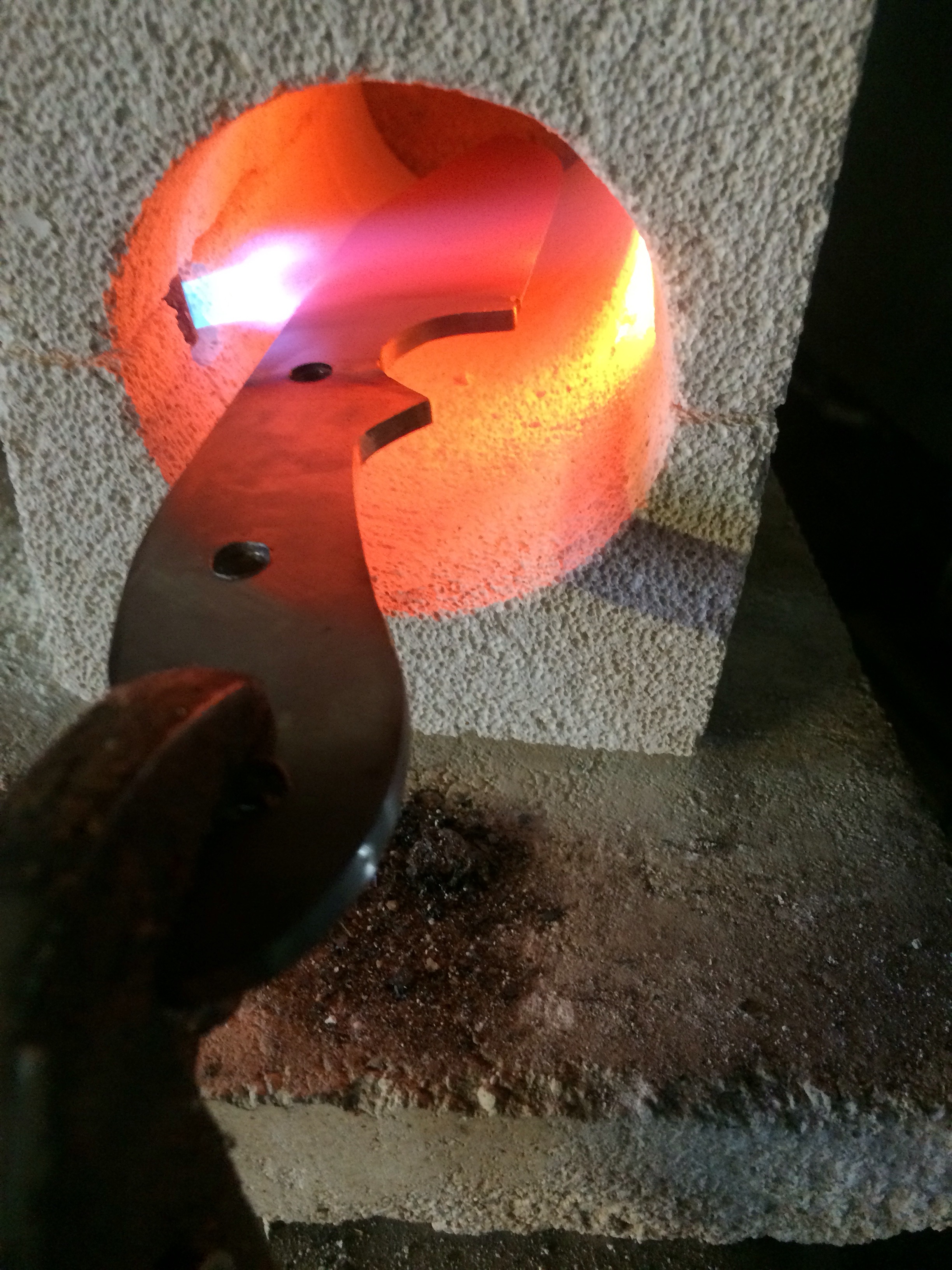
Because the stock is so thin, I hardened the blade before grinding the bevels:
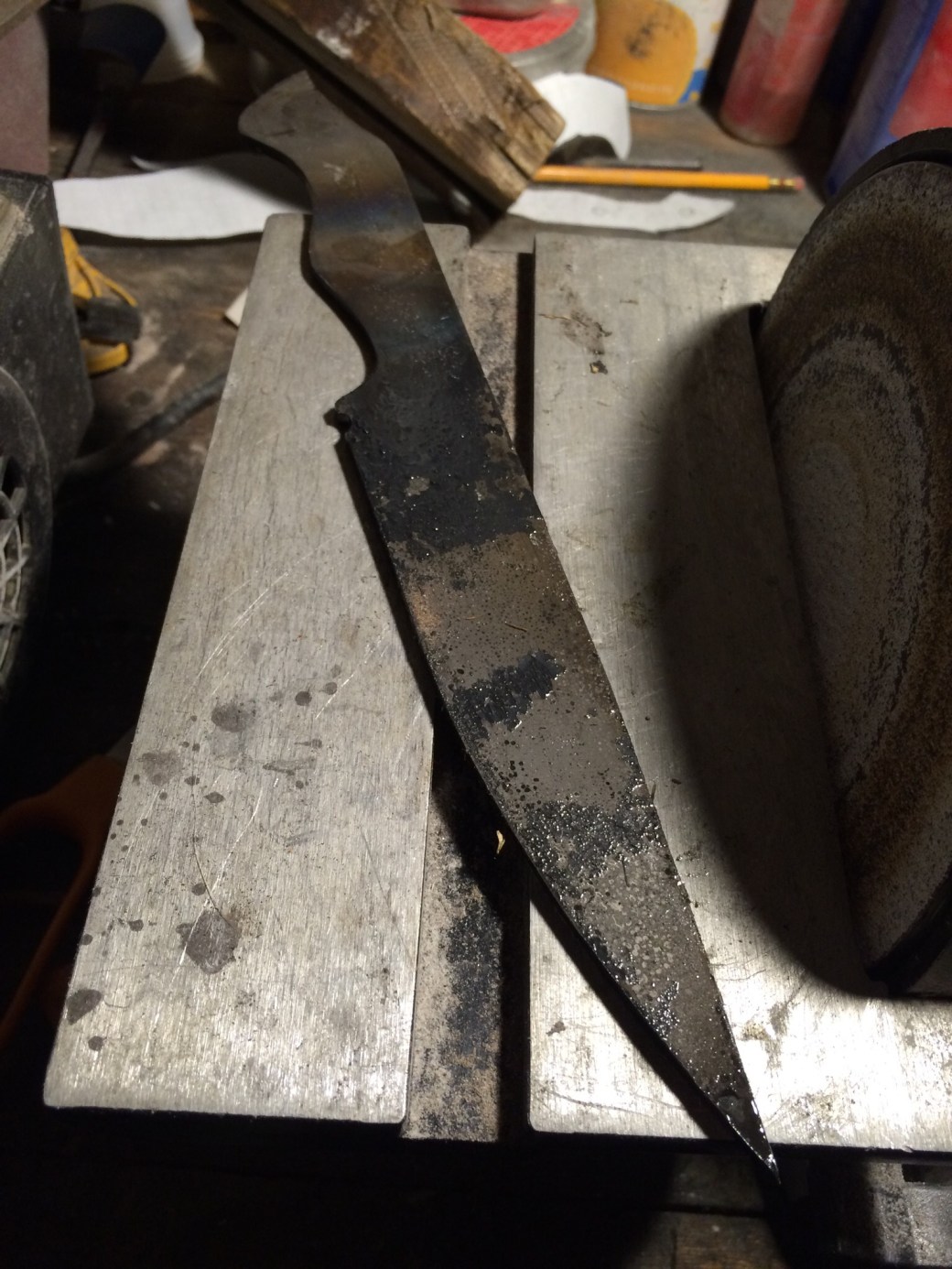
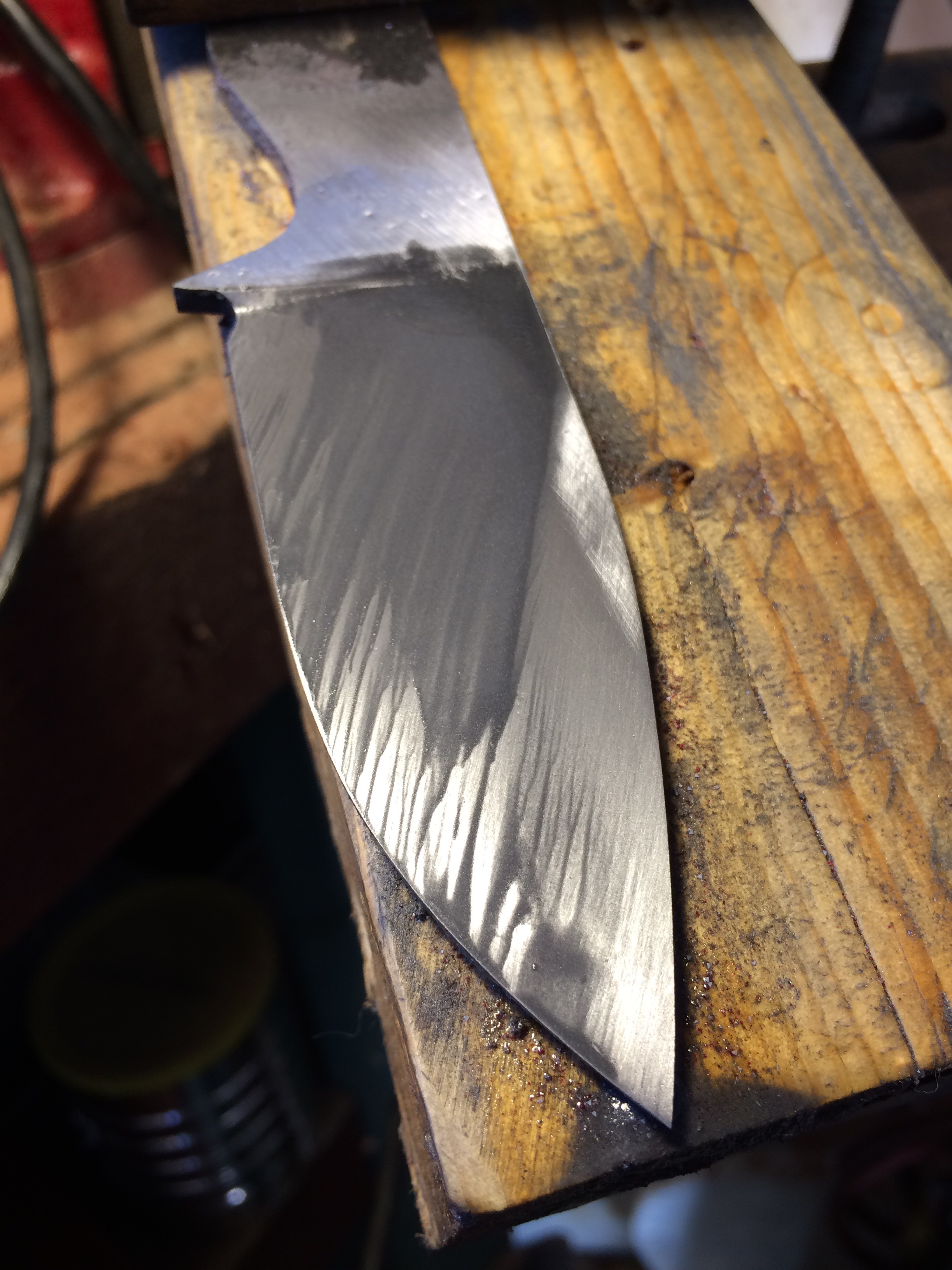
Rough grinding at 40 grit:
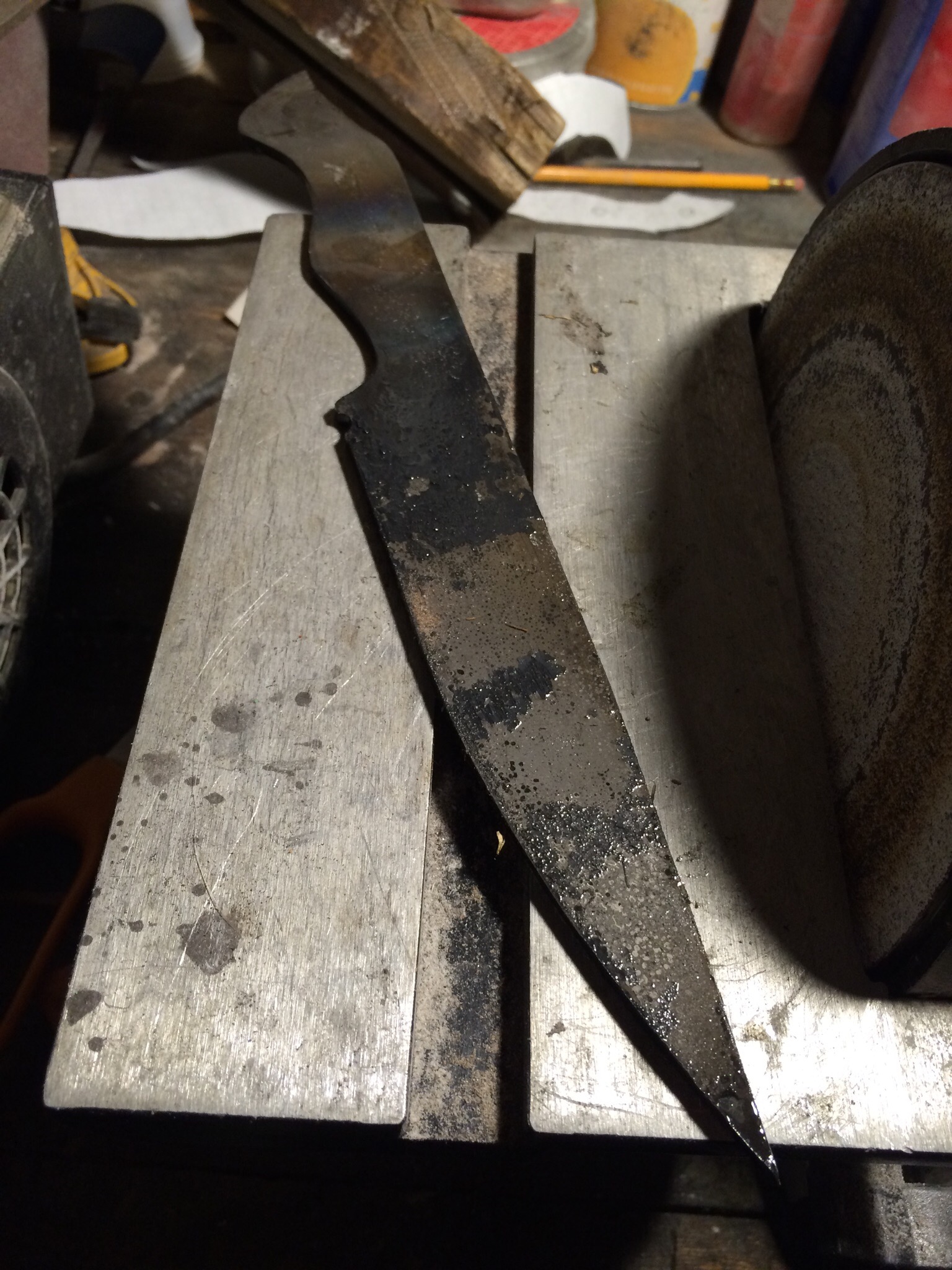

Full flat grind:

Laying down a hand finished satin:

Detail work on the plunge lines:

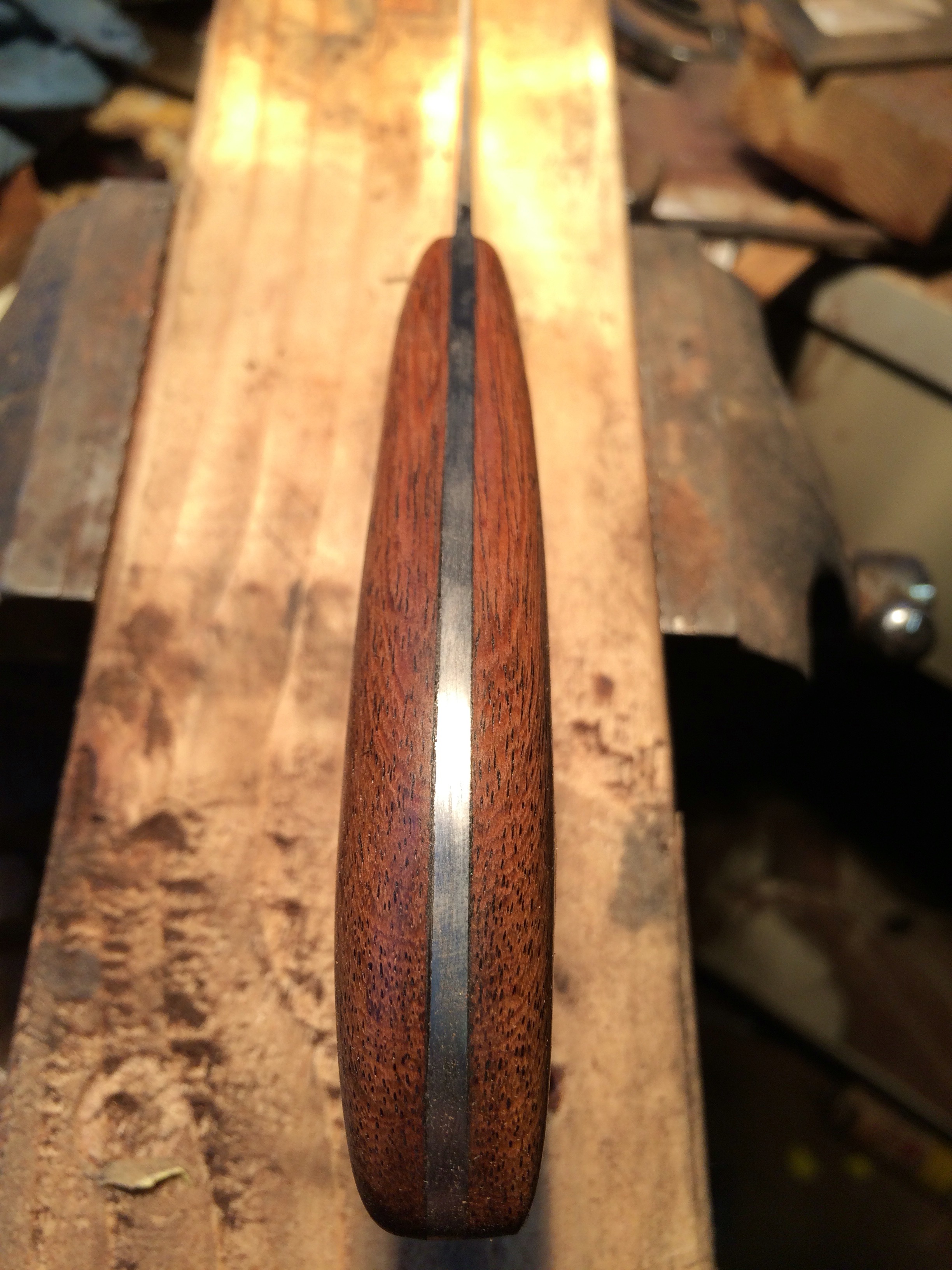
Ebony Gaboon: the black symbolizes the ‘yes’:

The bit near the ricasso; sanded to 2000 grit:

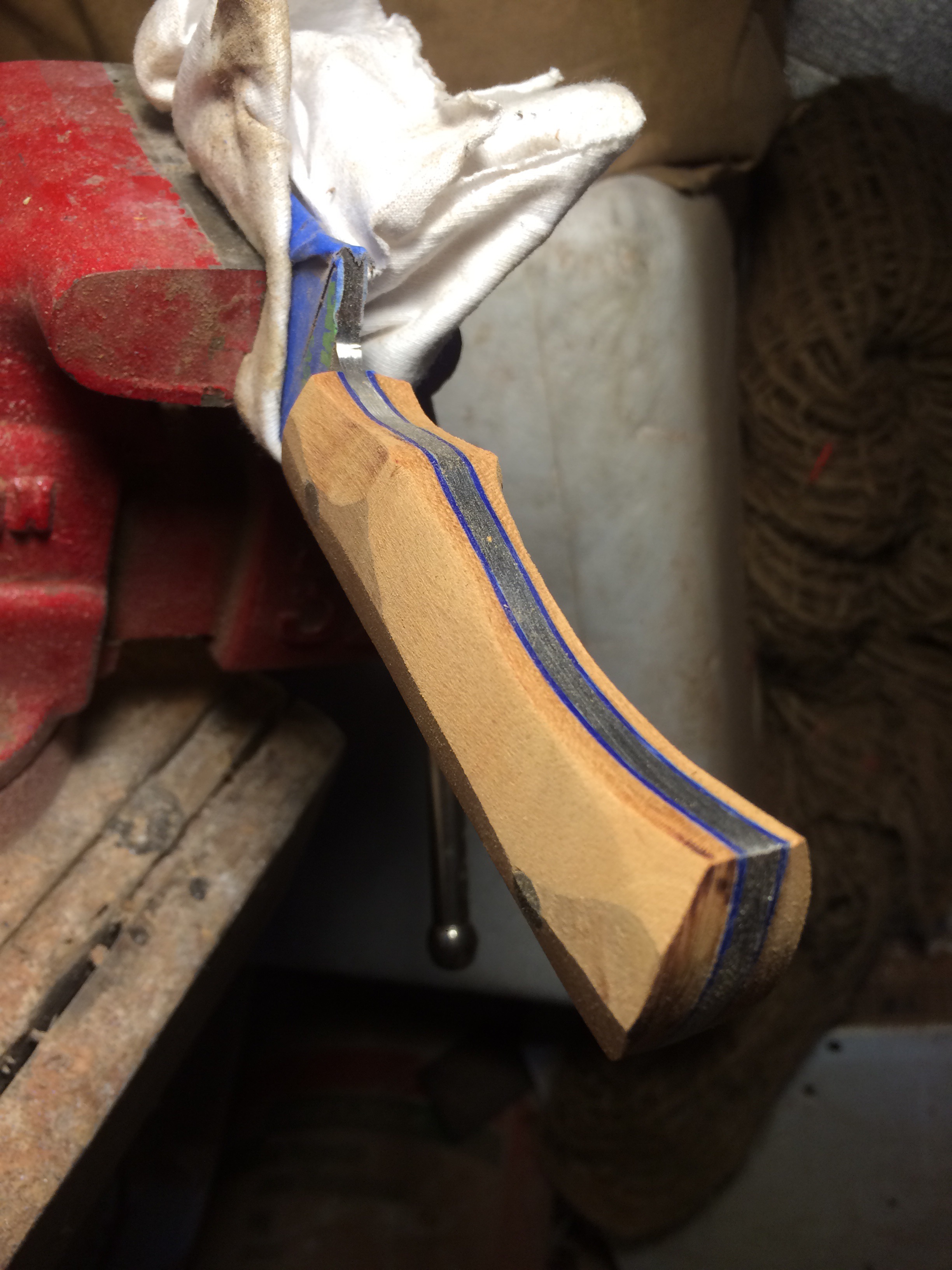
Profiling on the handle:

Rough-shaped:

Sanded to 220 grit and then oiled.  I let this sit for a day or so and then sand the entire handle up to 2000 grit.  This process helps to burst the grain:
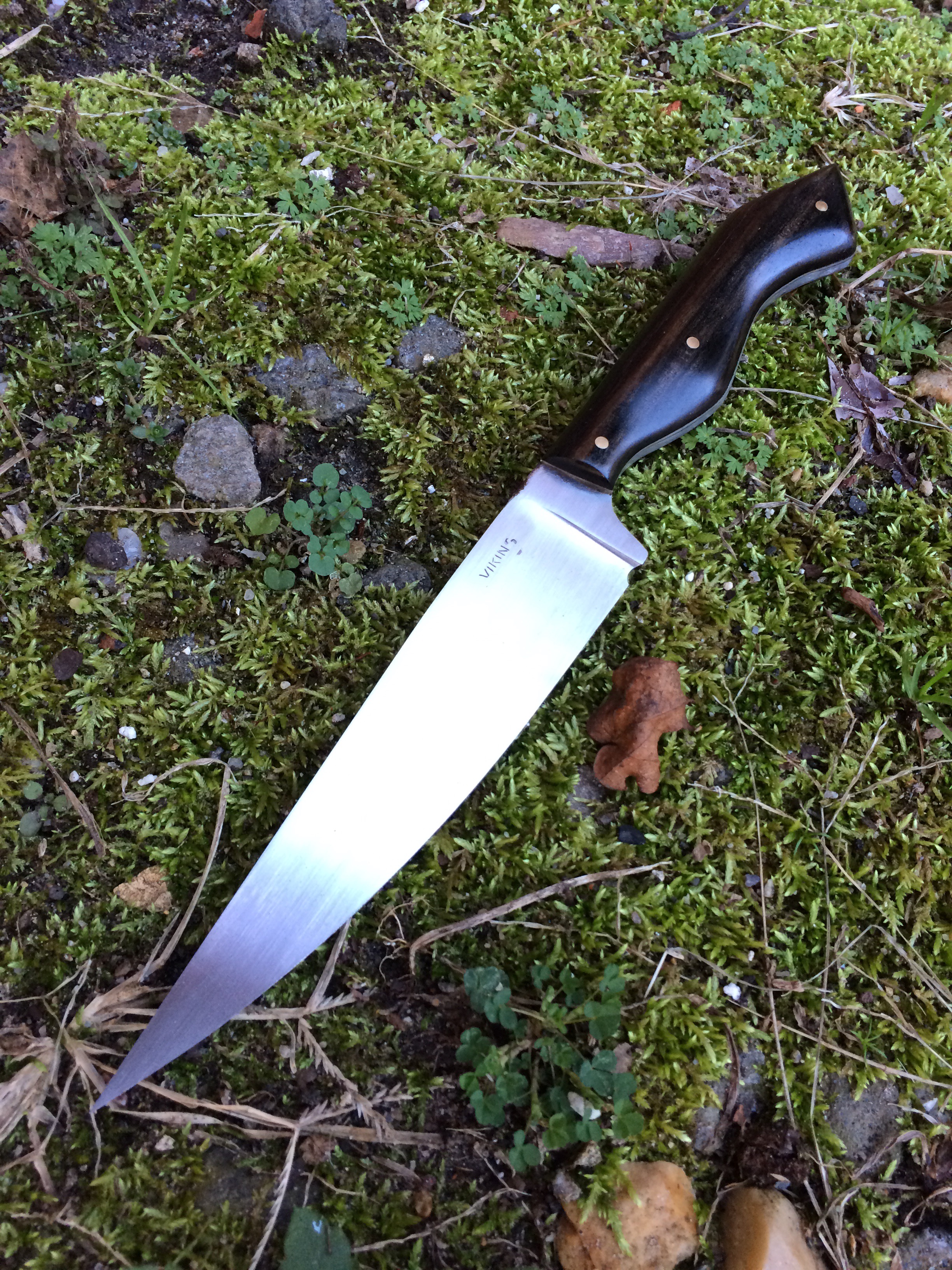
Urim:

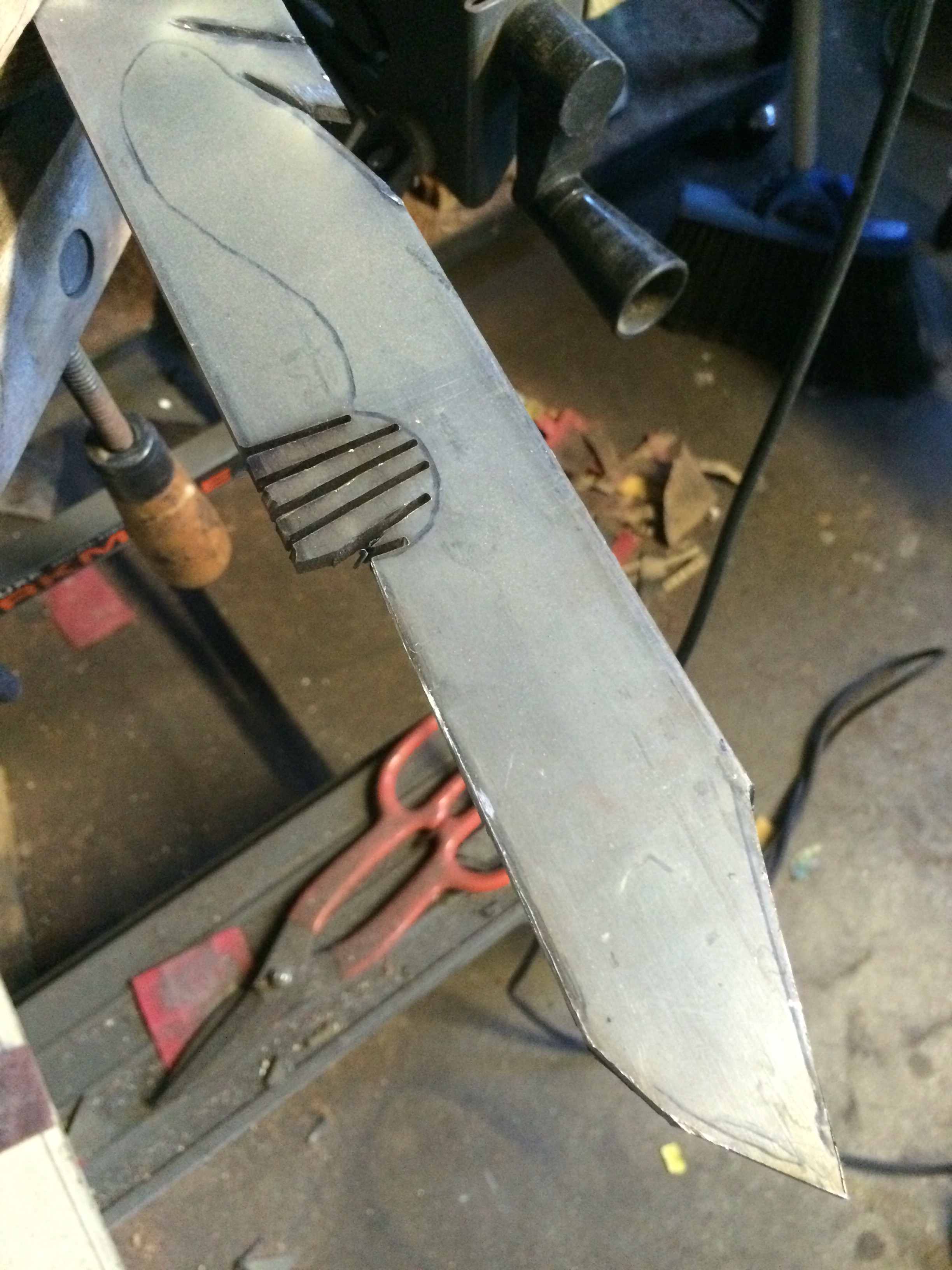
To start on Thummim we need things that cut:
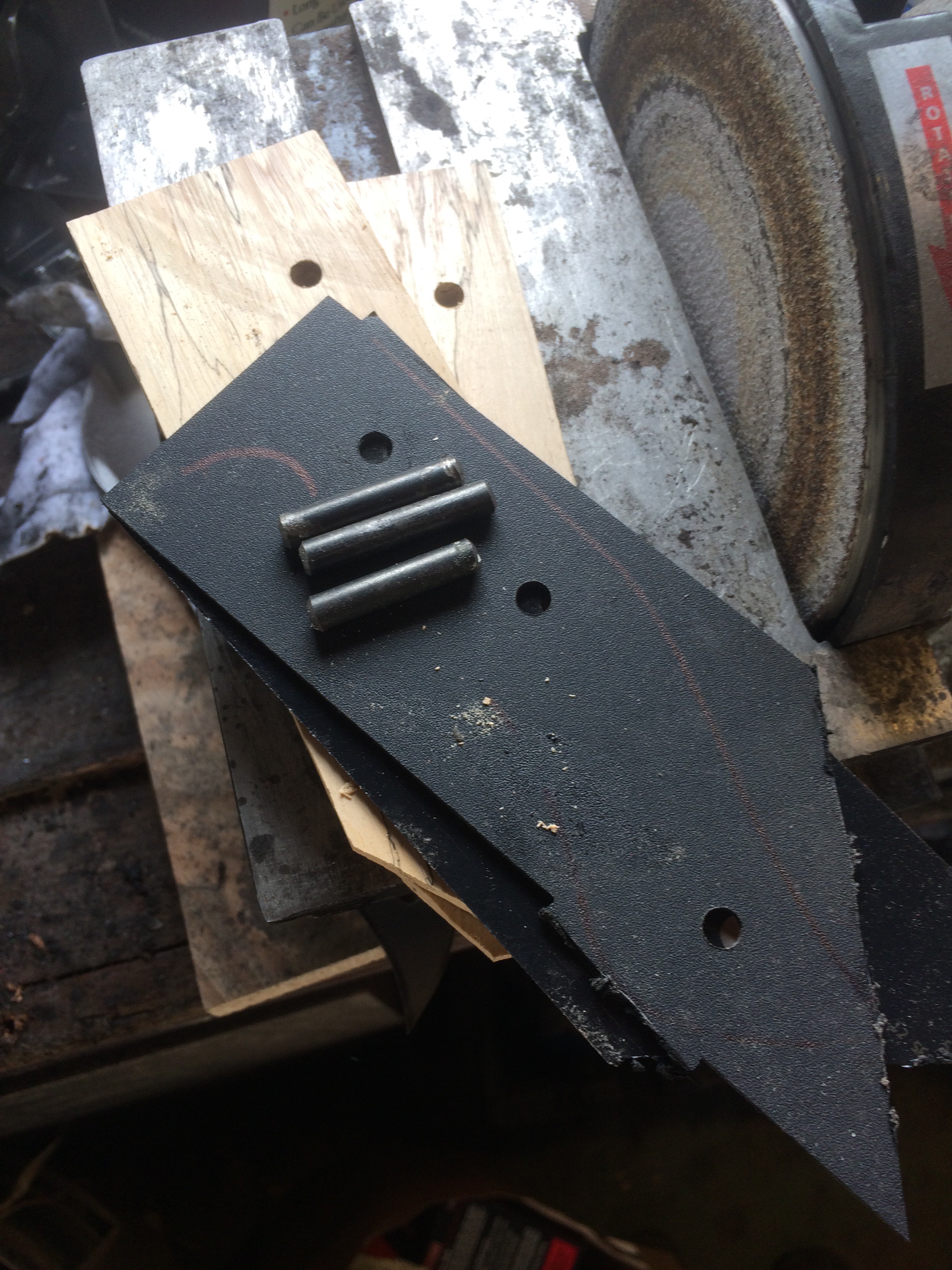
Once again the whole bit is hardened:
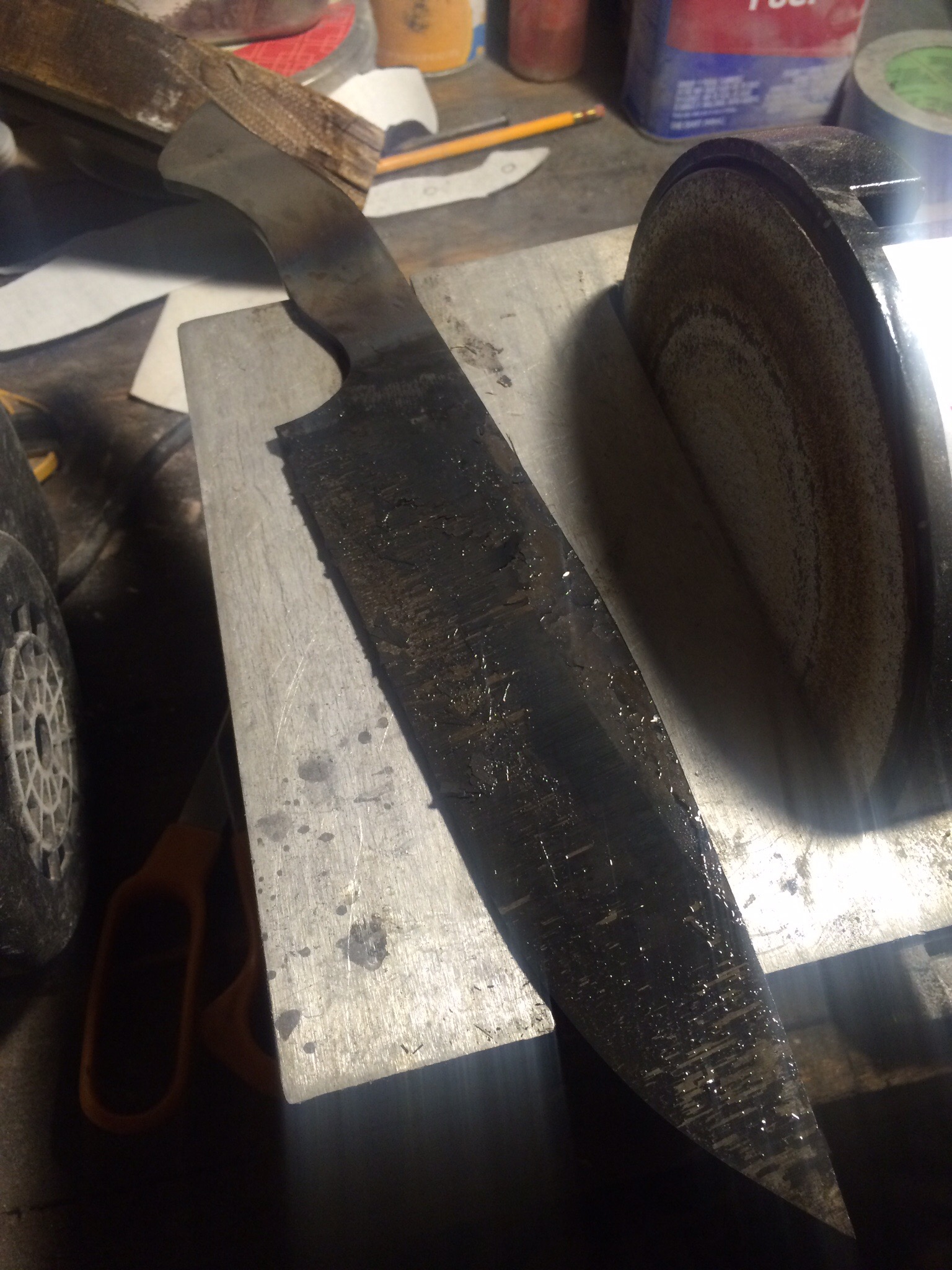
Rough grinding:

Full flat grind and finished on the grinder to 120 grit:
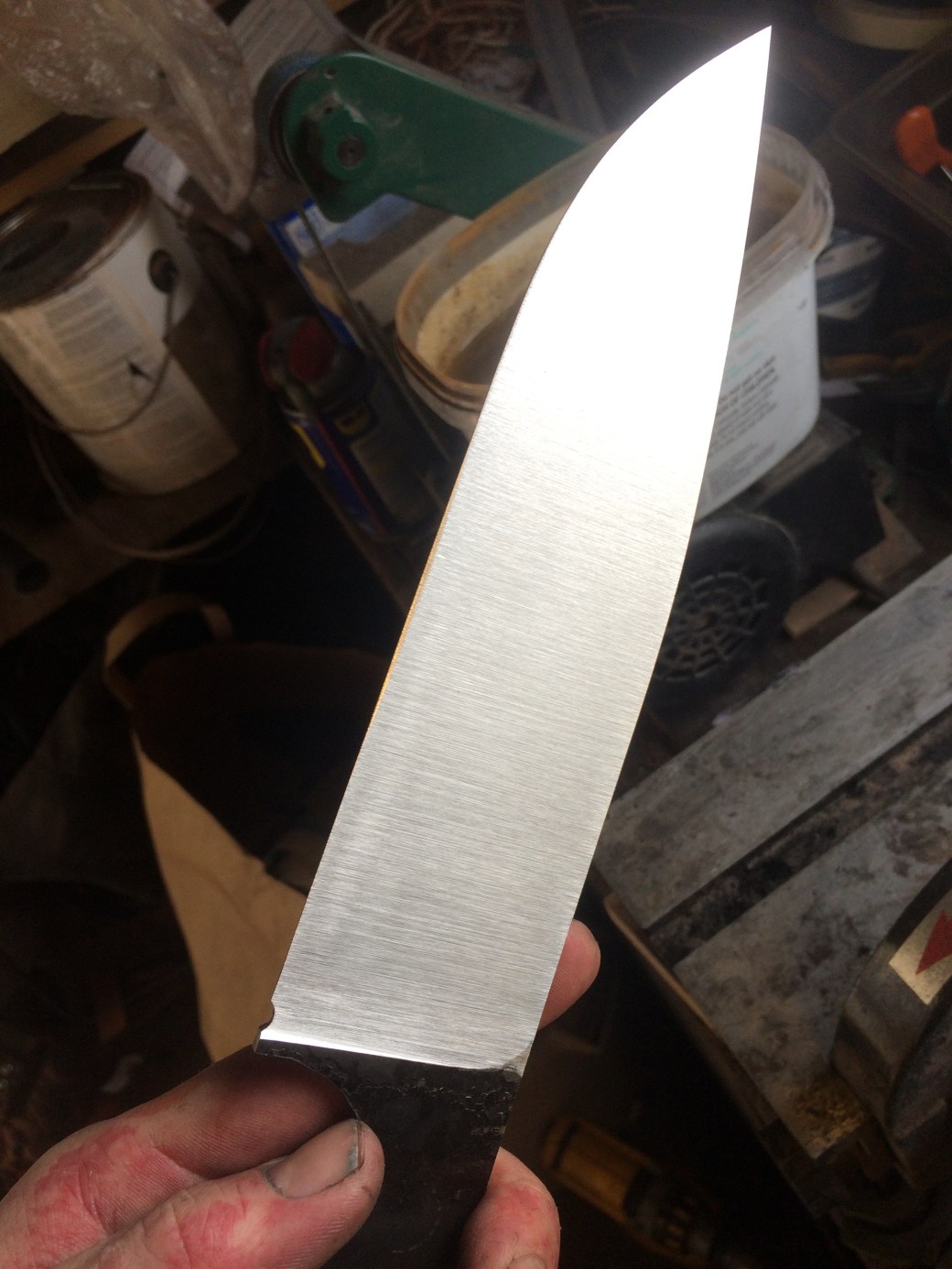
A lot of material was removed:
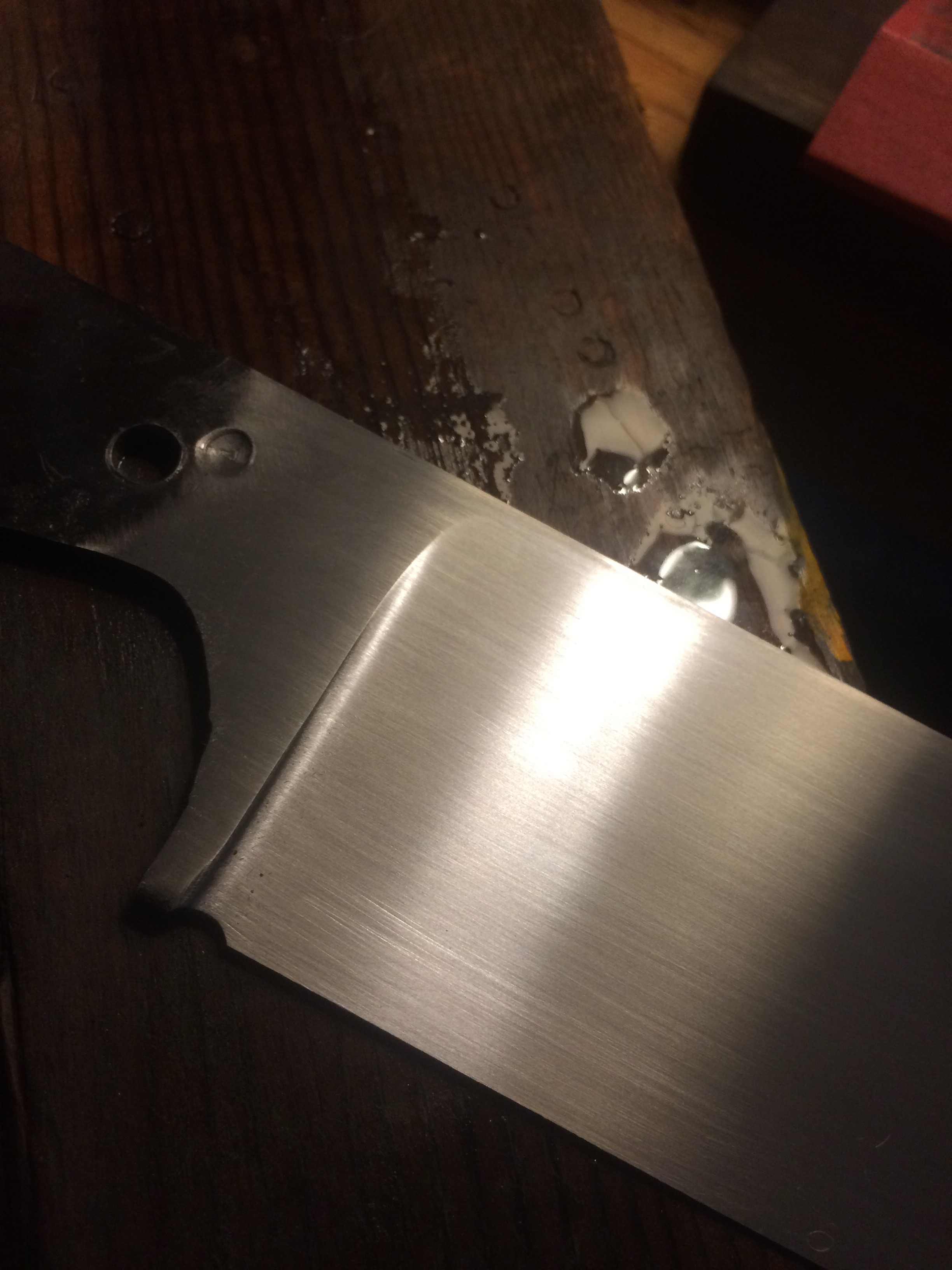
Laying down a hand finish.  A smoother finish makes for less resistance when doing knifework in the kitchen:


She goes into hot acid for an etch.  The etch helps to prevent corrosion and also makes for a more pronounced patina as the knife is used.  It will also darken the blade:

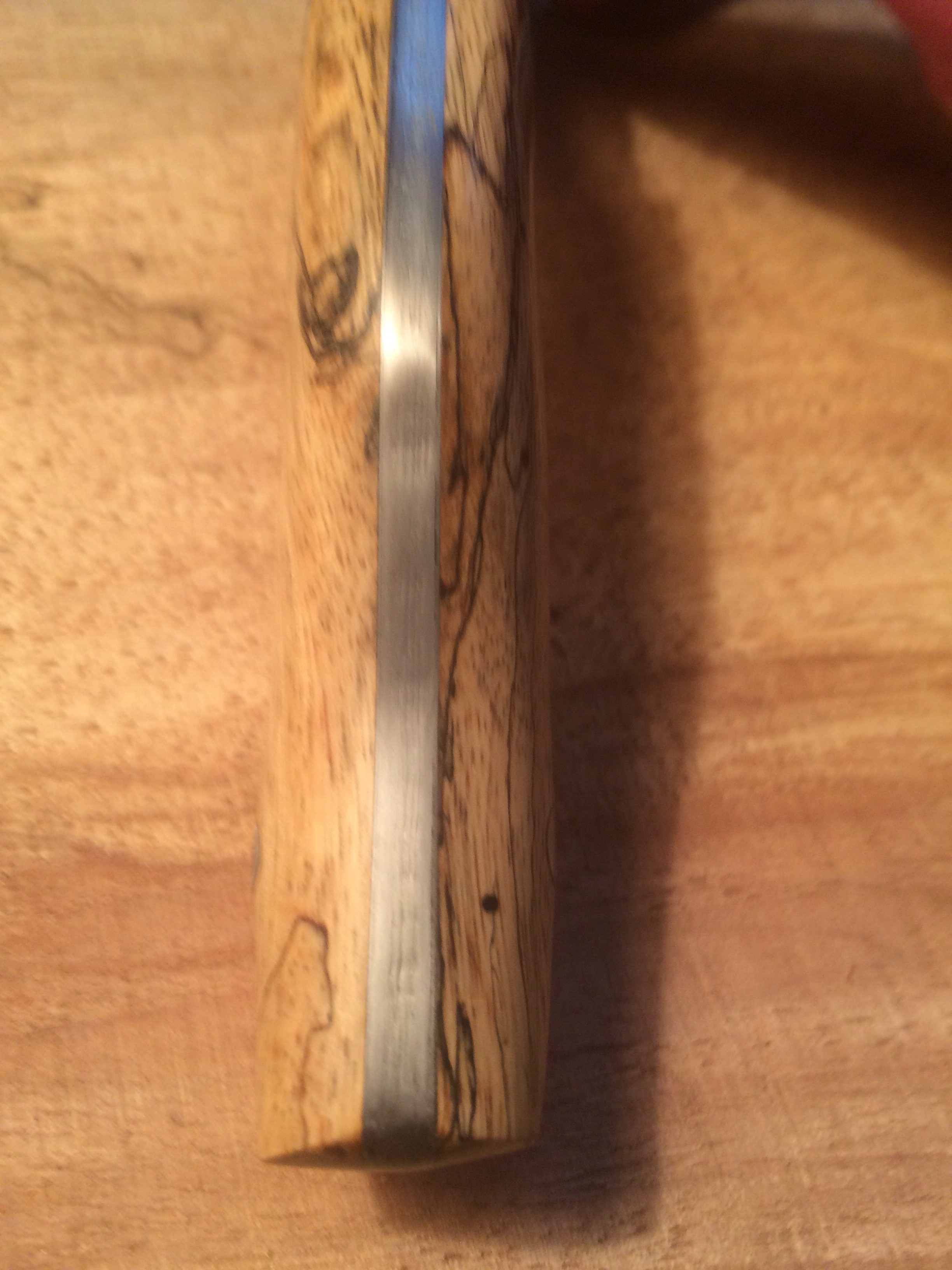
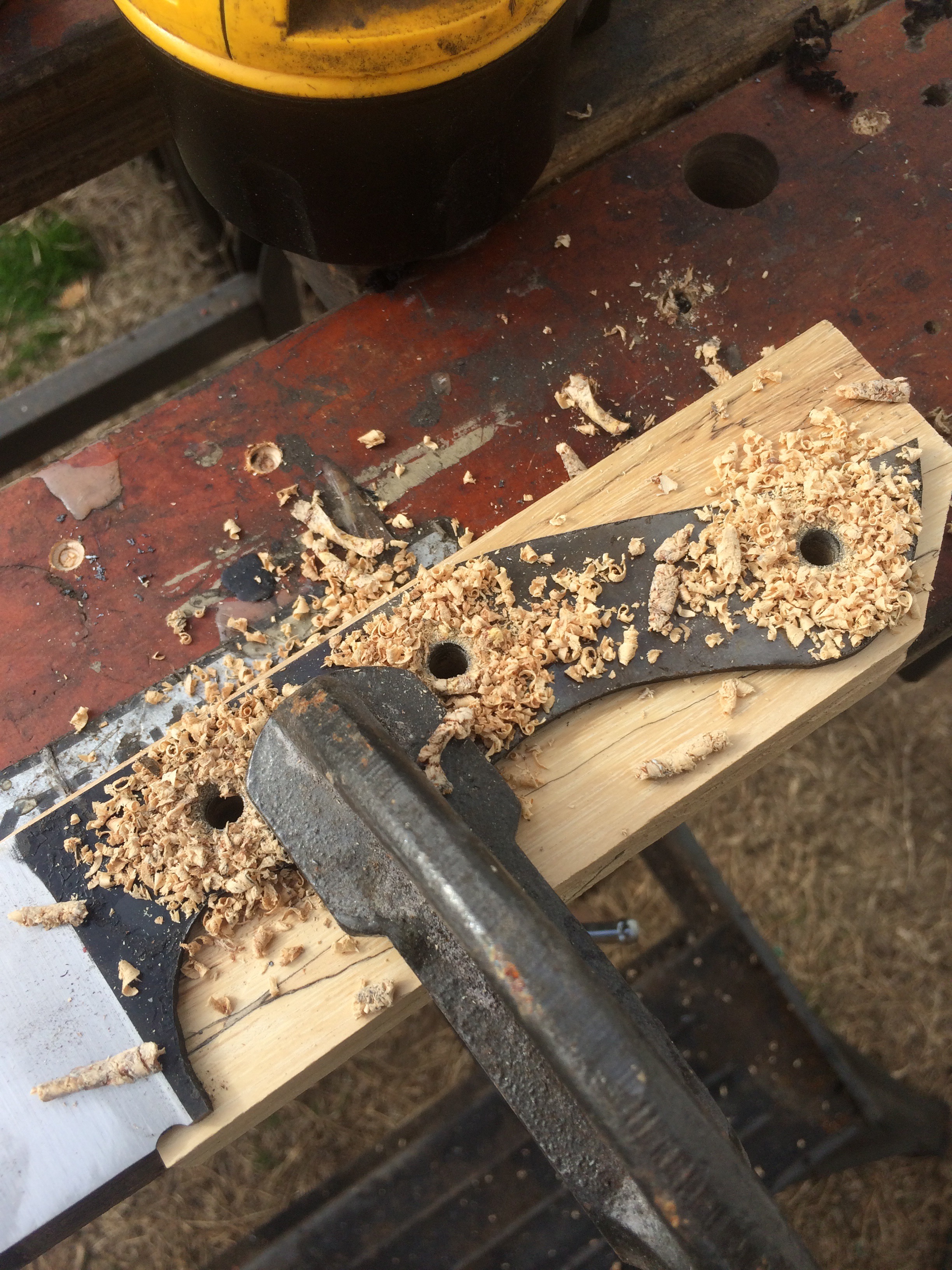
Spalted Tamarind:  the light color represents the ‘no’

With black spacers for contrast:
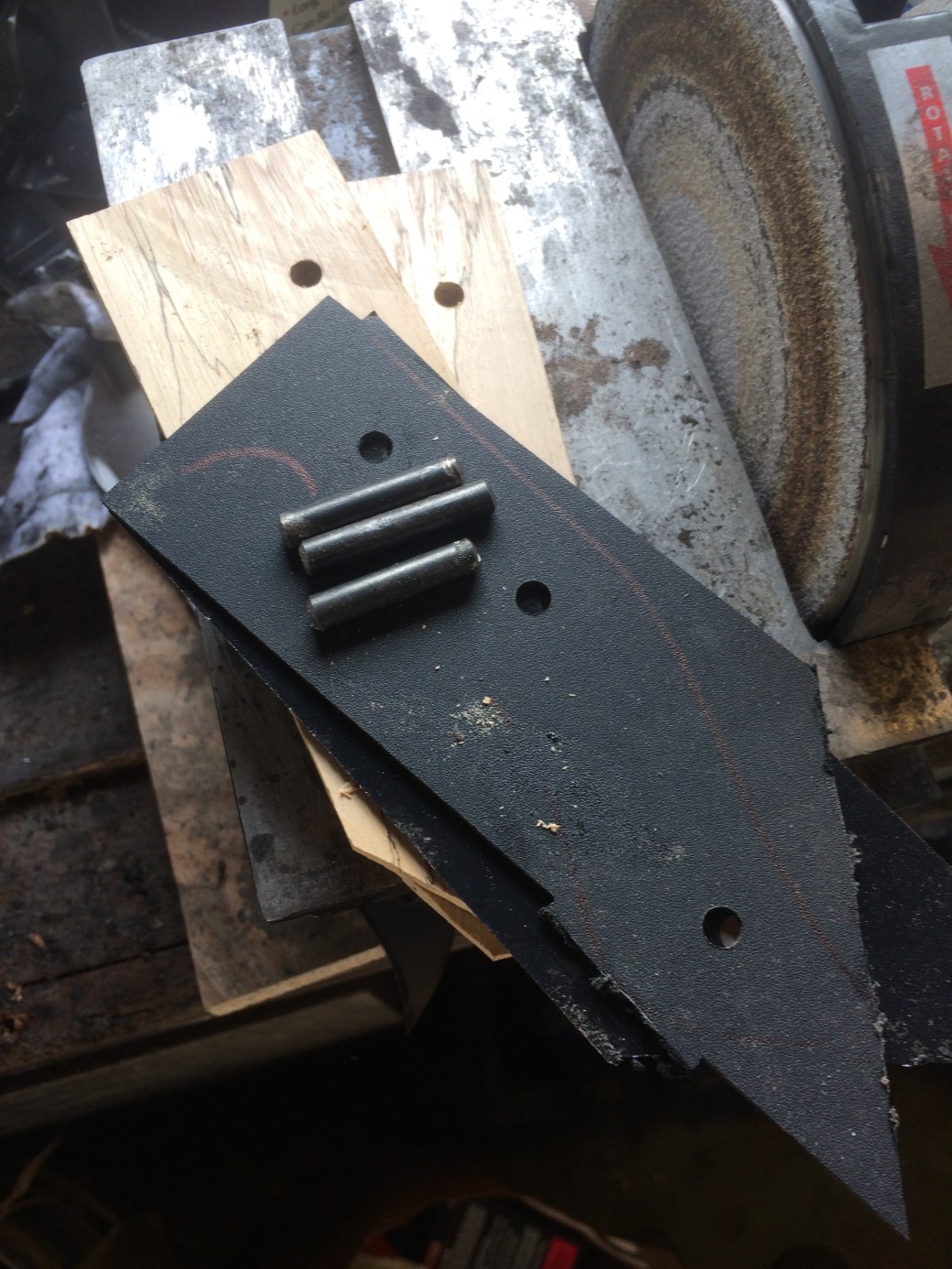
Once again, sanded to 2000 grit:
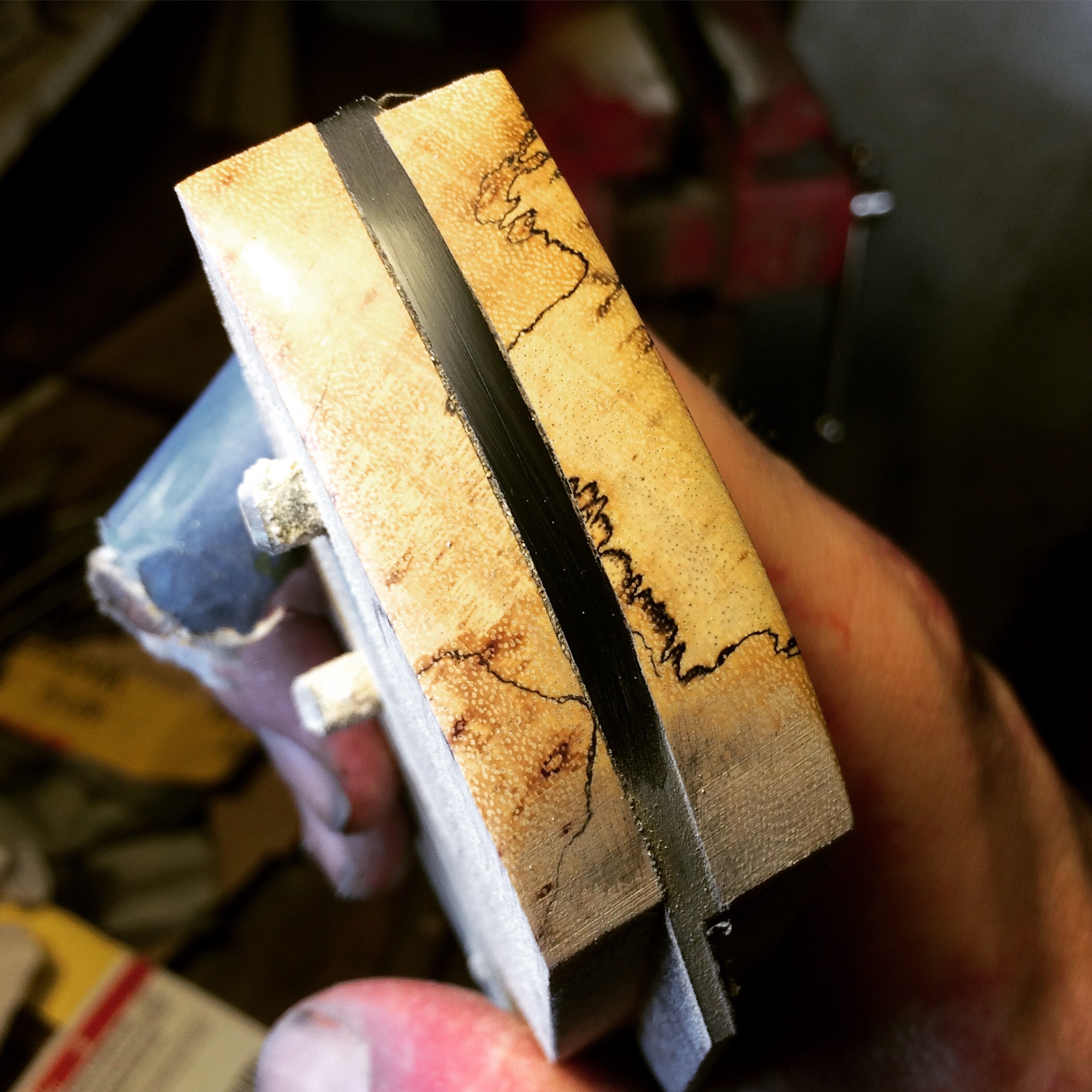
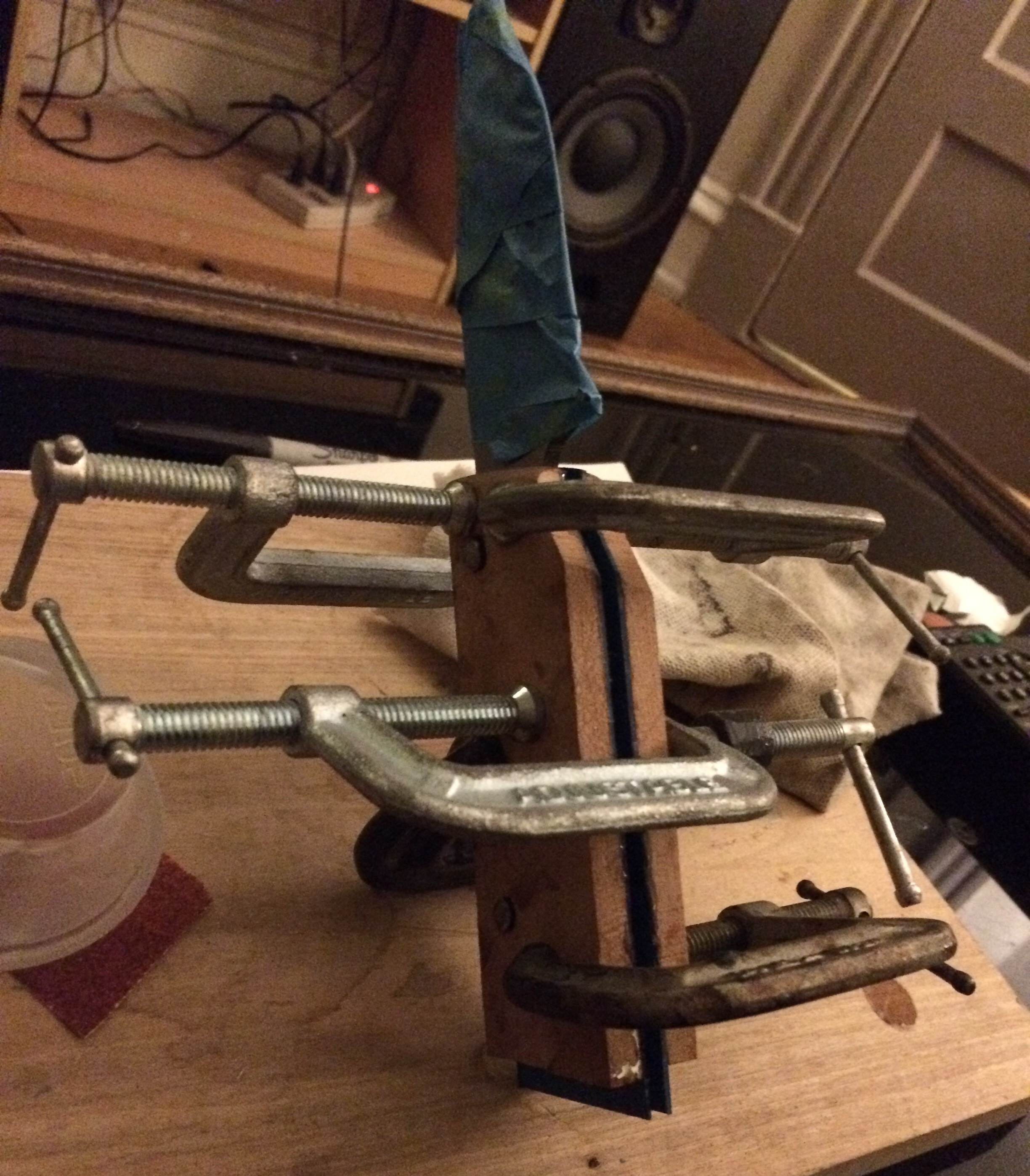
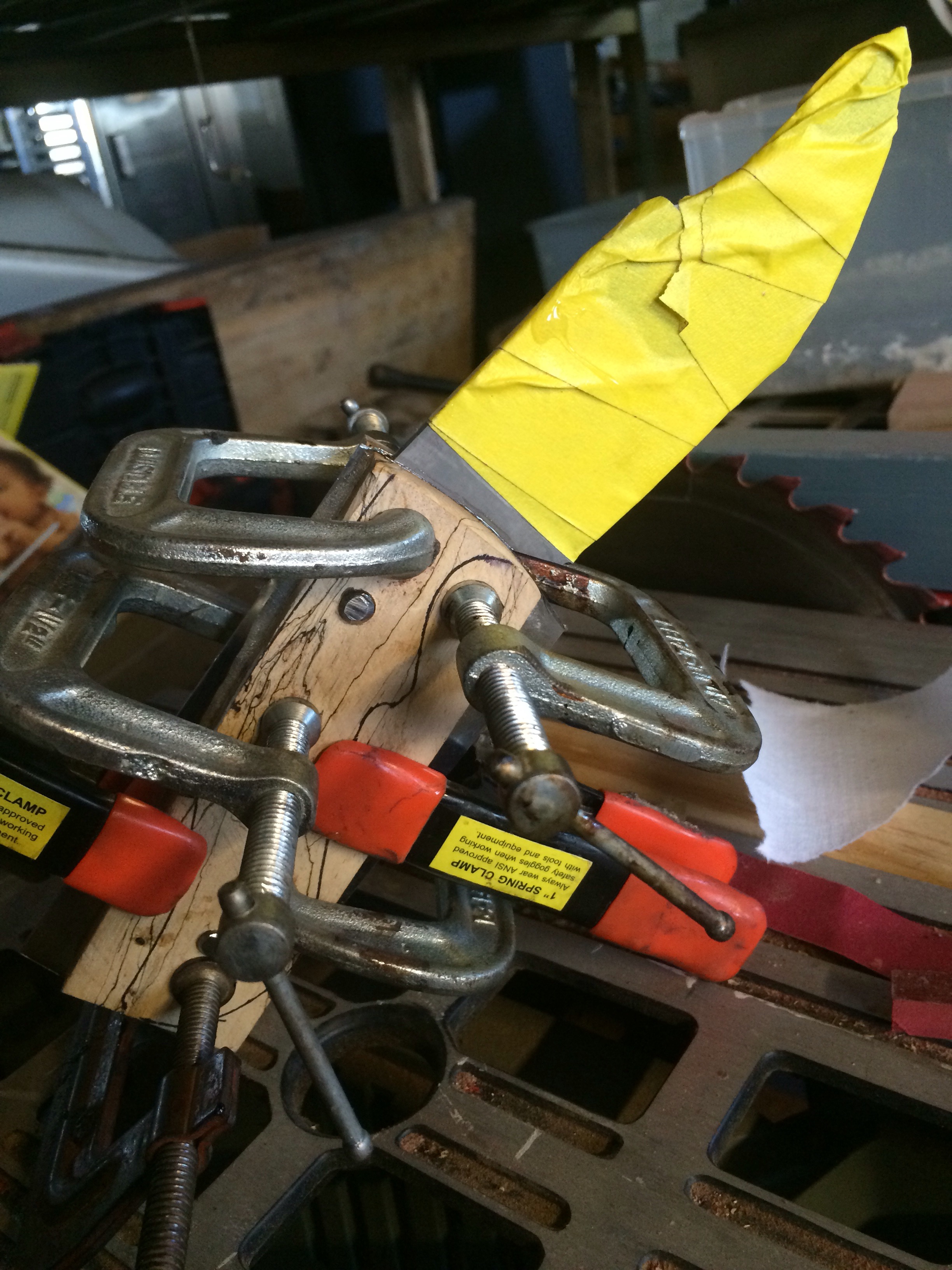
Clamped:
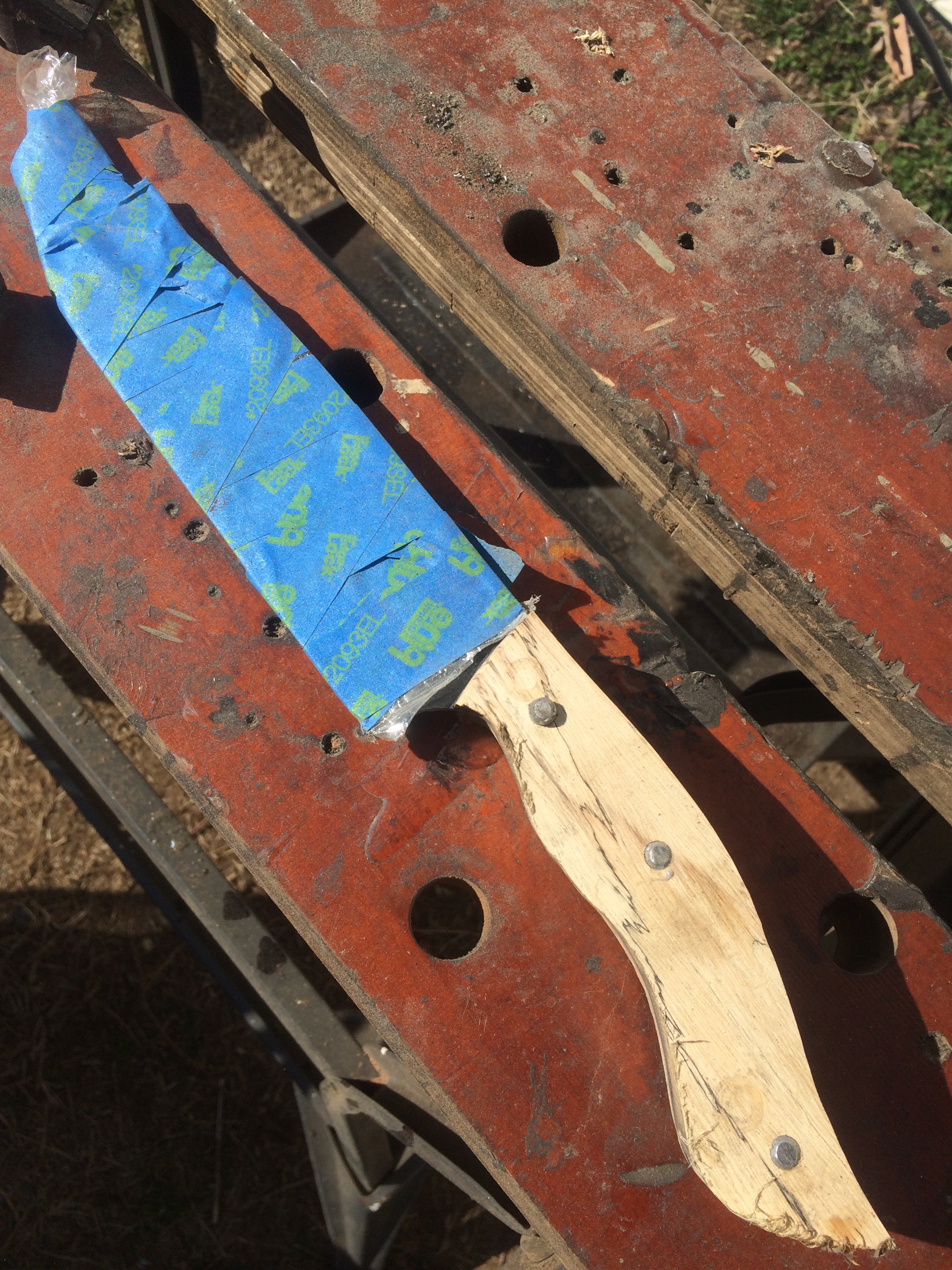
Profiled:

Shaped:

Thummim; the no to the yes:

Urim and Thummim:


The name of the professor mentioned in this story is Jonathan Shear, Ph.D., and you can find links to his publications here.

Knifemaking: being your own cheerleader and the Stag

“You’ve just got to pat yourself on the back and keep moving.  Ain’t nobody else gonna do that for you.”

-Gordon Russell, chef

The other week, early in the morning, I got a knock on my door.  It was the police.  My car alarm had been going off for the past hour and the officer said there had been quite a few calls about it.

We walked over and I turned the alarm off and disconnected the battery.  As the officer was leaving he said that someone had been kind enough to leave a note for me on my windshield.  I found a piece of paper under the wiper and read it.  I’m not sure what I was expecting.  After I read through all of the expletives, I saw that it was signed by “I Hate You”.

Beautiful.  Somebody hates me.

I tried to go back to sleep but I had a hard time.  I knew I wasn’t the first person to have their car alarm go off and I probably wouldn’t be the last but I was having a hard time figuring out what “I Hate You” expected to accomplish through their eloquently worded salutation to me.  Those sorts of things written to you by a stranger don’t feel nice.

Later in the day I found it to be really funny.  I kind of wish I had kept the note.

So what do you do when you find yourself on the receiving end of toxic outrage?  Or of violent vitriols or virulent viscosities or even vicissitudes of the most vicious varieties??  This is where you have to be your own cheerleader.  Because we’re going to screw up at some point, maybe say or do something in poor taste or offend someone’s sensibilities.  People can be awful- much worse than notes on cars.  And hiding behind the veil of social media, people often write things that they wouldn’t necessarily say to someone’s face.  So when someone says or does something dumb, it can be often accompanied by a slurry of shame-dumping and rage. Before long any sense of civility or compassion goes out the window.  If you find yourself on the receiving end of these sorts of shenanigans, it’s best to pat yourself on the back and just keep rolling.  These are the hard things to master in life, but they are worth it.  It’s important to keep moving forward.

This blade was a commission for a gentleman who is a cheerleading coach.  His wife asked if the knife could have an essence of an old Buck fixed blade he had as a kid so I took that into the consideration of the design.  ‘The Stag’ is a bit of a double entendre.  In the animal world a stag can be much larger than a buck, and this knife has a bit more heft than its commercial counterpart.  But on the other side you sometimes have to go stag, by yourself, and give yourself the things that the world is not always going to give you.

The other day I was working with a lady who was late because someone parked her car into her spot.  She said she didn’t even have time to write a nasty note.  I very gently told her that not writing that note was probably for the best…

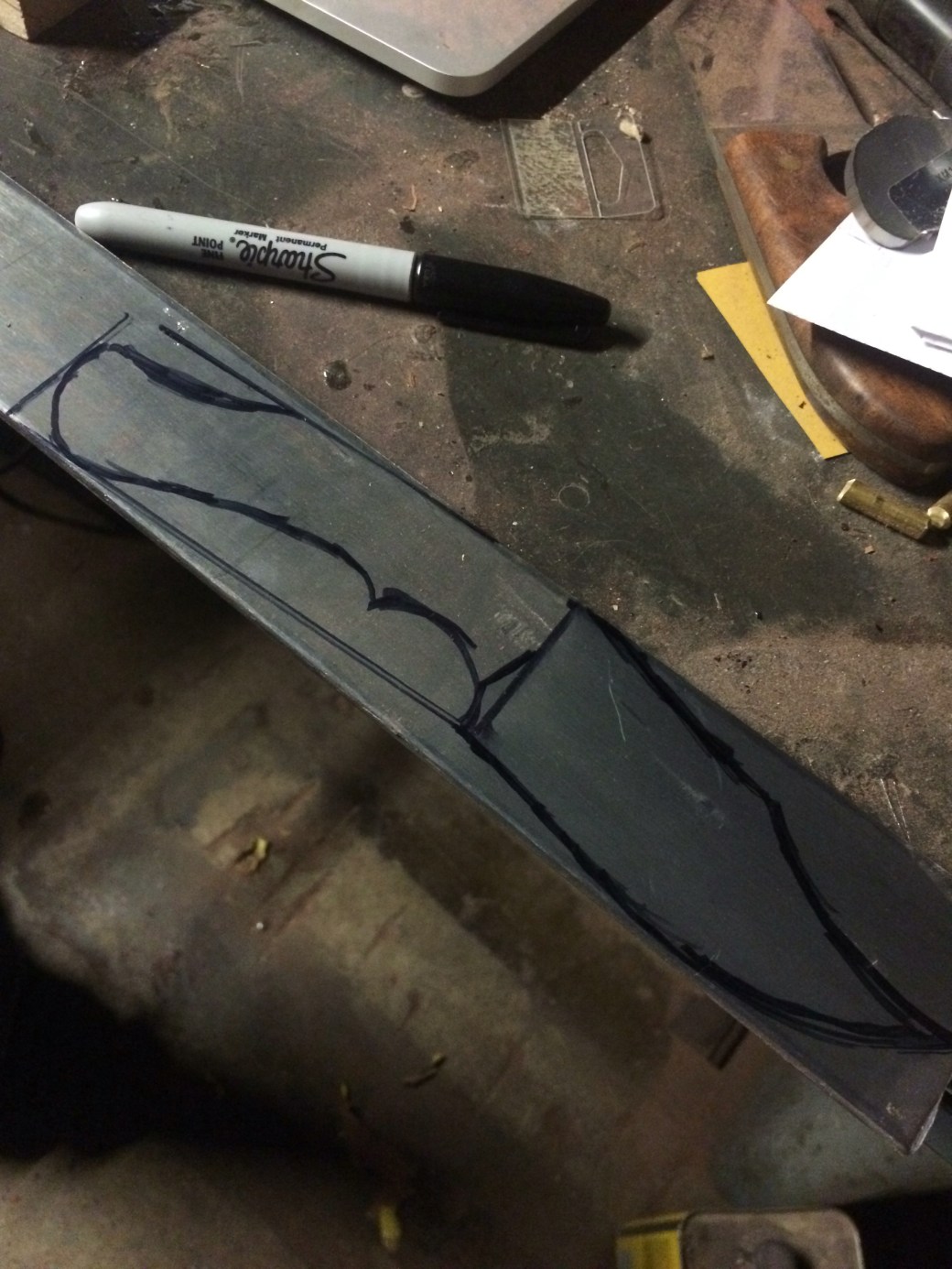
I did two designs for this knife, based on some of the Buck fixed blades.  I went with the bottom drawing:


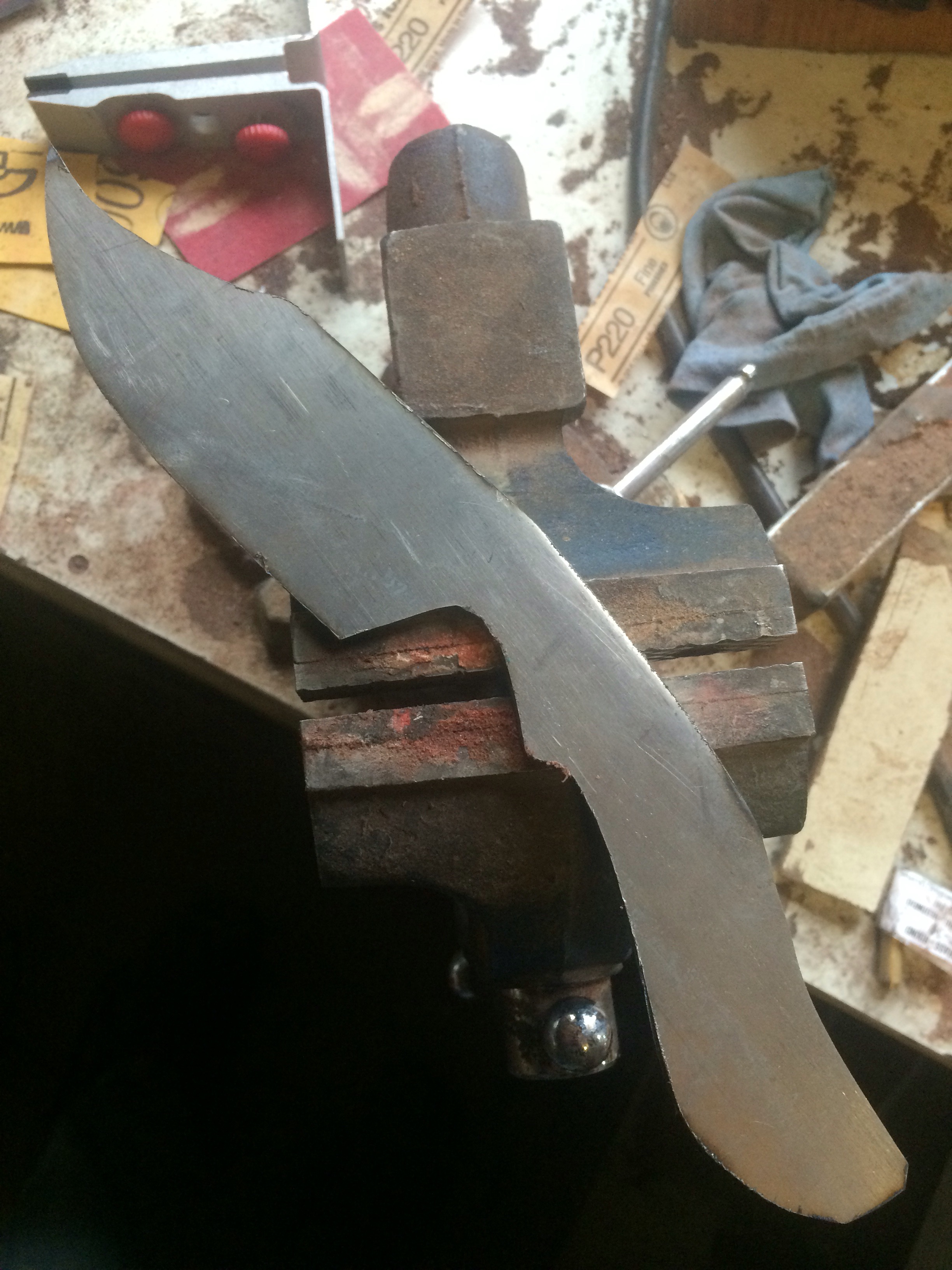
Wet sanding:

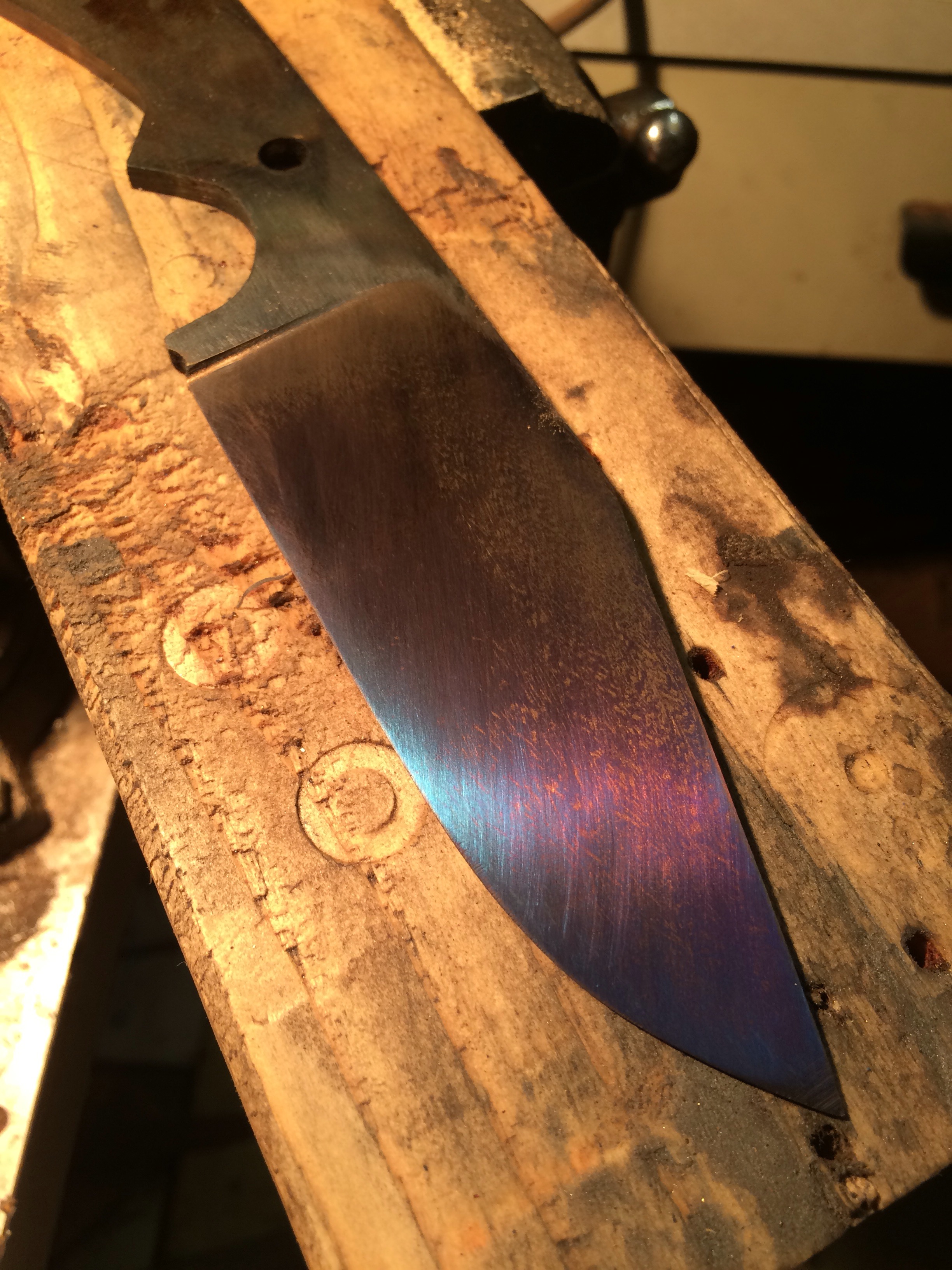
This is after heat treat, slag all removed, at about 600 grit:

Satin:

Walnut for the handle:

The Stag:  O1 tool steel, Walnut handle scales, fiber spacers, and steel hardware:

In the words of a dear friend, just pat yourself on the back and keep moving

Much love to Kent Huffman for the beautiful leatherwork and to Taylor Huffman Bernard for the beautiful woodburning.  Finished knife photos by James Bernard and his superior camera.

Knifemaking: making your mark and the Cuchilla Pequita

“Control what you can control, maggot!  Let everything else take a flying fuck at you and if you must go down, go down with your guns blazing.”

Cort the Gunslinger, from Stephen King’s The Drawing of the Three

The Gauchos were a group of cowboys who worked on the grasslands of South America during the 18th and 19th century. They were a people without boundaries, solitary, and existing on the Pampas of Argentina, Uruguay and Southern Brazil.  The Gauchos were a pretty wild bunch and had a lifestyle that was similar to the gypsies and travelers of Europe.  Always moving from place to place, job to job, and always on the hustle.  Most were nomadic and had few possessions. 

They were a solitary people, yes, but when they did run into other gauchos there was usually high-proof alcohol involved.  Also gambling.  And prostitutes.  Those three things made for a trifecta of machismo, and that usually resulted in conflict which manifested as duels.  Guns were expensive and hard to come by so the weapons of choice were usually knives.

When Gauchos dueled the objective was not to kill (although fatalities most definitely occurred); it was to leave a mark, preferably on the face.  A gaucho with a scar on his face had lost a duel, and all the other Gauchos knew this.  He would carry this scar for the rest of his life, but looking a little deeper one can find that scars are not always a badge of shame.

There is an inherent drive to leave your mark on the world but sometimes the world leaves its mark on you.  Things aren’t always the way we think they should be and in taking a risk to make a difference we can fail spectacularly.  We all lose duels everyday and some of us carry many scars, both seen and unseen.  Some of the most powerful and profound people I know carry scars that are both large and deep, yet these people shine brightly and leave their mark on the world everyday.  They are beautiful even though life has done its damnedest to leave its mark on them.  How is this possible?

I had a teacher once tell me that no one is in control.  This is something that is a bit of a struggle for me almost daily, even though I know that in the grand scheme of things my sphere of control is very small.  It comes down to choosing how to react to the things in our lives.

So there is a choice.  You can choose to not get pissy about the holiday Starbucks cup.  You can choose to not to feel like a victim because your candidate didn’t win.  You can choose connection over isolation.  You can choose to do something about situations that don’t serve you.  You can choose to wear your scars proudly because whatever left its mark on you wasn’t strong enough to take you down.  You can choose to let the things beyond your control take a flying fuck at you and fall as they may.  Though we can’t always control the circumstances in our lives, we can choose how we respond to them.  This is where we make our mark and is also the lesson of the Cuchilla Pequita.

There are several types of knives carried by the Gauchos.  The Cuchilla Pequita is loosely based on the Cuchilla.  The Spanish word for knife is el cuchillo, a masculine noun in the vocabulary.  The Gauchos feminized cuchillo and applied it to their particular style of knives, which had a ‘pregnant’ blade belly and a slightly dropped point.  This design is based on that style and starts in 1095 spring steel:

After grinding and hardening:

Drilling rivet holes:

Texas Mesquite:

Fitting the handle:

Fiber spacers for a splash of contrast:

Clamped:

Profiled:

Sanded up to 2000 grit:

The Cuchilla Pequita:

How we choose to react in our lives affects the impact we can make.  This is the lesson of the Cuchilla Pequita

Here are some sources that were incredibly helpful:

A Short Essay About Gaucho Knives: Facón, Daga, Cuchilla and Puñal

Brittanica Online

Knifemaking: prayer, calm, and the Snowjumper

“Blessings always beg for calm
In spite of their silvery arms”

Maritime- Calm

I pray a lot.  I really started about a year ago.  Growing up I thought it went along the lines of “Dear Jesus, please give me a pony.” I didn’t really understand prayer until pretty recently.  You can pray to Jesus, or whatever divine being you have faith in so long as it is bigger than yourself.  I talk to the Universe.  I didn’t talk to the Universe for a long time.  I found that I really needed help with the simple things.  There was little help in books, on the internet, or from people (books and internet both come from people, and nobody REALLY knows what’s going on).  So I started asking the universe for help.  This has never been easy for me because I try to do everything myself.  Instead of powering through everything, I would try (the operative word is try) to be quiet and still and ask.  The first thing I asked the universe for was guidance.

“Universe, please give me guidance.”

A week later I lost my job.

You have to be careful what you ask for because if you are expecting something specific you are probably going to be disappointed.  Once I got over the shock I tried to find more quiet spaces and ask for more simple things that could help me.  Universe, please help find peace.  Universe, please help me to trust.  Universe, please help me to know strong boundaries.  In certain situations I kindly ask the Universe to help me not fuck up.  And so on and so forth.

Most recently I have been asking the Universe for calm.  And the Universe has given me calm but something hasn’t been quite right.    The calm is there, I can project it, but I don’t feel it in me.  In areas where I find the calm but don’t feel it, I gently ask the Universe to help me to accept it.

None of this is overnight.  There is no flash of enlightenment or instant nirvana.  So I ask the Universe to help me find patience.

A few weeks ago we had a giant snowstorm.  There was somewhere between 12 and 18 inches.  I love snowstorms.  It is calm embodied.  Everything slows down and gets very quiet.  Many people stay home, the city shuts down, and nothing has to happen.  It happened on a Friday and all of my work got cancelled.  My girlfriend and I decided to get snowed in together.  We went to the store and stocked up on supplies and then headed to her place to batten down the hatches.  Then after a little while we noticed the heat wasn’t working.

I love this woman deeply.  I love how she makes things nice.  I love how she plans things.  She is talented and good at many things I am not, and will help me with those things.  She owns every bit of herself.  She is vulnerable and I see how empowering that is.  She is kind to my various maladjustments and occasional dysfunctions and the other parts of my being that I don’t love so much.  It’s far from perfect but it continues to bloom and makes me a better man.  Throughout all of this she is exquisitely beautiful and profoundly elegant and quite often gives me butterflies.  There are also things I am good at that help her.  Situations like heat and snowstorms are two of those things.

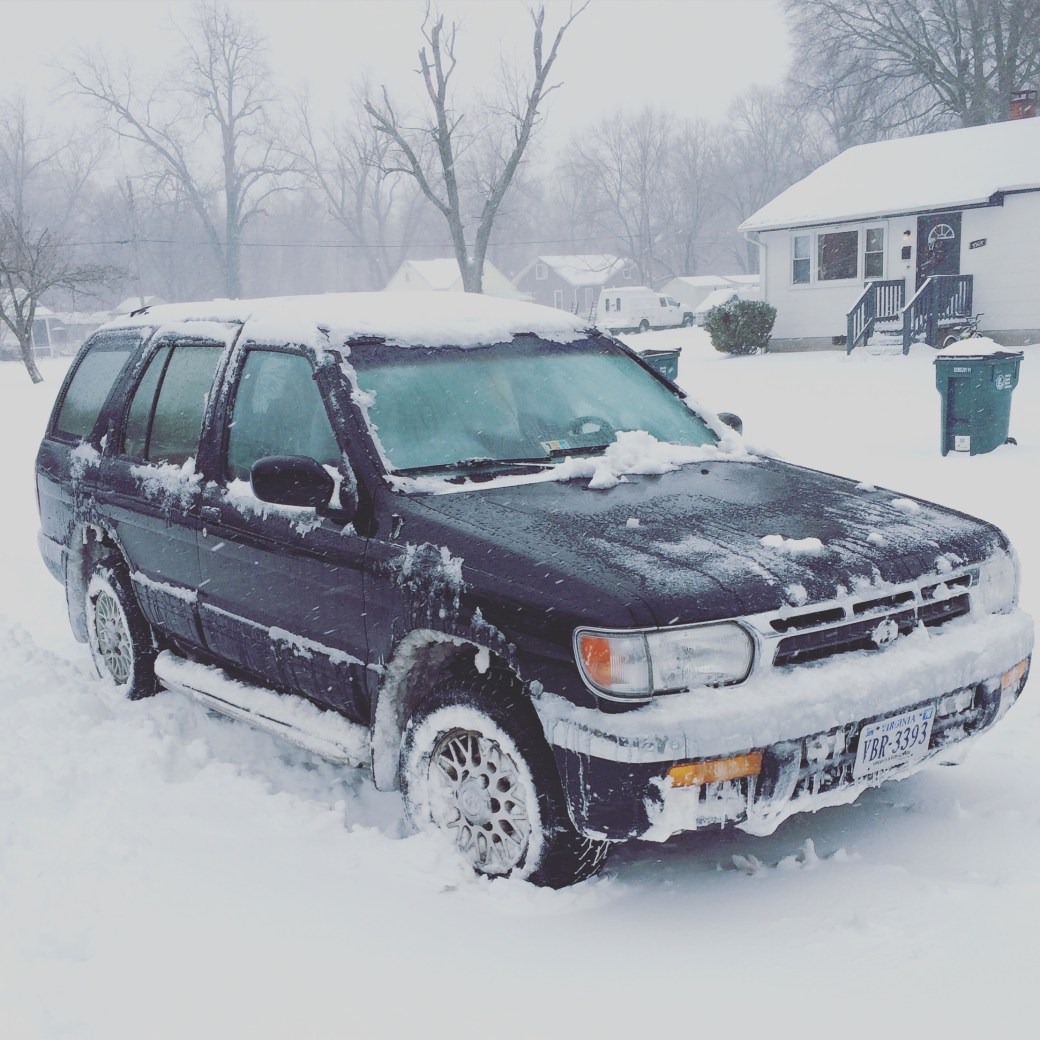
Back to the heat.  It was a full on snowstorm and it was glorious.  We went and picked up a kerosene heater from the warehouse where my workshop is.  We helped a couple of people get their cars unstuck.  We saw how beautiful everything was.  I have a 1997 Nissan Pathfinder with good four wheel drive and strong heat and we slid around a bit.  I found it to be very calming.

IMG_3016

I have a friend who does heating and HVAC work and he is a great guy.  He is also a workaholic.  I gave him a call to see if he could talk me through troubleshooting the system and he was actually up the street working.  He said he would be right over.  His wife must be a very patient woman.

Sure enough he got the furnace fired up.  I asked him what his price was for coming over and all he asked for was a couple bucks for gas.  That didn’t feel right so I offered to make him a knife.  He was down.  He likes to hunt and seems rather unfazed by the elements so I designed a skinner and named it the Snowjumper.  It is a winter blade.  I found some spalted Tamarind, which is a bright wood.  I used tin spacers: they are nearly the same color as the steel of the tang and are concealed in the way that the snow conceals the earth.  I also used steel rivets to match the spacers.

1095 spring steel:


    Hardened

Tempered:
Spalted Tamarind:  Those dark lines are actually where a fungus has eaten it’s way through the wood.

Time lapse of the handle fitting:


The Snowjumper:  1095 spring steel with a phosphoric acid etch, Spalted Tamarind handle, tin spacers, and steel hardware:


  Hidden tin spacers…

Be careful what you pray for.  Calm may come in a way you least expect it.  Accept it.

This is the lesson of the Snowjumper.

Knifemaking: going deep and the Kingfisher

When a needle falls into a deep well, many people will look into the well, but few will be ready to go down after it”

-African Proverb

I went to music school.  I was shown many ways to teach myself to be good at things.  I spent many hours in a practice room by myself, many more hours in front of a piano composing and arranging, and even more time listening.  To everything.  The education I got reached far beyond any classroom or practice space.  Life becomes those spaces.

Learning how to listen to things was the biggest lesson I learned.  When you listen, really listen, not just hear, your world opens up.  You notice all the nuanced bits of wonder.  As life gets busier and more complicated I still have to remind myself that it’s all still there, that it hasn’t and won’t go anywhere.  That within a world that holds a good deal of pain and sorrow for everyone there are also things that move and stir the soul, but they don’t always sit on the surface of our awareness…

There was one class that really opened things up and is sort of the inspiration for this writing.  It was called World Music, which is a rather vapid title for an experience that was so much more that.  It was taught by a very wonderful and kind man, one of the more enlightened people I’ve ever met.  Classes started off in silence and darkness, with the ringing of chimes.  Sometimes ambient music was played, or Tuvan throat singing, or guitar players from West Africa with rhythms I had never heard before.  There were many books to read, records to check out, and some of the most real discussions on being and the human condition that I have ever experienced.

It was during one of these discussions that something came up, and I don’t quite remember the context but it has stuck with me.  In the course of the discussion, it came up that our professor’s spirit animal was a dolphin.  He said that he was at the beach surfing when he was sixteen and nearly drowned and shortly thereafter found he related deeply with the dolphin.  The dolphin is able to dive very deep but always returns to the surface to breathe.  He told us he built his whole philosophy of teaching on that premise.

This is something that has been with me for awhile.  Sometimes you have to take a deep breath and go deep.  When you are exhausted, when it feels like life is more than you can handle, when you need to heal.  You can handle a lot more than you think you can but the tools and nourishment you need don’t always sit at the surface.  That doesn’t mean the process of finding these things doesn’t hurt like hell or isn’t terrifying at times.

Take the Kingfisher bird, for example.  To get the food it needs to sustain itself, it has to dive far beneath it’s comfort zone.  They sit on their perch overhanging the water and when they see their prey they dive, eyes closed, into the deep.  I think about this and wonder what is going through his little bird brain before he hits the water…

kingfisher

This is the lesson of the Kingfisher.  You close your eyes, you dive deep, and you come up with something nourishing.  Repeat as necessary, adding faith and a bit of courage as required.

I wanted to make a filet knife, something to help me dive.  I made her out of a thin piece of bedframe steel.  She has a 6in blade.

I initially ground two of these, but one didn’t turn out.  I left it soaking in the acid too long (for a deep etch) and there wasn’t much blade left….

My very dear friend James did the handle on this one.  She has Mora wood scales and brass hardware.


My good friends Mike and Jen using the Kingfisher to de-bone a goose… 

Sometimes you have go below the surface of things to find what you need.  This is the lesson of the Kingfisher.

Knifemaking: soldiering on and the Rio Bravo

“Tomorrow is the most important thing in life. Comes into us at midnight very clean. It’s perfect when it arrives and it puts itself in our hands. It hopes we’ve learned something from yesterday.”

― John Wayne

soldier on: phrasal verb with soldier. to continue doing something although it is difficult

  • Cambridge Advanced Learner’s Dictionary and Thesaurus

This blade was a commission for the father of a gentleman who is a professional videographer.   I came to know this gentleman after building a knife for him.  He called and asked if I could make a blade for a very special person- his father.

When I first met with the client, we talked for about an hour.  He showed me a short film he had made about his father, his father’s deep love of football, and how it brought the two of them closer as adults.  The film was quite stunning.  The NFL thought so too- it won their family tickets to the Super Bowl.

In the film, he told his father’s story of how he lost a chance to play for the Baltimore Colts, losing out to Johnny Unitas.  What followed was a strained relationship where the client really didn’t get a chance to know his father.  The film documented how football brought bonding and healing.  He asked if I could make a blade with an element of the game that his father loves.

I felt quite a bit of anxiety in making this blade.  I had to design it and give it a life for somebody’s loved one whom I had never met before.  It took a very long time because I really wanted to make the right statement.  The recipient of this blade is a man’s man, stoic, and has taken his licks.  He has a bit of cowboy in him- John Wayne was mentioned during our talk.  I named it the Rio Bravo after the John Wayne film.  Wayne was 51 when he starred in the film but still kicks a lot of ass.

I write this from a man’s perspective.  As a man I have a hard time dealing with difficult emotions and I think most men would agree that it is a bitch coming to terms with them.  They don’t go away, they just sit and fester if not dealt with.  In dealing with them we often fall apart, have meltdowns, withdraw, avoid, and sometimes leave a path of destruction.  You want to succeed, to have a purpose, to leave your mark on the world, and make things right.  When that doesn’t happen you can find yourself questioning your self-worth.  I don’t have children but when there are little ones looking up to you and watching you I imagine it adds that much more pressure.

The lesson of the Rio Bravo is that no matter what you soldier on.  The only way out is through.  You show up, you do the work, you laugh, you cry, and you take the bitter with the sweet.   I crafted this blade for a man who has done all of that and serves as an inspiration of what soldiering on earns you.

The beautiful part of this commission has been seeing how inspiring the healing can be.  A son did this for a father where there was pain on both ends.  The client showed me, a stranger, this incredibly vulnerable and moving film.  It’s hard to imagine the courage it took to make that film and to put an intimate story out into the world.

I loved working with this client.  There were multiple conversations about designs and materials.  He is an artist and we can talk about concrete things in abstract and obtuse ways.  At the end of it he always told me to do what I thought and that he trusted me.   This is where I started:


Some jimping for grip, and a nod to the laces of a football. 

Rough Grind

Hardened…

….and tempered

I wanted something with the feel of a football…

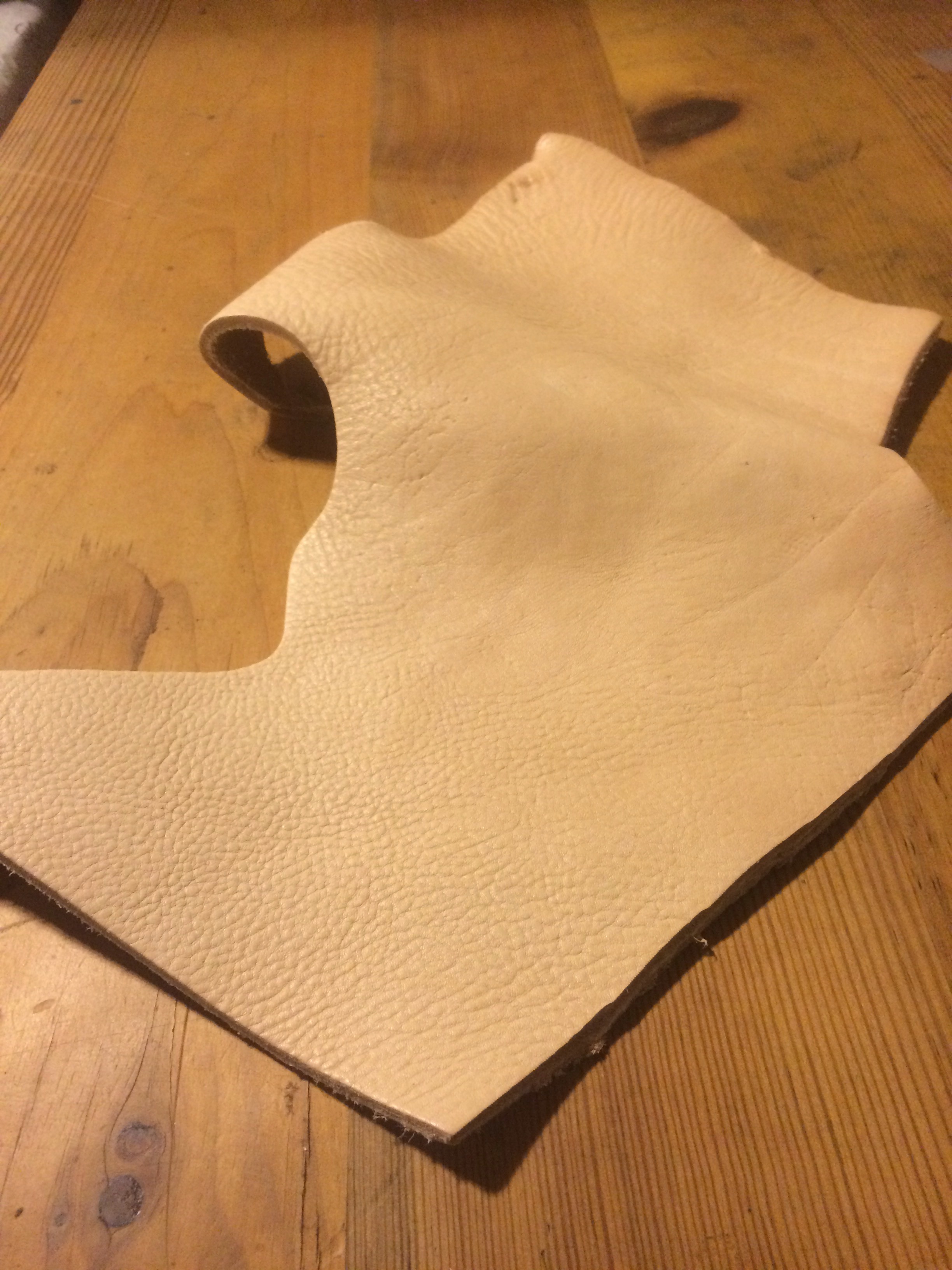
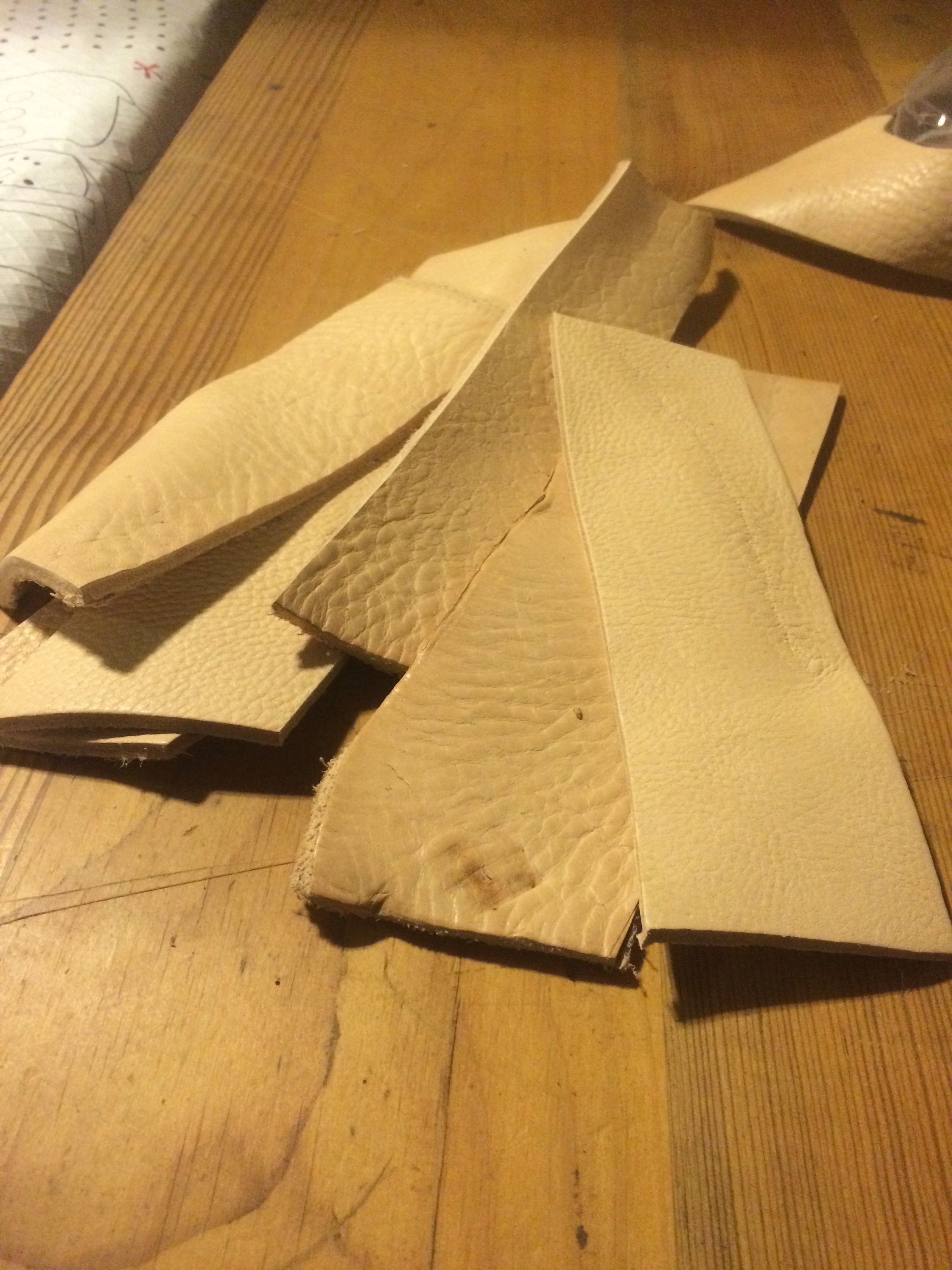
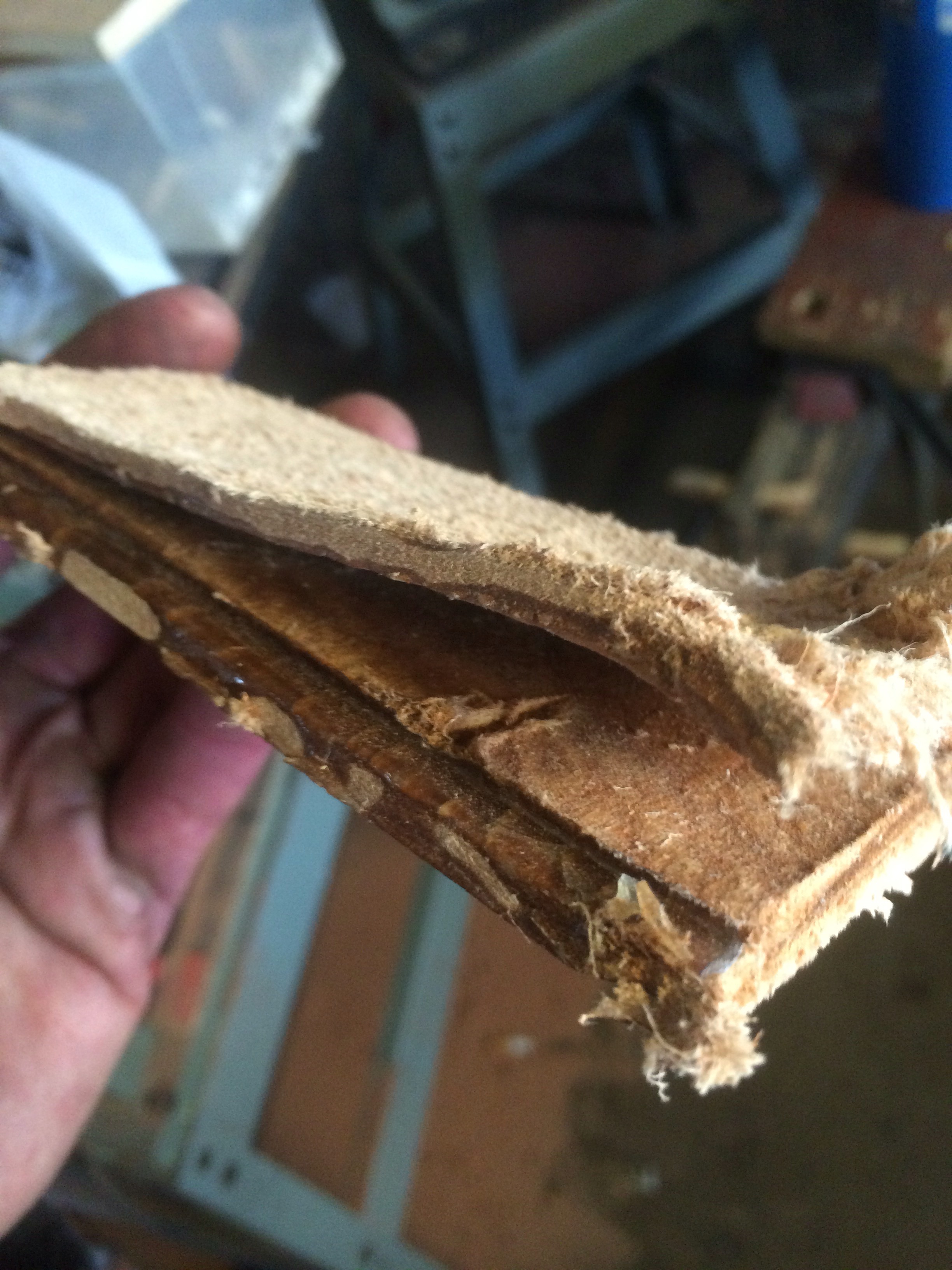
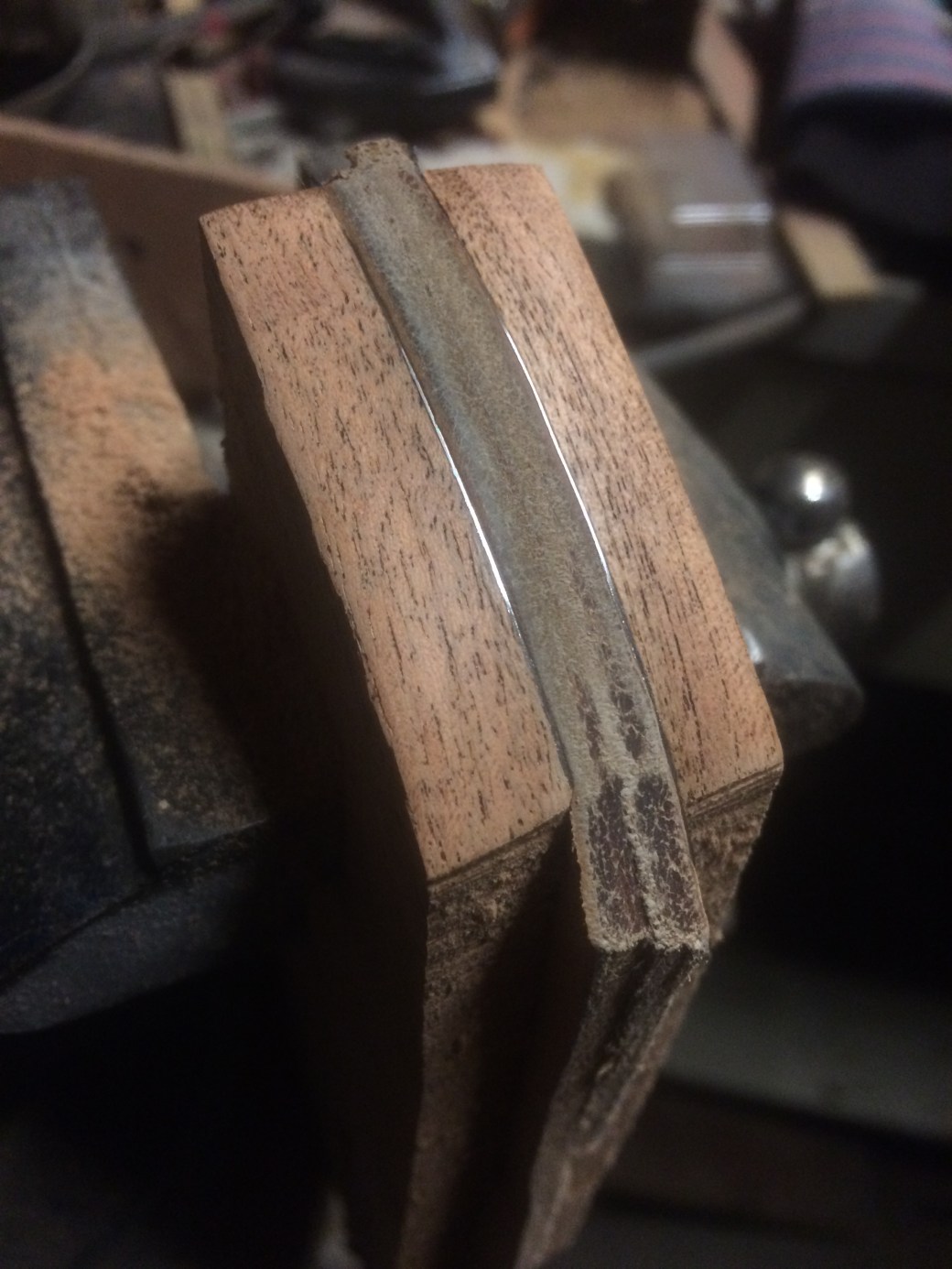
I cut it into strips and glued it together….

…and it failed miserably.  Still, I really wanted to work the leather in.  That’s the spirit of football even though it isn’t pigskin.  I was also really into the idea of having a part of something that once walked the earth be a part of this blade.  I wanted this to be a very masculine blade, with a southwestern theme.  For me it doesn’t get much more manly than the combination of Texas Mesquite, leather, and steel.  I put in some thin tin spacers for a bit of sparkle.
IMG_3086

I have a cousin in Texas who is a woodturner with a sawmill.  He handpicks cutoffs with the most gorgeous figures and sends them to me.  When I’m using his wood for a handle it’s like Christmas morning- think of opening your favorite Christmas present, only you get to do it for two and a half hours.  Thank you Bill Cockrell.  You are a very good man.

IMG_3091


The Rio Bravo: etched 1095 spring steel, Texas Mesquite handle, leather and tin spacers, with steel hardware.  
    I carved in some laces:
   

Soldier on, cowboy.  You never know what tomorrow may bring.

Knifemaking: The Spellcaster Epilogue

“Faithless is he that says farewell when the road darkens.”

J.R.R. Tolkien, The Fellowship of the Ring

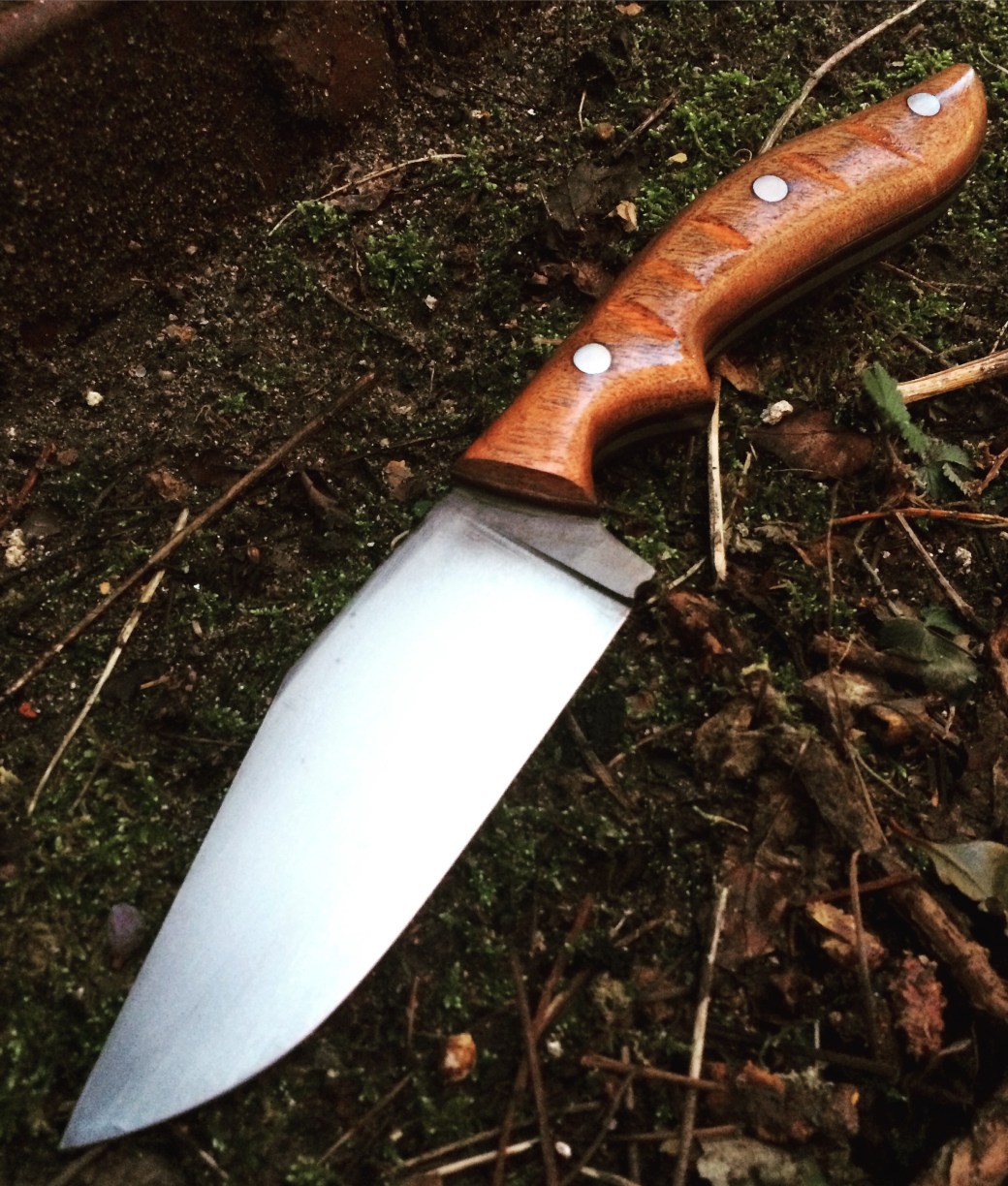
The Spellcaster was a lesson in faith- I wasn’t sure if it would even turn out.  I loved the idea that the steel came from a bedframe but I wouldn’t know if it would harden and temper properly till I had put in a lot of work on it.  It did.  I’ve been working on this blade a long time off and on and finally, like many things in life, I just had to take a leap and just go for it.  It is a thinner blade, very nimble and made for a smaller hand (well, smaller than mine….)

The lesson here is to trust that things will be ok, even if they aren’t the way you expected they would be.  Even if they aren’t the way you would like them to be.  This is something I struggle with- letting things be as they are.  In order to finish this blade I had to let it be as it was. Only then could I see how beautiful it really was.

This is after heat treat.  A file couldn’t touch it.  The bedframe delivered…   

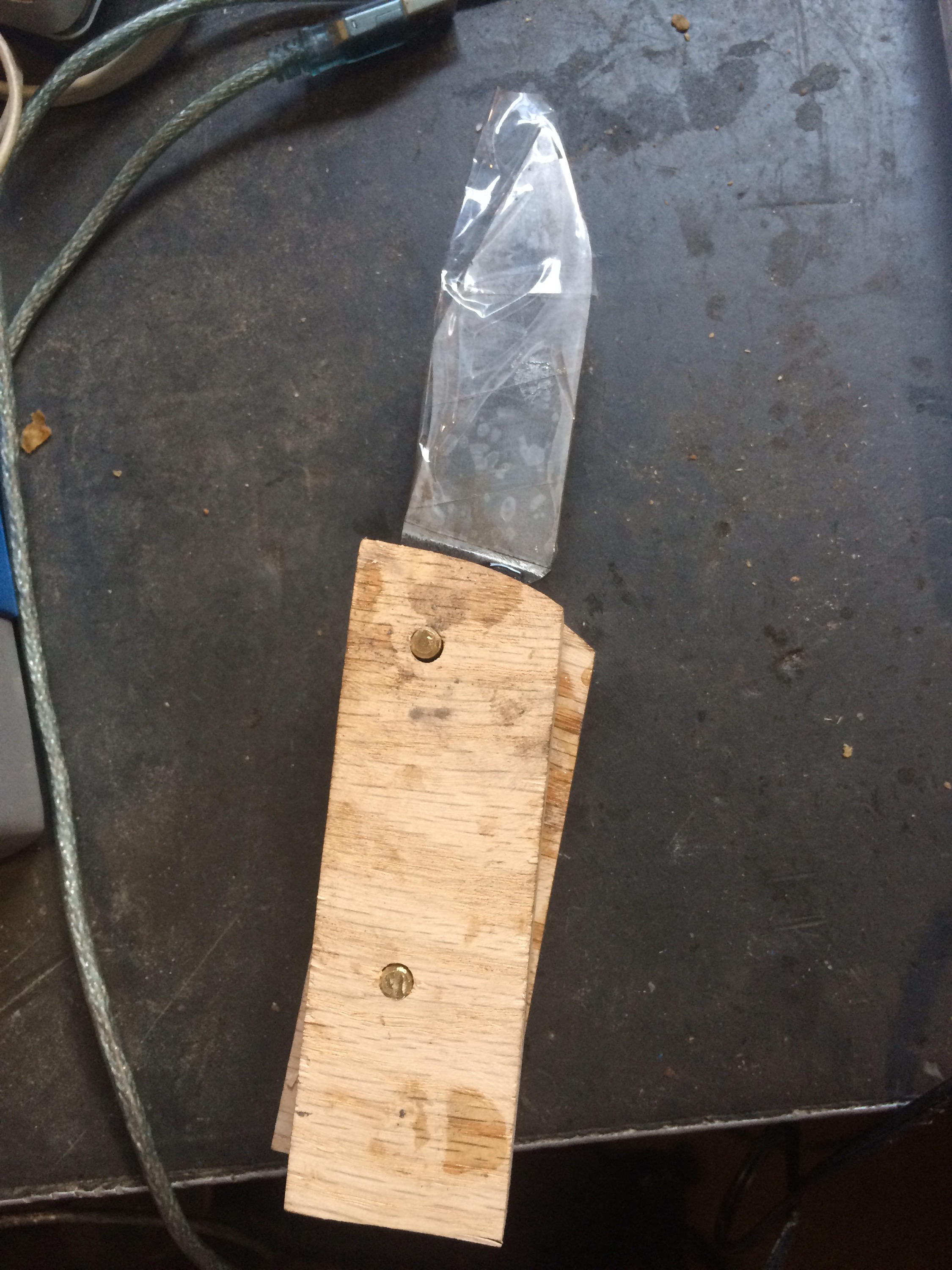
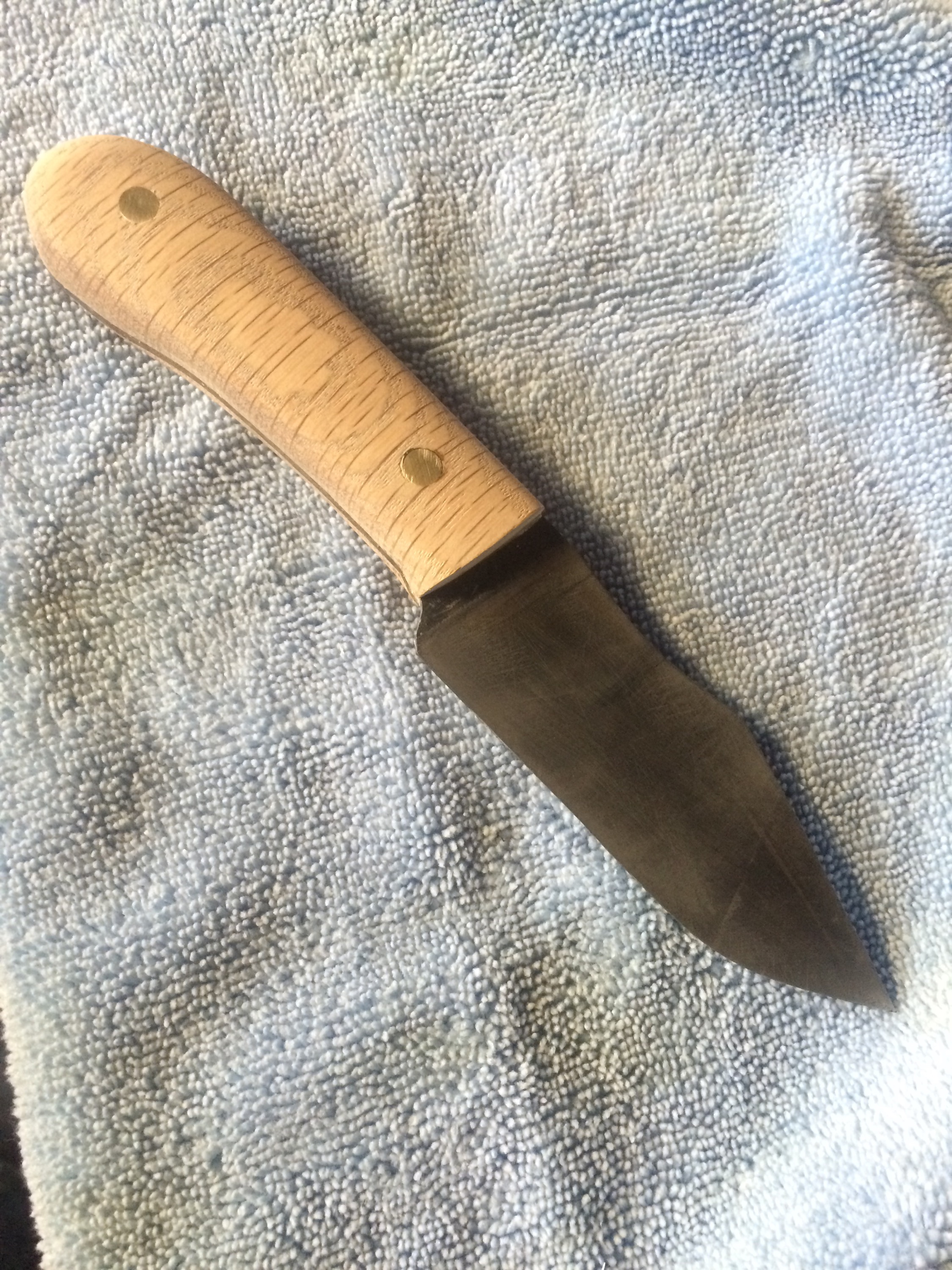
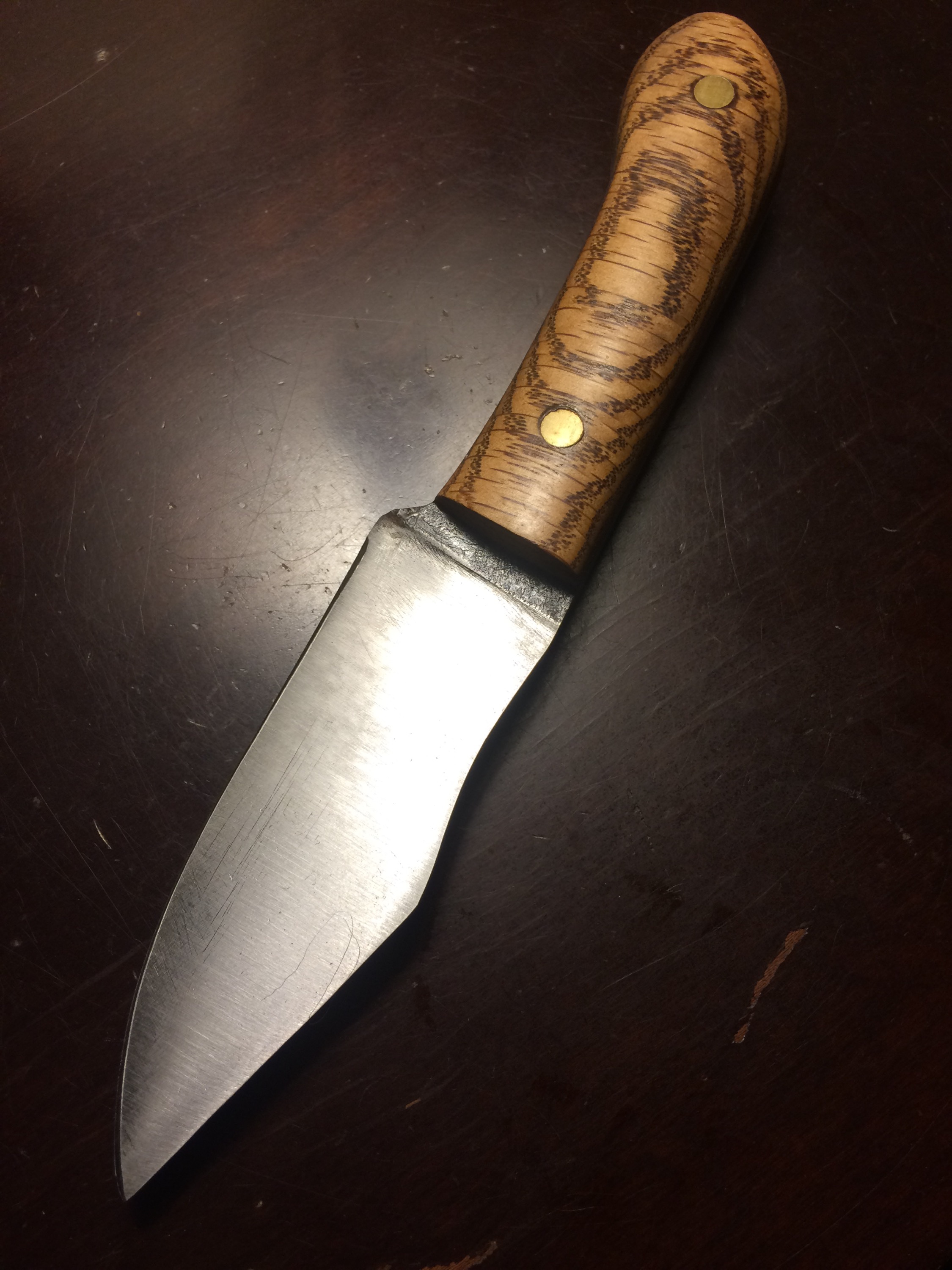
I used white oak for the handle.  I love oak.  It has mass and it’s heavy.  It takes up space and lets you know that it’s there.  In Celtic lore, oak is a protector, wise and strong and a bridge to otherworldly places.  I wanted that for this blade.

This is a beautiful process and one of my favorites: 

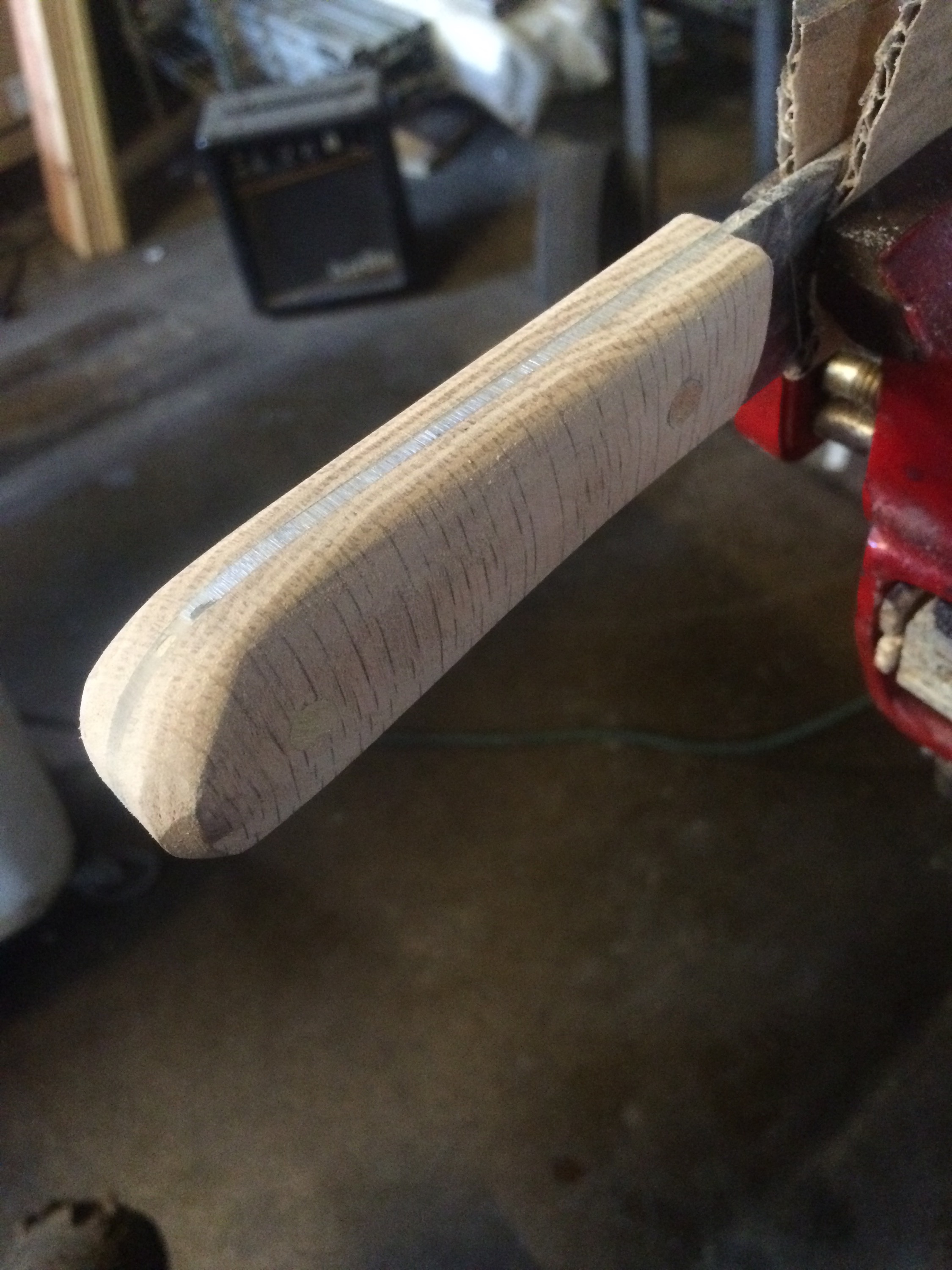
  Roughing it out…The grain is starting to come out…there is a woodworkers’ trick where the wood is rubbed down lightly with water and allowed to sit- this brings the grain to prominence.There she is….
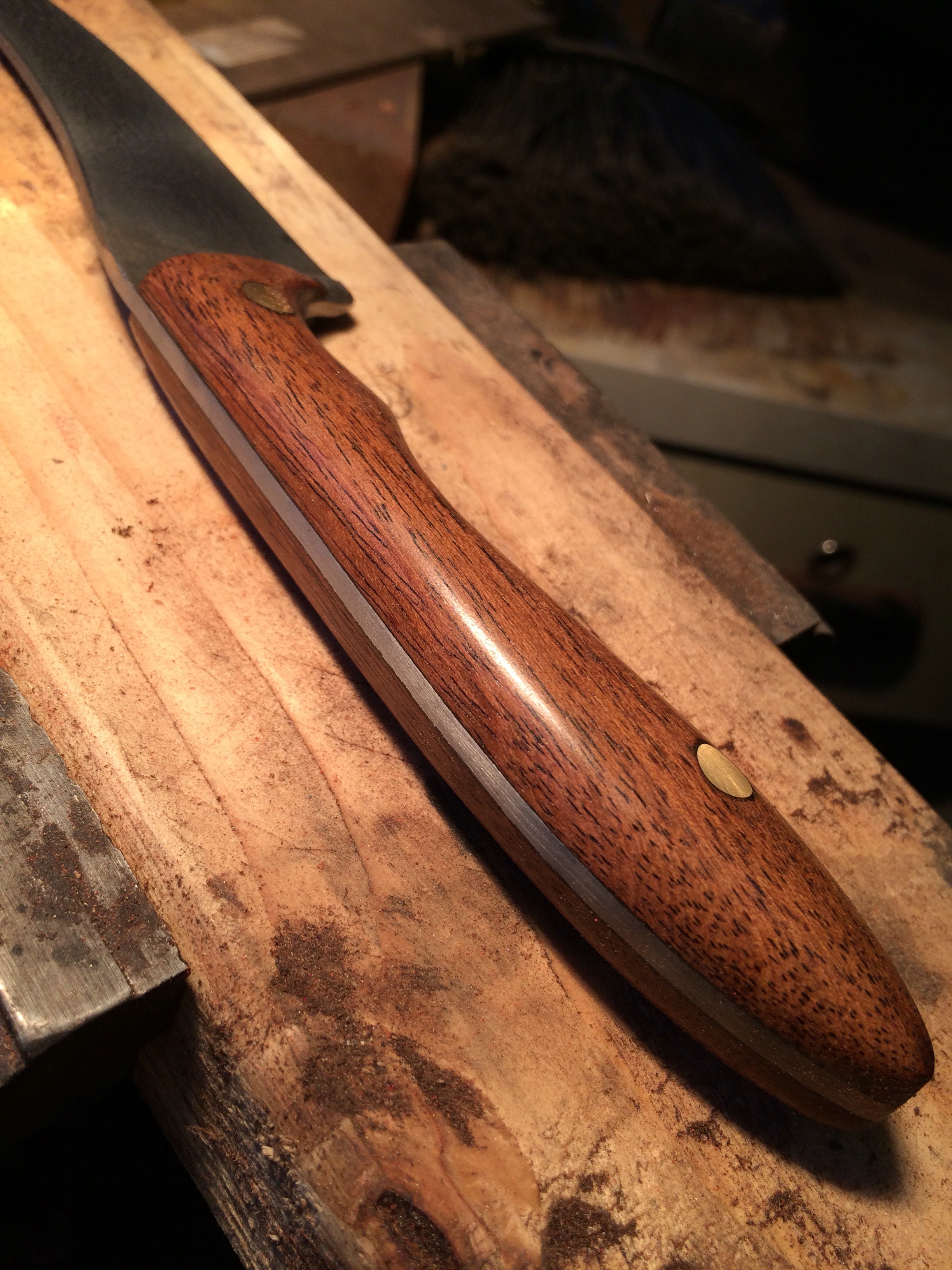
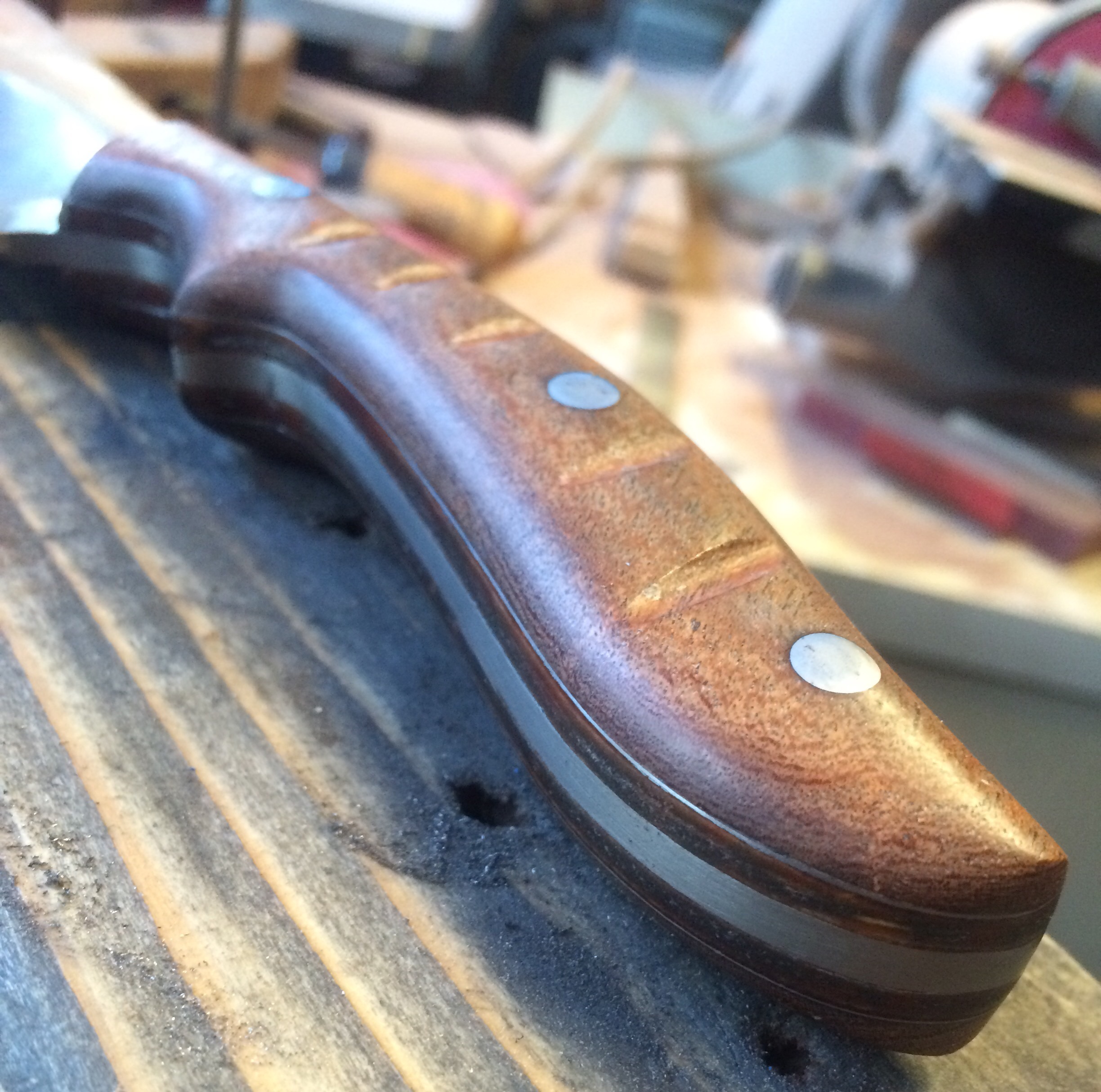
Brass rivets with a walnut danish oil, finished with tung oil.       


Always keep your faith.  This is the lesson of the Spellcaster.

Knifemaking: the supernatural, matters of faith, and the Spellcaster

That is supernatural, whatever it be, that is either not in the chain of natural cause and effect, or which acts on the chain of cause and effect, in nature, from without the chain. [Horace Bushnell, “Nature and the Supernatural,” 1858]

Of late there have been lots of areas in my life that require a bit of faith.  I’ve spent a good amount of time looking into matters of faith and where my own faith lies.  What I’ve found is that even in the simplest things there is faith.  Getting in your car is an act of faith…because honestly every time you do you are stepping into a motorized death machine.  Our cars operate on thousands of tiny explosions, fueled by a fluid of combustible vapors that even static cling can ignite.  Then there are the people operating these machine- people facing hundreds of distractions from screaming children to phone calls to just plumb not paying attention.  What is it that allows one to arrive at their destination unscathed?  A well regulated auto industry?  The due diligence of traffic enforcement?  Our expert driving skills?  A combination of all three?  Yes.  But maybe there is something outside of the normal chain of cause and effect that could be at play.  Maybe arriving at your destination could be considered a blessing or a miracle, be it the grocery store, a wedding, a funeral, a job you love, a job you hate, or anyplace.  Maybe there should be a bit more celebration.  Maybe what we perceive as mundane is actually quite profound.  Maybe I am over-thinking all of this….
It is with this overactive frame of mind that I approached the Spellcaster.  She is made from a piece of carbon steel that came from a bedframe, which I think is a beautiful story.  Essentially she comes from the dream realm, something supernatural in it’s own right.

At work there are people of many different ethnicities and cultures- Sikhs, Sicillians, Greeks, Ghanaians, the whole spectrum.  The other month at work I was running an auction pickup at a job site and several customers with a large order showed up at 4:30p- precisely the time i was scheduled to leave.  These gentleman were devout Muslims- shrewd businessmen but very sweet people.  I was a bit cranky at having to stay late on a Friday.  That crankiness was exacerbated when at 5p two of the three gentleman slipped off to pray which substantially slowed the loading of their many wares.  I had to pause and after that pause I became aware of my crankiness and realized it might be because I felt there might be a lack of faith and devotion in my own life.  I was witness to a tremendous act of faith and devotion, even though they had slipped off to pray in a place unseen.
The Spellcaster is also a prayer and an act of faith, it’s namesake drawing inspiration from entities and beings that operate far outside of the normal chain of cause and effect.
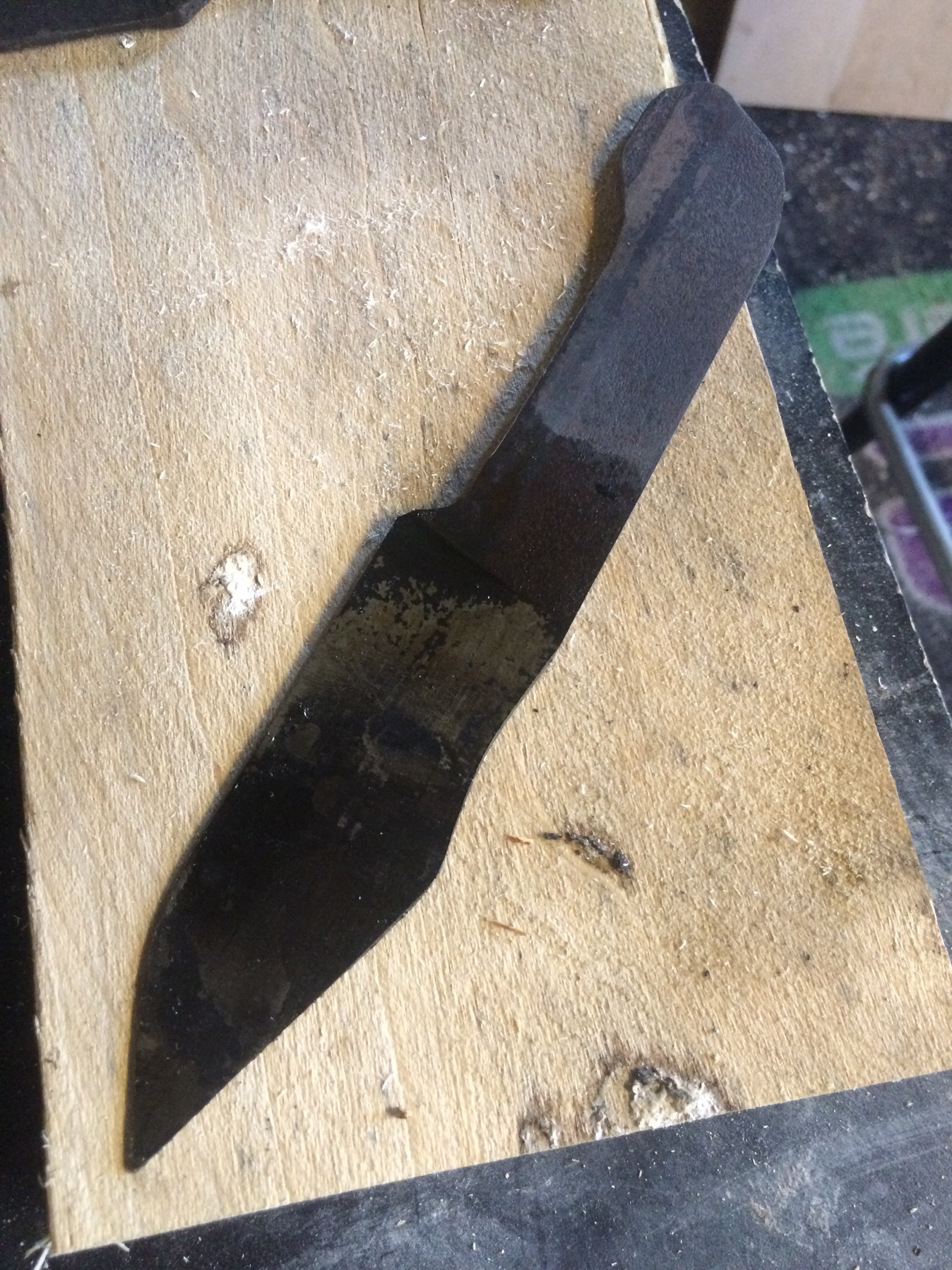
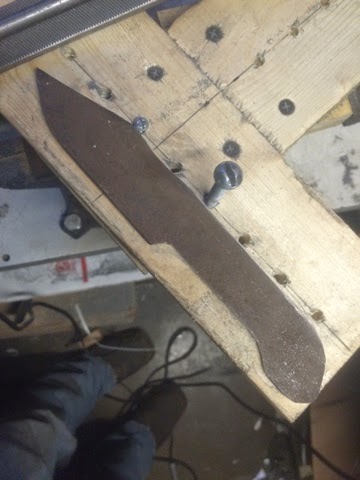
This is pre-heat treat, no rivet holes, raw stages.
The lesson of the Spellcaster is to allow oneself to witness and experience acts of faith, not in spite of but within different religions or creeds.  This sharpens my own faith.