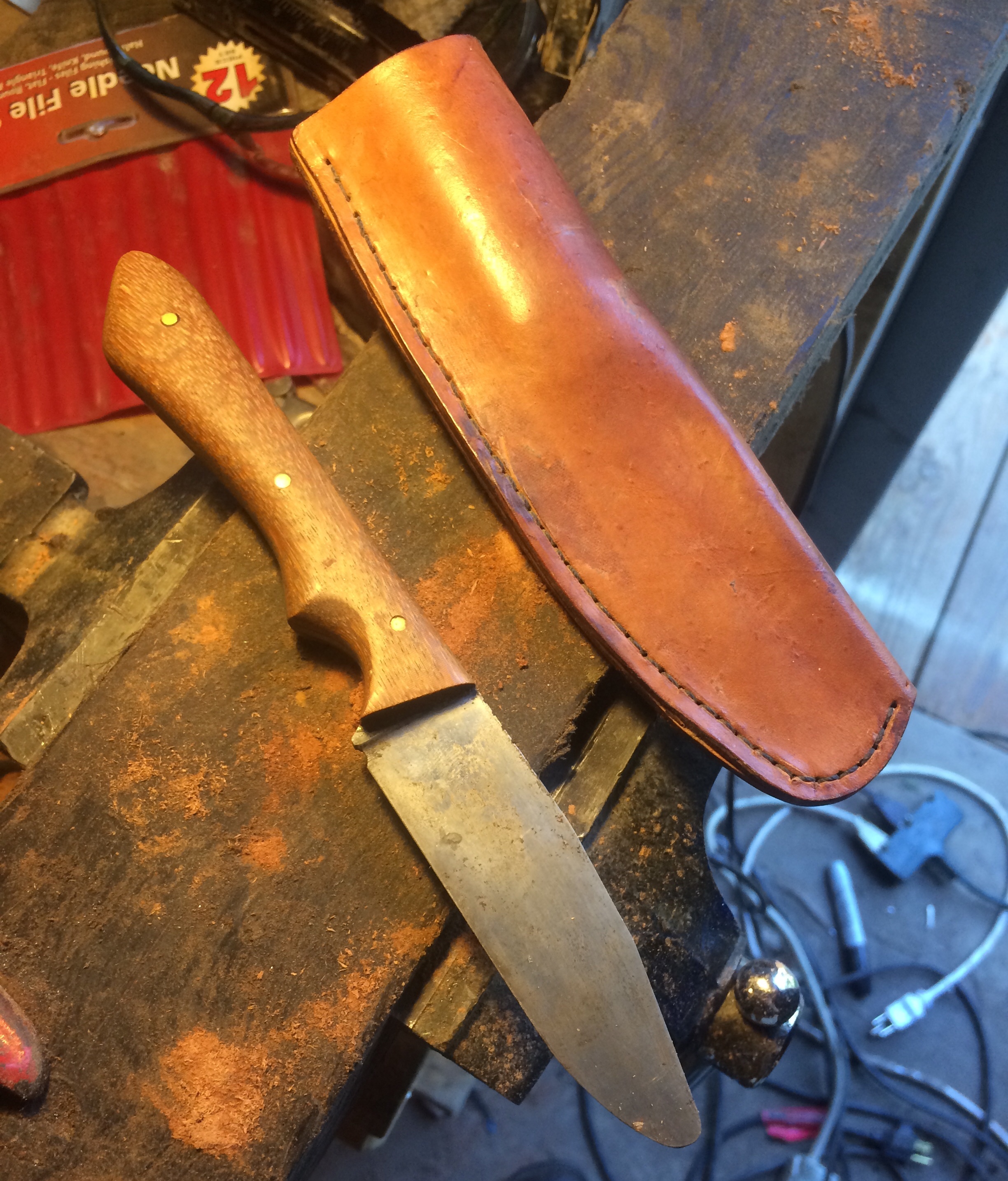
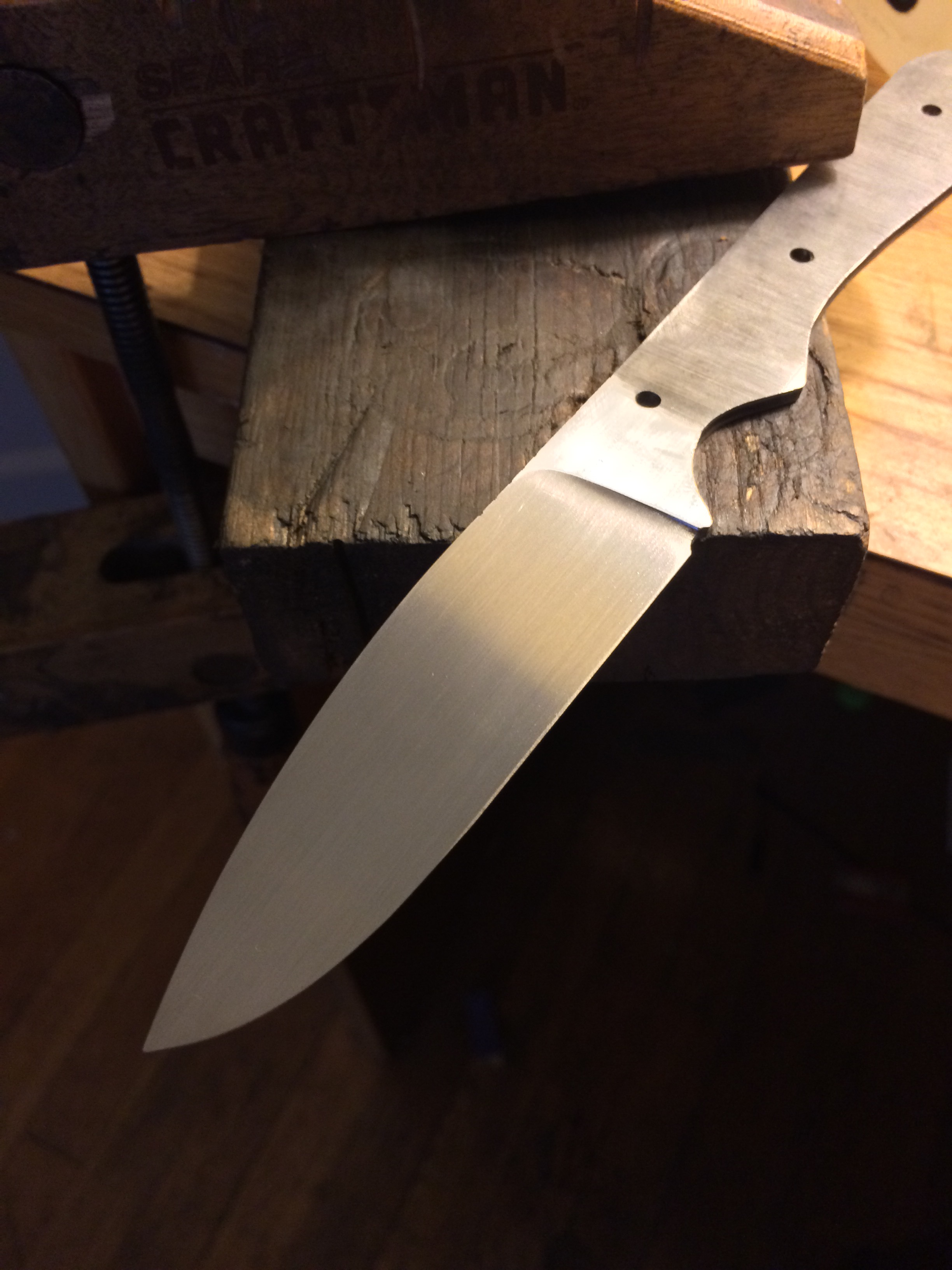
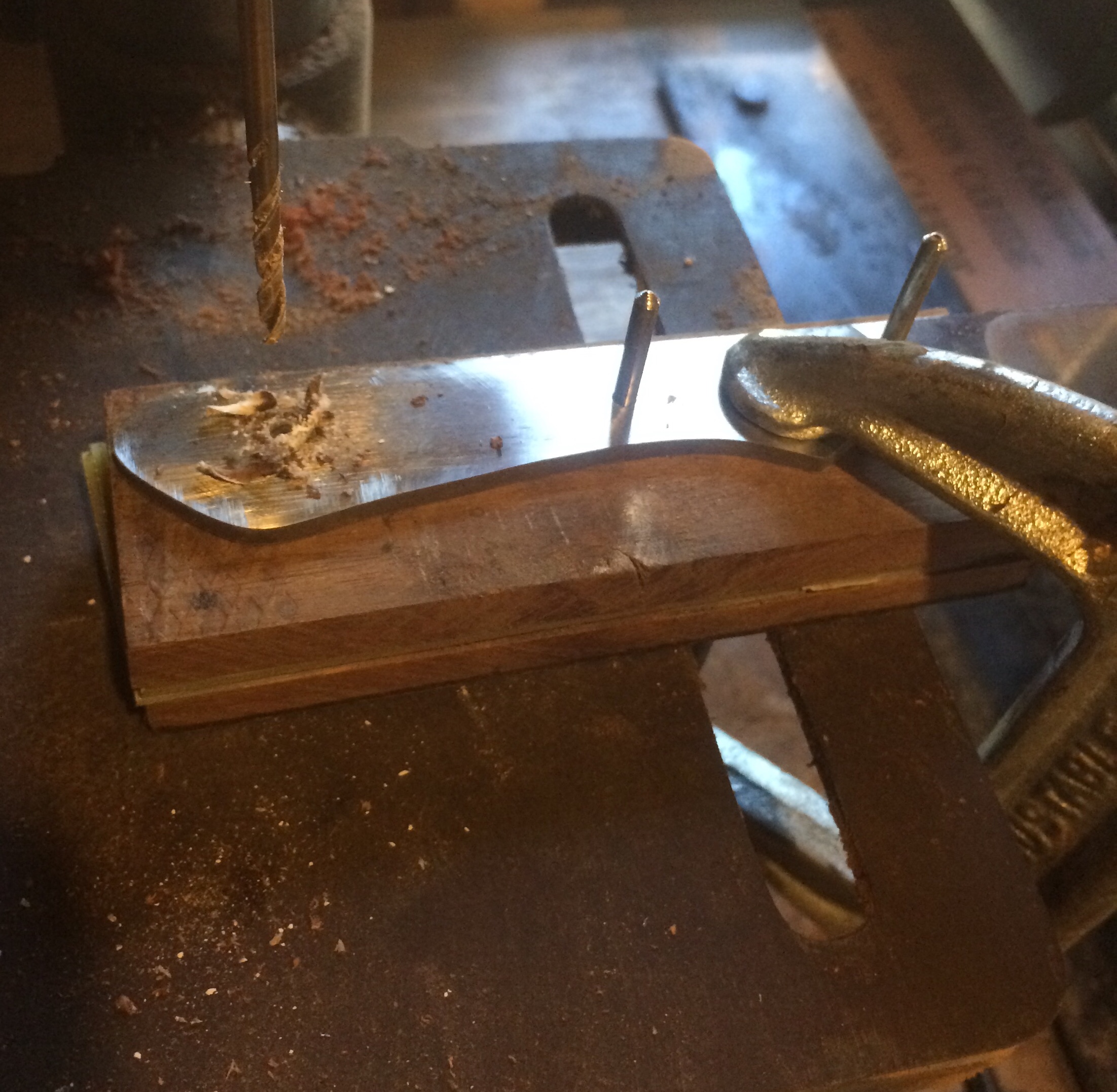
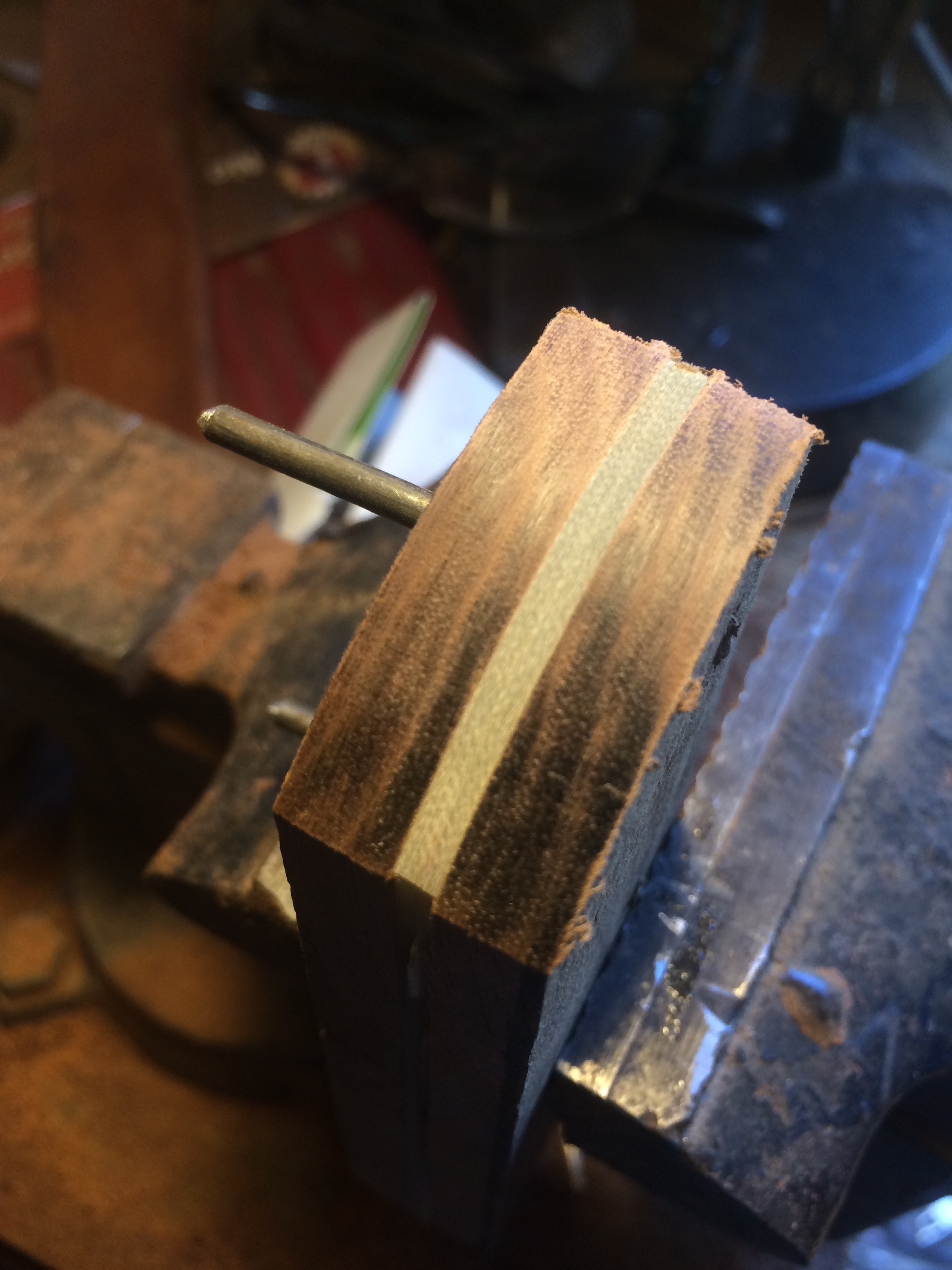
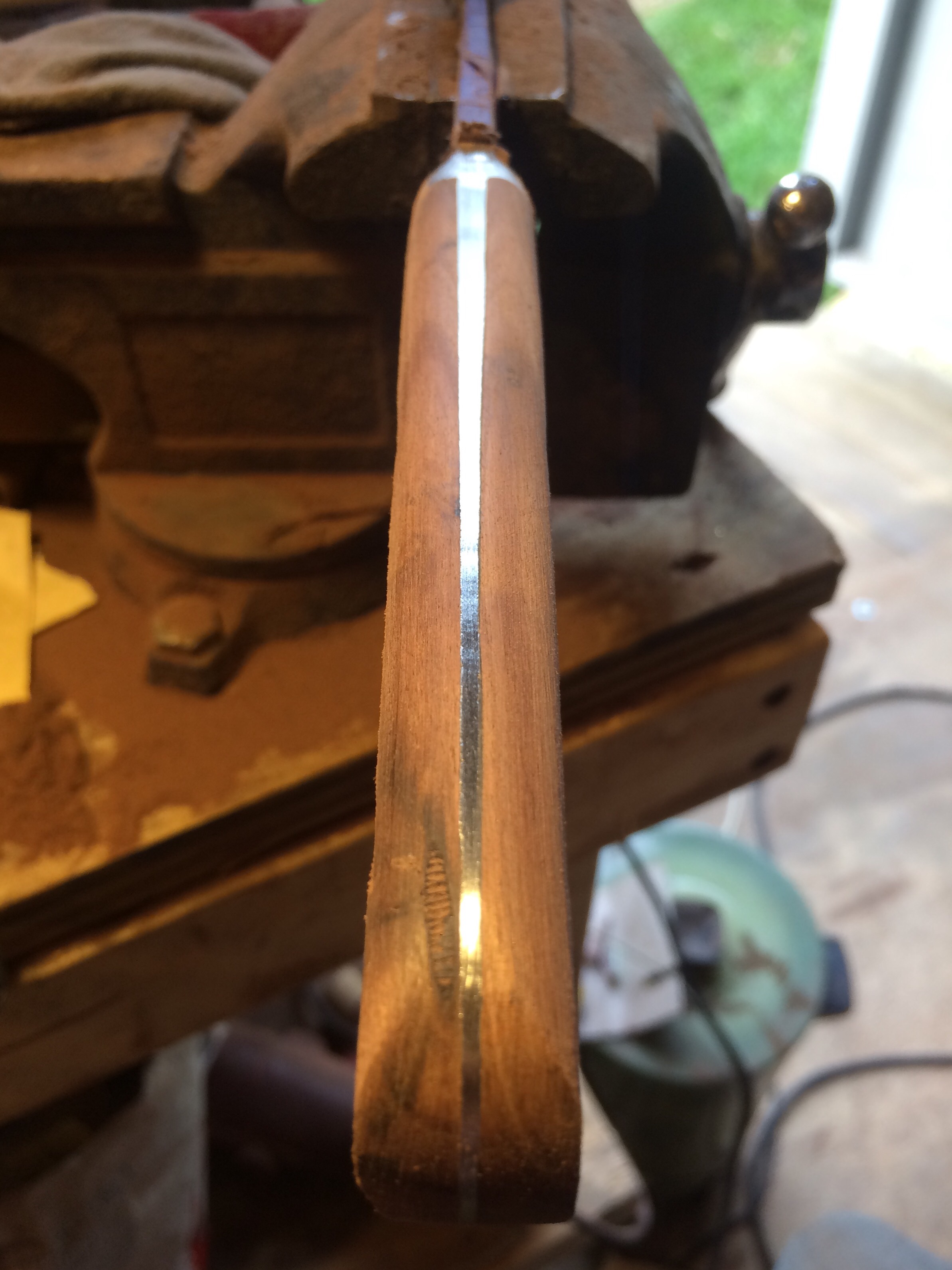
Knifemaking: all the little pieces, and the Mood Ring

A few days after Christmas in 2018 I got a call from a buddy of mine. He was a producer for a company that put together wedding bands and he had to get a group together for a New Years Eve party. He really needed a trombone player for the horn section and gave me a call because I am a trombone player and he knew I probably didn’t have a gig. The problem was I had just had a bit of orthopedic surgery and wasn’t sure I was up for it. He then told me what it paid and said all I needed to be able to do was get a horn up to my face. I told him I was down like a clown, Charlie Brown.

Just doing that gig put me on a list of musicians and I started getting calls. Over the years I’ve been up and down the mid-Atlantic playing in horn sections of wedding bands at country clubs, theatres, mansions, and sometimes out in fields. These are good gigs because the job is to help people have a good time on what is probably one of the happiest days of their lives. With open bars, this is usually not hard at all. Sometimes the receptions are super simple. Others are more involved with lots of moving parts, including musical cues, choreography, and spectacle. One couple at a vineyard wedding were huge anime fans and our producer orchestrated an arrangement of the theme from ‘Cowboy Bebop.’ I played at a Persian wedding were the mother of the groom performed something they called ‘The Knife Dance’, which (as one may assume) involves dancing with the knife that cuts the cake, and passing it through all the women in the family while everyone tosses money at them. The knife finally ends up in the hands of the bride, who cuts the cake.

The band is just a small piece of all this but from the stage you can see all the little pieces of things coming together- the cooks working out of sight, the catering people running food, the sound guy handing out microphones, and event people making sure important people are where they’re supposed to be. All this adds up to something that the guests remember for for years. As one of those tiny little pieces, I’ve found some of my happiest professional moments at these jobs.

Sometime in January of this year a gentleman reached out about getting a knife made for his wedding, something special to cut the cake. After a bit of back and forth, he told me his fiancée was making their own wedding dress. I told him if he sent me some of the dress material I could work it into the handle material. This was all familiar territory, bringing a lot of little pieces together to make something special.

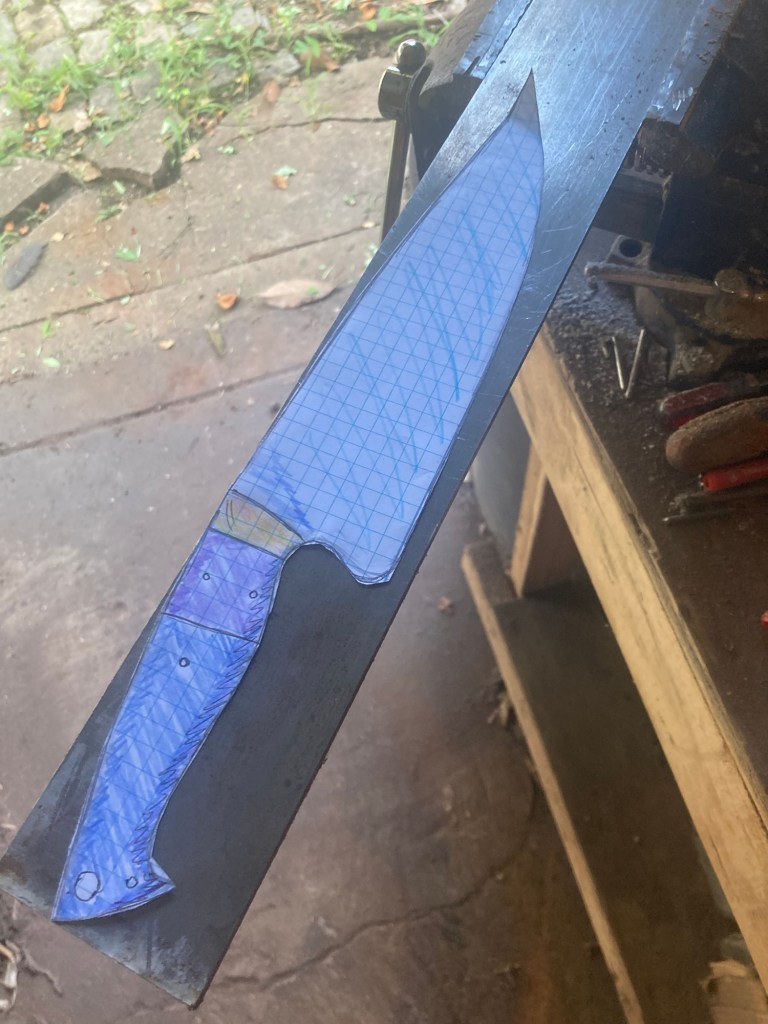
I got him some drawings together- The idea was that I would make send them a finished knife unsharpened for the cake, and after the wedding they send it back, I sharpen it, and they can then use it in their kitchen.

I used some contrasting colors to give an idea of what the knife handle COULD look like. I didn’t know what the dress material would look like.

Laying out the template

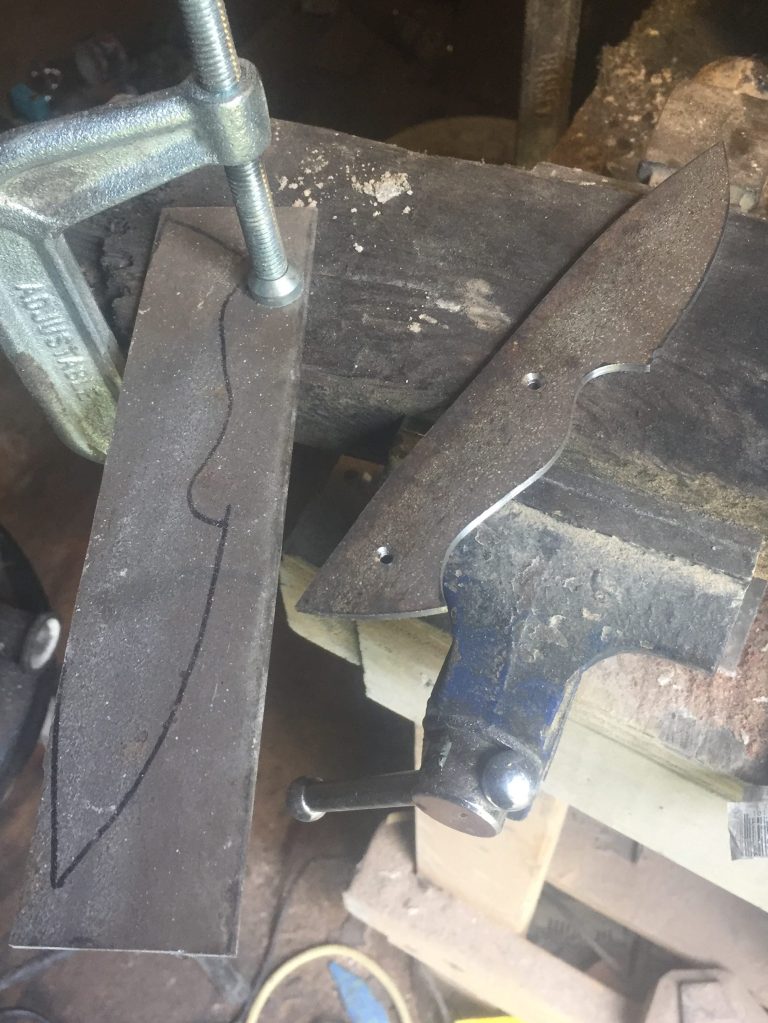
Copied on to the steel

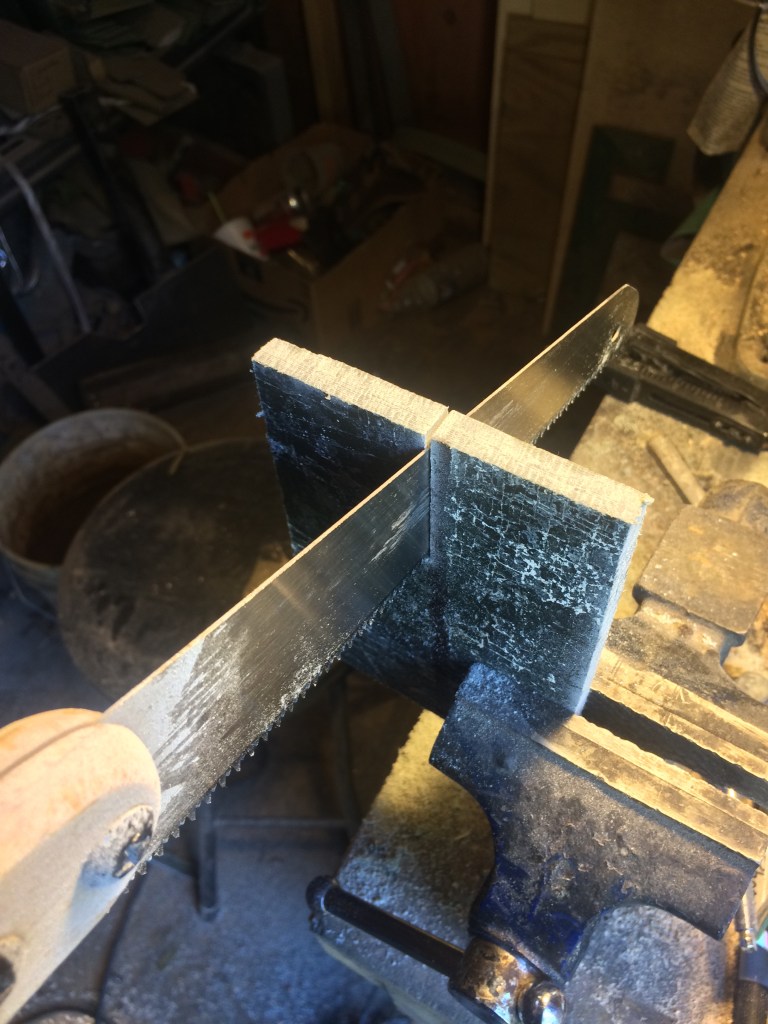
Profiled

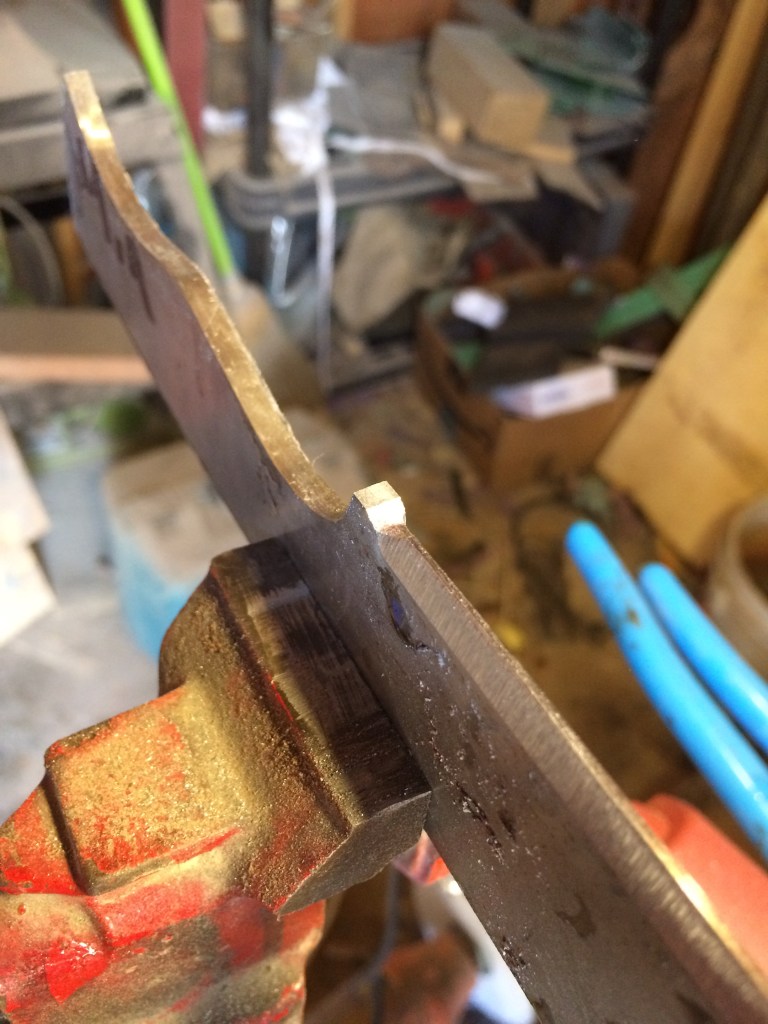
Removing some material before hardening

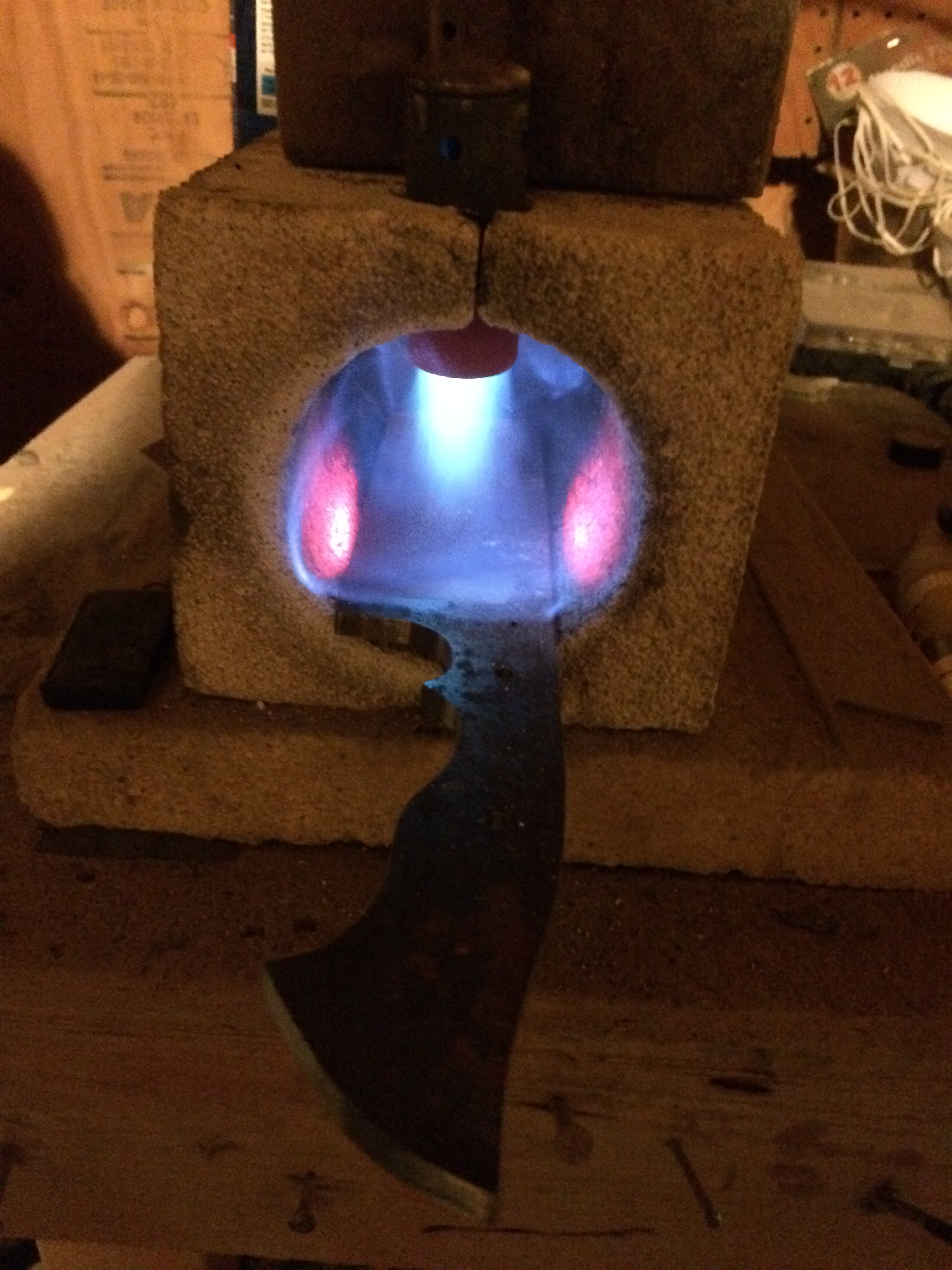
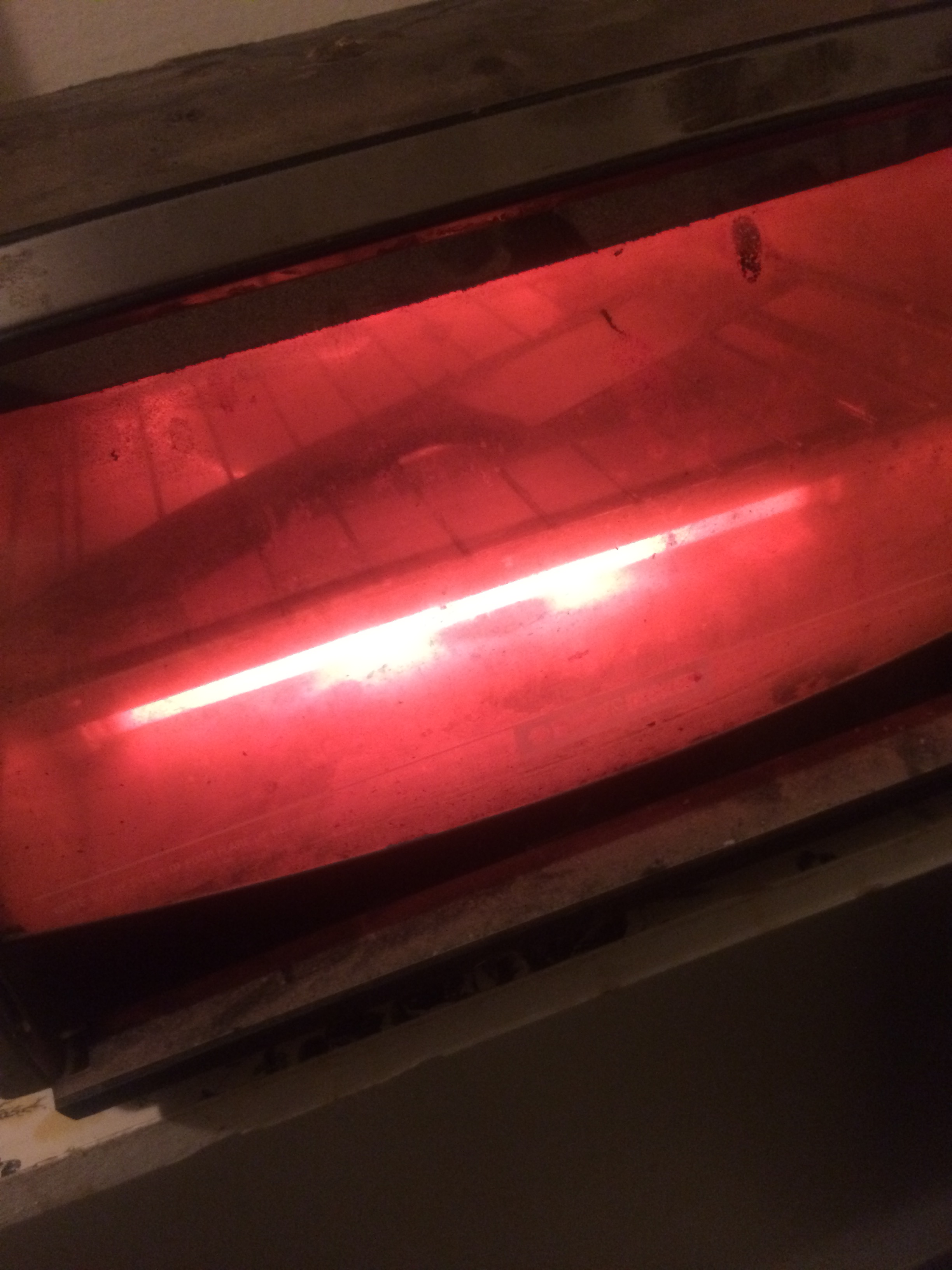
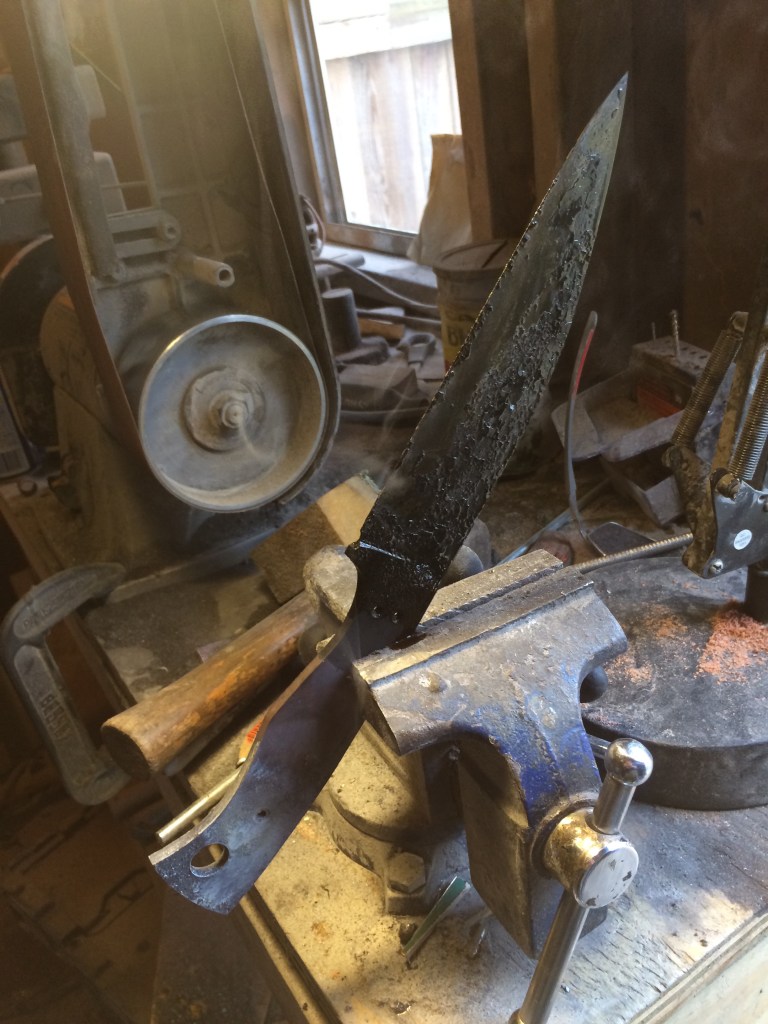
Into the forge

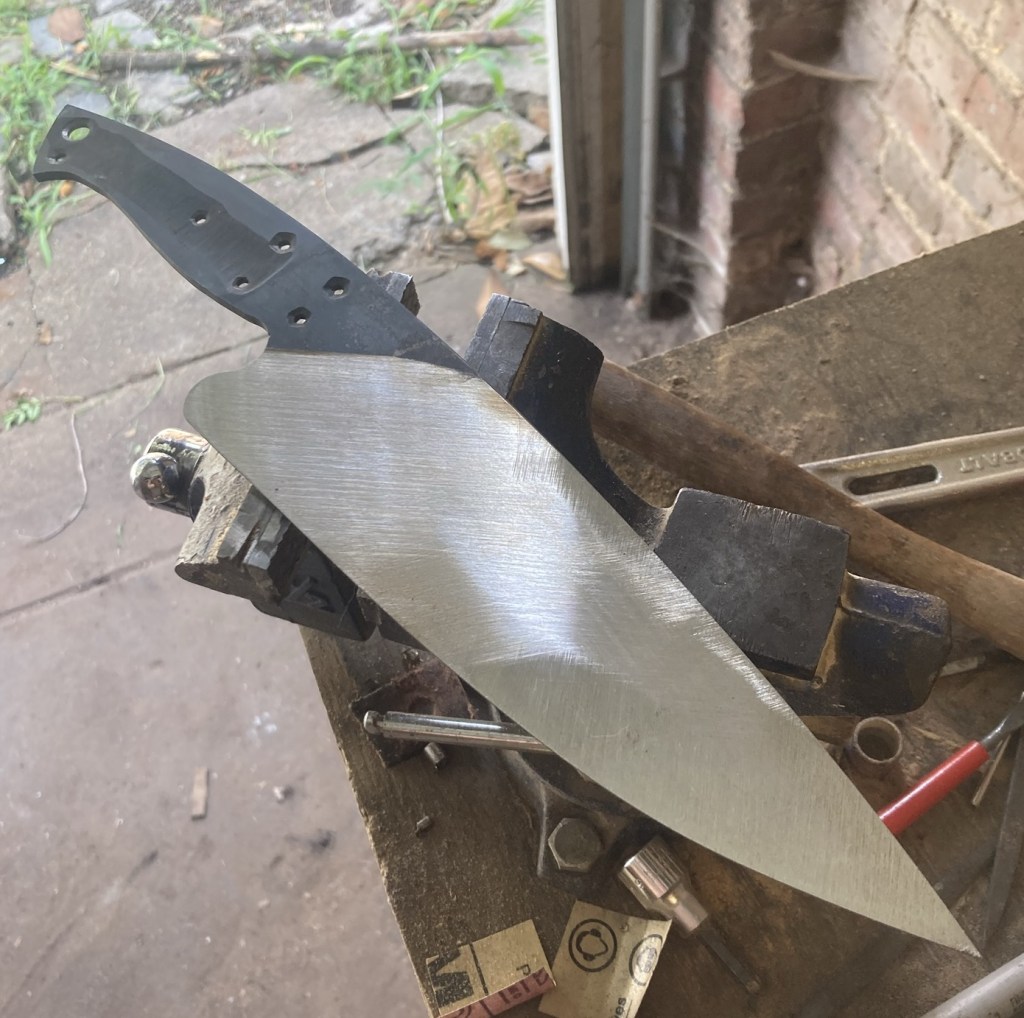
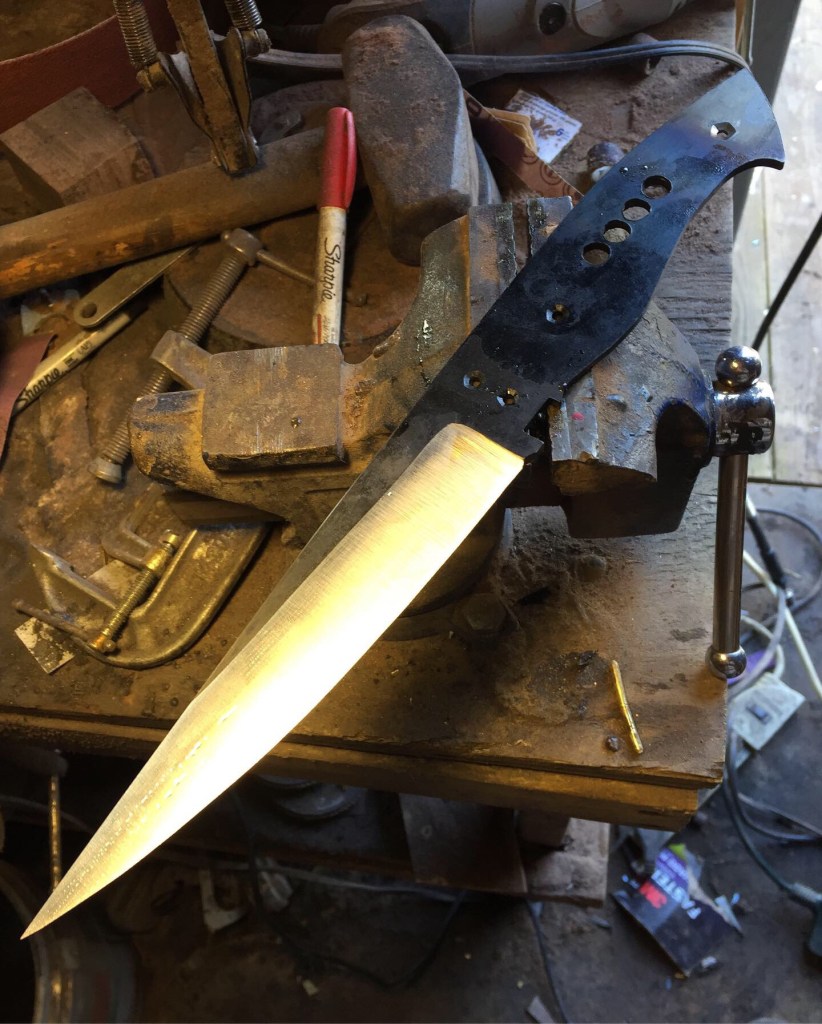
Grind some more

One of the clothing articles they sent me was the shirt the groom proposed in

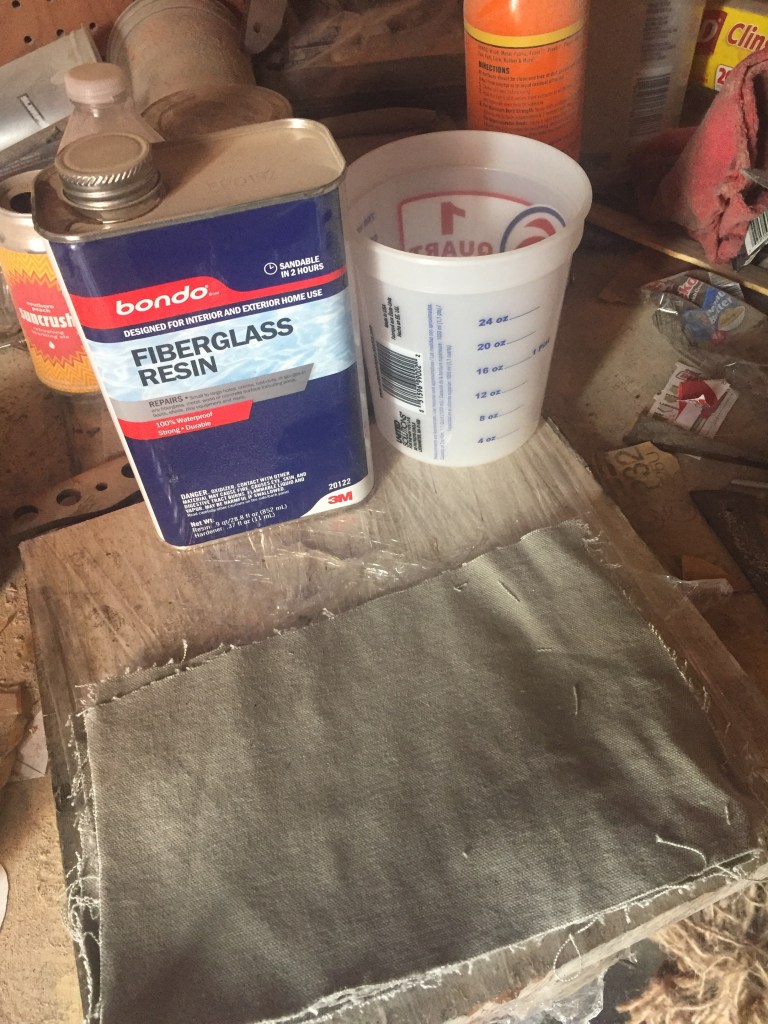
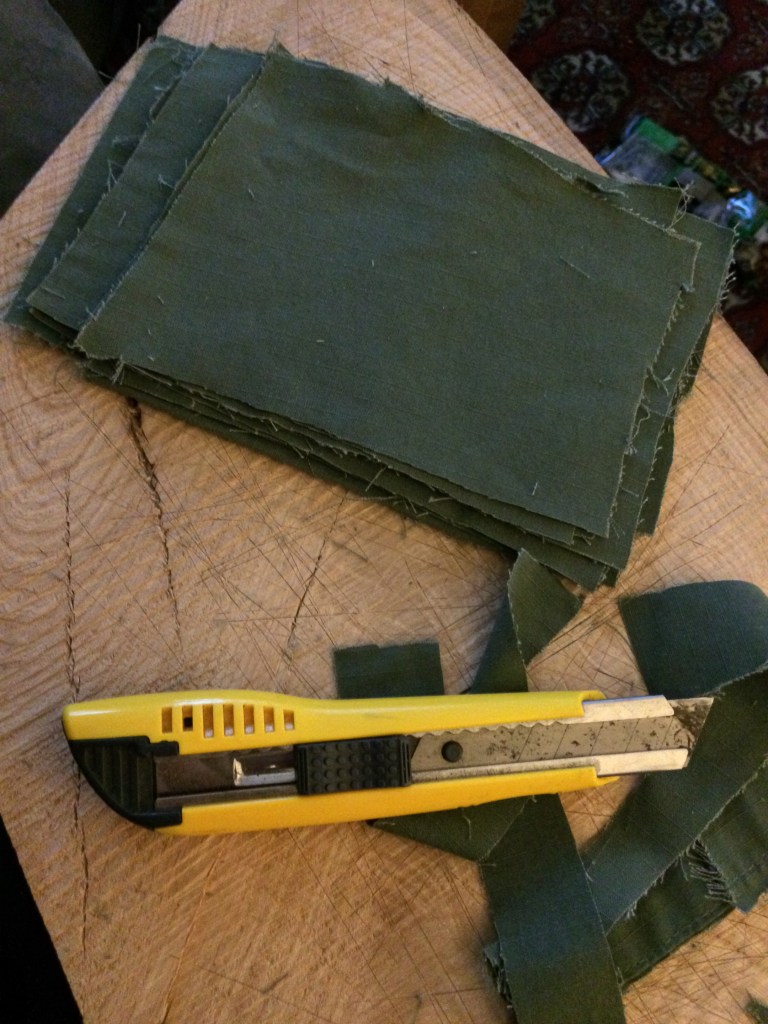
Some of the dress material, a shimmery chiffon mesh

There was also some black stretchy dress material

Layered together to create a pattern

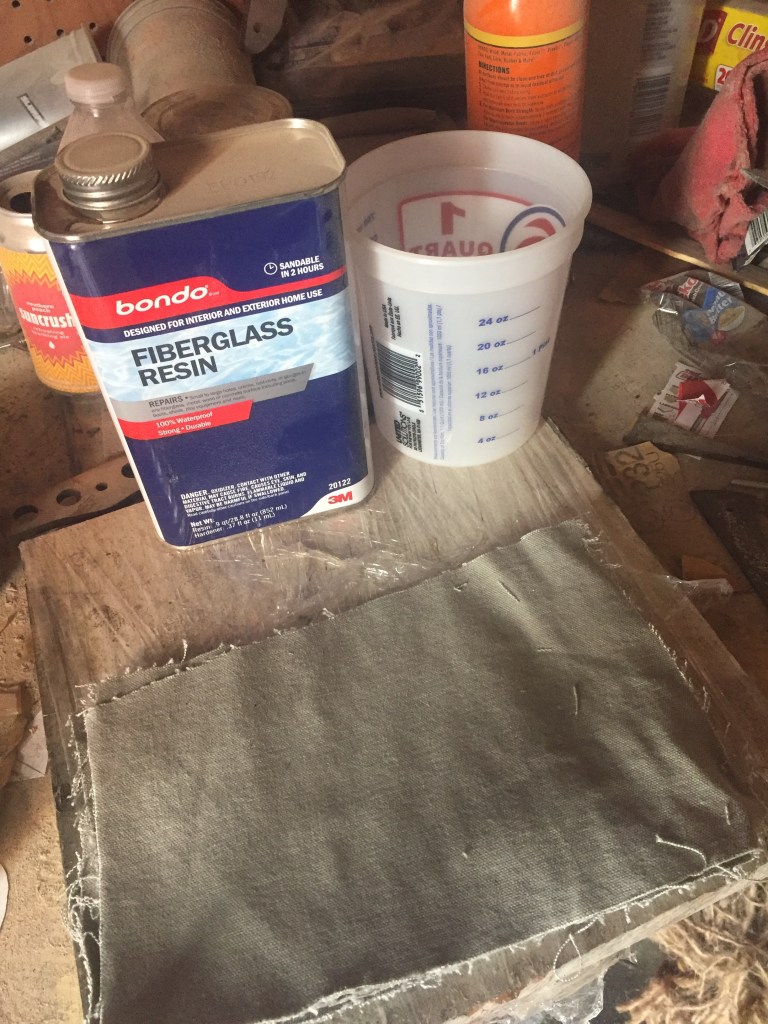
This will all get layered together with fiberglass resin

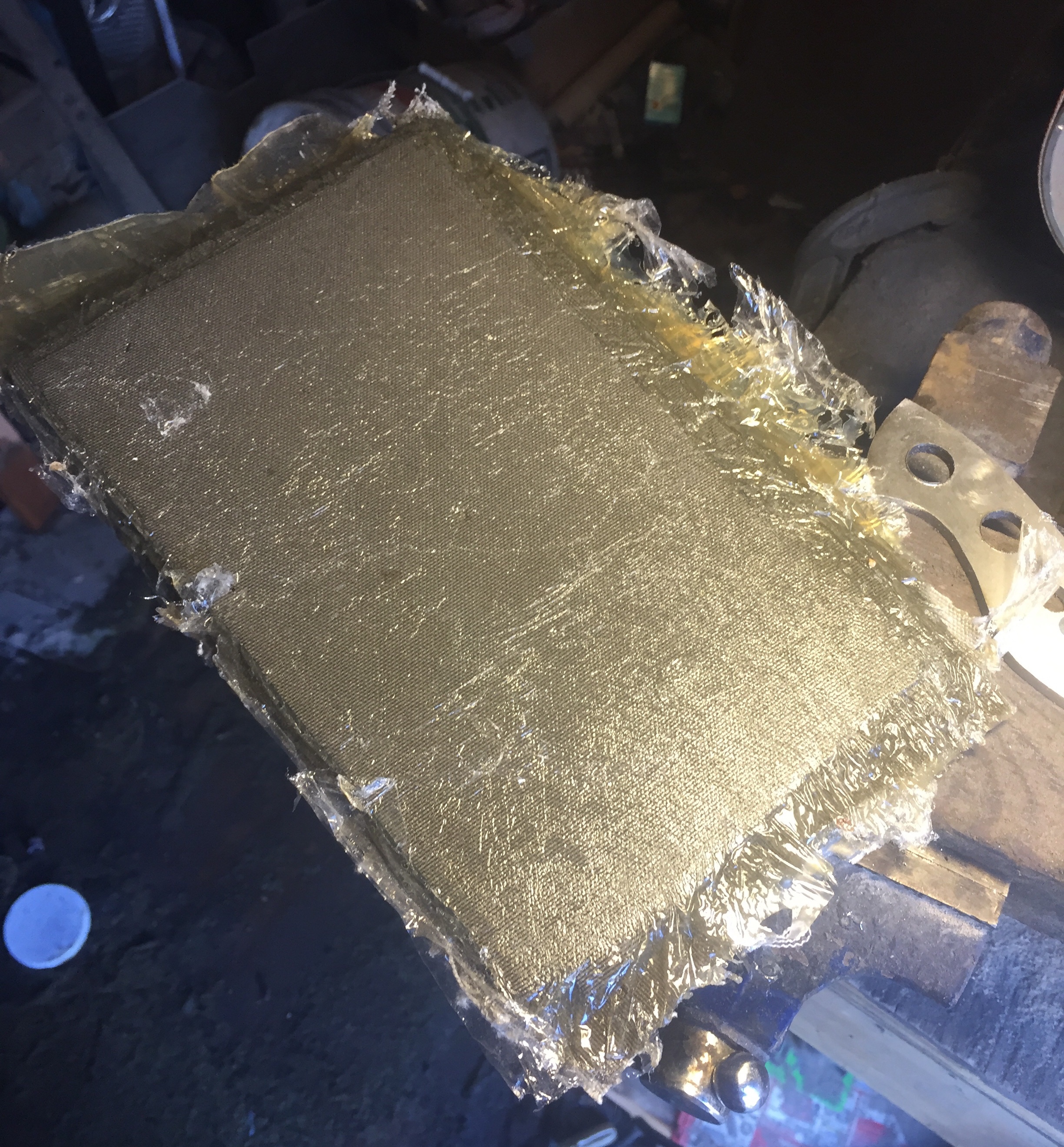
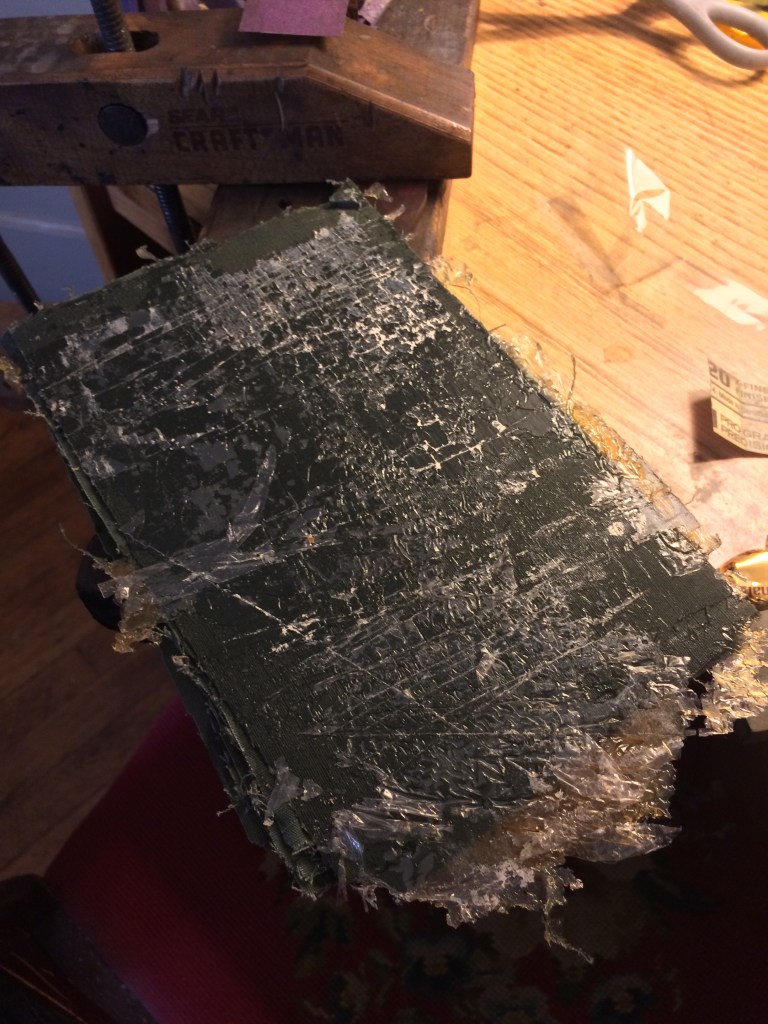
All smashed together

Cured

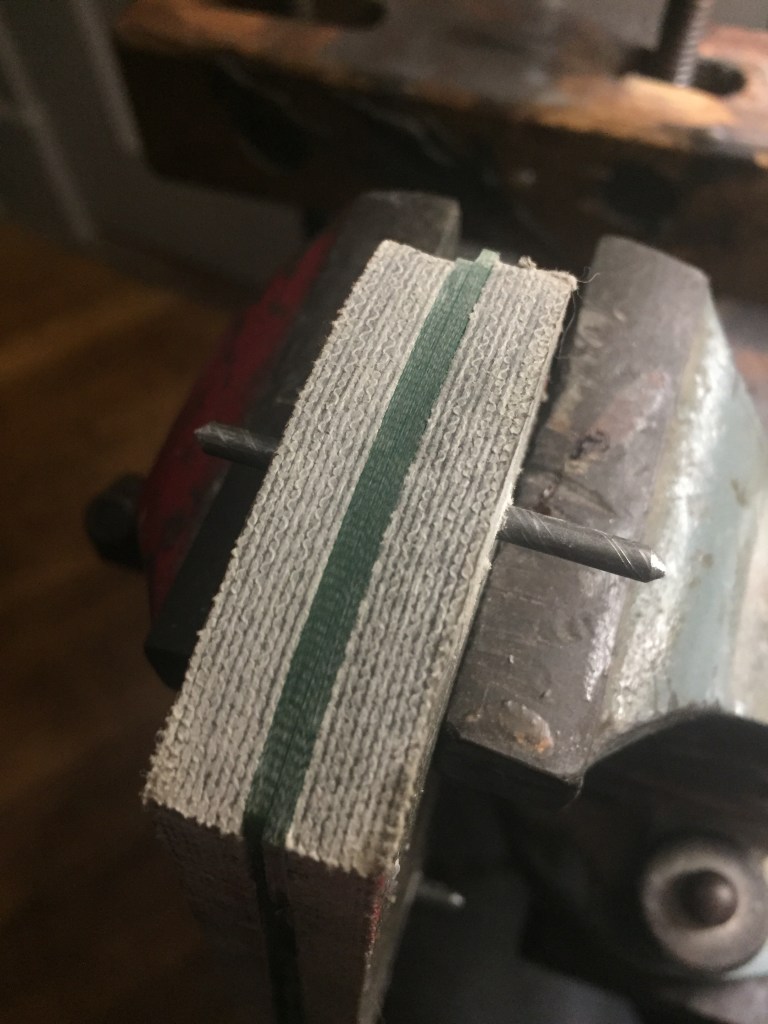
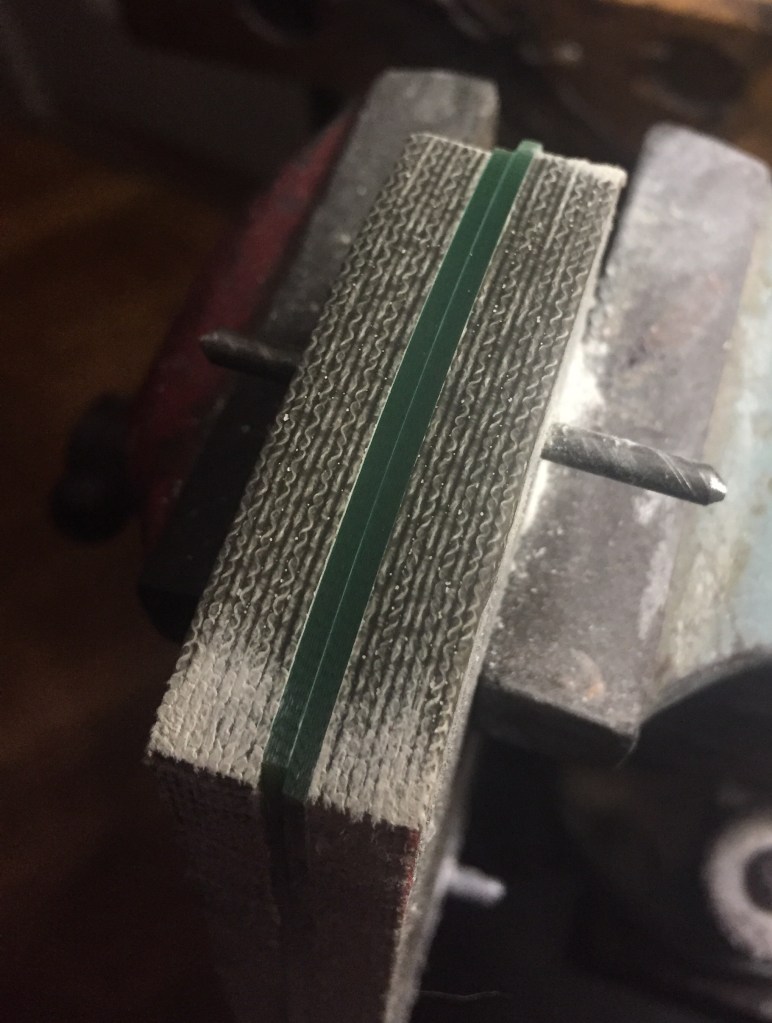
Everything properly smashed together

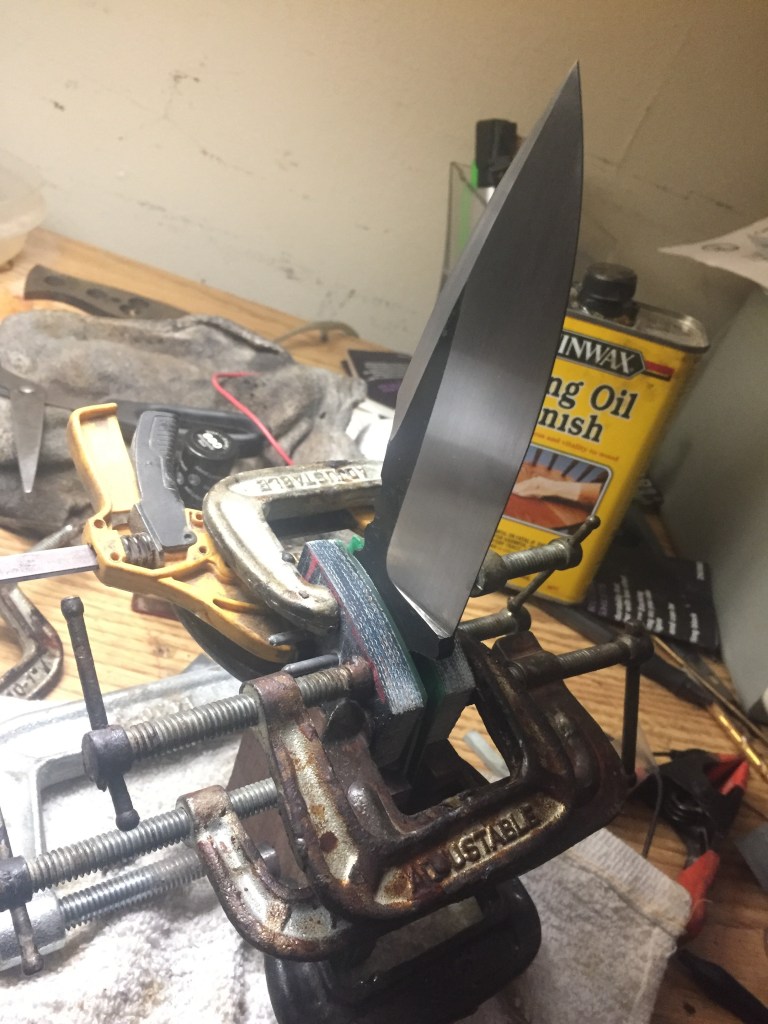
Back to the bladework, handsanding

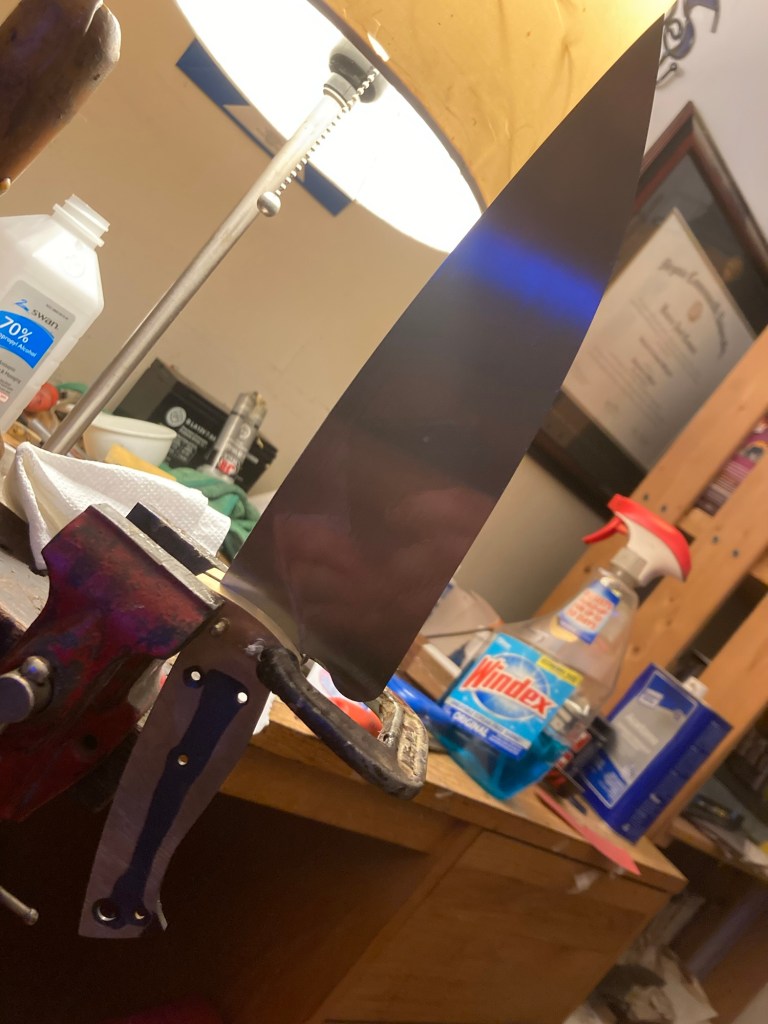
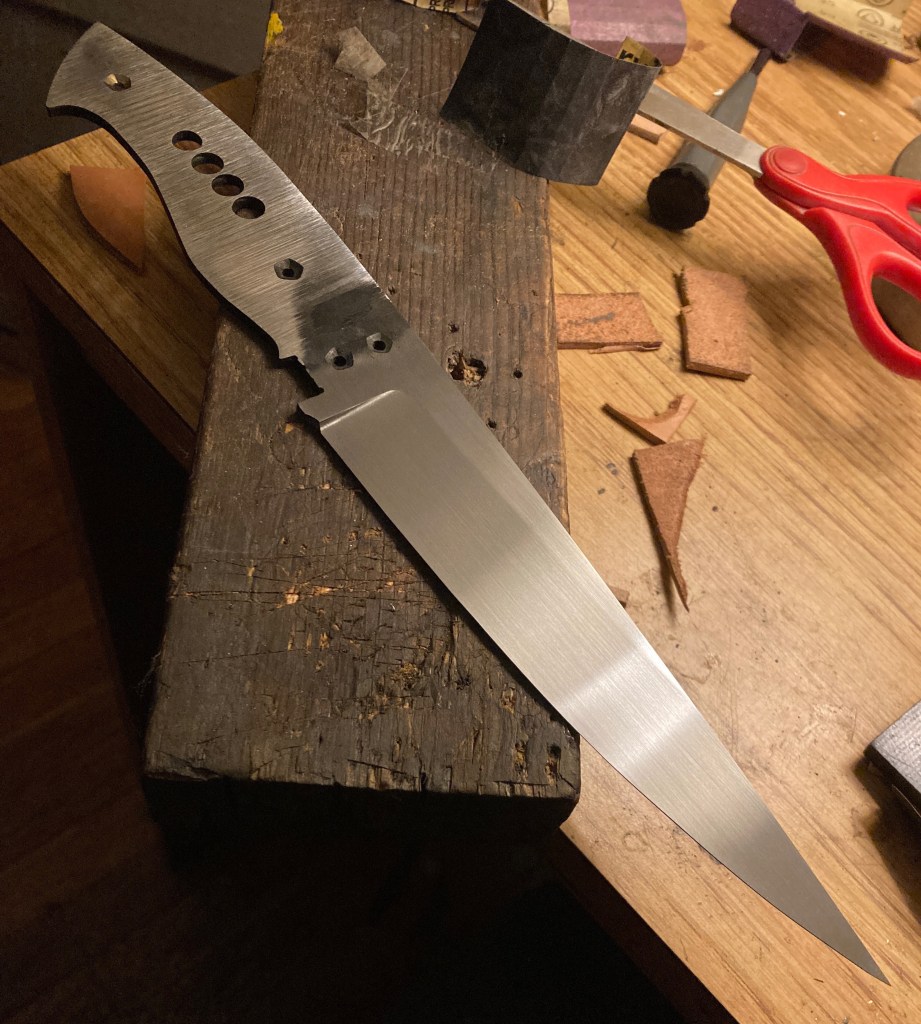
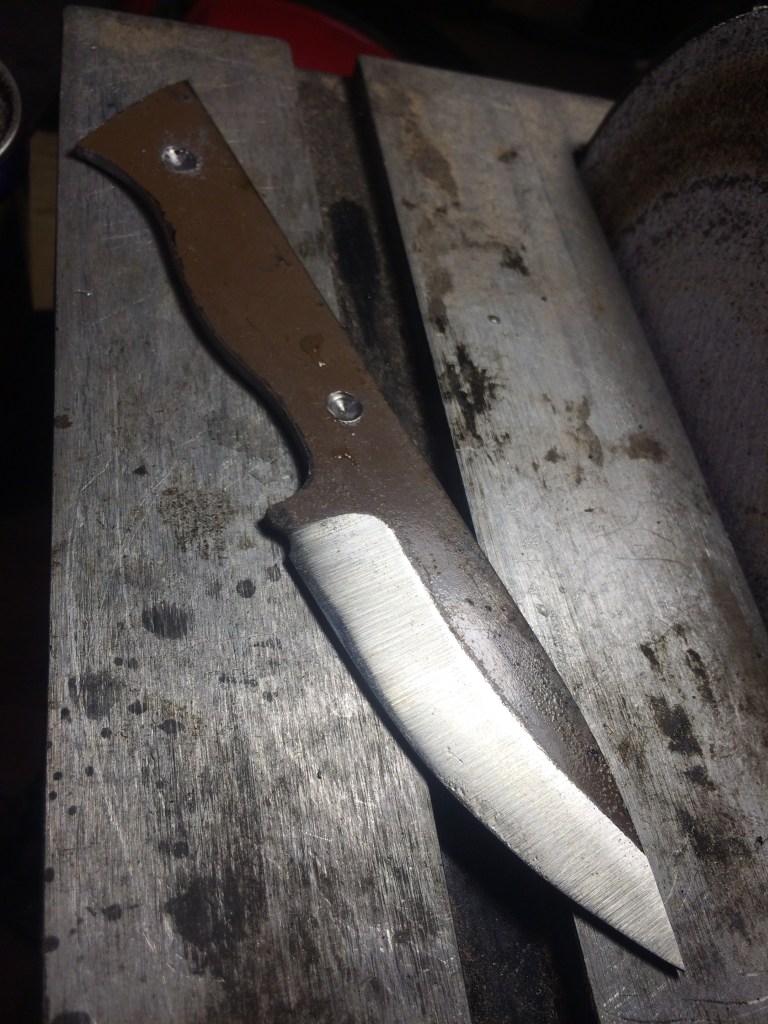
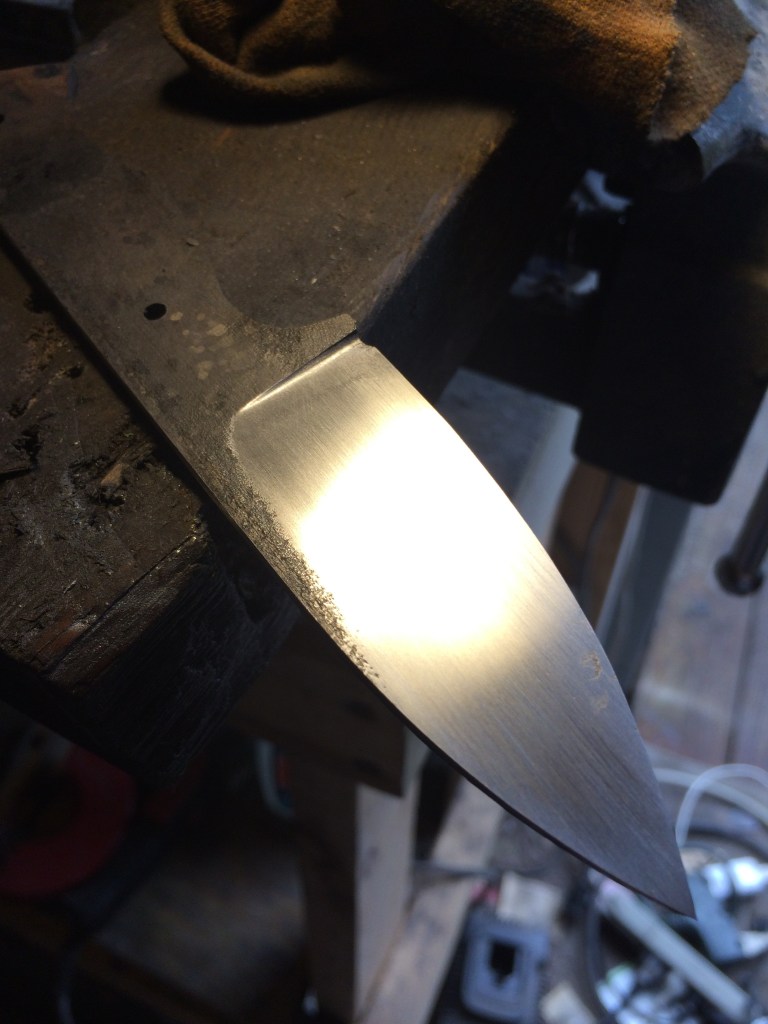
Satin finish

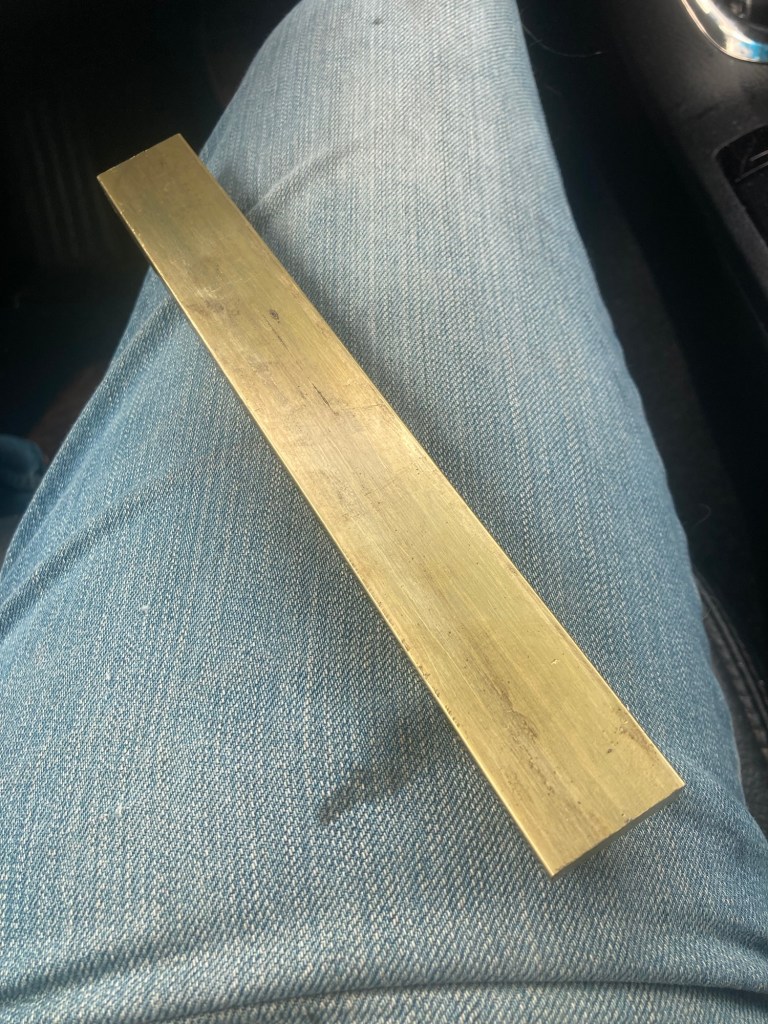
Bit of brass for the bloster

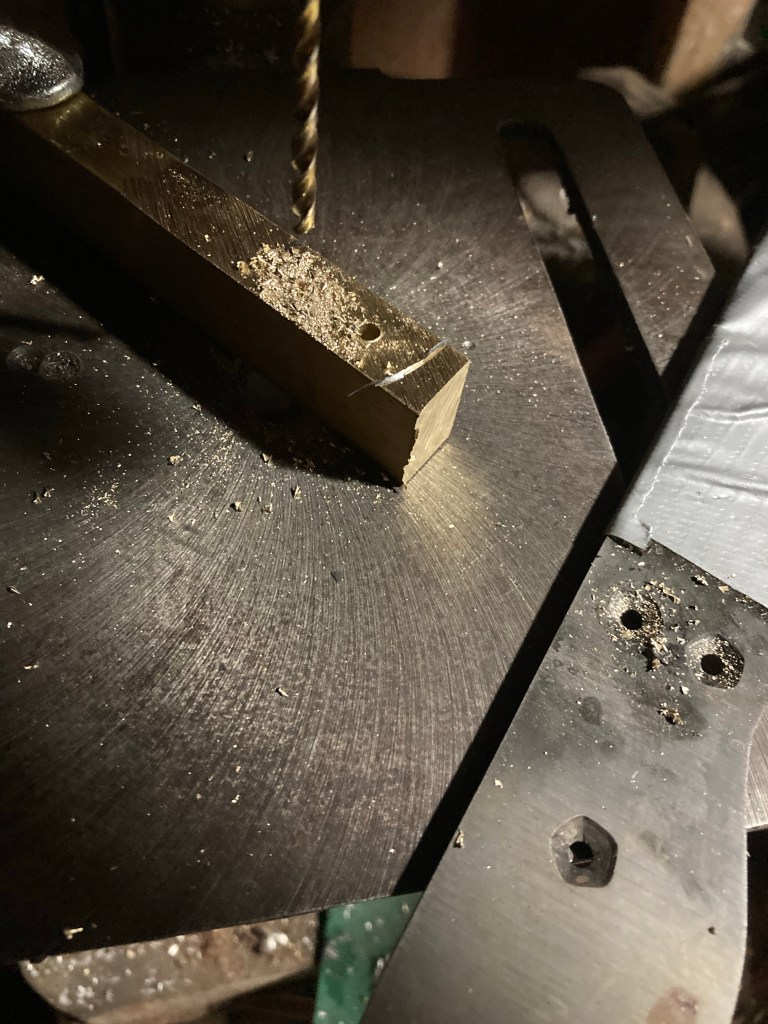
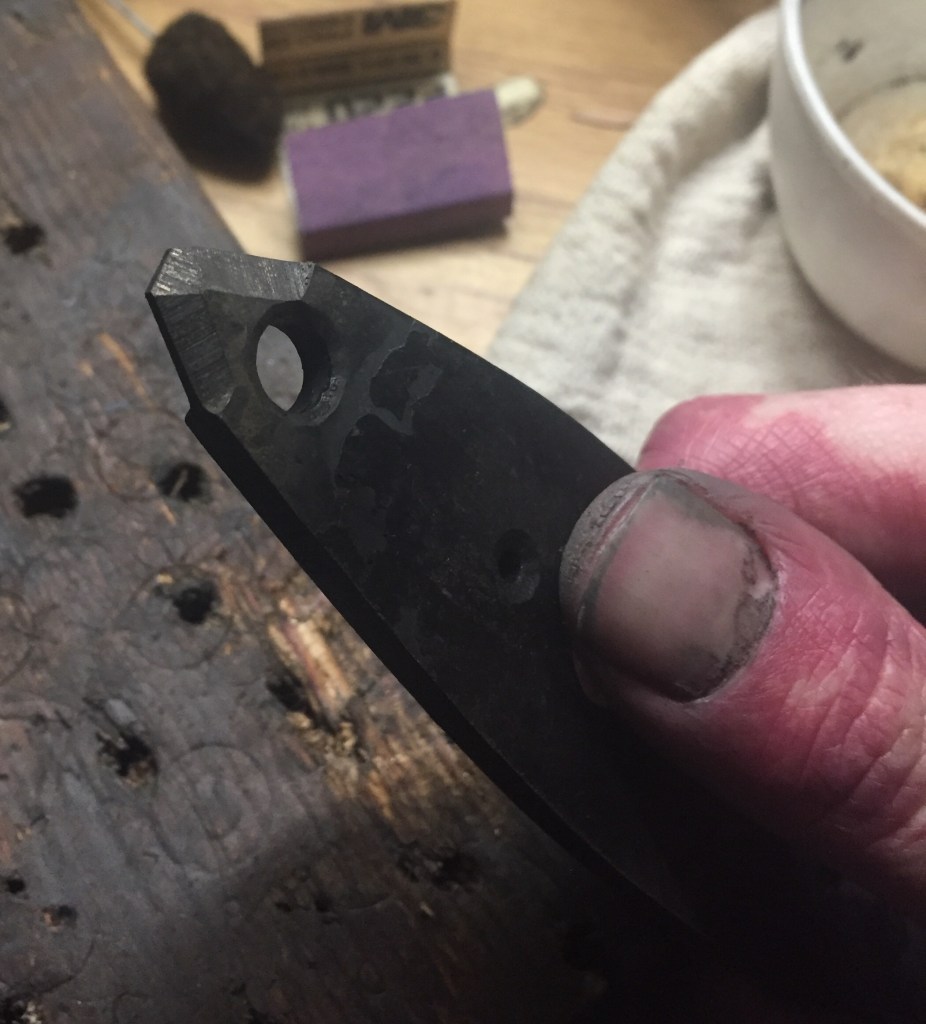
Drilling before shaping

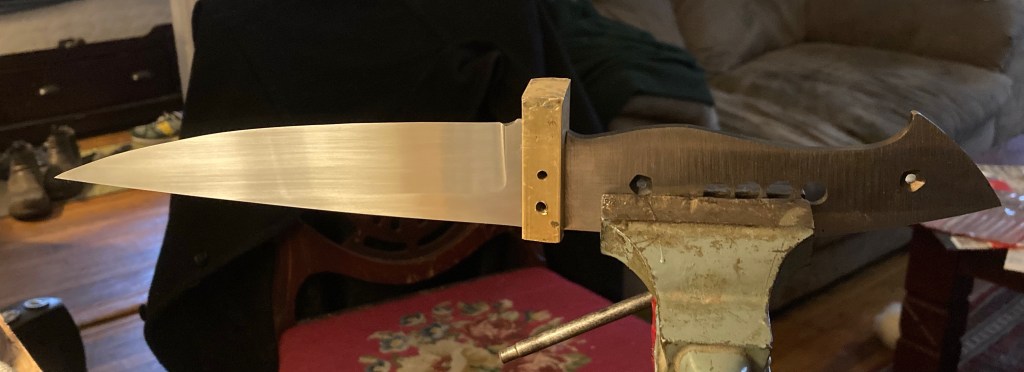
Shaped

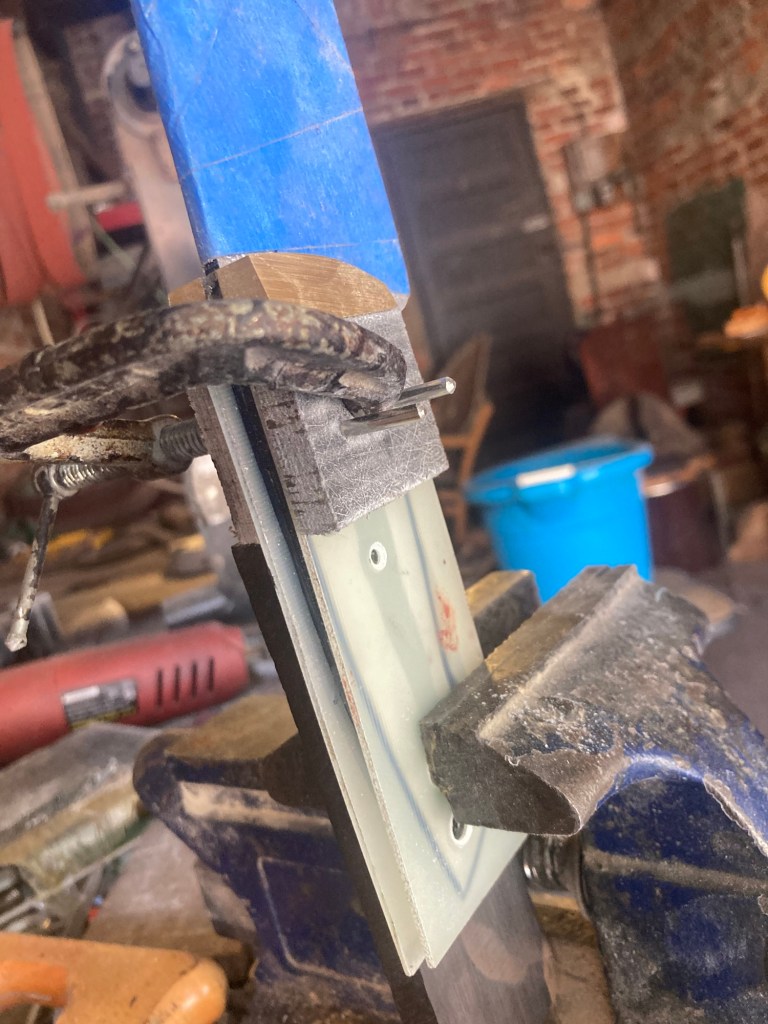
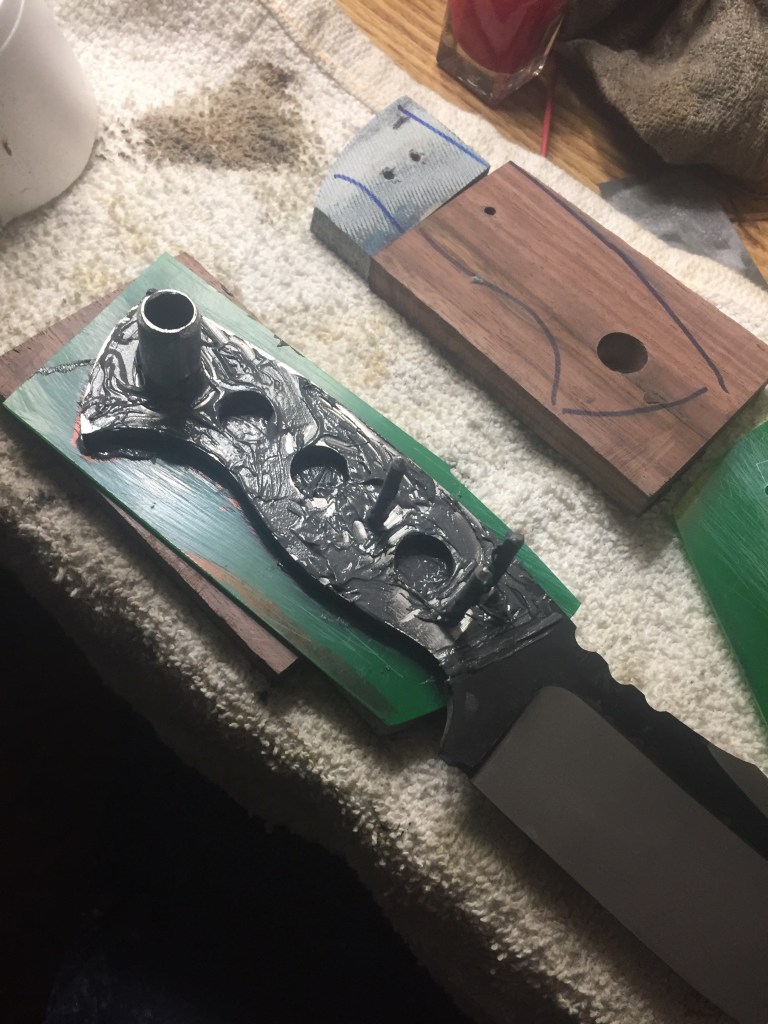
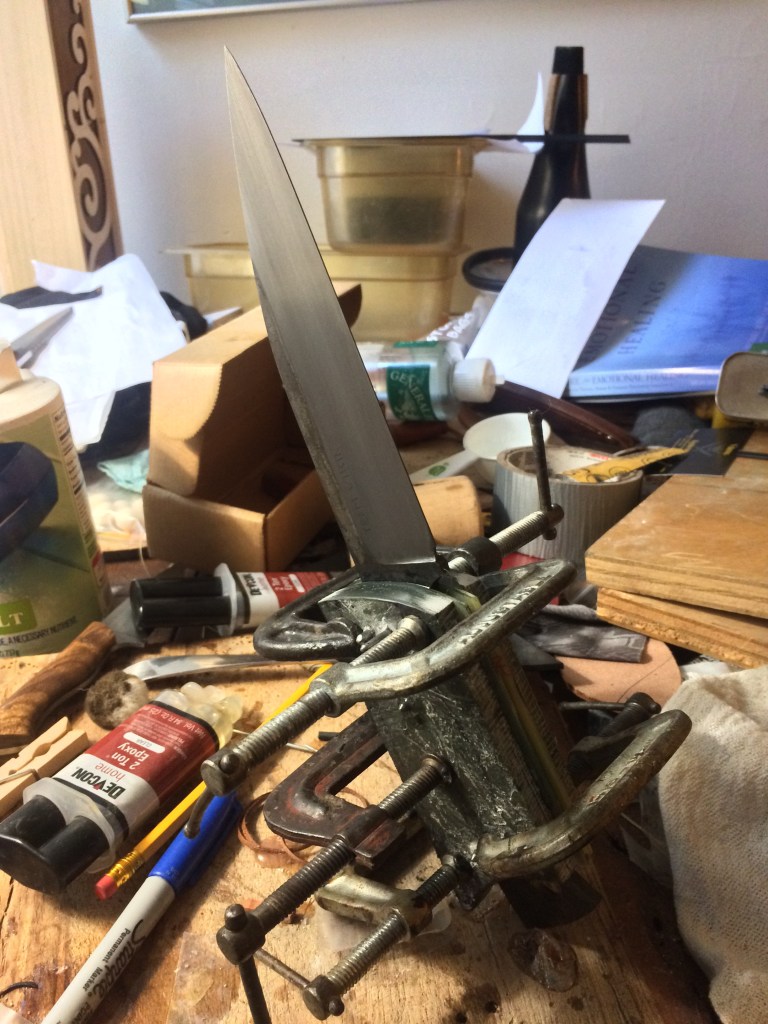
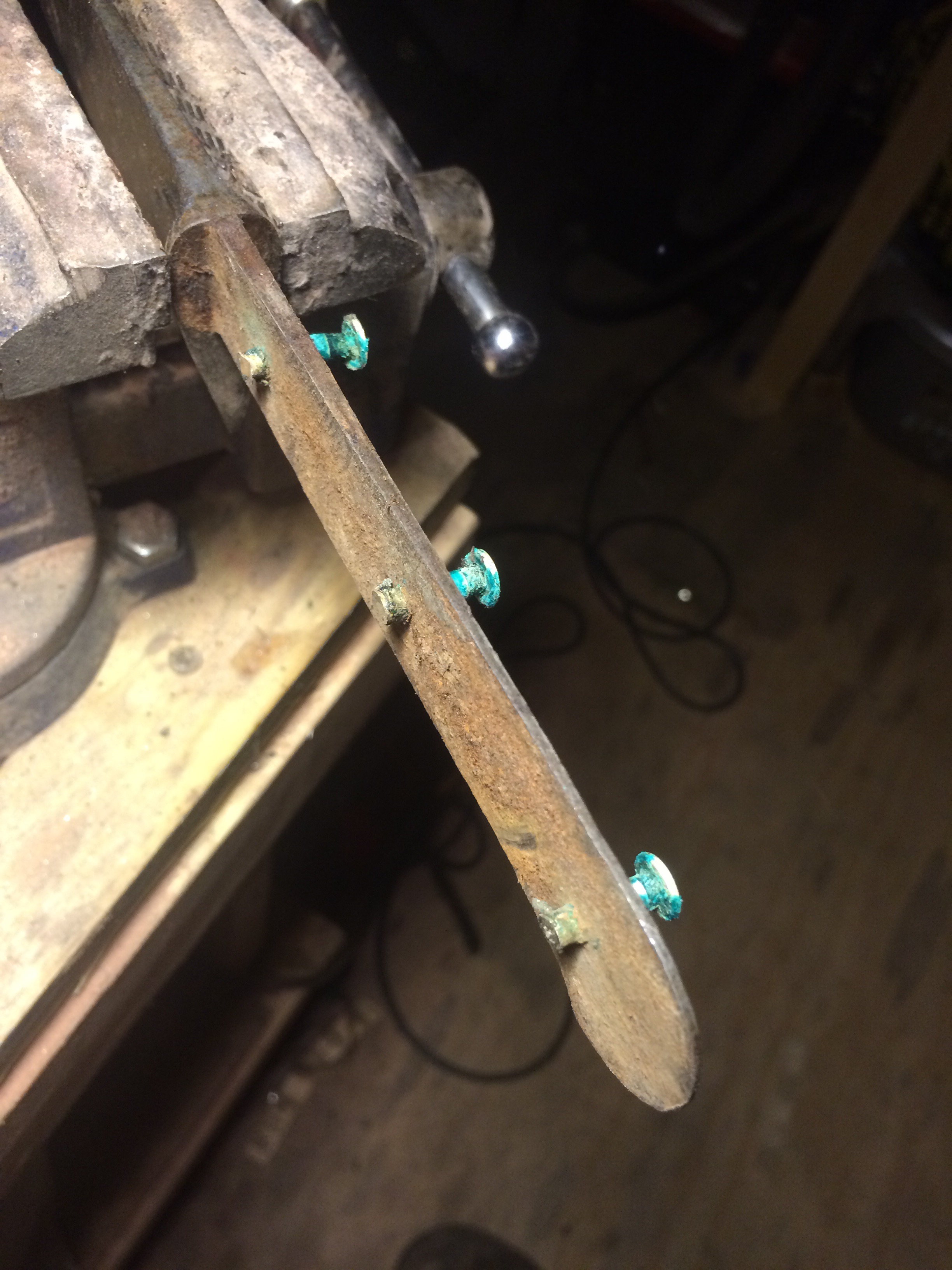
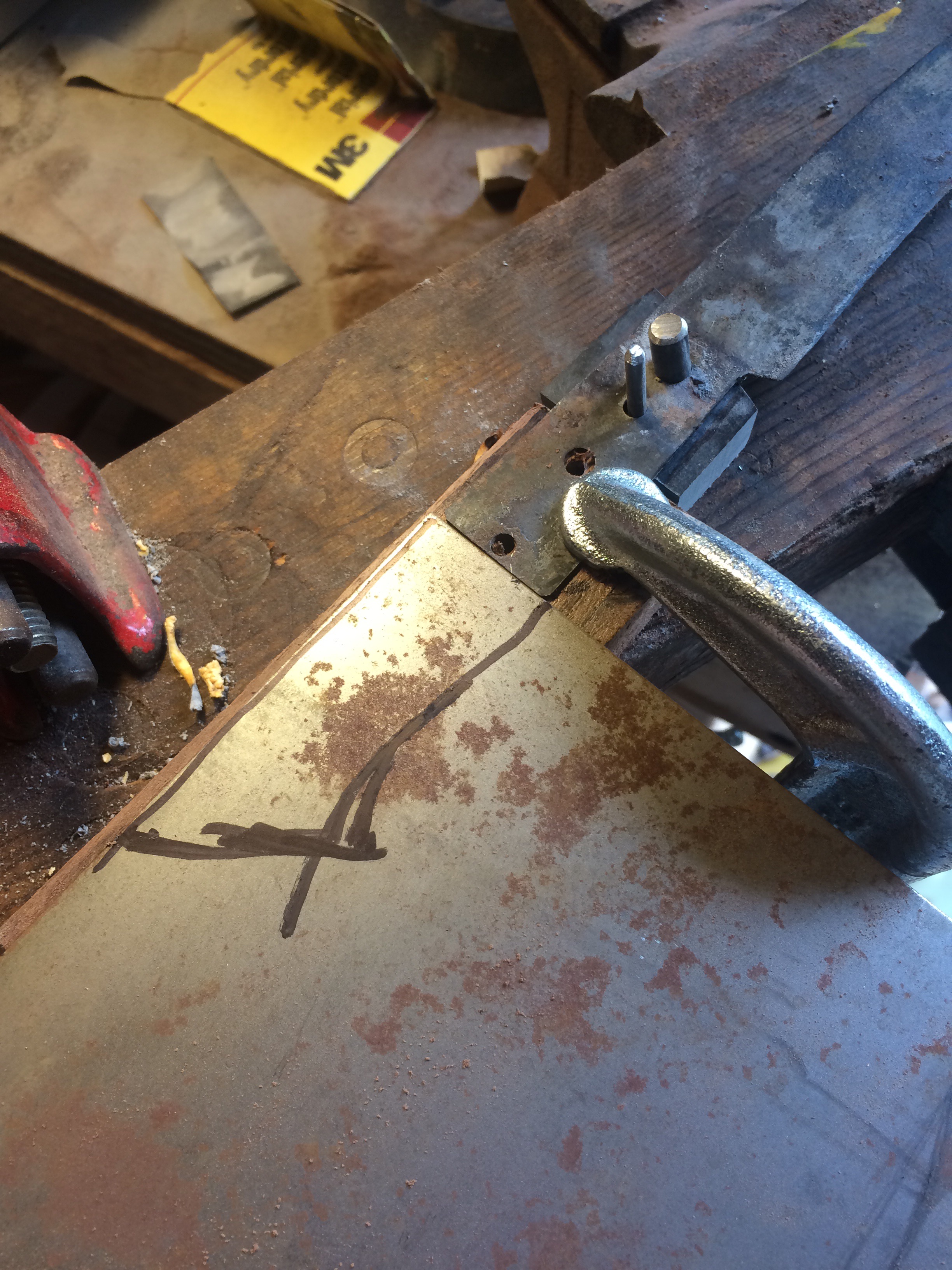
Fitted up and set with steel-reinforced JB Weld

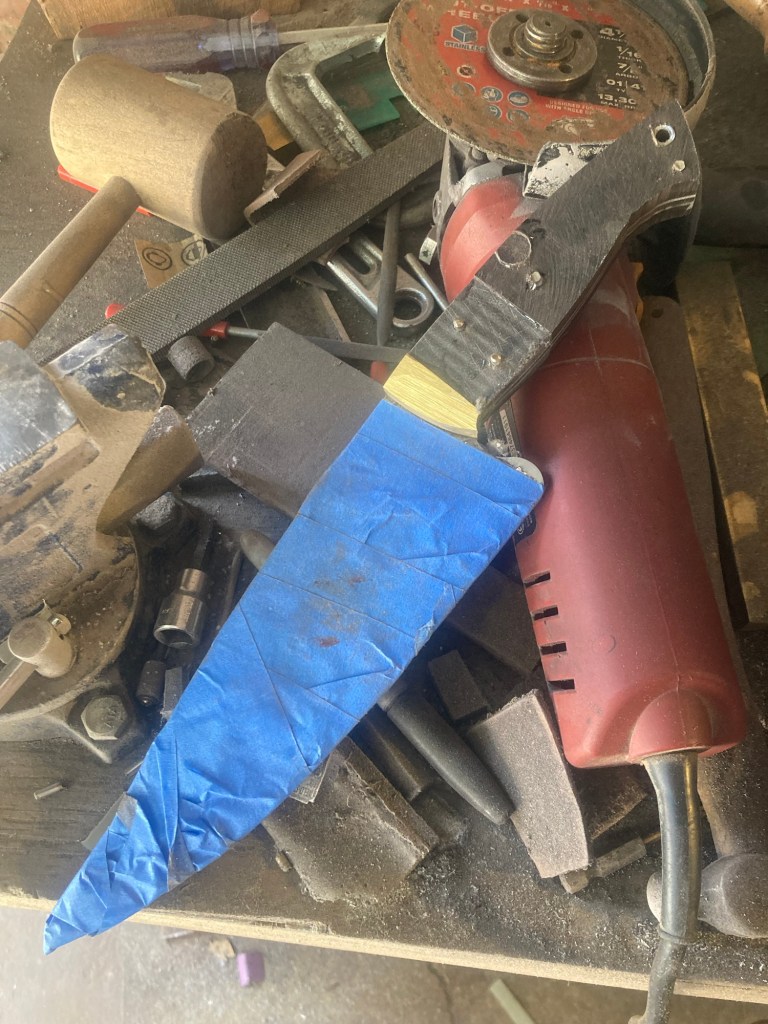
Rivets are peened

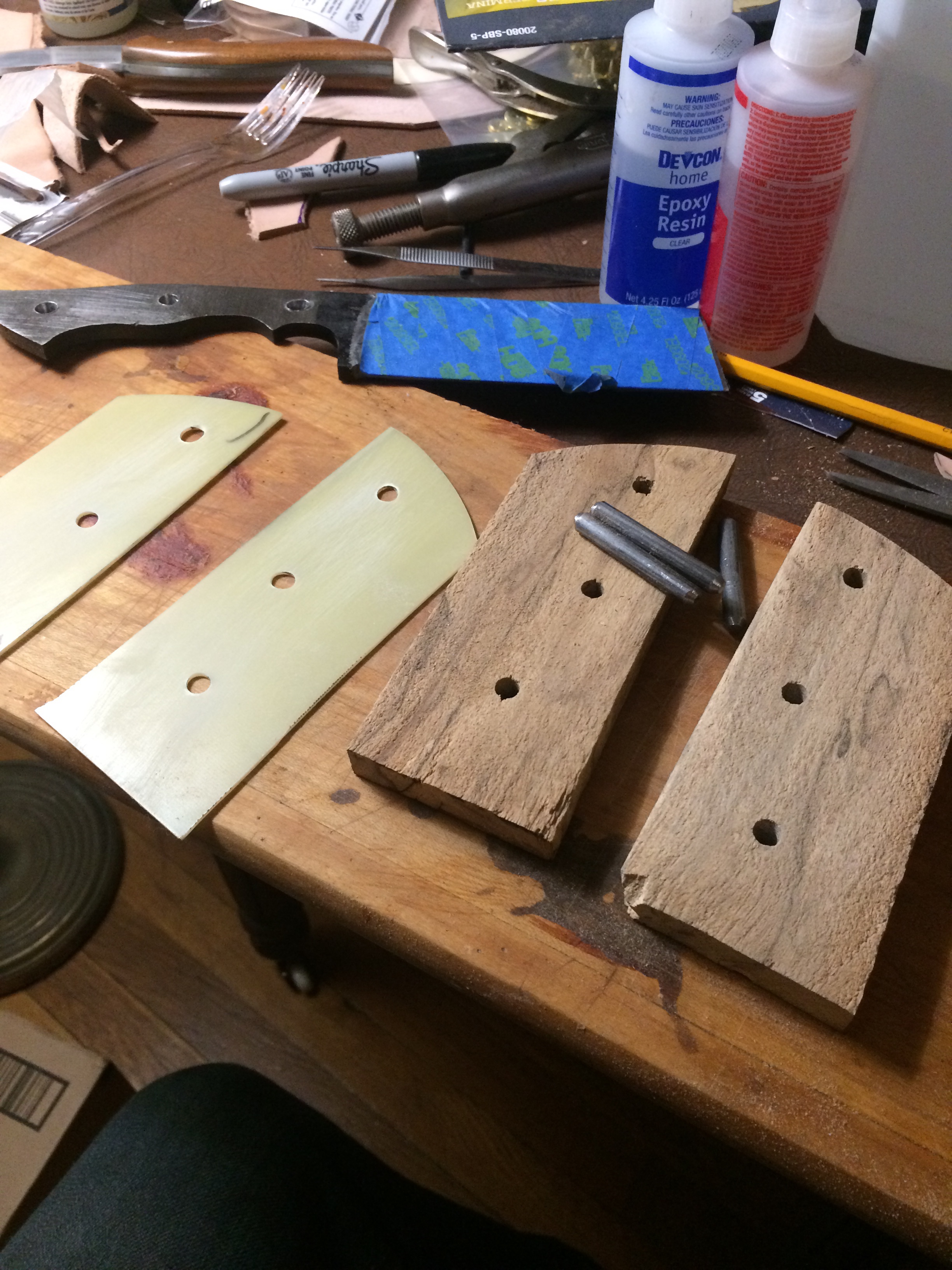
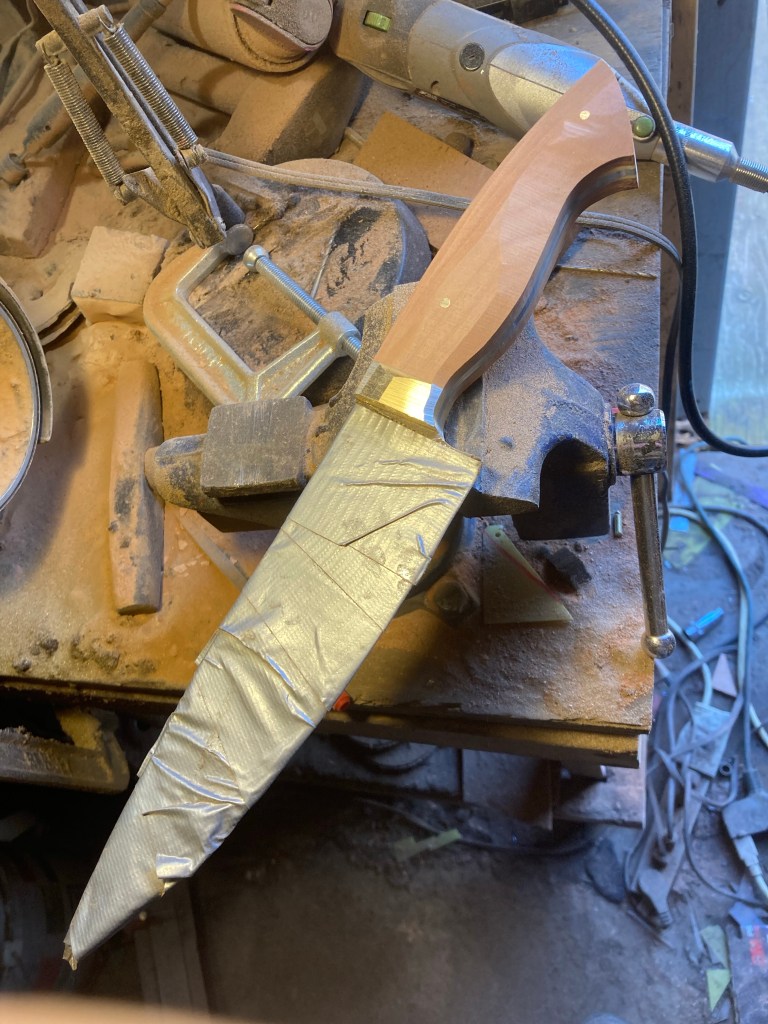
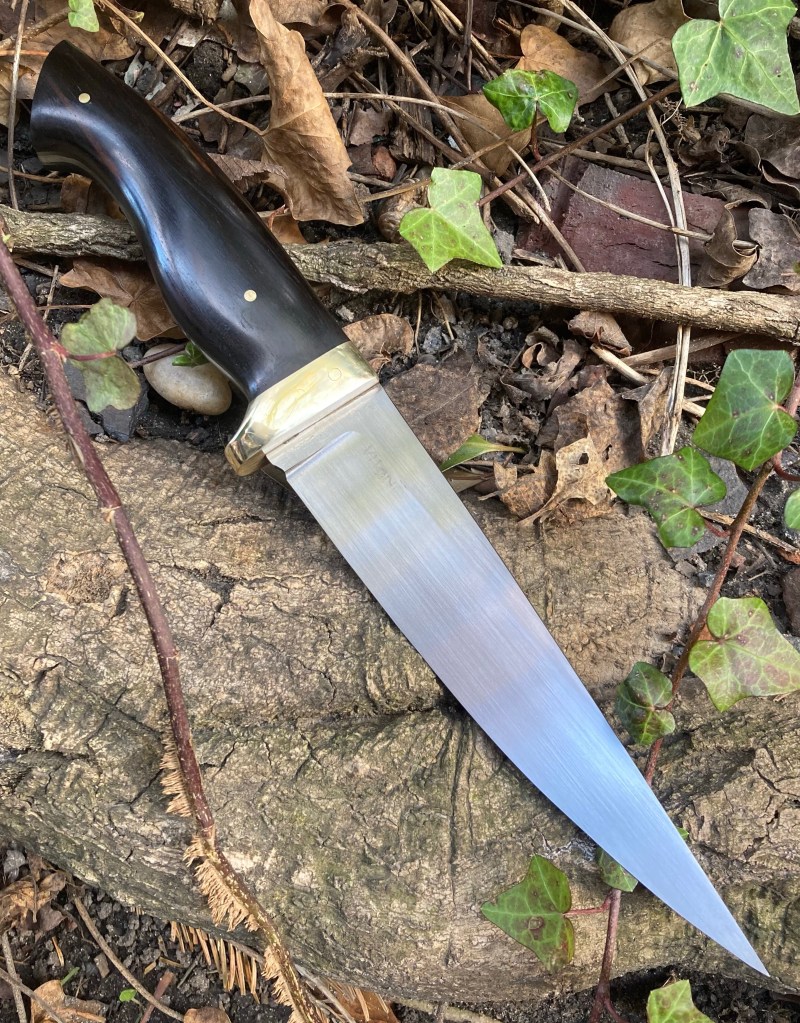
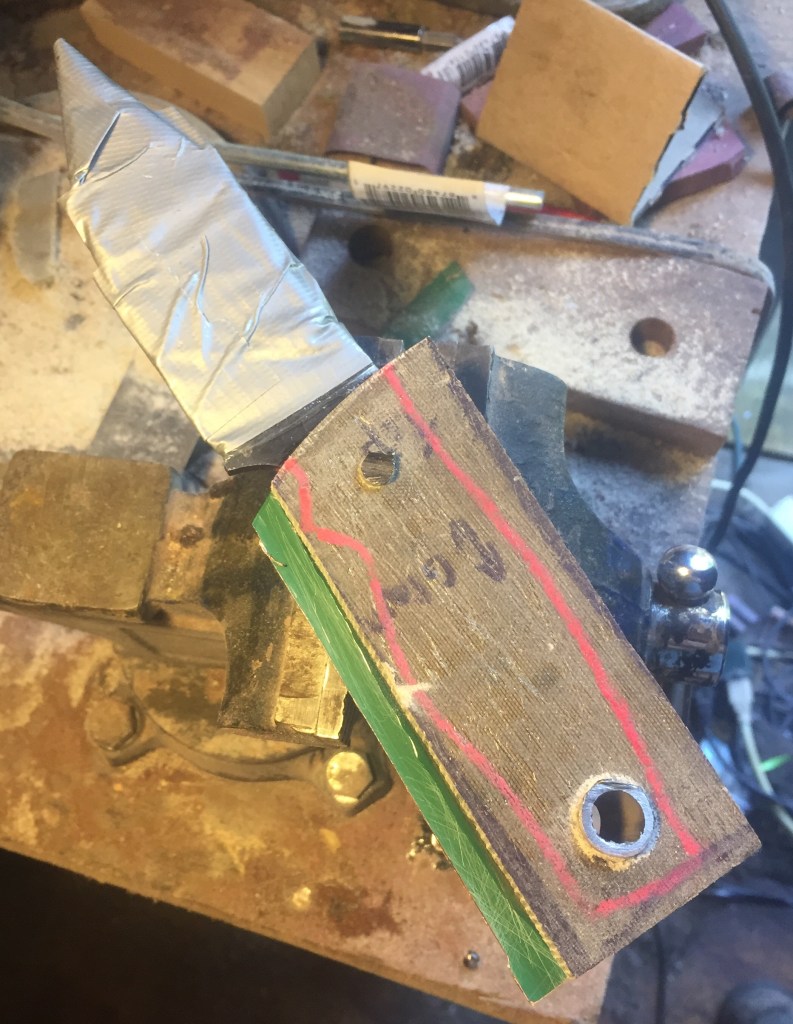
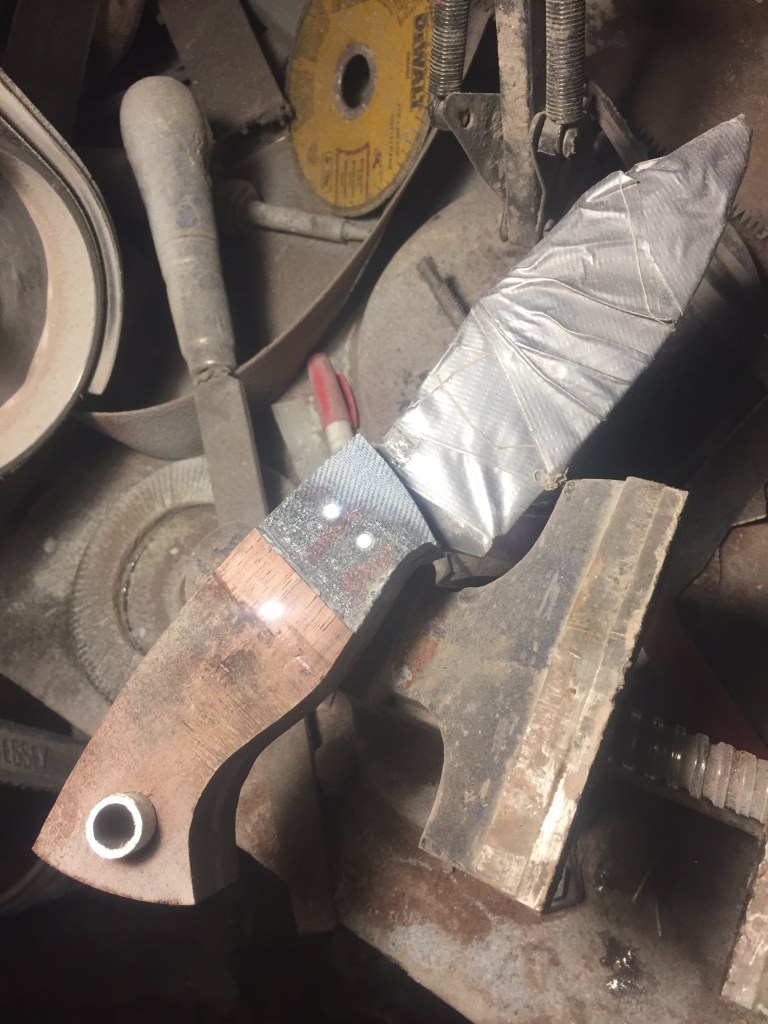
Fitting up the handle material. The wood is Ebony

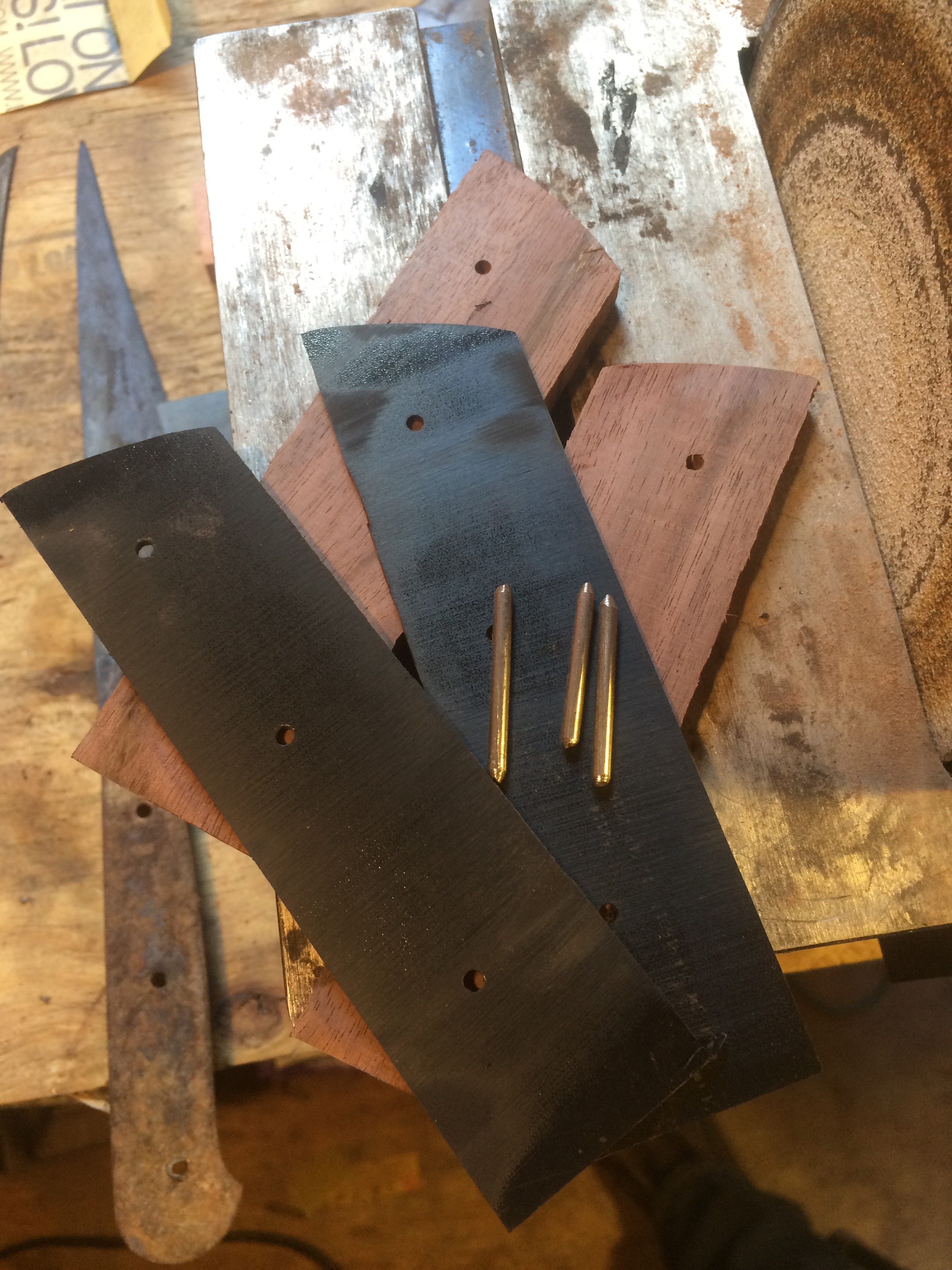
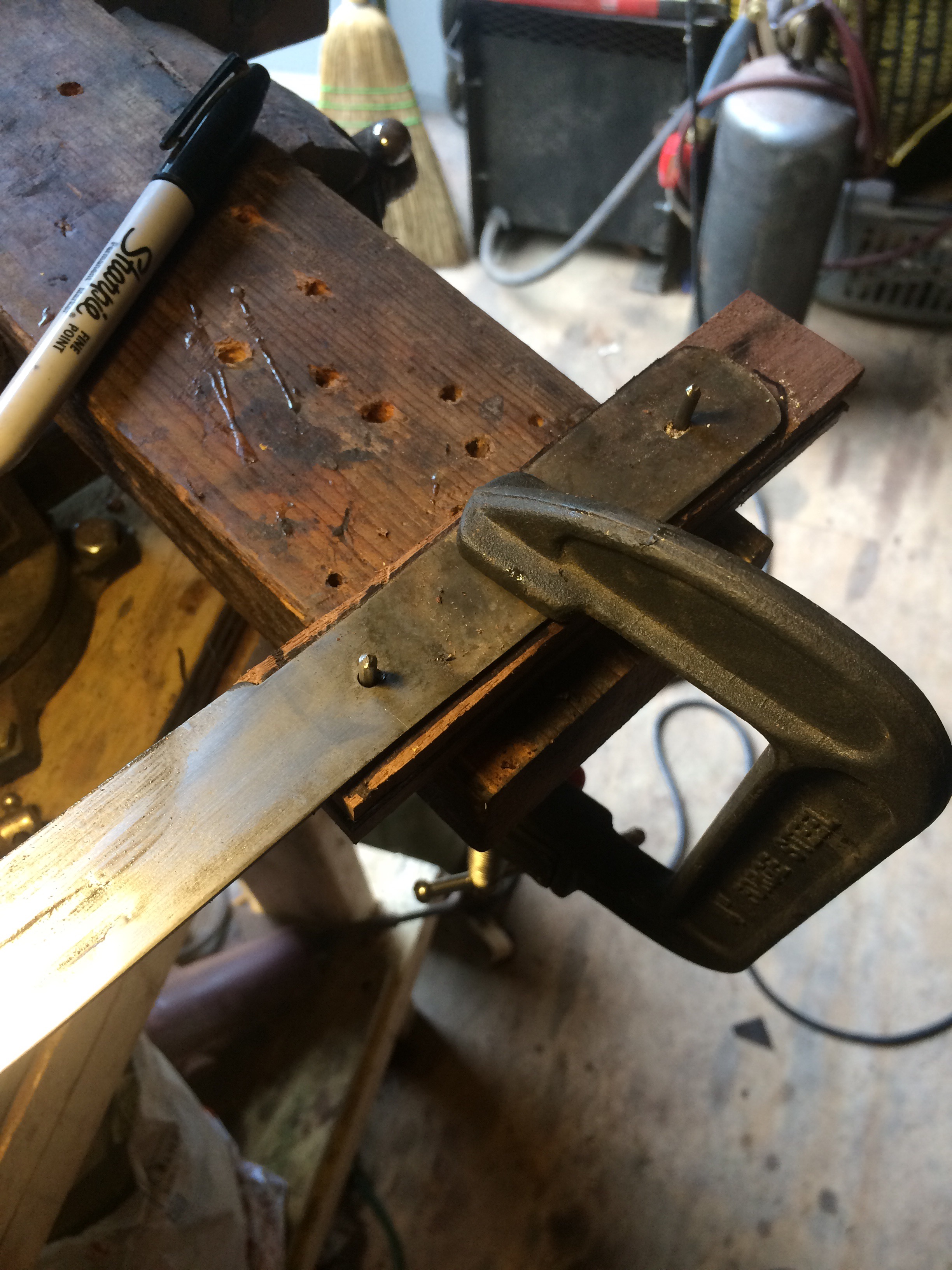
Ready for glue-up

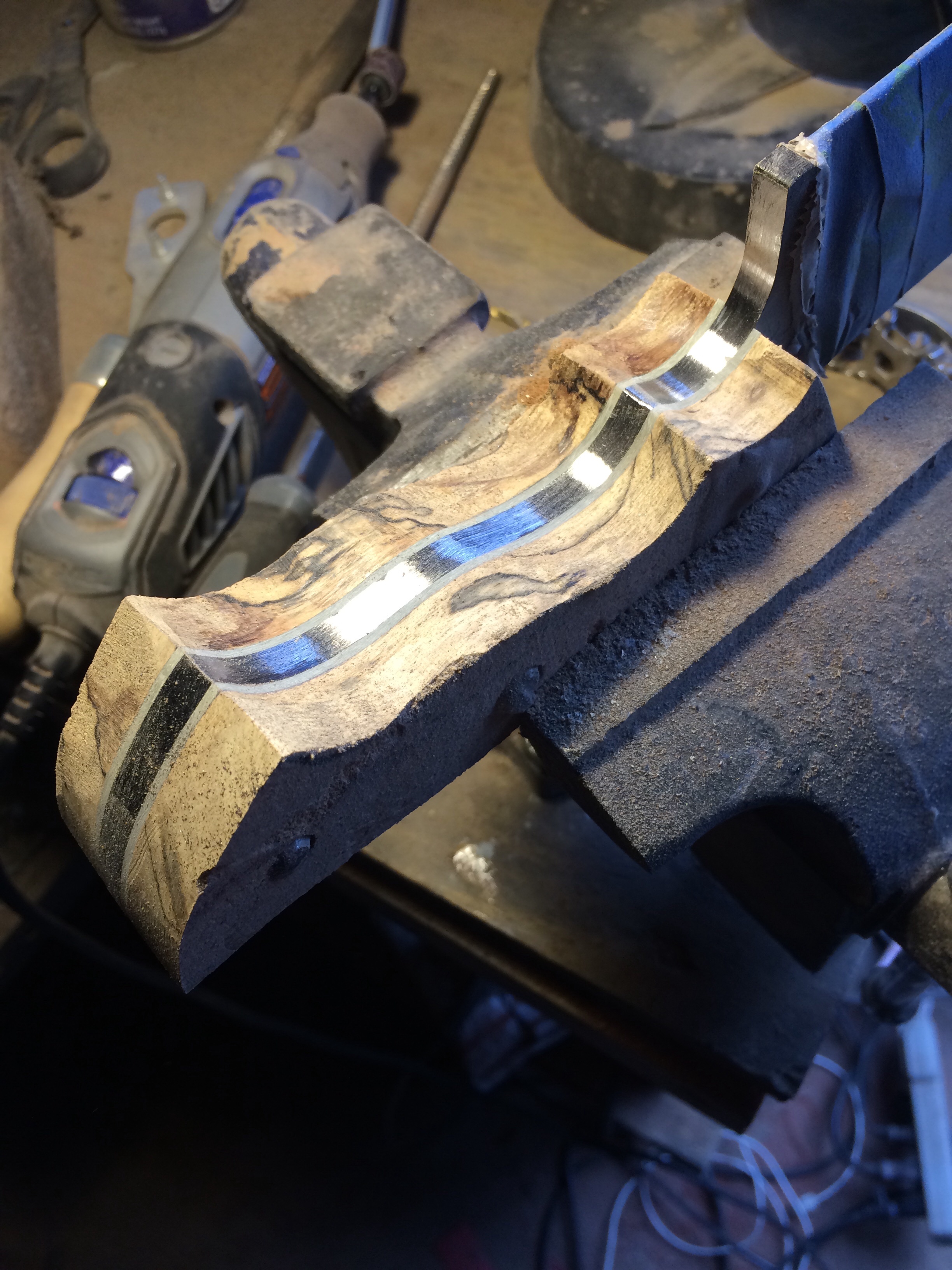
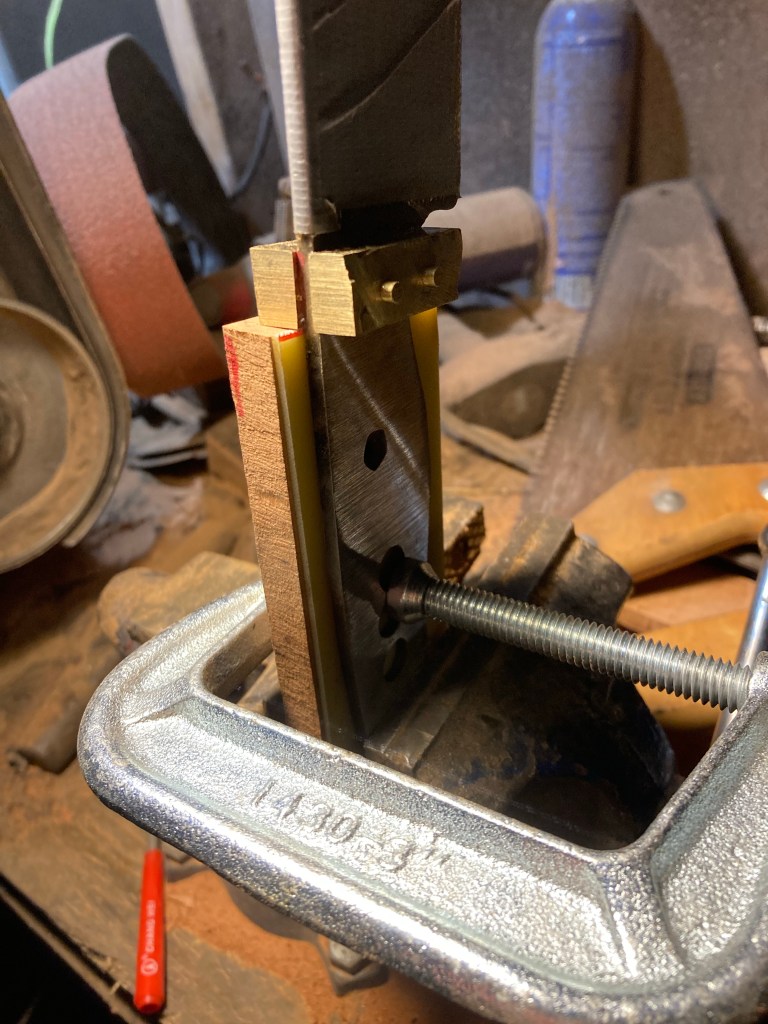
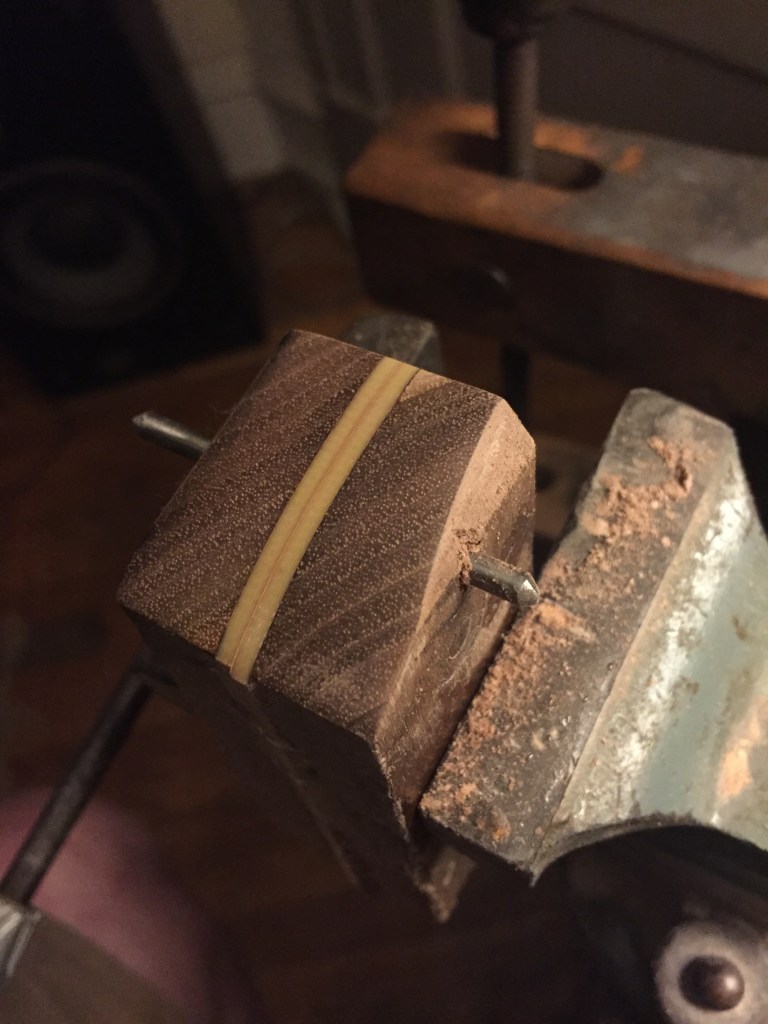
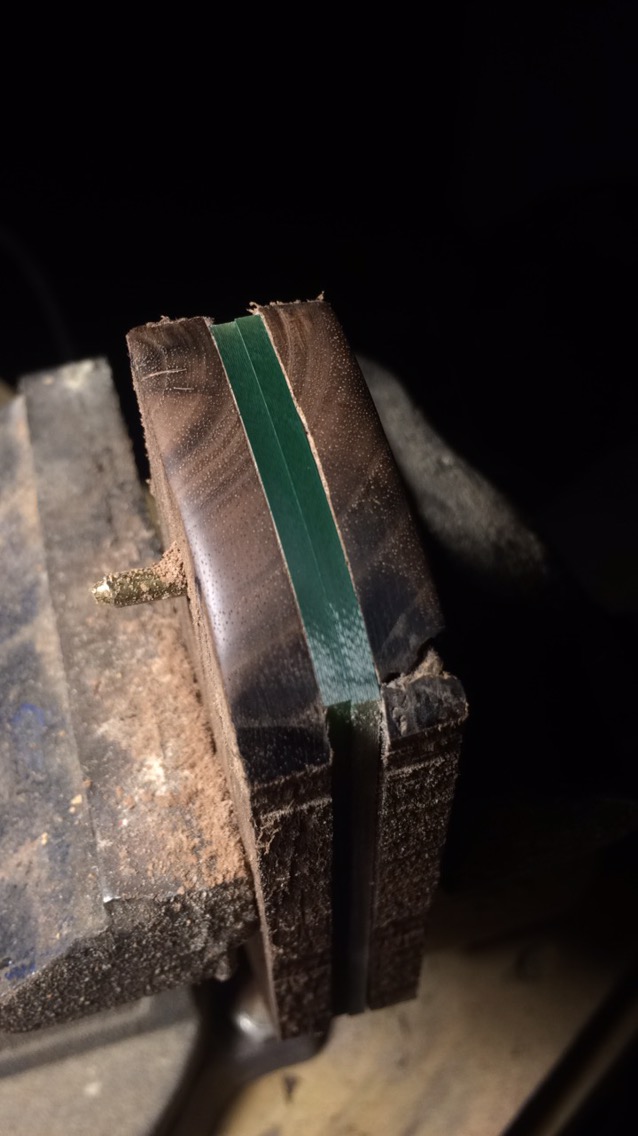
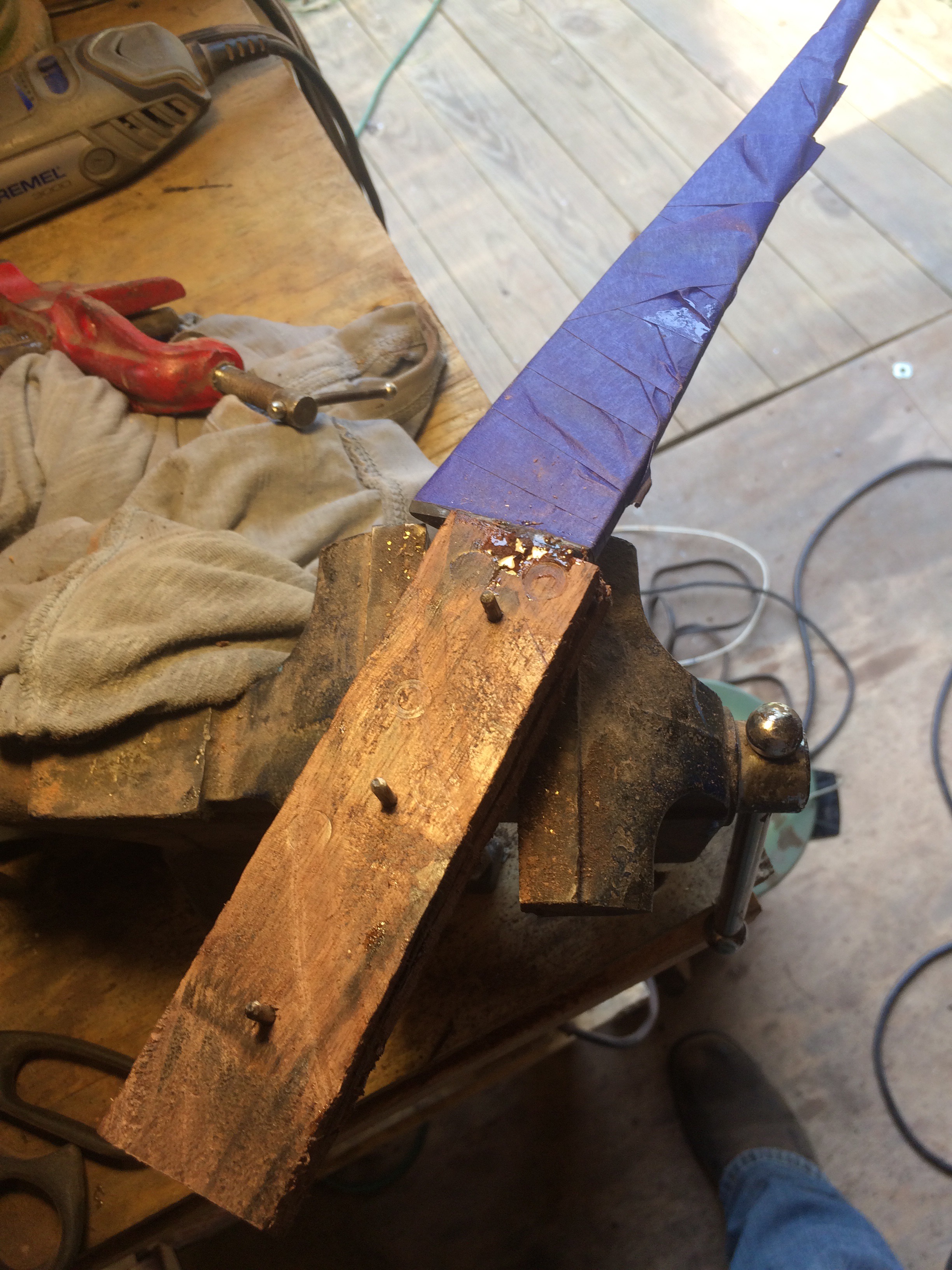
All glued up and clamped

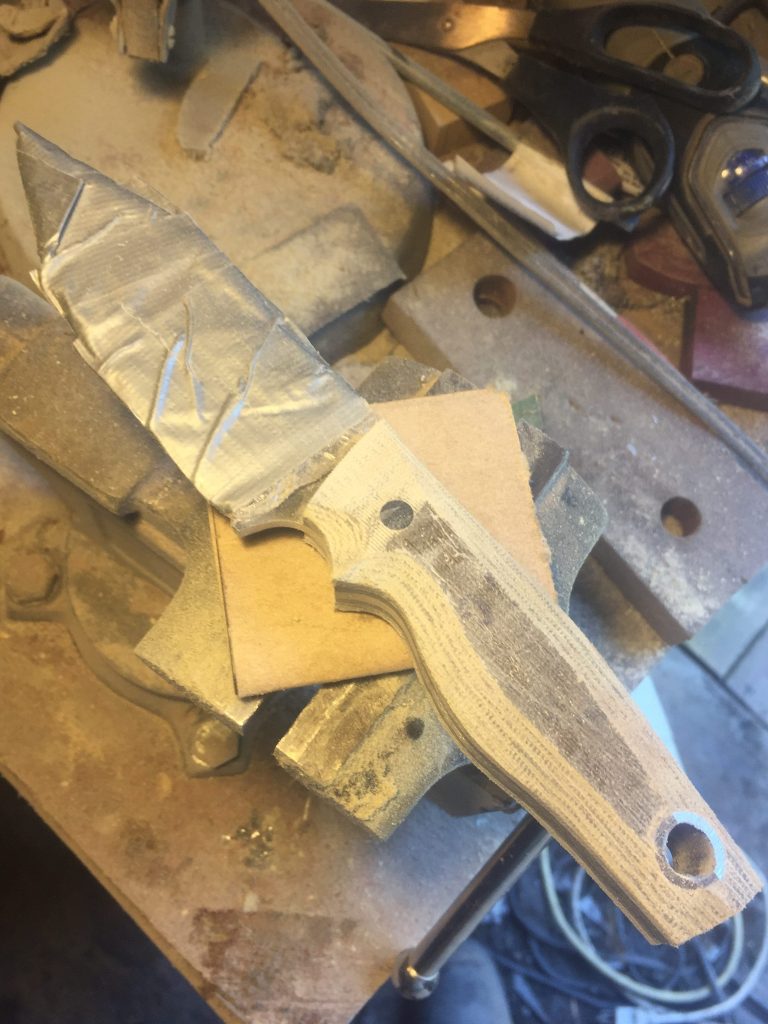
Profiled

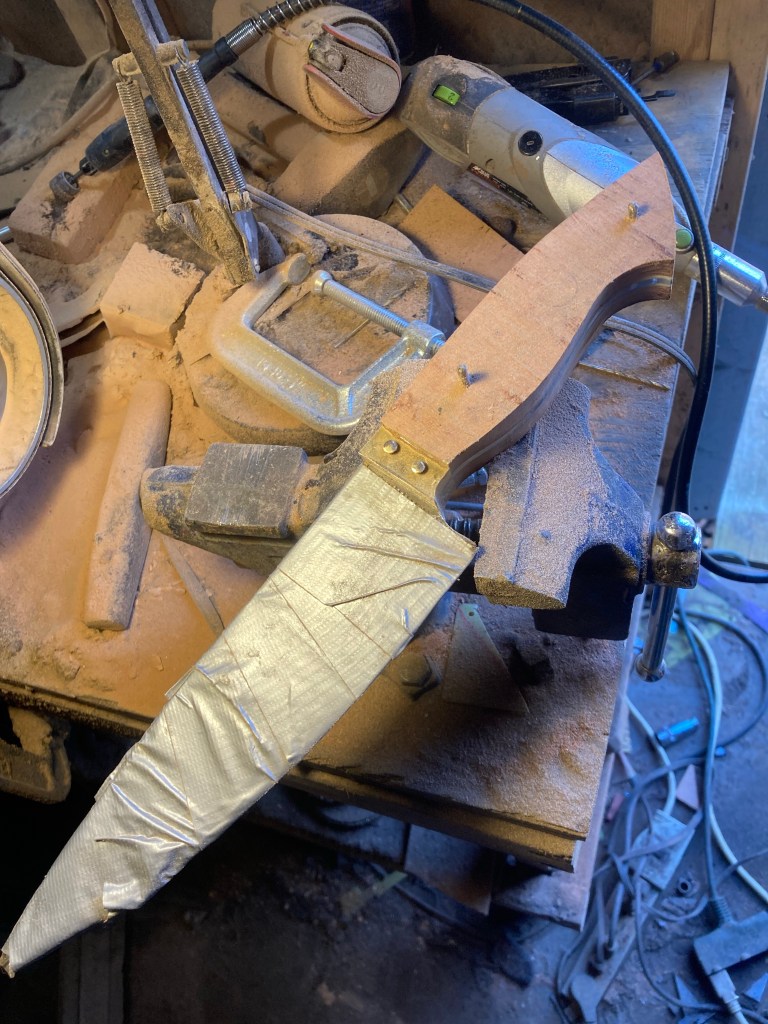
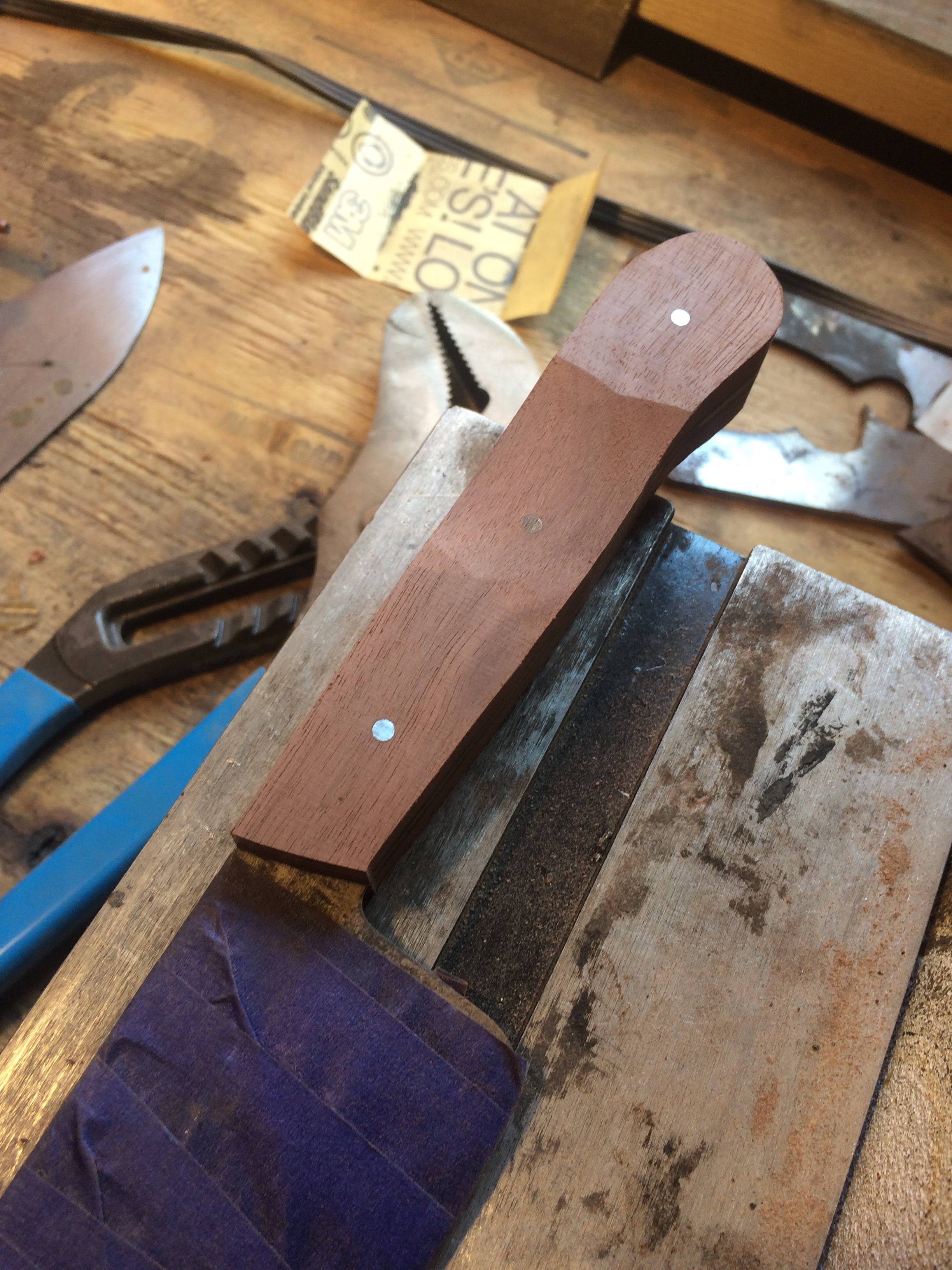
Shaped

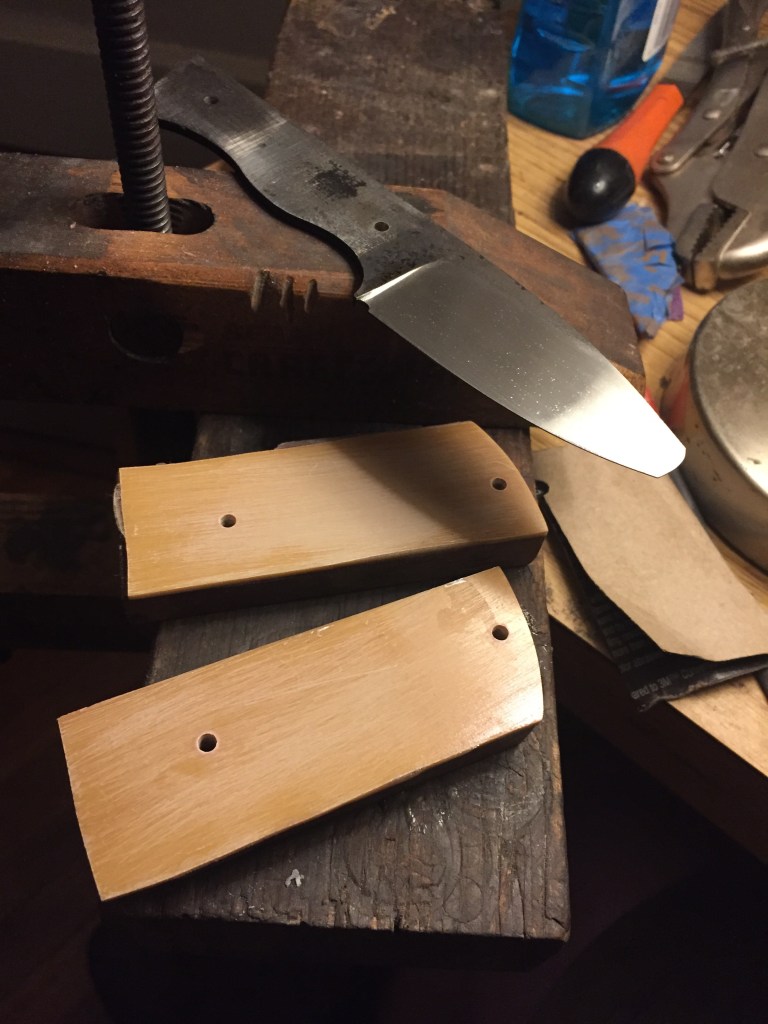
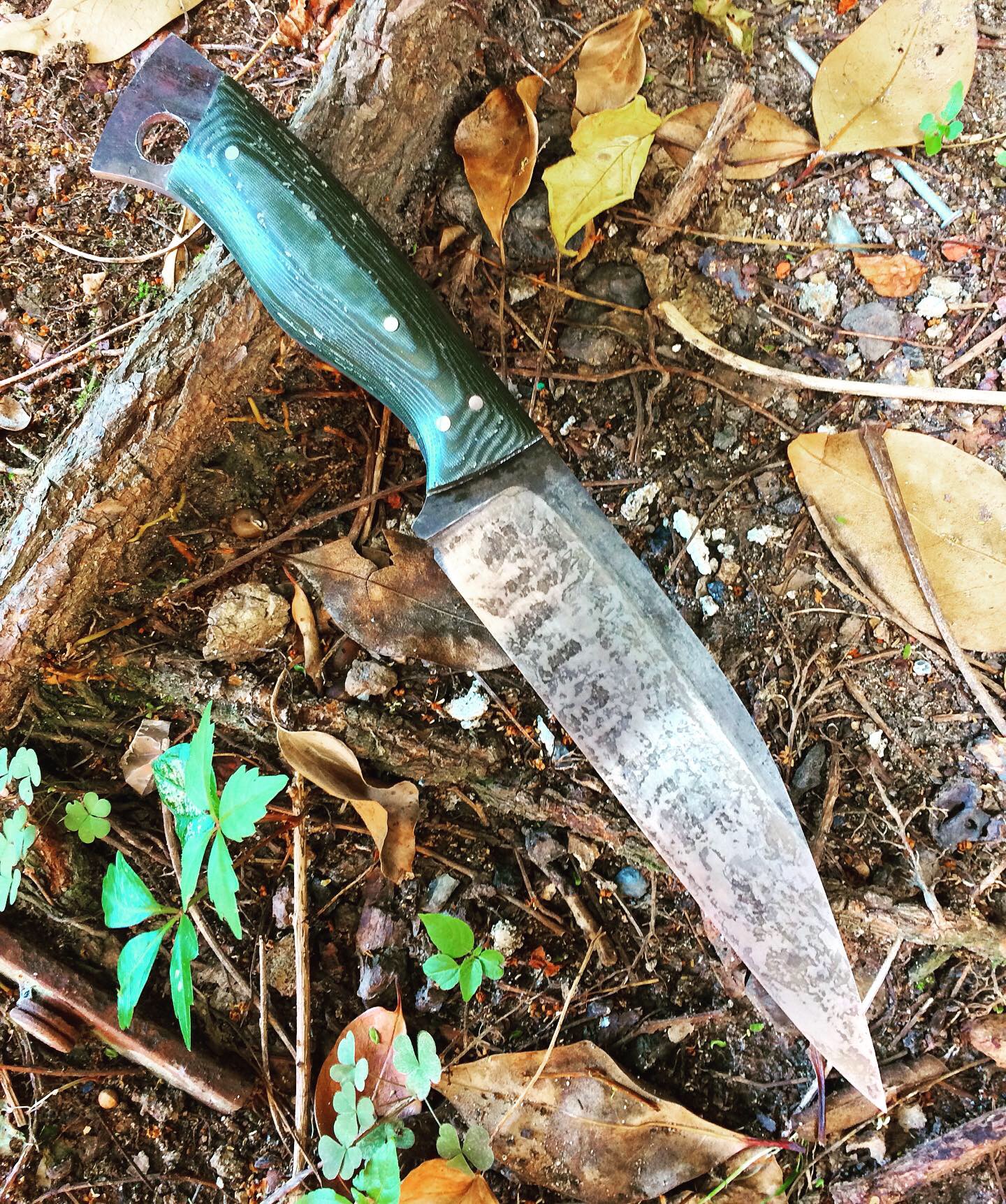
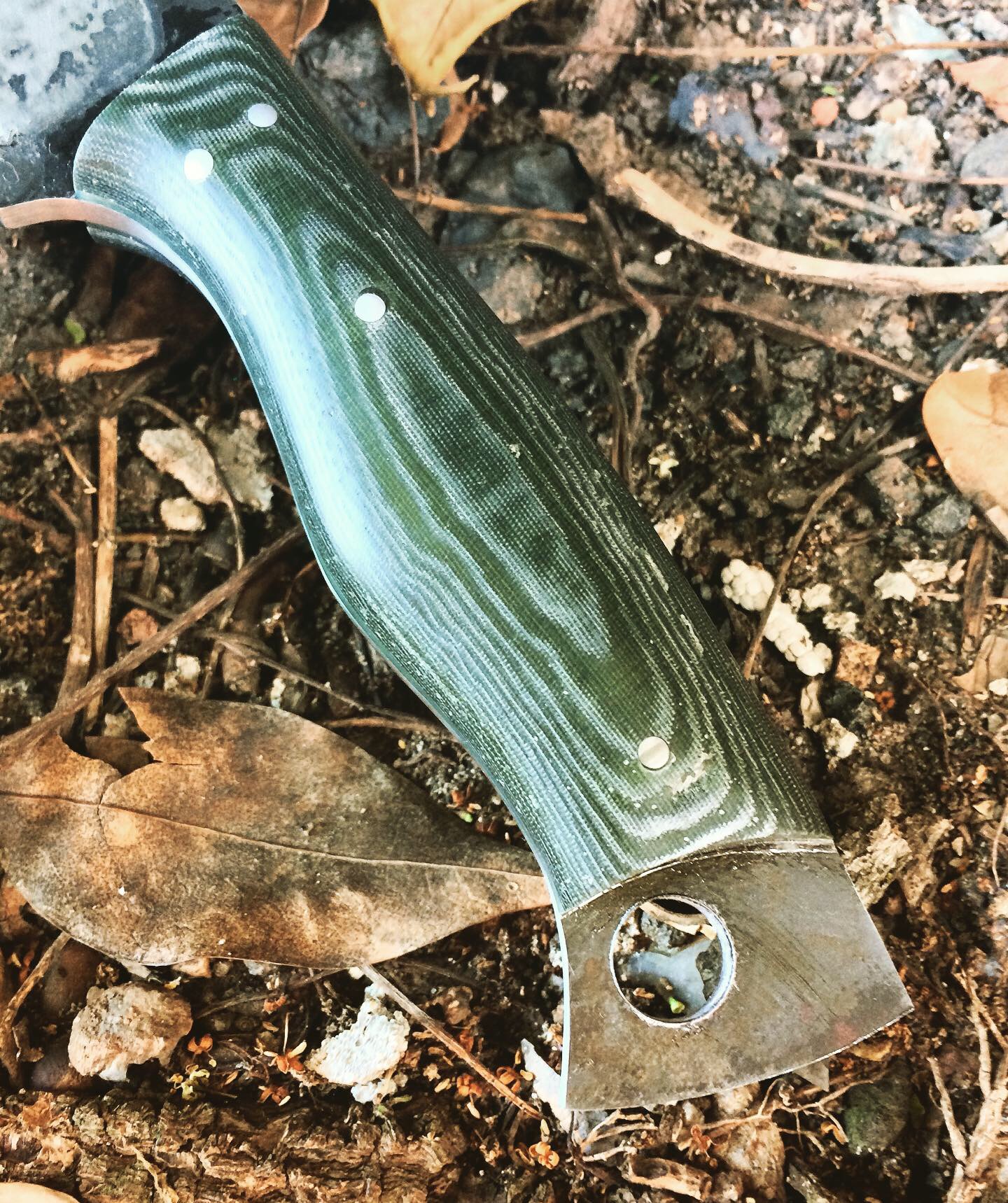
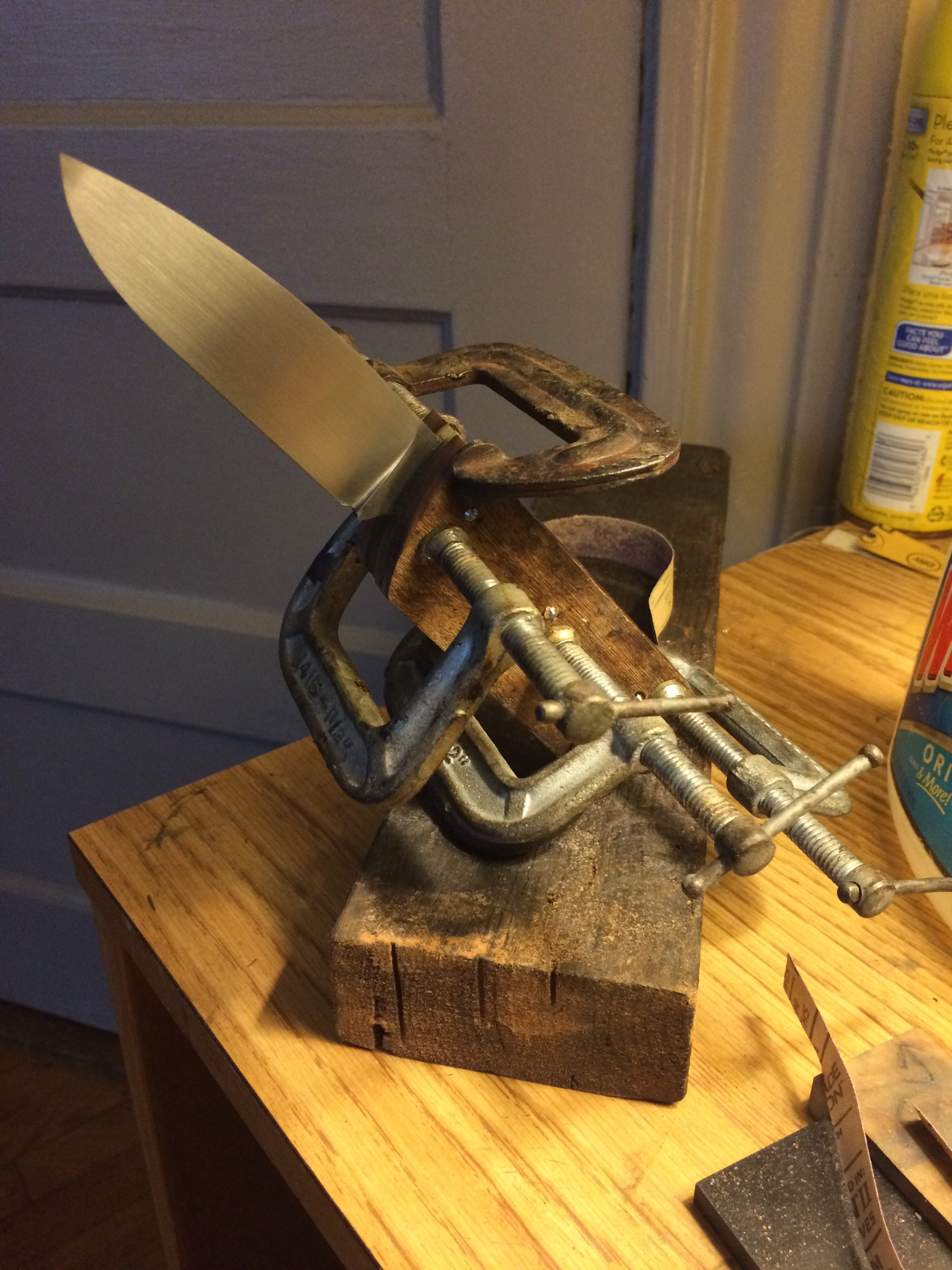
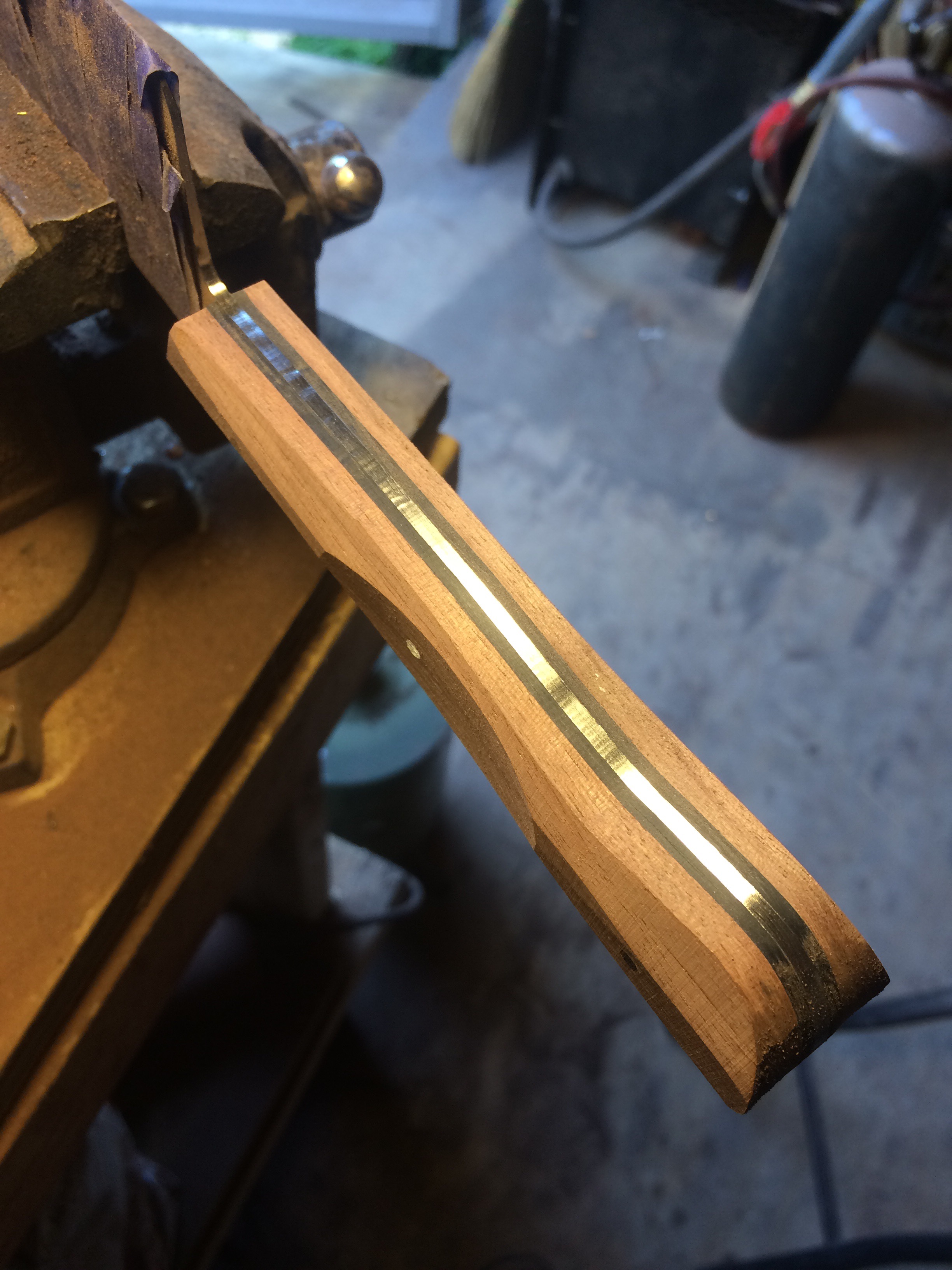
Finally started to see what this guy looks like

Depending on the light you can catch glittery bits of the chiffon

Knifemaking: courage in being gentle, and the Tennessee Gentlemen

Play that restless melody for me again
The one I’ve been so afraid of,
My sweet friend.
Maybe the little refrain will whisper inside the rain again
Play the one with all the changes
.”

Al Jarreau- “Something That You Said

Sometime in the beginning of the pandemic I started talking like Hulk Hogan. Just before everything got shut down I had been making combat daggers for spec ops guys. They had gotten in touch with me asking for “something that you can ram through somebody’s skull.” They all had a particular way of talking to me. The first time I talked to any of them they always addressed me as ‘sir’, and every interaction thereafter was ‘brother’. I really dug that. Even though they were paying me for a service, it made me feel like we were all on the same team and working together.

‘I APPRECIATE YOU, BROTHER!!!’

I found that to be immensely encouraging as I noticed it slipping into my vernacular. The irony of all this happening while I was building them tools of combat to rain down pain is not lost on me.

As Covid started shutting everything down and civil unrest led to riots, I found most of my means of livelihood shut down. Everything was a mess and I was broke trying to pay medical bills. The State Unemployment system was, and is still, a joke. With the murder of George Floyd, and everyone already agitated from lockdown, there was lots aggression and anger. Some of that aggression and anger manifested as marches through the streets, and some escalated to shopping centers being burned down. States of emergency were declared, riot police were dispatched, curfews were instilled, teargas was launched. Most all of this was happening less than a block from where I live, and occasionally it crossed over to the front yard of my building. There were nights where I was afraid someone was going to set my car on fire, which was how close this all was. My Buddhist vegetarian yoga teacher (who didn’t eat meat because it was unkind to animals) told me she was thinking about getting a gun and this did not seem unreasonable to me.

Everyone has the potential to fall prey to their baser of inclinations and move through life as a wrecking ball, especially when a private ambulance company is overdrawing your bank account because your livelihood is shut down like a high school keg party. It was my goal to not do that. During quiet moments at that time, I would check in with myself just to see what was hanging around. I found myself to be full primal rage, an ocean of grief, a profound sense of loss, and a hair-trigger response to any perceived threat. At such a reactive time as it was not too long ago, I found that it took a tremendous amount of courage to be kind and gentle.

During one such quiet moment I asked myself if we could break every interaction down to the very simplest parts of humanity and connection, and just not worry too much about the rest. Maybe we could find a way to let go of the weight of fear and uncertainty, and surrender to the simple joy of quietly going about one’s day. As a result of stripping everything down to the simplest parts of connection during a time of extreme duress, I found myself thinking of the Spec Ops guys for whom I was making daggers. I thought particularly of how in the course of our business I always felt seen and heard, and that my time and talents were respected and honored.

The crux of the Hulk Hogan technique is that it allows the people you interact with to also feel seen and heard. For me it was something that replaced a feeling of despair and hopelessness with a sense of community and belonging. It kept me safe and connected and prevented me from being a wrecking ball, which was what I felt like most of the time. In practice it started every morning with the gentleman selling me my coffee at the market down the street.

“IT’S GOOD TO SEE YOU, BROTHER!”

He got some encouragement and I got some coffee. Everybody feels better and has a bit more confidence for their day in a world that is on fire.

As I prepared for my days of shit work to keep myself from being sued by private medical companies, I did my best create disarming moments, as much for myself as the people I interacted with every day, starting with a cup of coffee. There is great power in gentleness, and after all the anger and violence I had experienced, I wanted to see what that practice looked like. Turns out it’s a bit like starting a chainsaw- a gentle but purposeful tug on the pulley cable gives you enough power to take a tree down. Pull too hard and you break the thing.

Ladies I talked to were always “Ma’am”, and anyone I believe to be identifying beyond the binary was always “Cousin”.

In focusing on my interactions with others, I found my crankiness and shit attitudes were curbed. They didn’t go away and I still found myself frustrated at the world, but those moments were much smaller and less consuming. It was much more than an affectation- I had absolutely fuck all going on and this was where I could direct my focus. After such a traumatizing time, this was a way that I could come back to myself and remember who I am and what I do.

Any sort of practice, when diligently observed and worked on, operates on a continuum. It meets you were you are and expands into everything. I was having a drink on my girlfriend’s porch one night when my girlfriend pointed out her neighbor struggling to get a washing machine off his pickup truck. Without thinking I got up and went over.

“BROTHER DO YOU NEED A HAND?!?”

…….

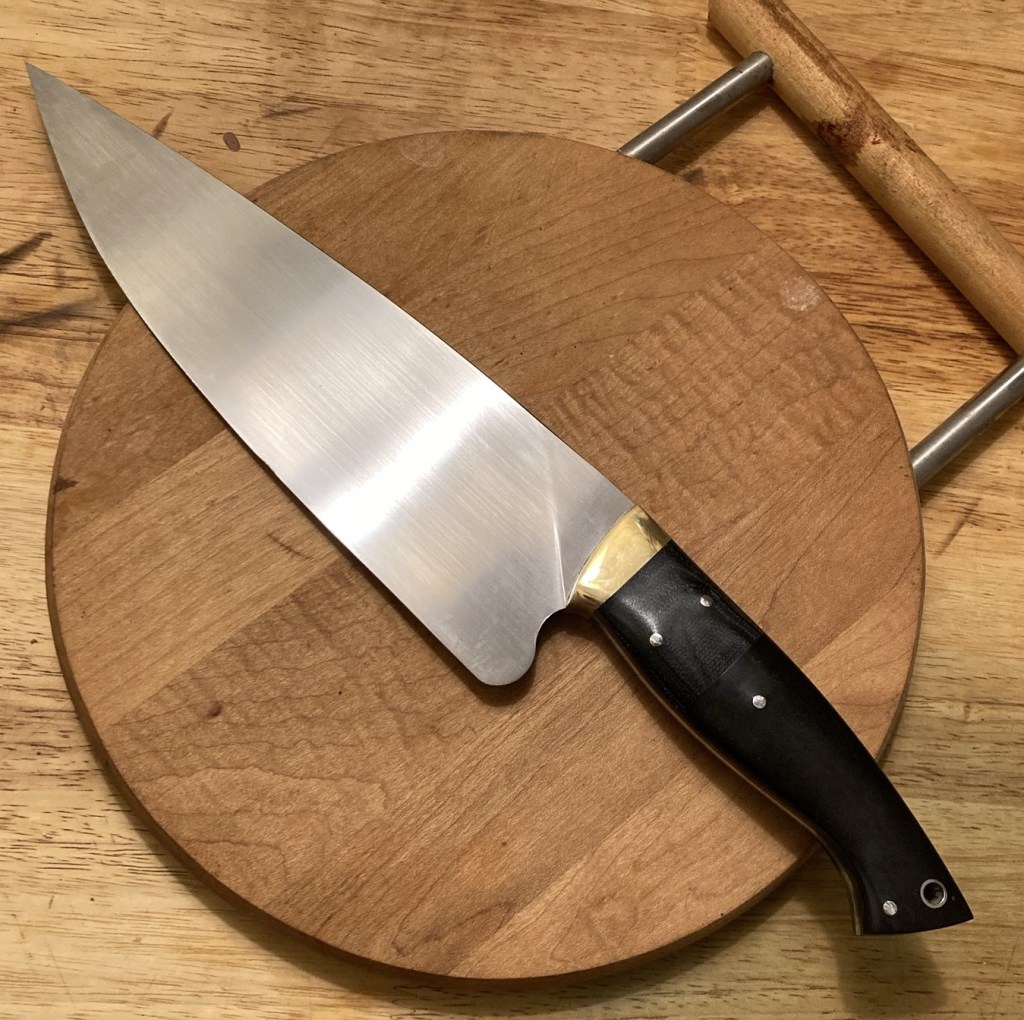
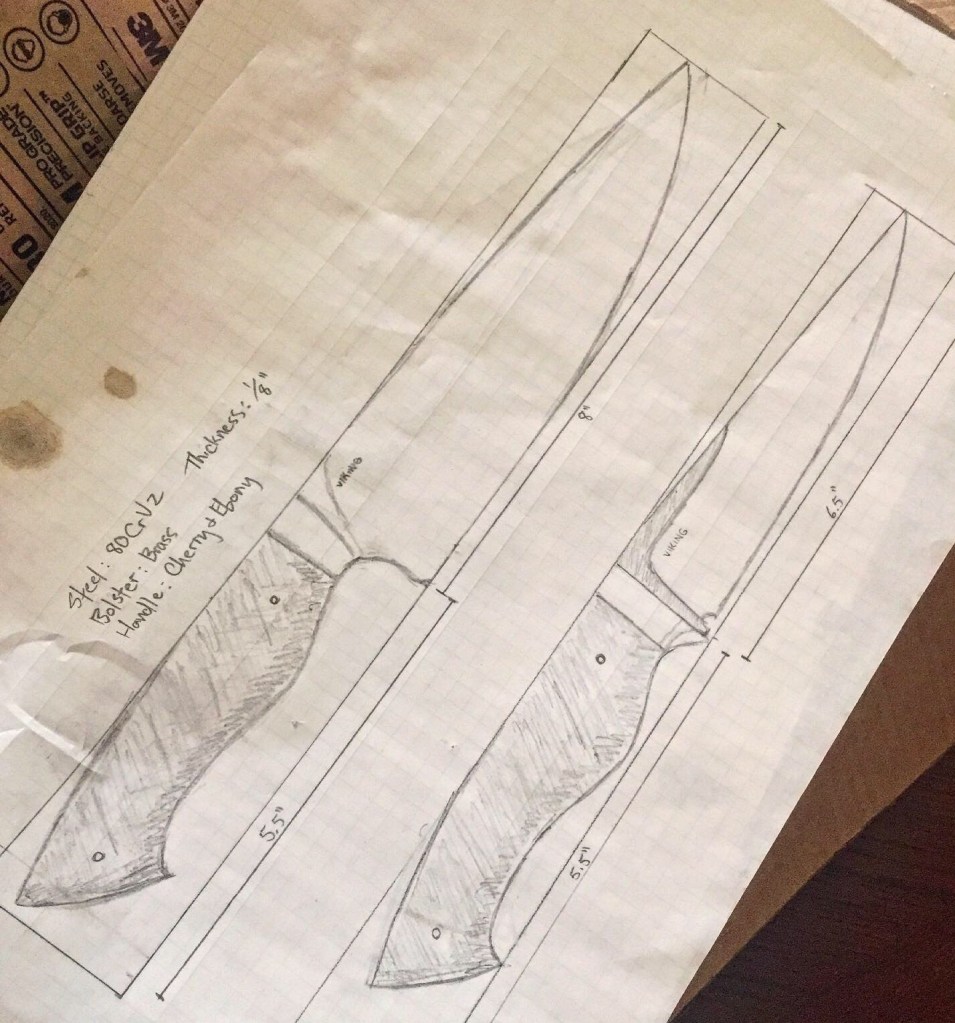
This two knife set was build for a good friend of mine in Tennessee. He got in touch needing something better for his kitchen. During hunting season he and his wife process a lot of deer. After field dressing, a good set of kitchen knives are good second-line tools.

When we spoke over the phone, he had said that while he had needed a set of knives, he had also wanted to throw me some business and help me to practice my craft. As a craftsman himself, he understood. He did to me what I had been doing to everybody else for the past two years, and this build was a lovely experience and testament to the courage of being gentle. I’ve detailed that experience below.

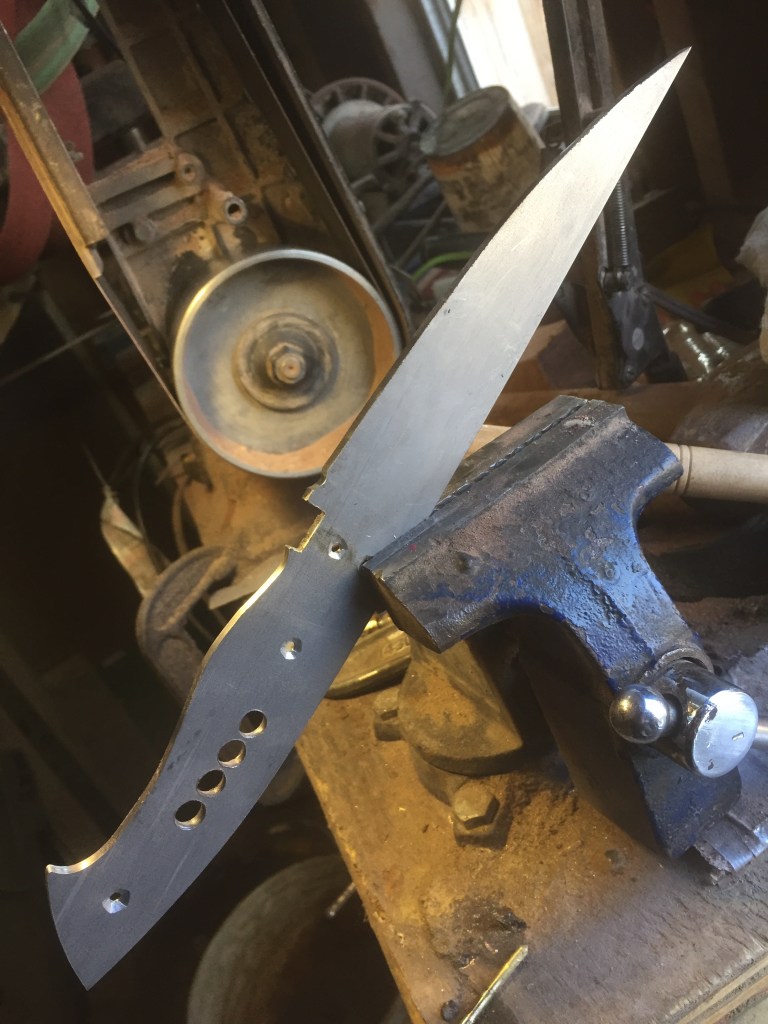
A critical mistake was made here. Rivet holes should always be drilled after the slot is cut and fitted. Lesson learned.
Fitted
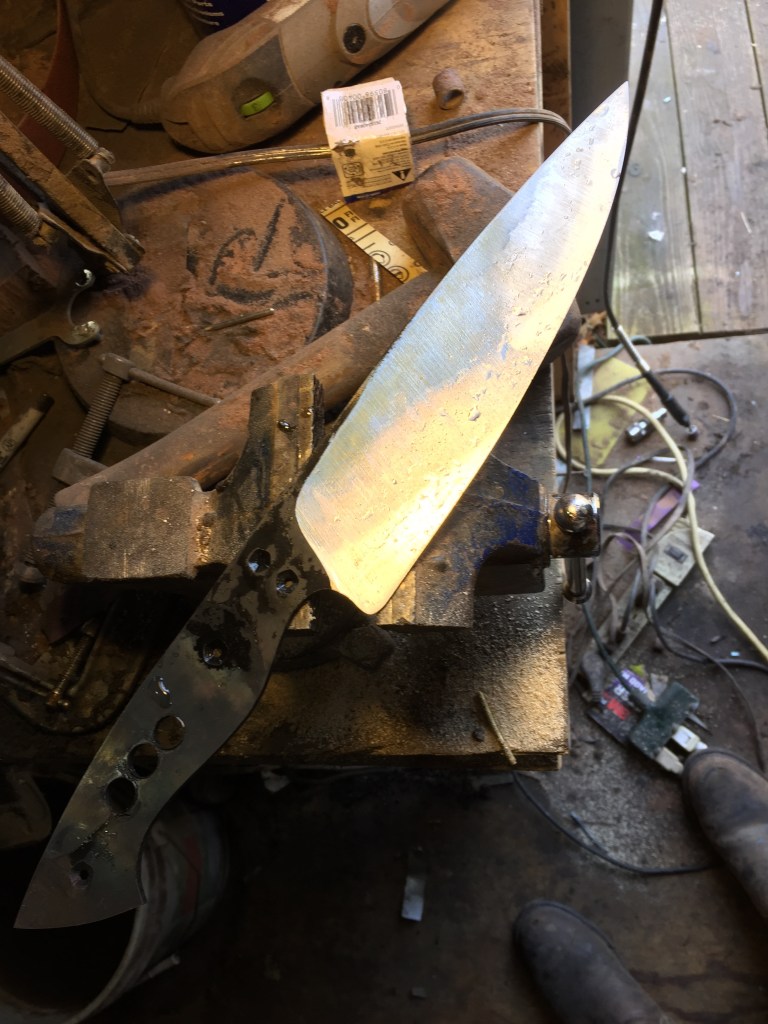
Hardening the Chef.
Rough grinding.
Rough grinding on the Boning knife after hardening.
A nice radius put on the spine.
Laying down a hand rubbed satin finish.
600 grit.
Getting ready for fit up.
Sanding the Chef.
Satin.
Making sure everything lines up.
….and everything did not line up. I broke two drill bits trying to get everything lined up before epoxy cured. Epoxy cured and I have to rip everything apart and figure out what everything wasn’t lined up. This was the third attempt and everything finally went together.
Hnadled up with Ebony.
Shaped.
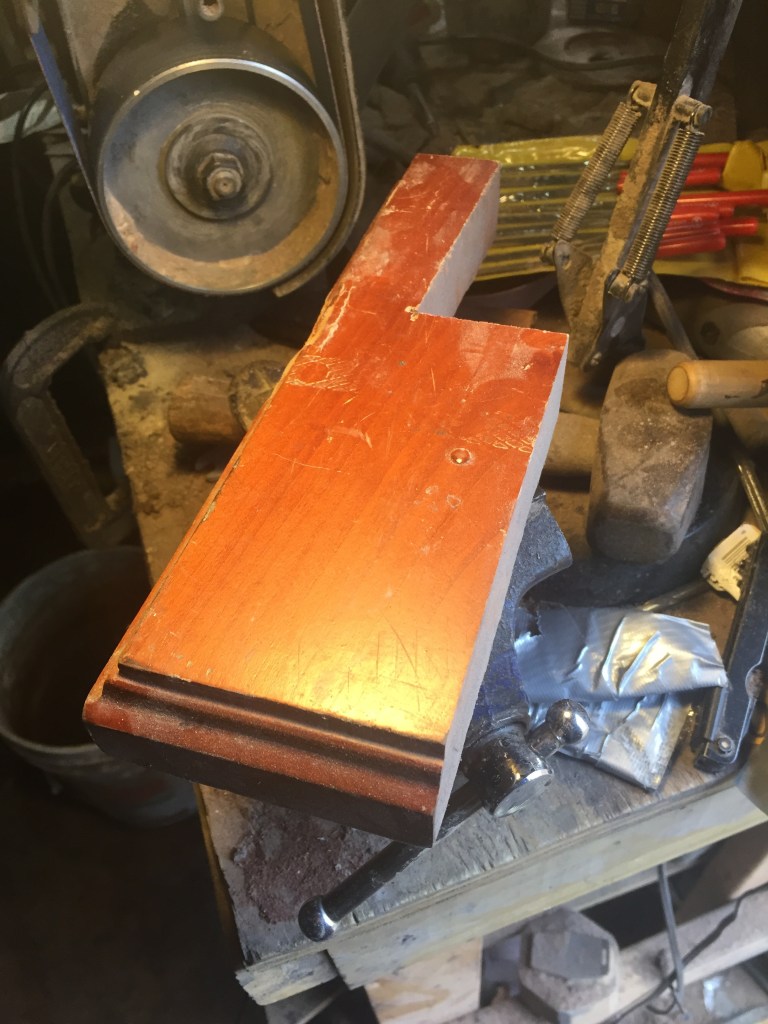
For the Chef we have reclaimed Cherry, recovered from an old mantlepiece.
Preparing the brass bolster.
Peened and fitted.

Knifemaking: an unexpected party, and the Cowpoke

“There is nothing like looking, if you want to find something. You certainly usually find something, if you look, but it is not always quite the something you were after.”
― J.R.R. Tolkien, “The Hobbit, or There and Back Again

My Dearest Young Friend,

I was told you have made it eleven times around the sun this year. Eleven! In celebration of this, your dad commissioned me to make you a special knife, which was convenient because I prefer to make knives that are special regardless! I like to make them out of things I find- in fact, the knife I made you was made out of materials that I found in the garbage. The blade is made out of an old bedframe that I can harden and the handle is made from walnut pulled out of an abandoned house.

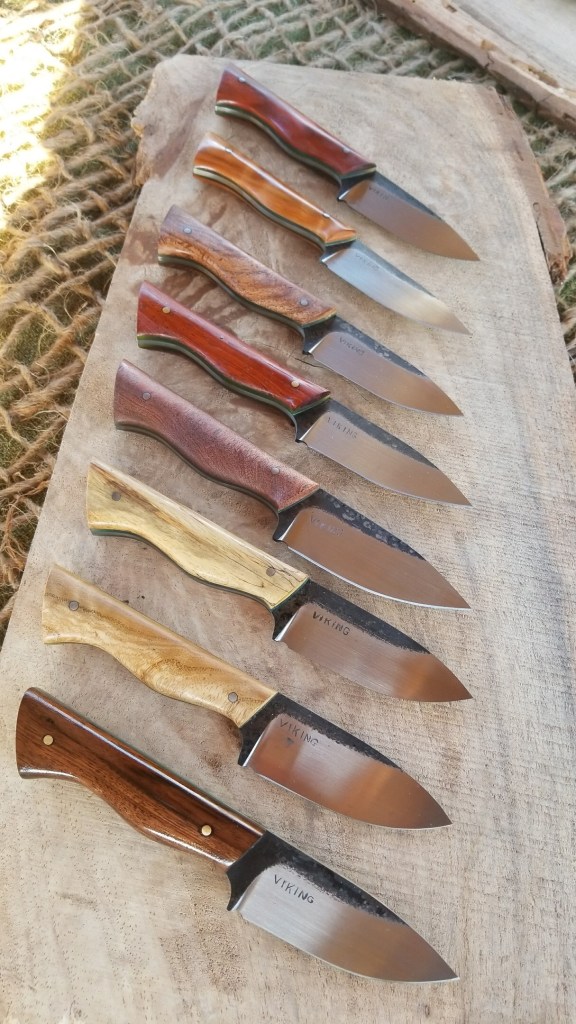
I make a lot of these particular knives. Anytime I see a bedframe in the trash, I pick it up and take it to my shop. Not all bedframes make good little knives but enough of them do so that it becomes worth my while to pick them up. It is through these little knives that I can explore and just be curious. I use whatever I have lying around the shop for the handles, or I try out ideas, or I just tinker around with no particular goal in mind to see what will happen. Sometimes nothing happens, but sometimes I can make something special that didn’t exist before I made it.

This creates a wonderful feeling that starts in my head, and goes through my arms and out my fingers, and keeps on going down my legs out my toes. I think you know this feeling. Perhaps you get this feeling when you read your books by Mr. Tolkien, or when you play Breath of the Wild. There’s always something good on the next page or just down the way- you only have to go looking for it. Even if you don’t find anything you might have made a new friend, or learned something about yourself, or your brothers and sisters. That is something special and should be celebrated- because sometimes the best party is the unexpected one.

As a grownup I sometimes forget that the unexpected and unknown can be good things- I started making knives to remind myself of this. It takes courage to be curious and explore and it’s important to remember that there’s a big world out there.

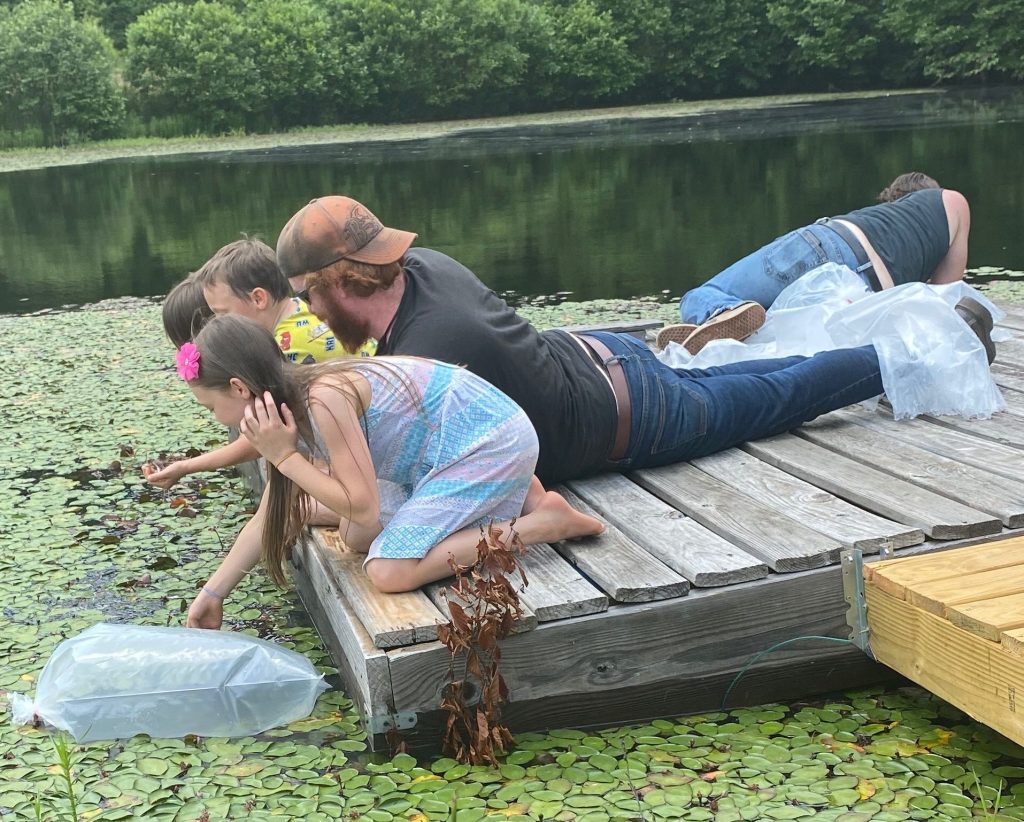
Some days I wake up and have no idea what the world will bring me so I try to approach most every day as an adventure. I spent a couple days each week of the past year helping your dad out at his work. One day I showed up and he told me we were going to stock the pond at your house with fish. We got in his truck and went to the farm supply store and your dad got something to the effect of a thousand minnows. That was a fun day, and you guys were all there. You never know what may happen if you don’t explore a bit. Thank you for sharing that adventure with me- your mom took this picture:

I hope you have a fantastic birthday and you keep reading and exploring!

The knife I made you begins with a piece of bedframe that I cut into smaller pieces:

I trace my design onto the steel:

Then it’s just a process of cutting it out- I have special tools for this.

I always try to have a couple of these going and I’m usually working on more than one at once-

Once I get the shape right, I grind the bevel in-

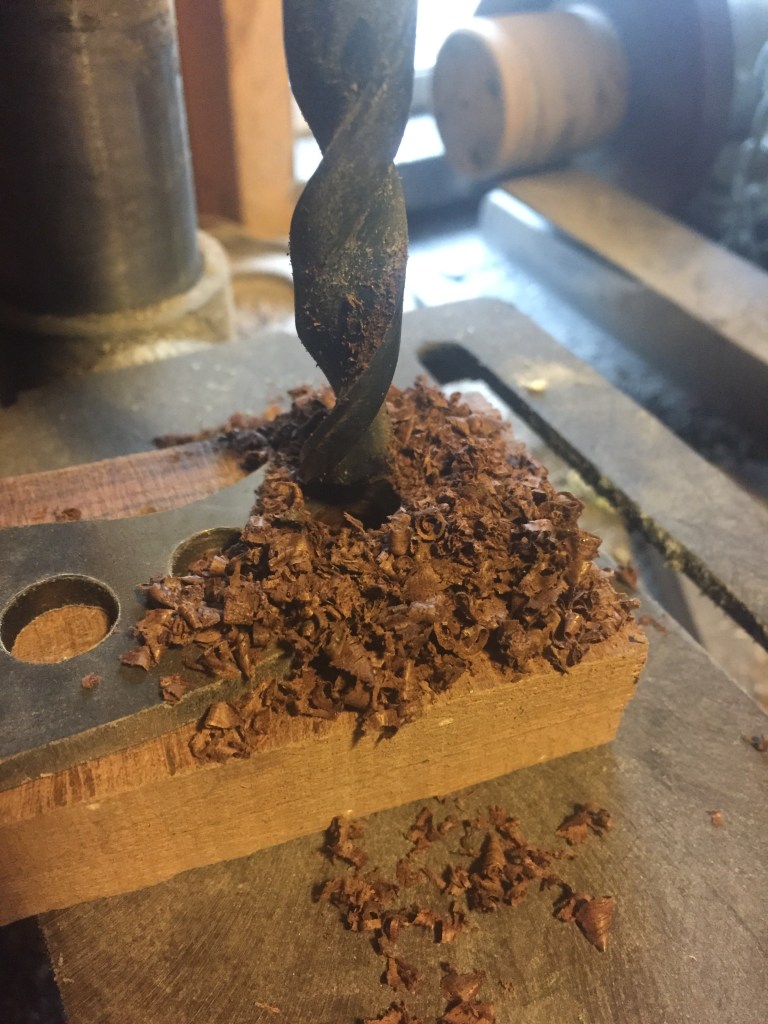
Then they go into the forge, a controlled fire that gets the steel very hot and hardens the blade. It gets so hard that sometimes it’s difficult to drill holes for the handle pins-

After that I use sandpaper to get the bevels nice and smooth. This helps the knife to cut better-

This one is blunted for you, so you can learn the feel and what it’s like to carry a knife-

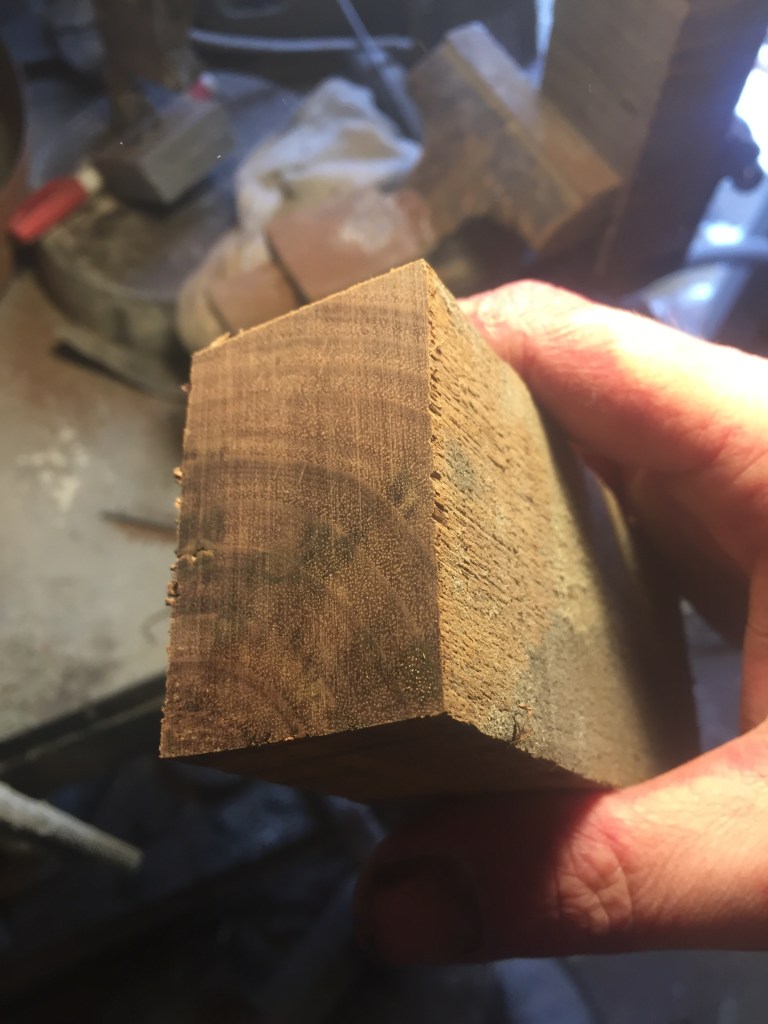
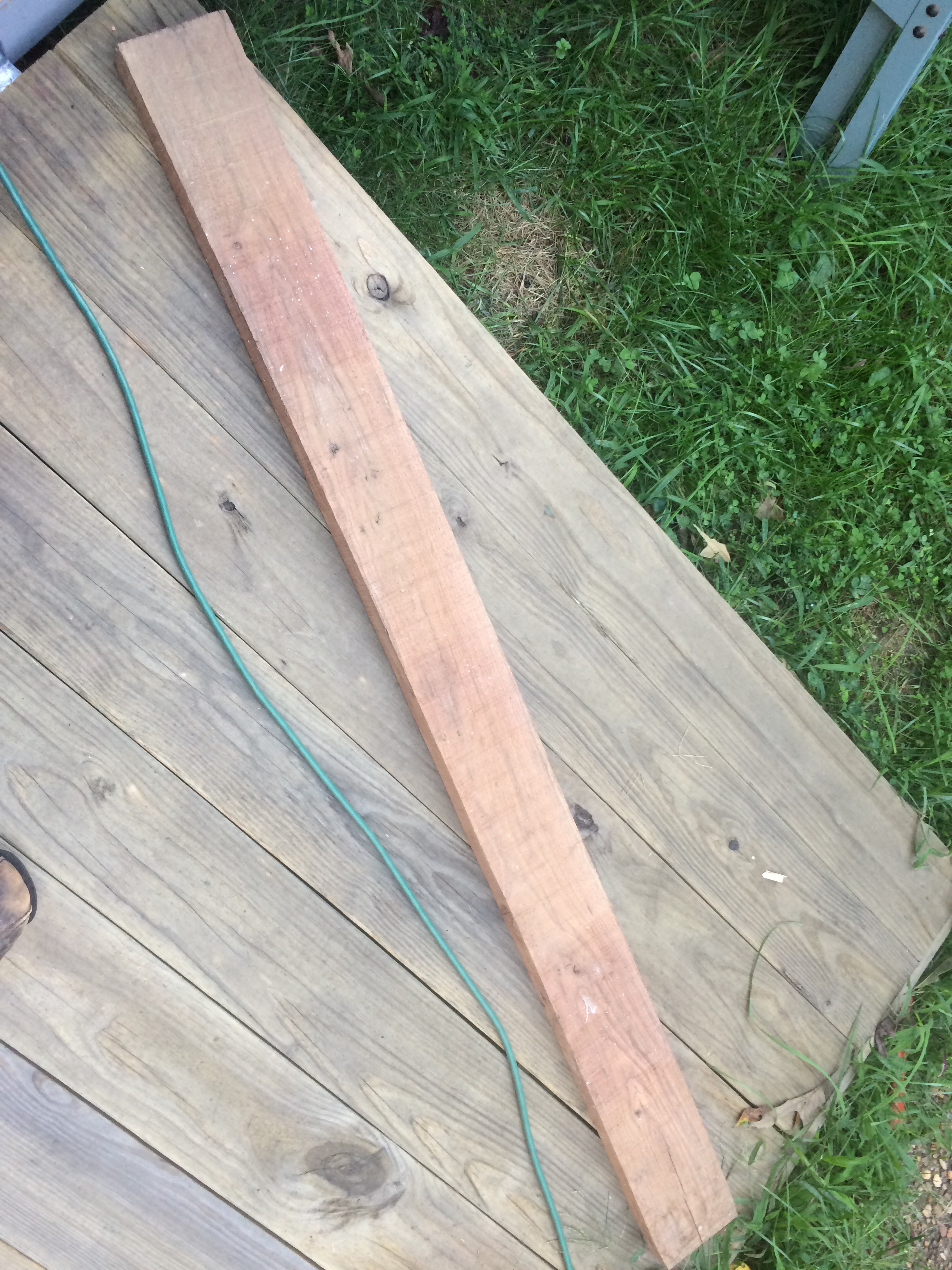
Here is a piece of Black Walnut. It was pulled out of an abandoned house in North Carolina-

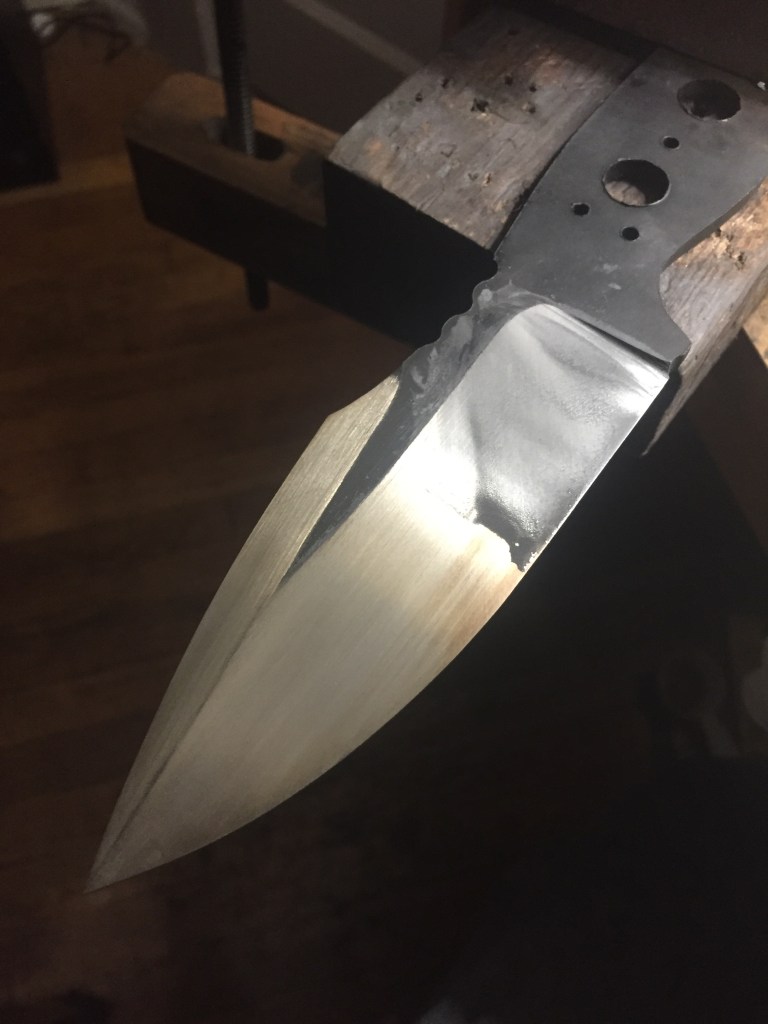
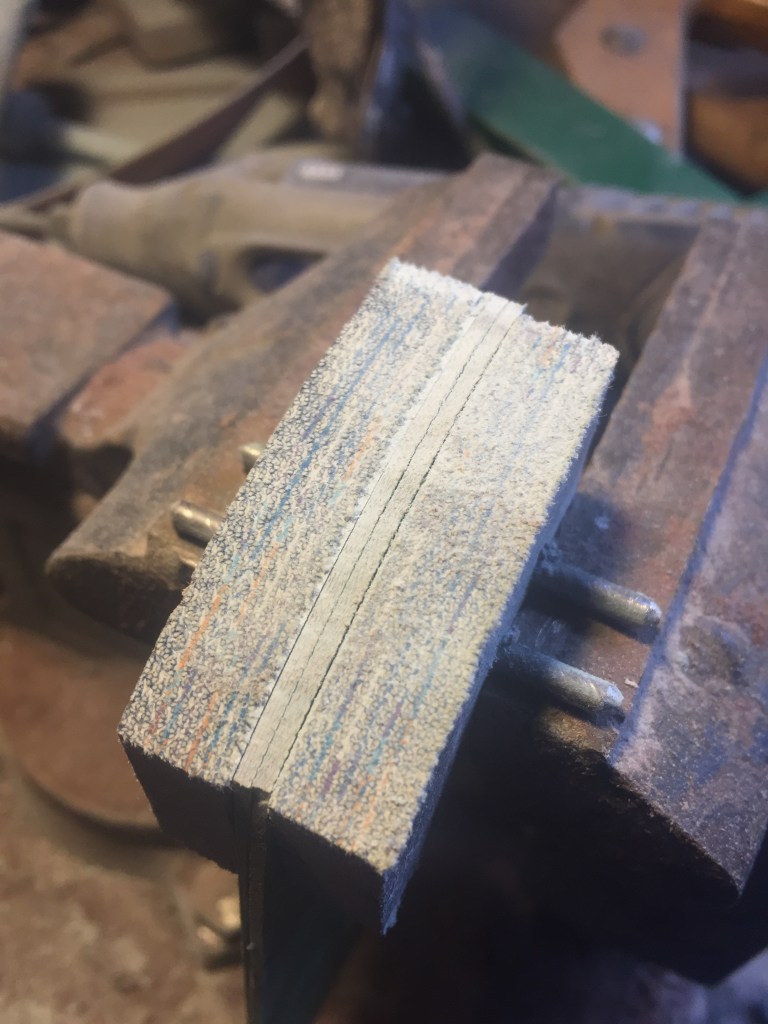
I cut two pieces of it and fit it to the knife. For a bit of color contrast, I use a bit of fiberglass computer board blanks that I rescued from a dumpster-

Now it is pinned and glued to the knife handle-

Here is where I shape it….

…..and shape it some more-

And now I sand it till it is shiny-

I made you a nice sheath for it so you can carry it around-

Knifemaking: remembering the magic, and the Bounty Hunter

“Come On, Baby! Do The Magic Hand Thing!”

-Greef Karga, from “The Mandalorian

I remember, at the age of fourteen, running around my grandmother’s backyard and pretending to have a lightsaber and desperately attempting to feel the Force flowing through me. It was around 1998 or 1999, and I had just seen the special edition of “Return of the Jedi”. Other fourteen year-olds I knew were busy with sports, or having girlfriends, or smoking cigarettes, drinking, or doing drugs. In other words, doing nearly anything but pantomiming a nearly fifteen-year-old sci-fi-fantasy film in a relative’s backyard, but there I was. By that point I had been neck deep in the lore of Star Wars for years. I had all the books- from the Jedi Academy series and Tales of the Bounty Hunters, to the books detailing the technical specifications of the weapons, technology, vehicles, and alien races. I played Dark Forces and Dark Forces II: Jedi Knight, Jedi Knight II, Shadows of the Empire, and half a dozen others. I knew the legacies of Dash Rendar, Kyle Katarn, and how to make a Ruby Bliel. I had the soundtrack to all three films, each on double cassette. I hadn’t tasted the kool-aid: I had dove headfirst into a vat of the stuff.

What this type of fixation does in younger people, as any nerd-dom member will tell you, is allows one to cultivate a rich inner life and vivid imagination for things. It also teaches one to see the magic where one would not normally expect to see it. This is why many nerds grow up to be incredibly interesting and capable adults.

On top of this, everyone experiences times when they find it difficult to see the magic in life. Falling down rabbit holes teaches you how to nurture yourself when everything might not be so inspiring. The thing that has always saved me is remembering what it is to feel the mystery of it all. The past year has been an exercise in this. Most of my work has been cancelled due to Covid and as of yet has not come back. No knife shows, no gigs, minimal commissions. One of the bright spots of this whole debacle has been season two of the Mandalorian in the fall and winter of 2020. When you’ve been stuck at home doing menial pandemic work just trying to pay the bills, there are few things like a person of a mysterious creed and badass armor having interstellar adventures with Carl Weathers and Bill Burr and a Force-sensitive baby Yoda. Every week I tuned in like I was fourteen. It’s deeply reassuring to know that during such troubled times there are things to make you remember why you pursue that which you value and help you to feel the magic in everything.

For me this is the beauty of having a small custom knife shop. You can do anything you like. There are limitations, the greatest being time, but almost anything that you can think of you can usually do (provided you have the patience.) In this respect, it’s important to keep the mind limber and receptive to creativity for when the muse strikes us. If I am not inspired, I know how to find those things because I’ve been doing it since I was little. Sometimes it’s podcasts, or a song, or a line from a book, or perhaps even a conversation or something I’ve eaten. Because of the pandemic and not going out into the world in my accustomed fashion, this has been quite challenging most days. If I can stir myself, then i can certainly stir someone with a knife I’ve built. If I’ve done that, then my job is complete.

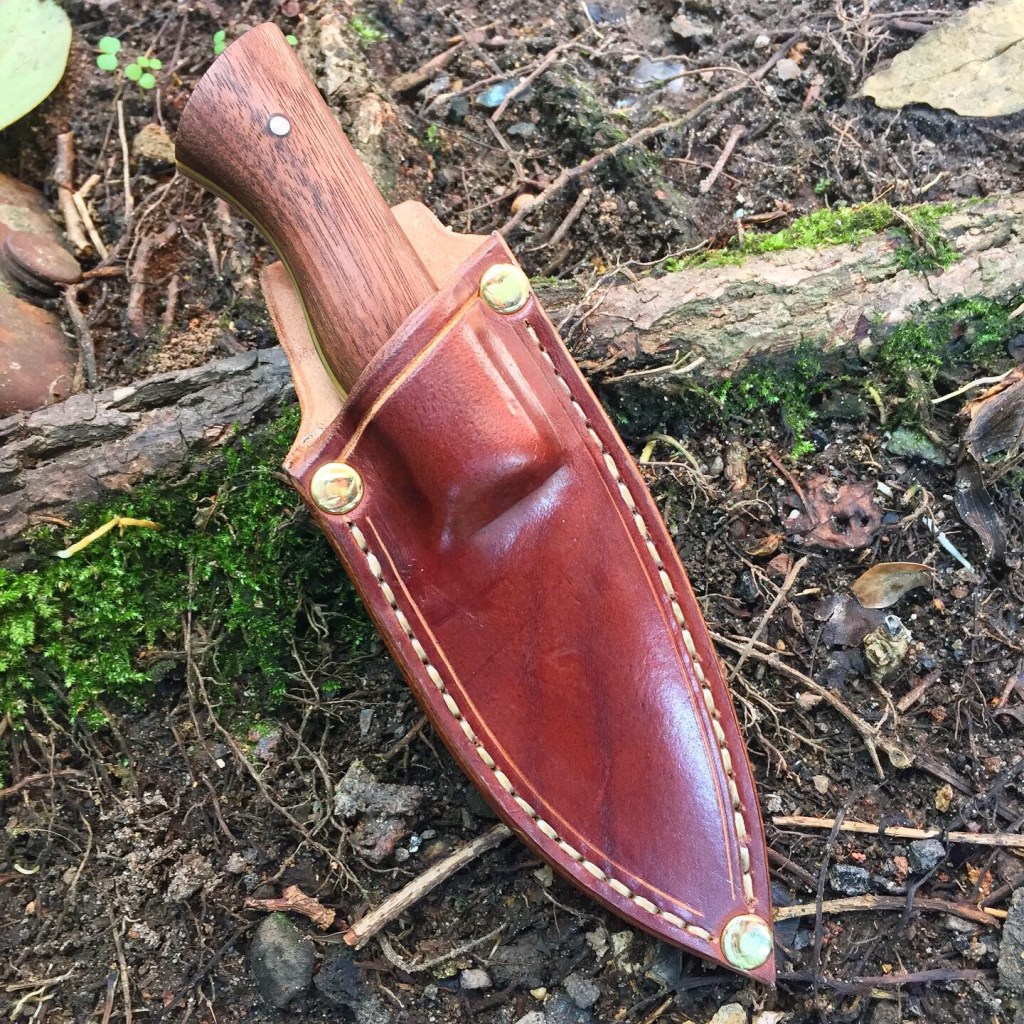
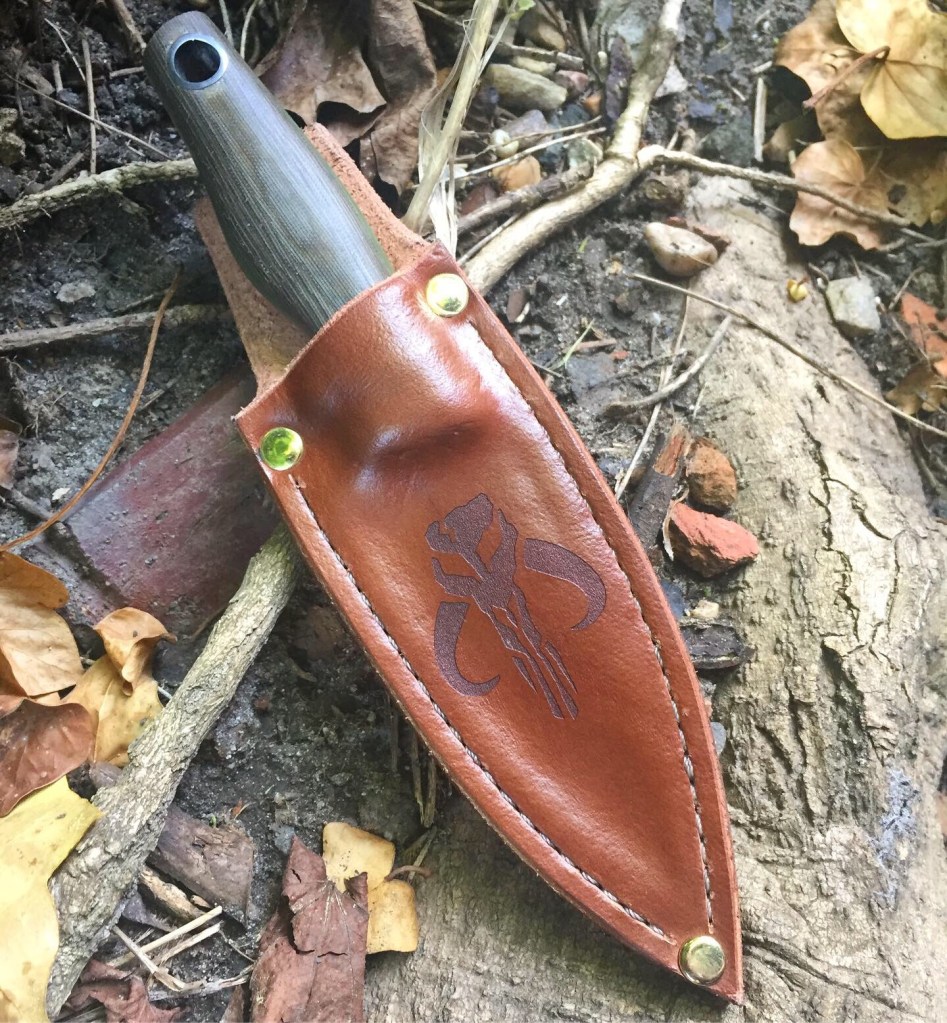
But sometimes we get commissions where WE are the ones who get stirred. We prefer to do everything in house and make sure the work comes from our own hand. While we don’t outsource tasks very often, occasionally we’ll get a commission that is interesting to us and requires that we do so. I received and email from a very good customer asking if I could get a Mythasaur skull on a custom blade and sheath. I thought of how the Mandalorian was such an oasis during a tough time; my own personal magic-hand-thing. I came up with a design that I hoped could fit a Mandalorian bounty hunter and found a laser engraving company in town. Chase your muse, do the work, and walk your path, don’t give up. It’s a journey but this is the way.

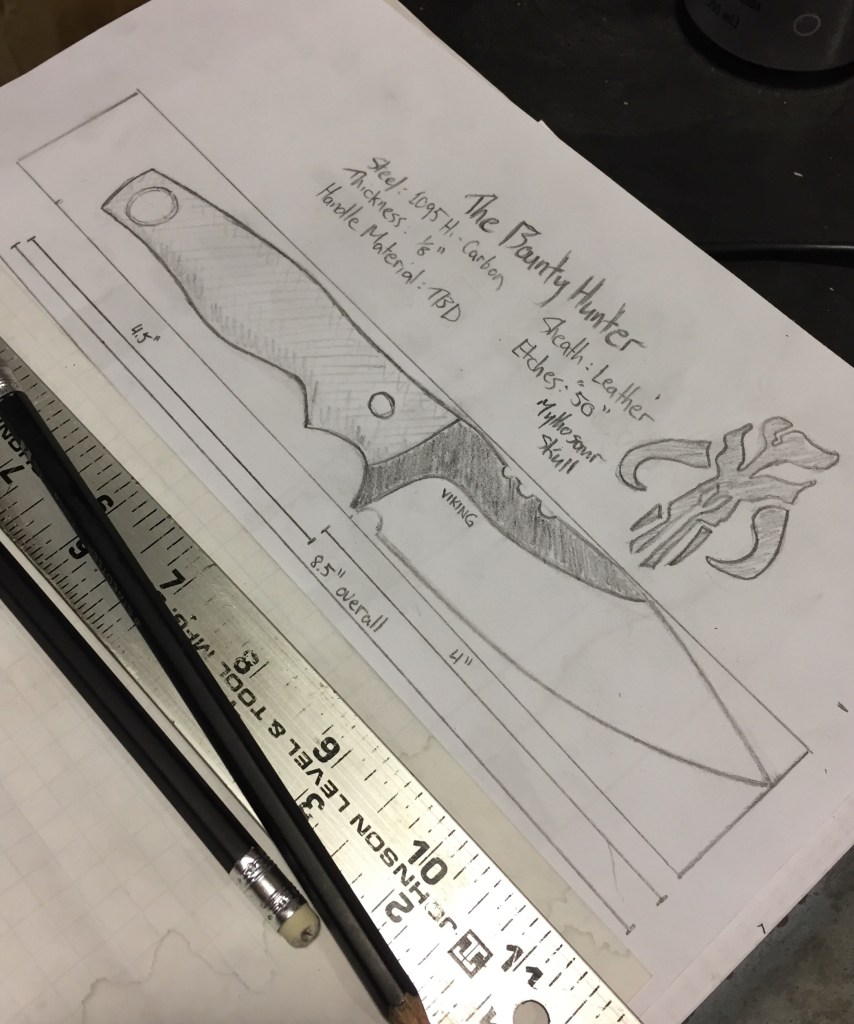
A quick schematic
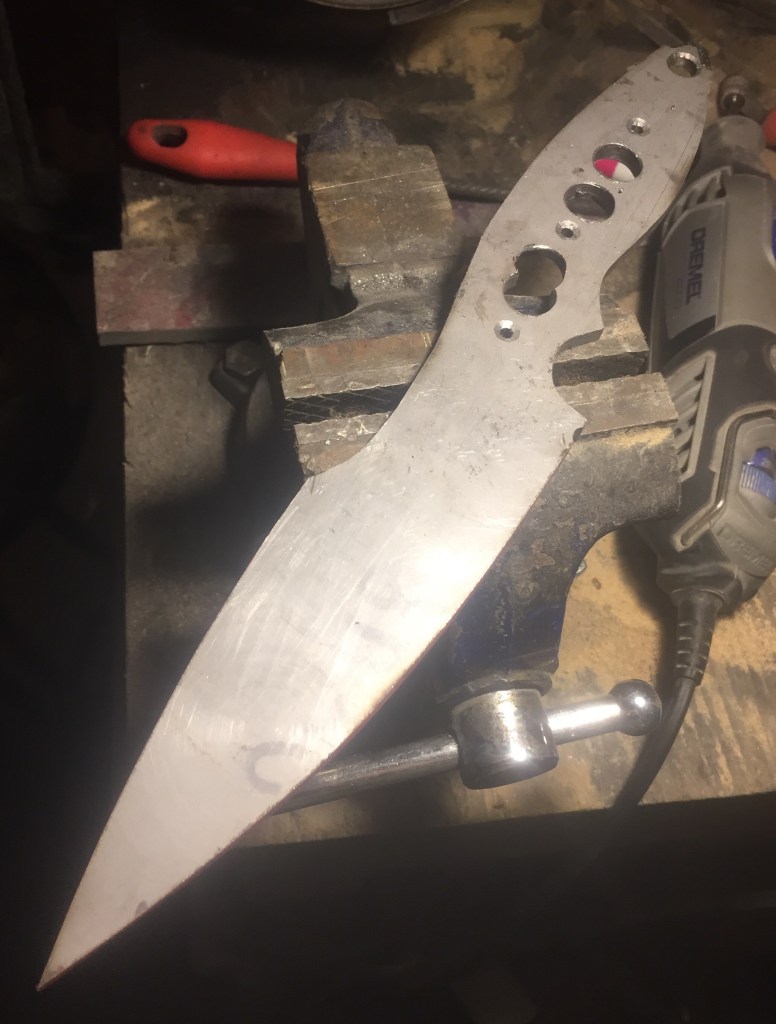
Roughing out the profile
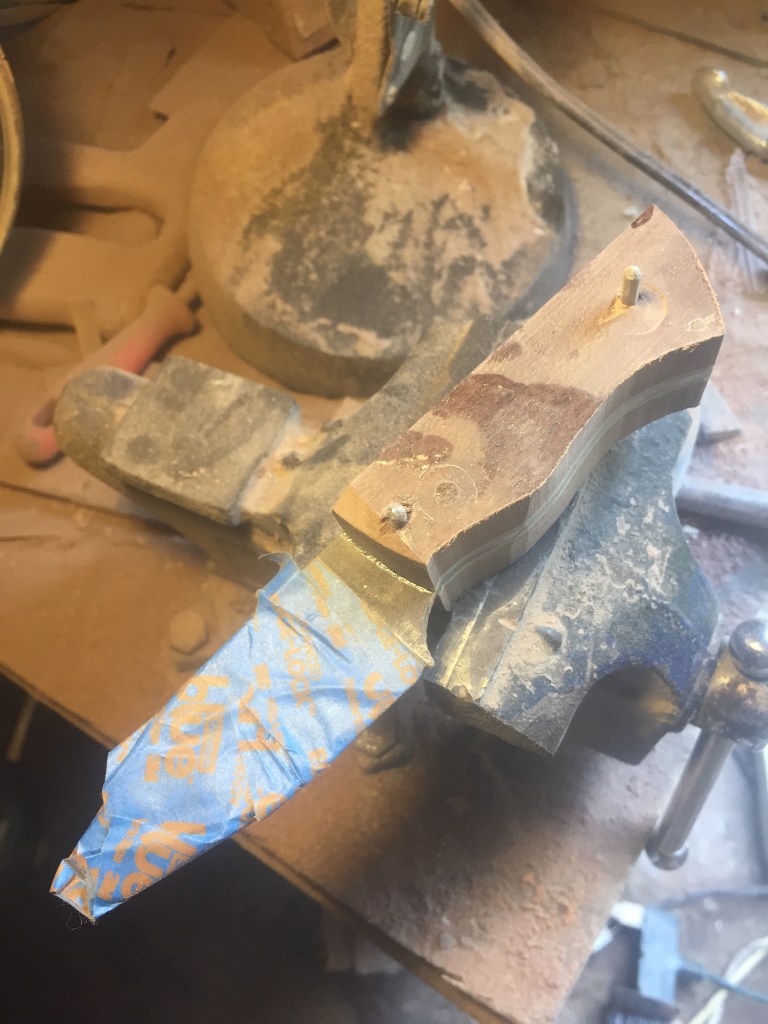
Removing a bit of weight and putting in rivet holes
Properly profiled
Bevels ground in
Pre-heat treat sanding
Out of the quench and cooling
Beginnings of a satin finish
…and we’re there.
A technical schematic for the laser people: precision is the name of the game.
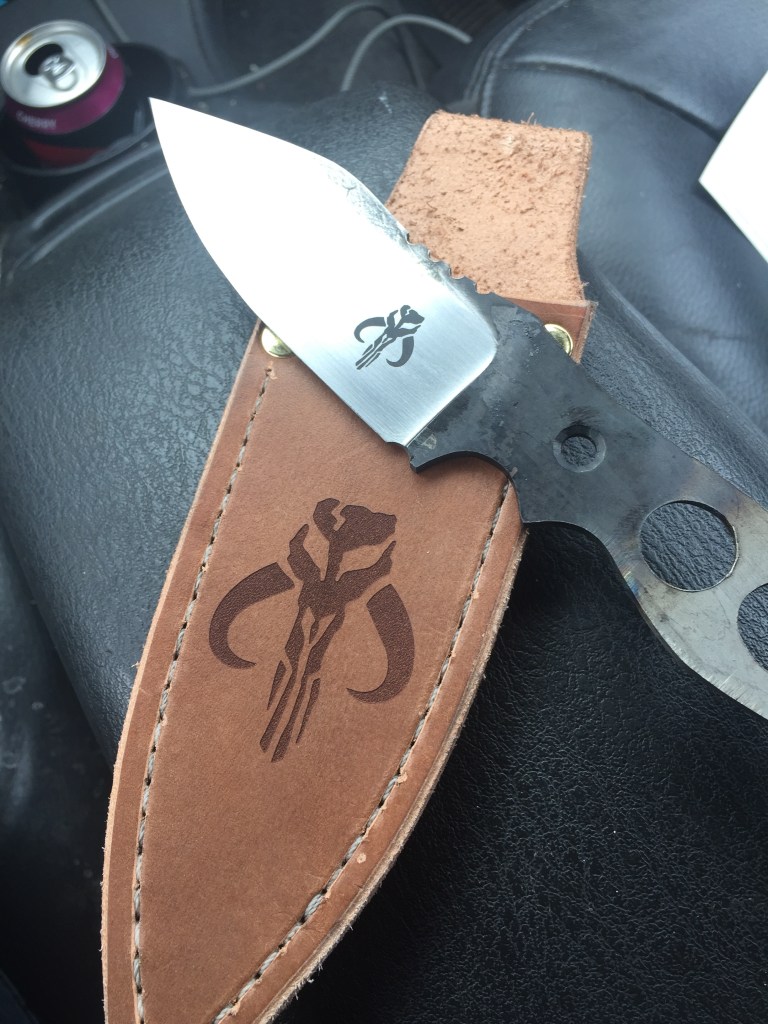
Proofs showing how the engraving will look- the blue is for contrast.
And it came out just like the picture
The handle is made from a pair of Carhartt Dungarees I got too fat for….
Cut into strips….
…layered into strips….
…with the resin…
And this is the raw material, about 3/16″ to 1/4″ thick.
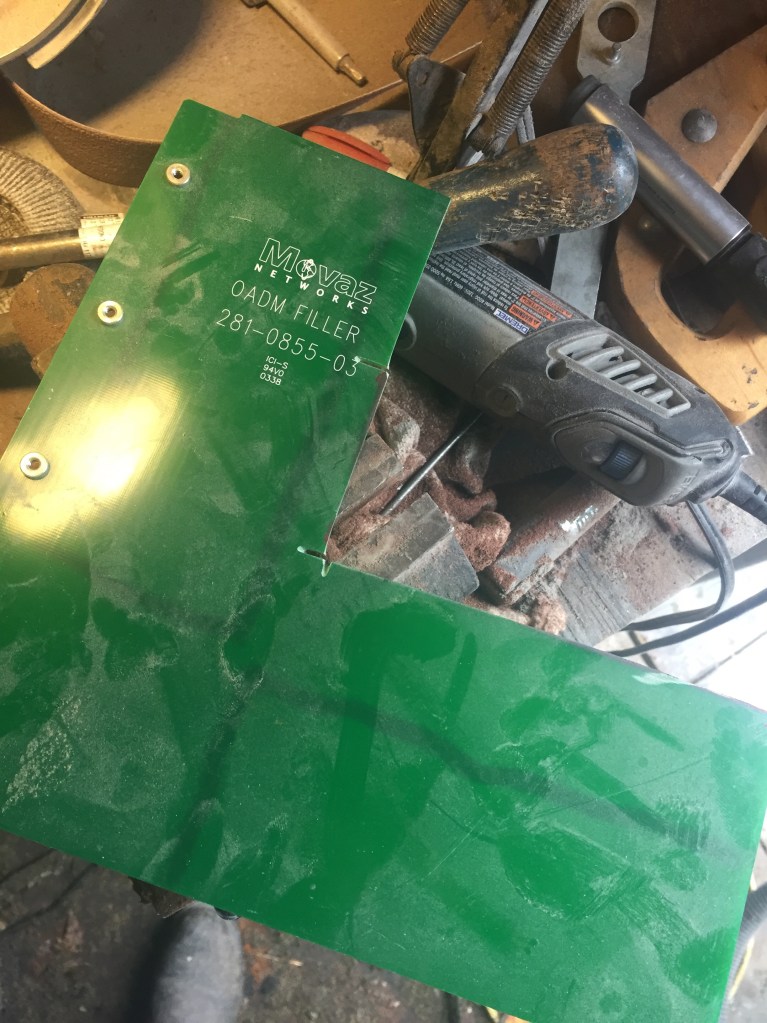
A PCB filler blank, rescued from a dumpster.
Everything gets drilled and glued/riveted together.
Ready for shaping.
Profiled
Shaped to fit the hand. This is off the grinder at 60 grit. The rest will be done by hand to help the material speak.
At around 120 grit you can see the “grain” start to speak. The higher you polish it, the more pronounced it will be.
The Bounty Hunter

Knifemaking: on being part of a team, and Puttin’ on the Fritz

“No member of a crew is praised for the rugged individuality of his rowing.”
― Ralph Waldo Emerson

For the past thirteen years I’ve worked off and on in the operations department for the symphony orchestra we have in town.  What many people may not be aware of is that there are a lot of logistical factors and people involved in getting an 80-person orchestra on stage to perform Beethoven: more so to perform Ravel.  Risers need to be built and installed, specialized percussion needs to be rented or even custom made, guest artists need to be booked and accommodated.  None of this even includes the years of training on the part of the musicians, or the planning and learning of the repertoire.  Outside of this, there is a whole team of people running youth programs and community choruses, each with their own logistical needs.  As one can imagine, it is tremendously expensive to run an orchestra and a great many people work very hard so that the classics can be heard as they were meant to be heard.  In a complicated and difficult world, it’s deeply comforting to know that there are people working tirelessly with sole intent of putting good work out into the world.

In recent years, however, people haven’t been going to orchestra concerts as they have in the past.  All over the country, symphonies have been closing down.

A few years ago a decision was made by the upper administration of the symphony in town to invest in a mobile tent big enough to put a stage and orchestra under.  This would allow the orchestra to be mobile and to perform concerts anywhere.  With the community just not going to the symphony as it once did, it was decided that the symphony would go to the community.

A large tent was purchased from a Canadian company and staging from a different company.  Two 24-foot box trucks were purchased to carry around the tent and stage, as well as all the accoutrements necessary for construction: wrenches and sockets, a jackhammer named Petunia, stake pullers, sledgehammers, a laser leveling system, and several tons of trusses, scaffolding, and hardware.

A crack team of theatre and stage professionals was assembled for crew.  At the helm of this endeavor was a husband-and-wife team, the Operations Manager and Production Manager of the Orchestra, who oversaw everything from site surveying to maintenance of the trucks to making sure everybody got paid. The assembled crew included a gentleman from the IATSE Local 87, who was an ace electrician, lighting operator, and rigger.  There was also a gentleman who was the technical director of a university-run theatre and a deus ex machina of lighting design, sound, carpentry, and all aspects of building and running a production.  Then there was a gentleman who did sound and logistical transport on motion picture and television sets for the Teamsters, and another gentleman, a math whiz working in IT and a veteran stagehand and crewperson. Finally there was me, a generally nice guy who always showed up on time and happened to be extremely proficient at moving heavy things. More people would come over the years but this is what it started with.

At some point or another I had worked with all of these people extensively, or helped them move, or gone to happy hour and had one or ten drinks with them.  As this project was getting started, I found myself really happy to be working with proper criminals of the theatre and entertainment industry.

A weekend was booked for training on how to put the tent up. The owner of the tent company came down to train us on how to put it up and take it down. He was a Canadian septuagenarian, who was formally an engineer for a railroad company in Winnipeg. I’m not sure how much the tent cost but it must have been significant for the elderly owner to fly down from Canada. As it turns out he wasn’t as elderly as he looked. We set it up and took it down twice.

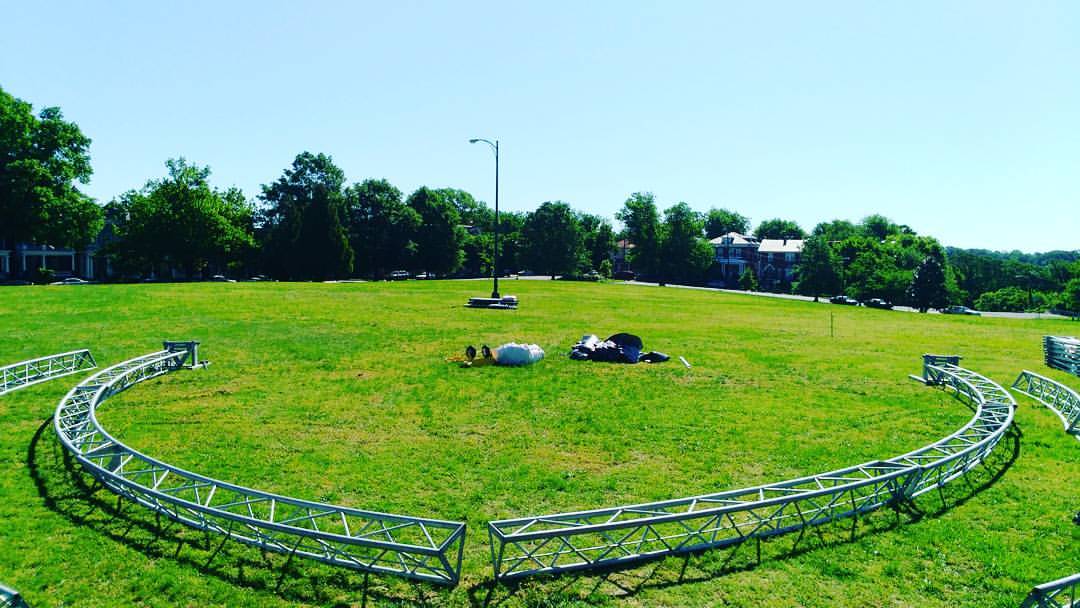
As with any large task, the crux of the build was built on many tiny steps. Permits for a temporary building structure are obtained for whatever county the performance is happening in. The site is scouted and surveyed, locating the flattest area possible. Locations for the load-bearing stakes are marked out according to the tent schematics. There is a single truck that contains all the parts and pieces for the tent- trusses, skins, poles, spansets, straps, stakes, the lot. Building it involved doing each of those tiny steps really well, and in the proper order. At first it was overwhelming.

Photo credit Tim Posey

What makes this job different from a theatre or arena is that everybody pretty much knows how to do everything. No job is more important than another and we were trained to be able to do it all. With the exception of driving the trucks, which requires a CDL due to weight, or operating the Lowell boom lift, which is an issue of insurance, anybody can jump on wherever there are tasks to be done. We all hang the lights and wire them up. We all move everything and everybody tightens bolts, hammers in stakes, and skins the frame. In the hierarchy of the job we always defer to the crew chief, but there is a level of trust that comes from having worked with everyone on a plethora of different jobs over many years. In this line of work there is an Esprit de Corps that is hard to explain to anyone who isn’t in the industry. We can put this thing up in our sleep and feel confident that the job was executed to the highest standards. If someone misses something there are at least three other guys (or gals) there to catch them.

While everyone can do everything, over the years we’ve all settled into leadership specialties within the scope of the job. There are two gentleman handle the business of getting the tent in the air, and everyone else knows to fall in to take orders. There are two other gentleman who take the helm of leveling the scaffolding for the massive stage that goes in the tent. I found myself managing the loading and unloading the stage truck which involves about fifteen tons of decking, railing and step units- everything having to be unloaded by hand. One gentleman is really good at getting the tension on the support lines really dialed in, giving the tent it’s sleek look.

Photo credit Tim Posey

It’s a good feeling to know that you were part of a crack team of professionals making something special happen. There aren’t any corporate teambuilding exercises or classes that comes anywhere close to making live entertainment productions happen.

Photo credit Dave Parrish Photography

Not everything goes according to plan and training isn’t going to prepare you for every contingency that is bound to happen. There was one time we had to drive all of the four foot stakes by hand when the hardened metal stake driver tip on Petunia the Jackhammer shattered. It took forever and put us behind. We have loaded everything wet in the pouring rain before and it is deeply miserable. Sometimes the industrial grade rental generator shows up late and we have no power till it gets there.

I was riding to an out of town tent gig with a couple of the guys. We were on the interstate and I saw the freshly-removed tread of a truck tire in the middle of the right-hand lane. “Somebody’s having a bad day,” I thought to myself. About three minutes later we passed one of our trucks on the side of the road, with our driver on his phone besides, and a bald rear exterior tire. Ahh, we were the ones having a bad day. So everybody gets on their phone to figure out who we can get out there to change the tire on a truck loaded with 20,000lbs of gear at 7am on a Saturday morning. We had to rent a Uhual to start getting tent trusses to the site so we could get started. We didn’t get our truck tire fixed till noon because the lugs were so rusted that they were frozen to the bolts.

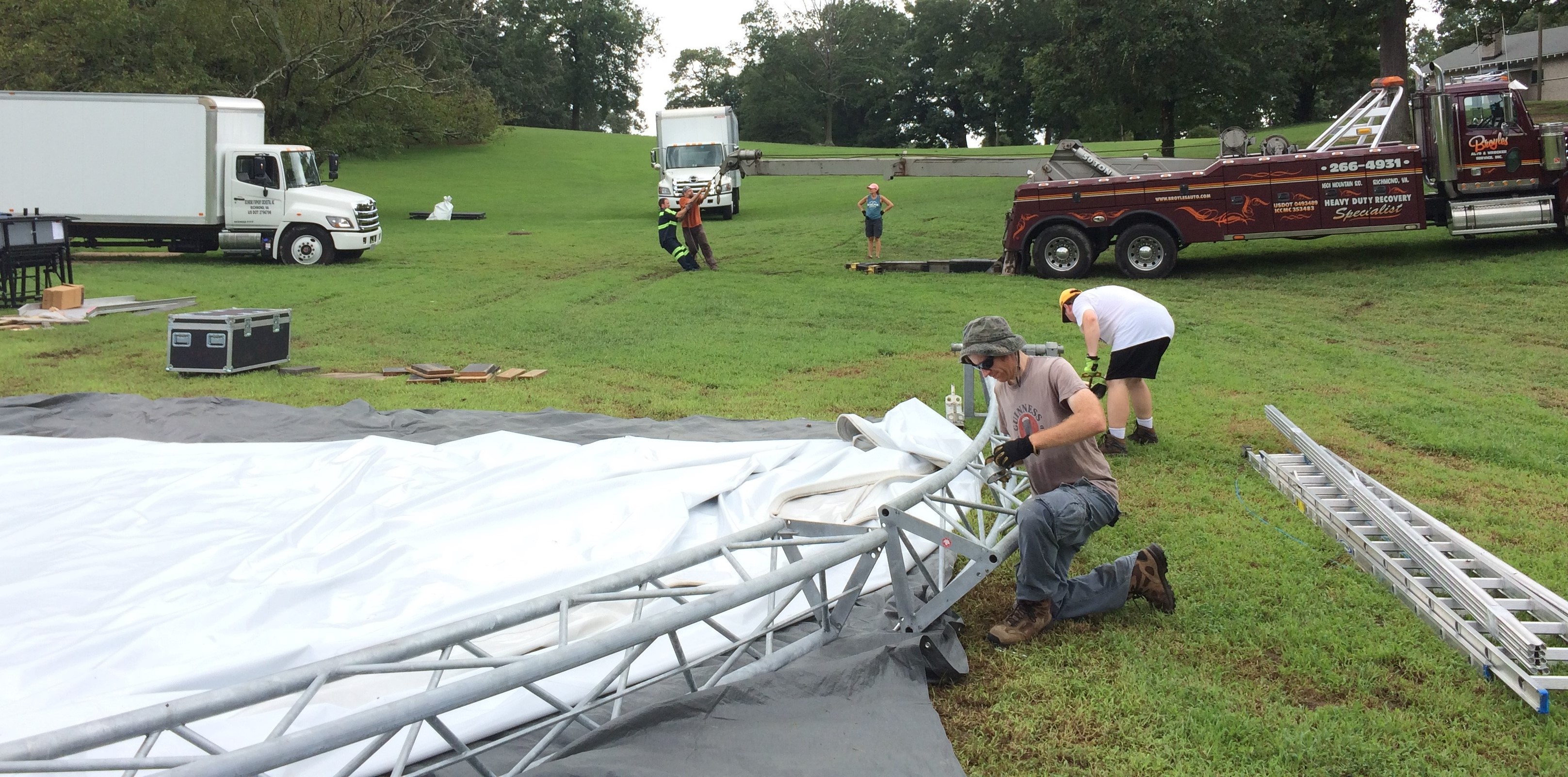
Blowing tires is a pain but it doesn’t happen too often. The biggest single pain is when the trucks get stuck and it happens all the time. Usually we know when the ground is saturated and we can lay out a track of plywood decking. We have to move them Egyptian-style as the truck moves and it is exhausting but a huge time saver. One time our stage truck got stuck so badly we had to call the biggest wrecker I have ever seen to pull it out. Then the wrecker got stuck. There was a season where the truck got stuck almost every other job and sometimes there just any other way around it.

Leveling the truck to the stage: the shims also make it easier for the truck to pull off without spinning into the ground.

Note the truck in the top left corner with front wheel buried to the rim in soft ground
Photo credit Tim Posey

Puttin’ on the Fritz was commissioned by an old friend of mine that I went to music school with. It was built for his brother, a member of the Army Special Forces. My friend and I have worked in similar industries where teamwork at a high level is essential, and this is no doubt the case for his brother. I designed a beefy fighting/utility knife with a harpoon point and a hardened skullcrusher on the butt of the blade. “Puttin’ on the Fritz” is a nod to the things that go wrong, and how we respond to them. It’s not a matter of if but when. Having a really good team helps you to accomplish things bigger than yourself and move through the adversities.

A quick sketch
Roughing out the profile
Profile dialed in.
That scribed line will become the final cutting edge.
Bevels are ground in.
Removing the machine marks.
Hardening- this is almost hot enough.
A little blurry after tempering
Laying down a satin finish.
600 grit
Skullcrusher
An old pair of work dungarees
Cutting the material for layering
These pieces will be layered in fiberglass resin.
Ready to be smashed together.
The raw material.
PCB fiberglass from a computer board blank that was rescued from a dumpster.
220 grit.
1000 grit.
Ready to be riveted and glued.
Clamped.
Ready to shaped
Ready to be contoured
Contoured
This is polished to 120 grit. The higher the grit you go, the more the material speaks.
Etching in the maker’s mark
Puttin’ on the Fritz

Puttin’ on the Fritz is made of high carbon steel, which means it will take a keen edge, hold it a good while, and will be easy to sharpen. It will stain and patina and tell the stories of the places you’ve been- this natural and characteristic of the steel. It came to you coated in EEZox gun oil, an oil based film that protects the finish. Your knife is made to be used so don’t be shy about getting it dirty. Be sure to keep your knife clean and oiled when not in use. Should you find any unpleasant surface oxidization you can remove it easily with a lightly oiled bit of 0000 steel wool, or a coarse rag with a bit vinegar on it.

Knifemaking: on hitting your mark, and The Crack Shot

“Each arrow leaves a memory in your heart, and it is the sum of those memories that will make you shoot better and better.”

Paulo Coelho- The Archer

A few years ago I went to go see a modern dance piece with my girlfriend. It was called “Tensegrity” and was based on the idea of tension in cells: wherein the structure of the cell is maintained through continuous tension in some of it’s supports and continuous compression in others. When any one of those tensions or compressions are interrupted the cell falls apart, or at least that’s my understanding of it. This idea has been around since the 1960’s, and is a portmanteau of “tensile” and “integrity”. These days the idea is used a lot in contemporary architecture and to make coffee tables and other furniture. There are loads of these tensegrity tables and sculptures on Pinterest, but the first I had ever heard of this was at that performance.

The choreographer of this piece is a good friend of of ours and after the performance we went to get a drink with him. I’ve always admired how prolific he is, constantly moving from piece to piece, work to work, and the way each performance had it’s own voice and character. I was a bit stuck at the time and was curious how this man could take shot after shot and always hit his target. So I asked him.

He told me that whatever you do, you have to do a lot of it, and sometimes badly. Everything is connected, he told me, and each piece builds off what you have done before and is fed by your collective experience. Always keep going, and always be thinking of what’s next. At least I think that’s what he said; a fairly liberal number of martinis and fireball shots were consumed and things started to get a little fuzzy…

Over the years I’ve thought about that night, and how seemingly incongruous disciplines fit together to propel a skill or craft forward. You hear about football players taking ballet but I met an orthopedic surgeon who was an ace pickle maker, and one of my favorite knifemakers is an avid botanist. So when you find choreographers exploring contemporary cell biology or bowhunters dabbling in Vipisanna meditation, you will probably find that they are drawing connections that are deepening and balancing something. Whenever I talk to people who are really good at what they do, I find there is an ocean of eclectic and varied experiences just beneath the veneer of whatever it is they practice that adds something special to their work. The sum of our experiences can always help us hit our mark.

The Crack Shot is a nod to this idea that the sum of our experiences can always help us hit our mark. It was built for a hunter and a woodsman. “Crack Shot” is an homage to his grandfather, the original Crack Shot, who taught him about being with nature, shooting, and how to hit your mark. It is the intention of this knife, with it’s blend of handmade and reclaimed material, to help it’s recipient remember the man who helped him be where he is today.

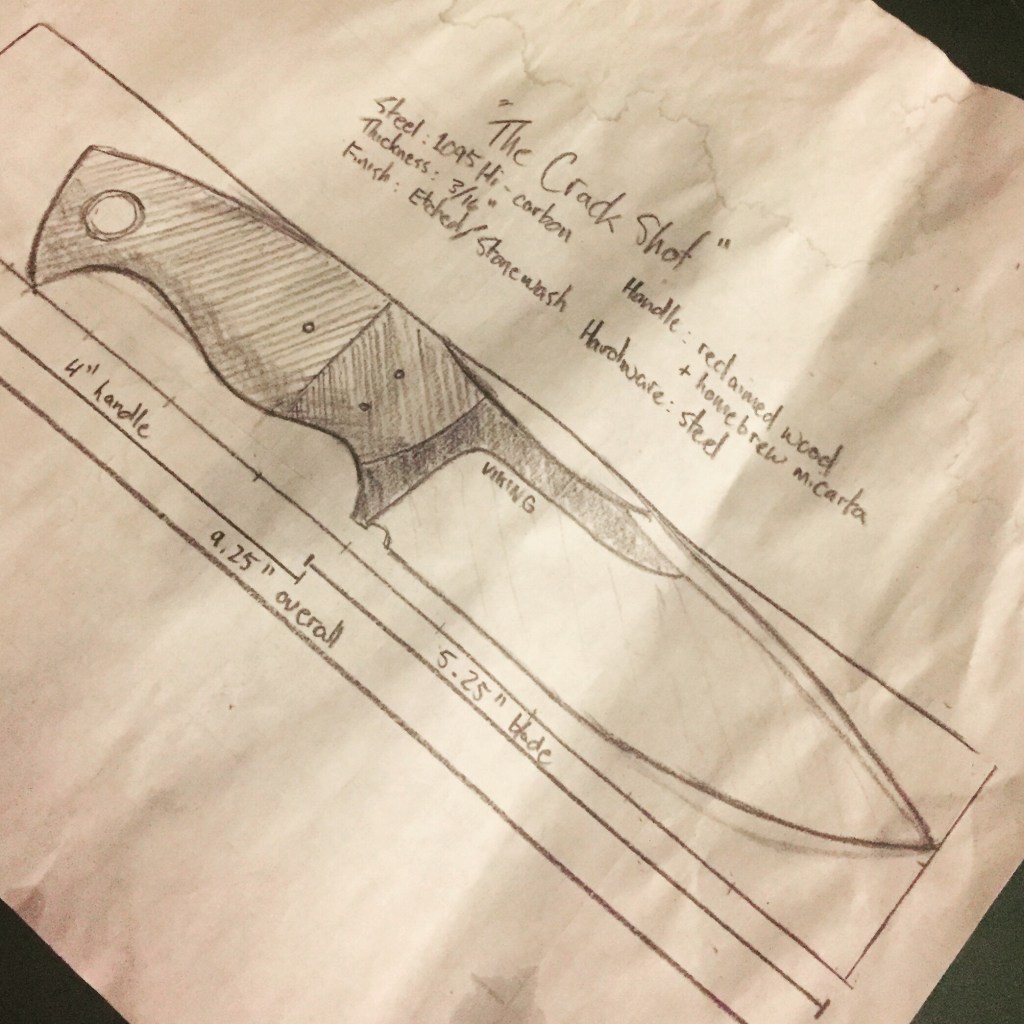
A quick sketch
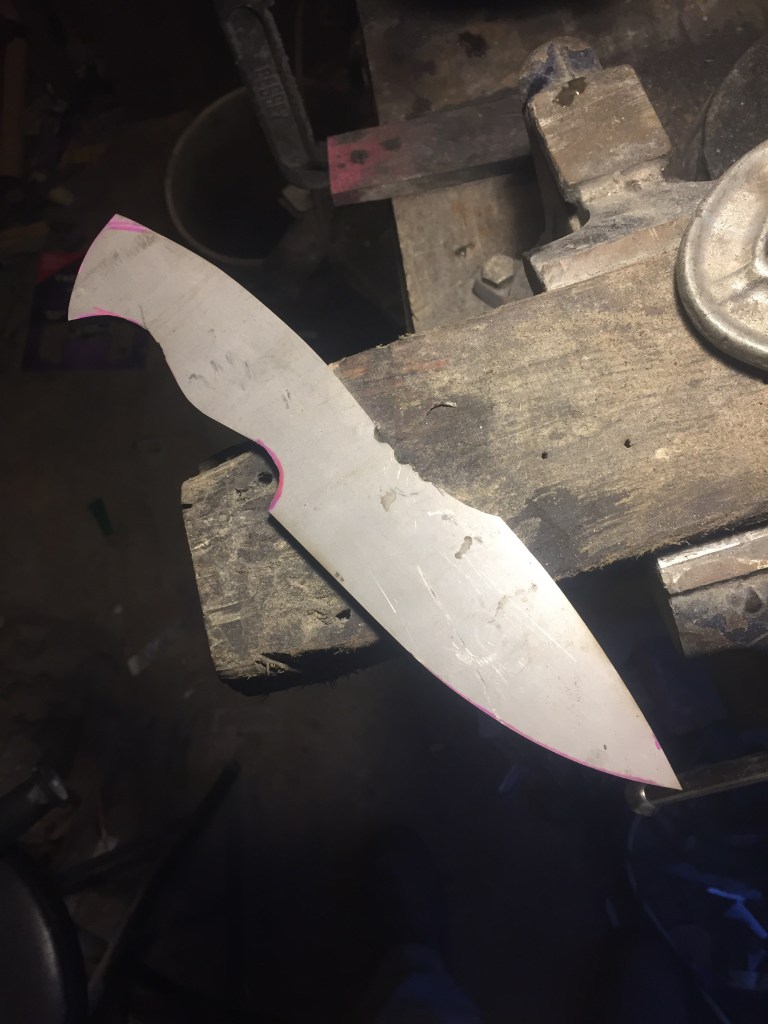
Roughing out the profile
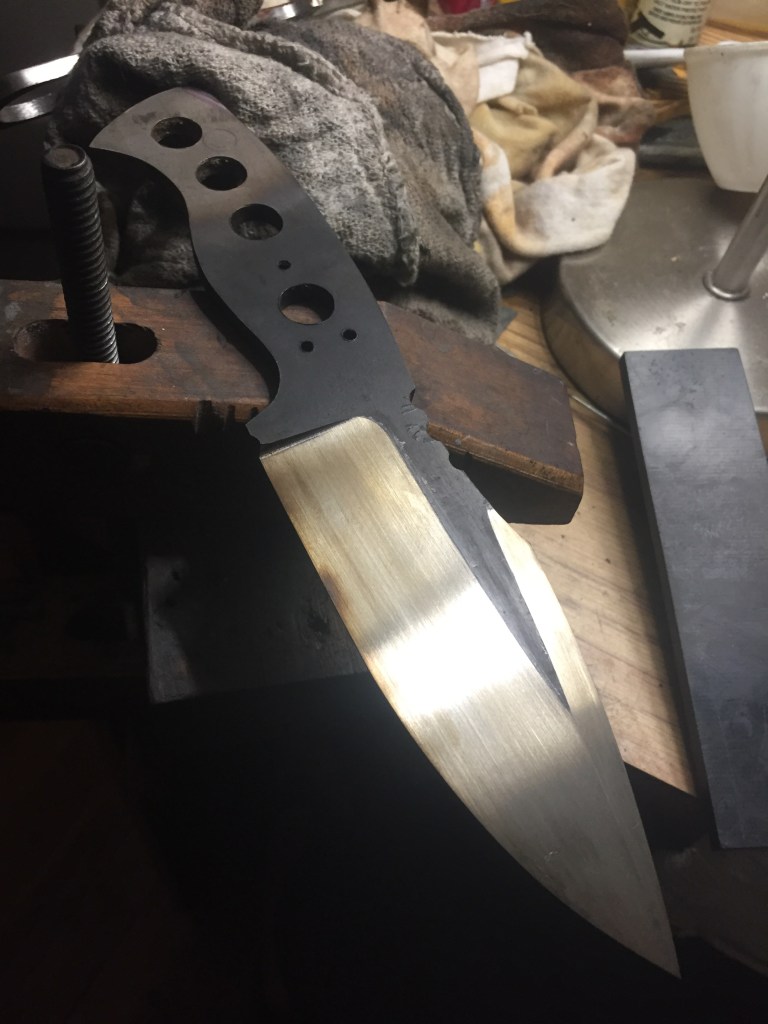
Grinding in the bevels and swedges. Since this is thick stock, the swedge will make a finer point for piercing.
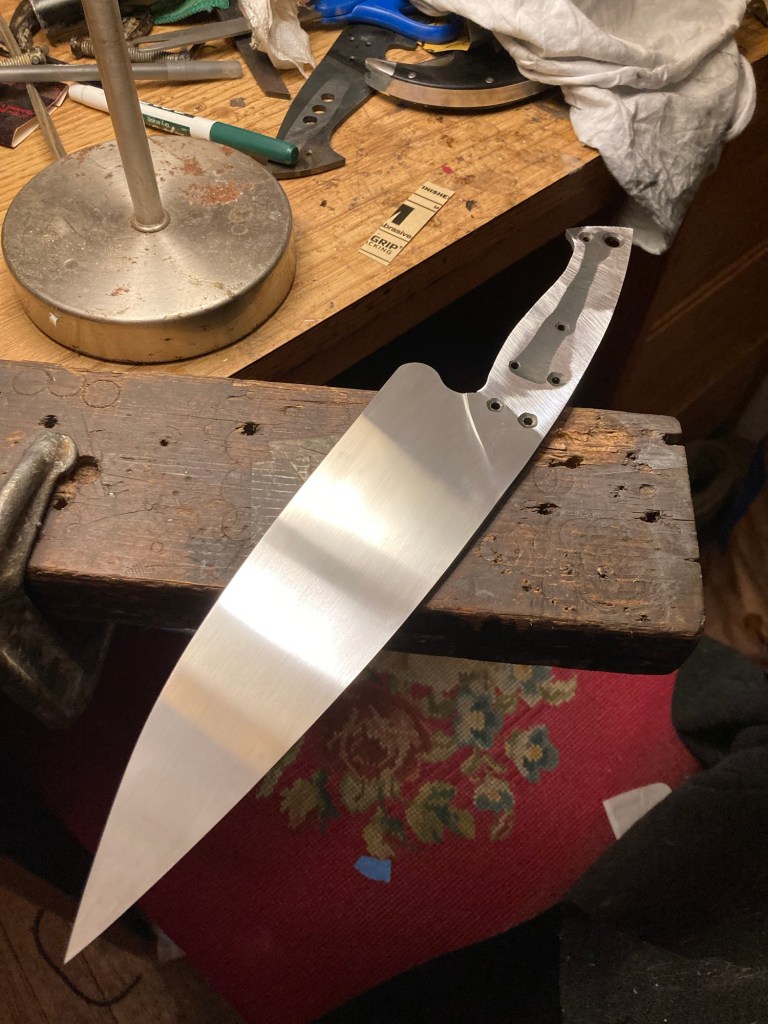
Removing the machine grinds by hand. This will make polishing easier after heat treatment.
Almost there…
Post-quench cooling.
After tempering- note the faint straw colors. This has drawn much of the stress out of the blade that built up during quench, making it much more durable.
Hand sanding….
…to a nice satin.
Etching in the namesake.
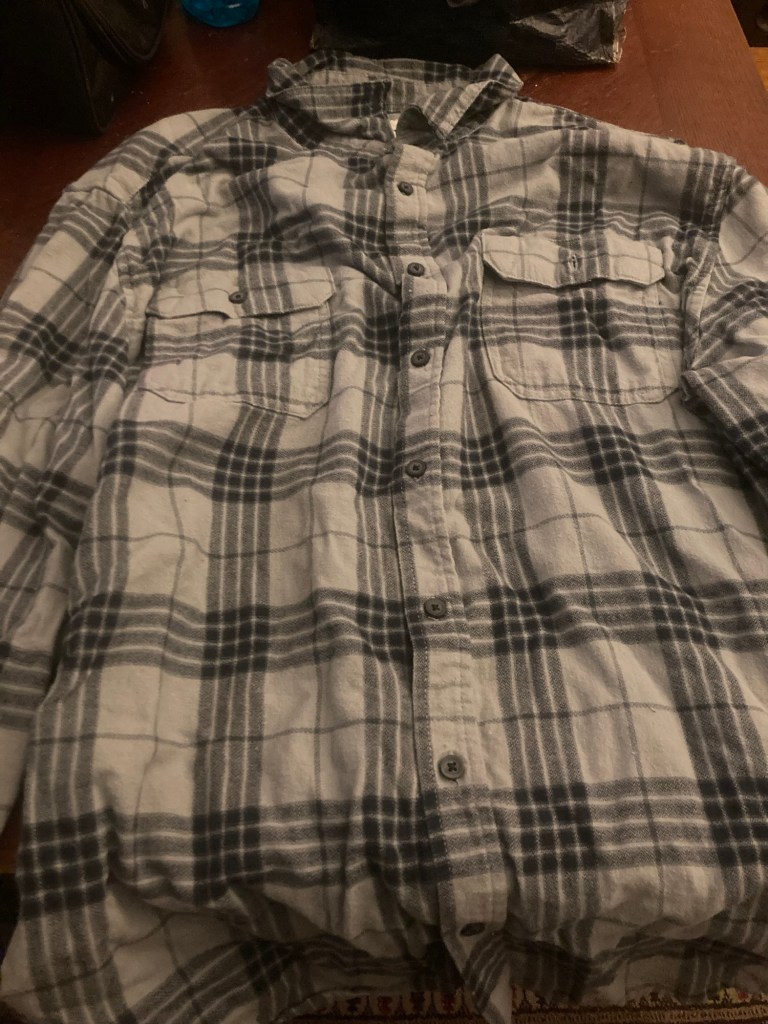
The client wanted something masculine and woodsy. I find there are few things more timeless that flannel and denim.
Alternating layers, so each piece should form a grain and be able to speak more articulately.
Prepped.
Each layer of clothes is smothered in fiberglass resin.
Now to smach everything together.
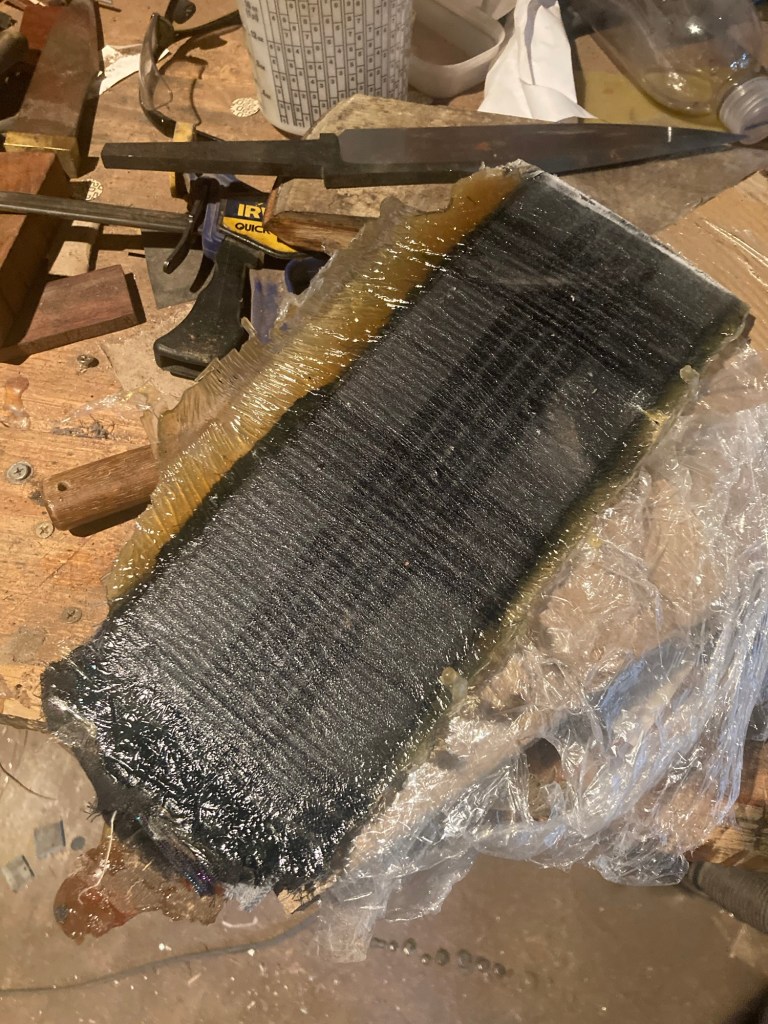
This is the raw material. All the layer have been permeated with resin, making everything a solid block.
Cutting out the bolsters.
Drill rivet holes.
A rough mockup so I know how everything fits together.
This gets sanded before glue up. I won’t be able to get to this part after everything is glued and riveted together.
All sanded up.
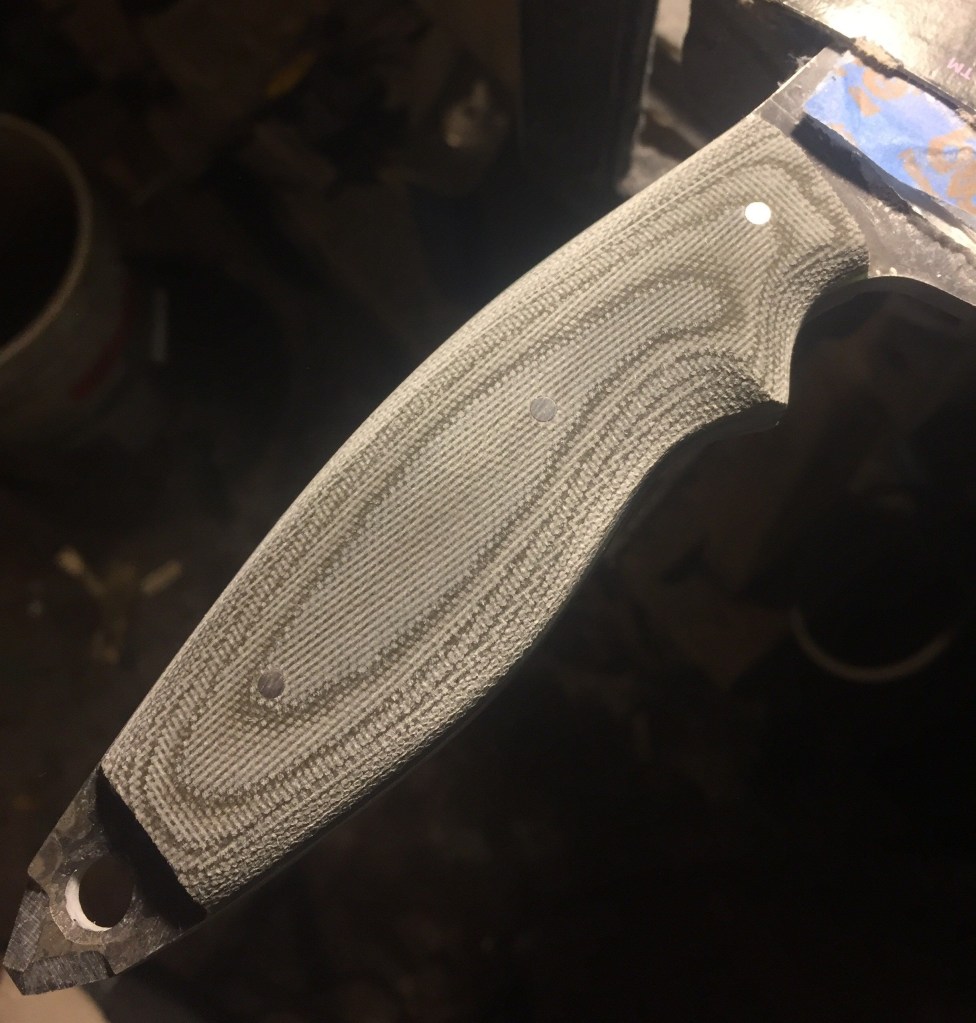
A piece of block walnut. I was doing tree work at an artist’s house in Charlotte Court House, Virginia. He had loads of this stuff. It was milled by his neighbor, a retired parishioner who started an abbey in South Korea in the late 1990’s to help North Korean defectors acclimate to a free country. It is very beautiful wood.
Bookmatched.
A fiberglass PCB blank for a network chassis full of hardware that runs your internet. This was rescued from a dumpster.
All laid out and everything fits together.
Two-ton epoxy resin.
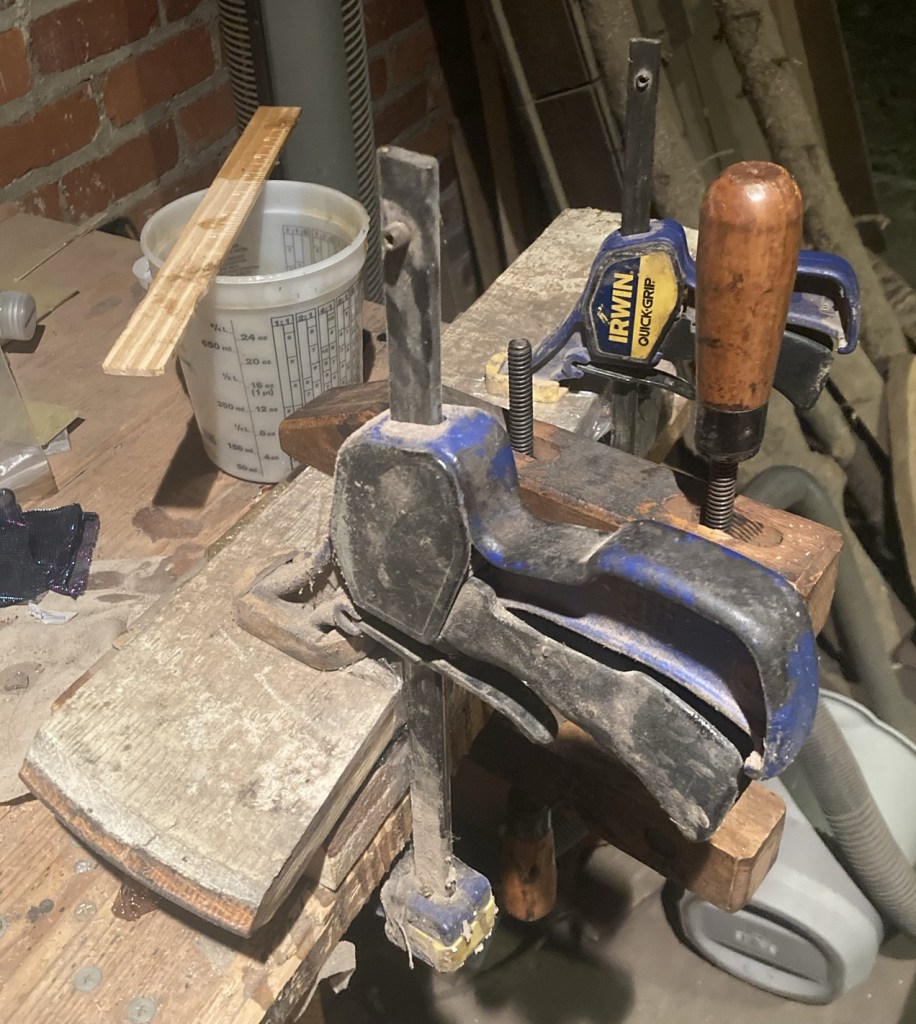
Clamped.
Now for shaping.
The Crack Shot.

The Crack Shot is made of high carbon steel, which means it will take a keen edge, hold it a good while, and will be easy to sharpen. It will stain and patina and tell the stories of the places you’ve been- this natural and characteristic of the steel. Your knife is made to be used so don’t be shy about getting it dirty. Be sure to keep your knife clean and oiled when not in use. Should you find any unpleasant surface oxidization you can remove it easily with a lightly oiled bit of 0000 steel wool, or a coarse rag with a bit vinegar on it.

Some further reading on cellular tensegrity referenced in the text body above:

Constructing Tensegrity Structures From One-Bar Elementary Cells

Knifemaking: the Halvard

“Kinsmen to kinsmen should be true.”

~The Saga of Olaf Haraldsson, c.186

The Halvard was built for a retiring military commander and commissioned by his crew.  A battle ready knife, built to use, but equally at home on display with merits of a successful career.  

Made from 1095 hi-carbon steel with a forced patina: a rugged appearance lending itself to rugged tasks.  The handle is made from a pair of BDU trousers, a nod to service, and a reminder that, though he may no longer wear the uniform, the uniform is always with him.

This knife took a long time to build.  About midway through the build we had to shutdown our shop due to a global pandemic, and getting back into the swing of things hasn’t been easy.  Nevertheless as we build these knives, we find that the knives also build us.  Halvard is a Norse name meaning “rock guardian”: solid, unbending, and steadily dedicated to the task at hand.

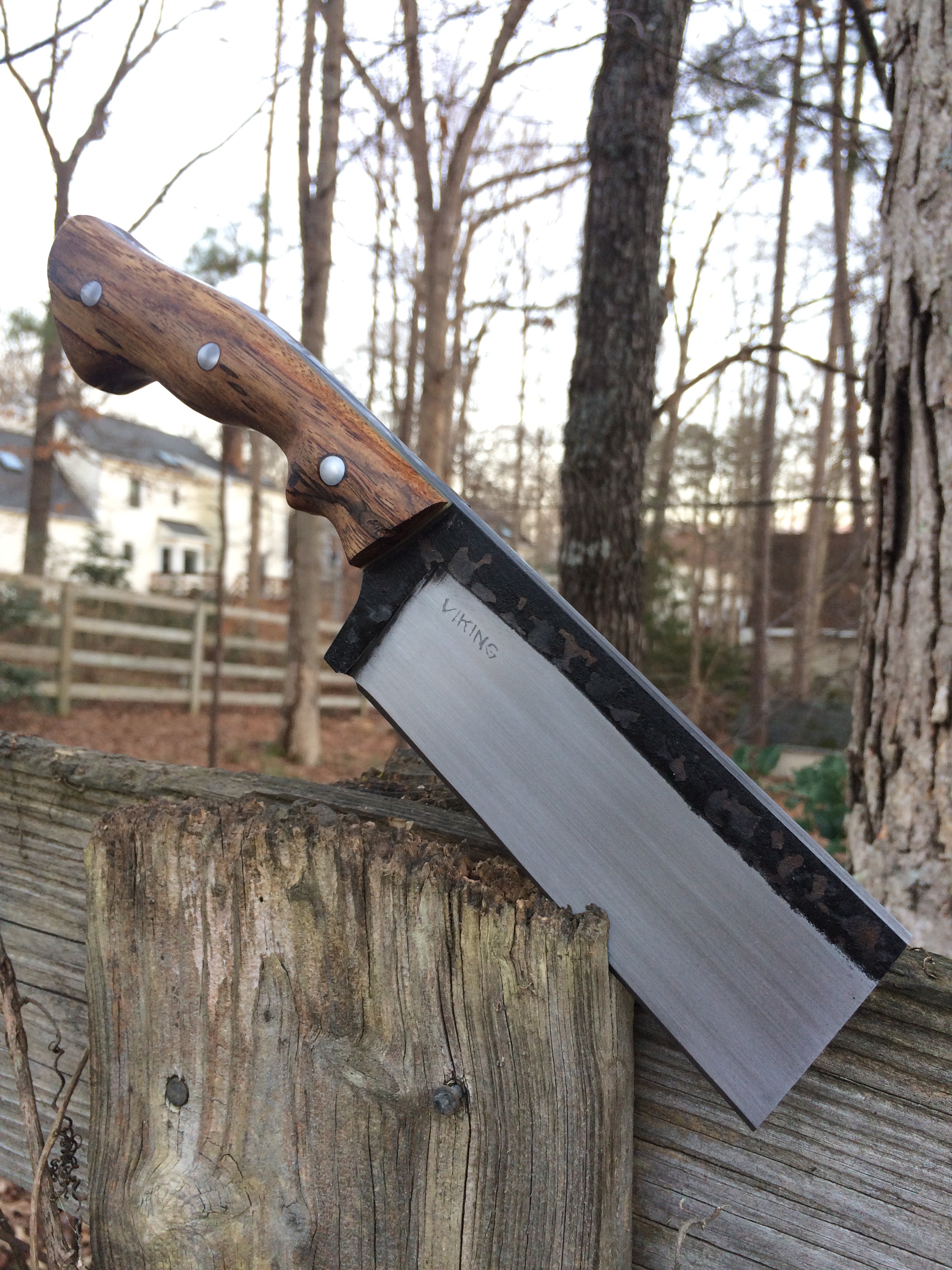
It was a pleasure building this knife for a group of Vikings.

halvard1

halvard2

halvard3

halvard4

halvard5


Knifemaking: The Ace, revisited

“When we are children we seldom think of the future. This innocence leaves us free to enjoy ourselves as few adults can. The day we fret about the future is the day we leave our childhood behind.”

Patrick Rothfuss- The Name of the Wind

(you can read about the original crafting of this knife here)

As I approach early middle-age I find myself surrounded by the children of my close friends.  They are marvelous little beings, unfettered by the troubles of the world, and always see possibilities and wonder around every corner.  In watching many of them grow up I feel like I’m let in on a beautiful little secret as they walk, talk, and become more cognizant of everything going on around them.  Boldly pursuing their curiosities, there is a pronounced presence in their endeavors and the way they move through their little worlds.

This unfettered presence of being is a subtle reminder that as an adult I am always second-guessing myself.  “I wish I had done that better,” I will think to myself, or “I wish I had been kinder.”  Rumination at the end of a bad day can trouble my sleep, and the thought of facing the day the next morning can be daunting.  I will often judge harshly my perceived tumbling through the world and wonder if I am doing any of this right.  There are moments when I find it hard to get excited about anything.  Many of the adults I confide in are often thinking the same thing.  These are merely symptoms of being grown in an extremely complicated world, and as many therapists have assured me over the years, are completely normal feelings to have.

Much of this melts away when I spend time with the children of people I’m close to.  They don’t think about any of those things.  As someone crashing through adulthood, I find that to be deeply reassuring.  I am also reminded that I am in fact an adult- no, you can’t have cookies for dinner, you can’t use your Ipad in the bathtub, and yes I do have to leave (please don’t be sad, I’ll be back).  I’m not sure how such big feelings can be contained in such tiny people.

About four years ago I made a blunted knife for the oldest child of some good friends of mine.  They have a house on some property in the country about 45 minutes out of the city.  They grow mushrooms and berries and have animals and forests.  I know the place pretty well- I helped them move out there.

There are now four children at their home.  They are farm kids in the summer.  I saw all of them the other week when I was doing a side job delivering some water containers to his dad, who uses them to run his homestead.  While he was sorting out another visitor, I went in to say hello to the kids.  They were all confused, except for the oldest, and asked me who I was and why I was in their house.

I told them who I was and that I was there to help their dad.  I was then barraged with questions and chatter- the oldest shows me their puppy, the second oldest tells me she doesn’t remember me, the third oldest asked me why I was there a second time, the youngest doesn’t talk yet but eyes me suspiciously.  Dad comes in and clears everything up.  I don’t think there are too many visitors during a weekday, and I felt that my presence was a happy little gift.  I’ve found the most sincere thing a kid can do is talk to you.

Before their dad and I unload the truck I brought in the oldest, whom I’ve known since he was three, wants to show me his treasures.  He pulls a box out of his room and starts removing things- some small folding knives, a bit of paracord, and a compass.  He is immensely proud and can’t even contain it.  I’m a bit jealous.  As a large man when I get excited it usually scares people.  So I quietly and secretly took in his excitement with him. Whoever figures out how to concentrate little boy excitement and put it in supplement form will make a mint.

His dad and I went out back to unload the truck and this little boy received instructions to make lunch for his brothers and sisters.  A few minutes he comes out with a peanut butter and jelly sandwich for me.  His dad hands me his blunted knife I made a couple years ago and asked if I could make it into a real knife.   I tell him I sure can.

Because in the end, it’s not just a knife.

This little boy isn’t thinking about the bigger picture but I am.  In seeing his reworked knife, I hope this little boy will learn to see what it is to grow and improve as he figures things out.  I hope that he will learn to look back on where he’s been and feel satisfaction in seeing how far he’s come.  I hope he will see what it means to put beautiful work out into the world and the empowerment contained within speaking his truth.  Most of all I wish him to not fret about the future and to trust in his tireless human spirit.  This is the lesson of the Ace.

This was the knife I made him four years ago.  It is a hardened and tempered butter knife that allowed him to get comfortable with carrying a bladed tool. 

The handle was coming off- we’ll put a new one on.  Off with the old:

The blade is re-profiled so it has a point and will cut:

img_7485

Giving him a good polish:

IMG_2835

Satin:

Black Walnut:

img_7486

img_7487

Computer board blank for spacing material.  Though it looks yellow, it will be green when fully polished:

img_7488

Drilling the rivet holes:

img_7489

The part of the handle that meets the ricasso is shaped and polished before glue-up:

img_7490

Glued:

img_7497

Profiled:

img_7505

Shaped.  From here on out it’s all hand work:

img_7506

The Ace, revisited:

img_7509


img_7511


Knifemaking: how I spent my summer vacation, and the Persuader, MkIII

“Warrior,

The bite marks soon will heal.

Warriors do not forget how it feels”

Stepdad- Warrior (Jungles Pt. 2)


(This is the second part of a story.  You can read the first part here).

On a late afternoon in mid July of 2018, three weeks after I nearly removed two of my fingers on a table saw, I found myself sitting with my girlfriend in a an empty group physical therapy room in a wing of the orthopedic center that had performed my surgery.  My hand had been repaired: a third of my thumb amputated and my index finger wired together to fuse the shattered bones and blown-out joints into one piece.

I had been ordered to physical therapy by my surgeon for two-part treatment.  The first part was wound care.  This would ensure that everything healed as it was supposed to, with no infection or complications, and to keep scar tissue to a minimum. The second part was the actual physical therapy, to regain as much use as possible in my injured hand, which which was currently completely bandaged with only my pinky and ring finger exposed.

I didn’t protest.  Nobody really talks about the aftermath of surviving something awful.  It will take the fight right out of you.  There is a truckload of emotional baggage that comes after the ‘get well’ flowers have wilted, the care cards have been boxed away, and normal life begins to resume.  Bills pile up and normal work responsibilities resume, but you are still fragile and adjusting and most likely carrying the weight of trauma.  Despair, depression, and existential crises of a behemoth magnitude are very real aftermaths of life-altering health emergencies as well as the emotional, physical, and financial burdens contained therein.  All of this greatly lowers your resistance, and I found myself more than willing to do what I was told.

This included a mountain of paperwork filled with verbiage of responsible parties, guarantors, and out-of-pocket maximums, essentially telling me that I would be paying for all of this for a very long time.  My girlfriend filled most of this out for me because I couldn’t even button my pants at that point much less sign my name.

In this room filled with all sorts of proprietary rehabilitative contraptions, I was introduced to Steve, an orthopedic hand therapist and educated hillbilly from West Virginia.  He was assisted by Justin, a former football player and mammoth of a man who was getting a Masters in Occupational Health and working in the office for the summer.  Normally this therapy room would be filled with patients but as it was late in the afternoon, it was just the four of us.

I found out, firstly, that hand therapists was a career that existed, and secondly, and paradoxically, they were the kindest sadists I had ever met.  As we sat down to remove my surgical dressings Steve told me that we would be spending a lot of time together and it was going to hurt a lot, starting immediately.   Boy he was right.  It took him half an hour to get the surgical dressing off as it had fused to my skin and surgical wounds with dried blood and other fluids and had two weeks to calcify to my skin and raw flesh.

Pain, as I would slowly learn, is an extraordinary teacher.  It reveals things about yourself that you most likely didn’t know were there, provided you lean into it a bit.  So I leaned in.  Steve was unrelenting and asked how I was doing.  I told him it hurt like a motherfucker.  “Great,” he said, “let’s keep going.”

When he finally disrobed my fingers I couldn’t look at them.  They looked like raw hamburger that had been stitched up.  I felt a little nauseous and so did my girlfriend.  Steve, however, said everything looked great and as it was supposed to look.  He bandaged my index finger and what was left of my thumb individually with inch-wide gauze dressing.  I was told to come back the next morning to get fitted for splints to protect my healing fingers and instructions for bandaging.

My girlfriend and I left and got Bojangles.  Bojangles chicken had become part of the healing process after one of my pre-operative visits several weeks before.  While the surgeon was concurrently examining my mangled hand, making a surgery plan, and giving me nerve block shots through massive syringes, my girlfriend was holding my other hand and staring away from the carnage and at a stack of magazines across the room.  There was a Southern Living magazine on a nearby table with biscuits on the cover.  “We need biscuits”, she whispered to me.  This was a welcoming distraction because I immediately stopped thinking about my hand and how much all of this was going to cost and thought about the glorious coming of biscuits and fried chicken.  From that moment on Bojangles became Orthopedic Trauma Chicken: the patron saint of reconstructive hand surgery, may her light ever shine upon us.

(Many months later one of her children broke their wrist and the other dislocated his knee.  They too learned of the virtues that Orthopedic Trauma Chicken offered.)

The next day I went back to the office early in the morning by myself.  Steve was waiting for me with some sterile wraps.  He explained to me that the bandages would serve as an infection barrier, but also to help my fingers to keep their shape as they healed, specifically my thumb.  In this early part of the healing process, he told me it was important to wrap them as he had shown me, as that was the desired shape that they would take.  I wasn’t to wash them or put any balms or ointments or disinfectants on them.  The body takes care of itself, he said, and I was to let my body do it’s thing.  Infection was a dangerous possibility and I was to call them if I showed any signs, but the 2,000 milligrams of antibiotics I took everyday kept that from happening.  I did exactly as I was told.  I left with two bright blue removable finger splints made from a thermo-setting plastic.  I could button my pants again.

I went there two or three times a week after work.  It was always in the late afternoon and usually only a couple people were in the therapy room.  Steve would unwrap my fingers and let them air out.  Justin would bring a small cup of water cut with peroxide that I would soak my fingers in for about half an hour.  Steve would then pick off the eschar with forceps to prevent scar tissue from forming.  Every few days he would remove a couple of stitches.  All of this was extremely painful and it went on for a month and a half but I was so glad for those two guys.  Steve would tell stories about the dumb things he did in the boonies of West Virginia growing up, and Justin would regale us with stories of dancing on the bar of a downtown drinking establishment.  Justin also had excellent playlists that he would have going over the speakers.  I came to really look forward to these appointments.

As I sat there soaking my fingers day in and day out I also noticed some other other patients there.  There were several gentleman with work injuries who were there on their company workman’s compensation.  There was a lady who had damaged a tendon in her hand with a kitchen knife, and a couple ladies and gentlemen with wrist injuries.  Steve and the gang tended to all of them.  There was one gentleman who stood out- a large muscular guy whose injury I couldn’t figure out.  I knew he wouldn’t be there if he hadn’t had something serious happen but I couldn’t discern what that was.  One day as I was sitting with my hand airing out waiting for Steve, I heard somebody tell me how good my fingers looked.  It was the large gentleman who came in everyday.  This surprised me because for one; I felt that despite what everyone at that office was telling me, my fingers did not look great and that I was a disaster, and for two; I wasn’t used to talking to anybody but the therapists outside of small pleasantries.

The large man then showed me his left hand and I saw that he only had four fingers.  His thumb was nothing but a nub and his index finger and the flesh immediately below was completely gone.   I had to look twice because it was so completely normal and comfortable for him that I didn’t notice at first.  Amazingly enough, that wasn’t even why he was there- he was an electrician by trade and had torn a major tendon in his bicep that had to be reattached.  His hand, he told me, had happened after an accident when he was nineteen years old.  The surgeon had saved his index finger, but he said he had it removed a month later because he was pissed off that it wouldn’t work right.   Young and dumb, he told me, and he wished he had kept the finger and learned to use it as it was.  He told me to figure out how to work through the pain and get as much use out of it as possible.

……..

While all this was happening I was going to work, and sorting out the massive stack of bills I had accumulated.  Even with insurance, this whole ordeal was phenomenally expensive.  I learned more about the financial workings of the healthcare industry than I ever cared to.  Shortly after the surgery, which was covered by my insurance, I got a $4,000 bill from the anesthesiologist, saying it was an out of network provider and not covered by my insurance.  After spending hours on the phone with the insurance company, the surgery center, and the anesthesiologist, I found out that it should have been lumped in with my surgery but wasn’t.  The reason for this was because the tax ID for the anesthesiologist’s claim was in-network, but the provider they sent wasn’t.  All three of them told me I was stuck with this bill and there wasn’t anything they could do for me.  Through some stroke of fate, I found that my neighbor worked in insurance and knew the billing manager of my surgery center and gave me her number.  I spoke with her once and I don’t know what she did but she waved her black magic healthcare wand and made it go away.  That was just one incident of many, but it was always a whiplash.  I renamed my mailbox the Mailbox of Doom because I never knew what fresh hell was going to be waiting for me.

As my hand healed, I got back into the shop a little bit.  Steve had told me that I would be able to do all the things I had done before, but I would definitely have to find different ways to do them.  Finding those different ways added up to teaching myself to make knives all over again.  I found myself thinking of a professor I had in music school.  The man was a brilliant concert pianist.   I didn’t find out till much later that he had suffered a stroke and had to teach himself to play piano all over again- I had no idea of this when I was taking class with him.  The man had since passed and I found myself wishing to be able to ask him about what the rehabilitative process looked like for him and how it felt.

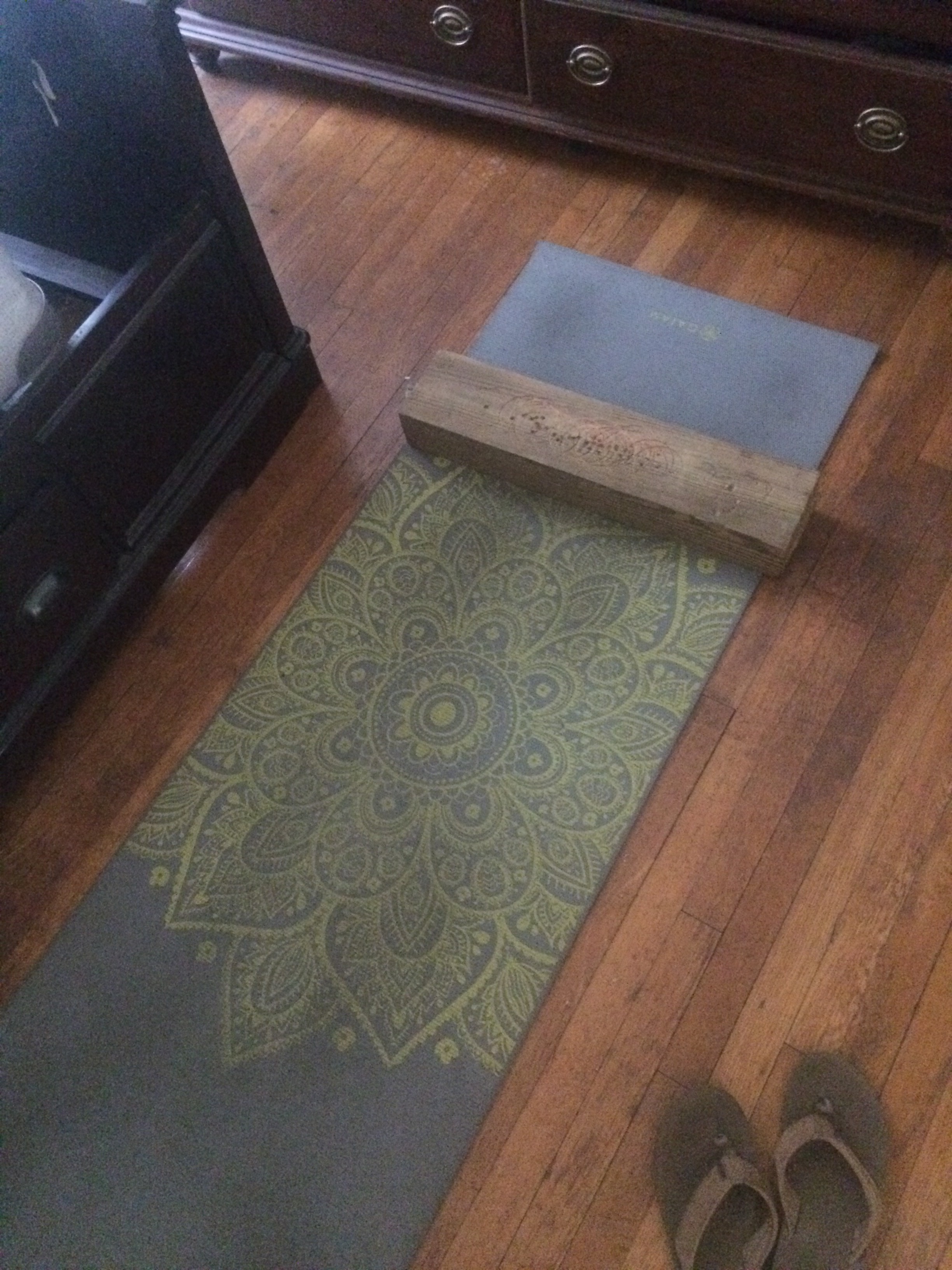
I also called my yoga teacher.  I missed being able to do yoga and asked Steve what I could and couldn’t do.  He told me I could put weight on my forearms, but not my hand.  I told this to my yoga teacher and she choreographed a modified Ashtanga series for me that I could do on my forearms.  She told me to get some yoga blocks to help facilitate this.  When I saw how much foam yoga blocks cost, I decided I would just use a piece of treated 4″x6″ lumber cutoff that I had in my truck.  I did Viking Recovery Yoga a couple times a week and it was brutally difficult.  I leaned into the pain.
……….

Slowly I eased into more physical therapy work and getting facility back into my hand.  Justin had gone back to college and I often met with another therapist, Kay, a lady from Puerto Rico.  She was fantastically kind and gentle, and always wore fiercely hip shoes.  Her husband was retired military and they went on wild adventures on the weekends.  She showed me pictures of a trip where they had taken visually impaired kids on a whitewater rafting trip- all the kids in the picture are tearing ass down river rapids and had on the giant sunglasses that you see the elderly wearing.  At first I wondered how she functioned in such a deeply masculine work environment but the reality was that she was probably the wildest of everyone.

With Steve, I always took a ‘make it suck more’ approach to physical therapy.  Make me do more, give me more things to work on at home, kick my ass a little harder, I’ve got to do better.  With him it was like being at the gym with a buddy.  While I was working through my brutal hand exercises, he would be timing me and telling me about his last bow hunting adventure.  One time he had me dig twenty marbles out of five pounds of silly putty with my two gimpy fingers while he went on a soliloquy about a regional restaurant chain in West Virginia with the best damn breakfast biscuits he had ever had.

With Kay everything was a little bit gentler.  I still pushed but the drive was more subdued.  Conversation was turned inward and bravado was dialed way back.  She asked about how things were going in the shop and I would do my best to articulate all the digital nuances I was navigating and modifying.  My type A disposition would be disarmed before I even knew it was happening and she would talk me through issues I was having.  It was a lot.  After I had spent forty-five minutes struggling with an exercise, she would always tell me I was doing really well.  I would then go sit in my car and cry before I drove home.

……..

 In December I had another smaller surgery to remove the hardware that had been in place while the bone in my index finger fused.  Compared to everything else it wasn’t that big of a deal.  In February of 2019 I had my last post-op follow-up with my surgeon.  Before he discharged me from his care and the care of the physical therapists, he told me I had healed very quickly and my results were not typical of people who sustained my severity of injury.  I told him that I didn’t have a gold plated insurance plan and zero workman’s compensation.  If I gave up I would just sink.  There was no other choice.

I also told him that there were a lot of people who had invested a tremendous amount of time and energy into a very expensive process to help me, and it would be a huge disservice to everyone, including myself, if I didn’t honor that by doing the best that I possibly could.

This was the first knife I completely finished after I was discharged.

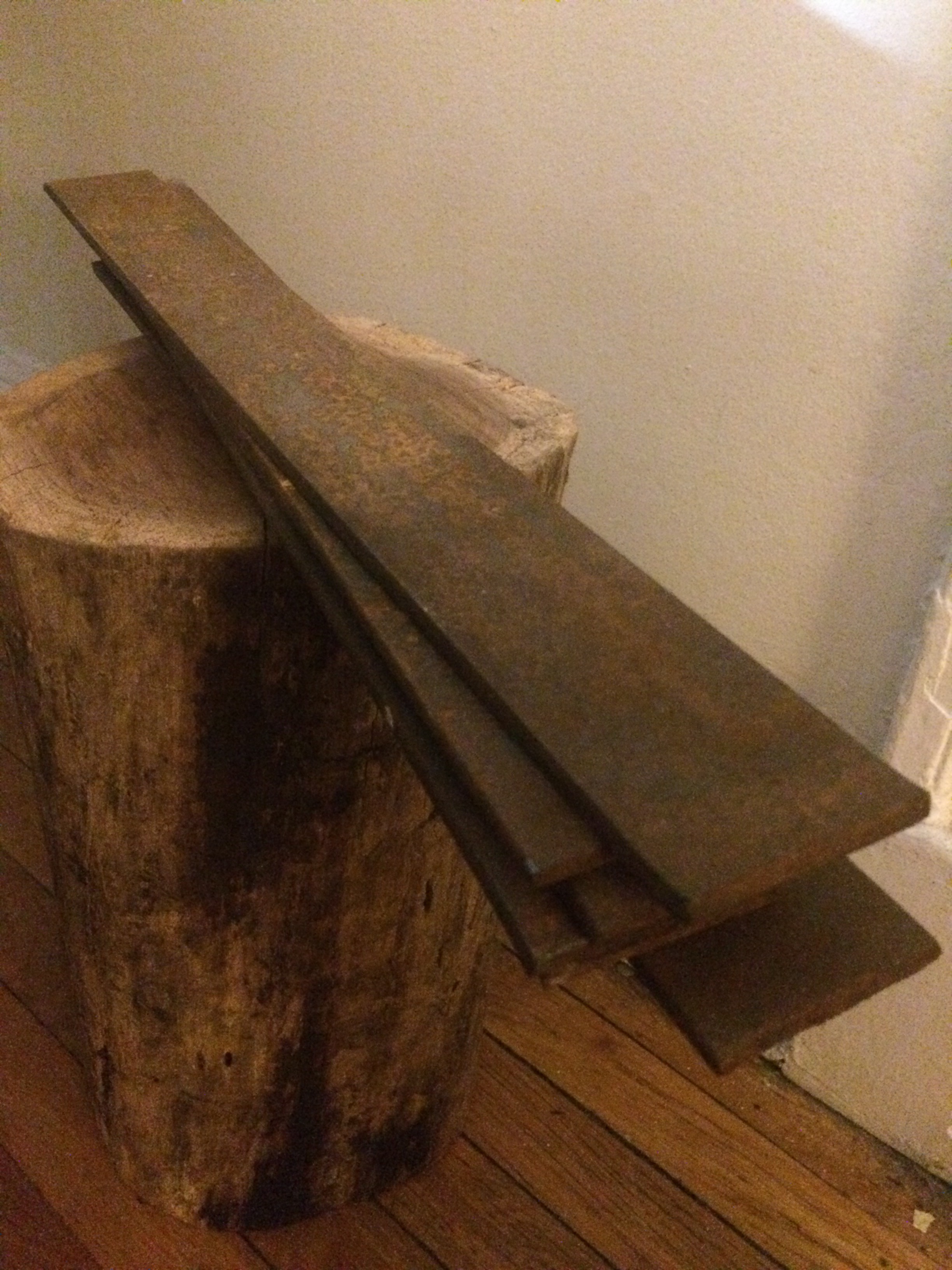
This steel came from a friend.  The man they bought their house from made lawnmower blades and they found these in the garage when they moved in.  This is a 1/4″ oil hardening steel:
persuader1

Rough grinding:

persuader2

Hand sanding before hardening:

persuader3

persuader4

Hardened

persuader5

Tempering:

persuader6

persuader7

Satin finish:

persuader8

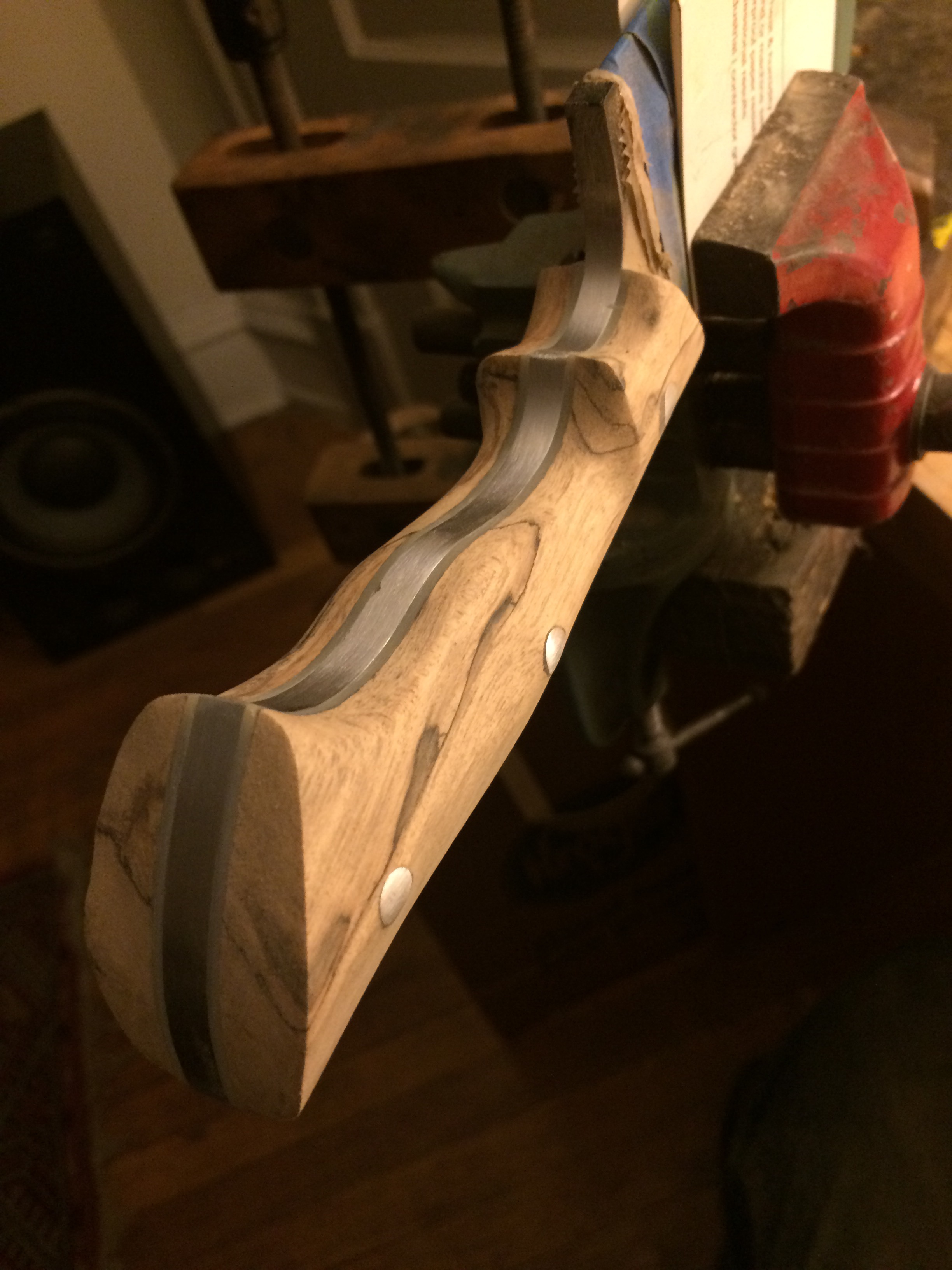
Spalted Pecan from my cousin in Texas:
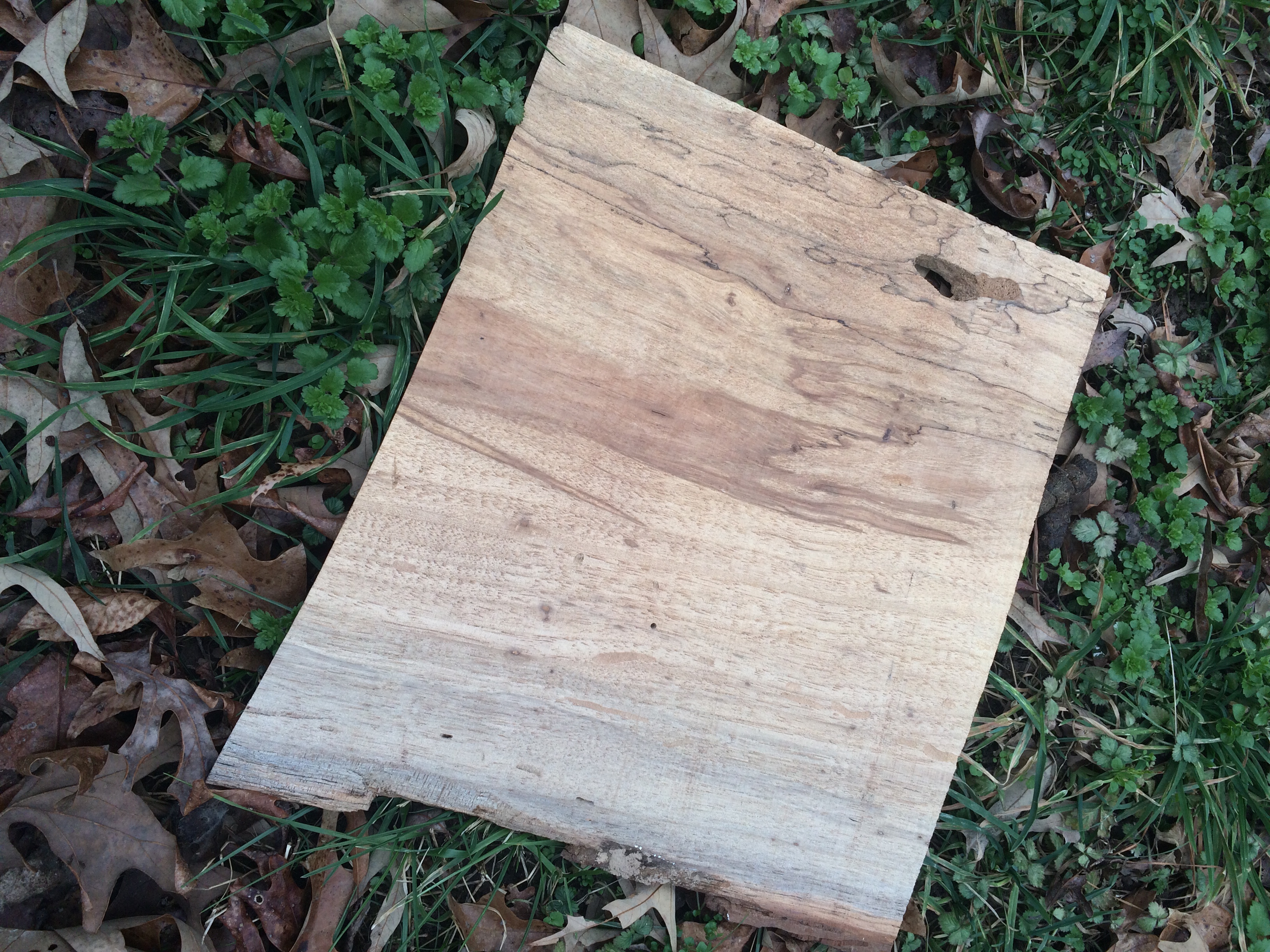
The black lines weaving their way through the grain is actually a fungus.  This fungus that injures the tree actually makes it more beautiful:

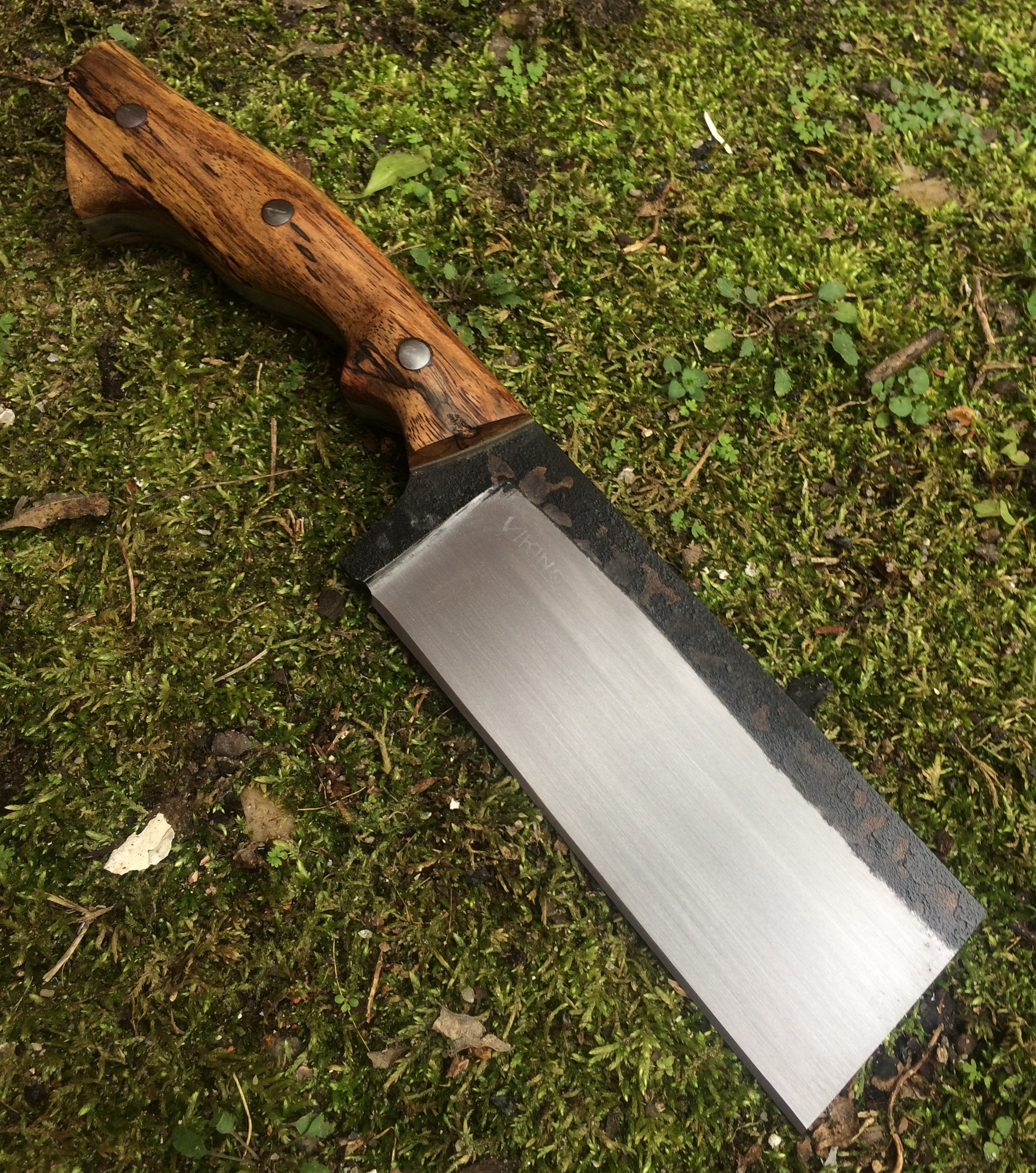
The Persuader:
img_6427.jpg

Move on, but don’t forget how it feels.


Knifemaking: The Things That Come to Us- A Restoration

“i imagine that yes is the only living thing.”
― e.e. cummings


There are many things that come into our own personal worlds- children, possessions, problems, blessings and a myriad of others.  It’s not so important how or why they enter our lives, but what we do with them.  It expends a great amount of energy to ponder what we may have done to deserve the painful and traumatizing events that come to us, and an equal amount of energy is wasted when we wonder if we are worthy of the good things that are brought our way.

Because when we start dwelling on the why’s and how’s, we tend to become overwhelmed and lose sight of what best needs to be done with what comes into our lives.

And within that judgement of why and how, we start to say no to things.  We become afraid we may be hurt, or that we may fail ourselves or those we care about.  Perhaps we are afraid of making ourselves unsafe.  Whatever the reason, in saying no we shut ourselves out of the blessing may be inside of a painful situation.  We say no to what may be a path forward because it is dressed as something unpleasant.  It is then that we become prisoners in our lives instead of seeing the ways we can be shaped and grow.  We should say no to things that are harmful and do not better us, but it’s always good to say yes to what life brings us.

The summers are slow for me, and sometimes I have to get creative in the ways I support myself.  I end up saying yes to many opportunities that under normal circumstances I would decline, usually due to time constraints, time away from loved ones, or a high probability of bodily endangerment (or a combination of all three).  Over the years the things I’ve reluctantly said yes to have usually been the most rewarding.

One of the times I said yes this summer was to a tree job in rural Virginia.  I was on a crew to cut down a huge dead tree.  Removing dead trees can be dangerous.  Rotting can occur in any number of unseen places of the tree, causing structural instability, and the tree may not fall where or when you desire it to fall.  This particular tree, though dead as a doornail, fell exactly as it was supposed to.

The client was an artist, and brought us French-pressed coffee.  We talked for a bit and I told him about making knives and how I got my materials.  He told me that he had some slabs of black walnut and that I was welcome to them.  They had been milled by a neighboring man who had run an abbey in South Korea, saying ‘yes’ to whatever fleeing defectors and dissidents from the North that the world brought their way.  Later he sent me an article about the man who cut the wood, you can find it here.  Black Walnut is expensive and isn’t something to normally fall into one’s path, so, in the practice of saying yes, I happily took some.

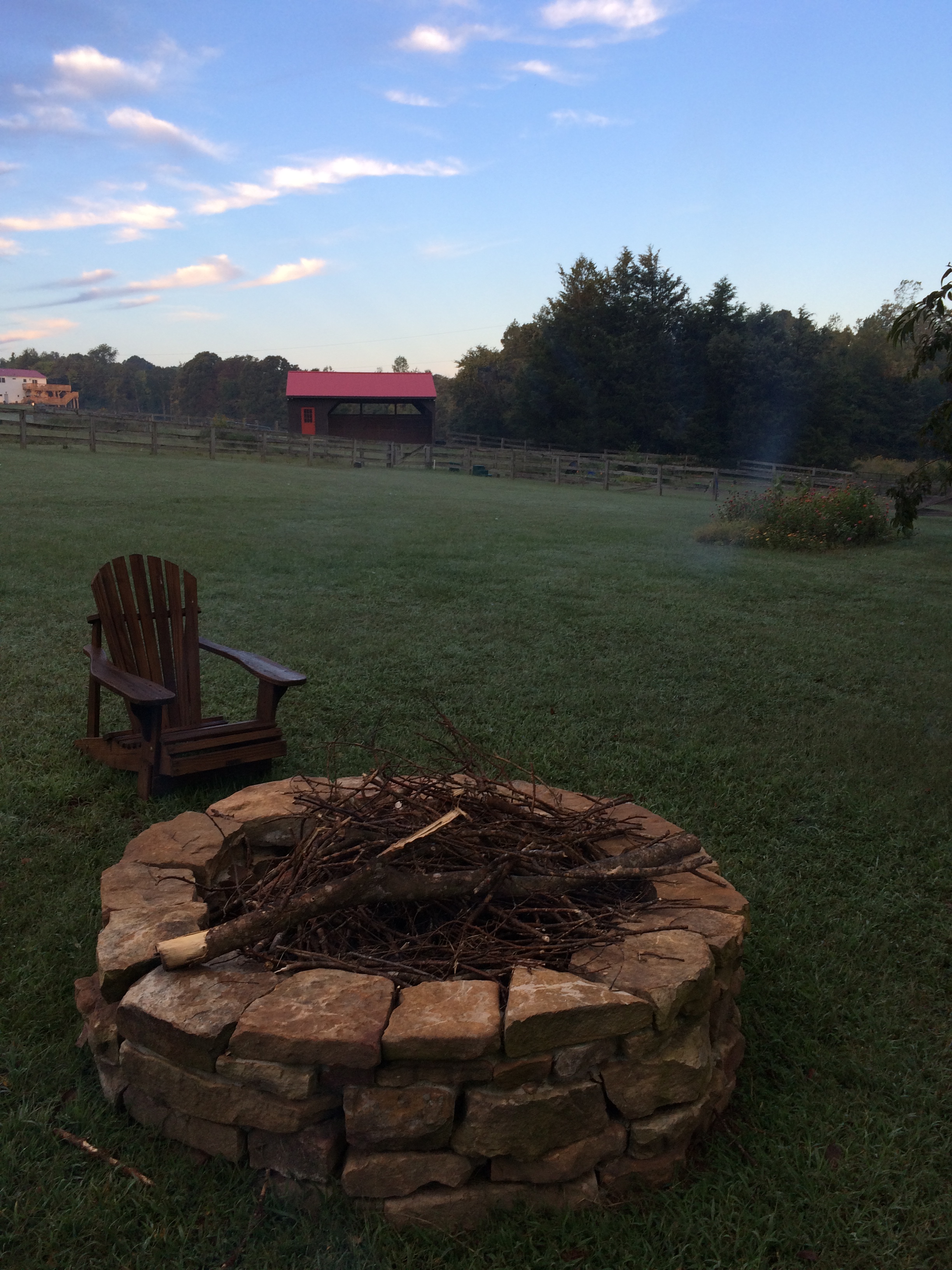
A week or so later I said yes to doing a bit of work on a good friend’s farm.  My friend is a busy lady and sometimes needs a hand with the upkeep of her property.  She and her family are good friends of mine.  I worked for her son for several years and like to get out to their property as often as I can.  It’s really beautiful:

IMG_2509

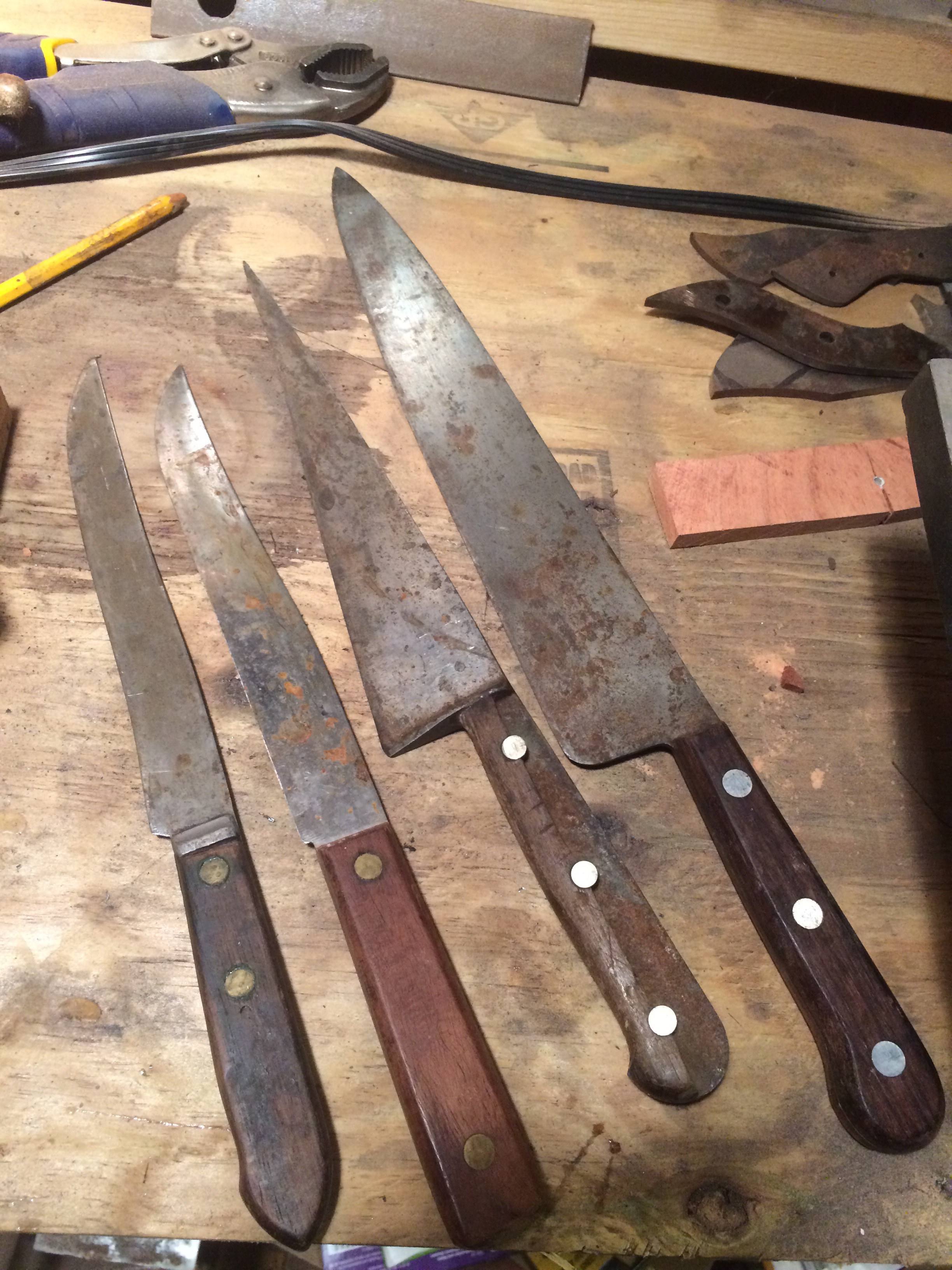
She had a set of knives she wasn’t sure what to do with.  They belonged to her late husband, and came to him from his grandfather, who was an Austrian immigrant.  He came to the United States in the early 1900’s and made his living as a chef, choosing to say yes to a new world and a new life.  She told me she’d like to have them restored so they can go to her children and stepchildren to remember their father.  I told her I would have a look at them and see what I could do.

Tools of the trade, from left to right:  A carving knife; a fish knife; a French slicing knife; and a 12″ chef’s knife

So these knives came to me, at least a hundred years old, and of deep sentimental value.   I started by removing the cracked and broken handles.
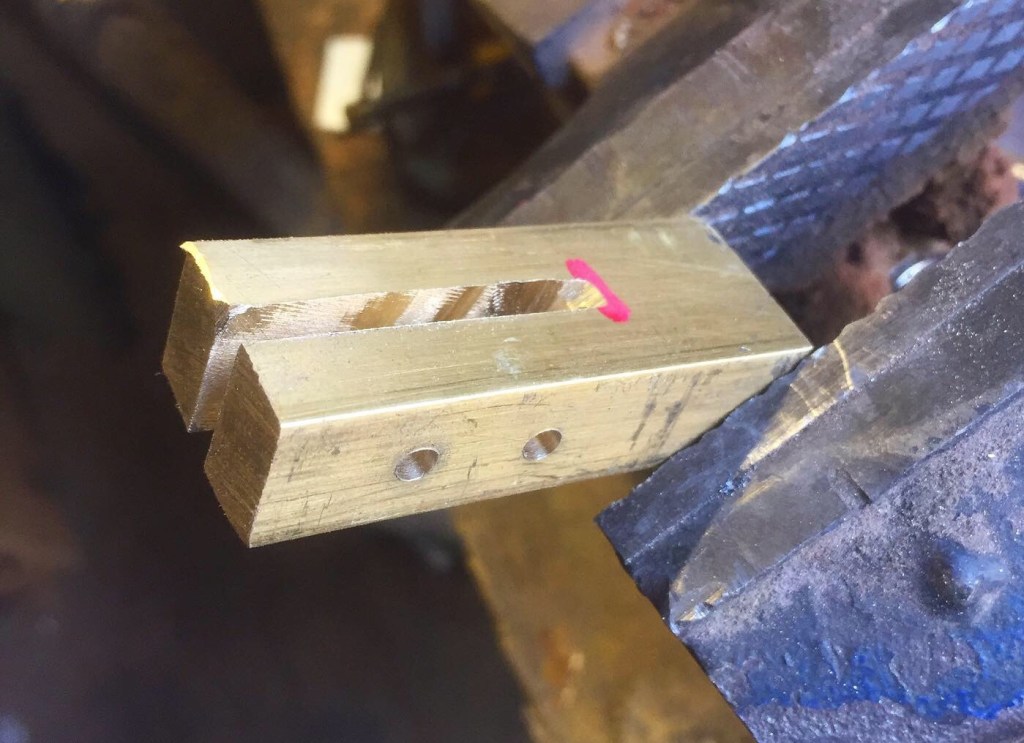
I cleaned up the corrosion and oxidization from the blades, but left much of the etched patina from their years in the kitchen.

In a continued practice of saying ‘yes’ I chose to use some of the Black Walnut I got from the tree job for the handle material.  It fit nicely into the story of these knives.  This is what it looks like sanded and polished.

All of the handles started as thin blocks cut from the Black Walnut.

Shaping.


The filet knife was only half-tang, so I extended it with mild steel from a sheet.

I added a G10 bolster and spacer for a bit of contrast.

After glueing and sanding.

Getting the fish knife ready for glueing and shaping.

The French slicer was tricky….

…but also an elegant challenge, with its tapered tang and integral bolsters.


Finished, they came out rather beautifully:

Say yes to the things that come to you whenever possible.  It’s always worth it on the other side.