Knifemaking: yes and no; and Urim and Thummim

“Take these,” said the old man, holding out a white stone and a black stone that had been embedded at the center of the breastplate. “They are called Urim and Thummim.  The black signifies ‘yes,’ and the white ‘no.’  When you are unable to read the omens, they will help you to do so.  Always ask an objective question.”

Paulo Coelho- The Alchemist

I took a philosophy class in college.  The professor was an older gentleman, and a bit mysterious.  He had us buy a very expensive textbook which we never used.  He was the one asking the questions and it was mostly us, the class, that did the talking.  We never learned much about him other that that he had had a bit of celebrity on the academic circuit several decades prior. In his younger days he practiced judo.  Later in life he discovered Tai Chi, and taught that as well.  He never elaborated on any of this.

I don’t remember much of what we talked about.  I was twenty-two and liked to go to class stoned.  I do remember there was some Kant in there, and some St. Augustine, and probably some ideas on relative morality versus universal morality.  I also remember one lesson we had, one about truth, and how all matters can be broken down into a yes or a no.

He gave an example: all cellular communication can be broken down into ‘yes’ or ‘no’.  ‘Yes I will fuse with this protein,’ or ‘No I will not fuse with this protein.’  ‘Yes I will bind to this synapse,’ or ‘No, I will not bind to this synapse.’  Matters that are gray in appearance only remain so until one goes deep enough to find a ‘yes’ or a ‘no’- and in many instances in our personal lives we never get to that point.  Sometimes the truth contains many yes’s and no’s.  Sometimes the truth is much larger than our own individual internal agreement or disagreements.  This is part of what gives life it’s mystery and beauty.

There was one particular assignment, a large one, that came up.  We had to write a 10 page paper on a topic we chose.  The professor had a list of topics to choose from.  We were to choose a topic with which we most disagreed.  I had found mine:

‘True virtue requires true religion’

He then flipped it around and told us that our paper had to argue in agreement with our chosen topic.  I didn’t know where to start.  I didn’t agree with this statement at all and was a bit stumped.  After many starts and stops I found a legal dictionary and first looked up the definition of truth, then of virtue.  I found a way to manipulate those very clean and sterile definitions to find agreement with a statement I didn’t agree with.  I don’t remember exactly what I wrote and I’m not sure how I got ten pages out of that but I was pleased with myself.

I got my paper back.  There were no corrections or suggestions.  Written at the top of the page in red ink was a little note saying that I had made my argument using a clever lawyer’s trick.  I got a C.

Over the past dozen or so years I’ve thought a lot about this.  Truth is something that just is.  It is the yes or the no.  The point is that the truth of things can’t be manipulated.  There is discordance in the world because all of us are trying to manipulate the truth to serve our needs, to pacify our fears and insecurities, to indulge our convictions, and to fit into the way we believe things should be.  In spite of these dances we do, at some point everything will break down into yes or no.  When things appear to be both yes and no at the same time it only means that the truth isn’t fully visible at that point.

This doesn’t mean things are clear or easy.   Black for one person may be white for another, and vice versa.  It won’t always fit into nice agreeable little boxes.  I was working with teenagers and there was a young girl who was acting out horribly.  After speaking with her mother, I found out that her father had left the family to go live his life as a woman.  The young girl had a very strong ‘no’ to her father’s insurmountable ‘yes’.

At some point decisions have to be made and assistance may be needed when one can’t always read the signs of which path to take.  Sometimes we can bring an external influence in to help us to get to our truth, our own personal “yes’s” and “no’s”.  This is the where Urim and Thummim come in.

This two-knife kitchen set was a commission for a good friend and former teacher. He is a man who taught me how to look at matters deeply and to think about things critically.  We were on a farm for this past Thanksgiving and I noticed that he had been reading The Alchemist by Paulo Coelho.  This is a book that is special to me, and was given to me during a time when I was having trouble reading the omens.  It was the inspiration for this set, and an exercise of gratitude for this man, a sort of alchemist himself, who has helped me to find my own truths over the years:

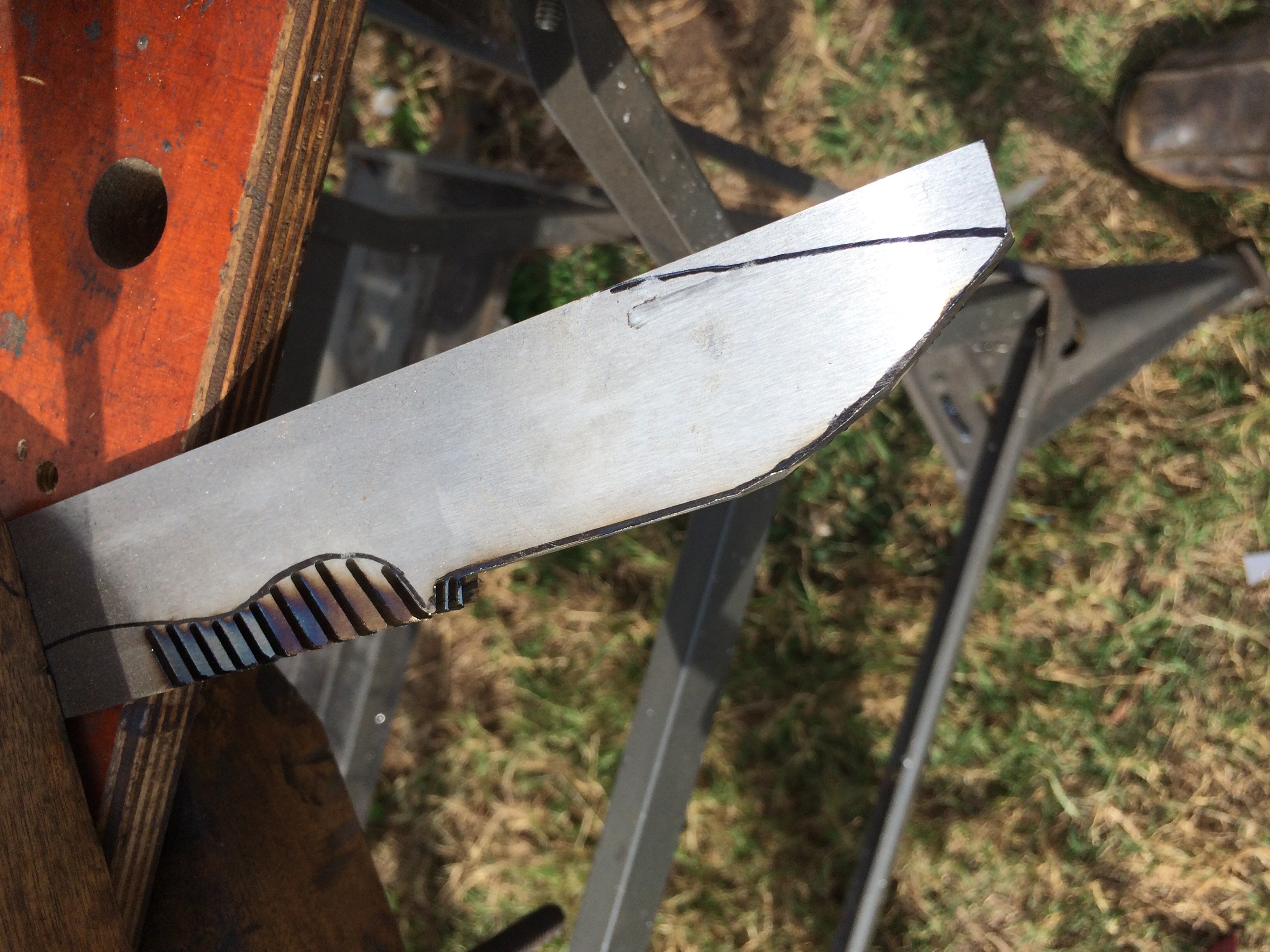
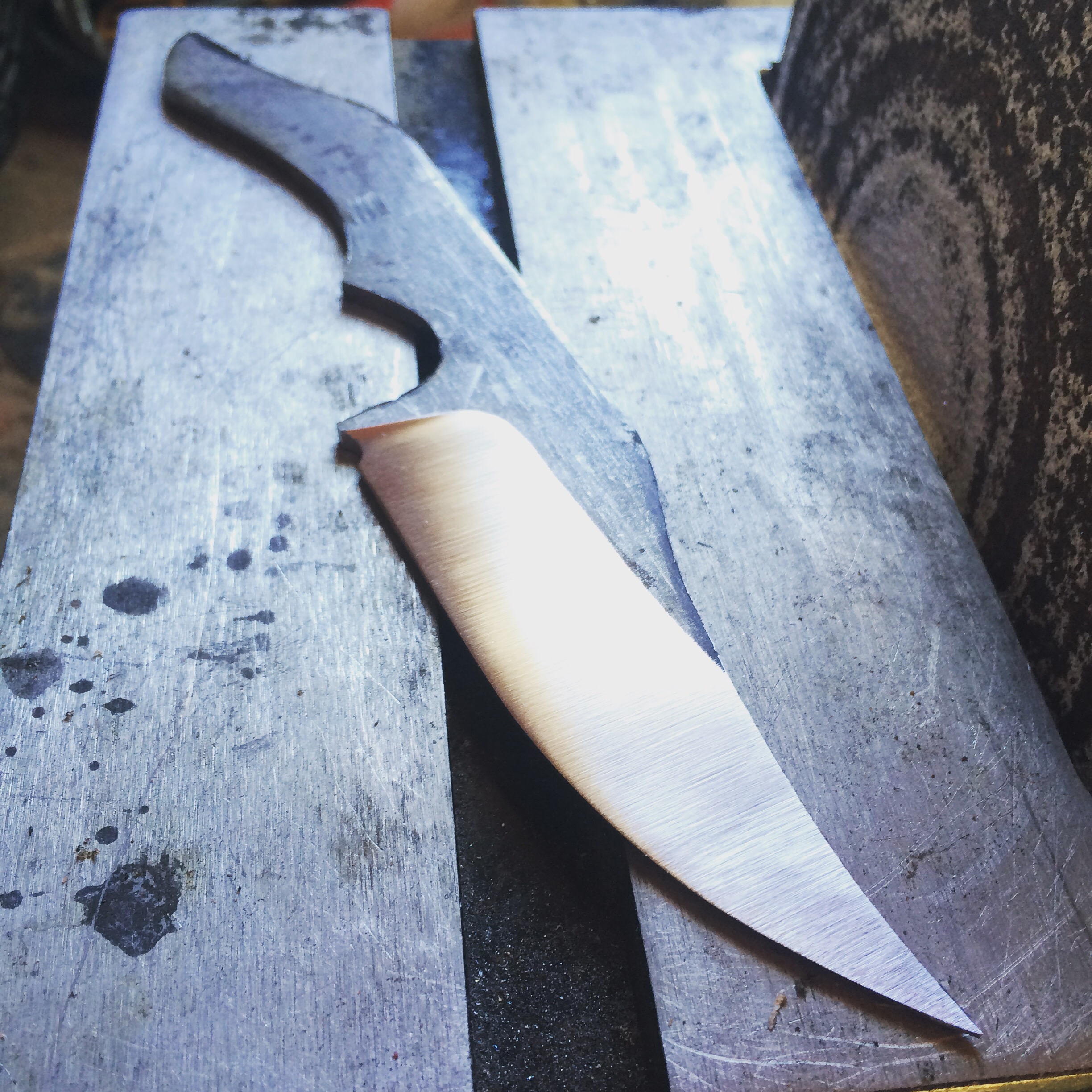
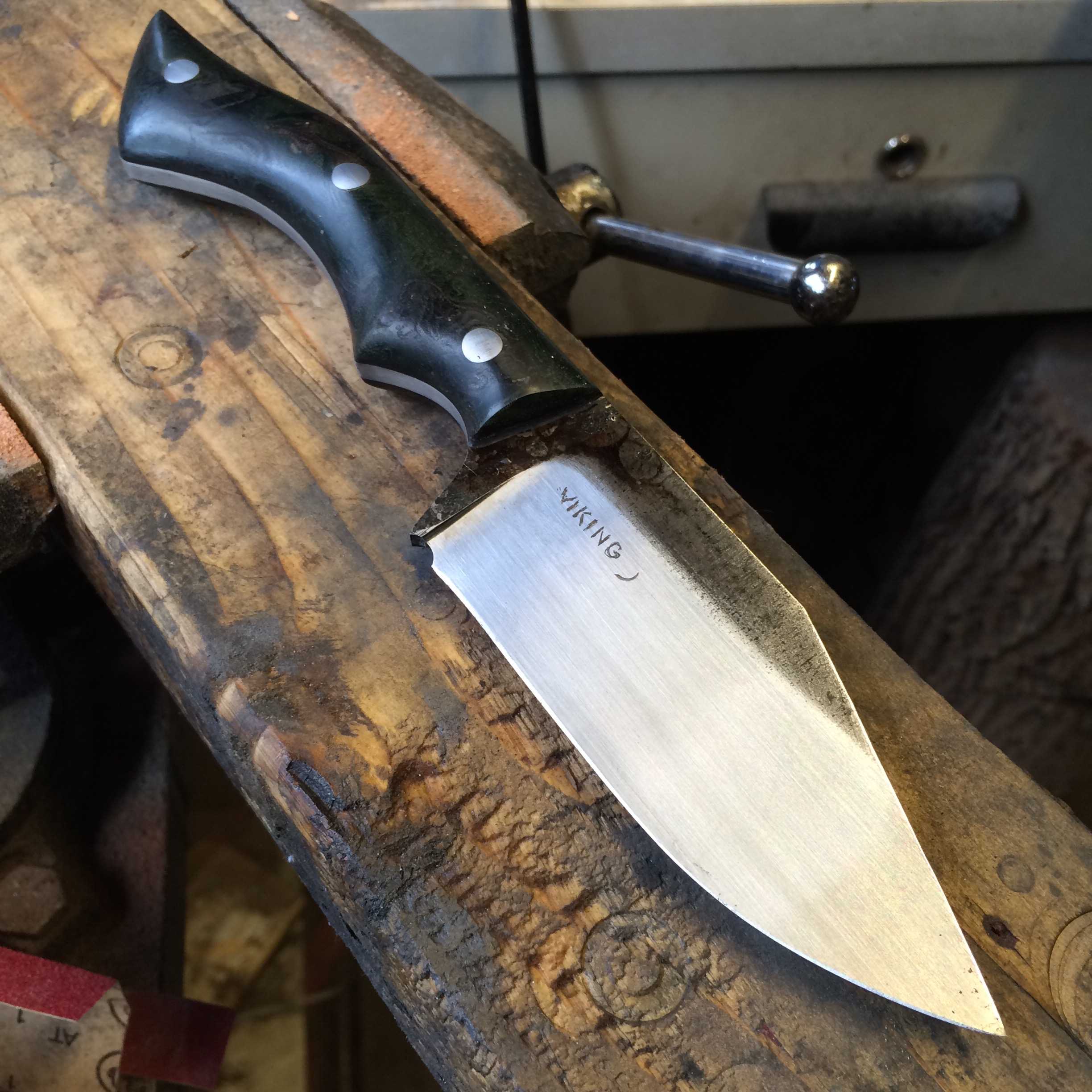
We start with Urim, a six-inch boning/filet knife

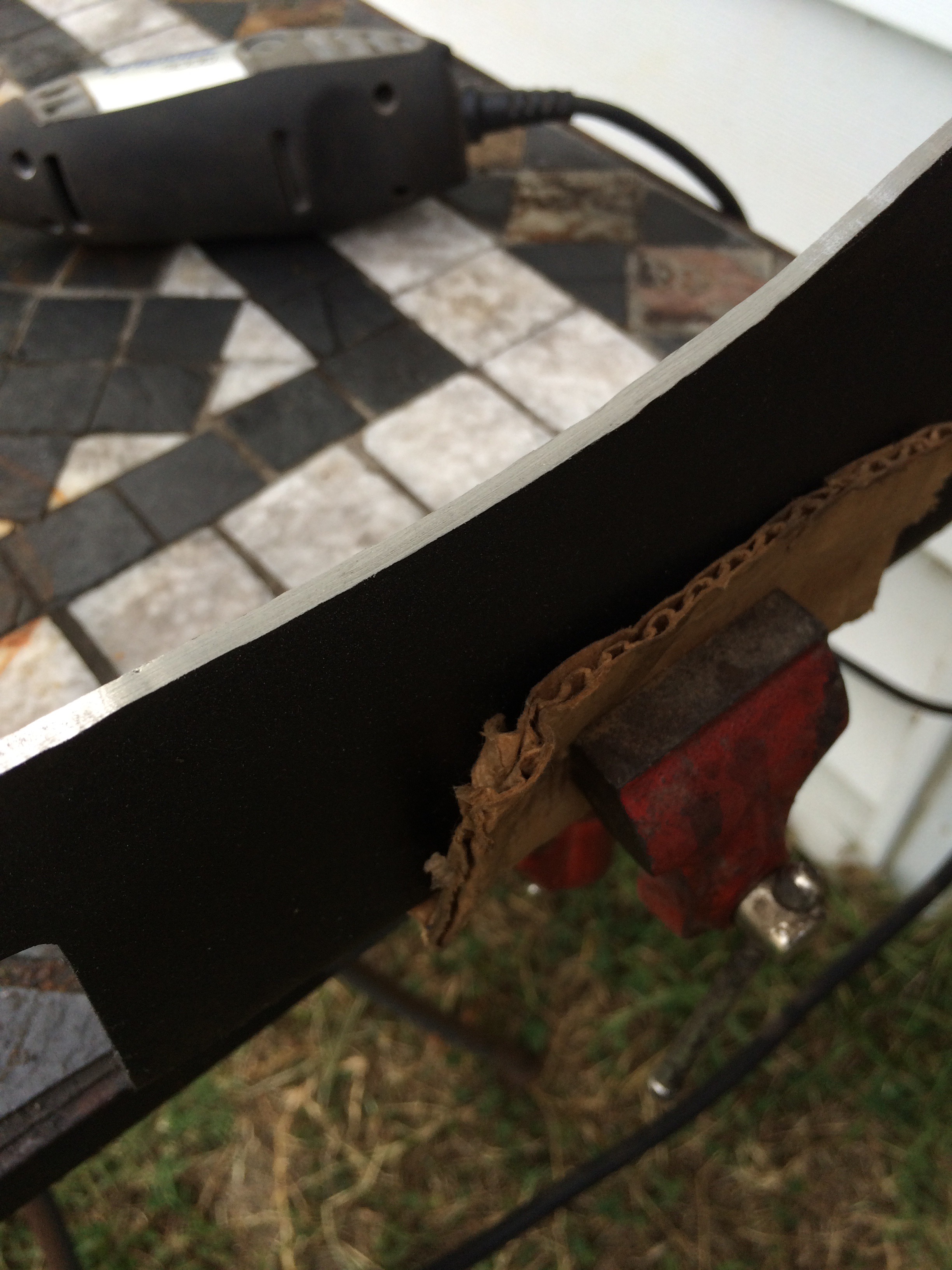
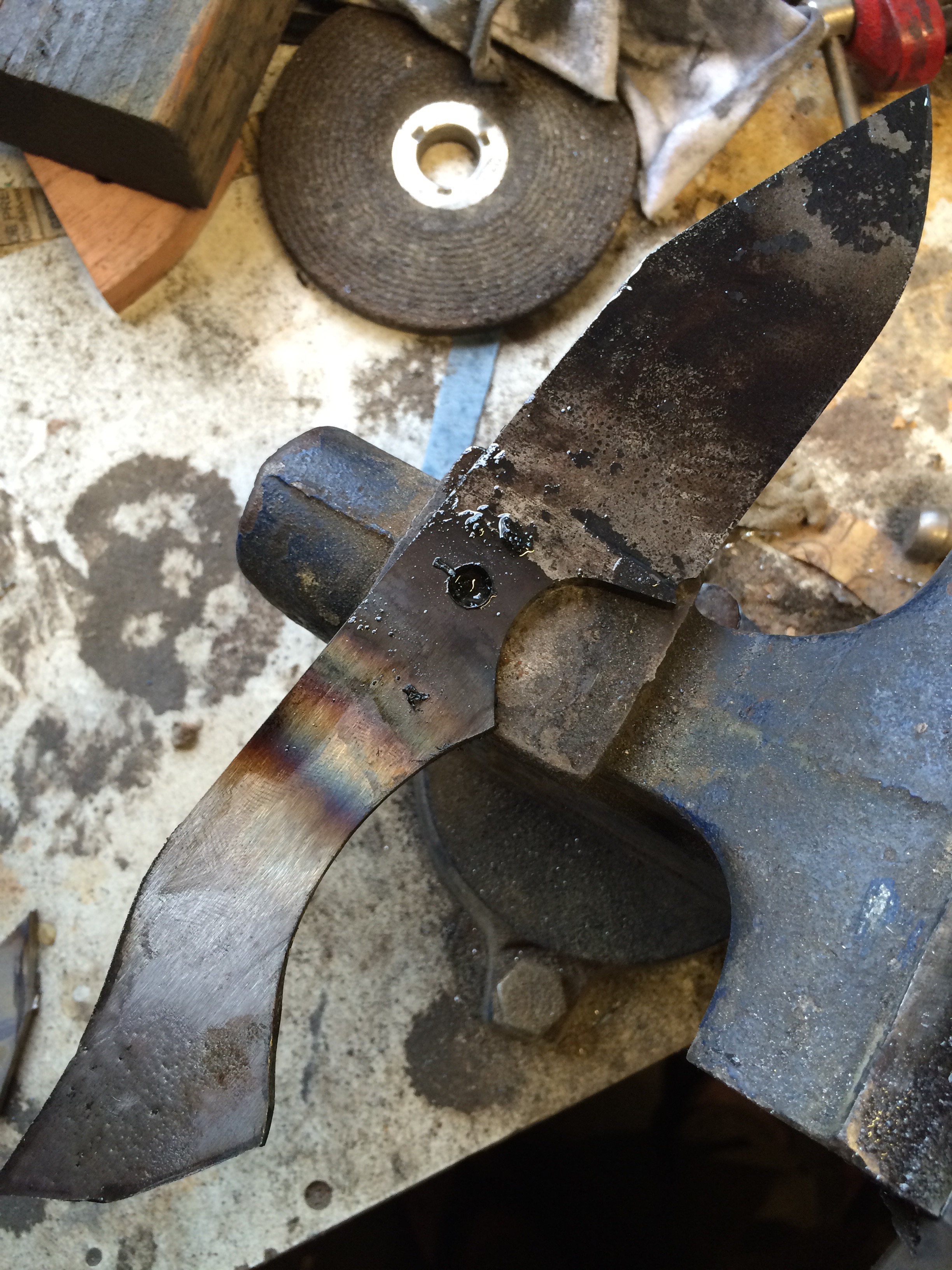
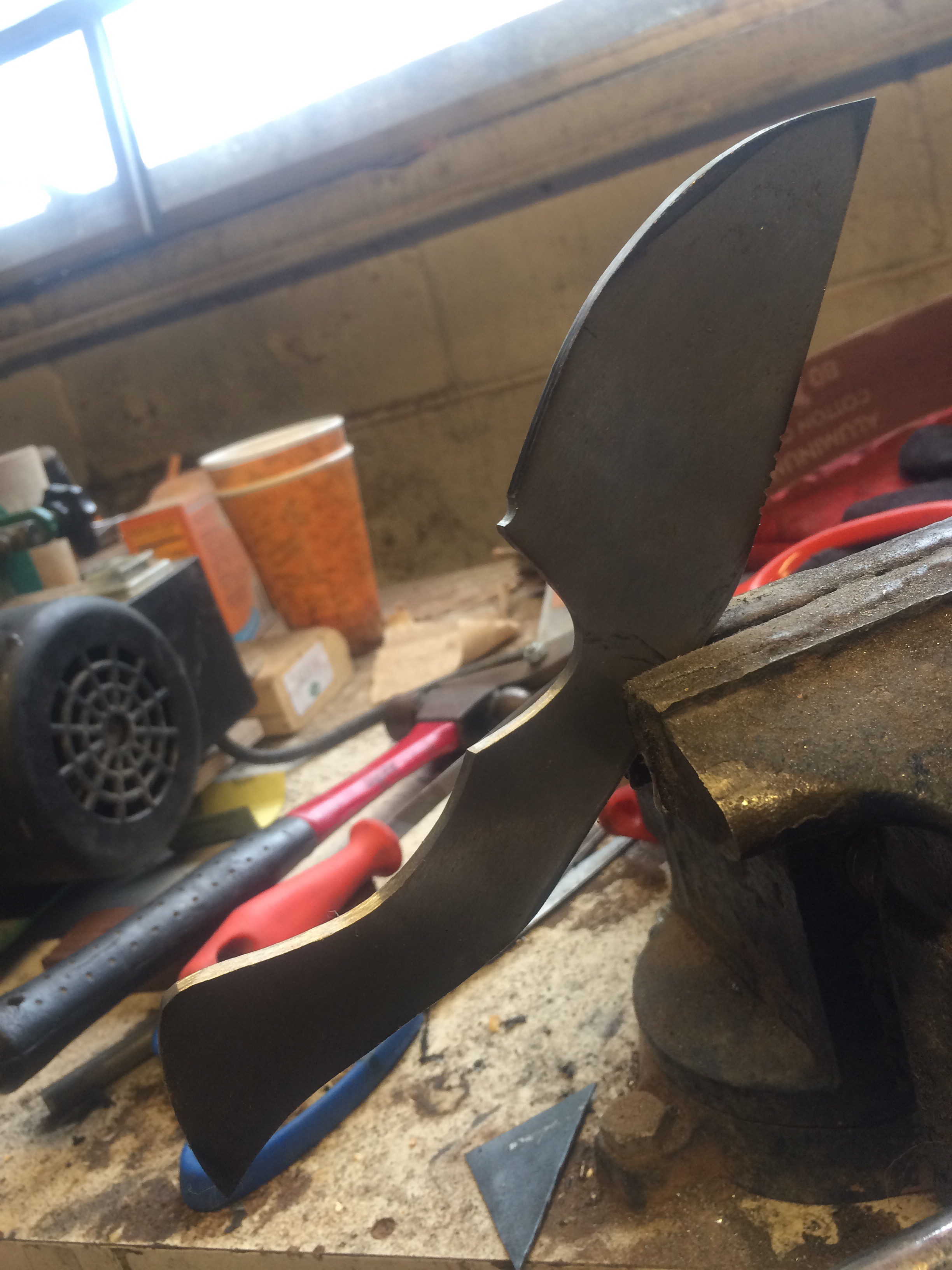
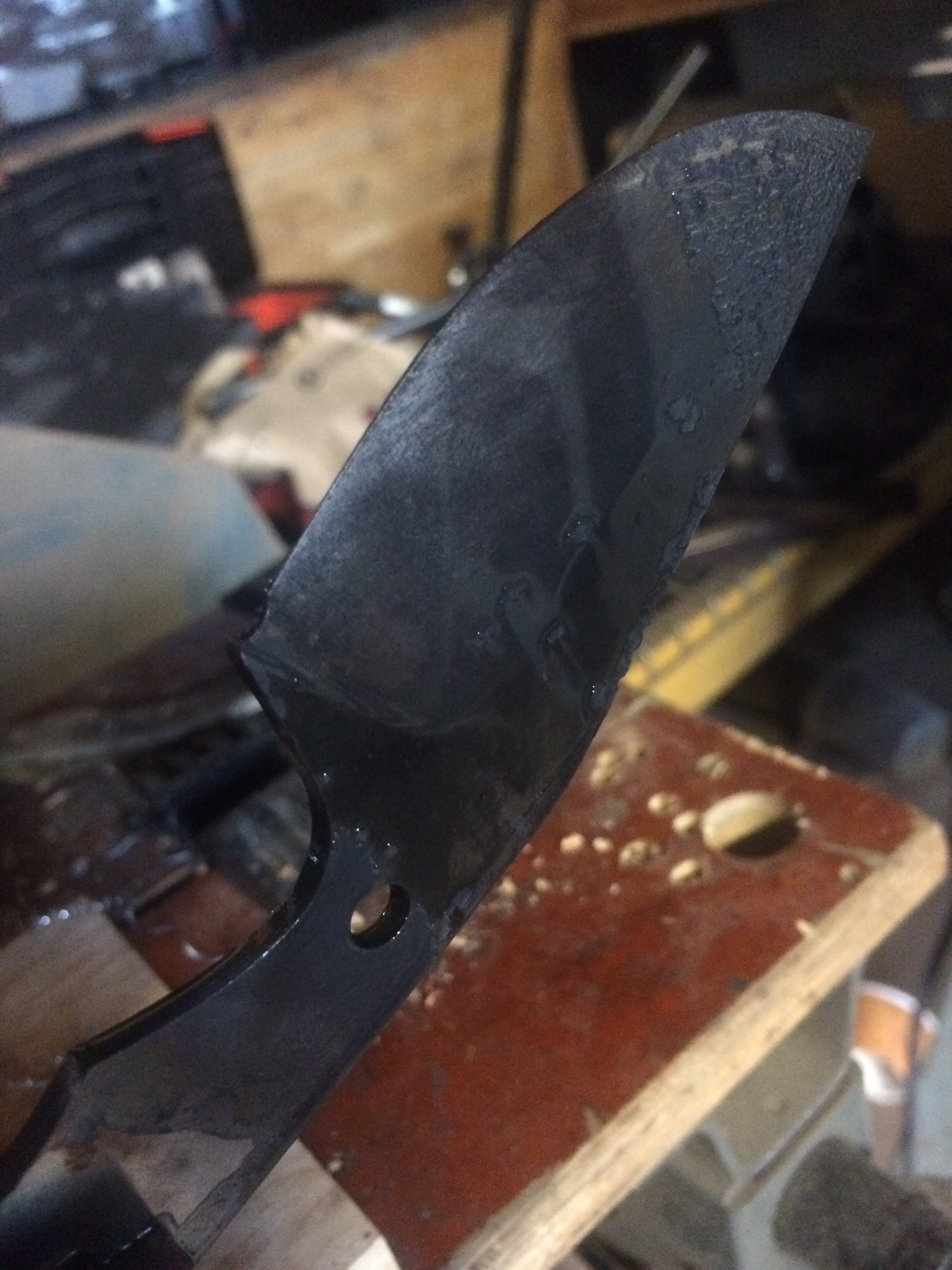
Because the stock is so thin, I hardened the blade before grinding the bevels:
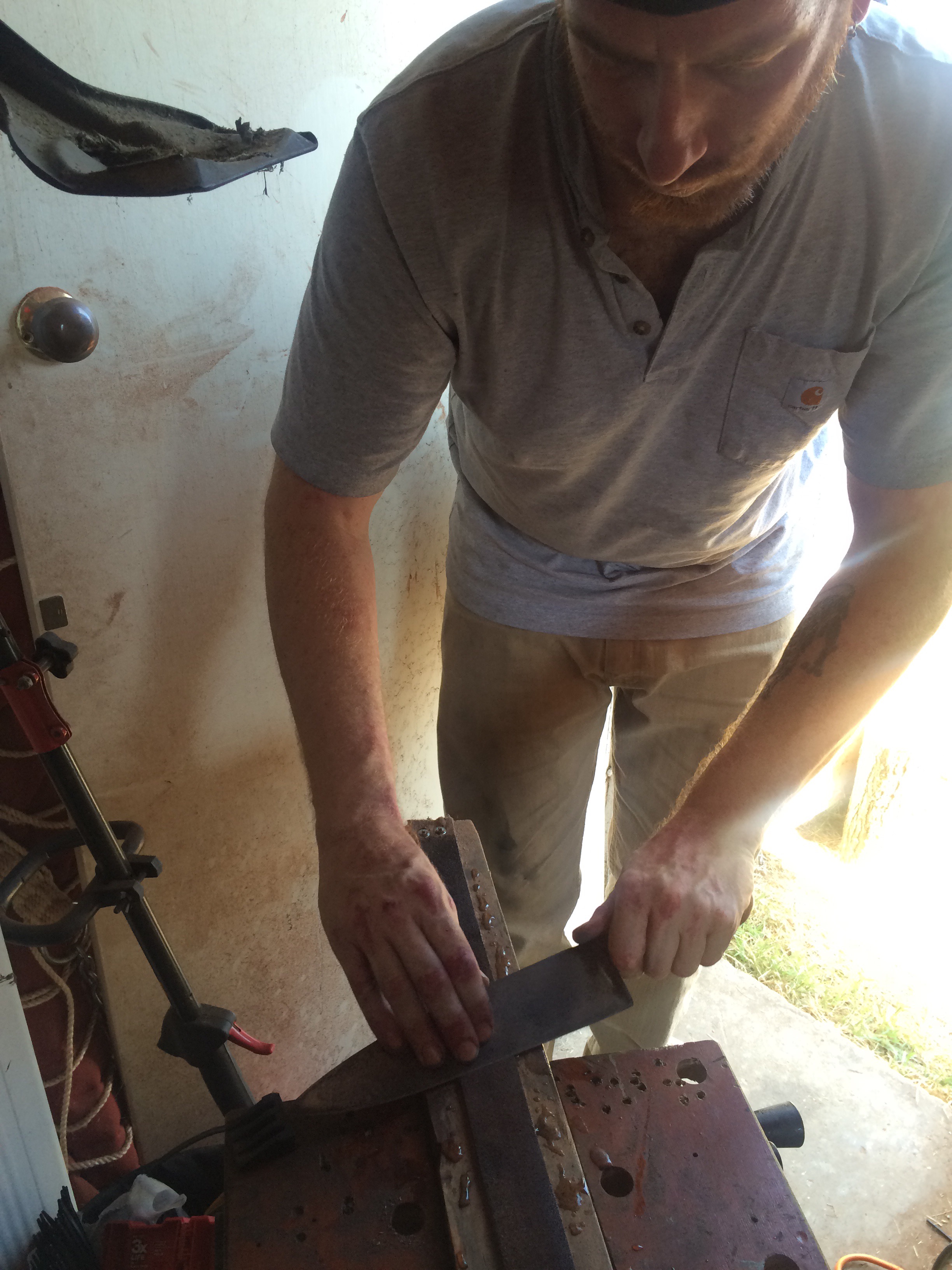
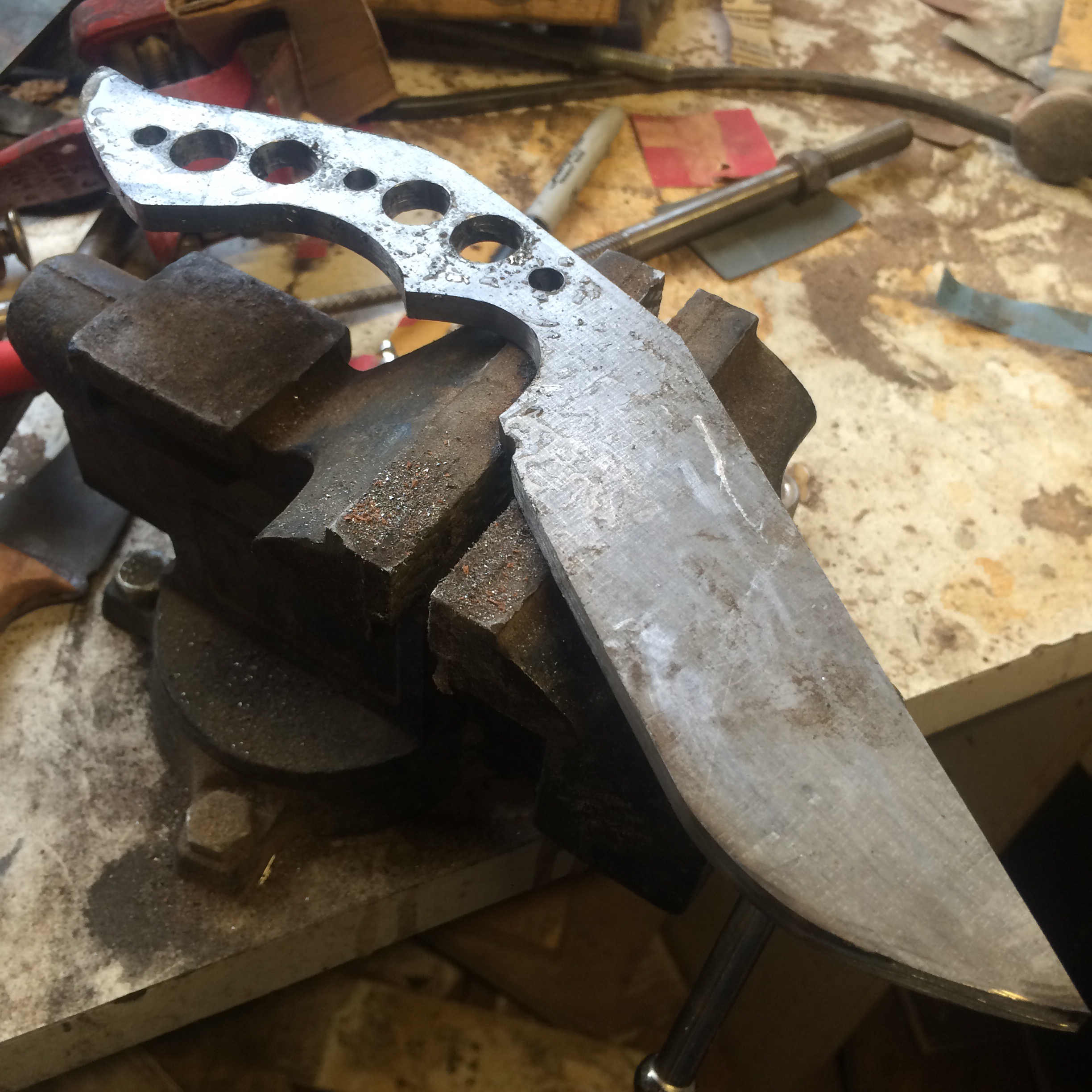
Rough grinding at 40 grit:

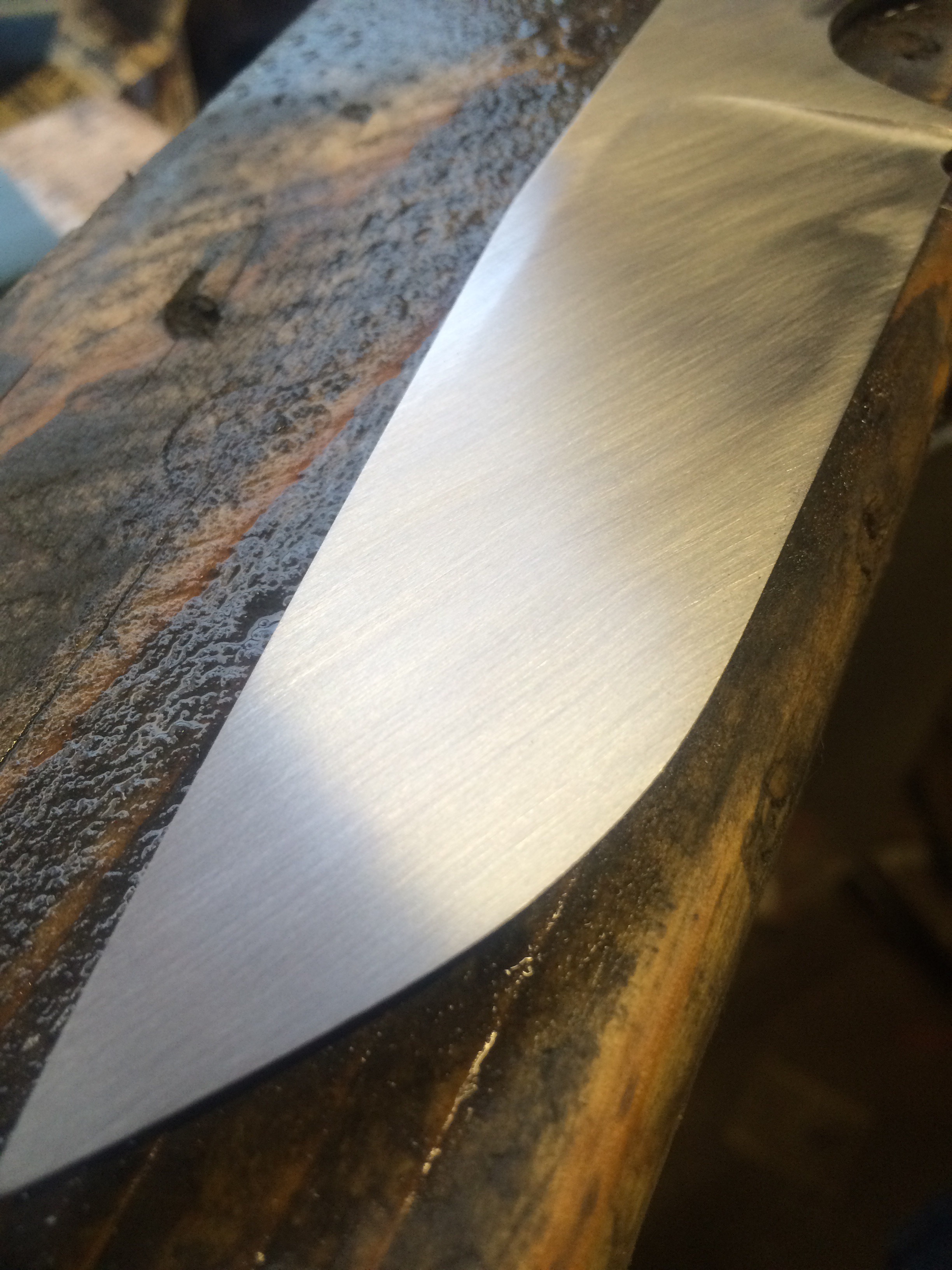
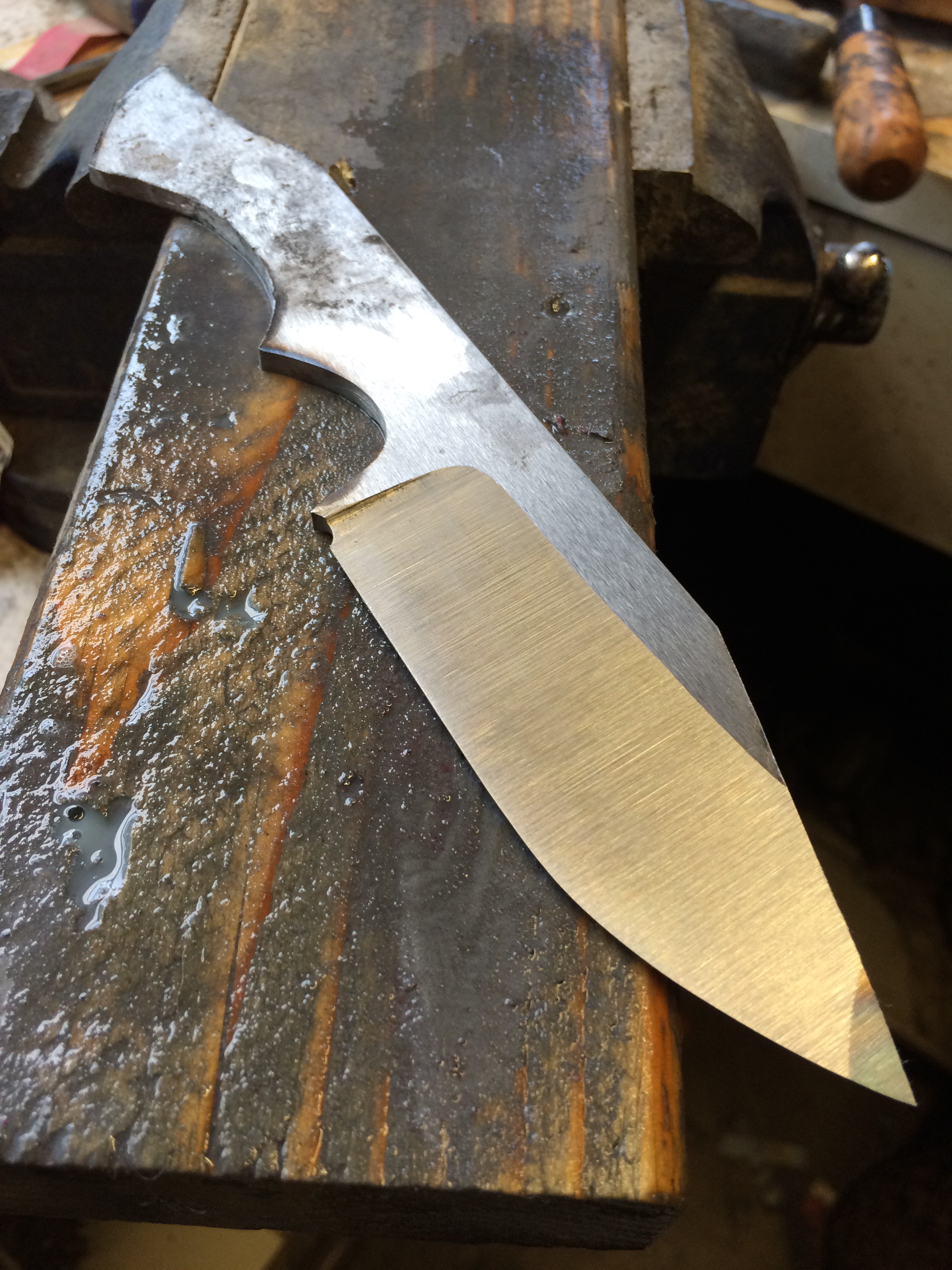
Full flat grind:

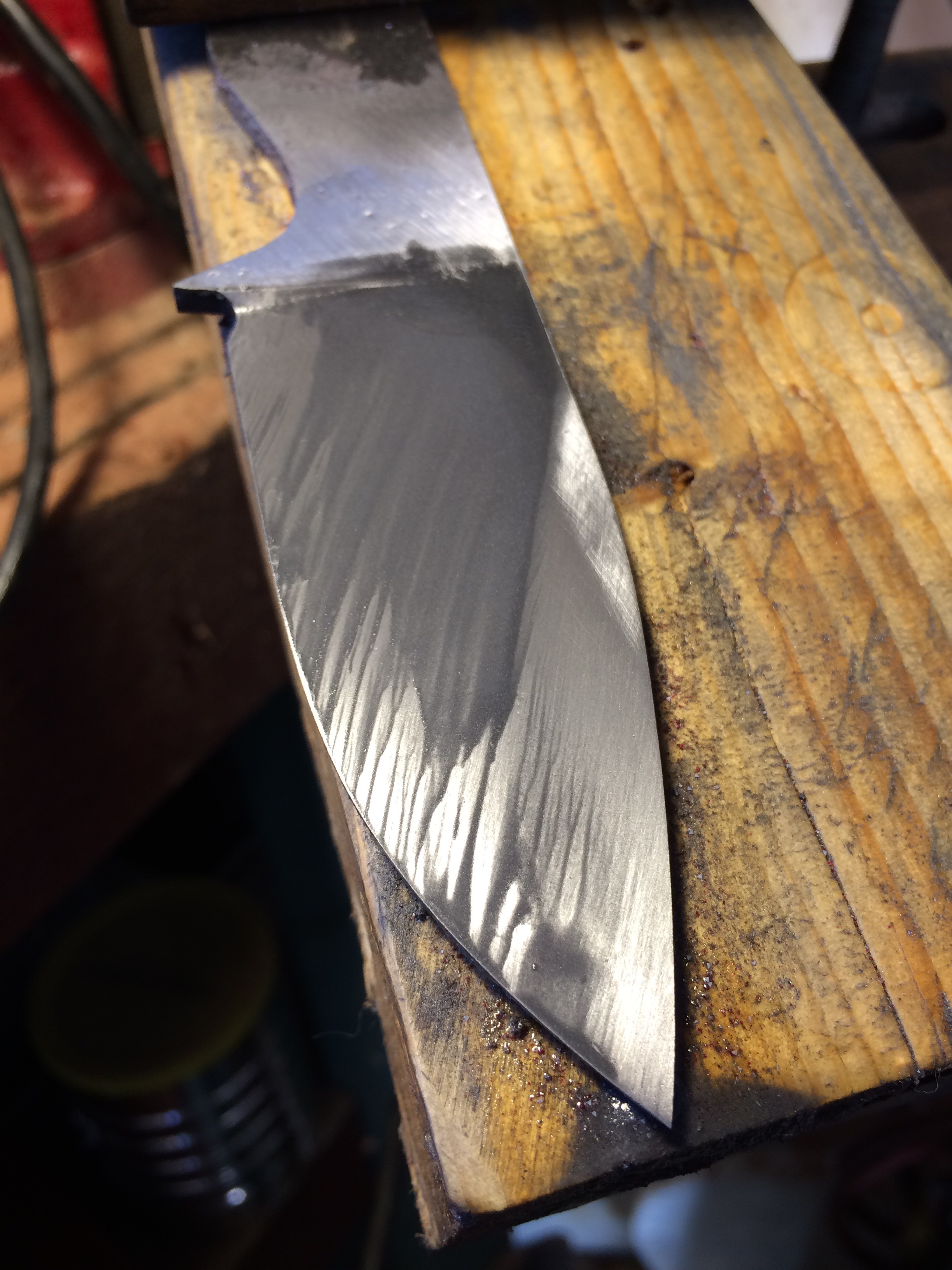
Laying down a hand finished satin:

Detail work on the plunge lines:

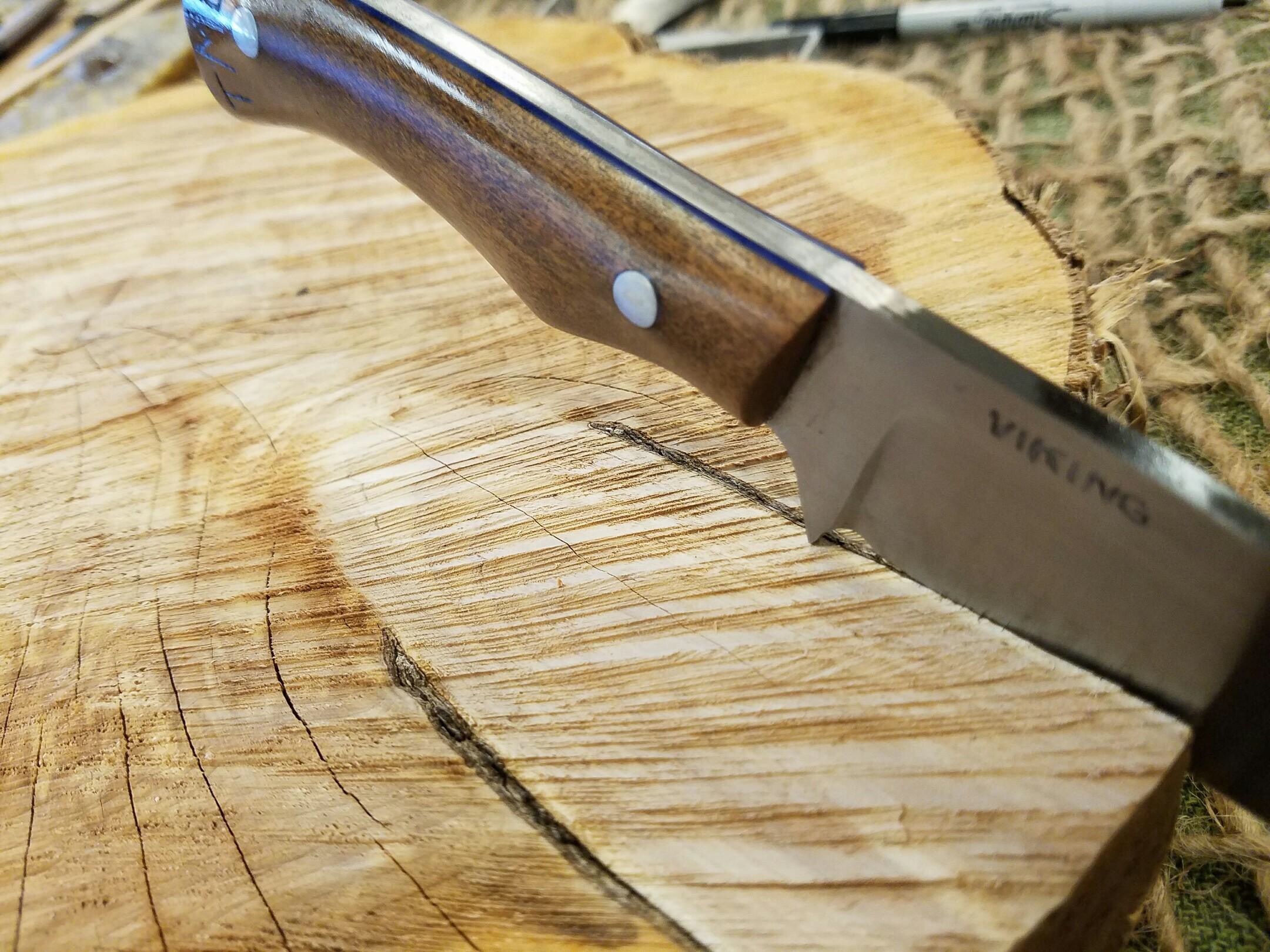
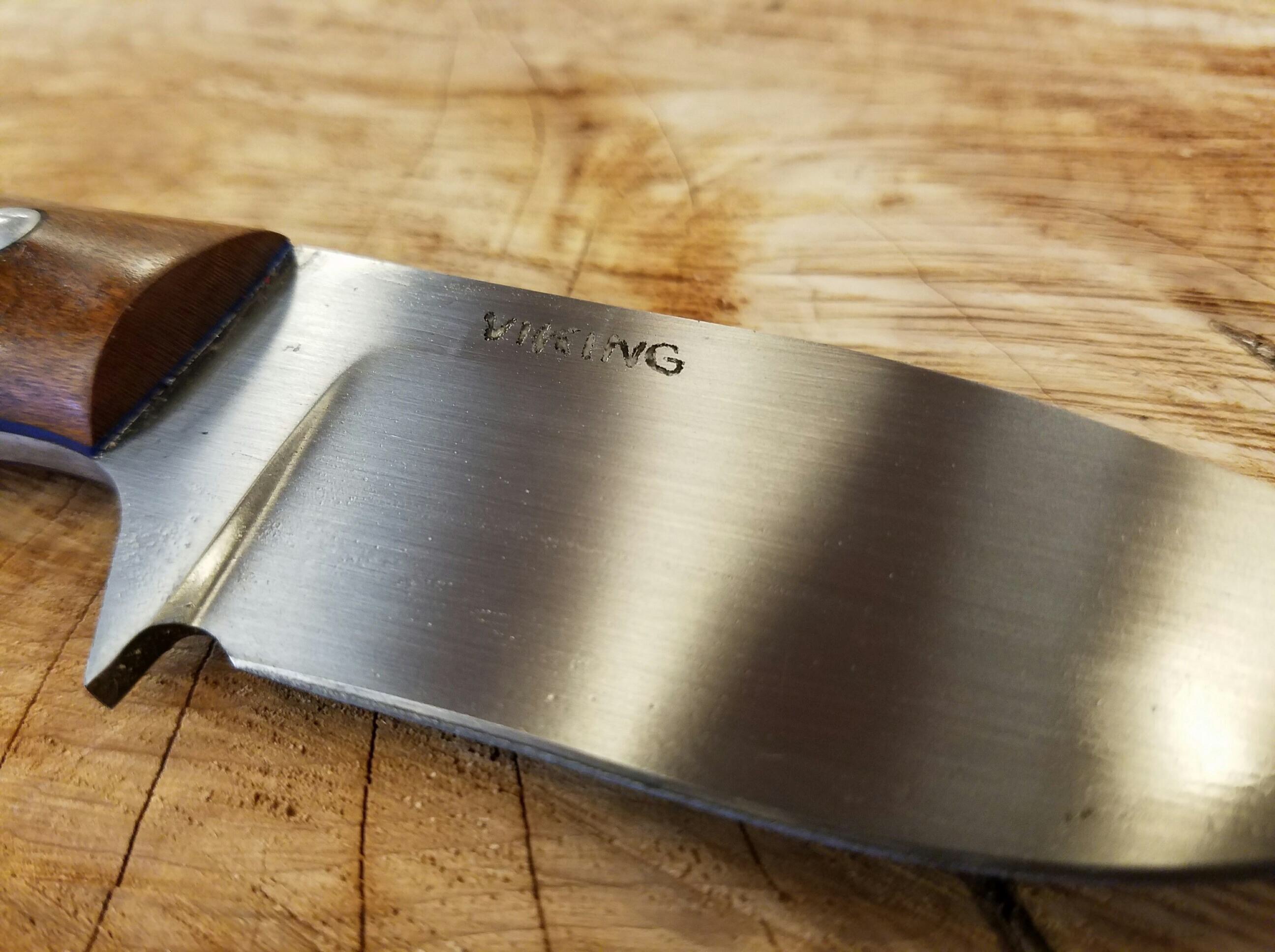
Ebony Gaboon: the black symbolizes the ‘yes’:

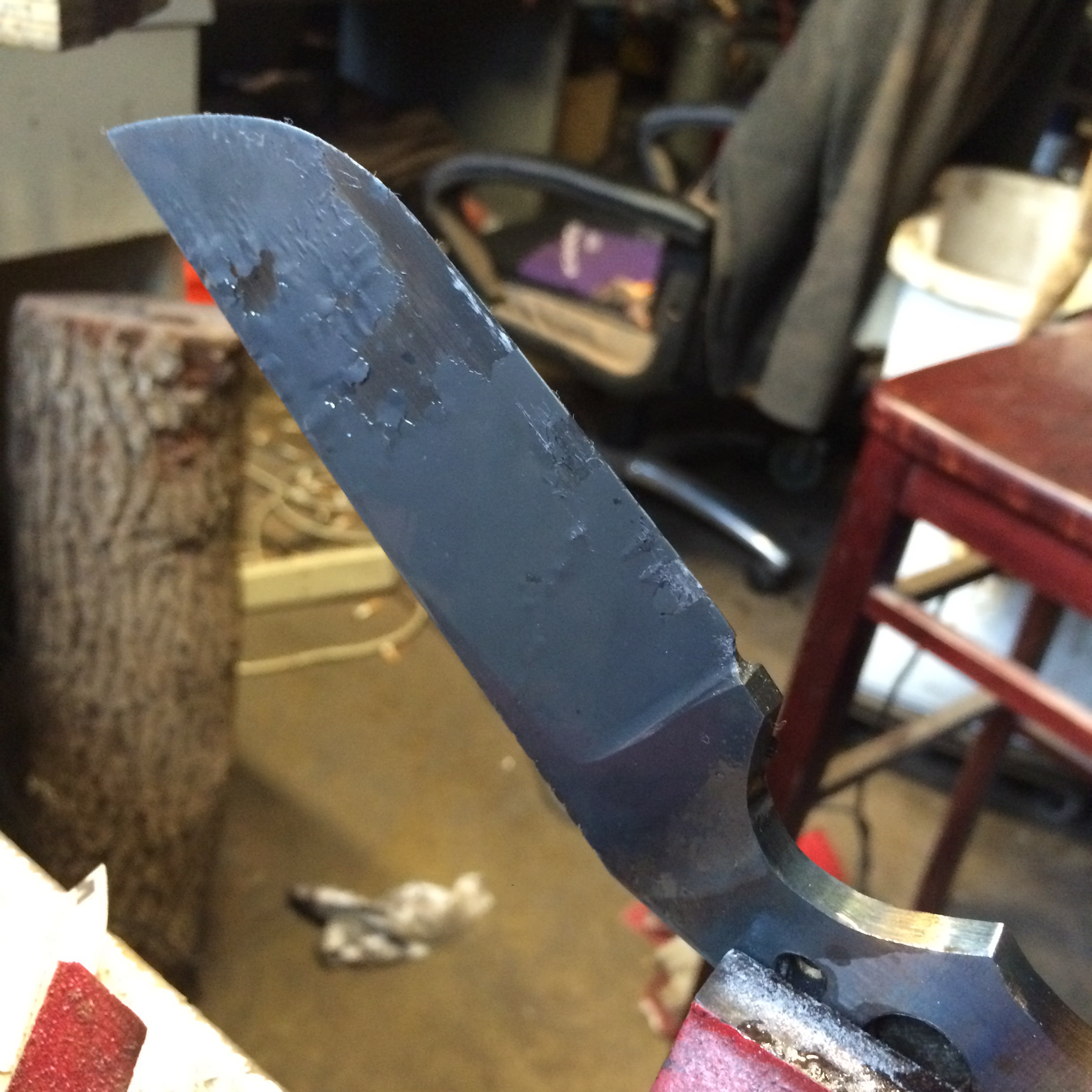
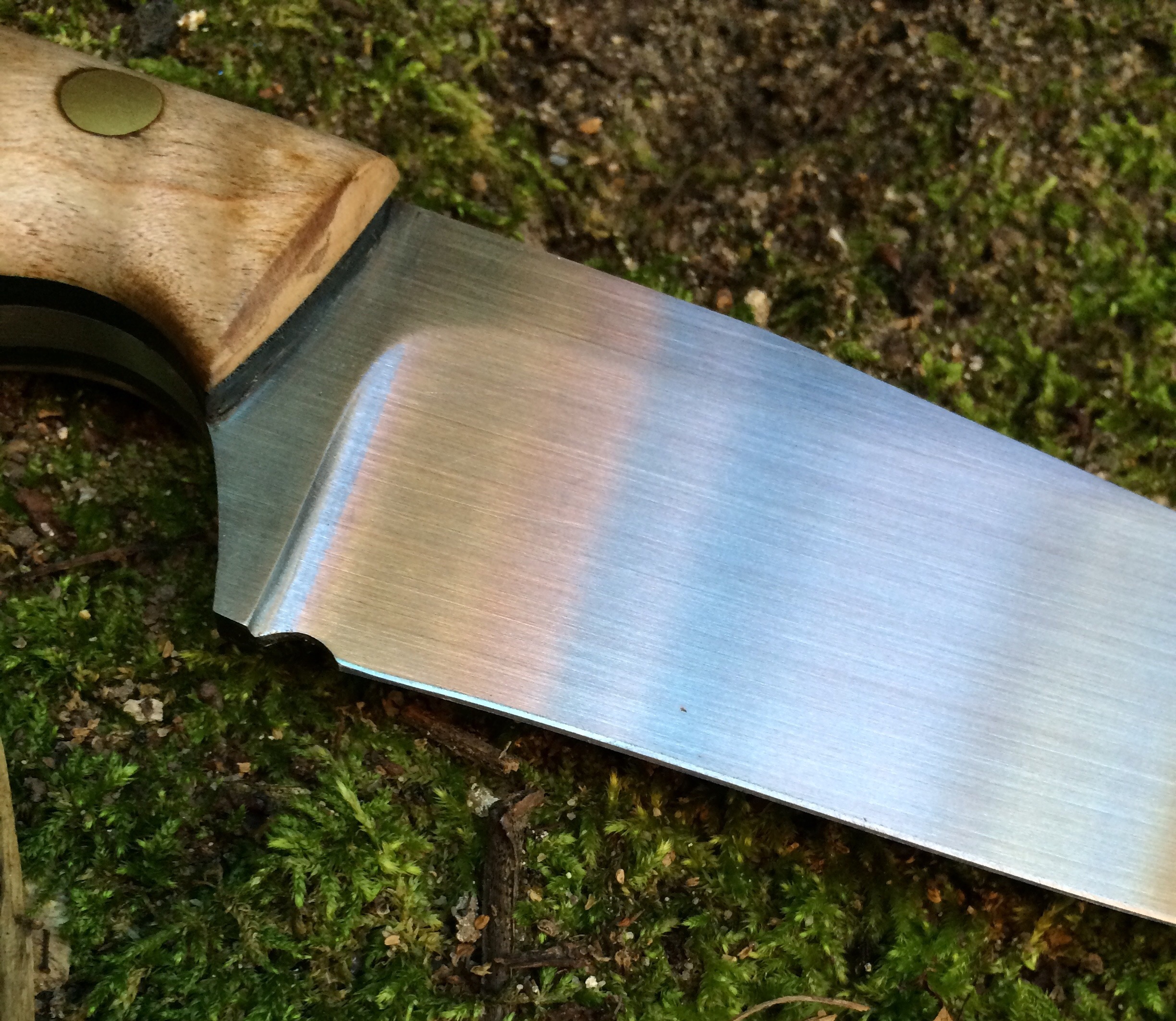
The bit near the ricasso; sanded to 2000 grit:

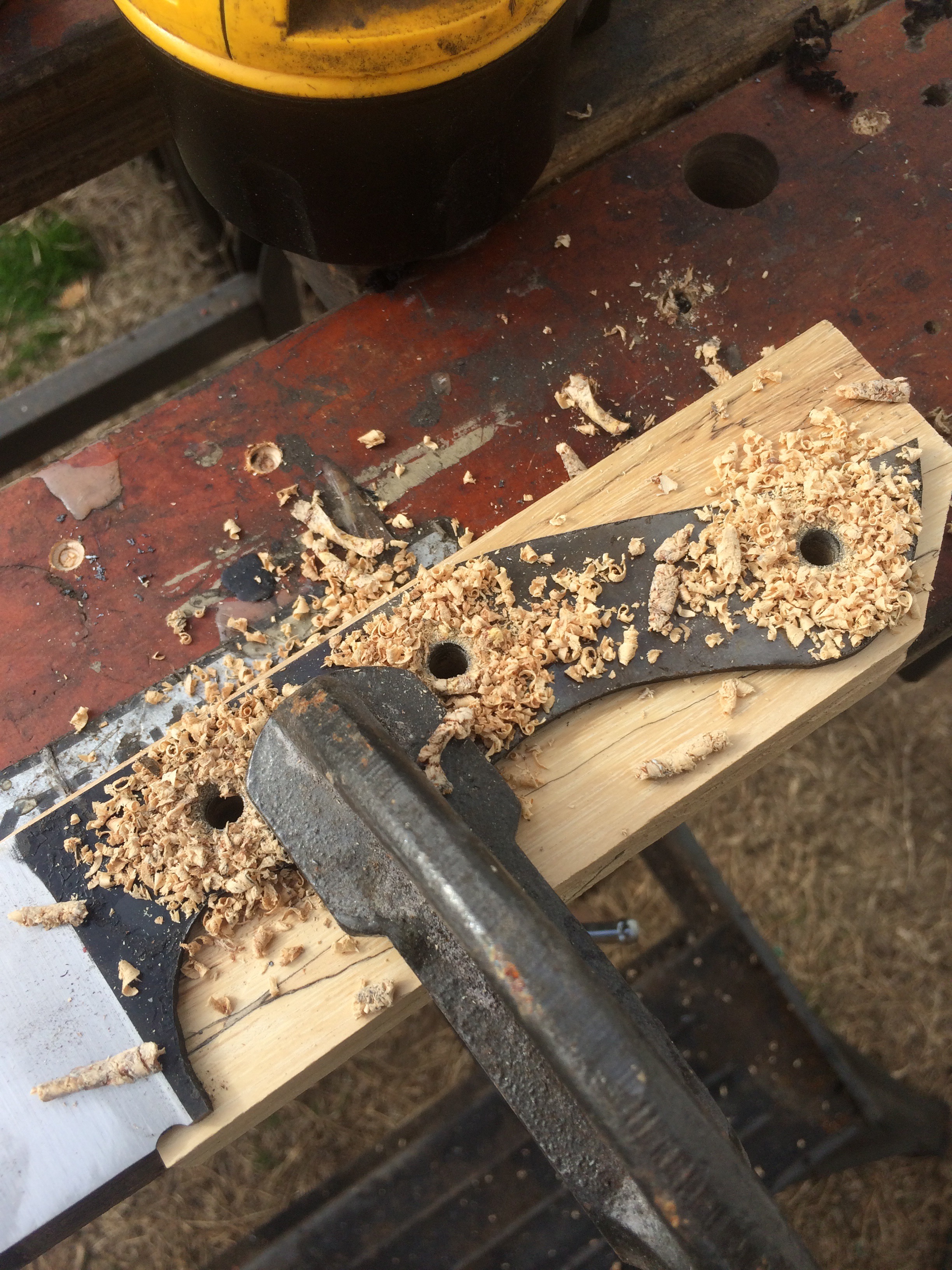
Profiling on the handle:

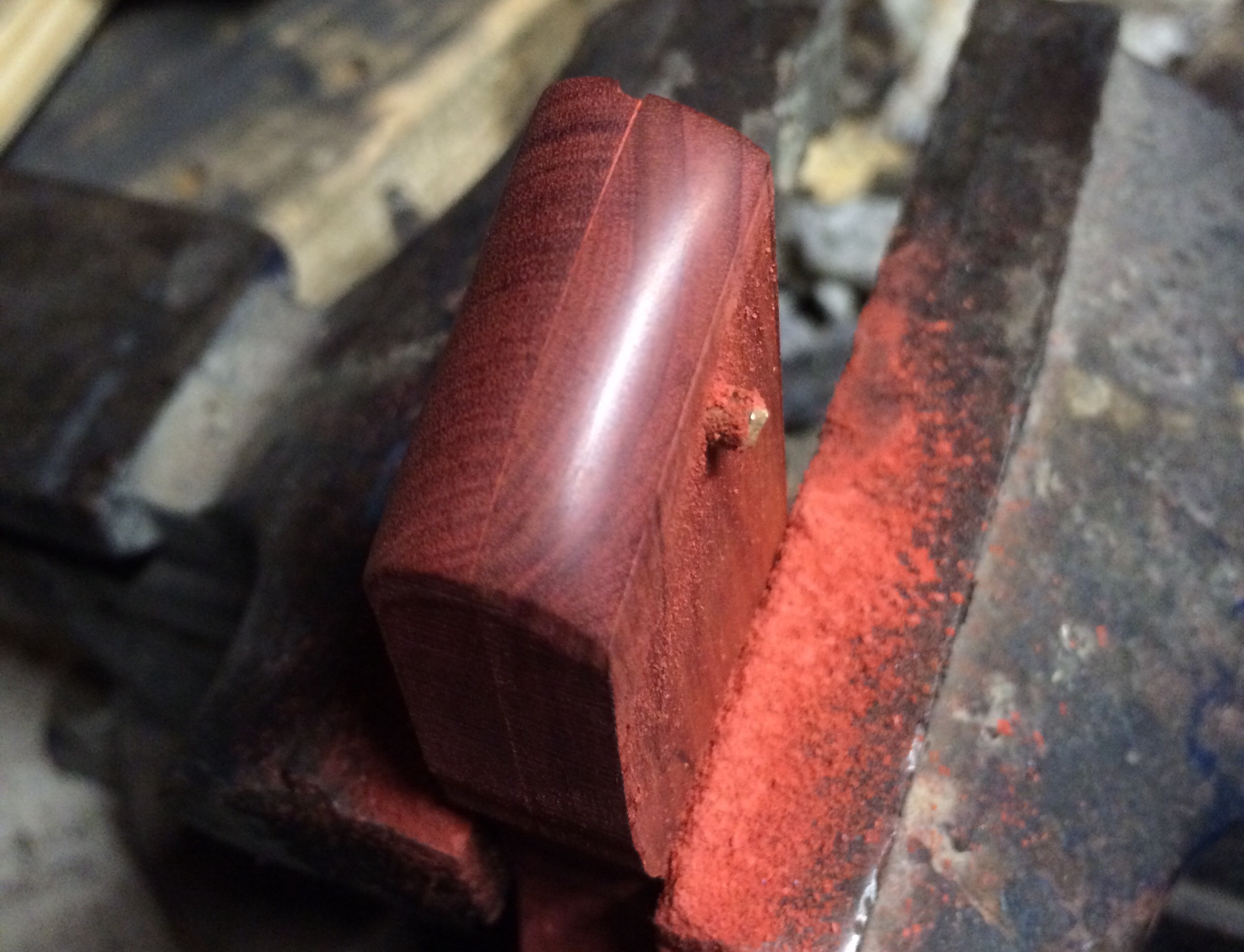
Rough-shaped:

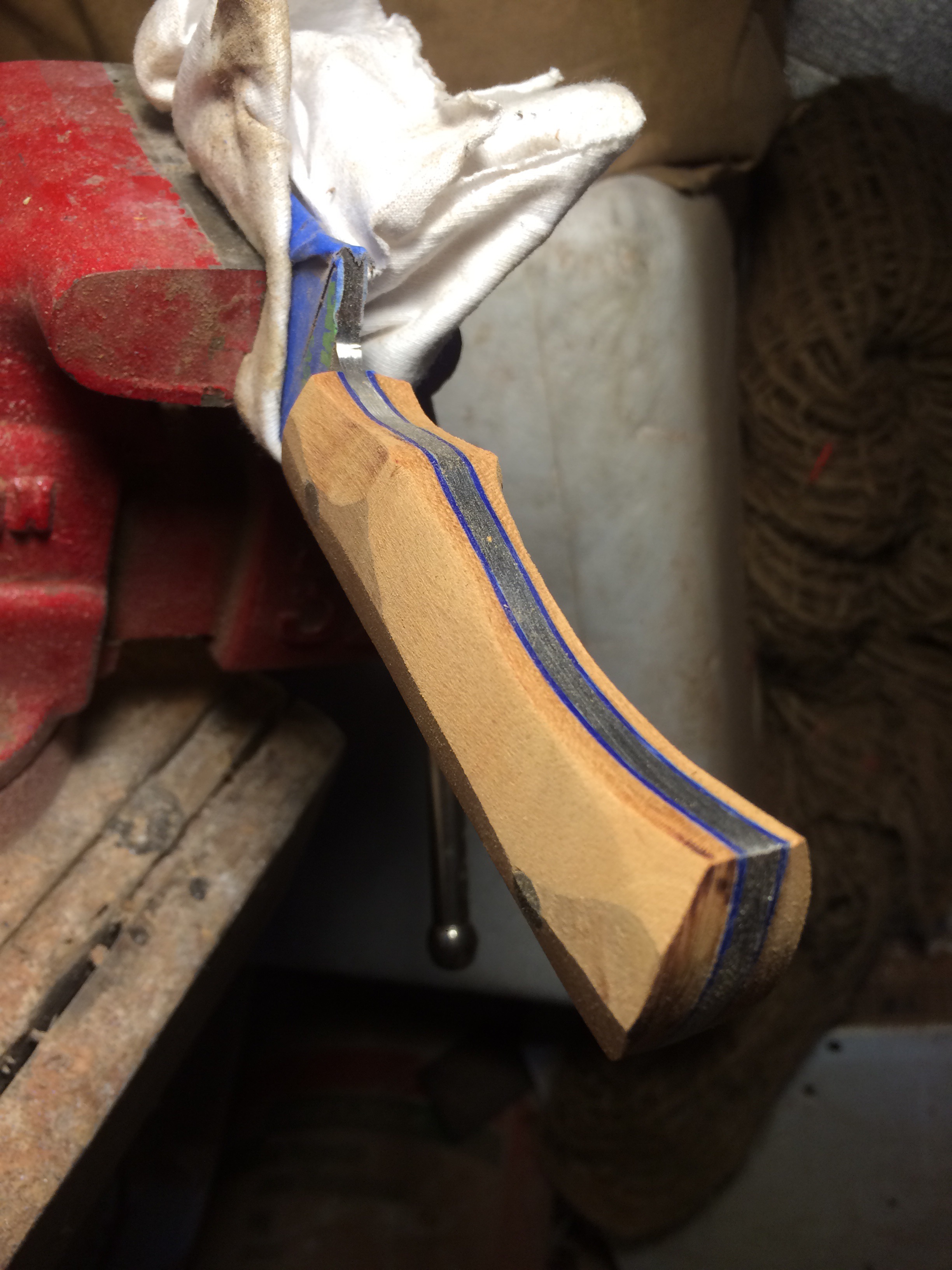
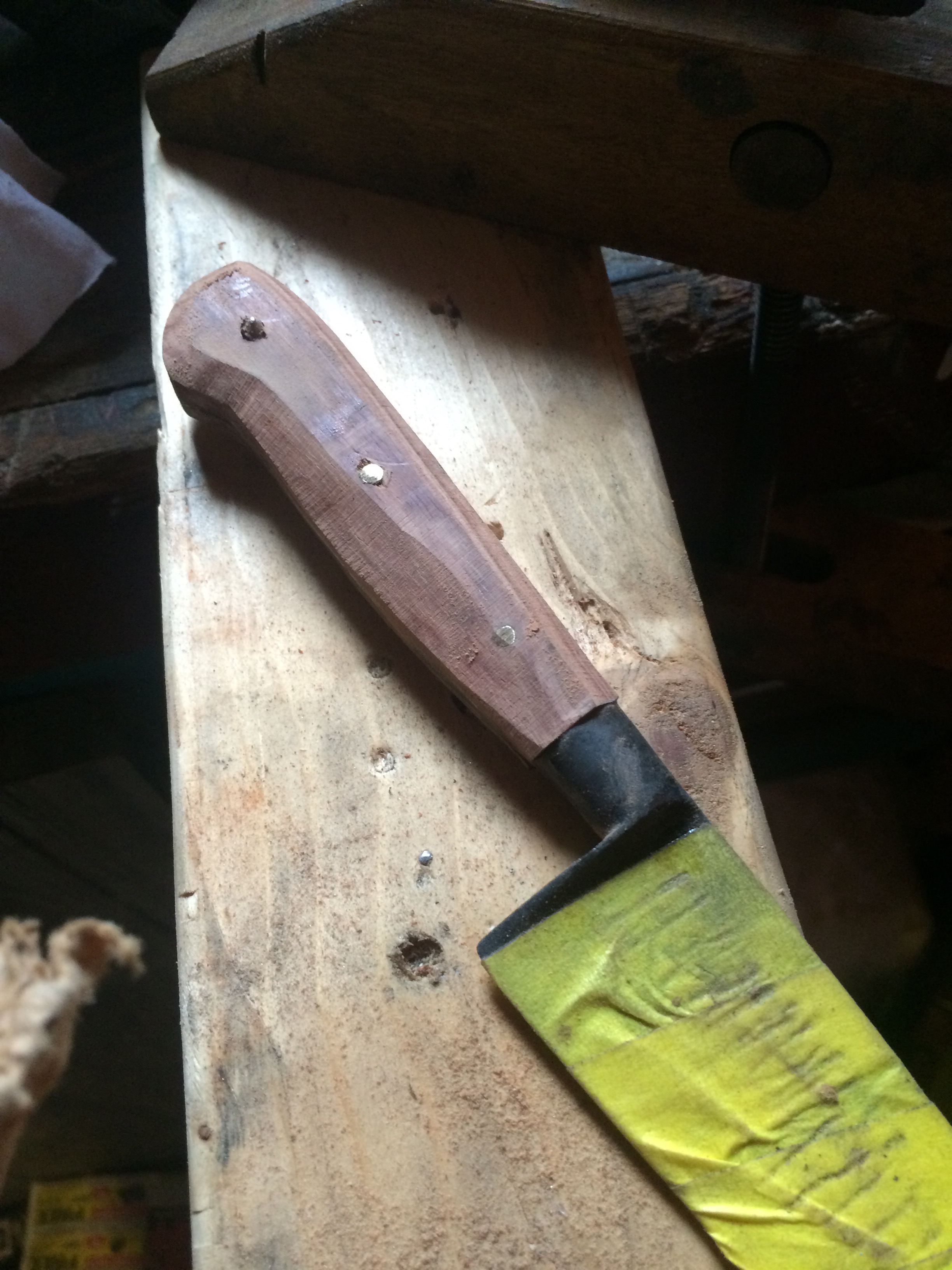
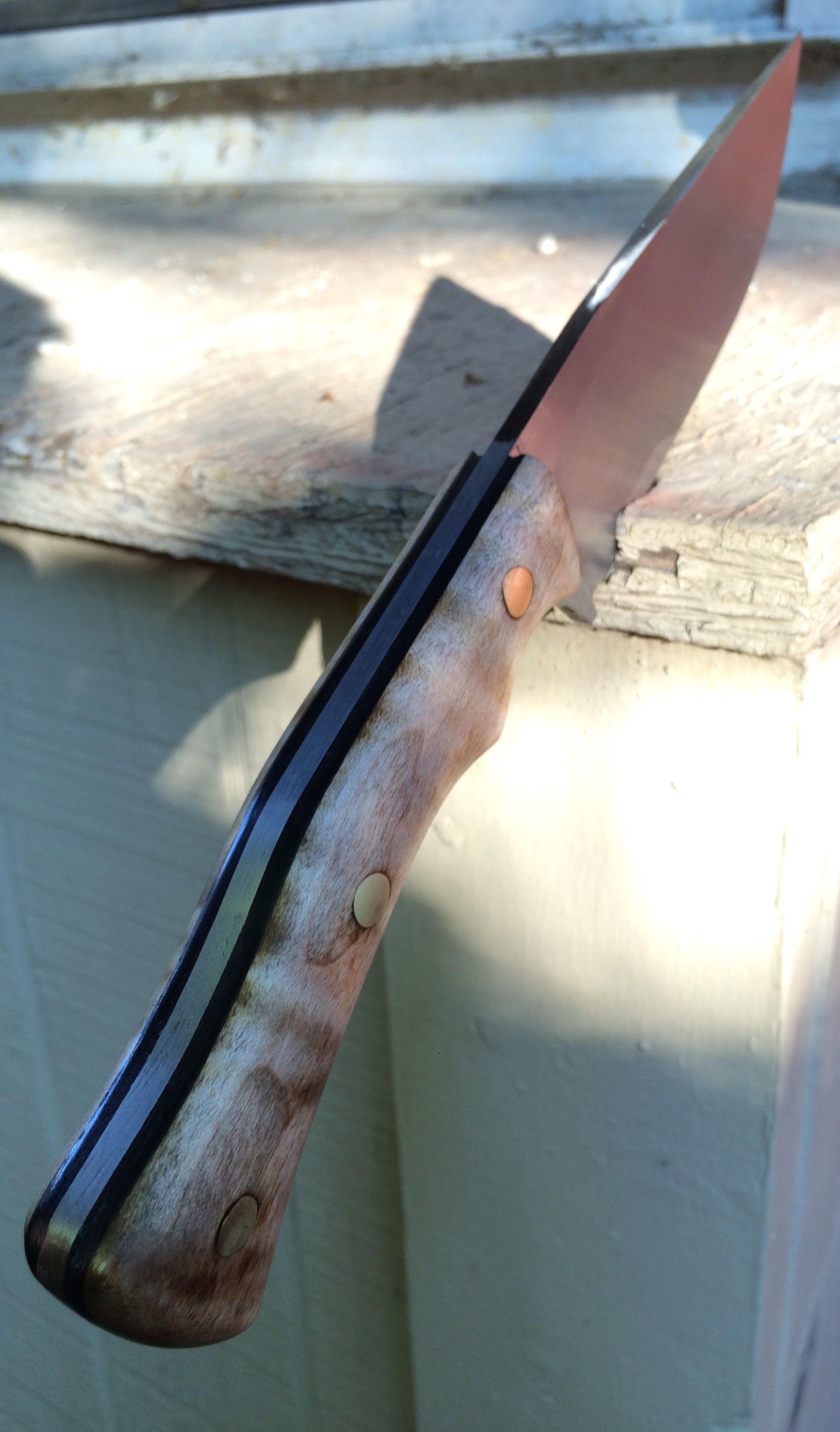
Sanded to 220 grit and then oiled.  I let this sit for a day or so and then sand the entire handle up to 2000 grit.  This process helps to burst the grain:
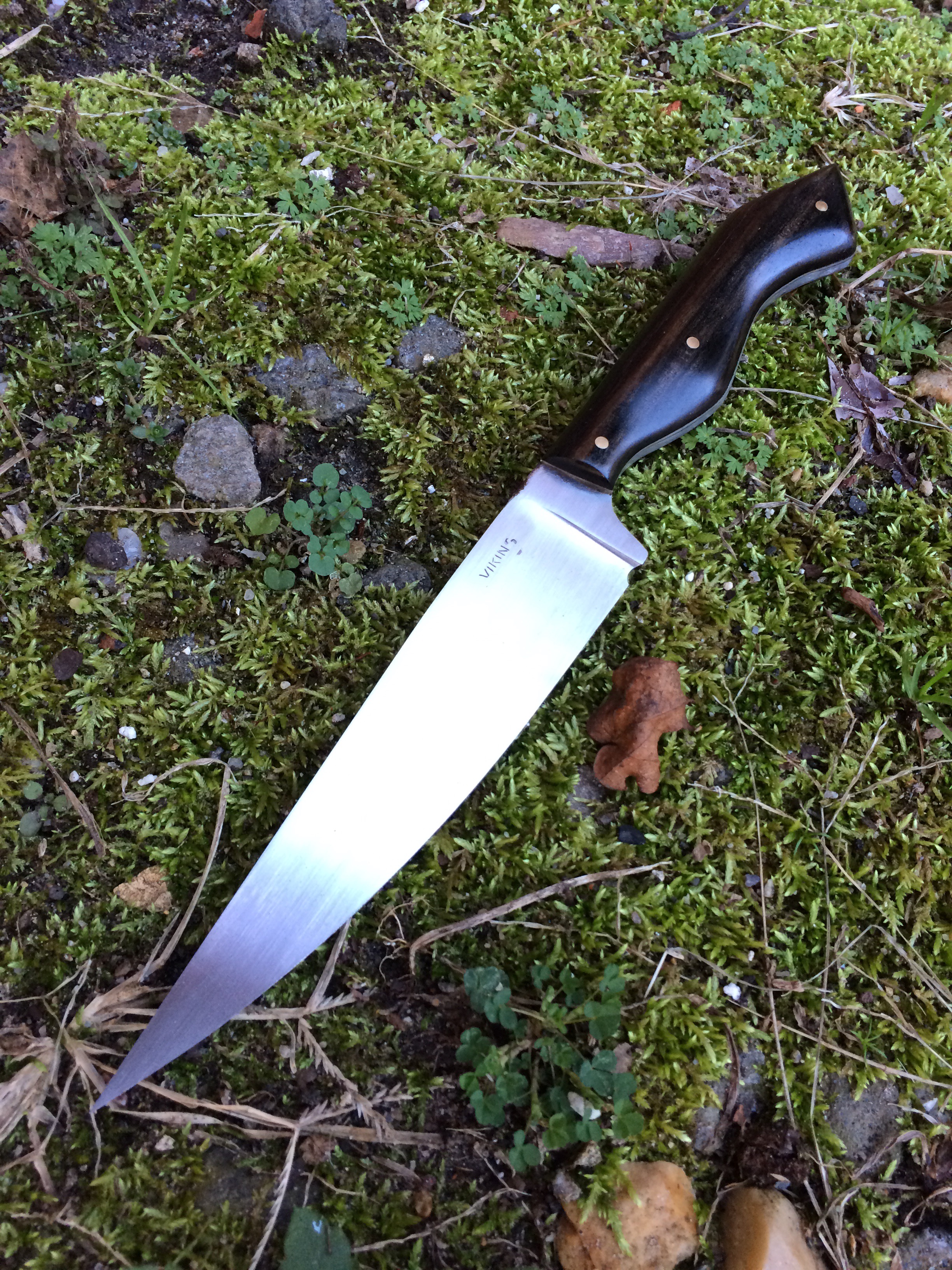
Urim:

To start on Thummim we need things that cut:
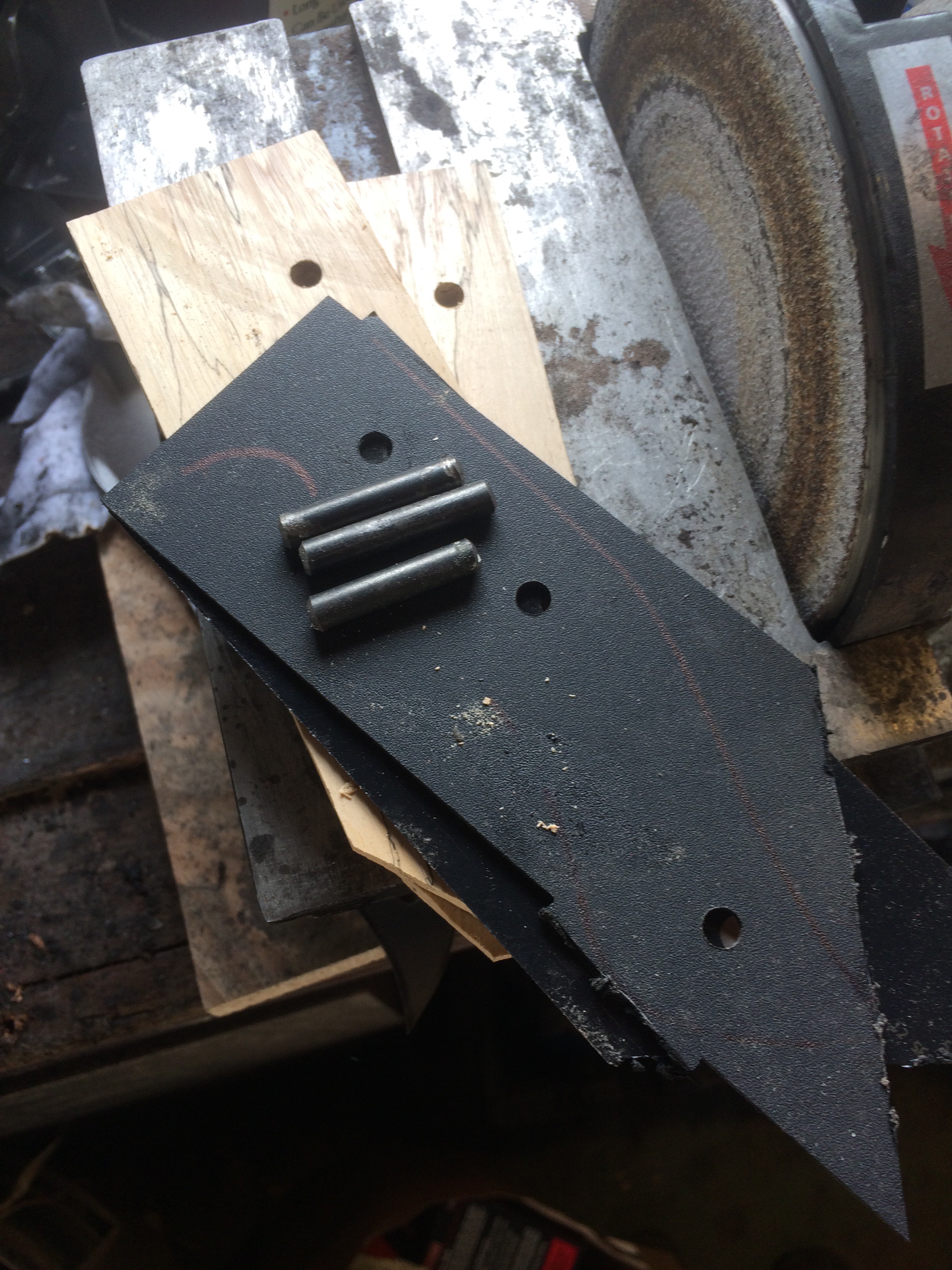
Once again the whole bit is hardened:
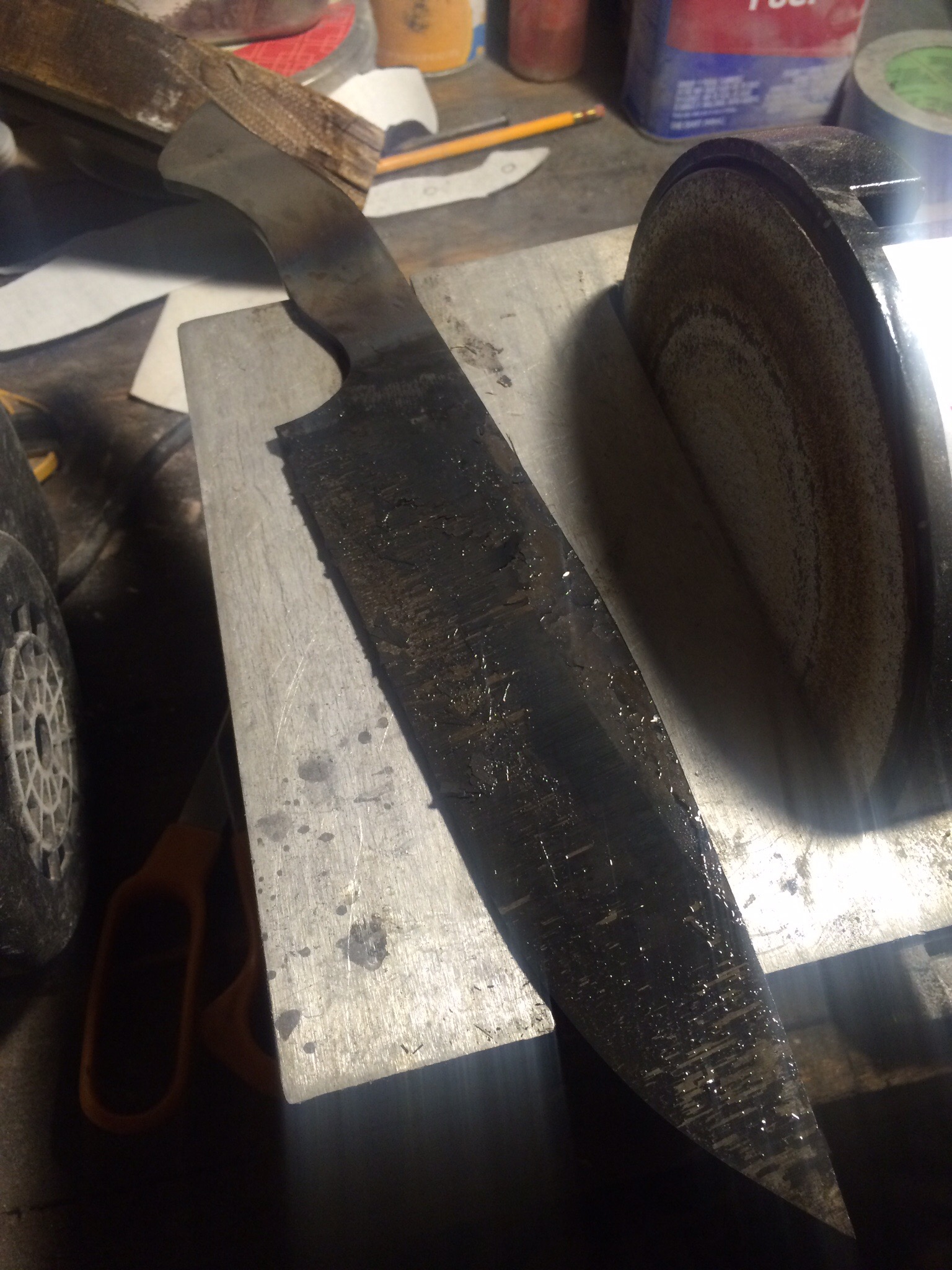
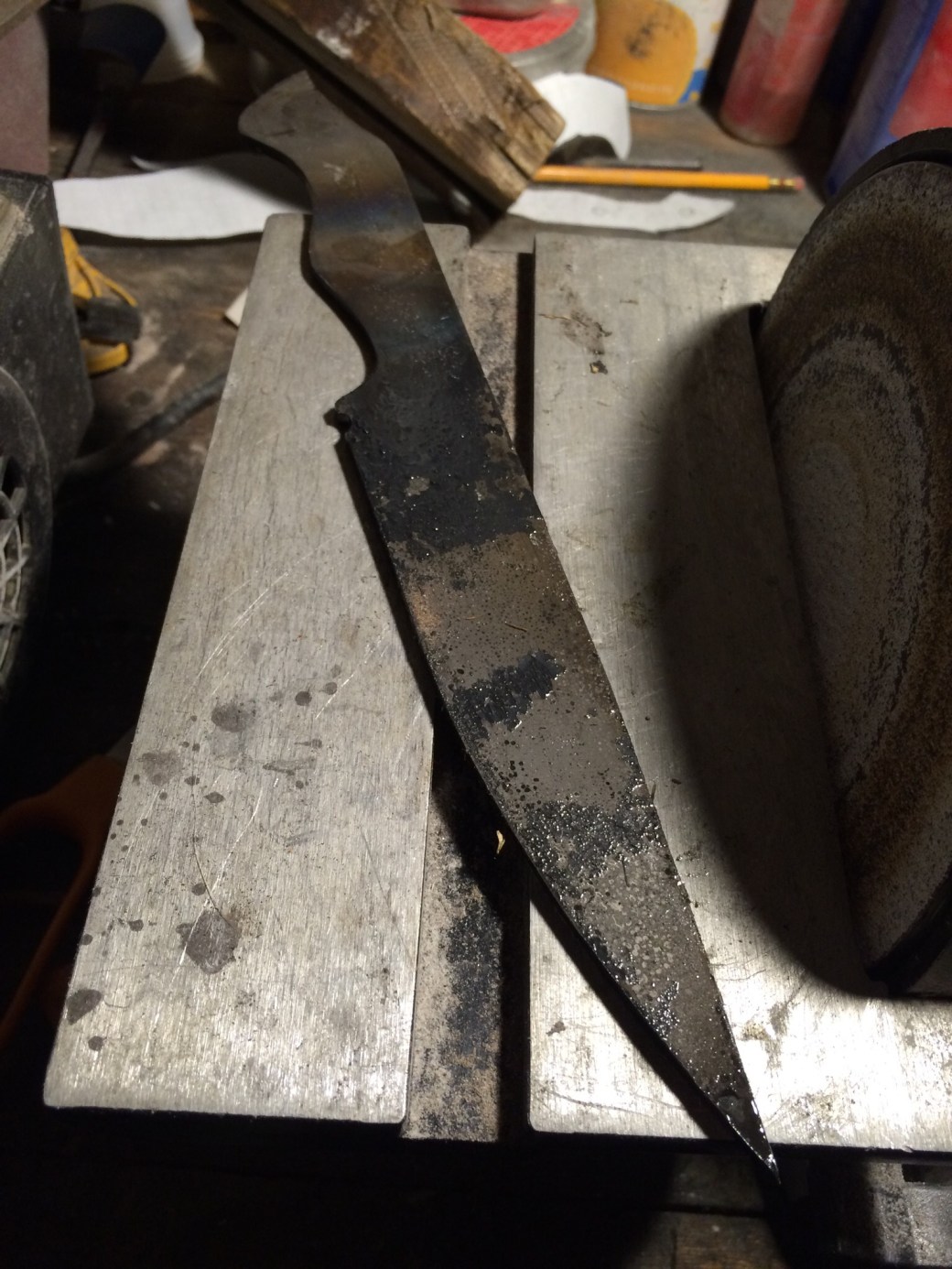
Rough grinding:

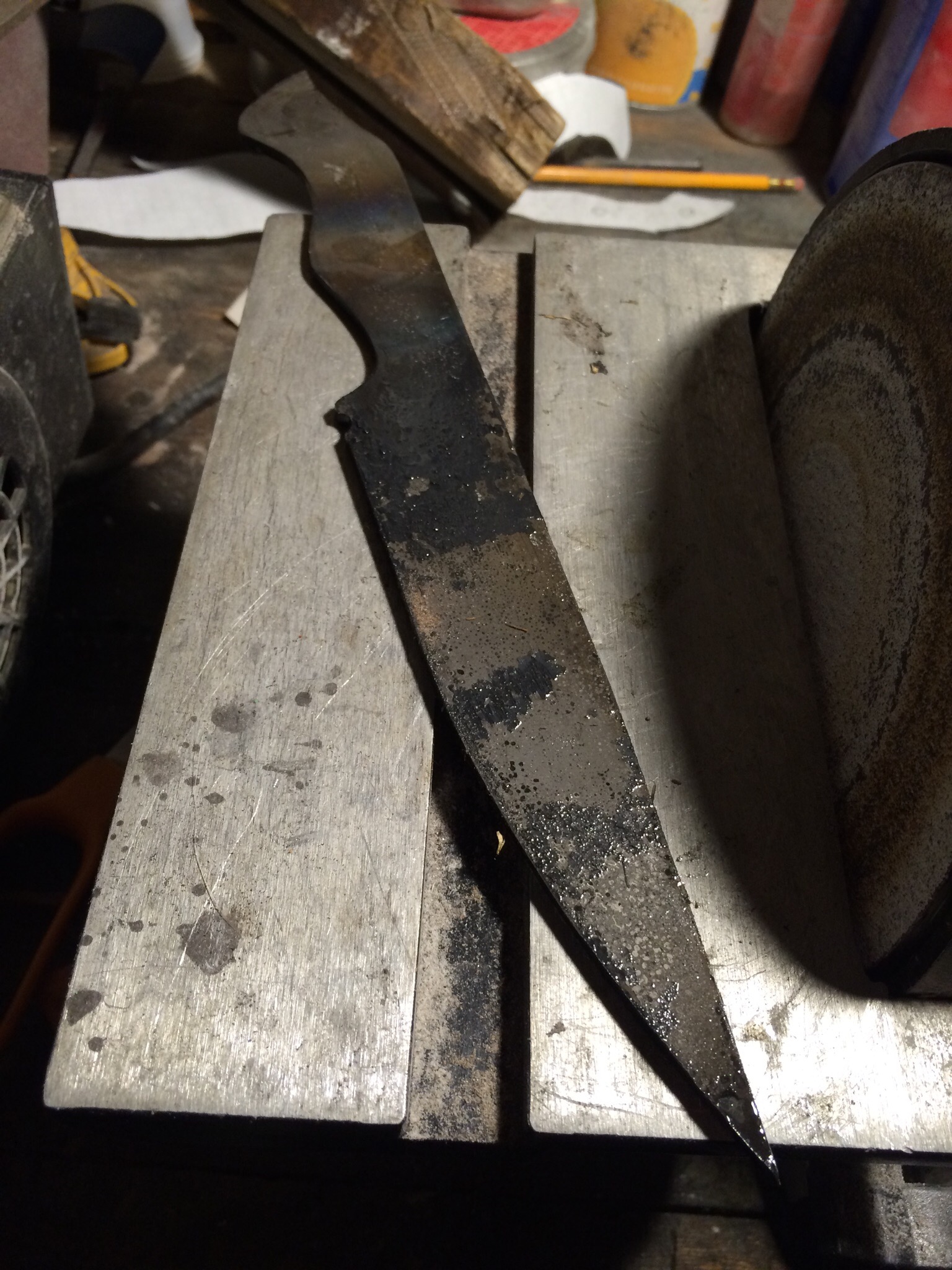
Full flat grind and finished on the grinder to 120 grit:
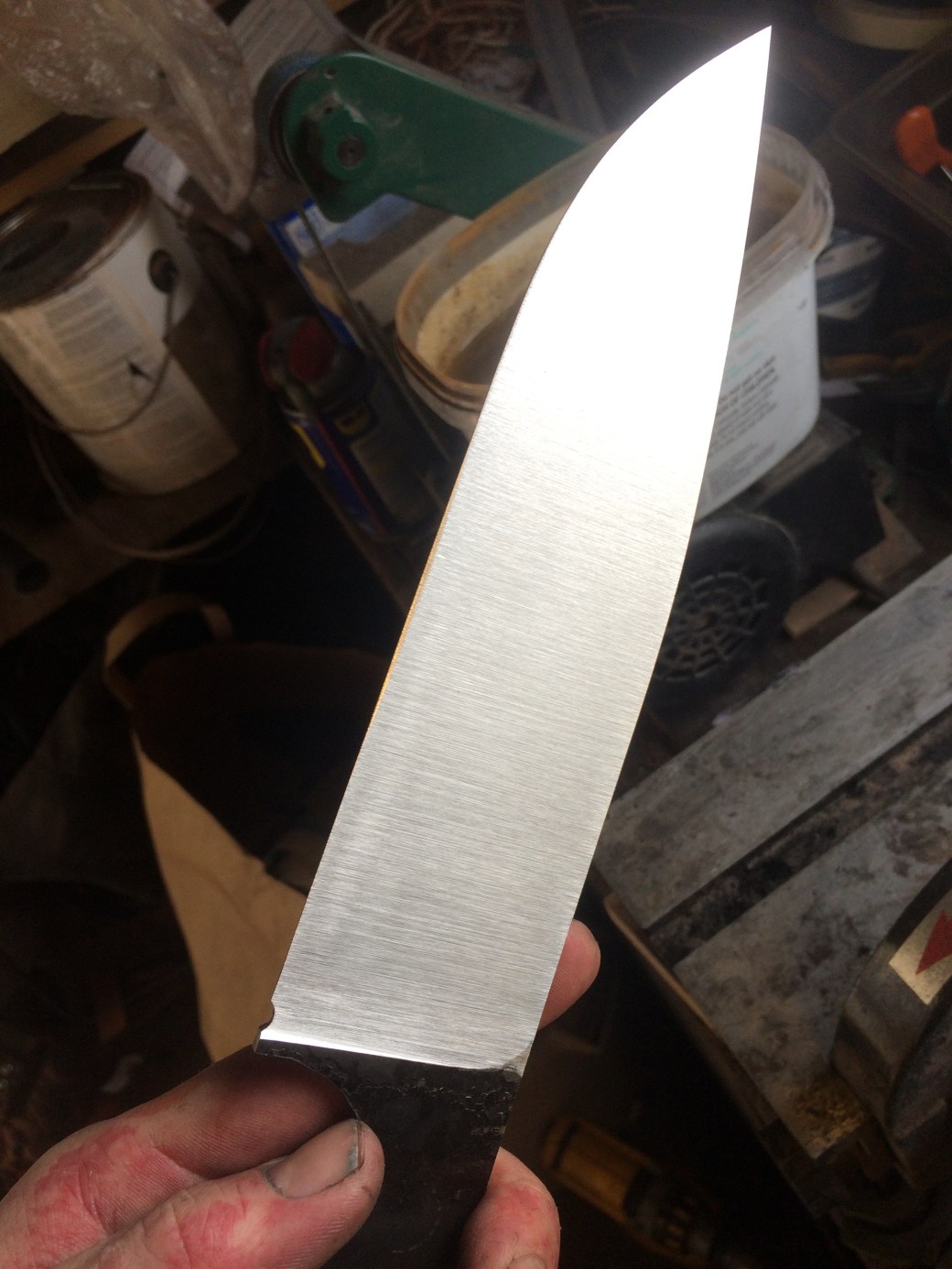
A lot of material was removed:
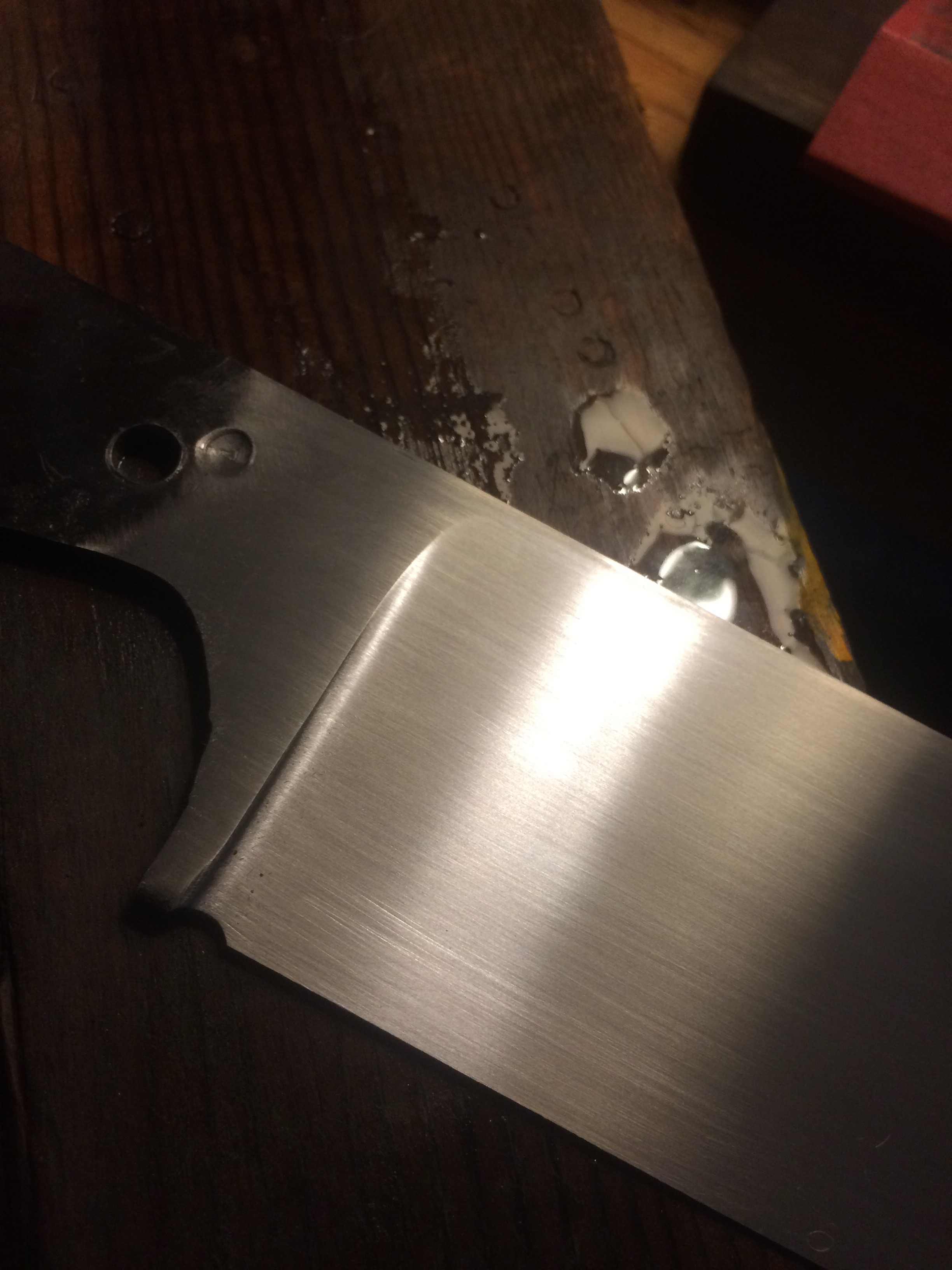
Laying down a hand finish.  A smoother finish makes for less resistance when doing knifework in the kitchen:


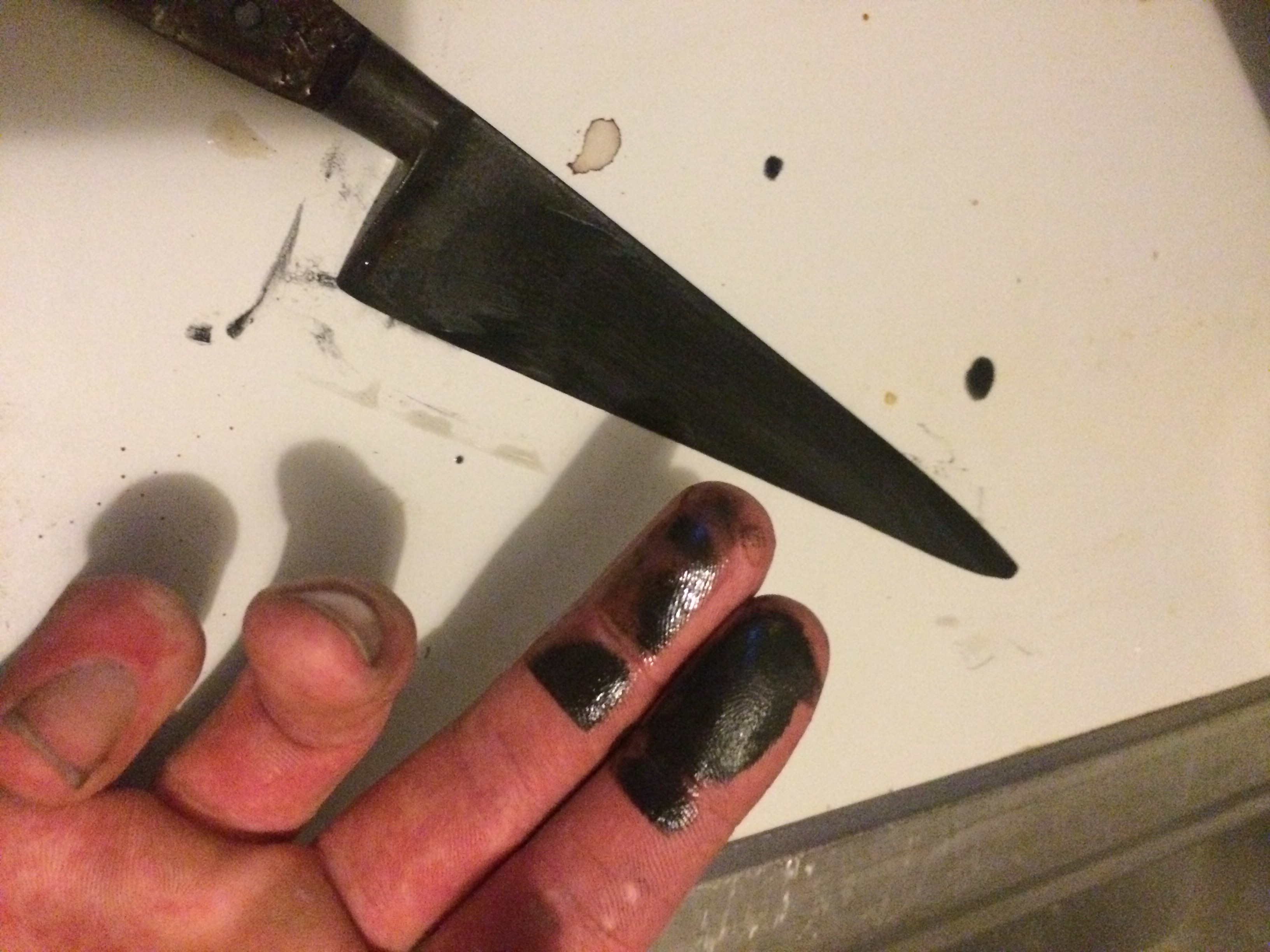
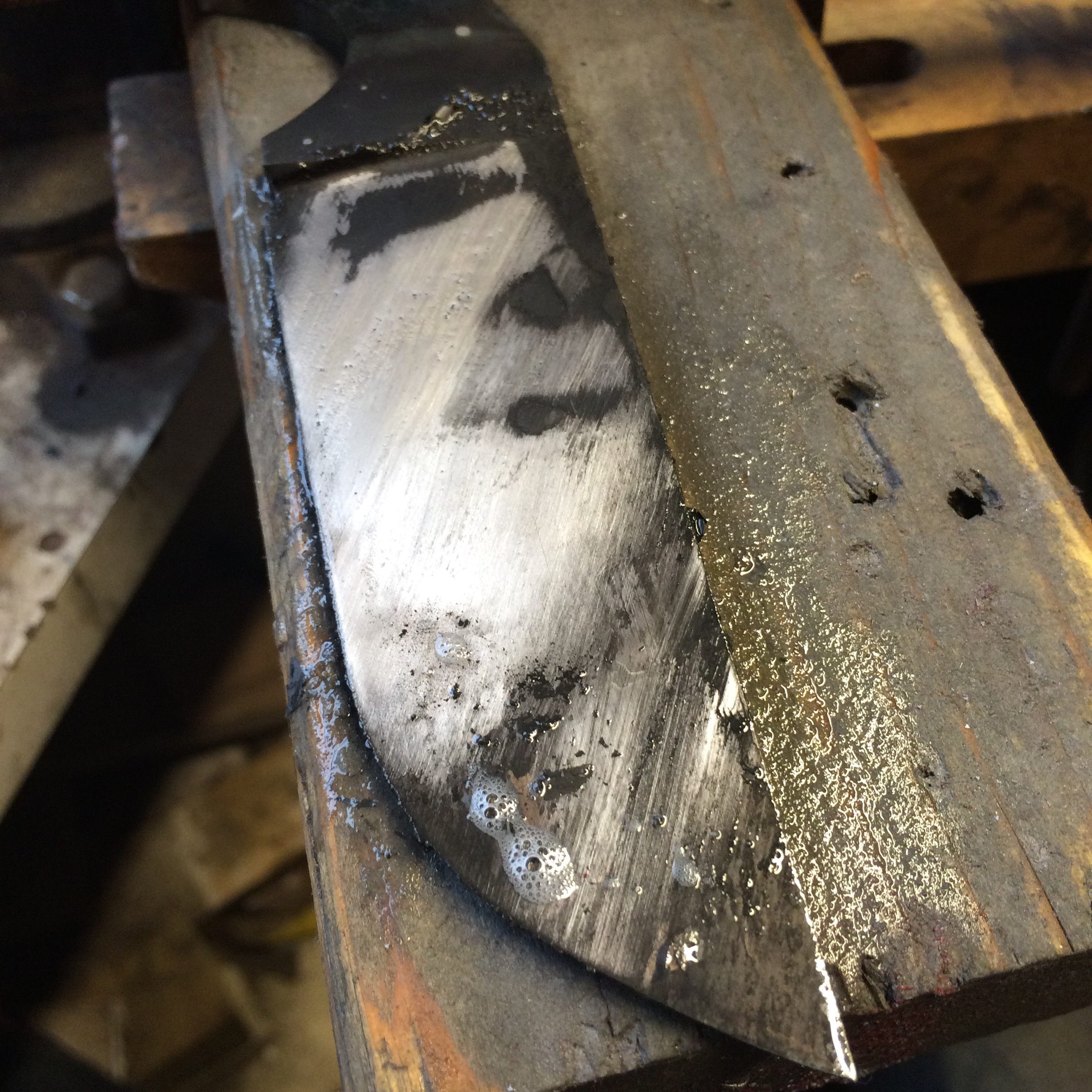
She goes into hot acid for an etch.  The etch helps to prevent corrosion and also makes for a more pronounced patina as the knife is used.  It will also darken the blade:

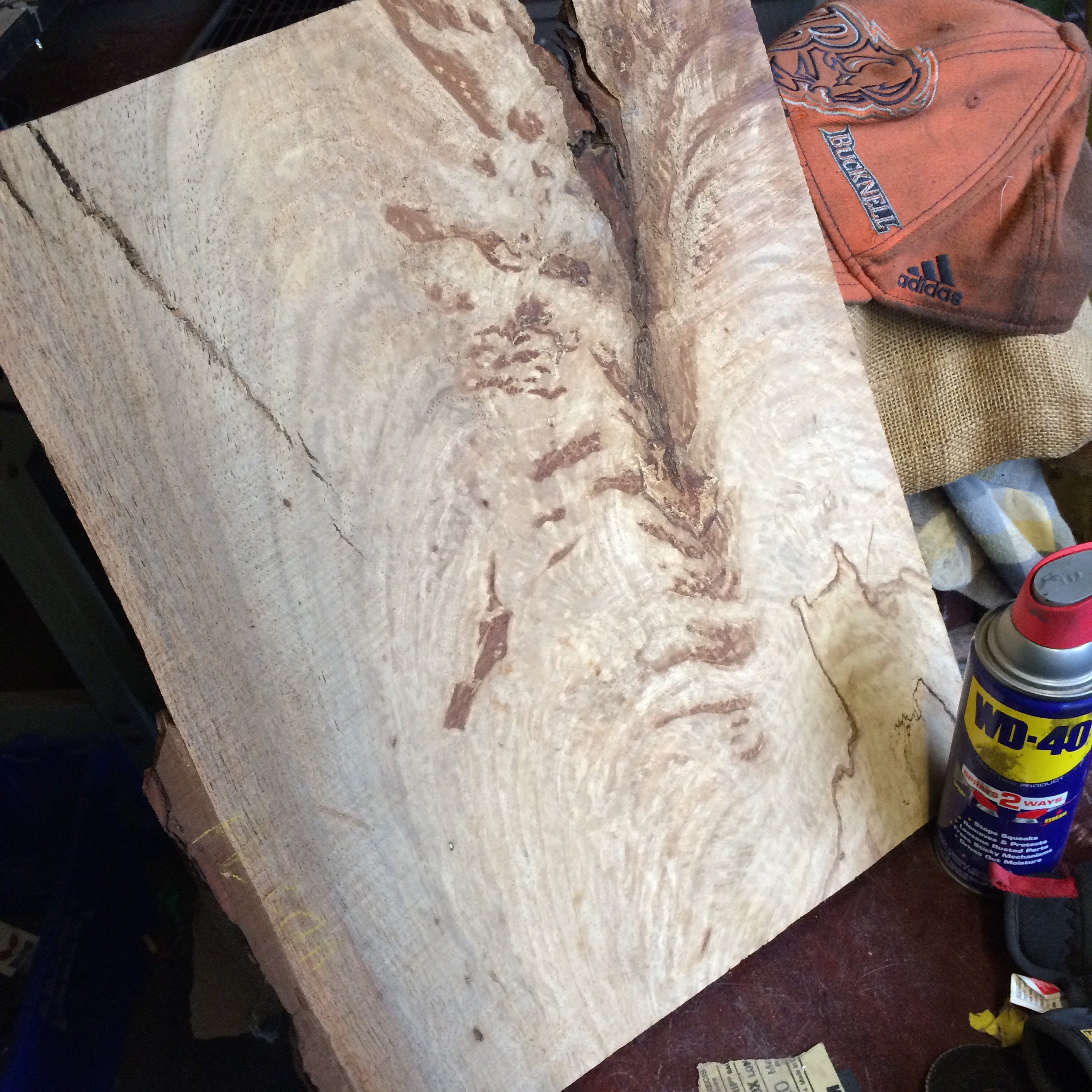
Spalted Tamarind:  the light color represents the ‘no’

With black spacers for contrast:
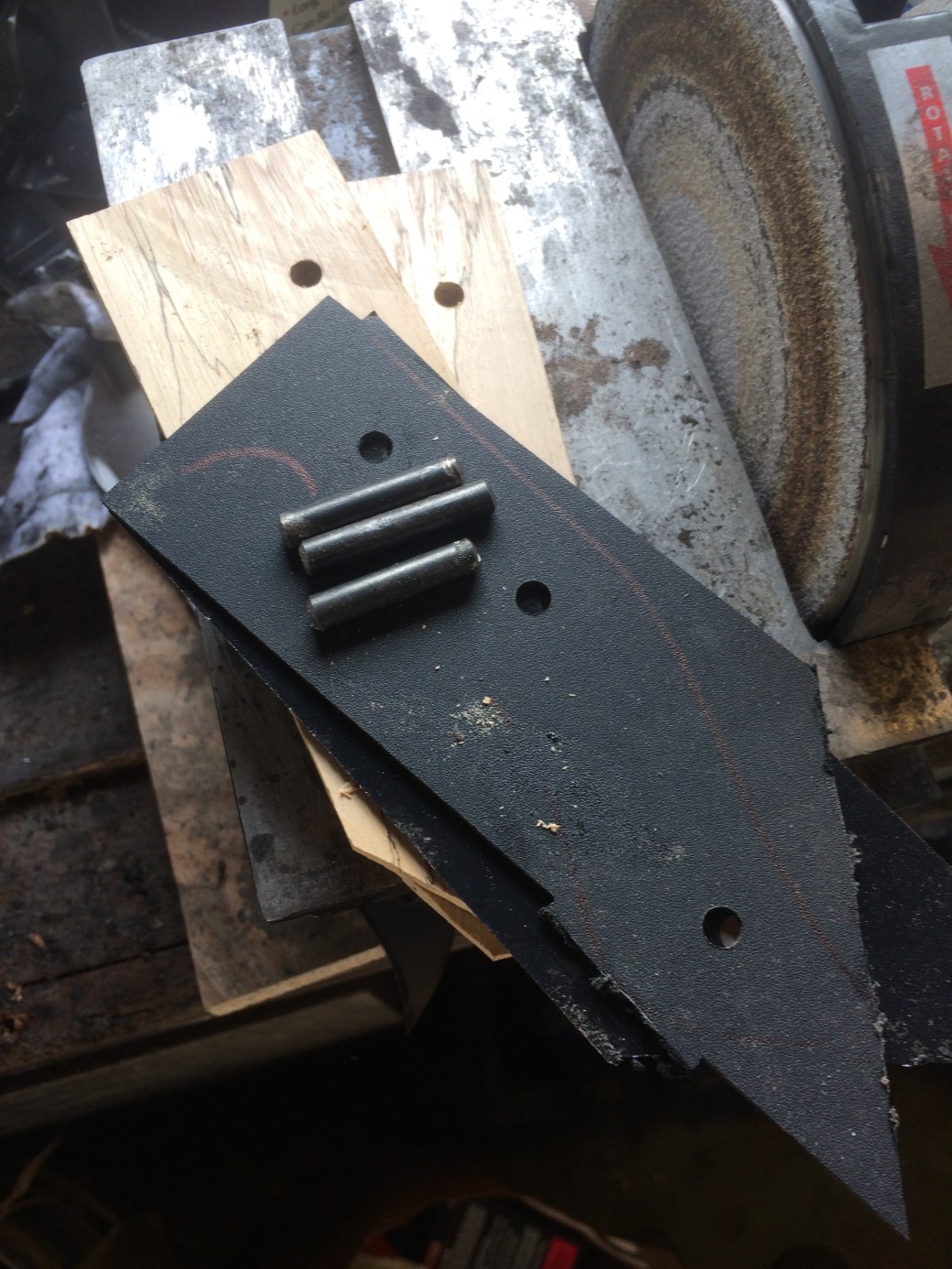
Once again, sanded to 2000 grit:
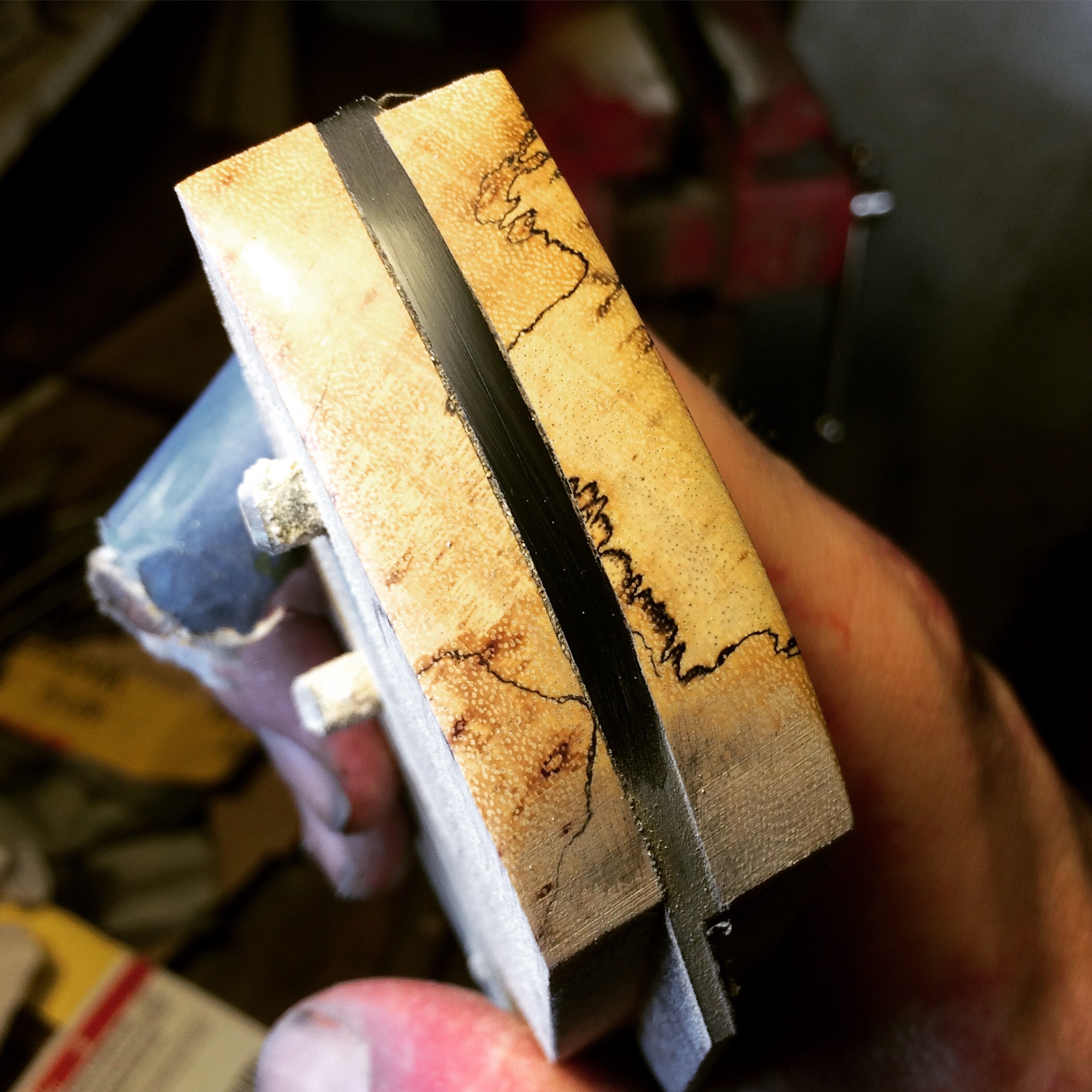
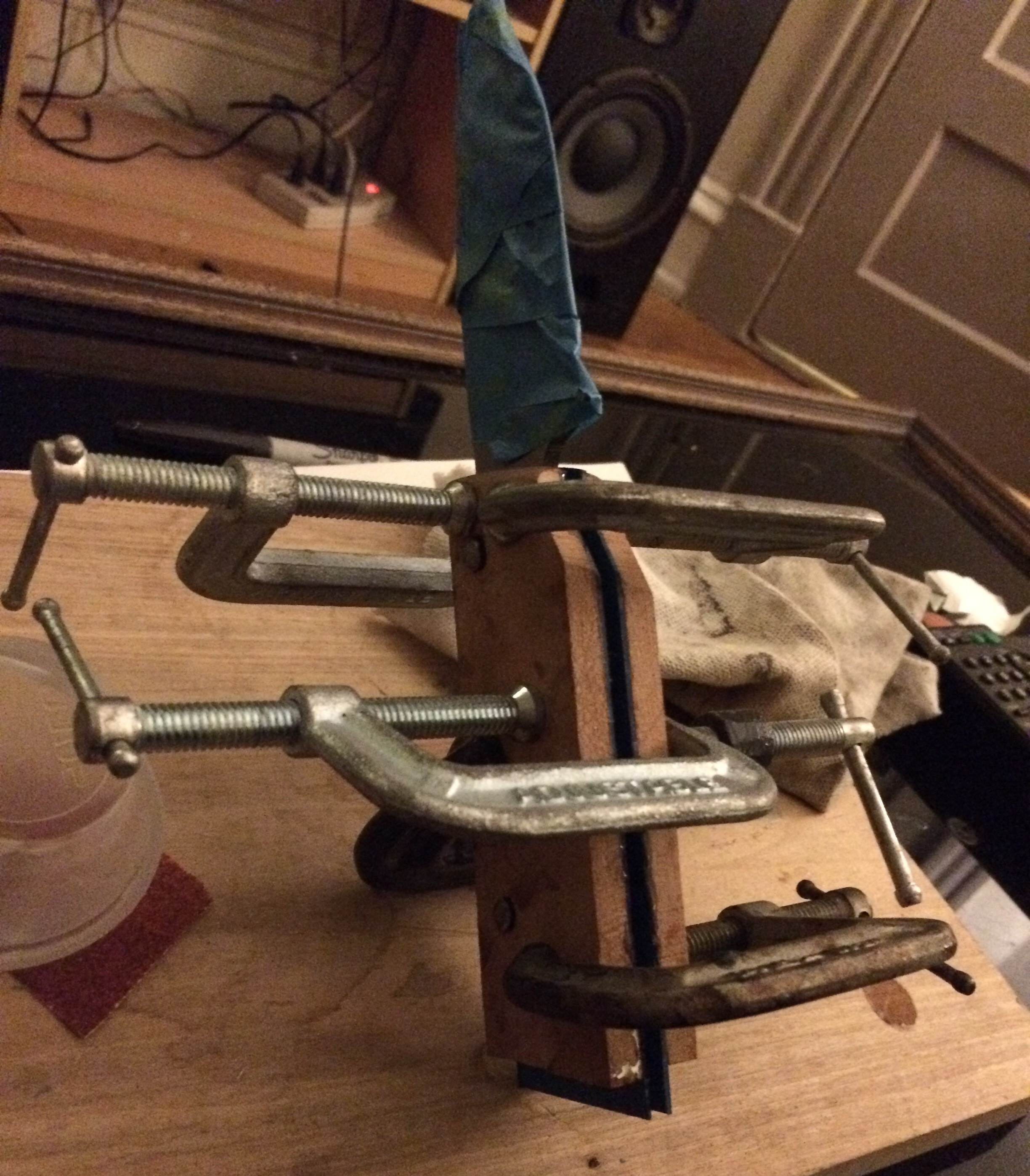
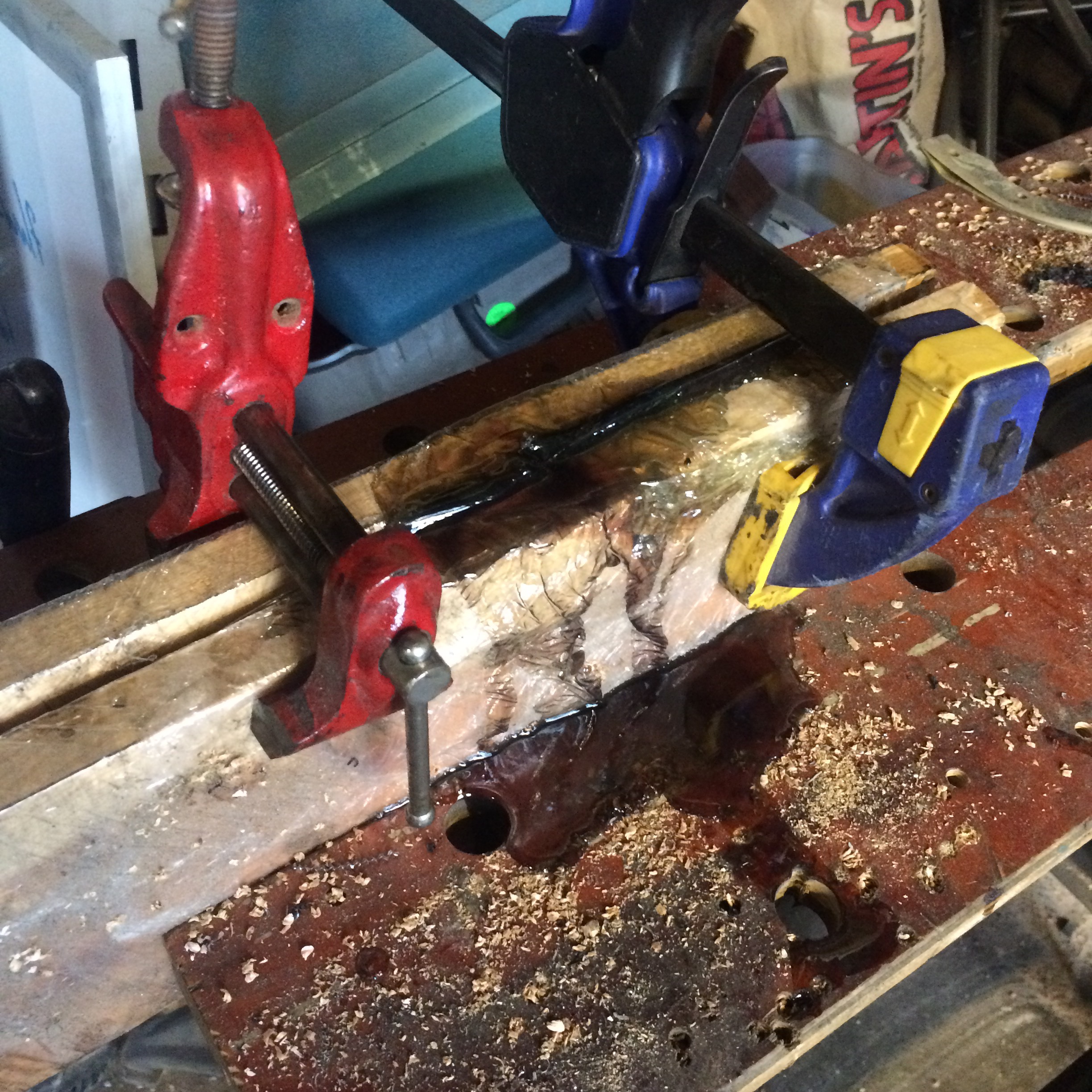
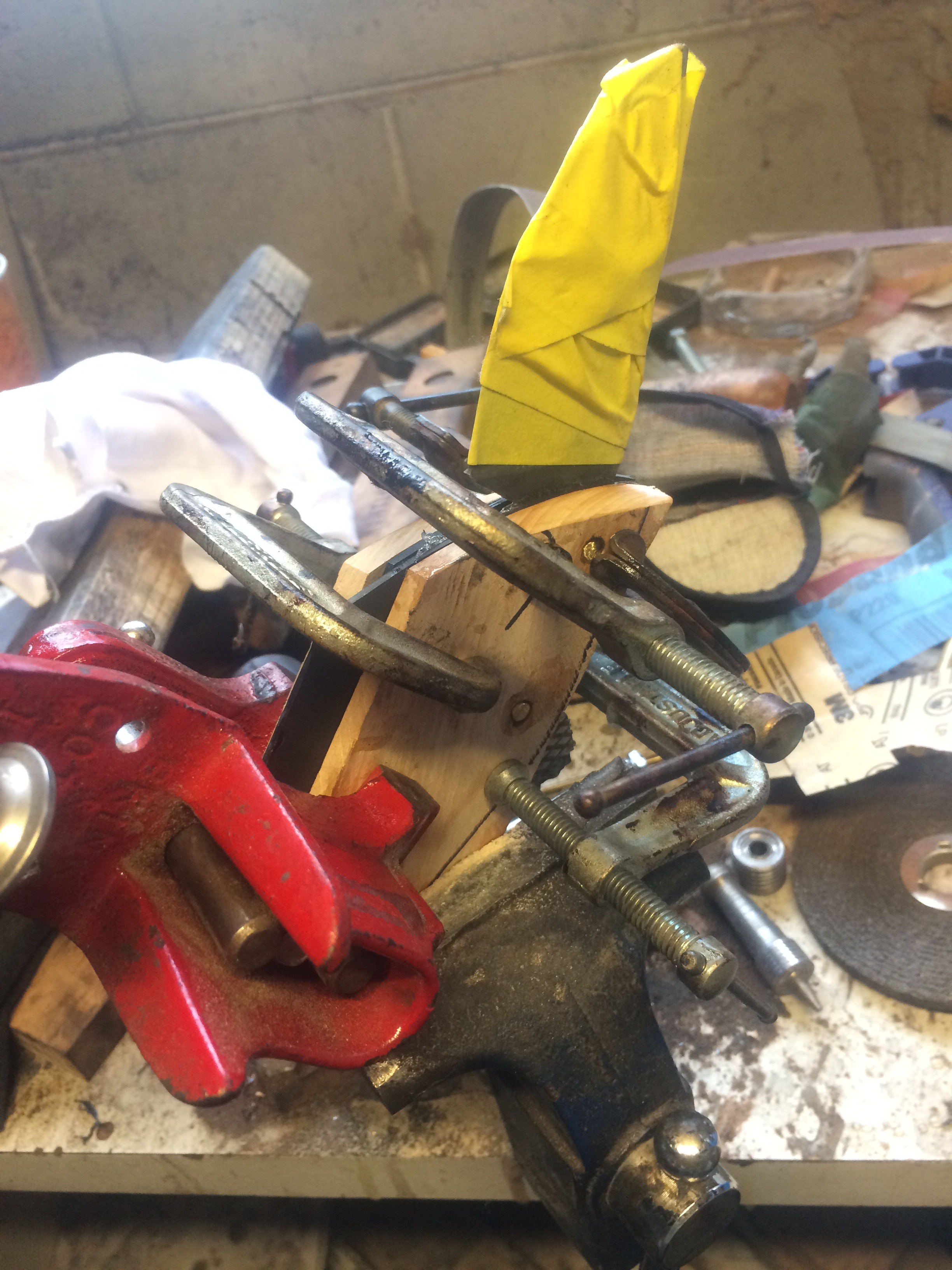
Clamped:
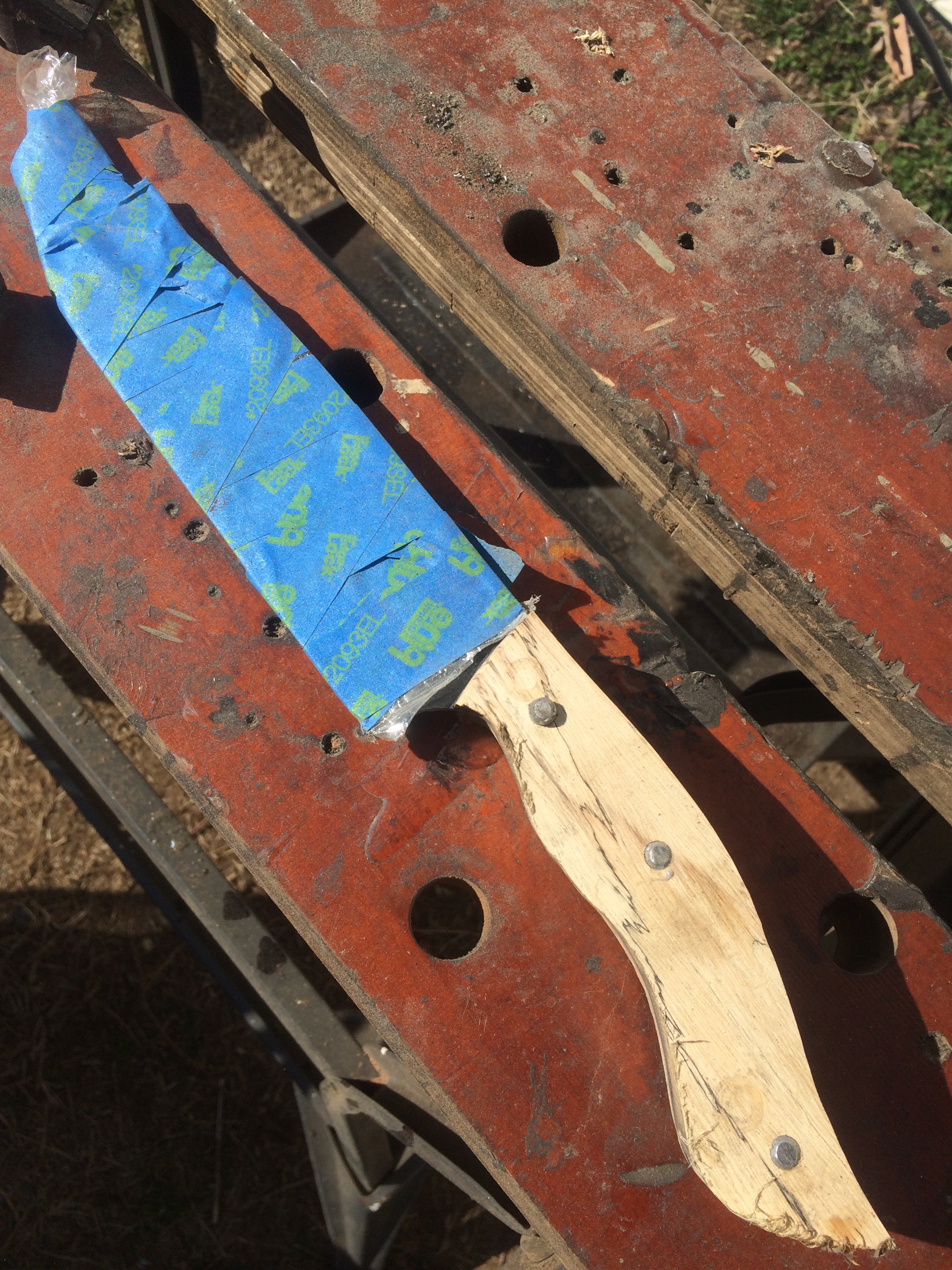
Profiled:

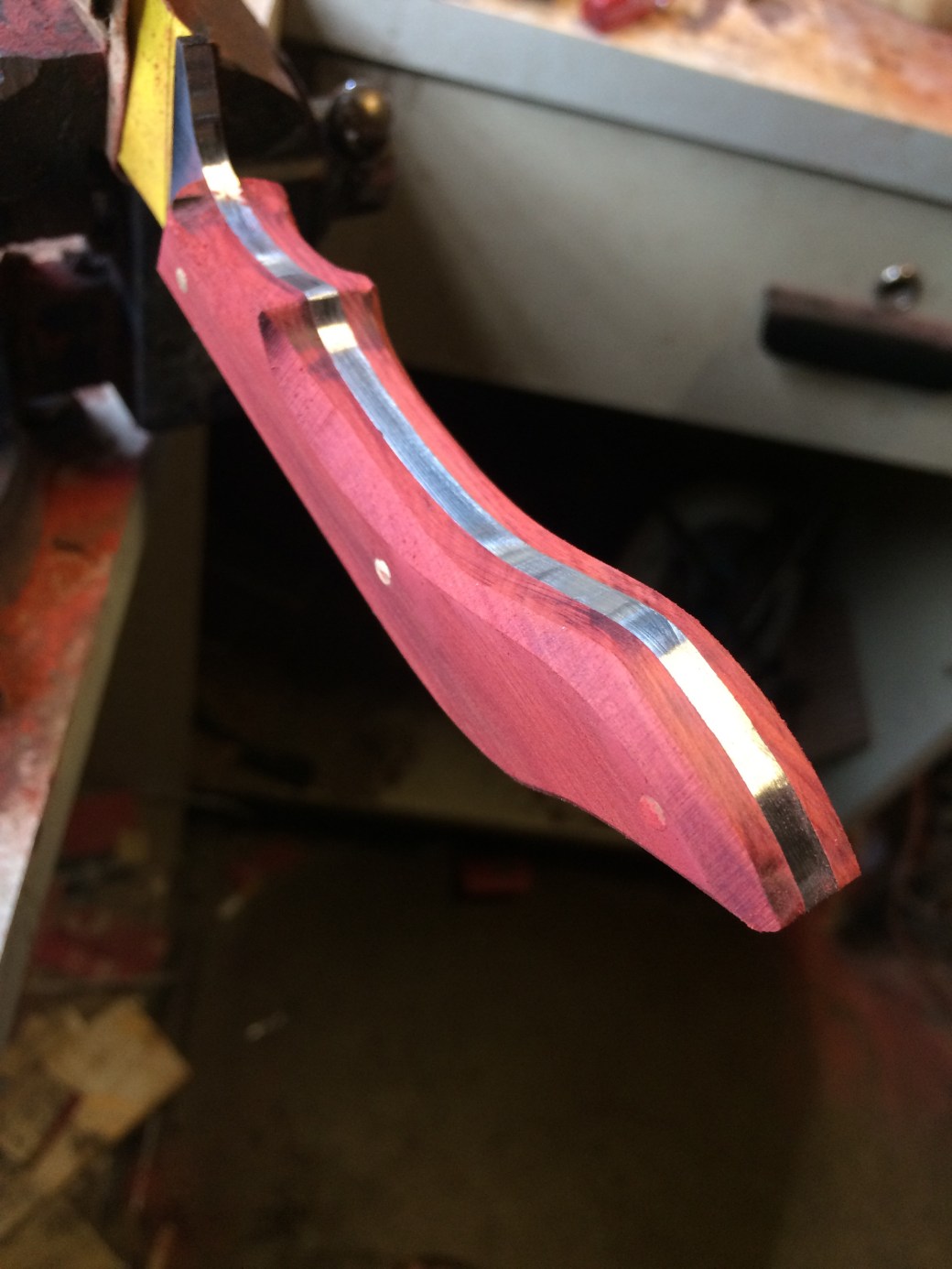
Shaped:

Thummim; the no to the yes:

Urim and Thummim:


The name of the professor mentioned in this story is Jonathan Shear, Ph.D., and you can find links to his publications here.

Knifemaking: being your own cheerleader and the Stag

“You’ve just got to pat yourself on the back and keep moving.  Ain’t nobody else gonna do that for you.”

-Gordon Russell, chef

The other week, early in the morning, I got a knock on my door.  It was the police.  My car alarm had been going off for the past hour and the officer said there had been quite a few calls about it.

We walked over and I turned the alarm off and disconnected the battery.  As the officer was leaving he said that someone had been kind enough to leave a note for me on my windshield.  I found a piece of paper under the wiper and read it.  I’m not sure what I was expecting.  After I read through all of the expletives, I saw that it was signed by “I Hate You”.

Beautiful.  Somebody hates me.

I tried to go back to sleep but I had a hard time.  I knew I wasn’t the first person to have their car alarm go off and I probably wouldn’t be the last but I was having a hard time figuring out what “I Hate You” expected to accomplish through their eloquently worded salutation to me.  Those sorts of things written to you by a stranger don’t feel nice.

Later in the day I found it to be really funny.  I kind of wish I had kept the note.

So what do you do when you find yourself on the receiving end of toxic outrage?  Or of violent vitriols or virulent viscosities or even vicissitudes of the most vicious varieties??  This is where you have to be your own cheerleader.  Because we’re going to screw up at some point, maybe say or do something in poor taste or offend someone’s sensibilities.  People can be awful- much worse than notes on cars.  And hiding behind the veil of social media, people often write things that they wouldn’t necessarily say to someone’s face.  So when someone says or does something dumb, it can be often accompanied by a slurry of shame-dumping and rage. Before long any sense of civility or compassion goes out the window.  If you find yourself on the receiving end of these sorts of shenanigans, it’s best to pat yourself on the back and just keep rolling.  These are the hard things to master in life, but they are worth it.  It’s important to keep moving forward.

This blade was a commission for a gentleman who is a cheerleading coach.  His wife asked if the knife could have an essence of an old Buck fixed blade he had as a kid so I took that into the consideration of the design.  ‘The Stag’ is a bit of a double entendre.  In the animal world a stag can be much larger than a buck, and this knife has a bit more heft than its commercial counterpart.  But on the other side you sometimes have to go stag, by yourself, and give yourself the things that the world is not always going to give you.

The other day I was working with a lady who was late because someone parked her car into her spot.  She said she didn’t even have time to write a nasty note.  I very gently told her that not writing that note was probably for the best…

I did two designs for this knife, based on some of the Buck fixed blades.  I went with the bottom drawing:


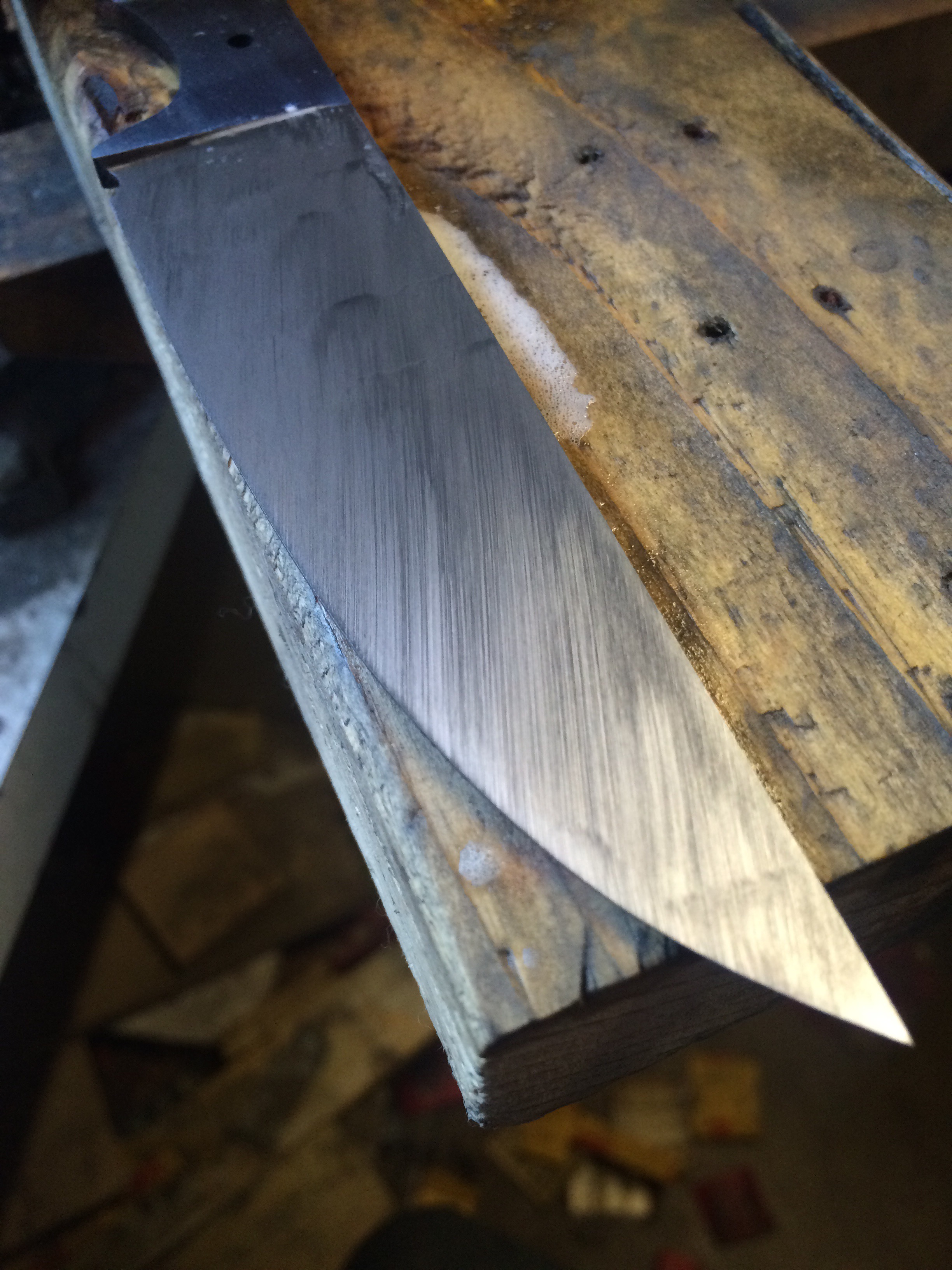
Wet sanding:

This is after heat treat, slag all removed, at about 600 grit:

Satin:

Walnut for the handle:

The Stag:  O1 tool steel, Walnut handle scales, fiber spacers, and steel hardware:

In the words of a dear friend, just pat yourself on the back and keep moving

Much love to Kent Huffman for the beautiful leatherwork and to Taylor Huffman Bernard for the beautiful woodburning.  Finished knife photos by James Bernard and his superior camera.

Knifemaking: how to behave in the world, and the Dummy

“You big dummy!”

-Fred Sanford

It was New Year’s Eve a couple of years ago and it had been a pretty crappy year.  I was with very good friends, half drunk, and a bit reflective.  There are times in life when challenges present themselves, as they always will.  You can deal with them with grace, dignity, and elegance and use them as an opportunity to move forward….or you can let each one smack you in the head until you find yourself sitting in a pile on the ground feeling sorry for yourself.  My year could be summarized by the latter.  So in my half drunken state I came up with the last New Year’s resolution I would ever make.  I wrote it down:


Don’t be a dumbass. The next day in a brand new year I thought about this.  I proposed that whatever future situation I found myself in and there was a decision to make I would ask myself, “What would a dumbass do?”.  When I had determined what course of action a dumbass would follow, I would simply not follow that course.  

The beauty of the whole thing is the simplicity of it.  Much like kindness, it functions on a continuum.  It will meet you where you are and, if you are diligent in your practice of not being a dumbass, it will expand into your entire universe.  Before long, what started as a way to make your immediate life better turns into a lifestyle.  You set an intention to be present in your life and your relationships.  You are navigating opportunities.  You are not perfect but anyone who is not a dumbass knows that no one is.  It is quite challenging but the payoff is that you, my dear friend, are not being a dumbass.

But alas, no system is perfect.  Sometimes, despite your best efforts, you find yourself ambling down an avenue of unbridled, unbuttoned, and completely unadulterated dumbassery.

I found myself on that avenue the other week.  It was one of the most embarrassing and humbling days of my professional life.

I had a contracted production runner job working for a big televised arena show.  My job was to run around town and procure necessary items for the show.  I’m generally very good this job.  They give you a list of things they need done to make the show happen, you figure out the best way to accomplish those things, and everyone works together to make a production happen.  Many times you are part of a well-oiled machine that makes incredible things happen and it is very satisfying.

This particular show, being a massive televised touring production with many things that can potentially go wrong, required a copy of our drivers’s license for insurance purposes.  Most production runner gigs don’t do this.  No worries though and I handed over my license.

It had expired.  Then I remembered the notice I had gotten from the DMV a couple of months ago and how I said I’d get around to it and how I actually hadn’t.  This wasn’t exactly the way I wanted to be reminded.  It was hugely embarrassing and I wanted to run away and hide. 

I did not run away and hide, because that’s what a dumbass does.  The people on the production team for this organization are incredibly kind and though I couldn’t do my normal job and was working my way out of a shame funk, they let me work in catering.  I hadn’t done anything in food service since I was 19.

They sent me to the kitchen and I met with the head catering lady who just laughed at me, handed me an apron, and sent me to help unload a cargo van slam full of food to be prepared that day.  The cargo van was in the loading dock and the loading dock was a zoo.  In addition to the van there were four tractor trailers being unloaded by about forty stagehands.  There were four forklifts unstacking road cases and half a dozen men with radios directing all of this.  I joined four or five other guys at the van and start loading up carts with everything from fresh salmon to the biggest can of marinara sauce I had ever seen. 

I get one of the loaded carts to take to the kitchen and it is slam full.  I am trying to navigate the insanity of the loading dock and I hit a bump.  There is a gallon-sized tub of dijon mustard sitting on top of the cart that I watch, in slow motion, fly off the top of the cart, hit the ground, break open, and splay all over the crew chief directing the insanity.  He was not happy….

So food gets back to the kitchen and unloaded.  I would spend the next four hours peeling potatoes, cutting endives, and shredding raddichio.  It was surprisingly calm in there.  I made sandwiches for lunches, ran dirty dishes to the wash area, and cut up more vegetables.  Every time I ran into the head catering lady she would say ‘here comes trouble…’.

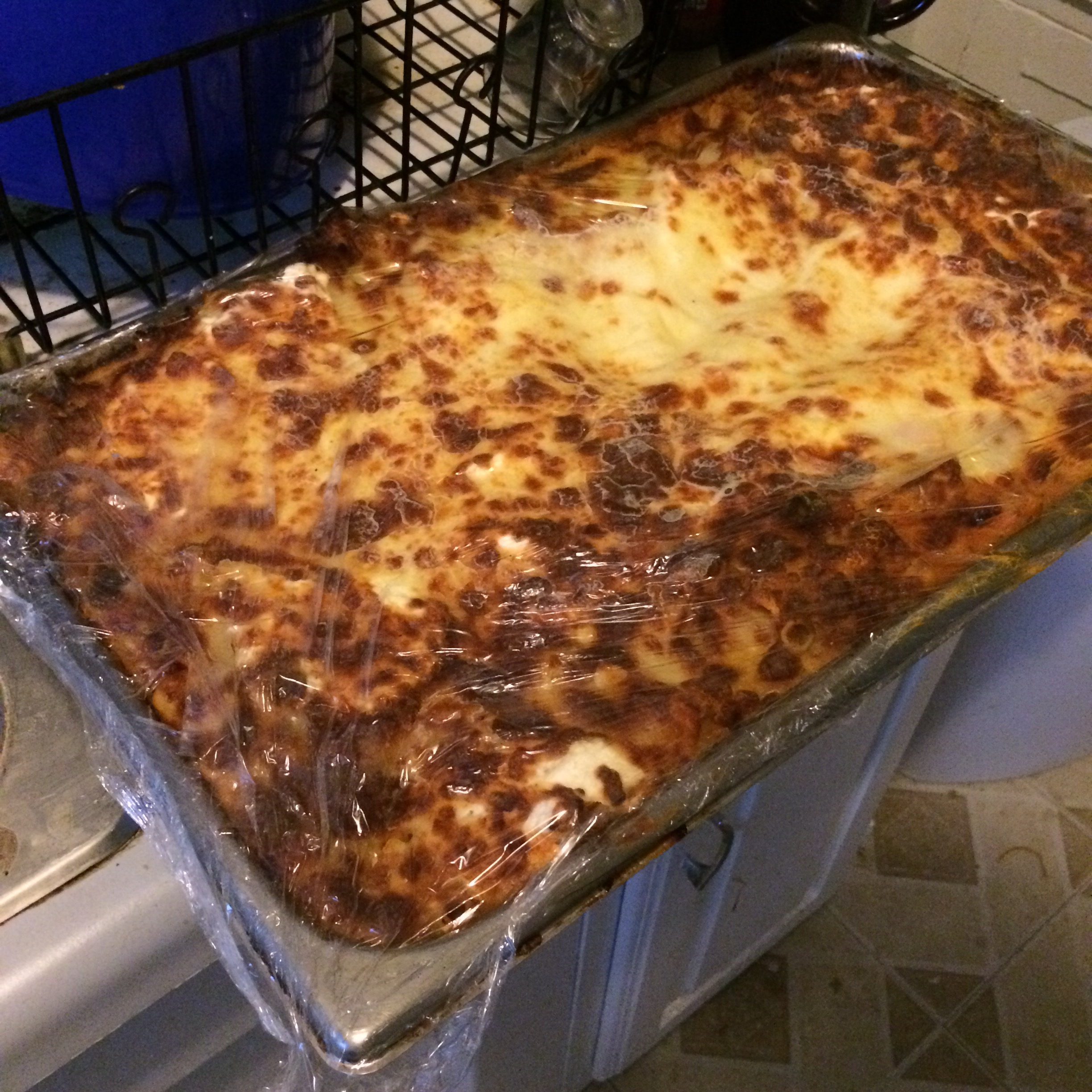
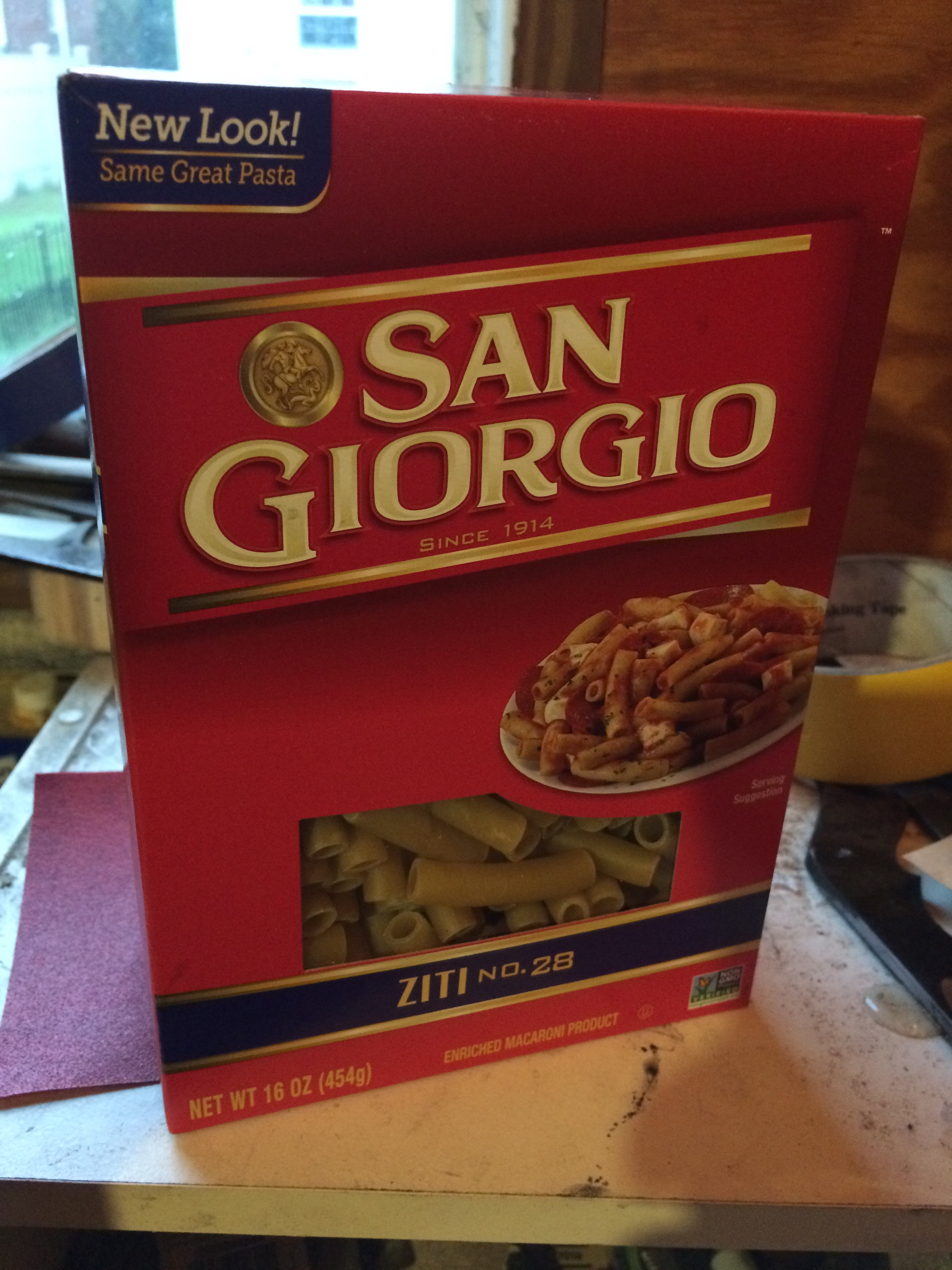
They were all very sweet and kind.  They sent me home with a hotel tray full of baked ziti which fed me for two weeks:

This is the lesson of the Dummy.  Sometimes you have to stay with your dumbassery and it will pass.  Everyone is a dumbass sometimes.  Thank you Universe for teaching me humility….

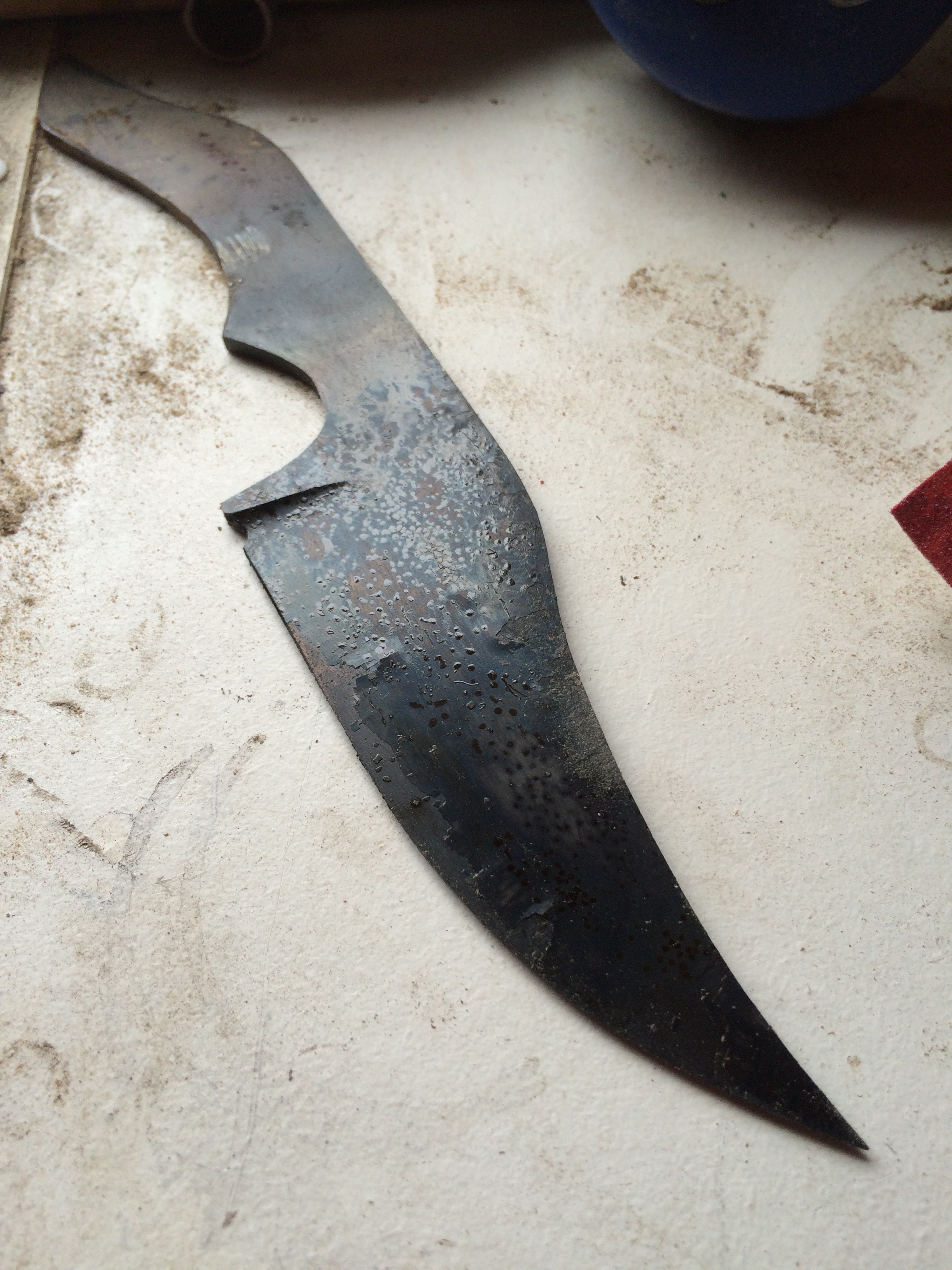
I started with 1095 spring steel.  Here it is cut, with bevels started:

Hardened:

Wet sanding:

….for a satin finish

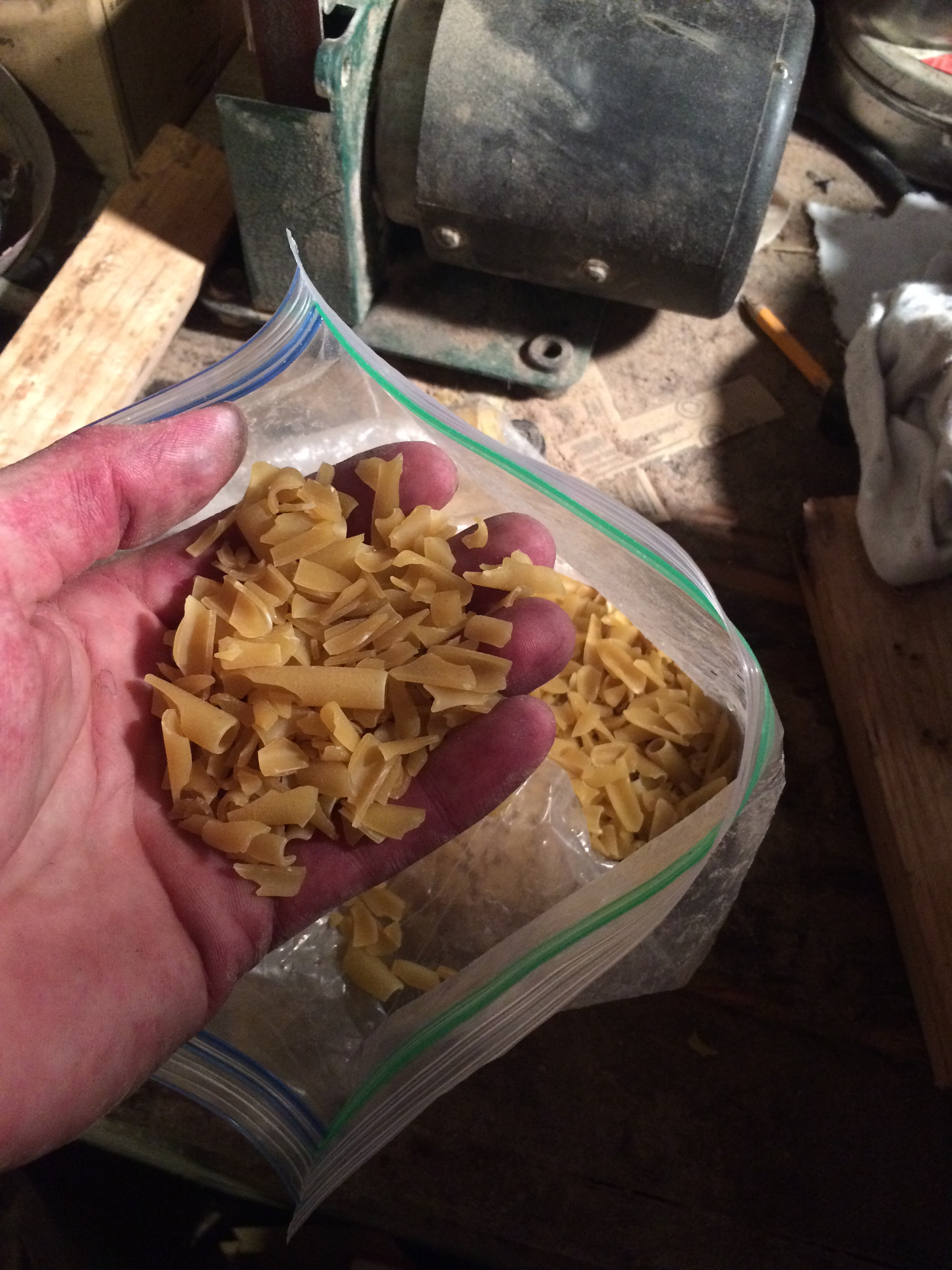
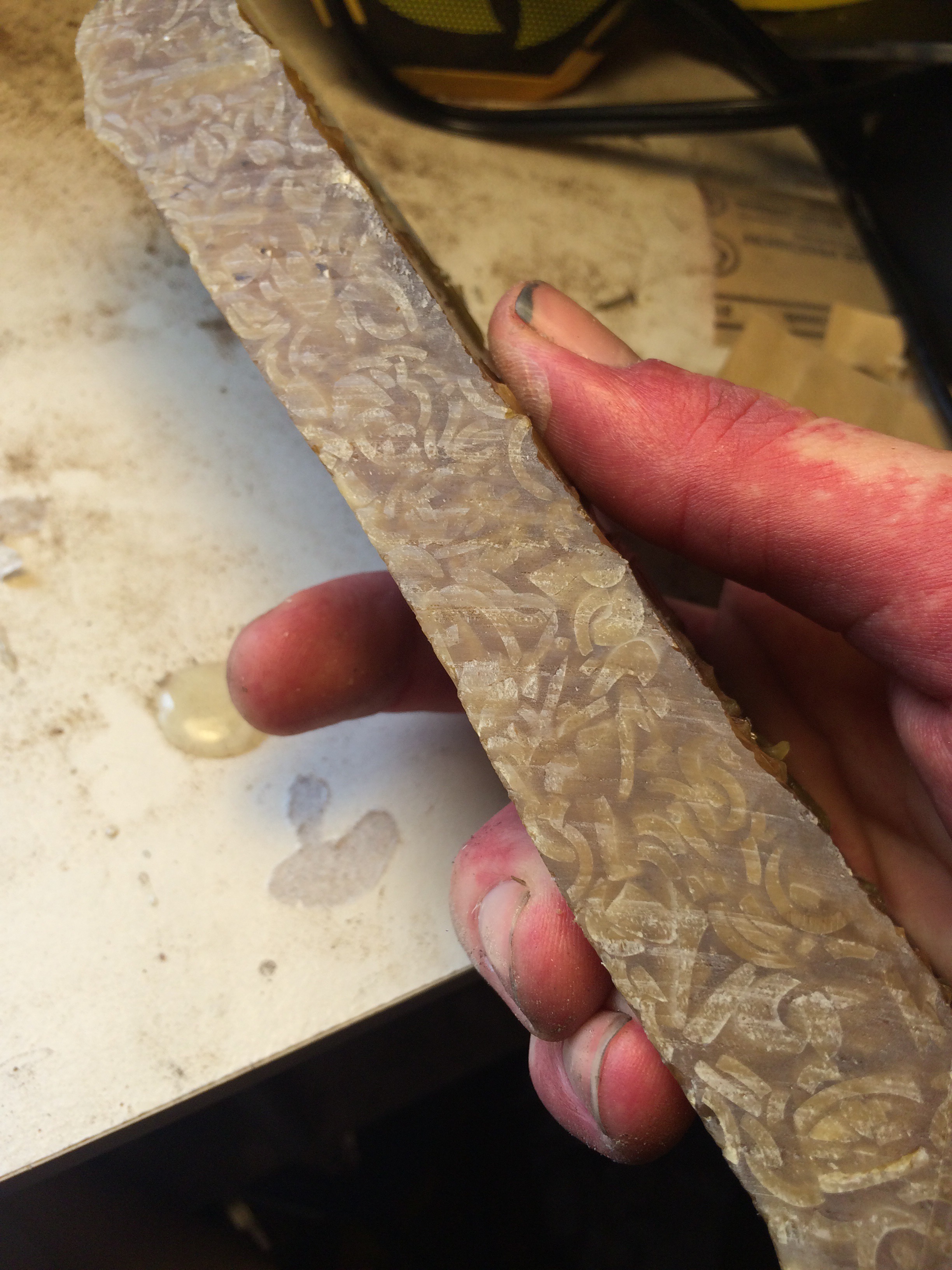
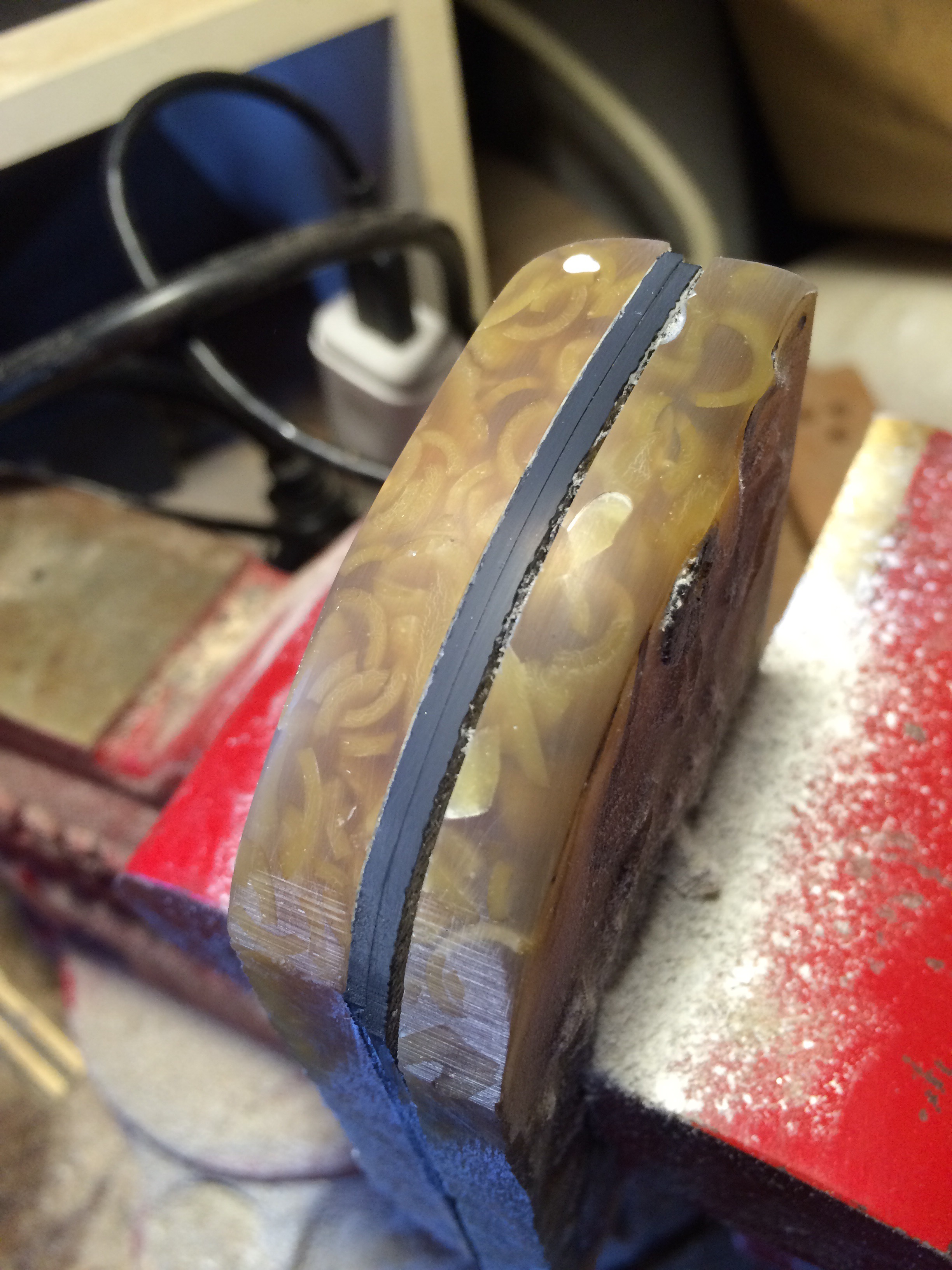
In gratitude for the many meals I was gifted, I wanted to work ziti into the handle:

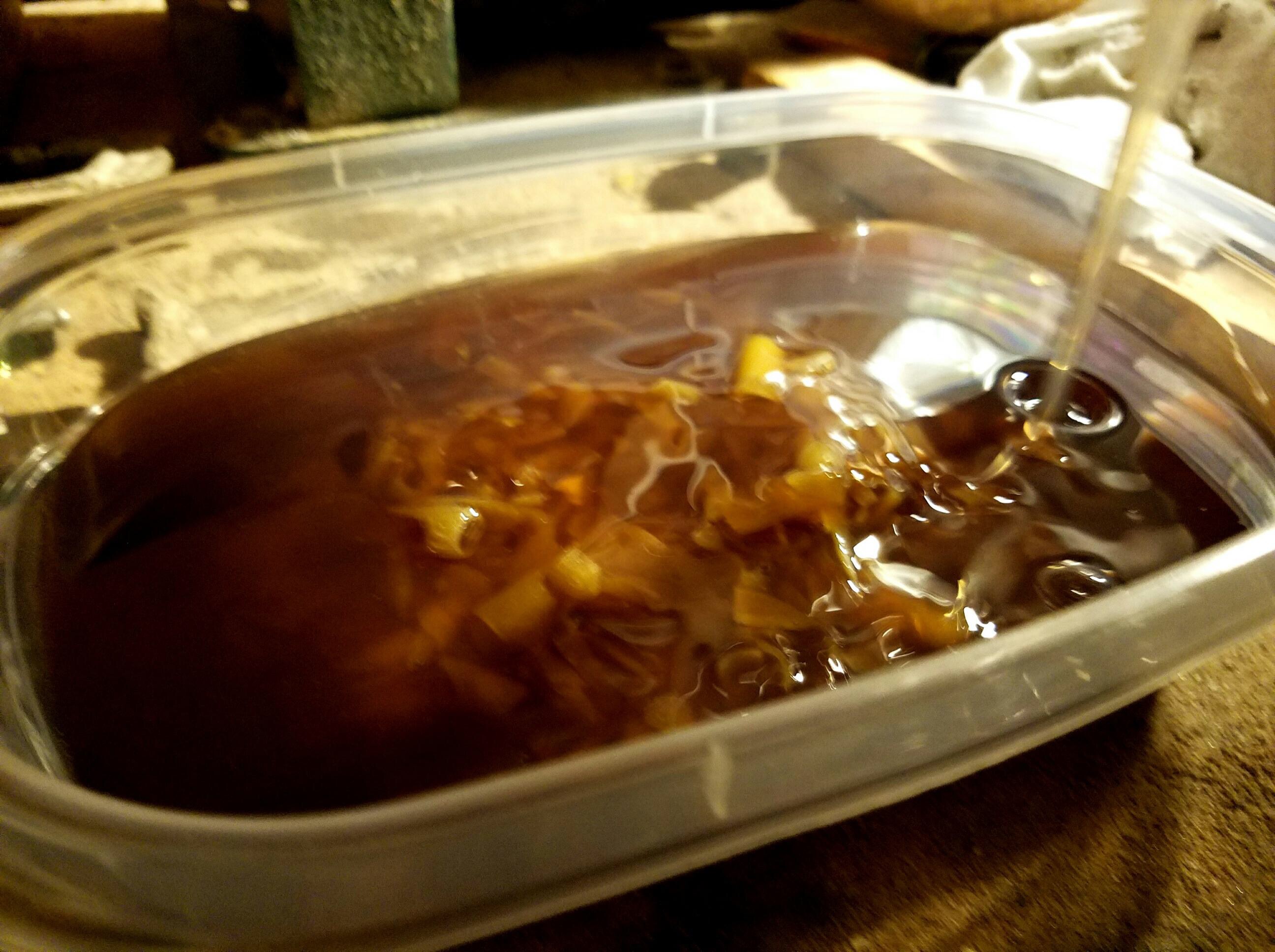
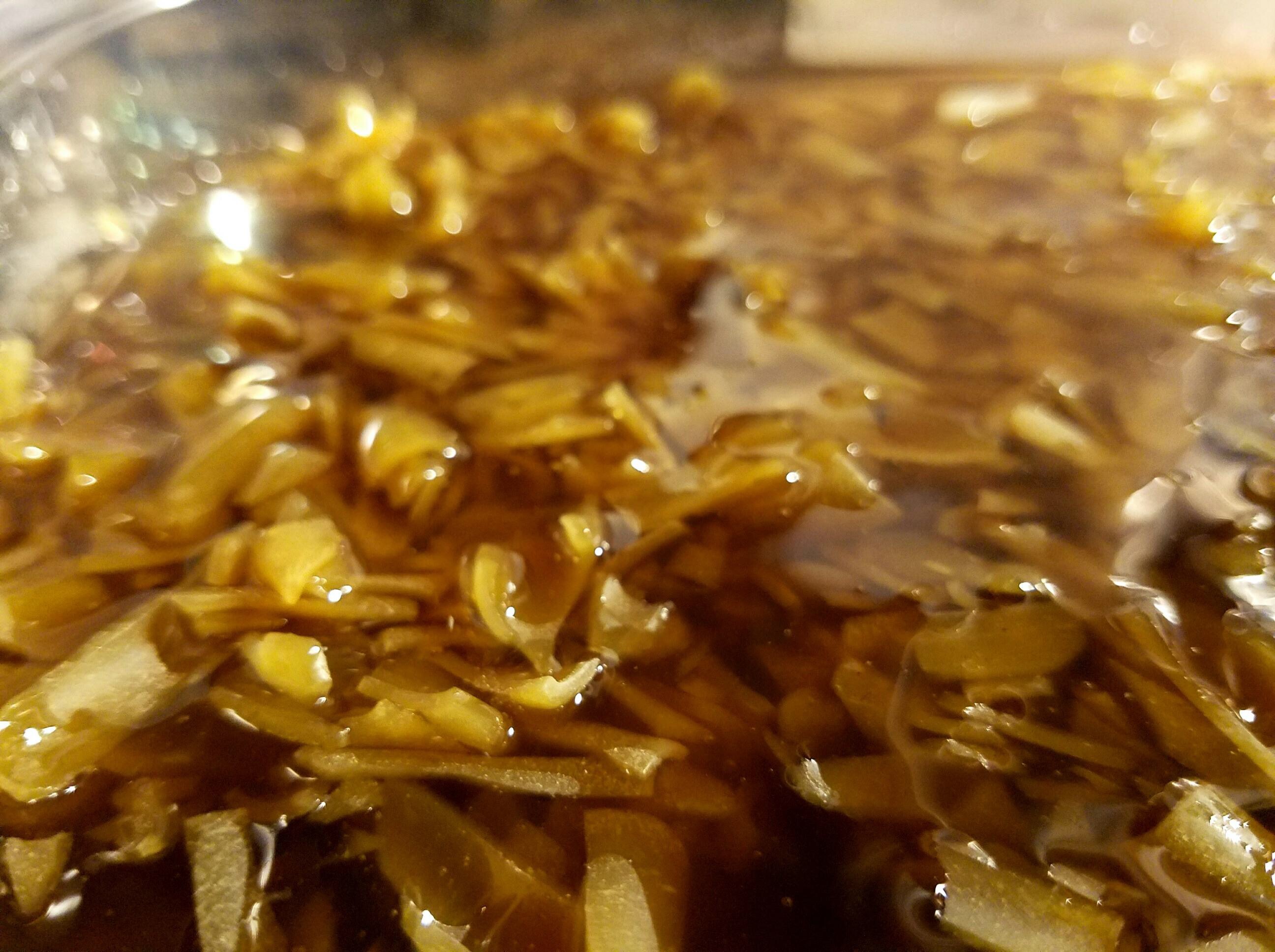
Hulk smash:

Fiberglass resin:

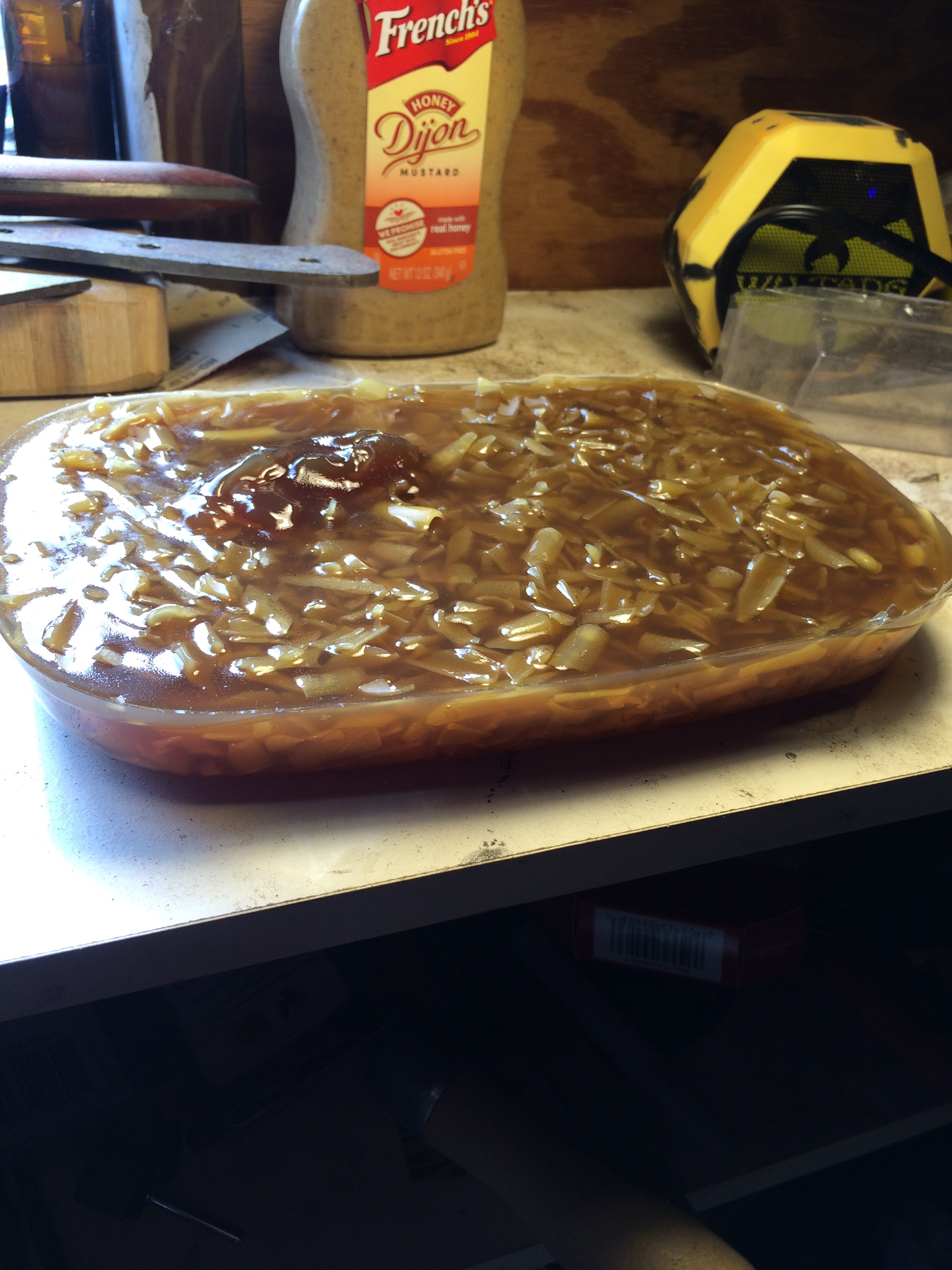
Dinner is served:

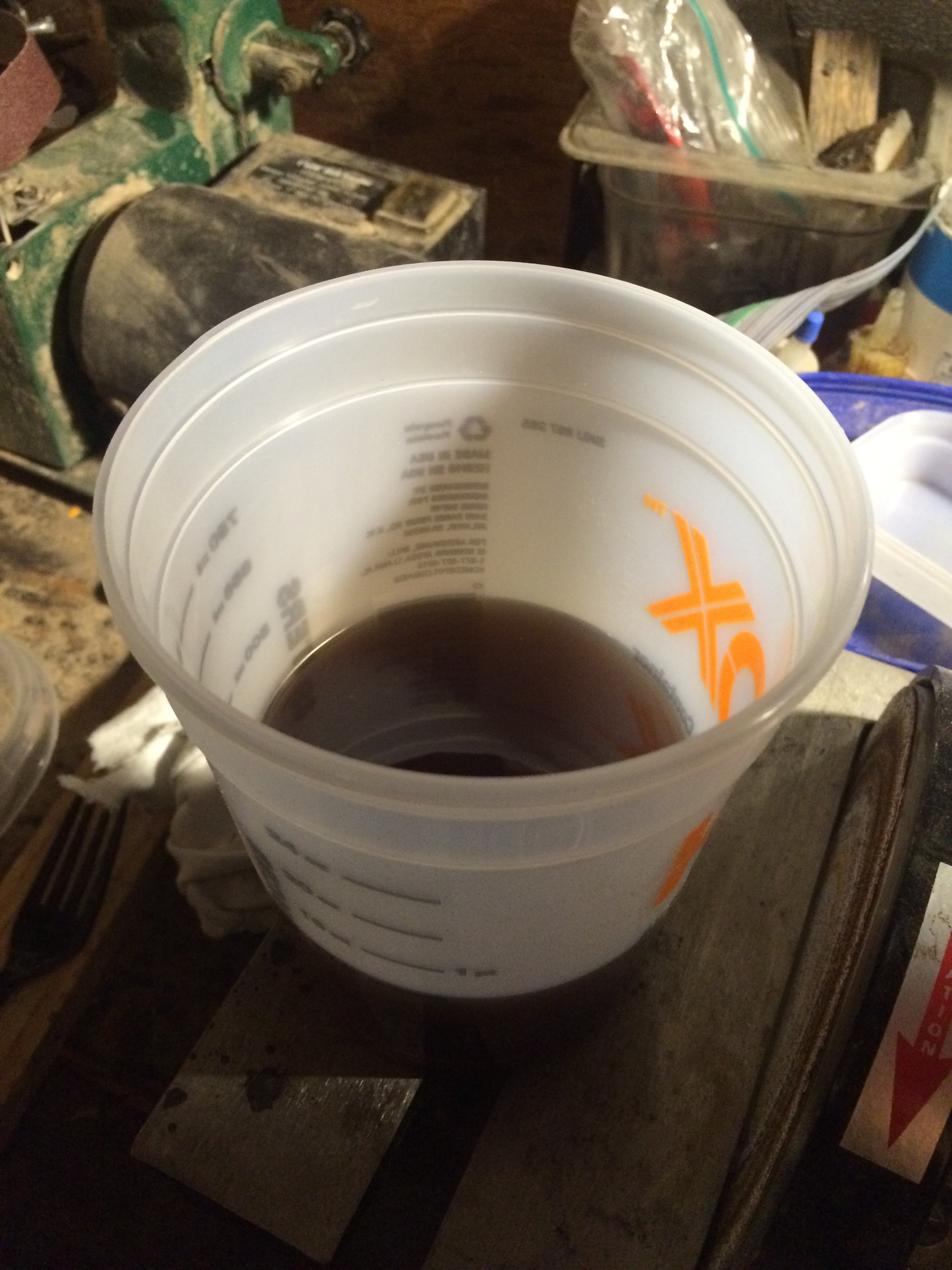
The dijon mustard, a low point of my dummy day:

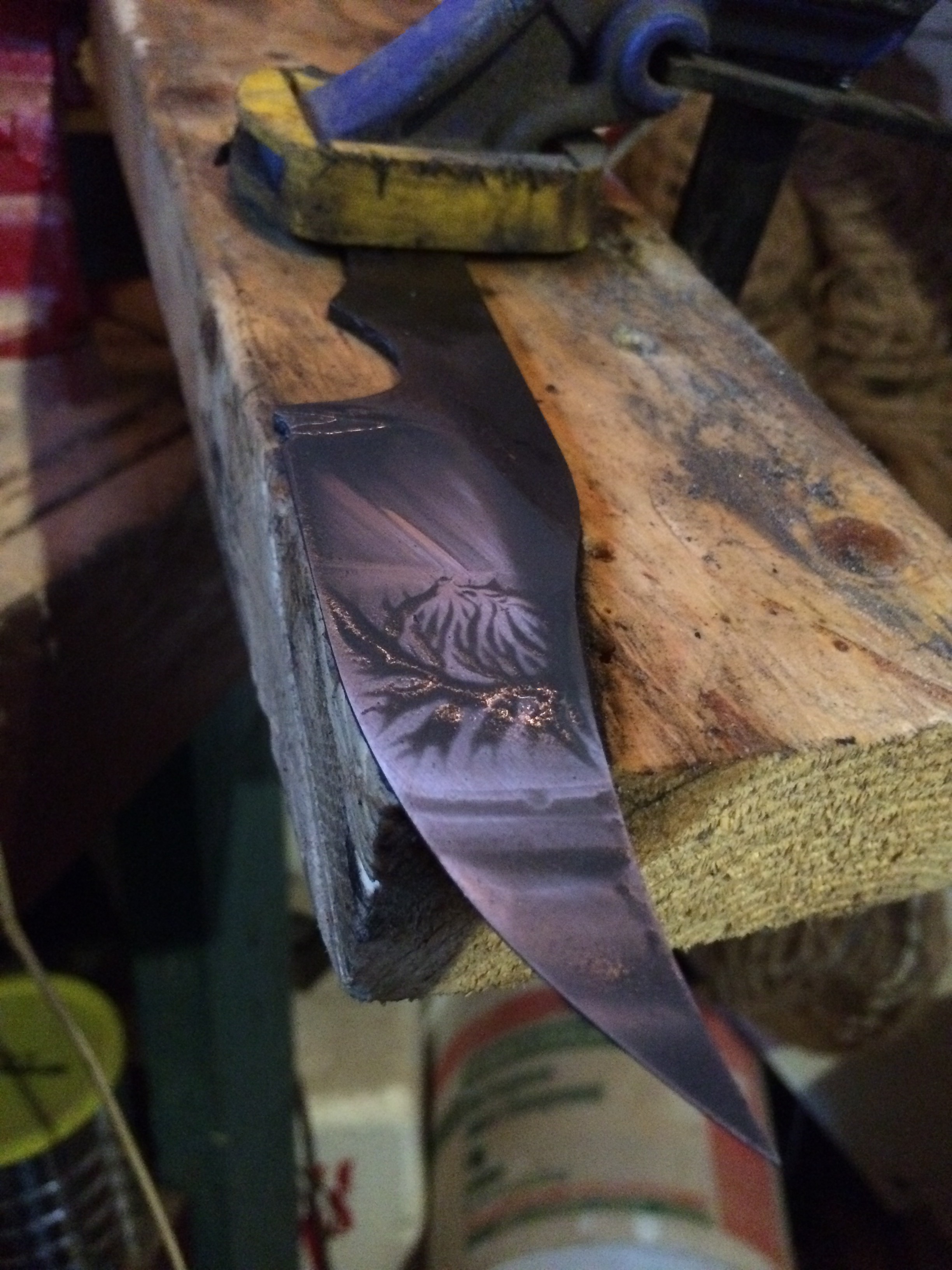
I used this to force a patina on the blade:

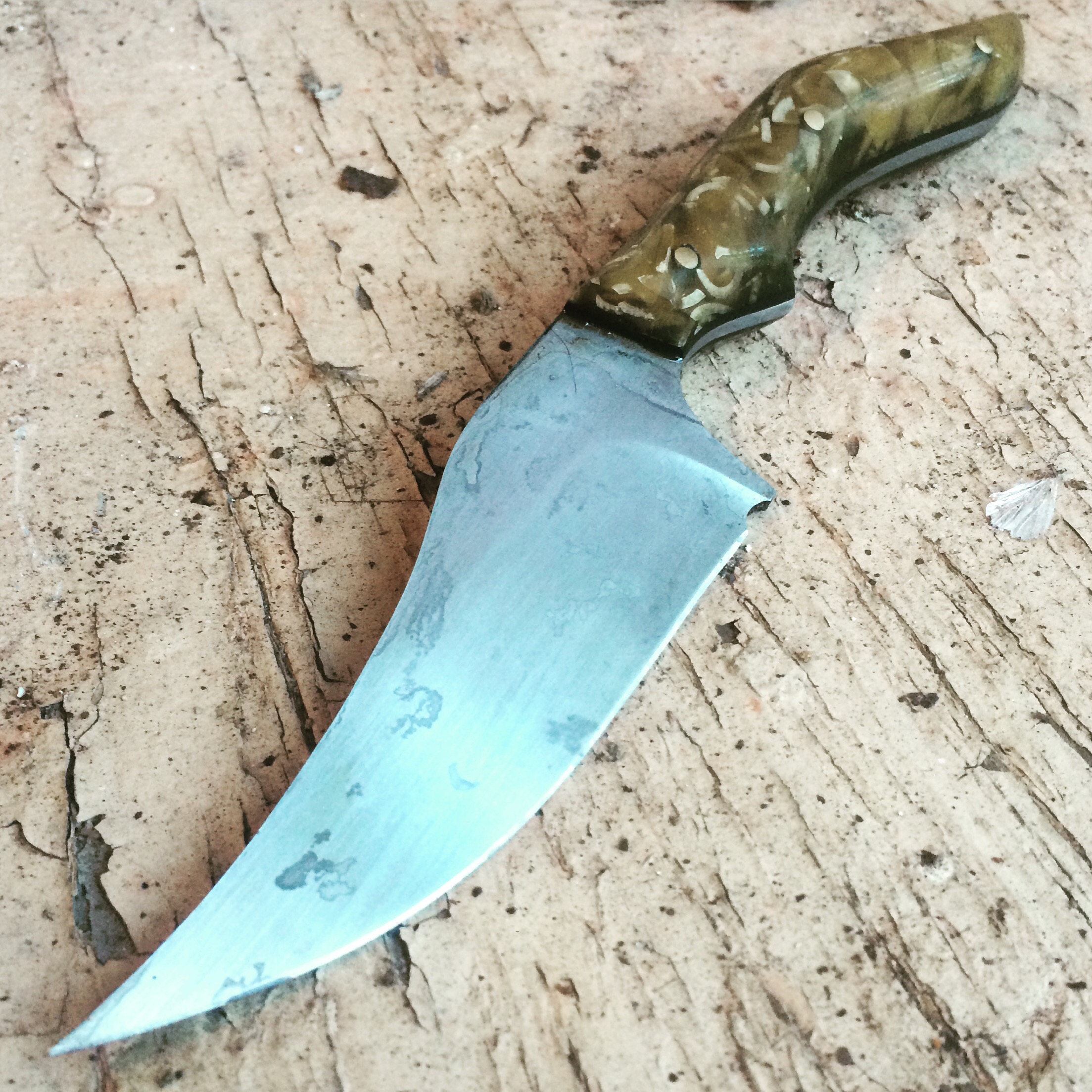
The Dummy:

With all the love in my heart, don’t be a dumbass.

Knifemaking: past things made present and a restoration project

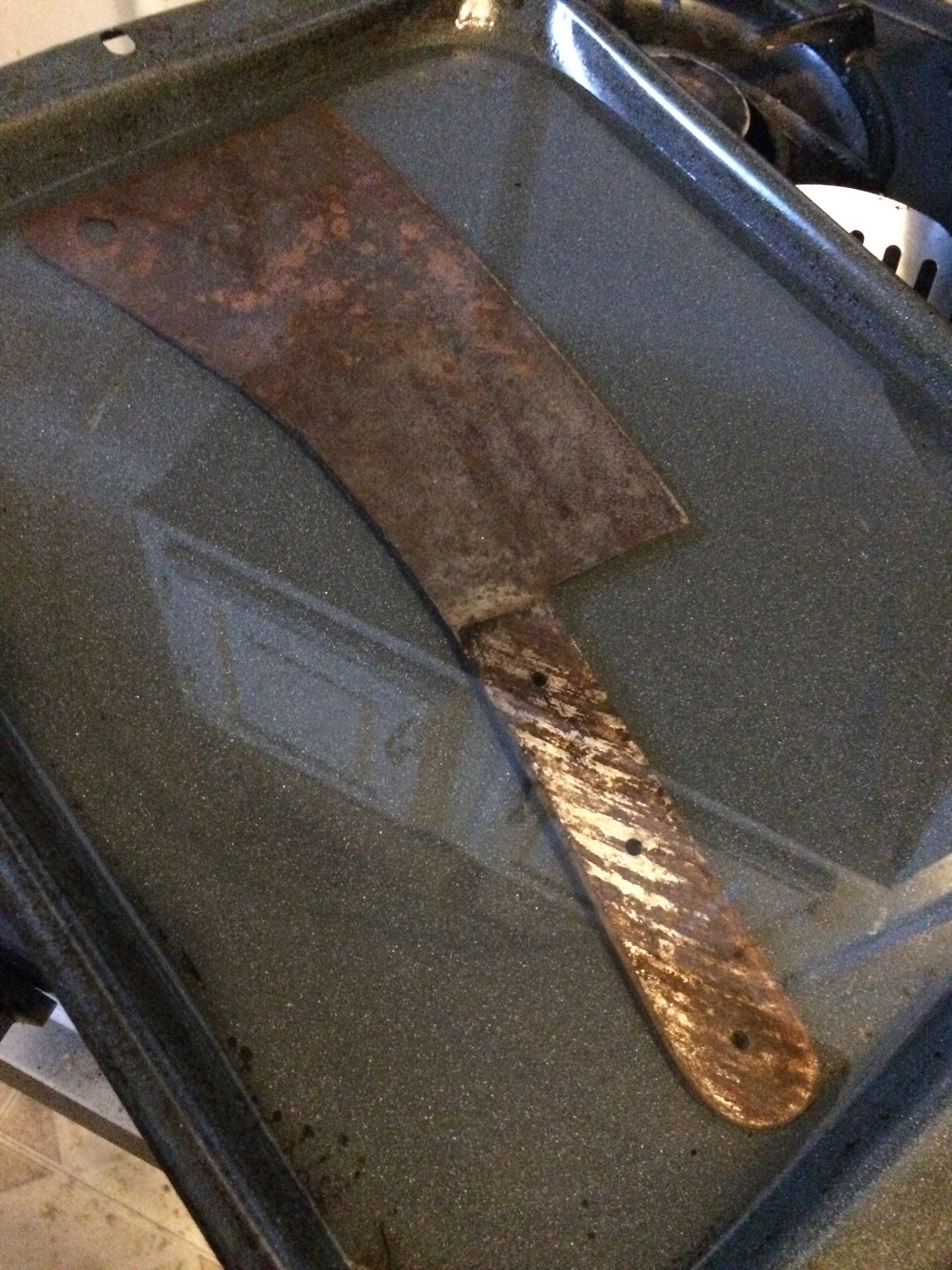
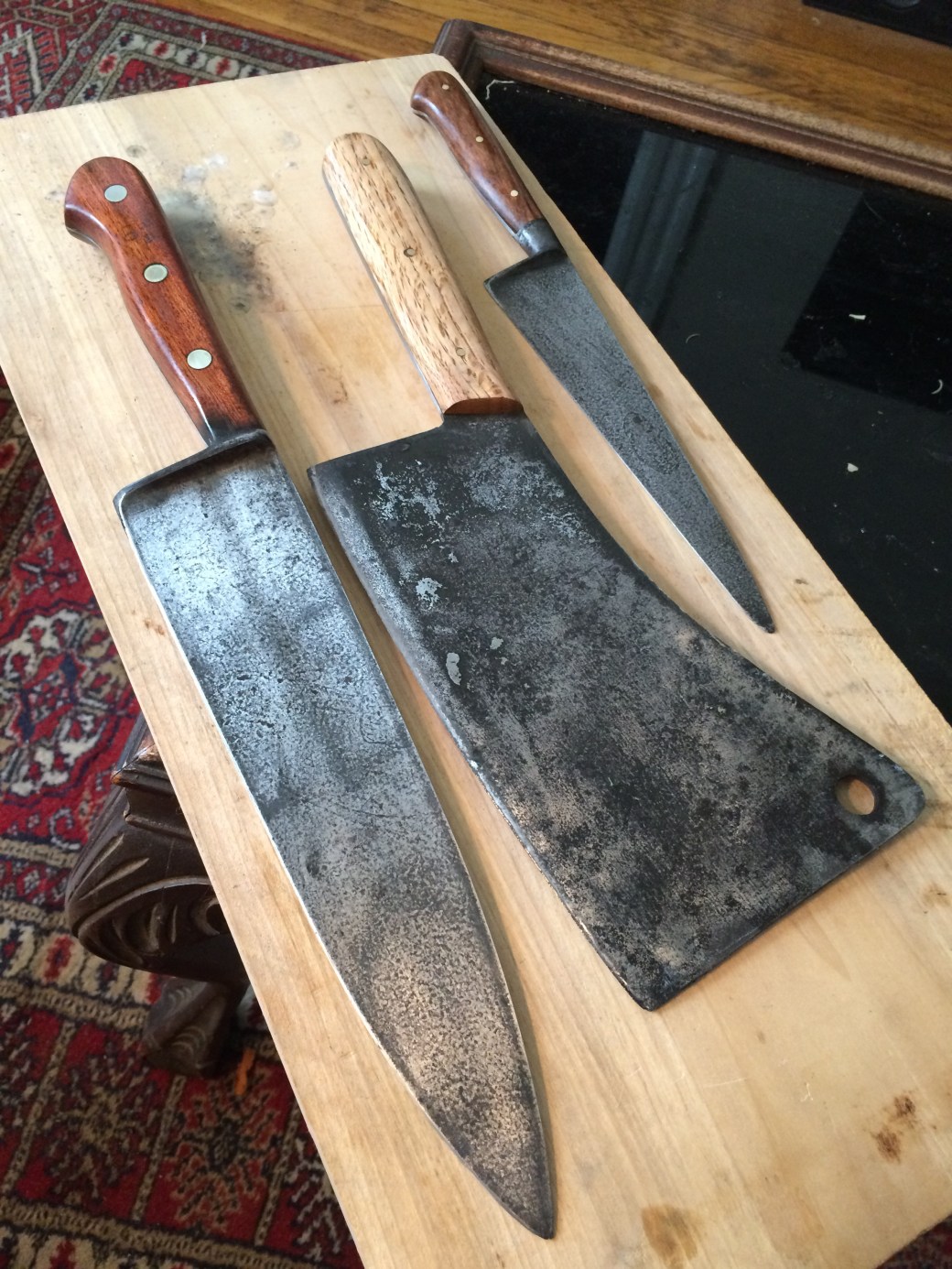
An acquaintance brought me three knives to be restored: three beautiful old kitchen knives, a trifecta of culinary efficiency.  There is a massive cleaver, a 10″ German style chef’s knife, and a 6″ French style utility knife:

They have been through the paces.

Everything breaks down at some point.  As someone who will push himself to the point of exhaustion I find this to be a strangely comforting and, paradoxically, terrifying idea.  There are times in life when the only way to get to the beauty that once was is to go through the worn out parts.

Wait…how did these things get worn out in the first place?

I’ve found that there are seasons of life when it feels as if the universe is screaming at you to make something happen, to make changes, to do better, and to seize opportunity.  And suddenly inside yourself you can see a path to these things.  You begin to feel a sense of urgency so strong that it feels like the whips are being cracked.

And so whatever your task at hand is becomes an insatiable vixen.  At least this is what it can feel like.

In these moments we often neglect to take care of ourselves and then wonder why things aren’t working as they should.  But still we keep pushing.  And in our zeal to accomplish we can end up depleted- physically, emotionally, and spiritually, appear as shells of the amazing things that we are.

Sort of like these knives…

Restorative processes are not always pretty.  Sometimes they hurt a little or a even a lot.  They can be alienating to the people we care most about.  And they come with the moments of hesitation and questioning and reluctance.  These things are still functioning so why mess with them?  Is it worth the time and work?  Maybe it’s ok the way it is.  Maybe if I pretend that there isn’t an issue it will all be fine.  These are healthy things to ask.  But are they working at their best?  Are they past their prime?  Are they getting any better?  Absolutely not. And in this life, leaving something better than you found it is one of the sweeter things we can experience.

So you strip away the layers of rust that came from daily exposure to the elements.  The wood that has become cracked from moisture exposure after years of washings has to come off.  New wood is put on and sanded and finished with the deepest of love.  The dull edges are honed sharp again.  Everything thing is oiled and brought back to life.  When you start these processes, and they are processes which can take awhile, it requires a commitment and a degree of tenacity to stick to it.

These knives were out of commission for a bit but it was necessary in order for them to function at their best.  Similar things happen in us when we take the time to look after ourselves.  It’s always a process and there isn’t necessarily a discernable timetable.  In this particular instance the restoration took me several days.

I started by removing two of the handles:

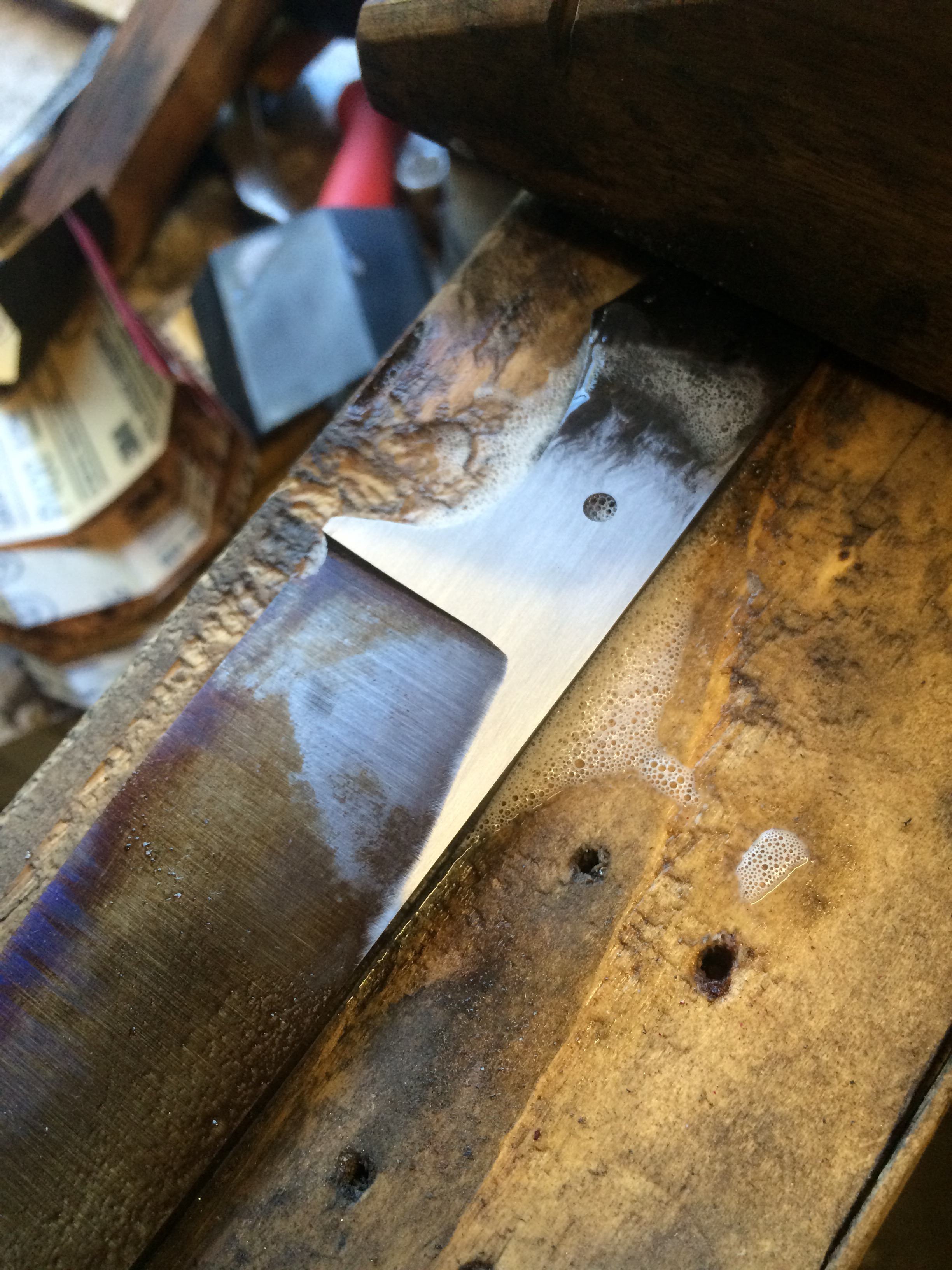
I soaked the small French knife in vinegar for about two days.  The vinegar eats away rust and corrosion but doesn’t harm the integrity of the blade.  It does create a reaction with the steel that leaves this residue on the blade.

She gets a sanding with high grit paper to make sure all the corrosion is gone.

Ready for a handle:

Glued and clamped:

Ready for shaping:

Shaped:

On the initial sanding I stopped at 220 grit and applied a liberal coat of oil and let it dry overnight.  Doing this makes for a more pronounced, nuanced, and beautiful grain pattern.

Working through the grits, up to 2000.  I think this is 600:

Our friend the cleaver:

A vinegar bath for a couple of days:

The spine was pretty roughed up:

So I smoothed and deburred it:

Quarter sawn white oak:

The customer asked to keep the original handle for the 10″ chef’s knife.  Here it is at about 120 grit:

Here it is at 2000 grit.  I believe it is Mahogany:

Oiled, of the Tung variety:

Sharpening:

Stropping:

Past things made present.  All restoration does is enhance the beauty within.  These are ready for the kitchen:

Knifemaking: Conflict, Trust and the Vixen

Conflict is essential to evolution

-Paulo Coelho, Aleph

The thing is that love gives us a ringside seat on somebody else’s flaws, so of course you’re gonna spot some things that kinda need to be mentioned…

-Alain de Botton


Conflict is an inevitable part of life.  We find it in our professional and romantic relationships, in the work we do, in our places of joy and sorrow, and just about everywhere in between.  We even find it in ourselves. 

Merriam-Webster defines conflict as an “antagonistic state or action (as of divergent ideas, interests, or persons)”.  This sounds about right.

Depending on how we were raised, conflict can make us feel unsafe and insecure because we equated conflict to something being deeply wrong with us.  Often we’re raised to be agreeable, to not make a fuss, to put on a happy face, and to be seen and not heard.  Because of this there can be a tendency to submit to the incompatibles that arise and completely lose ourselves during moments of heated conflict.  We give away all of our power and ignore our needs for the sake of resolution.  There can also a tendency to run, to check out mentally and emotionally, and to avoid; all for the purpose of not having to deal with the conflict at all.  Ancient fears arise during conflict: fears of not having enough, fears of not being heard, fears of being seen as less than, fears of asking for help, or fears of our needs not being acknowledged or met.  Conflict can take us right back into the terror of our smaller selves.

Fear often makes us do the complete opposite of what is best for us.  But in a world of incompatibles, of yes’s and no’s that are always at odds with each other, conflict will always remain.  I’ve always wondered about this in the way I’ve wondered why deep sadness exists, and why pain and suffering are so prevalent.   

Conflict helps us to be active participants in our lives.  It seems counter-intuitive but conflict helps us to grow and be seen.  In the same way that deep sadness and pain can be teachers, conflict can take us to school on how to be a decent human being. 

Conflict in romantic relationships can be one of the more challenging arenas because it forces us to show and acknowledge things we may prefer to not acknowledge.  It occurs when any number of our maladjustments that we haven’t dealt with or are still processing rubs up against our partner’s.  Or when our partner’s maladjustments rub up against us.  In many instances things are simply going to rub us the wrong way and we may not be able to articulate exactly why.  

This is particularly unique to romantic conflict because there is nowhere to hide.  In other arenas we can veil ourselves with busy-ness and obligations.  We can keep our own counsel, hide our feelings, hold everything at a distance, and still uphold our responsibilities and navigate life somewhat successfully.  Doing this with someone whose heart you occupy is likely to be catastrophic.  The best thing to do is to let all of yourself be seen and work from there.

Though it may not feel like it, this is one of the healthiest things anyone can do.  We are built to be close to one another and we are all flawed.   To be able to say ‘I was only a jackass because I was deeply afraid and I’m working to be better because I care about this’ gains so much more mileage for trust and intimacy than pretending like nothing is wrong or powering through a conflict.   When someone you love knows where you are coming from it creates a sense of safety for that person, even though it may be uncomfortable for you.  Eventually you may find a sense of safety because in allowing all of yourself to be seen, it allows all of you to be loved.  Trust deepens on both ends and allows for everything to blossom.  This is something to stay on top of and it’s important to be ever mindful.

This blade was made after a conflict with someone I love.  It was a reminder to myself to lean into conflict.  Conflict is a Vixen, a lady in red, shining, beautiful, and also extremely sharp and ready to slice the hell out of you if you aren’t on top of it….

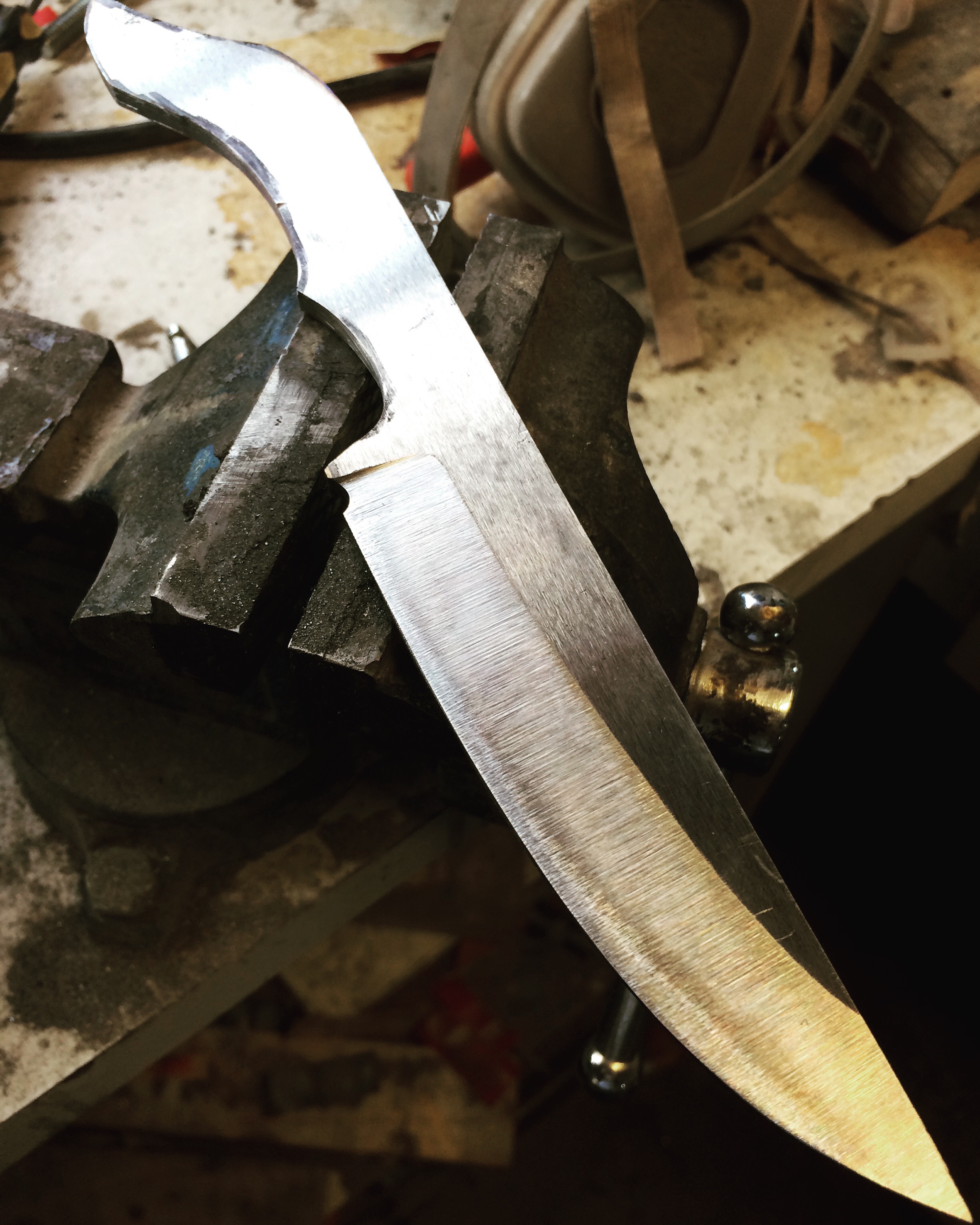
O1 tool steel, profiled:

Scribed for grinding the bevels, and a notched blade choil:

Rough grinding:

Full flat grind:

Hardened:

Sanding the ricasso after tempering:

Many hours later…

Redheart:

The Vixen:

IMG_3445_sRGB

Many things will often be at odds with each other but being able to be with all of them is at the heart of doing conflict well, and ultimately at navigating the world.  This is the lesson of the Vixen.

Knifemaking: finding your roots and the Treethrower

‘In their highest boughs the world rustles, their roots rest in infinity; but they do not lose themselves there, they struggle with all the force of their lives for one thing only: to fulfill themselves according to their own laws, to build up their own form, to represent themselves. Nothing is holier, nothing is more exemplary than a beautiful, strong tree.’

Hermann Hesse, Bäume. Betrachtungen und Gedichte

I have an old friend and his name is Joe.  Joe is a fascinating guy.  We went to music school together.  Joe is a killer rock musician, a badass chef, and is also really good at climbing trees.

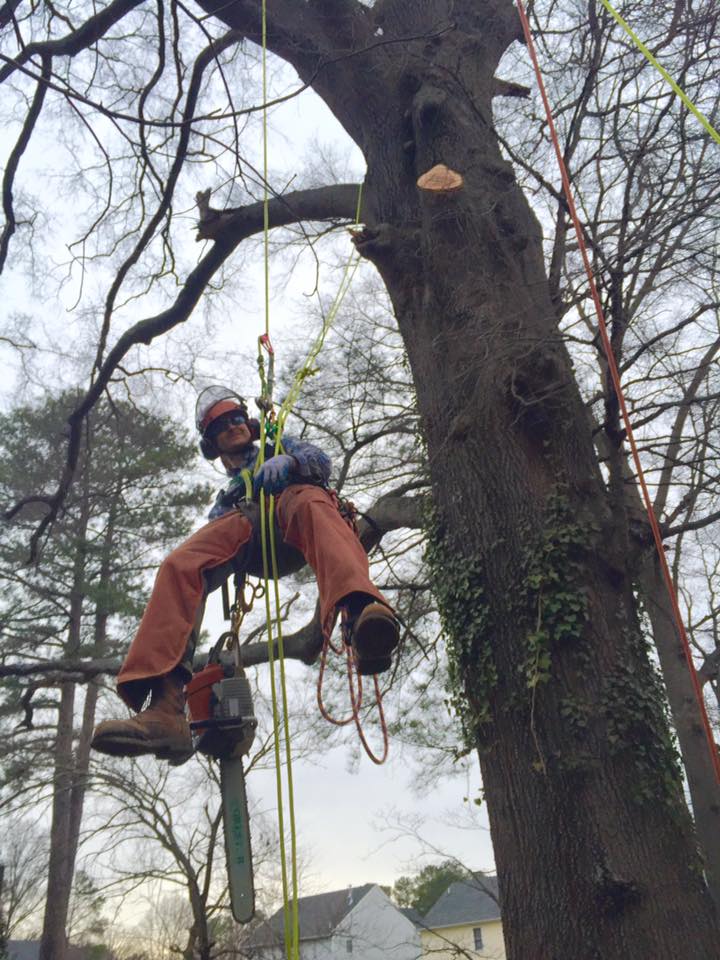
This is Joe:

12646998_10102981413934626_3333592218995759607_n

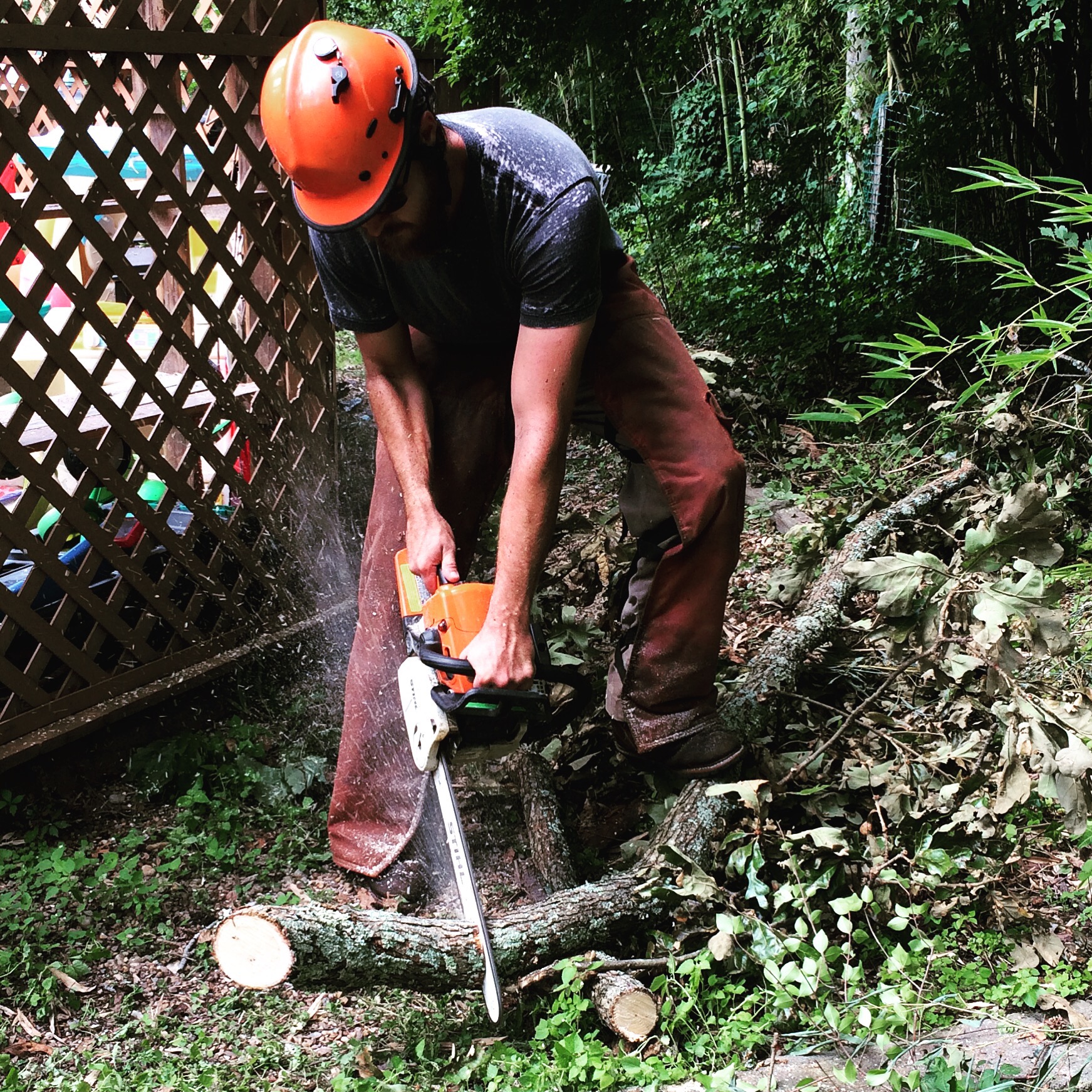
Joe does tree work full time at the moment.  On weekends and his off days he does side work for friends.  Sometimes he calls me to give him a hand.  Sometimes the money is good and sometimes it is not but it’s refreshing work to do and it’s nice to be along for the ride.  His clients are always happy with his work.

The work I did with Joe consisted of removing dead or sick branches and limbs, and removing branches or limbs in order to open up a client’s yard to sun.  Any part of the tree extruding over a client’s house was also removed, by way of a block and tackle pulley system rigged to the tree so the branch could be slowly and safely lowered to the ground.  All of this was done with regard for the tree, with chainsaw cuts executed in such a fashion so that limbs could healthily grow back.  Deadwood was removed and cut flush at the trunk.

There was a quiet and zen process to a lot of this.  It all started with laying all of our tools out.  Joe would put on his rigging gear and I would fuel up and oil the chainsaws.  He would then set a climb line high in the tree and start to ascend, lugging a chainsaw, some handsaws and some tools.  The zen in this work comes from ritual.  All ropes and lines are kept coiled and tidy.  All brush is cut, cleared and neatly piled as soon as it comes down from the tree.  If you are using a chainsaw then you are wearing kevlar chaps and the chainsaw stops as soon as you are through cutting and before you move to the next cut.  If you are using the chainsaw in a tree then you have set at least three independent safety points, in case you accidentally cut your support line.  These little rituals and protocols help to remove some of the thinking from the process.  It creates a sort of space to be present with yourself and really feel what you are doing.  In this space you can start to feel a grounding and calm in the process.  It also allows you to really focus on what you are doing and helps to keep you safe.  All these things gently coerce you into slowing down and this is a good thing.  Tree work is pretty dangerous after all.

This space that has been created allows more mental real estate for when things get a bit hairy.  There was a the time when a line came loose and giant log cut from a tree fell and put a giant hole in the client’s deck.  Or the ‘how the fuck are we going to get all of this done?’ moments.  Or it’s rainy or icy and you feel extra unsafe.

It’s really refreshing to feel this because it’s a microcosm of life I forget to feel at times.  In this season of life, for myself and many of those close to me, sometimes you forget to ground yourself and everything feels uncertain.  Life changes quickly, living gets more expensive, and what worked yesterday doesn’t necessarily work today.  Focus wanes, a feeling of security becomes a commodity, and one can find themselves feeling a bit daft and inadequate.  This can be remedied by practices and rituals.  Keeping your ropes and lines tidy, in a spiritual and emotional sense.  This can be a bit of a process, especially if you come from a place where roots were shallow and conditional on things outside of yourself.

This is the lesson of the Treethrower.  I came to this idea while tossing massive logs we had cut down into a firewood pile.  It’s important to find roots in what you are doing.  When this doesn’t happen everything can feel daunting.  Often times these rooting things are right beneath your nose and, paradoxically, the last place we tend to look.  Finding them, even for a moment each day, can make a world of difference in your life.

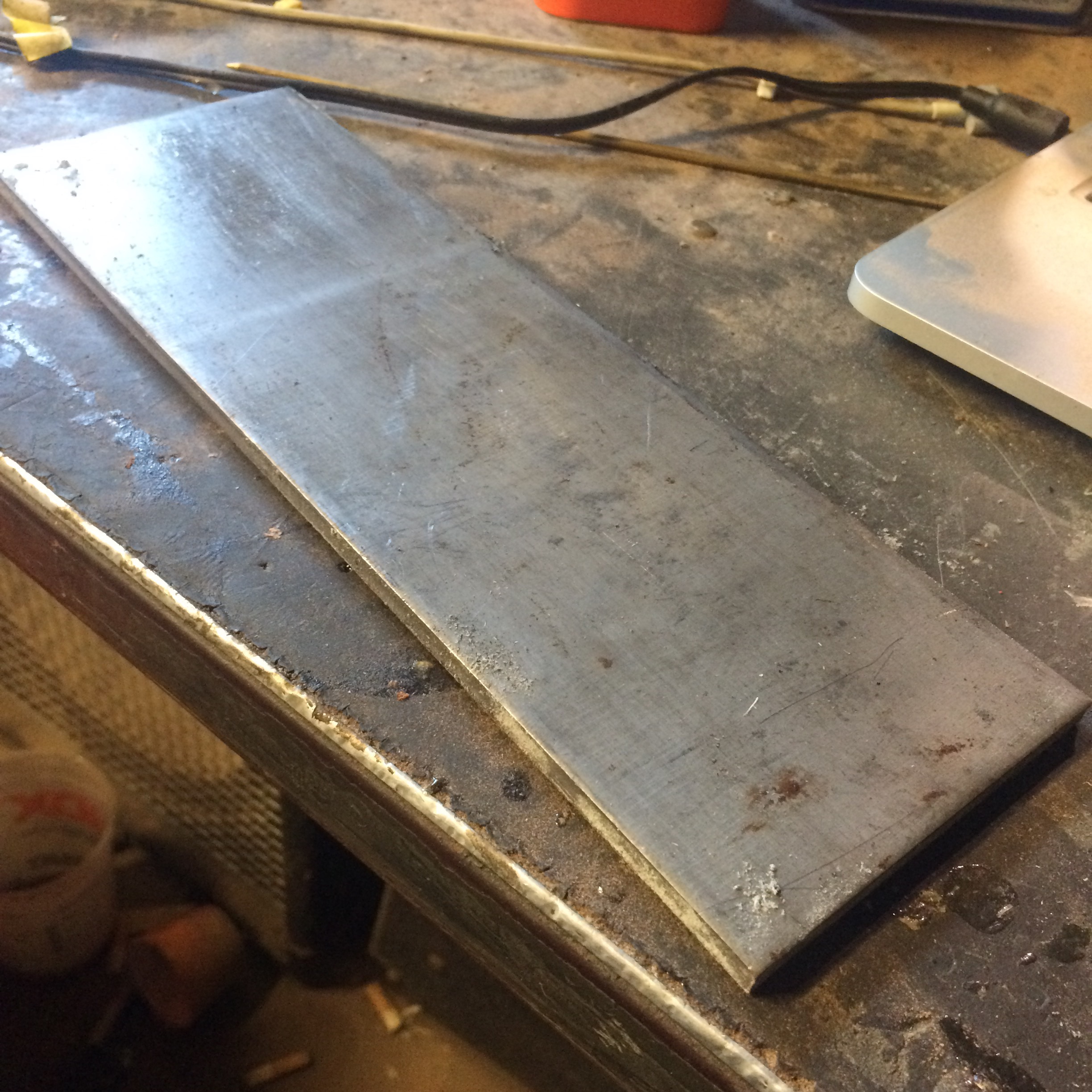
It starts with a massive bar of 1/4″ 1095 spring steel.  My good friend and partner picked this up at a steel mill in North Carolina.

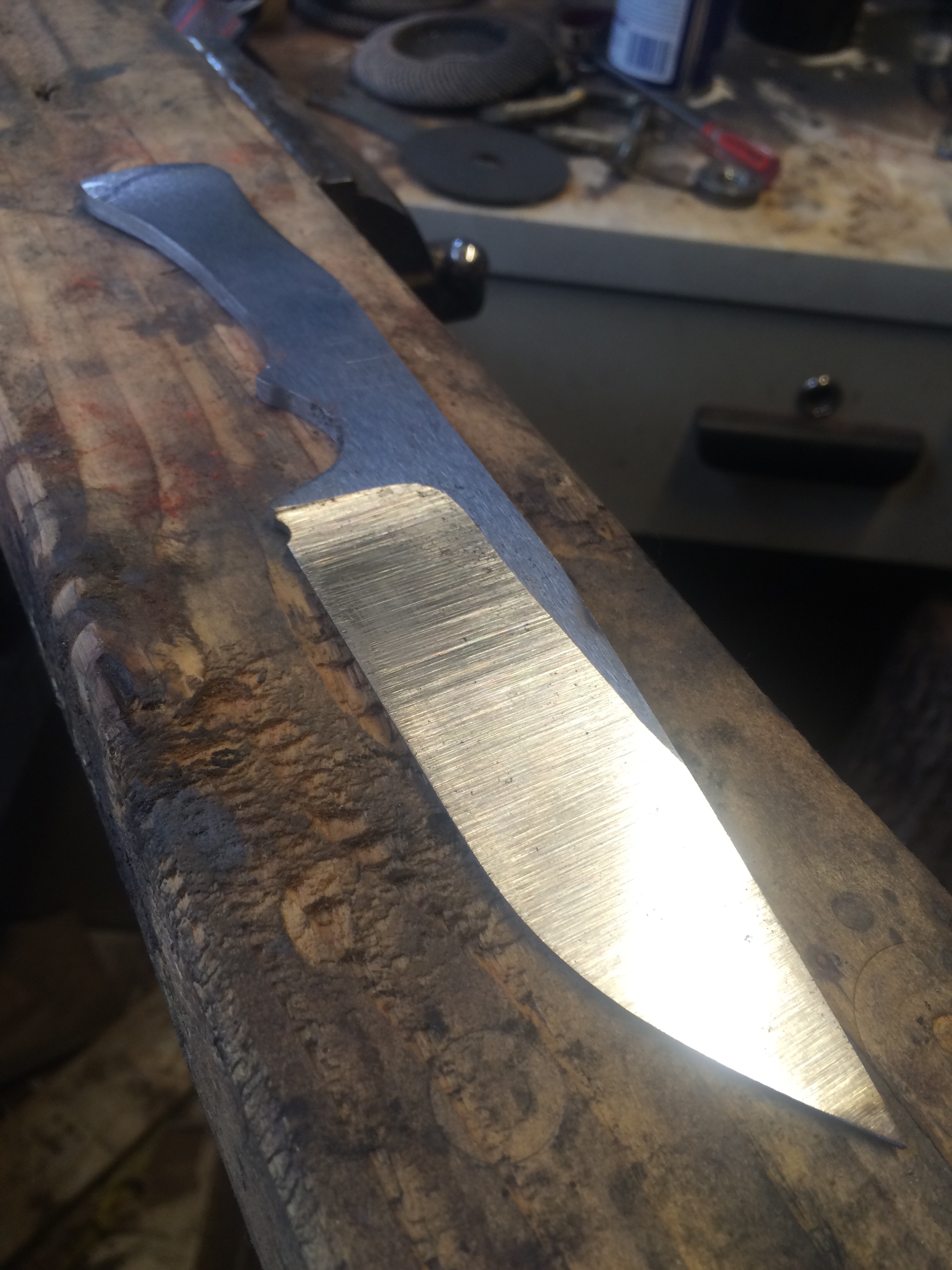
The angle of the blade on this design allows for much more leverage during large cutting chores.

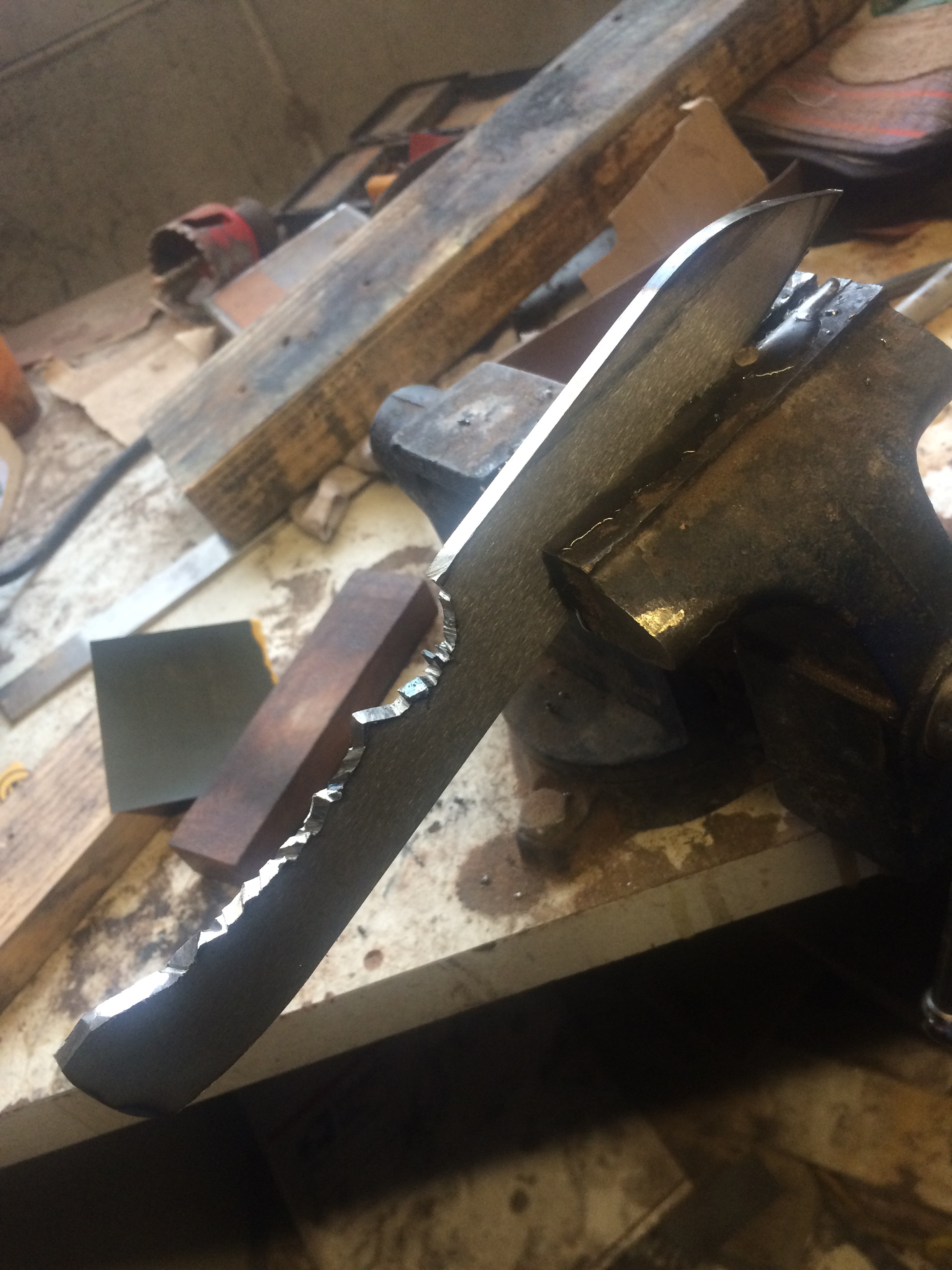
I burned through about 8 cut off discs cutting this out:

Some half inch holes to remove weight.

Several hours later…

There is a lot of material to remove…

Full flat grind

Hand sanding before heat treatment

Into the forge:

Tempering…

This is a large piece of spalted pecan, sent to me by my wonderful cousin in Texas.

Up to 2000 grit

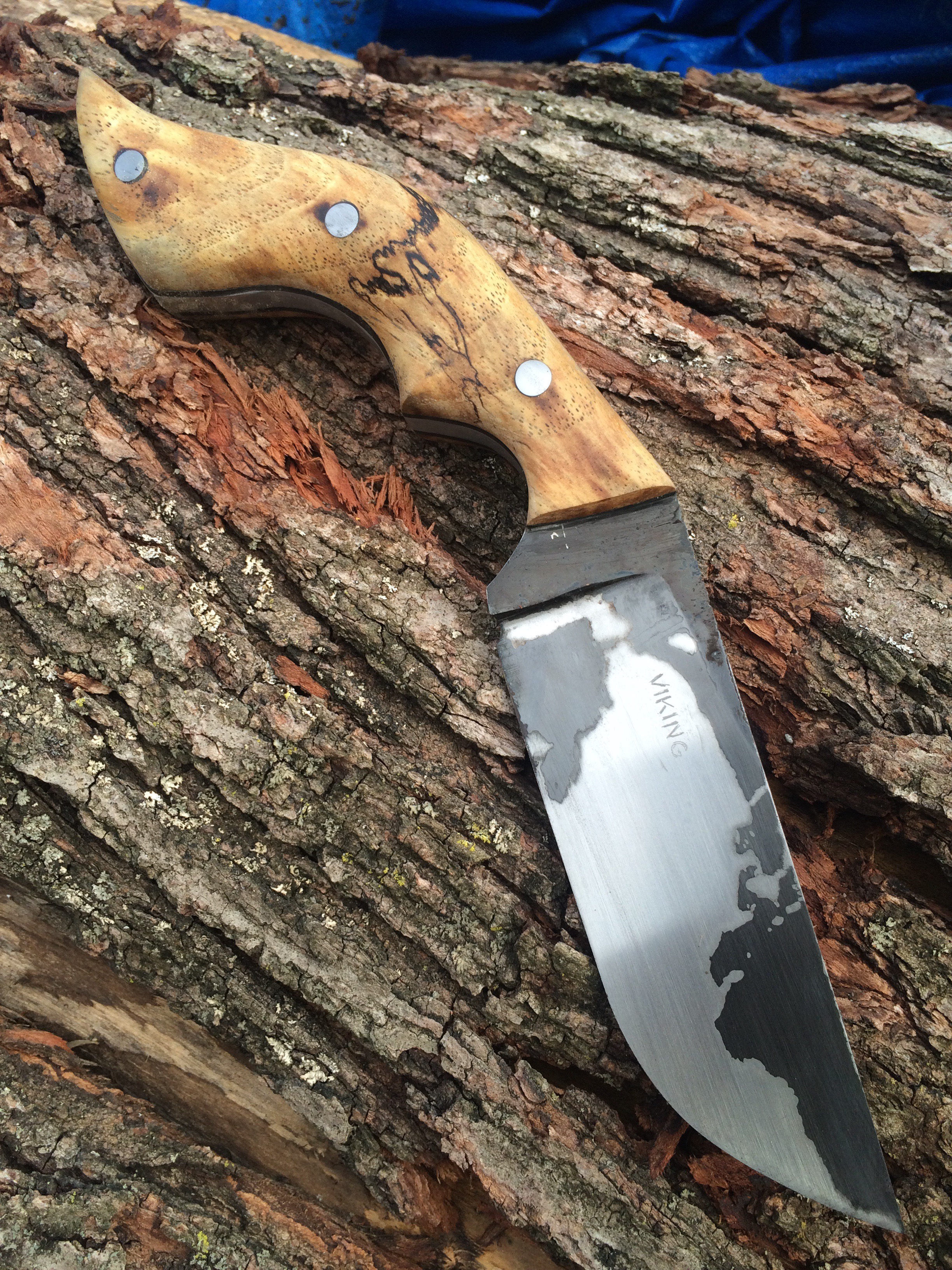
The Treethrower:  1095 spring steel, spalted Pecan handle scales, kydex spacers and steel hardware.

Thanks for the lessons, Joe.

Knifemaking: love, mixed martial arts, and the Lightbringer

“Love suffereth long, it is bountiful; love envieth not; love doth not boast itself, it is not puffed up

It doth no uncomely thing, it seeketh not her own things, it is not provoked to anger, it thinketh no evil

It rejoiceth not in iniquity, but rejoiceth in the truth;

It suffereth all things, it believeth all things, it hopeth all things, it endureth all things.

Love doeth never fall away, though that prophesyings be abolished, or the tongues cease, or  knowledge vanish away.”

I Corinthians 13, The Geneva Bible

On the other side of fear there is love.  We often here about labors of love, tough love, and doing what we have to do out of love.  These are the things that are easy to talk about but much harder to describe what they actually feel like when one finds themselves in the midst of them.  These are the things that are hard to deliver if your heart is not truly in them.  Like a good meal, love is not something that can be bullshitted, and certainly not for an extended period of time.

Love is connection.  It’s what holds things together through good and bad.  It helps us to feel our light when it feels like the universe is doing it’s best to crush us.  Most of us probably have parts of our lives that we look back on and wonder ‘how did I get through that?’  It’s love.

We all know romantic love with its intoxicating and consuming nature.  It puts the color in our world.  But beyond the rainbows and butterflies it takes a warrior to love someone deeply, to do the hard things, to fight for what is dearest to them.  This is what makes the world shine.

Then there are the times in life when the light of love can go dim and your world goes dark.  I found myself in one of those places a couple years ago.  It was bad.  I talked to a therapist who told me I was absorbing chaos.  Those close to me said it felt like there was a hole in my heart.  I got ultra New Age-y and talked to several light healers who told me my energies were out of alignment with love and that my heart chakra was blocked.

Though it was helpful to hear these things, it shed no light on what I was supposed to do to fix them or how difficult it would be.

It all came to head sometime after Christmas.  I had lost quite a bit of weight.  My friends said that I looked great but I felt awful.  I was getting up and going to work and going through the motions but it felt like moving mountains.  I had to get the office lady to remind me to eat.

There was a gentleman who had been coming in to pick up our scrap metal at our work for quite awhile.  He was a big Puerto Rican gentleman who used to be an MMA fighter.  His name was Jose and he is one of the happiest and most grateful people I’ve ever met.  He used to get into a lot of fights when he was a kid and then he made it into a career.  He said he stopped because he was tired of beating people up.  He had dated a lady who was a Brazilian fighter.  He always told me never to date an MMA fighter.  I told him not to worry.

So it was around this time that I was having all these problems and he came in and just looked at me.

‘Brother what happened?’

I asked what he meant.

‘You used to be BIG and HAPPY, but now you little and sad.  What happened, brother?’

We talked for a bit.  Jose is a really good man.  He told me to not stop loving, no matter what, that love always comes through.  He told me to look up the Bible verse (copied at the top of this post), which I reluctantly did.  I knew it from having it drilled into my head as a kid in Sunday school and I always thought it was cheesy.  I had heard it so many times under such superficial bumper sticker circumstances that I almost forgot how really elegantly composed it is.

So I made it a point to start doing things out of love, in a way that I had never really done before.  I started showing up for myself.  It was really hard and it wasn’t pretty.  In fact it was about as far from rainbows and butterflies as one could possibly get and still be in the realm of love.  Sometimes it’s still hard and not the prettiest to look at but I had made a promise to myself that I wouldn’t let it ever get that dim again.

This is the lesson of the Lightbringer.  It was through that process that I learned that love is something you have to stay on top of and nurture even when, no, especially when it’s hard.   It is living and breathing and a sort of life force that keeps the world beautiful.  Even when the world makes it difficult to love, it doesn’t mean you should stop.  Without it, everything can lose it’s meaning and your world can go dark.

 O1 tool steel, in the process of roughing out the blank

Off the grinder at 80 grit

She is ready for heat treat

Hardened and tempered and sanded to 120 grit at a 45 degree angle

220 grit, cutting in at the opposite 45 degrees…

32o grit straight down the blade for a nice satin finish.  These lines are one of the signatures of a hand finished knife blade.  On the subject of labors of love, hand sanding hardened steel is no joke…

Curly Maple attached to the blade

Toward the end of the shaping, sanding, and bursting process…

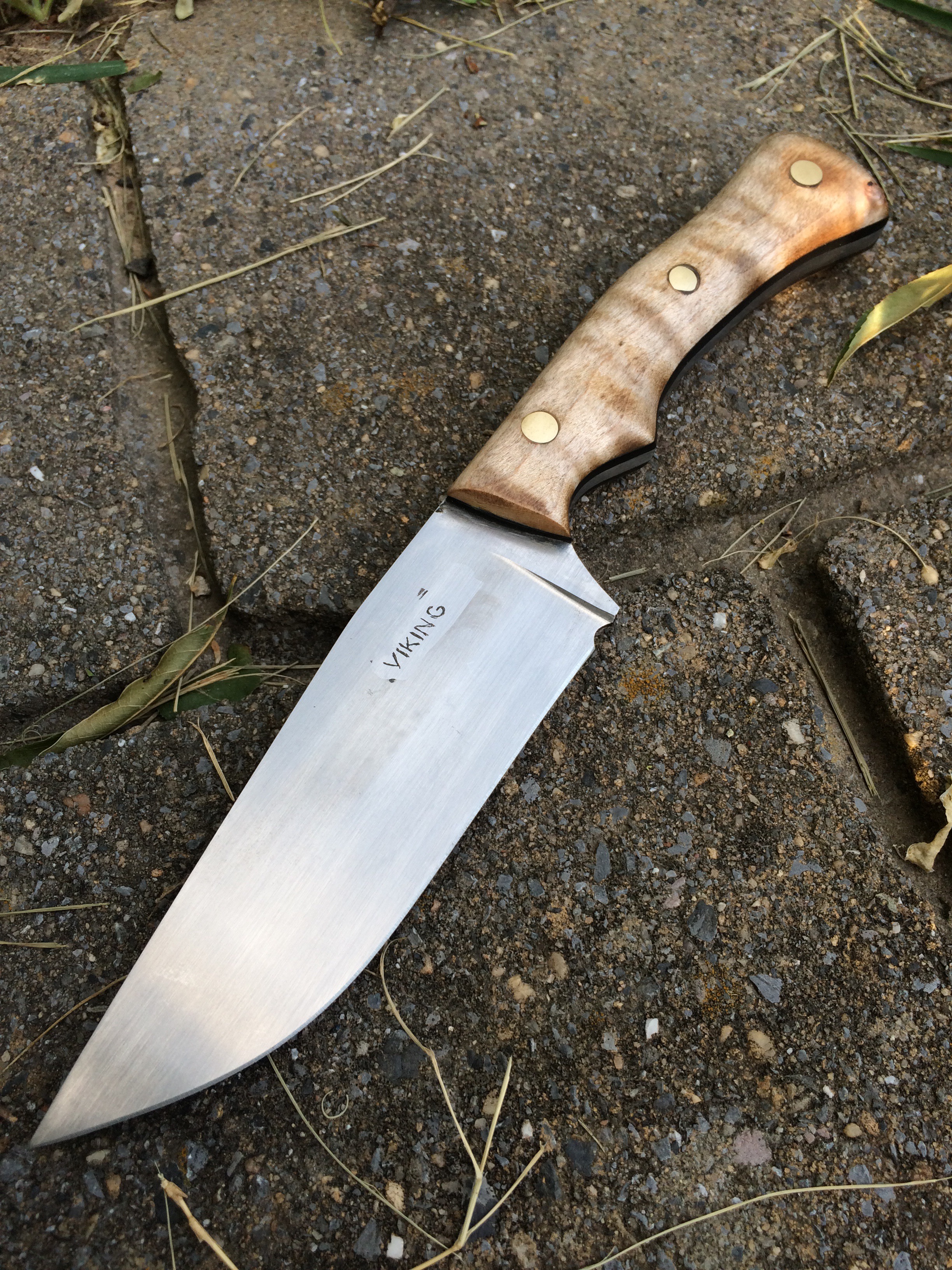
The Lightbringer:  O1 tool steel, bursted Curly Maple, Kydex spacers, and brass hardware


I ran into Jose at a gas station the other week.  He told me I looked big again.  I just gave him a hug.

Knifemaking: being in the know, Hobart mixers, and the Gunny

“If, then, I were asked for the most important advice I could give, that which I considered to be the most useful to the men of our century, I should simply say: in the name of God, stop a moment, cease your work, look around you.”
Leo Tolstoy 


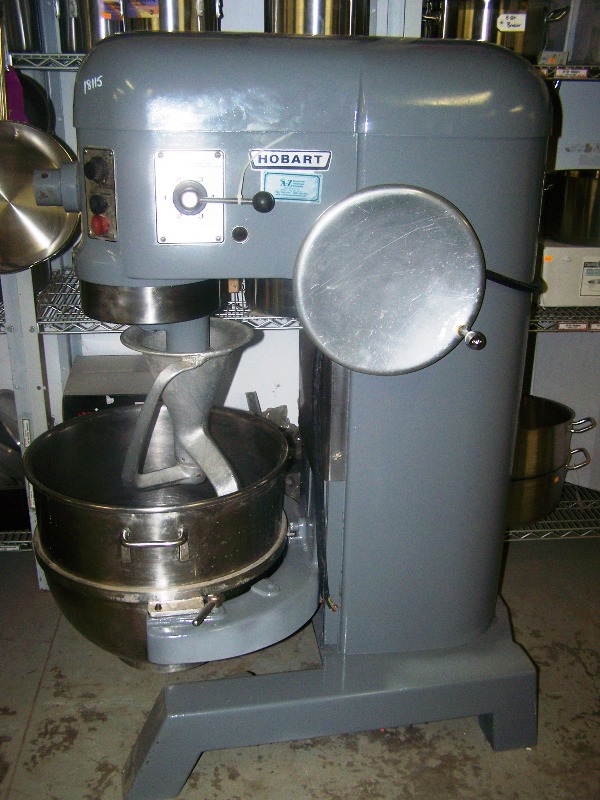
A few months ago I did a job for my friends who run an auction company.  There was an auction happening at a school out in the country and they needed someone to go out and bid on two gigantic dough mixers.  They weigh a little more than half a ton and are very expensive.

They  look like this:

18115

The only issue was that they didn’t know what voltage they were.  Sometimes these machines have a 460 voltage requirement.  These higher voltages exist to reduce wiring requirements and the need for additional electrical equipment facilities with large power requirements.  The facilities that have these requirements are usually nuclear submarines or large government or corporate campuses.  Most houses only go as high as 220 volts, and that’s only for the washer and dryer hook up.  Unless you are operating a nuclear submarine, anything running on 460 volt power is generally going to be used as a boat anchor or scrapped.

My job was to go out and look at the specs and see what voltage they were.  Anything under 460 voltage would be good to bid on and able to be resold for a profit.

I drove out to the school on an early November morning.  Everything was spread out in front of a storage shed across the street from the school, separated by a two lane highway.  What I saw when I got there was a cornucopia of ancient office equipment, school lockers, floor buffers, and cafeteria equipment from an era gone by.  A lot of the town folk came out to see the festivities and they looked as one would expect the residents of a peanut farming community to look.  I went and looked in the shed and there was even more junk- desks, old computer printers, and large pieces of cafeteria equipment designed to feed the hungry masses.  It was here I found my mixers, alone with no attention from the farming community (they were busy picking over everything outside).  Nobody knew there was a potentially profitable business endeavor here.  Nobody else was in the know.
I went over and found the spec label.  Under power requirements it said 460V.  Son of a bitch.

There were two other gentleman eyeing the mixers as well.  They did not look like members of the peanut farming community.  They arrived in a box truck and a dually pick-up with a trailer attached.  This was the competition and they meant business.  These gentleman were definitely in the know with these mixers.

We said formal hellos.  They asked what the voltage was and I told them, expecting them to pack up and leave.

I called Fred the service tech.  He told me that some of these particular models of mixer were dual voltage and I would need to remove the top cover and look at the motor.  I waited till nobody else was around, and had a peak at the motor.  They were indeed dual voltage- 220v/460V.  So they were worth money.  They were as good as mine.

The other gentlemen did not leave.  We stood off to the side waiting for the auctioneer to make his way to the shed.

When it came time to bid these gentlemen matched every bid I made.  It was just me and them.  We got up to 2000 dollars and the bidding slowed down a bit.  The farming community were both entertained and dumbfounded.  Everything else sold for next to nothing but here were these people who did not belong, wagering thousands of dollars on two hunks of metal.

As per my instructions, I stopped at 3,000 dollars.  The gentleman backed their box truck up and loaded up these two pieces of equipment.  They had been in the know the whole time and they came to win.

With a bit of awareness you can start to see that there is more going on in the world than you ever imagined.  This sort of awareness usually helps me to be a better citizen of the universe.

There is the gentleman you may work with who tries to be everything to everyone.  It is profoundly annoying.  Spend 18 hours with him on a business trip and you find his brother died of a heroin overdose.  All he is doing is trying to keep everyone safe in the only way he knows how.  Being in the know of this helps you to cultivate a bit of compassion toward this man.

Or there is the person who is raising hell in Starbucks.  You know for a fact that that person did not wake up with the sole intention of making an entire coffee shop miserable- possibly because you may have done the same thing at one point or another.  There is probably something else going on that is causing this person to act this way.  Being in the know helps create space for empathy for this person.

There are thousands of situations like the auction or the other two incidents.  Having a bit of knowledge of things can help to create a richer existence or at least help you to know what you are missing out on at a country auction.  Sometimes all this takes is slowing down and having a look around.

This is the lesson of the Gunny.  It gets its name from the Gunnery Sergeant, and NCO in the Marine Corps whose job is to be in the know.  Sometimes just being aware is enough to make a difference.

I started working on this knife as part of a demonstration at a show, and it was at this stage when I got back to the shop.  He is made from O1 tool steel.

After hardening…

After hours of hand sanding…

Three shirts that no longer fit- in black, brown, and green

Cut into strips…

….and then pieces

Fiberglass resin…

….for a stinky salad

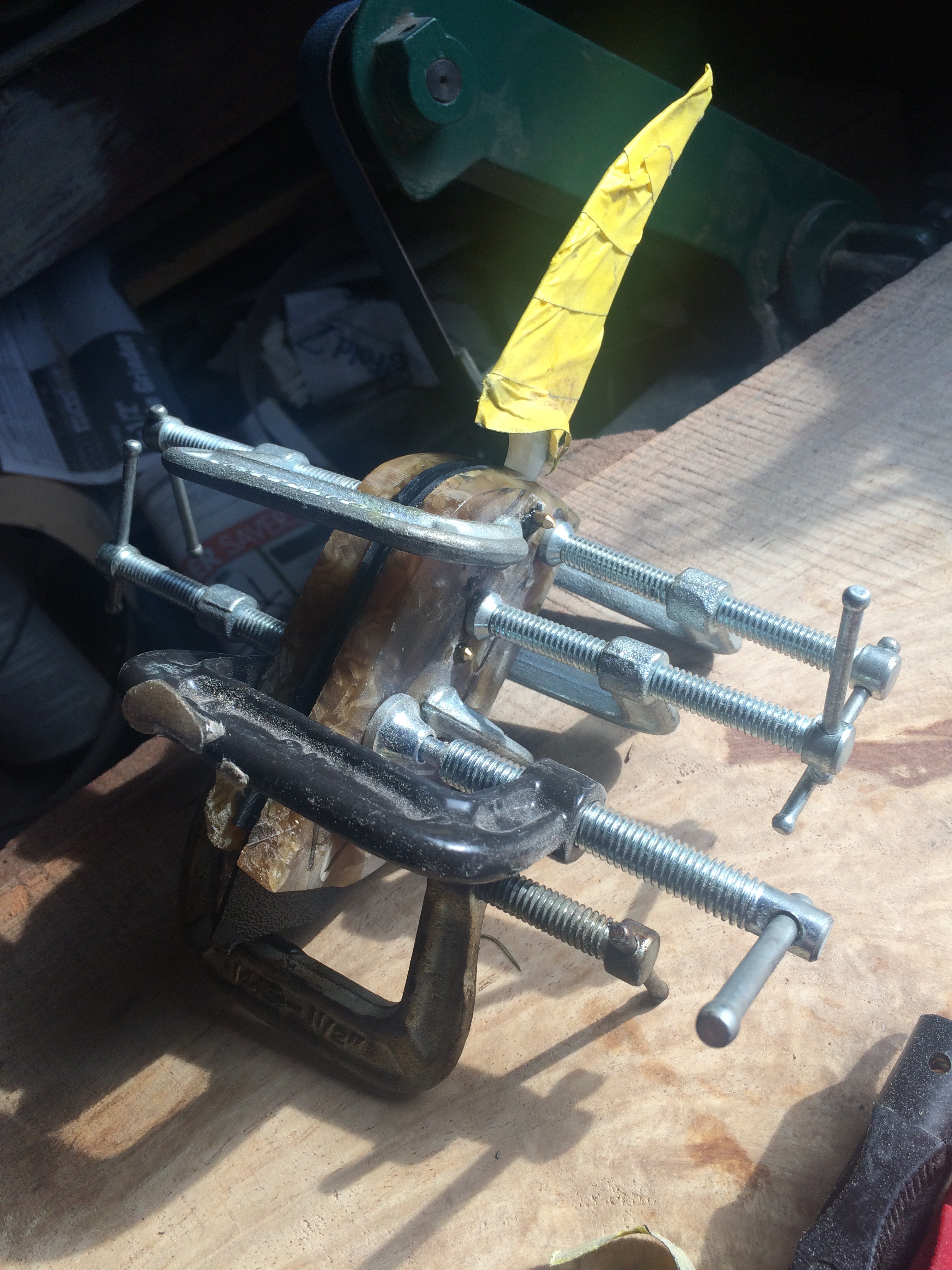
Put into a bag and clamped:

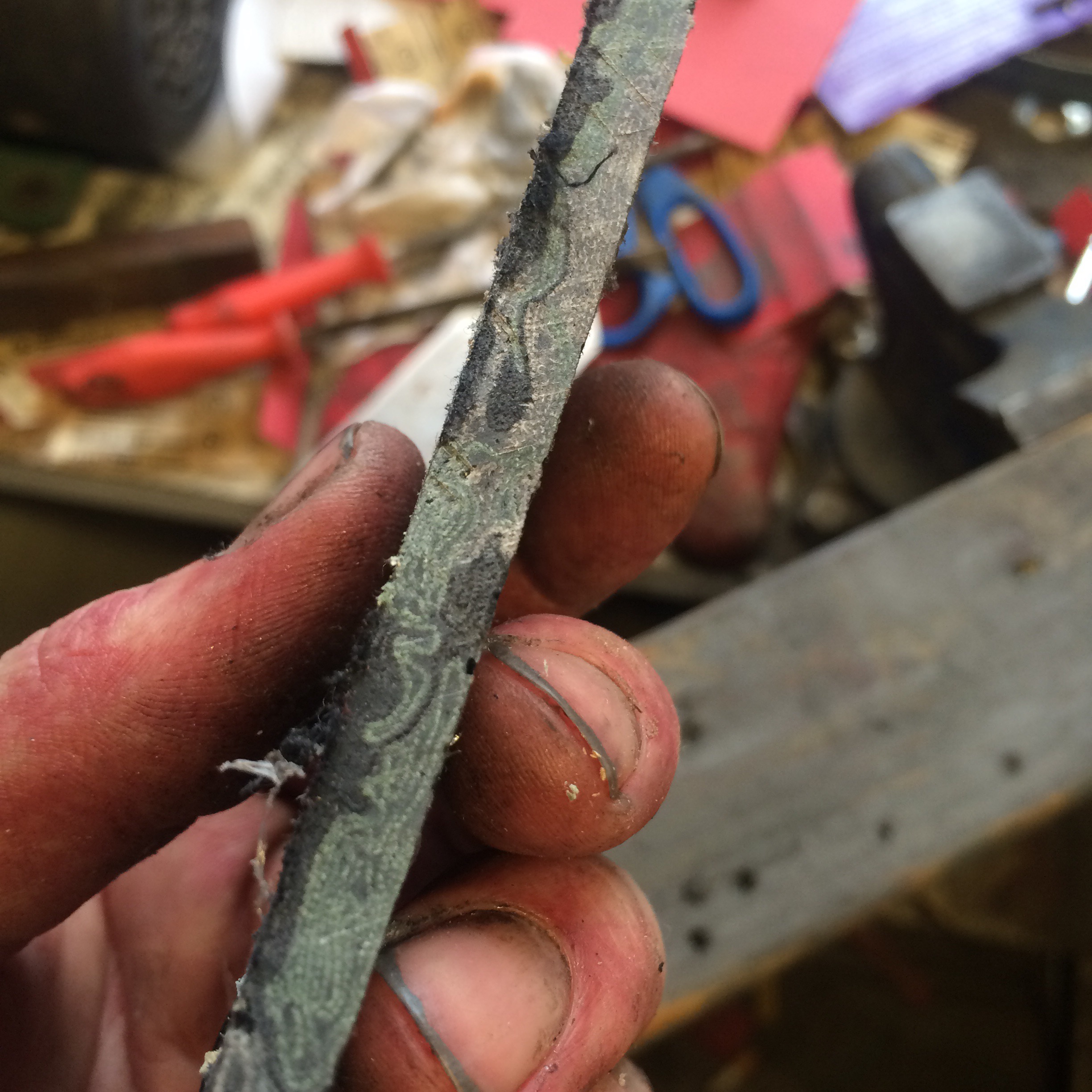
It comes out looking like this:


The Gunny: O1 tool steel, homebrewed camo micarta, kydex spacers, and steel hardware.

In finding a bit of awareness there can be a deeper connection to the world around us.  This is the lesson of the Gunny.

Knifemaking: when things break down and the Skin Yer Dinner

“The place to improve the world is first in one’s own heart and head and hands and then work outward from there”

Robert M. Persig- Zen and the Art of Motorcycle Maintenance

One of the major lessons of life is that things are going to break down.  It doesn’t matter how well the schedule of maintenance is managed, no matter how well oiled and lubricated all the moving parts are, or how diligently things are inspected.

At some point or another things just aren’t going to work the way that they are supposed to and sometimes it takes more than just ourselves to get them repaired.

As I’ve gotten older I’m a little more mindful of this.  Sort of.  It’s been a bit of a process actually.  I do my best to not let my things go to shit.  Some of those things are easier for me to do than others but it’s definitely better than it has been in the past.  Part of this tendency to let things go to shit comes from living in a consumer society.  Things aren’t necessarily built to be repaired.  They are meant to be consumed and thrown away.   If it breaks, buy something newer and shinier and better.  Fixing things takes time and often it is very appealing to go and buy a new one rather than repair what you have as best you are able.  This notion goes for more than just our material possessions.

Sometimes I find myself having to repair things that I have let completely go to shit.  Sometimes it’s in my professional life, sometimes it’s in my relationships, sometimes it’s my truck.  It’s important to not beat yourself up (or anybody else) when something goes to shit, which it inevitably will.

My truck.  I like to drive mid to late ’90s Japanese midsize SUVs because they perform really well, are built on truck chassis, and are relatively easy to fix and find parts for.  Sometimes it’s a little stressful because I don’t always know what I am doing and turns into an exercise in not over-thinking.  It’s also an exercise in observing how you operate when things aren’t working as they should.  I did a brake job the other month.  I’ve never done my own brakes before but the idea of saving a couple hundred dollars sounded good.  The passenger side wheel took me two and a half hours- during which time I removed the entire brake caliper by mistake, and accidentally drained all of the brake fluid.  The driver side wheel took me 45 minutes.  After several attempts to bleed my brake lines of the air inside on my own, I had to take my truck to my mechanic who talks to me like I am ten years old (‘Son, why the hell did you disconnect the brake line?’).

In taking on these sorts of projects, I go through the entire spectrum of human emotion and always become more intimate with myself.  It’s important to trust yourself, and to let go of the fear that you will screw something up more than it already is.  To take that intention of helping something to do what it does and to manifest that into whatever you are working on.

The intimacy thing- it goes for more than knowing just yourself.  Sometimes I have help on these projects.  Sometimes I help those close to me on their things.  It’s good to have someone who can pick up on something you may have missed, who can help you laugh, and help ease your anxieties.  In these situations a lot of the masks come off and you can really get to know someone without pretense or pontification because there is a common goal.  It’s reassuring knowing that when something goes wrong you can help yourself, or help somebody else, or be helped.  The deeper lesson is that things will always break down, ourselves included, but they don’t have to stay that way.

This blade was a commission for a fourteen year-old boy, the son of a really wonderful friend of mine who is an HVAC technician, someone who in his professional life brings the broken and neglected into good working order.  The other week my girlfriend and I were working on her HVAC system which had gone out.  We put a new fan motor in and were a bit hesitant on the wiring.  I called my friend, who came over and wired up the motor and rewired the thermostat on pretty short notice.  His son was with him and asked me for a knife… and also asked that it be called the Skin Yer Dinner…

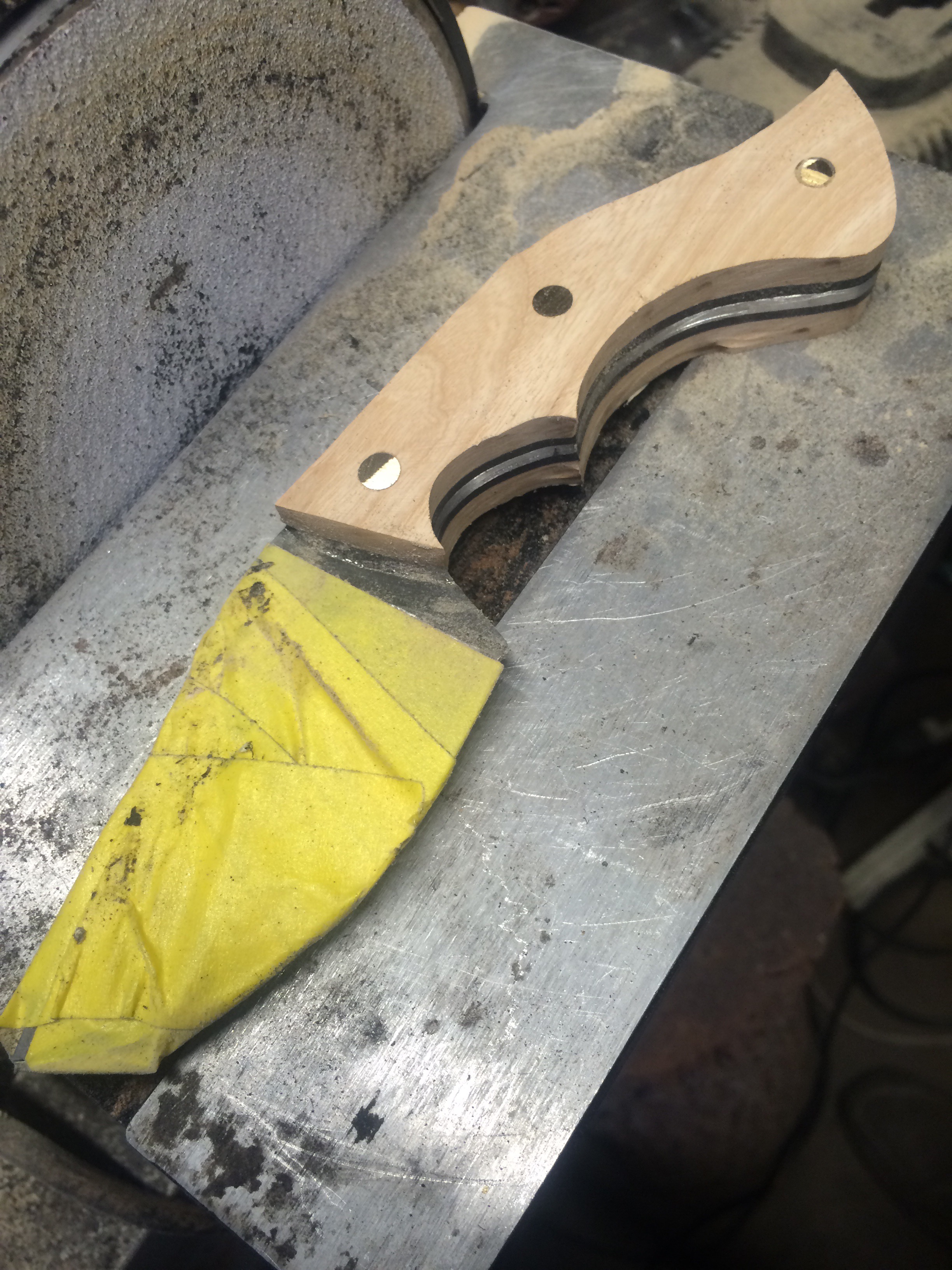
I started with a piece of 1095 spring steel…

Hardened

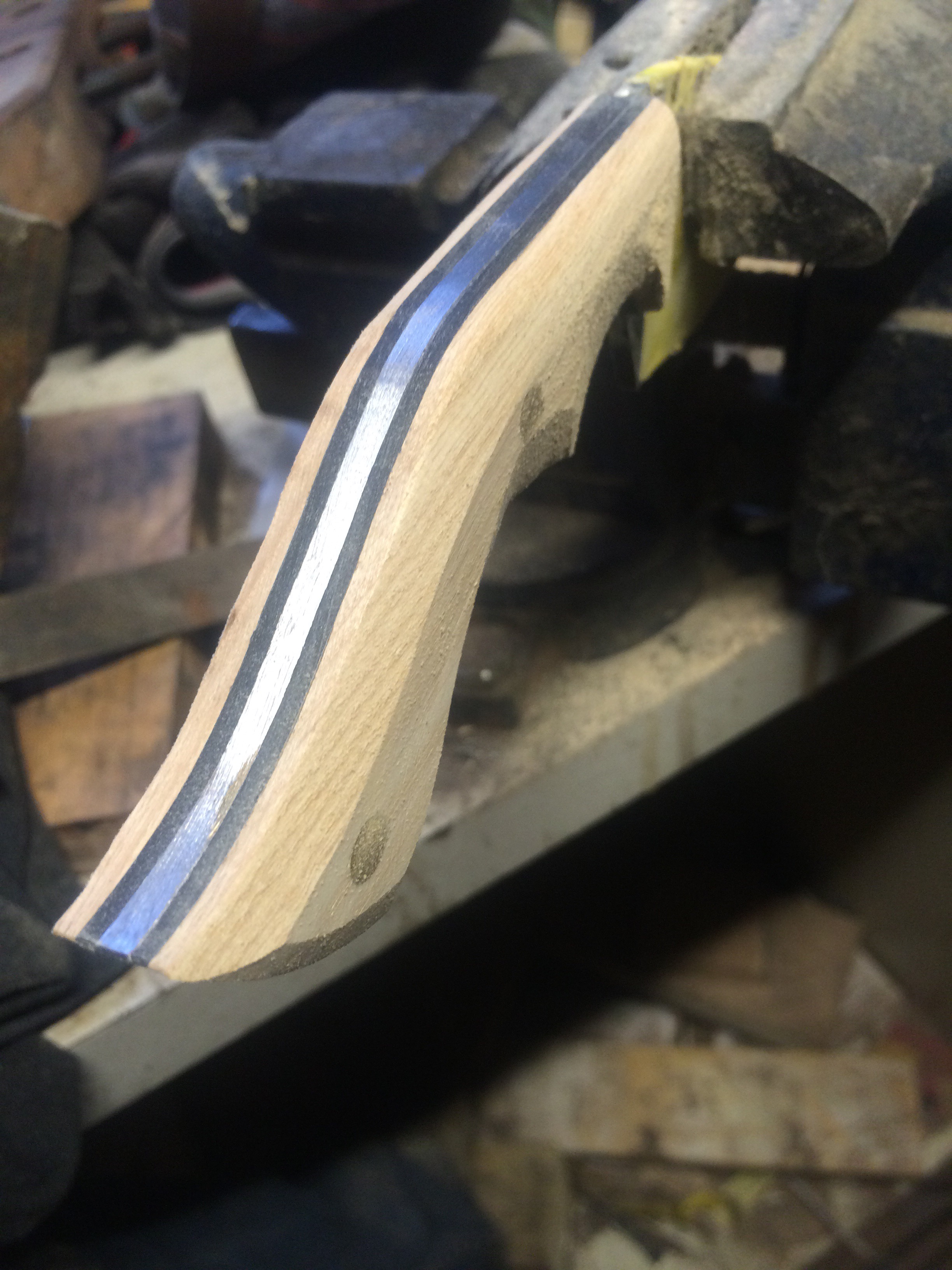
A bit of Texas River Ash…

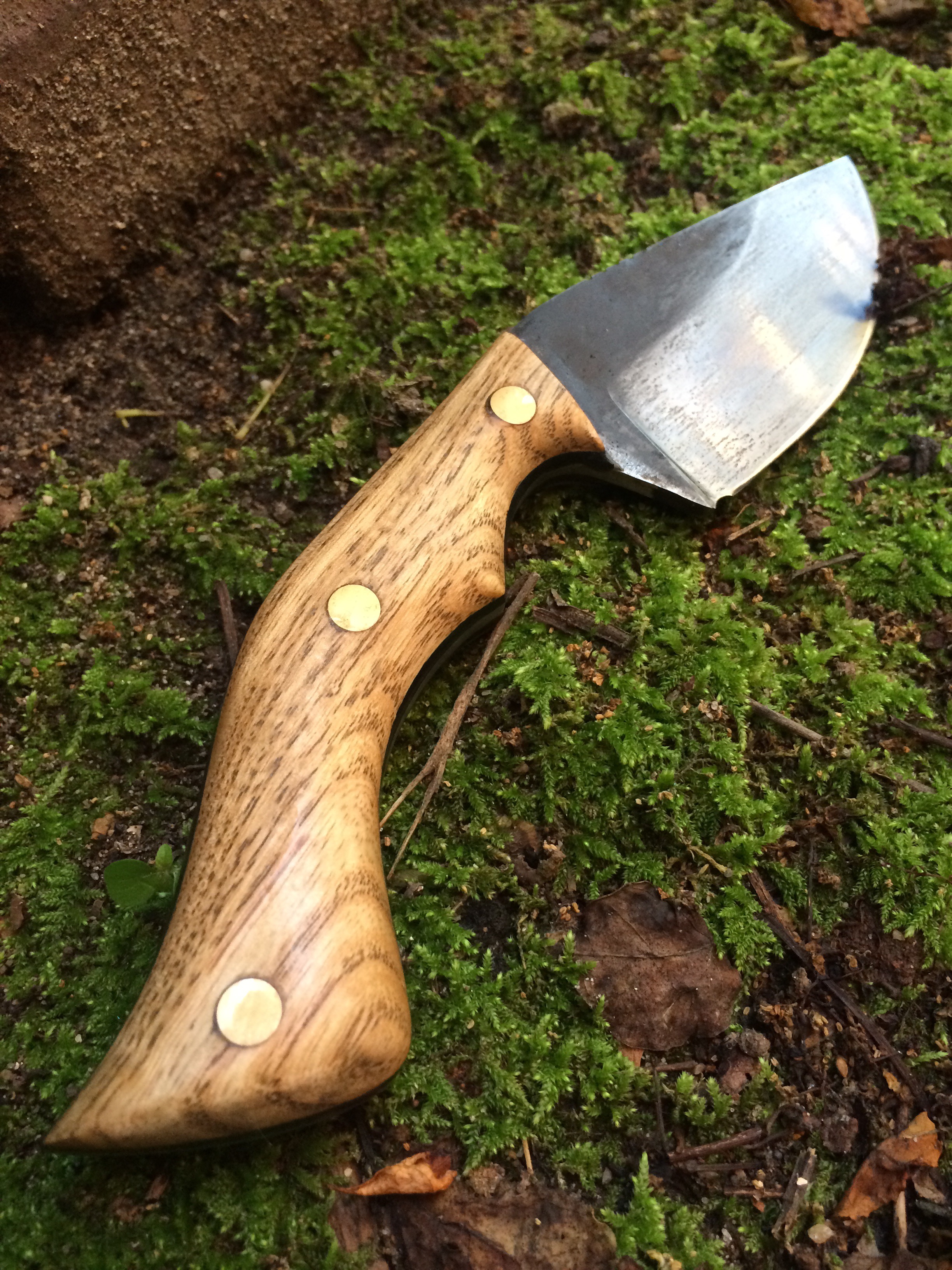
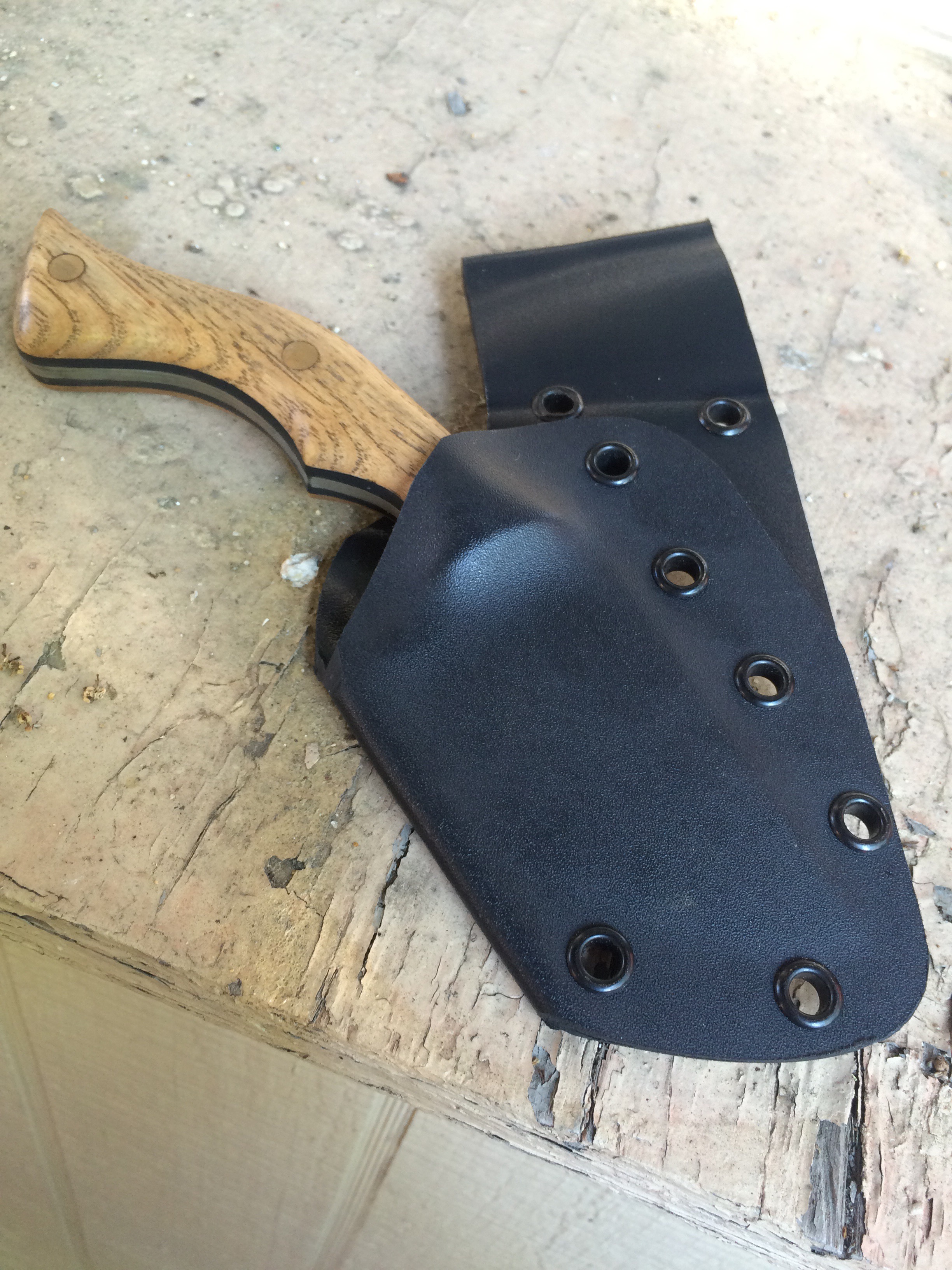
The Skin Yer Dinner:  Etched 1095 spring steel, Texas River ash handle, Kydex spacers, and brass hardware.  I also threw in a custom Kydex sheath…


IMG_3617

IMG_3614

Things break down and it’s a part of life…but so is figuring out how to get them working again.