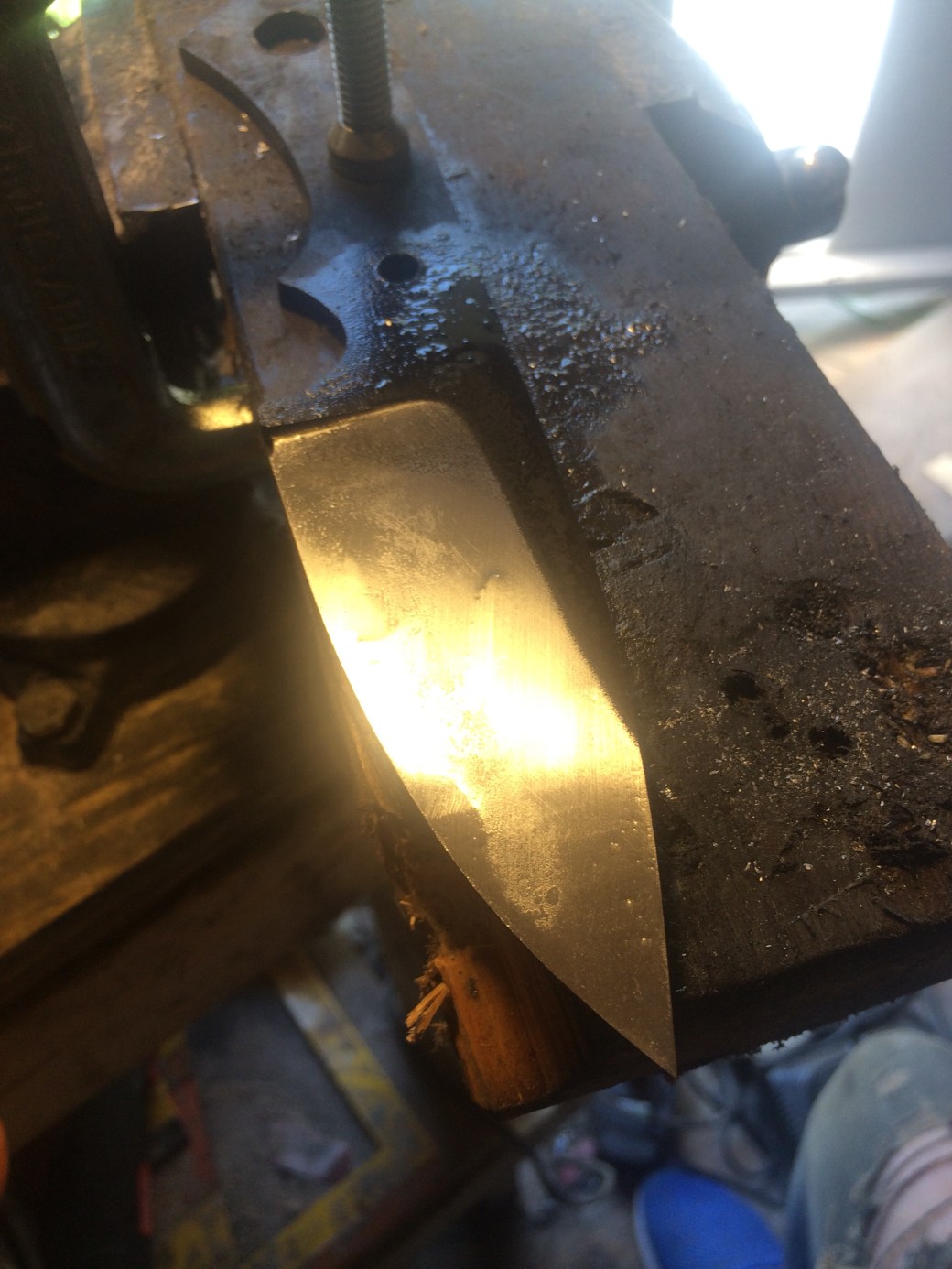
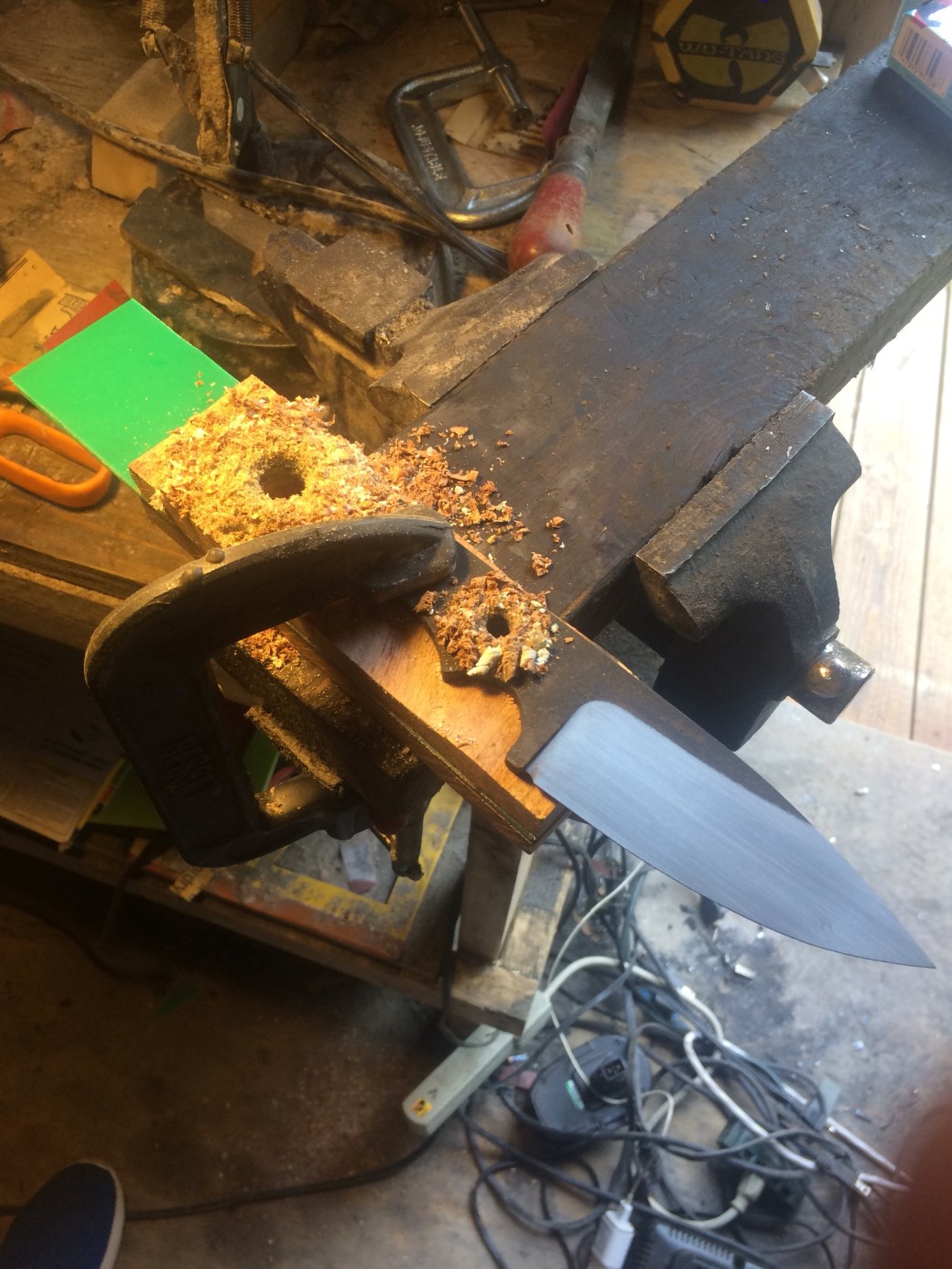
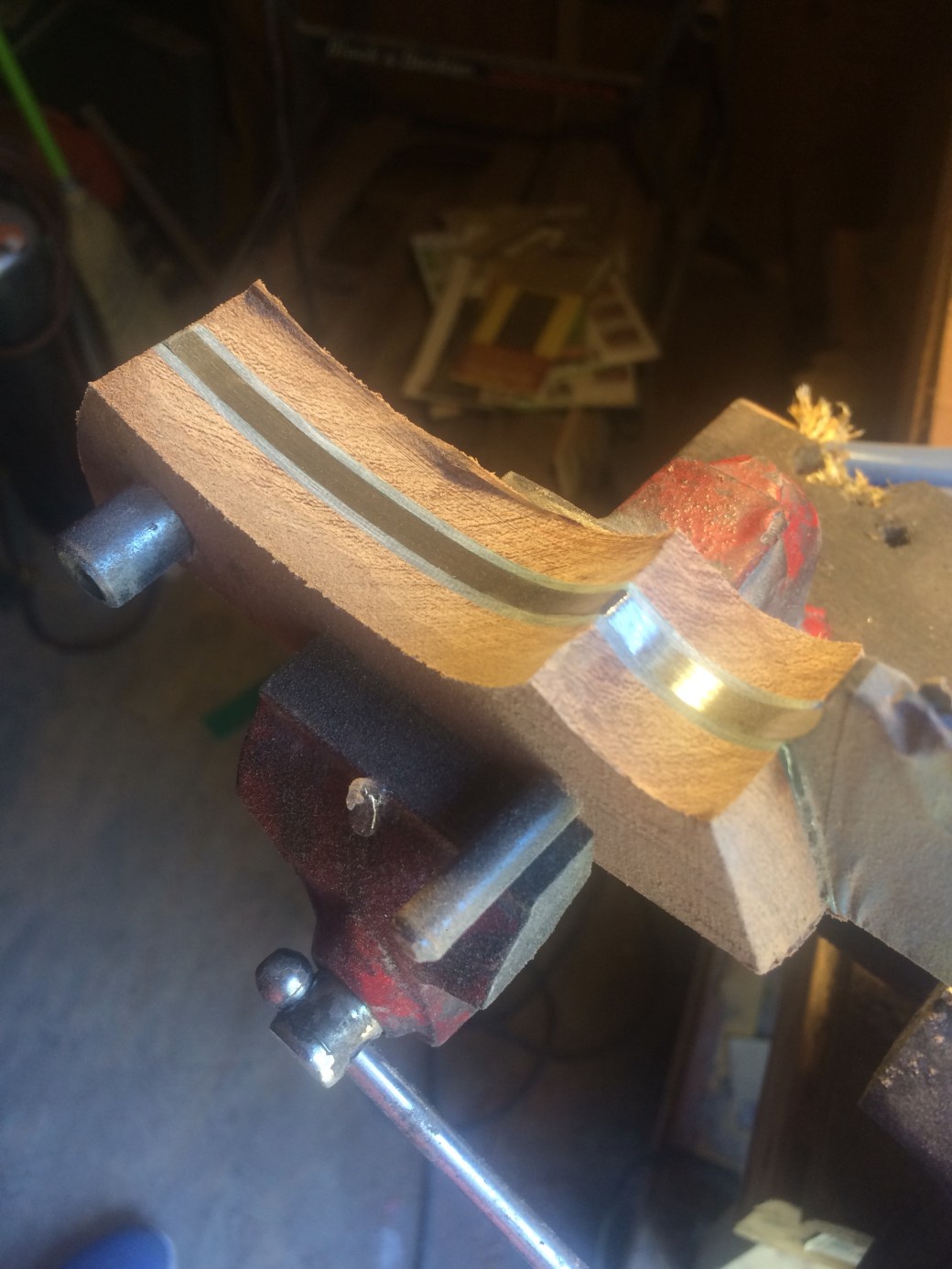
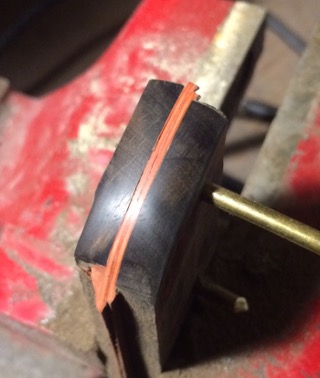
Knifemaking: therapy for large men, Buddhism with the boring parts left out, and the Rumfoord

“I was a victim of a series of
accidents, as are we all.”

Malachi Constant, from Kurt Vonnegut’s The Sirens of Titan


A few years ago I went to see a therapist.  I was stagnating.  I had lost my job and was doing all sorts of ridiculous things to make ends meet.  Over the course of about six months I floundered about.  I worked security for outdoor festivals, fixed toilets in a friend’s apartment buildings, and did tree work with another friend.

I remember being baffled by the whole situation, and feeling like a victim of unfortunate circumstance.  This wasn’t how any of this was supposed to happen.

Knives were not doing well.  As I was sitting there staring at my belly button and not doing anything about my situation, it was suggested by those close to me that I go talk to someone who could help me.  That was the last thing I wanted to do.

After some consideration, and a good amount of trepidation, I called a counseling office recommended by my insurance company and I went in for an appointment.

I remember sitting in a very Spartan office, with lamps suggesting a mood of emotional intimacy, and an institutional nightstand with a box of off-brand tissues sitting on top of it.   My therapist walked in.  He was a large African-American gentleman, crisply dressed, and carrying a folder.

He asked me the formal therapist/patient questions: what I hoped to accomplish in our sessions, and what it was I hoped to gain from our time together.  The truth was that I was a little stuck.  There were things about myself that I missed, a spontaneity and ease of being that I had lost.  I knew where I was and I knew where I wanted to be but I didn’t know how to get there.  Also there was a lot of emotional clutter and traumatic bullshit in the way.  I told him all of this.

‘I think I can help you with that’, he said.  ‘As for the emotional clutter and everything else in the way- I think it’s time to let that shit go’.

So we began.  Nearly every two weeks for about a year, and then maybe once a month for the year after that.  My therapist was technically a licensed clinical social worker who specialized in substance abuse counseling.  I didn’t have any substance abuse issues- I had simply told the administrative lady at the office that I was most comfortable talking to a middle-aged man, and this gentleman had an opening.  He didn’t wear a suit like all the other therapists.  His dealings with addicts, I found, left him with a particular knack for getting to the root of personal problems , and a no-bullshit way of going about it, like a sort of Krav Maga of psychotherapy.  I come from a place where you didn’t talk about how you felt so to voluntarily talk about things that were bothering me was, and is, something that is incredibly uncomfortable.  And honestly I wasn’t looking to talk about what was bothering me- I was looking for someone to tell me what to do.

Of course that isn’t how therapy works.  He didn’t tell me what to do.  He would ask how situations made me feel and then challenge me.  I came in one time really bothered about something and I remember him laughing at me.  ‘Welp, you’re in the shit now’ he said, ‘What do you intend to do about it?’

The bluntness was empowering and it didn’t come with any judgement.  This was simply how one large man was helping another large man.  I would go in and tell him that my shit was all fucked up that week.  And he would nonchalantly ask me if I had a plan for unfucking my shit, and that if I did not, perhaps there were some goddamn unresolved childhood issues being played out and my fucked up shit was just a manifestation of that.  Then we would unpack my goddamn issues so that I could start unfucking my shit.

I would tell him that I struggled with faith that everything would be ok.  He said everybody does.  I told him I had a hard time dealing with disappointment and uncomfortable feelings that came from harboring resentments.  I let him know I was ashamed about not being able to accept failure.  He told me that all these made me a completely normal human being.  Month after month he would talk me off of existential cliffs.  ‘Don’t be a victim’, he would say.  ‘Be a warrior.’

We talked a lot about transformation and how it can be difficult to change.  I would be frustrated about something that was so deeply innate to my being that I didn’t know where to start.  He would gently tell me that a person can only change so much, and some things simply can’t be changed.  And then he would say that some of the things I was trying to change weren’t bad things and I should reframe what it was I was trying to do.  It was a study in Buddhism, but with the boring parts left out, and a whole lot more expletives.  When a sculptor wants to make a statue of an elephant from a block of stone, he simply removes the parts that don’t look like an elephant.  There comes a point when you can’t remove anything else to make the stone look more like an elephant.  This was what we were doing- removing (or at least identifying) the parts that didn’t serve the whole, and accepting everything else with kindness and compassion.  Om Mani Padme Hum…

We laughed a lot.  Lots of sad things came up, and I would get really weepy and reach for the off-brand box of tissues in that intimately lit office.  We talked about music and books and art, and what it was to be a good man and what doing the right thing looked like.   We usually ran over our time limit.

After a while I started bringing in the knives I was making and talking through the stories.  It was like sculpting an elephant, or yourself, but I was taking away the parts that didn’t look like a knife.  I was afraid it might be weird bringing big knives into a shrink’s office week after week but he told me to keep bringing them and to keep telling him their stories.  So I did.  I told him they were guardians that helped me to write the ridiculous experience that life has been for me.  I’ve never done things the conventional way, or even the smart way, and bringing your handmade knives in to help you talk about your story with your large African American psychotherapist probably falls into at least one of those categories.  He was always kind to that part of me.  He told me to keep building little sharp guardians and to keep writing.  At the end of each session I would shake his hand and thank him.  ‘No, thank you,’ he would say.  He said he always looked forward to seeing me on his schedule and to what I would come in and tell him.  I think he dealt with people much more fucked up than I was.

I started seeing him less frequently.  I found, slowly and when not crippled by self doubt, that I was getting to where I wanted to be and was able to find what I needed in myself.  I was doing good things and feeling alright.  He told me that much, and that nobody really knows what they are doing anyway, and he was always there if I needed him.  He also told me to keep my knives sharp.

Every so often, when I’m about to do something dumb, I’ll hear that man’s voice telling me not to be a dumbass and I’ll think twice…

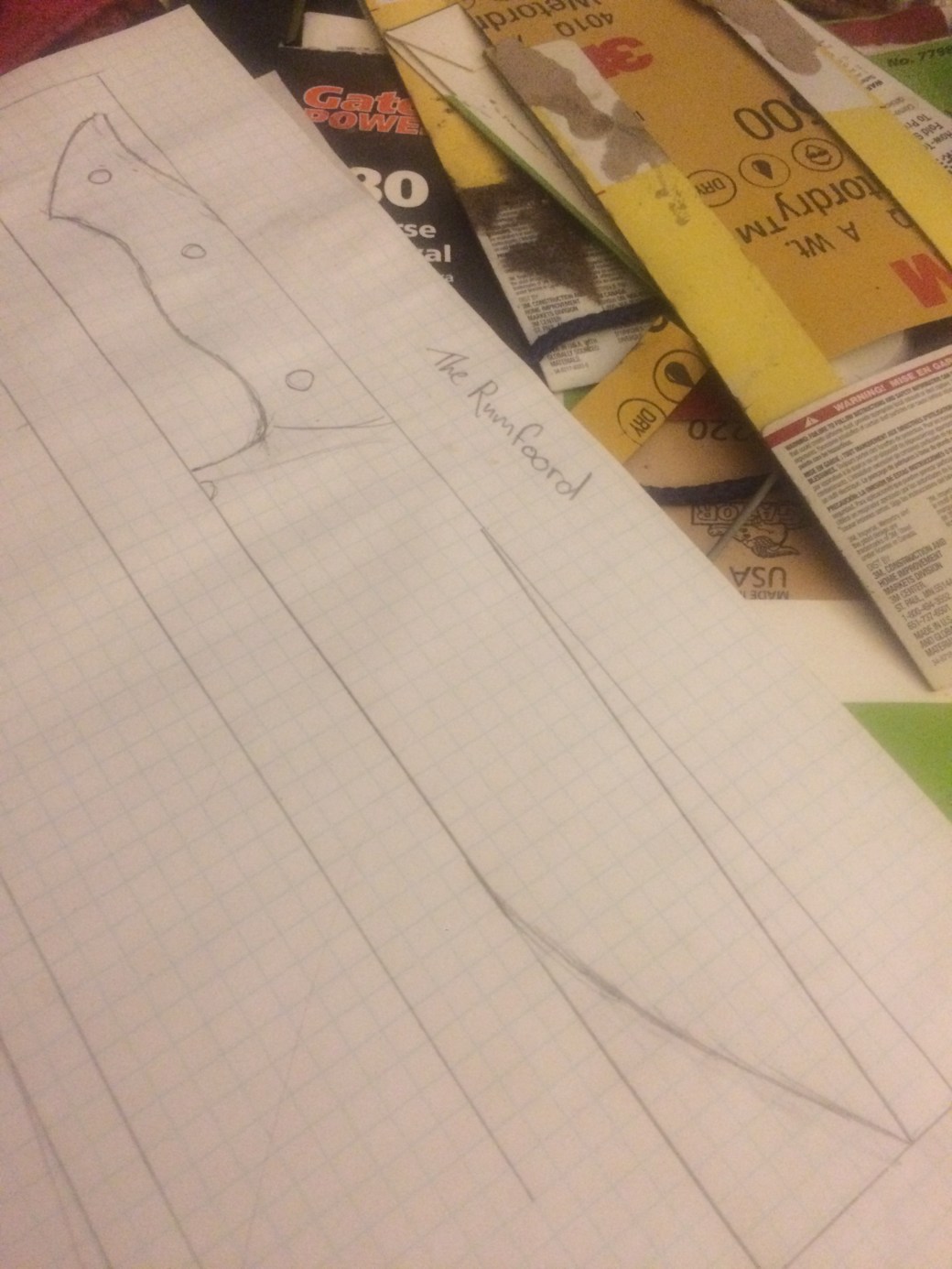
Sometimes one may know where they want to be but don’t always know how they’re going to get there.  The journey to that destination is often the most interesting part of making it in the world.  This blade gets it’s name from one of my favorite books, The Sirens of Titan, where the main character is at the mercy of the whims of chance and destiny (and also aliens), but through the grace of the almighty chonosynclastic infundibulum, ends up precisely at his foretold destiny.  Along the way all of his core beliefs are challenged and his world is completely upended, yet there he is at the end of it all.  This is the lesson of the Rumfoord.

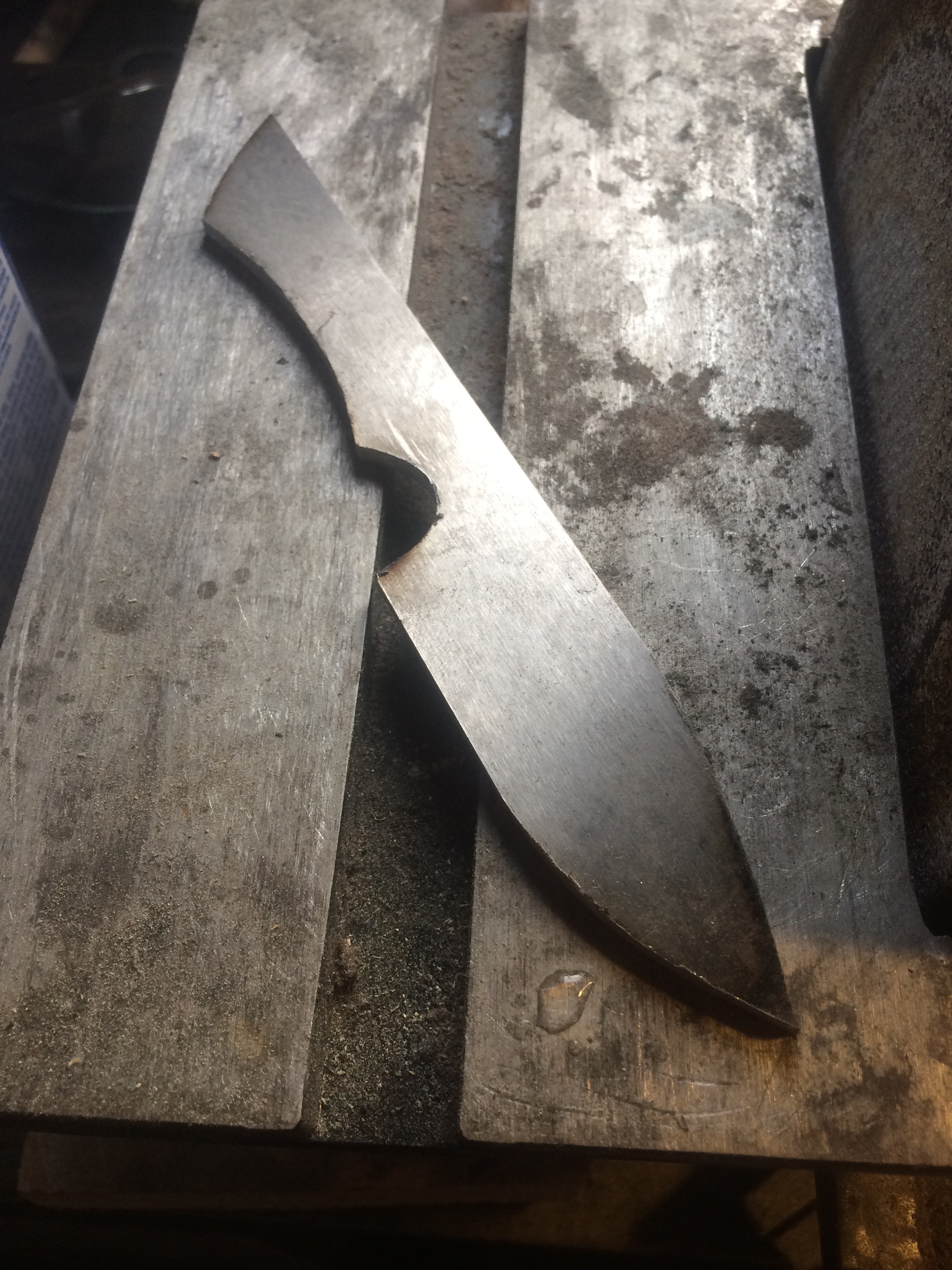
This knife was built for a gentleman who was waiting a very long time for it:
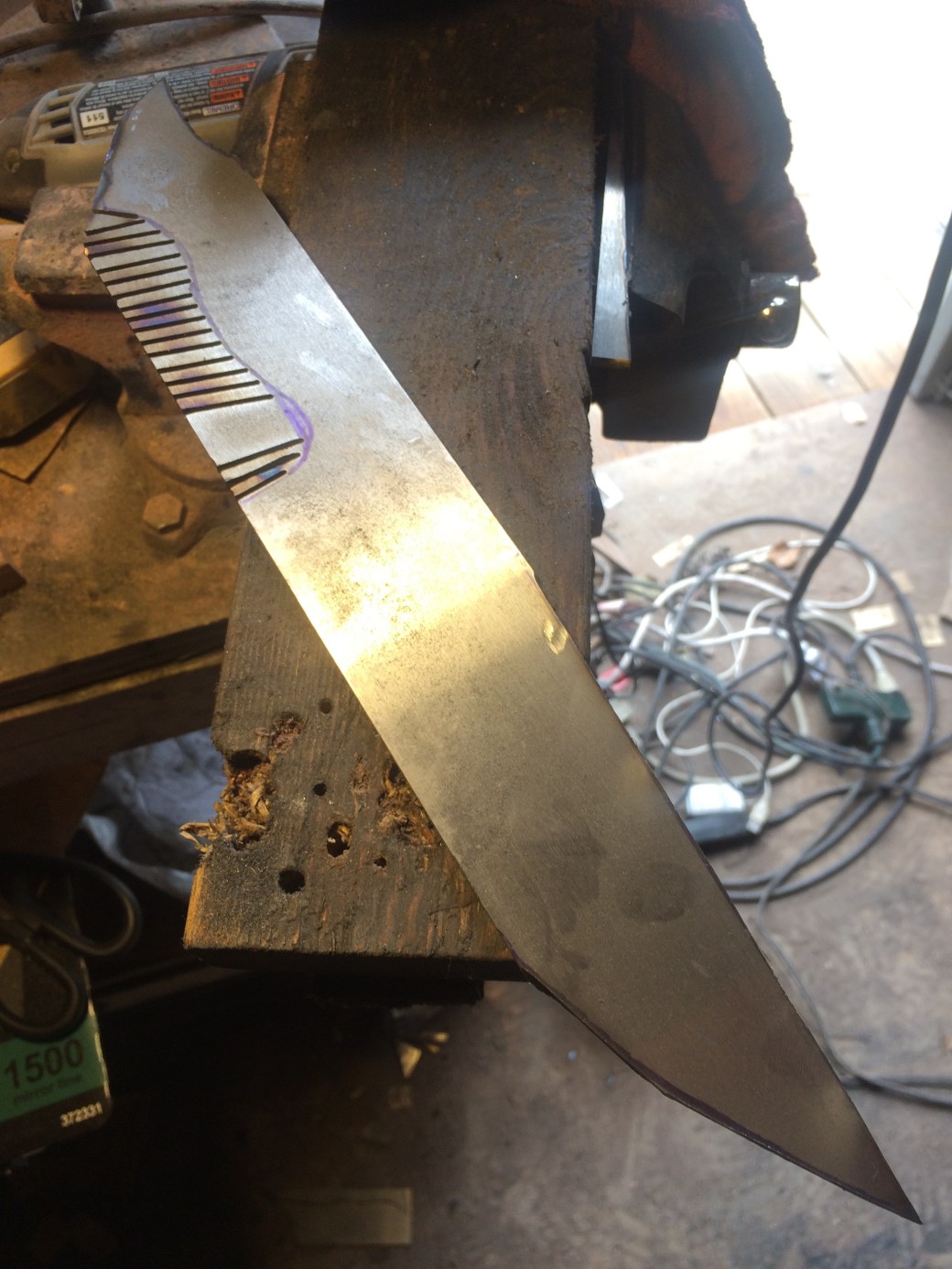
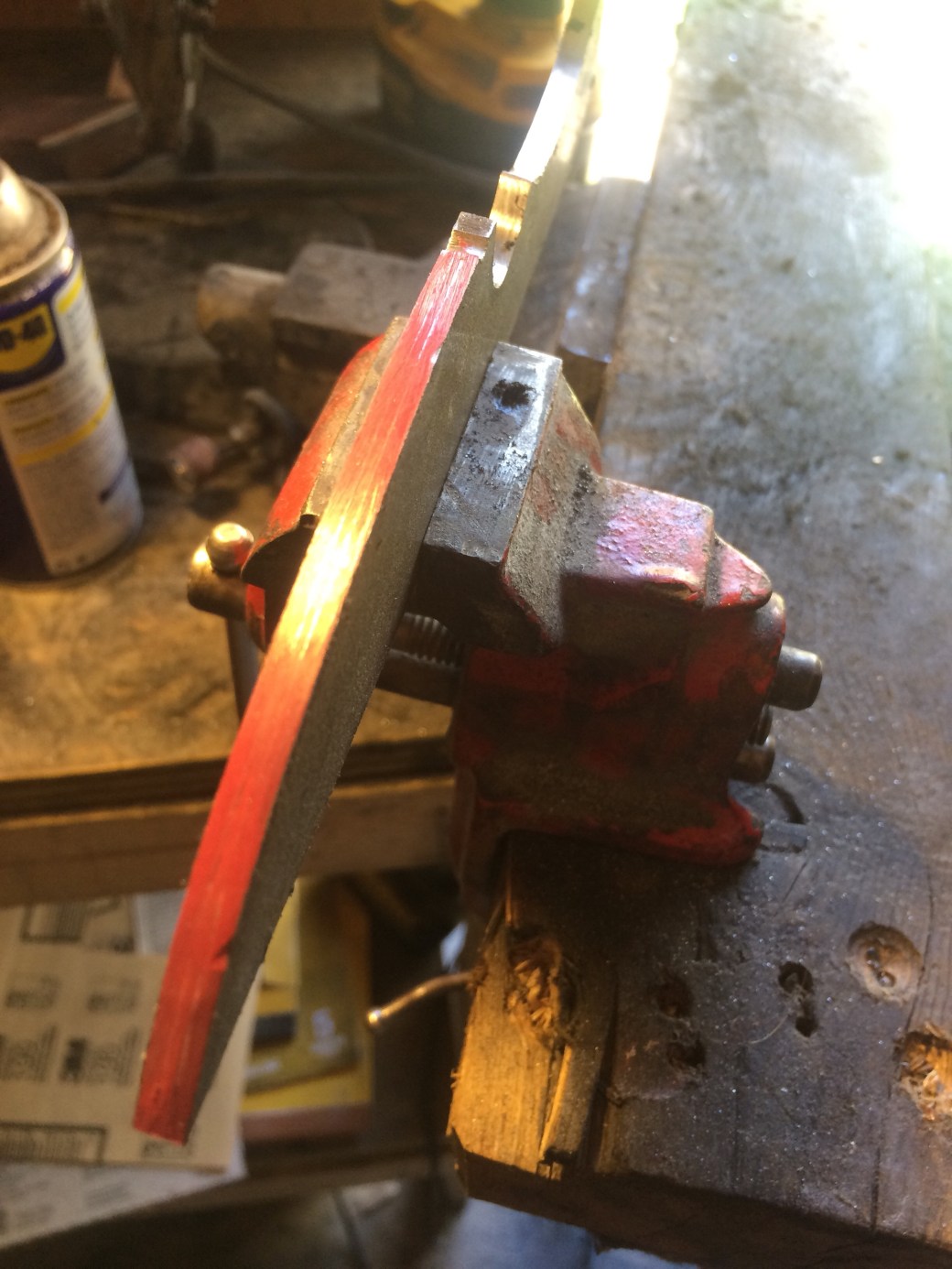
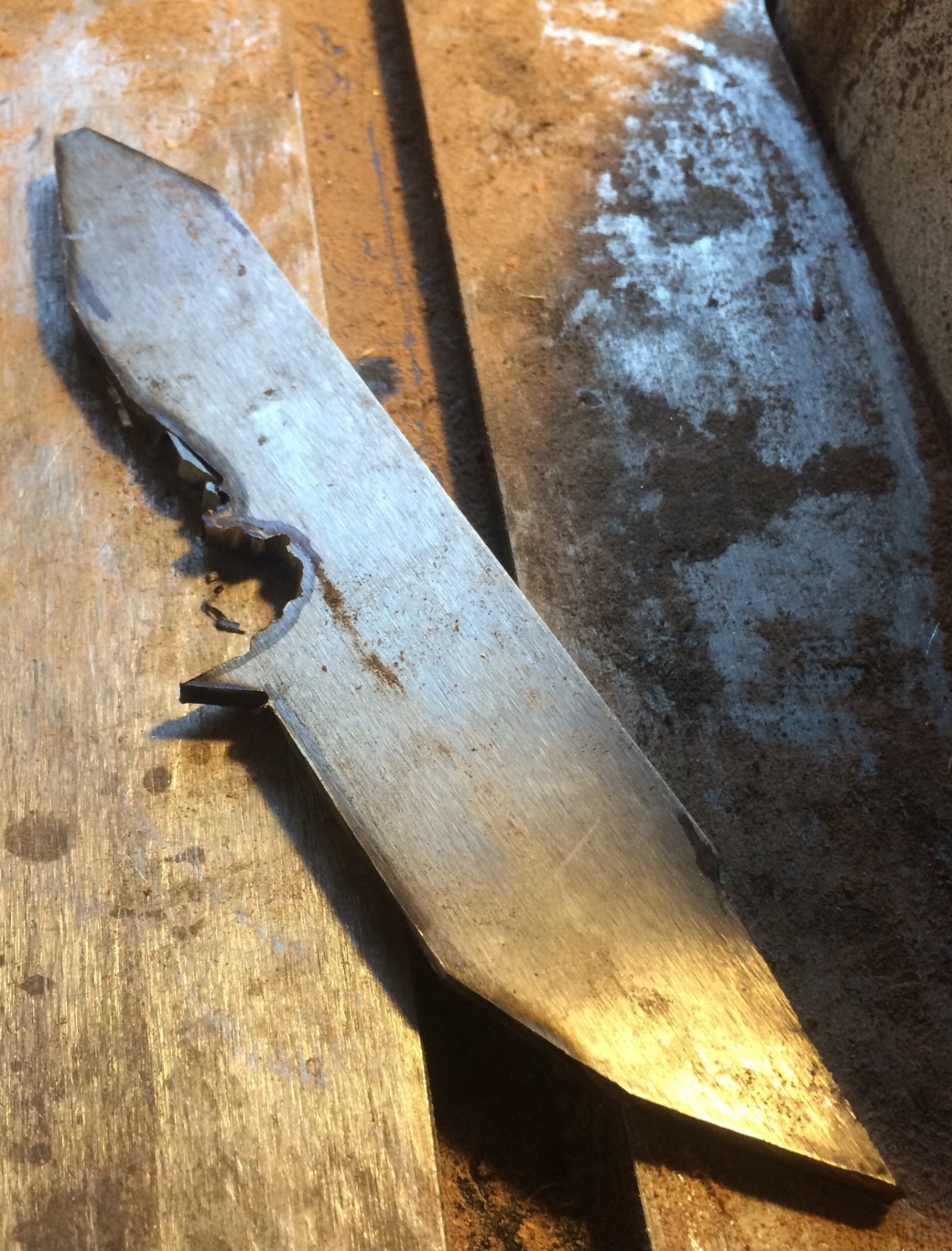
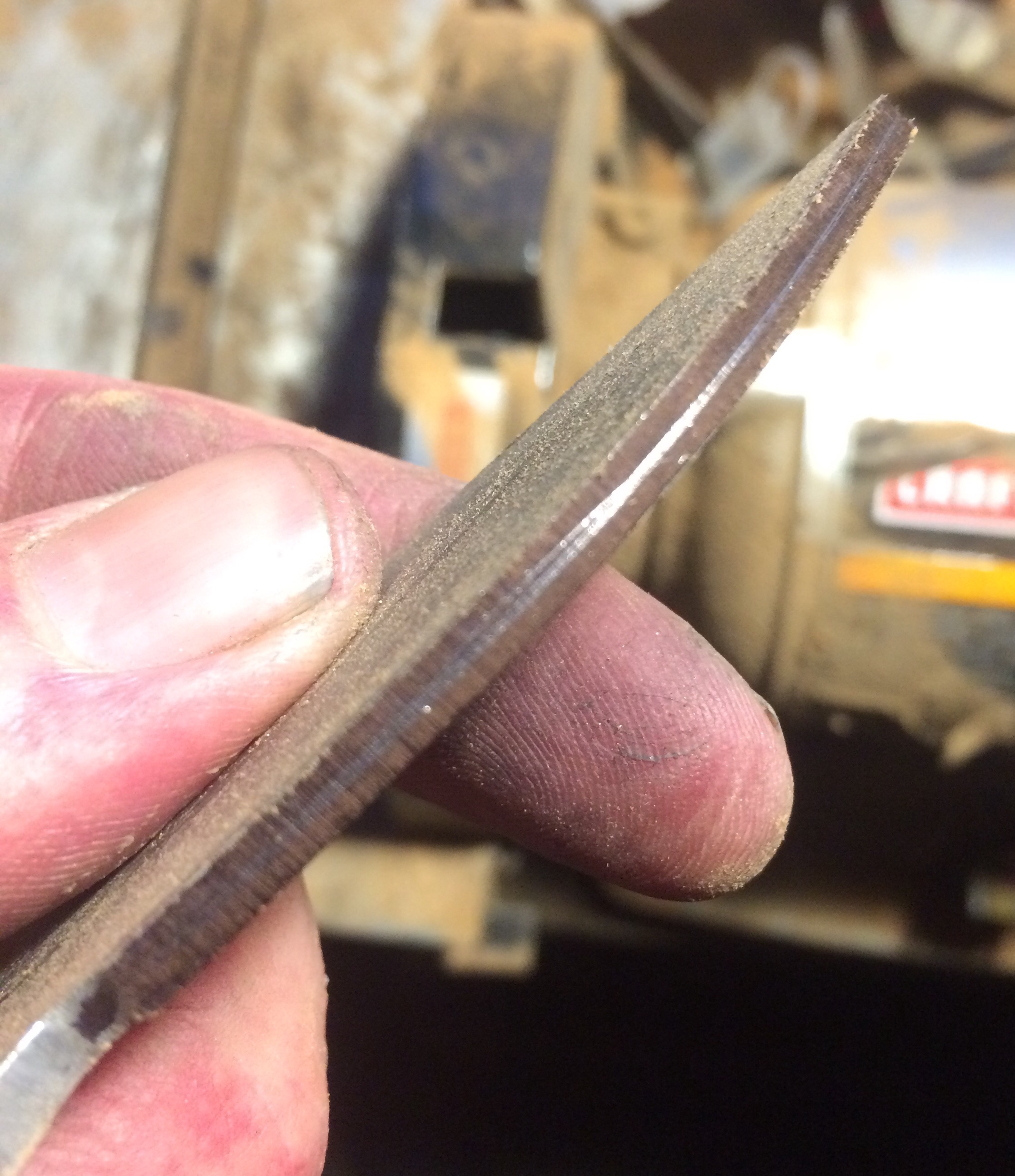
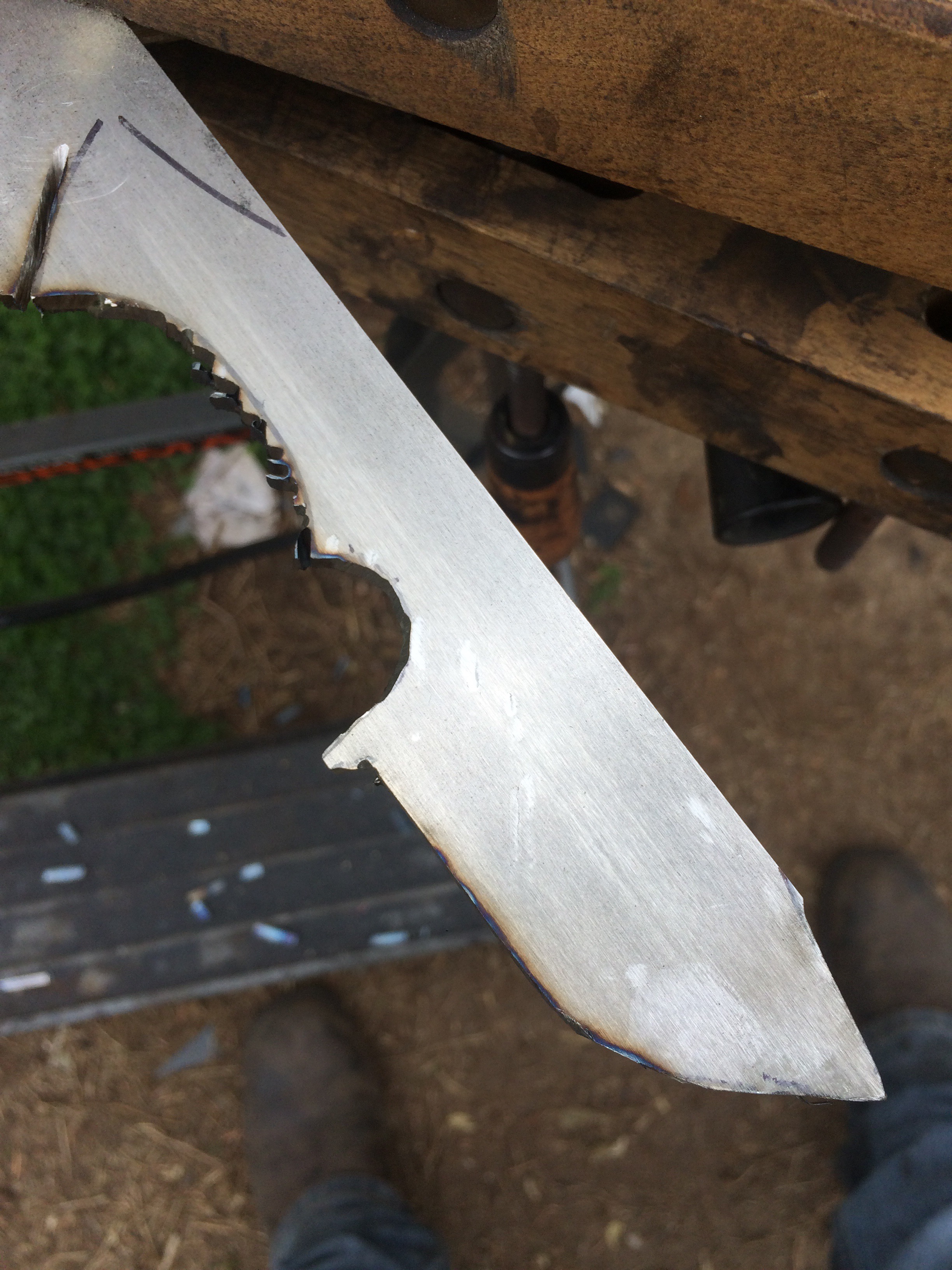
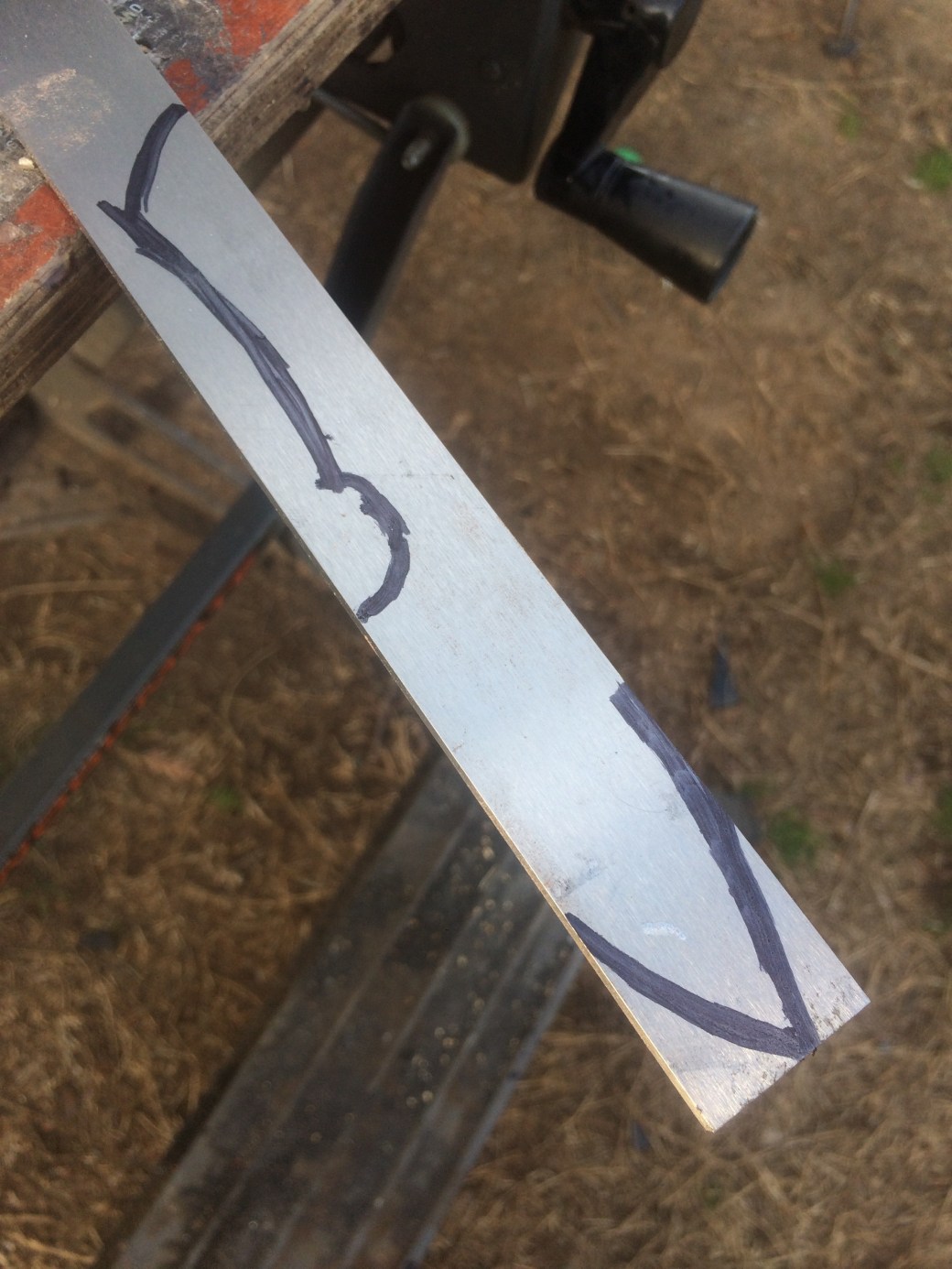
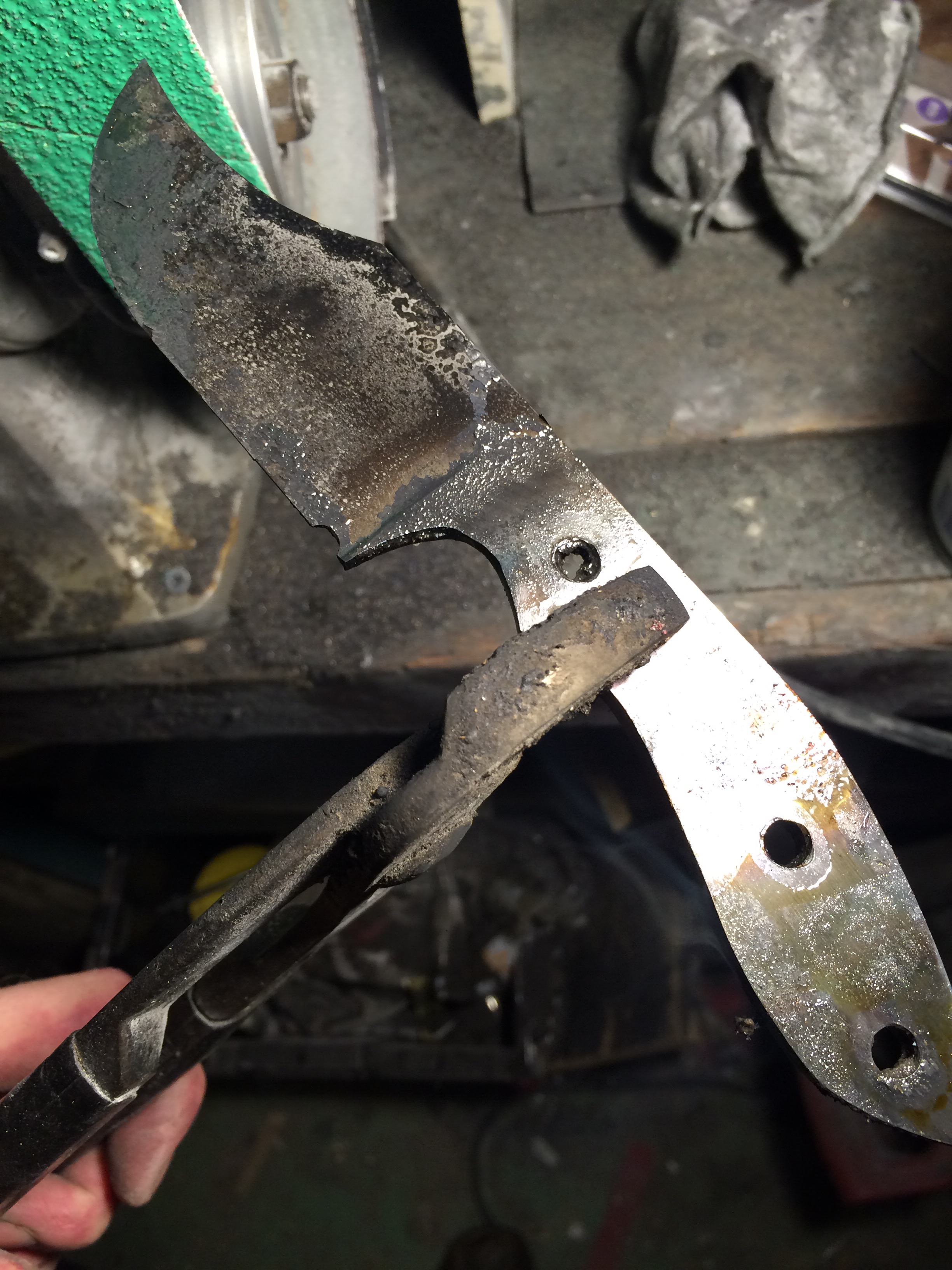
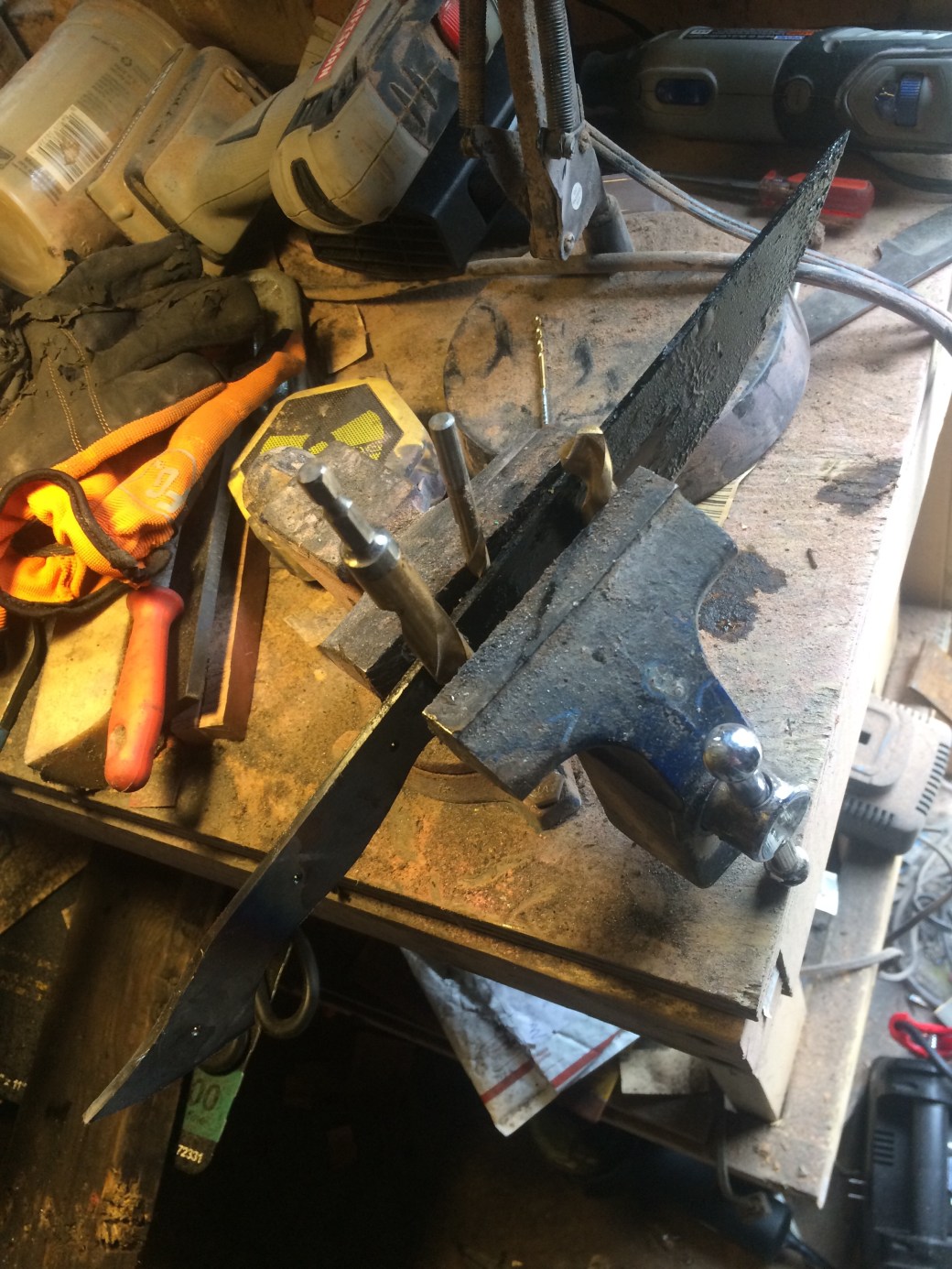
Heating can cause warping.  A sophisticated setup for straightening…
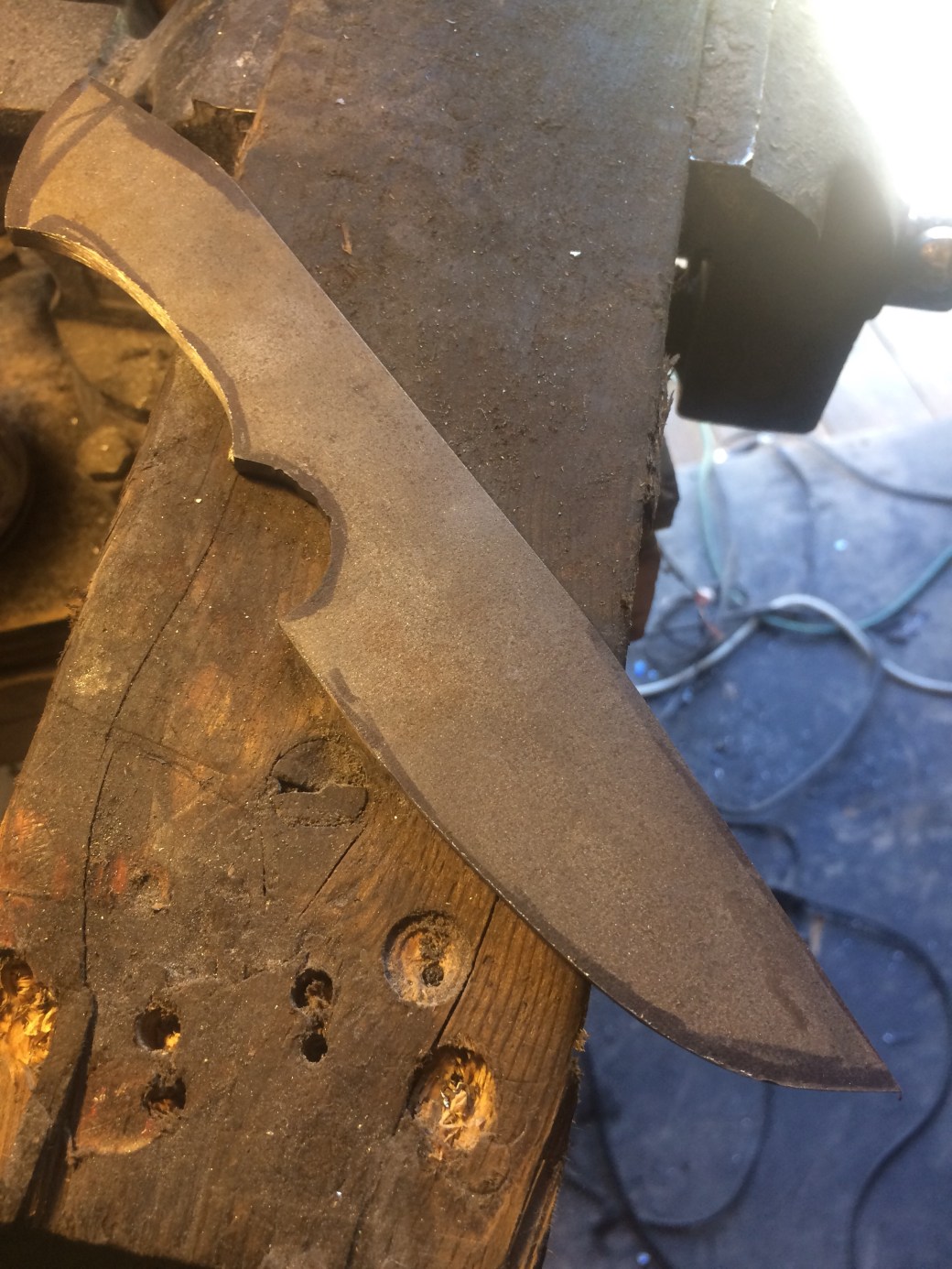
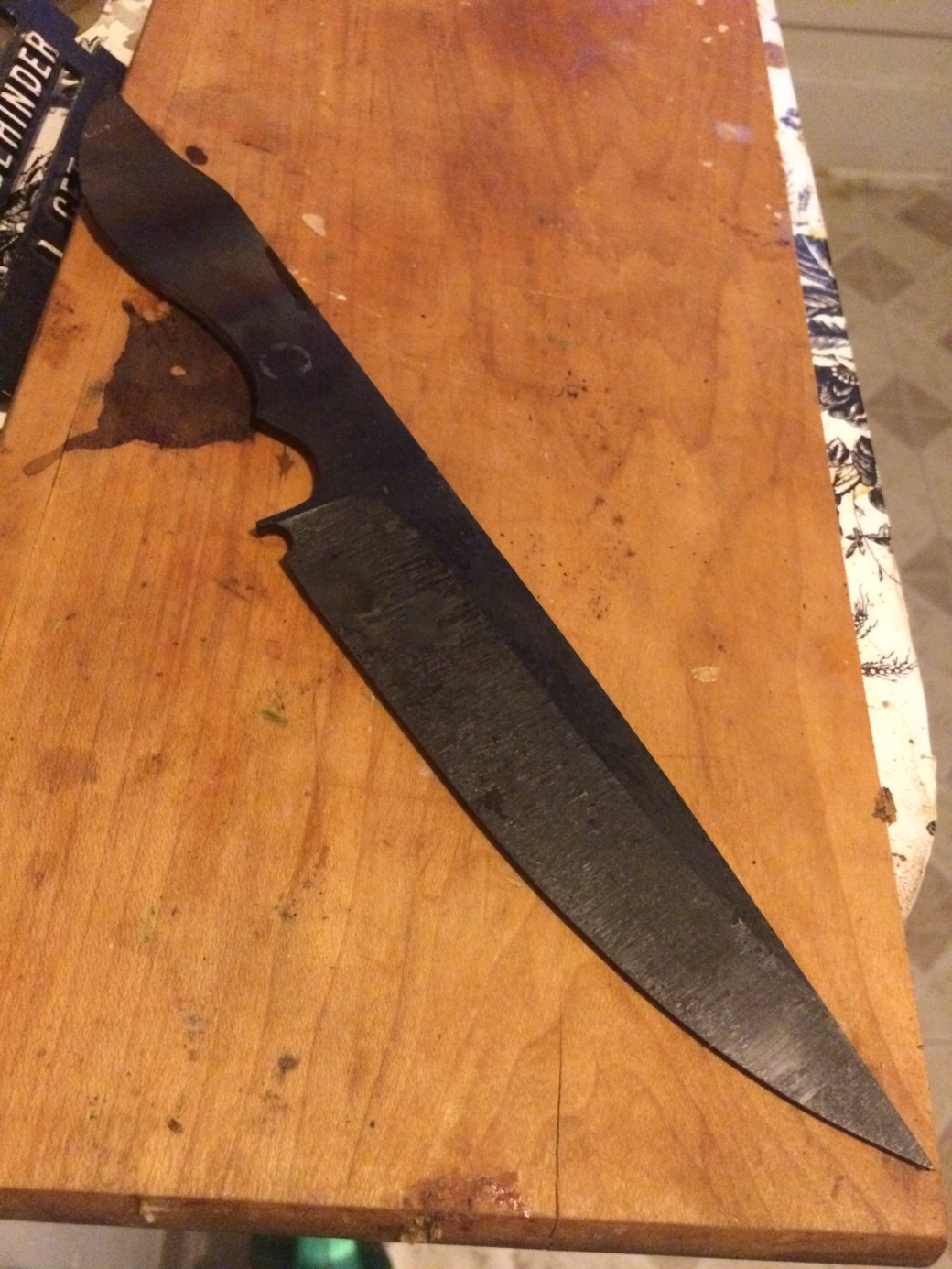
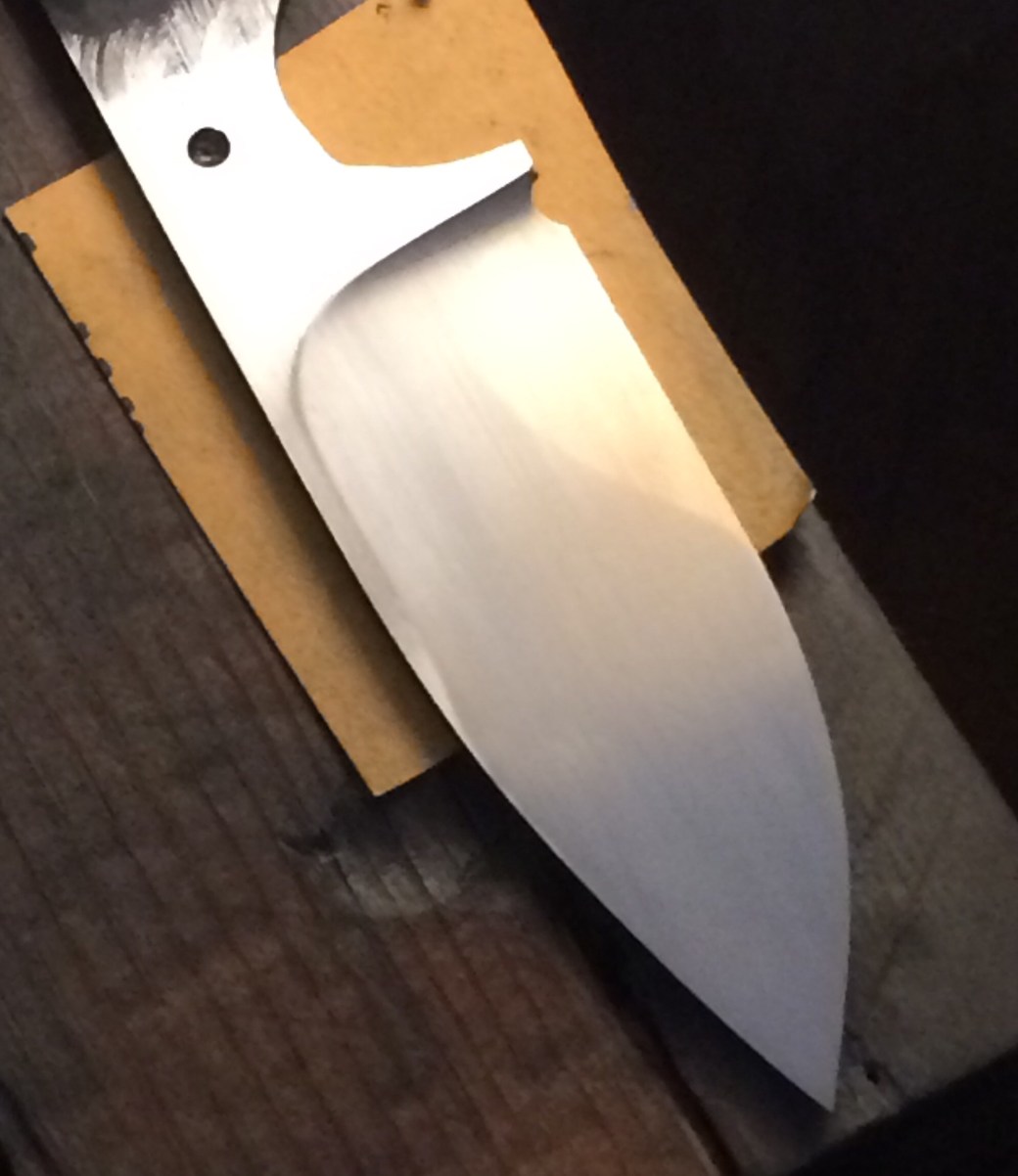
Roughing in a full flat grind:

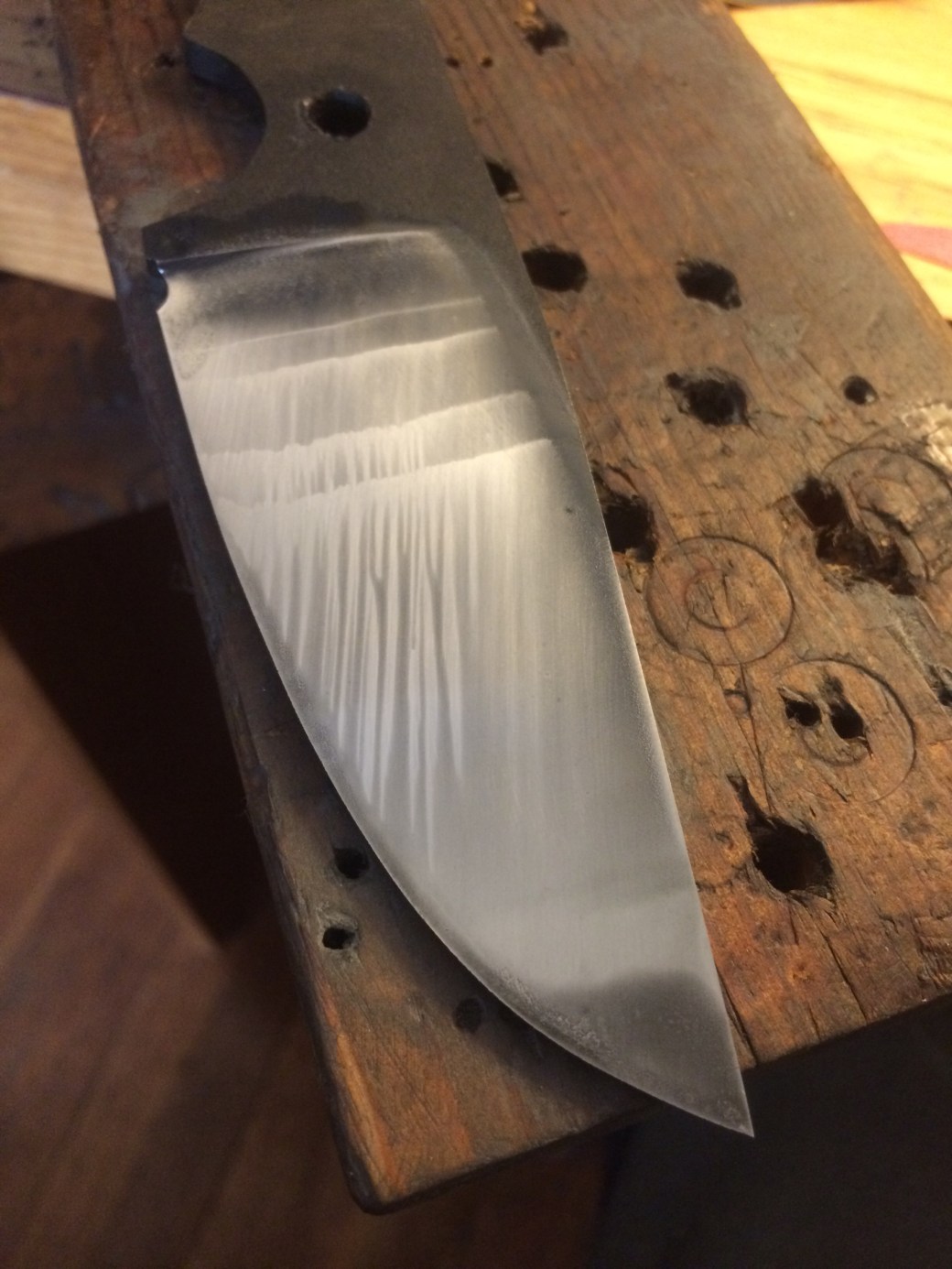
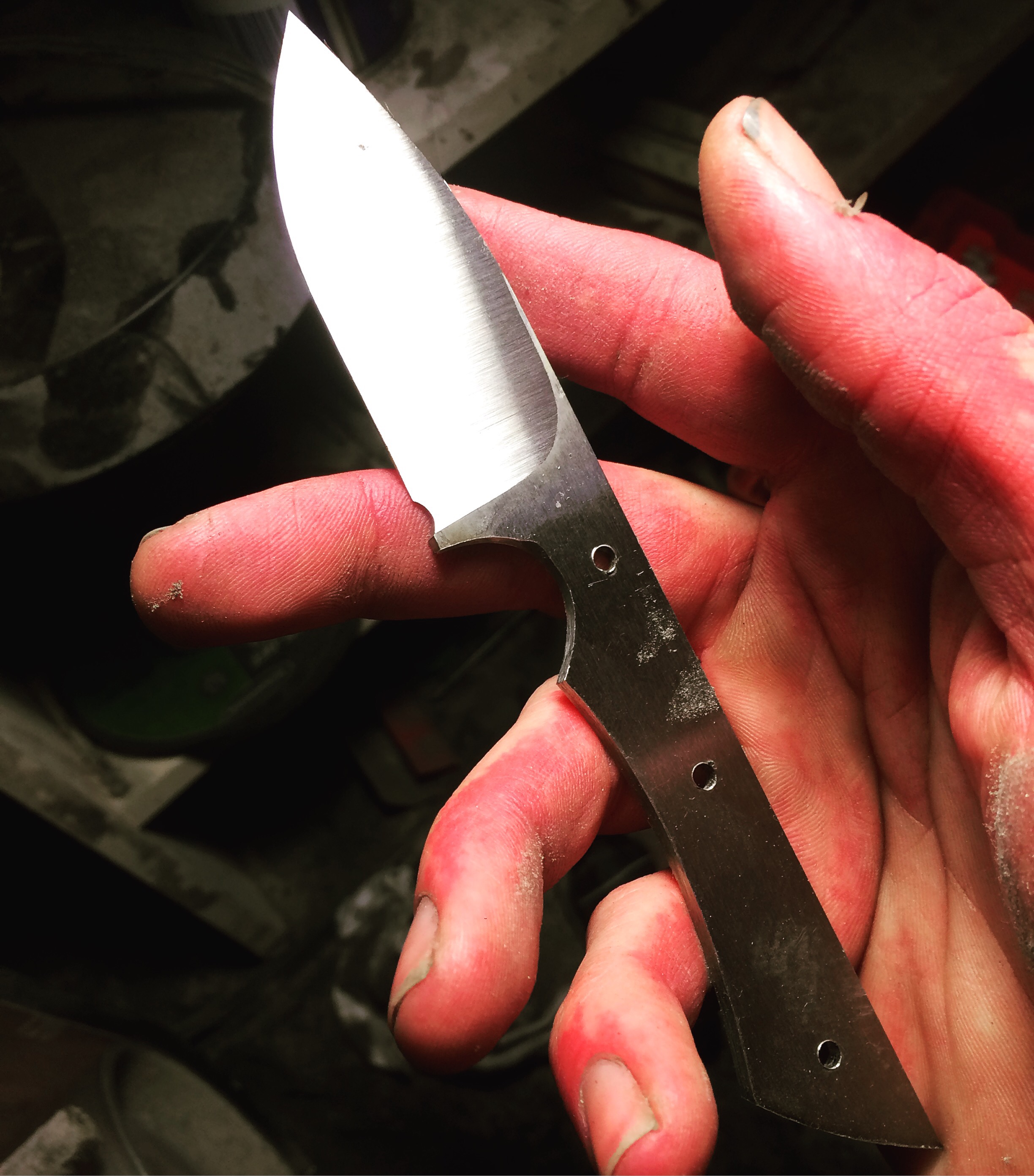
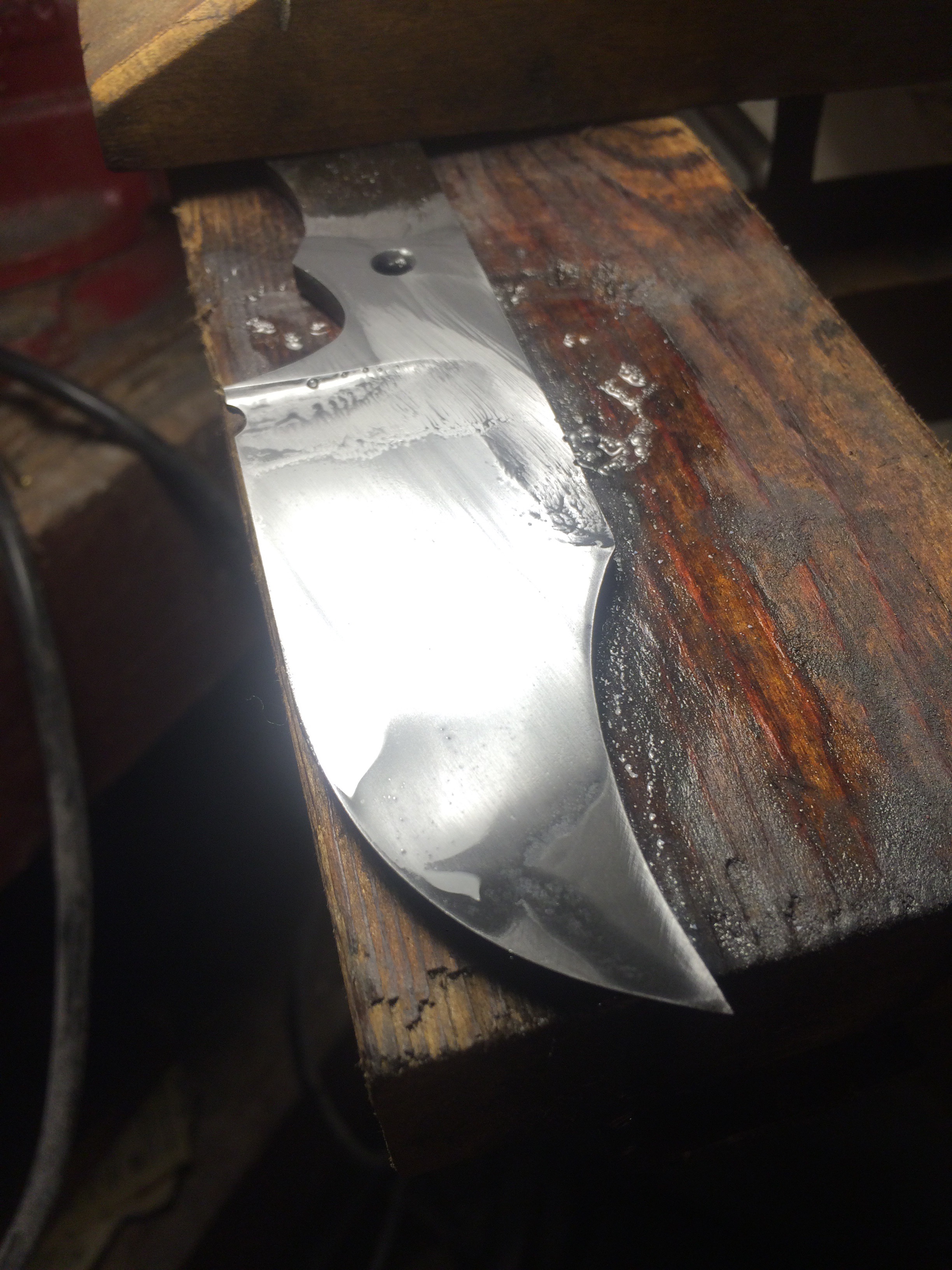
Removing all the machine marks…

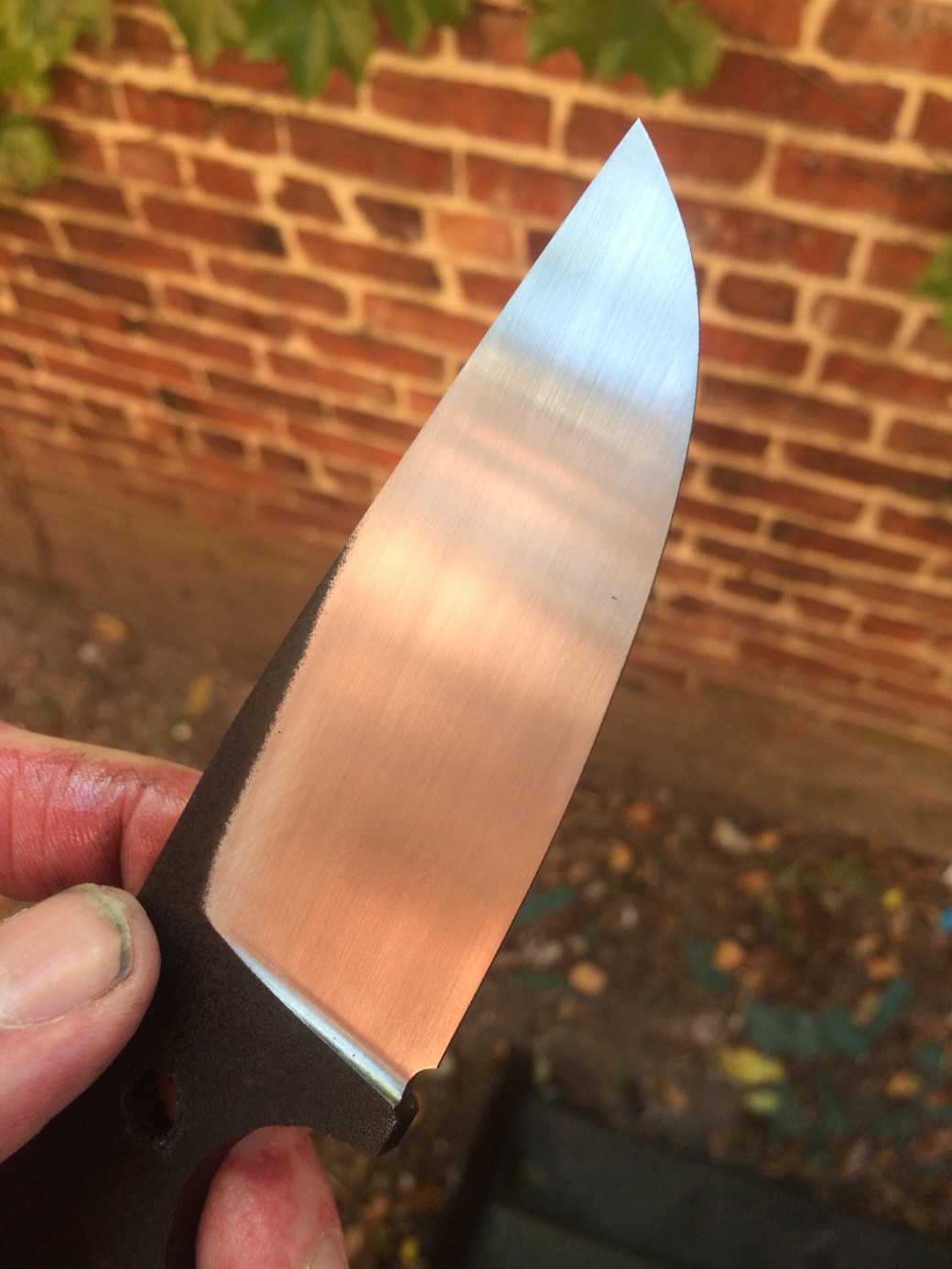
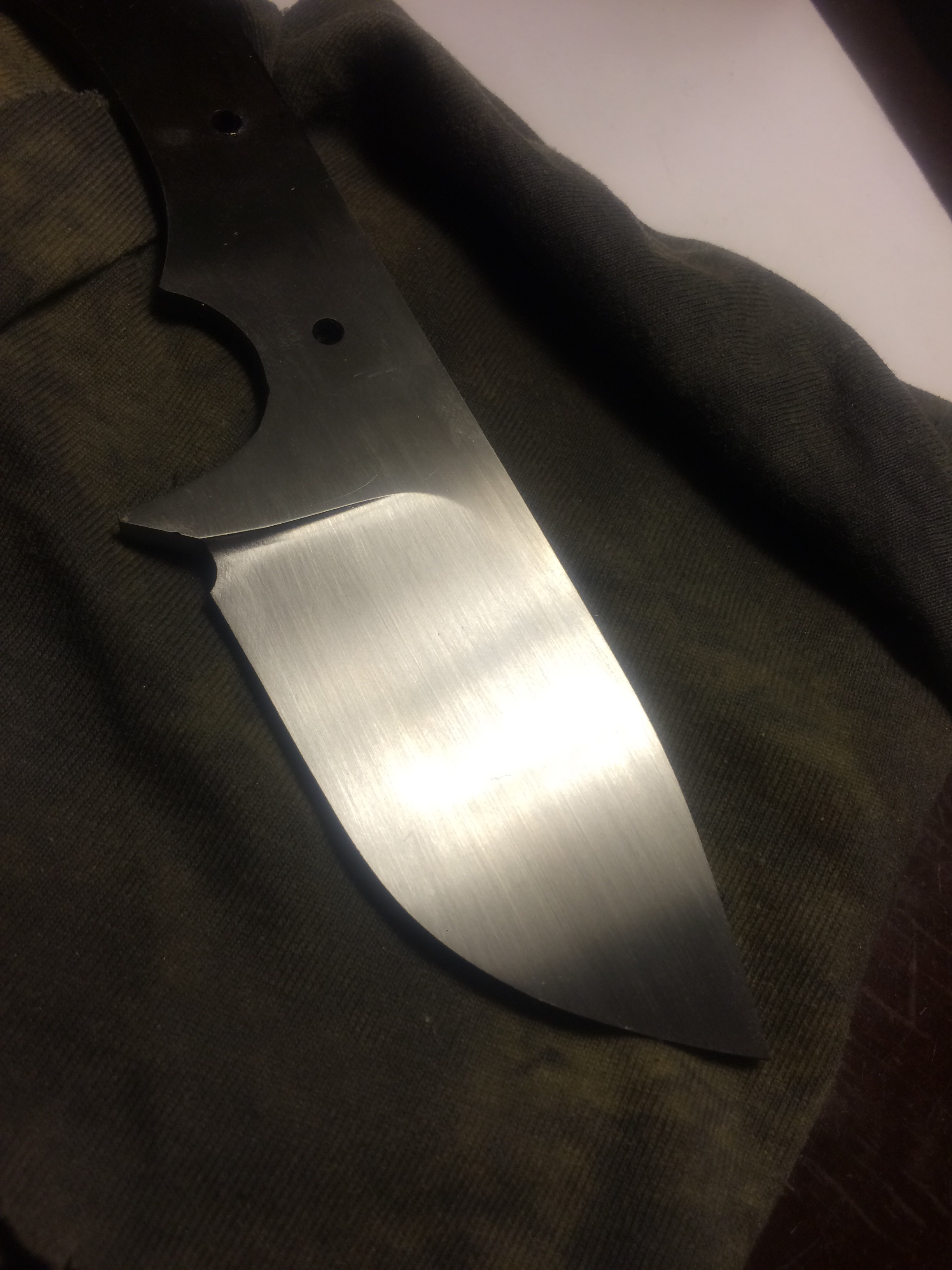
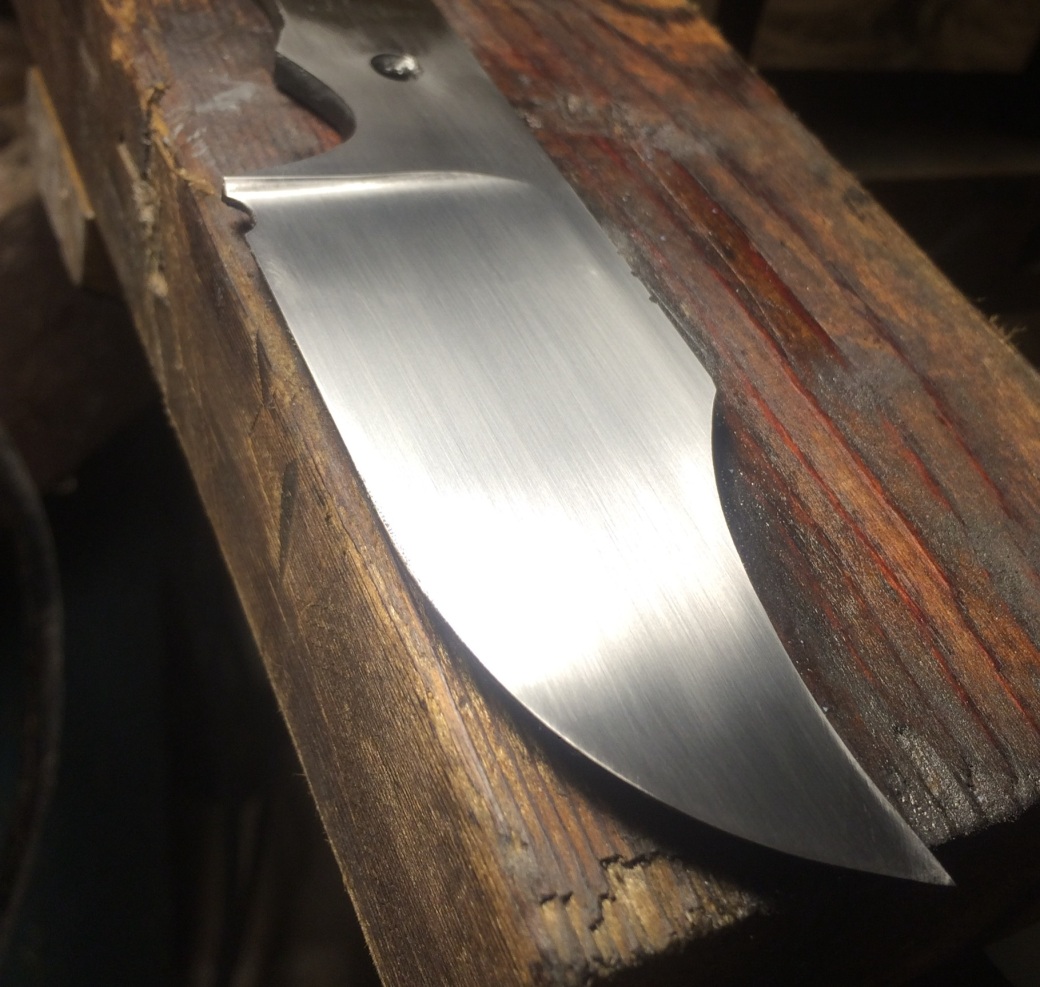
…to achieve something a bit more pleasing.  A smoother finish helps the blade to move through food better.

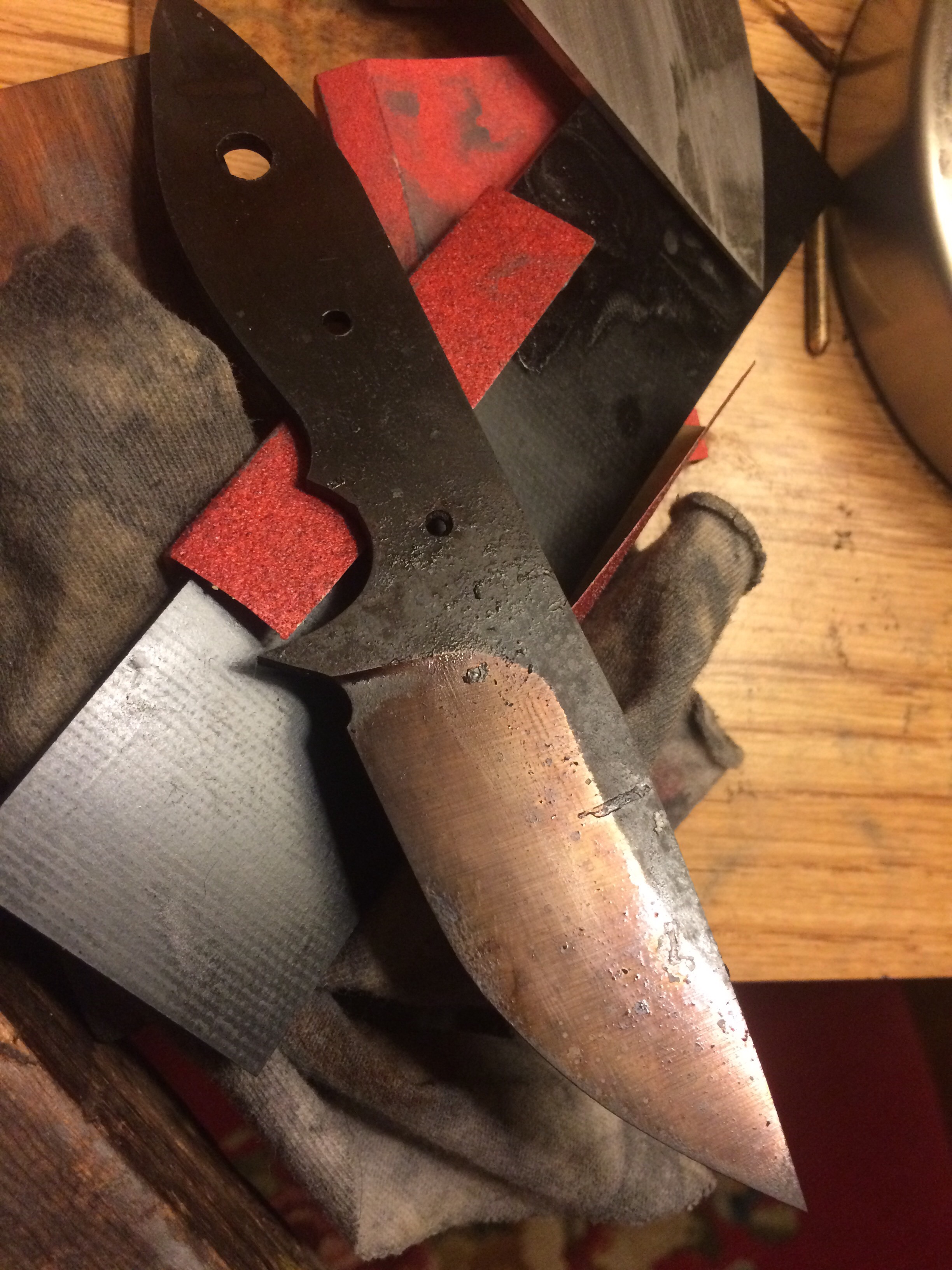
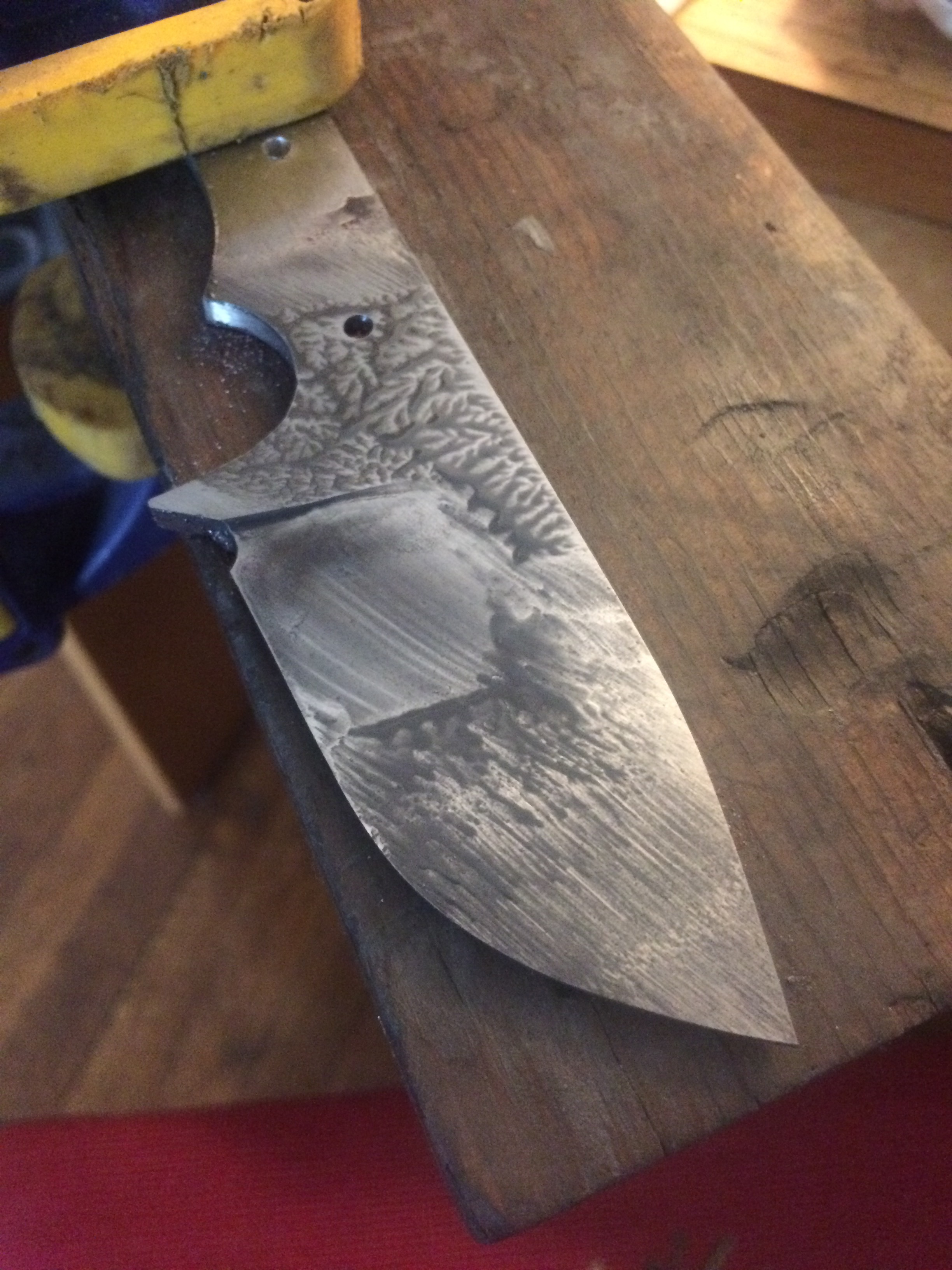
An acid etch to force a patina.  This helps with corrosion resistance on the high carbon steel.

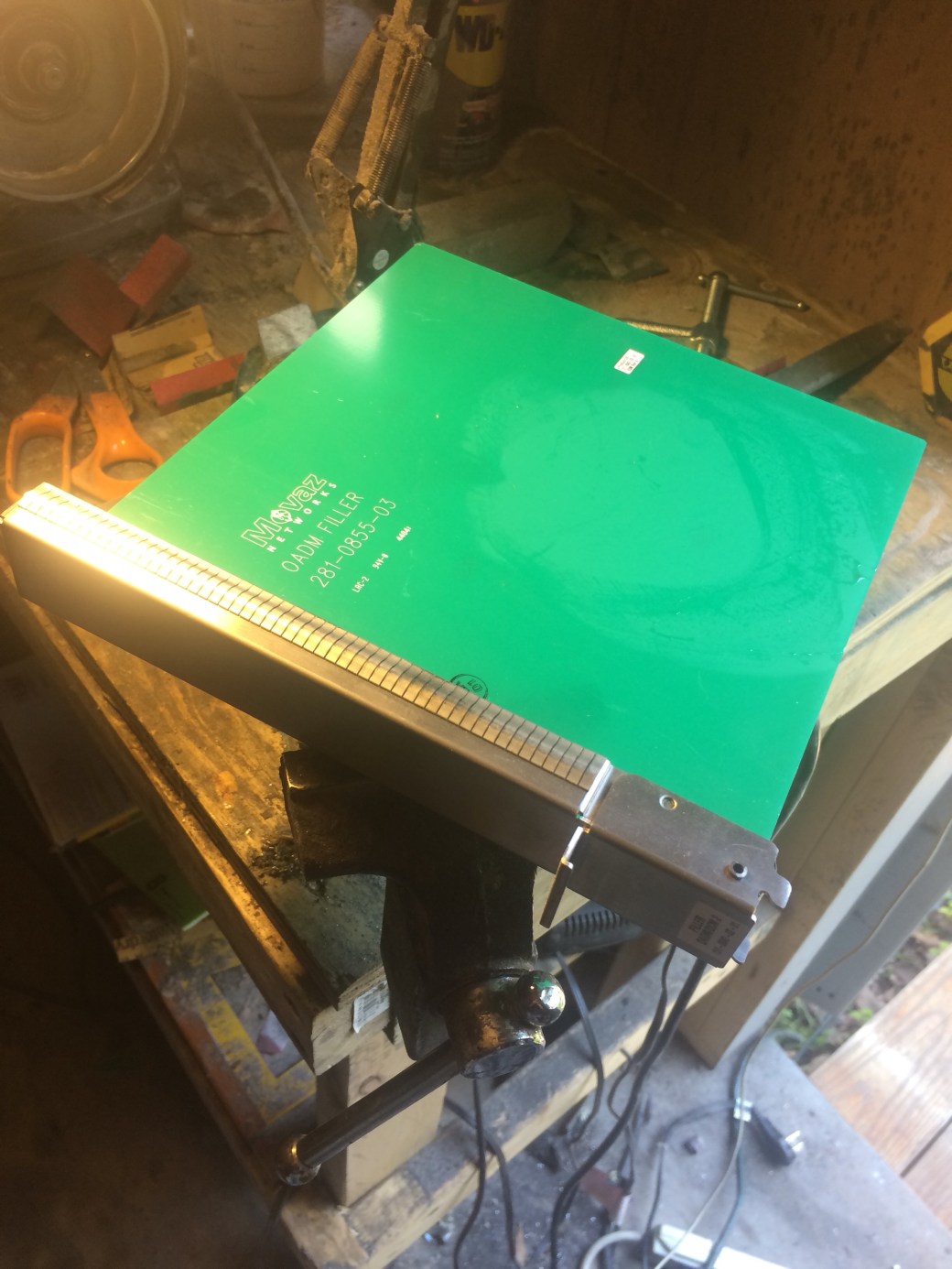
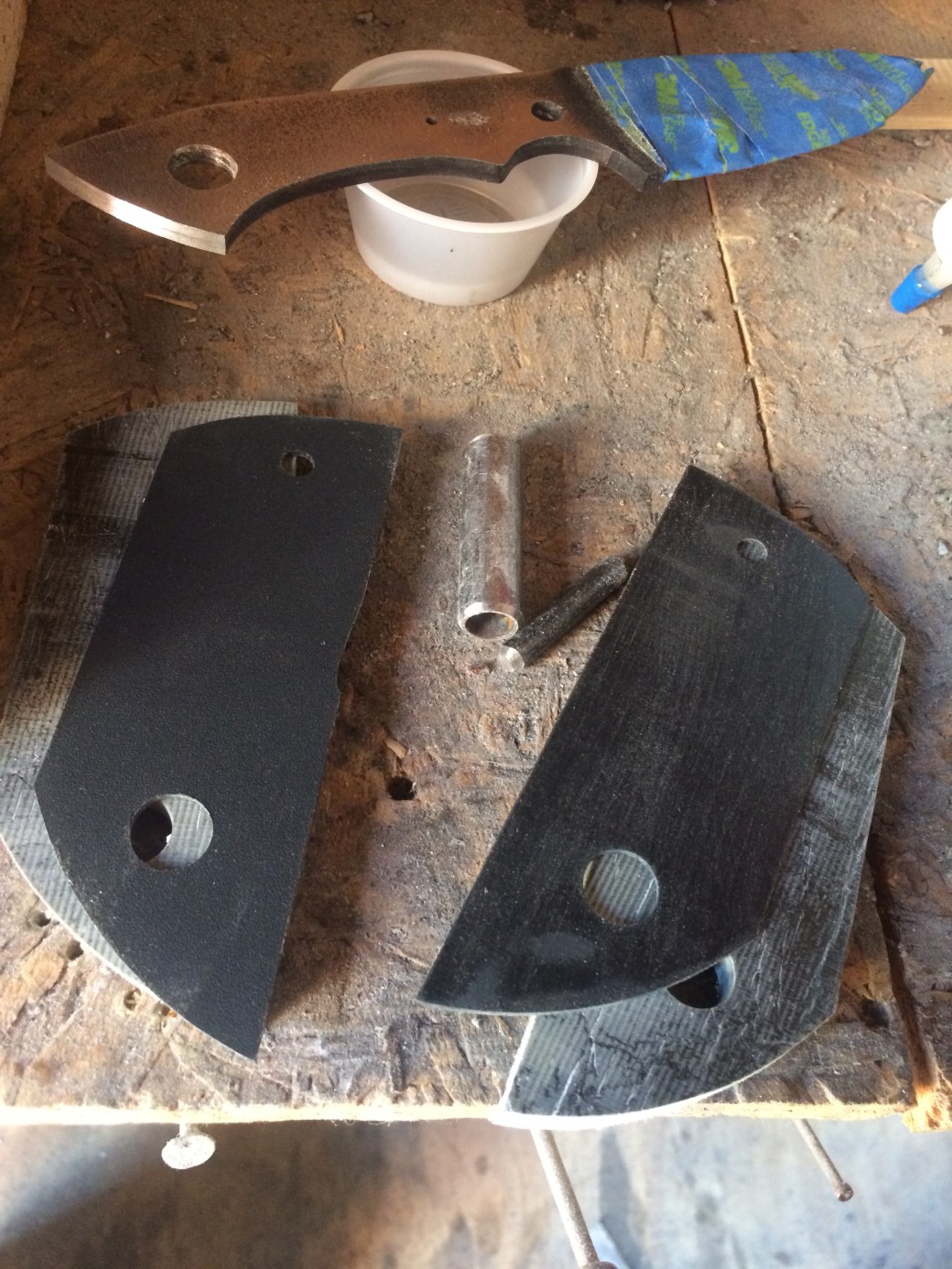
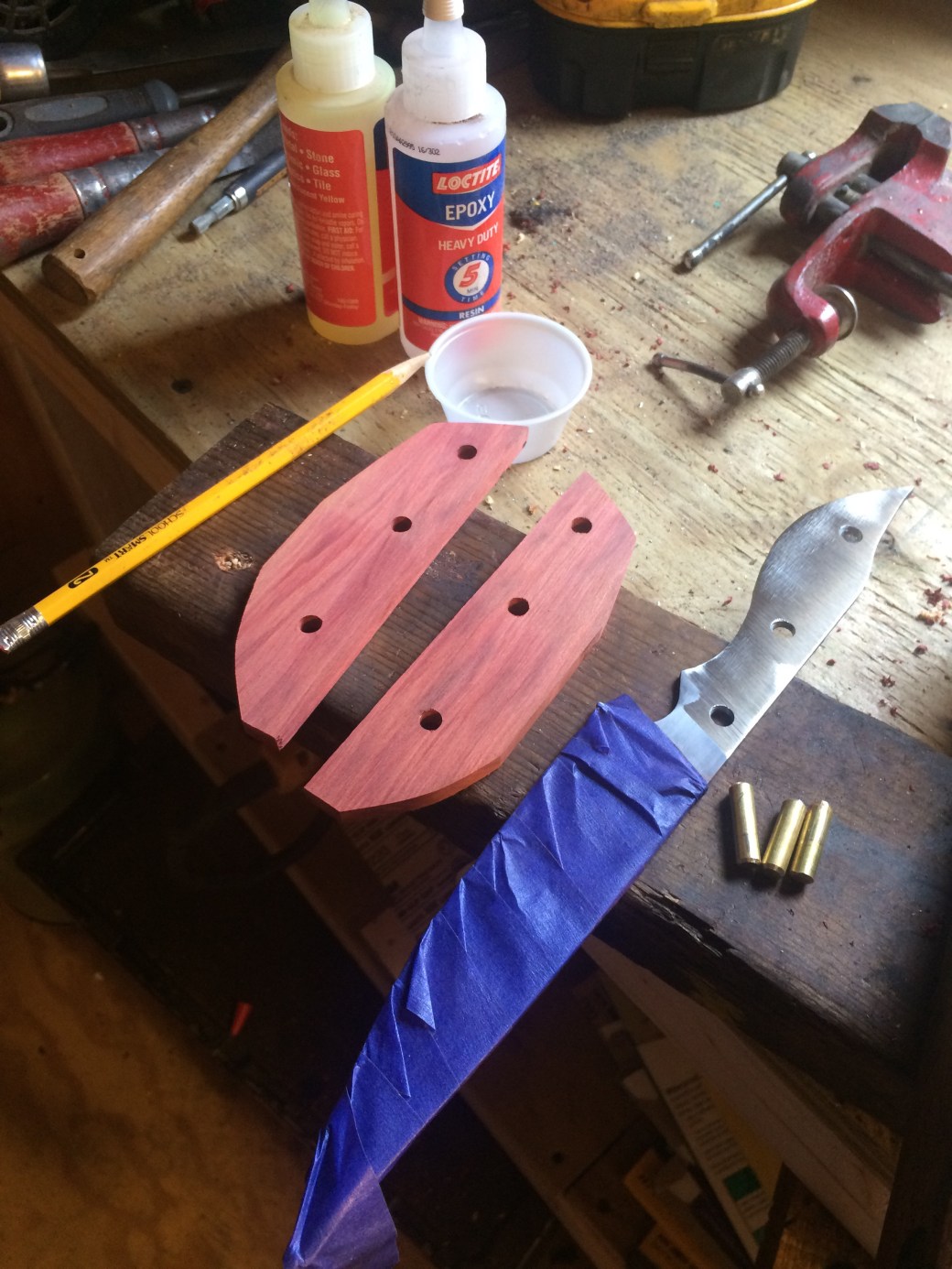
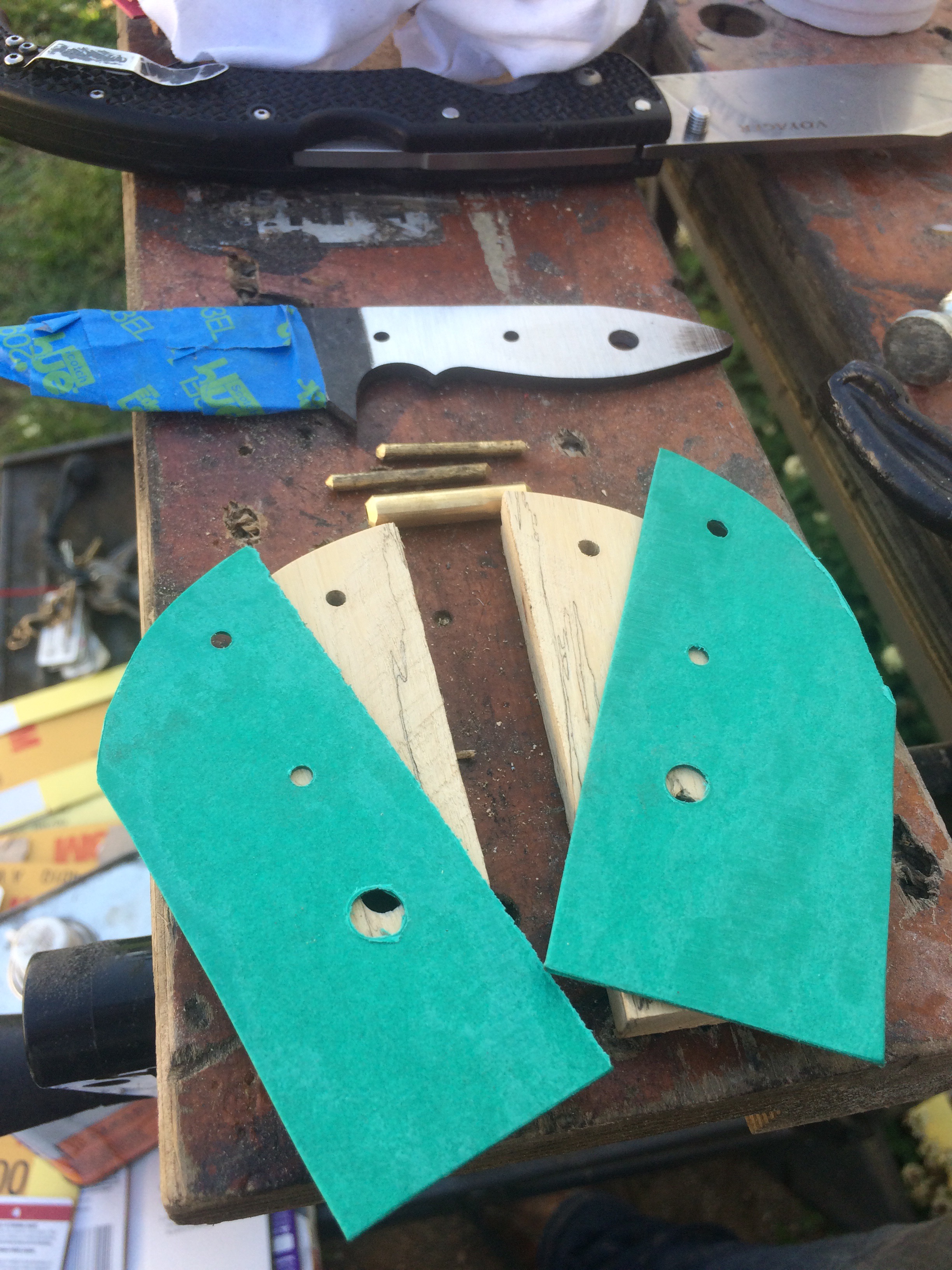
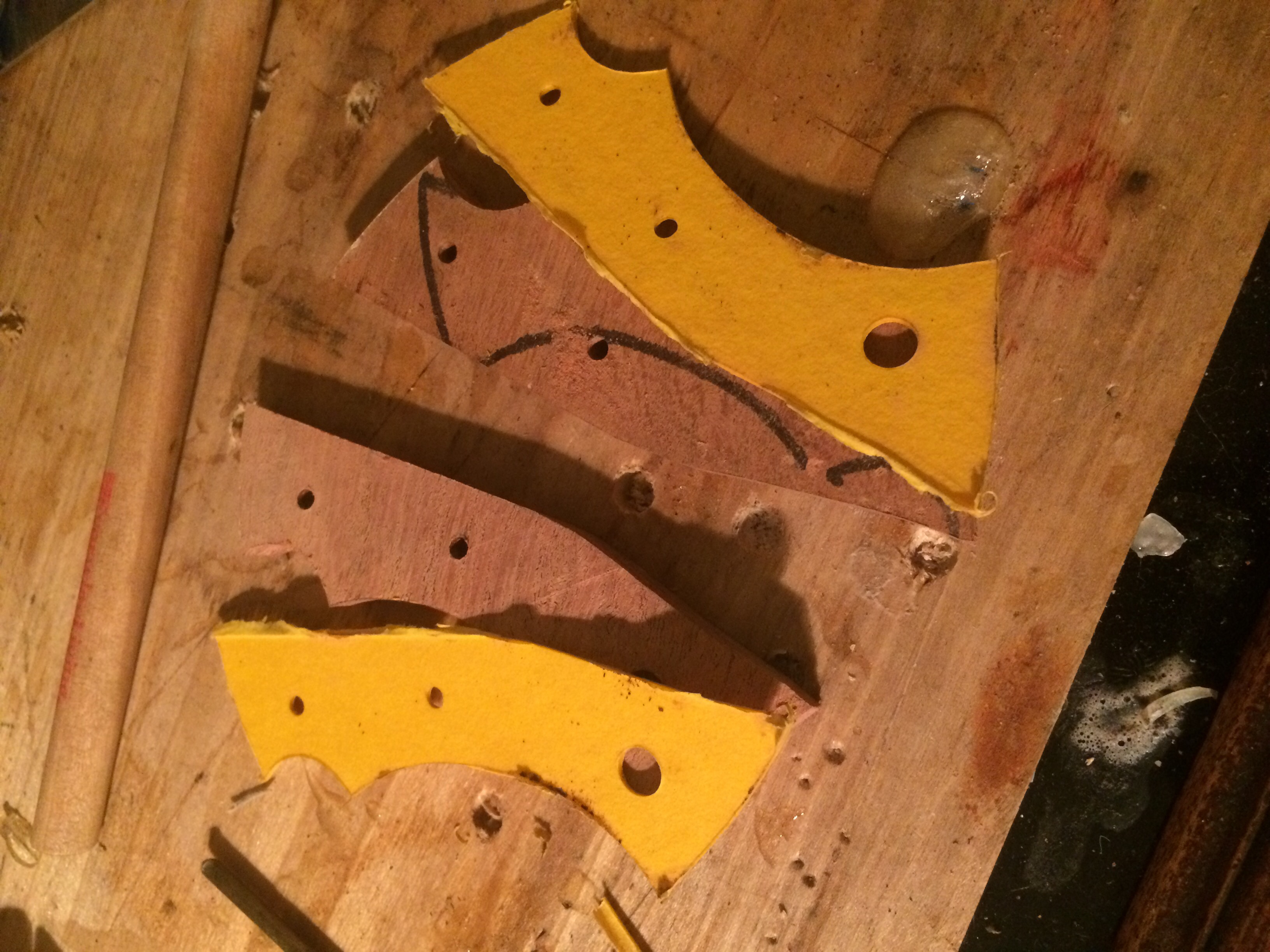
A PCB board blank from a server chassis.  This will be spacing material for the handle:
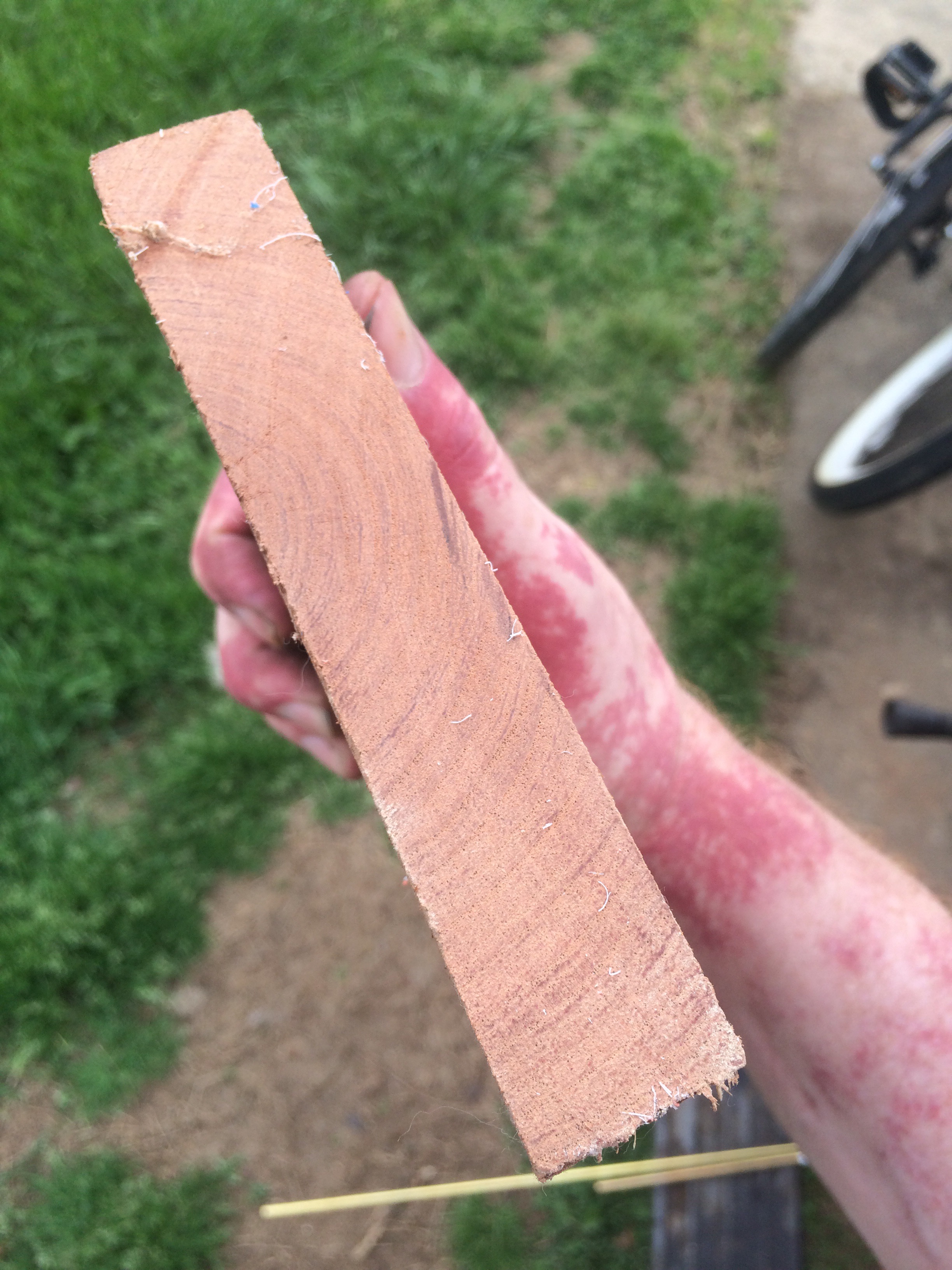
Texas Pecan, from my cousin Bill:

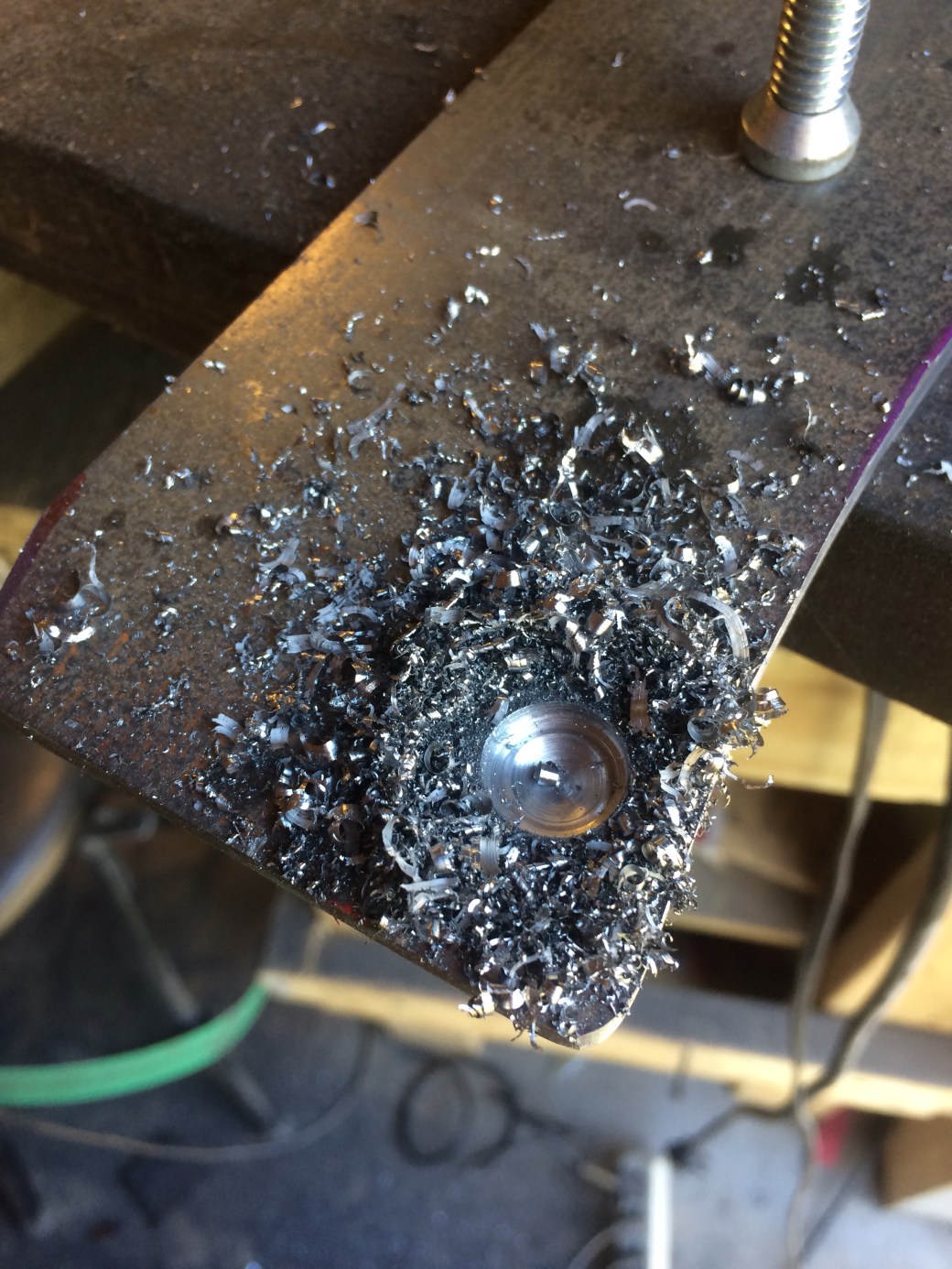
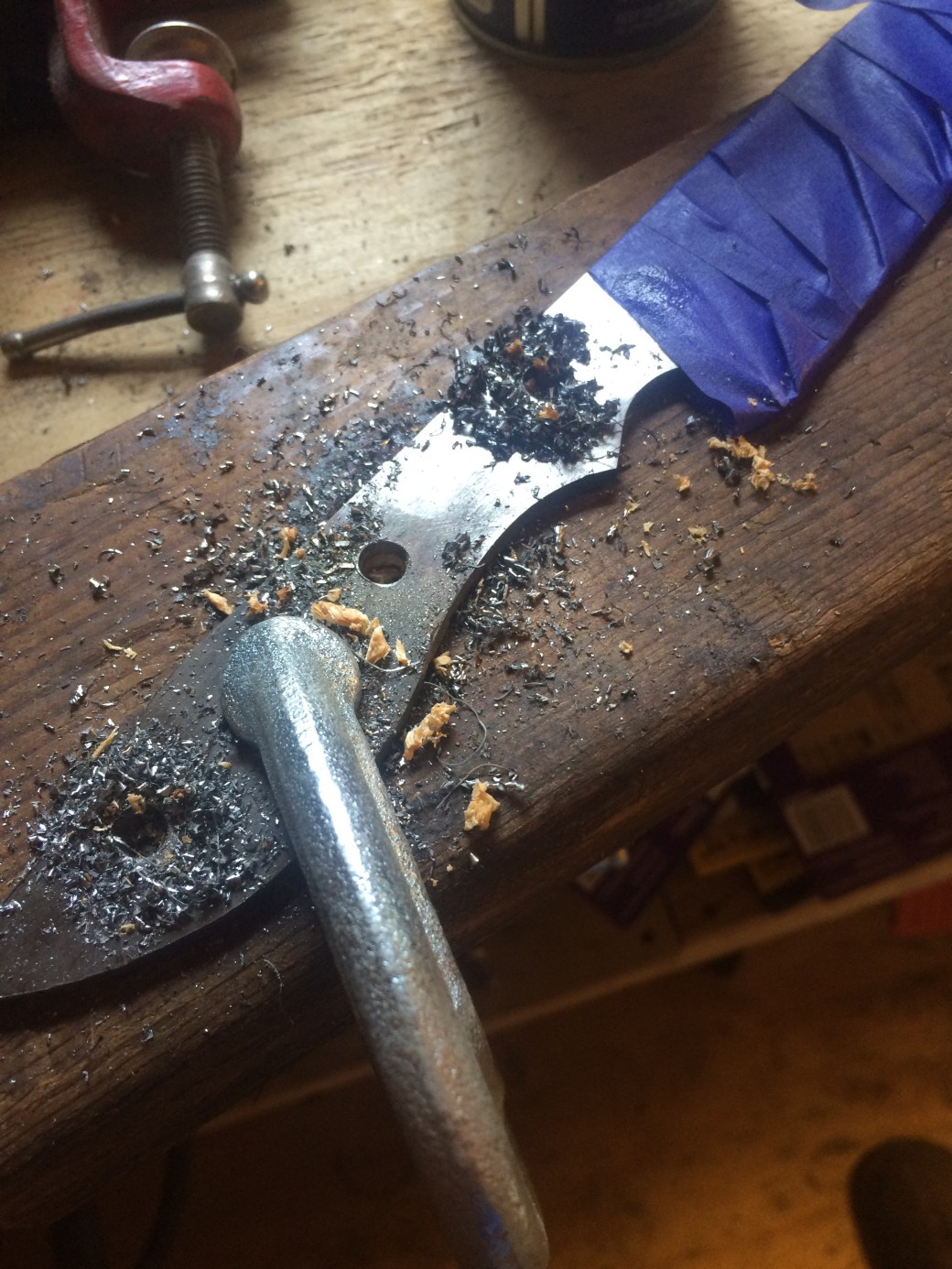
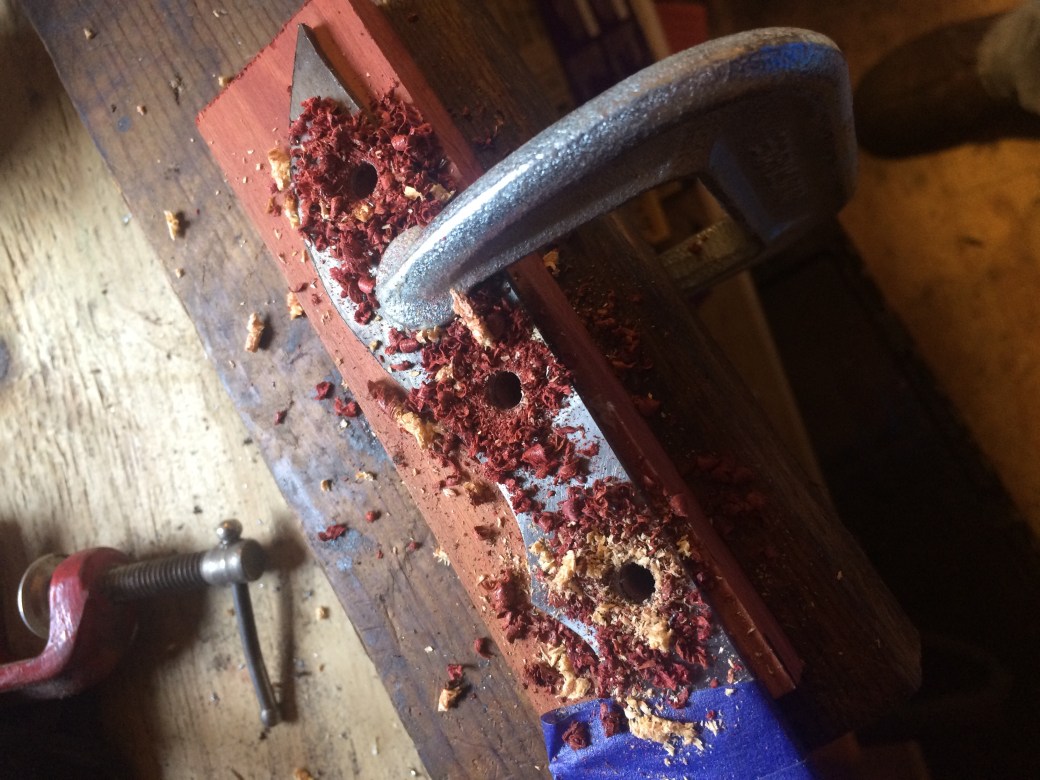
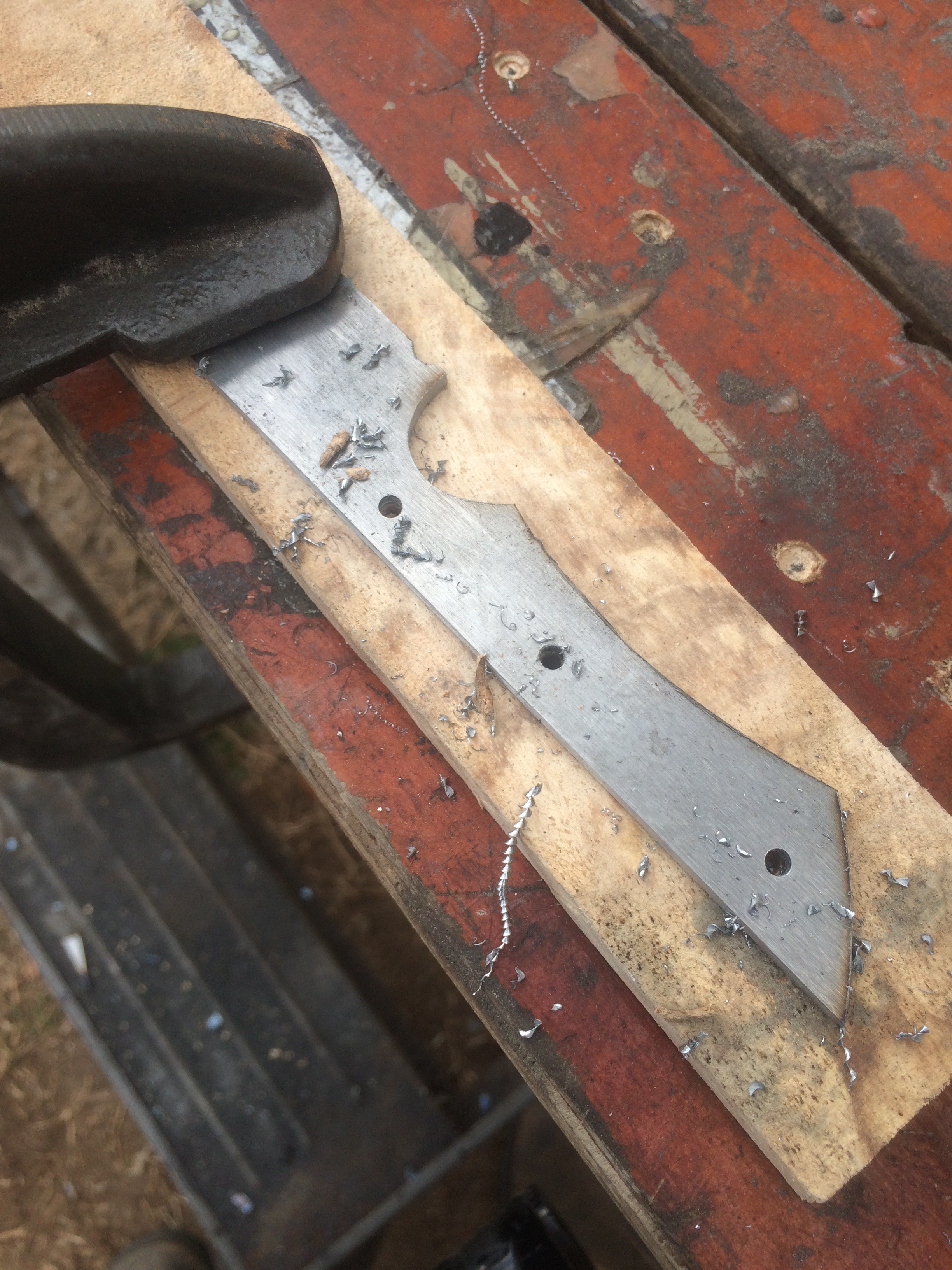
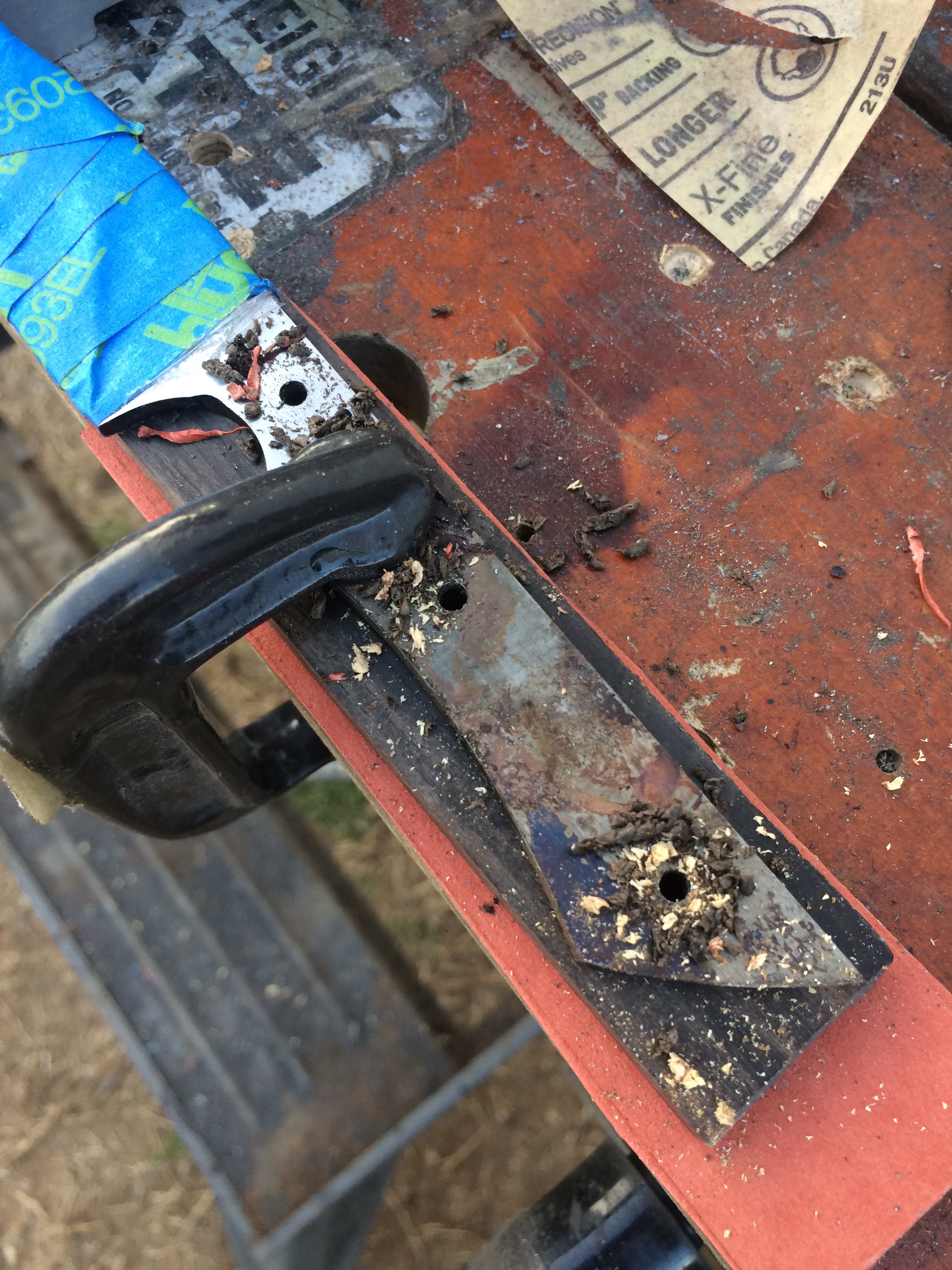
Drilling out the rivet holes:

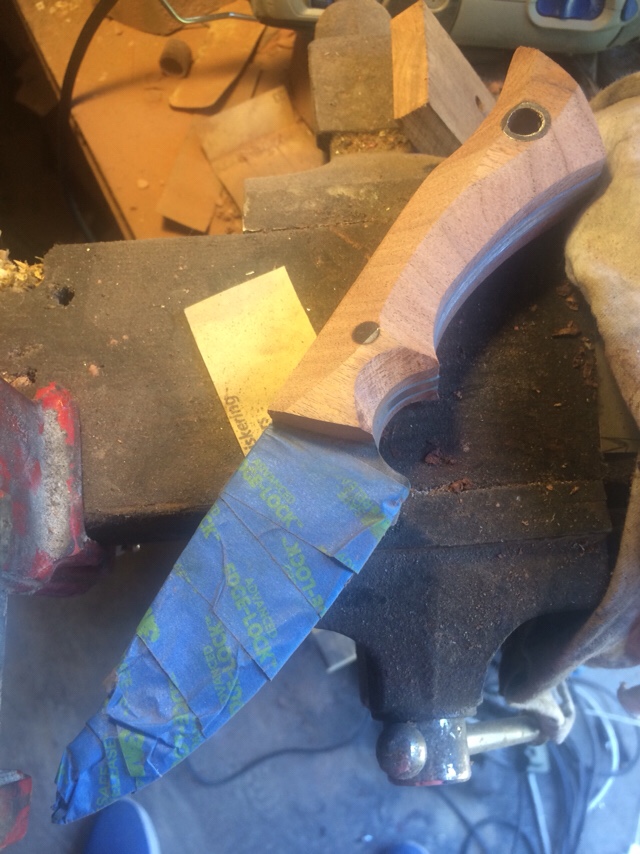
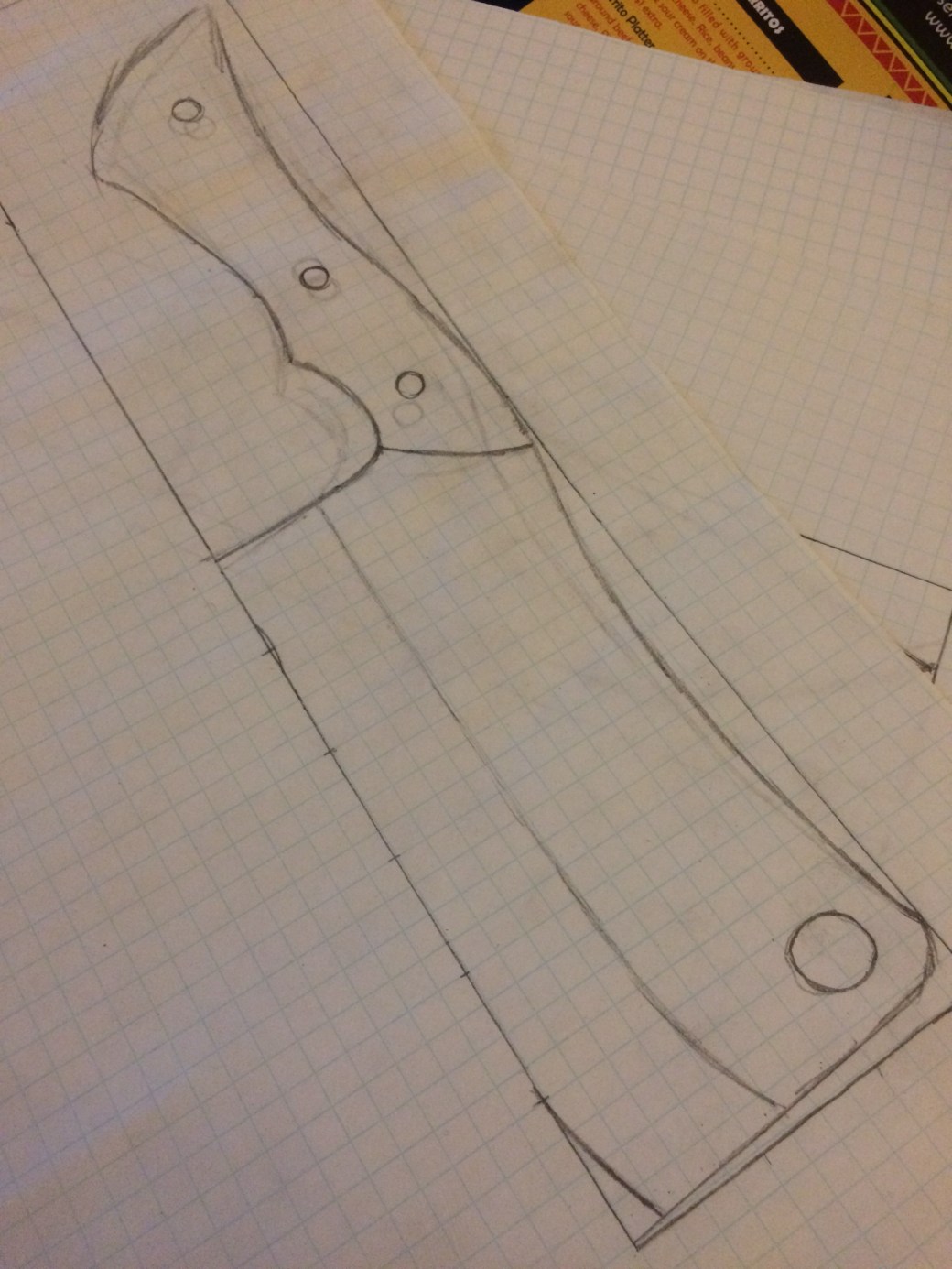
Laying out the handle profile:
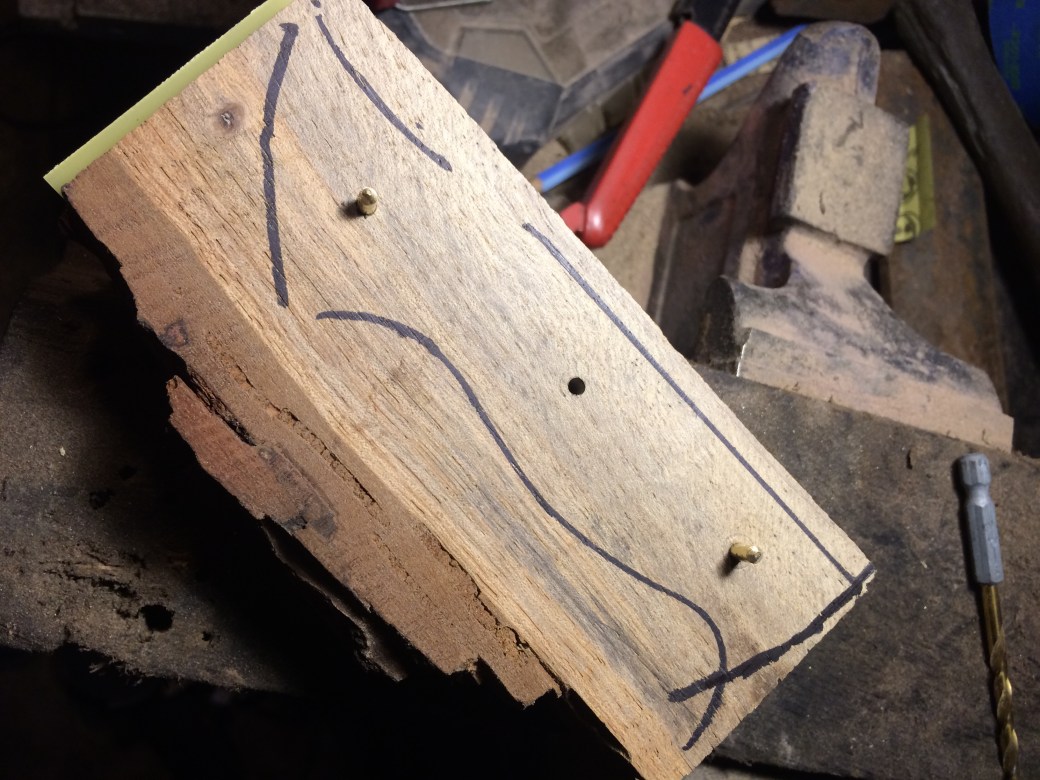
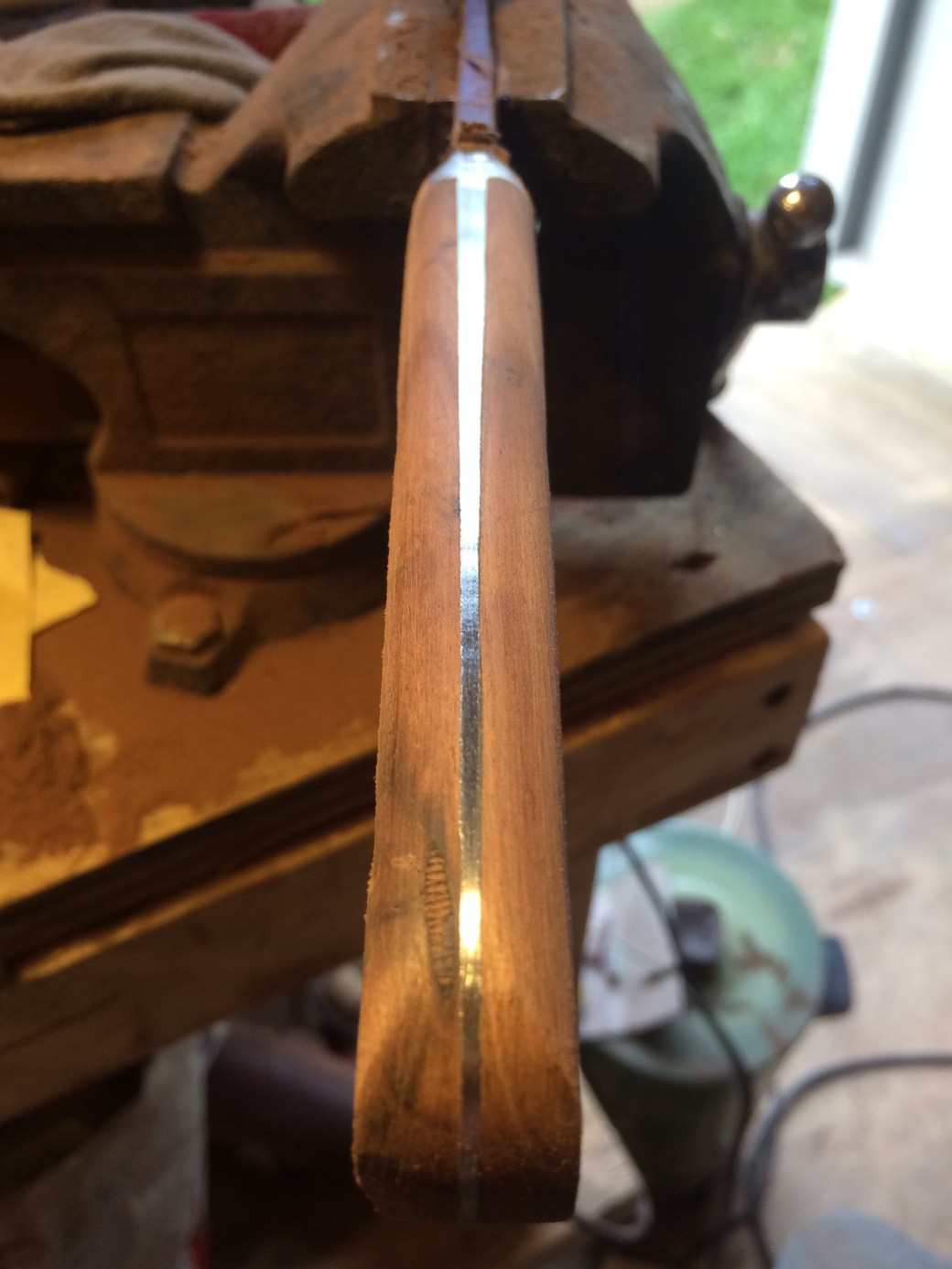
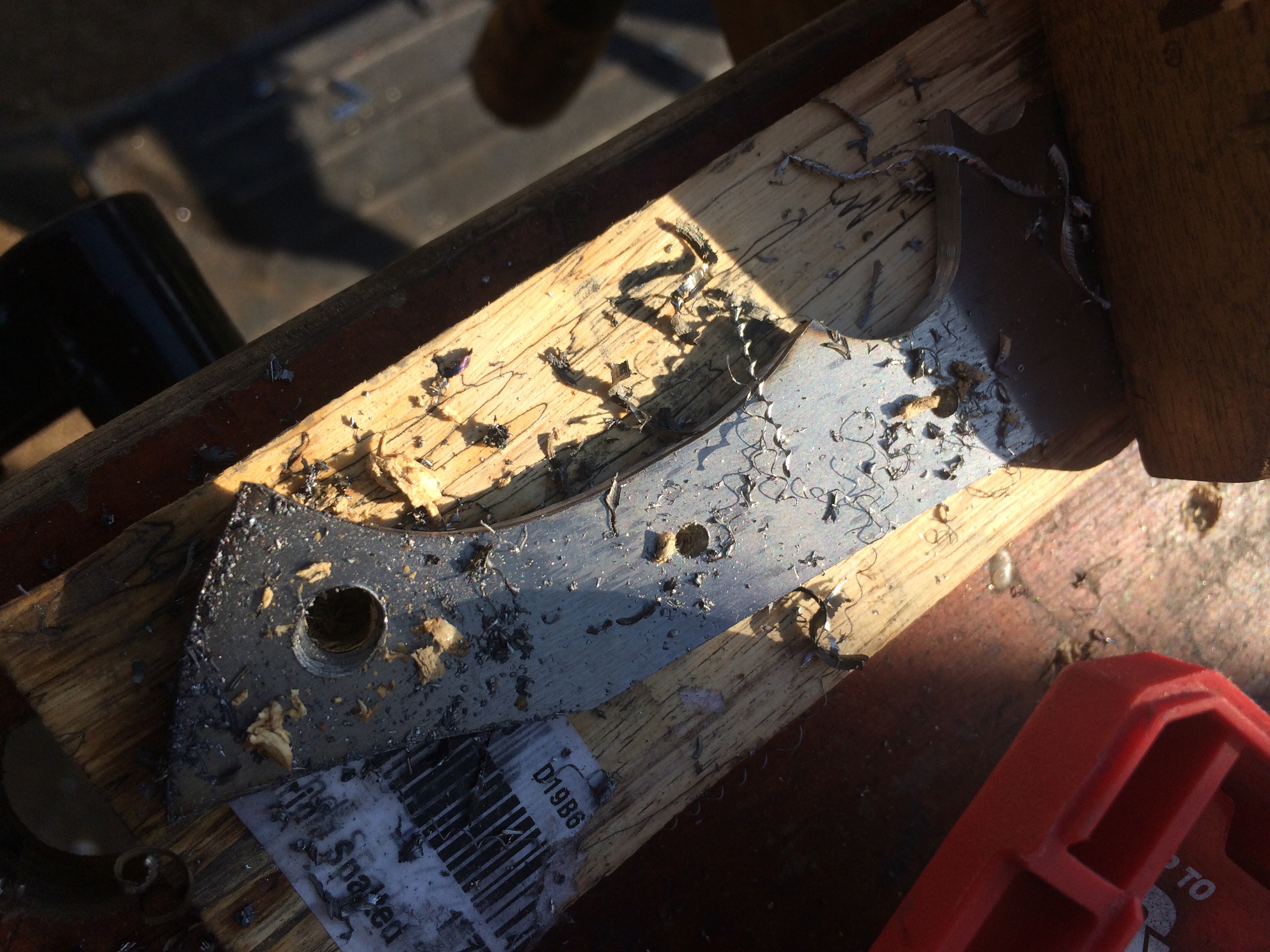
The handle near the ricasso, at 40 grit:
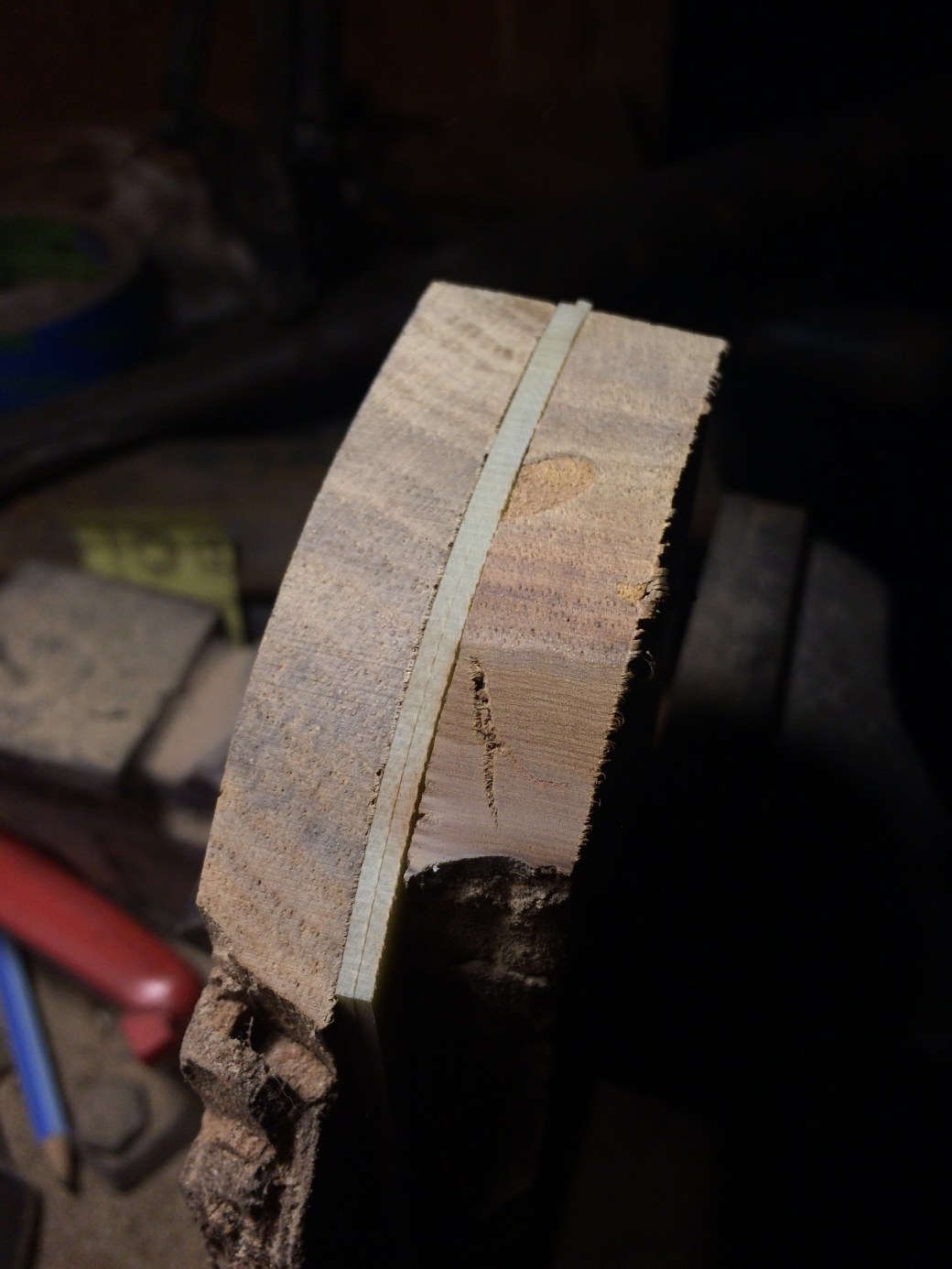
The handle near the ricasso, at 1500 grit:

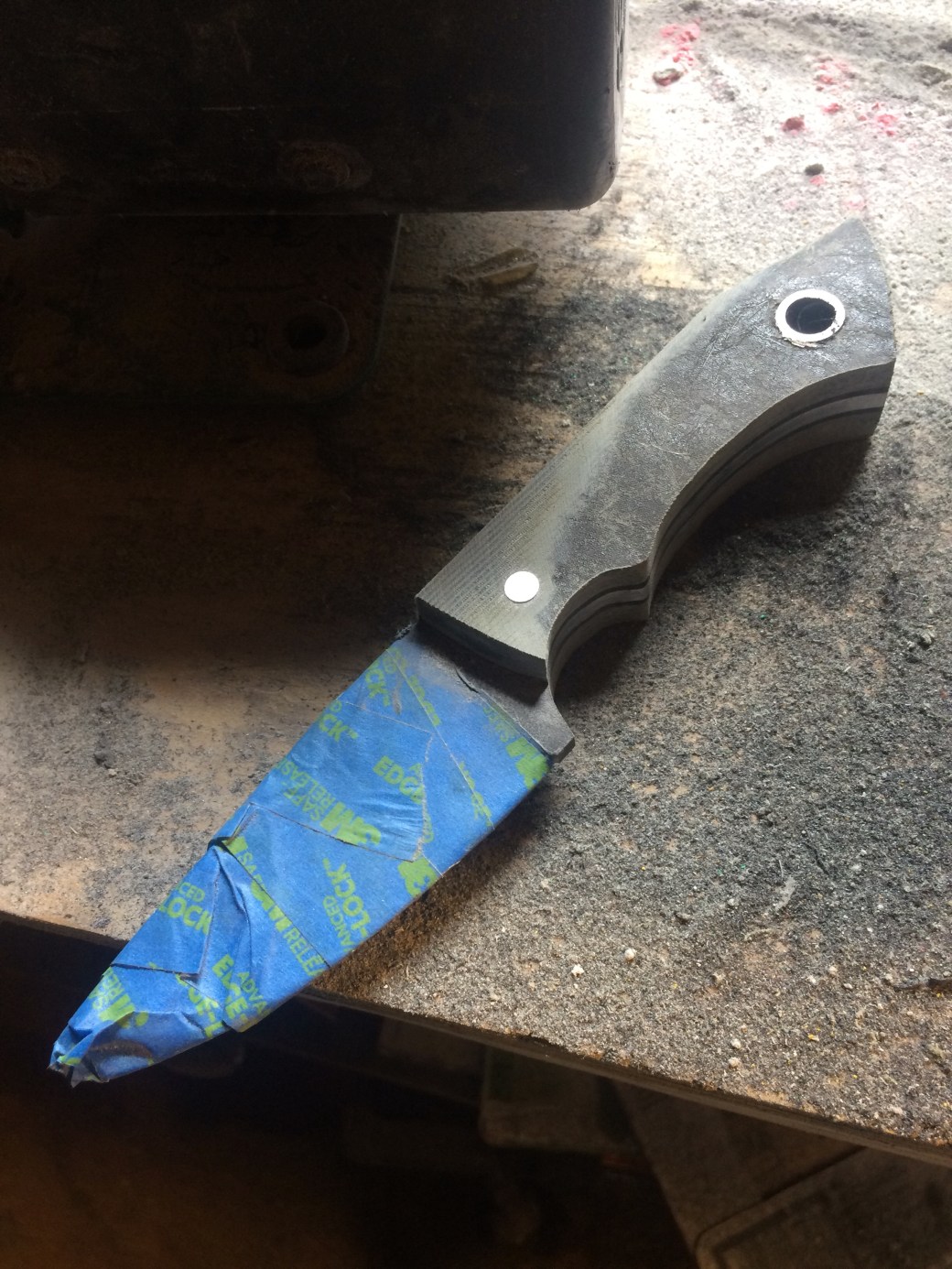
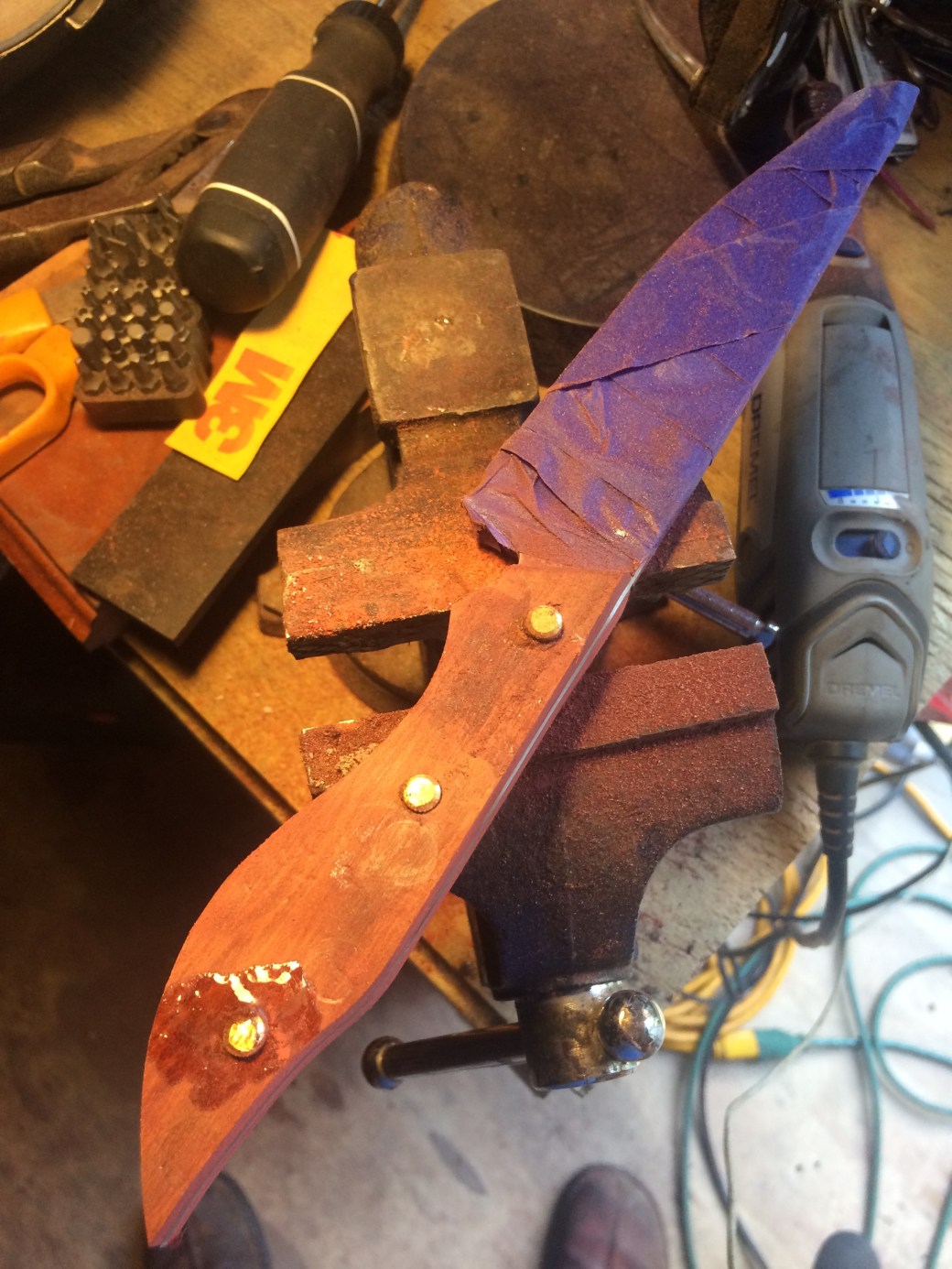
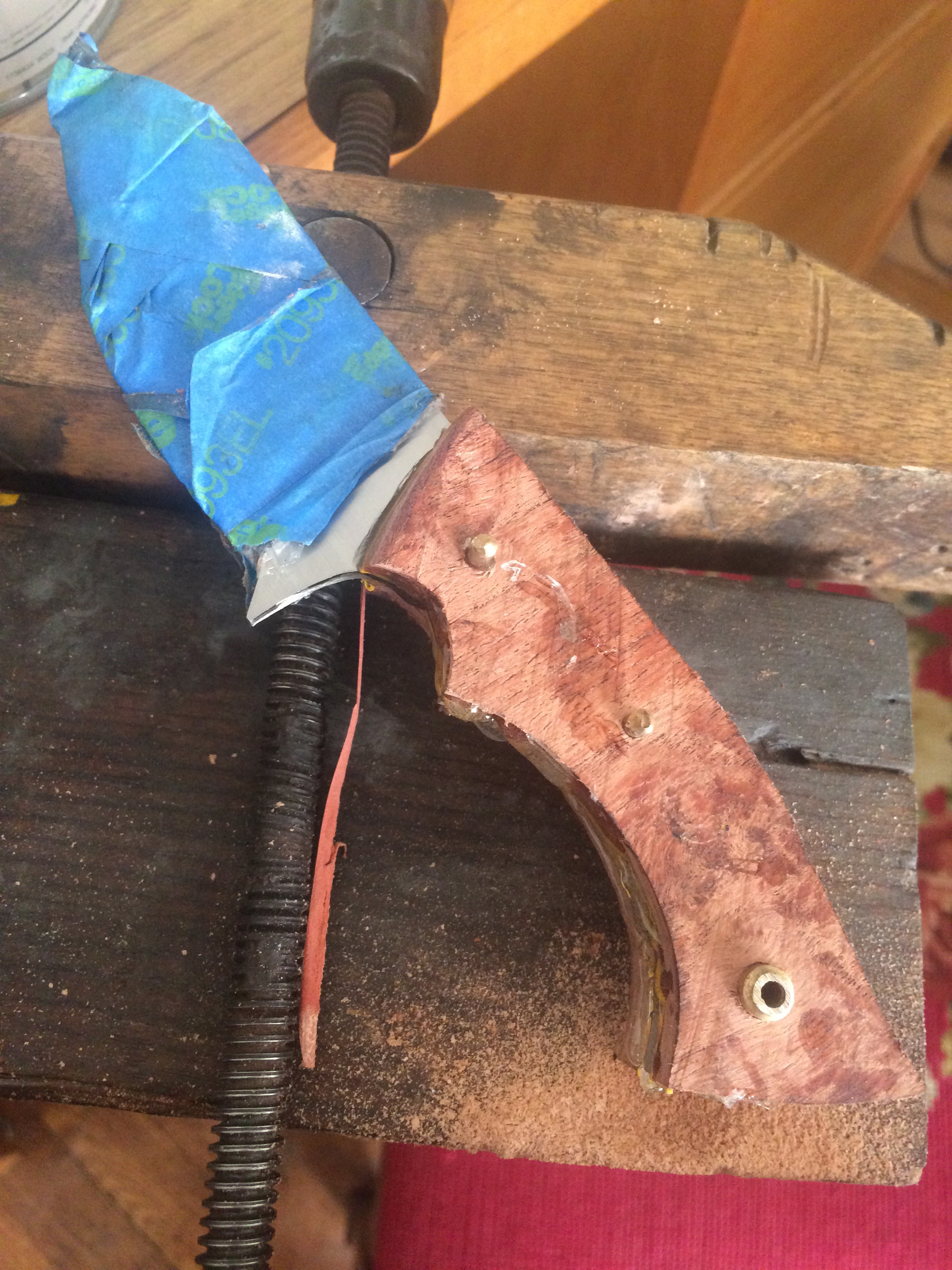
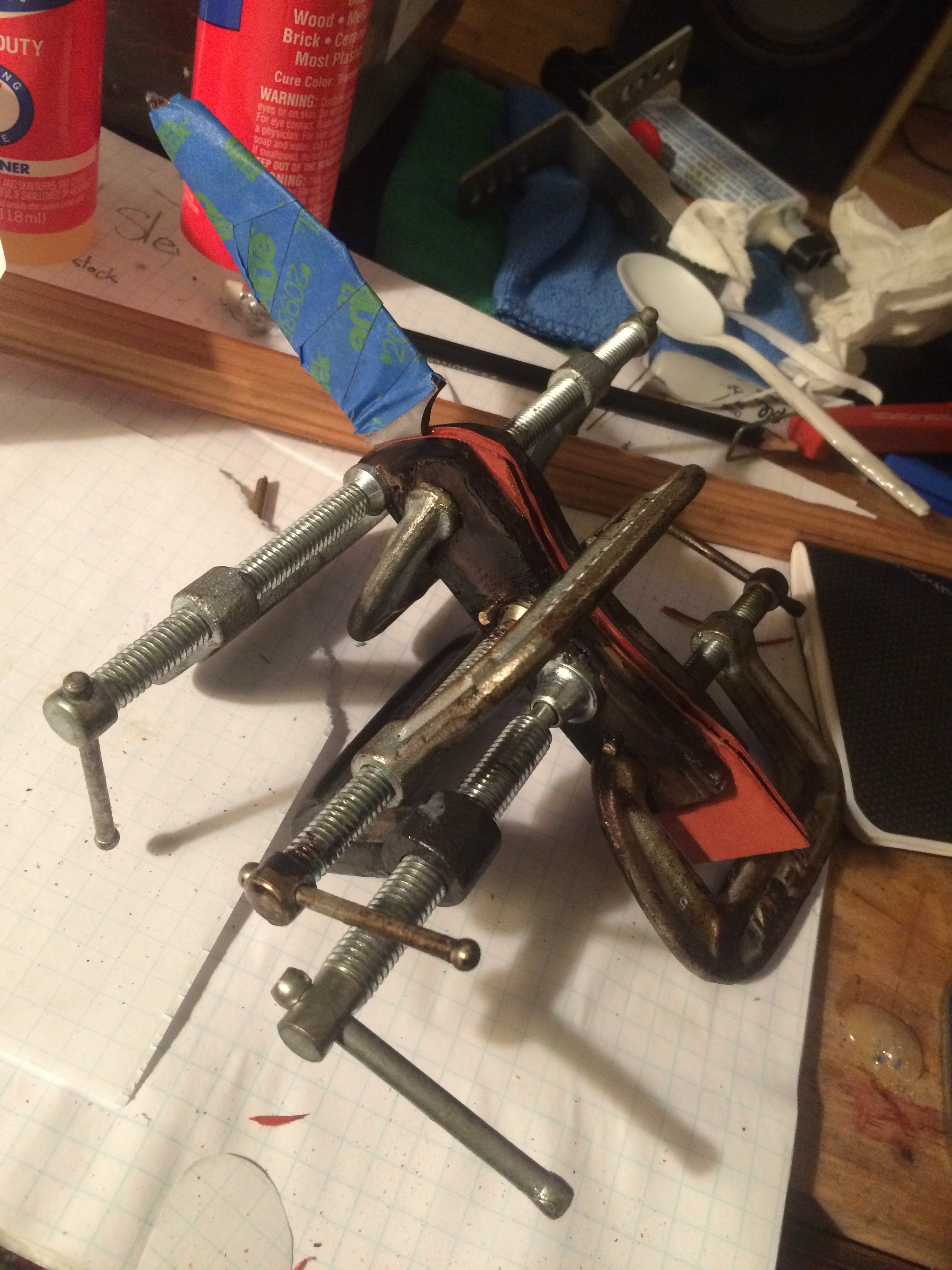
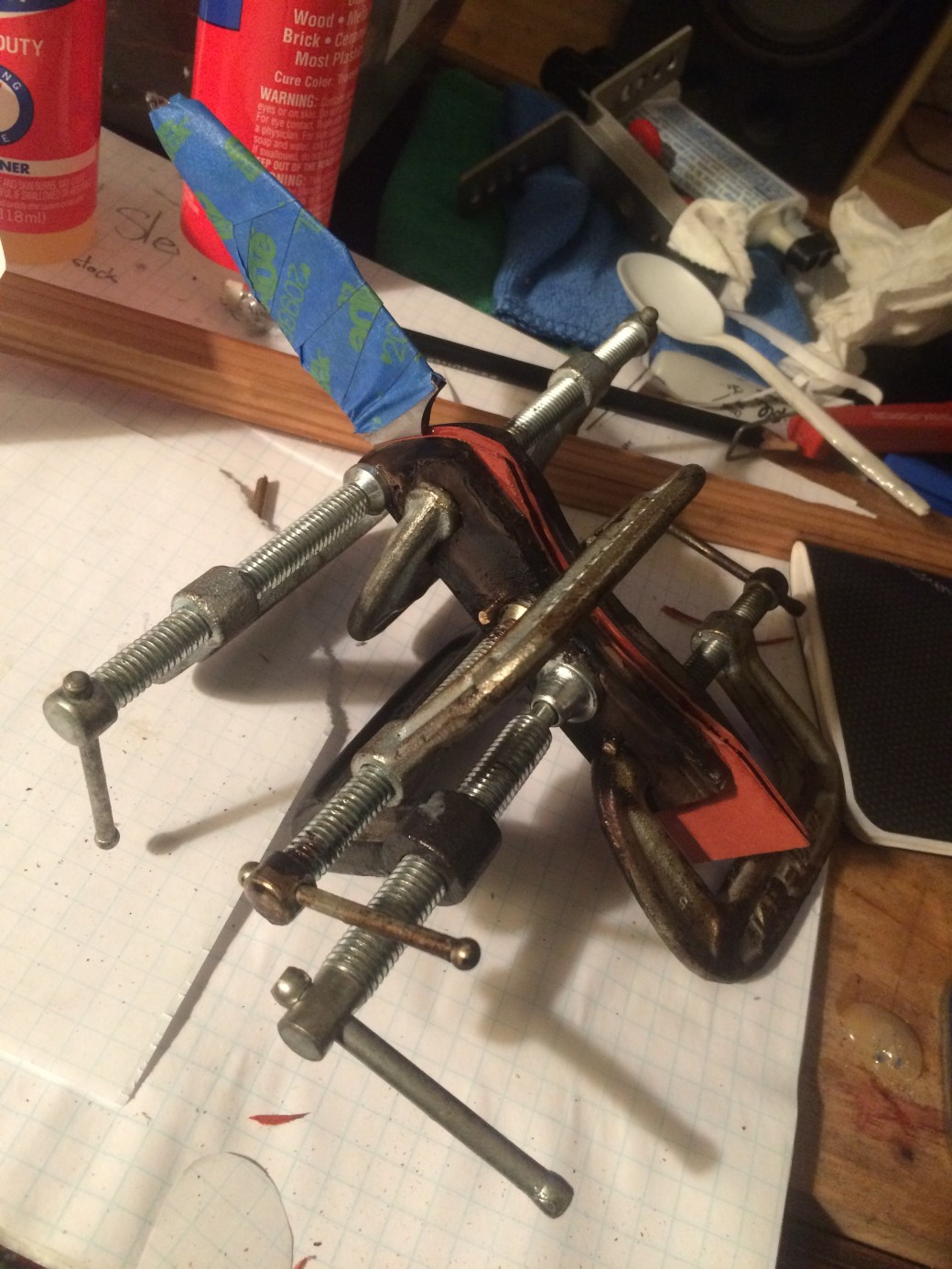
Glued up:
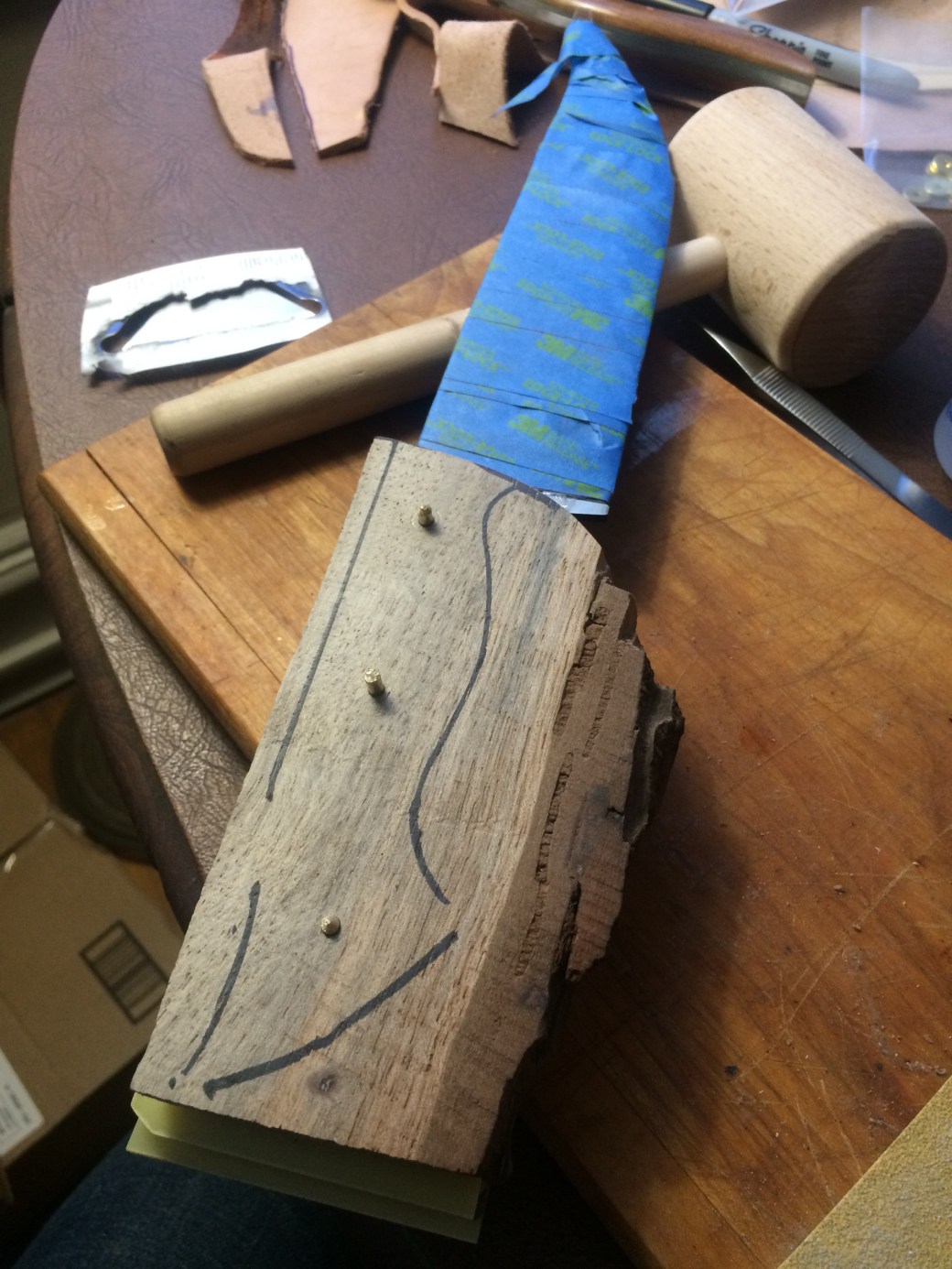
Profiled:
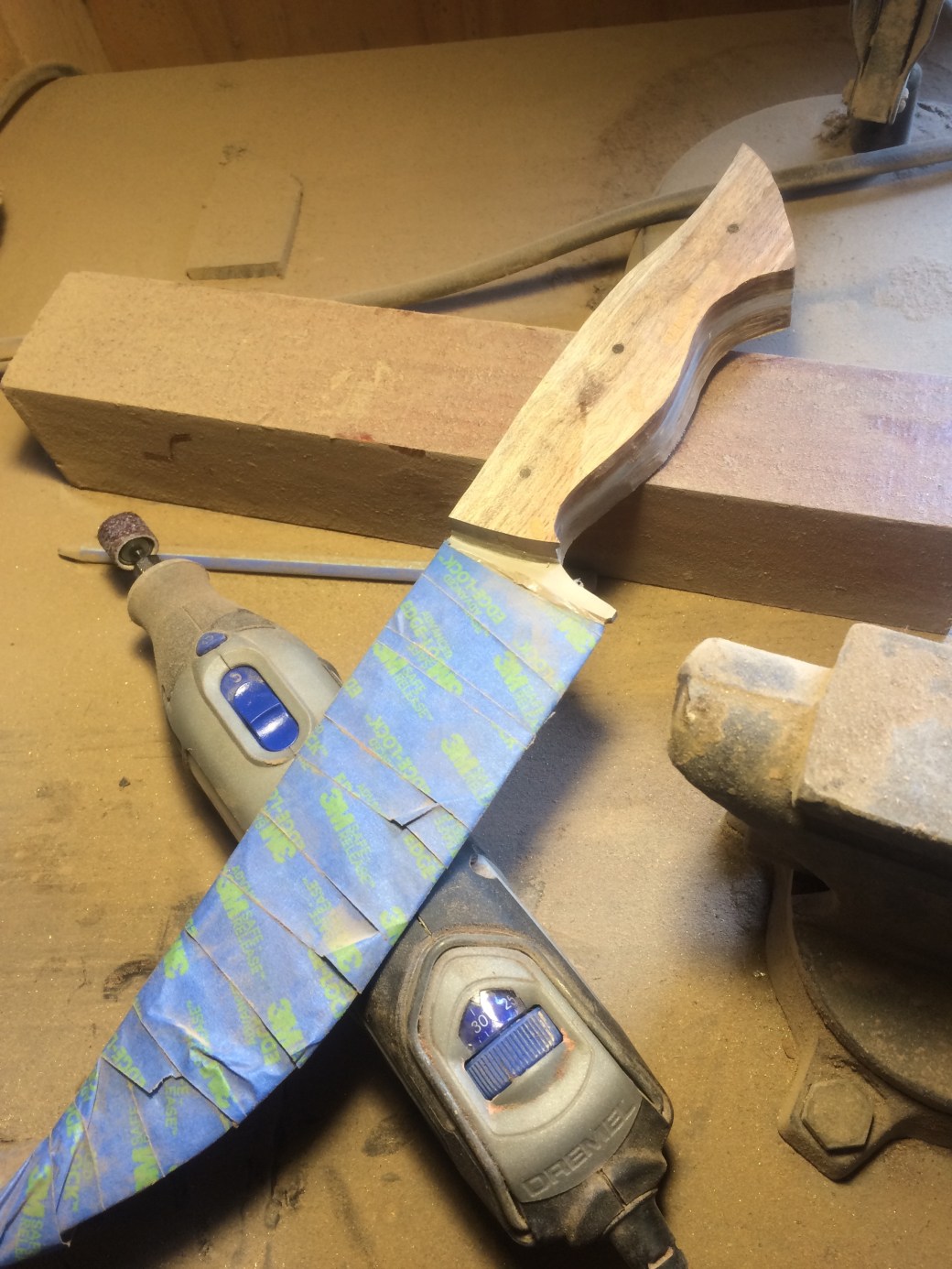
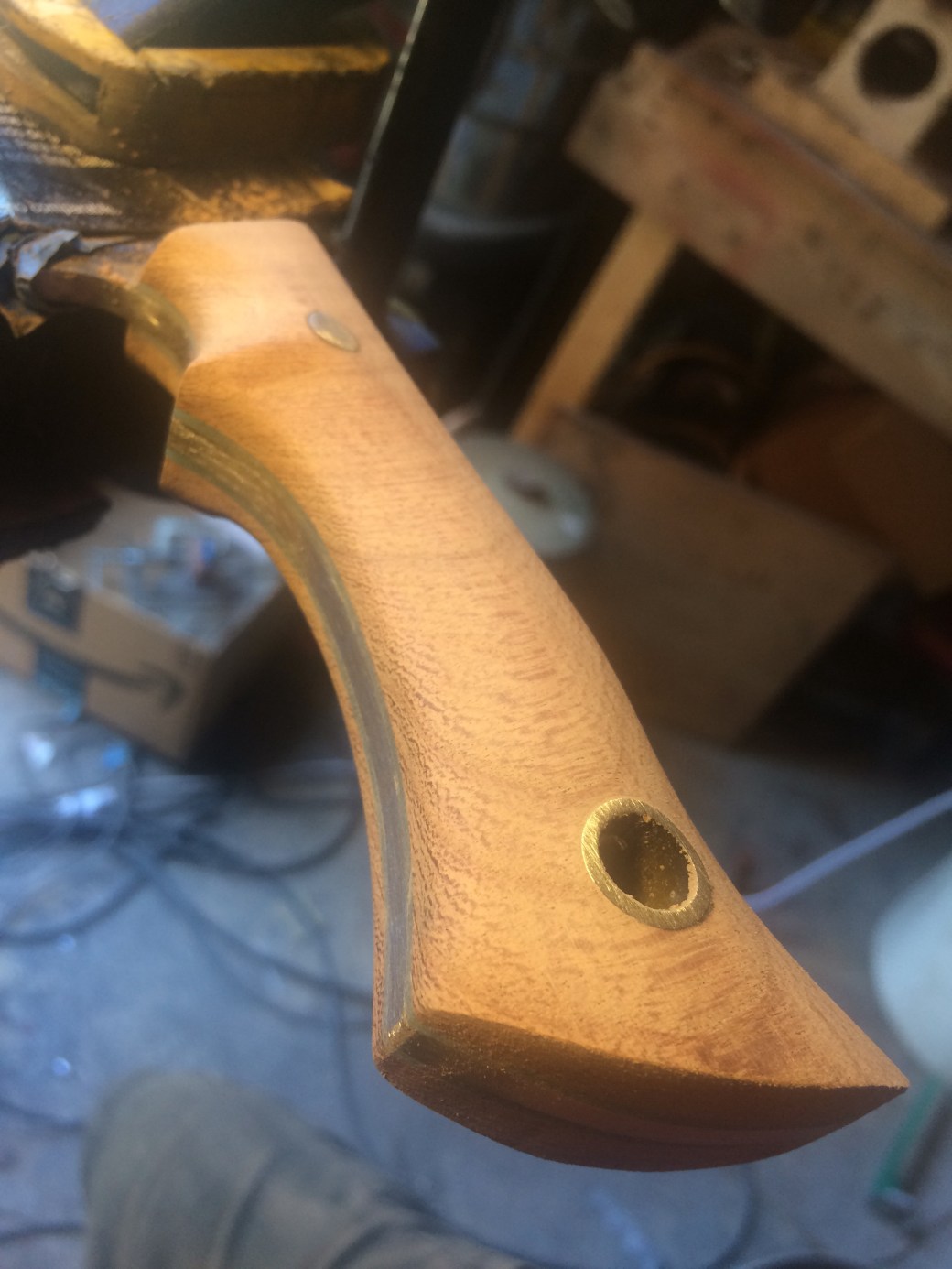
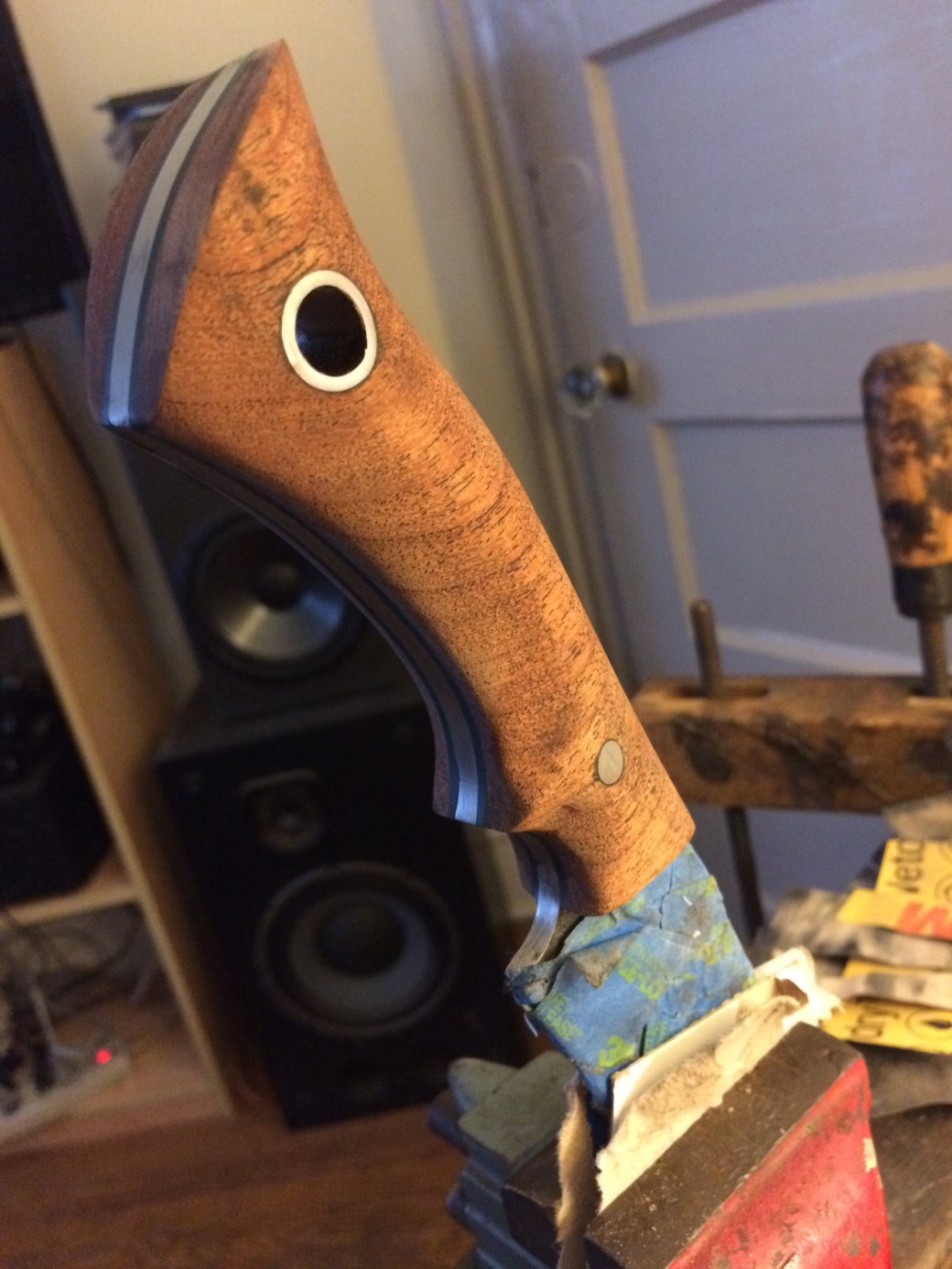
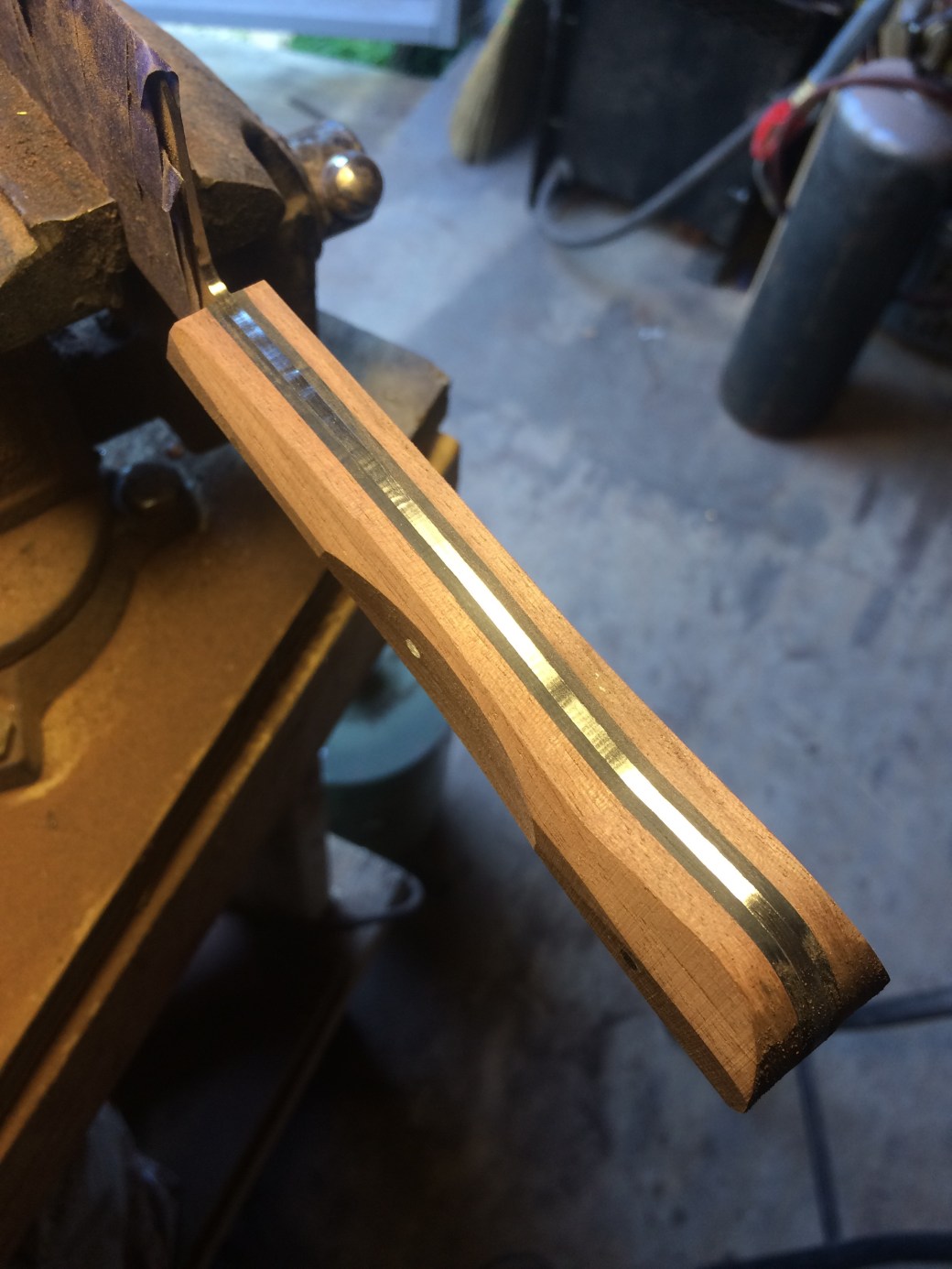
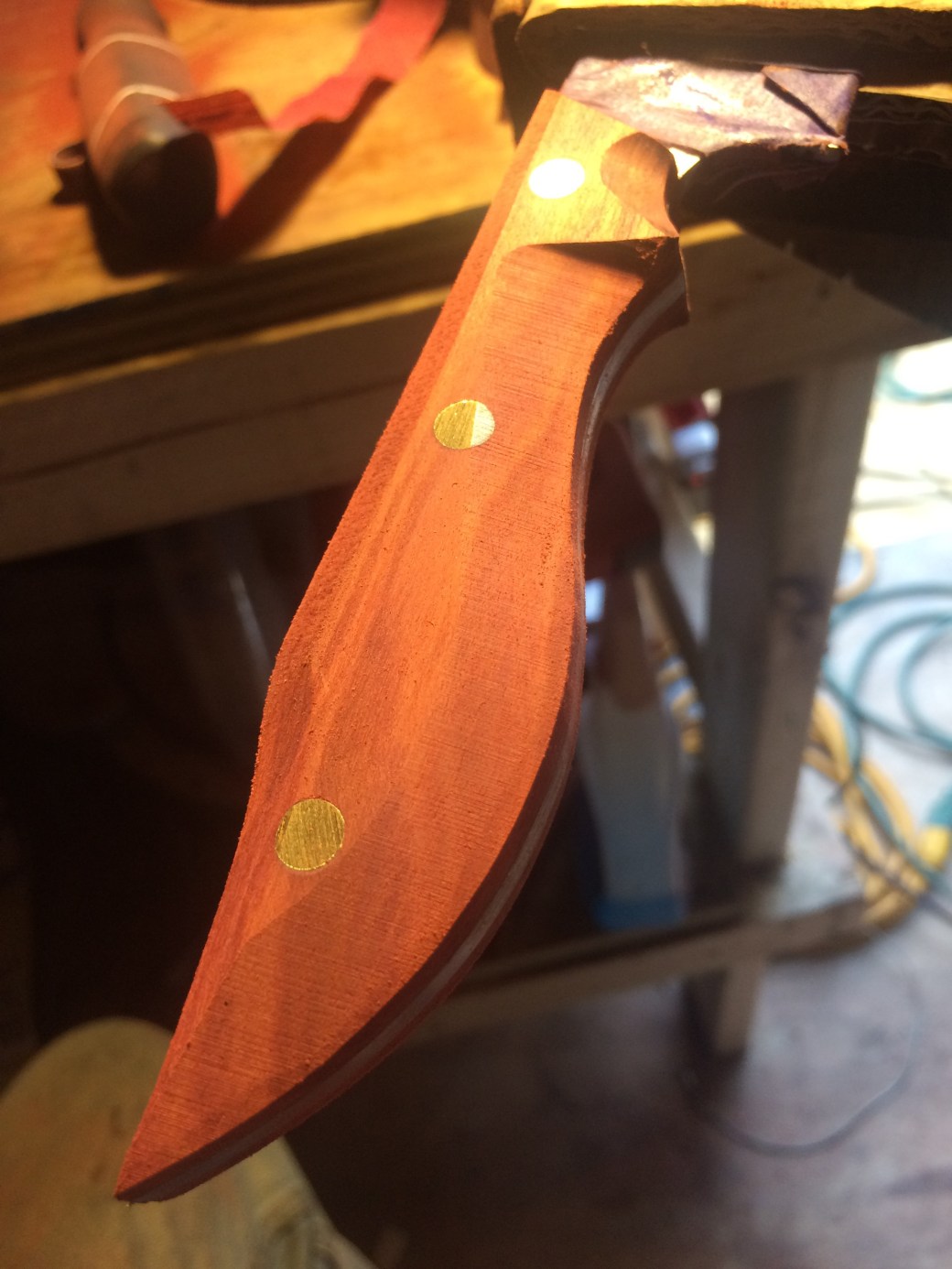
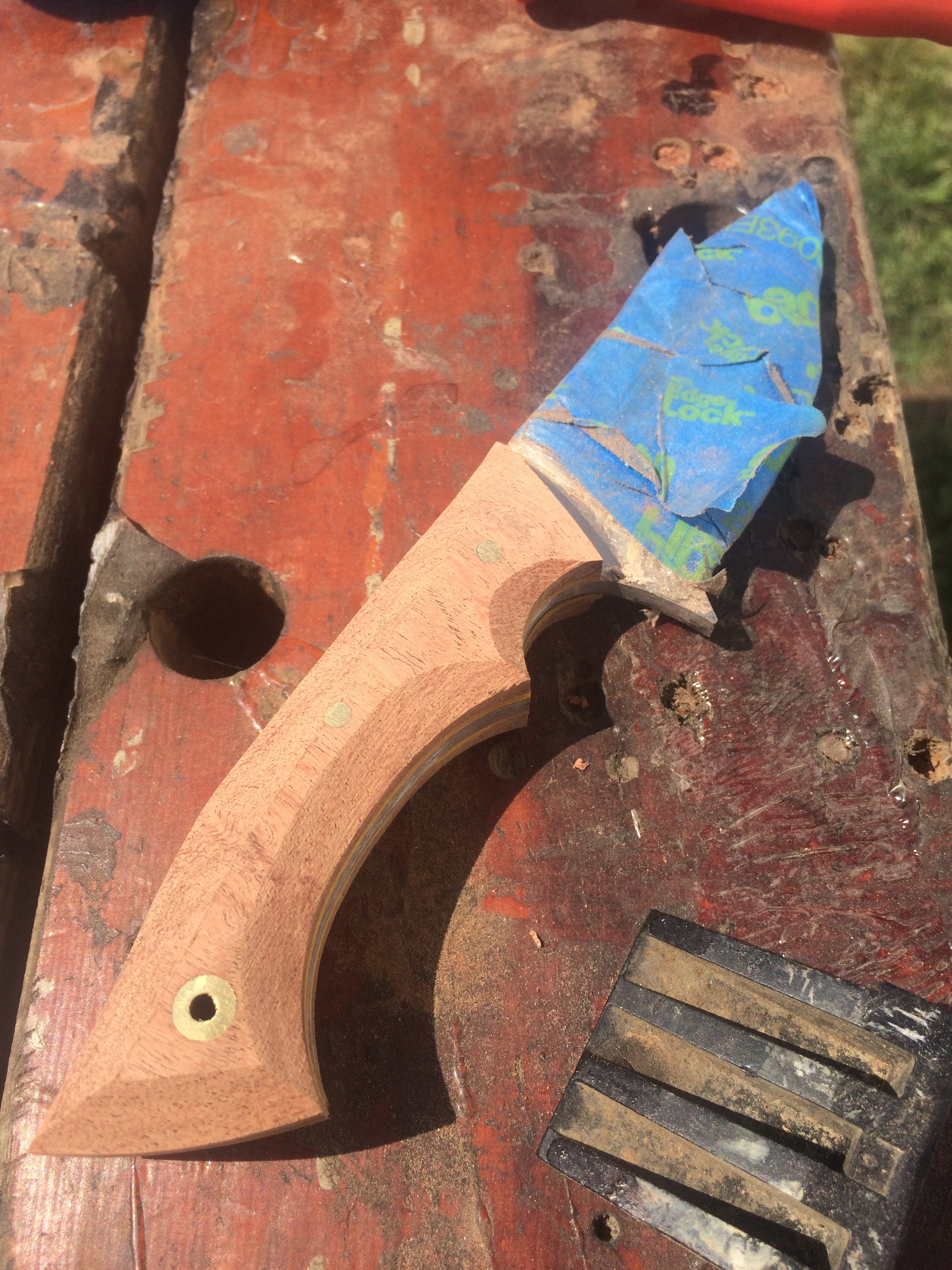
Shaped:

Smoothed:
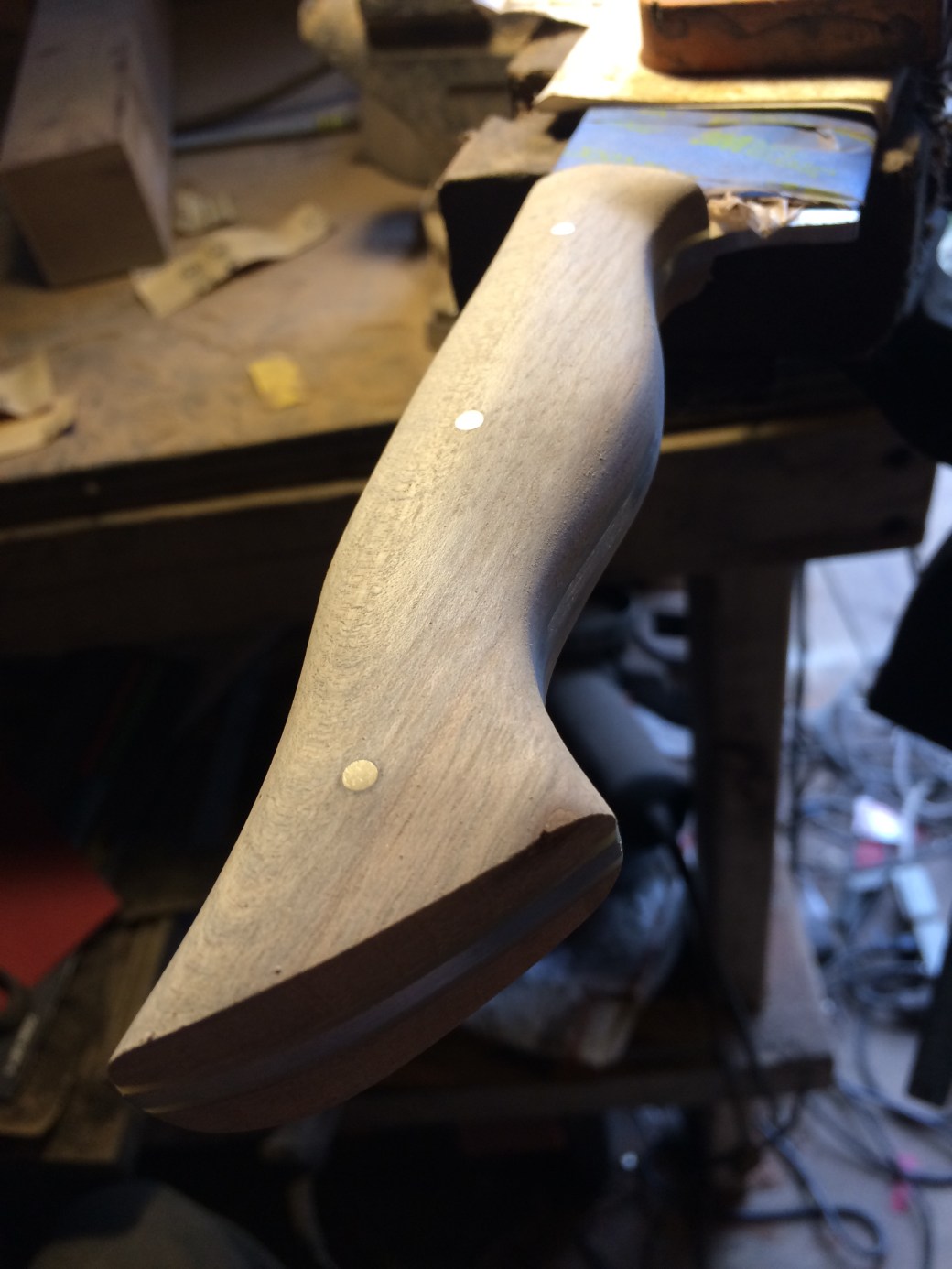
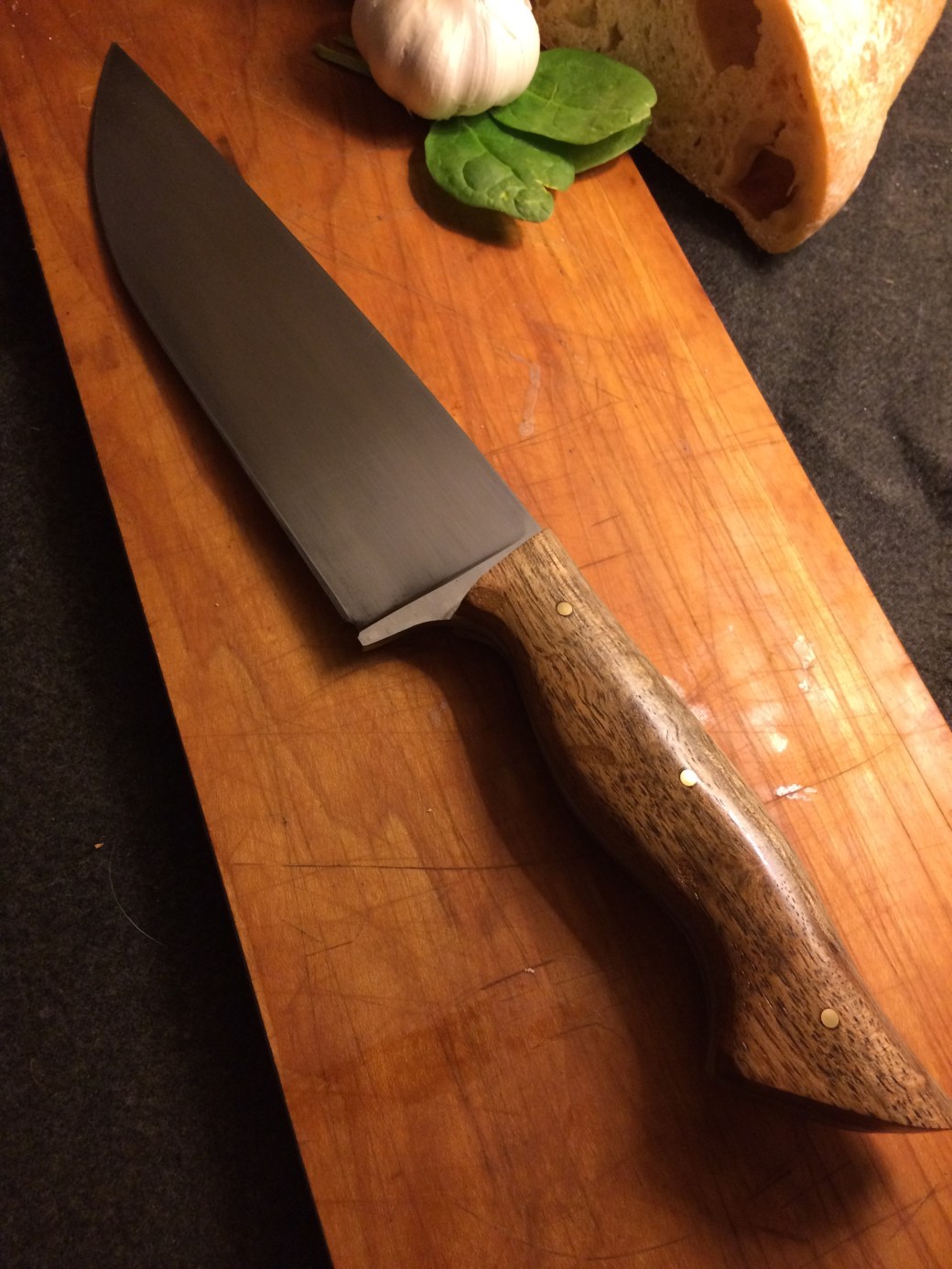
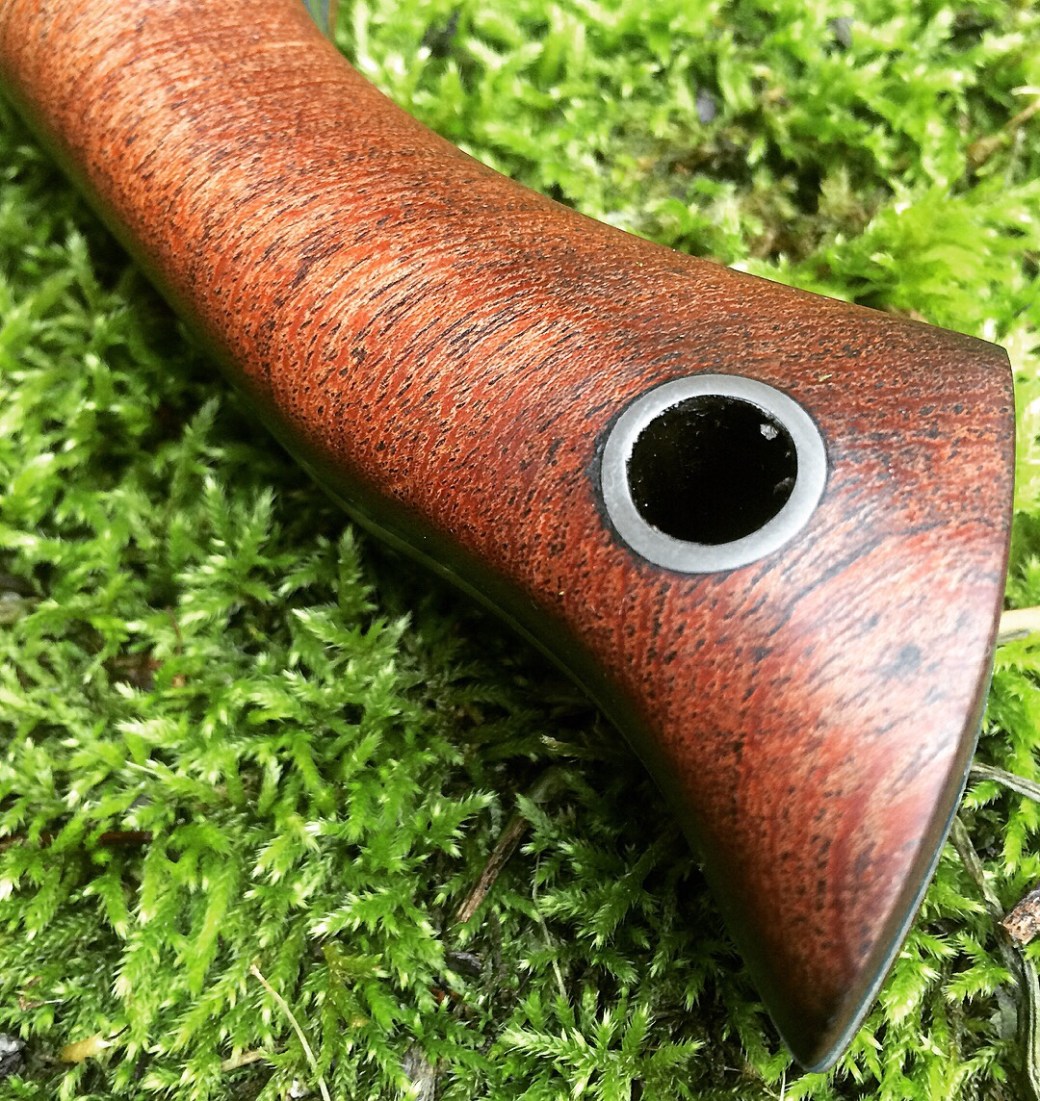
The Rumfoord:

Knifemaking: having a quiet day and the Woodsman, Mark Deux

‘In silence there is eloquence. Stop weaving and see how the pattern improves.’

-Rumi

From mid-January to mid-June of this year everything had been a blur.  I was running from job to job, gig to gig, knife to knife, trying to stay on top of everything.  Every time that I felt like I had room to breathe, something else would come up.  Car repairs, state taxes, doctors’ visits, new tools.  It was always something and I was hustling left and right, making sure everything was moving forward and getting taken care of.

Then I had an accident that pretty much stopped everything.

I injured two of my fingers pretty seriously on a table saw.  I was cutting some very thin material when the saw bound up and kicked, and I couldn’t get away fast enough.  The shop is at my partner James’ house and he happened to be home when this happened.  I quickly grabbed a dirty towel and, doing my best not to panic, politely yelled that I needed to go to the ER, right that second.  

On the ride to the ER, which was about twenty minutes away, I took stock of the situation.  James, who teaches shop and technology education, asked me to double check that my fingers were still attached and not on the floor of the shop.  Indeed they were still attached.  I would be told later that I was very lucky to keep my fingers- none of the major tendons or arteries were damaged beyond repair.  

I do my best to practice calm in my life.  Strong reactions happen from time to time, and the best way to deal with them is to feel them, let them pass, and address what caused the strong reaction in the first place.  This is an incredibly challenging thing to do and I don’t always do it well but I’ve gotten better at it over the years.  On the ride to the ER I found impossible to calm down.  I noticed that my thoughts were manic and erratic and I had trouble breathing normally.  I felt a pretty deep sense of guilt and shame, as if I had this coming because I wasn’t slowing down.  A doctor would later tell me that what I had experienced was an acute stress reaction and was normal for what I had experienced, largely in part from the sheer volume of adrenaline and other chemicals that my body had released.  

The ER was a miserable experience.  The ER doctor told me they would need to operate but they would need to transport me to another facility because there was no one covered by my insurance at that particular hospital.  Nobody even looked at my fingers and I sat on a hospital bed and bled on myself for two hours before someone gave me any pain medicine.  The paramedics finally arrived and bandaged my hand- the first time anyone had done anything. They pumped me full of IV fentanyl before loading me onto an ambulance to go to another hospital.  Those guys knew how to get shit done, and in my very stoned state I kept telling them how glad I was that they were there.

We got to the next hospital, and my girlfriend met me there.  In my state of shock I had forgotten my phone at the shop and James had called her.  I was really glad she was there because it would be another four hours before the surgeon showed up.  As it turned out he was not covered by my insurance either.  Somebody had screwed up. 

The worst part about the ER is that you are forced to make life-altering decisions when you are in a state of shock, and/or heavily medicated and not in your best of faculties.  The surgeon gave me the option of going ahead with surgery but understood if I didn’t want to- he was very kind and professional, and pretty pissed that this was the way the system was working.  I opted not to have surgery that night because it would have medically bankrupted me.  I would never have been able to pay that kind of money back.  I would have to find another surgeon on my own.   He cleaned and temporarily stitched me up enough so that I could safely leave, which involved two incredibly painful nerve block shots and a pretty shoddy cast courtesy of the ER nurse- I think it was her first.  By the time we left, my pharmacy had closed and the hospital wouldn’t send me home with any medication.  I had to make it the night without pain pills or antibiotics (I would end up taking 2000mg of Keflex a day for 20 days- I was so filthy when I went in they were afraid I was going to give myself sepsis).  We went home and tried to get some rest, because the next day would be busy.

I think this was what it looked like when the system fails you.  

……

The next morning we got on the phone.  We called my insurance company and they found a place that would take a look at me right away.  Ironically enough their office was located at the first hospital I had gone to the day before.  I met with an orthopedic surgeon and his nurse practitioner.

I found out that orthopedic surgeons do a lot of hip and knee replacements on the elderly, so when a young person comes in with an exciting injury everyone wants to see.  I had no less than six people come and look at me, all very excited. 

The doctor was really excited to work on me- he was an artist and I was his canvas.  He drew me a picture of the procedure he would do and explained the whole thing.  They were going to fuse the middle joint of my index finger which the table saw had blown out, and remove a bit of my thumb.  I got another two painful shots of nerve block while he examined everything and moved some things back into place.  There aren’t a whole lot of words to convey how painful those shots are- I nearly crushed my girlfriend’s hand with my good hand.  My surgery would be two days from then, and they told me to rest.  So that’s what I did.

I have always had trouble finding quiet places and allowing myself to rest.  Now I had no choice.  I called my work and told them what happened and that I wasn’t sure when I would be back in.  I had to cancel some contractor work and push back a lot of client work.  That was what hurt the most.  My girlfriend and I watched a lot of Netflix, something we rarely ever do together.  I don’t watch a whole lot of TV but over the next week I would watch more TV than I had in the past five years.  And honestly it was really nice to check out.  I slept a lot and took pain medication and was generally kind of dopey.  I told my girlfriend that she was beautiful and I loved her, frequently.  I couldn’t bathe myself, or put my contact lenses in, or dress myself.  I just had to surrender to everything and let myself be helped. 

…..

Two days later we went to have surgery done.  I have never had any surgical procedure done before and was really nervous.  They took me in the back and had me put on a hospital gown and fixed up an IV in me.  After a large bump of a sedative they gave me a giant nerve block shot in my shoulder, which made my entire arm go numb.  I was dopey but still semi-conscious when they wheeled me into the OR.  They had music piped in- Bryan Adams was playing.  From what I understand of these things, the anesthesiologist has you count backwards from one hundred till you knock out.  Apparently they didn’t do this with me- I knocked out on my own singing ‘Heaven’ from Canada’s most famous musical export.  I think this was an auspicious sign.

…..

After surgery everything was kind of fuzzy.  We went home and my girlfriend put me in her bed and told me not to get up while she went to pick up my prescriptions.  My entire left arm was completely numb from the nerve block and I remember being really hungry.  Apparently I got up and ate an entire box of her kids’ Pop-Tarts while she was gone and then swore to her that I didn’t.  There were Pop-Tart wrappers all over the place- I don’t remember any of this.  I slept a whole lot and my dead arm, which I was supposed to keep elevated, kept falling and hitting me in the head.  I had a whole pile of pills that I had to take and my girlfriend dutifully kept me on a tight schedule.  The best I could do was tell her that I loved her and tell her how beautiful she was.

The next four days passed like that.  She took off from her high stress-job and looked after me. She helped me bathe, made sure I was taking my medicine, and kept me fed.  I would get really weepy from time to time.  It was all a lot; the trauma from the accident, the bone-deep pain from the surgery, and the bills that would be coming (because even with insurance these procedures are very expensive), and the people I felt I had let down.  Then there was this really wonderful woman taking care of me telling me that it was ok and how well I was doing.  The pain medication peeled away all of the armor I usually wear to function in the world and so from time to time all of this would hit me and I would just sit there and cry.

A few days later we went to clean up my apartment.  I had gotten off the major pain killers to see how my hand was doing so I could get back to my day job.  In situations where there is a caregiver and a care receiver things can turn toxic and codependent— I’ve seen it happen.  The pain pills can be addictive and I didn’t want to be a patient or lean on anyone if I didn’t have to. 

I had a couple of my friends come over to help.  I couldn’t really do a whole lot.  My girlfriend spent two hours cleaning my shower- a knifemaker’s shower can get really dirty.  One of my friends washed all my dishes for me.  James had let me keep my car at his place till I could drive again, and I finally went and picked it up.  And I started going back to work.

……

My two fingers have been in special splints as they heal, so I’ve been doing everything with eight fingers instead of ten.  All the simple things I do that I never think about, like brushing my teeth or packing a backpack or making a sandwich, suddenly require a lot more thought and take twice as long.  It’s really draining and frustrating and a full day of that makes me really tired.    

One thing that continually catches me off guard is the amount of help that is available.  Whenever there is something I can’t do there is always someone right there to help.  Shortly after the surgery I was working a large concert and I had trouble getting a pack of snack crackers open.  I had to grab a union stagehand, an older gentleman with a long white ponytail, and ask him if he could open my crackers for me.  “Well sure brother,” he says.  “Everybody needs a little help now and then.”  Cue waterworks from me.

Getting back into the shop has been scary, and a slow process.  I was in the middle of this knife when I injured myself and I had to keep emailing the client to push back when I would have it finished.  I did all of the woodworking and leatherwork with eight fingers.  It’s been an exercise in leaning into fear and getting back on the horse. 

I tend to have a lot of quiet days of late.  Quiet days allow everything to settle and help one’s focus to reset and help one to cultivate a sense of gratitude.  They also allow for deep processing and healing.  This is also lesson of the Woodsman.  Any good person of the Woods knows how to find quiet and the goodness that comes from within.  The second part of this build has been an exercise in just that.

O1 tool steel, out of the forge:

img_5879

Hand sanding:

img_5880

Computer board for the spacing material:

img_5882

Mesquite from Texas for the handle:

img_4584-1

img_5883

All profiled:
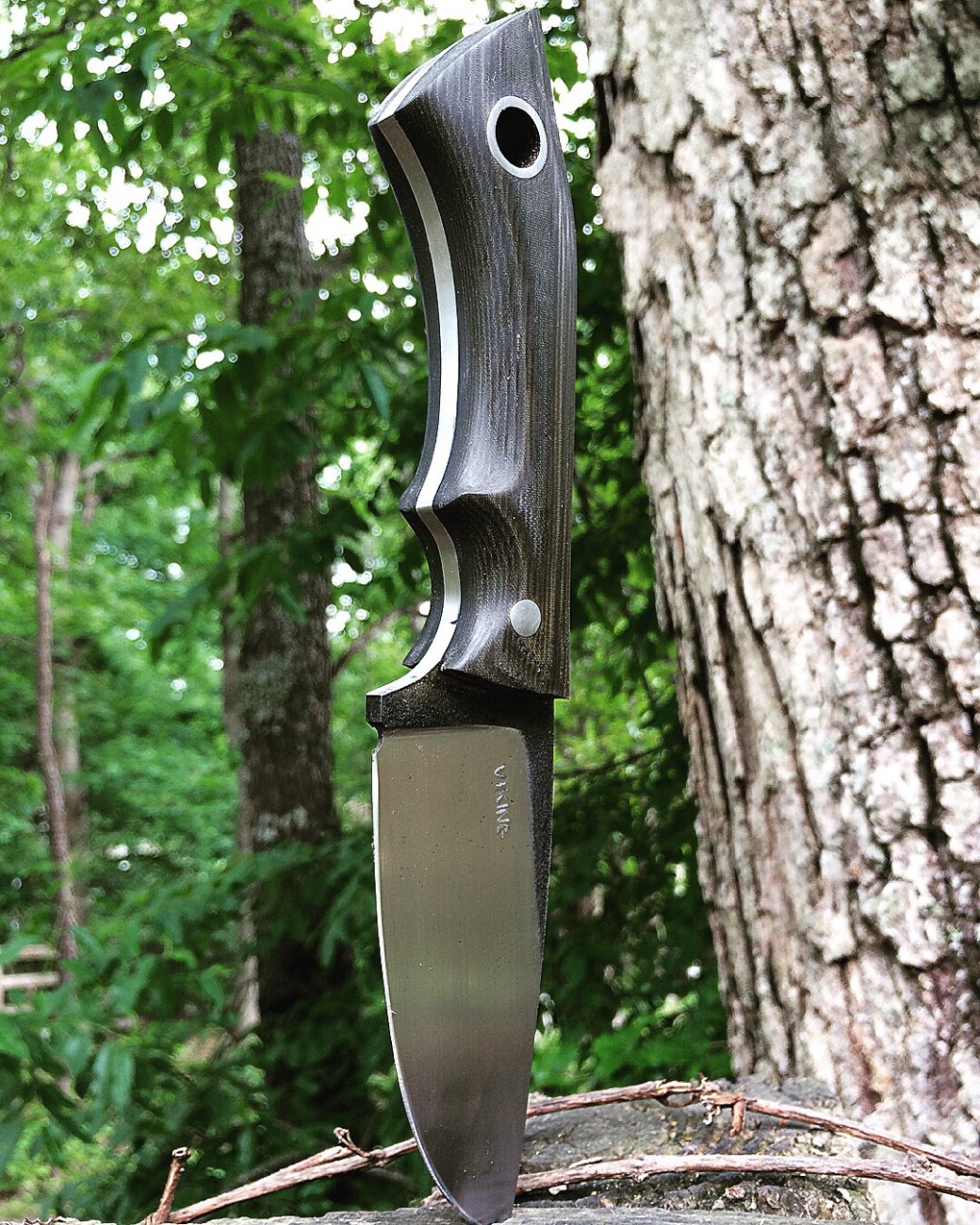
img_5926

img_5925

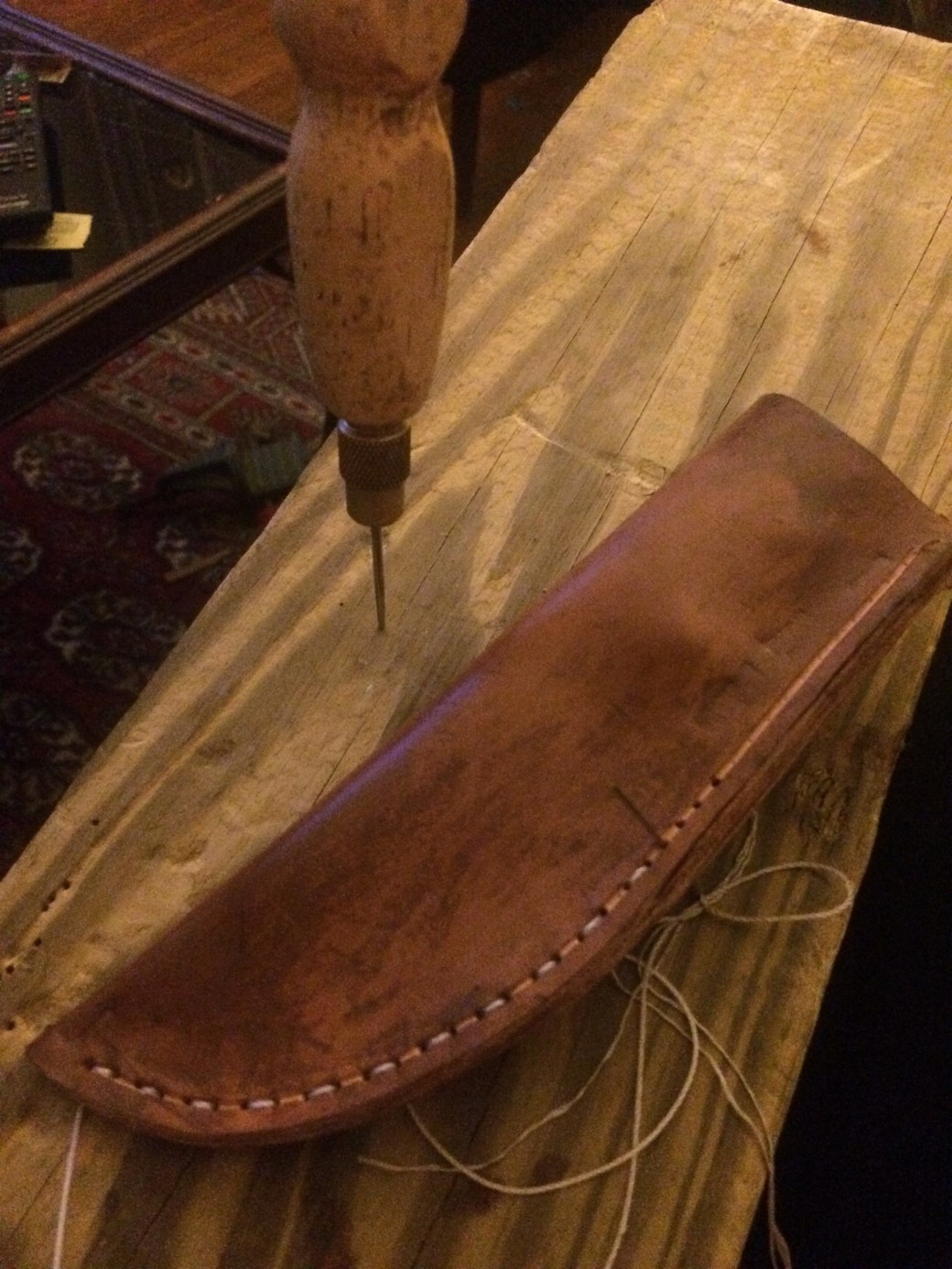
Rough shaped on the grinder- from here out it’s all hand work:
img_5927

This is at 220 grit:

img_5928

Letting a bit of oil set in to help the grain to speak:

The Woodsman, Mark II:

Knifemaking: a walk through the forest and the Woodsman

“Come closer and see,
See into the trees”

The Cure- “A Forest”

This knife was a donation to a charity auction put on by the Virginia Department of Forestry.  Many of the men and women who work for the Department of Forestry spend much of their work time and free time outdoors.  I wanted to build something that fit into that idea- stout and sturdy with no problem disappearing into the woods.  I designed a drop point hunter that was just that:

Cut out:

Centerline is scribed:

Early grinding work:

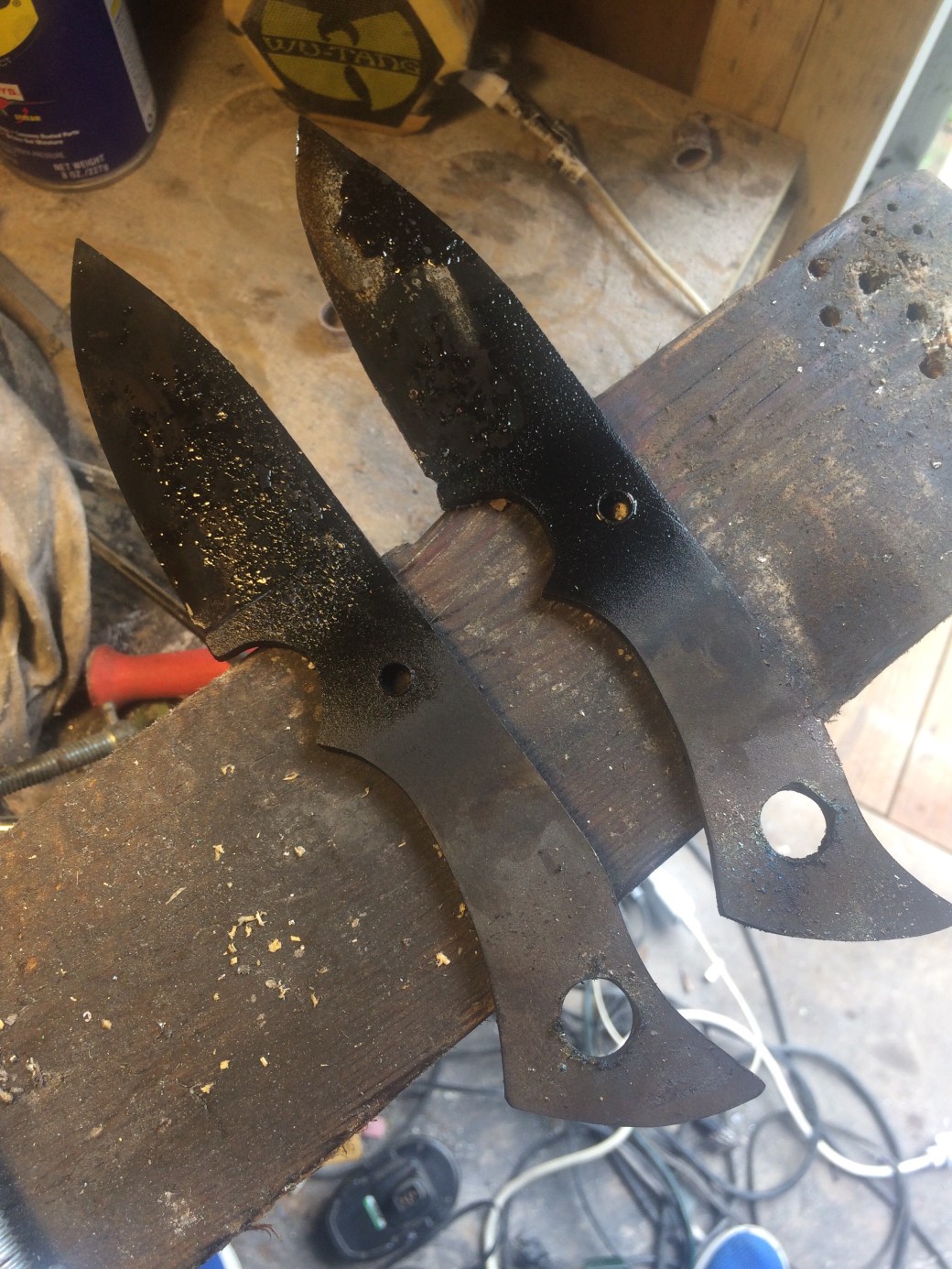
Hardened…

…and tempered

Polishing:

….to a nice satin finish:

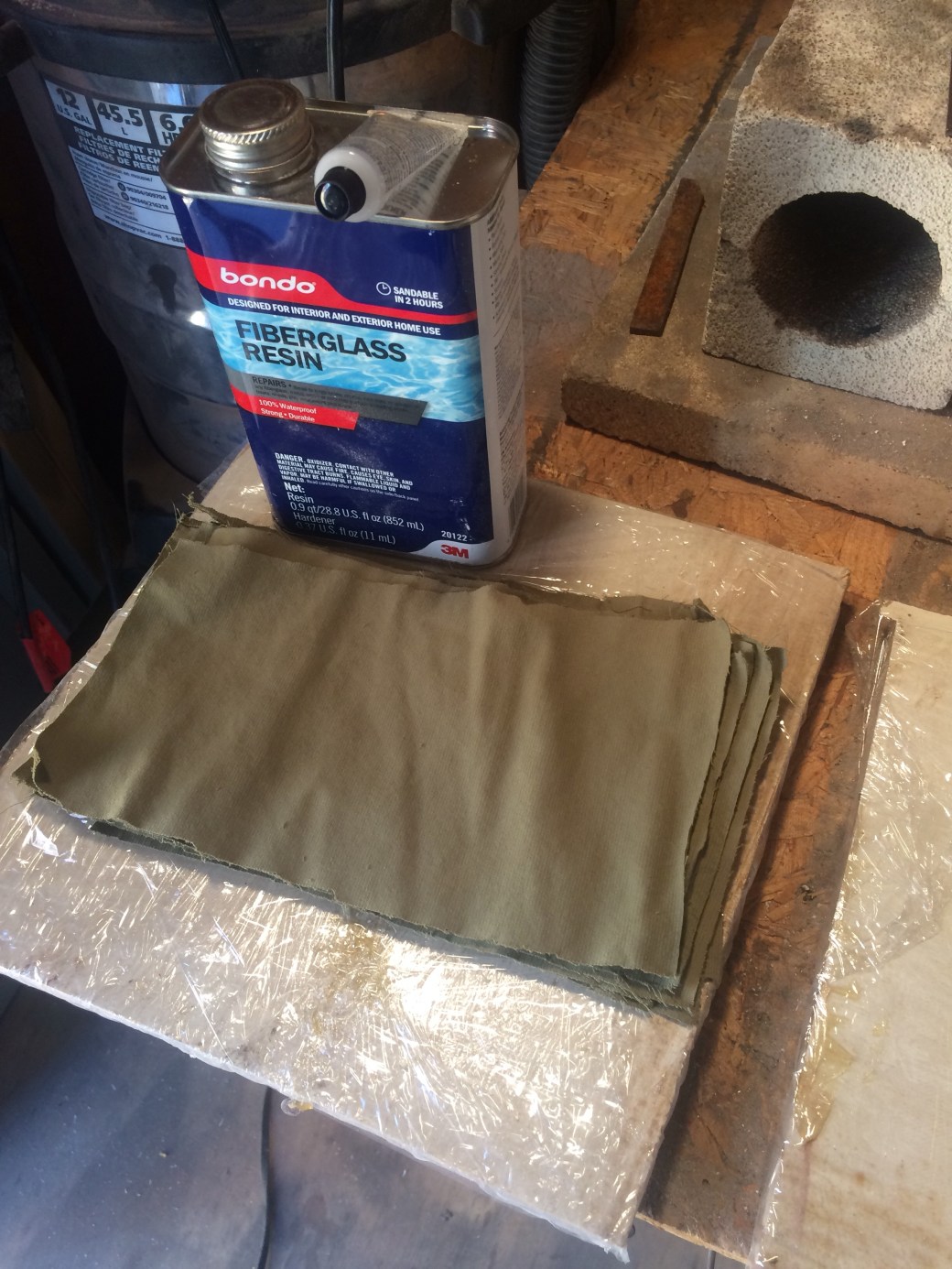
An old shirt of mine I used to camp in.  It’s beat up and full of holes, which makes it an excellent candidate for knife handle material:

Ready to be set in fiberglass resin:

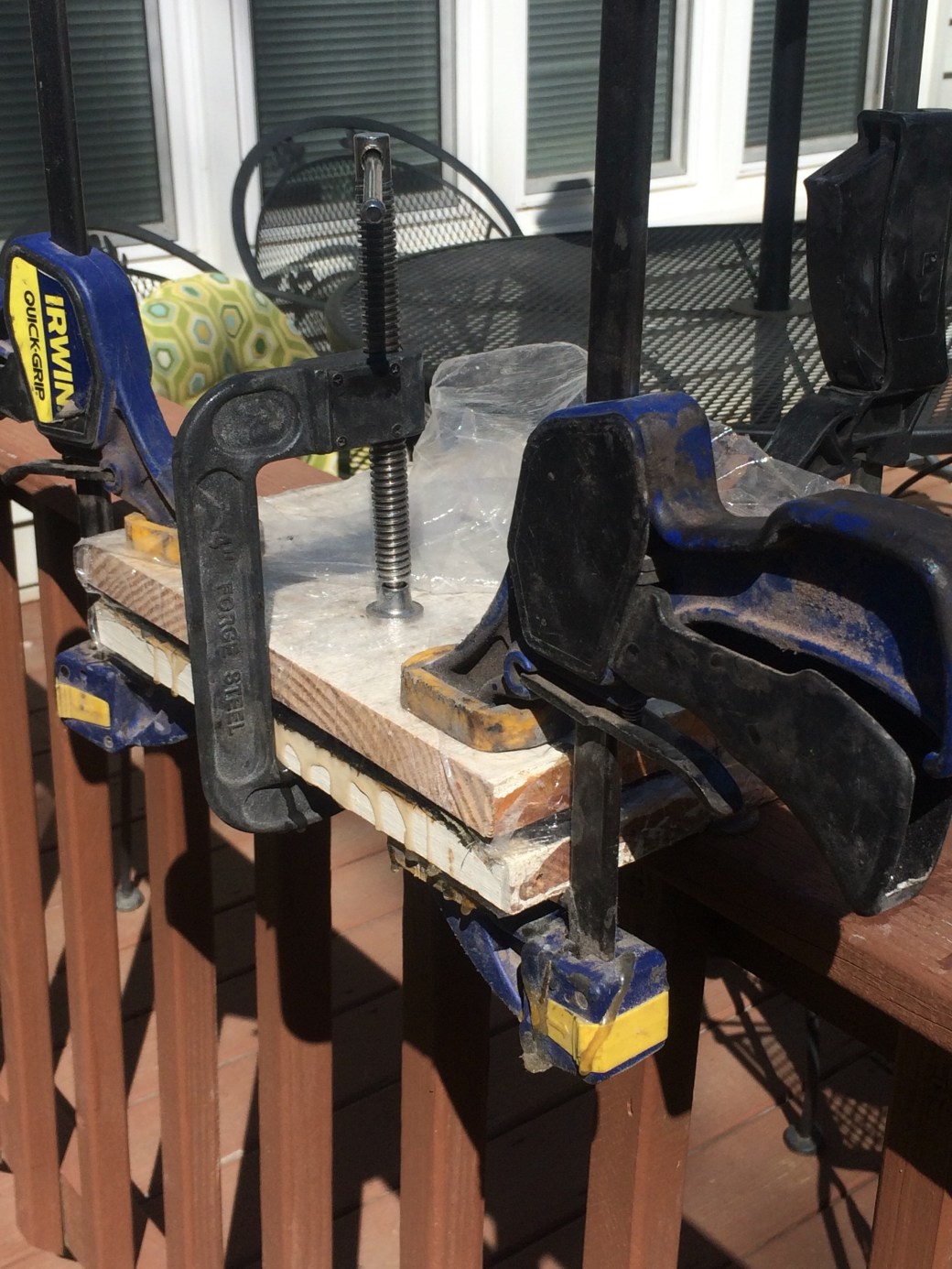
All the layers pressed together:

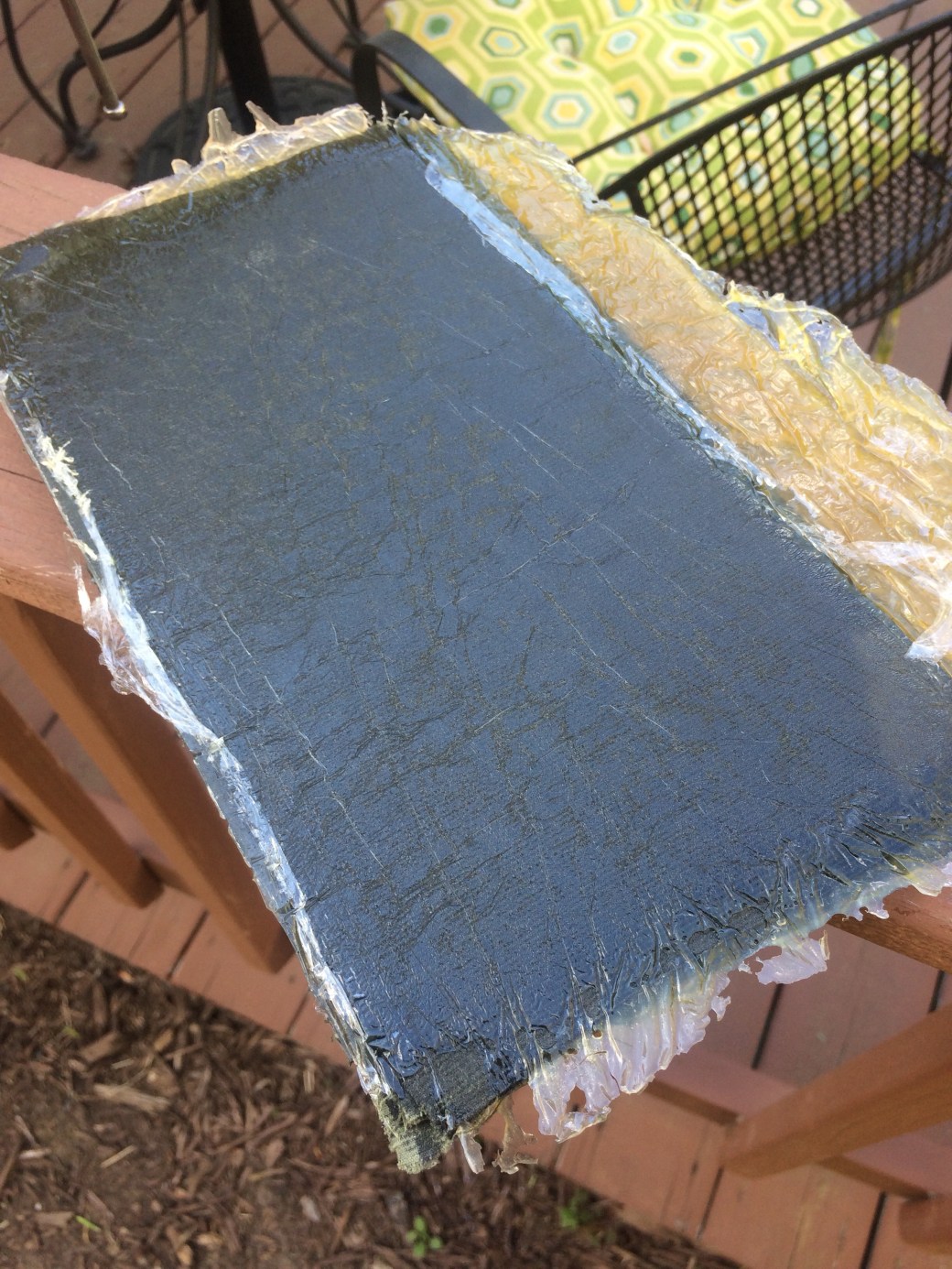
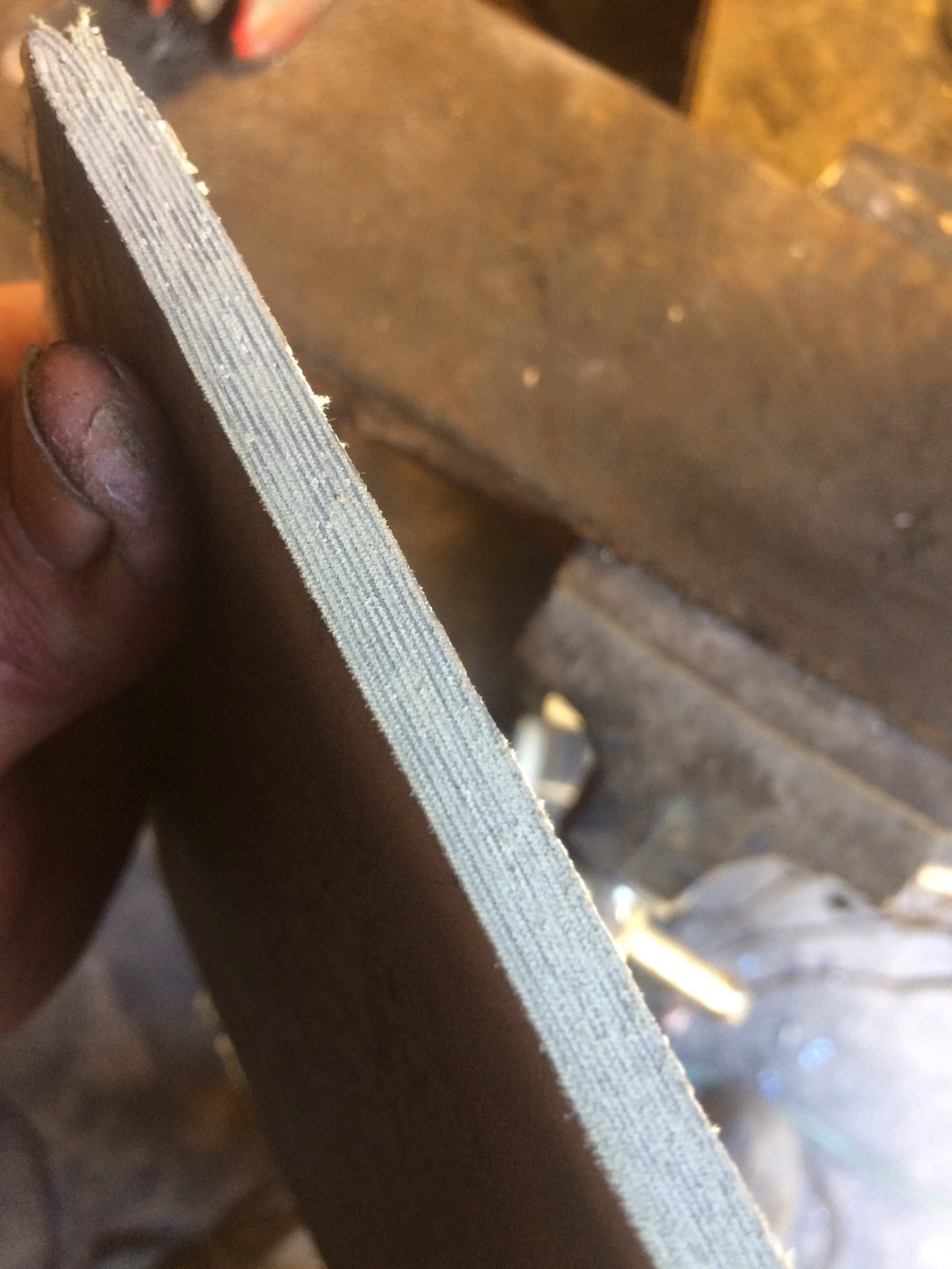
Everything is cured:

The Woodsman:


You can read more about how the department of Forestry serves you here:

http://www.southernforests.org/

…and here is one of the causes that they serve:

http://www.semperk9.org/

Knifemaking: the other side of things, and the Hippo

“Audi alteram partem.”

“Hear the other side.”

-St. Augustine of Hippo


The other side.  Sometime we’re so used to seeing everything from our own point of view that the other side can seem foreign, or even wrong.  But to truly live and to understand, sometimes we have to hear the other side, or even live over there for awhile. 

The “other side” can be just about anything.  St. Augustine’s quote can be applied to today’s politics- gun control, immigration, issues of gender identity- issues that are magnanimously polarizing and place many of us on one side or the other.  We simply don’t listen because we don’t think what the other side has to say has any use to us.

And it goes deeper.  We don’t hear the other side of what many parts of our life have to tell us.  Maybe they are unpleasant or painful, or we feel they don’t serve us, or they are extraneous and not needed, or they poke at a deep wound that we would rather leave alone.  So we go through our world pretending the other side doesn’t have anything to say to us.  This usually works until it doesn’t.  And then life will come and hand us a situation or circumstance that places us on precisely the other side of where we’d like to be.

Some of the happiest people I know have been through the greatest sorrow.  The most loving people I know have suffered losses so great that when I put myself in their shoes I’m not sure how I’d get out of bed in the morning.  But these are the people who have heard the other side, and know that the highs and lows are two sides of the same coin.  The other side of suffering is serenity; the other side of pain is pleasure; the other side of misery is joy; and the other side of grief is love.  In shutting ourself off from misery, we are effectively shutting ourself off from our greatest joy.

…….

It was the summer of 2004 and I had been invited to my first wedding.  A friend of mine was getting married.  We had grown up down the street from each other and had gone to high school together.  As an awkward and maladjusted teenager I had always been grateful that she had been such a good friend to me.  She had graduated a little before I did and liked to travel- she would send me postcards sometimes.  At this point I had been in college for a couple of years and had barely seen any of my friends I had grown up with, including her.  I was really happy for her and excited to see how she was doing, and glad she thought to invite me.  The service was going to be in a little chapel on her college campus, about four hours away. 

Then, about a week before I was going to head out, another friend I had grown up with died in an extremely traumatic car accident.  It was really bad.  It had been late at night and their car had crashed and caught fire.  There were three other passengers and no one could get out.  No one survived and they had to be identified by dental records.

The funeral was a day before I was headed out of town.  I took the day off of work from my summer job to go to the service.  I was much younger and pretty naive to a lot of the ways of the world but I noticed that nobody, not family or church clergy, had anything substantial to say to make any sense of it.  After a few years I would realize that this is the ultimate tragedy of a young person dying- there’s nothing anyone can say to make it better.  I grew up with this guy, we did church youth group together.  We weren’t particularly close but we had spent a lot of time together over the years.  Gradually I felt my emotions getting the better of me throughout the service.  I tried thinking about baseball, but during the eulogy it was all waterworks.  My father, who had come with me (and I was glad he did), handed me his handkerchief.

….

After the funeral, I packed a suitcase and drove four hours to attend a wedding the next day.  I remember that drive very clearly- blasting music and feeling a bit of grief but otherwise very happy to be alive.  I checked into my hotel and went out with a couple of friends that I hadn’t seen in forever.  Up to that point I don’t ever remember laughing so hard.  I stumbled back to my hotel room, which was a mile and a half away, and went to sleep, quite content with laughter and health.

The next day I went to the wedding service.  There was a string quartet playing processional music, I think it was Ravel, and lots of flowers.  It was a really happy and beautiful service, and I remember how incredible it was that one day you could go to a funeral and the next day a wedding, and that these were perfectly natural occurrences to have in one’s life.  I don’t know if I would have been nearly as grateful and present if I hadn’t had the previous day’s experience of being on the other side.

It’s a strange world we live in.  Be sure to hear what the other side has to say. 

…..

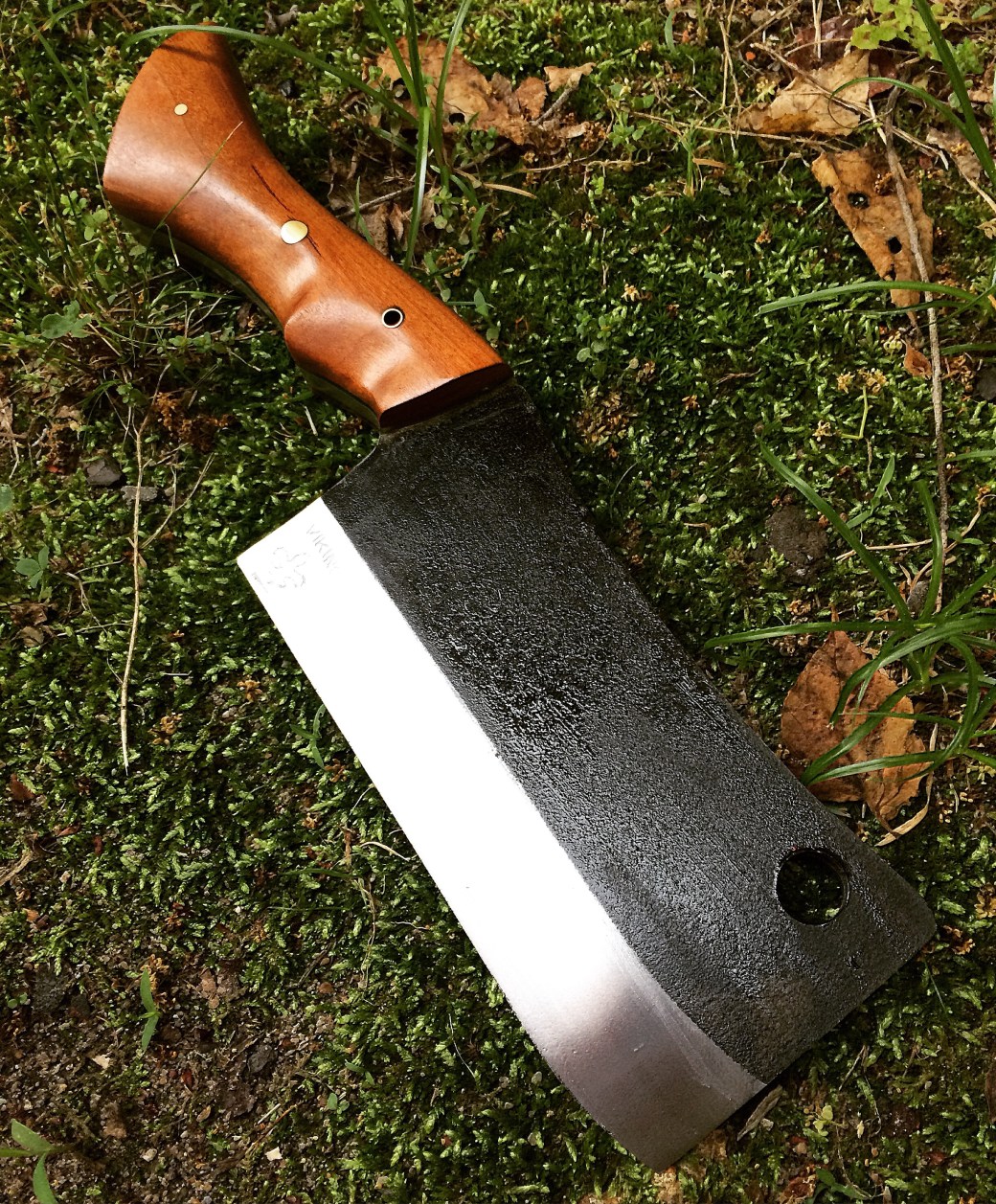
The Hippo was a commission from a gentleman for whom I often do contract work.  It was built for his wife, a lady who’s faith is extremely important to her.  She loves to cook and I was told the only kitchen tool she didn’t have was a cleaver, so I designed and built her one.  I named it the Hippo after St. Augustine, as a nod to the saint who’s writings influenced many subsequent saints, and because of it’s sheer size.  This thing is massive.

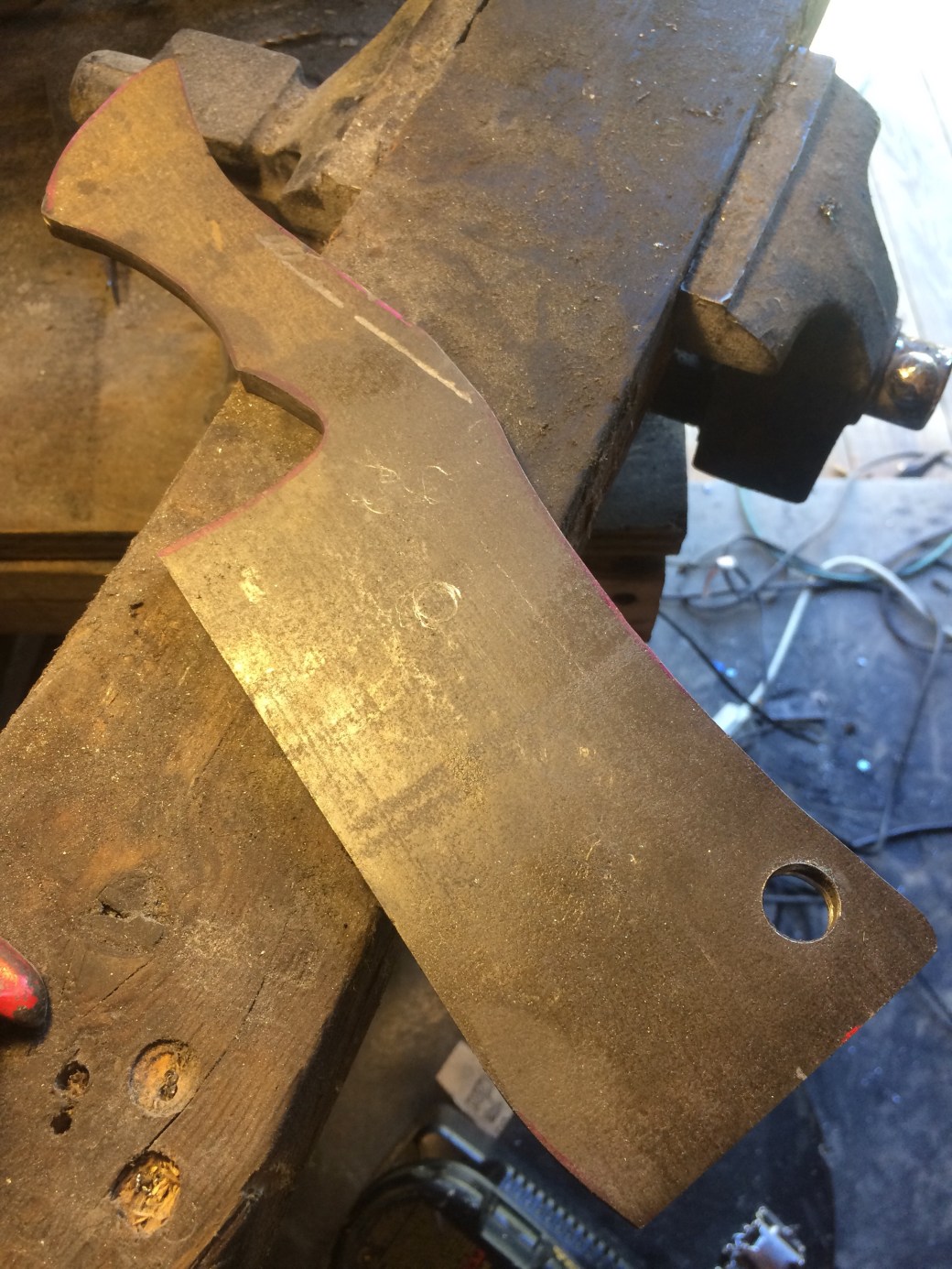
On 1/4″ stock, O1 tool steel:

Boring out the hanger hole:

Profiled:

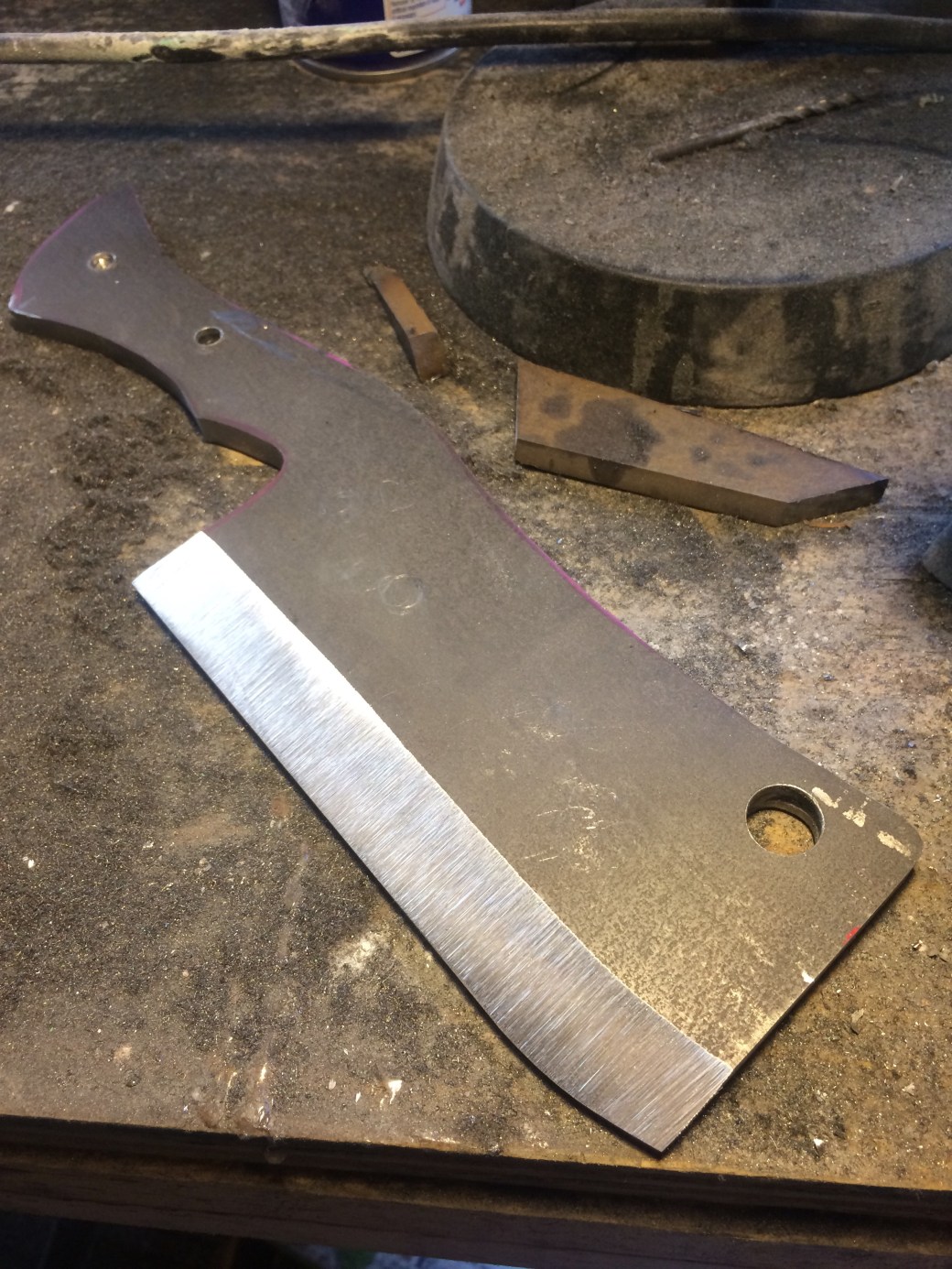
Bevelled:

img_5683-1

Polishing before heat treat.  Removing machine marks now will make polishing easier what this big boy has been hardened:

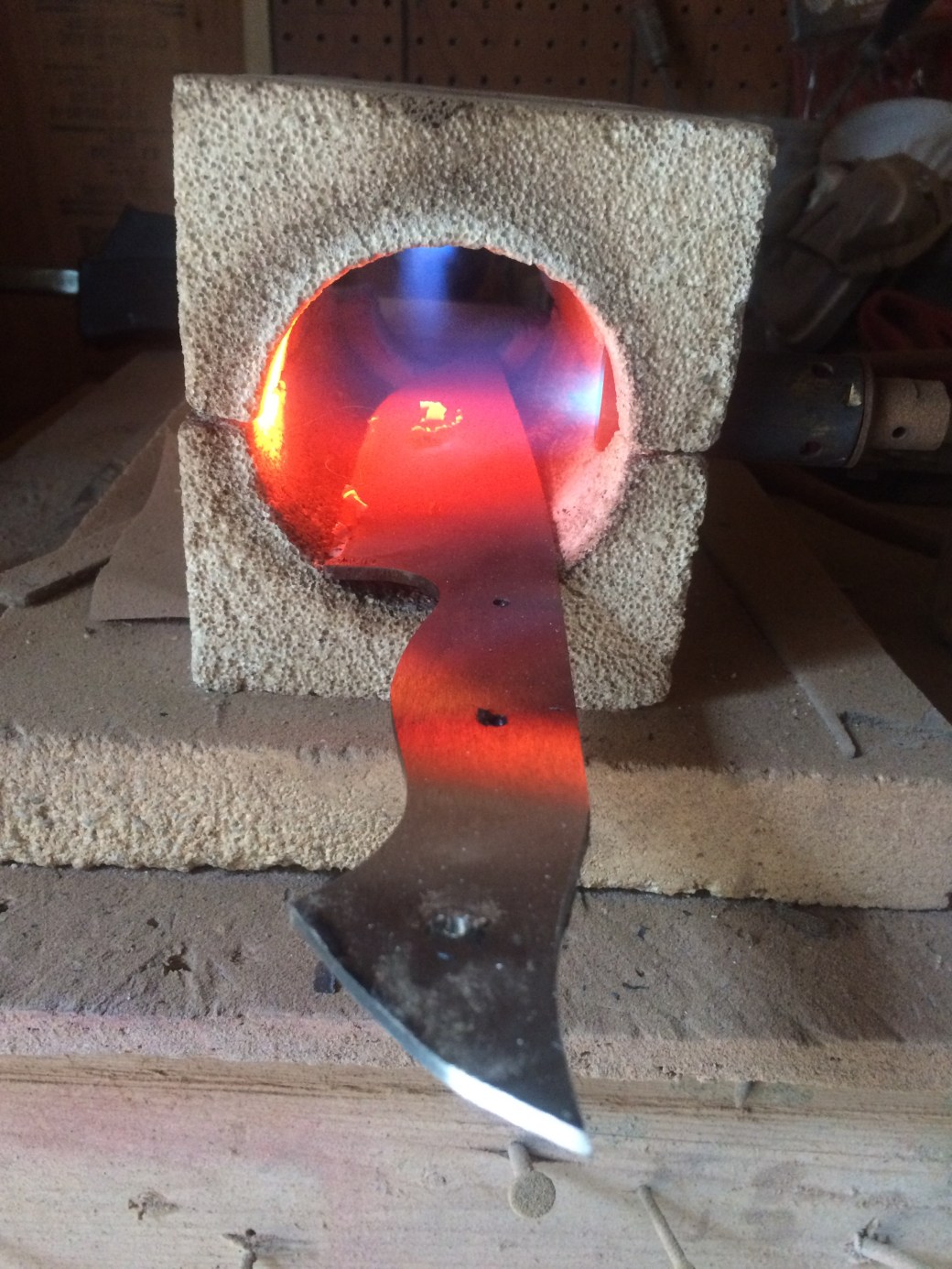
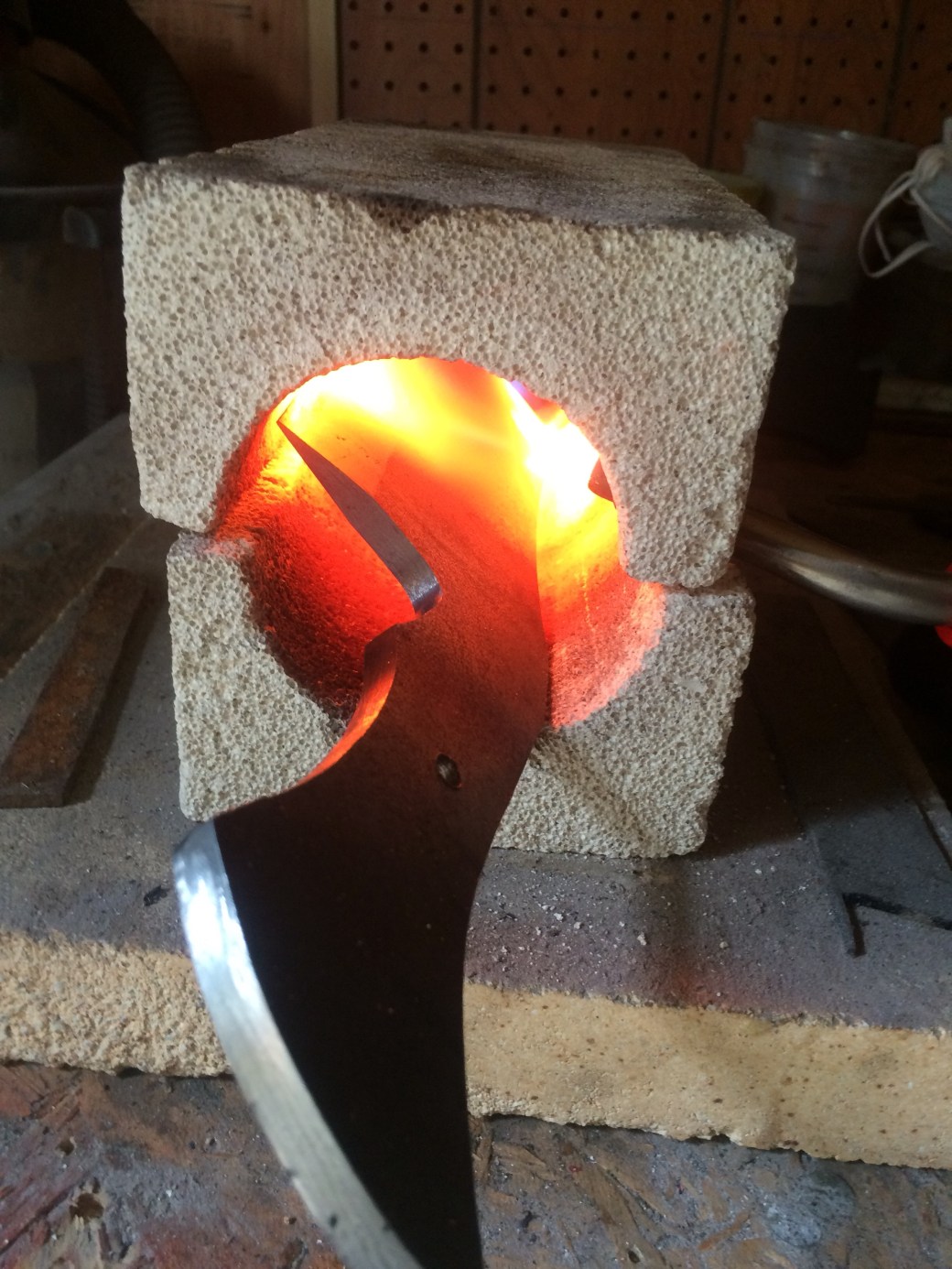
This thing barely fit in the forge:

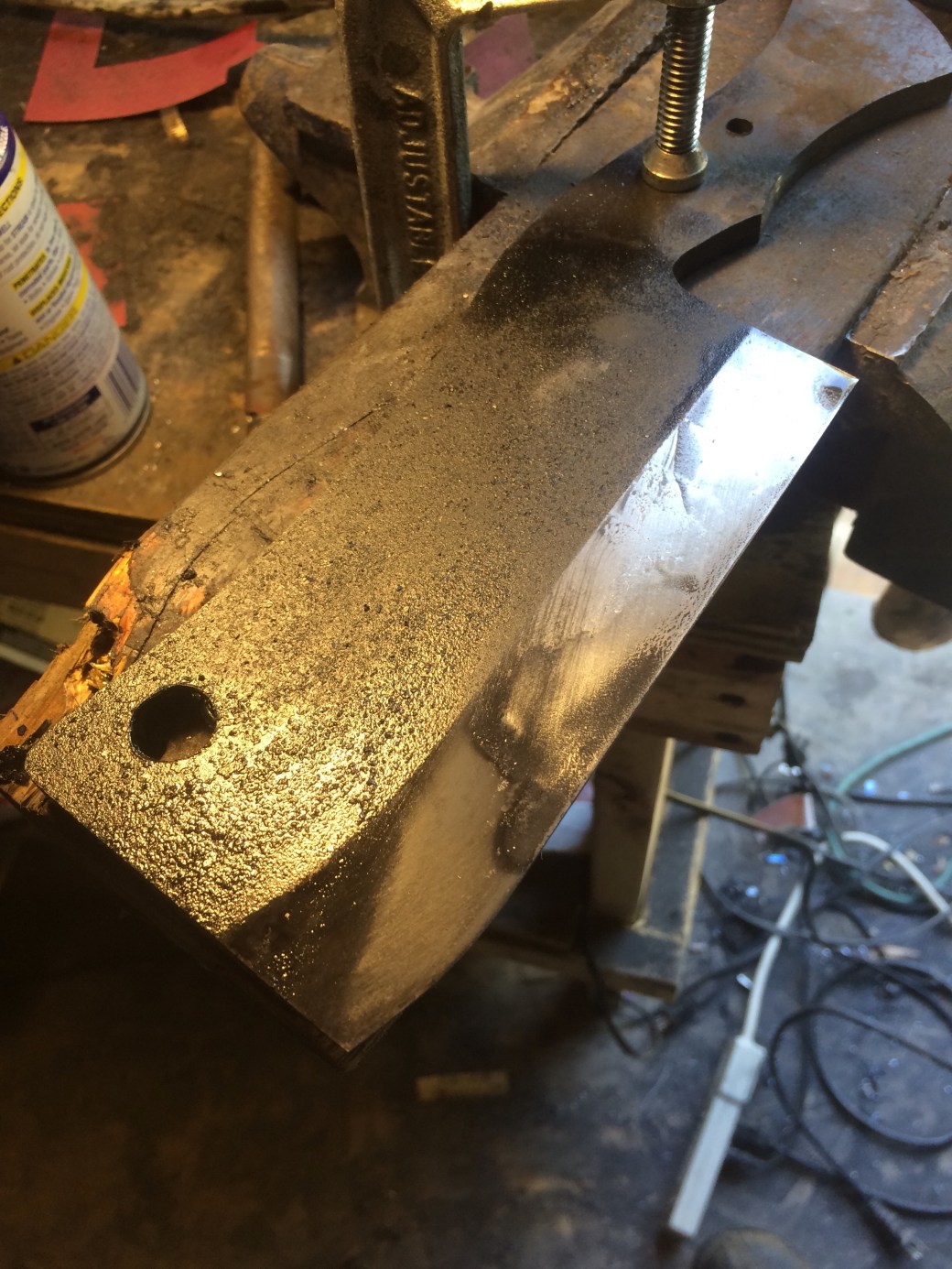
Removing some of the firescale:

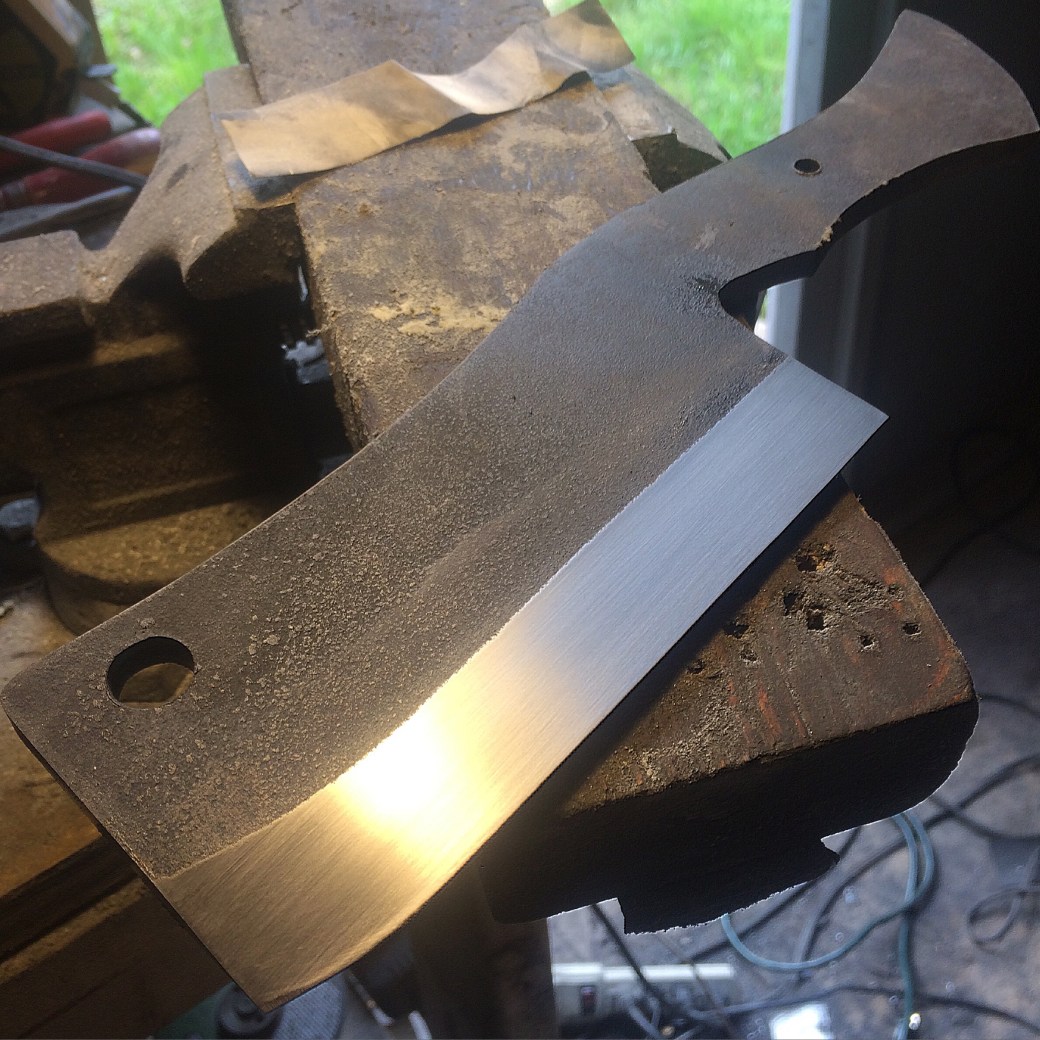
The business end is polished:

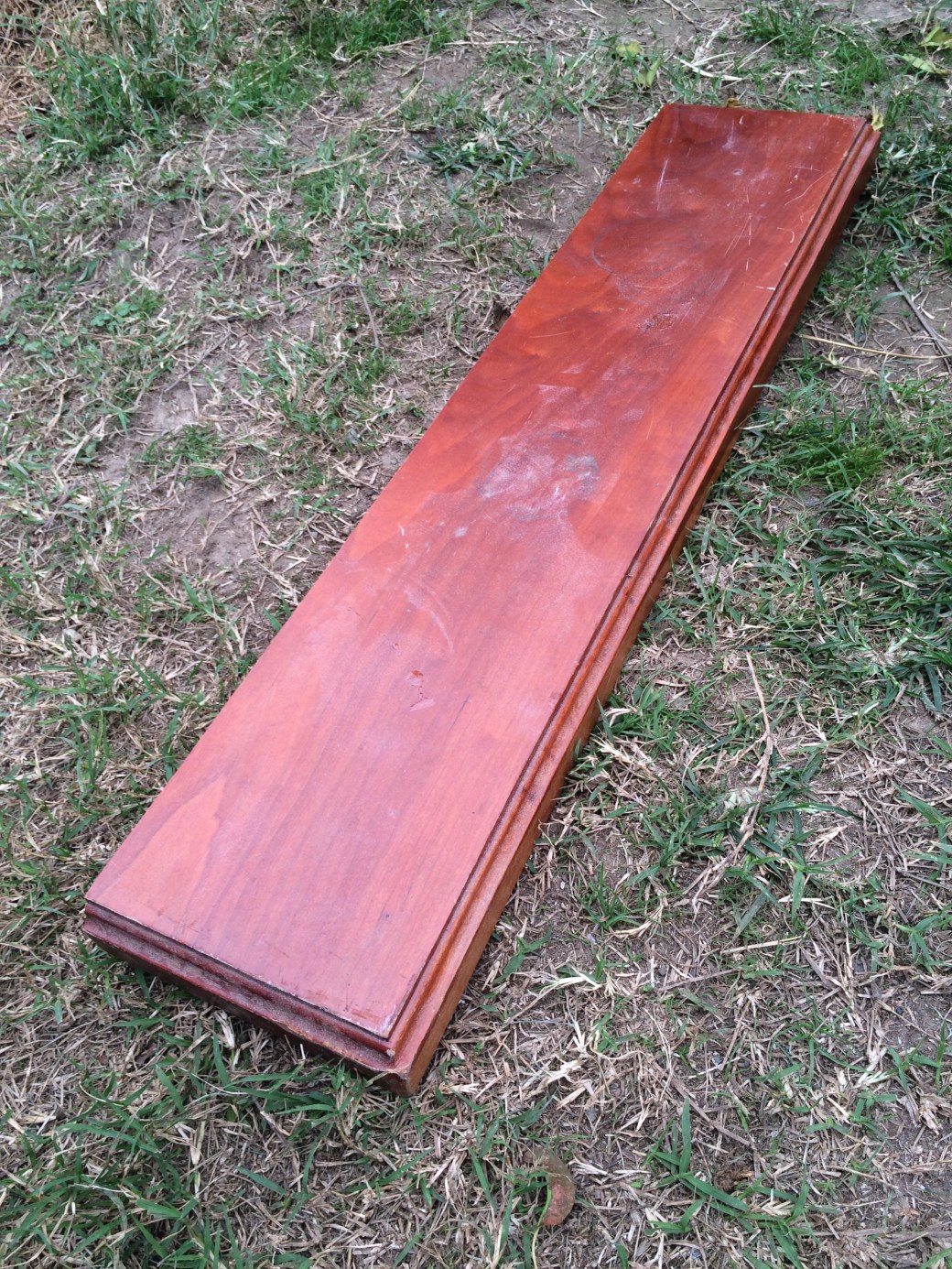
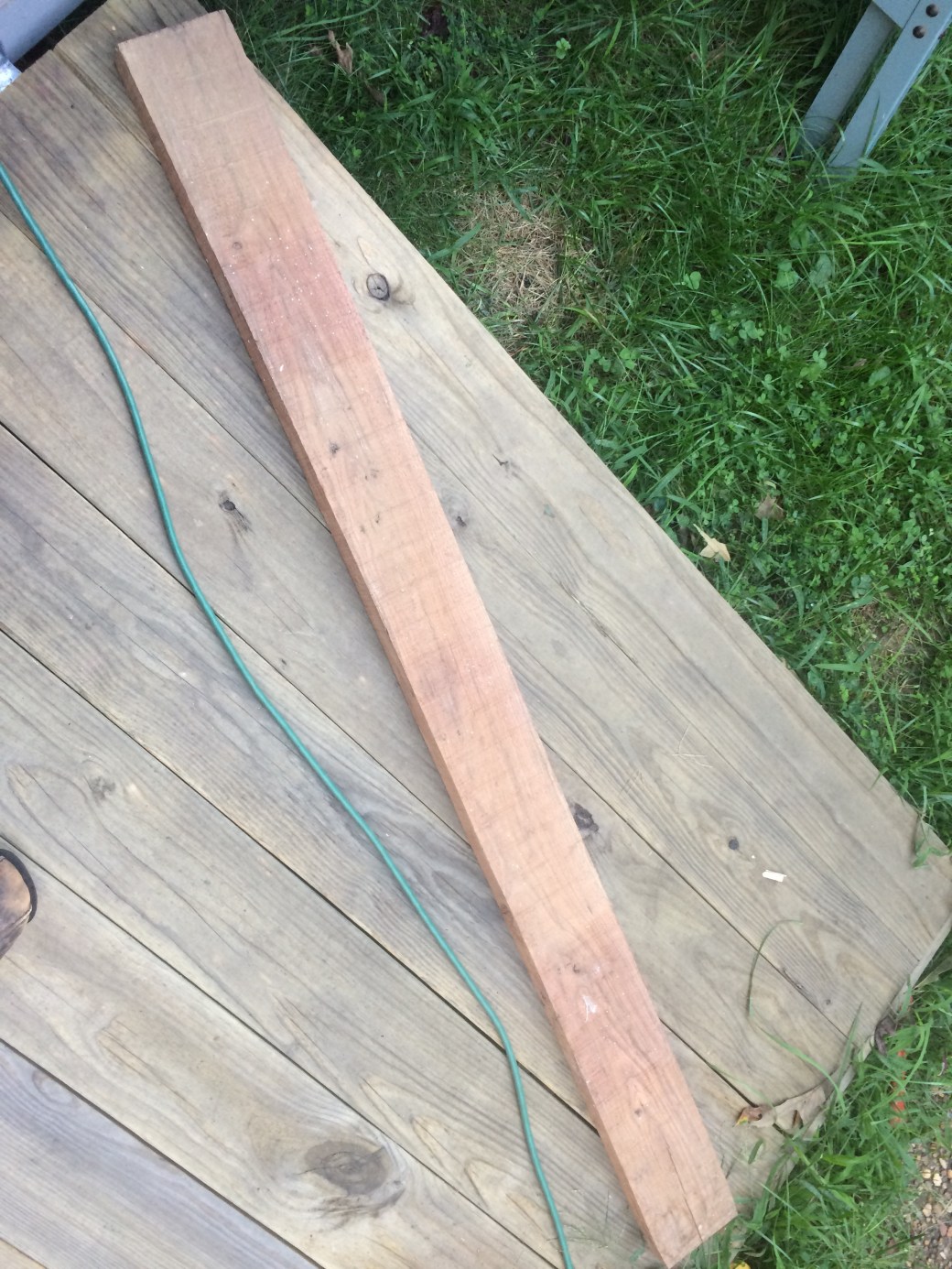
This is a piece of Cherry wood the came off the mantle of a fireplace:

img_4010

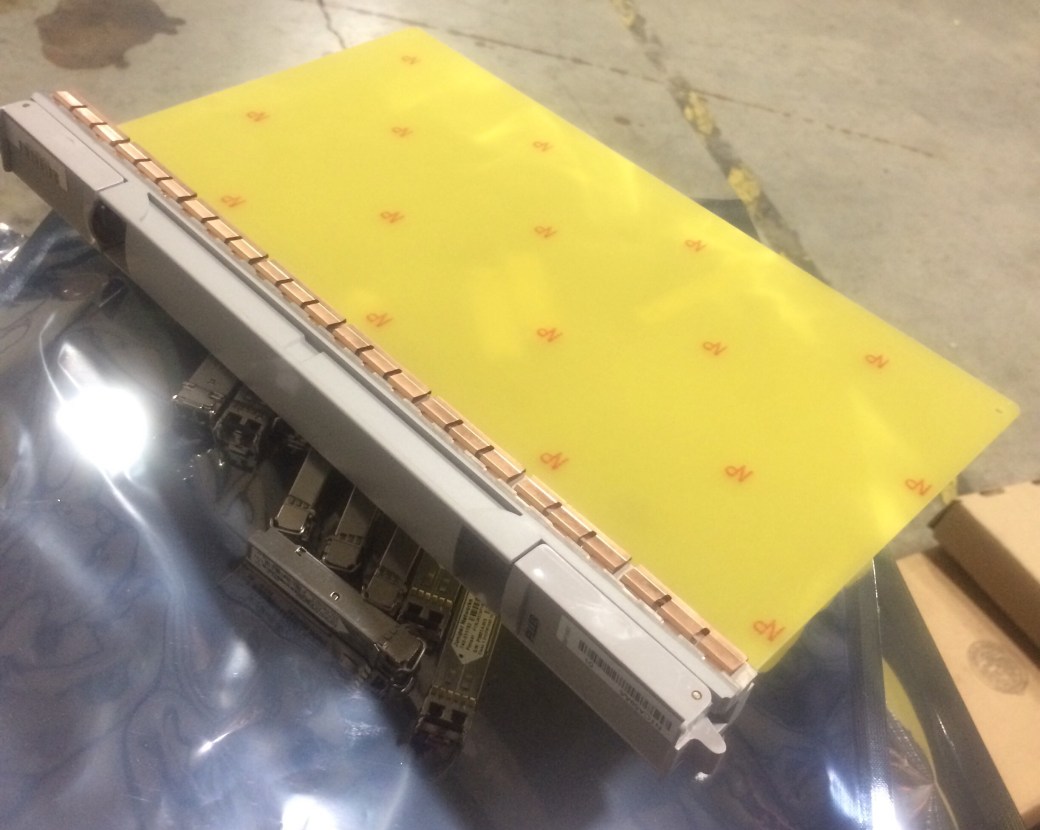
Computer board blank for spacing material:

img_4579-1

Drilling the rivet holes to attach to the tang:

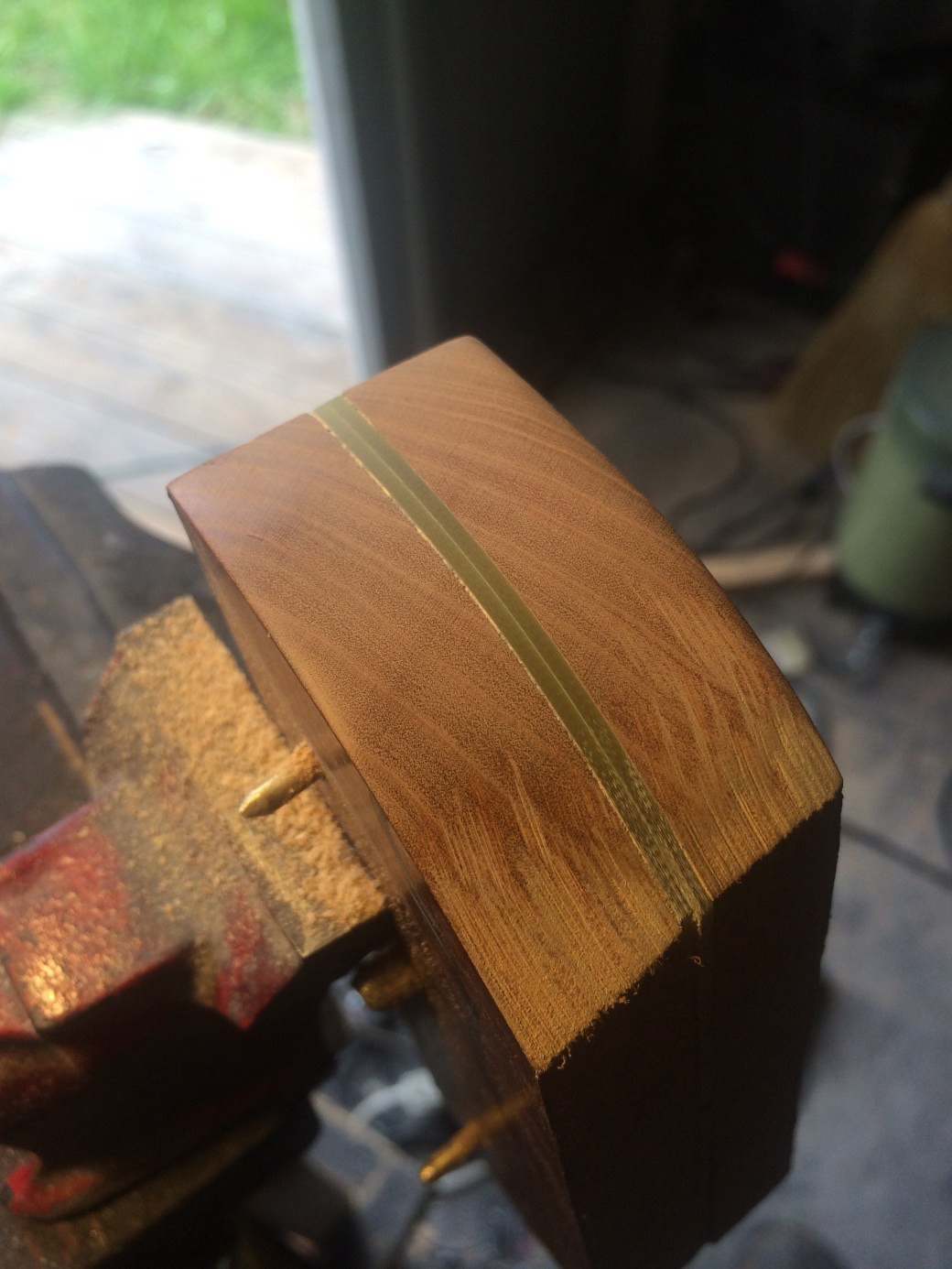
The grain is quite lovely:

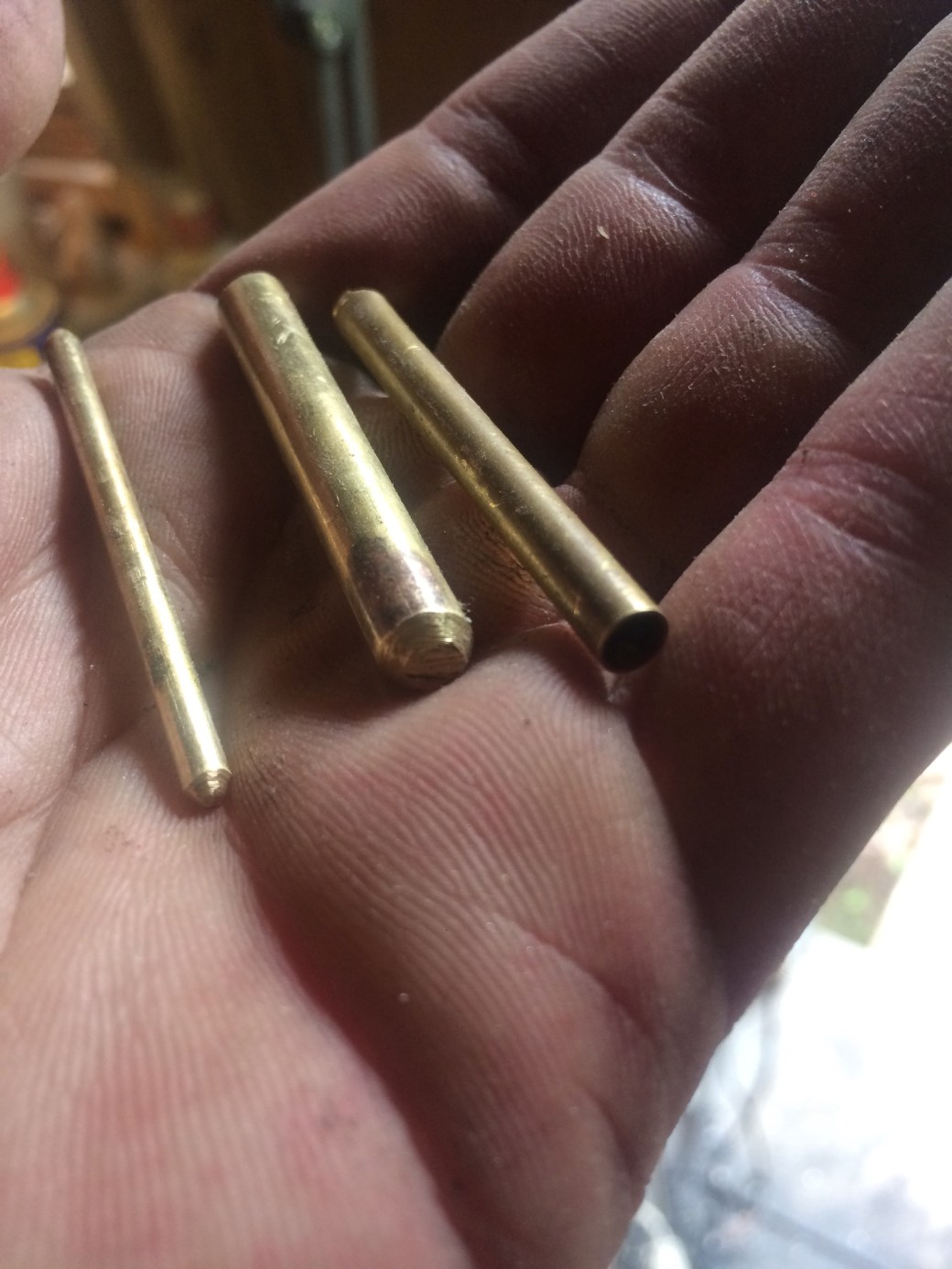
Brass rivets- the middle is the Father, the right is the Son, and the left is the Holy Ghost:

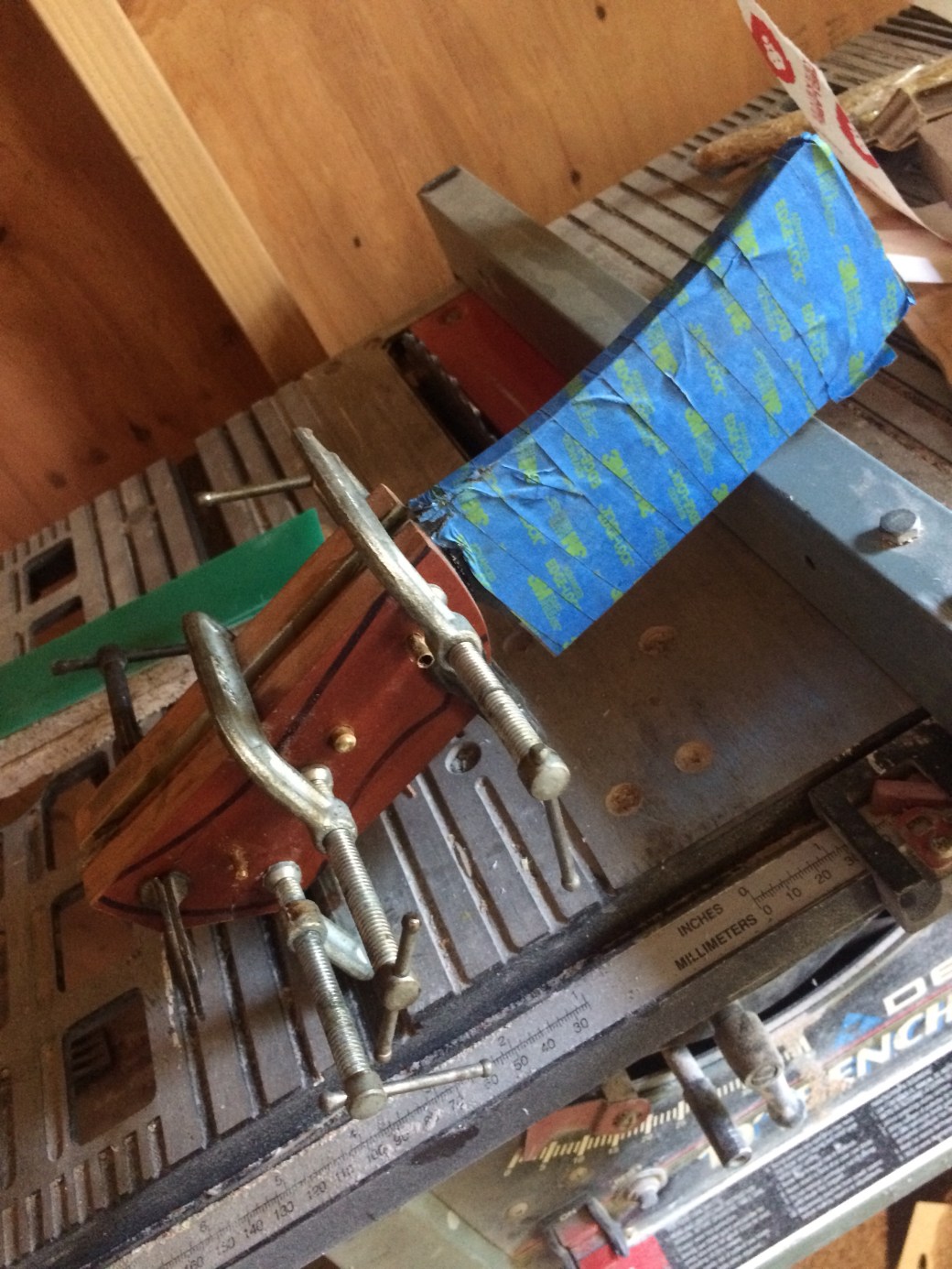
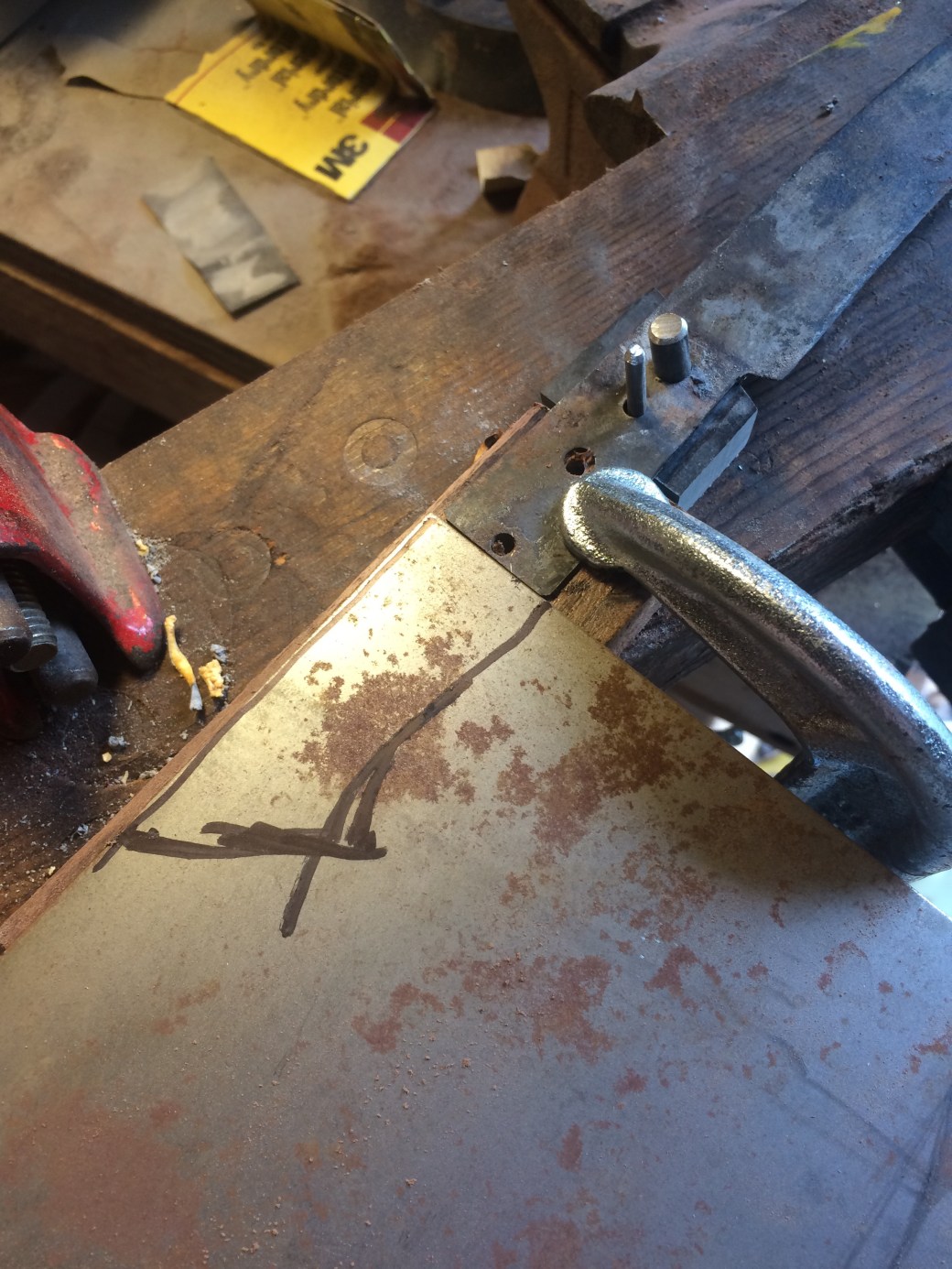
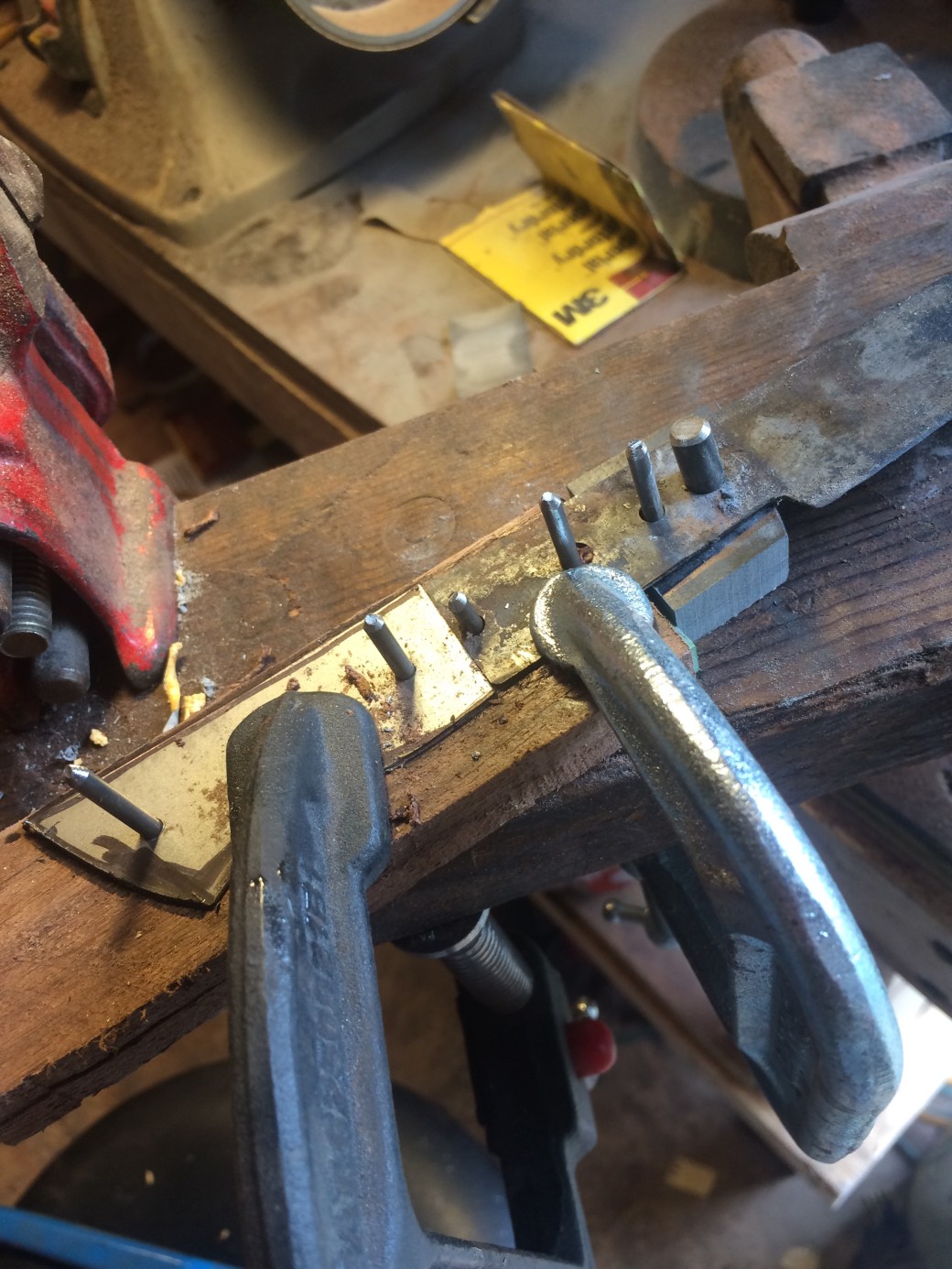
Clamped and glued up:

The Hippo:

Knifemaking: The Things That Come to Us- A Restoration

“i imagine that yes is the only living thing.”
― e.e. cummings


There are many things that come into our own personal worlds- children, possessions, problems, blessings and a myriad of others.  It’s not so important how or why they enter our lives, but what we do with them.  It expends a great amount of energy to ponder what we may have done to deserve the painful and traumatizing events that come to us, and an equal amount of energy is wasted when we wonder if we are worthy of the good things that are brought our way.

Because when we start dwelling on the why’s and how’s, we tend to become overwhelmed and lose sight of what best needs to be done with what comes into our lives.

And within that judgement of why and how, we start to say no to things.  We become afraid we may be hurt, or that we may fail ourselves or those we care about.  Perhaps we are afraid of making ourselves unsafe.  Whatever the reason, in saying no we shut ourselves out of the blessing may be inside of a painful situation.  We say no to what may be a path forward because it is dressed as something unpleasant.  It is then that we become prisoners in our lives instead of seeing the ways we can be shaped and grow.  We should say no to things that are harmful and do not better us, but it’s always good to say yes to what life brings us.

The summers are slow for me, and sometimes I have to get creative in the ways I support myself.  I end up saying yes to many opportunities that under normal circumstances I would decline, usually due to time constraints, time away from loved ones, or a high probability of bodily endangerment (or a combination of all three).  Over the years the things I’ve reluctantly said yes to have usually been the most rewarding.

One of the times I said yes this summer was to a tree job in rural Virginia.  I was on a crew to cut down a huge dead tree.  Removing dead trees can be dangerous.  Rotting can occur in any number of unseen places of the tree, causing structural instability, and the tree may not fall where or when you desire it to fall.  This particular tree, though dead as a doornail, fell exactly as it was supposed to.

The client was an artist, and brought us French-pressed coffee.  We talked for a bit and I told him about making knives and how I got my materials.  He told me that he had some slabs of black walnut and that I was welcome to them.  They had been milled by a neighboring man who had run an abbey in South Korea, saying ‘yes’ to whatever fleeing defectors and dissidents from the North that the world brought their way.  Later he sent me an article about the man who cut the wood, you can find it here.  Black Walnut is expensive and isn’t something to normally fall into one’s path, so, in the practice of saying yes, I happily took some.

A week or so later I said yes to doing a bit of work on a good friend’s farm.  My friend is a busy lady and sometimes needs a hand with the upkeep of her property.  She and her family are good friends of mine.  I worked for her son for several years and like to get out to their property as often as I can.  It’s really beautiful:

IMG_2509

She had a set of knives she wasn’t sure what to do with.  They belonged to her late husband, and came to him from his grandfather, who was an Austrian immigrant.  He came to the United States in the early 1900’s and made his living as a chef, choosing to say yes to a new world and a new life.  She told me she’d like to have them restored so they can go to her children and stepchildren to remember their father.  I told her I would have a look at them and see what I could do.

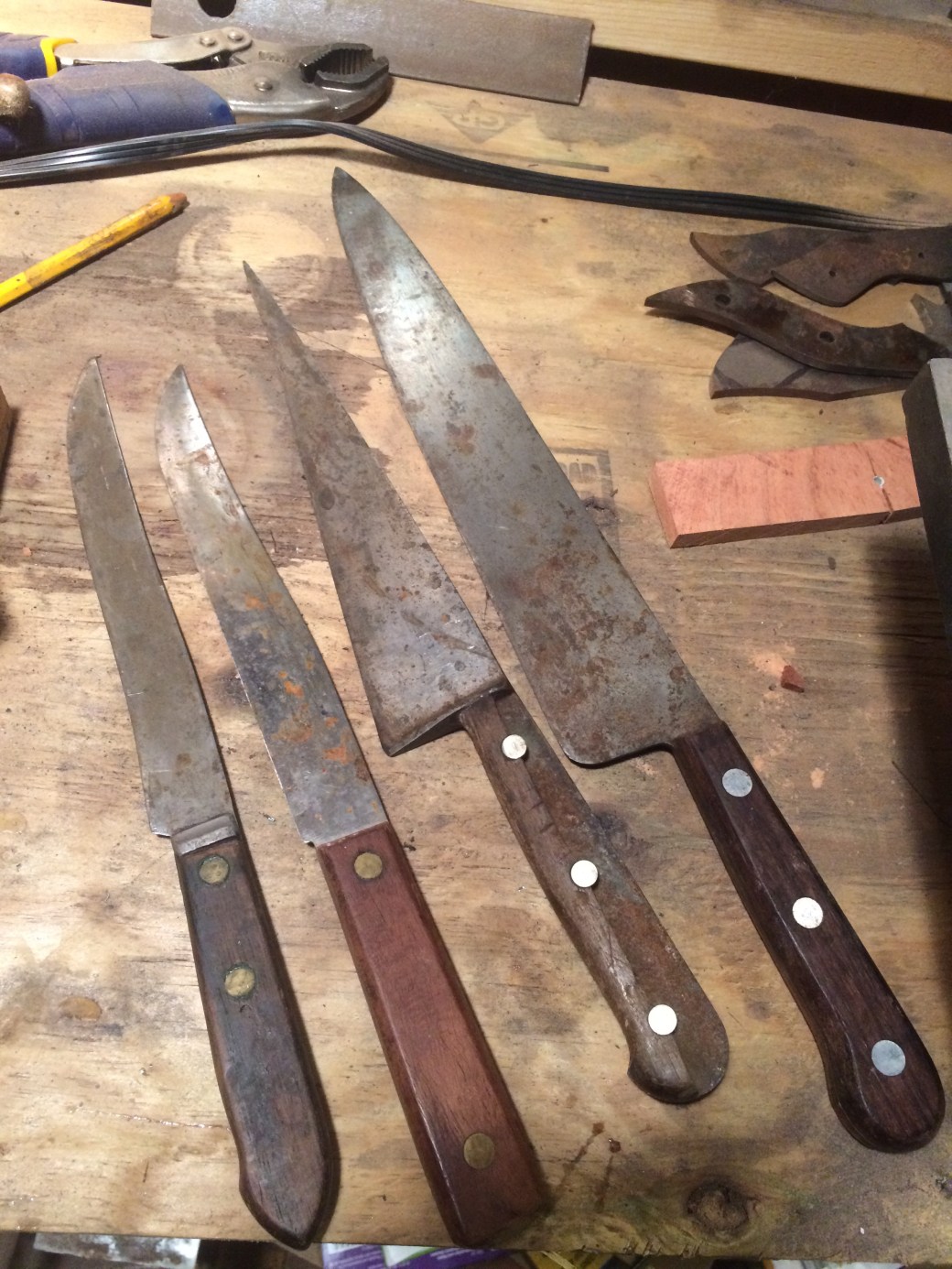
Tools of the trade, from left to right:  A carving knife; a fish knife; a French slicing knife; and a 12″ chef’s knife

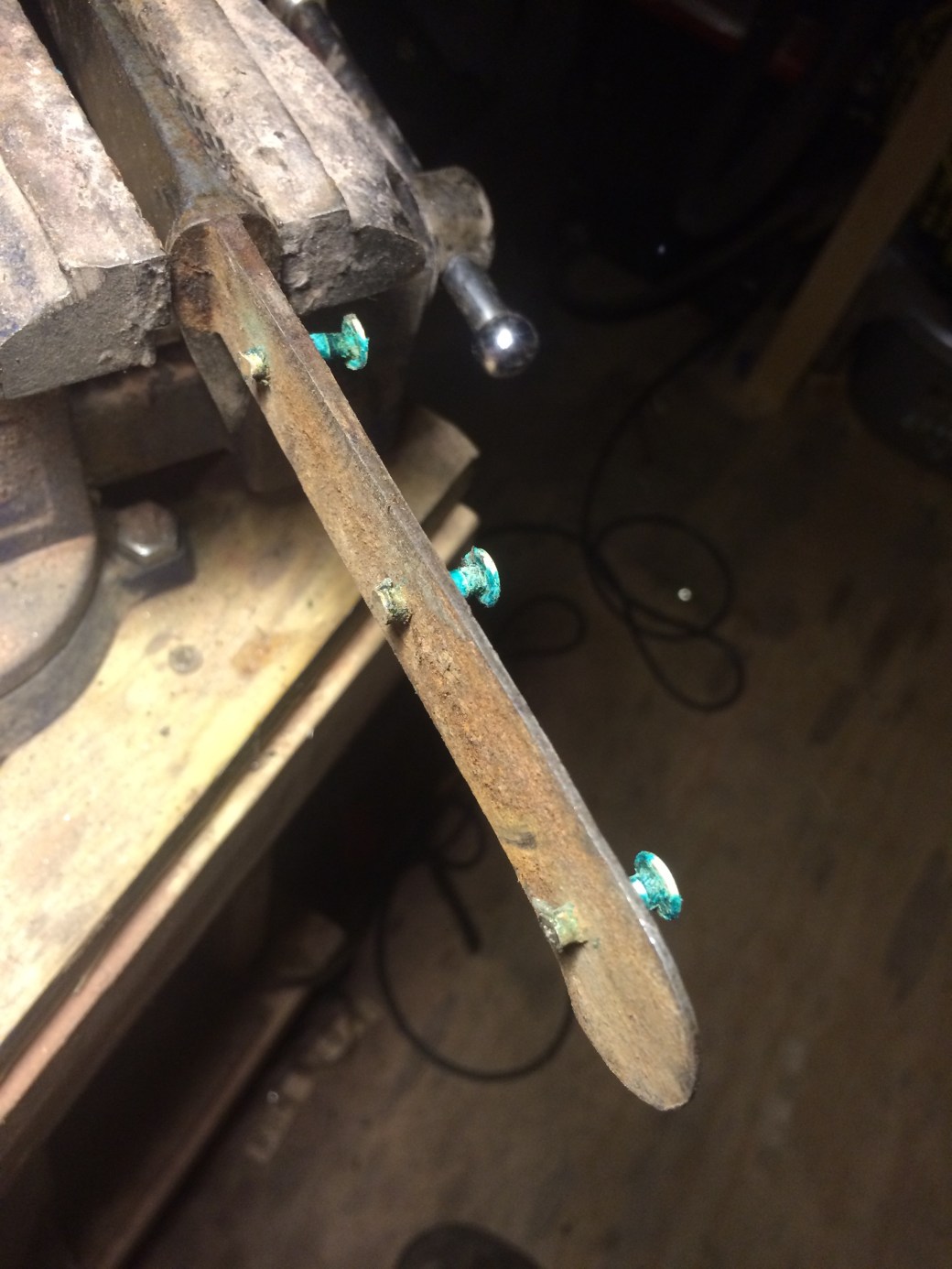
So these knives came to me, at least a hundred years old, and of deep sentimental value.   I started by removing the cracked and broken handles.

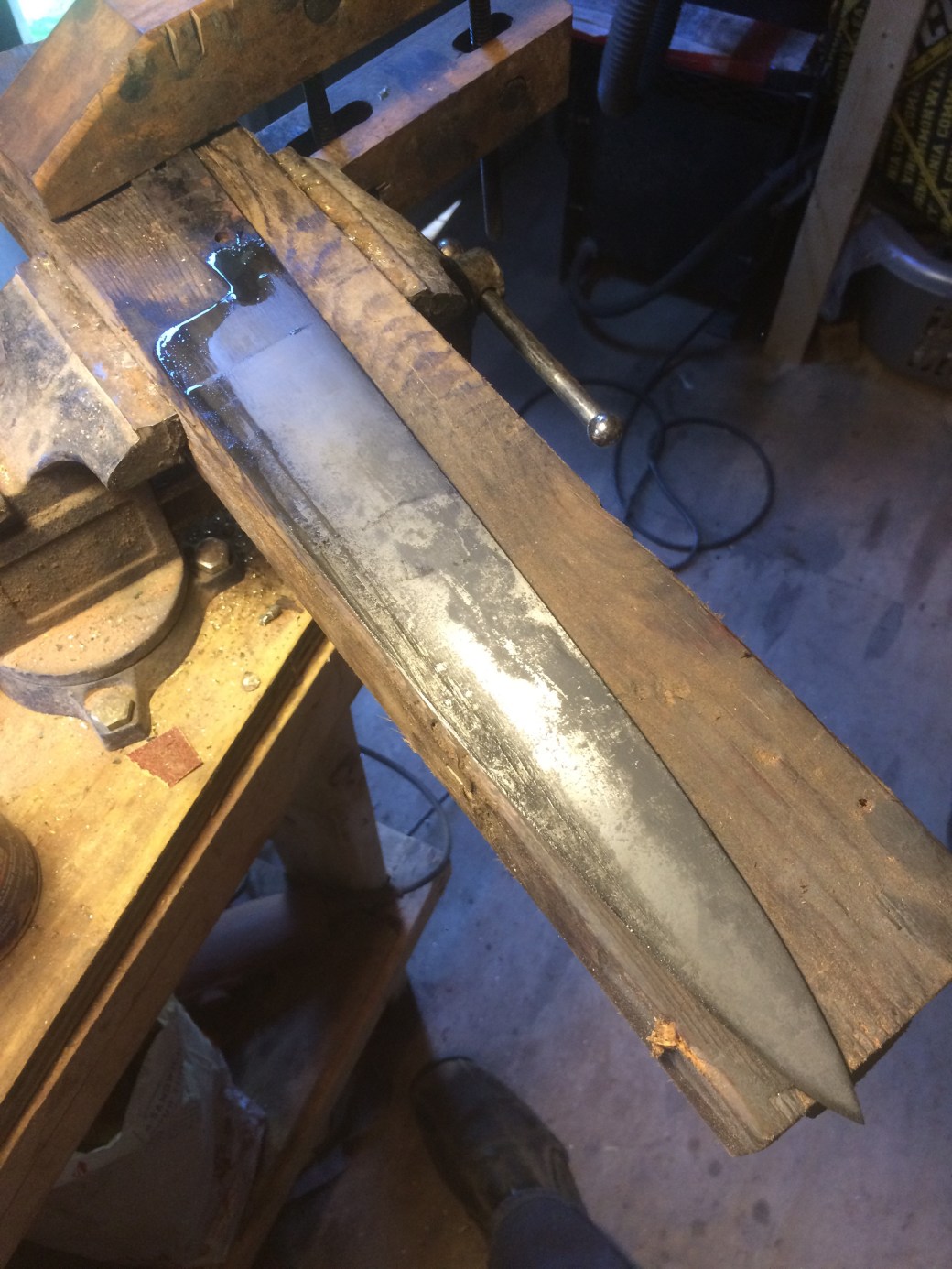
I cleaned up the corrosion and oxidization from the blades, but left much of the etched patina from their years in the kitchen.

In a continued practice of saying ‘yes’ I chose to use some of the Black Walnut I got from the tree job for the handle material.  It fit nicely into the story of these knives.  This is what it looks like sanded and polished.
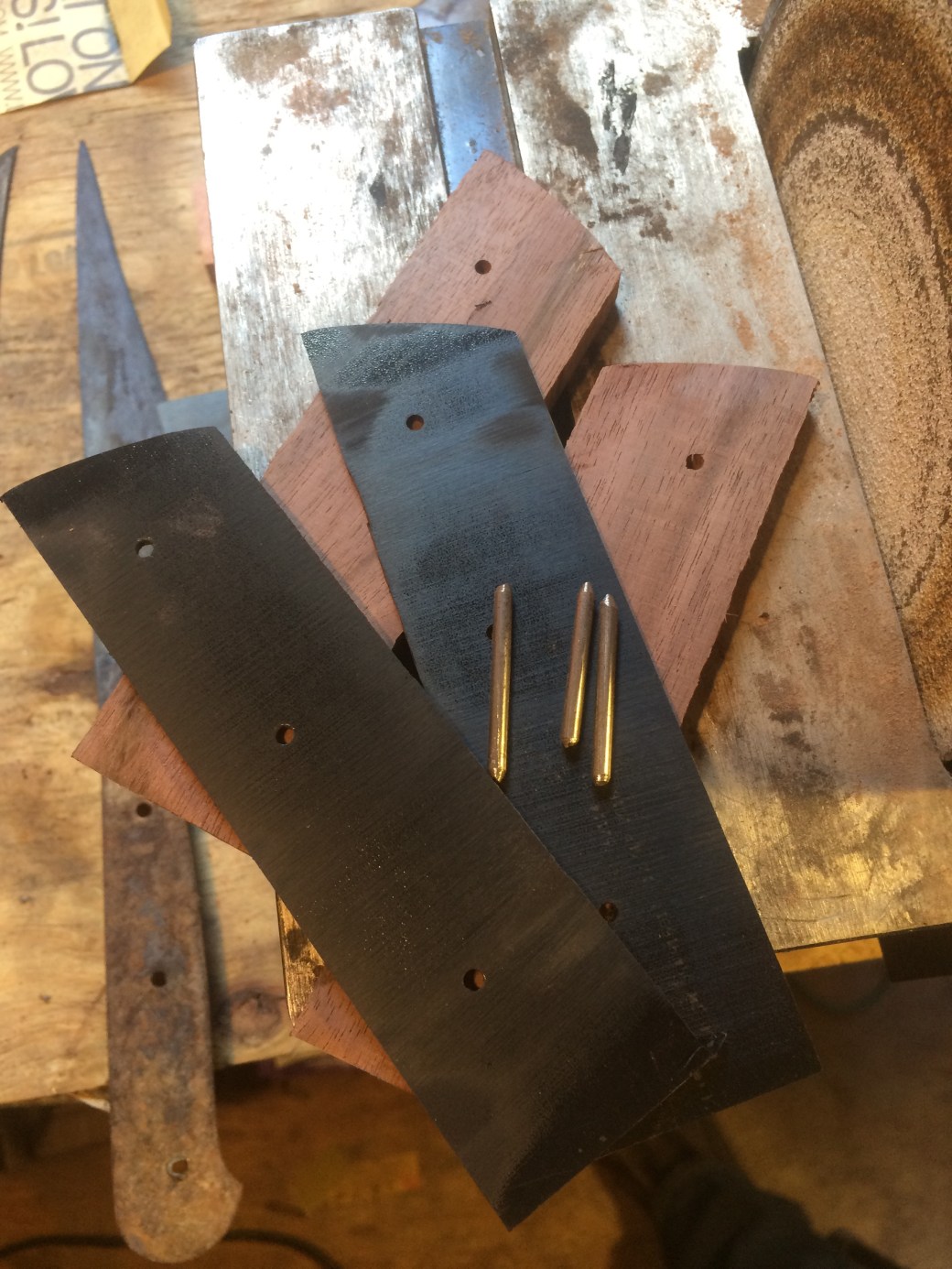
All of the handles started as thin blocks cut from the Black Walnut.

Shaping.


The filet knife was only half-tang, so I extended it with mild steel from a sheet.

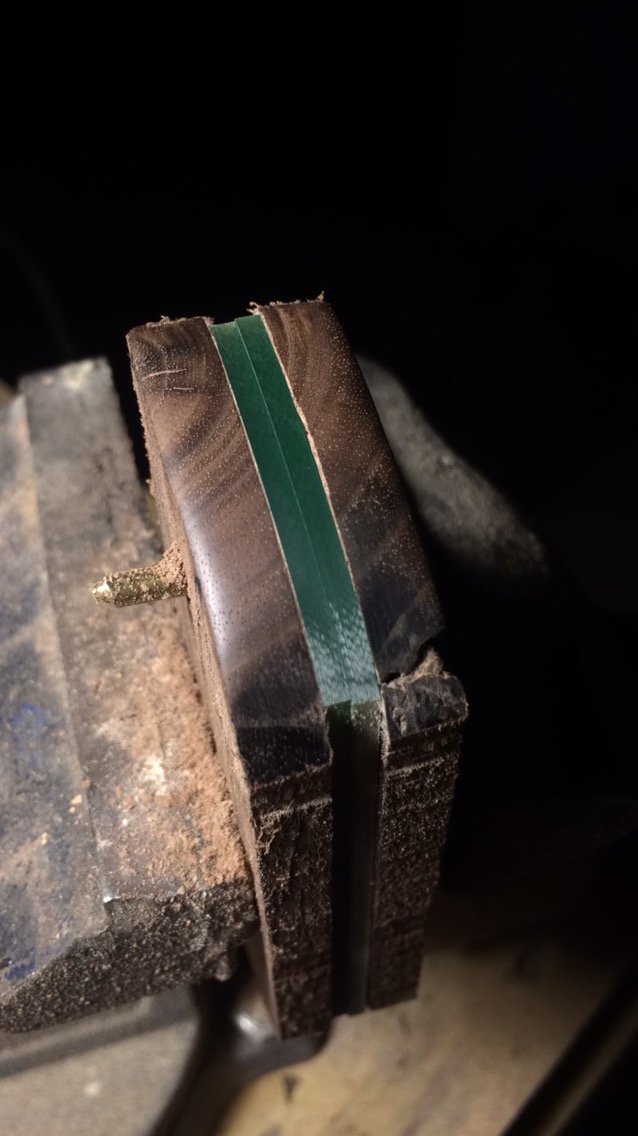
I added a G10 bolster and spacer for a bit of contrast.

After glueing and sanding.

Getting the fish knife ready for glueing and shaping.

The French slicer was tricky….

…but also an elegant challenge, with its tapered tang and integral bolsters.


Finished, they came out rather beautifully:

Say yes to the things that come to you whenever possible.  It’s always worth it on the other side.

Knifemaking: Chainsaws, Being Gentle of Spirit, and the Lionheart

‘Only the weak are cruel. Gentleness can only be expected from the strong.’

Leo Buscaglia

A couple of years ago I was out in the country with a good friend of mine, giving him a hand in clearing some trees on his property.  There was a ramshackle house on that piece of property that hadn’t been lived in for years.  We were clearing the trees to make a path for the demolition equipment to come in and tear what was left of this house down so a new one could be built.

We hauled logs and trees that had already fallen.  This area had not been visited by anyone in quite some time and was quite overgrown.  We didn’t bother with any of the larger trees but anything under forty feet was fair game.  We were in the middle of the woods and it was just us.  My friend had two Stihl chainsaws and was cutting the trees down.  I was hauling the logs out out of the way and stacking them to be cut into firewood later.

We took a break- there were a lot of trees left to take down.  My friend had two chainsaws, one for each of us, so we decided to divide and conquer.   When we got started again I grabbed a saw and found that I could not get it running.  I yanked the pullcord.  Nothing.  To be safe I topped off the fuel and the chain oil.  I adjusted the choke.  I gave the pullcord another tug.  When it still wouldn’t start I assumed that I wasn’t pulling hard enough.  So I pulled harder.

My friend stopped me and told me to be gentle, otherwise I would rip the cord out.  I kindly let him know that I was an extremely gentle person.

He laughed.  ‘Maybe gentle of spirit,’ he said and gave the cord an easy tug.  The saw started right up.
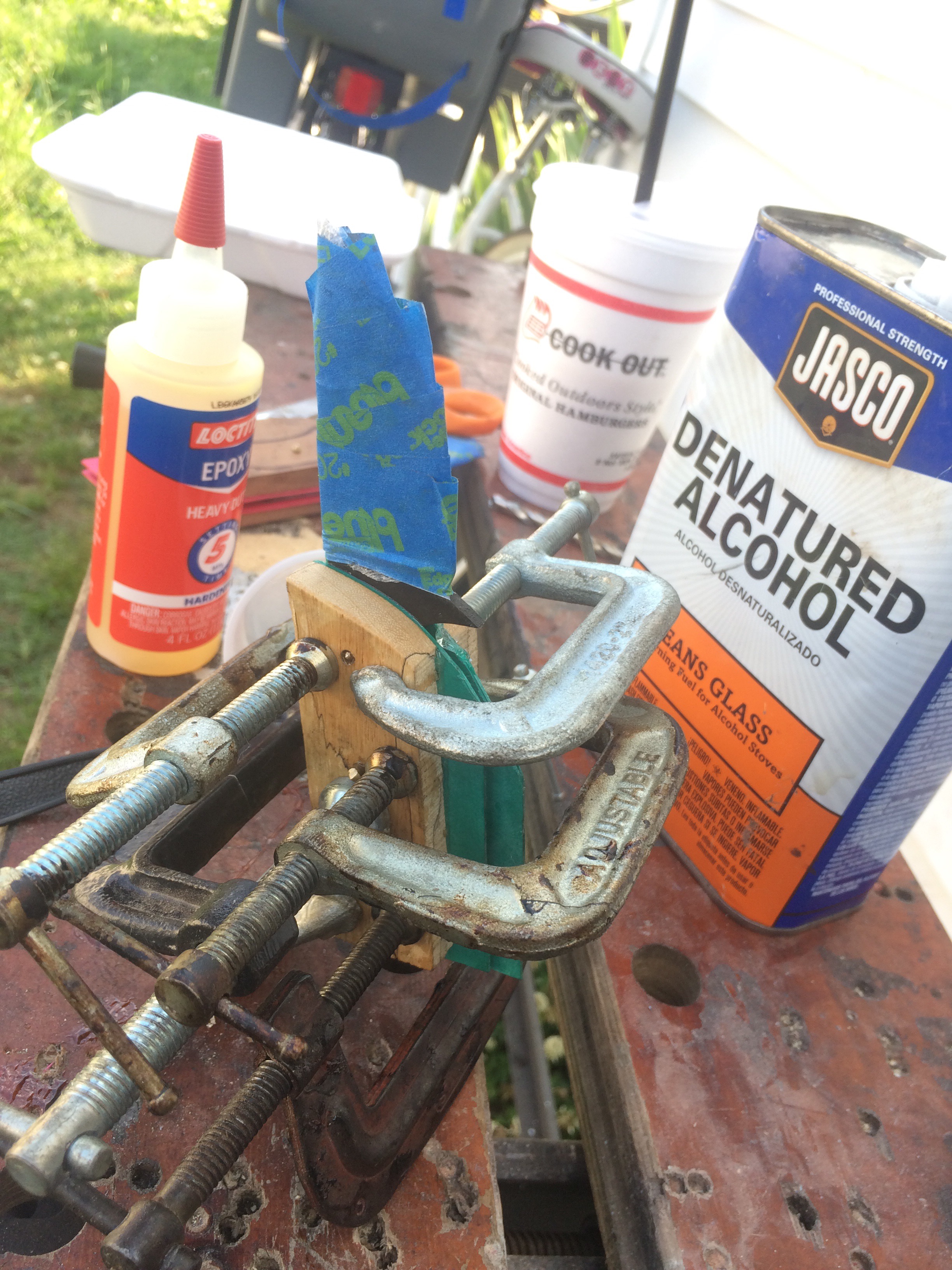
That man, always with the truth.  I thought I was being gentle….

The truth of the matter, and what became clear that day, is that behind any kind of power is gentleness.  Not everything in this world can be beaten or bullied into submission, though there have been times in my life where I liked to think so.  As with the chainsaw, gentleness sometimes IS the power.  Out in the woods that day, the one who was gentle was the one who was cutting the trees down and that person was not me.

Gentleness is often seen as a sign of being weak.  This is not true, despite what has been demonstrated to us throughout our lives.  While brute and strength and force have their place, without something gentle behind them they serve only to divide and intimidate.  Gentleness serves as a means to connect.  It acts as a vessel for strength, holding it and giving it purpose.  Behind every great leader, parent, speaker, or creator of things there is something gentle.  Without that everything dissolves into fear and chaos.

This is the lesson of the Lionheart.  To find gentle is to find power.  The road to finding those is courage and bravery manifested, which are traits of someone who is Lionhearted.  It’s not an easy road for certain but the best ones never are.

This blade is a 6in filet/boning knife, built from 1/8″ O1 tool steel stock.  It was commissioned by a man who has quite a bit of Lionheart in him, and was the inspiration for the namesake of this knife:

Rough cut:

Filework on the blade choil.  This makes it easier to sharpen and provides a visual aid in creating symmetrical plunge lines:

Profiled:

Initial work on the bevels.  Removing too much steel will cause it to warp in the forge.  Ready for heat treat:

Hardened:

Removing more material after heat treat:

Hand sanding:

Satin finish:

I should have drilled these earlier, but here we are:

Rivet holes in the scales.  The wood is Redheart:

Ready for assembly:

Profiled:

Shaped:

The Lionheart:

Be gentle with that chainsaw….

Knifemaking: the things that get in the way and the Arrow

“The way we do anything is the way we do everything.”

-Martha Beck

……..

“I guess I’ve been carrying many small things.”

-Mina Tindle- “To Carry Many Small Things”

When I was nineteen I started lifting weights.  I didn’t have a particular destination or goal.  The only real goal that was there was to lift as well or better than I had the day before.  I paid attention to form, technique, and consistency.  I got better as time went by.

Ritual was crucial.  I would allow myself to be very quiet.  I had a taken some dance classes in college and would do these really amazing spine-lengthening stretches.  After my workout I would take a shower, sit in the sauna for twenty minutes, and then leave.  I did all of this without speaking to anyone.  It was like going to church: still, prayerful, and introspective.

I never made notes or kept logs.  I made sure my routines and circuits were simple enough to remember day to day and week to week and so on.  I kept up with this for eleven, maybe twelve years.  When I felt good, I went to the gym.  When I felt bad, I went to the gym.

Then about two or three years ago I noticed I was having trouble finding those quiet and still places.  I had trouble getting to the gym and staying present with what I was doing.  Actually I had trouble staying present in nearly all the things I was trying to do.  I wasn’t sure what to do.  I went to the doctor, got blood work done.  I talked to a therapist.  I was healthy.

My girlfriend noticed this, and put me in touch with a lady she had been studying with.  She said I was probably missing a physical practice and since the gym wasn’t in the picture anymore I should at least talk to this lady, who was in the practice of Ashtanga yoga.  I had watched her take a course of study from this woman to help her heal from a hip injury.  She was calmer, glowier, and looked fantastic with a sort of shimmer about her.  Ok, I finally said, I’ll give her a shout.

I made an appointment with this lady and we talked about what it was to practice yoga.  Her name is Leigh.  She told me that in this practice, if practiced diligently, transformation would occur.  She said that I would notice unpleasant things rise to the surface.  Things would fall away, she said, and those would mostly be the things that got in the way: bad habits, patterns of self-sabotage, and bad attitudes- the fun things. Afterwards I told my girlfriend that if I turned into some sort of New Age asshole who extolled the virtues of kale and hashtagged ‘namaste’, I would prefer she shoot me, bury me in the backyard, and tell everyone I left her.

(Quite a few months later I would find myself in front of a salad bar at a hillbilly barbecue buffet in North Carolina, and I would notice that my first thought was ‘where the fuck is the baby kale?’  My second thought had something to do with being shocked that my first thought was about kale…).

I started meeting with Leigh about every month or so and she was right.  Things DID fall away.  I found myself becoming very protective of my sleep and rest.  I started eating better and found myself desiring fruits and vegetables, which is something completely new.   I stopped going out and I didn’t miss it at all.  I leaned into life a little more.

Then I noticed all the small things I had been carrying.  In Ashtanga, I found that almost everything I didn’t like about myself was held out and dangled in front of my face whenever I was on the mat and often culminated in tears.  I wasn’t aware of all the prickly bits I carry around on an almost daily basis: guilt, shame, resentment, rage, and impulsivity.  I’ve always heard from my friends about how relaxing and grounding yoga was for them.  I have not had that experience.  I sobbed uncontrollably during the first week I started.  I wasn’t nearly as patient as I thought I was, and definitely more judgmental than I ever believed.  Sometimes I find I am so present with myself that it hurts.  Unlike the gym, there is no rush of endorphins for me.  I end with everything I start with and honestly, it really sucks sometimes.
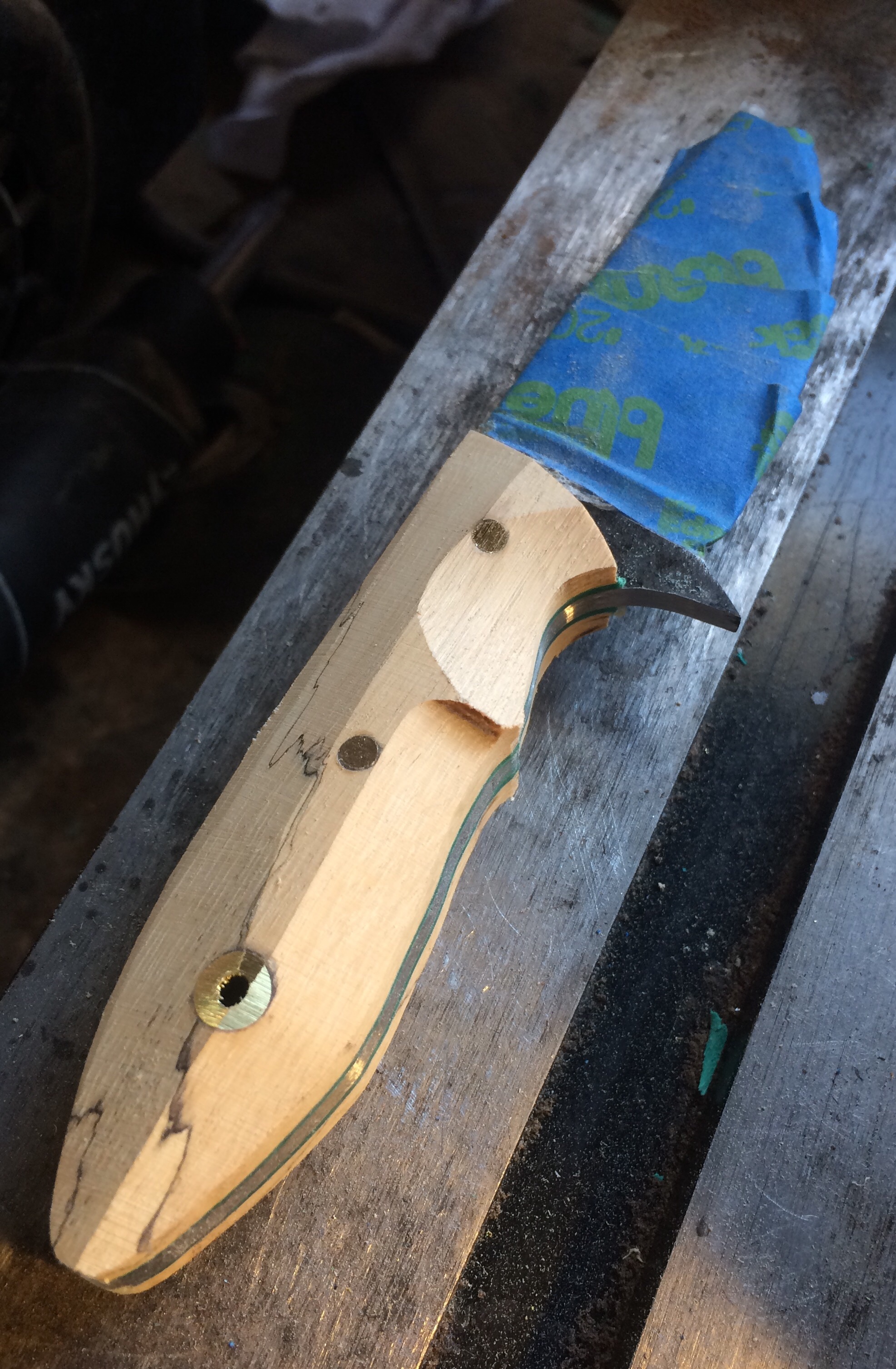
This sounds like a ringing endorsement and you’re probably asking yourself “where do I sign up?”

The truth is that this is a practice that helps you to know yourself, all of yourself, and that is usually going to be painful.  The growth and transformation happens when you find the pain isn’t going to kill you (although sometimes you wish it would).  The idea is not to make the uncomfortable things go away- they aren’t going to.  It’s to create a space to be with them and to go about your life in spite of being uncomfortable.

This blade was a commission for Leigh, from her husband.  Both of them are incredibly loving and kind and supportive people.  Leigh herself is an arrow, piercing those things that get in the way and always doing so with love and encouragement.  She has become a very dear friend and making this knife was a pleasure.

I designed this knife for whittling.  She is built for a smaller hand:

Rough cut, from O1 tool steel stock:

Smoothed out:

Centerline scribed:

Rough grinding:

Hardening:

Tempered:

Laying down a hand finish:

Just a bit more:

Spalted Tamarind:

Bookmatched:

Ready for glue:

Glued and clamped:


Shaped to fit the hand:

The Arrow:

This knife comes with a prayer, the Prayer of the Arrow, to help with all the things that get in the way:

May I be kind to myself
May I be gentle toward myself and others,
And may I move through my world with elegance and grace
May I find a calm mind and go about my day with peace and serenity and
May focus manifest within that calm
Help me to let go of guilt and shame, and help me to be with my anxieties, and to
Lean into my fears and not
be intimidated by them or anything else
May I know that I have enough
Help me to see things for what they are, and to
let go of appearances and of what others may think
Help me to know strong boundaries and to act on them
Help me to not think so much or give so much weight to my emotions and desires
Help me to keep moving forward and to have faith in myself and those I care for
Please keep me safe
And let me know that I am loved

Knifemaking: finding a way and the Desert Fox

“So many people live within unhappy circumstances and yet will not take the initiative to change their situation because they are conditioned to a life of security, conformity, and conservatism, all of which may appear to give one peace of mind, but in reality nothing is more dangerous to the adventurous spirit within a man than a secure future.”

John KrakauerInto the Wild


The Desert Fox, also known as the Fennec Fox is the smallest member of the species Canid.  They can be found in the Sahara Desert of North Africa.  Living in such averse conditions has allowed for some particular adaptations in order for them to find their way in their environment, most notably their prominent ears (I mean, look at those things):


The ears help them to dissipate heat, as desert temperatures can get up to 117 degrees Fahrenheit during the day. They also have a specially evolved set of kidneys allowing them to go without water nearly indefinitely and their required moisture can be obtained from their food.  Unlike other foxes or canines, they have fur on the bottoms of their feet.  This keeps them from burning their feet when traveling over hot sand.  Their cream-colored coat helps to reflect the heat of the sun.

They are omnivorous, eating insects, lizards, and birds, but are also known to eat roots, leaves and other vegetation.  The Desert Foxes are social creatures, live in groups, and mate for life.

I find this to be an incredibly encouraging little animal, finding home and company in a place where a large portion of its environment is actively trying to kill it.  On days where I’m not sure how to find my own way, I often think of the Desert Fox.  I find that I don’t have to worry about blistering heat, numerous birds of prey, even more numerous venomous snakes, or scarce food sources, and then I proceed to count my blessings and pray that I don’t become complacent in my station from lack of natural predators.

Because finding your way when there isn’t anything pushing you can be just as hard as navigating a desert full of bad things.

I was in Pittsburgh recently, taking an Uber to dinner.  I’ve never particularly cared for riding Uber; it always feels like there’s an expectation for conversation and an uncomfortable and resentful silence if that expectation is not met.  On one Uber ride in Manhattan there was a driver from the Caribbean who wouldn’t stop talking about his kid and showed my friend and I a video of him playing baseball.  All this while driving in rush hour traffic.  This most recent Uber ride was not that.

The man picked us up and the conversation was easy.  After a little while of talking about what we were doing in the ‘Burgh, I asked him what he did for a living.  He said that he had been a private investigator in Los Angeles for twenty years, from the early ’80’s to the late ’90’s.  He said he had seen it all: cheating spouses, runaway kids, you name it. He thought it was all hilarious.  He wanted to write a book.

His friends all thought his stories were great and they had been encouraging.  The only problem, he said, was when he sat down to write he couldn’t get anything on the page.  He just froze.

I know what this is.  This is the crippling self-doubt that almost every writer and creative person I know deals with.  Myself included.  I told him so.  Hell, I know a filmmaker who has a Crippling Self-Doubt Room in his house where he goes before he works on his projects.  If you don’t find a way forward, you get stuck, and your ideas aren’t heard.  Nothing happens and life goes on.  You have to live with the sting of unrealized potential.  That sting becomes more painful as the years go on and there is no more time to realize what could be.

The only thing to do, I told him, was to find a way to be with that debilitating feeling of self-doubt.  Find a way to get something, anything, on the page.  Once there is something on the page finding your way becomes much easier, and it can take you to surprising places.  There is meaning in those places, satisfaction, and everything becomes a bit deeper and beautiful.

This is the lesson of the Desert Fox, a creature that has an unforgiving place to call home yet finds a way to thrive in it, and makes an existence in the uncomfortable.  If there is something eating at you and calling to you, then you can always find a way to make it happen.


We start with flat stock O1 tool steel:

Roughing in the blade choil:

Profiled:

Rivet Holes:

Hand sanding the bevels before heat treat:

Hardened:

Tempered:

Hand-finished satin:

Texas Mesquite.  One of my most favorite materials to work with:

Shaped:

Sanded to 220 before giving the grain a burst:

The Desert Fox:

If you can find a way to exist in the uncomfortable, than you can almost always find a way forward.

fennec fox

Knifemaking: Rock and roll, privilege, and the Sir

“He who conquers himself is the mightiest warrior.”

-Confucious


Warrior, Merchant, Artisan, Farmer.  These are the four classical occupational archetypes of Feudal China.  These archetypes still ring true today.  There are variances and nuances but in the way we go through life, many of us find ourselves in all four of these occupations, even if only briefly:

-The Farmer understands the value of labor.  He is master of working within the seasons to sow his crop.

-The Artisan understands how different mediums and materials go together, and how to craft his goods within that understanding.  He is master of his tools.

-The Merchant understands business- buying low, selling high, and having a good product.  Business at it’s core level is the art of profit and the Merchant is master of this.

-The Warrior understands the above three archetypes.  He is master of himself and carries the weaponry of his choosing.  He serves society.

I have found myself, at various points in life, in all four occupations.  The Warrior intrigues me most.  Speaking as a man, I feel that most of us want to master ourselves, and the things that try to enslave us- our fears, our desires, and our insecurities.  In our occupations and work, obsessions and compulsions can develop, our fears can play out, and we can become consumed.  We can become obsessed with trying to squeeze the seasons dry, or maximizing profits, or with crafting a better and more beautiful mousetrap.  When these things become all that we see, we have failed to master ourselves and aren’t really serving anything except for what we are trying to achieve.  At this point, all the things that really matter get left in the dust.  We lose sight of the world we live in and are not present in our lives.

In order to master yourself you must know yourself.  Sometimes the best way to know yourself is to know others.  And sometimes the best way to do that is in service to others.

I was working a large arena rock and roll show, one of the largest I’ve ever worked.  The headliners had been around for decades, on the top of the charts, and darlings of video-era MTV.  They have recently been selling out arenas around the world.

I strolled into the production office to get my assignments for the day.  There was laundry, grocery shopping for the tour busses, FedEx and post office runs, prescriptions to be filled, and other bits of housekeeping errands that keep a massive touring operation on the road.  Not everything gets done.  Touring is a practice, not a science.  The most successful touring operations are predicated upon this notion.  My job is to take care of as many of these things as possible based on what the tour needs and the priorities of the show.  This doesn’t leave time for anything that may be superfluous or unnecessary.

After the day was laid out and I had my assignments, the tour manager asked if I could add another thing to my list.  There was a very large basket of toiletries- soaps, shampoos, and lotions- that had been collected from God knows how many swanky hotels.  The tour manager asked me if, time permitting, I could find a Women’s Shelter or a shelter for families in transition and drop them off there.  The band and the crew collect them from every place they stay for that explicit purpose.

I didn’t give it too much thought.  I had a lot of things to do and honestly this little task wasn’t real high on my list.  But the tour manager kept asking me about it and so I decided to make it a priority.  After all, I was in a position to take care of this.  I got on the internet and found a facility nearby.  It was a shelter for women leaving bad domestic situations- in many instances they showed up with nothing but the clothes on their back.

I called them and told them who I was and who I was with and asked if they accepted donations.  Yes we do, they said, please come by.

So I went by, even though I really didn’t have the time.  The people at this organization were really happy to get these things.  They wanted to take a picture for their social media page.  All smiles.  They thanked me for thinking of them and to remember them in the future because funding is always tight and every bit helps.

This was all really special to be a part of, even though it was a pretty small thing.  I wasn’t really expecting that and it was nice.  I don’t normally find myself in these sort of situations.  I’m usually wrapped up in my own affairs, serving the things I am trying to achieve rather than broadening my gaze.  I noticed a lightness in me and the rest of the day felt easier.

There’s a lot of talk about privilege- white privilege, gender privilege, and a myriad of others.  When all of the social justice orthodoxy is stripped away, I find privilege to be a form of power.  There’s nothing wrong with being privileged but it’s important to be aware of it.  Many of us aren’t aware that we have that power within ourselves.  It’s a noble thing to use that privilege, that power (which, honestly, many of us take for granted) to help those who may need it.  It’s a really special thing to give or share of your time and talents when it’s within you power to do so.  This type of service can help you to become more familiar and intimate with yourself, and also help to make the world around you a better place.  That is the mark of a Warrior, and the lesson of the Sir.

O1 tool steel, thin stock

Profiled:

Rough grinding:

This is how to heat up your quench oil on a cold day:

Hardened and tempered:

Handfinishing, at around 220 grit:

Hand finishing at around 320 grit:

Ebony wood:


img_4467

Clamped:

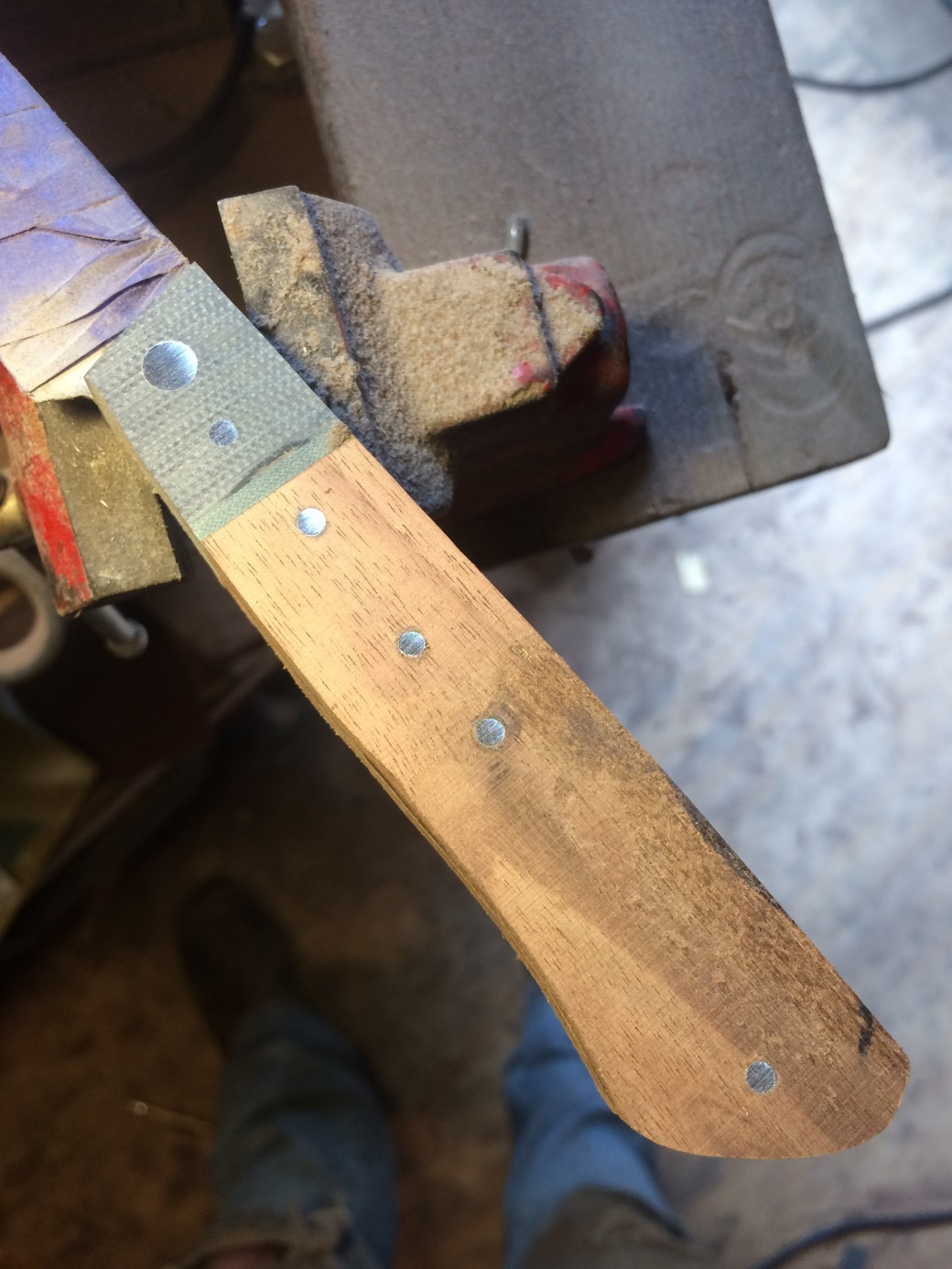
Shaped:

The Sir:

Don’t be afraid to look out for others every so often.  This is part of the path toward mastering oneself.

Just a Bunch of Roadies– This is an organization of Music Industry Professionals that use their time and talents to make a difference.  They facilitate larger operations, but also smaller projects, like the one written about in this story.  Be sure to check out their website if you would like to help.

Knifemaking: doing the work and the Operator, Mark II

“The sword has to be more than a simple weapon; it has to be an answer to life’s questions.”

Miyamoto Musashi, The Book of Five Rings

(you can read about the crafting of the original Operator here)

I’ve always been drawn to people who do things.  The people who speak through their work and translate knowledge and mastery through their particular skill set without having to say much.  This is a day and age where anyone can broadcast claims of mastery and experience to a large audience and it can be difficult to discern who has done the work to back up these claims and who is just trying to get to the bank.

In today’s vernacular, ‘operator’ commonly refers to military personnel who are at the pointy-end of things.  They are the ones who are taking the orders and quietly (or not so) doing the work out of a sense of duty and service.  ‘Operator’ is a title that gets tossed around and claimed where it doesn’t always belong, very similar to ‘genius’.  The ones who actually fit the bill generally eschew such titles.  This is usually a symptom that you are doing the work.

This blade was a commission for a military serviceman doing Ops work.  I wanted to build him a tool that would serve him in the work he was doing.

There was a summer about ten years ago where I was between semesters of study.  I had decided that I wanted to learn how to fix things.  Many of my friends were working at Blockbusters or car washes but I liked the idea of being able to take care of things myself.  I took a really awful job doing apartment maintenance for three and a half months and did just that.

It was not very satisfying.  The job I took was for a rental company who owned properties in my neighborhood so I could walk to work.  It was a pretty slummish company that rented to a lot of college kids.  I ended up having keys to half the apartments of what was called ‘Hell Block’ of a street close by to me.  The summer was when a lot of leases ended so there were many people moving in and out.  As a result the streets and alleys were full of discarded furniture for most of the summer, a lot of which was set ablaze by some of the rowdier tenants.  Sometimes my days started with cleaning up the ashes of incinerated love seats.

Other days started with hauling four-burner stoves up three flights of a fire escape.  Most of the time was spent flipping apartments from where someone had moved out so that someone else could move in.  There was a lot of painting.  Flat antique white for the walls and ceilings and semi-gloss eggshell white for the trim and kitchens.  The apartments weren’t very nice to begin with and after three days of work they still didn’t look very nice.  I tried to remind myself to just make it about the work.

I would spend hours gutting bathrooms- ripping out drywall, removing tiling, and replacing subflooring before redoing everything.  The best days were when I could work by myself and keep my own company.  Bathrooms were a bit more satisfying to do because they would actually look nice when you finished them.

There was one time when a new tenant couldn’t move into her apartment because a homeless person had moved in after we had flipped it.  We went in the apartment after the police took him away and found no less than eight bicycles, some smelly furniture, and a plethora of bizarre pornography.  There were also footprints all over the wall.  We had to repaint that one.

My boss was a middle-aged anomaly with claims of ties to the trash hauling unions of New York City.  I didn’t really believe anything he said.  There were four of us handling most of the work orders:

-Mark was in art school, a bit cranky, and liked to smoke a lot of pot.  Oftentimes it was hard to tell whether he was stoned or not.  I liked him.

-Scott had gotten back from several tours of Iraq, most recently Abu Ghraib.  He was a good guy but wouldn’t get anything done unless he was told exactly what to do.

-Mario was in his late thirties and from Guatemala.  He worked 7 days a week and sent most of his money home to his family.  He didn’t say much but I think he missed home.  The man could eat faster than anyone I’d ever met.  He said that in the Guatemalan Army they only gave you three minutes for lunch.

There was also a rotating cast of derelicts who would come in and work for a week and then disappear.  I never learned their names.

One of the happiest days I had was telling my jackass boss that I quit.  I gave myself a two week vacation before I went back to school.

What I learned at this job was that in order to get through many uncomfortable situations with a modicum of success you have to make it about the work.  It helps to find something bigger than yourself in what you are doing.  The skills I was learning would serve me well much later down the line, and the money would help me buy books and live through the school year and work on my education.  Everything else was just bullshit that came with the job.

To let yourself speak through the work you do, whether you are toppling Marxist empires or replacing toilets in shitty tenements- this is the lesson of the Operator.  In these situations our work speaks through us but also teaches us our lessons.

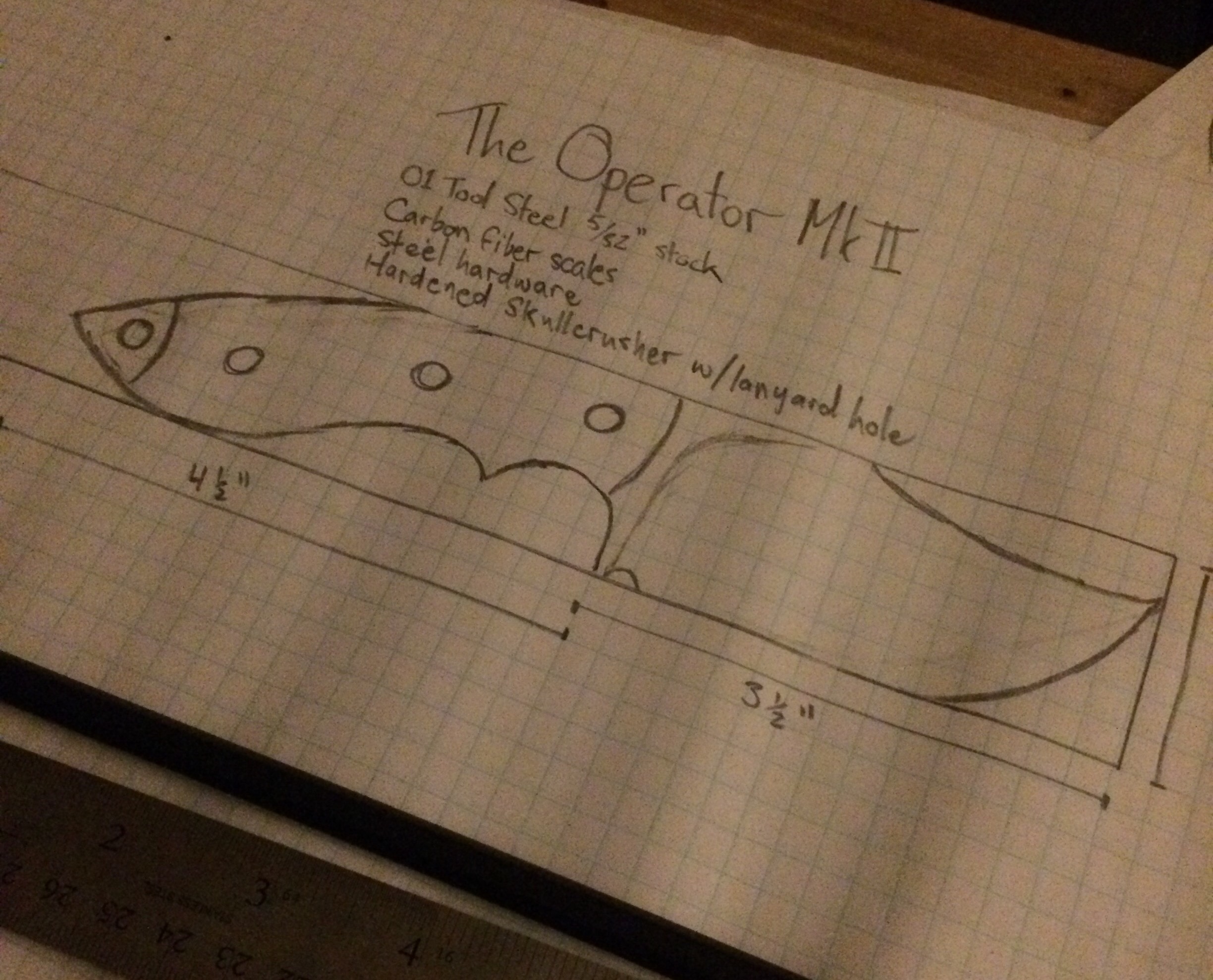
The recipient of this blade may find himself in harms way and needed a blade that would serve in such situations:

Rough cutting:


Bevels profiled:

Hardened:

Hand sanding:

img_4169_srgb

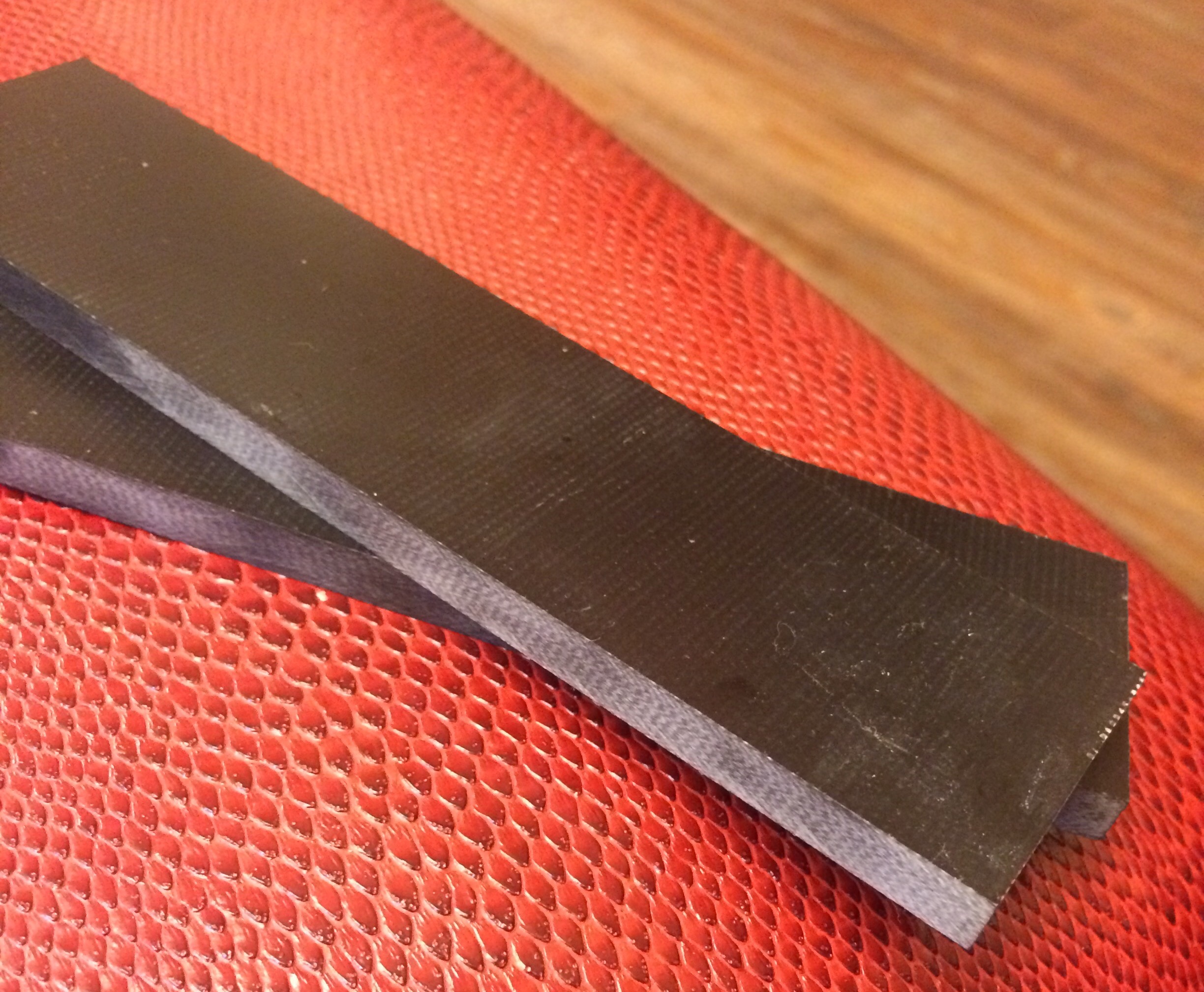
This is G10, a commercially manufactured synthetic material.  Normally I prefer to make my own handle material but in this instance I opted for something consistently fabricated that would be failsafe in a potentially tactical situation:


The Operator, MkII: O1 tool steel, G10 scales, fabric spacers, and steel hardware.

Let your work be your lessons.