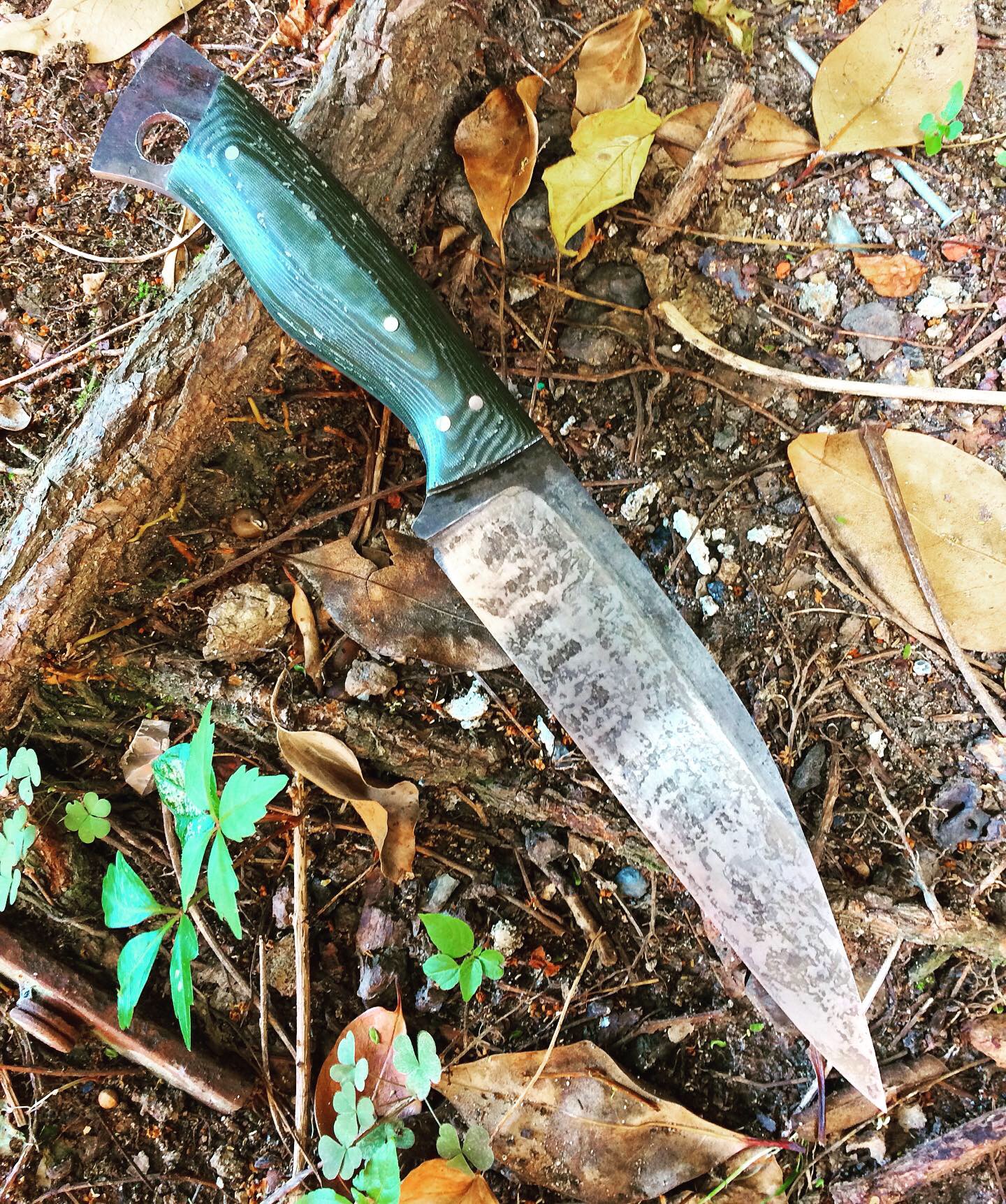
Knifemaking: remembering the magic, and the Bounty Hunter

“Come On, Baby! Do The Magic Hand Thing!”

-Greef Karga, from “The Mandalorian

I remember, at the age of fourteen, running around my grandmother’s backyard and pretending to have a lightsaber and desperately attempting to feel the Force flowing through me. It was around 1998 or 1999, and I had just seen the special edition of “Return of the Jedi”. Other fourteen year-olds I knew were busy with sports, or having girlfriends, or smoking cigarettes, drinking, or doing drugs. In other words, doing nearly anything but pantomiming a nearly fifteen-year-old sci-fi-fantasy film in a relative’s backyard, but there I was. By that point I had been neck deep in the lore of Star Wars for years. I had all the books- from the Jedi Academy series and Tales of the Bounty Hunters, to the books detailing the technical specifications of the weapons, technology, vehicles, and alien races. I played Dark Forces and Dark Forces II: Jedi Knight, Jedi Knight II, Shadows of the Empire, and half a dozen others. I knew the legacies of Dash Rendar, Kyle Katarn, and how to make a Ruby Bliel. I had the soundtrack to all three films, each on double cassette. I hadn’t tasted the kool-aid: I had dove headfirst into a vat of the stuff.

What this type of fixation does in younger people, as any nerd-dom member will tell you, is allows one to cultivate a rich inner life and vivid imagination for things. It also teaches one to see the magic where one would not normally expect to see it. This is why many nerds grow up to be incredibly interesting and capable adults.

On top of this, everyone experiences times when they find it difficult to see the magic in life. Falling down rabbit holes teaches you how to nurture yourself when everything might not be so inspiring. The thing that has always saved me is remembering what it is to feel the mystery of it all. The past year has been an exercise in this. Most of my work has been cancelled due to Covid and as of yet has not come back. No knife shows, no gigs, minimal commissions. One of the bright spots of this whole debacle has been season two of the Mandalorian in the fall and winter of 2020. When you’ve been stuck at home doing menial pandemic work just trying to pay the bills, there are few things like a person of a mysterious creed and badass armor having interstellar adventures with Carl Weathers and Bill Burr and a Force-sensitive baby Yoda. Every week I tuned in like I was fourteen. It’s deeply reassuring to know that during such troubled times there are things to make you remember why you pursue that which you value and help you to feel the magic in everything.

For me this is the beauty of having a small custom knife shop. You can do anything you like. There are limitations, the greatest being time, but almost anything that you can think of you can usually do (provided you have the patience.) In this respect, it’s important to keep the mind limber and receptive to creativity for when the muse strikes us. If I am not inspired, I know how to find those things because I’ve been doing it since I was little. Sometimes it’s podcasts, or a song, or a line from a book, or perhaps even a conversation or something I’ve eaten. Because of the pandemic and not going out into the world in my accustomed fashion, this has been quite challenging most days. If I can stir myself, then i can certainly stir someone with a knife I’ve built. If I’ve done that, then my job is complete.

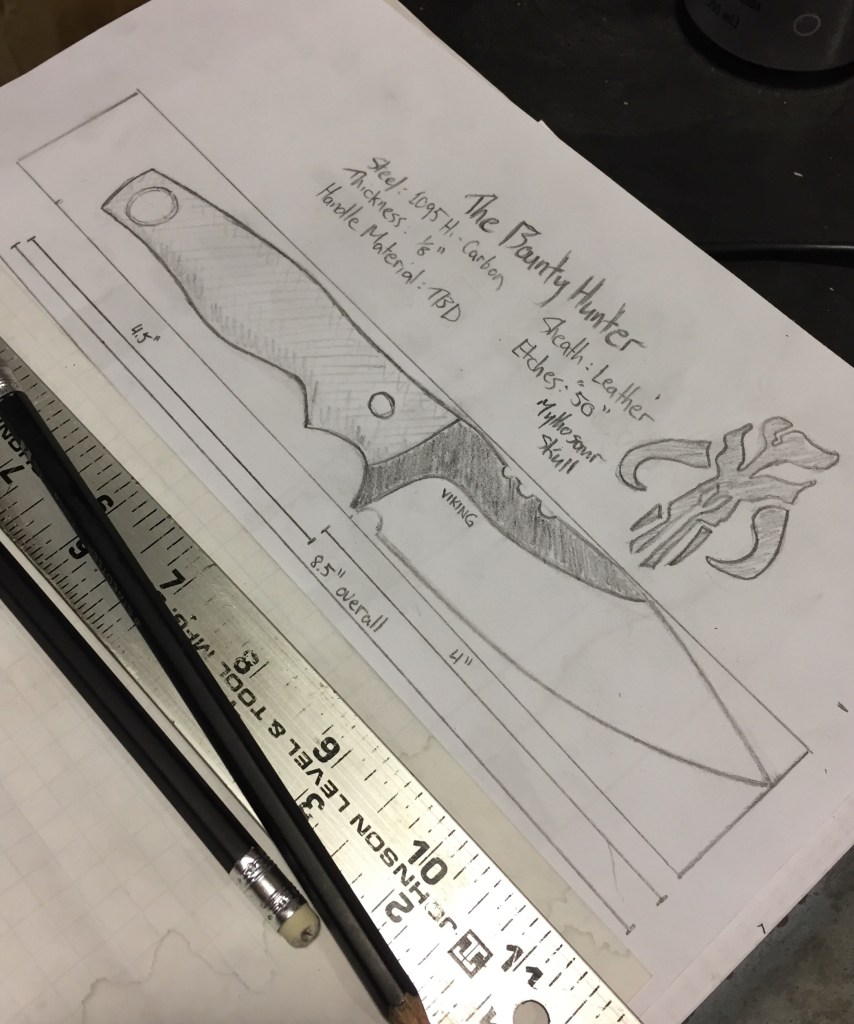
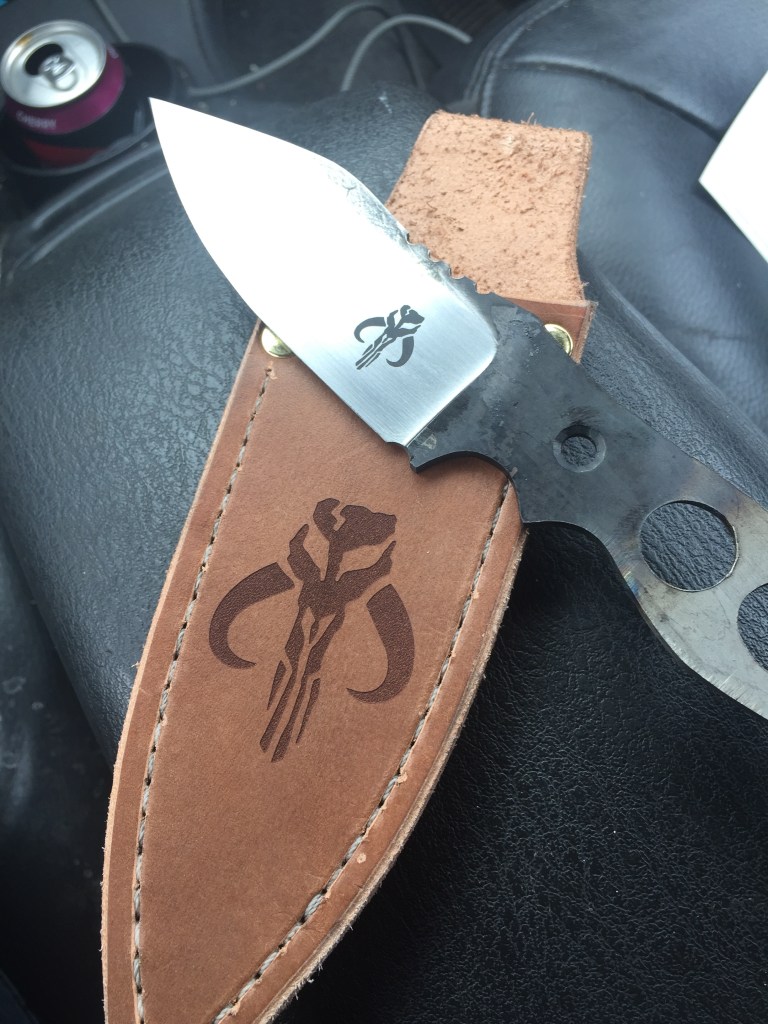
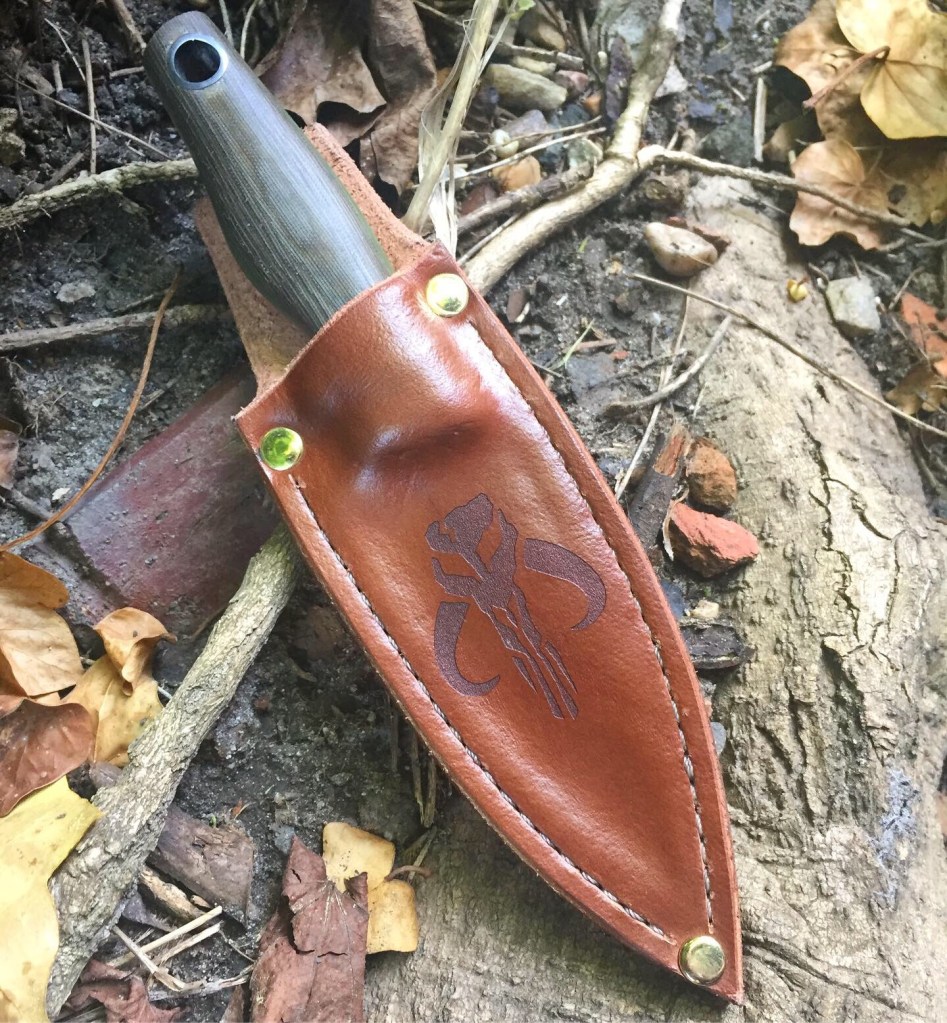
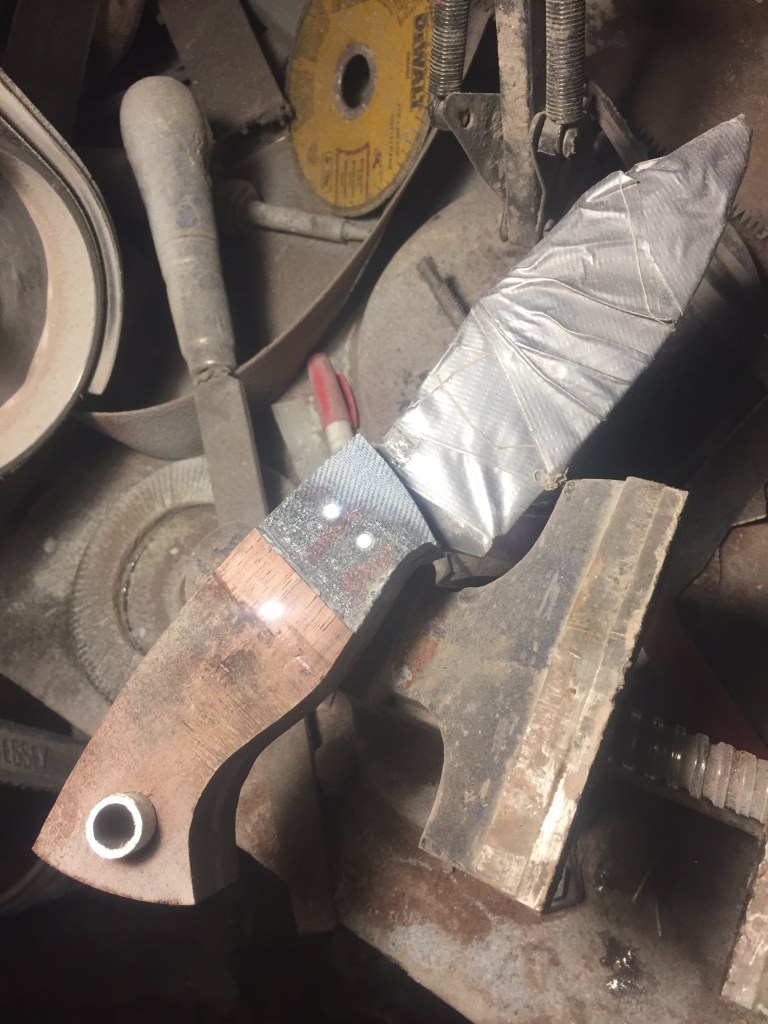
But sometimes we get commissions where WE are the ones who get stirred. We prefer to do everything in house and make sure the work comes from our own hand. While we don’t outsource tasks very often, occasionally we’ll get a commission that is interesting to us and requires that we do so. I received and email from a very good customer asking if I could get a Mythasaur skull on a custom blade and sheath. I thought of how the Mandalorian was such an oasis during a tough time; my own personal magic-hand-thing. I came up with a design that I hoped could fit a Mandalorian bounty hunter and found a laser engraving company in town. Chase your muse, do the work, and walk your path, don’t give up. It’s a journey but this is the way.

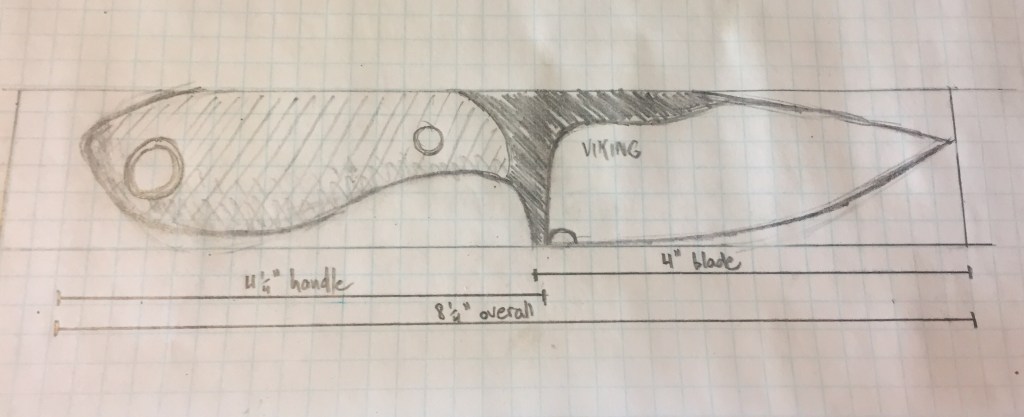
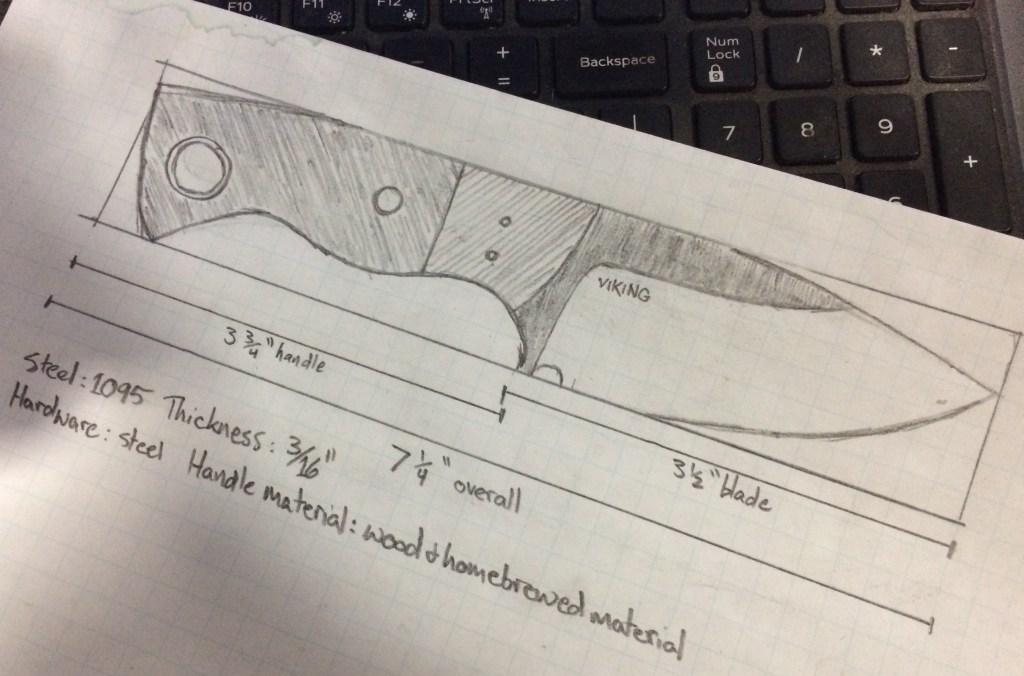
A quick schematic
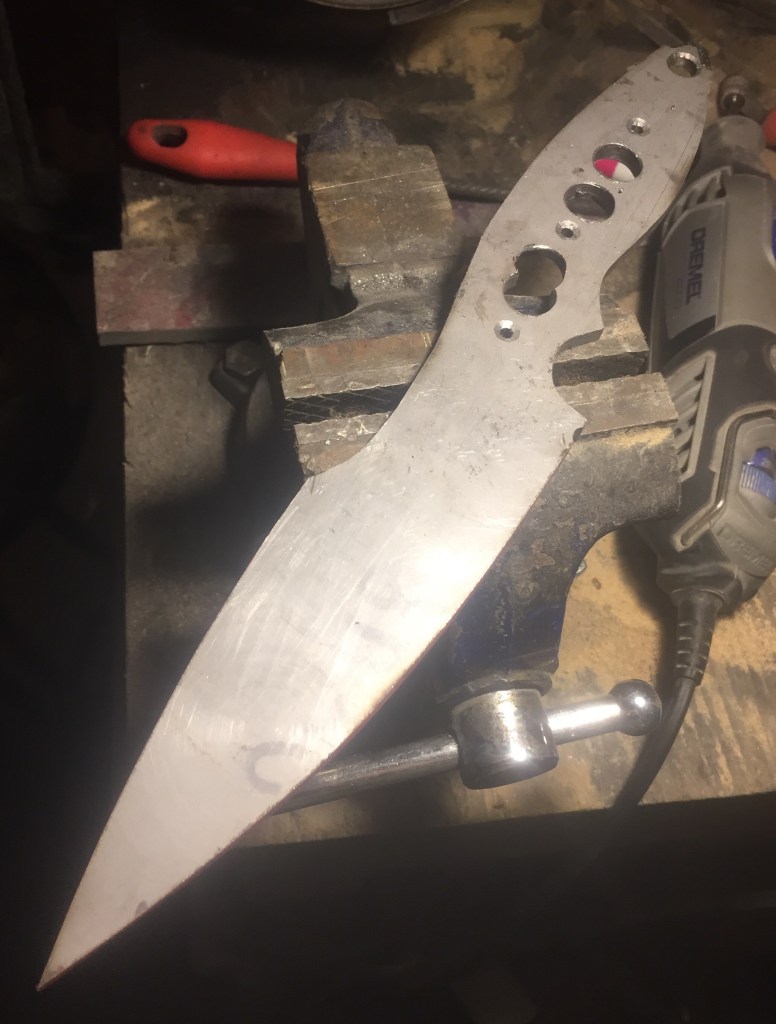
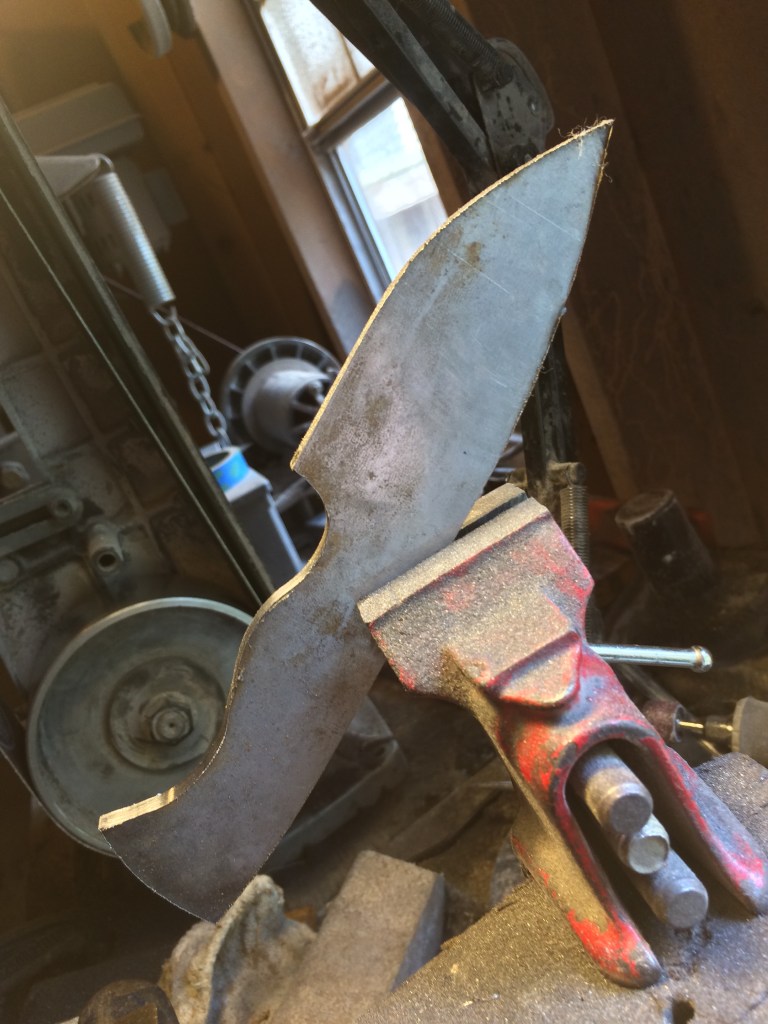
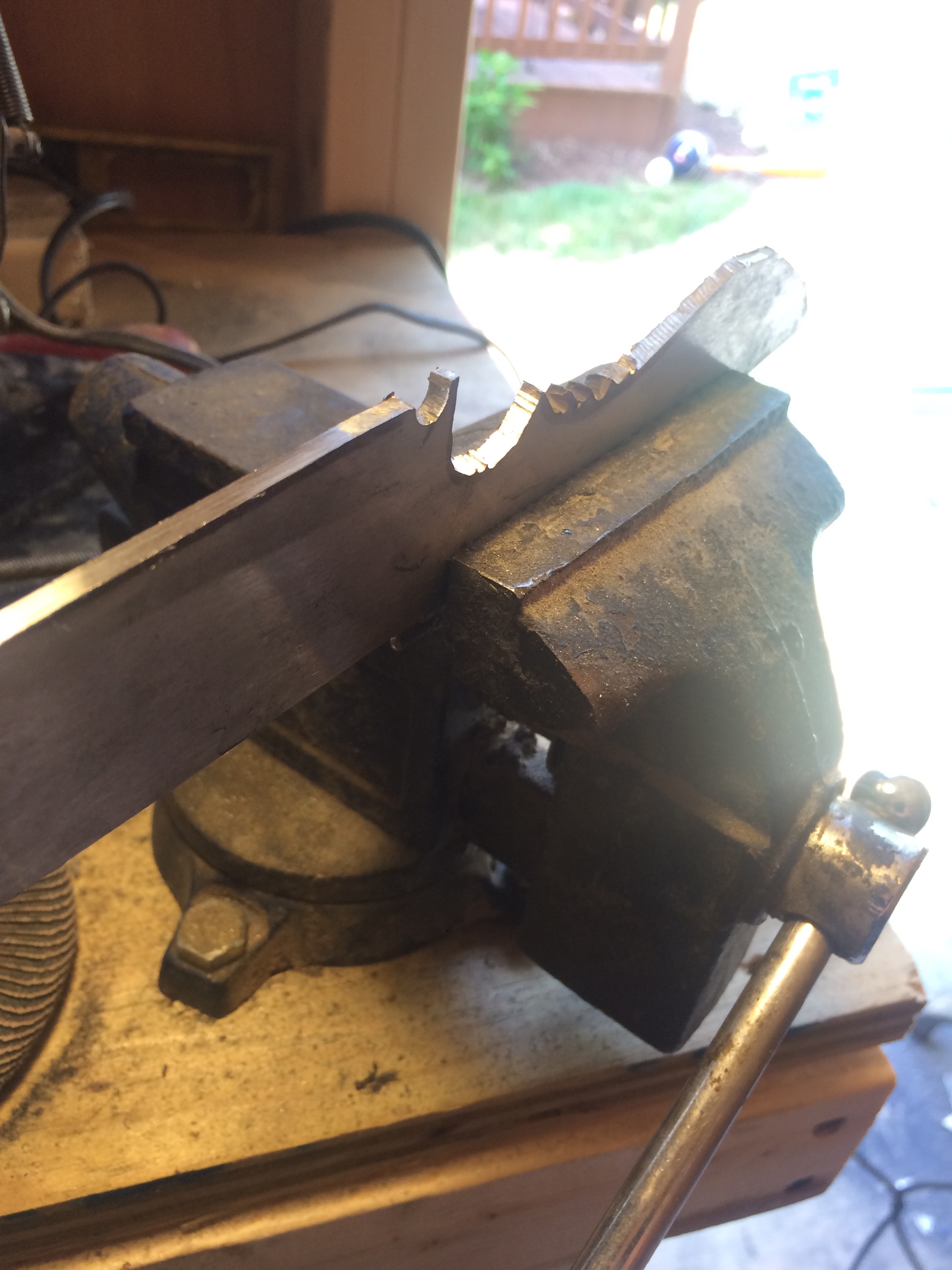
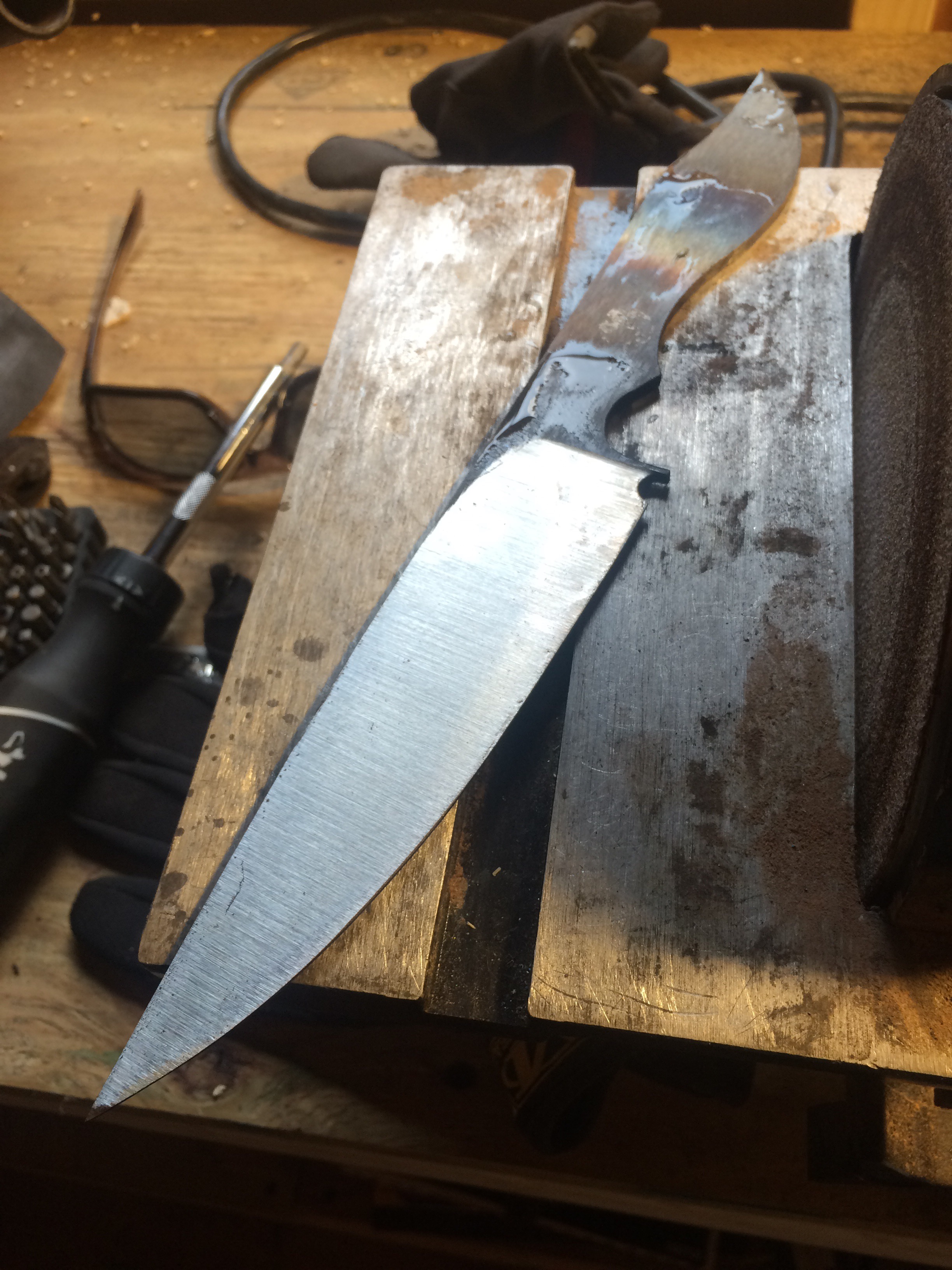
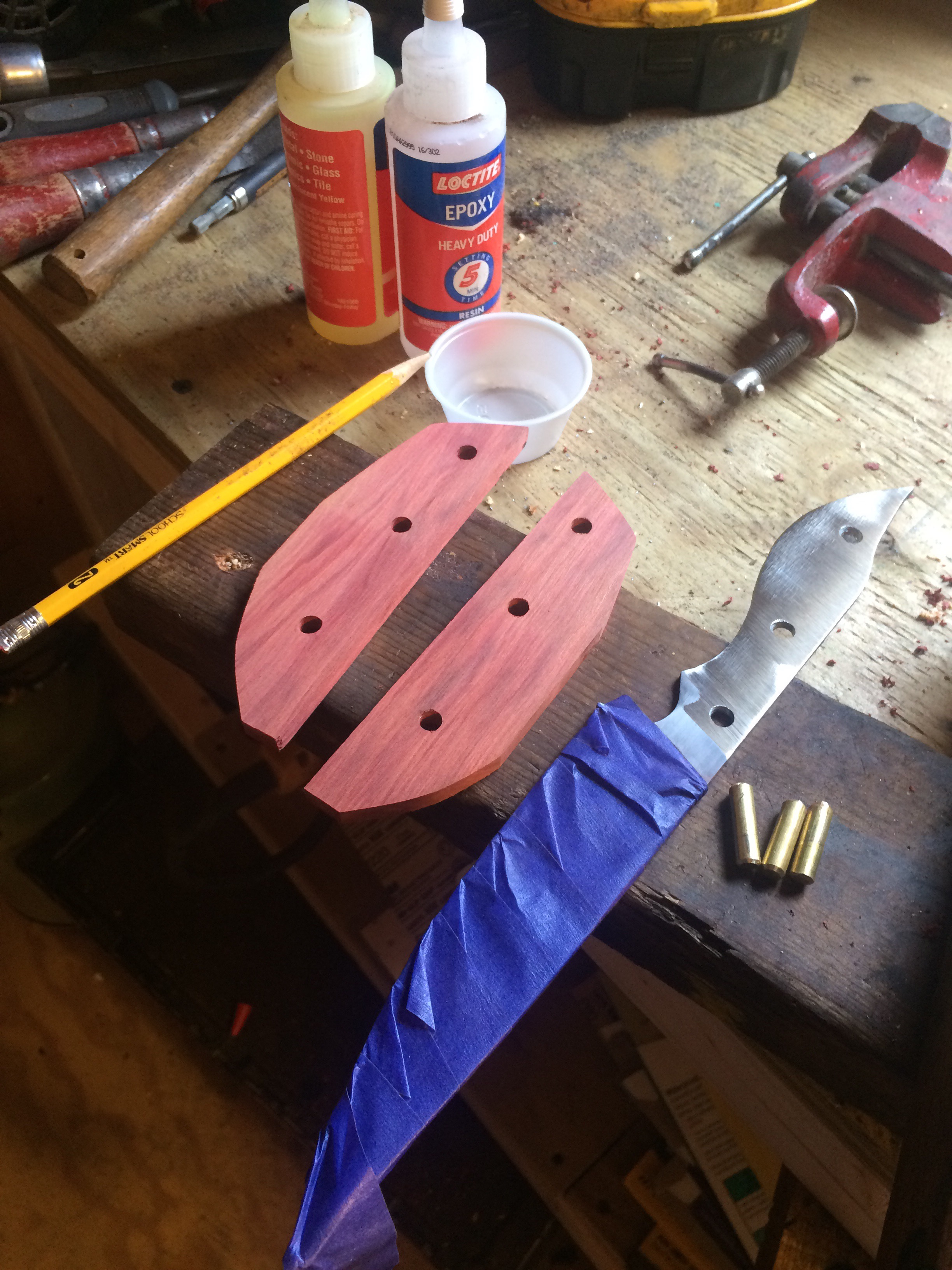
Roughing out the profile
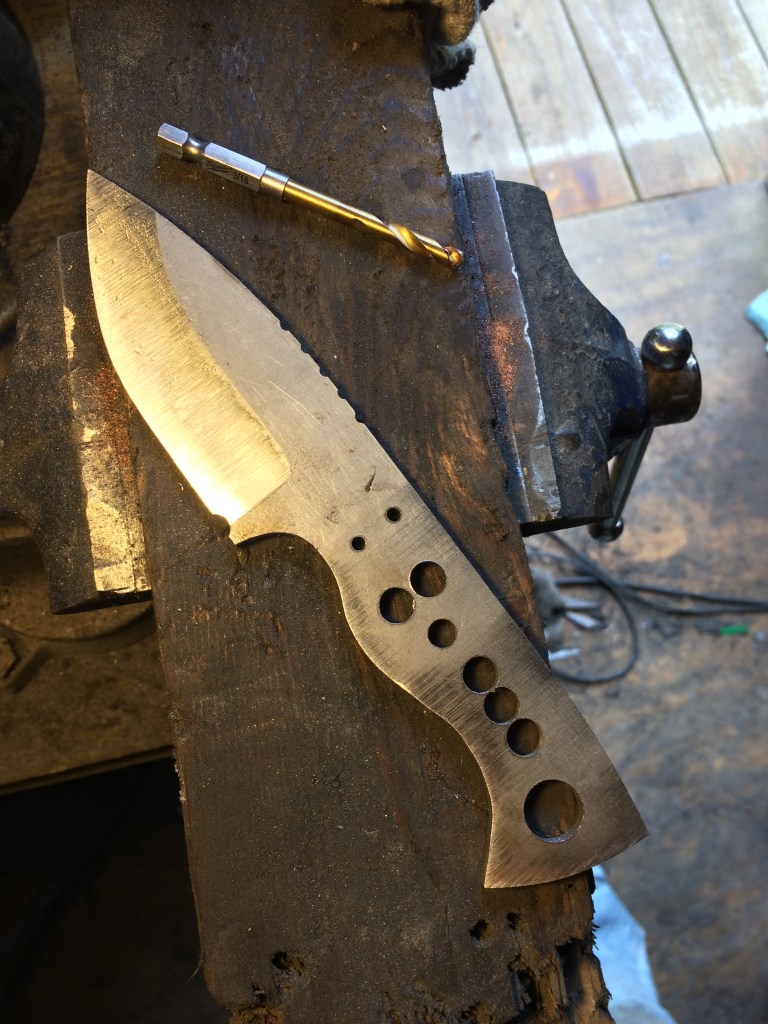
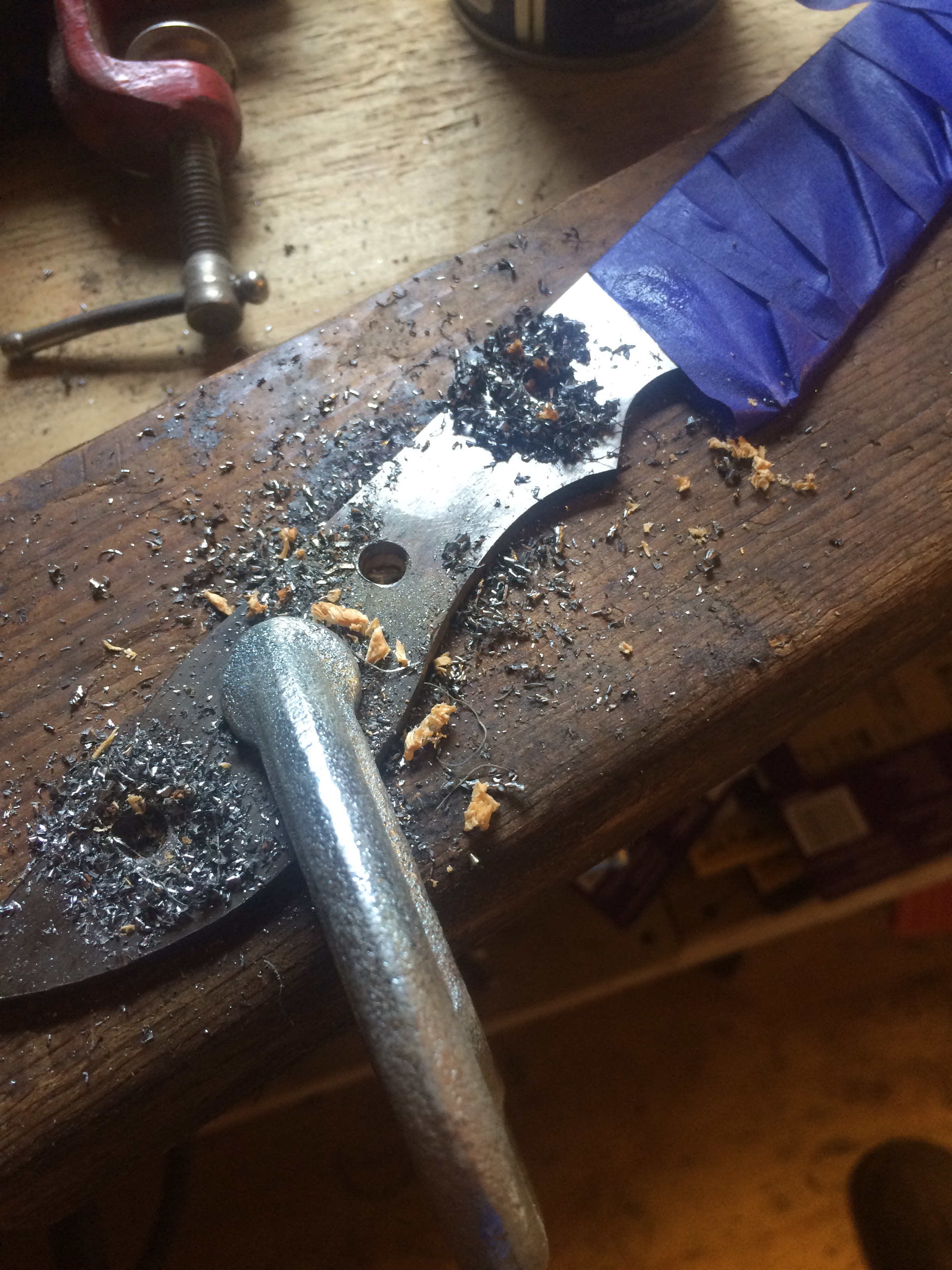
Removing a bit of weight and putting in rivet holes
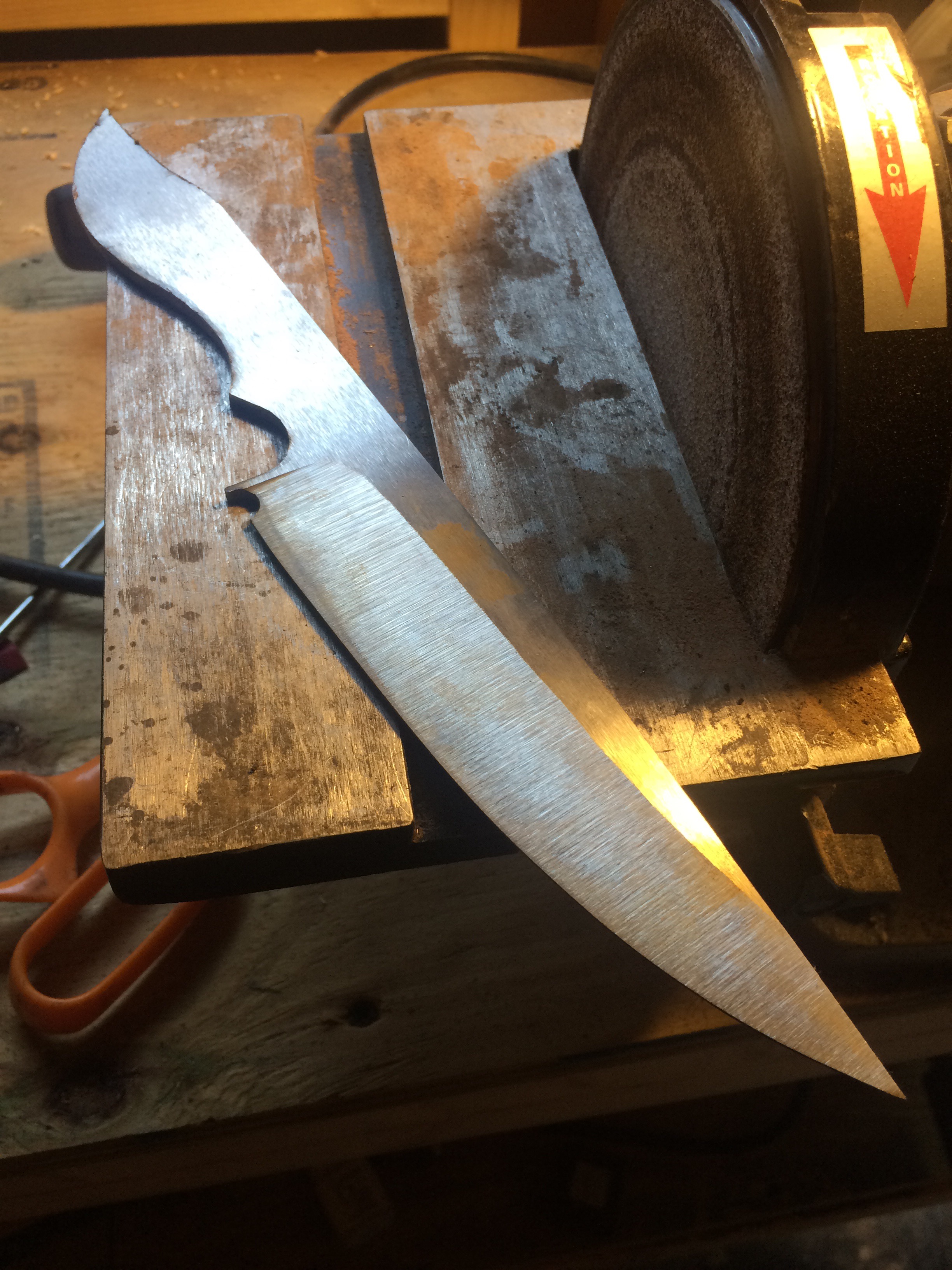
Properly profiled
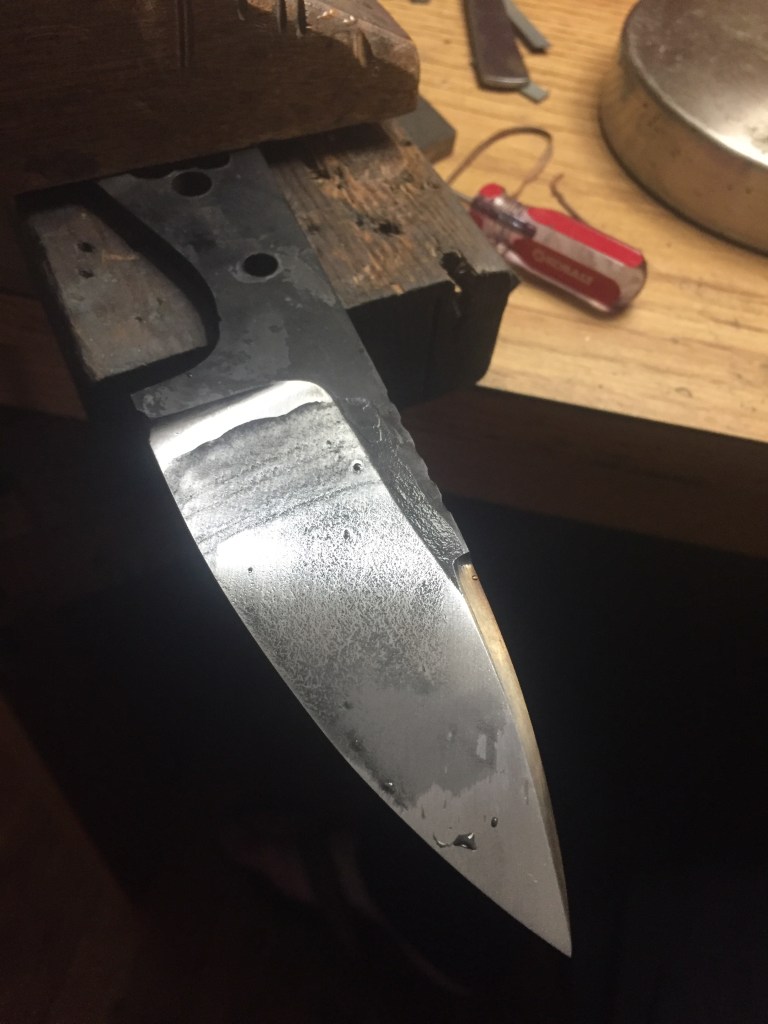
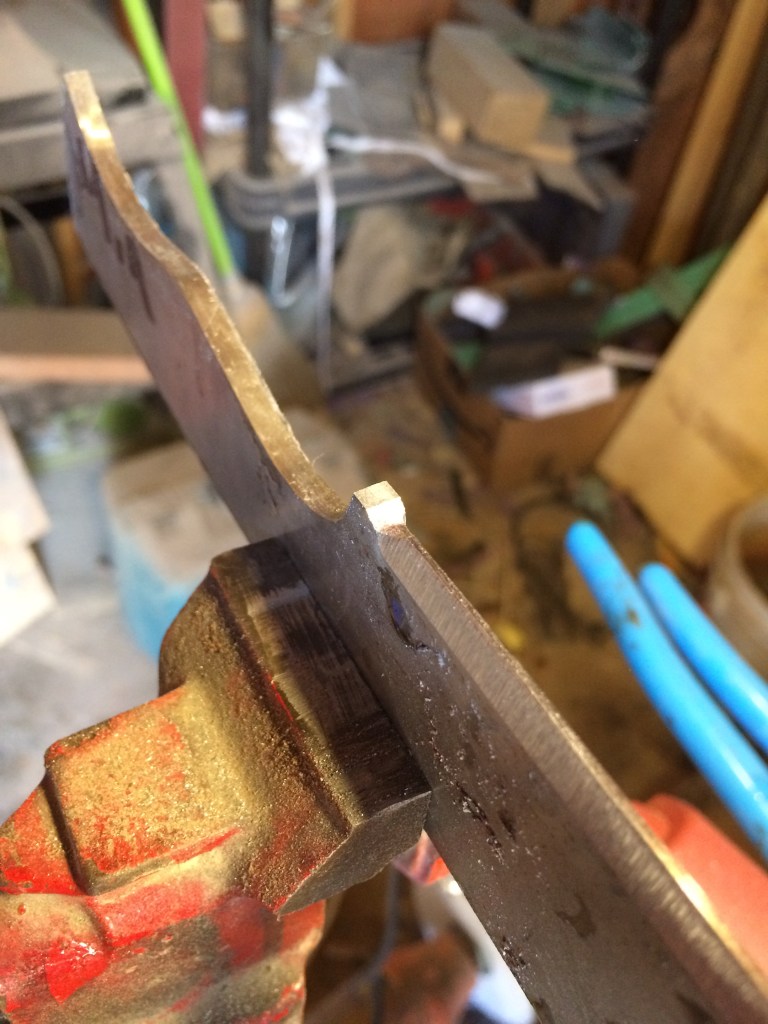
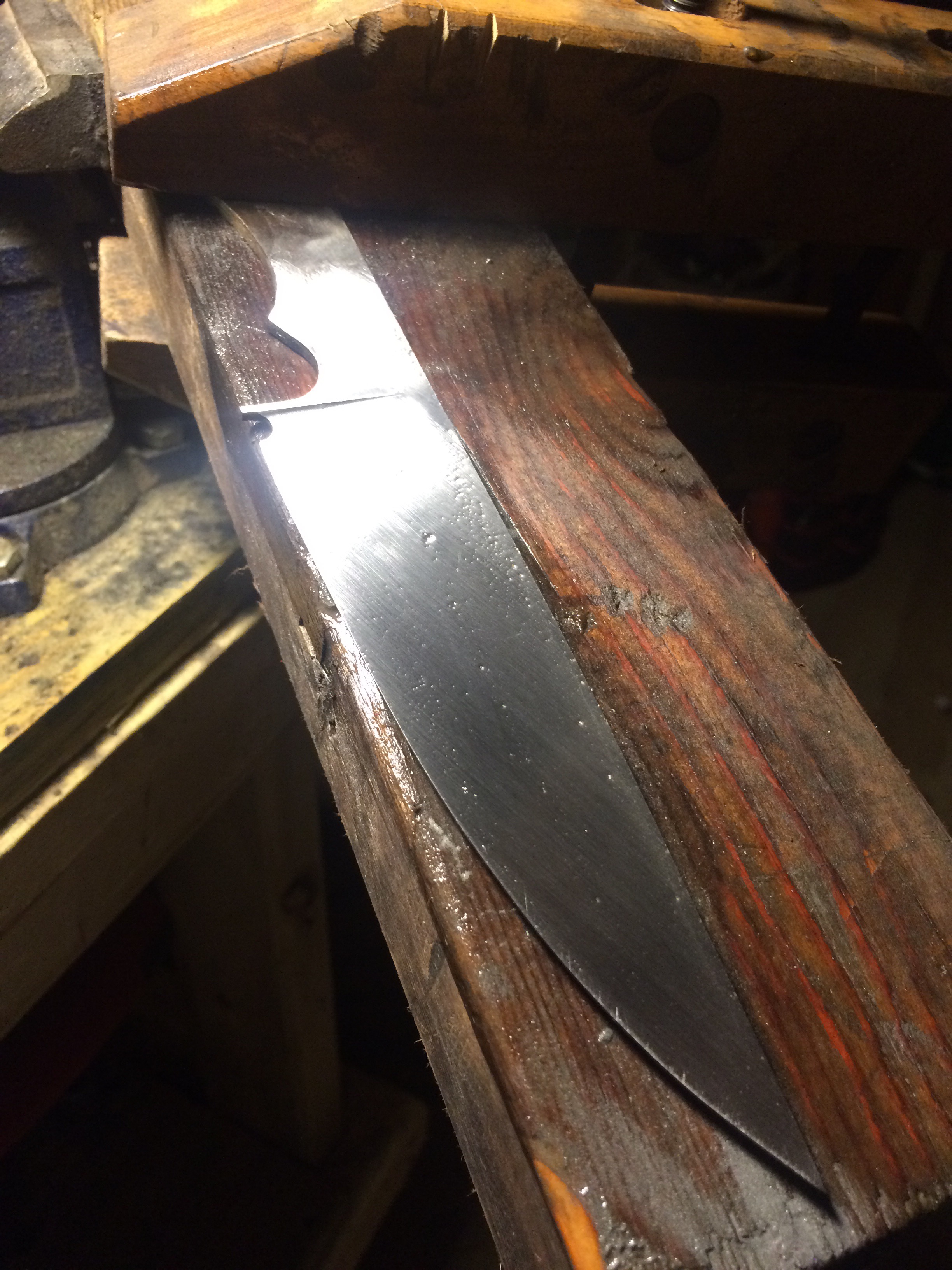
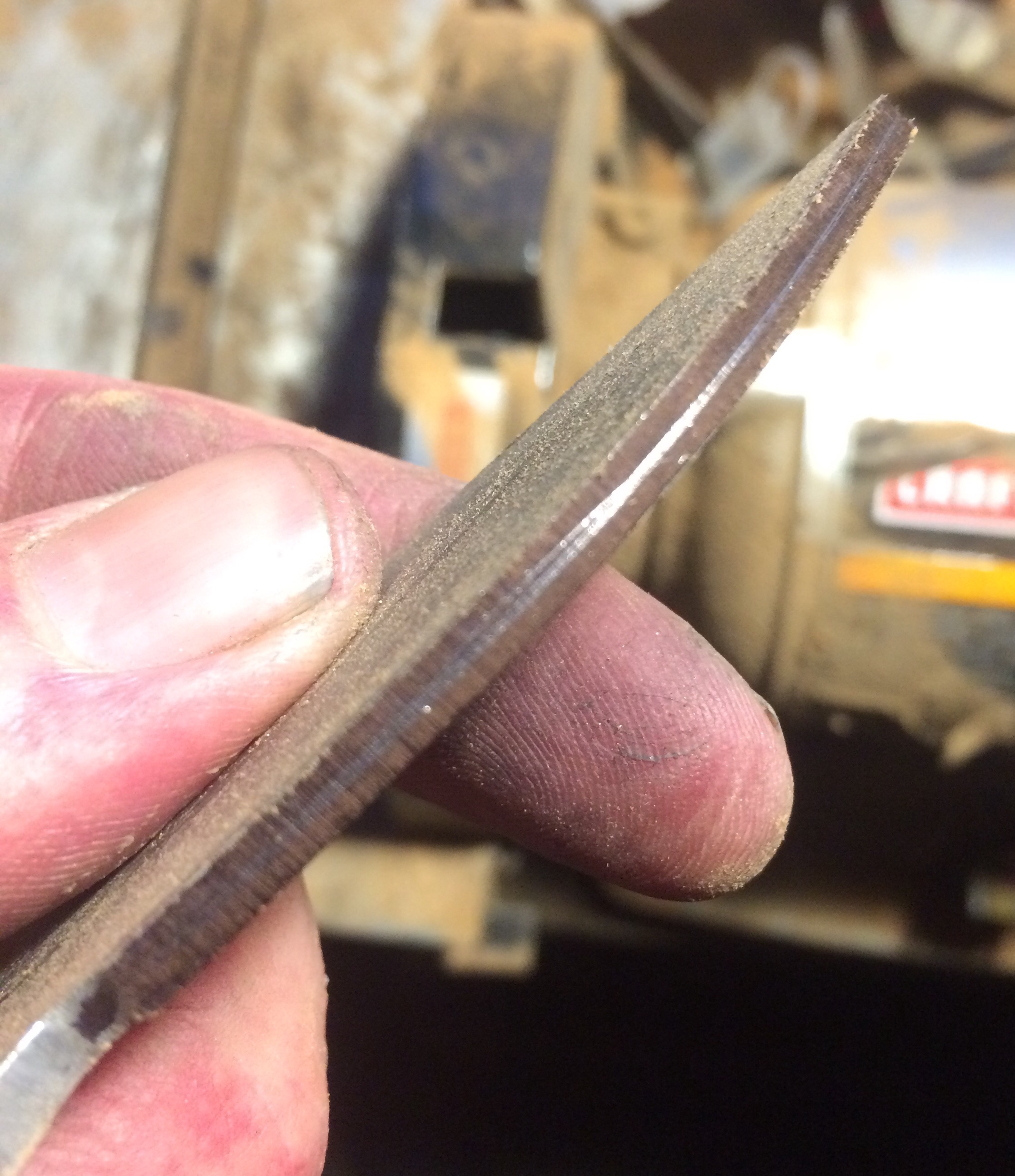
Bevels ground in
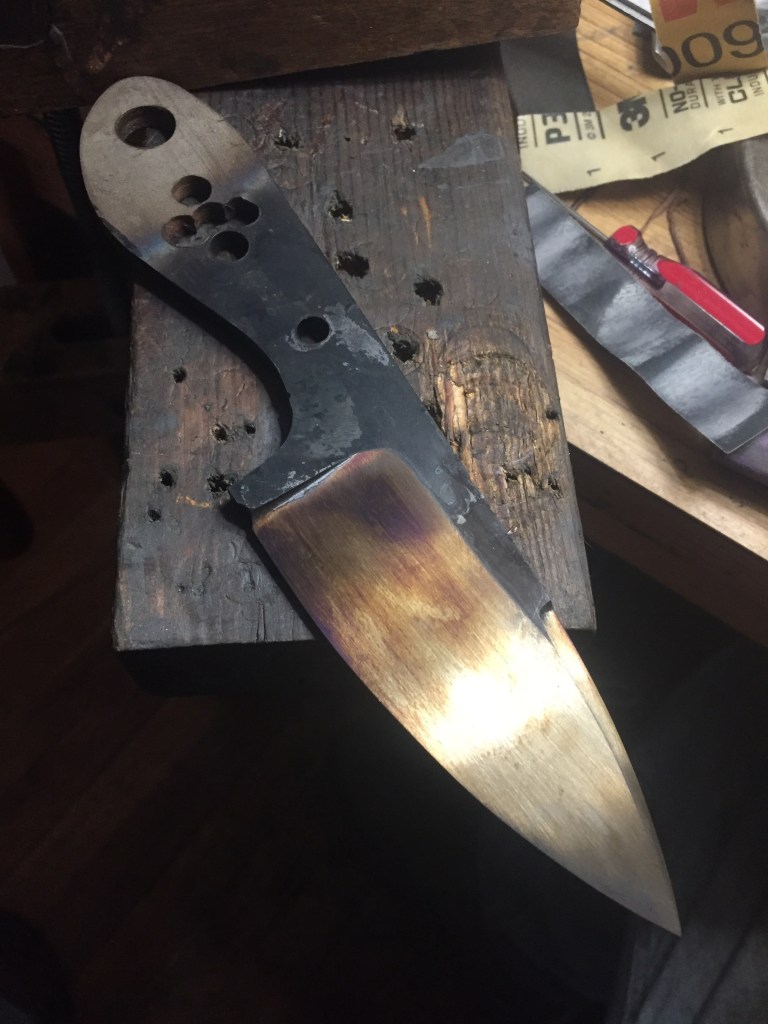
Pre-heat treat sanding
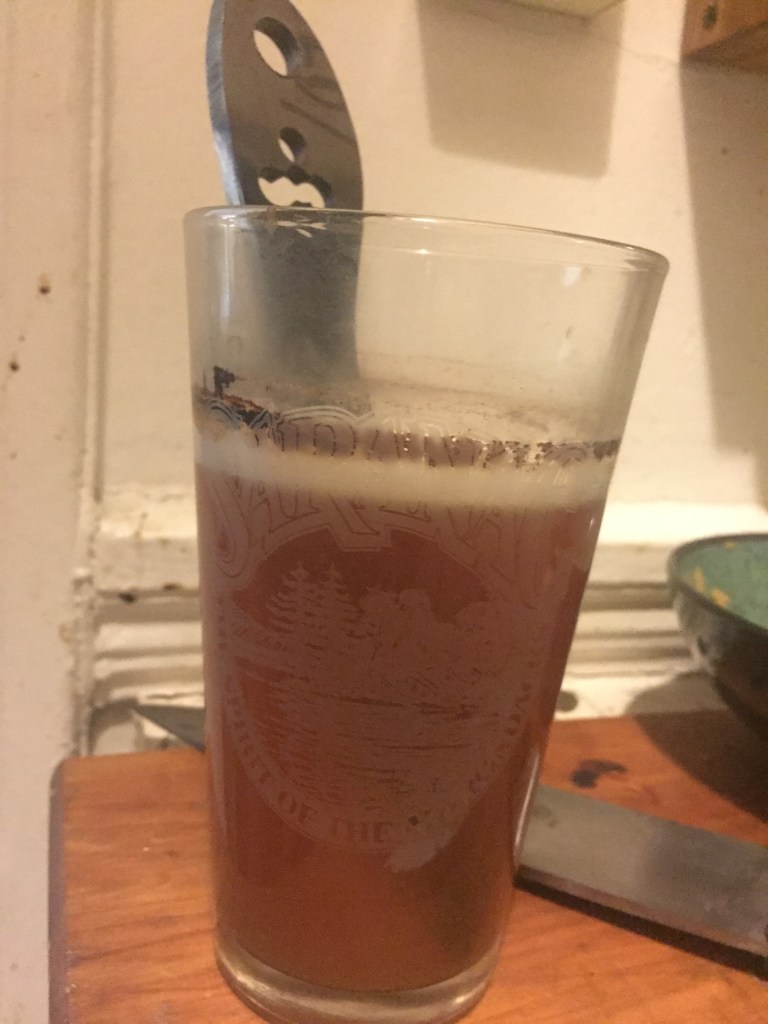
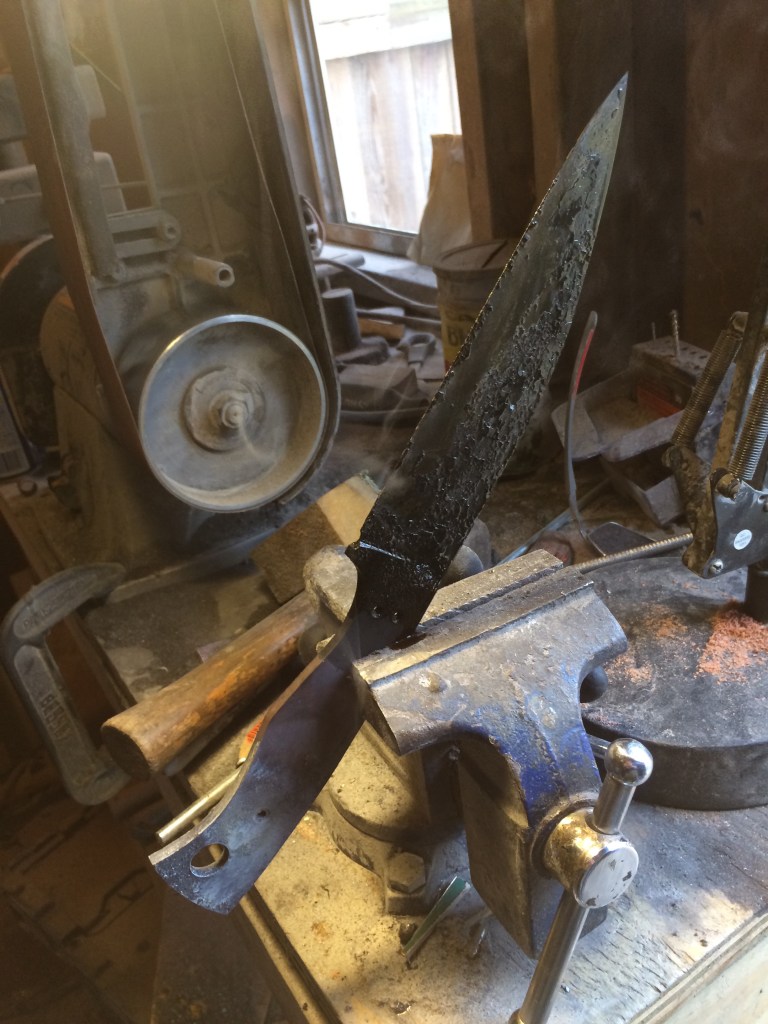
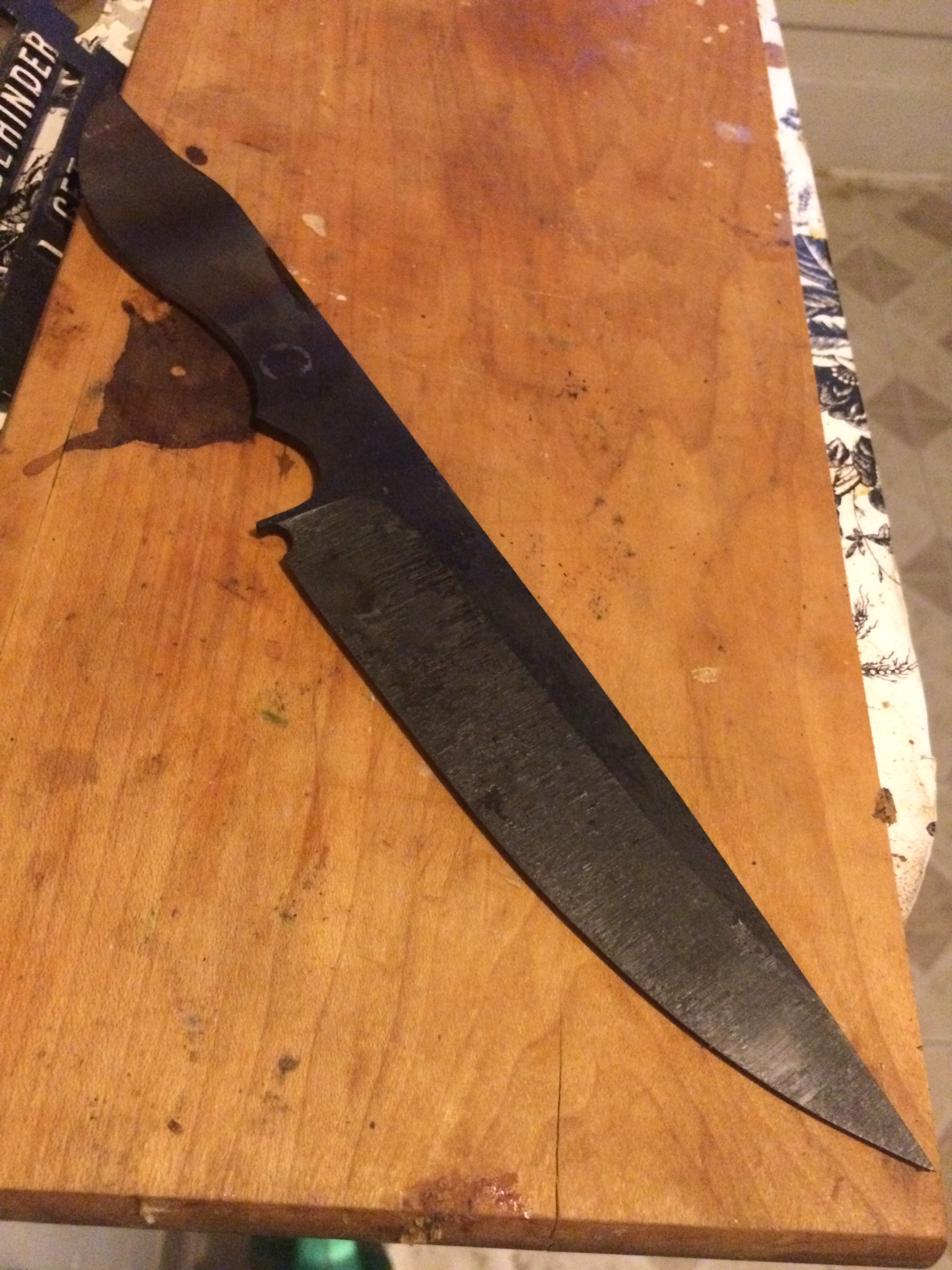
Out of the quench and cooling
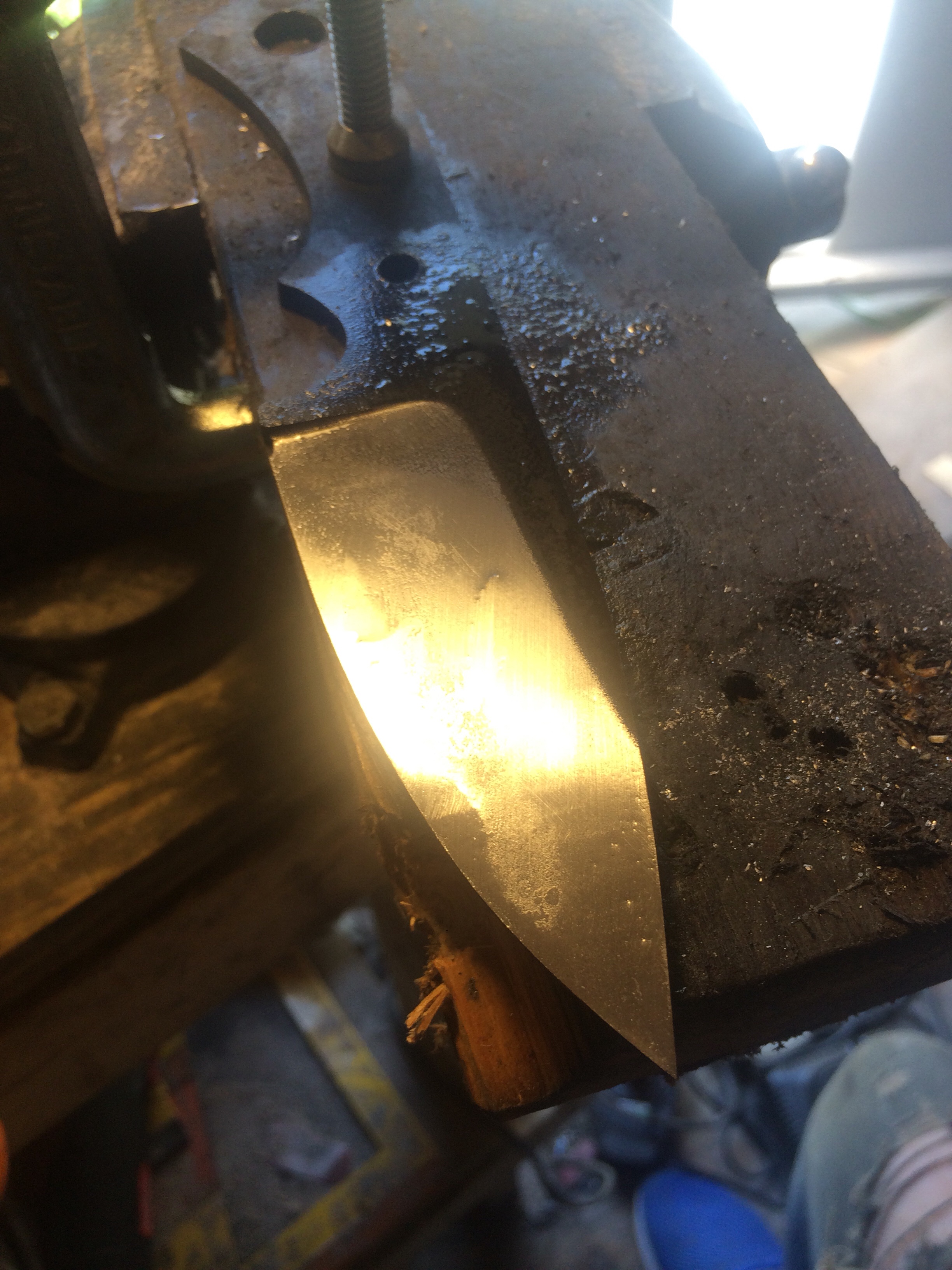
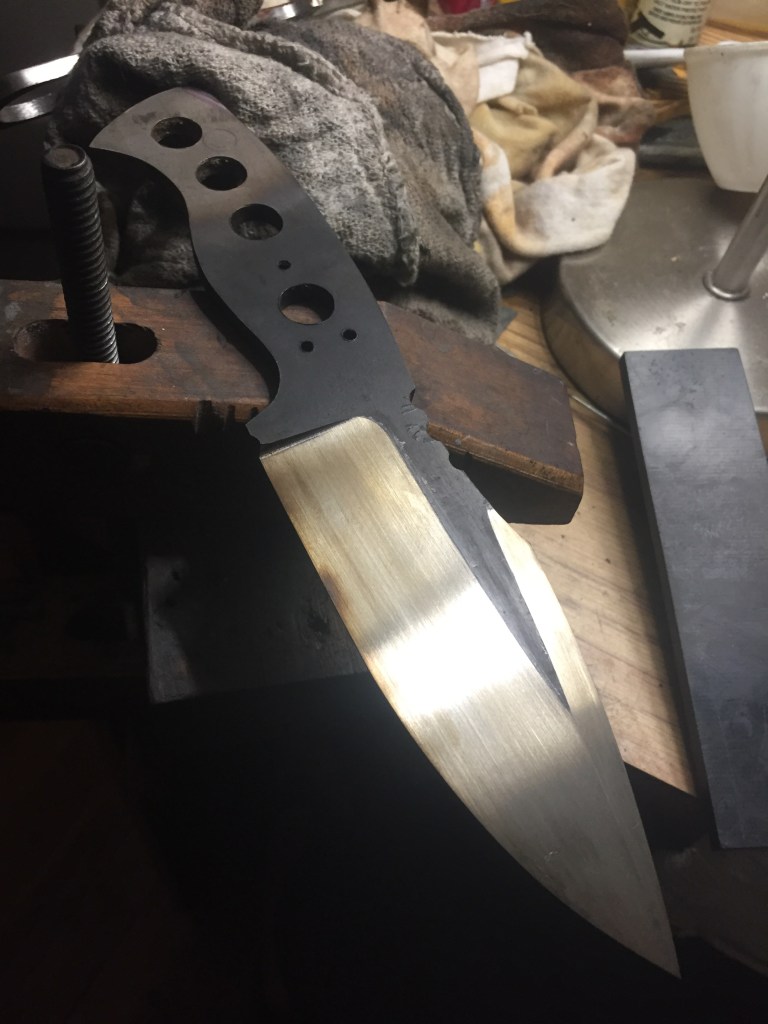
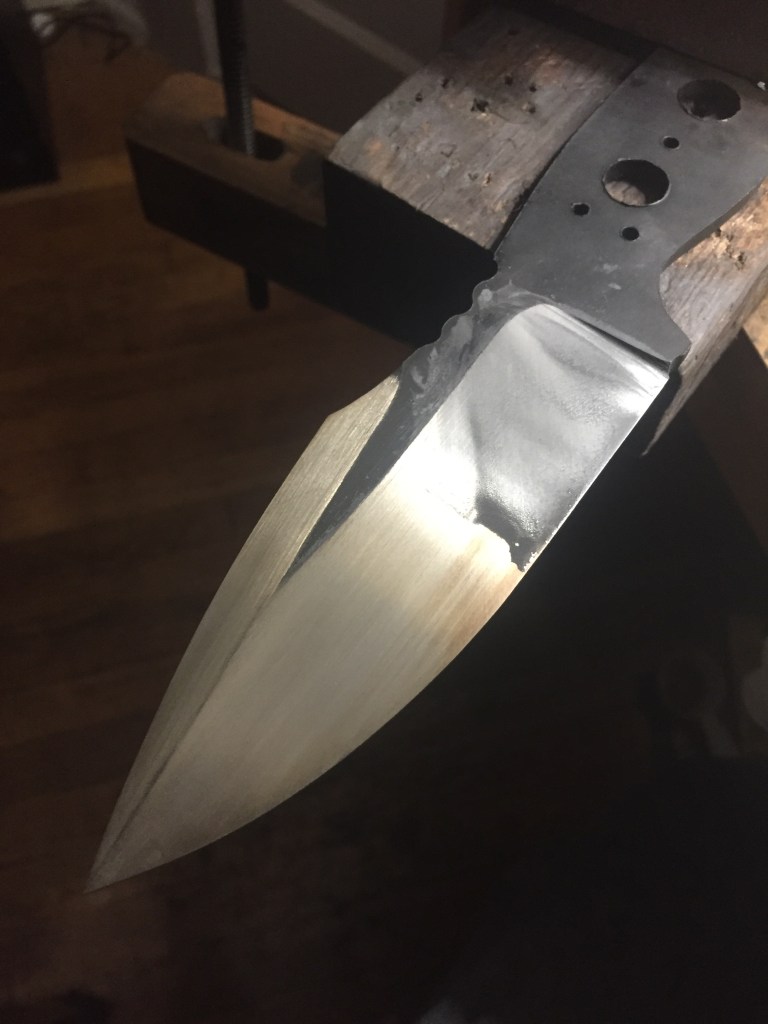
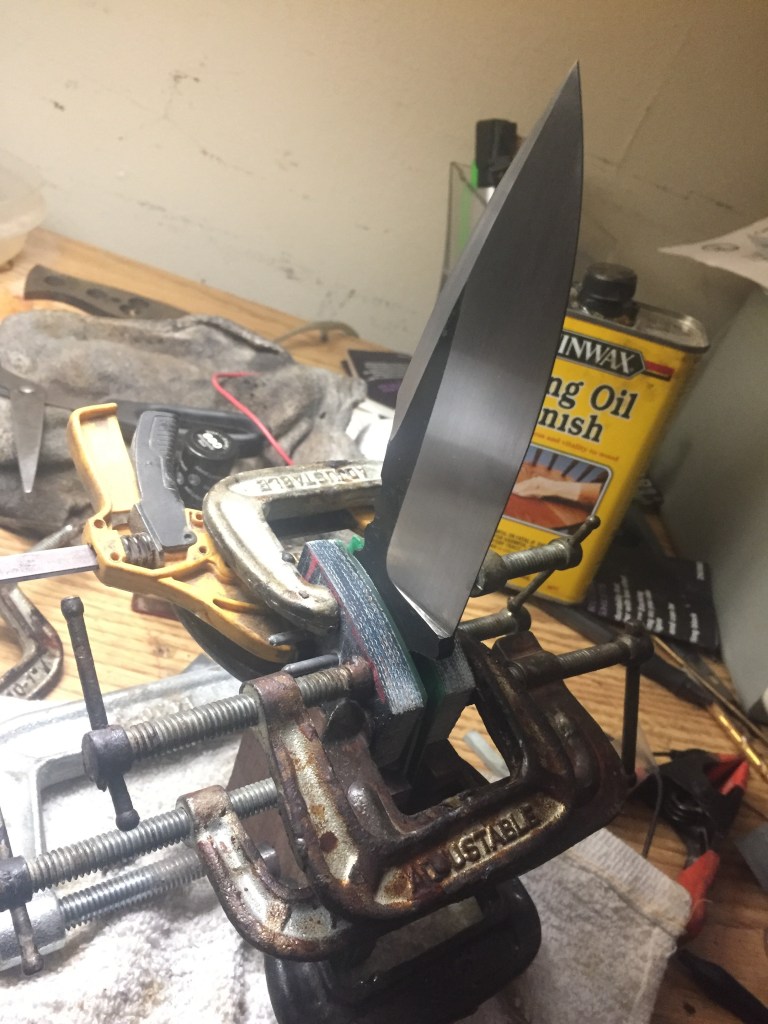
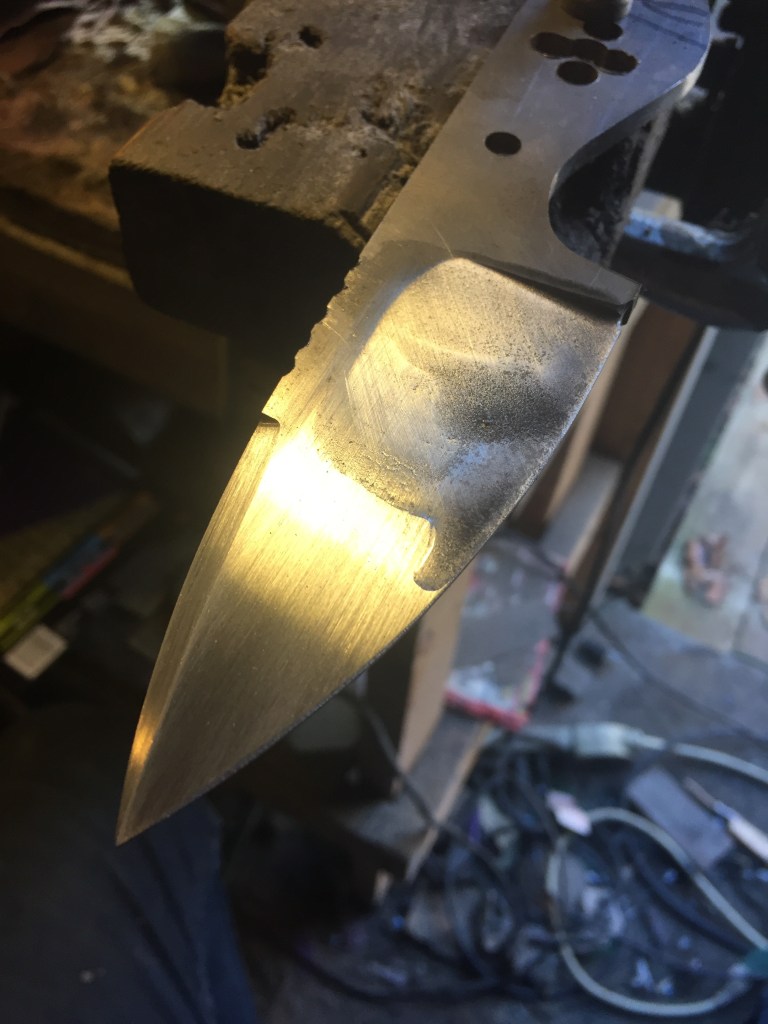
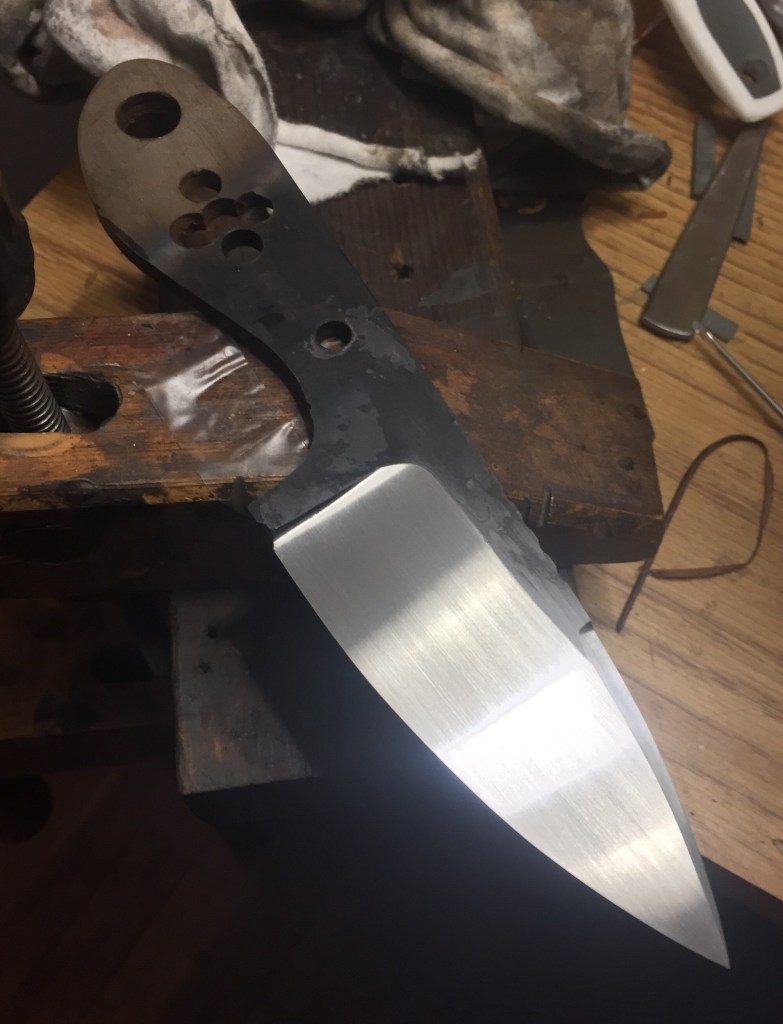
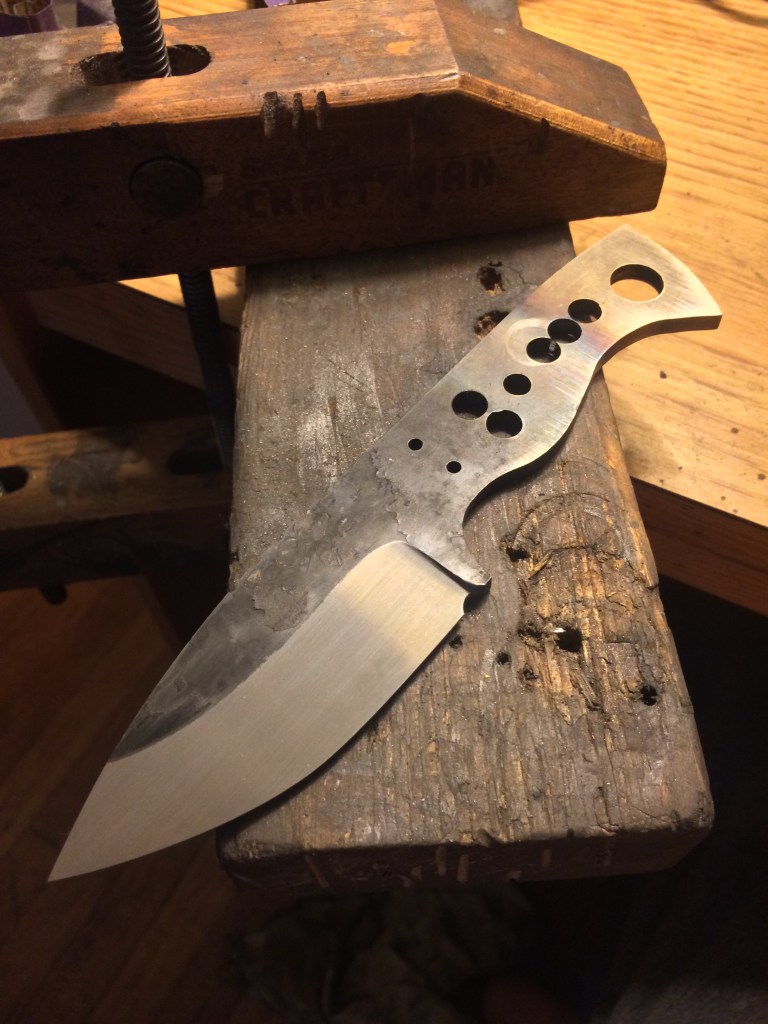
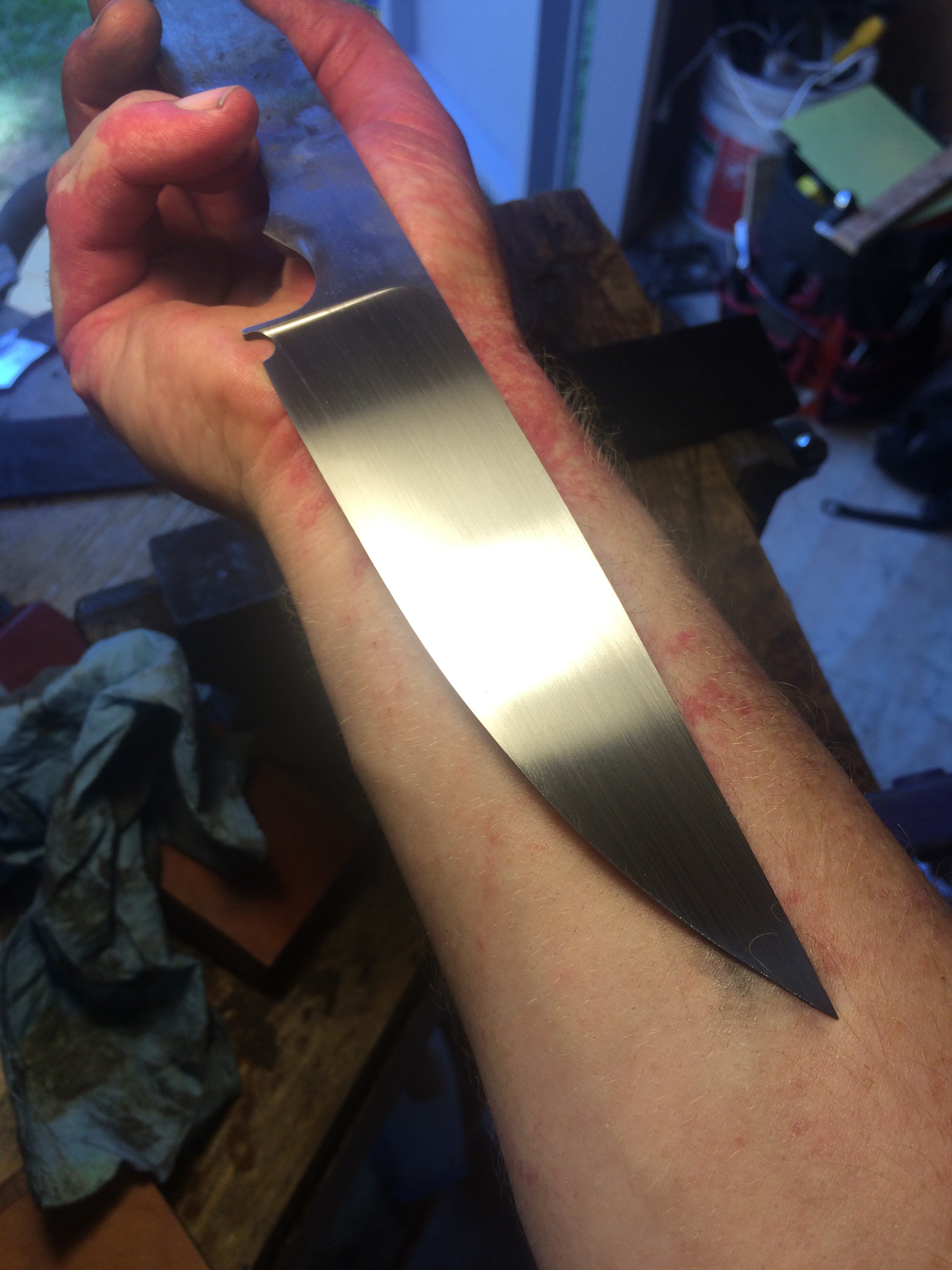
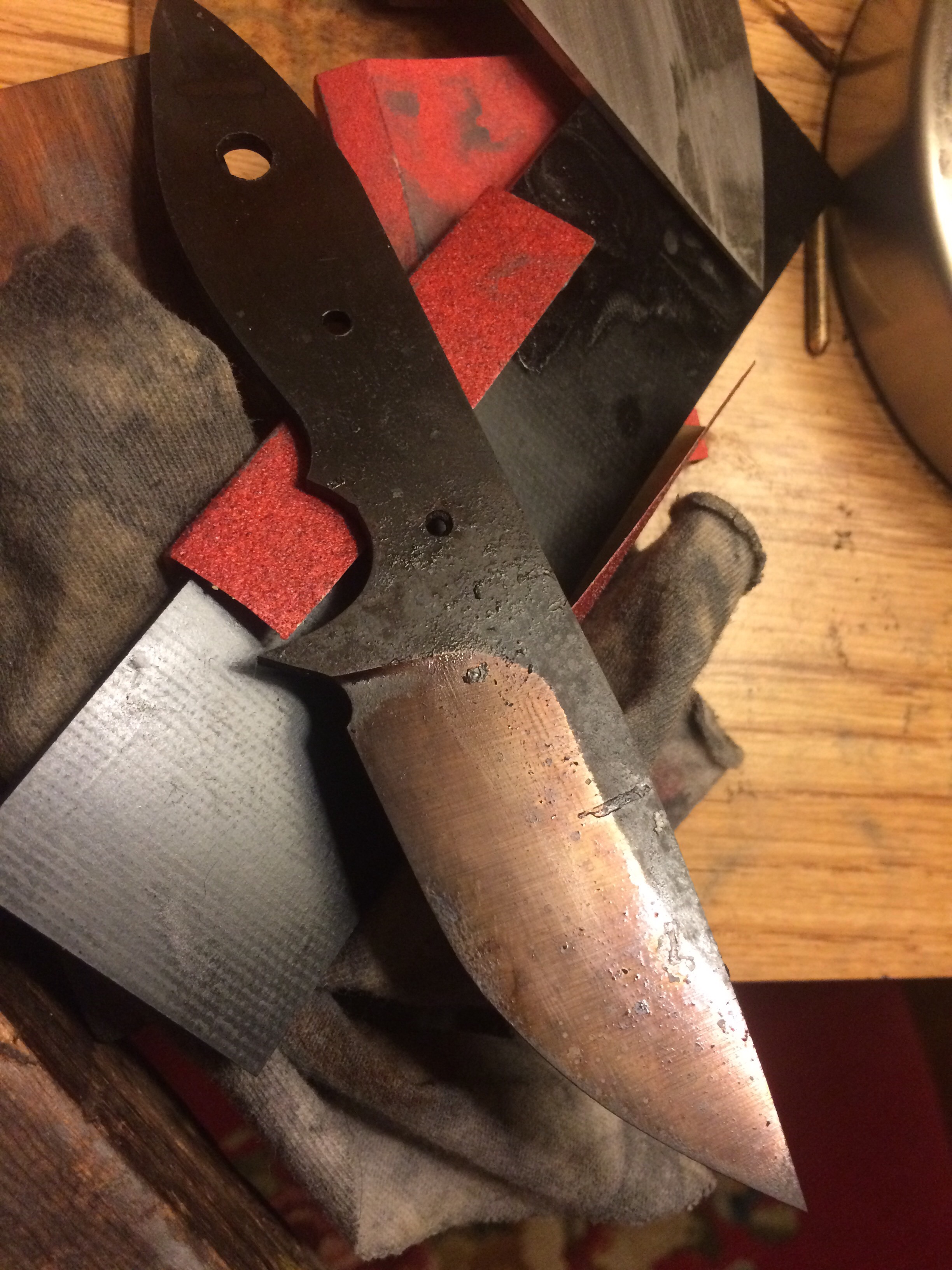
Beginnings of a satin finish
…and we’re there.
A technical schematic for the laser people: precision is the name of the game.
Proofs showing how the engraving will look- the blue is for contrast.
And it came out just like the picture
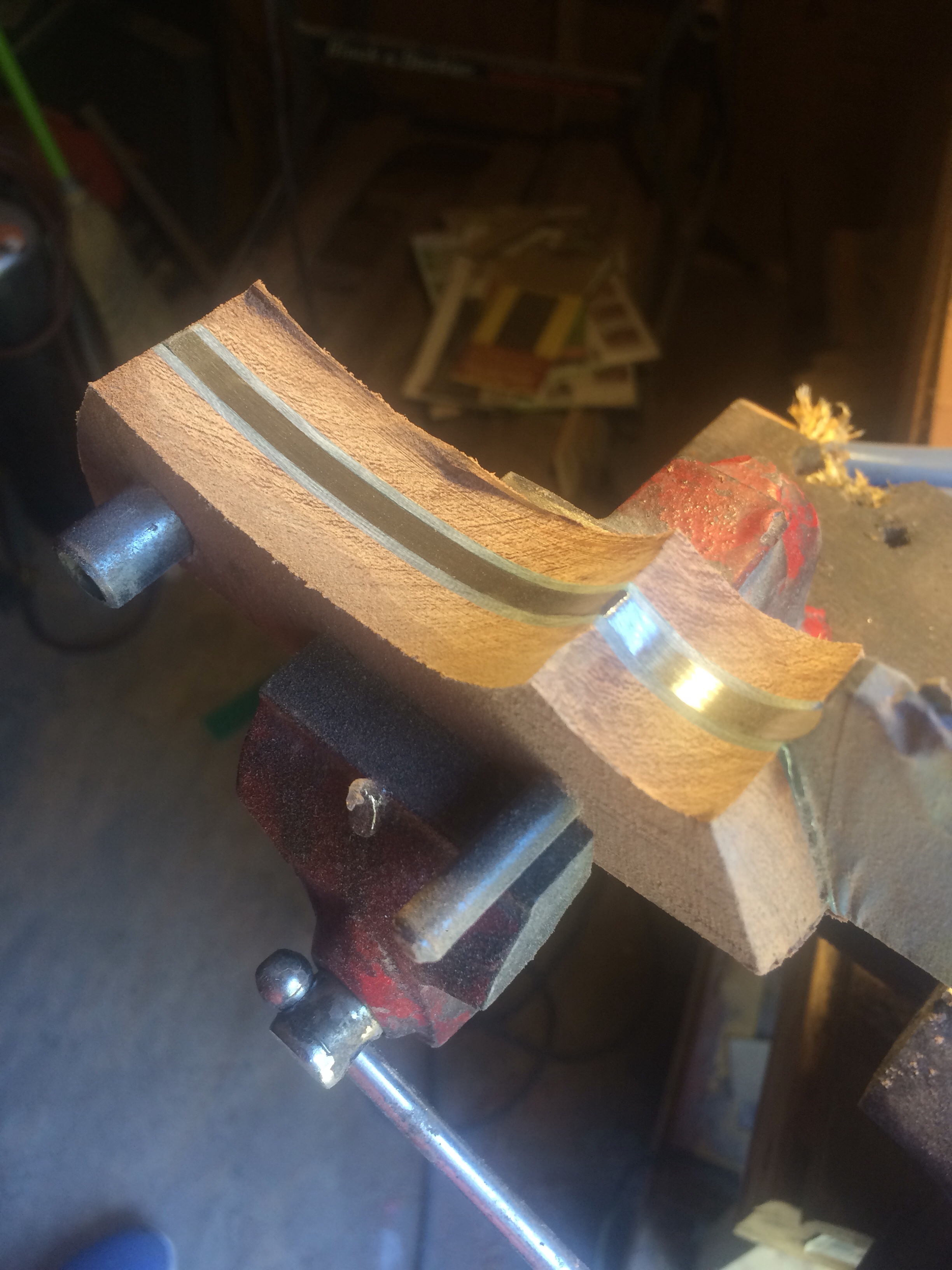
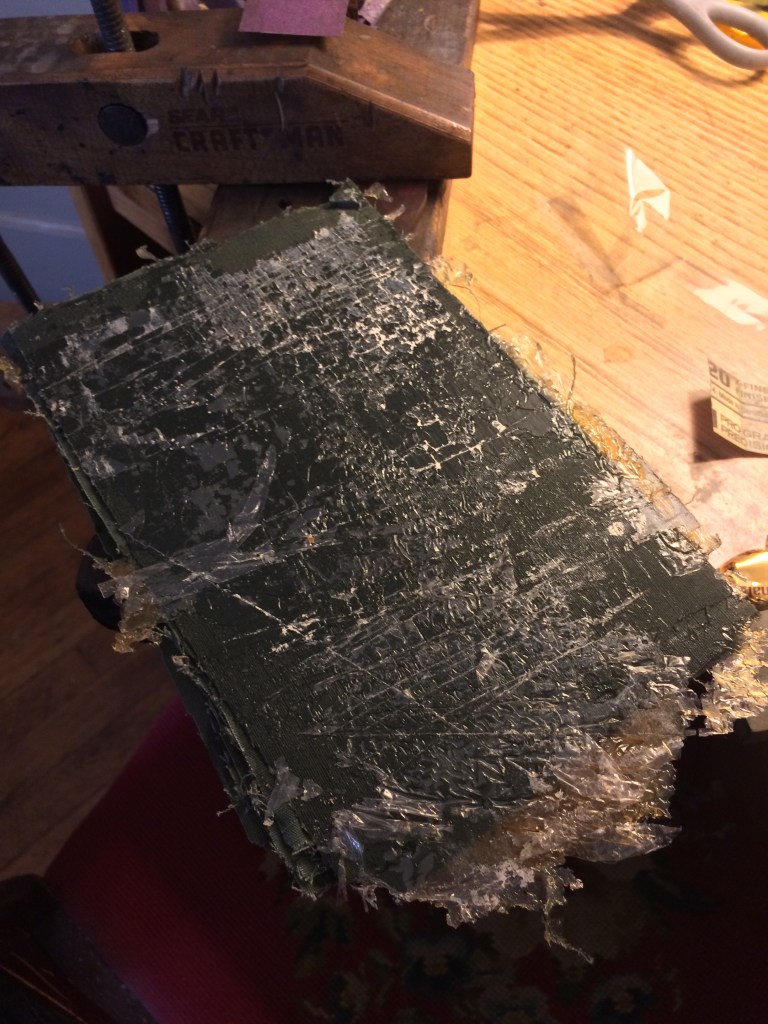
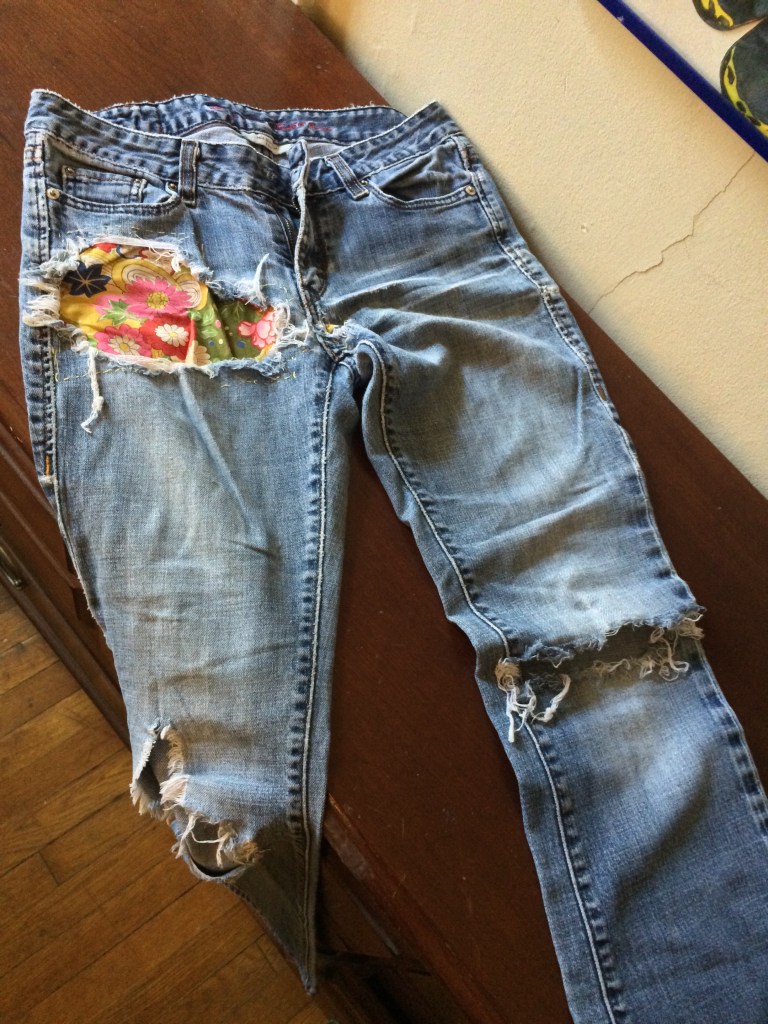
The handle is made from a pair of Carhartt Dungarees I got too fat for….
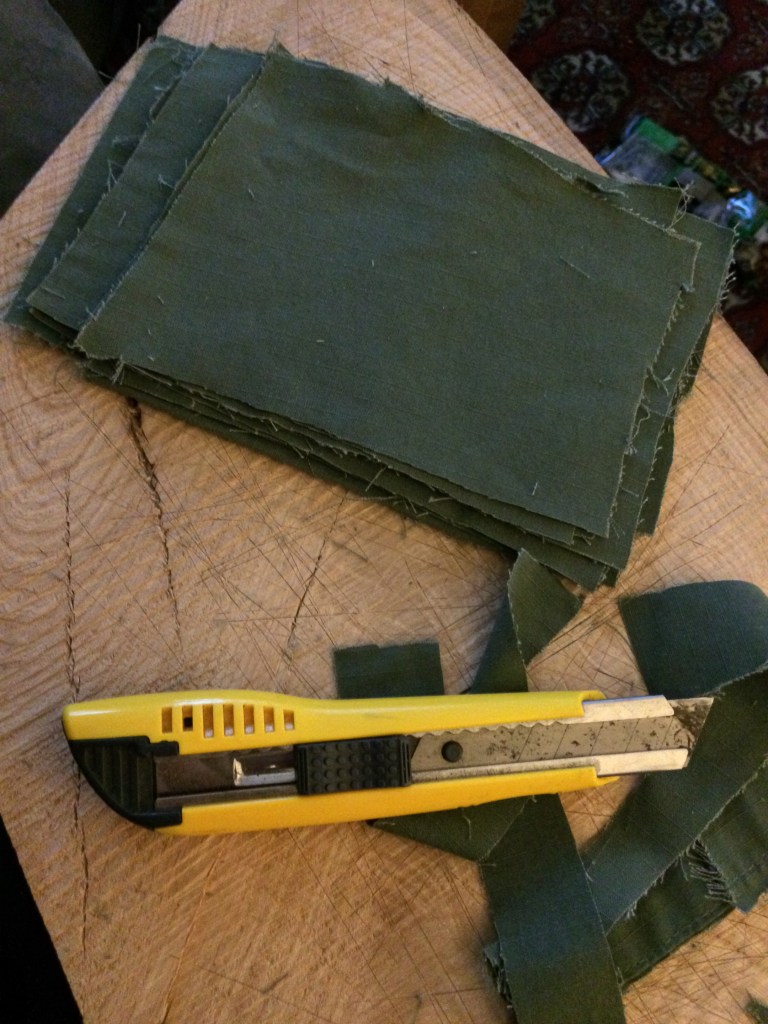
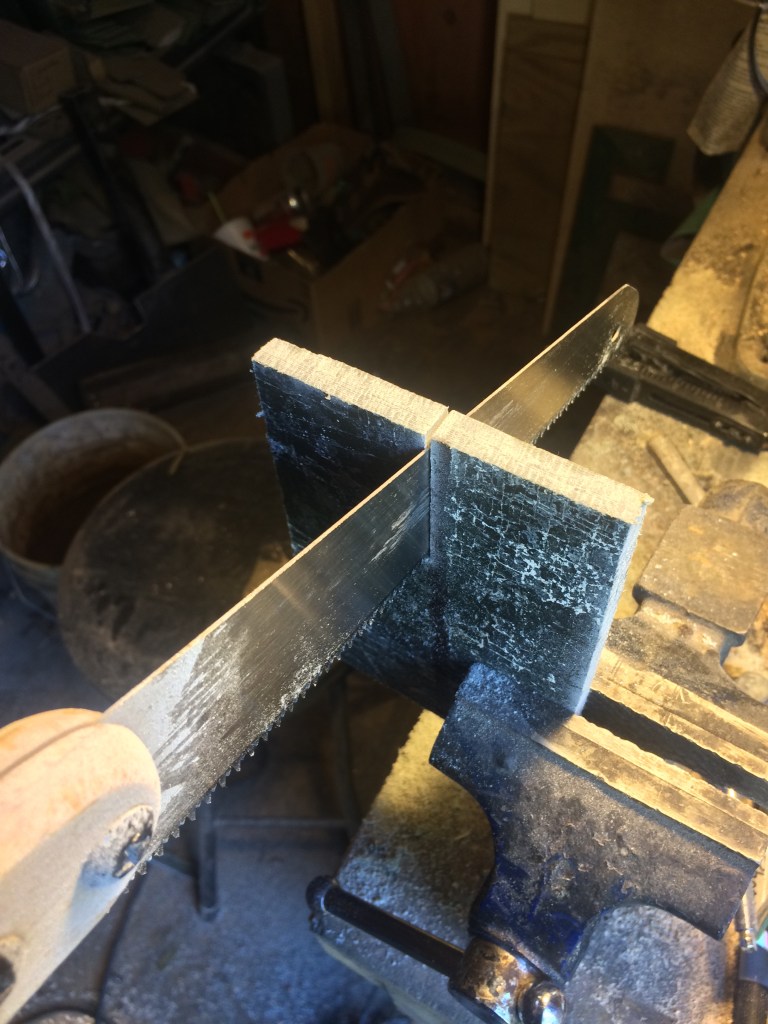
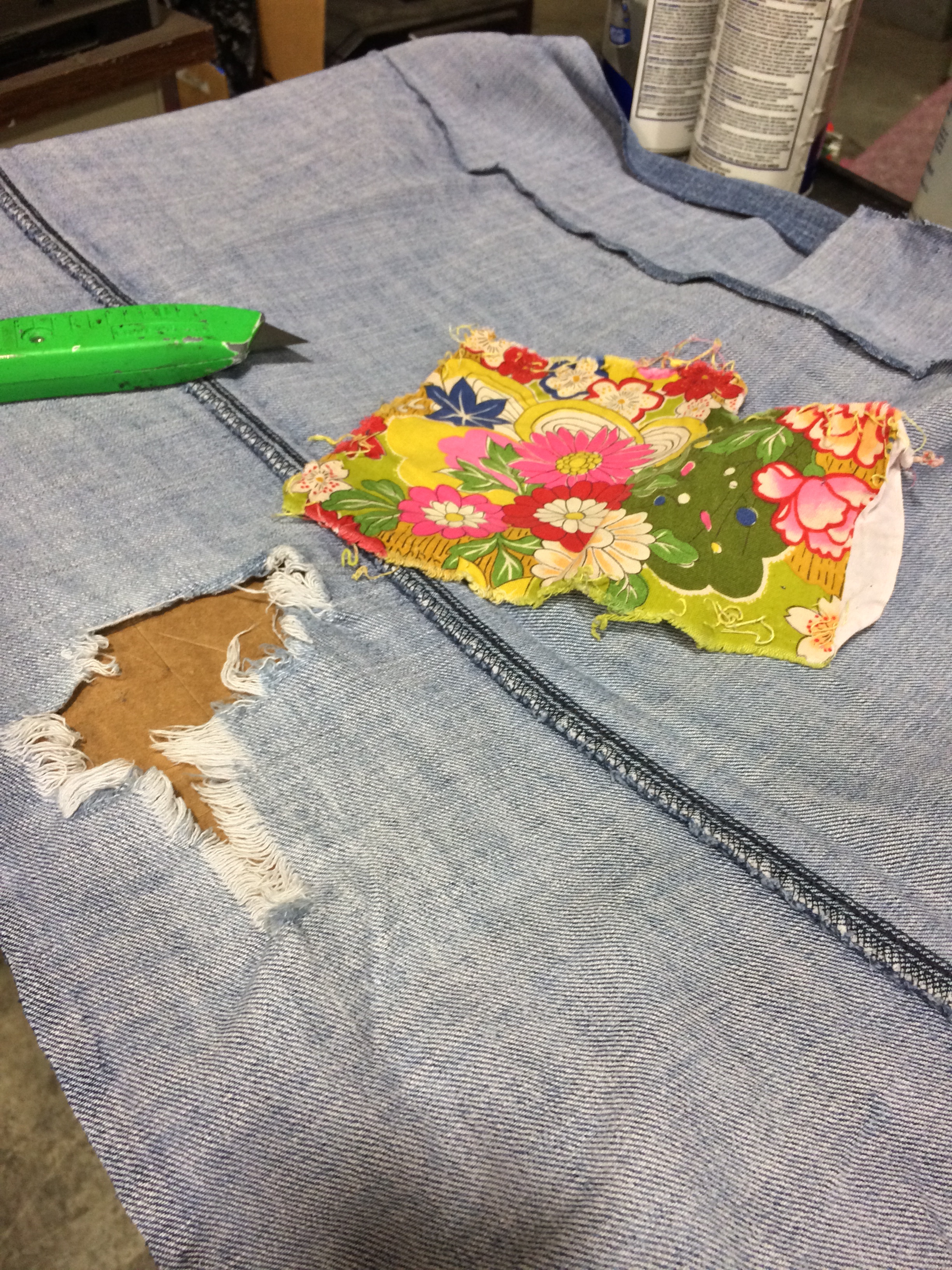
Cut into strips….
…layered into strips….
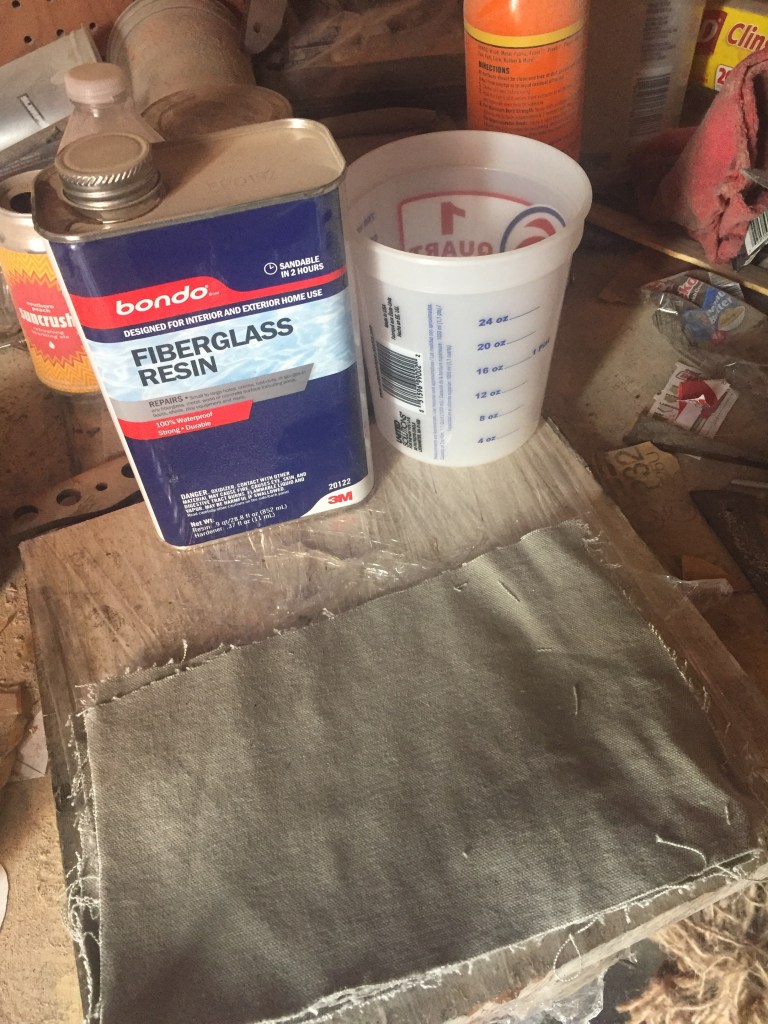
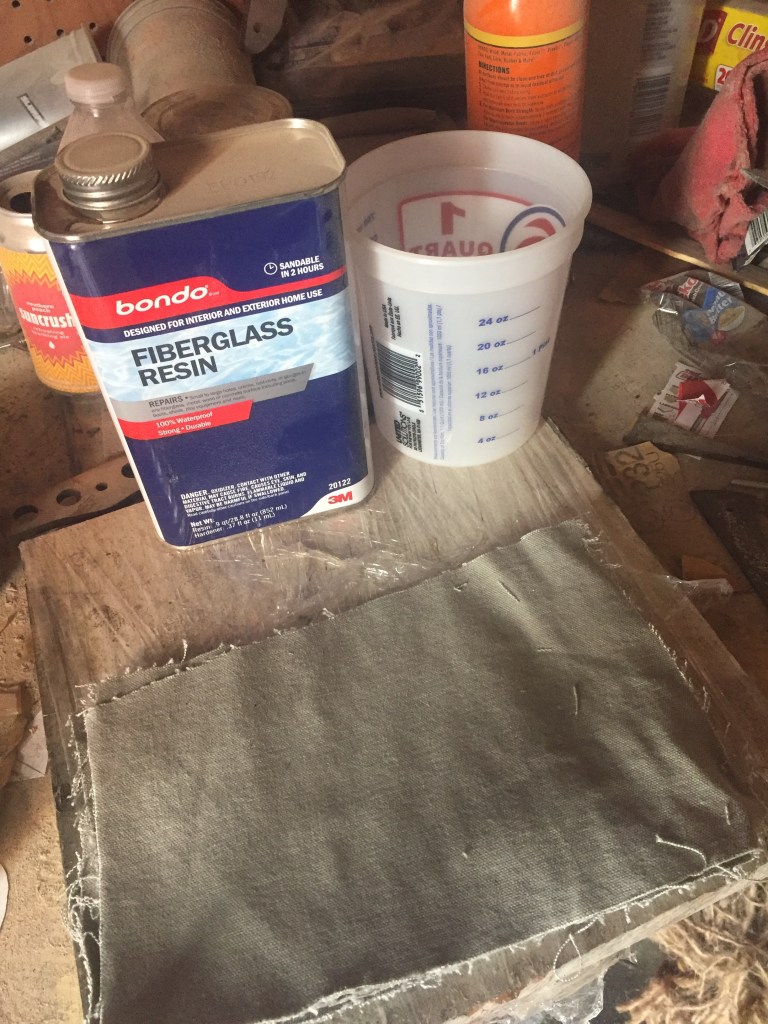
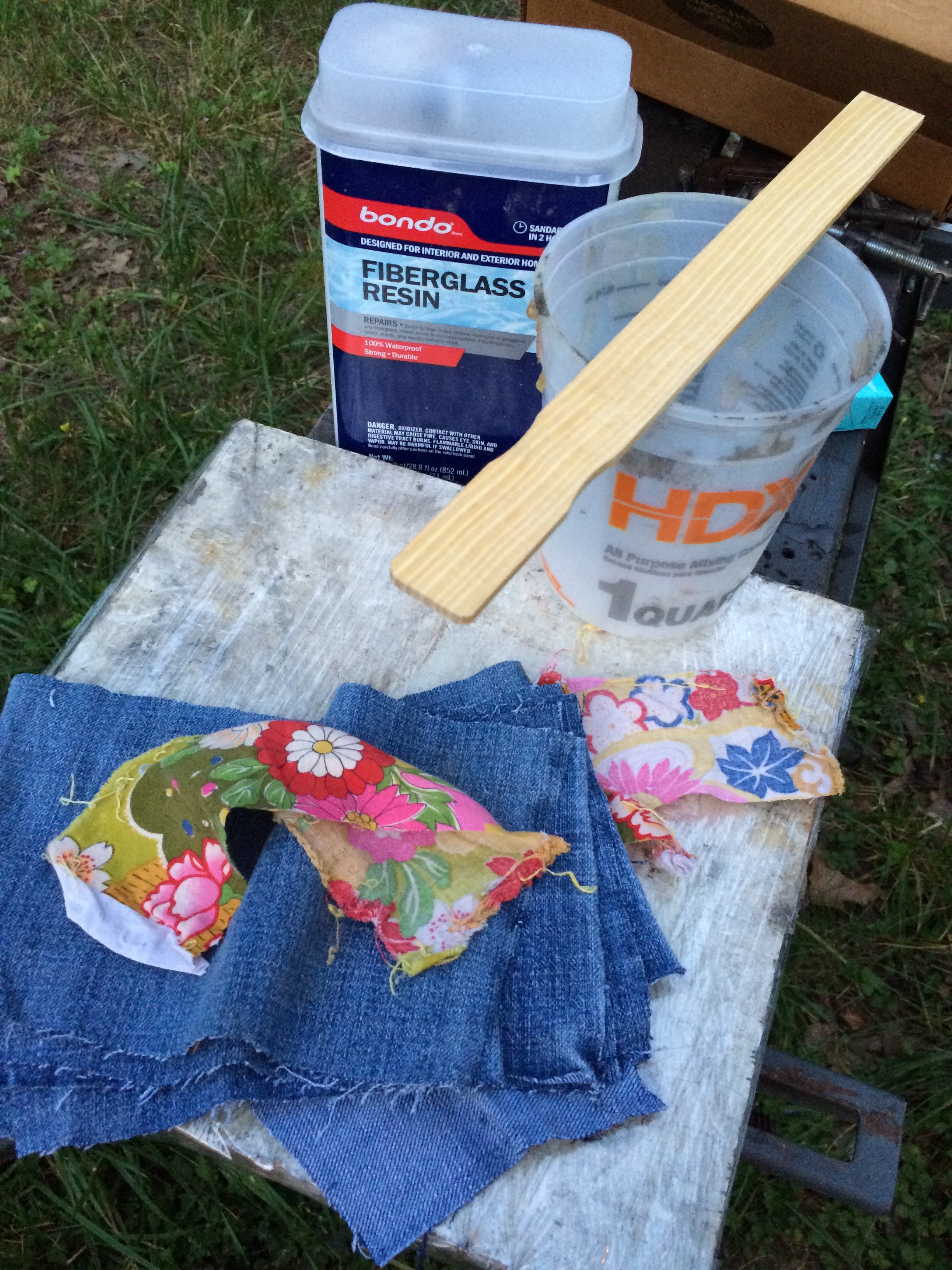
…with the resin…
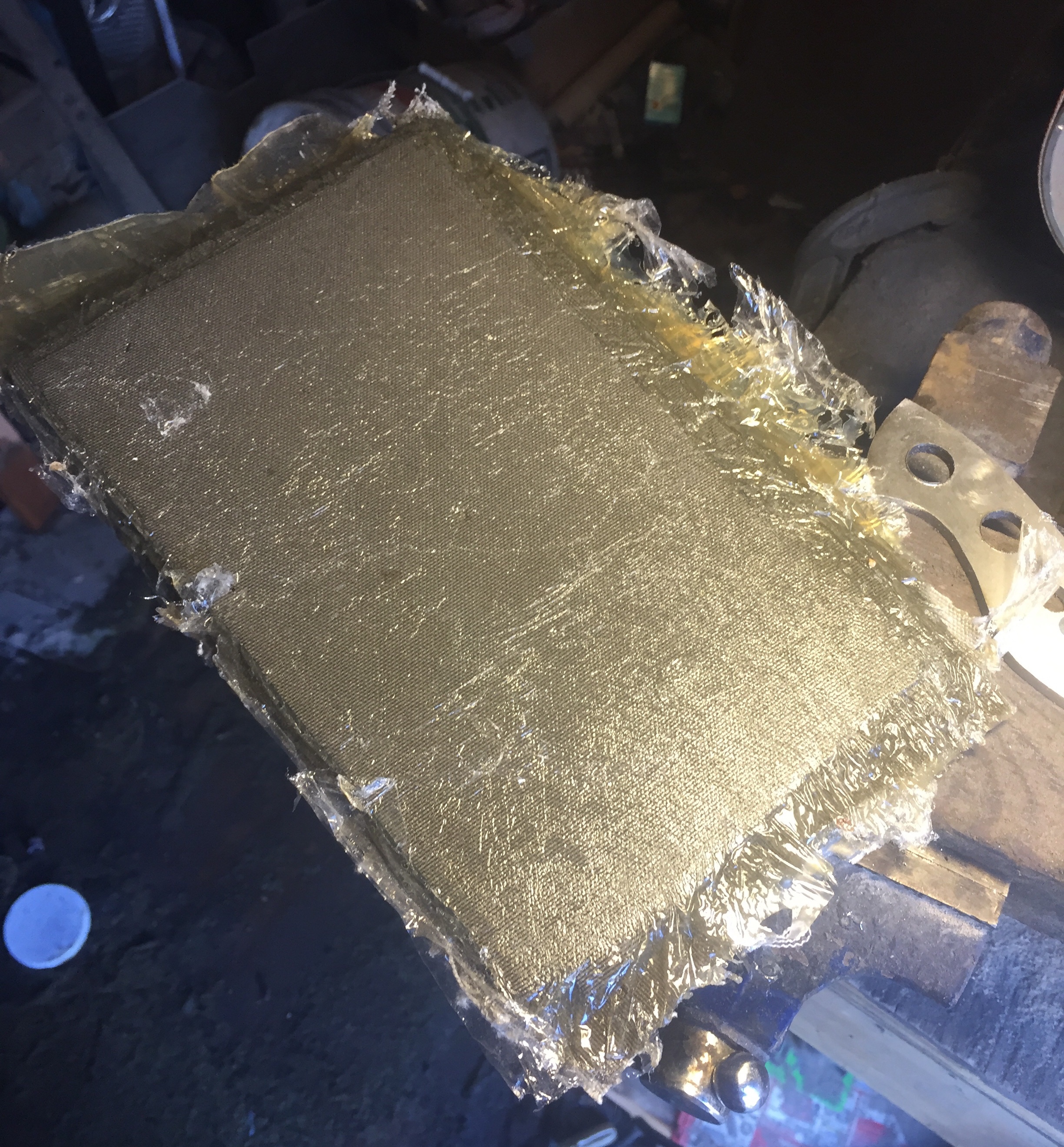
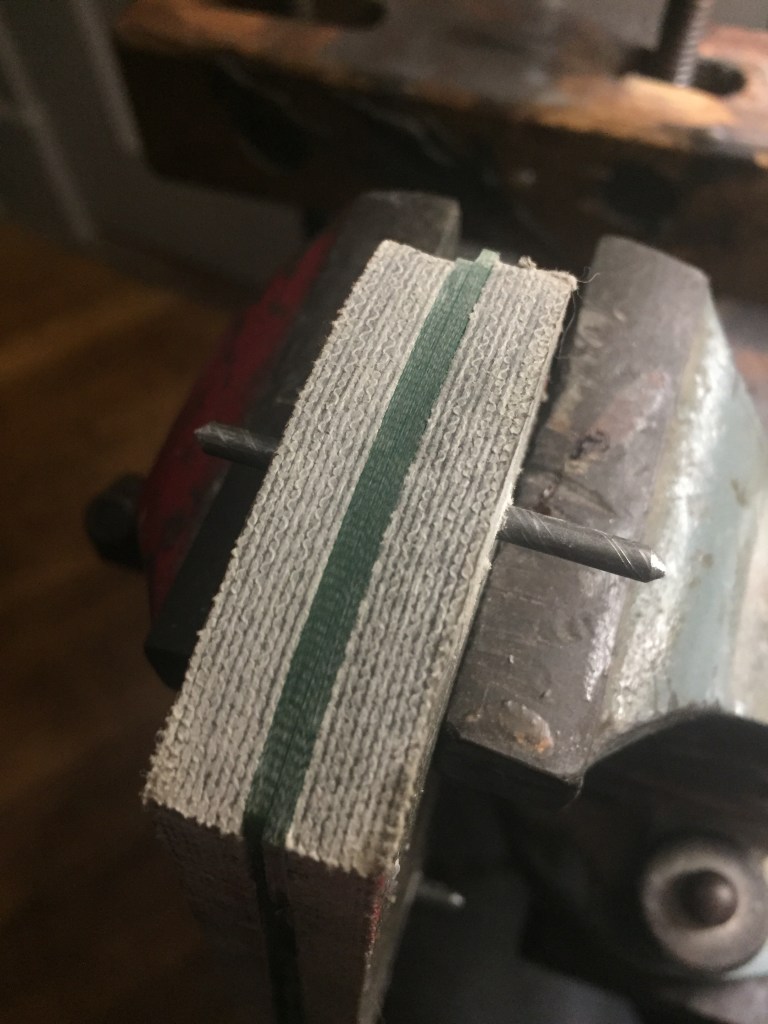
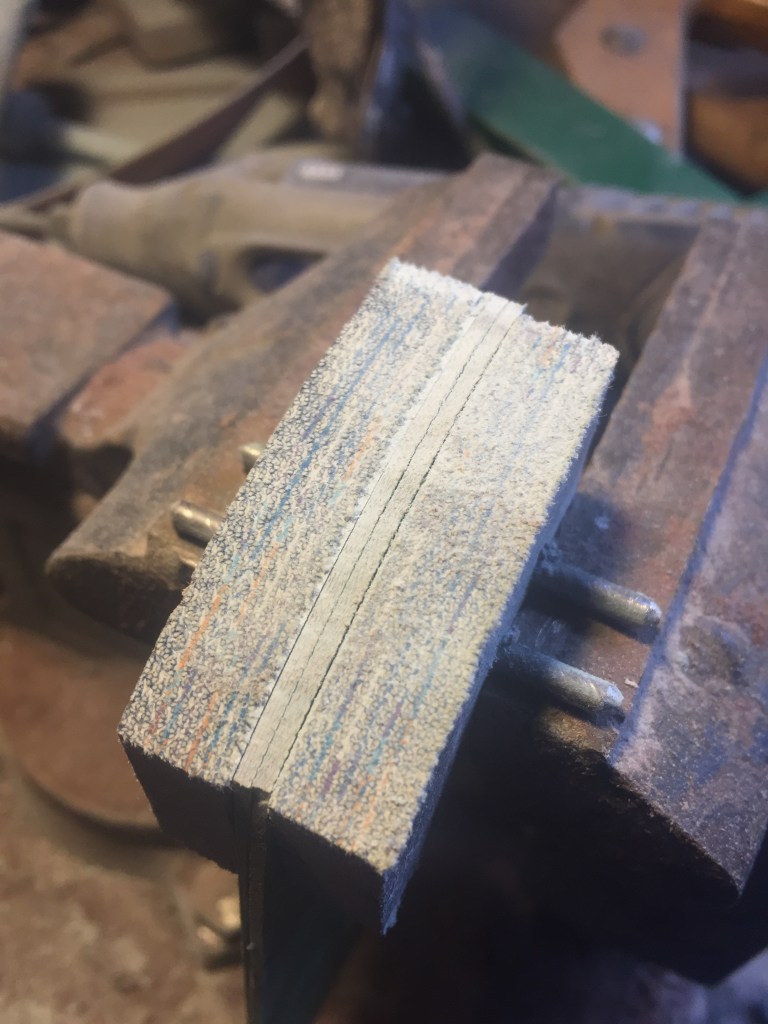
And this is the raw material, about 3/16″ to 1/4″ thick.
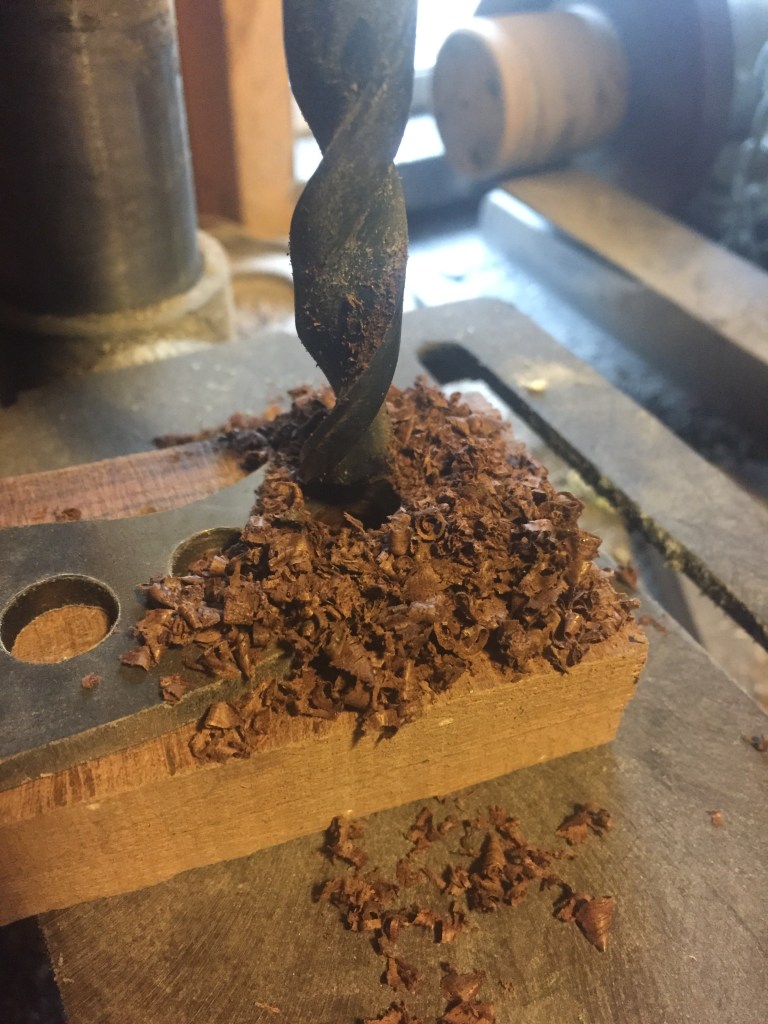
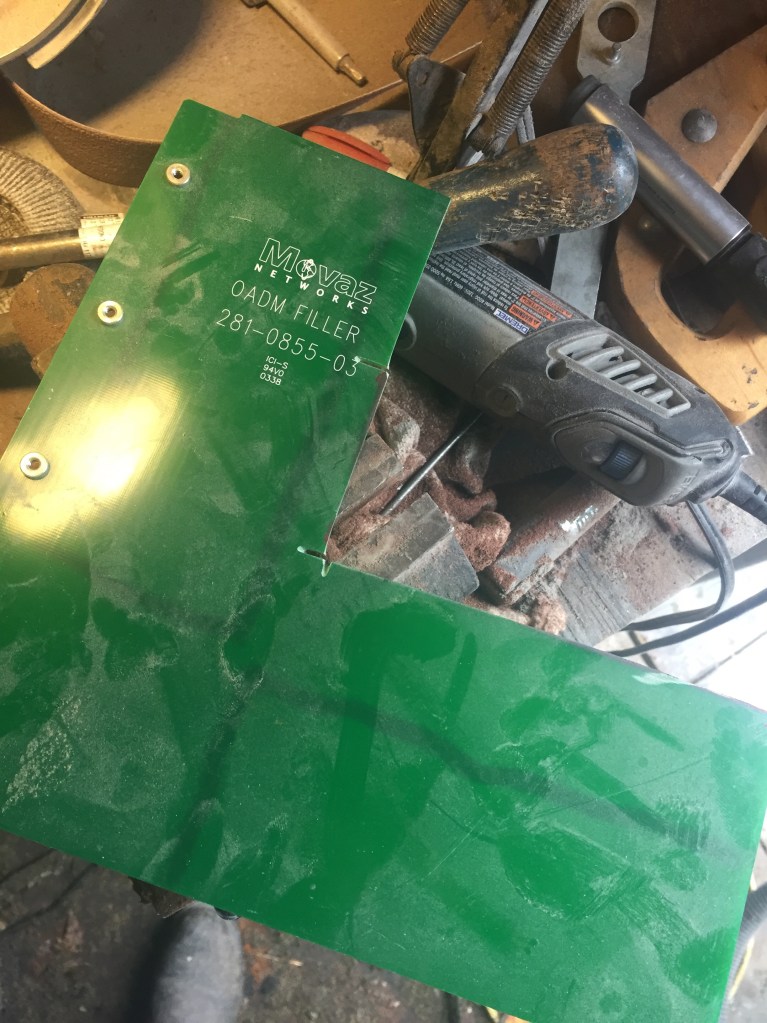
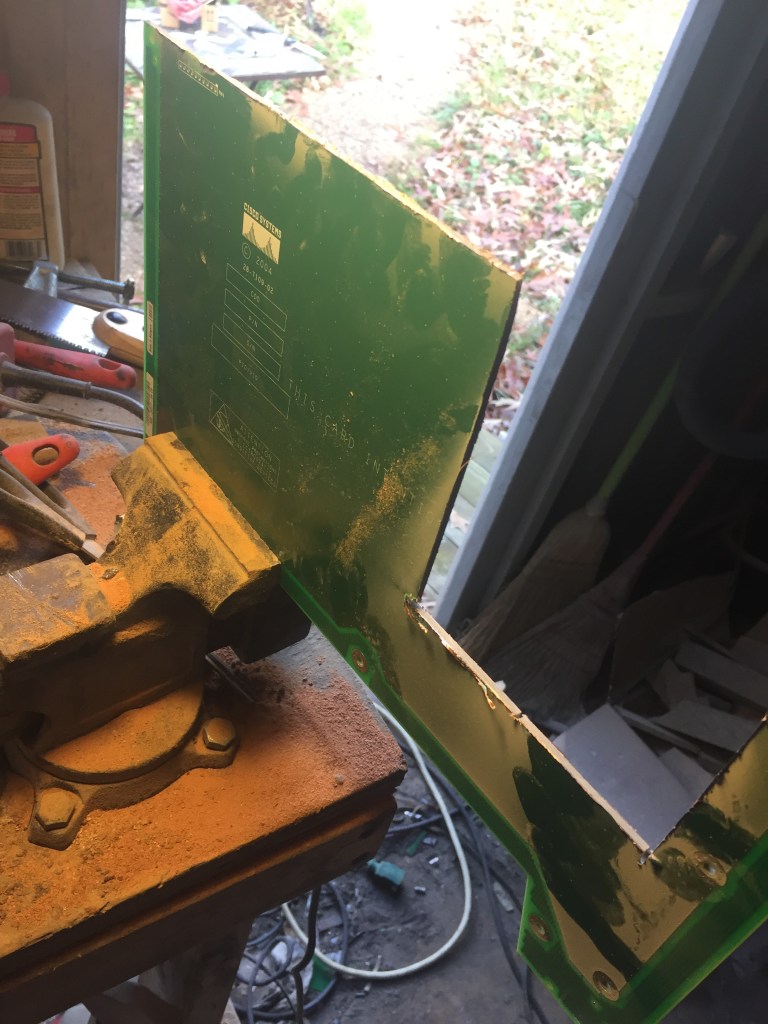
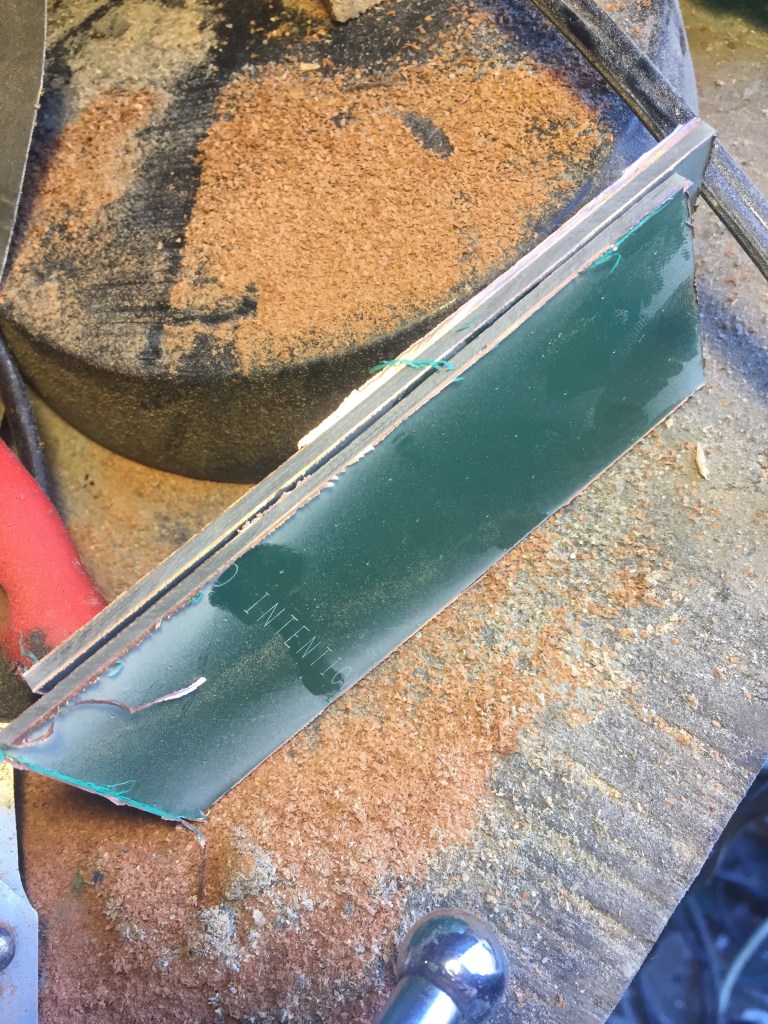
A PCB filler blank, rescued from a dumpster.
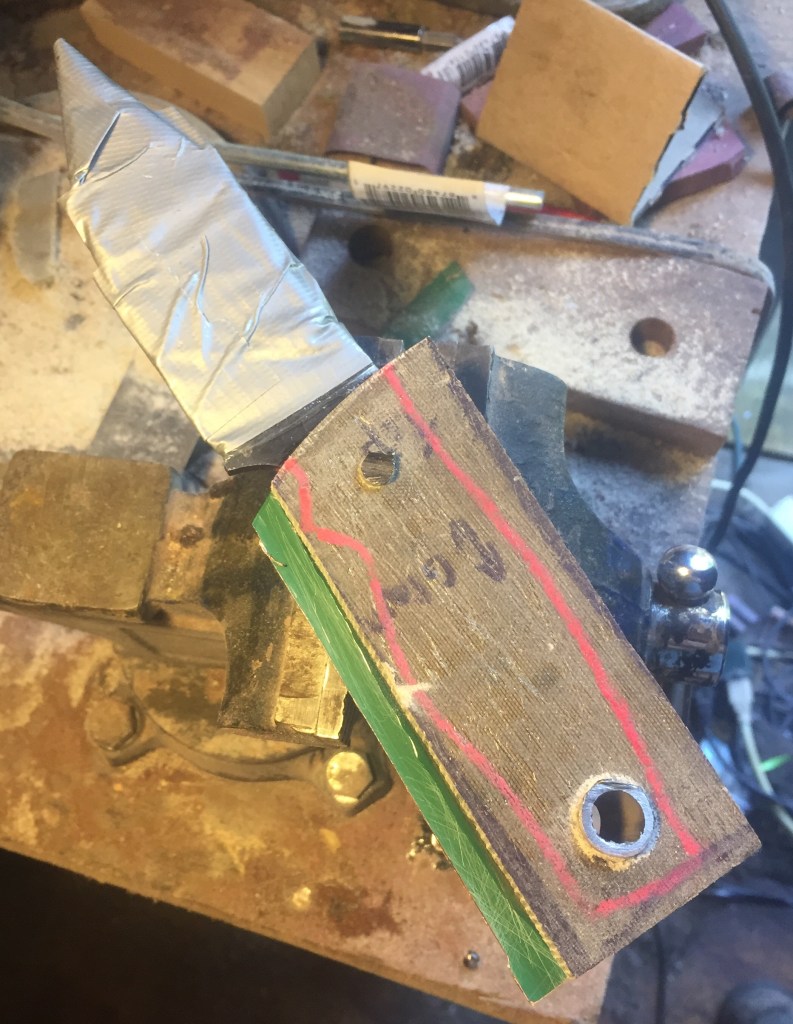
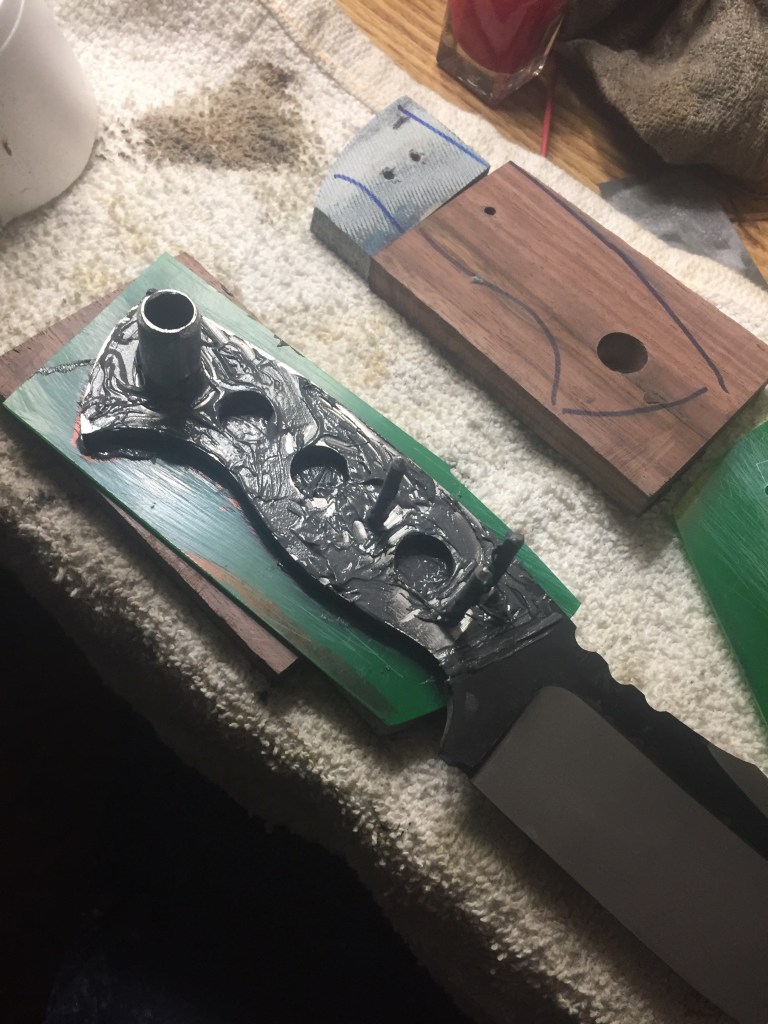
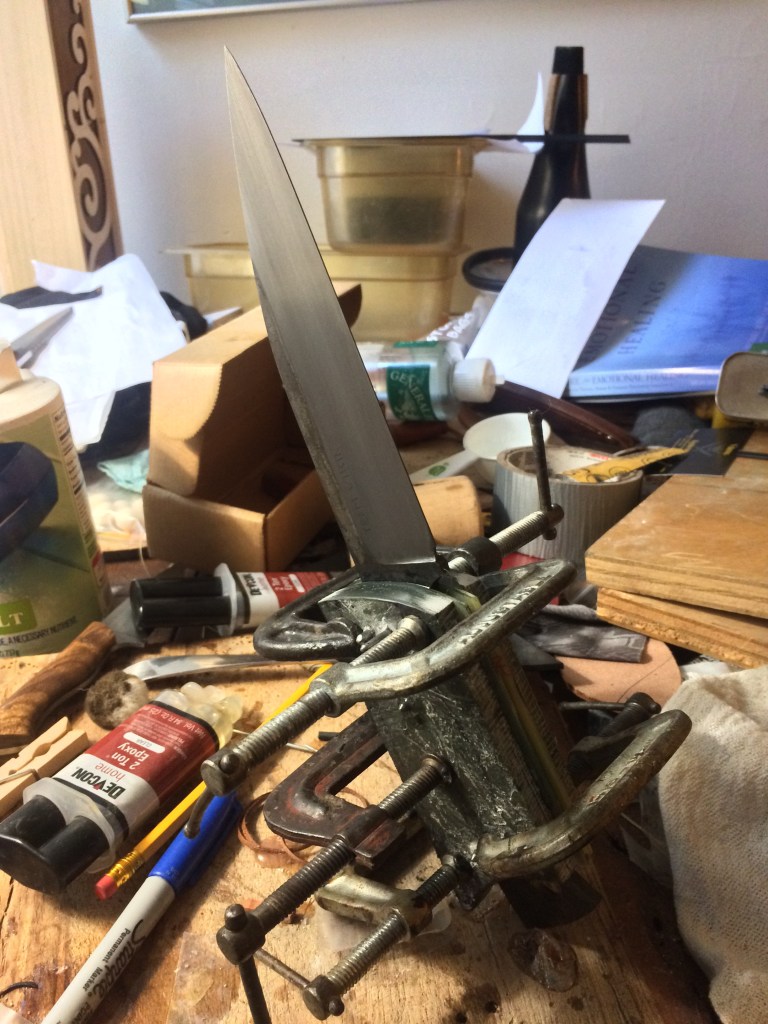
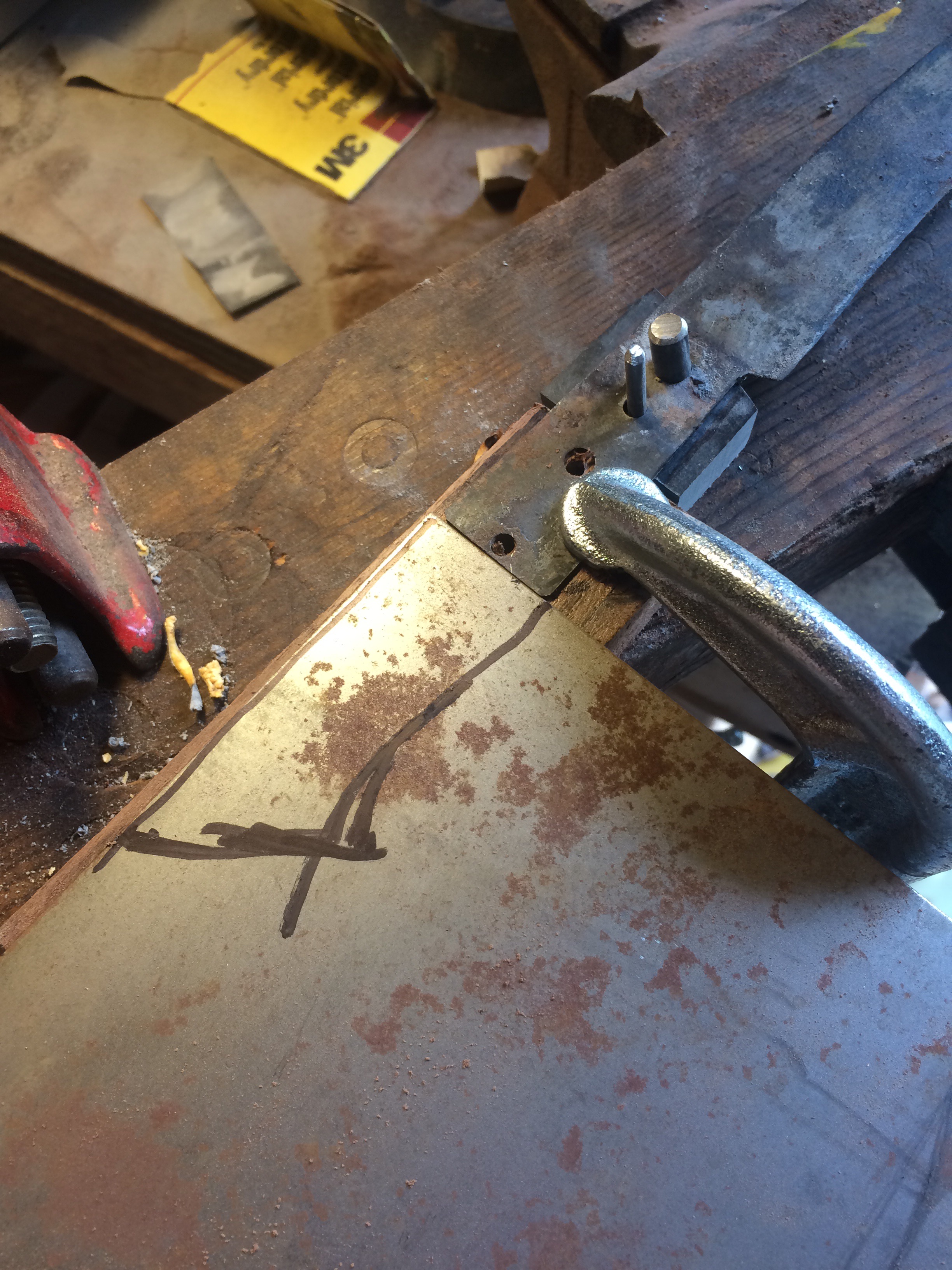
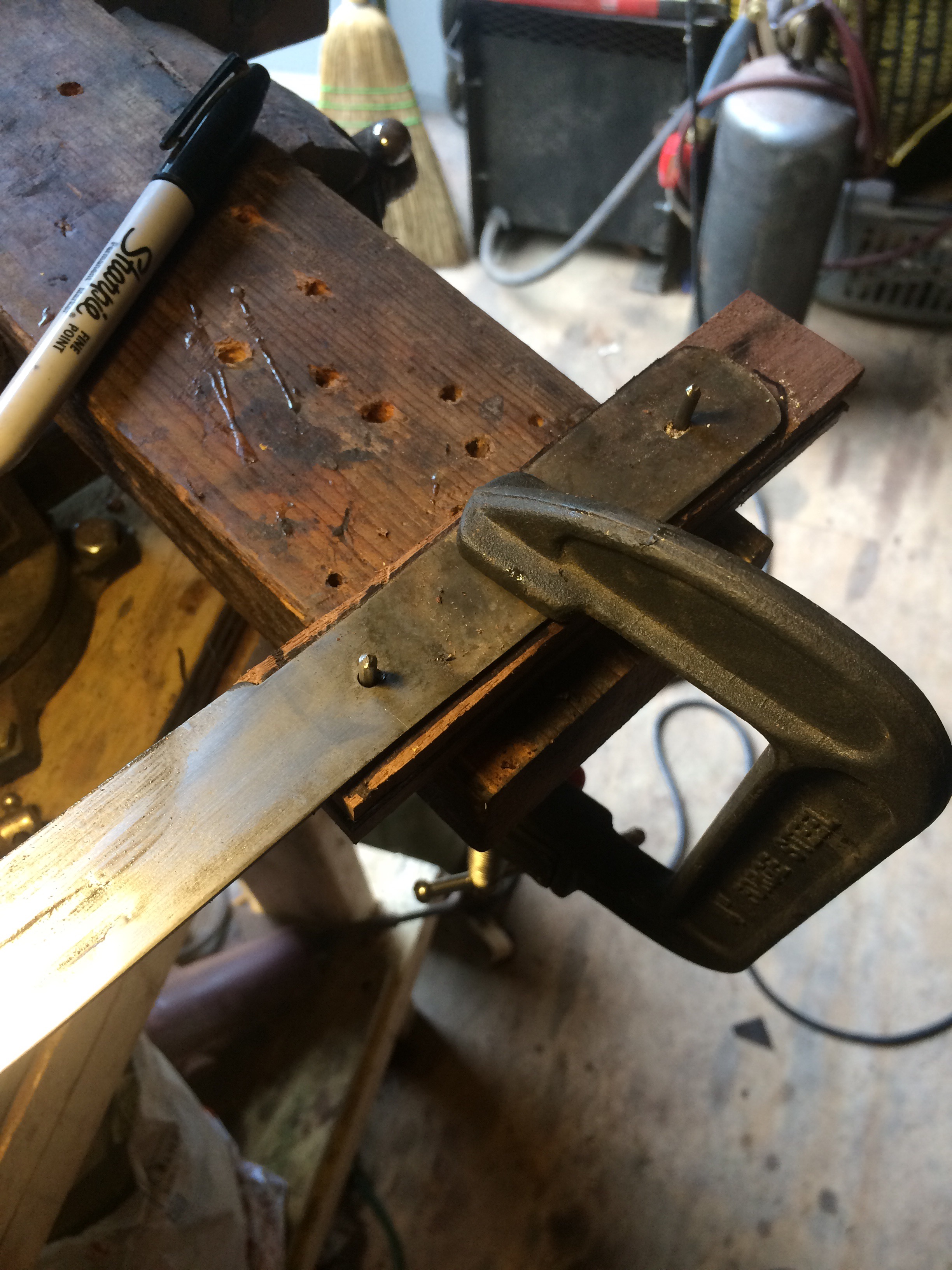
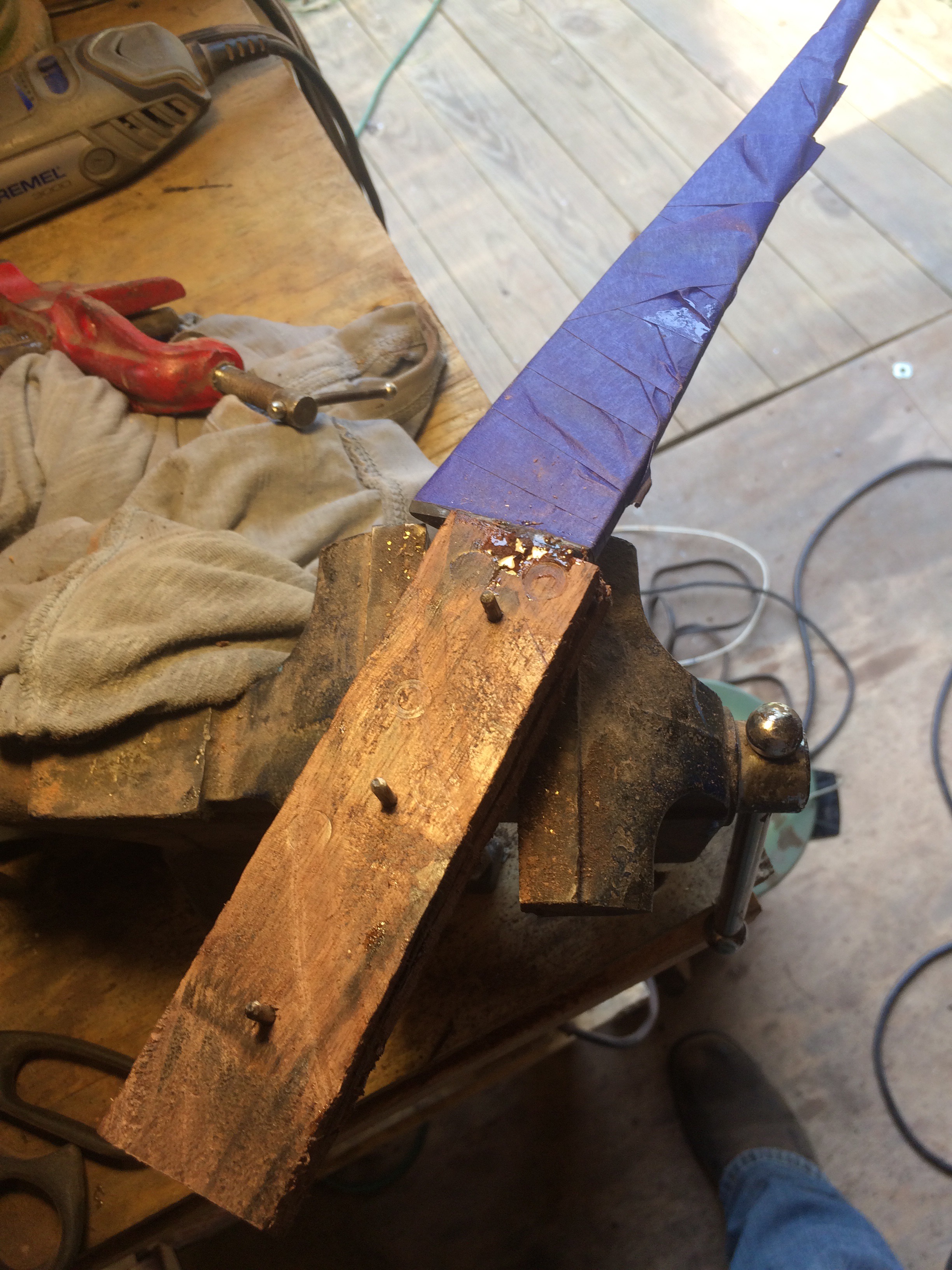
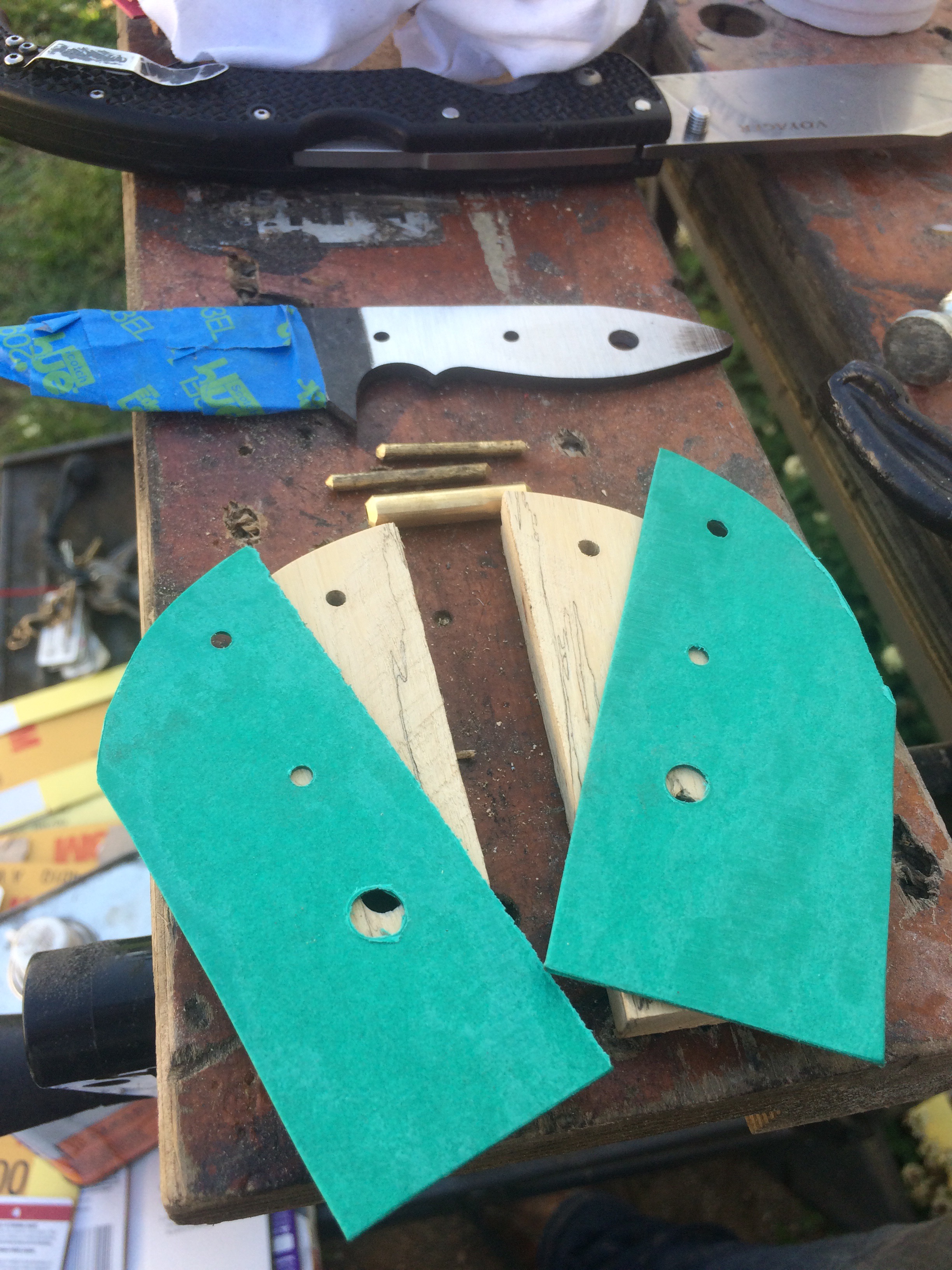
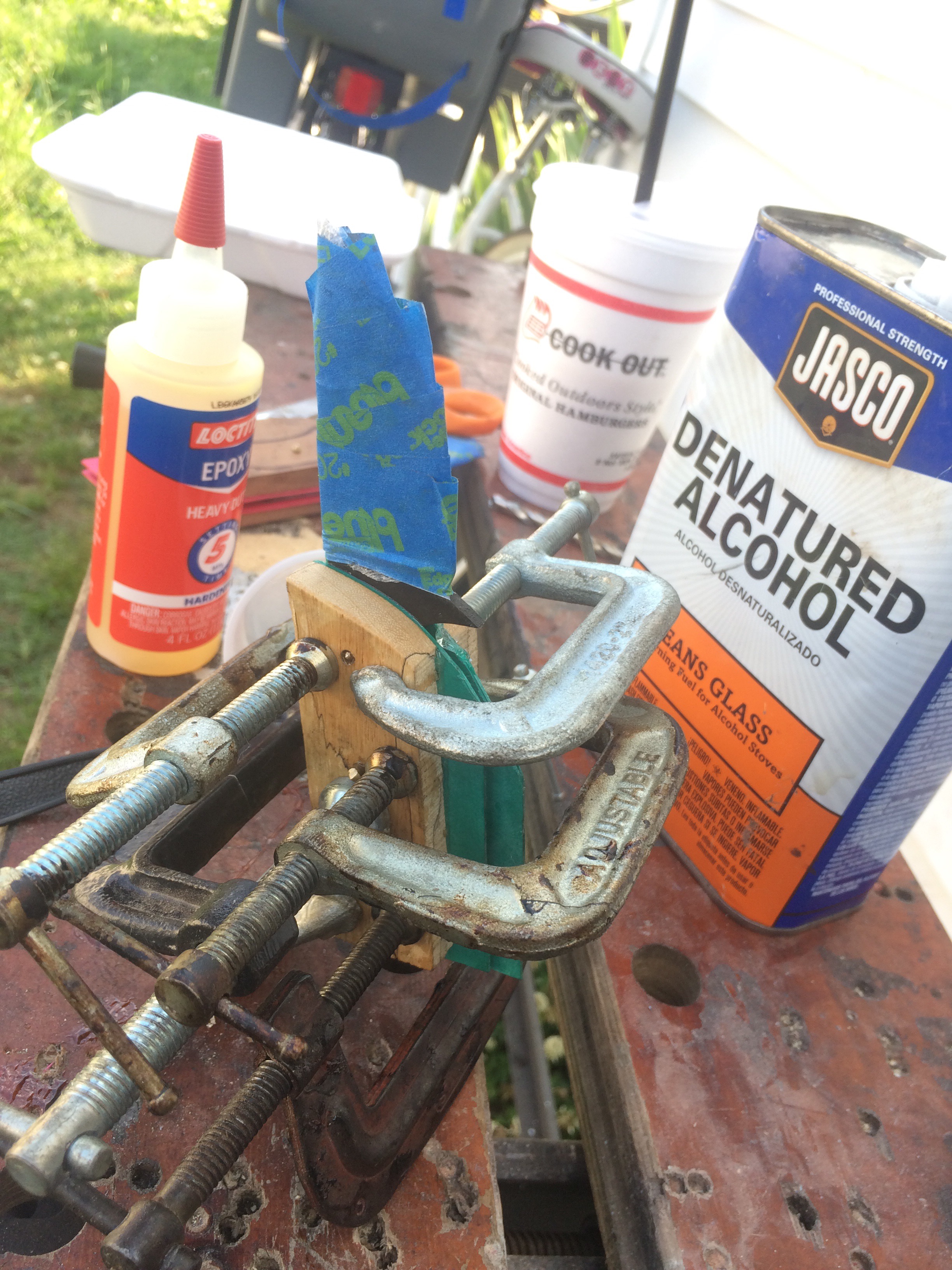
Everything gets drilled and glued/riveted together.
Ready for shaping.
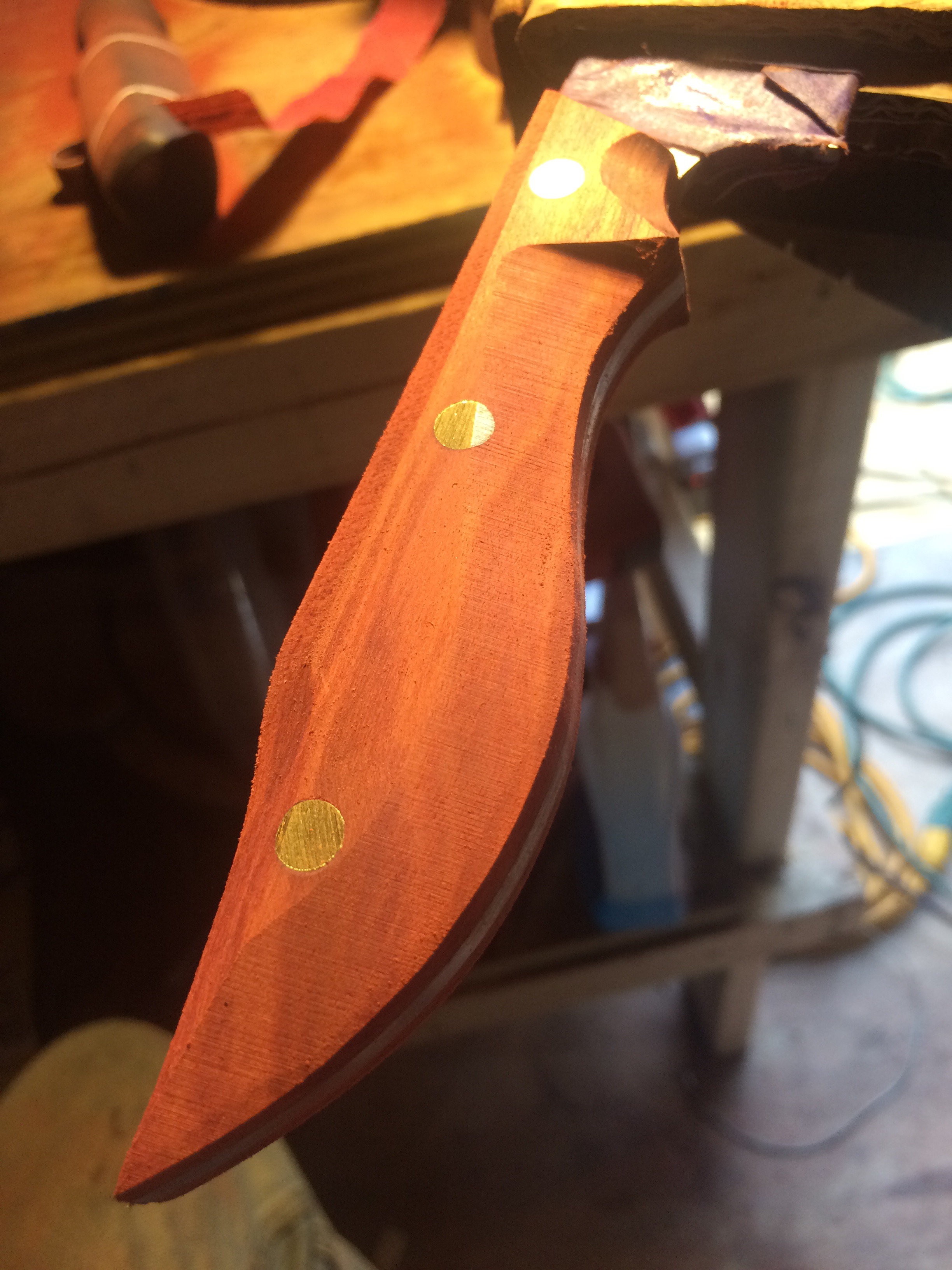
Profiled
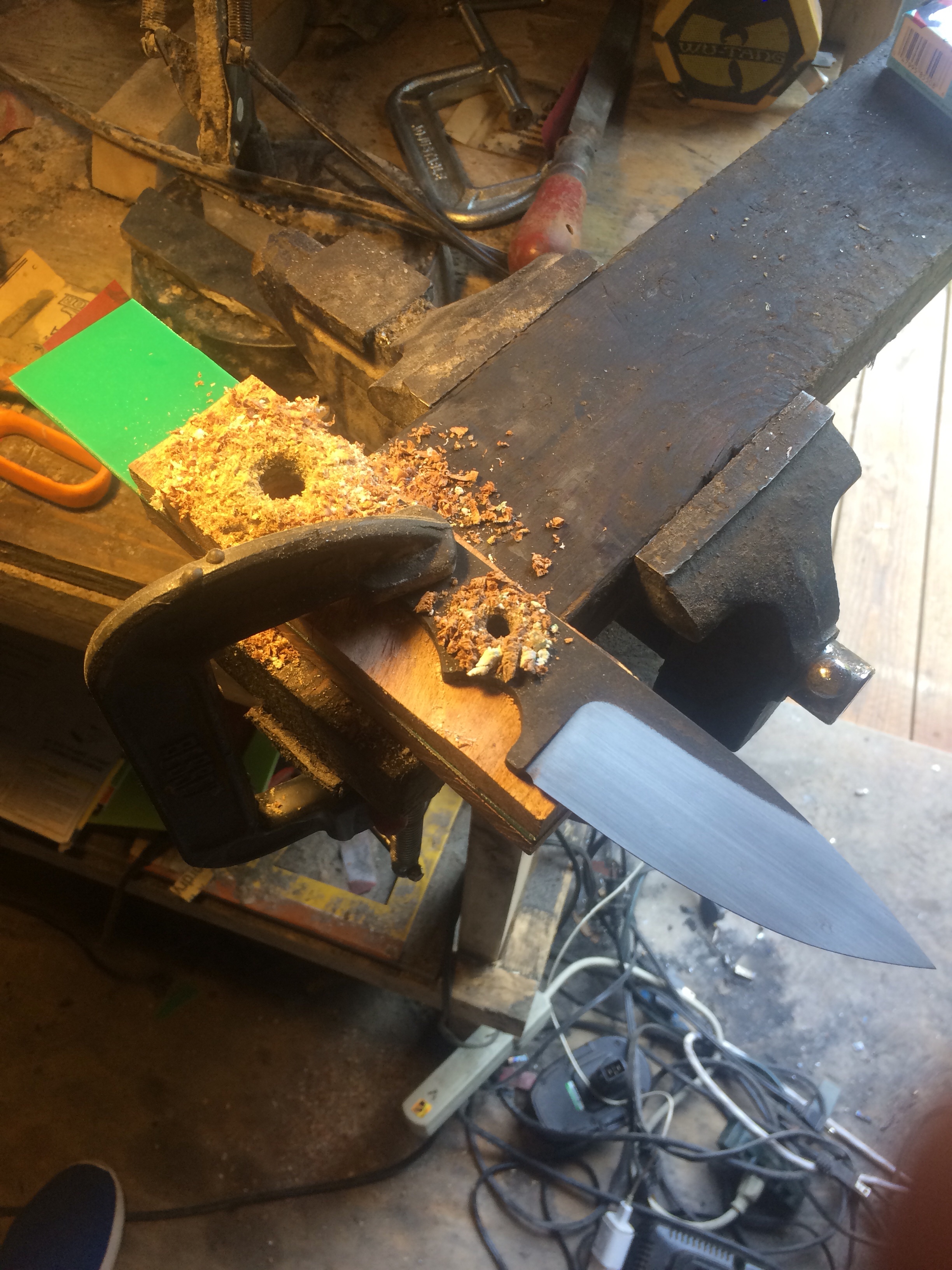
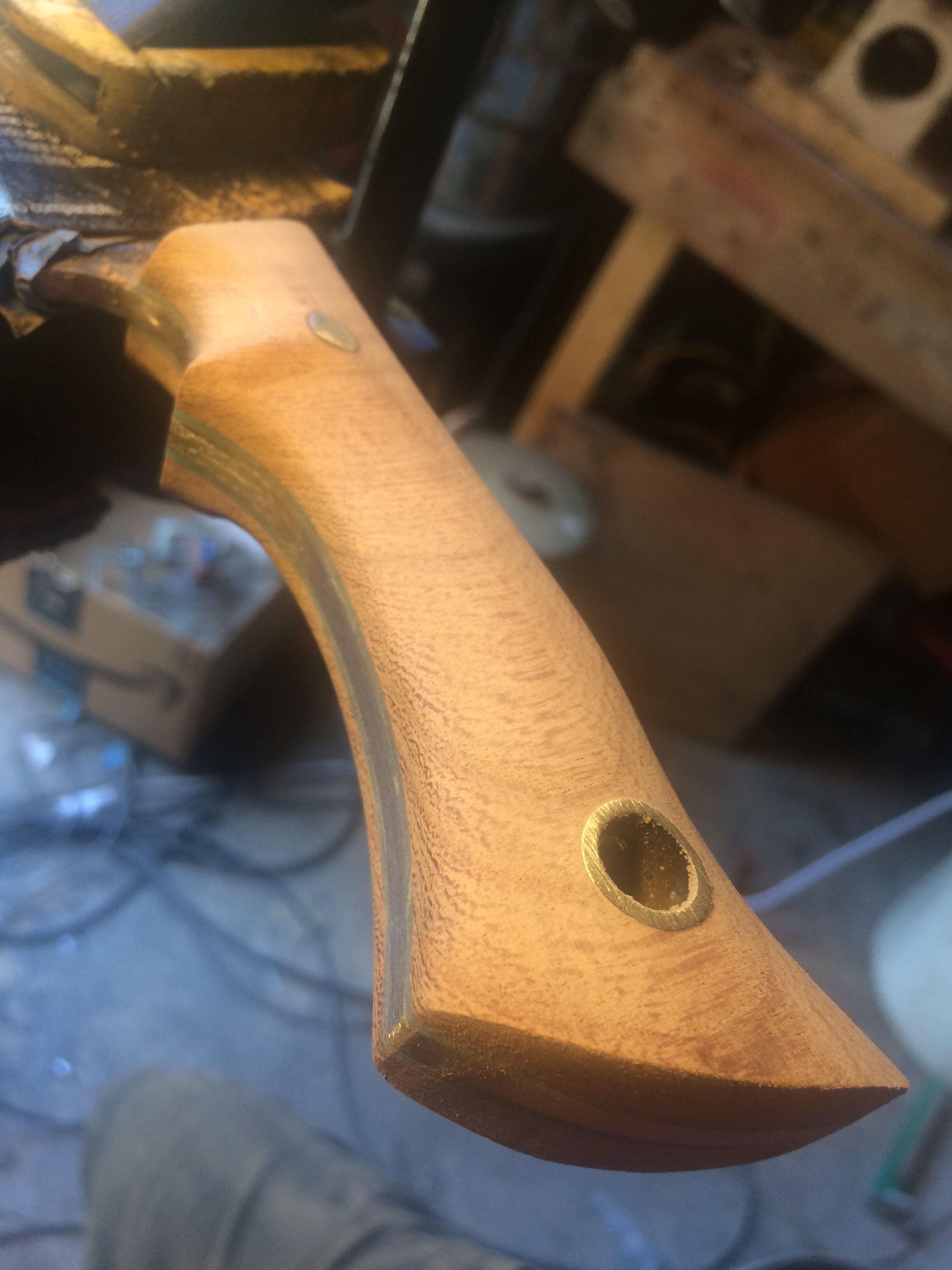
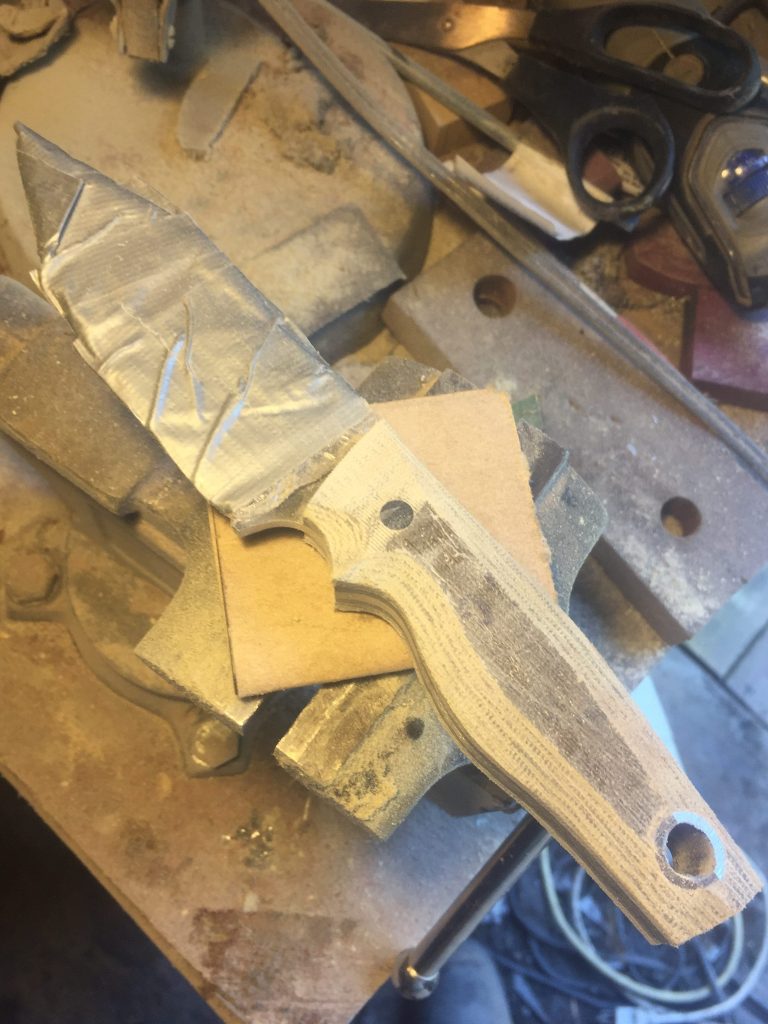
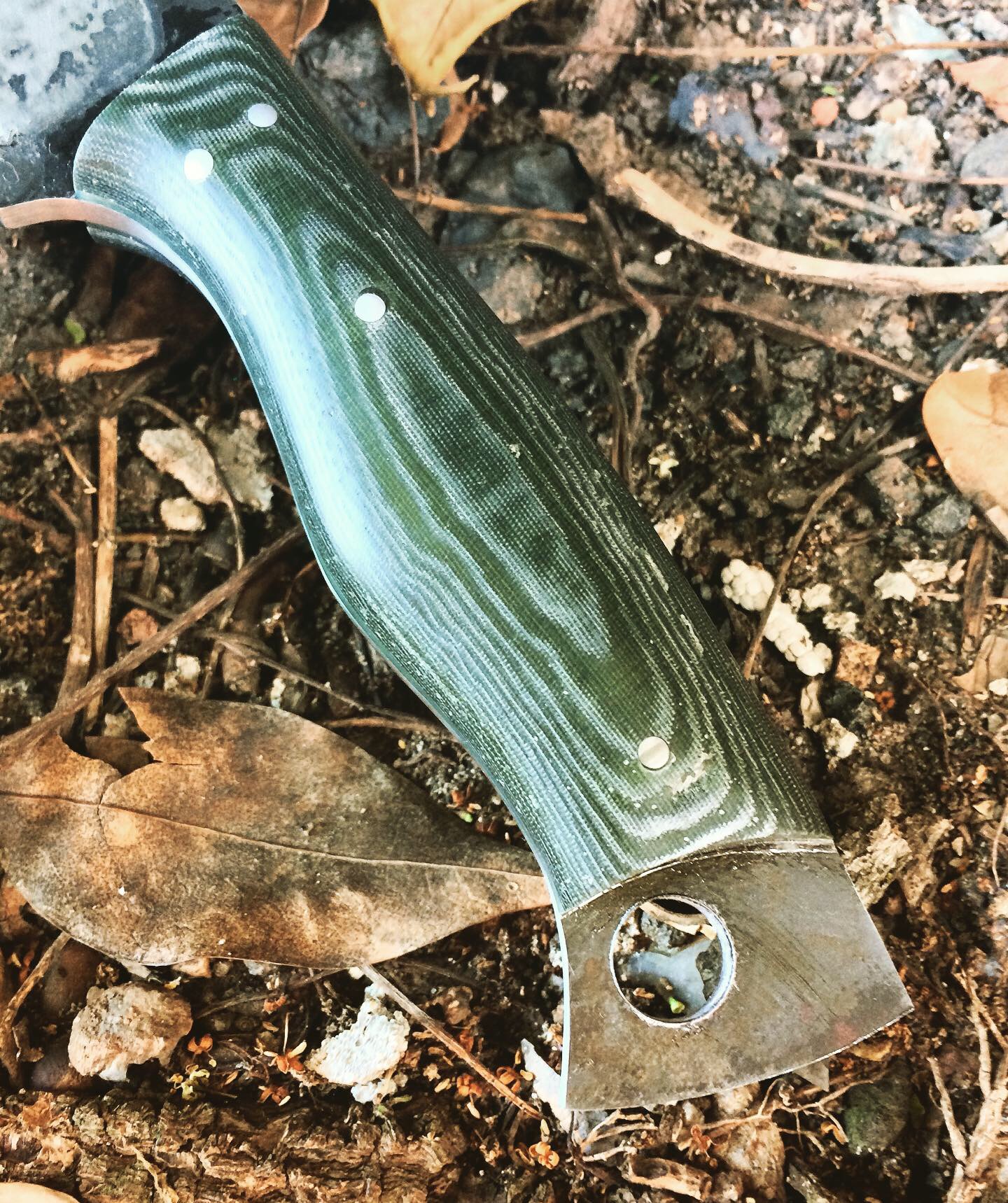
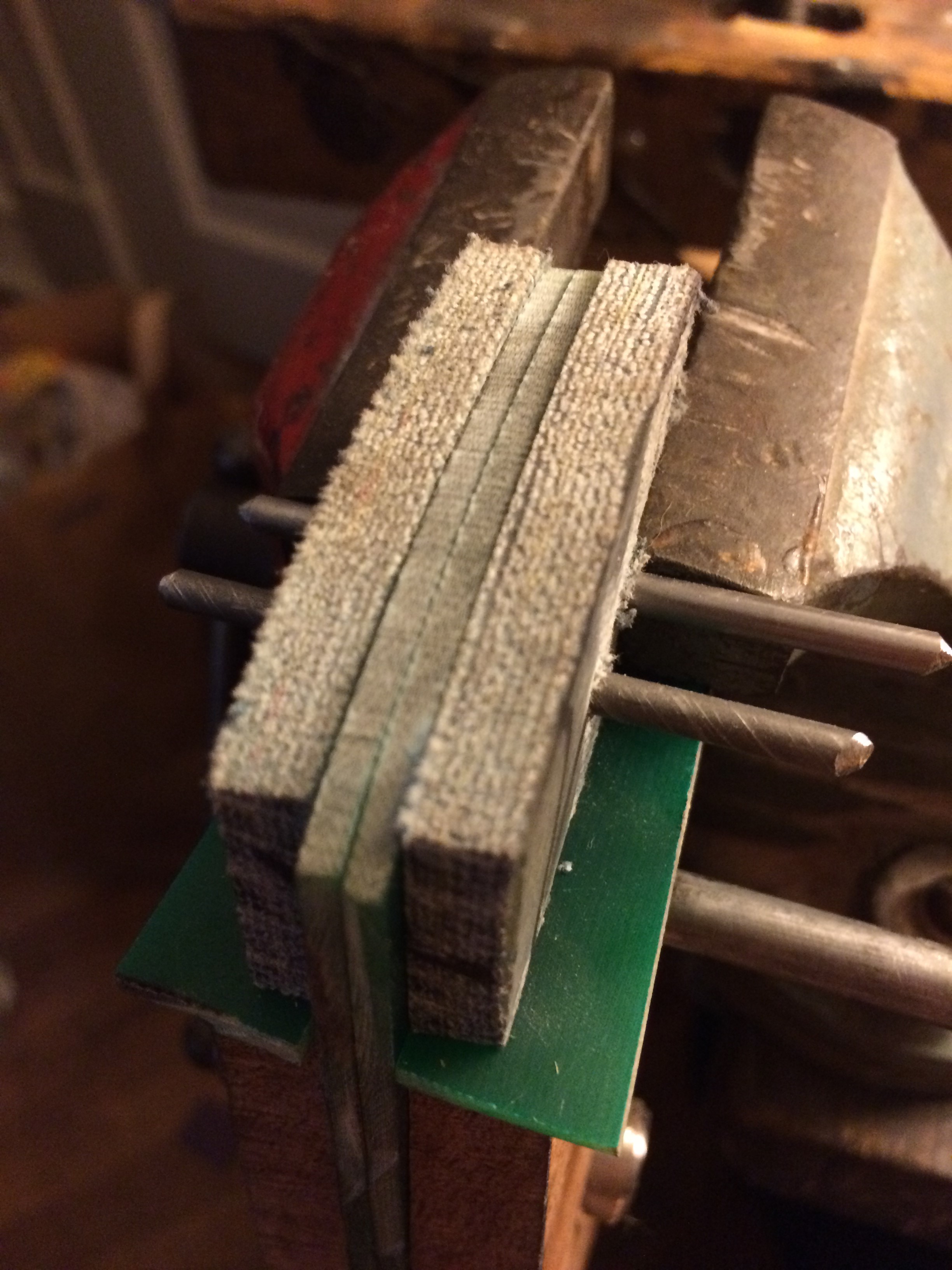
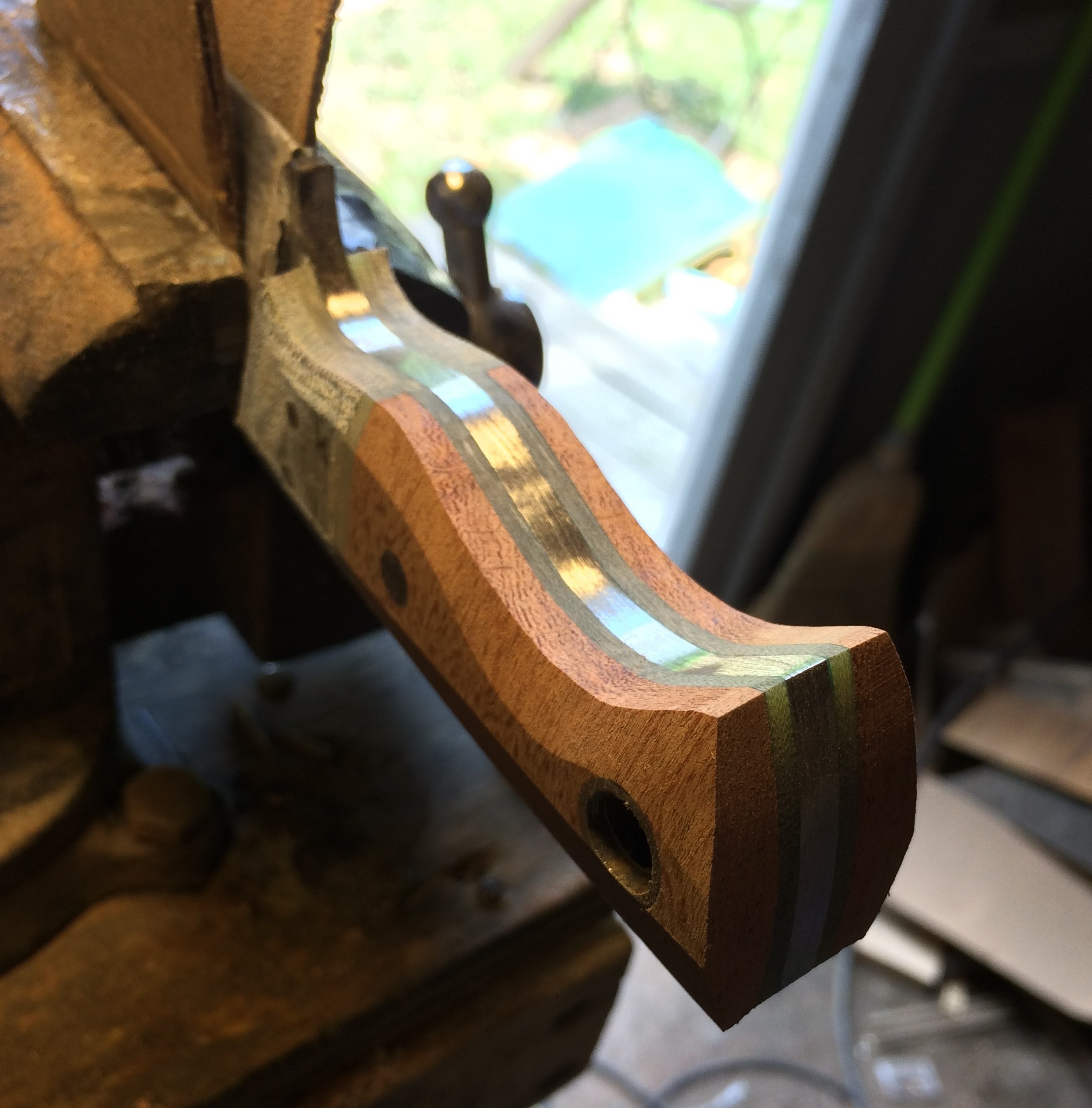
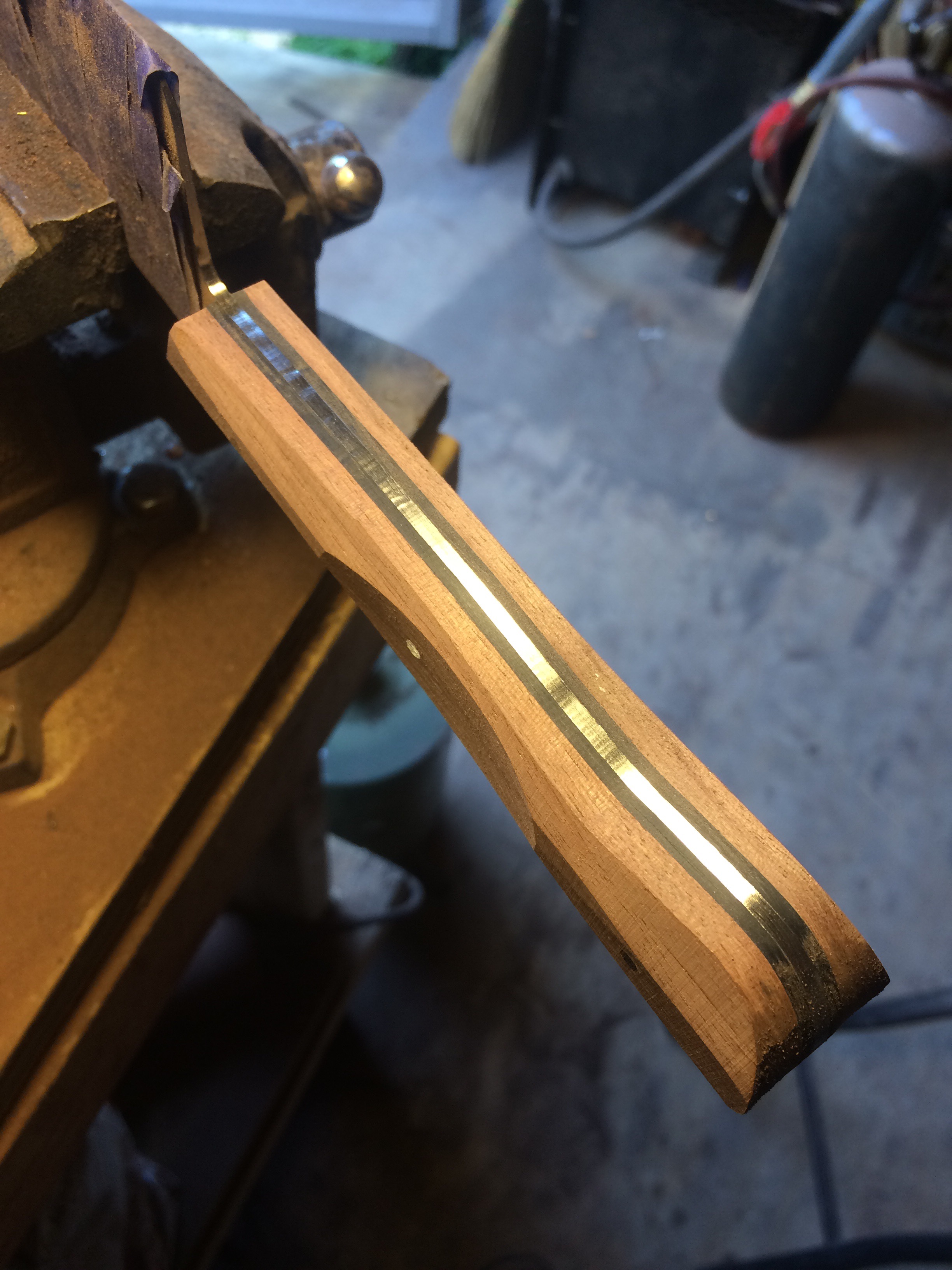
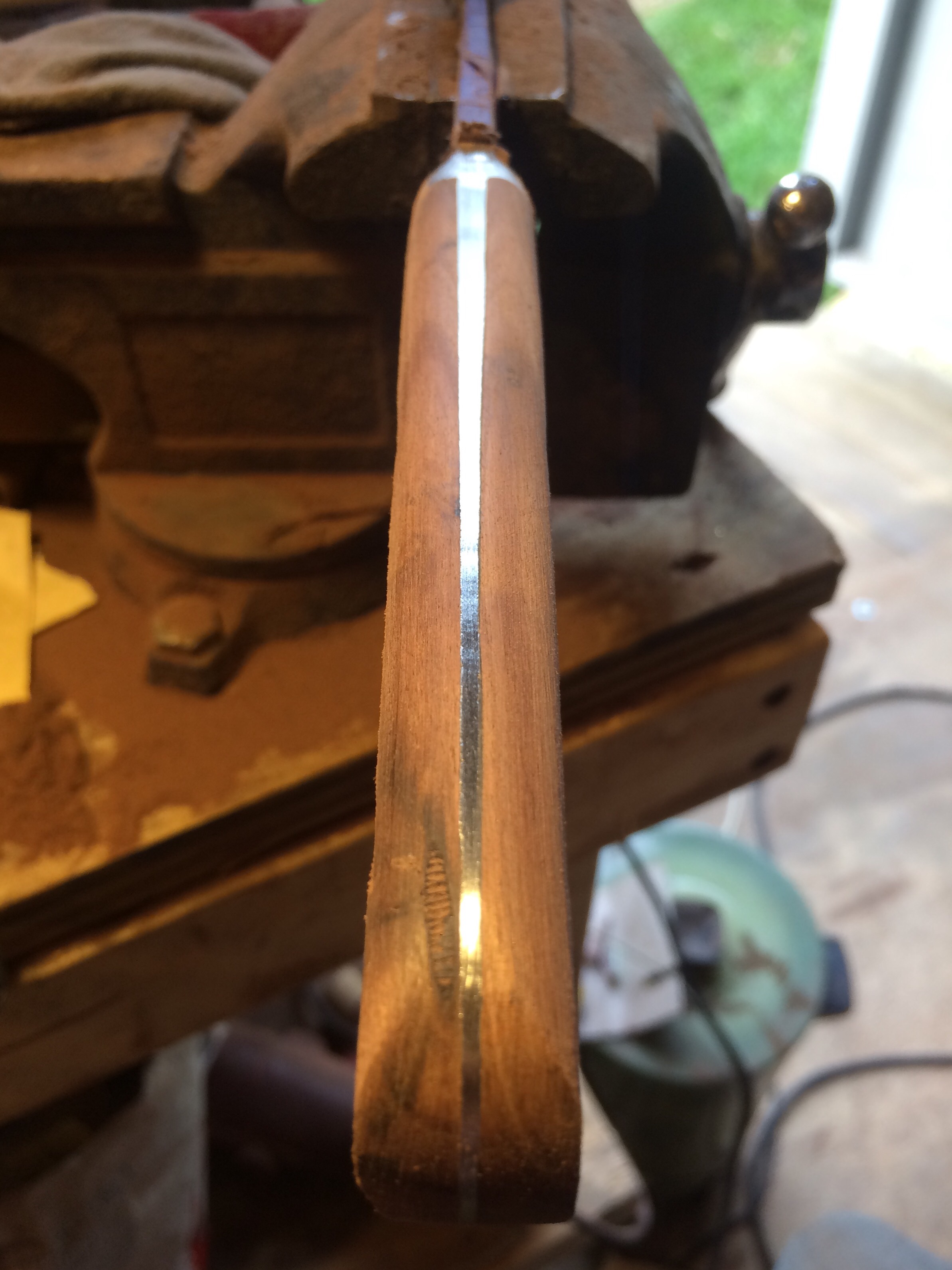
Shaped to fit the hand. This is off the grinder at 60 grit. The rest will be done by hand to help the material speak.
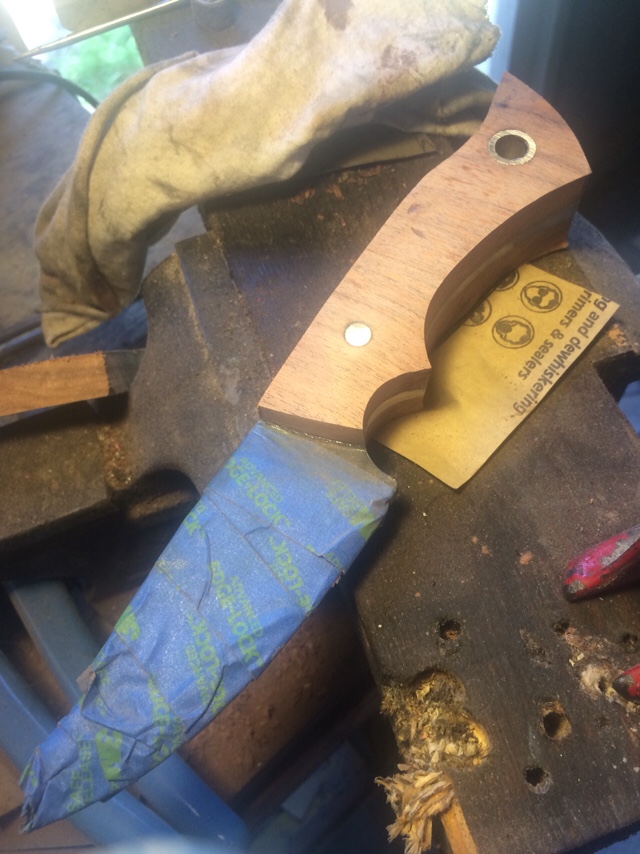
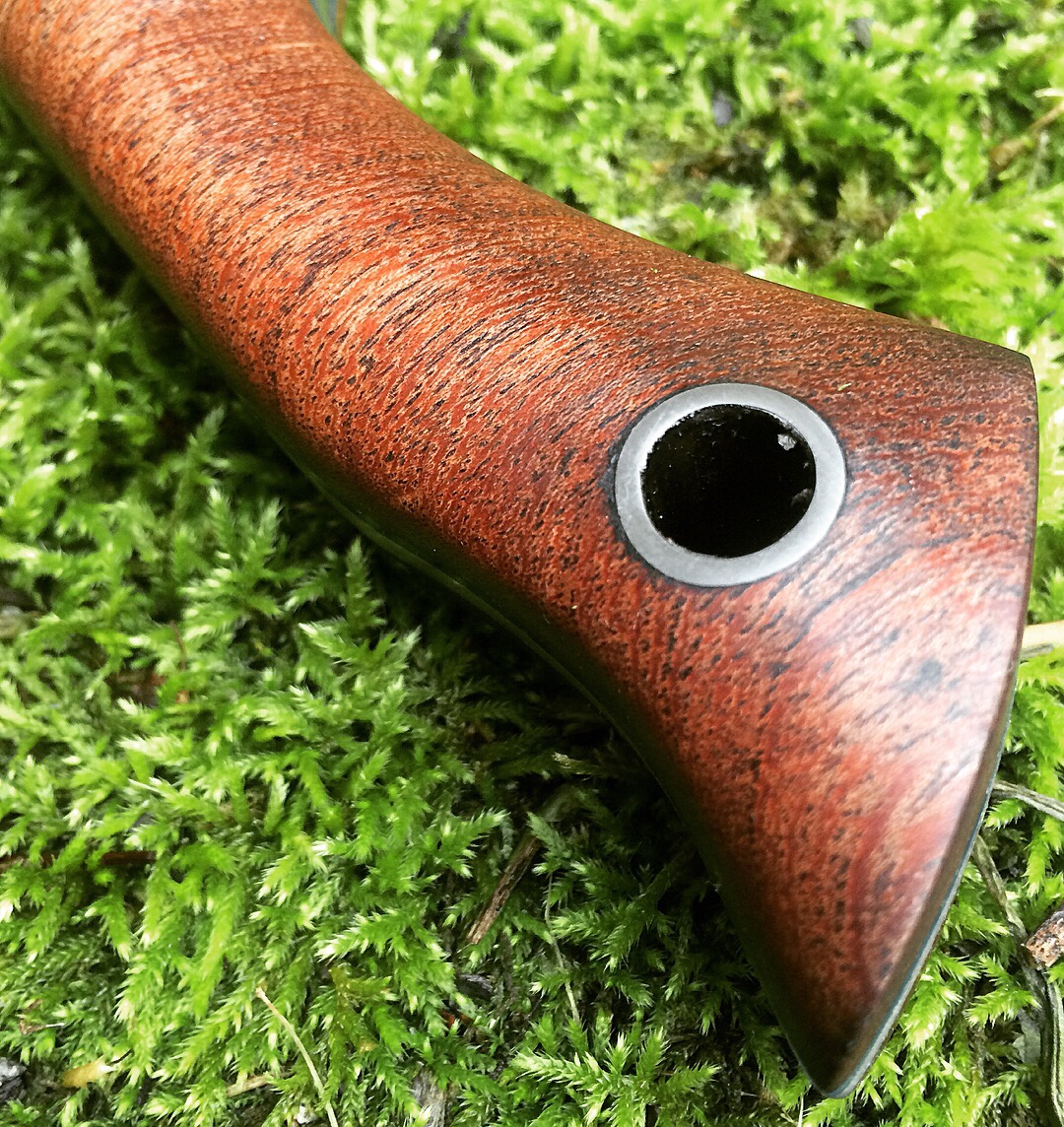
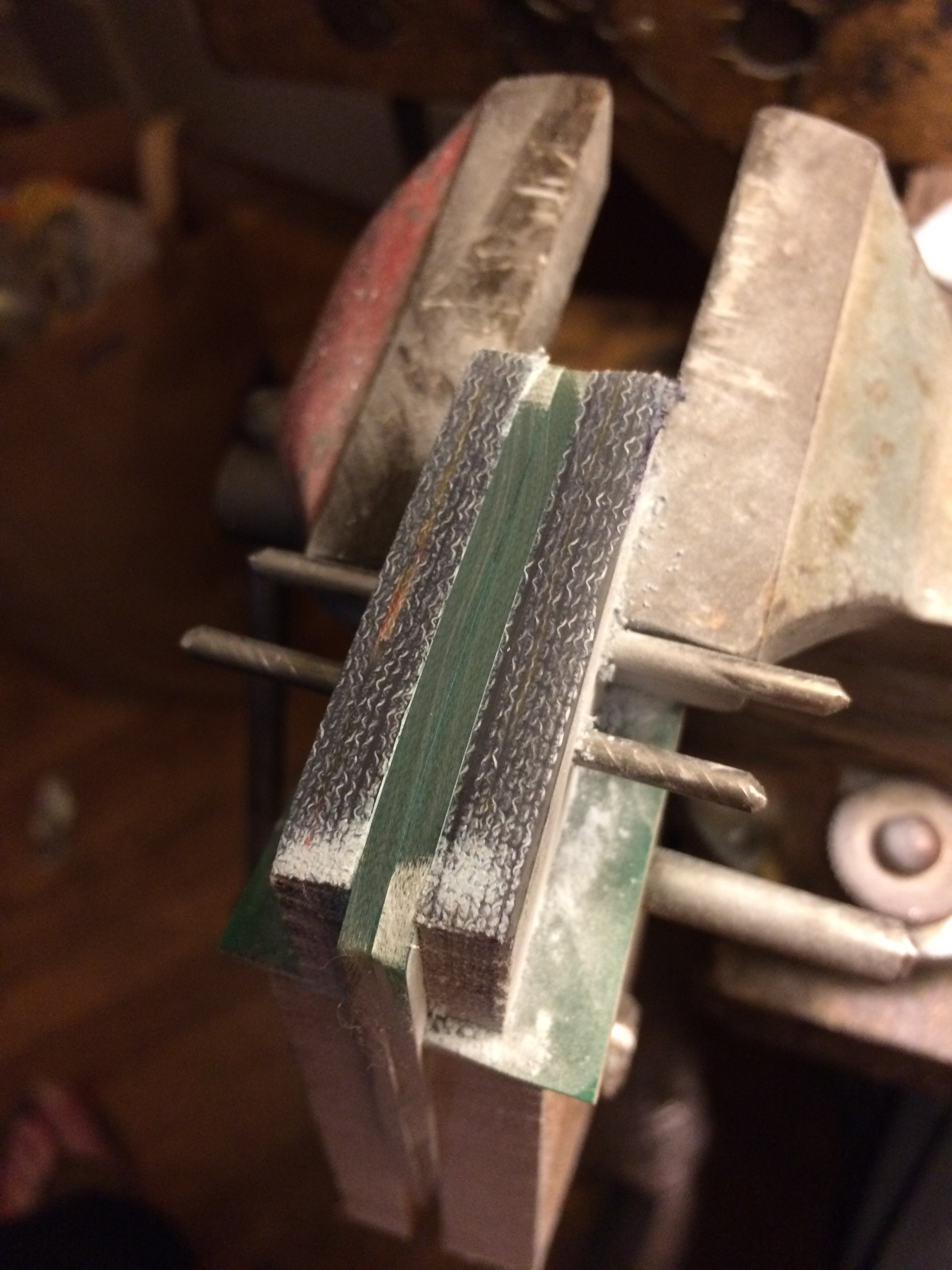
At around 120 grit you can see the “grain” start to speak. The higher you polish it, the more pronounced it will be.
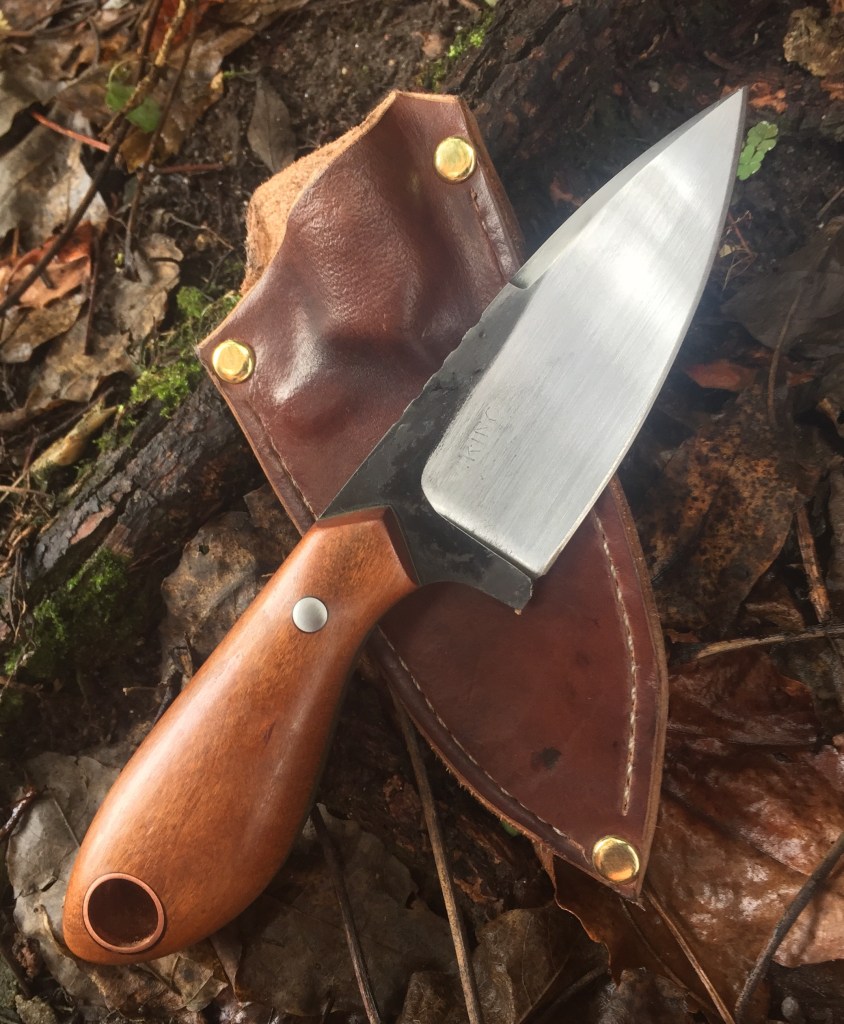
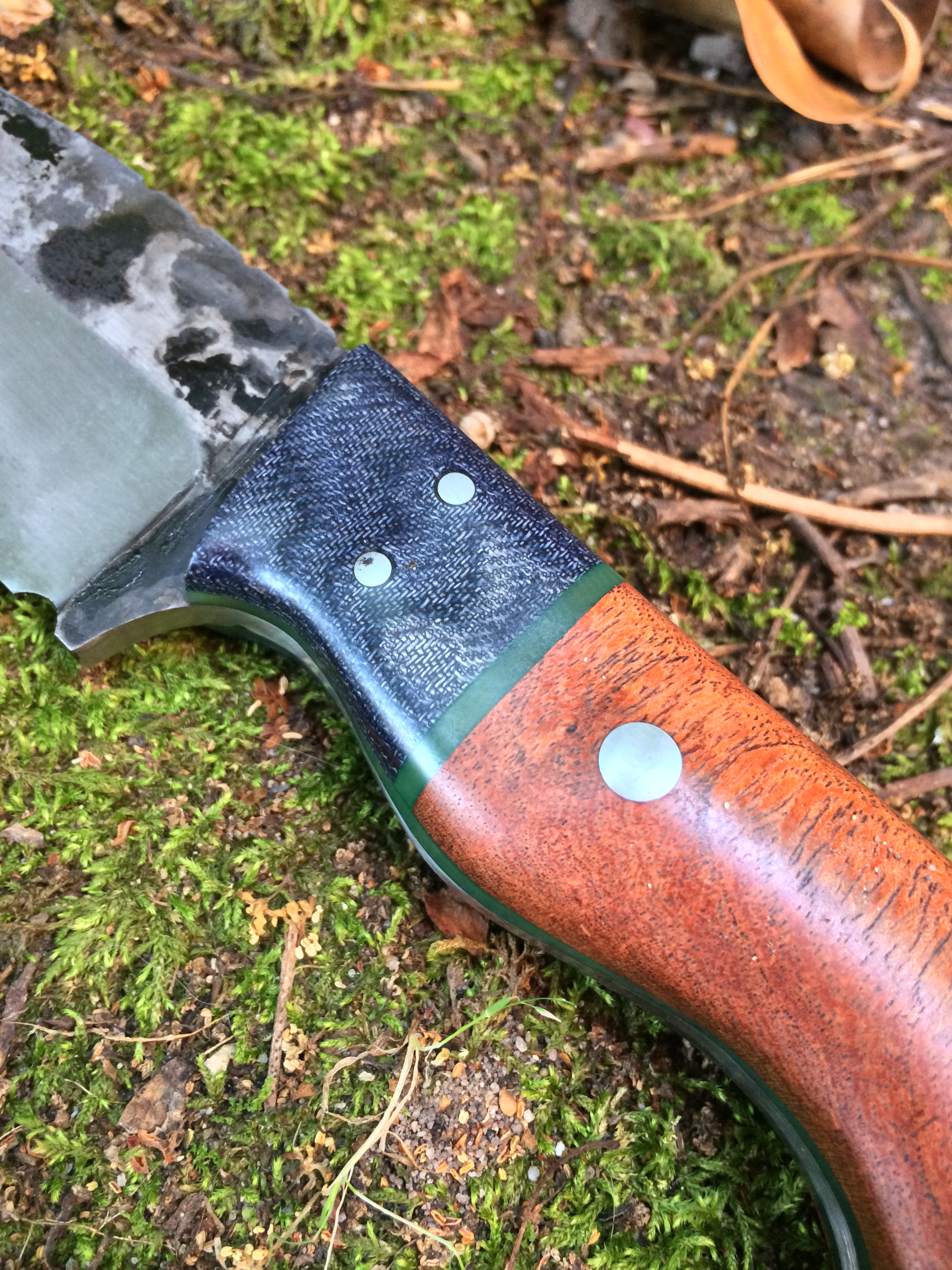
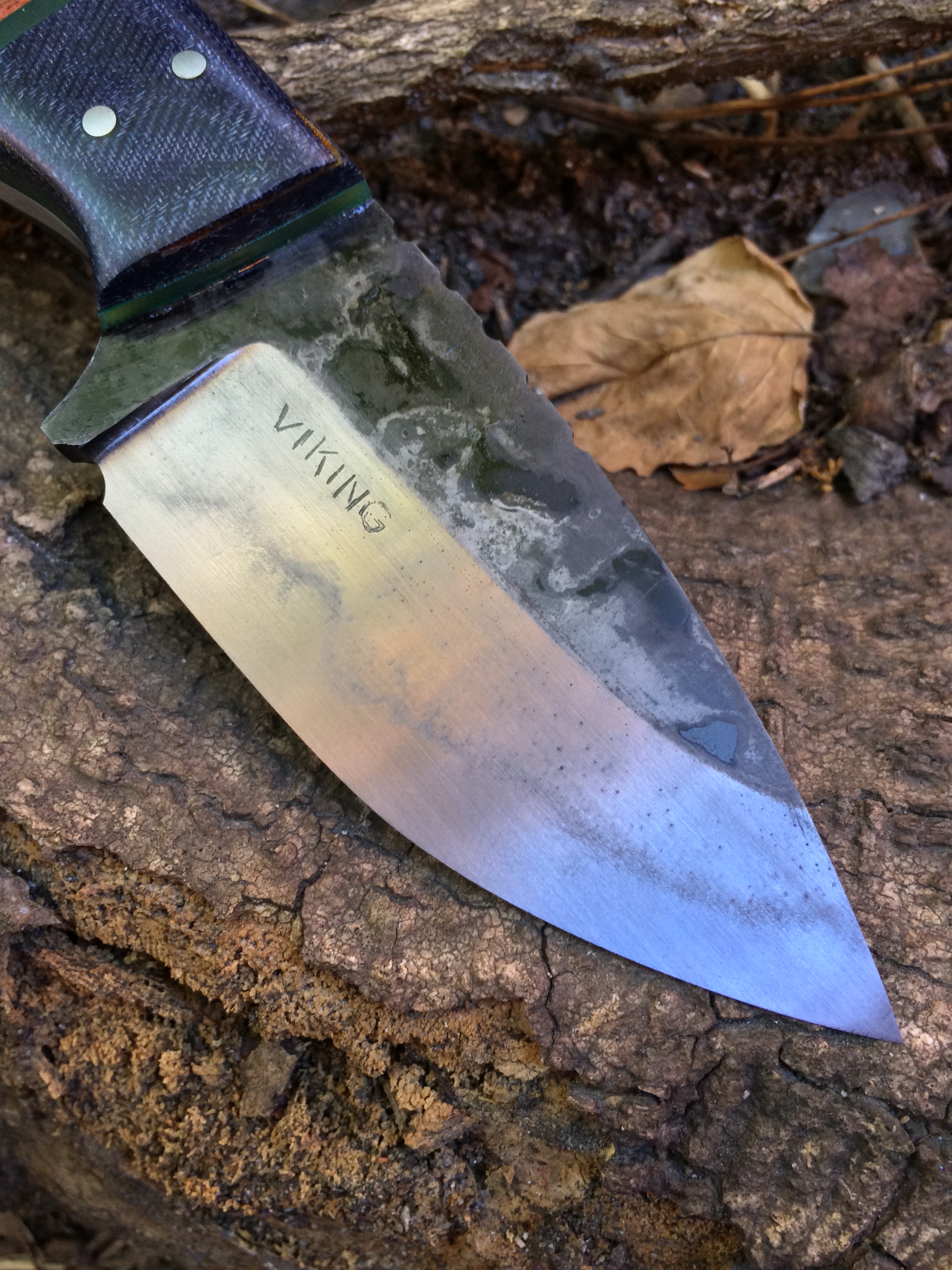
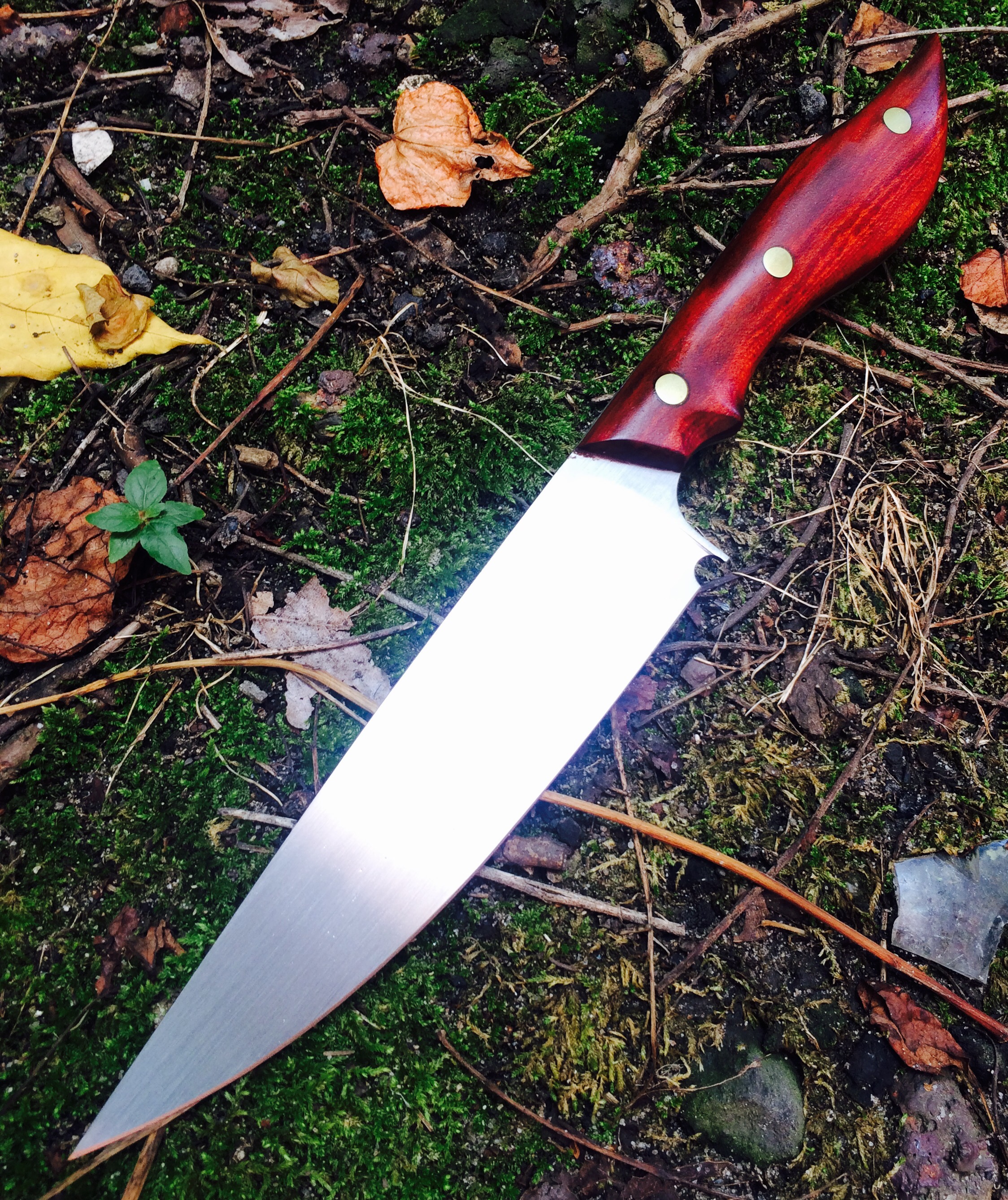
The Bounty Hunter

Knifemaking: on being part of a team, and Puttin’ on the Fritz

“No member of a crew is praised for the rugged individuality of his rowing.”
― Ralph Waldo Emerson

For the past thirteen years I’ve worked off and on in the operations department for the symphony orchestra we have in town.  What many people may not be aware of is that there are a lot of logistical factors and people involved in getting an 80-person orchestra on stage to perform Beethoven: more so to perform Ravel.  Risers need to be built and installed, specialized percussion needs to be rented or even custom made, guest artists need to be booked and accommodated.  None of this even includes the years of training on the part of the musicians, or the planning and learning of the repertoire.  Outside of this, there is a whole team of people running youth programs and community choruses, each with their own logistical needs.  As one can imagine, it is tremendously expensive to run an orchestra and a great many people work very hard so that the classics can be heard as they were meant to be heard.  In a complicated and difficult world, it’s deeply comforting to know that there are people working tirelessly with sole intent of putting good work out into the world.

In recent years, however, people haven’t been going to orchestra concerts as they have in the past.  All over the country, symphonies have been closing down.

A few years ago a decision was made by the upper administration of the symphony in town to invest in a mobile tent big enough to put a stage and orchestra under.  This would allow the orchestra to be mobile and to perform concerts anywhere.  With the community just not going to the symphony as it once did, it was decided that the symphony would go to the community.

A large tent was purchased from a Canadian company and staging from a different company.  Two 24-foot box trucks were purchased to carry around the tent and stage, as well as all the accoutrements necessary for construction: wrenches and sockets, a jackhammer named Petunia, stake pullers, sledgehammers, a laser leveling system, and several tons of trusses, scaffolding, and hardware.

A crack team of theatre and stage professionals was assembled for crew.  At the helm of this endeavor was a husband-and-wife team, the Operations Manager and Production Manager of the Orchestra, who oversaw everything from site surveying to maintenance of the trucks to making sure everybody got paid. The assembled crew included a gentleman from the IATSE Local 87, who was an ace electrician, lighting operator, and rigger.  There was also a gentleman who was the technical director of a university-run theatre and a deus ex machina of lighting design, sound, carpentry, and all aspects of building and running a production.  Then there was a gentleman who did sound and logistical transport on motion picture and television sets for the Teamsters, and another gentleman, a math whiz working in IT and a veteran stagehand and crewperson. Finally there was me, a generally nice guy who always showed up on time and happened to be extremely proficient at moving heavy things. More people would come over the years but this is what it started with.

At some point or another I had worked with all of these people extensively, or helped them move, or gone to happy hour and had one or ten drinks with them.  As this project was getting started, I found myself really happy to be working with proper criminals of the theatre and entertainment industry.

A weekend was booked for training on how to put the tent up. The owner of the tent company came down to train us on how to put it up and take it down. He was a Canadian septuagenarian, who was formally an engineer for a railroad company in Winnipeg. I’m not sure how much the tent cost but it must have been significant for the elderly owner to fly down from Canada. As it turns out he wasn’t as elderly as he looked. We set it up and took it down twice.

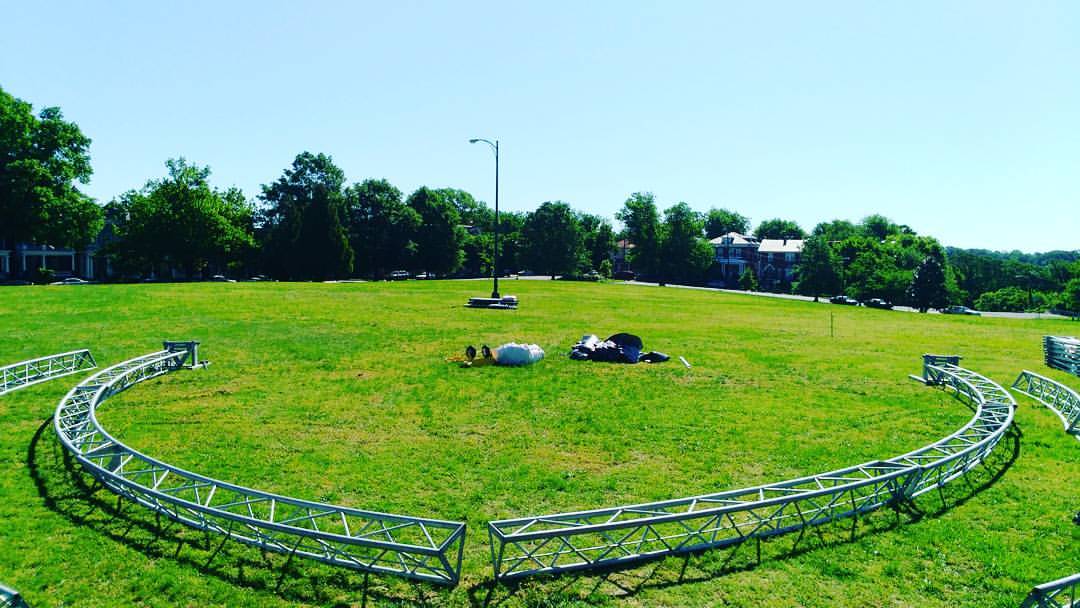
As with any large task, the crux of the build was built on many tiny steps. Permits for a temporary building structure are obtained for whatever county the performance is happening in. The site is scouted and surveyed, locating the flattest area possible. Locations for the load-bearing stakes are marked out according to the tent schematics. There is a single truck that contains all the parts and pieces for the tent- trusses, skins, poles, spansets, straps, stakes, the lot. Building it involved doing each of those tiny steps really well, and in the proper order. At first it was overwhelming.

Photo credit Tim Posey

What makes this job different from a theatre or arena is that everybody pretty much knows how to do everything. No job is more important than another and we were trained to be able to do it all. With the exception of driving the trucks, which requires a CDL due to weight, or operating the Lowell boom lift, which is an issue of insurance, anybody can jump on wherever there are tasks to be done. We all hang the lights and wire them up. We all move everything and everybody tightens bolts, hammers in stakes, and skins the frame. In the hierarchy of the job we always defer to the crew chief, but there is a level of trust that comes from having worked with everyone on a plethora of different jobs over many years. In this line of work there is an Esprit de Corps that is hard to explain to anyone who isn’t in the industry. We can put this thing up in our sleep and feel confident that the job was executed to the highest standards. If someone misses something there are at least three other guys (or gals) there to catch them.

While everyone can do everything, over the years we’ve all settled into leadership specialties within the scope of the job. There are two gentleman handle the business of getting the tent in the air, and everyone else knows to fall in to take orders. There are two other gentleman who take the helm of leveling the scaffolding for the massive stage that goes in the tent. I found myself managing the loading and unloading the stage truck which involves about fifteen tons of decking, railing and step units- everything having to be unloaded by hand. One gentleman is really good at getting the tension on the support lines really dialed in, giving the tent it’s sleek look.

Photo credit Tim Posey

It’s a good feeling to know that you were part of a crack team of professionals making something special happen. There aren’t any corporate teambuilding exercises or classes that comes anywhere close to making live entertainment productions happen.

Photo credit Dave Parrish Photography

Not everything goes according to plan and training isn’t going to prepare you for every contingency that is bound to happen. There was one time we had to drive all of the four foot stakes by hand when the hardened metal stake driver tip on Petunia the Jackhammer shattered. It took forever and put us behind. We have loaded everything wet in the pouring rain before and it is deeply miserable. Sometimes the industrial grade rental generator shows up late and we have no power till it gets there.

I was riding to an out of town tent gig with a couple of the guys. We were on the interstate and I saw the freshly-removed tread of a truck tire in the middle of the right-hand lane. “Somebody’s having a bad day,” I thought to myself. About three minutes later we passed one of our trucks on the side of the road, with our driver on his phone besides, and a bald rear exterior tire. Ahh, we were the ones having a bad day. So everybody gets on their phone to figure out who we can get out there to change the tire on a truck loaded with 20,000lbs of gear at 7am on a Saturday morning. We had to rent a Uhual to start getting tent trusses to the site so we could get started. We didn’t get our truck tire fixed till noon because the lugs were so rusted that they were frozen to the bolts.

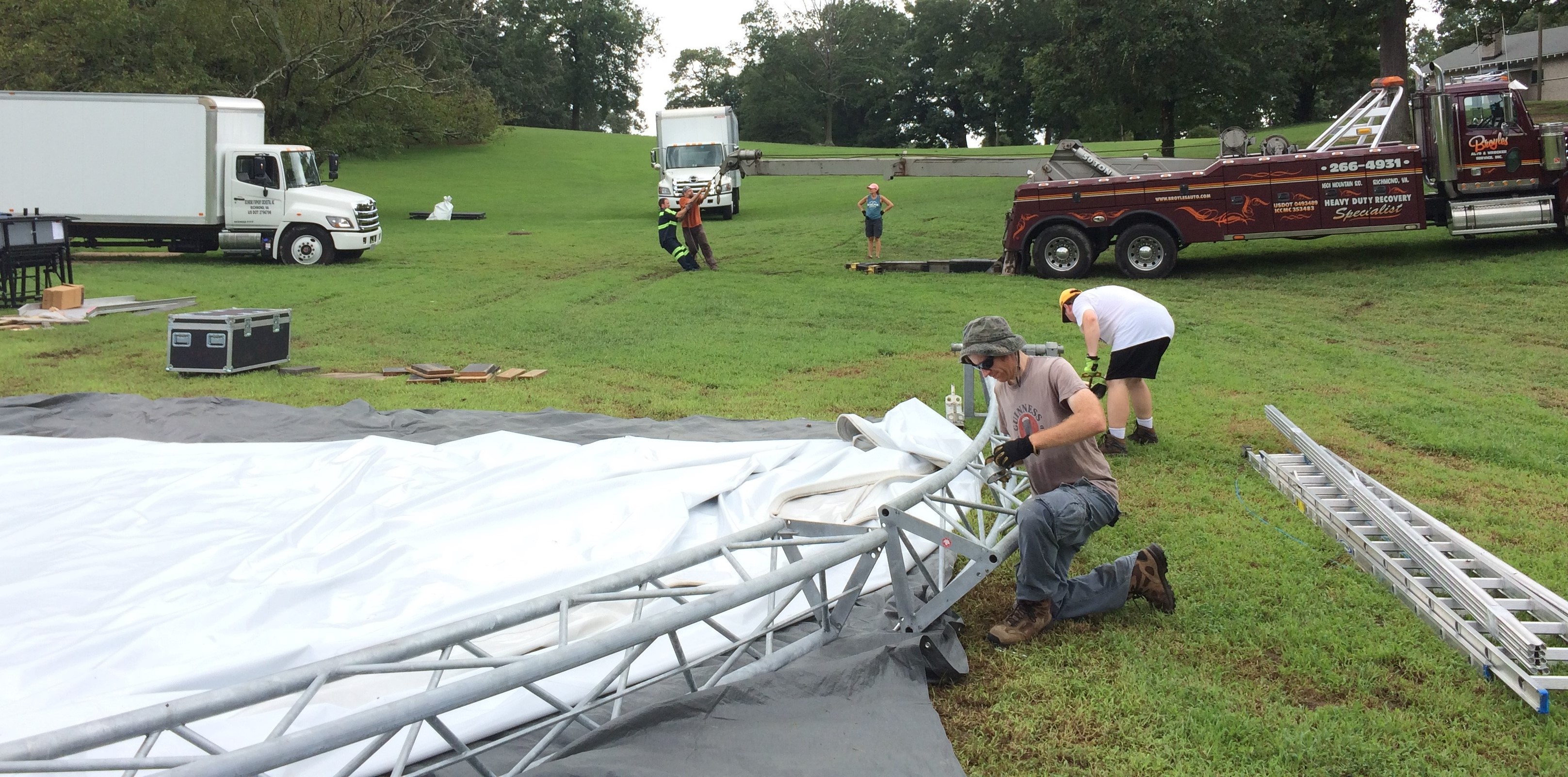
Blowing tires is a pain but it doesn’t happen too often. The biggest single pain is when the trucks get stuck and it happens all the time. Usually we know when the ground is saturated and we can lay out a track of plywood decking. We have to move them Egyptian-style as the truck moves and it is exhausting but a huge time saver. One time our stage truck got stuck so badly we had to call the biggest wrecker I have ever seen to pull it out. Then the wrecker got stuck. There was a season where the truck got stuck almost every other job and sometimes there just any other way around it.

Leveling the truck to the stage: the shims also make it easier for the truck to pull off without spinning into the ground.

Note the truck in the top left corner with front wheel buried to the rim in soft ground
Photo credit Tim Posey

Puttin’ on the Fritz was commissioned by an old friend of mine that I went to music school with. It was built for his brother, a member of the Army Special Forces. My friend and I have worked in similar industries where teamwork at a high level is essential, and this is no doubt the case for his brother. I designed a beefy fighting/utility knife with a harpoon point and a hardened skullcrusher on the butt of the blade. “Puttin’ on the Fritz” is a nod to the things that go wrong, and how we respond to them. It’s not a matter of if but when. Having a really good team helps you to accomplish things bigger than yourself and move through the adversities.

A quick sketch
Roughing out the profile
Profile dialed in.
That scribed line will become the final cutting edge.
Bevels are ground in.
Removing the machine marks.
Hardening- this is almost hot enough.
A little blurry after tempering
Laying down a satin finish.
600 grit
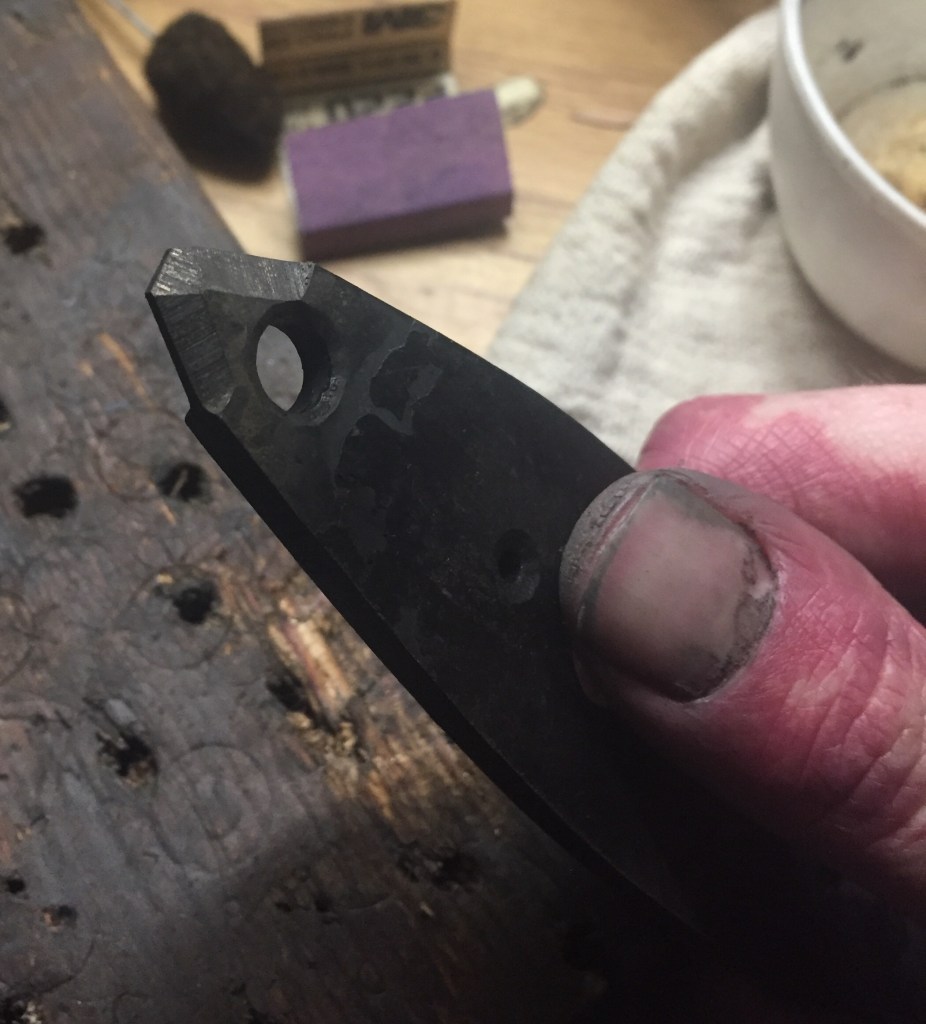
Skullcrusher
An old pair of work dungarees
Cutting the material for layering
These pieces will be layered in fiberglass resin.
Ready to be smashed together.
The raw material.
PCB fiberglass from a computer board blank that was rescued from a dumpster.
220 grit.
1000 grit.
Ready to be riveted and glued.
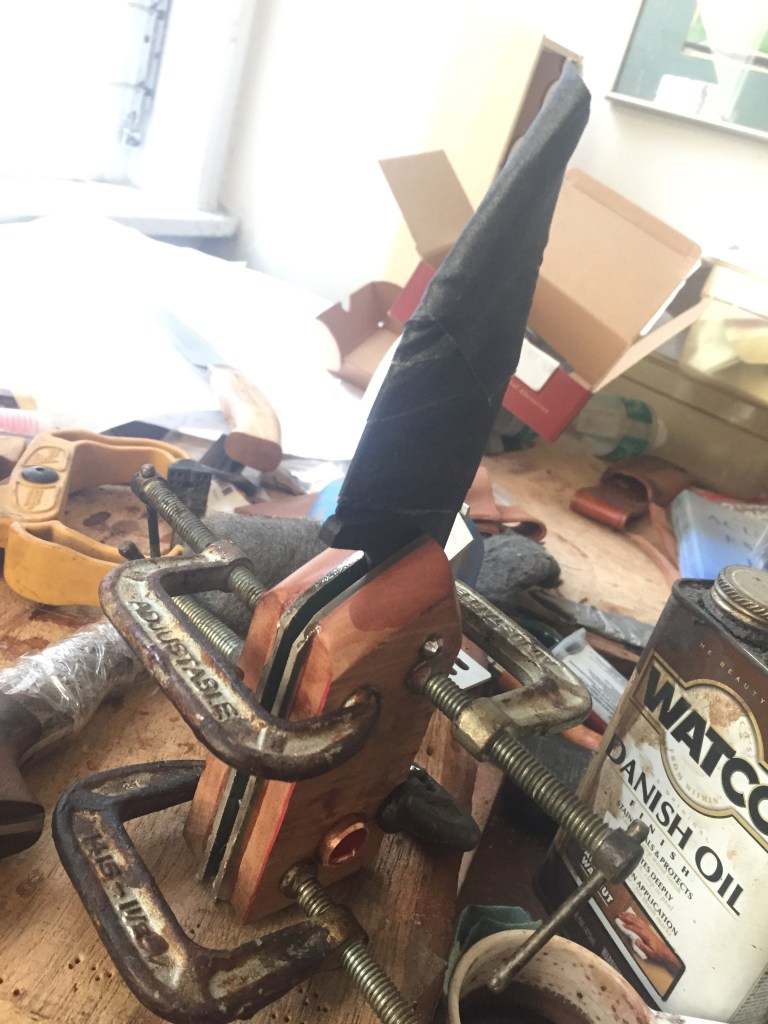
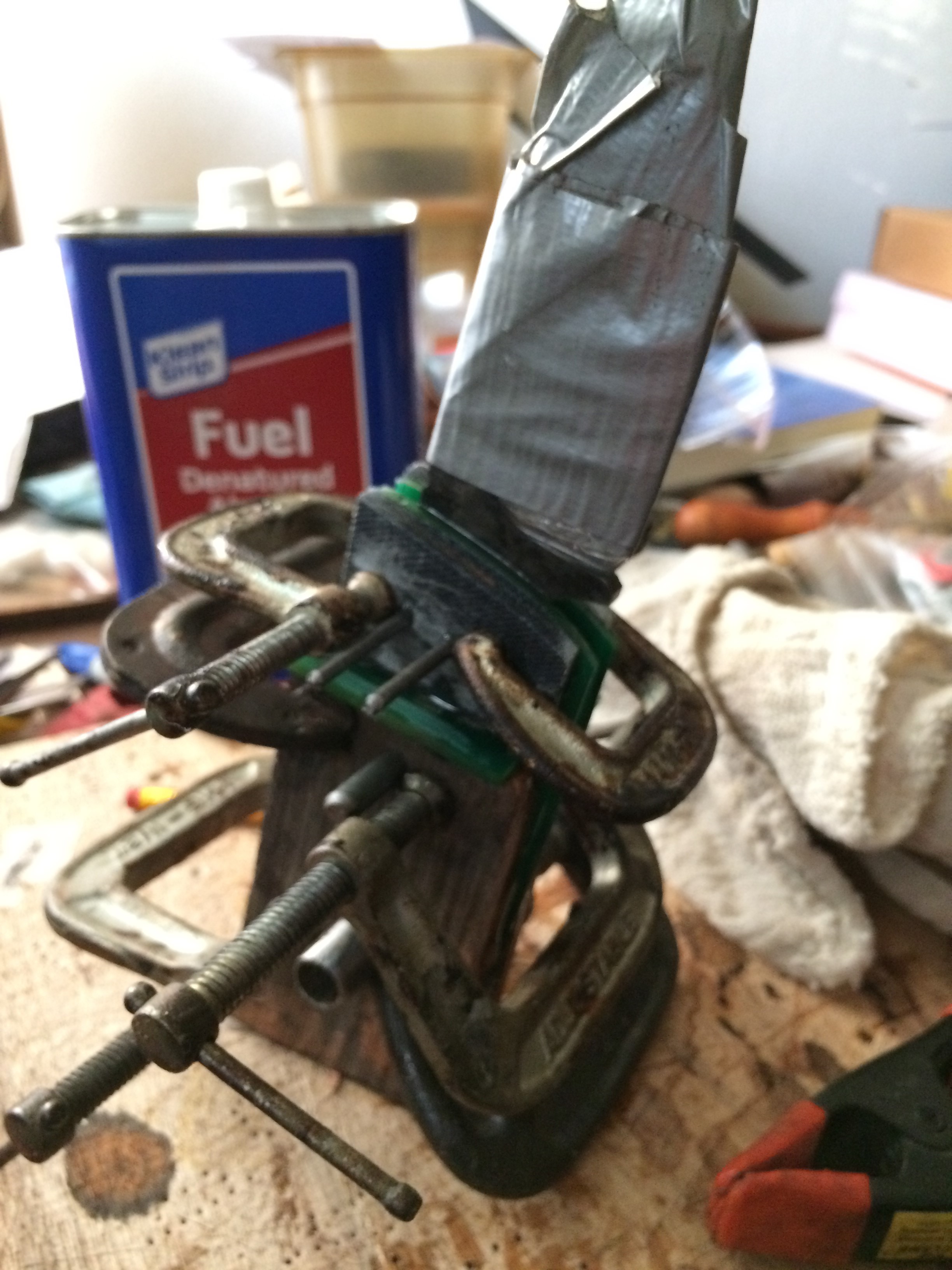
Clamped.
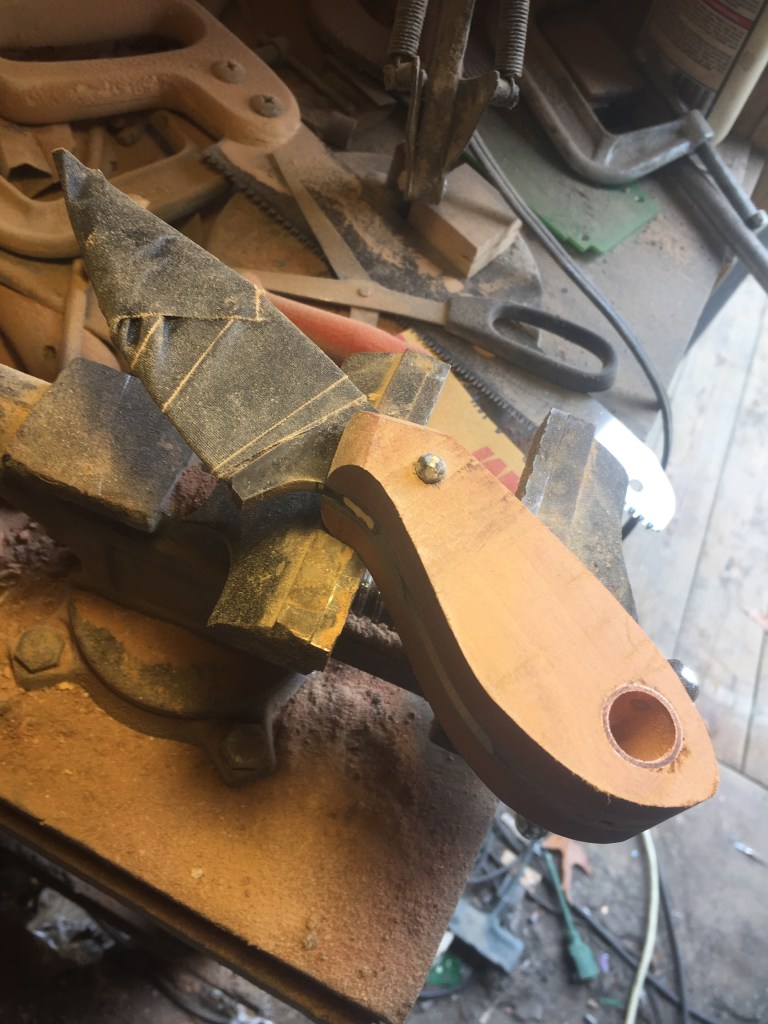
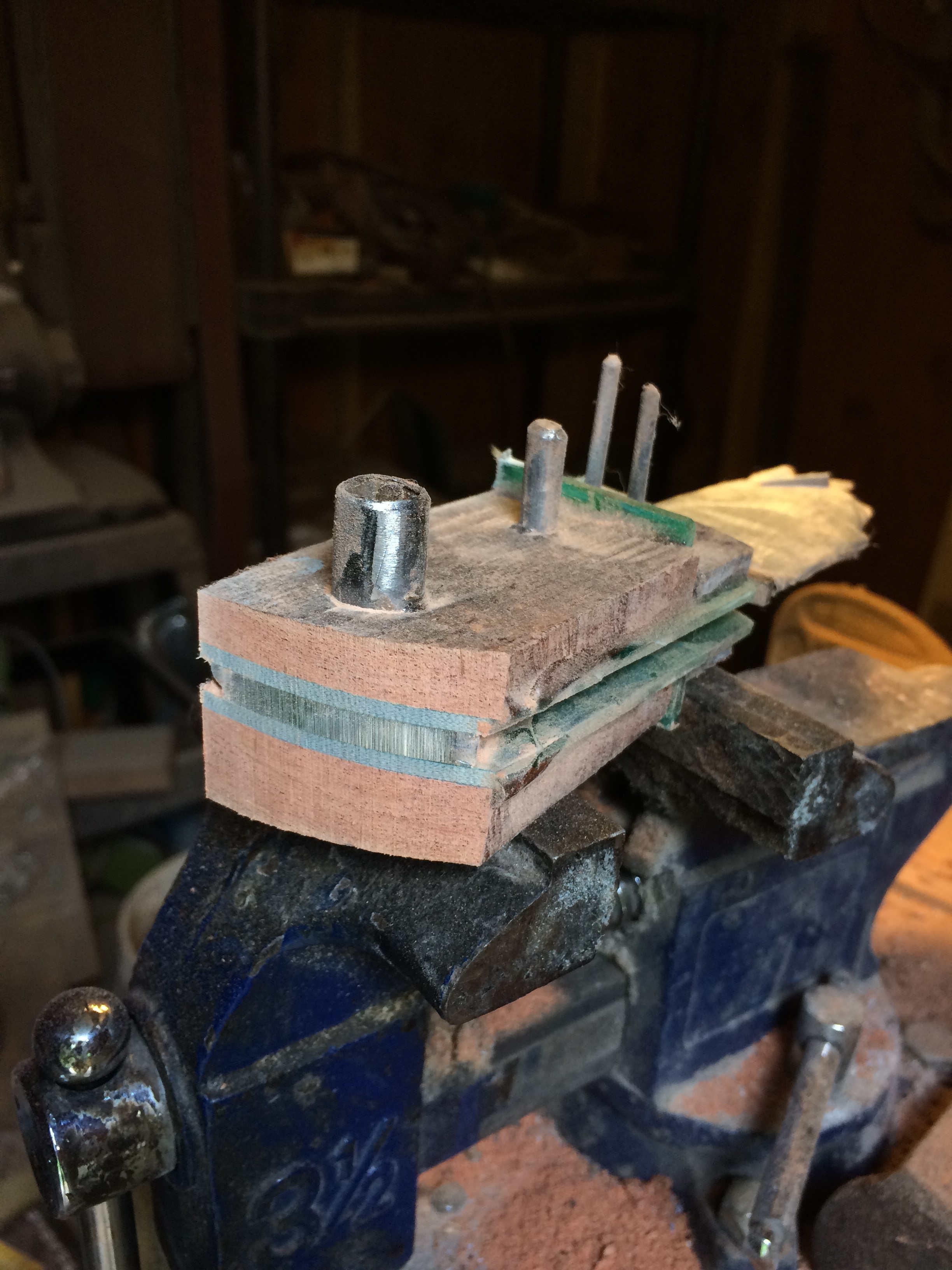
Ready to shaped
Ready to be contoured
Contoured
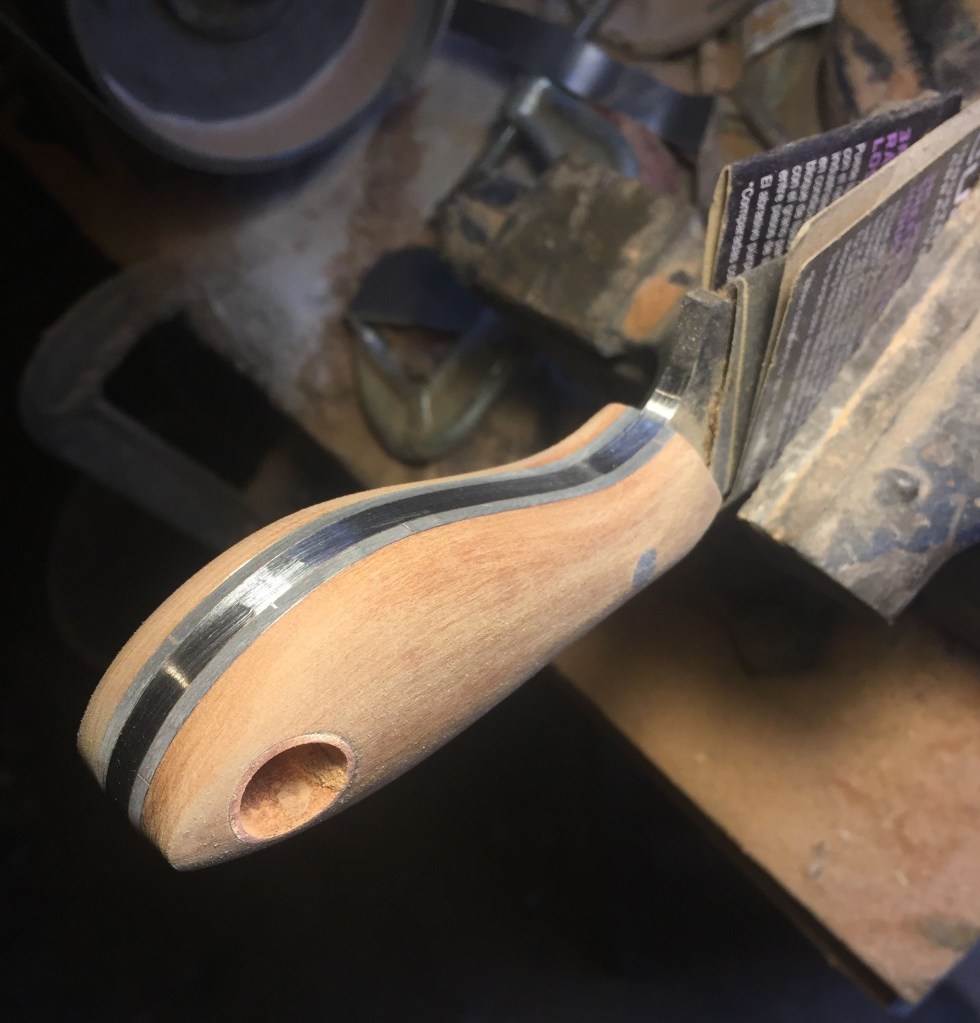
This is polished to 120 grit. The higher the grit you go, the more the material speaks.
Etching in the maker’s mark
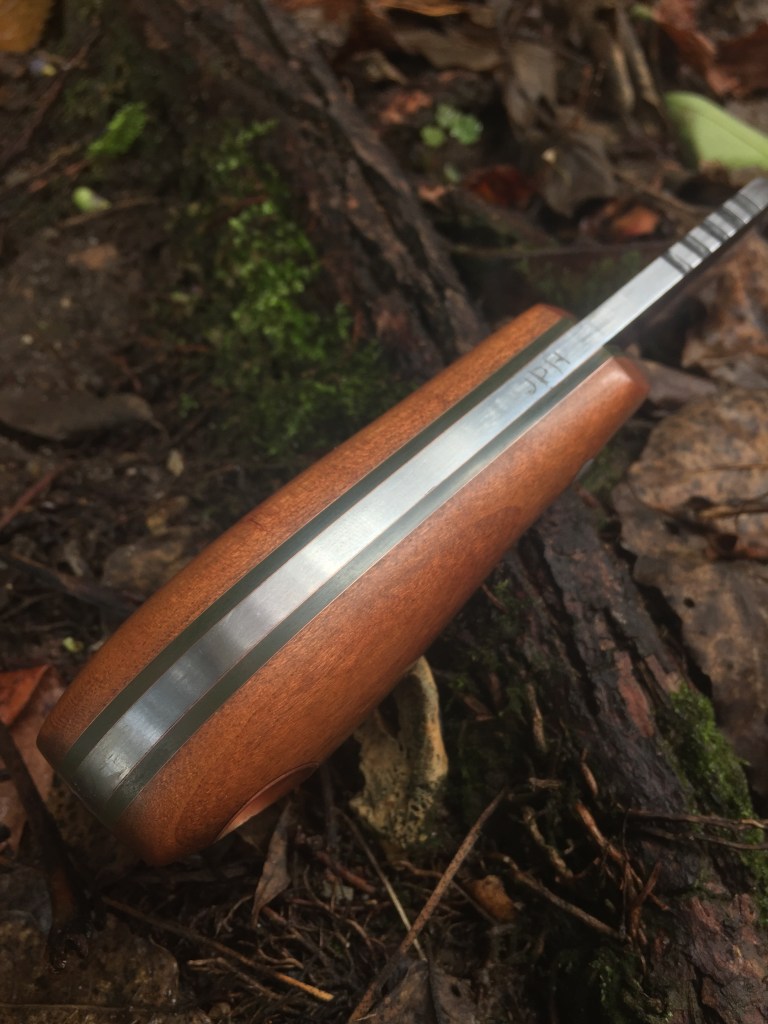
Puttin’ on the Fritz

Puttin’ on the Fritz is made of high carbon steel, which means it will take a keen edge, hold it a good while, and will be easy to sharpen. It will stain and patina and tell the stories of the places you’ve been- this natural and characteristic of the steel. It came to you coated in EEZox gun oil, an oil based film that protects the finish. Your knife is made to be used so don’t be shy about getting it dirty. Be sure to keep your knife clean and oiled when not in use. Should you find any unpleasant surface oxidization you can remove it easily with a lightly oiled bit of 0000 steel wool, or a coarse rag with a bit vinegar on it.

Knifemaking: on hitting your mark, and The Crack Shot

“Each arrow leaves a memory in your heart, and it is the sum of those memories that will make you shoot better and better.”

Paulo Coelho- The Archer

A few years ago I went to go see a modern dance piece with my girlfriend. It was called “Tensegrity” and was based on the idea of tension in cells: wherein the structure of the cell is maintained through continuous tension in some of it’s supports and continuous compression in others. When any one of those tensions or compressions are interrupted the cell falls apart, or at least that’s my understanding of it. This idea has been around since the 1960’s, and is a portmanteau of “tensile” and “integrity”. These days the idea is used a lot in contemporary architecture and to make coffee tables and other furniture. There are loads of these tensegrity tables and sculptures on Pinterest, but the first I had ever heard of this was at that performance.

The choreographer of this piece is a good friend of of ours and after the performance we went to get a drink with him. I’ve always admired how prolific he is, constantly moving from piece to piece, work to work, and the way each performance had it’s own voice and character. I was a bit stuck at the time and was curious how this man could take shot after shot and always hit his target. So I asked him.

He told me that whatever you do, you have to do a lot of it, and sometimes badly. Everything is connected, he told me, and each piece builds off what you have done before and is fed by your collective experience. Always keep going, and always be thinking of what’s next. At least I think that’s what he said; a fairly liberal number of martinis and fireball shots were consumed and things started to get a little fuzzy…

Over the years I’ve thought about that night, and how seemingly incongruous disciplines fit together to propel a skill or craft forward. You hear about football players taking ballet but I met an orthopedic surgeon who was an ace pickle maker, and one of my favorite knifemakers is an avid botanist. So when you find choreographers exploring contemporary cell biology or bowhunters dabbling in Vipisanna meditation, you will probably find that they are drawing connections that are deepening and balancing something. Whenever I talk to people who are really good at what they do, I find there is an ocean of eclectic and varied experiences just beneath the veneer of whatever it is they practice that adds something special to their work. The sum of our experiences can always help us hit our mark.

The Crack Shot is a nod to this idea that the sum of our experiences can always help us hit our mark. It was built for a hunter and a woodsman. “Crack Shot” is an homage to his grandfather, the original Crack Shot, who taught him about being with nature, shooting, and how to hit your mark. It is the intention of this knife, with it’s blend of handmade and reclaimed material, to help it’s recipient remember the man who helped him be where he is today.

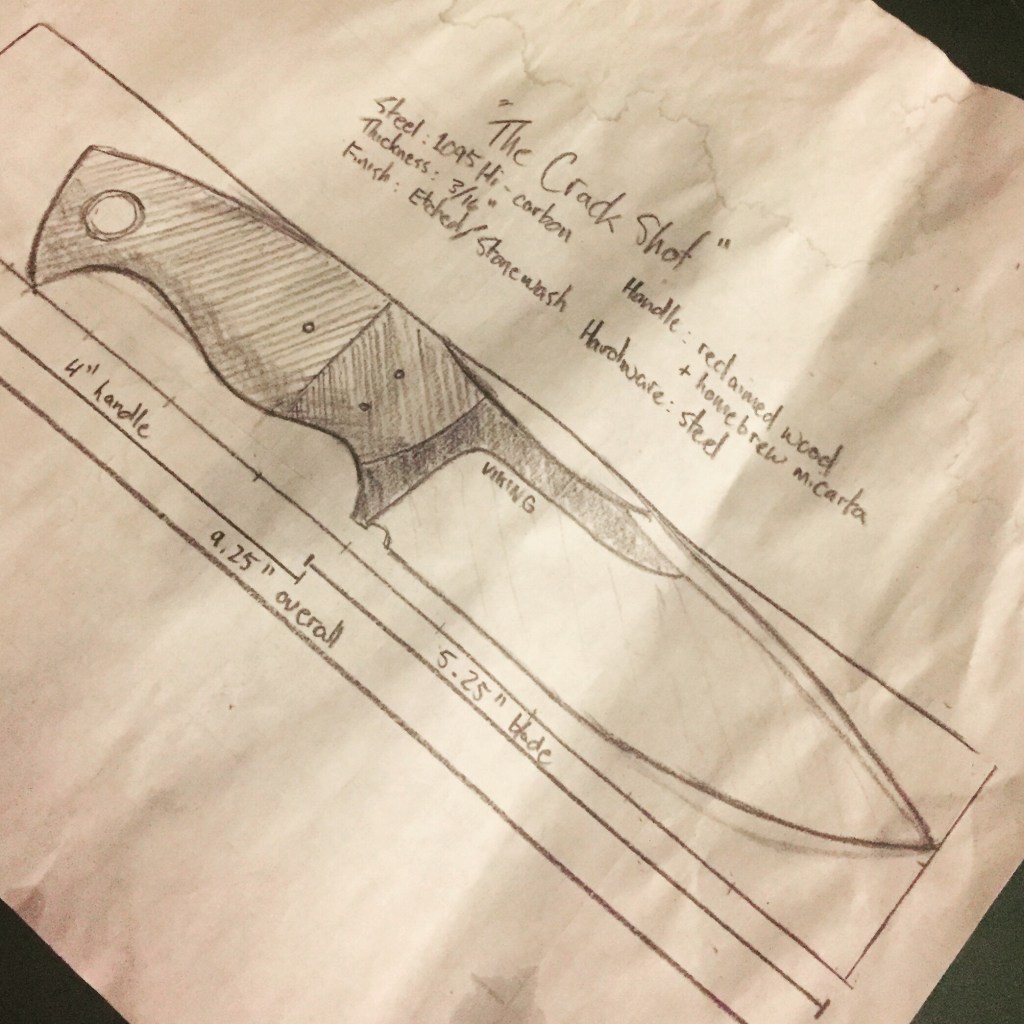
A quick sketch
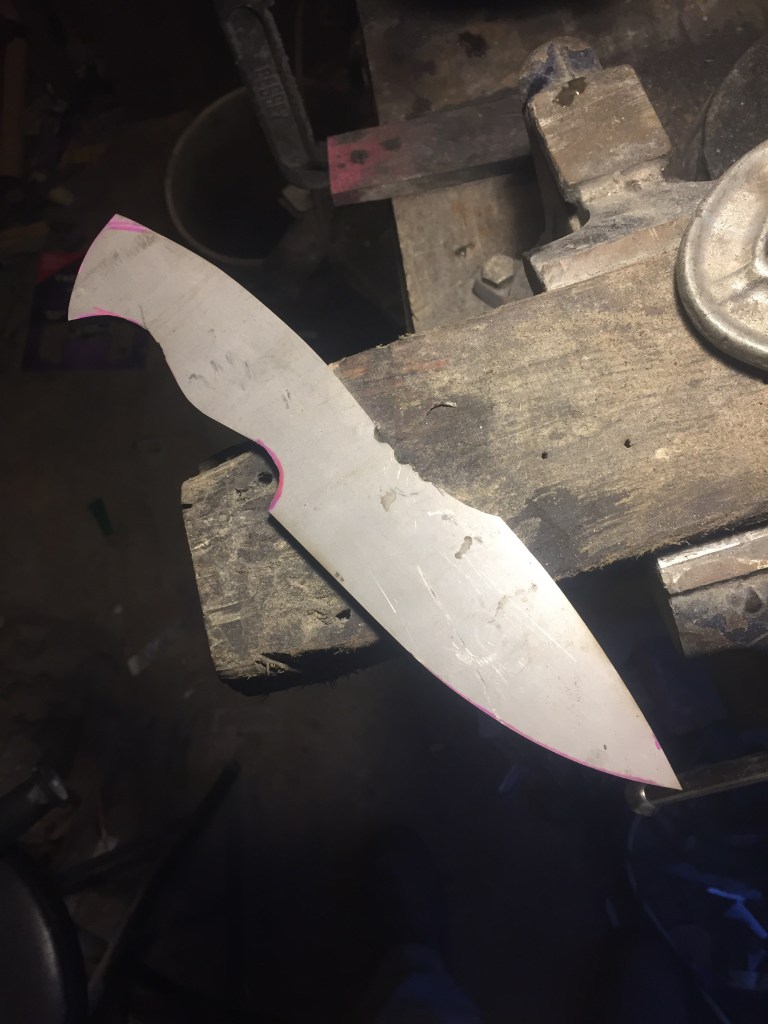
Roughing out the profile
Grinding in the bevels and swedges. Since this is thick stock, the swedge will make a finer point for piercing.
Removing the machine grinds by hand. This will make polishing easier after heat treatment.
Almost there…
Post-quench cooling.
After tempering- note the faint straw colors. This has drawn much of the stress out of the blade that built up during quench, making it much more durable.
Hand sanding….
…to a nice satin.
Etching in the namesake.
The client wanted something masculine and woodsy. I find there are few things more timeless that flannel and denim.
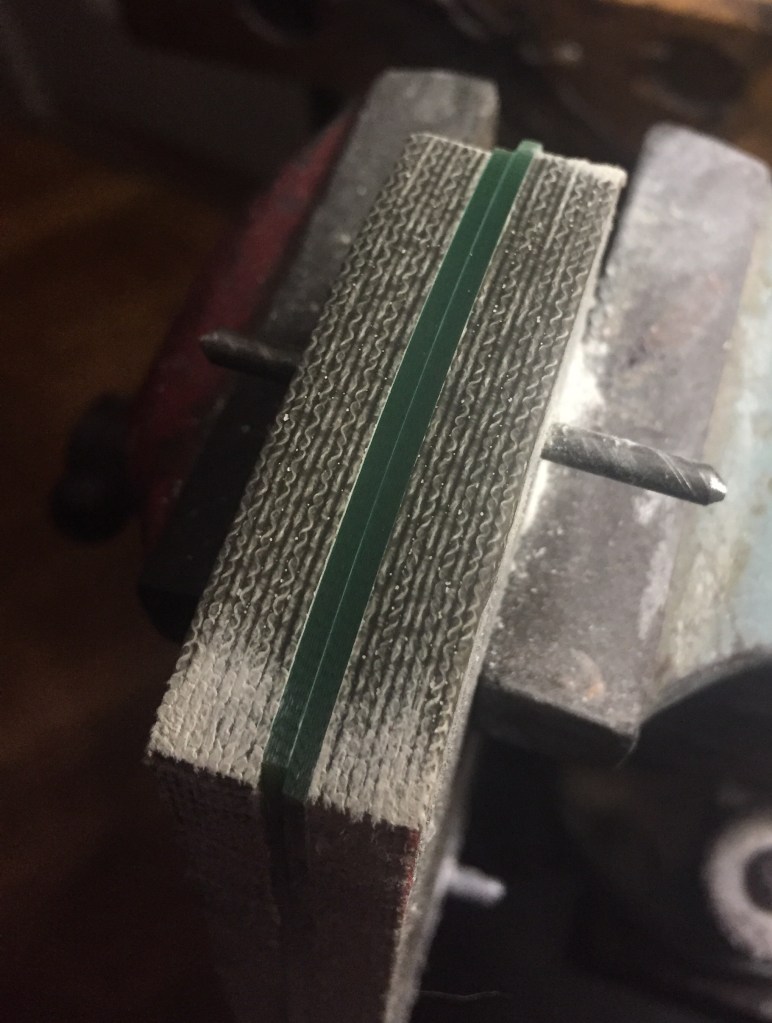
Alternating layers, so each piece should form a grain and be able to speak more articulately.
Prepped.
Each layer of clothes is smothered in fiberglass resin.
Now to smach everything together.
This is the raw material. All the layer have been permeated with resin, making everything a solid block.
Cutting out the bolsters.
Drill rivet holes.
A rough mockup so I know how everything fits together.
This gets sanded before glue up. I won’t be able to get to this part after everything is glued and riveted together.
All sanded up.
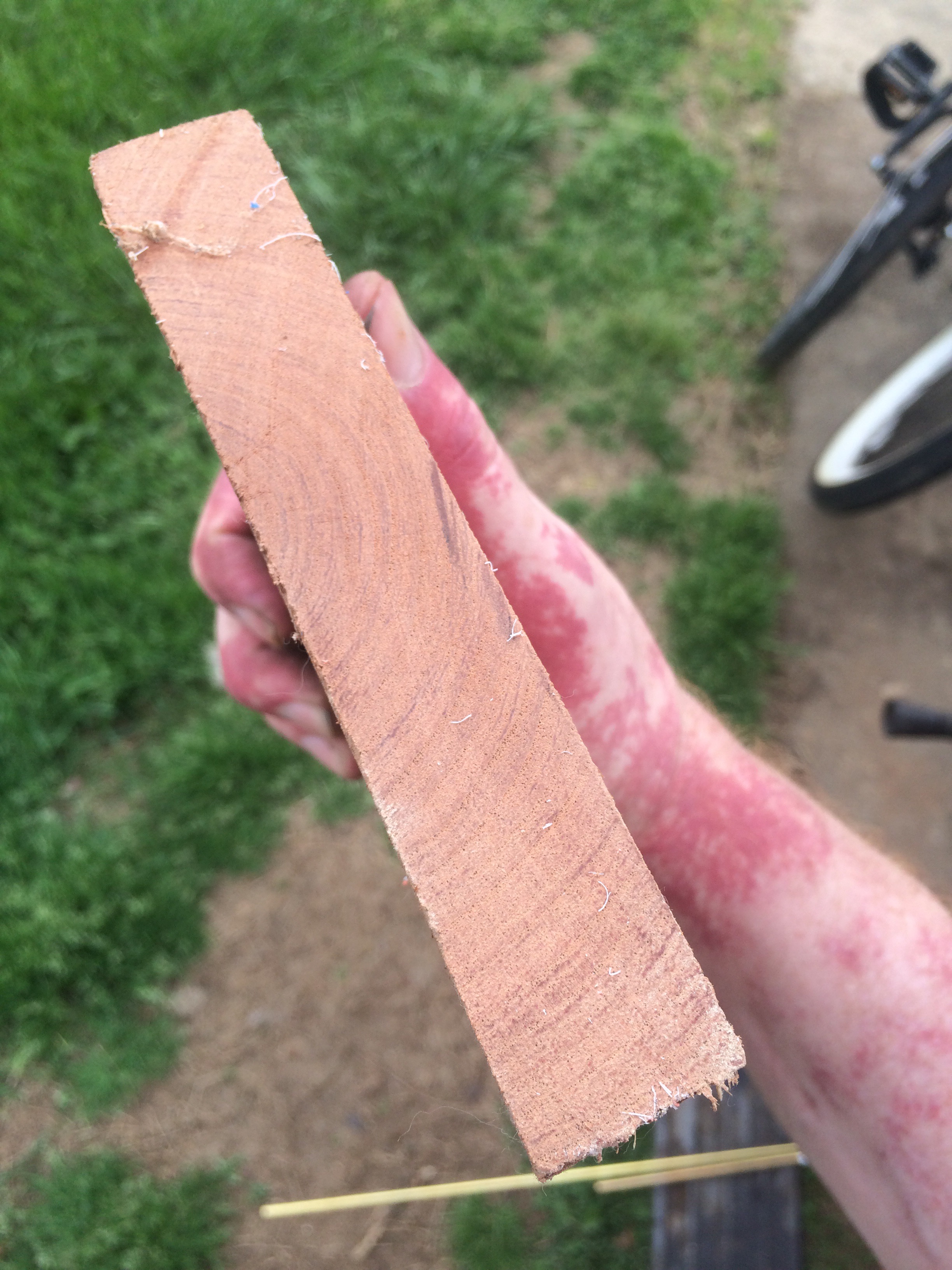
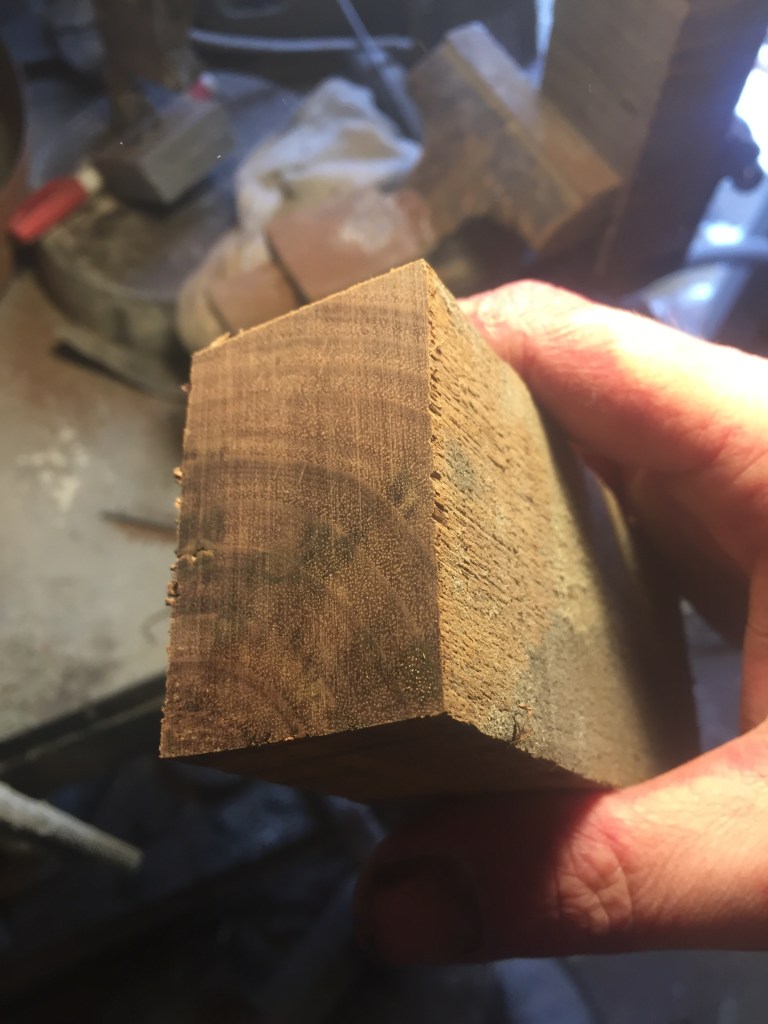
A piece of block walnut. I was doing tree work at an artist’s house in Charlotte Court House, Virginia. He had loads of this stuff. It was milled by his neighbor, a retired parishioner who started an abbey in South Korea in the late 1990’s to help North Korean defectors acclimate to a free country. It is very beautiful wood.
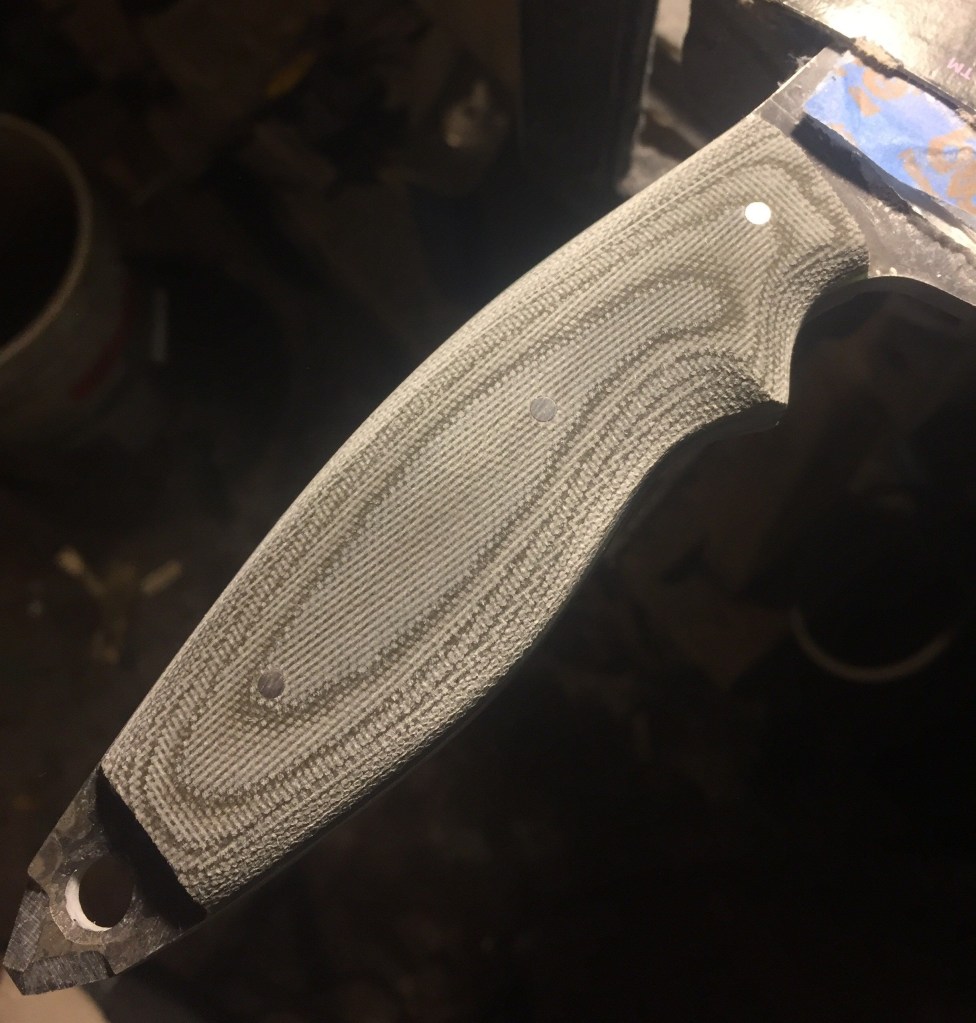
Bookmatched.
A fiberglass PCB blank for a network chassis full of hardware that runs your internet. This was rescued from a dumpster.
All laid out and everything fits together.
Two-ton epoxy resin.
Clamped.
Now for shaping.
The Crack Shot.

The Crack Shot is made of high carbon steel, which means it will take a keen edge, hold it a good while, and will be easy to sharpen. It will stain and patina and tell the stories of the places you’ve been- this natural and characteristic of the steel. Your knife is made to be used so don’t be shy about getting it dirty. Be sure to keep your knife clean and oiled when not in use. Should you find any unpleasant surface oxidization you can remove it easily with a lightly oiled bit of 0000 steel wool, or a coarse rag with a bit vinegar on it.

Some further reading on cellular tensegrity referenced in the text body above:

Constructing Tensegrity Structures From One-Bar Elementary Cells

Knifemaking: what we do with the unexpected, and the Foundling

“I was once a Foundling.”

Din Djarin, from The Mandalorian

A few years ago I got a call from a gentleman about a knife that needed a new handle. He had a thick Australian accent and told me one of his friends was redoing some walls and ceilings in her house and had found an old cleaver behind the drywall. He asked if I would be able to put a new handle on it, and by the way it was also going to be a wedding present for his friend who found it.

A mysterious butcher’s tool in the walls? A wedding gift? Nuptials without knives are nuptials not worth having. Besides that, certain things in life have a habit of being found when we need them the most. This all sounded extraordinarily auspicious to me. Of course I took the job. I couldn’t have made this up if I tried.

I met my new Australian friend, who at the time was raising Alpacas (because of course he was), at a country bazaar just outside the city and picked up the cleaver. It was important to me to honor the found-nature of this deeply immodest blade of humble origins, so all the material save for the pin stock and adhesives came from refuse dumpsters or abandoned houses. I named the cleaver Wallace, and returned him to my Australian Alpaca friend. As with any other job I dropped the work off, made sure the person paying me was happy, and didn’t think much of it.

I did finally met the lady who found the cleaver at one of our shows, and she has bought a knife almost every year around Christmas time. She got in touch this year about having a knife made, and I realized that her and her husband had never seen how the cleaver was built.

I think the things that find their way into our lives are so much more interesting than the things we seek out. While it’s good to have a plan, it’s also important to acknowledge that plans fail, often spectacularly, and the best things happen to us while we’re planning something else. We stumble into to deep love, or fall into a career, and despite our best calculations, the special moments and deepest connections in our lives seem to occur solely at the whims of the universe. Very much like Wallace the Cleaver and his handle made from garbage that somehow found it’s way into our shop, it’s up to us to choose what to do with the things we find ourself with.

The Foundling was a commission for her husband, who was always stealing her knife, and was built using all sorts of materials that found their way to me.

The Foundling starts with a quick sketch
The scribe lines show where the final cutting edge will be
Jimping is filed in on the spine for grip
The grind at the top of the spine is called a swedge, and give the blade more of a point
Wet sanding before hardening
Into the forge
After the quench
…and after tempering
More polishing
A quick etch in acid
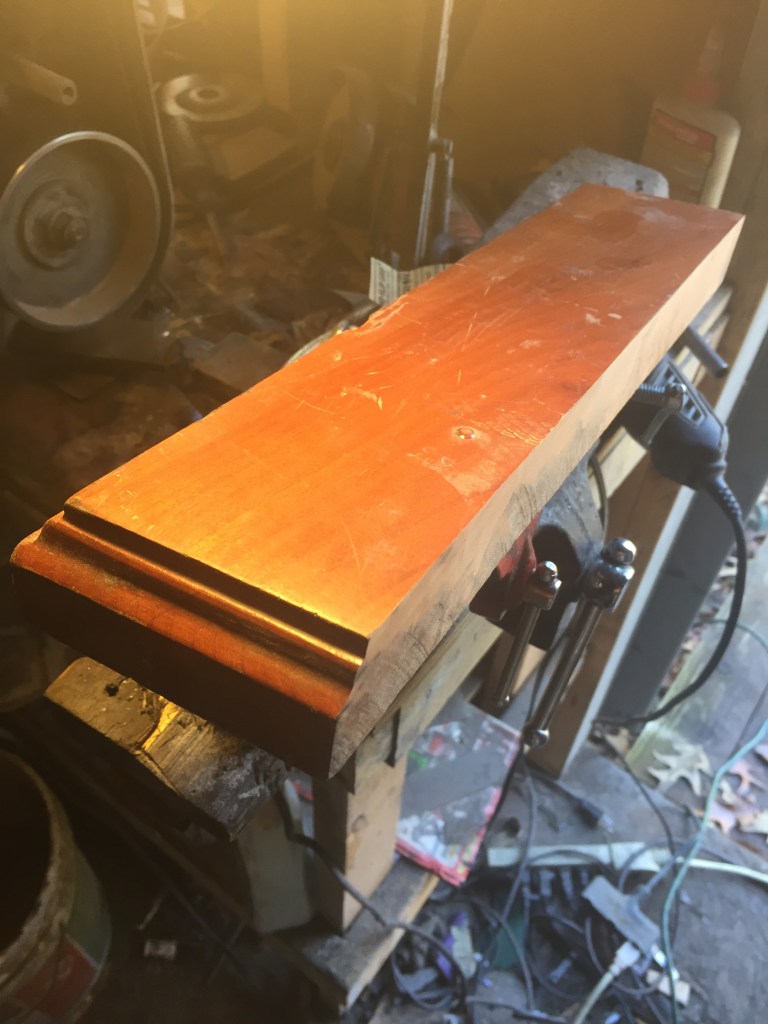
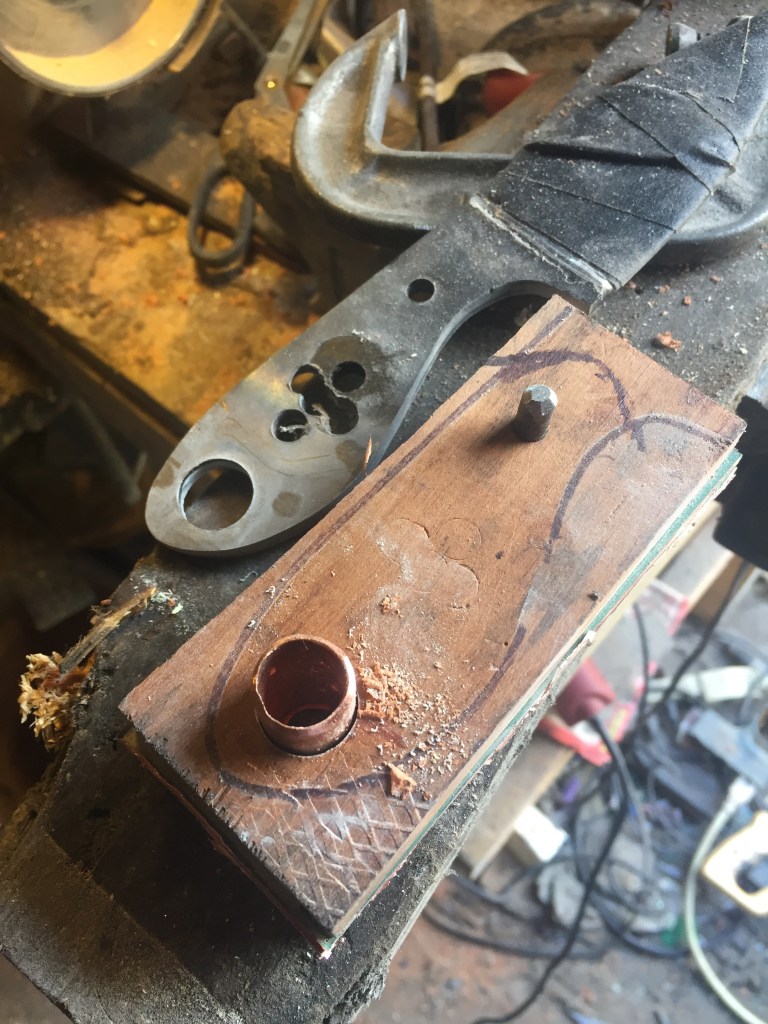
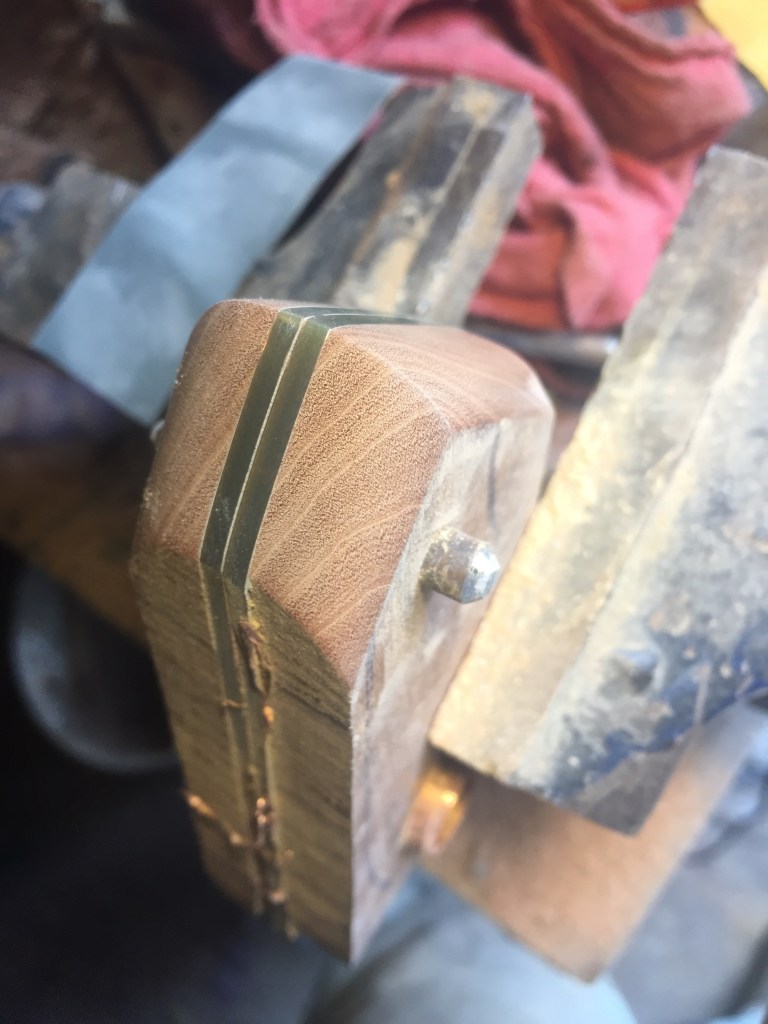
A piece of Cherry wood, which came off an old mantlepiece
A PCB blank, rescued from a dumpster
A piece of copper plumbing pipe

Knifemaking: the Halvard

“Kinsmen to kinsmen should be true.”

~The Saga of Olaf Haraldsson, c.186

The Halvard was built for a retiring military commander and commissioned by his crew.  A battle ready knife, built to use, but equally at home on display with merits of a successful career.  

Made from 1095 hi-carbon steel with a forced patina: a rugged appearance lending itself to rugged tasks.  The handle is made from a pair of BDU trousers, a nod to service, and a reminder that, though he may no longer wear the uniform, the uniform is always with him.

This knife took a long time to build.  About midway through the build we had to shutdown our shop due to a global pandemic, and getting back into the swing of things hasn’t been easy.  Nevertheless as we build these knives, we find that the knives also build us.  Halvard is a Norse name meaning “rock guardian”: solid, unbending, and steadily dedicated to the task at hand.

It was a pleasure building this knife for a group of Vikings.

halvard1

halvard2

halvard3

halvard4

halvard5


Knifemaking: a commencement address (of sorts), and the Masilda

Dear Younger Person Whom I’ve Never Met Before:

Some very dear friends of mine asked me to make a knife for you.  These friends of mine are wonderful people that I have known for quite some time, and shared many adventures. They told me they have known your parents for a long time as well, so I can infer that your parents are wonderful people too. They have also known you since you were born and, if I may be so bold, I can only assume that you are a wonderful person as well, and that we are well met.

I was also told you have completed your secondary studies and are going out into the world- congratulations! My very dear friends asked me to make you something special, but also something that was functional and practical.  Something that would serve you well on outdoor adventures; an elegant tool and faithful companion.  Something to remind you of where you have grown up.  A security blanket that doubles as a prayer rosary and, if I may say so, a bold fashion statement.

As you may have noticed, Younger-Person-Whom-I’ve-Never-Met-Before, the situation of the world is a bit spicier than usual.  To be honest, the only thing that has gotten me out of the house most days in this great year of 2020 is knowing that I will be coming back home as soon as possible.  In spite of my trepidations of late, I’ve found that time marches on and life stops for no one, and there’s no point in staying home and being afraid while life passes you by.  The world cares not for our anxieties, worries, or fears, Younger-Person-Whom-I’ve-Never-Met-Before, and the sooner this is understood the freer we become.  Be sure to wear a mask, practice social distancing, and listen to the experts.  That is what they are here for.

I have designed and built you a bushcraft knife.  She is made from 1095 hi-carbon steel, which has been differentially hardened.  What this means is, while the whole blade is hardened, the cutting edge is the only part of the blade at full hardness and the spine is just slightly softer.  This offers durability and a slight bit of give, like a samurai sword.  There is a smoky line along the edge of the blade and a slight color change where you can see the differences in hardness.

The handle contains a piece of bookmatched Texas Mesquite.  It comes from a cousin of mine near Big Springs, milled on his property.  The bolster is made from a pair of lady jeans that belonged to my girlfriend- vintage Levi’s 501’s, something strong and deeply feminine.  Your knife is stout and sturdy; strong enough to baton firewood but lithe enough to prepare dinner. 

I named her Masilda, which is an old Romany-Traveller name that means ‘battle-ready’.  And while I am no authority on anything, your knife does contain a few truths and values in which I strongly believe.  Having a knife named battle-ready is no empty moniker and I have consolidated a trifecta of practices and that you may find useful in navigating a complicated world.  When you use your knife I hope that you think of them:

-Speak your truth.  The media says that we are in the post-truth era, an age of alternative facts, and other dressed-up horseshit designed to keep you from critically analyzing what’s going on around you.   The reality is that the truth always matters, and always will.  Make sure you know your own truths- the things you know to be right and good about yourself and how you see yourself in the world.  Clothe yourself in them.  Should you ever feel lost you’ll know exactly where they are- they will help you find your bearings.

-You can always make more money, but you can’t make more time.  Time is the currency of our terminal human experience.  While making a living is necessary, be aware of how much of your time you sell to a job that only cares about profit margins and what they can squeeze out of you.  If you ever have any doubts about what you should be doing with the time you have been given, refer to the above bullet point.  You’ll know what to do and you’ll be able to hold yourself in esteem while doing it.

Be kind.  It’s sounds cliche, like something written on a shoddy mass-market pressboard wall decoration in the Housewares Section of Target, but do your best to be kind.  It’s the connective fiber of our collective human experience during our brief time on this lovely little world.  If you can, you will find that the world opens up to you a bit easier, and is perhaps a bit richer and more vibrant.  There may be situations you need to tell someone to eat a big bag of shit.  Only do so out of kindness.

Wishing you many happy years with the Masilda.

The Masilda started with a drawing, a drop point style:

I had a bigger piece of steel than I thought, so the actual knife is a bit longer than the drawing:

Jimping- to prevent slipping when choking up on the blade:

Rough grinds:

Wet-sanding out the machine marks:

The hardening process:

After quench:

After tempering, a satin finish:

A pair of vintage lady jeans from my partner, deeply-loved and well-worn:

img_9238masildablog2

Fiberglass resin will be layered between pieces of denim, like a lasagna.  The pathc will go in as well:

blog1

Now smash the whole thing together:

blog2

The raw material:

blog3

Cut and drilled in, with the blade profile traced in so that i know where everything is:

blog4

Texas Mesquite:

img_7566

It smells really good:

blog5

Computer board blank rescued from a dumpster.  It’s just a thin piece of fiberglass board:

img_8132

Denim and computer board at 60 grit:

blog6

At 800:

blog7

All ready for glue up:

blog8

Glued and clamped

blog9

Shaping up:

blog10

From here, all the sanding is done by hand:

blog11

The higher the grit you go, the more pronounced the grain and fiber:

blog12

The Masilda:

masilda1

masilda2

masilda3

masilda4

Instructions for Care:

 Your knife is made of high carbon steel, which means it will take a keen edge, hold it a good while, and will be easy to sharpen.  It will stain and patina and tell the stories of the places you’ve been.  Be sure to keep your knife clean and oiled when not in use.  Should you find any unpleasant surface oxidization you can remove it easily with a lightly oiled bit of 0000 steel wool, or a coarse rag with a bit vinegar on it.  She is built to be used, so don’t be shy about getting her dirty.

Knifemaking: having a quiet day and the Woodsman, Mark Deux

‘In silence there is eloquence. Stop weaving and see how the pattern improves.’

-Rumi

From mid-January to mid-June of this year everything had been a blur.  I was running from job to job, gig to gig, knife to knife, trying to stay on top of everything.  Every time that I felt like I had room to breathe, something else would come up.  Car repairs, state taxes, doctors’ visits, new tools.  It was always something and I was hustling left and right, making sure everything was moving forward and getting taken care of.

Then I had an accident that pretty much stopped everything.

I injured two of my fingers pretty seriously on a table saw.  I was cutting some very thin material when the saw bound up and kicked, and I couldn’t get away fast enough.  The shop is at my partner James’ house and he happened to be home when this happened.  I quickly grabbed a dirty towel and, doing my best not to panic, politely yelled that I needed to go to the ER, right that second.  

On the ride to the ER, which was about twenty minutes away, I took stock of the situation.  James, who teaches shop and technology education, asked me to double check that my fingers were still attached and not on the floor of the shop.  Indeed they were still attached.  I would be told later that I was very lucky to keep my fingers- none of the major tendons or arteries were damaged beyond repair.  

I do my best to practice calm in my life.  Strong reactions happen from time to time, and the best way to deal with them is to feel them, let them pass, and address what caused the strong reaction in the first place.  This is an incredibly challenging thing to do and I don’t always do it well but I’ve gotten better at it over the years.  On the ride to the ER I found impossible to calm down.  I noticed that my thoughts were manic and erratic and I had trouble breathing normally.  I felt a pretty deep sense of guilt and shame, as if I had this coming because I wasn’t slowing down.  A doctor would later tell me that what I had experienced was an acute stress reaction and was normal for what I had experienced, largely in part from the sheer volume of adrenaline and other chemicals that my body had released.  

The ER was a miserable experience.  The ER doctor told me they would need to operate but they would need to transport me to another facility because there was no one covered by my insurance at that particular hospital.  Nobody even looked at my fingers and I sat on a hospital bed and bled on myself for two hours before someone gave me any pain medicine.  The paramedics finally arrived and bandaged my hand- the first time anyone had done anything. They pumped me full of IV fentanyl before loading me onto an ambulance to go to another hospital.  Those guys knew how to get shit done, and in my very stoned state I kept telling them how glad I was that they were there.

We got to the next hospital, and my girlfriend met me there.  In my state of shock I had forgotten my phone at the shop and James had called her.  I was really glad she was there because it would be another four hours before the surgeon showed up.  As it turned out he was not covered by my insurance either.  Somebody had screwed up. 

The worst part about the ER is that you are forced to make life-altering decisions when you are in a state of shock, and/or heavily medicated and not in your best of faculties.  The surgeon gave me the option of going ahead with surgery but understood if I didn’t want to- he was very kind and professional, and pretty pissed that this was the way the system was working.  I opted not to have surgery that night because it would have medically bankrupted me.  I would never have been able to pay that kind of money back.  I would have to find another surgeon on my own.   He cleaned and temporarily stitched me up enough so that I could safely leave, which involved two incredibly painful nerve block shots and a pretty shoddy cast courtesy of the ER nurse- I think it was her first.  By the time we left, my pharmacy had closed and the hospital wouldn’t send me home with any medication.  I had to make it the night without pain pills or antibiotics (I would end up taking 2000mg of Keflex a day for 20 days- I was so filthy when I went in they were afraid I was going to give myself sepsis).  We went home and tried to get some rest, because the next day would be busy.

I think this was what it looked like when the system fails you.  

……

The next morning we got on the phone.  We called my insurance company and they found a place that would take a look at me right away.  Ironically enough their office was located at the first hospital I had gone to the day before.  I met with an orthopedic surgeon and his nurse practitioner.

I found out that orthopedic surgeons do a lot of hip and knee replacements on the elderly, so when a young person comes in with an exciting injury everyone wants to see.  I had no less than six people come and look at me, all very excited. 

The doctor was really excited to work on me- he was an artist and I was his canvas.  He drew me a picture of the procedure he would do and explained the whole thing.  They were going to fuse the middle joint of my index finger which the table saw had blown out, and remove a bit of my thumb.  I got another two painful shots of nerve block while he examined everything and moved some things back into place.  There aren’t a whole lot of words to convey how painful those shots are- I nearly crushed my girlfriend’s hand with my good hand.  My surgery would be two days from then, and they told me to rest.  So that’s what I did.

I have always had trouble finding quiet places and allowing myself to rest.  Now I had no choice.  I called my work and told them what happened and that I wasn’t sure when I would be back in.  I had to cancel some contractor work and push back a lot of client work.  That was what hurt the most.  My girlfriend and I watched a lot of Netflix, something we rarely ever do together.  I don’t watch a whole lot of TV but over the next week I would watch more TV than I had in the past five years.  And honestly it was really nice to check out.  I slept a lot and took pain medication and was generally kind of dopey.  I told my girlfriend that she was beautiful and I loved her, frequently.  I couldn’t bathe myself, or put my contact lenses in, or dress myself.  I just had to surrender to everything and let myself be helped. 

…..

Two days later we went to have surgery done.  I have never had any surgical procedure done before and was really nervous.  They took me in the back and had me put on a hospital gown and fixed up an IV in me.  After a large bump of a sedative they gave me a giant nerve block shot in my shoulder, which made my entire arm go numb.  I was dopey but still semi-conscious when they wheeled me into the OR.  They had music piped in- Bryan Adams was playing.  From what I understand of these things, the anesthesiologist has you count backwards from one hundred till you knock out.  Apparently they didn’t do this with me- I knocked out on my own singing ‘Heaven’ from Canada’s most famous musical export.  I think this was an auspicious sign.

…..

After surgery everything was kind of fuzzy.  We went home and my girlfriend put me in her bed and told me not to get up while she went to pick up my prescriptions.  My entire left arm was completely numb from the nerve block and I remember being really hungry.  Apparently I got up and ate an entire box of her kids’ Pop-Tarts while she was gone and then swore to her that I didn’t.  There were Pop-Tart wrappers all over the place- I don’t remember any of this.  I slept a whole lot and my dead arm, which I was supposed to keep elevated, kept falling and hitting me in the head.  I had a whole pile of pills that I had to take and my girlfriend dutifully kept me on a tight schedule.  The best I could do was tell her that I loved her and tell her how beautiful she was.

The next four days passed like that.  She took off from her high stress-job and looked after me. She helped me bathe, made sure I was taking my medicine, and kept me fed.  I would get really weepy from time to time.  It was all a lot; the trauma from the accident, the bone-deep pain from the surgery, and the bills that would be coming (because even with insurance these procedures are very expensive), and the people I felt I had let down.  Then there was this really wonderful woman taking care of me telling me that it was ok and how well I was doing.  The pain medication peeled away all of the armor I usually wear to function in the world and so from time to time all of this would hit me and I would just sit there and cry.

A few days later we went to clean up my apartment.  I had gotten off the major pain killers to see how my hand was doing so I could get back to my day job.  In situations where there is a caregiver and a care receiver things can turn toxic and codependent— I’ve seen it happen.  The pain pills can be addictive and I didn’t want to be a patient or lean on anyone if I didn’t have to. 

I had a couple of my friends come over to help.  I couldn’t really do a whole lot.  My girlfriend spent two hours cleaning my shower- a knifemaker’s shower can get really dirty.  One of my friends washed all my dishes for me.  James had let me keep my car at his place till I could drive again, and I finally went and picked it up.  And I started going back to work.

……

My two fingers have been in special splints as they heal, so I’ve been doing everything with eight fingers instead of ten.  All the simple things I do that I never think about, like brushing my teeth or packing a backpack or making a sandwich, suddenly require a lot more thought and take twice as long.  It’s really draining and frustrating and a full day of that makes me really tired.    

One thing that continually catches me off guard is the amount of help that is available.  Whenever there is something I can’t do there is always someone right there to help.  Shortly after the surgery I was working a large concert and I had trouble getting a pack of snack crackers open.  I had to grab a union stagehand, an older gentleman with a long white ponytail, and ask him if he could open my crackers for me.  “Well sure brother,” he says.  “Everybody needs a little help now and then.”  Cue waterworks from me.

Getting back into the shop has been scary, and a slow process.  I was in the middle of this knife when I injured myself and I had to keep emailing the client to push back when I would have it finished.  I did all of the woodworking and leatherwork with eight fingers.  It’s been an exercise in leaning into fear and getting back on the horse. 

I tend to have a lot of quiet days of late.  Quiet days allow everything to settle and help one’s focus to reset and help one to cultivate a sense of gratitude.  They also allow for deep processing and healing.  This is also lesson of the Woodsman.  Any good person of the Woods knows how to find quiet and the goodness that comes from within.  The second part of this build has been an exercise in just that.

O1 tool steel, out of the forge:

img_5879

Hand sanding:

img_5880

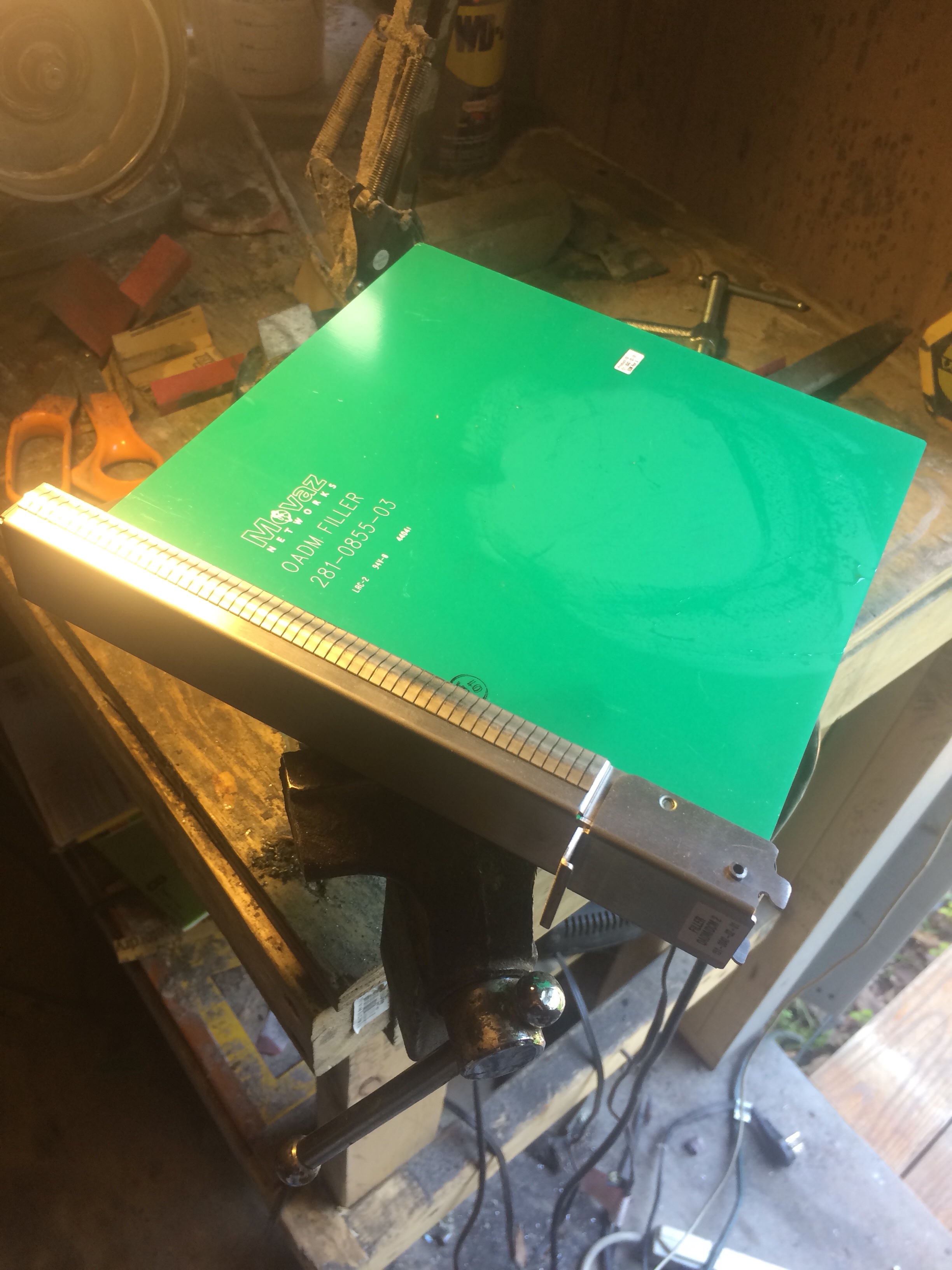
Computer board for the spacing material:
img_5882

Mesquite from Texas for the handle:

img_4584-1

img_5883

All profiled:

img_5926

img_5925

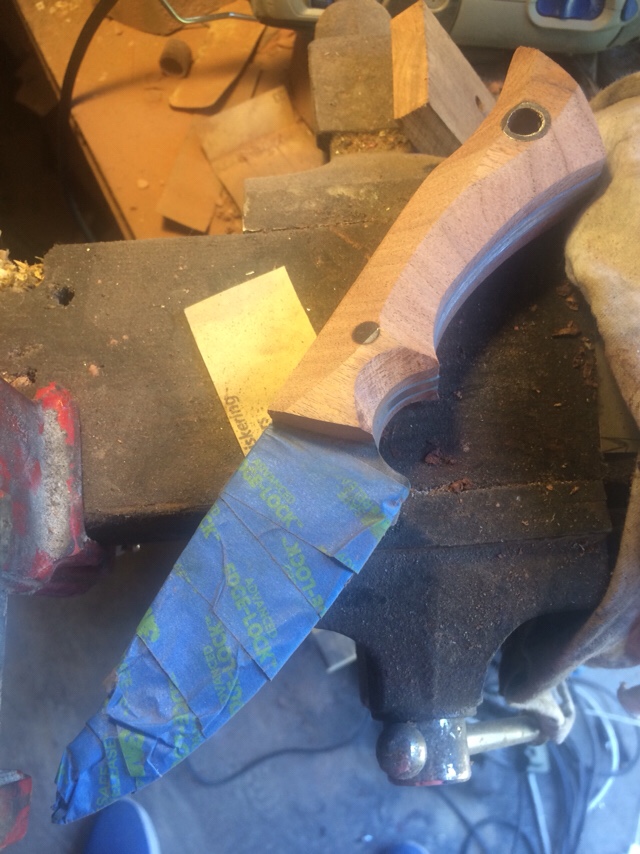
Rough shaped on the grinder- from here out it’s all hand work:
img_5927

This is at 220 grit:

img_5928

Letting a bit of oil set in to help the grain to speak:
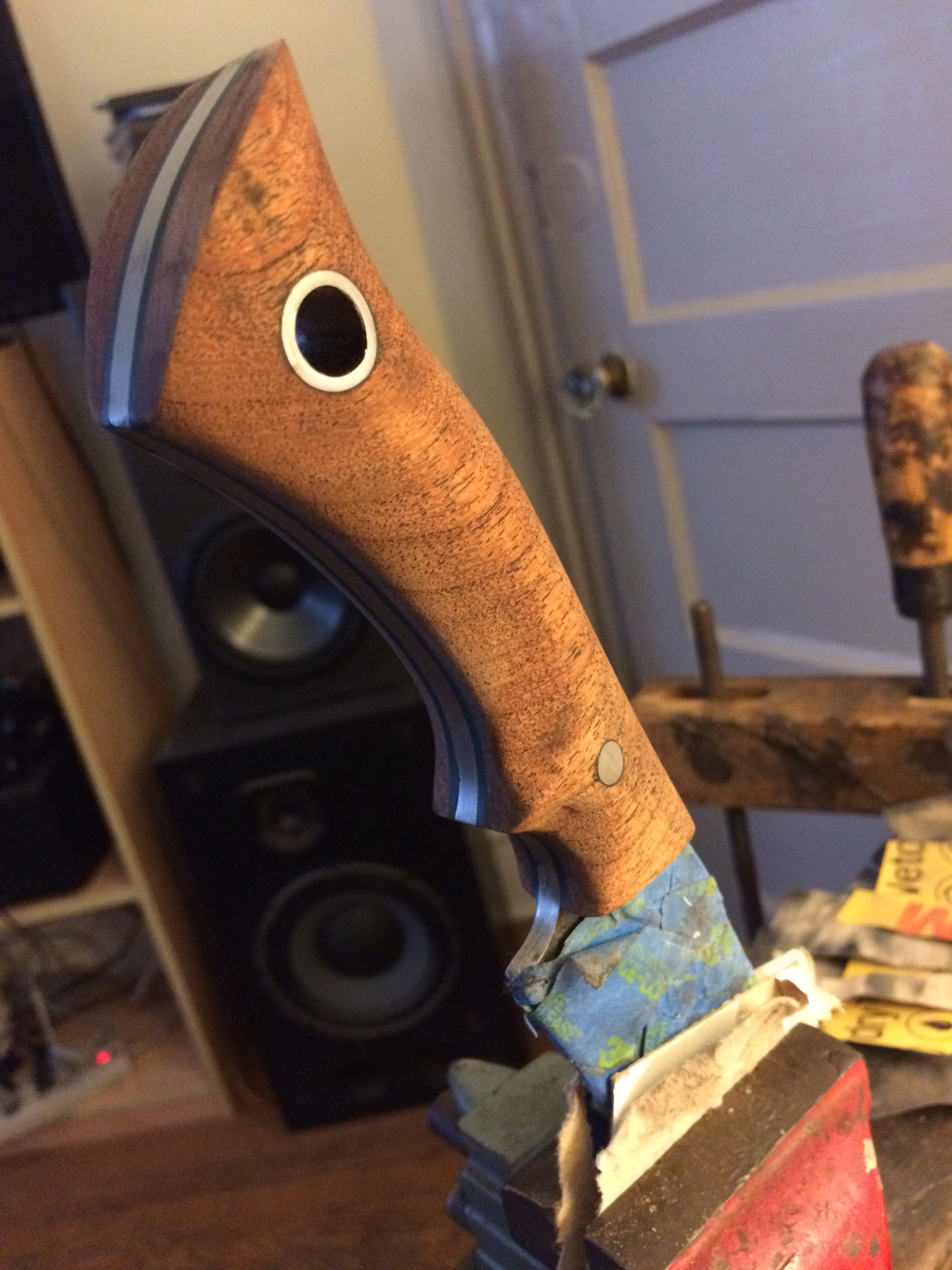
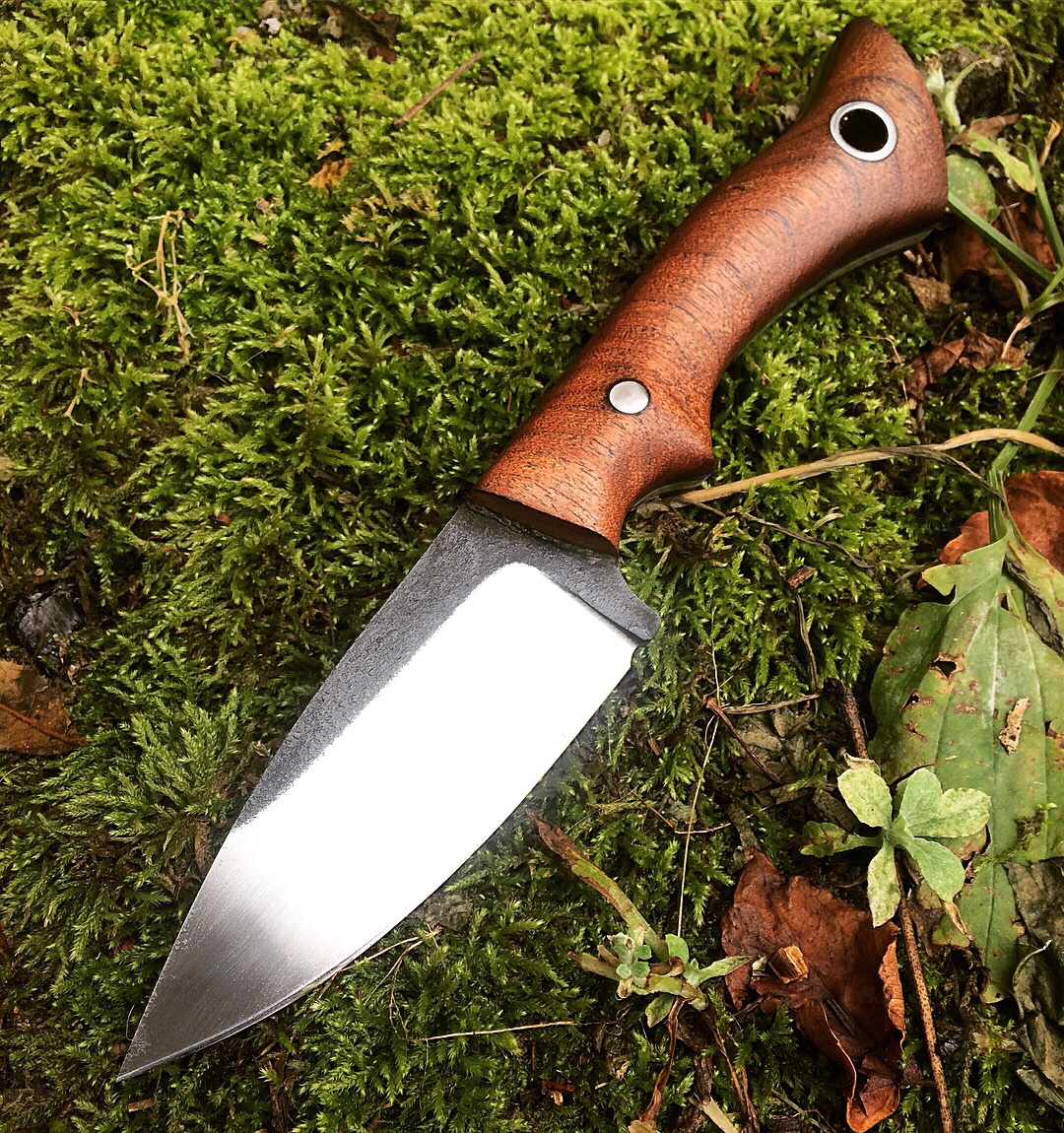
The Woodsman, Mark II:
Knifemaking: The Things That Come to Us- A Restoration

“i imagine that yes is the only living thing.”
― e.e. cummings


There are many things that come into our own personal worlds- children, possessions, problems, blessings and a myriad of others.  It’s not so important how or why they enter our lives, but what we do with them.  It expends a great amount of energy to ponder what we may have done to deserve the painful and traumatizing events that come to us, and an equal amount of energy is wasted when we wonder if we are worthy of the good things that are brought our way.

Because when we start dwelling on the why’s and how’s, we tend to become overwhelmed and lose sight of what best needs to be done with what comes into our lives.

And within that judgement of why and how, we start to say no to things.  We become afraid we may be hurt, or that we may fail ourselves or those we care about.  Perhaps we are afraid of making ourselves unsafe.  Whatever the reason, in saying no we shut ourselves out of the blessing may be inside of a painful situation.  We say no to what may be a path forward because it is dressed as something unpleasant.  It is then that we become prisoners in our lives instead of seeing the ways we can be shaped and grow.  We should say no to things that are harmful and do not better us, but it’s always good to say yes to what life brings us.

The summers are slow for me, and sometimes I have to get creative in the ways I support myself.  I end up saying yes to many opportunities that under normal circumstances I would decline, usually due to time constraints, time away from loved ones, or a high probability of bodily endangerment (or a combination of all three).  Over the years the things I’ve reluctantly said yes to have usually been the most rewarding.

One of the times I said yes this summer was to a tree job in rural Virginia.  I was on a crew to cut down a huge dead tree.  Removing dead trees can be dangerous.  Rotting can occur in any number of unseen places of the tree, causing structural instability, and the tree may not fall where or when you desire it to fall.  This particular tree, though dead as a doornail, fell exactly as it was supposed to.

The client was an artist, and brought us French-pressed coffee.  We talked for a bit and I told him about making knives and how I got my materials.  He told me that he had some slabs of black walnut and that I was welcome to them.  They had been milled by a neighboring man who had run an abbey in South Korea, saying ‘yes’ to whatever fleeing defectors and dissidents from the North that the world brought their way.  Later he sent me an article about the man who cut the wood, you can find it here.  Black Walnut is expensive and isn’t something to normally fall into one’s path, so, in the practice of saying yes, I happily took some.

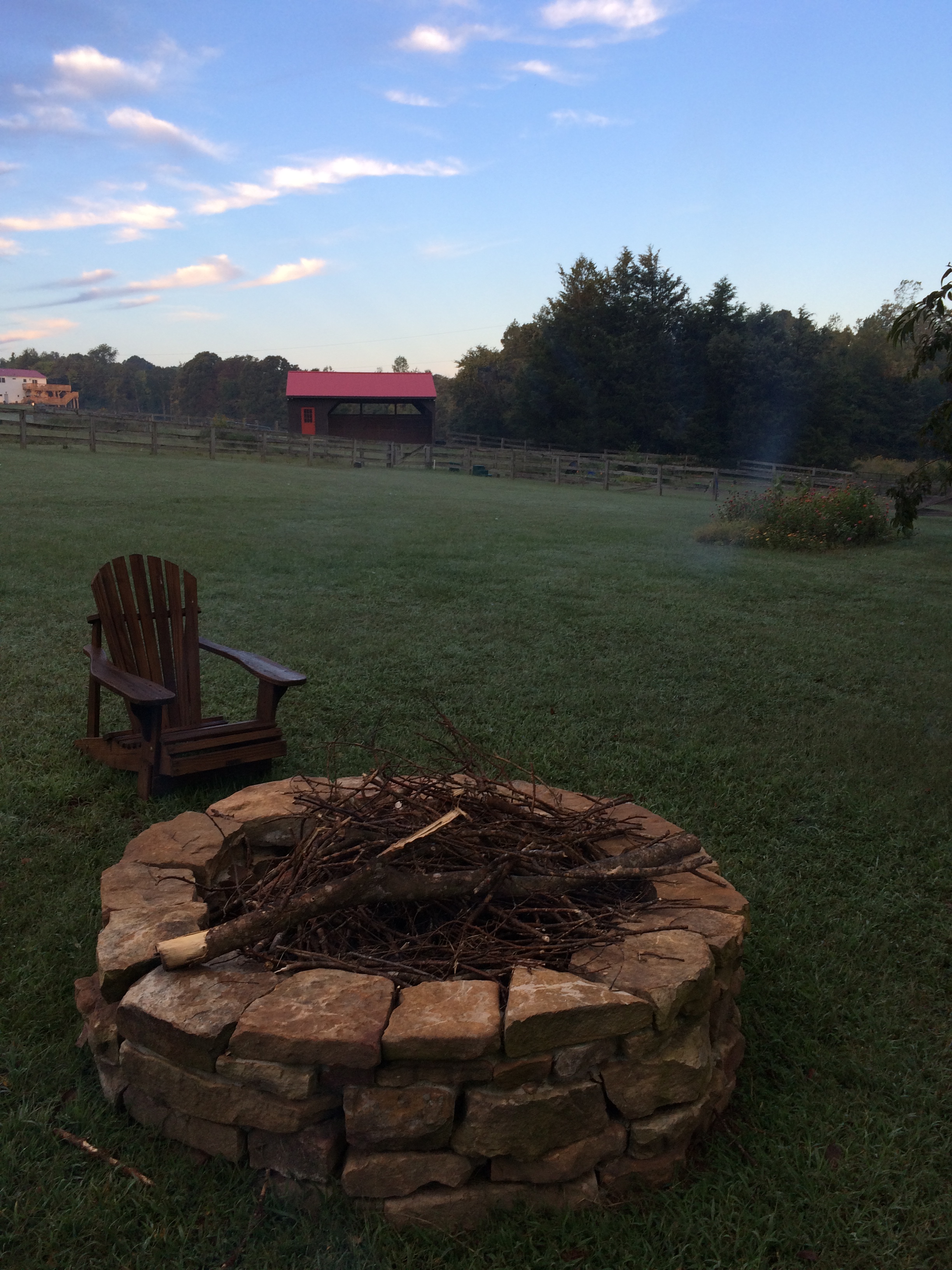
A week or so later I said yes to doing a bit of work on a good friend’s farm.  My friend is a busy lady and sometimes needs a hand with the upkeep of her property.  She and her family are good friends of mine.  I worked for her son for several years and like to get out to their property as often as I can.  It’s really beautiful:
IMG_2509

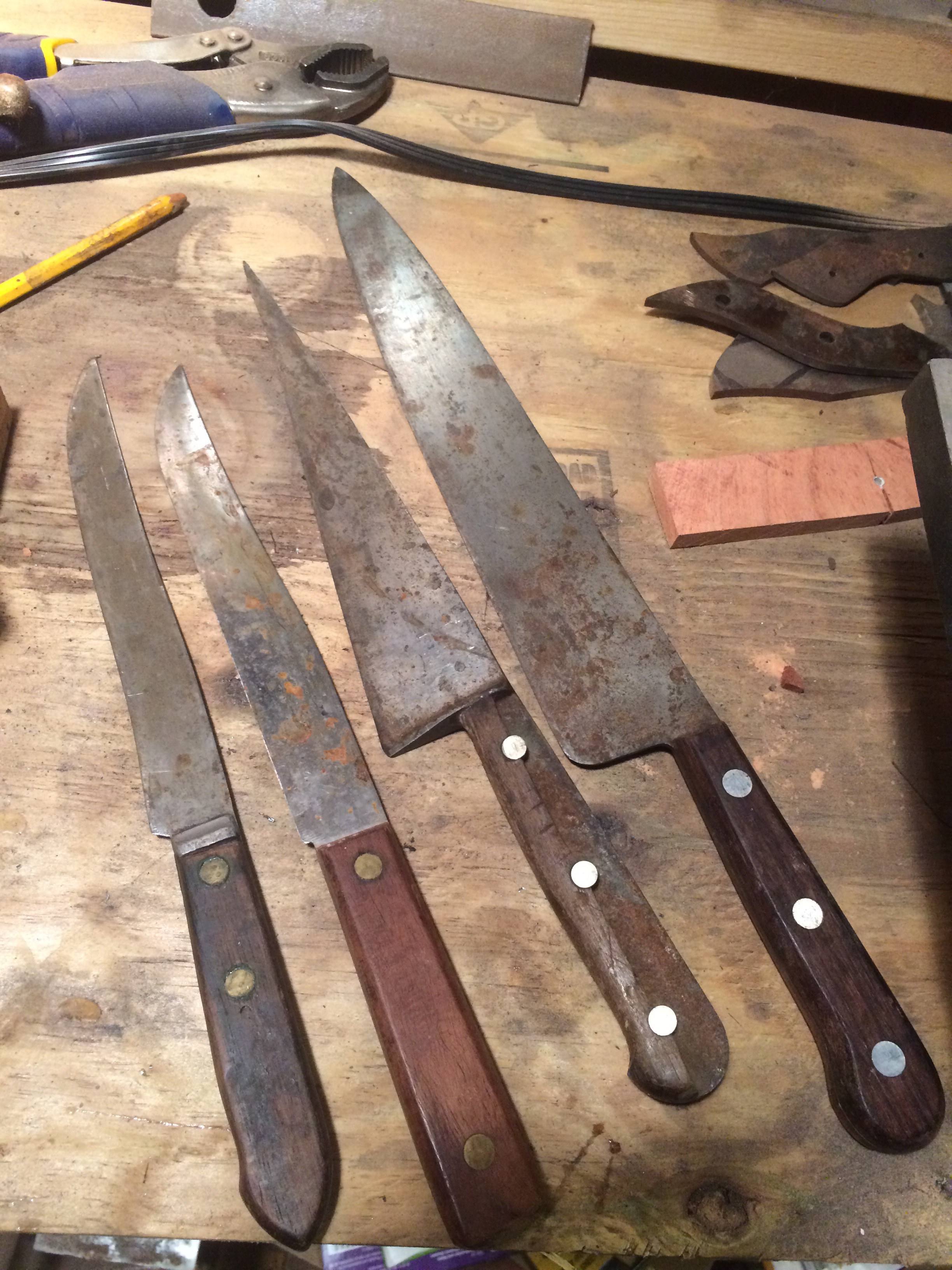
She had a set of knives she wasn’t sure what to do with.  They belonged to her late husband, and came to him from his grandfather, who was an Austrian immigrant.  He came to the United States in the early 1900’s and made his living as a chef, choosing to say yes to a new world and a new life.  She told me she’d like to have them restored so they can go to her children and stepchildren to remember their father.  I told her I would have a look at them and see what I could do.

Tools of the trade, from left to right:  A carving knife; a fish knife; a French slicing knife; and a 12″ chef’s knife

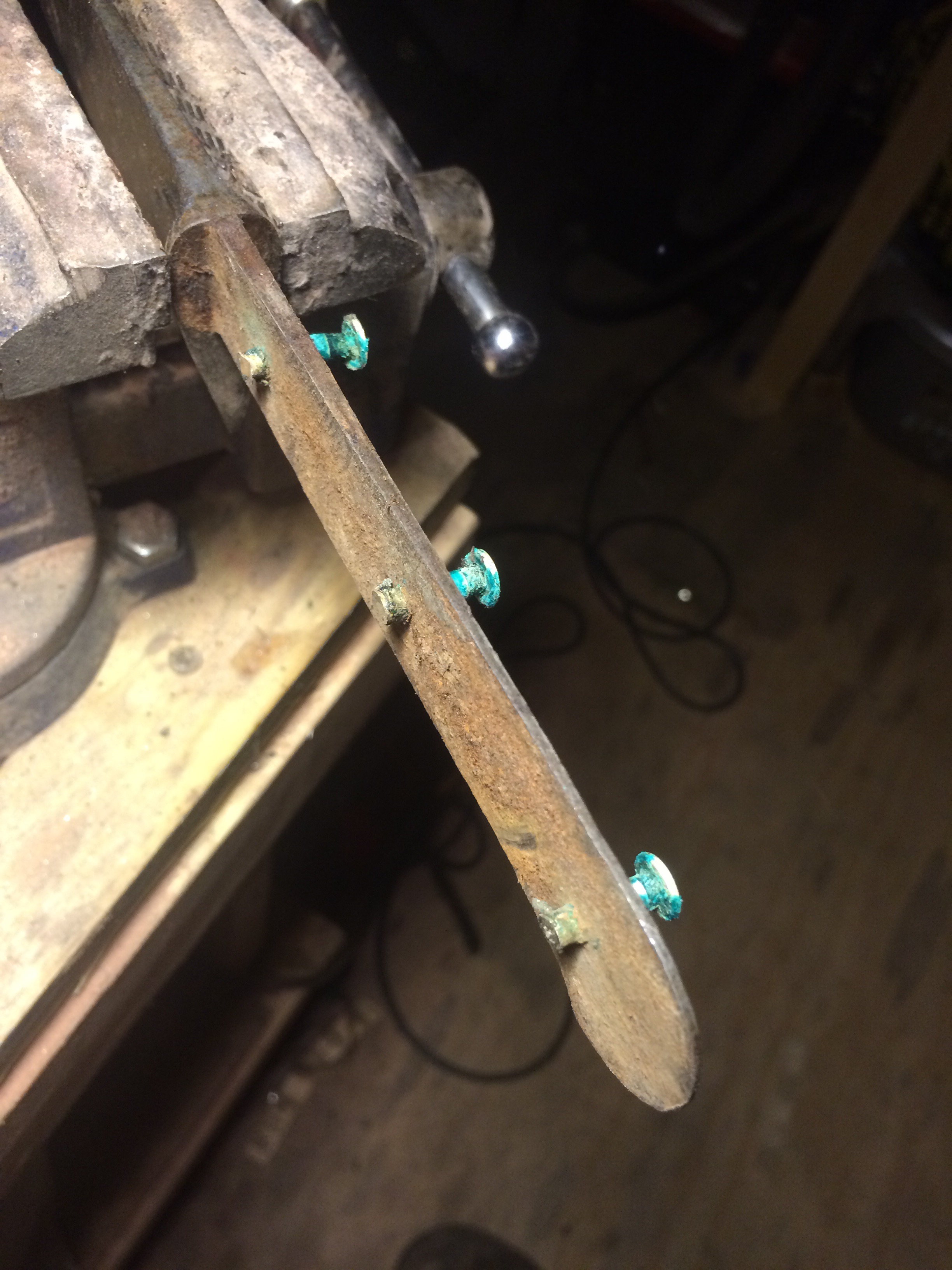
So these knives came to me, at least a hundred years old, and of deep sentimental value.   I started by removing the cracked and broken handles.

I cleaned up the corrosion and oxidization from the blades, but left much of the etched patina from their years in the kitchen.

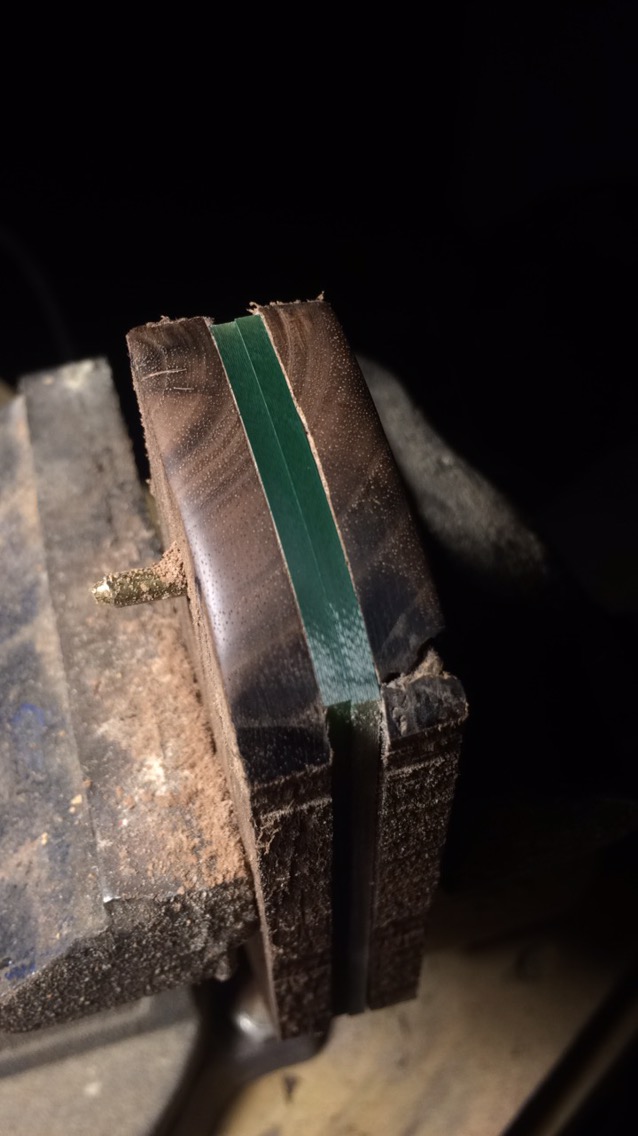
In a continued practice of saying ‘yes’ I chose to use some of the Black Walnut I got from the tree job for the handle material.  It fit nicely into the story of these knives.  This is what it looks like sanded and polished.
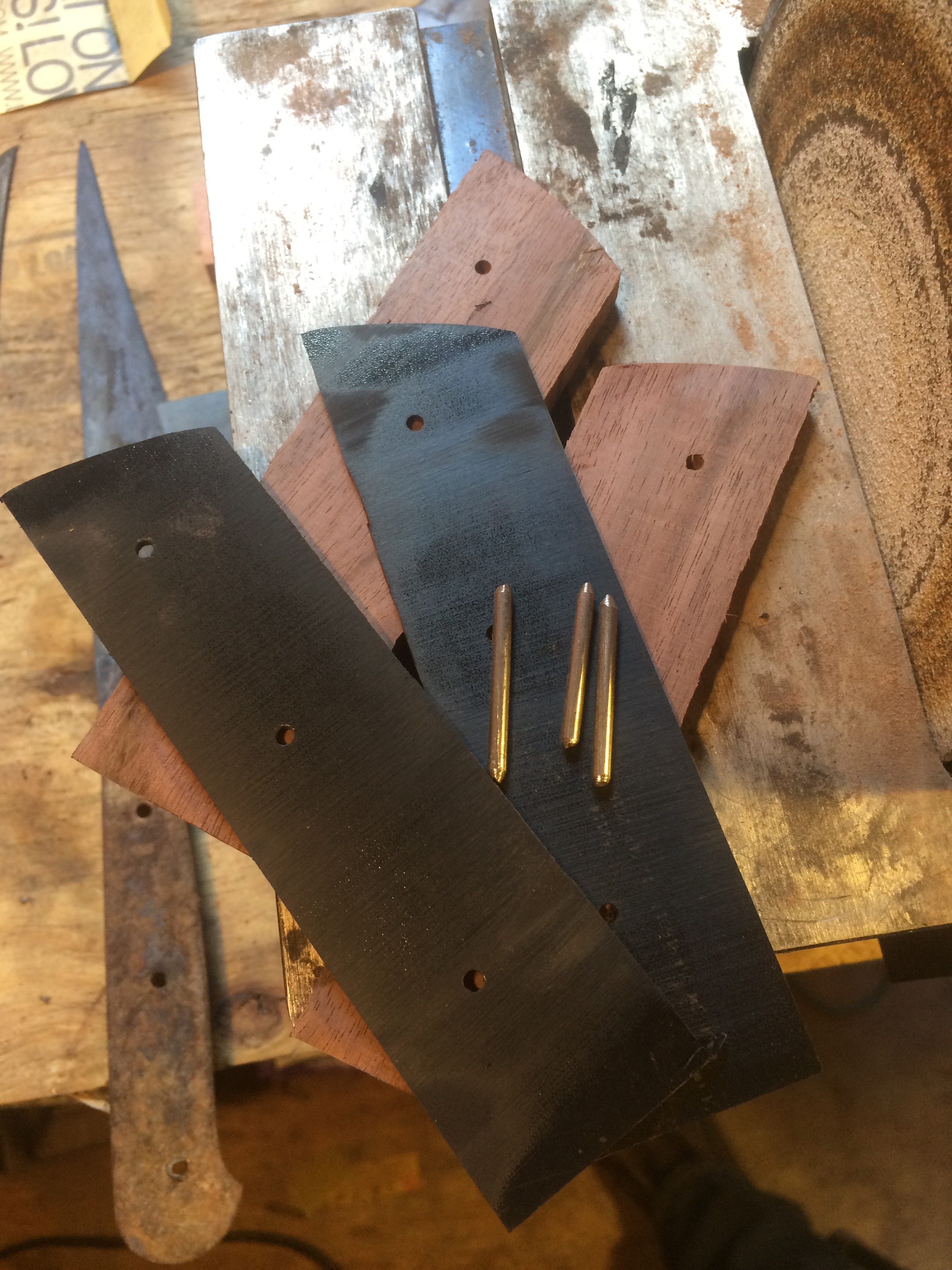
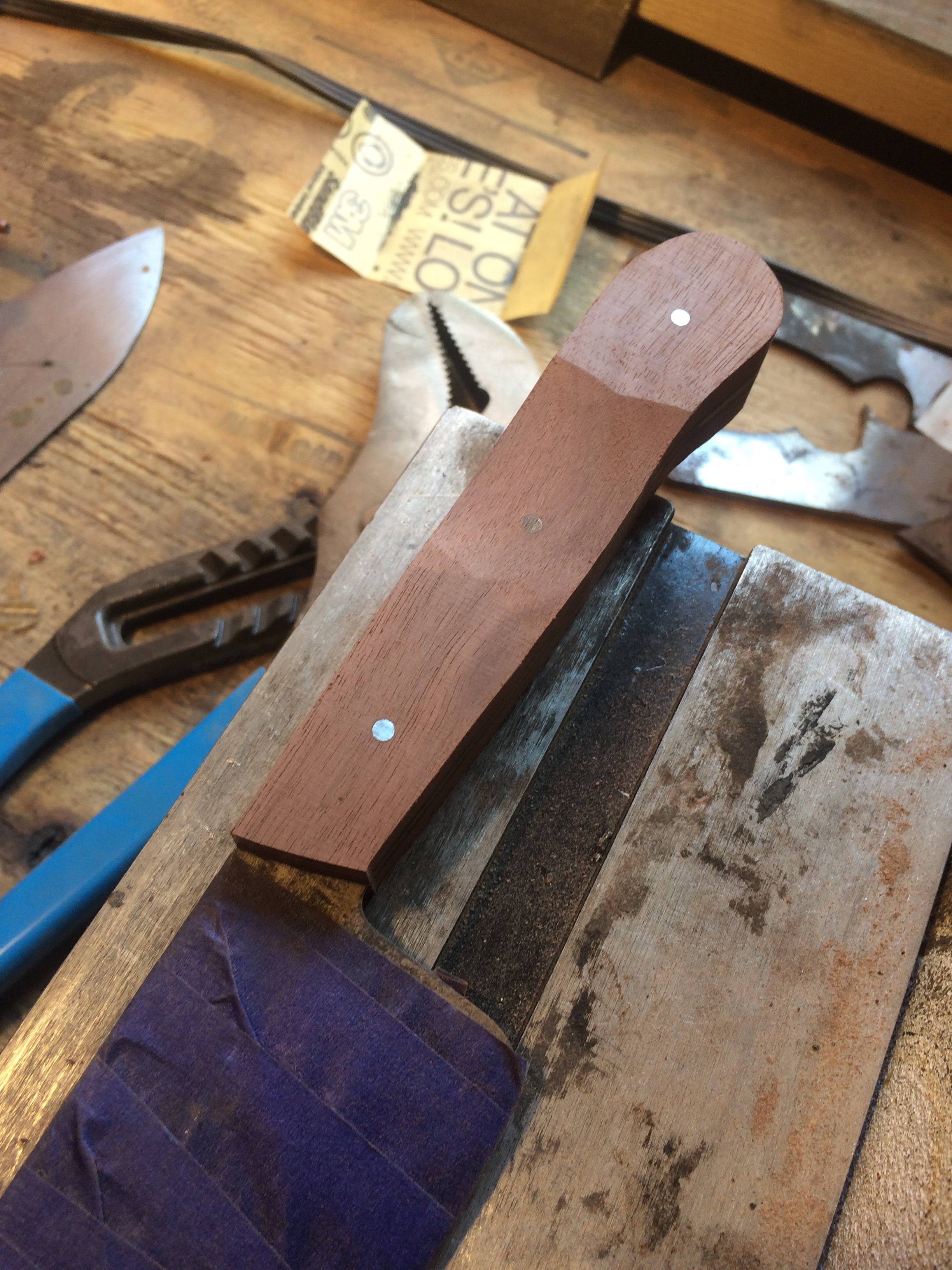
All of the handles started as thin blocks cut from the Black Walnut.

Shaping.


The filet knife was only half-tang, so I extended it with mild steel from a sheet.

I added a G10 bolster and spacer for a bit of contrast.

After glueing and sanding.

Getting the fish knife ready for glueing and shaping.

The French slicer was tricky….

…but also an elegant challenge, with its tapered tang and integral bolsters.


Finished, they came out rather beautifully:

Say yes to the things that come to you whenever possible.  It’s always worth it on the other side.

Knifemaking: Chainsaws, Being Gentle of Spirit, and the Lionheart

‘Only the weak are cruel. Gentleness can only be expected from the strong.’

Leo Buscaglia

A couple of years ago I was out in the country with a good friend of mine, giving him a hand in clearing some trees on his property.  There was a ramshackle house on that piece of property that hadn’t been lived in for years.  We were clearing the trees to make a path for the demolition equipment to come in and tear what was left of this house down so a new one could be built.

We hauled logs and trees that had already fallen.  This area had not been visited by anyone in quite some time and was quite overgrown.  We didn’t bother with any of the larger trees but anything under forty feet was fair game.  We were in the middle of the woods and it was just us.  My friend had two Stihl chainsaws and was cutting the trees down.  I was hauling the logs out out of the way and stacking them to be cut into firewood later.

We took a break- there were a lot of trees left to take down.  My friend had two chainsaws, one for each of us, so we decided to divide and conquer.   When we got started again I grabbed a saw and found that I could not get it running.  I yanked the pullcord.  Nothing.  To be safe I topped off the fuel and the chain oil.  I adjusted the choke.  I gave the pullcord another tug.  When it still wouldn’t start I assumed that I wasn’t pulling hard enough.  So I pulled harder.

My friend stopped me and told me to be gentle, otherwise I would rip the cord out.  I kindly let him know that I was an extremely gentle person.

He laughed.  ‘Maybe gentle of spirit,’ he said and gave the cord an easy tug.  The saw started right up.

That man, always with the truth.  I thought I was being gentle….

The truth of the matter, and what became clear that day, is that behind any kind of power is gentleness.  Not everything in this world can be beaten or bullied into submission, though there have been times in my life where I liked to think so.  As with the chainsaw, gentleness sometimes IS the power.  Out in the woods that day, the one who was gentle was the one who was cutting the trees down and that person was not me.

Gentleness is often seen as a sign of being weak.  This is not true, despite what has been demonstrated to us throughout our lives.  While brute and strength and force have their place, without something gentle behind them they serve only to divide and intimidate.  Gentleness serves as a means to connect.  It acts as a vessel for strength, holding it and giving it purpose.  Behind every great leader, parent, speaker, or creator of things there is something gentle.  Without that everything dissolves into fear and chaos.

This is the lesson of the Lionheart.  To find gentle is to find power.  The road to finding those is courage and bravery manifested, which are traits of someone who is Lionhearted.  It’s not an easy road for certain but the best ones never are.
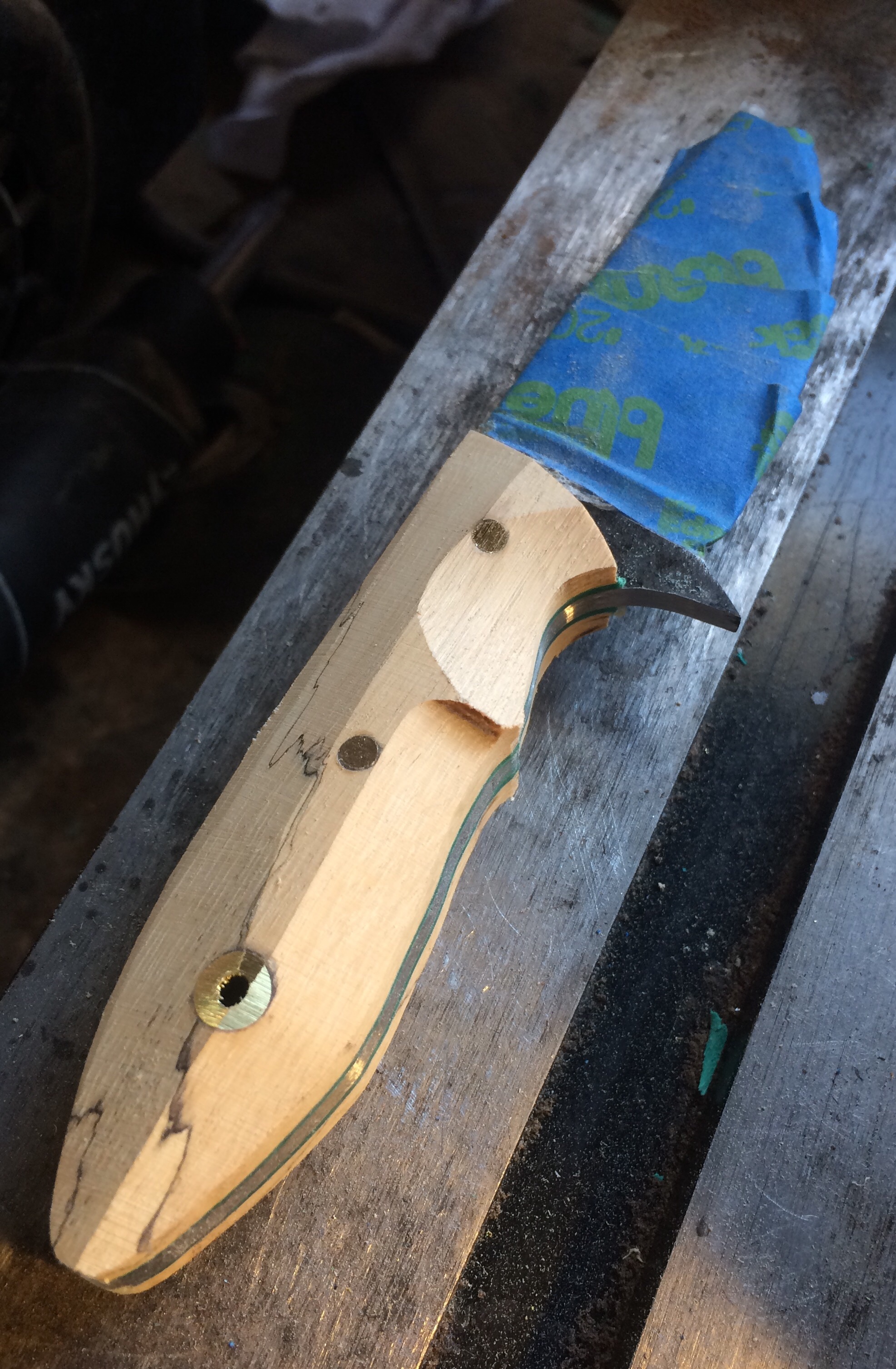
This blade is a 6in filet/boning knife, built from 1/8″ O1 tool steel stock.  It was commissioned by a man who has quite a bit of Lionheart in him, and was the inspiration for the namesake of this knife:

Rough cut:

Filework on the blade choil.  This makes it easier to sharpen and provides a visual aid in creating symmetrical plunge lines:

Profiled:

Initial work on the bevels.  Removing too much steel will cause it to warp in the forge.  Ready for heat treat:

Hardened:

Removing more material after heat treat:

Hand sanding:

Satin finish:

I should have drilled these earlier, but here we are:

Rivet holes in the scales.  The wood is Redheart:

Ready for assembly:

Profiled:

Shaped:

The Lionheart:

Be gentle with that chainsaw….

Knifemaking: the things that get in the way and the Arrow

“The way we do anything is the way we do everything.”

-Martha Beck

……..

“I guess I’ve been carrying many small things.”

-Mina Tindle- “To Carry Many Small Things”

When I was nineteen I started lifting weights.  I didn’t have a particular destination or goal.  The only real goal that was there was to lift as well or better than I had the day before.  I paid attention to form, technique, and consistency.  I got better as time went by.

Ritual was crucial.  I would allow myself to be very quiet.  I had a taken some dance classes in college and would do these really amazing spine-lengthening stretches.  After my workout I would take a shower, sit in the sauna for twenty minutes, and then leave.  I did all of this without speaking to anyone.  It was like going to church: still, prayerful, and introspective.

I never made notes or kept logs.  I made sure my routines and circuits were simple enough to remember day to day and week to week and so on.  I kept up with this for eleven, maybe twelve years.  When I felt good, I went to the gym.  When I felt bad, I went to the gym.

Then about two or three years ago I noticed I was having trouble finding those quiet and still places.  I had trouble getting to the gym and staying present with what I was doing.  Actually I had trouble staying present in nearly all the things I was trying to do.  I wasn’t sure what to do.  I went to the doctor, got blood work done.  I talked to a therapist.  I was healthy.

My girlfriend noticed this, and put me in touch with a lady she had been studying with.  She said I was probably missing a physical practice and since the gym wasn’t in the picture anymore I should at least talk to this lady, who was in the practice of Ashtanga yoga.  I had watched her take a course of study from this woman to help her heal from a hip injury.  She was calmer, glowier, and looked fantastic with a sort of shimmer about her.  Ok, I finally said, I’ll give her a shout.

I made an appointment with this lady and we talked about what it was to practice yoga.  Her name is Leigh.  She told me that in this practice, if practiced diligently, transformation would occur.  She said that I would notice unpleasant things rise to the surface.  Things would fall away, she said, and those would mostly be the things that got in the way: bad habits, patterns of self-sabotage, and bad attitudes- the fun things. Afterwards I told my girlfriend that if I turned into some sort of New Age asshole who extolled the virtues of kale and hashtagged ‘namaste’, I would prefer she shoot me, bury me in the backyard, and tell everyone I left her.

(Quite a few months later I would find myself in front of a salad bar at a hillbilly barbecue buffet in North Carolina, and I would notice that my first thought was ‘where the fuck is the baby kale?’  My second thought had something to do with being shocked that my first thought was about kale…).

I started meeting with Leigh about every month or so and she was right.  Things DID fall away.  I found myself becoming very protective of my sleep and rest.  I started eating better and found myself desiring fruits and vegetables, which is something completely new.   I stopped going out and I didn’t miss it at all.  I leaned into life a little more.

Then I noticed all the small things I had been carrying.  In Ashtanga, I found that almost everything I didn’t like about myself was held out and dangled in front of my face whenever I was on the mat and often culminated in tears.  I wasn’t aware of all the prickly bits I carry around on an almost daily basis: guilt, shame, resentment, rage, and impulsivity.  I’ve always heard from my friends about how relaxing and grounding yoga was for them.  I have not had that experience.  I sobbed uncontrollably during the first week I started.  I wasn’t nearly as patient as I thought I was, and definitely more judgmental than I ever believed.  Sometimes I find I am so present with myself that it hurts.  Unlike the gym, there is no rush of endorphins for me.  I end with everything I start with and honestly, it really sucks sometimes.

This sounds like a ringing endorsement and you’re probably asking yourself “where do I sign up?”

The truth is that this is a practice that helps you to know yourself, all of yourself, and that is usually going to be painful.  The growth and transformation happens when you find the pain isn’t going to kill you (although sometimes you wish it would).  The idea is not to make the uncomfortable things go away- they aren’t going to.  It’s to create a space to be with them and to go about your life in spite of being uncomfortable.

This blade was a commission for Leigh, from her husband.  Both of them are incredibly loving and kind and supportive people.  Leigh herself is an arrow, piercing those things that get in the way and always doing so with love and encouragement.  She has become a very dear friend and making this knife was a pleasure.

I designed this knife for whittling.  She is built for a smaller hand:

Rough cut, from O1 tool steel stock:

Smoothed out:

Centerline scribed:

Rough grinding:

Hardening:

Tempered:

Laying down a hand finish:

Just a bit more:

Spalted Tamarind:

Bookmatched:

Ready for glue:

Glued and clamped:


Shaped to fit the hand:

The Arrow:

This knife comes with a prayer, the Prayer of the Arrow, to help with all the things that get in the way:

May I be kind to myself
May I be gentle toward myself and others,
And may I move through my world with elegance and grace
May I find a calm mind and go about my day with peace and serenity and
May focus manifest within that calm
Help me to let go of guilt and shame, and help me to be with my anxieties, and to
Lean into my fears and not
be intimidated by them or anything else
May I know that I have enough
Help me to see things for what they are, and to
let go of appearances and of what others may think
Help me to know strong boundaries and to act on them
Help me to not think so much or give so much weight to my emotions and desires
Help me to keep moving forward and to have faith in myself and those I care for
Please keep me safe
And let me know that I am loved