Knifemaking: braving the storm and St. Elmo’s Fire

“I have seen many storms in my life. Most storms have caught me by surprise, so I had to learn very quickly to look further and understand that I am not capable of controlling the weather, to exercise the art of patience and to respect the fury of nature.”

Paulo Coelho

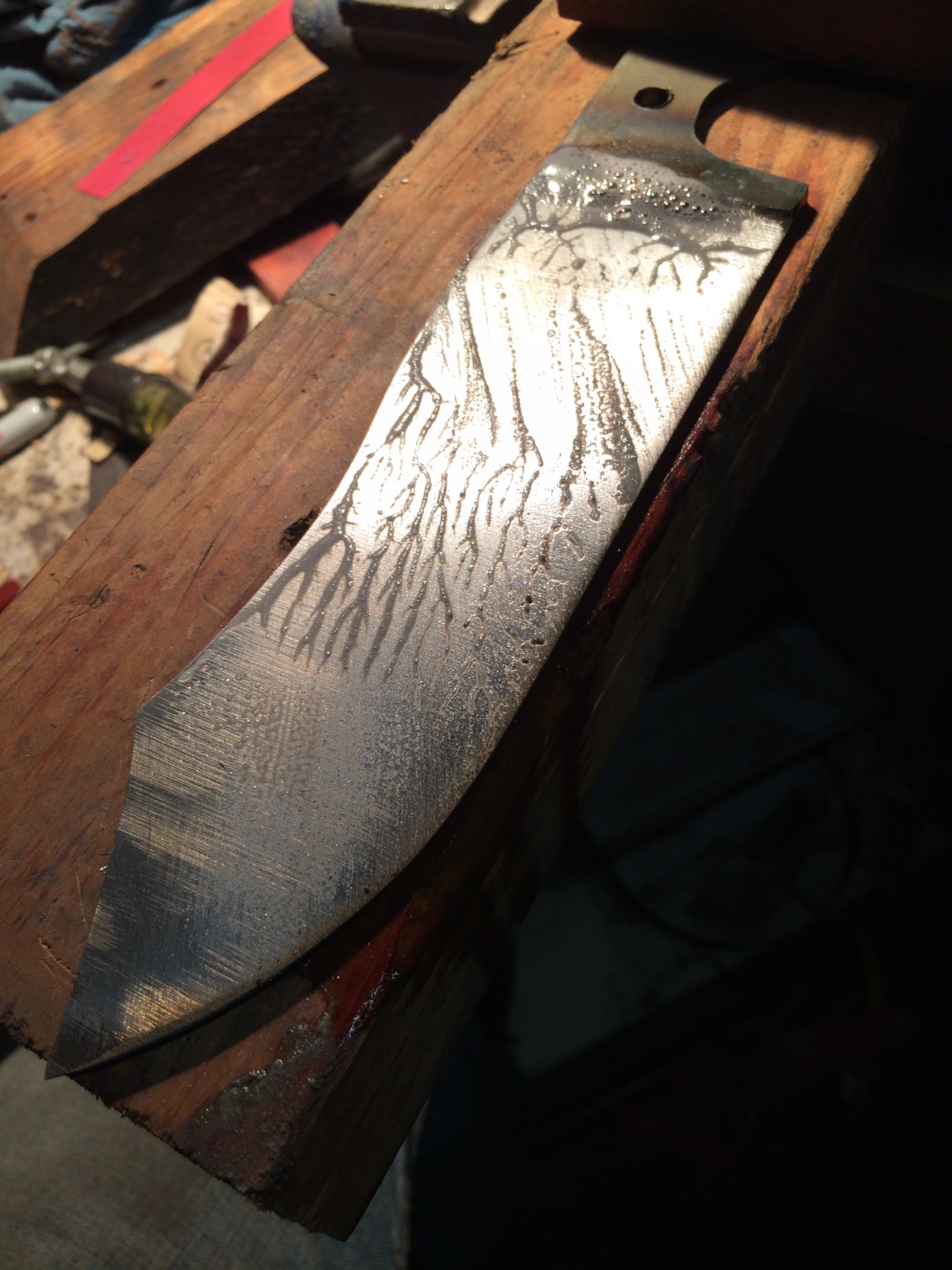
St. Erasmus, or St. Elmo, is known as the patron saint of sailors.   The namesake of this blade refers to a meteorological phenomenon that results from an electrically charged atmosphere that occurs during thunderstorms.  It manifests itself as a series of blue sparks, with the mast of the ship acting as a conductor.  During storms at sea, sailors would often observe St. Elmo’s Fire.  It has always been symbolized as a sign of the Divine, and sailors knew that they were looked after when it appeared.

stelmo

I made this blade with idea of it being a seaworthy vessel- something that has braved many storms and still has its spirit intact.  Sometimes we brave so many storms that we forget how to enjoy the calm.  Instead of having a life of calm punctuated by storms, it becomes a life of storms punctuated by calm.

The important thing to realize is that beneath the churning waves and far beneath the thunder, lightning and winds is an entire body of calm.  And that there was calm before the storm and there will be calm after.

This isn’t to say that storms aren’t dangerous but they do come with their lessons.  I’ve spent a good amount of life in a state of anxiety anticipating storms.  Some of us have been conditioned to live in constant turbulence, lest we not be prepared for the foul weather.  Over time, we stop differentiating between the calm and the turbulent seas and create a maelstrom where there is none because we haven’t ever known what that calm feels like.  Shifting this type of thinking takes time and a good deal of work.  To be perpetually worried of the storms robs you from fully enjoying the moment and the beautiful things that occupy the vast majority of time between.  Ultimately you can’t control the Nature but you can control yourself.

This the lesson of St. Elmo’s Fire.  To allow the storms to pass and to have faith that you will find safe passage through the rough waters.  To feel your own calm in the midst of chaos.  Oftentimes you can find out what you are really made of within that chaos.

This blade was a commission for a very old friend who did a lovely photoshoot for me.  We’ve often talked about storms and how to get through them.

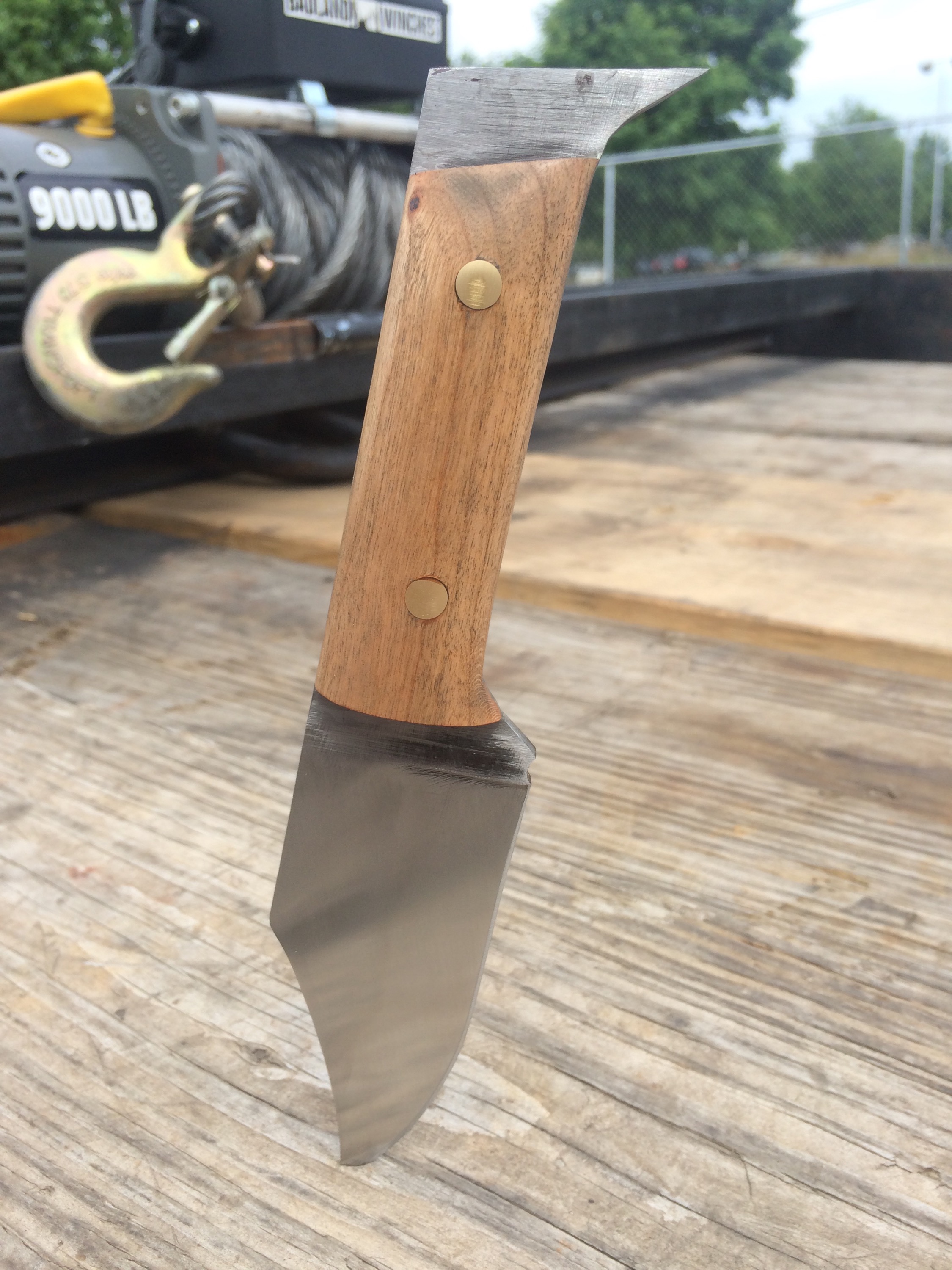
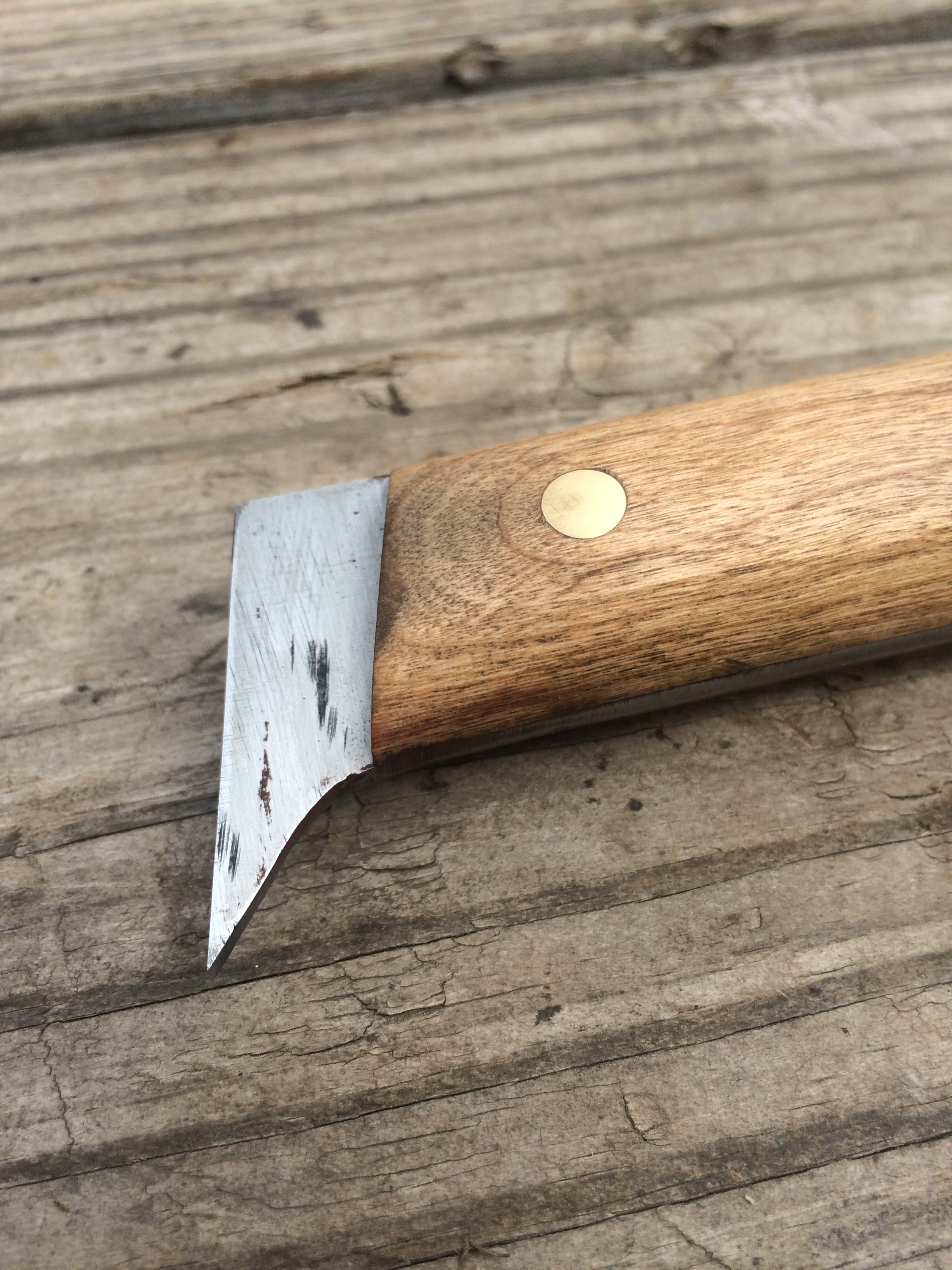
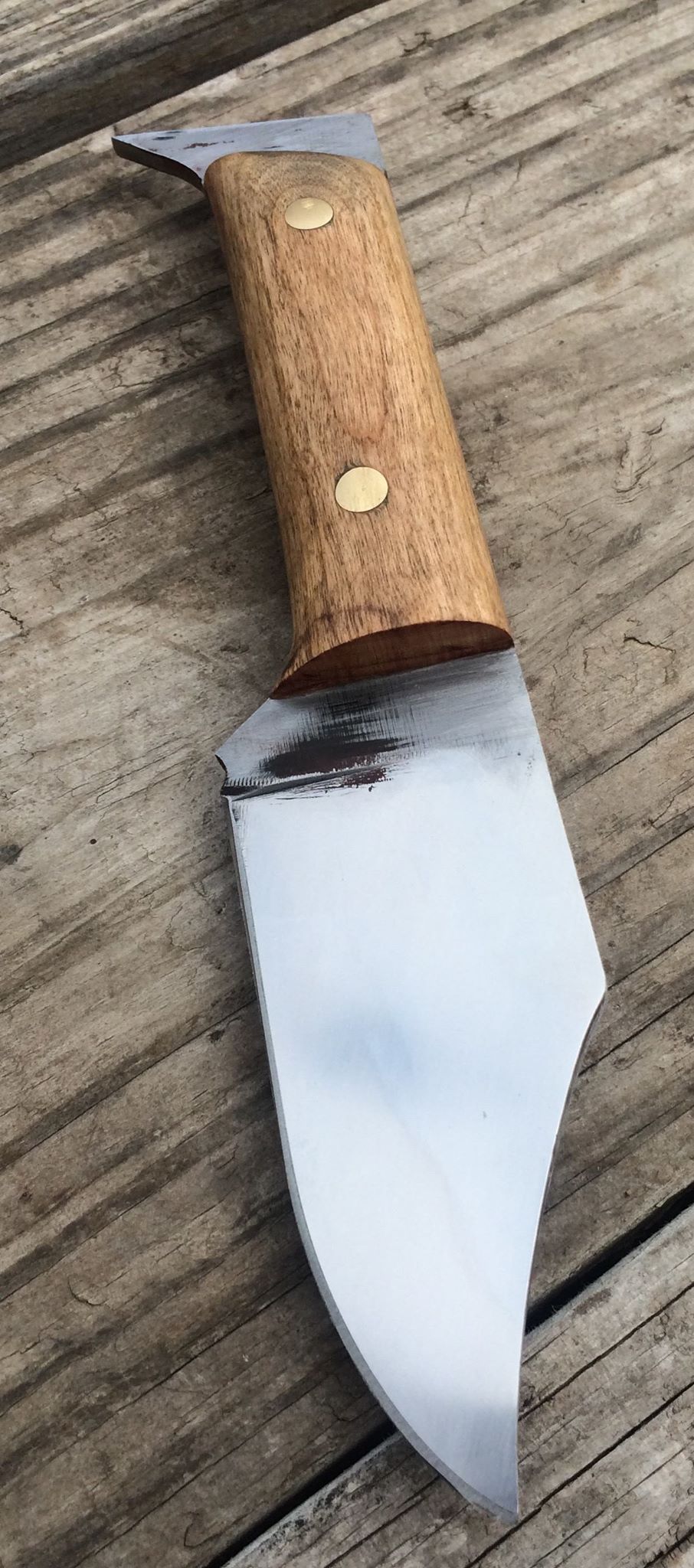
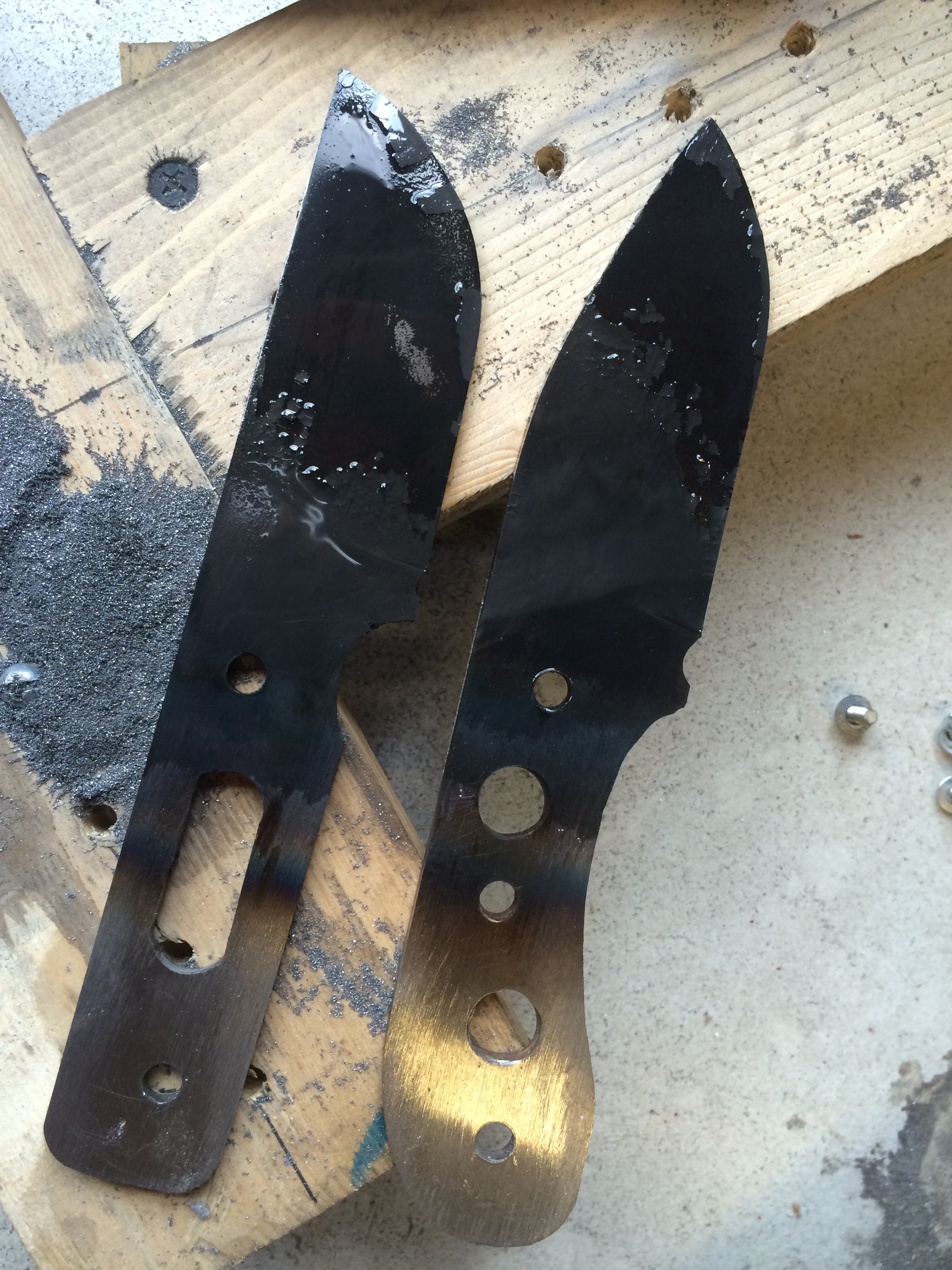
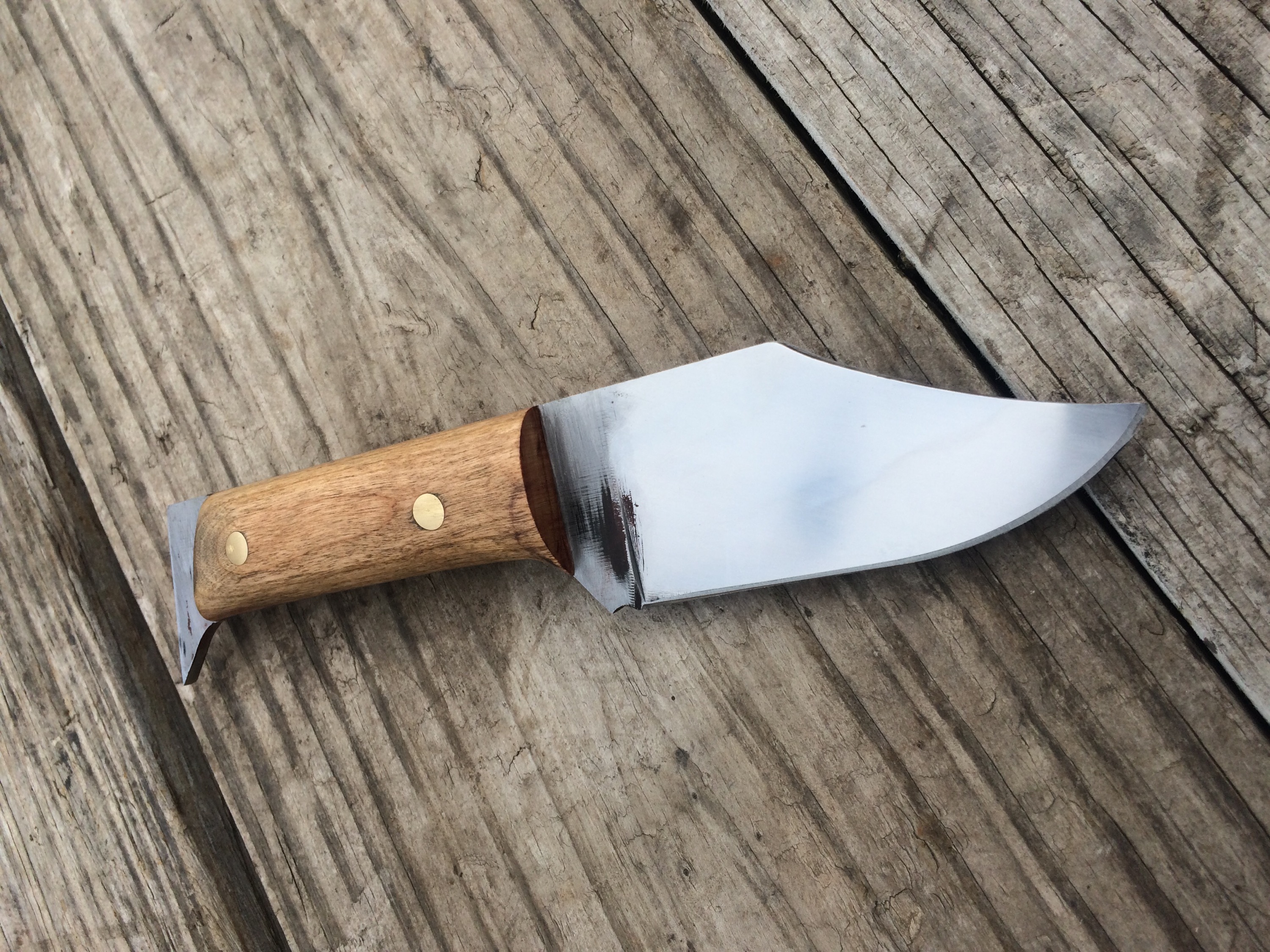
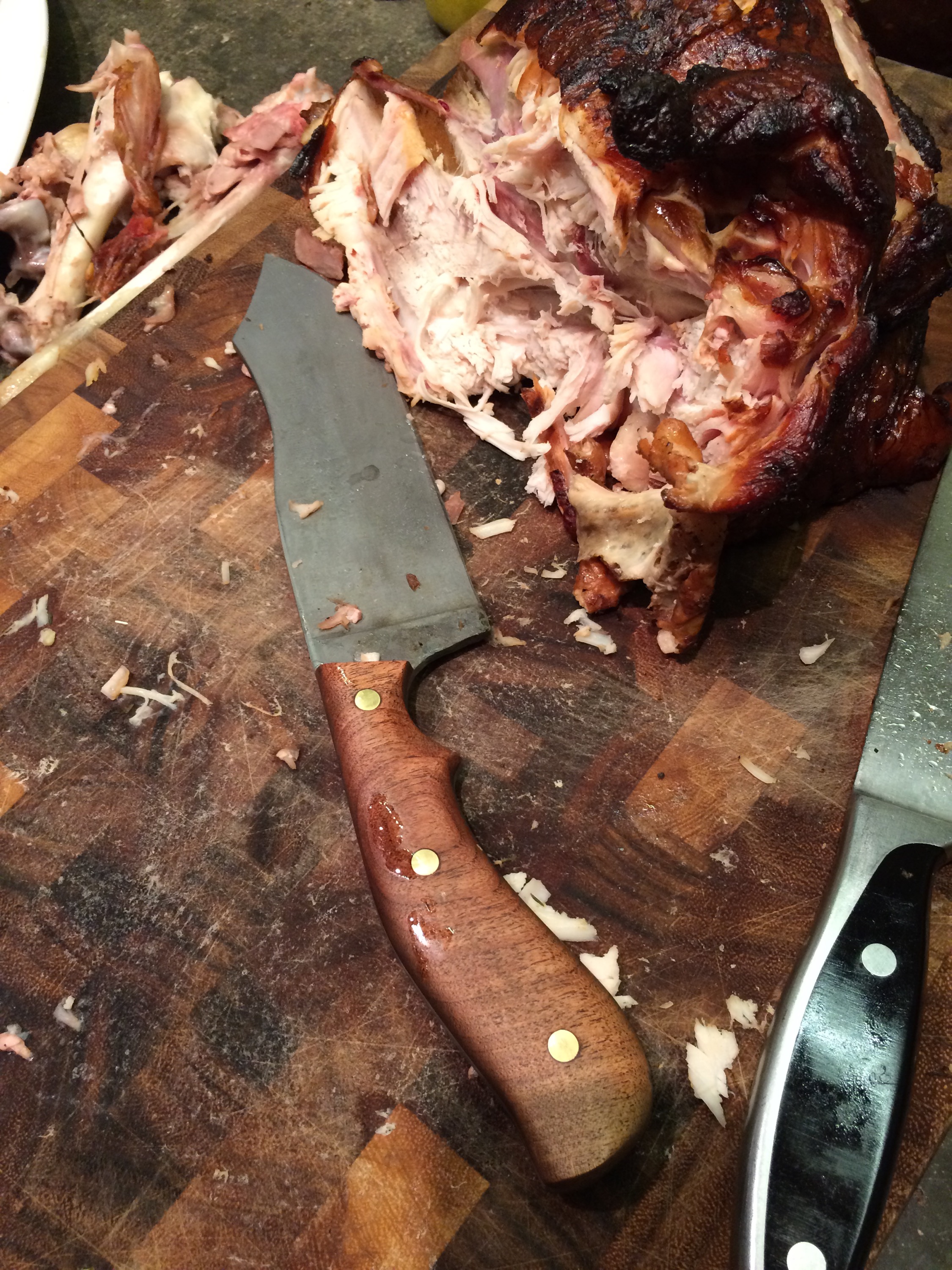
I did a series of kitchen knife designs and this one was sort of a wild card.  Functionally she is a German style chef’s knife.  The clip in the blade gives her some forward momentum.  The drop in the handle rests comfortably in the heel of the hand, and also follows the natural line of the forearm through the wrist.  The finger choil provides a comfortable resting place for the lower three fingers if a traditional chef’s grip is preferred.
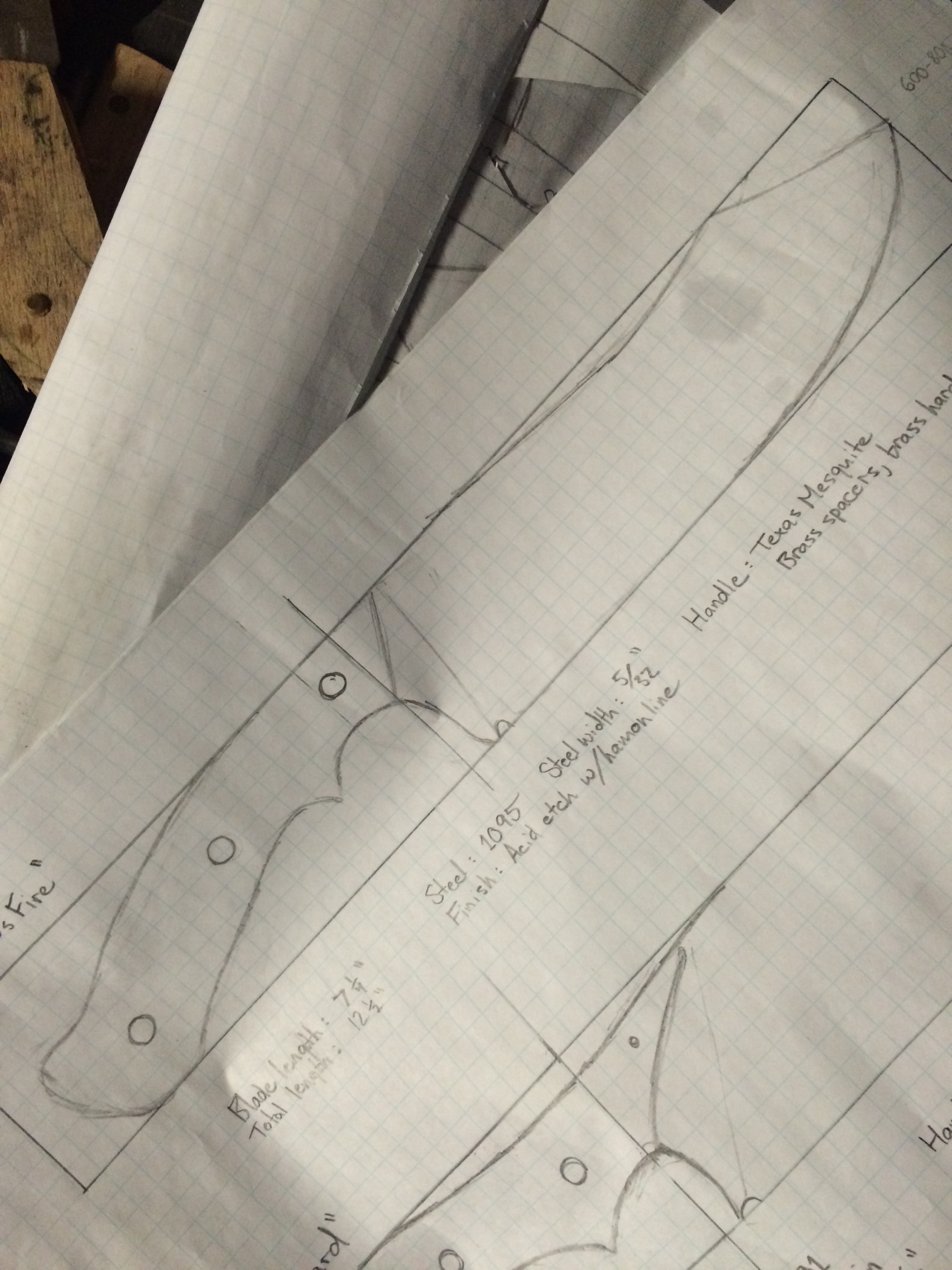
The blade is 7.25″ long.  Blades these long are a continual challenge for me to grind.  If ground too thin they will warp and possibly crack during heat treat.  On blades this large there is grinding before and after hardening and tempering.

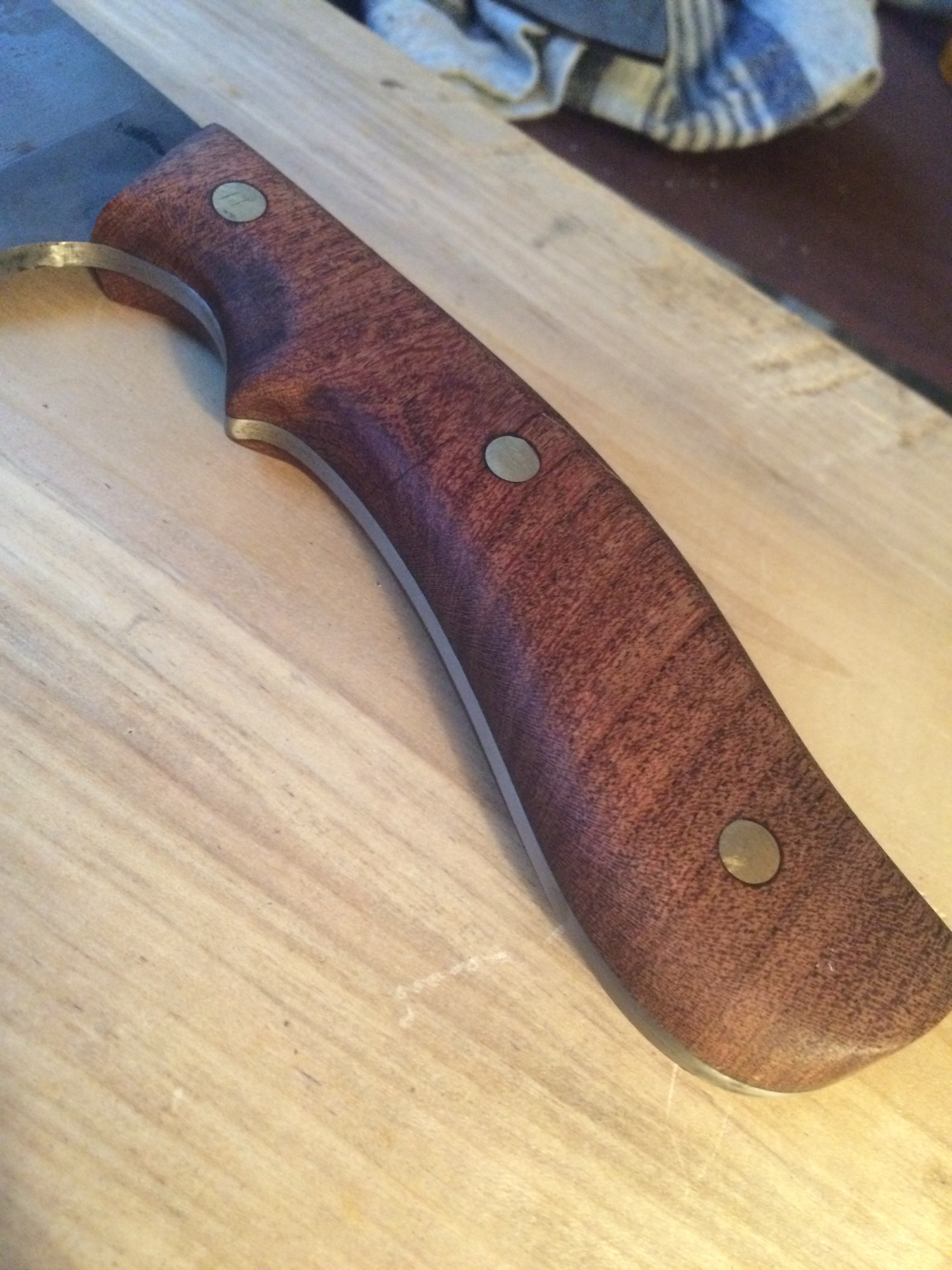
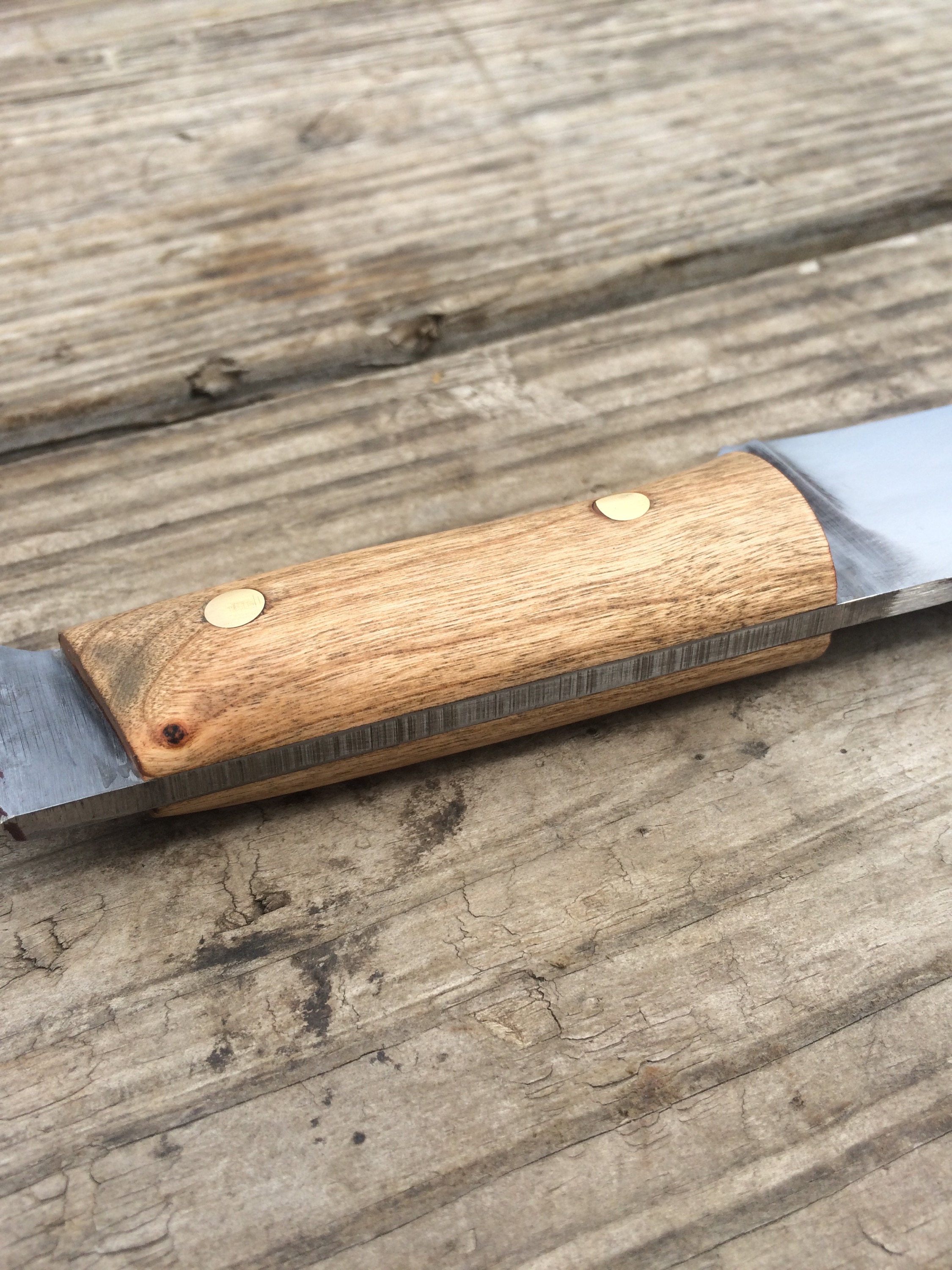
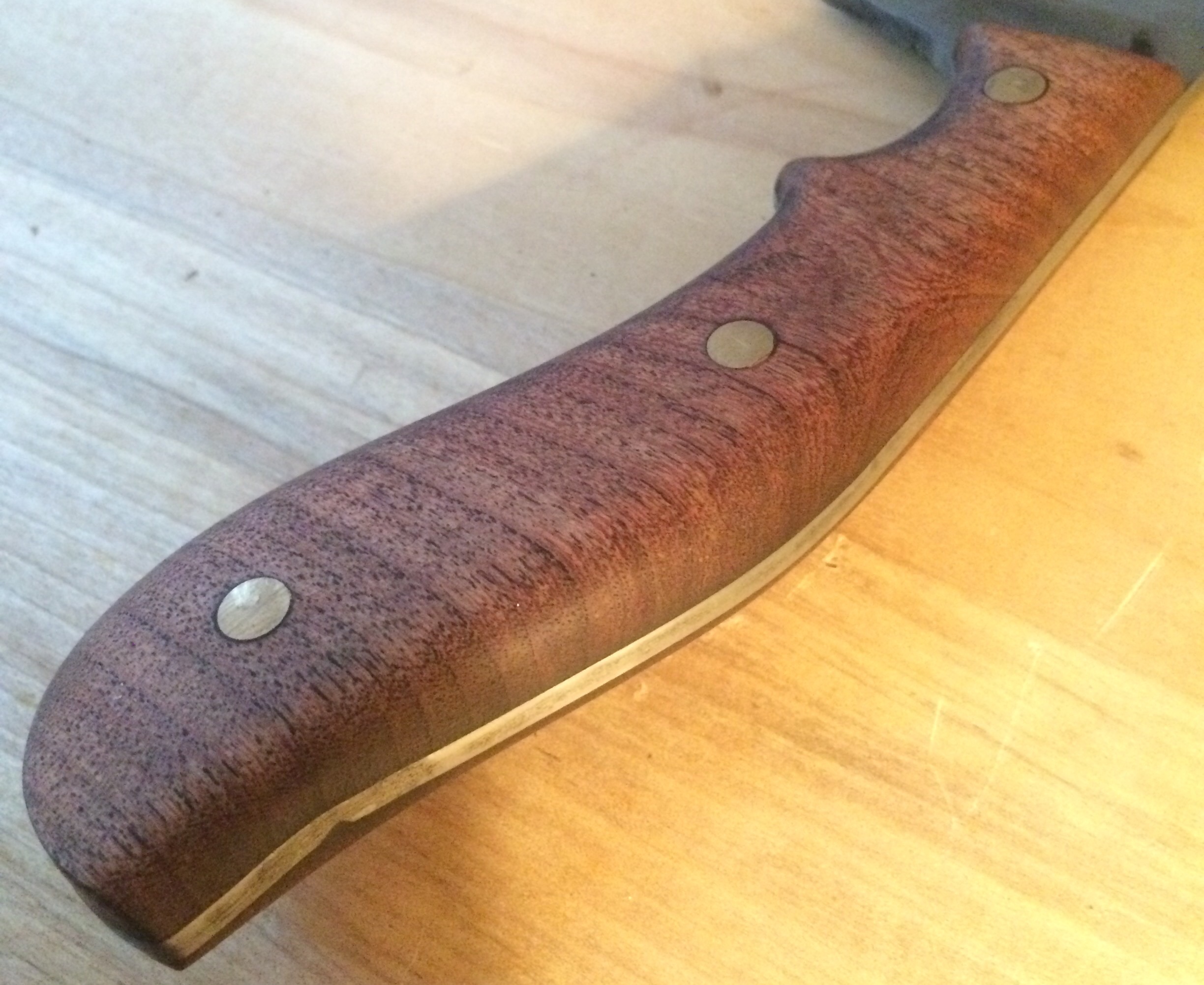
  I love working with Mesquite.  It has a fiery bouquet.
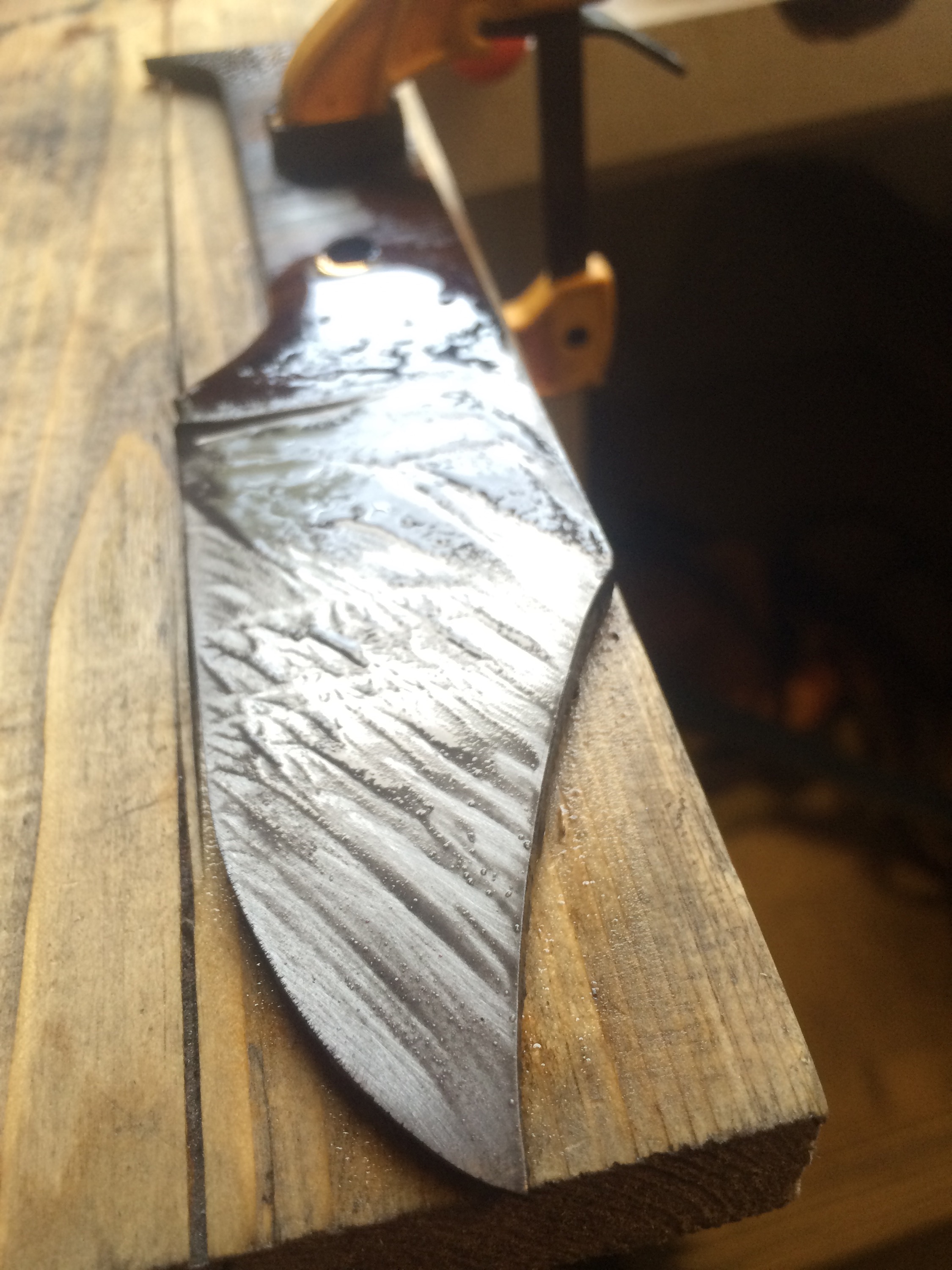
  St. Elmo’s Fire: 1095 spring steel with a phosphoric acid etch, Texas Mesquite handle and brass hardware.

  
There was some turkey involved on this past Thursday  
Trust that the storm will pass.

Be sure to check out Lauren Serpa and her beautiful work.

Snow days and the importance of letting yourself be

(Originally published 2/23/2015)

I’ve always enjoyed a good snow day.  I like the idea of everything slowing down. I like how quiet it gets and how the familiar gets cloaked in white, allowing one to see it in a totally different perspective.  Most of all I like the stillness of it all.  Living in the fan you can always tell who decided they weren’t going to drive or go to work by the layers of snow on all the cars.  I find this to be very calming.

IMG_1618One of my favorite things to do is to go drive places in the snow.  Just to see everything in it’s moment of winter culmination.  With all this snow we’ve had I try to make it to the woods.  It’s quite stunning:IMG_1619

I think what I love most about all of this is that everything just is.  The trees don’t complain, the river doesn’t get anxious, the trail isn’t bothered by the snow.  They’re all just in their moment.

This is the point where I become quiet.  And I don’t really notice it.  So often there is the tendency to feel like there isn’t enough time or enough isn’t being done and I lose my moments being consumed by those things.  Doing.  Always doing but not necessarily accomplishing.  I want for more of the quiet of being and It seems so elusive at times.  Then there are times when it is right there, familiar and loved, like a worn book you’ve read dozens of times.

Then there is the state of becoming aware of these moments of being and trying to hold onto it rather than just let it be.  In trying to hold on to these these things I find this is where I suffer- probably where many people suffer.  I aspire to be more like the trees- bending in the breeze, bathing in the rain, and being patient under a blanket of snow.  Continually growing and present with all of the elements in their world all while being deeply rooted.

There were deer out today.  I’m sure they are out everyday but they are especially conspicuous in the snow.  I really wanted a picture, because seeing deer running through the snow doesn’t happen in my world as often as I’d like.  They are fast.   I walked some more.  After awhile there was a deep moment of stillness and this happened:

IMG_1621

Ethel and Geraldine. And then they were gone. Apparently Thursdays is bingo day at Pony Pasture…

Moments and being and snow days.  Doing is important but if it’s a full time job then you miss all the nuanced bits of your world and life becomes extremely uncomfortable.  It’s a beautiful thing to slow down and surrender to those moments.

Knifemaking: stubborness, resistance, and The Mule

You know all that shit you don’t want to do?  That’s the shit you do first.”

-my very dear friend Mr. Alan Parrot on resistance

Slim, you stubborner than a motherfucker

-my very dear friend Mr. Alan Parrot on some of my finer traits

Stubborness.  Unyielding, refusing to change.  The ability to dig one’s heels in and not budge.  I think this may be a bit negative, although those things are not necessarily untrue.  I think it lends itself more to an earthiness or stoutness of heart although it’s probably pretty frustrating at times for those close to us stubborn people.  Hell, sometimes it’s frustrating to be close to myself.

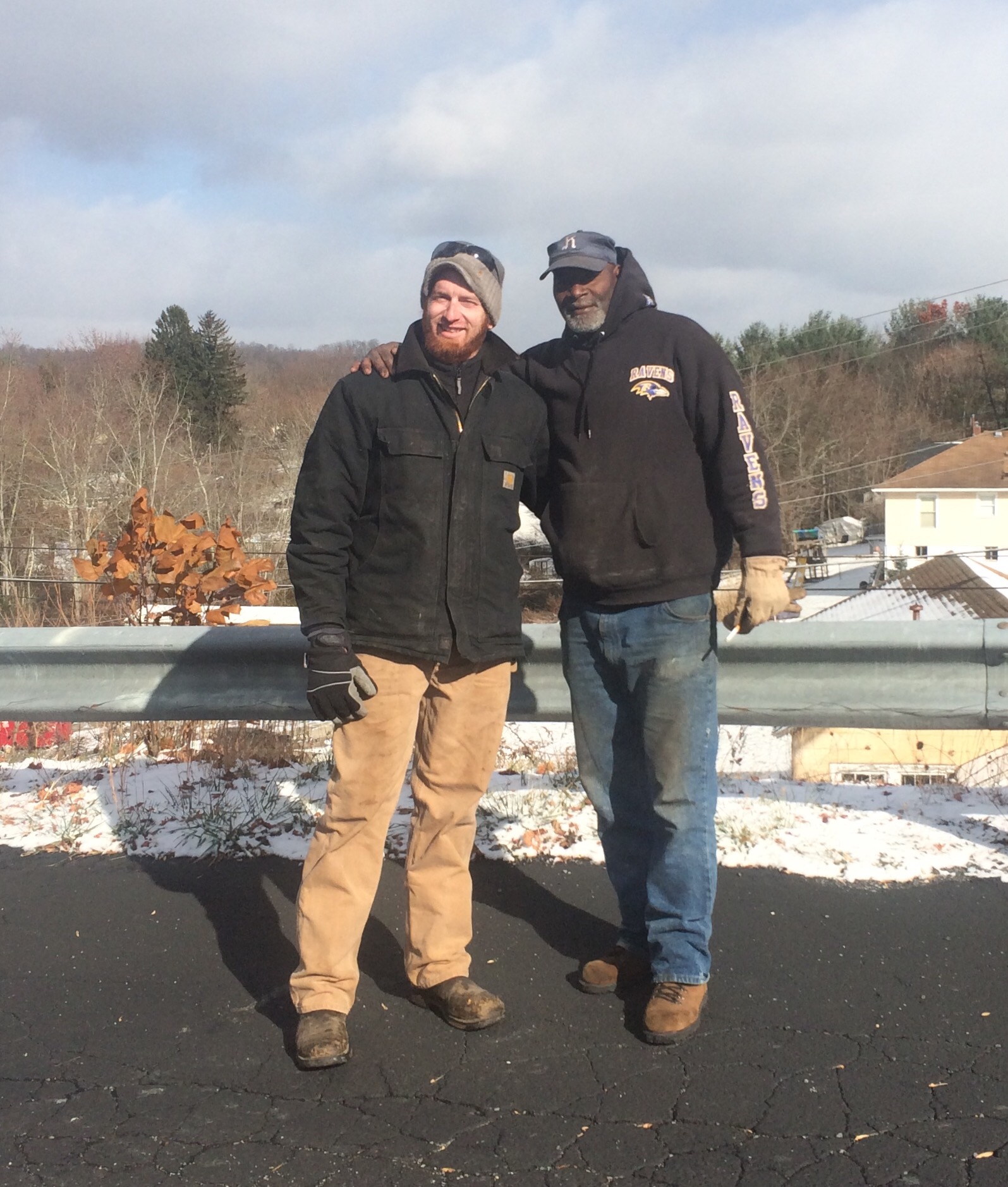
Alan is a gentleman I have worked with. I call him Mr. Al.  Here is a picture of us in West Virginia:

…it was cold…

He’s a fifty-five year-old African American man, ex-marine, and one of the most profound people I’ve met.  He’s fixed my car, dropped some serious lessons on me, and made me laugh till I cried.  He’s also stubborn as shit.  We did quite a few jobs together…and sometimes we would end up screaming at each other.  I couldn’t tell you what about.  Maybe it was my forklift driving or maybe he wasn’t moving fast enough for my liking or something else that really wasn’t all that important.

After we had screamed at each other and finished whatever nightmare job we were on, I’d usually buy him a cheeseburger.  Because I’m stubborn, even in my love for this man.

This is the lesson of the Mule.  Rooted, but in an earthy way and ultimately coming from a place of love.

I find resistance to be the negative side of things.  That thing you feel when you know what you need to do but don’t do it?  That is resistance and it can be sticky and awful.  To get through that I often need to look at what’s beneath that.  Oftentimes it may be fear of failure, feelings of not being good enough, or any number of things.  Things of the smaller self.  To get through this I usually imagine the small self being held by my larger self, usually a very large tree.  It doesn’t work all the time because life can be overwhelming.  When it does work it is quite liberating.

 Sometimes you need to dig into your being.  So I put a sharp foot on the profile of the Mule to do just that….Slowly to the left….    slowly to the right…  Hardening the foot as well as the blade  Hardened up nicely she did…  Wet sanding… For the handle I used Cherry wood.  In Celtic lore, Cherry is the Tree of the Heart. She sits and cures…  Brass rivets and a lovely grain…


I left some of the scuffing.  The stuff of character…  She’s been through a journey.  I fancy a bit of the singed oil smduge…  

10014928_10102577420615476_1305789096652702656_o

The lesson of the mule is to take heart in your stubbornness, and to let go of resistance.  Both of these things will always be continuing works in progress, at least for me.

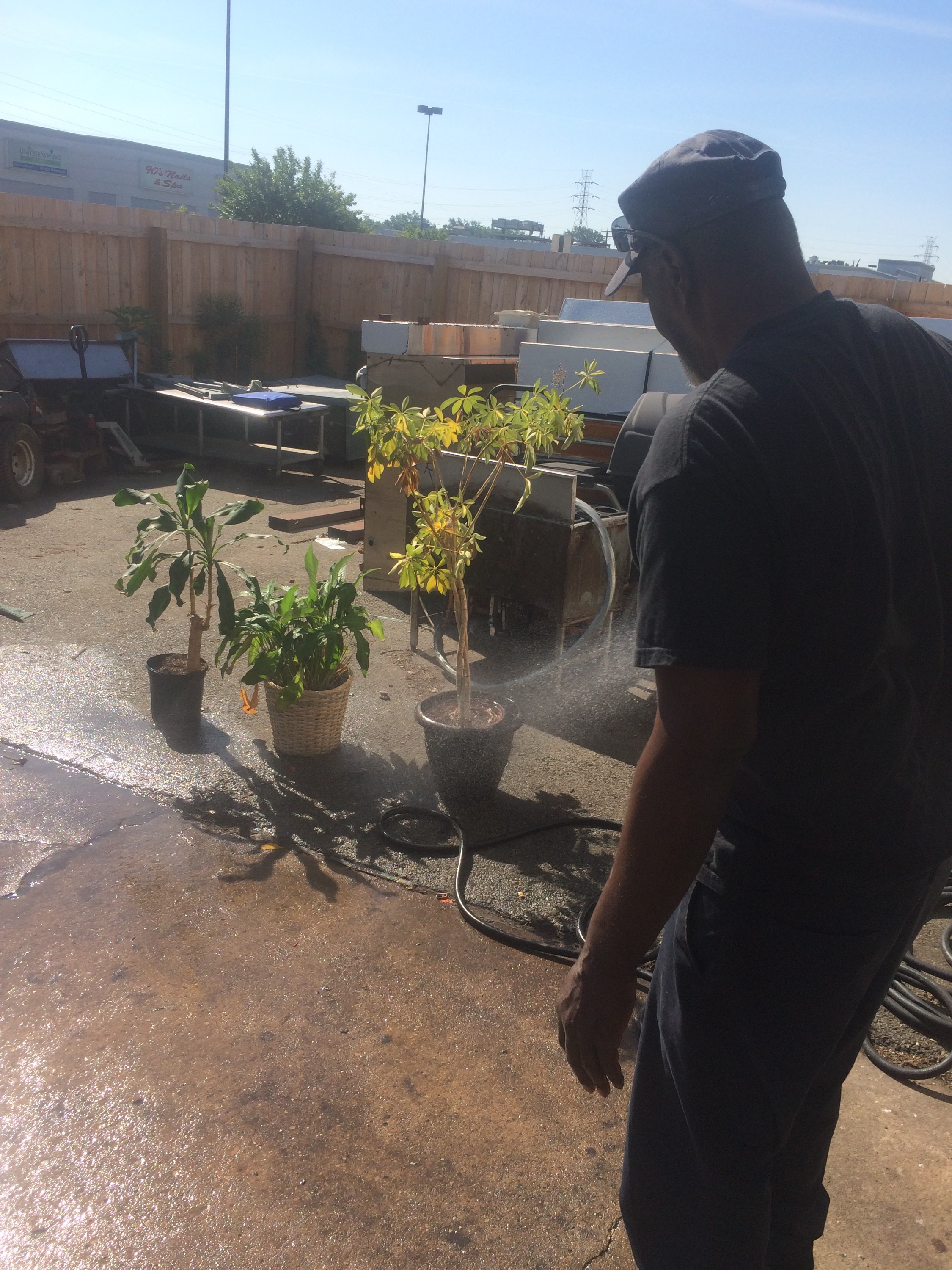
Here is a picture of Mr. Al watering his plants;


Knifemaking: finding your home, braving the elements, and the Northerner

“A farm of your own is better, even if small. Everyone’s someone at home.”

Hávamálst. 36

Home is what you make it.  The first thing I do when I go into anybody’s home is notice how it smells.  There are many things that can be inferred this way.  It may smell of cooking and spices, a fireplace, clean linens, pets, Murphy’s oil soap, and the people who live there.  All these things are things of love, cultivated in a place where the person who lives there can just come and be.  It’s a safe place where we can take off whatever armor we may wear during the day.  It’s a refuge that shields us from the elements in our lives.

Some brave harsher elements than others.  And in the times we live in, the elements are no longer relegated to heavy rains, freezing blizzards, or lands parched with drought.  They are deadlines for work, the threat of unemployment, passive-aggressive emails, fruitless battles with the DMV, quarterly tax estimations, health insurance premiums, our police executing citizens without arrest or trial, politicians stripping us of our civil liberties and thousands of other things we have little control over.

This can send our stress through the roof and it’s a small wonder.  From an evolutionary standpoint our reactions to stressors were designed to help keep us safe and alive.  You see a bear, you react appropriately by stressing out hard and in turn releasing enough adrenaline to haul ass out of that situation. Then you calm down, throw some logs on the fire and snuggle up with the misses.  Or the mister.  But these days unrelenting stress can lead to unhealthy anxiety and this in turn often leads to depression, ultimately leading to feelings of being stuck and health issues.  Depression and anxiety have their evolutionary purposes but I feel their effects been blown way out of proportion by the amount stimulation and unnecessary stress in today’s world.

This is why it’s important to have a home.  A place where the elements won’t creep in.  This may take some work.  An inspiration for me is John Wemmick from Dickens’ Great Expectations.  He has an unpleasant job, deals with many stressors but goes home to his castle, a safe and gentle refuge he has built for himself.
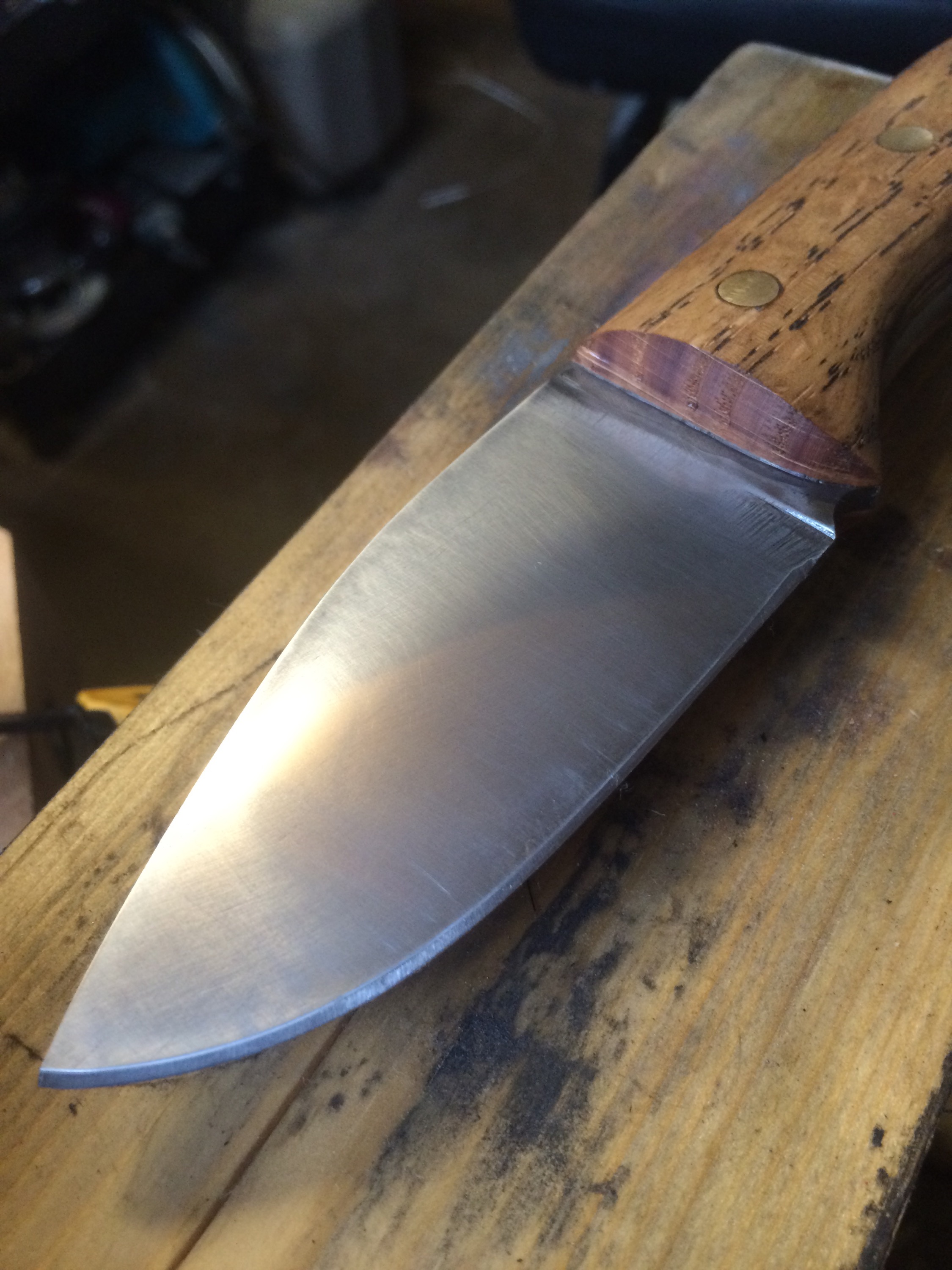
Throughout history and literature the people from the northern areas are by nature a people more hardened to the elements.  They are a people capable of great acceptance, aware that they can’t change the elements but instead find a way to thrive within them.  That is the inspiration for this blade.

I had to do a bit of research on blade shapes and functions.  I wanted to make something that would aid a modern day Northerner in his outdoor tasks.  This blade is loosely based on a composite of bushcraft designs.  It is a drop point blade with a partial saber grind.  I tried to find a balance between having a deep enough belly for slicing and having enough of a point for effective piercing.  I am rather fond of the O1 tool steel.  It is relatively easy to work with and hardens up beautifully.  it takes a keen edge and is forgiving of my mistakes.

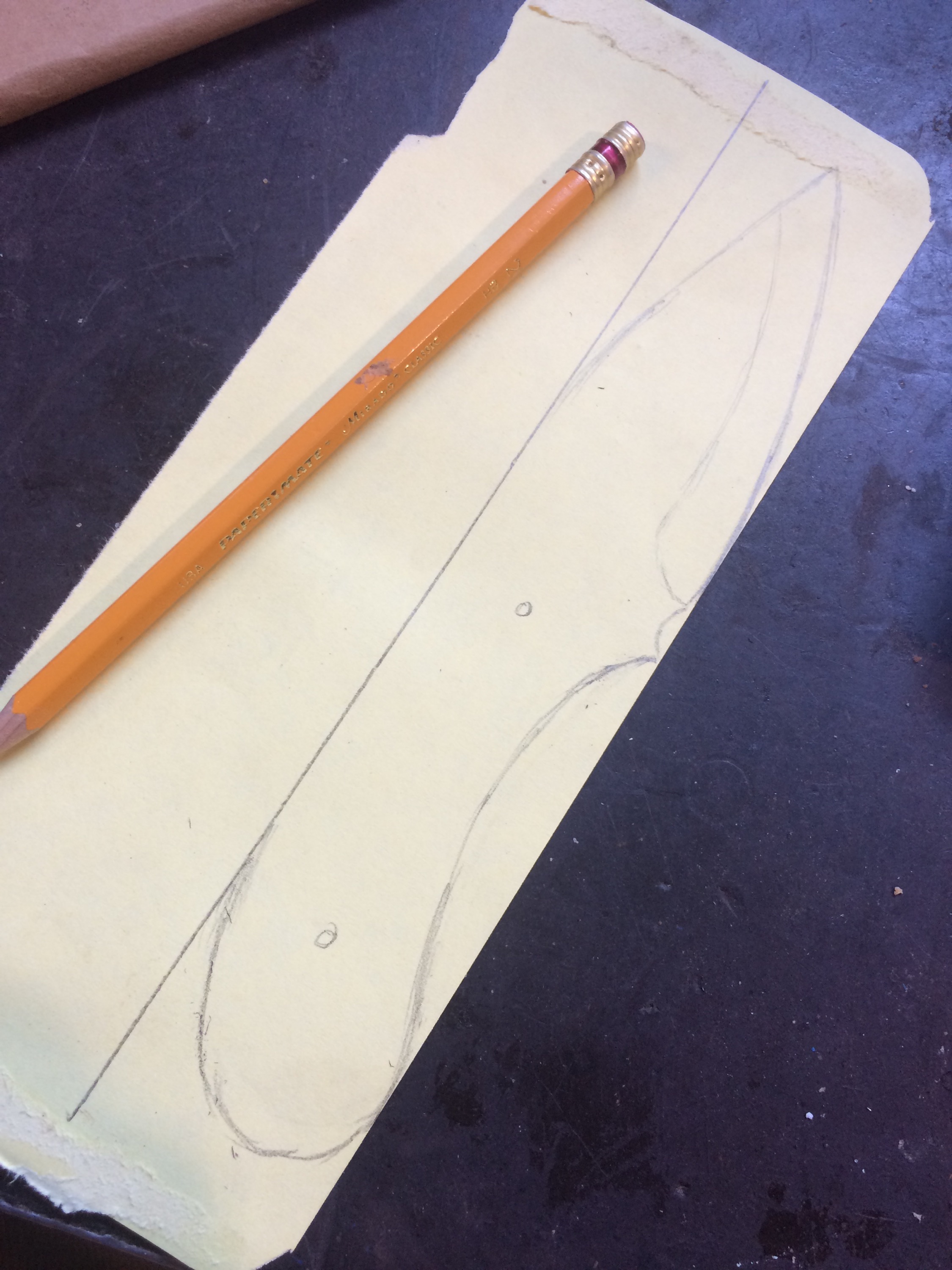
 Cut and profiled

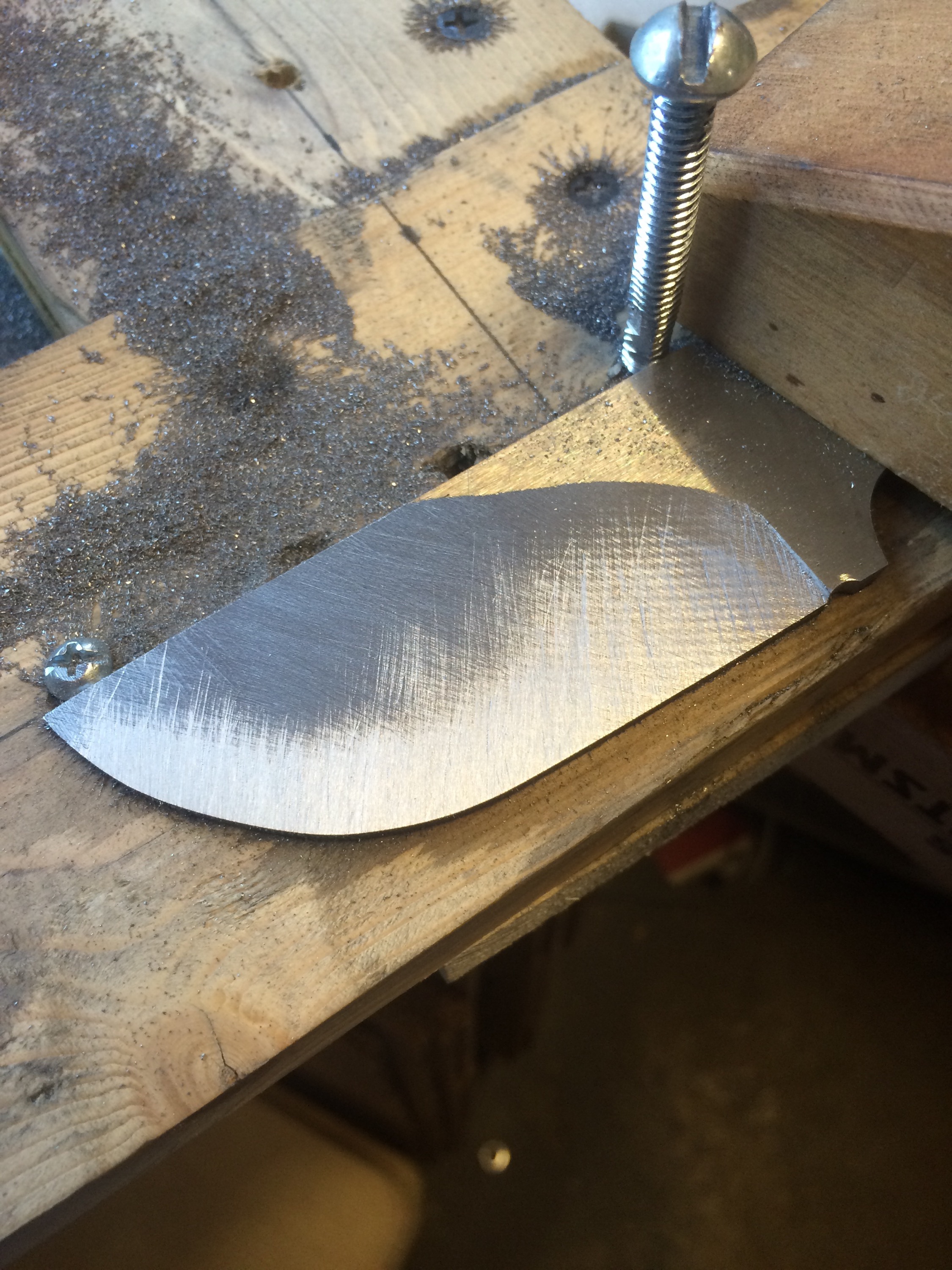
And the grind.  A little bit at a time… 


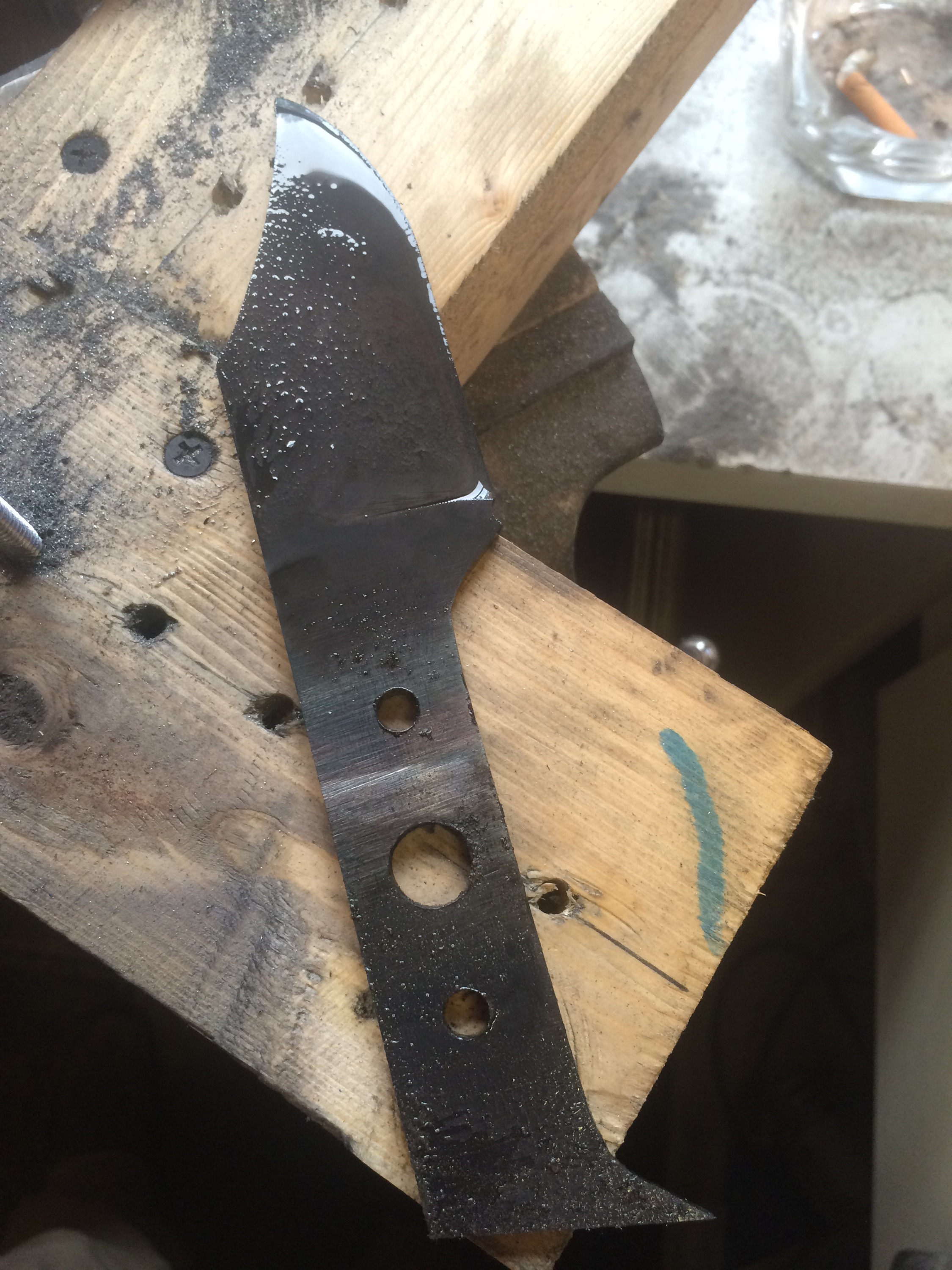
Ground and sanded.  The larger holes help to lighten the blade. 

Wet sanding after heat treat.  I have been using WD-40.  It won’t rust and I find it gives a smoother finish. 

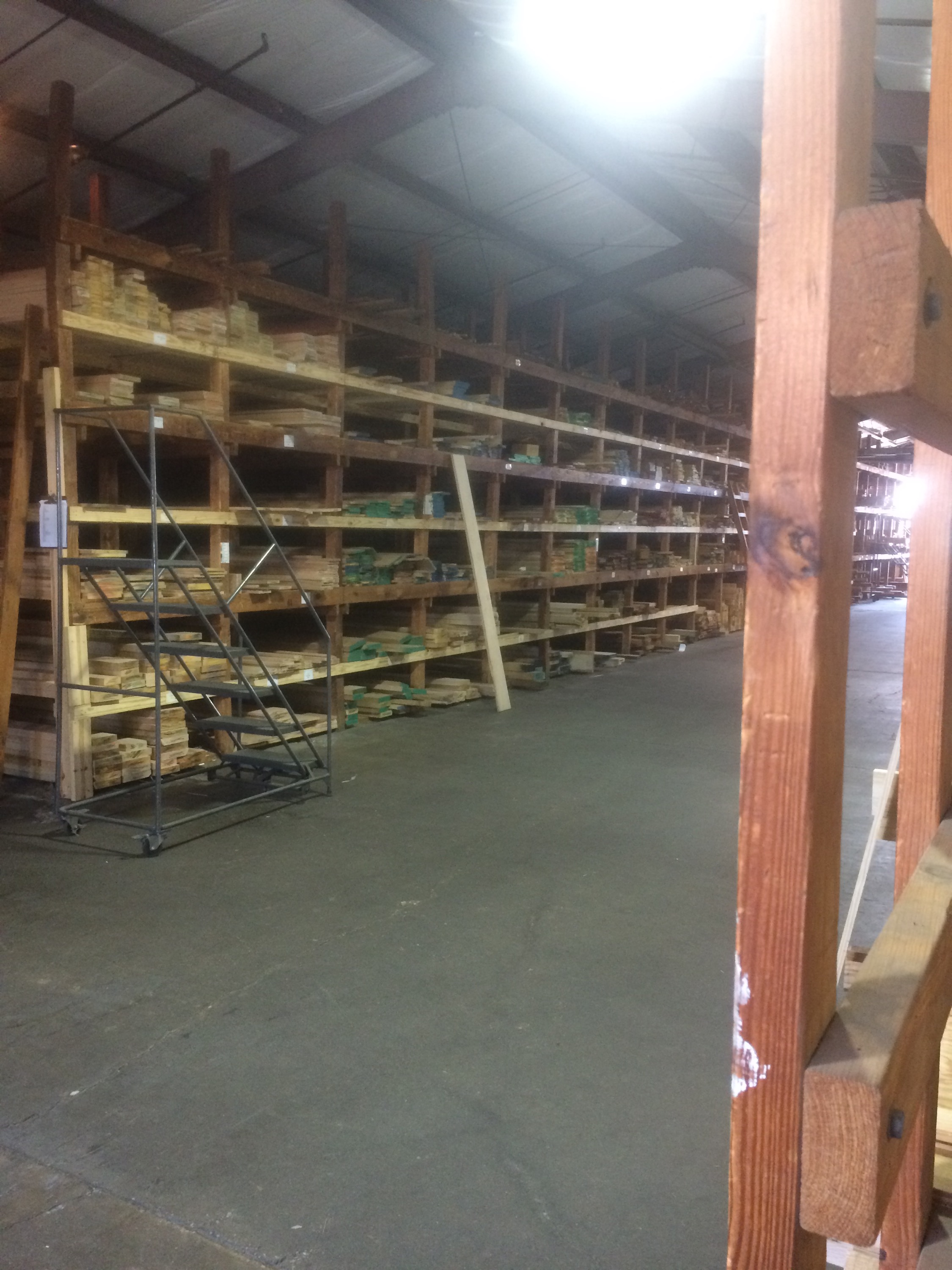
I went to a lumber mill to try to find some more exotic wood.  It was awesome. 

I found a beautiful piece of quarter sawn white oak.  It is sawn in such a way that gives it more stability and shows the grain more beautifully.  Here is a lovely video on the process and how it affects the grain.
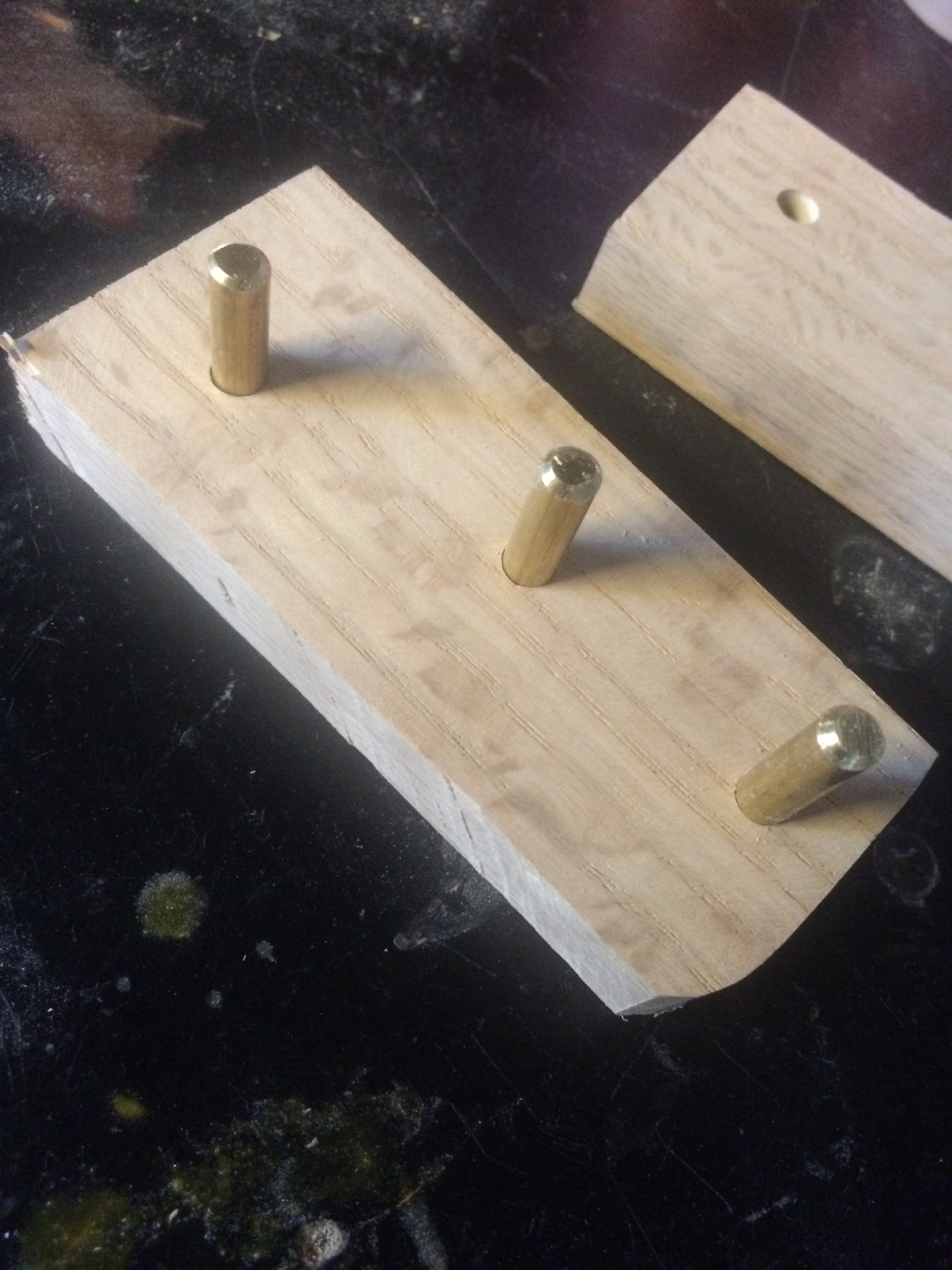
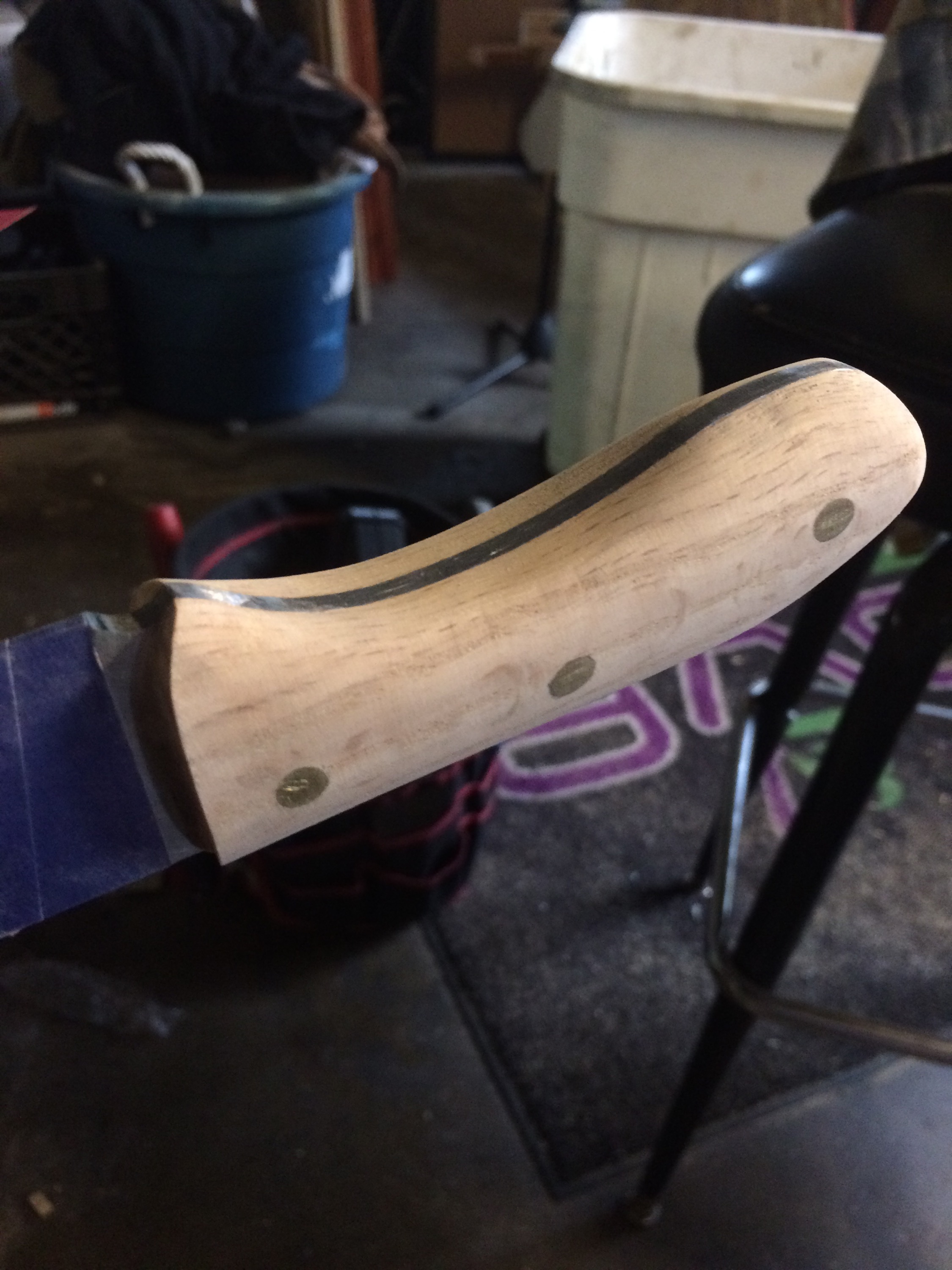
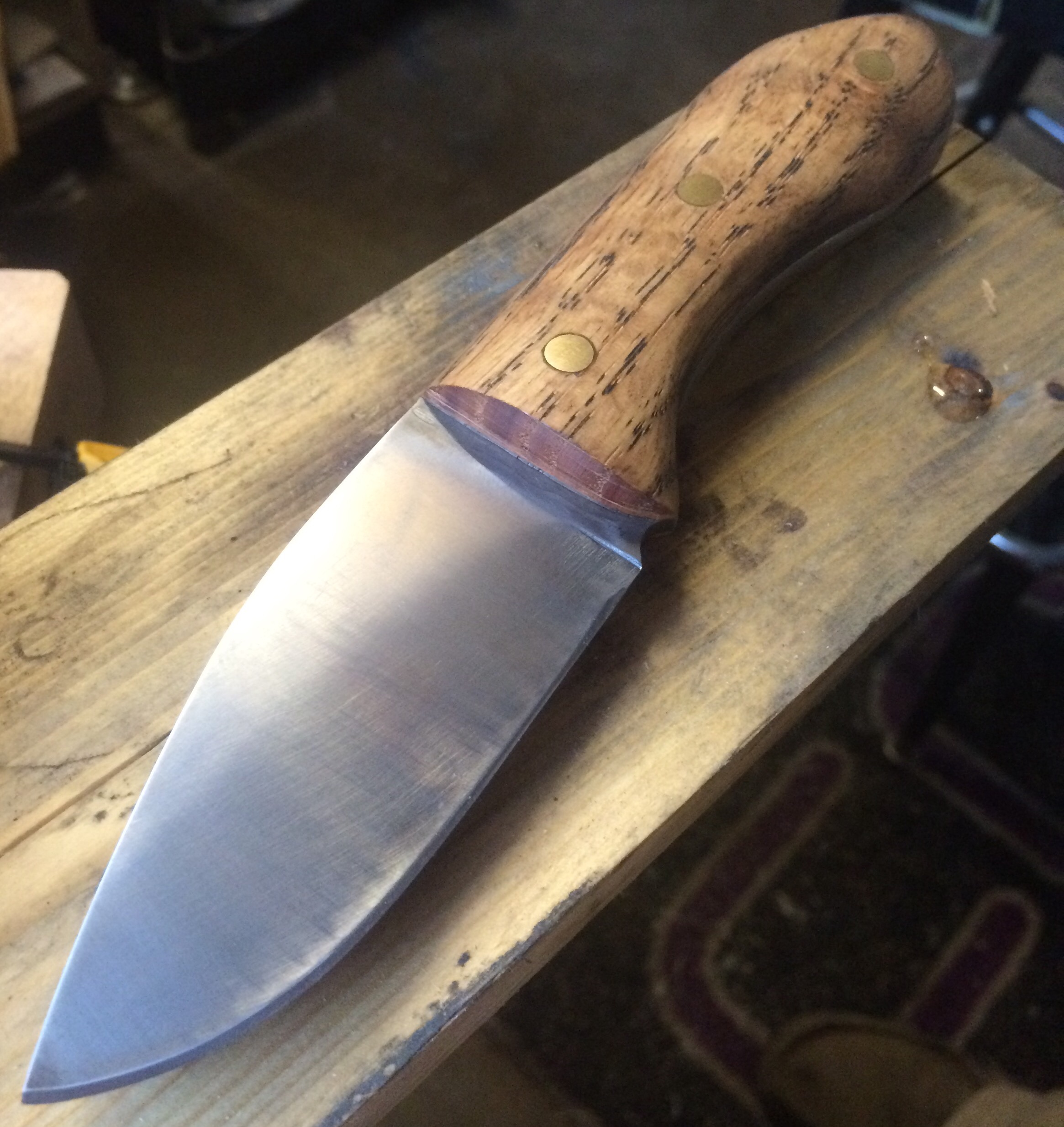
Handle work: brass rivets that I bevelled and the oak shaped and rough sanded.     After much more sanding….  A dark shade of Danish oil

  The Northerner

The grain is stunning.
  A fabulous backside is always a bonus….

Edge detail….

There will always be things in our life that will challenge us and create stress.  As long as we have a place we can go, whether bricks or mortar or built within ourselves, we will always be able to brave the elements.  This is the lesson of the Northerner.

Knifemaking: being content, releasing, and the Minimalist

“Elegance is achieved when all that is superfluous has been discarded and the human being discovers simplicity and concentration: the simpler and more sober the posture, the more beautiful it will be.”

Paulo Coelho, Manuscript Found in Accra

Originally, I wanted to call this blade The Monk.  When I see images or videos of Buddhist monks, or anyone living in a monastic setting, I used to wonder how they survive on so little.  Recently it was explained to me that they aren’t choosing a life of poverty.  They are choosing a life of contentment.  The idea as I’ve come to understand it is that they have enough and this brings contentment.  Enough, but in a gentle and satisfactory way.  This is pretty much counter to most of the ideas of what we are taught about being successful in Western society.

That was the inspiration for this blade.  Something simple.  Enough.  Content to just be.

There is an elegance in the simple.  Simple is difficult to pull off well.  Think of the best things.  Bach is simple but by no means easy to perform and certainly not lacking in beauty or depth.  Then there is steak- the best steak needs nothing but salt, pepper and a hot grill.  The list can go on.

This is where the beauty is.  An idea or tool or work of art or meal that has everything it needs and nothing it doesn’t.

There is a practice in many Buddhist temples that consists of tidying and cleaning.  It is believed that a tidy workspace helps with concentration.  There are books on the matter of getting rid of clutter.  Behind this is the idea that when we release the material things that are no longer serving us it will follow that we also release the emotional things that hold us back from being our naturally vibrant selves.

Ultimately I find this blade to be a reflection of how I desire to be.  In a way I am this blade.  As I was slowly removing the things that ultimately didn’t serve the purpose, function, being, beauty or existence of this knife I thought of the things that don’t serve me that I desire to release.  Like the grinding of this blade, release doesn’t happen all at once and if I tried to do it all at once I would be an overwhelmed, anxious, and contracted human being.  I’ve been there.  I think we all have.  Breathe deeply and appreciate how beautiful the simplicity of something can be.

I started this blade with a bit of O1 tool steel stock:

I wanted to make something simple and functional and beautiful.  This is what I came up with:


And a flat grind…


In keeping with the idea of not having anything unnecessary, I removed some of the stock in the handle.  It also makes it lighter.  Here he is after filing and sanding….


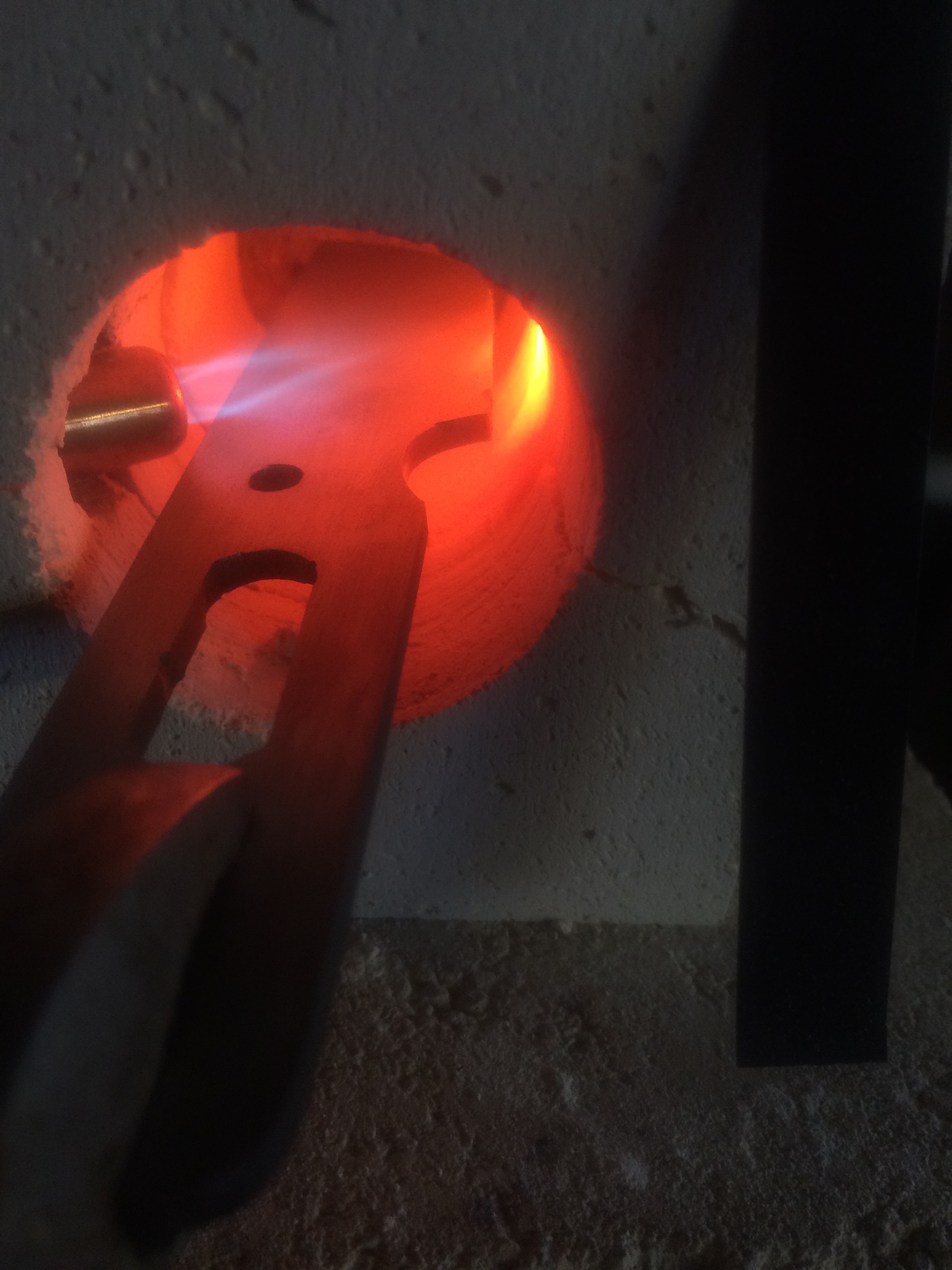
Hardening and tempering.  It took some tries but I got a forge built that gets plenty hot: the Brigid Marsal 3.0…


And after a dunk in some warm cooking oil…


He cleans up nice:


So for the handle I went back to the idea of the monk- enough clothes to keep you warm and decent, a safe place to sleep, and enough to eat.  Having just enough to help you really feel your inner being.  I found a dough proofing board used by bakers.  I made the handle out of that, one’s proverbial daily bread.  A simple coat of Danish Oil protects the handle and brings out it’s beauty.


 And the secondary bevel…

Handle detail.  So much love…. 

As I learn and grow, I find that some of the things I thought I needed aren’t serving me.  It’s ok to release these things.  This is the lesson of the Minimalist.