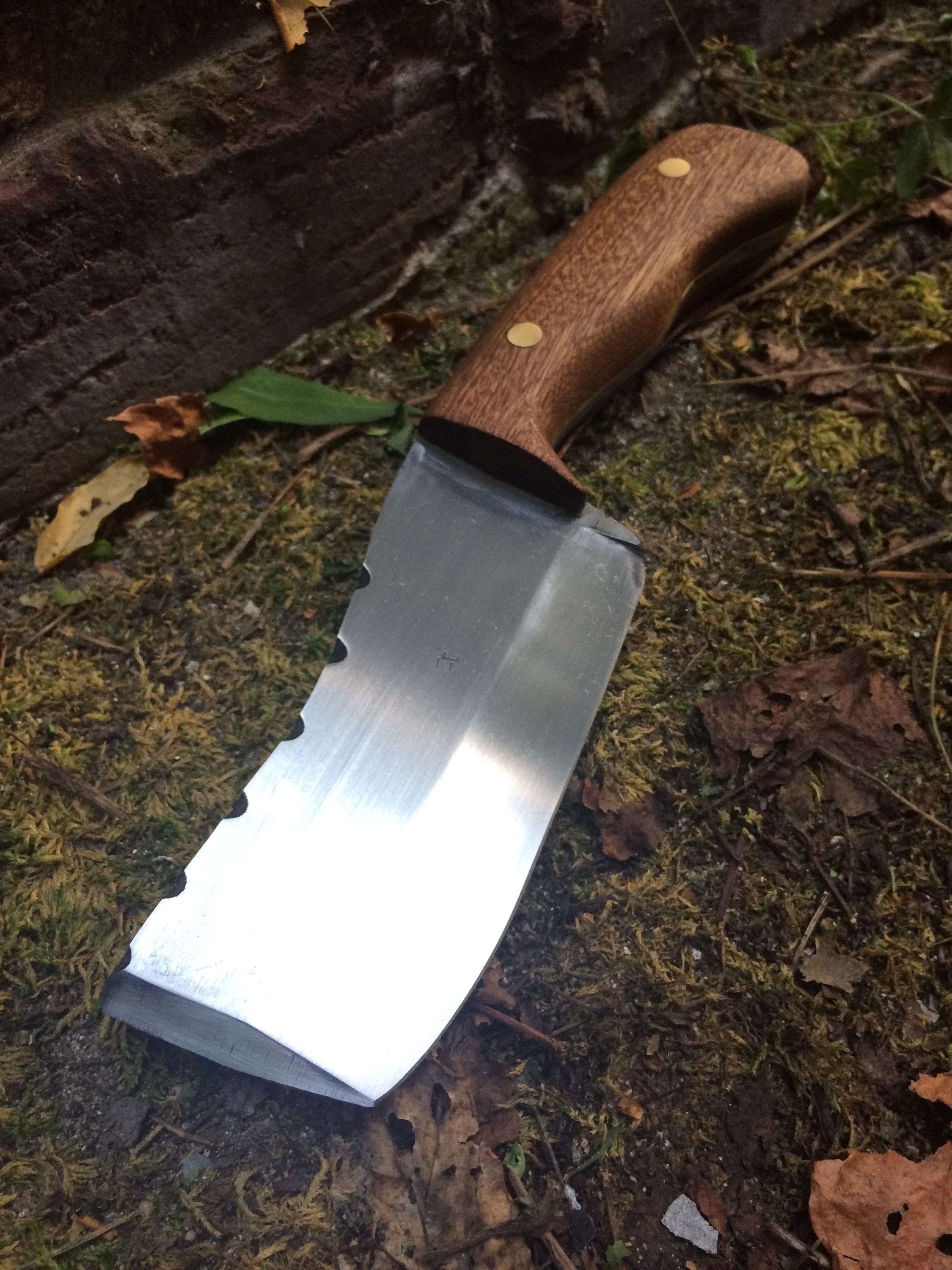
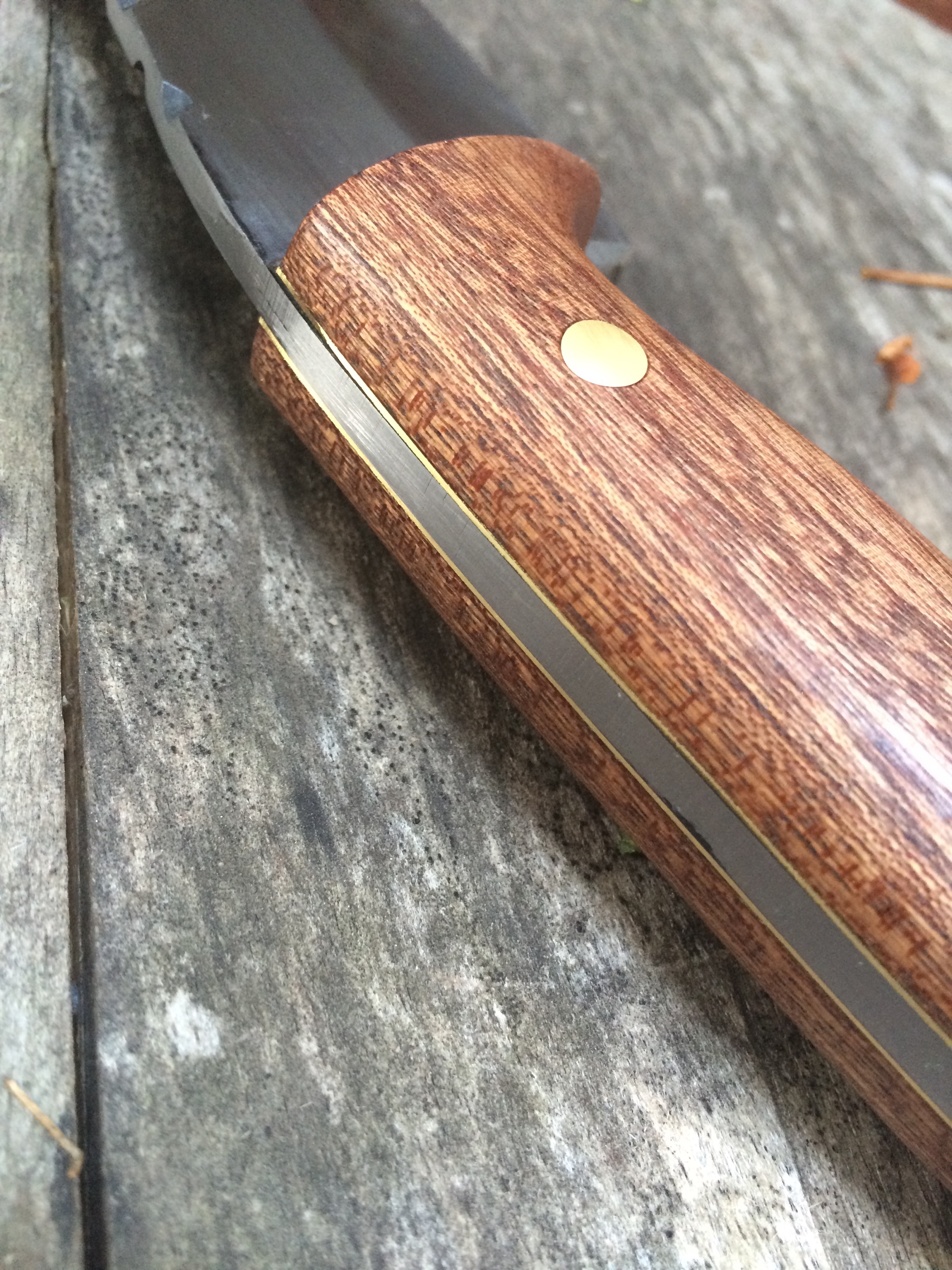
Knifemaking: a little bit at a time and the Scout

“Ready or not
I hear a clock tock ticking away
Though I’d asked for those hands to stay in place”

Correatown- “Everything, All at Once”

I wake up most mornings and wonder how I am going to get everything done.  I think about all the things I need to do, the things I want to do, and feel a little bit of shame over the things I’ve been meaning to do but haven’t done yet.  There is this mental space where I run through my entire life- where I’m born, I live, and I die, all before I even get out of bed.

At the bottom of all of the mental chatter there is a gentle little voice that says to do it a little bit at a time.  It also says that there is plenty of time.  Sometimes it gets drowned out but I know it’s there if I listen for it.  This is what gets me going.

For the past ten or so years I’ve taken walks in the woods.  As things get busier I don’t get out there as often as I’d like.  It’s an exercise in not trying to do everything all at once.  You walk the woods a little bit at a time, and the notion of trying to do anything other than that feels rather asinine.  I try to approach the things I have to do in this fashion.  It doesn’t always work and I get frustrated a lot.  A lot.  Sometimes the feeling of there not being enough time screams at me so loudly that I have to go home and take a nap.  Most times I’m not able to do that, in which case I try to take it back to the forest.  In being with that feeling I find that there usually is enough time.  If not, I try to remember that I am human being and not a human doing.

Attempting to do everything all at once is a sort of self-defeating behavior.  This type of all-or-nothing thinking tends to overwhelm and makes the idea of quitting into a rather attractive proposition.  Buying into this thinking gets you regret and remorse, but only after it has robbed you of your precious moments and there literally isn’t enough time.

This is the lesson of the Scout.  To walk your forest one step at a time.  It’s easy to get pulled off your path.  There are a thousand things that demand our attention and can pull us off of our center.  We can’t always give what we love the attention and care we would like and sometimes it’s easier to give up.  Don’t give up.  Do it a little bit at a time and it will all get done.

I wanted to make something that reminded me of this little area where I like to walk:

IMG_3400.JPG

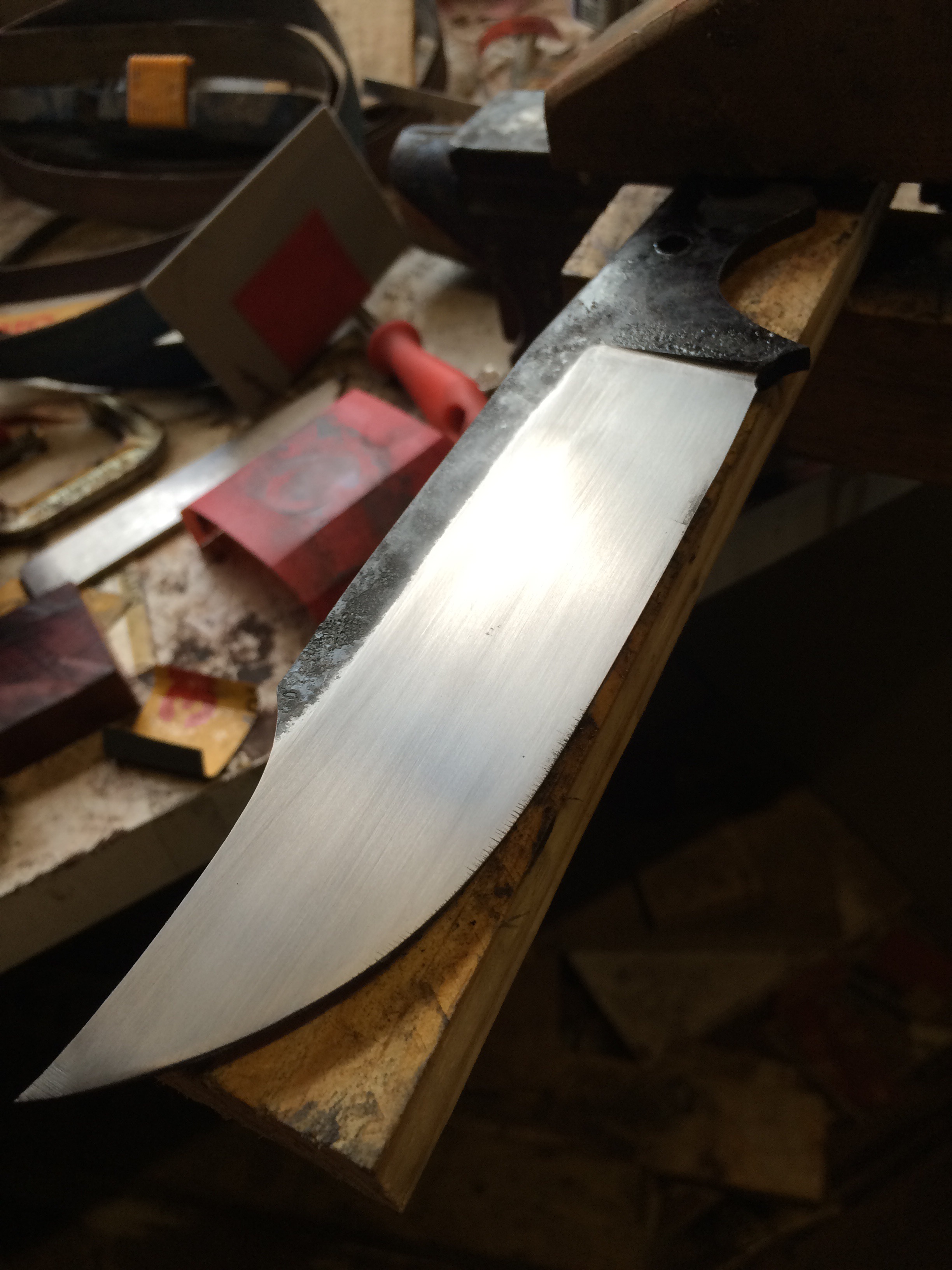
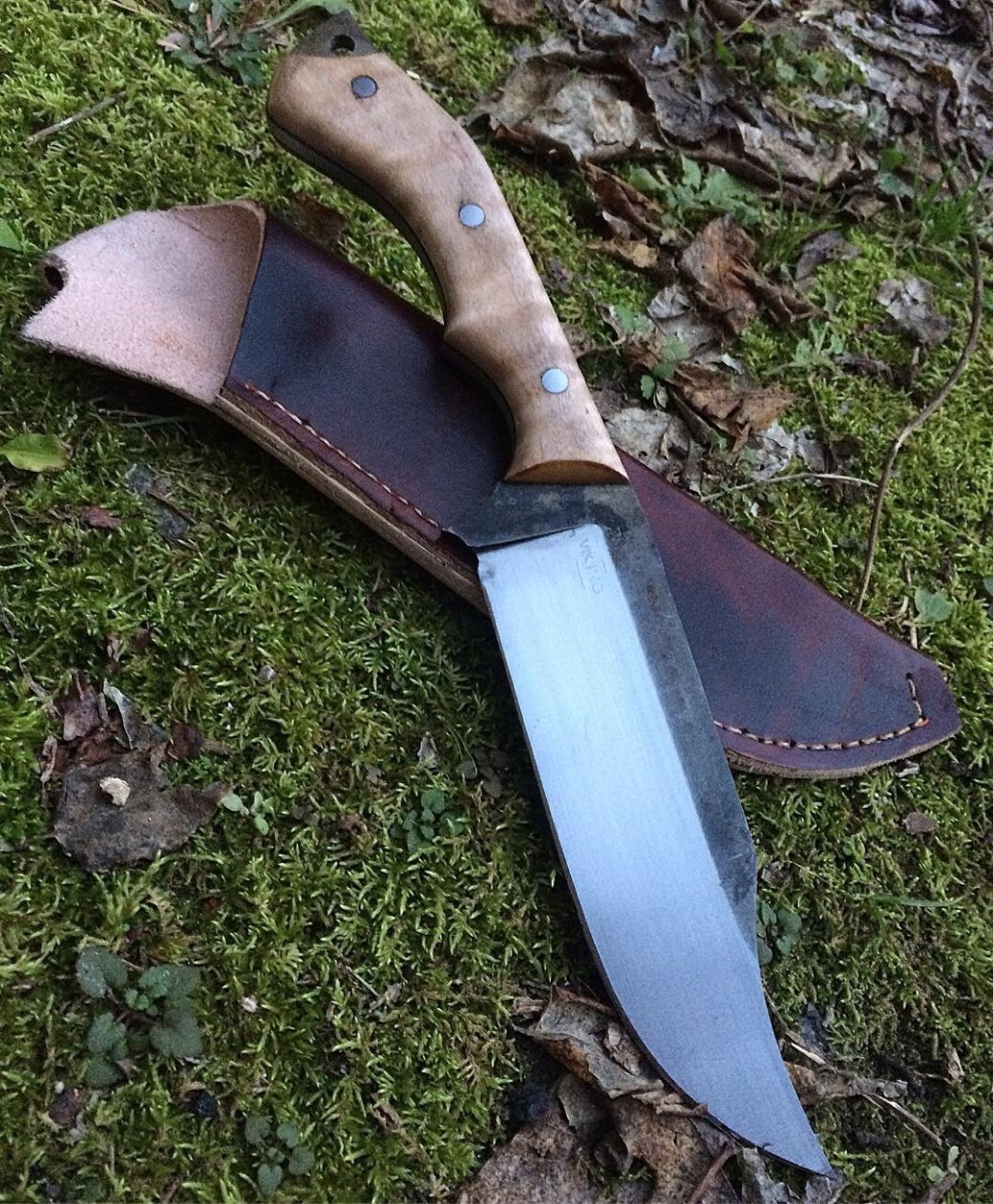
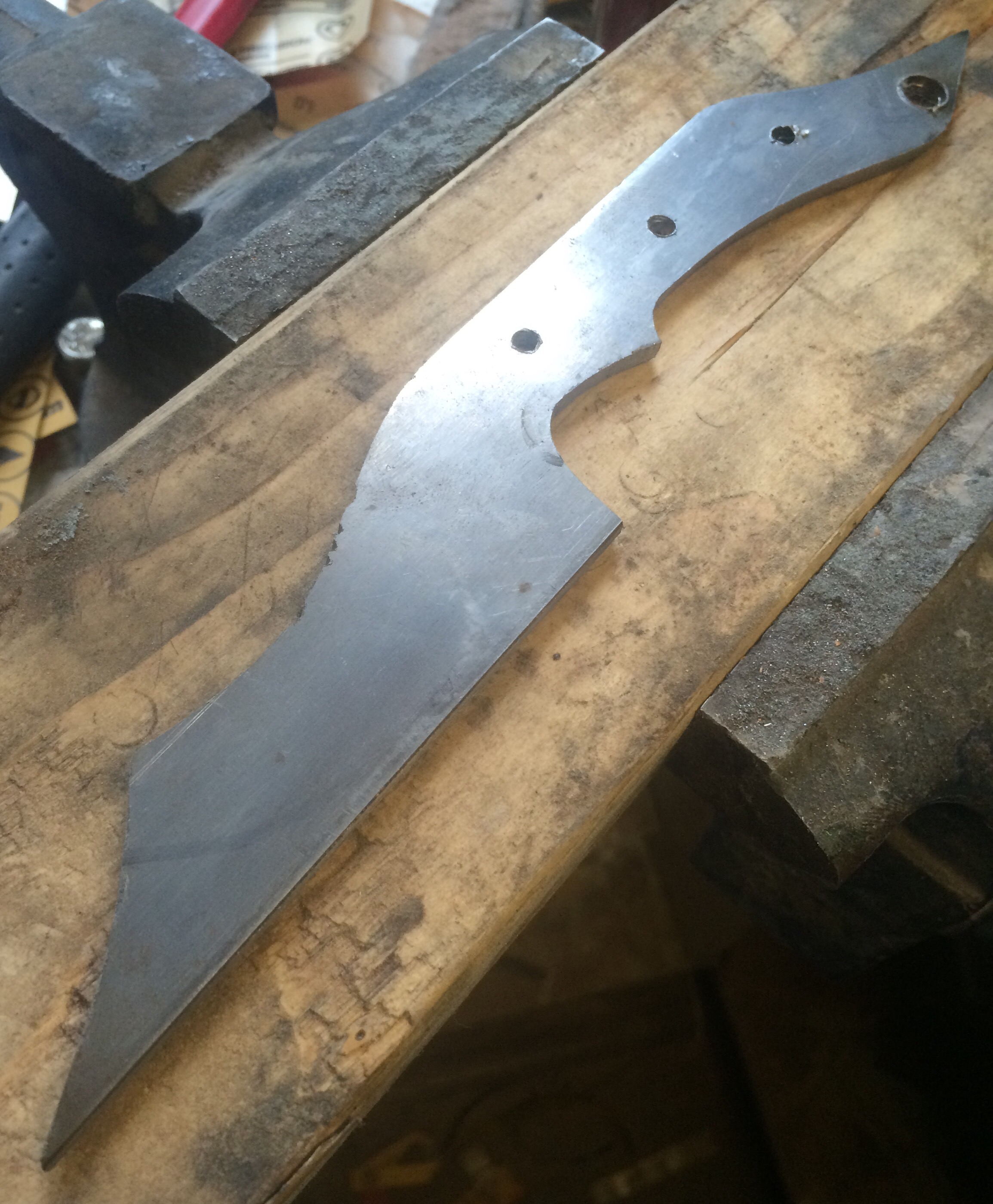
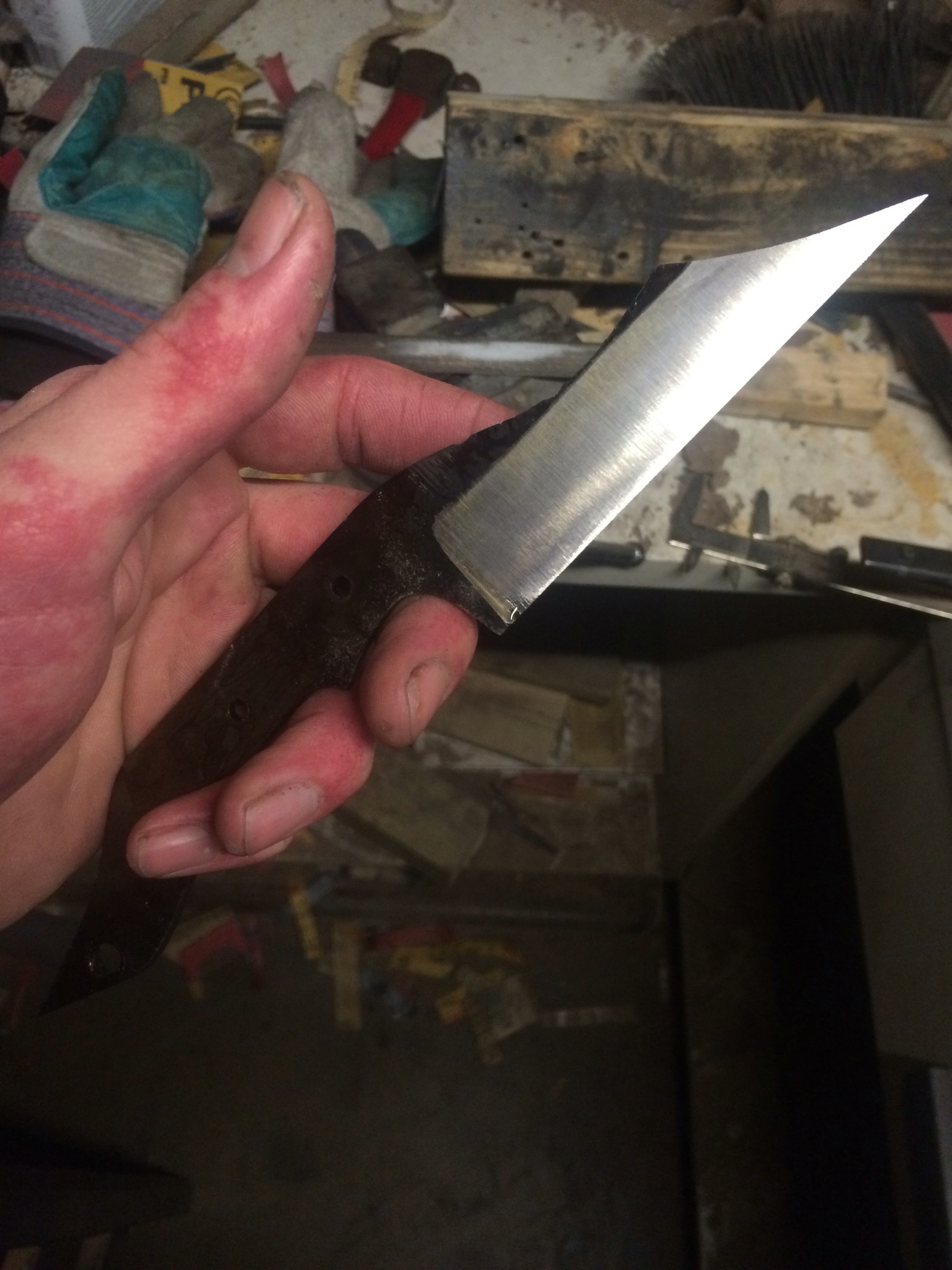
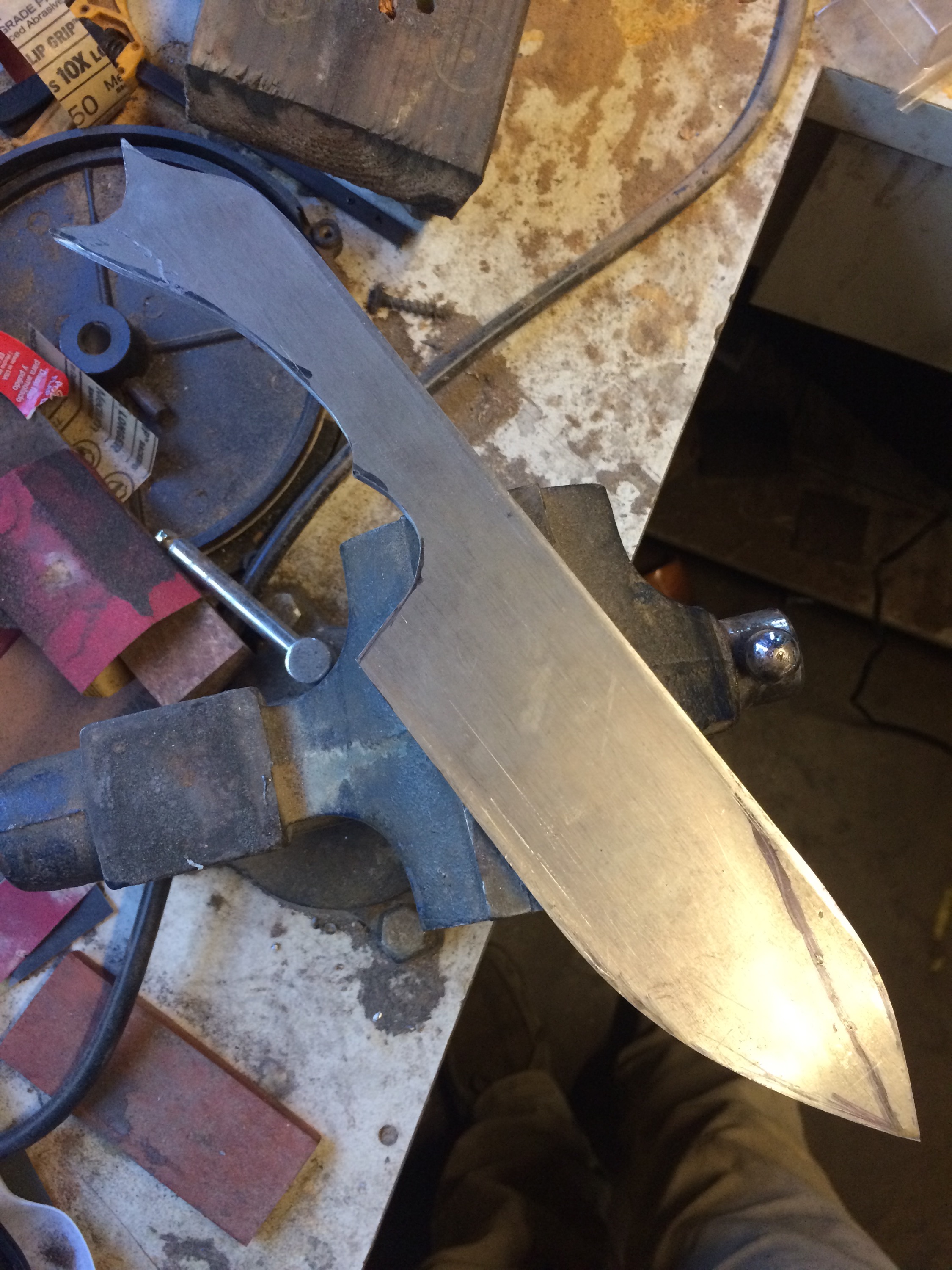
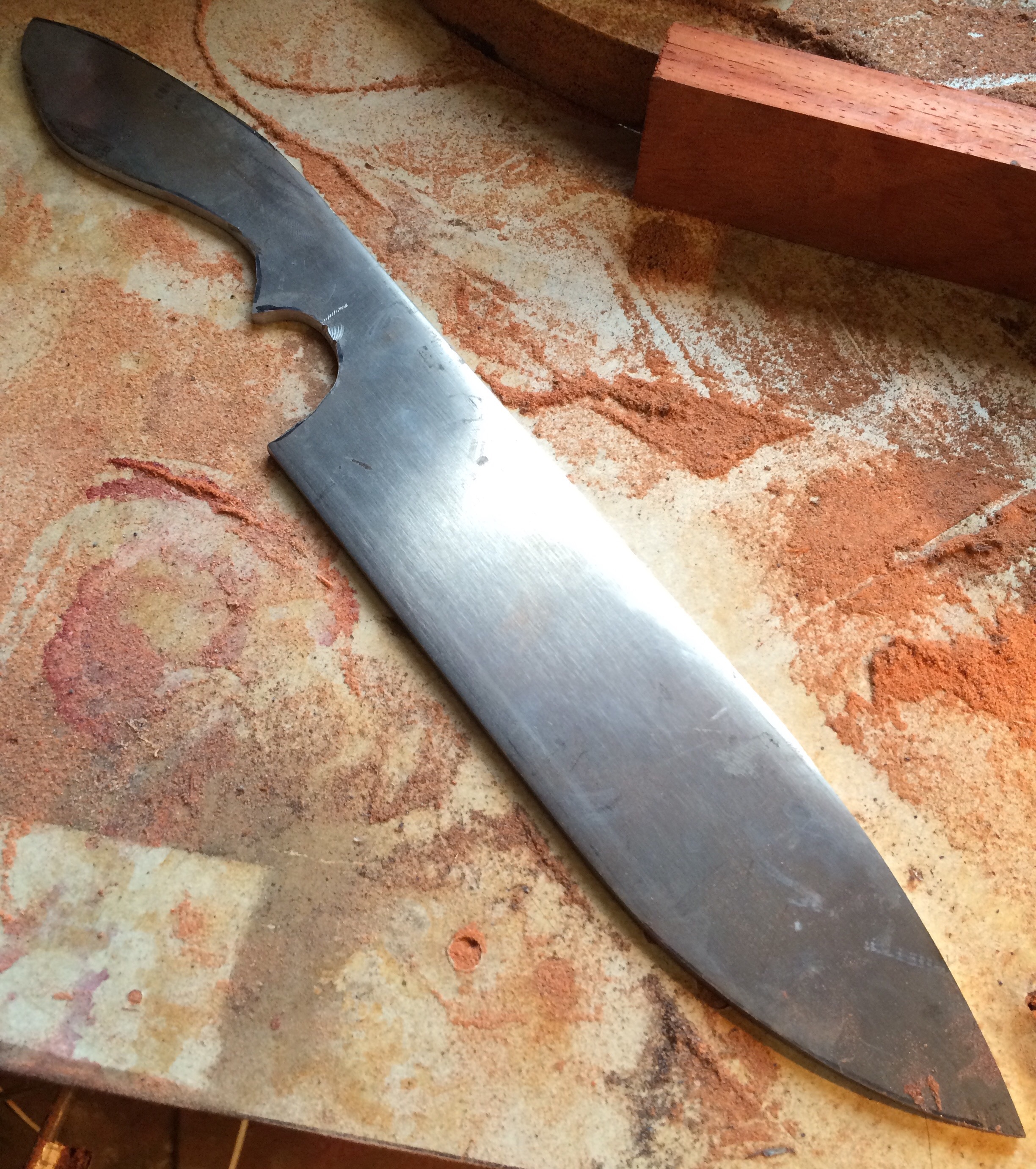
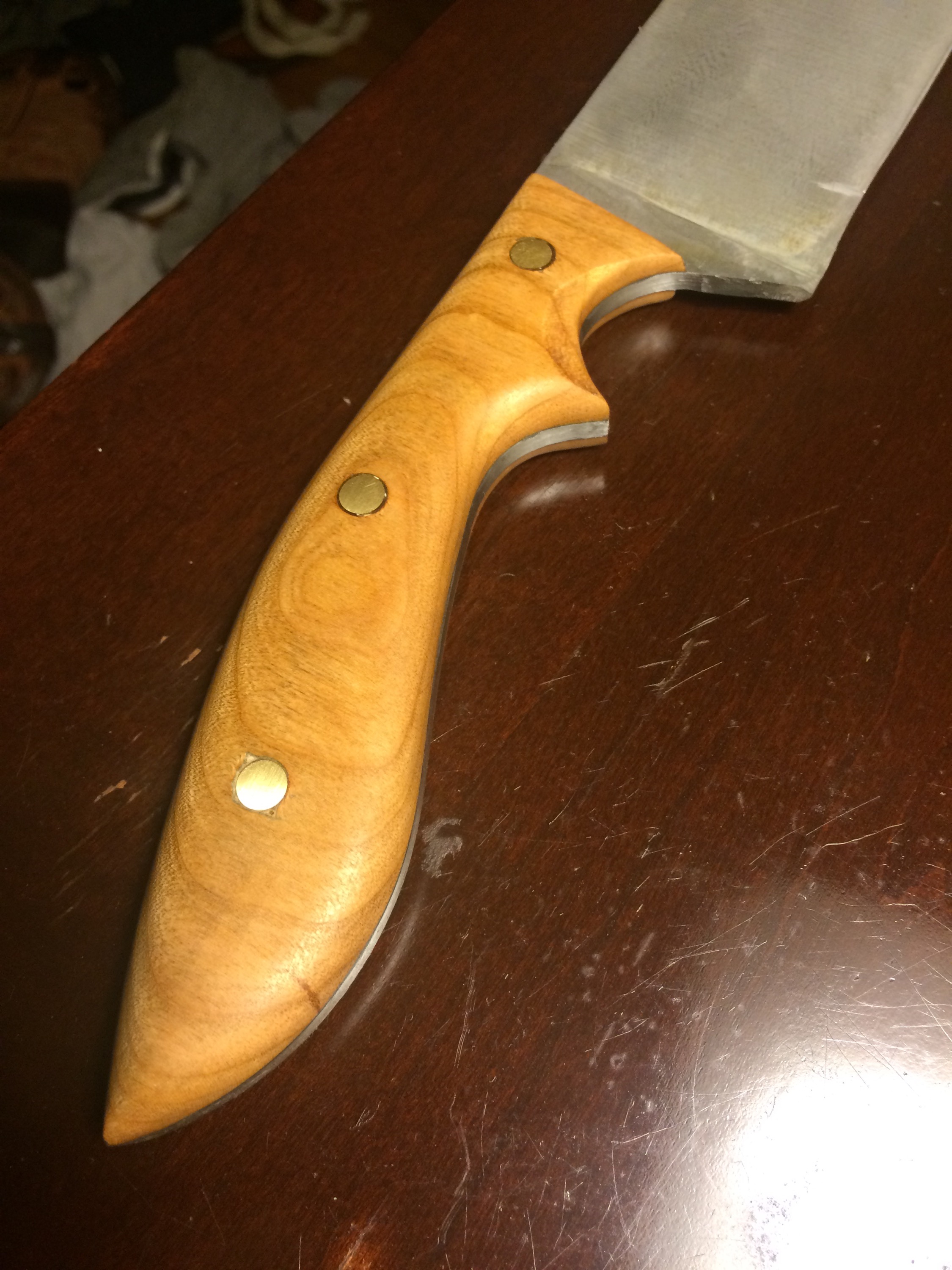
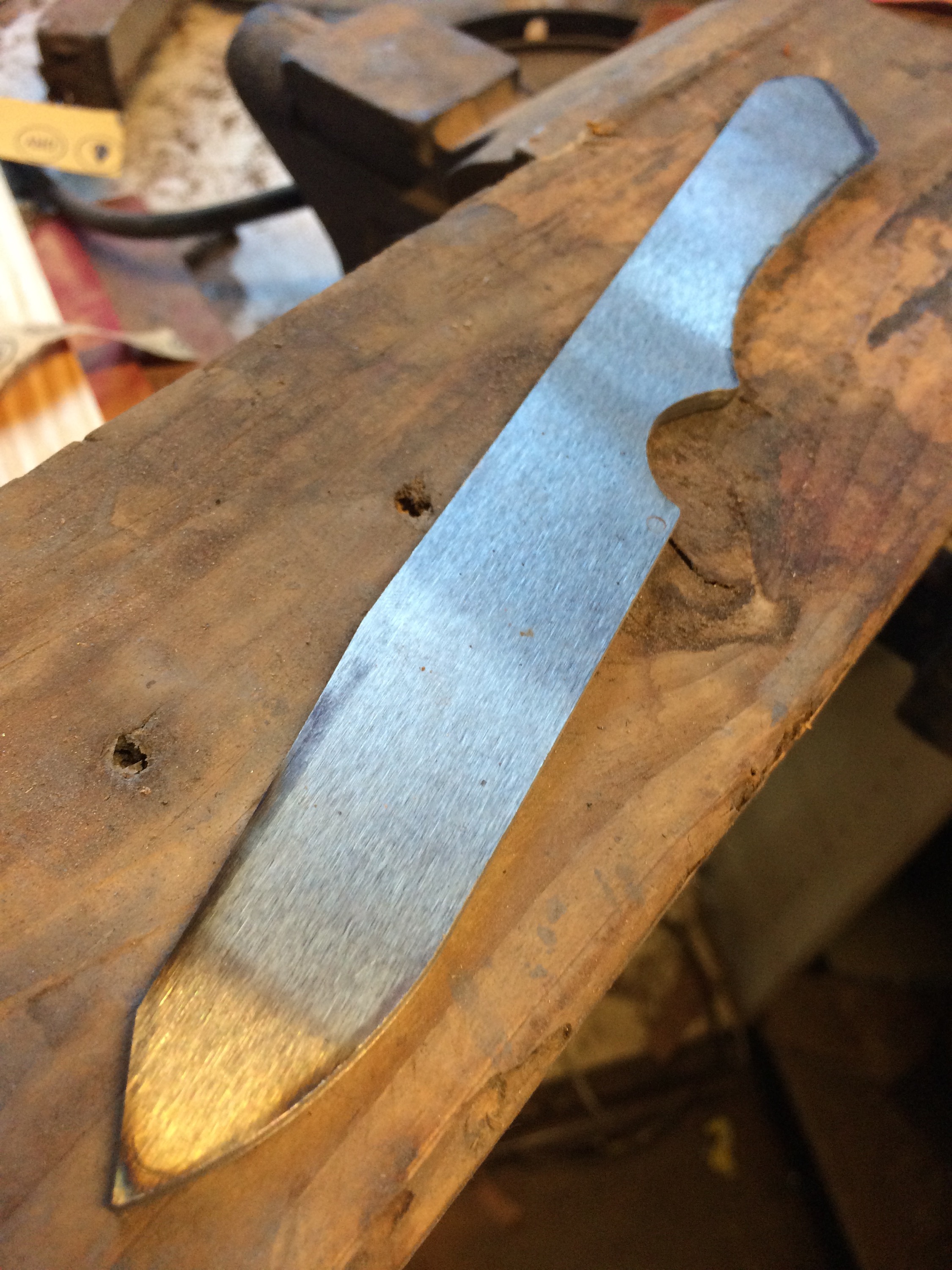
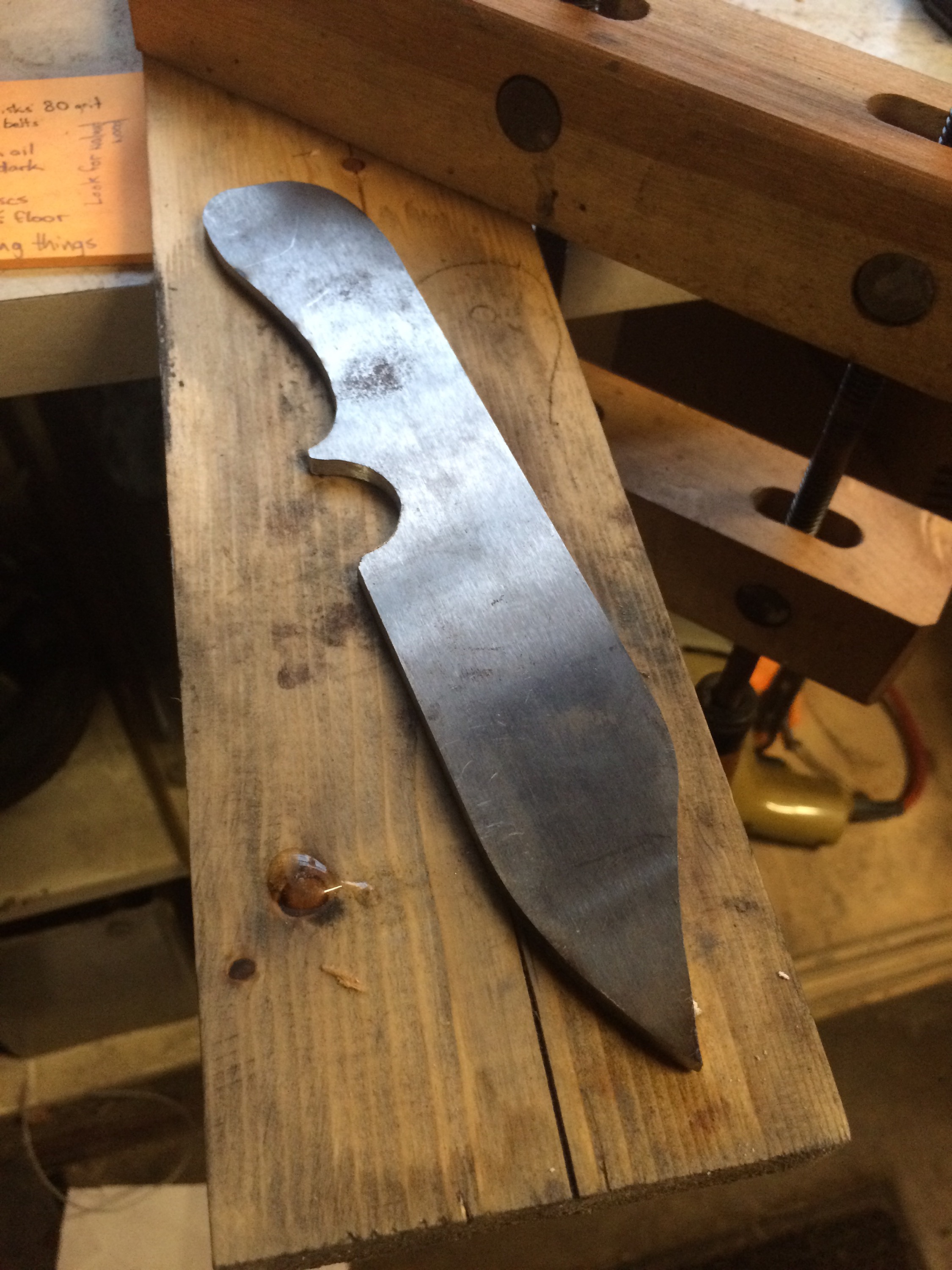
I started with O1 tool steel and bushcraft style design with a handle that winds like the stream above.  I usually use 1095 because it’s cheap and I have a lot of it but I like using O1 for the Chromium in it- it polishes up nicely

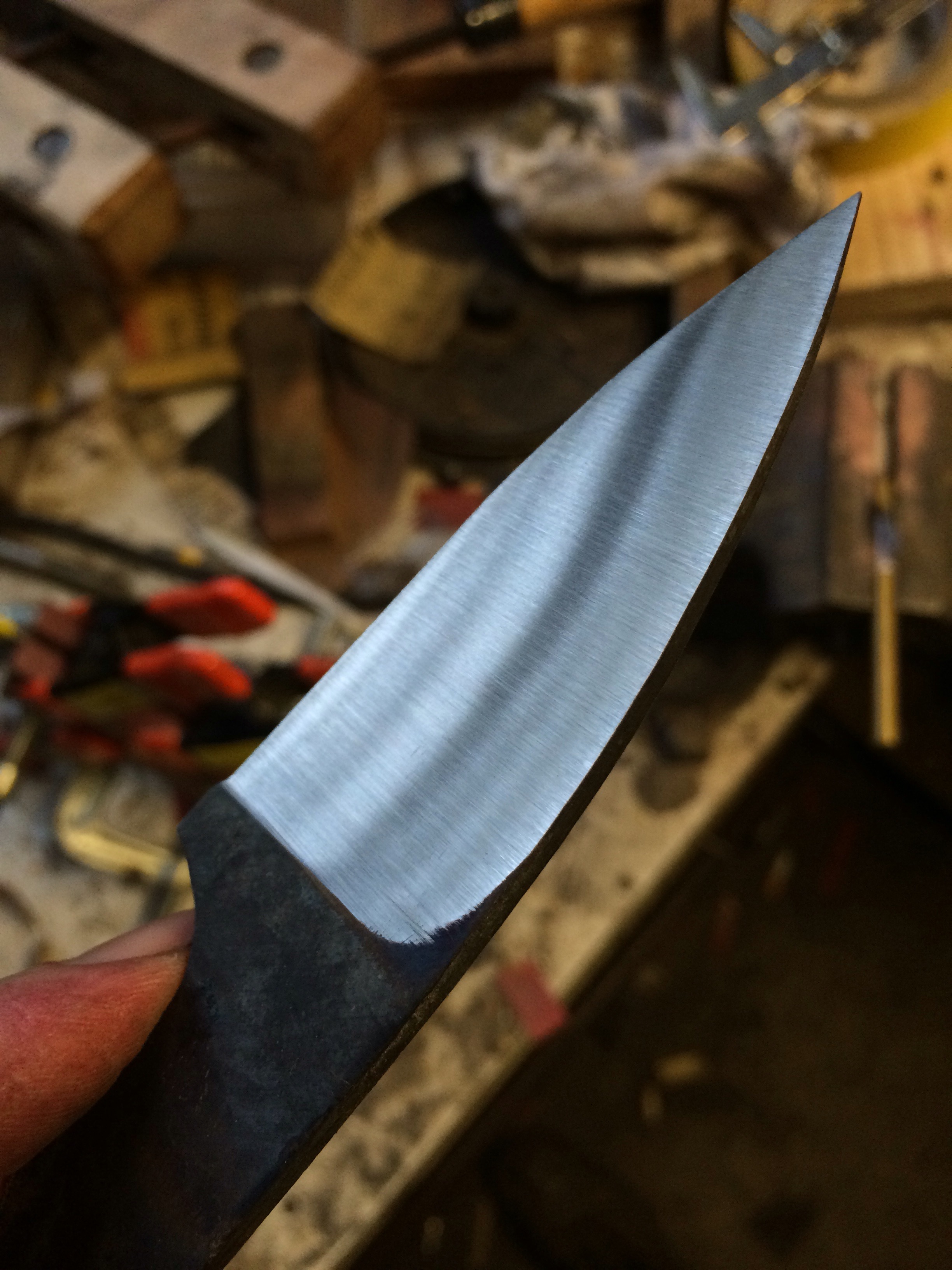
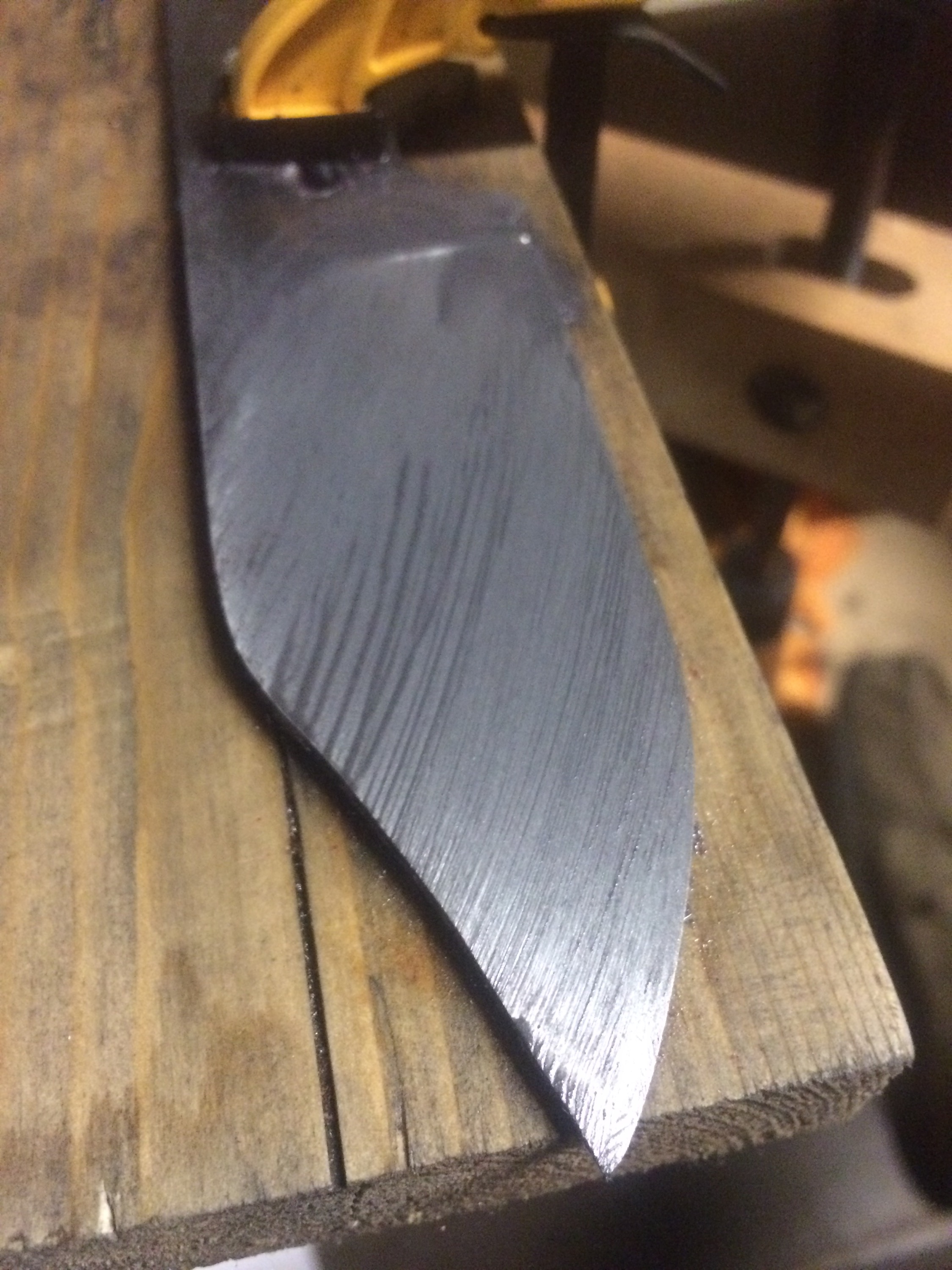
Hardened:

FullSizeRender 8

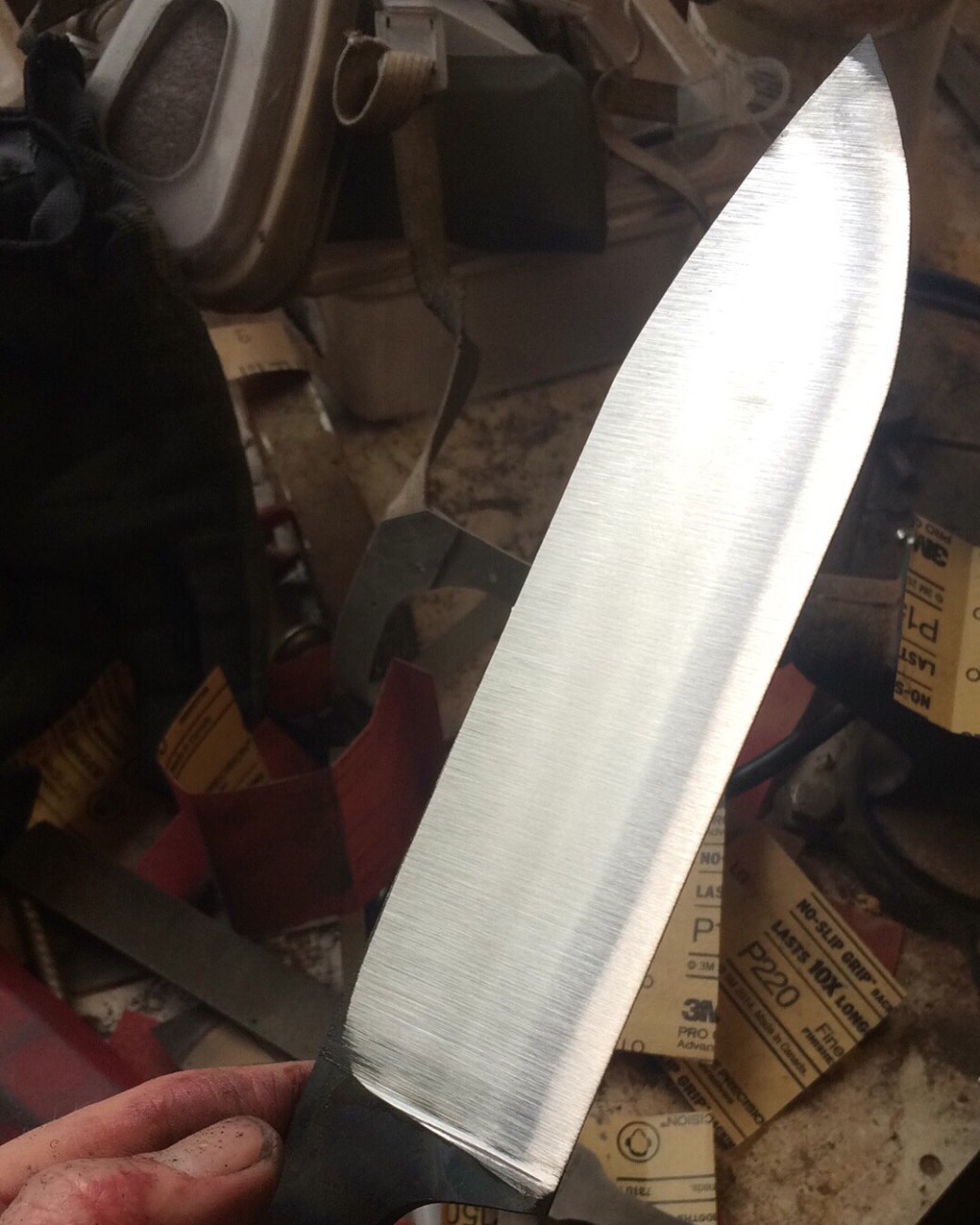
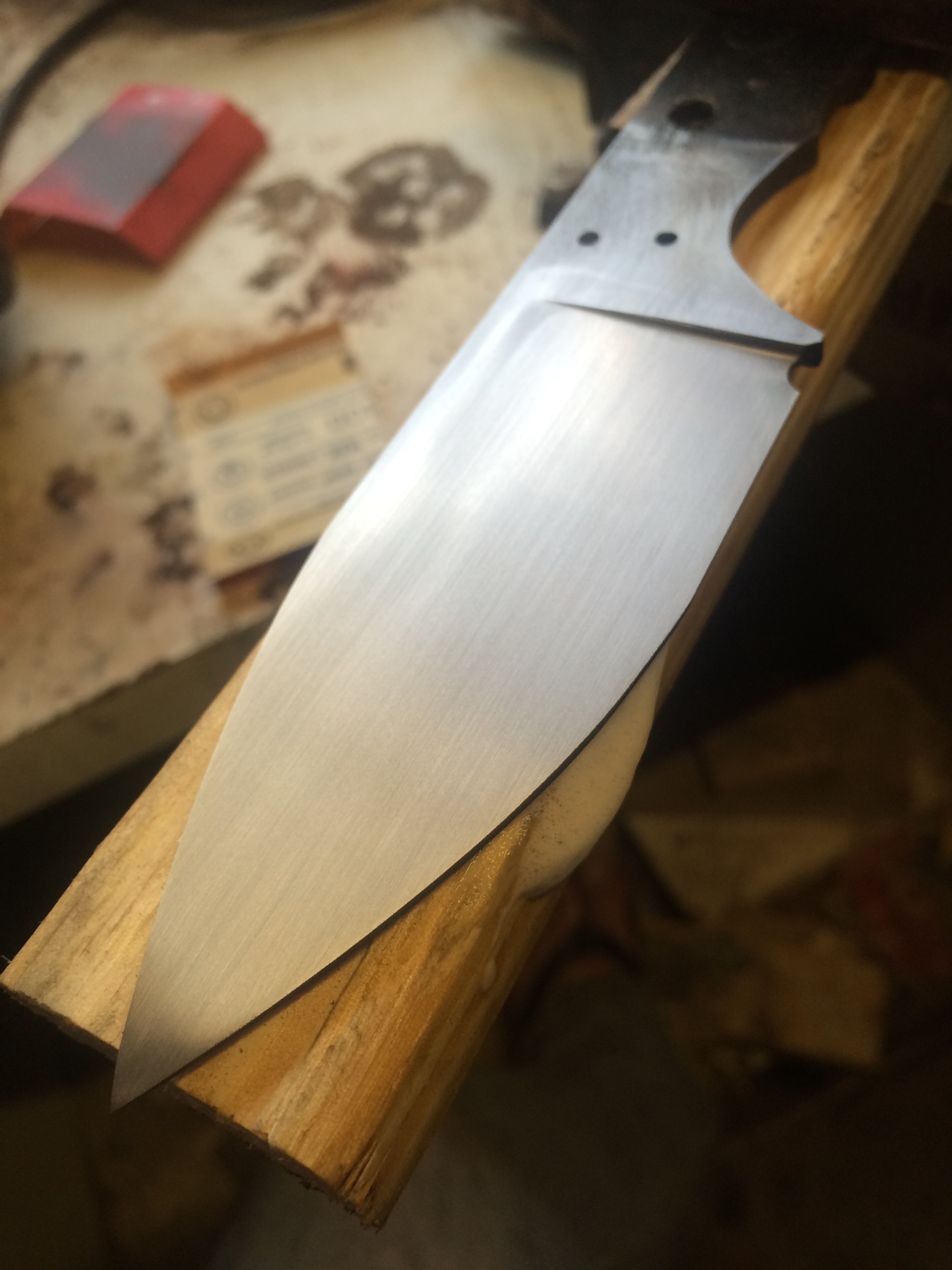
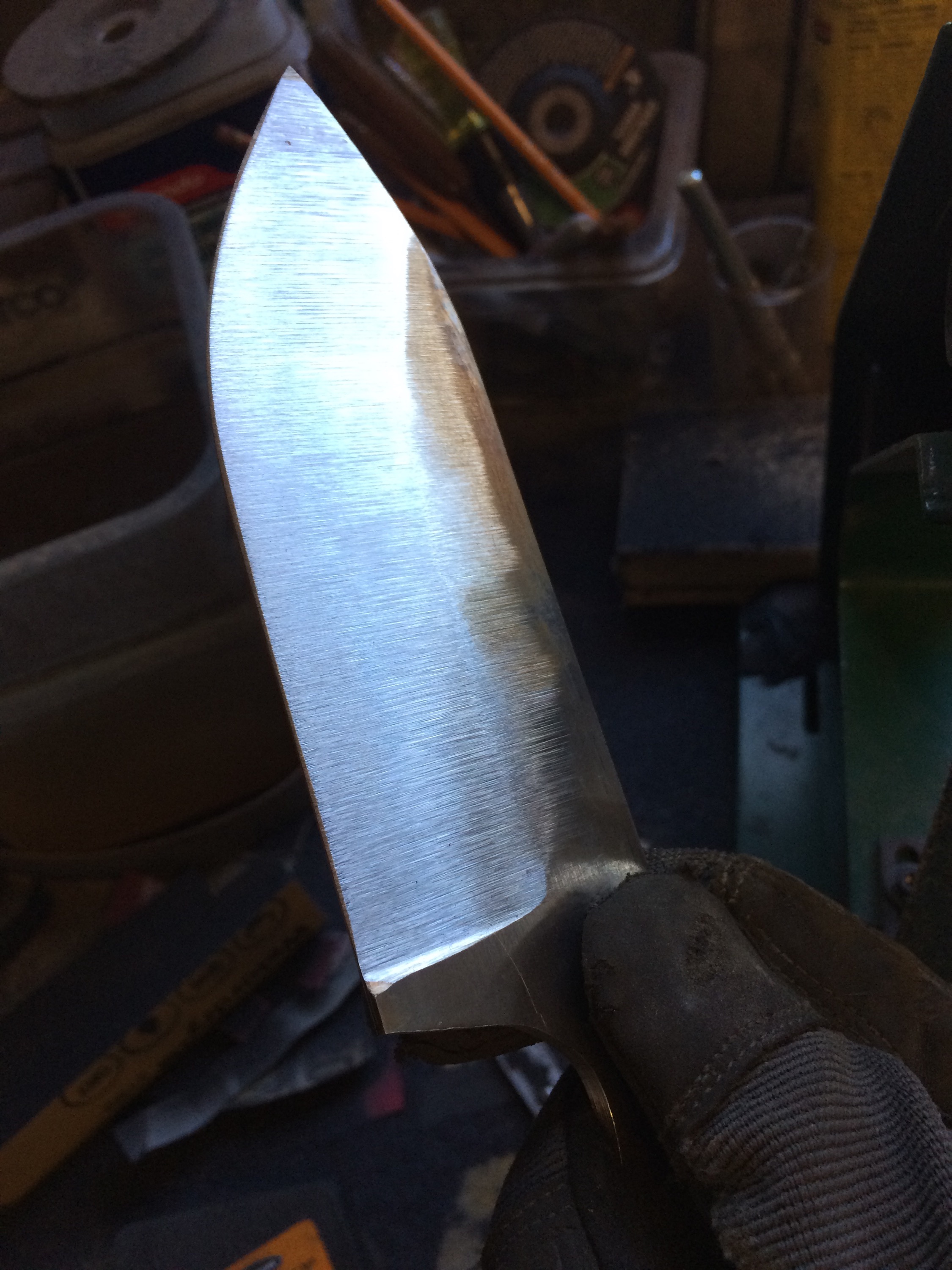
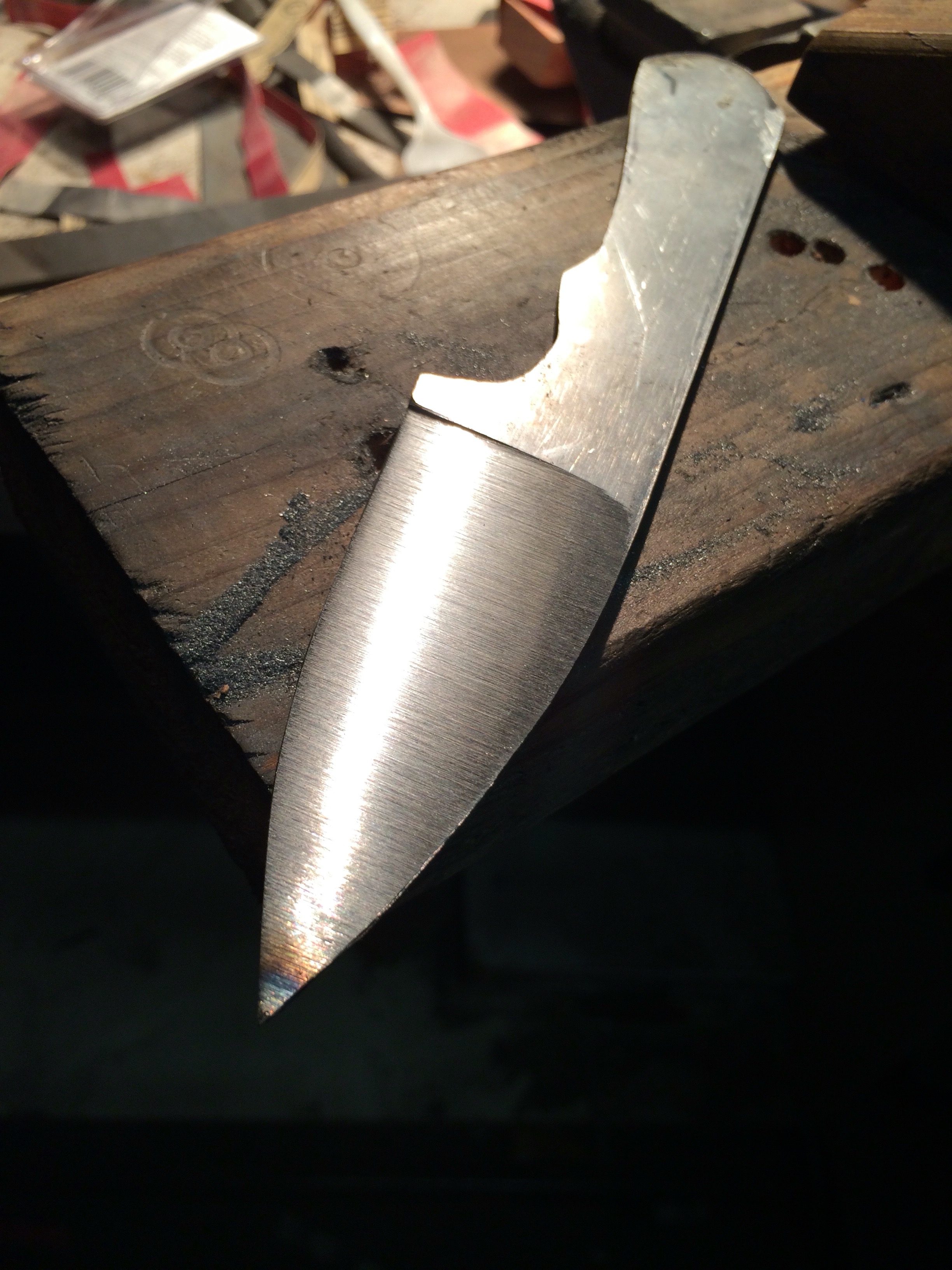
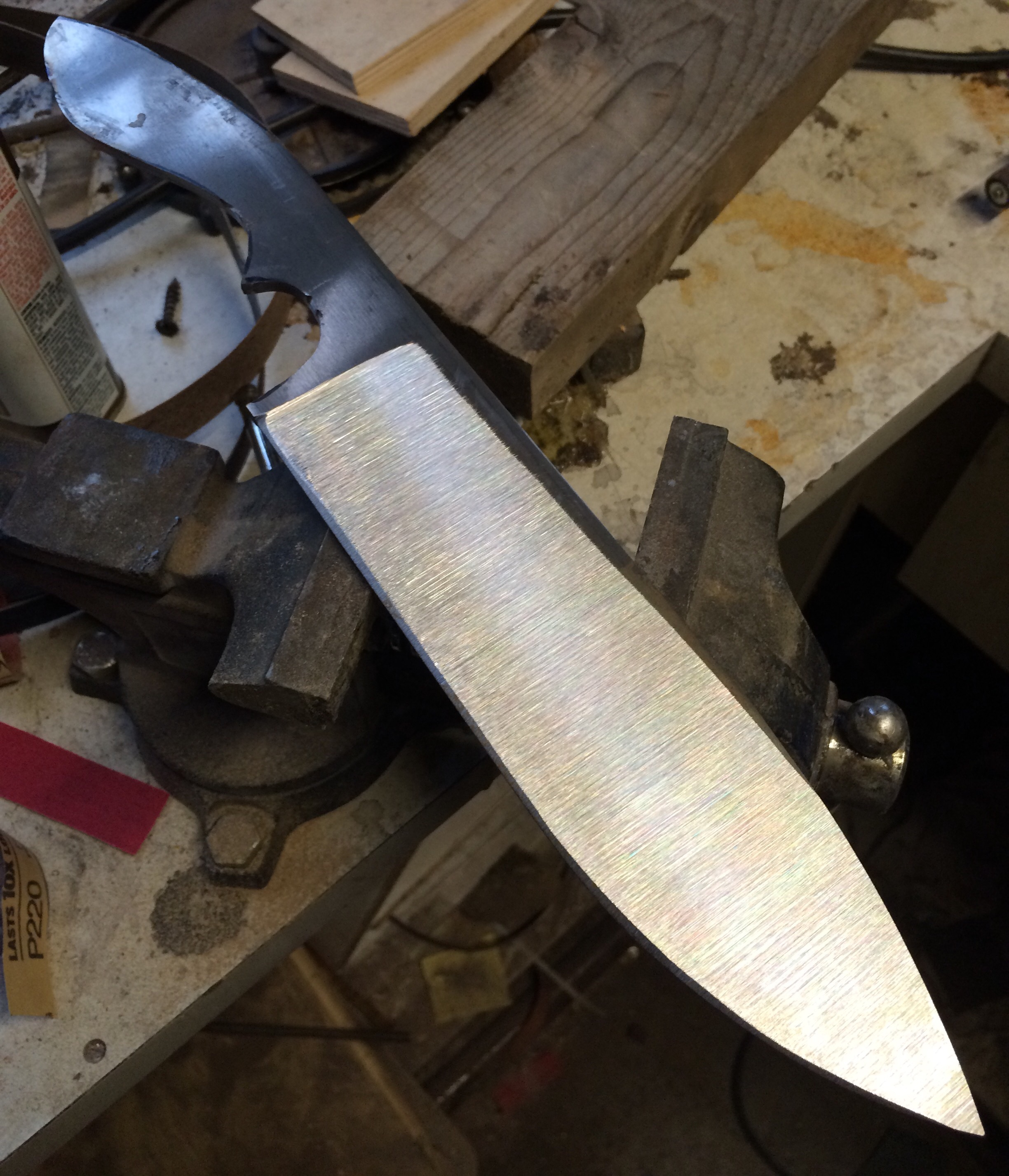
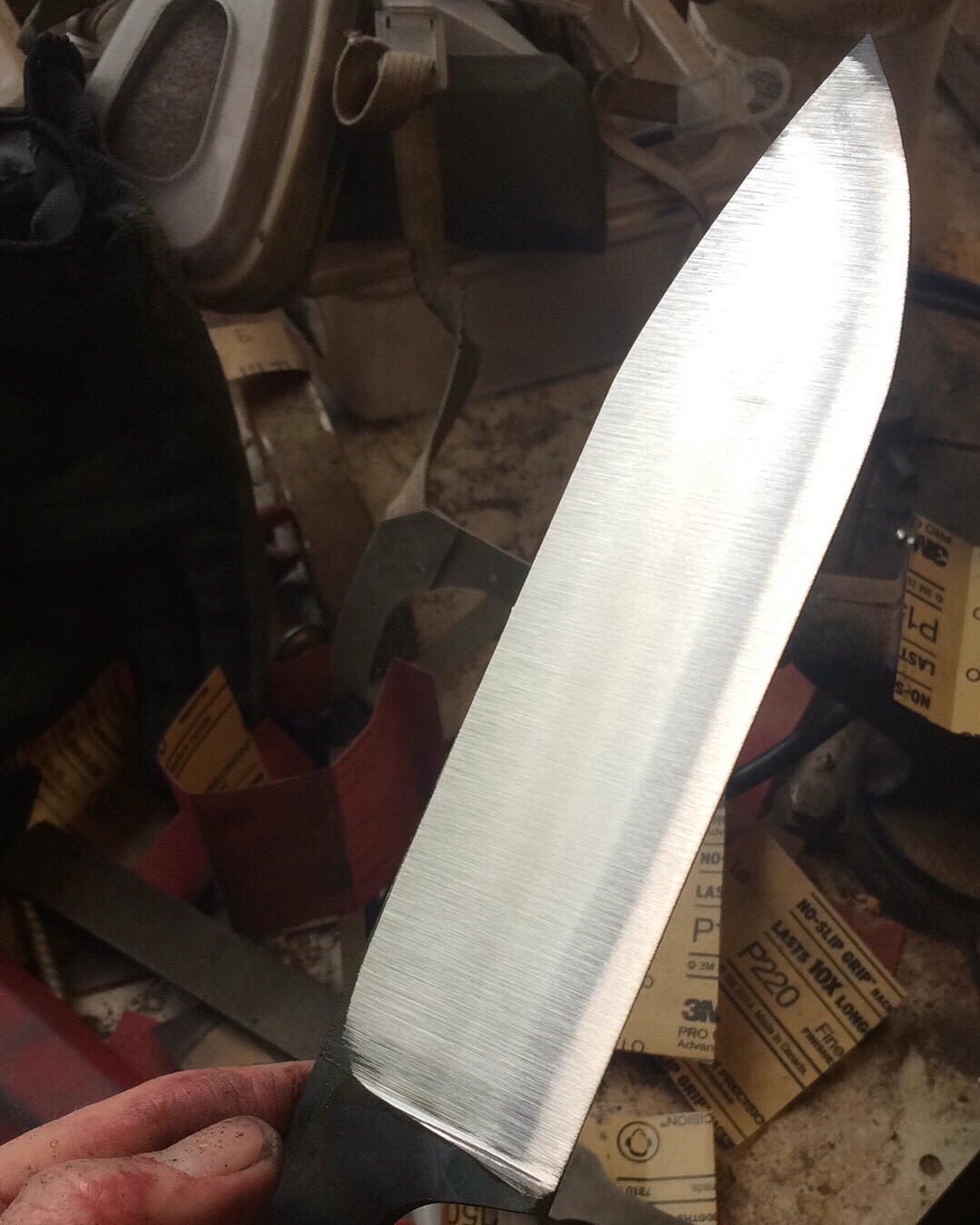
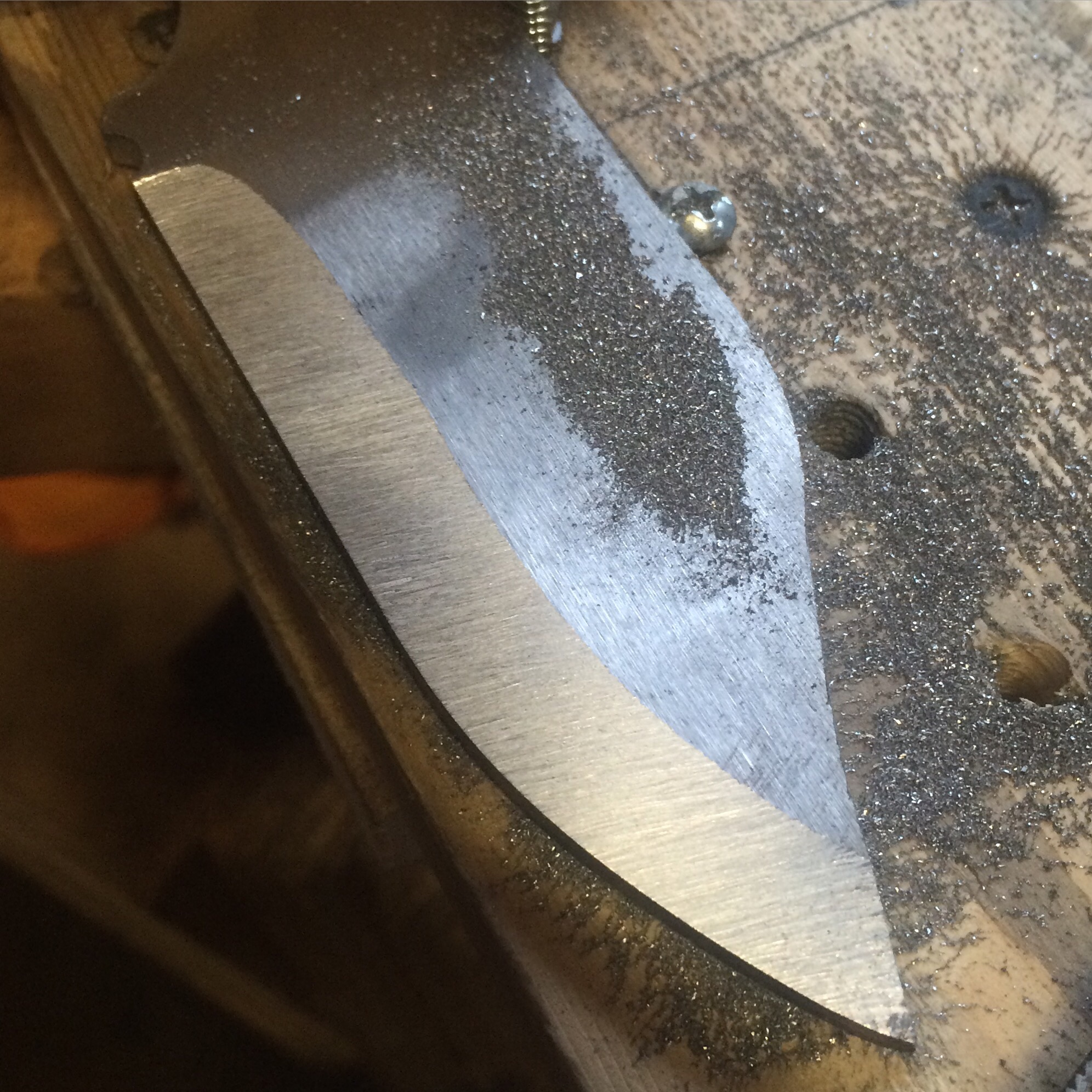
Sanded.  Not too shiny because he is built to be used:

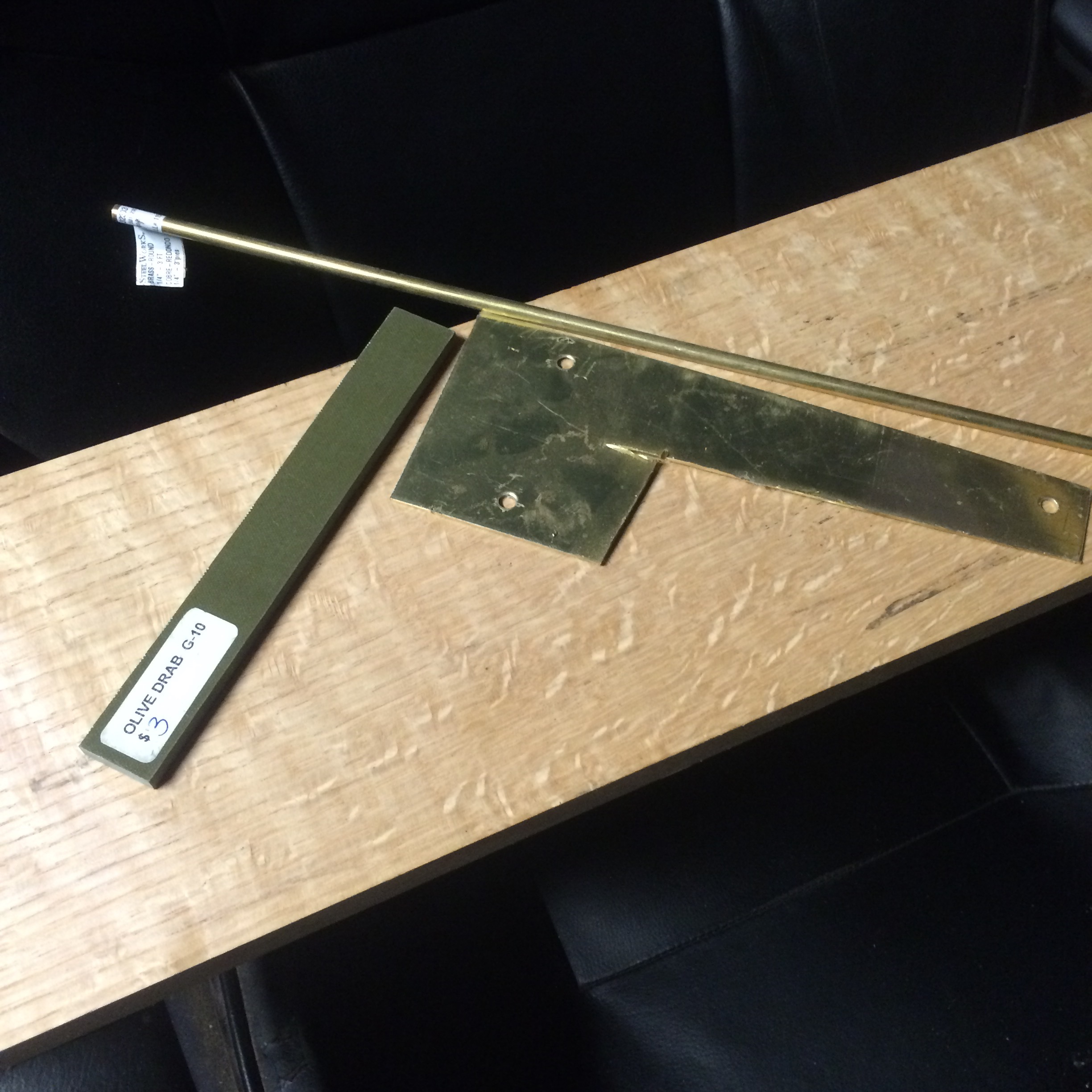
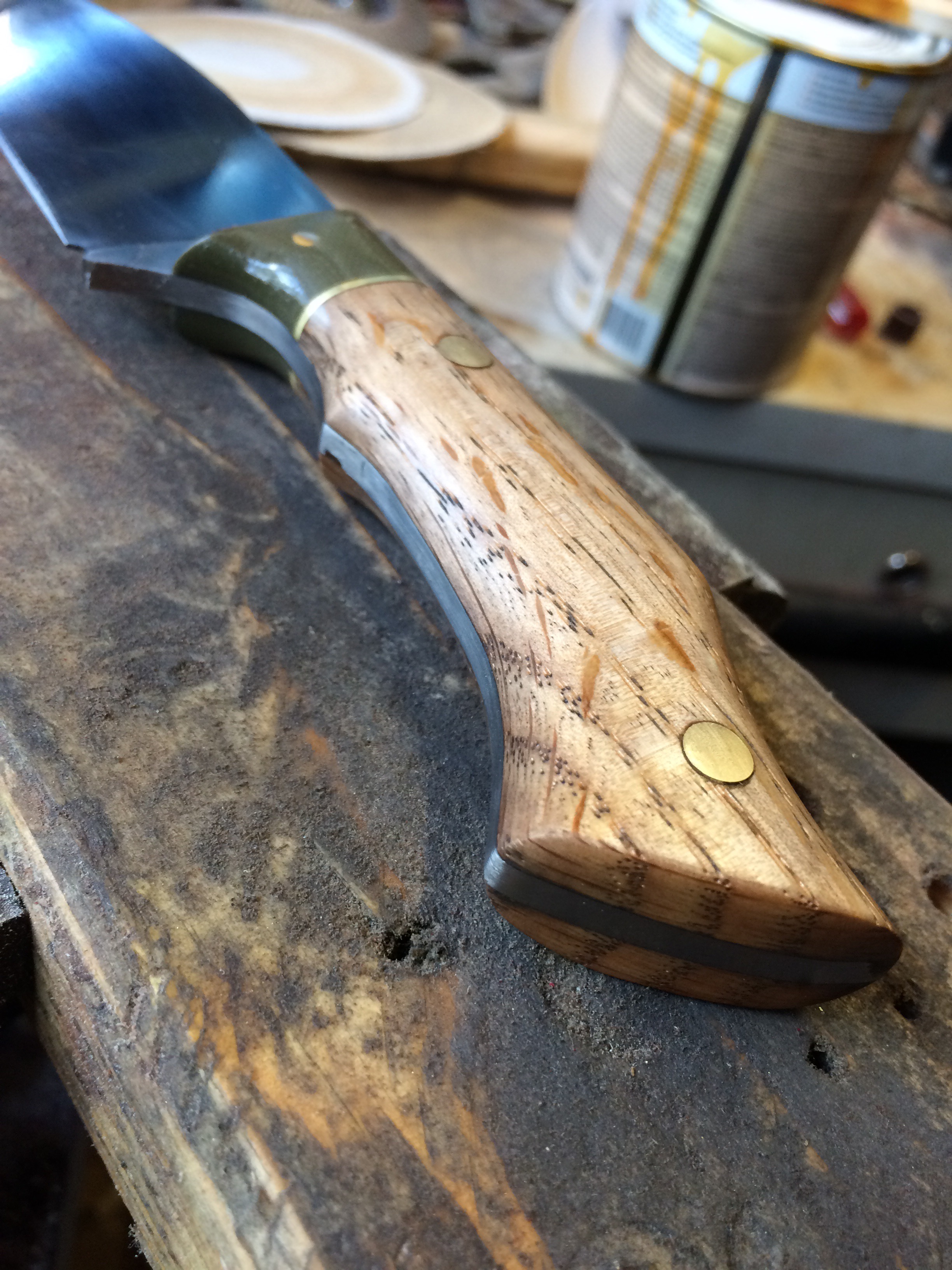
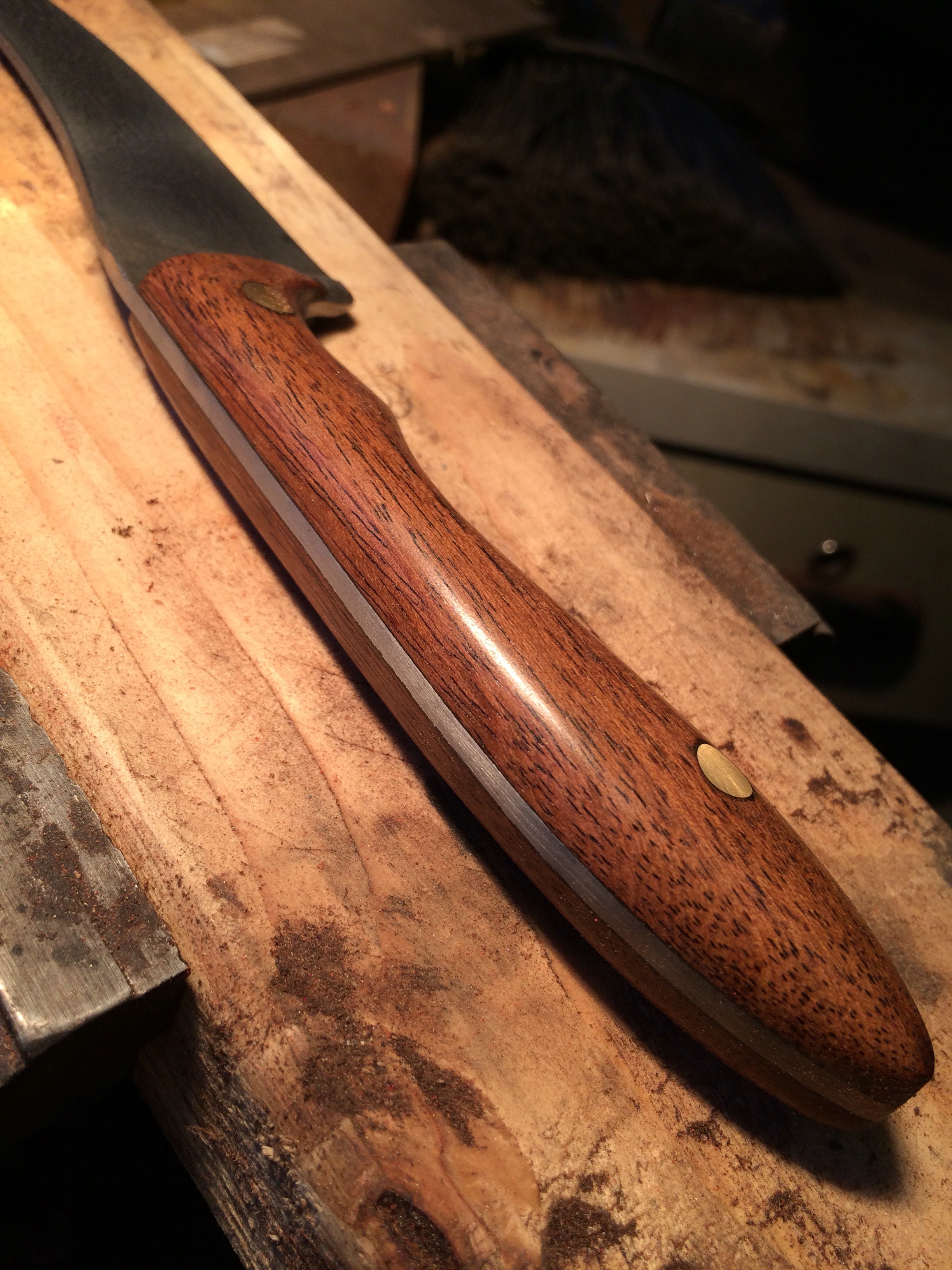
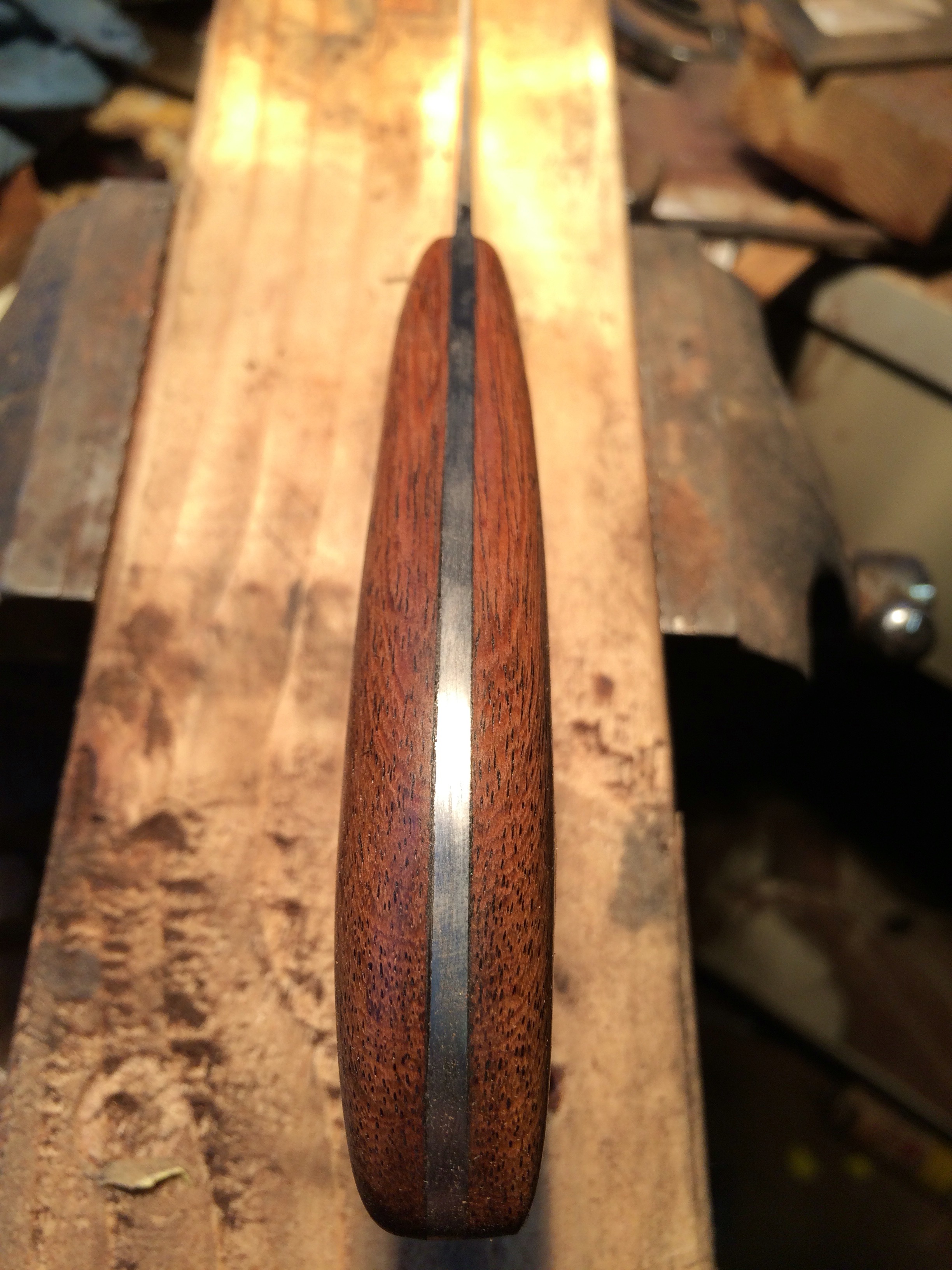
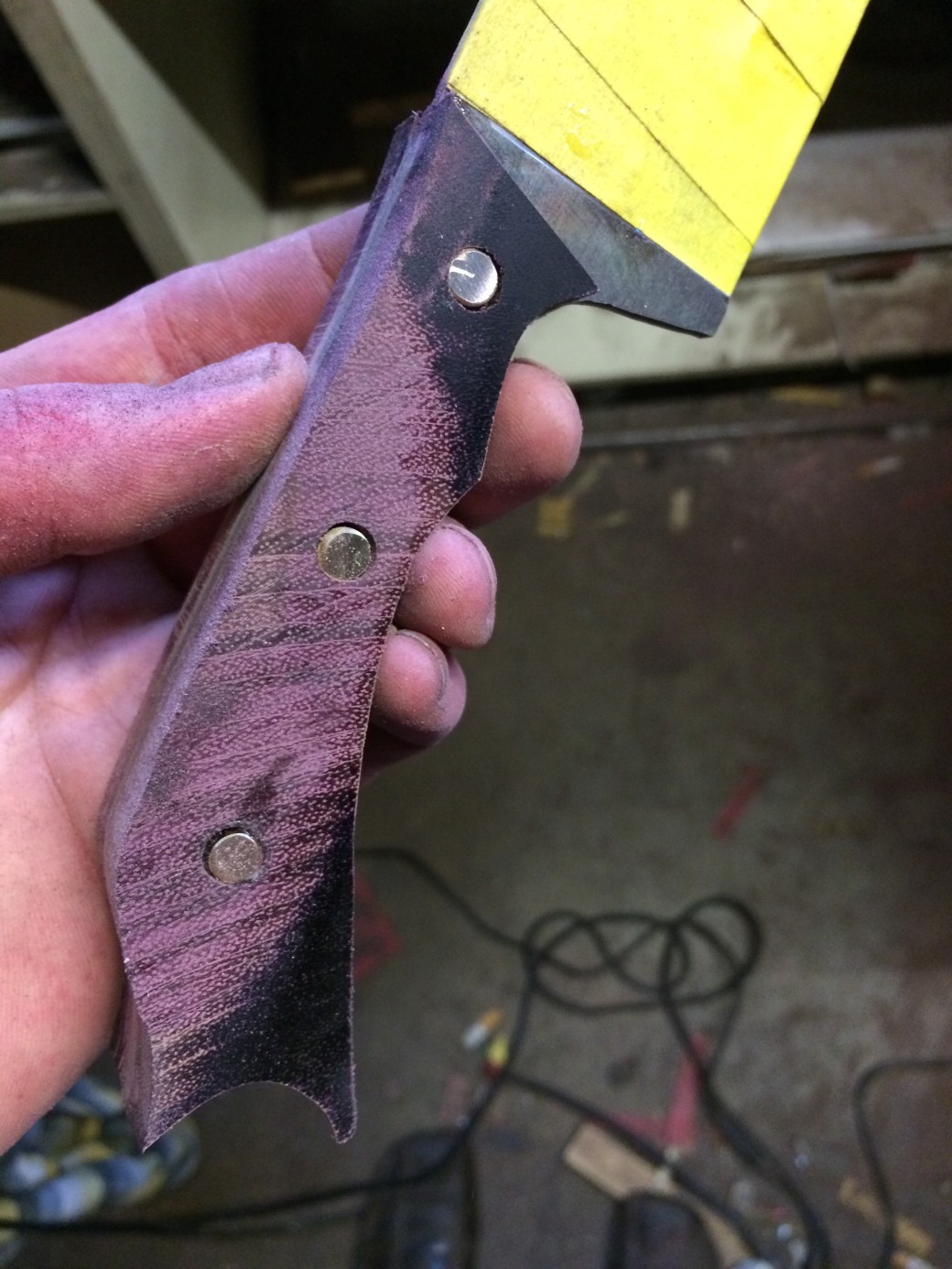
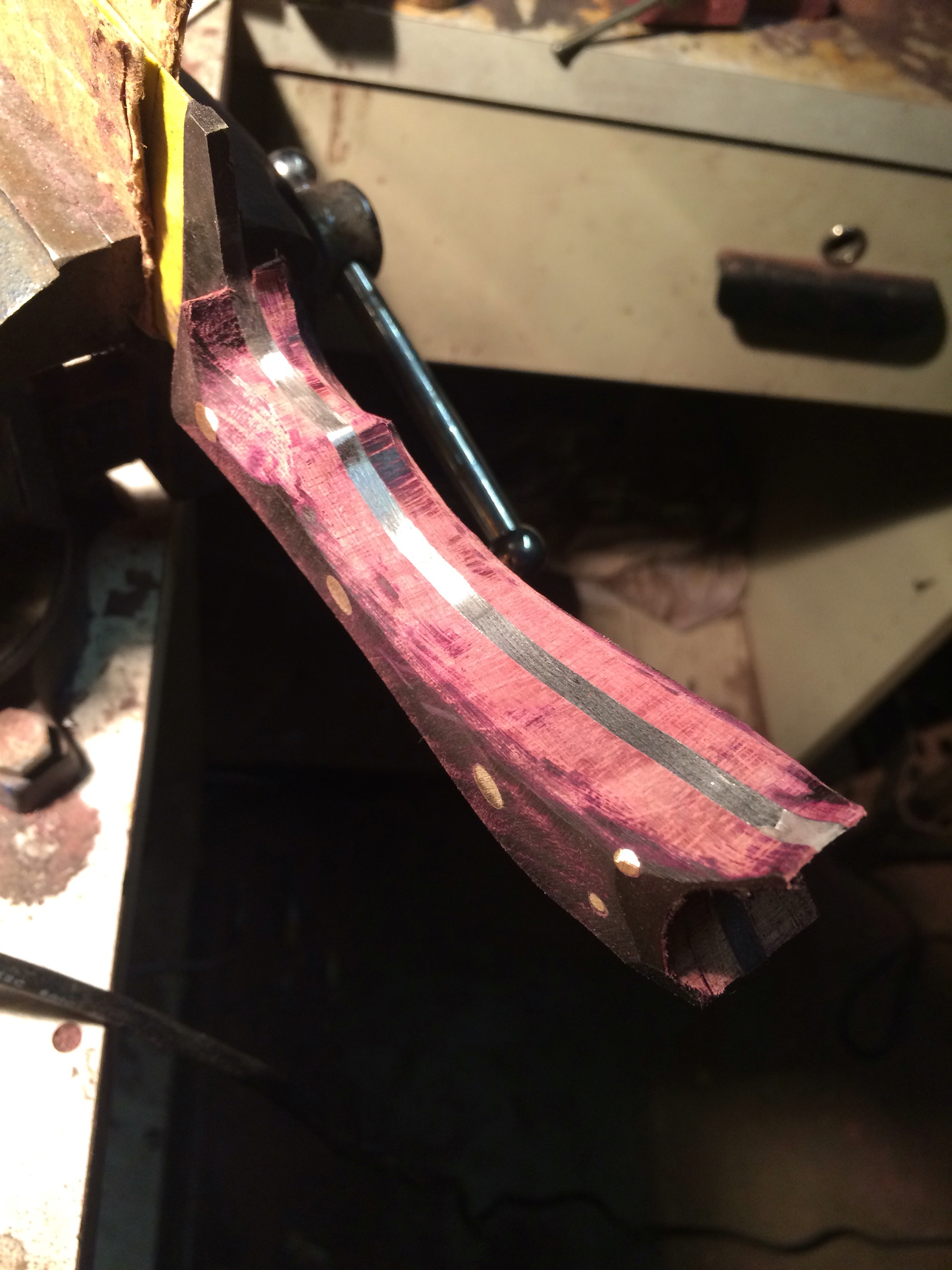
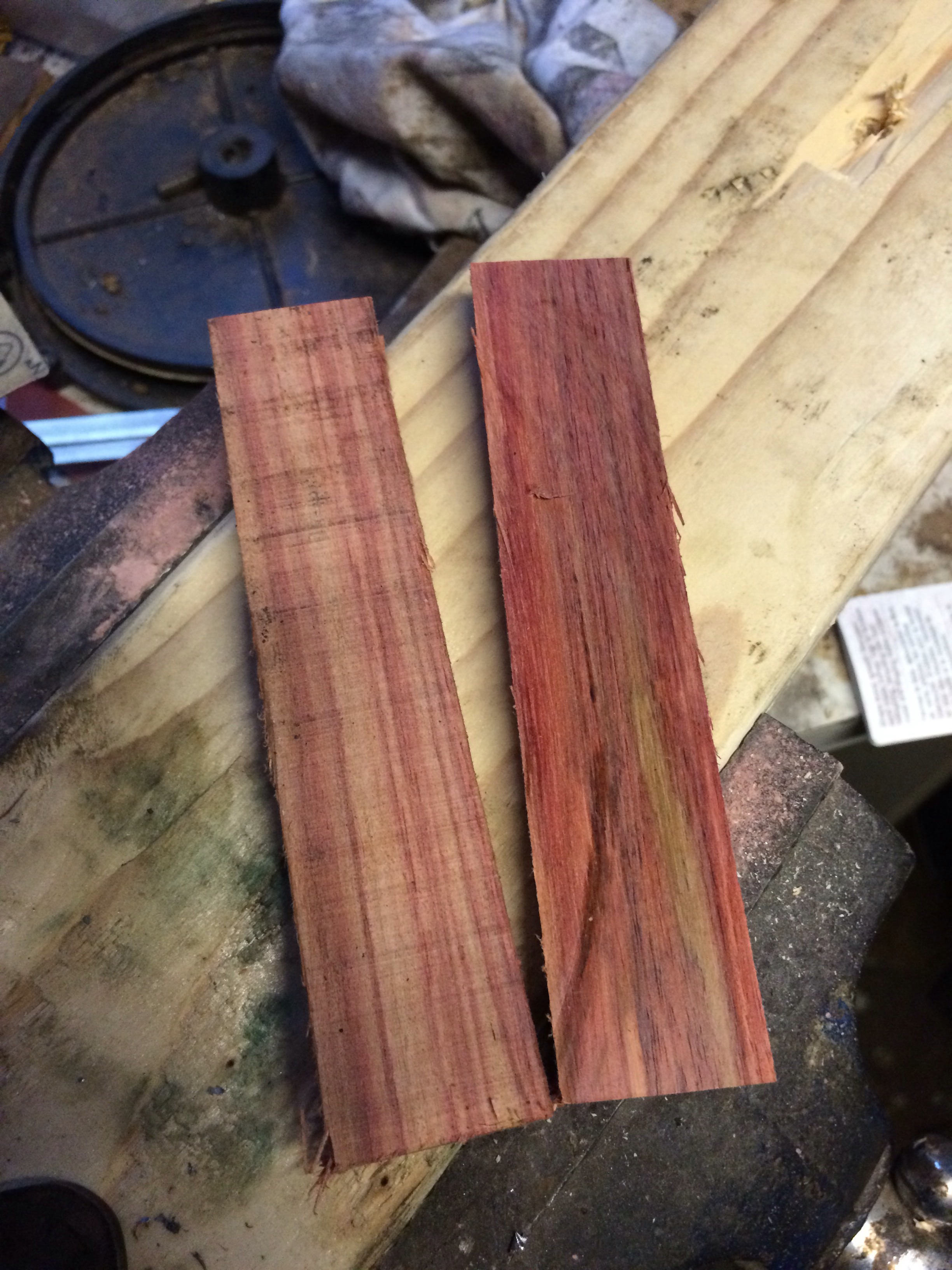
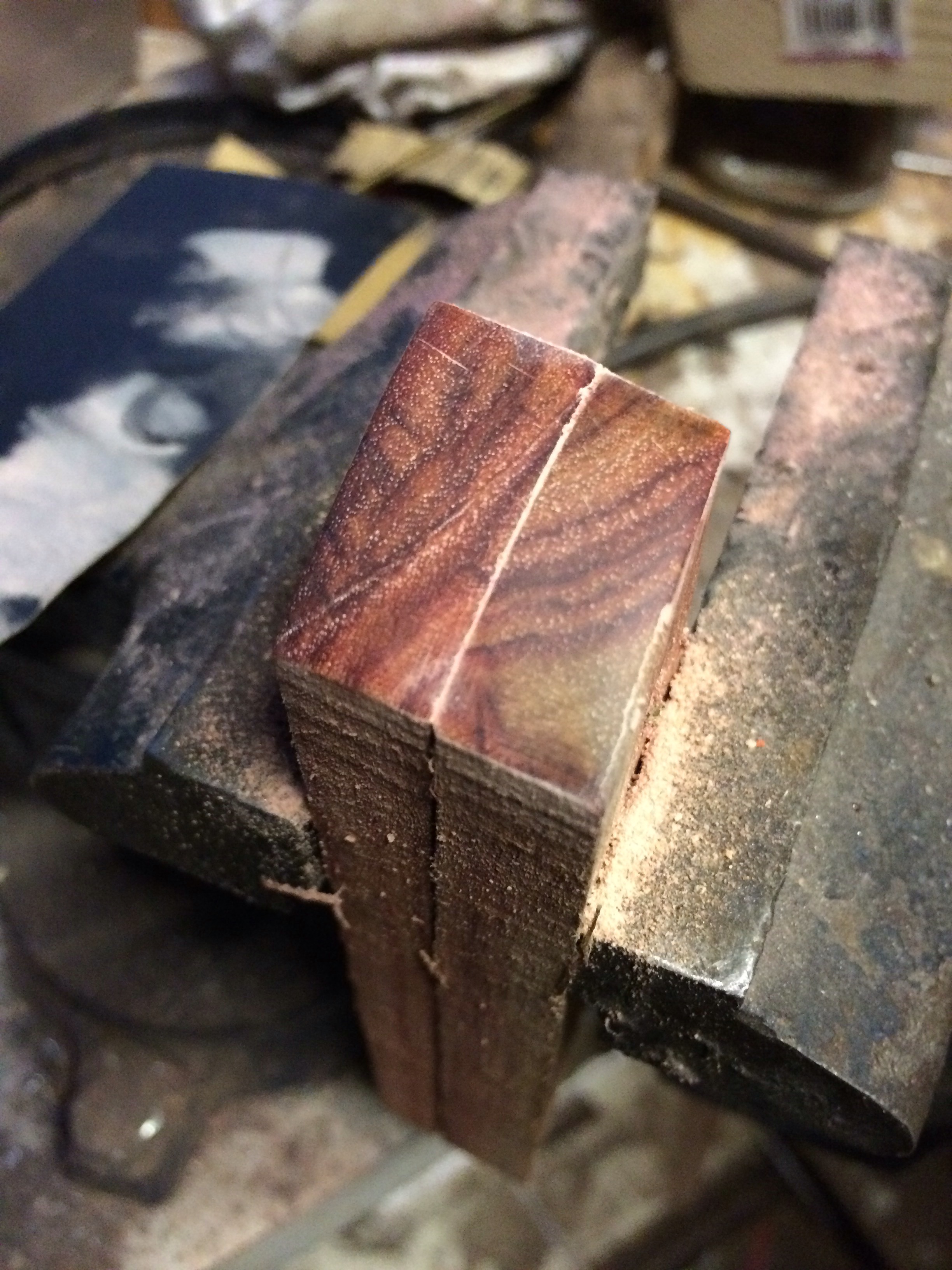
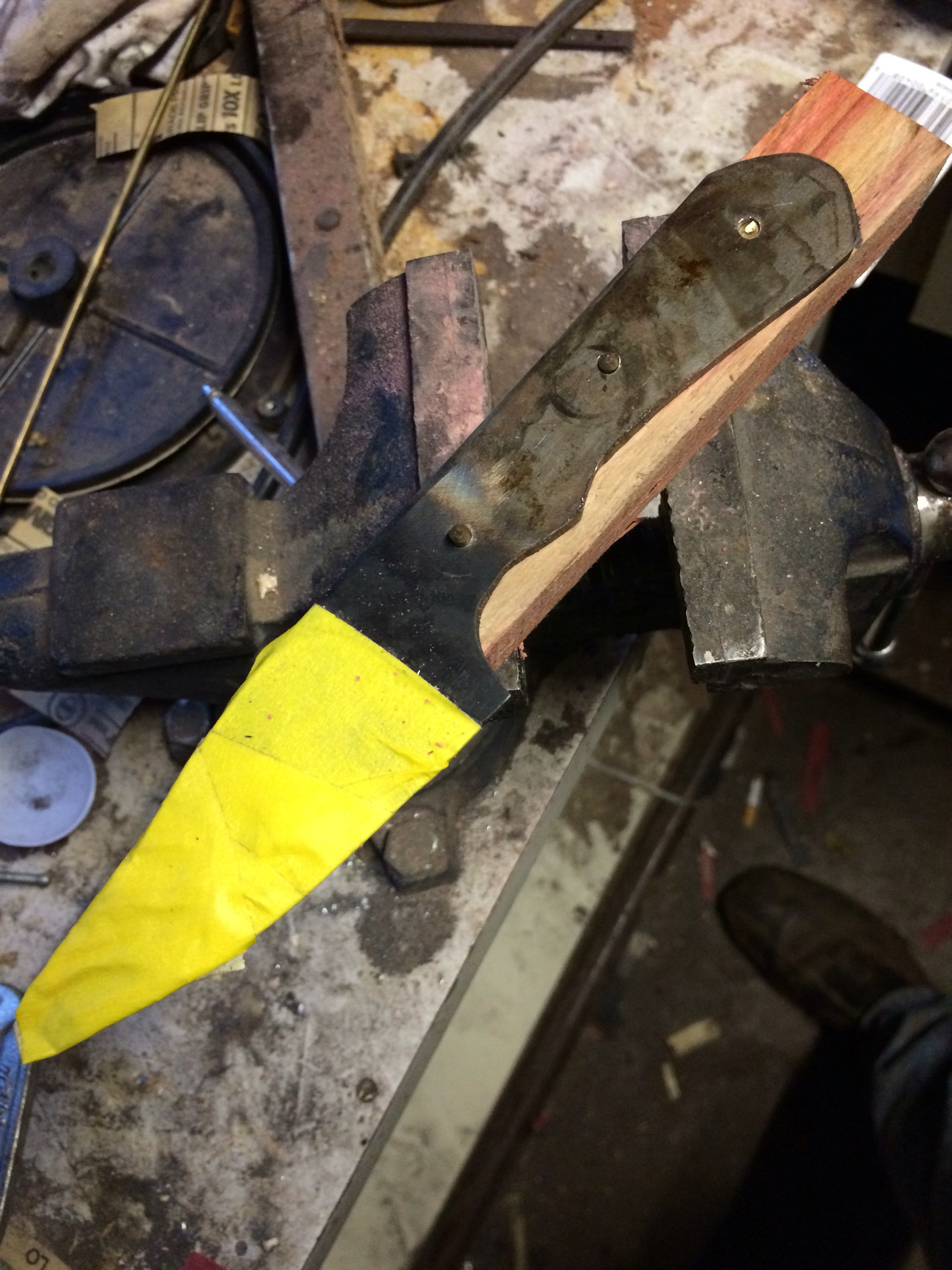
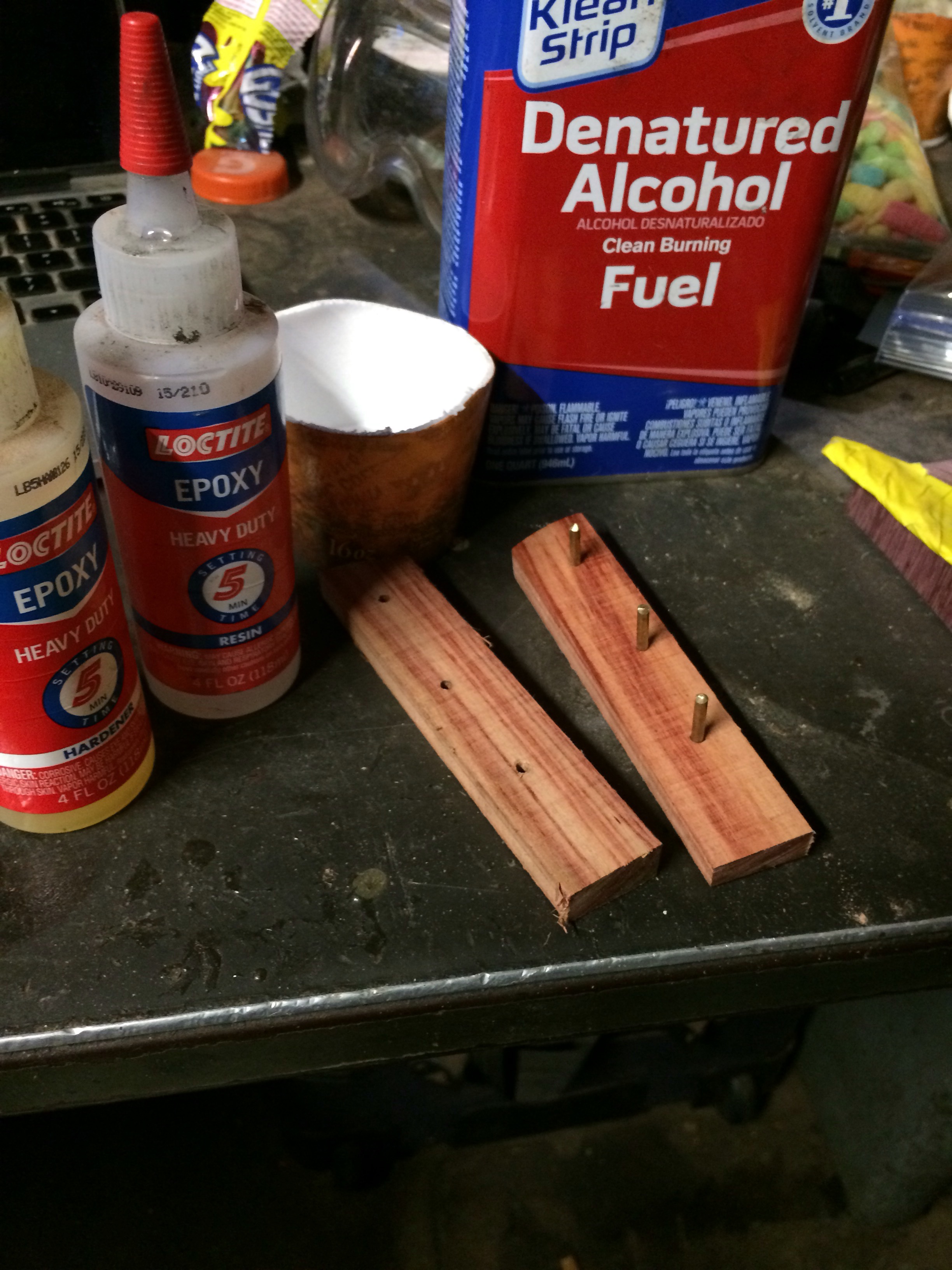
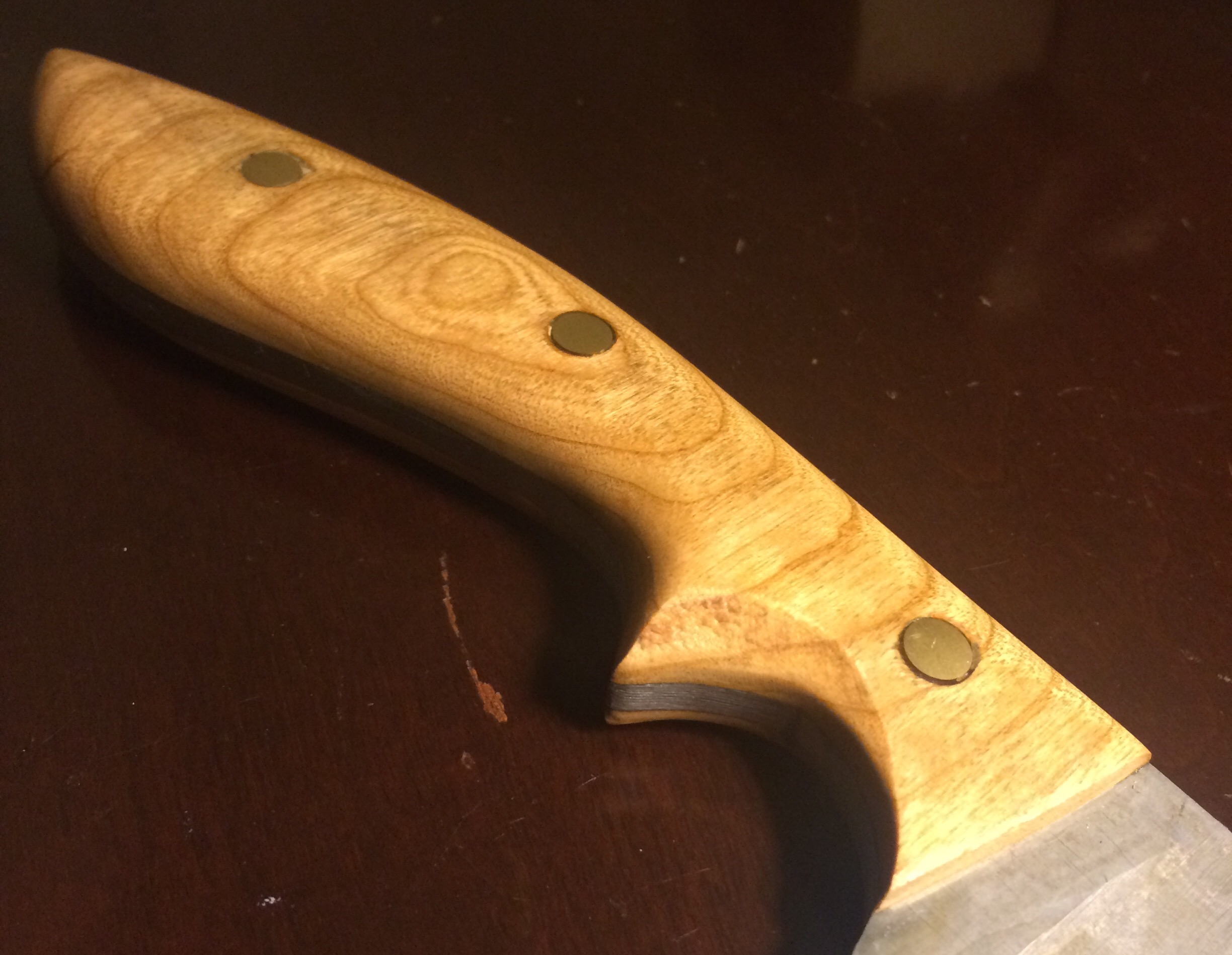
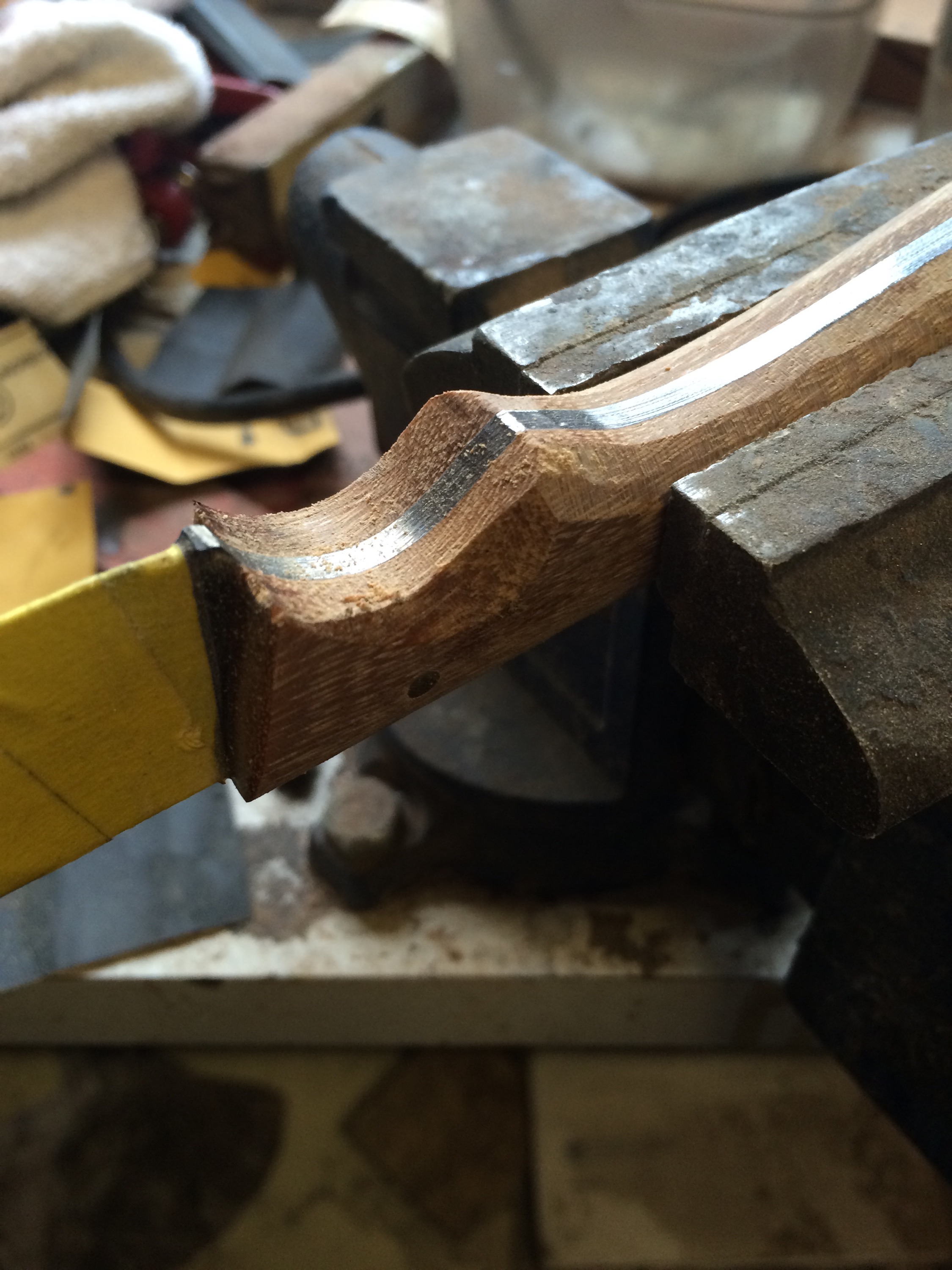
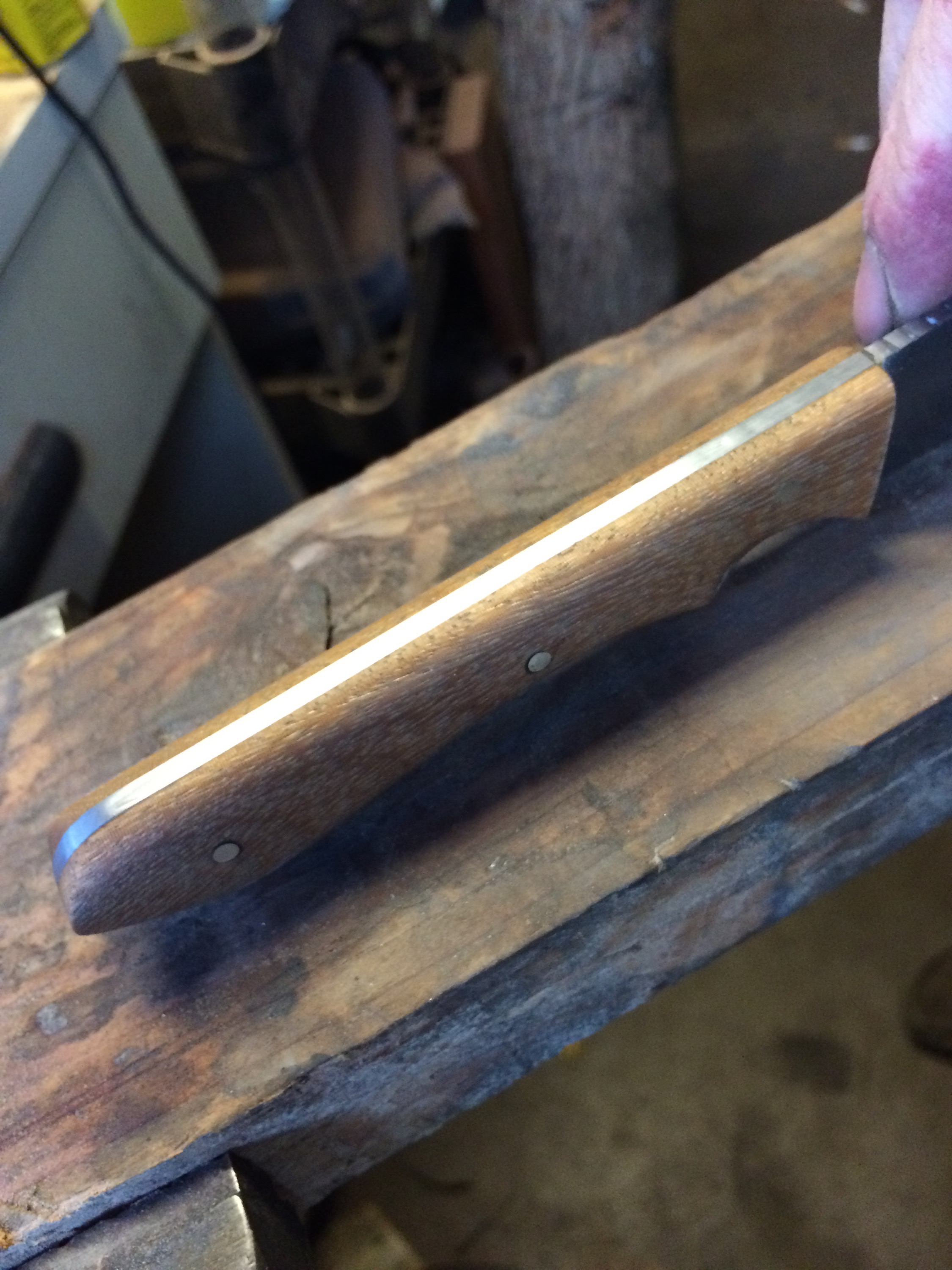
Here is what I used for the handle- quartersawn white oak, olive drab g-10, and brass.  It was a bit of an undertaking and there was some improvising because some things didn’t go as planned.  One step at a time…

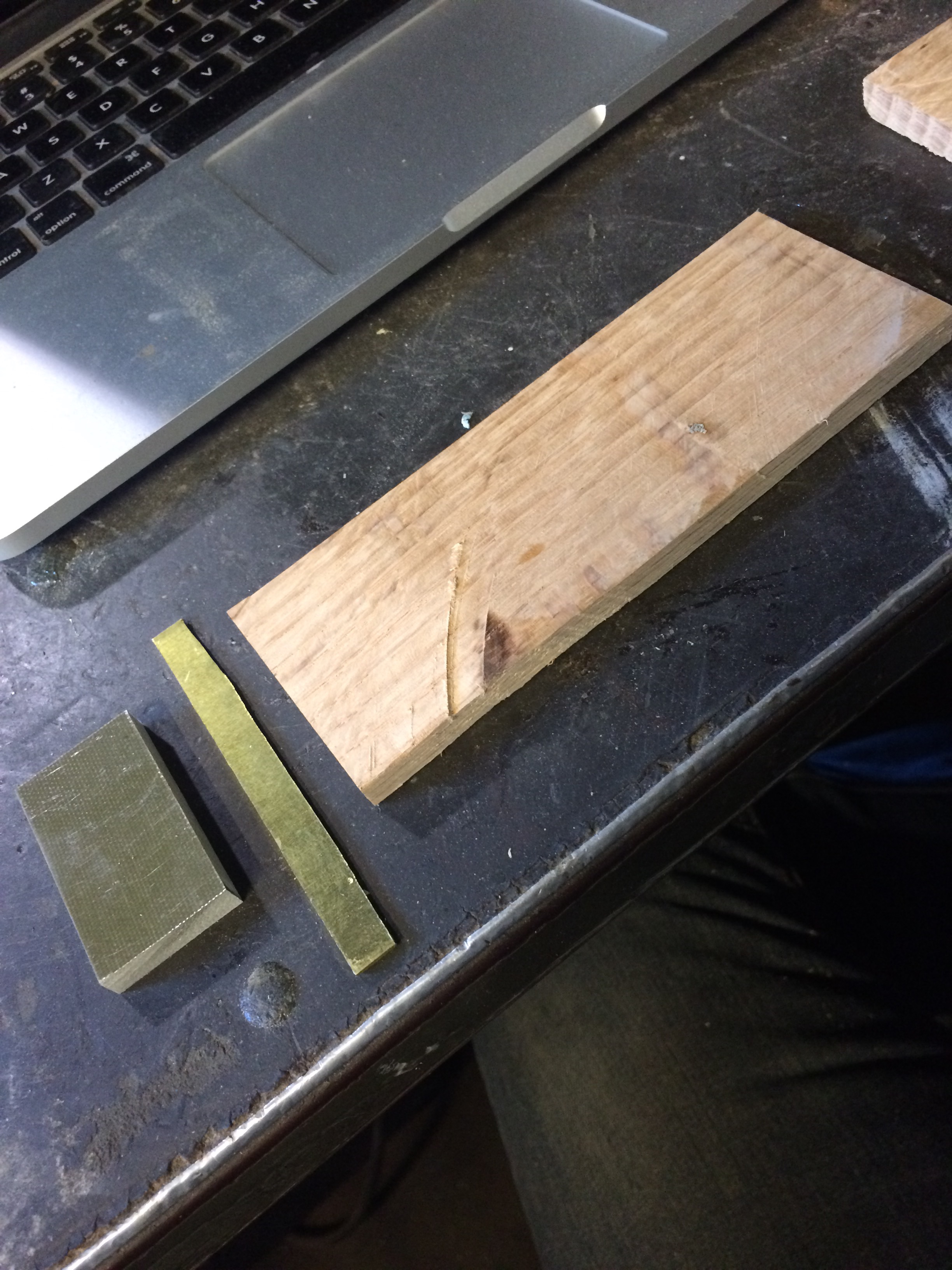
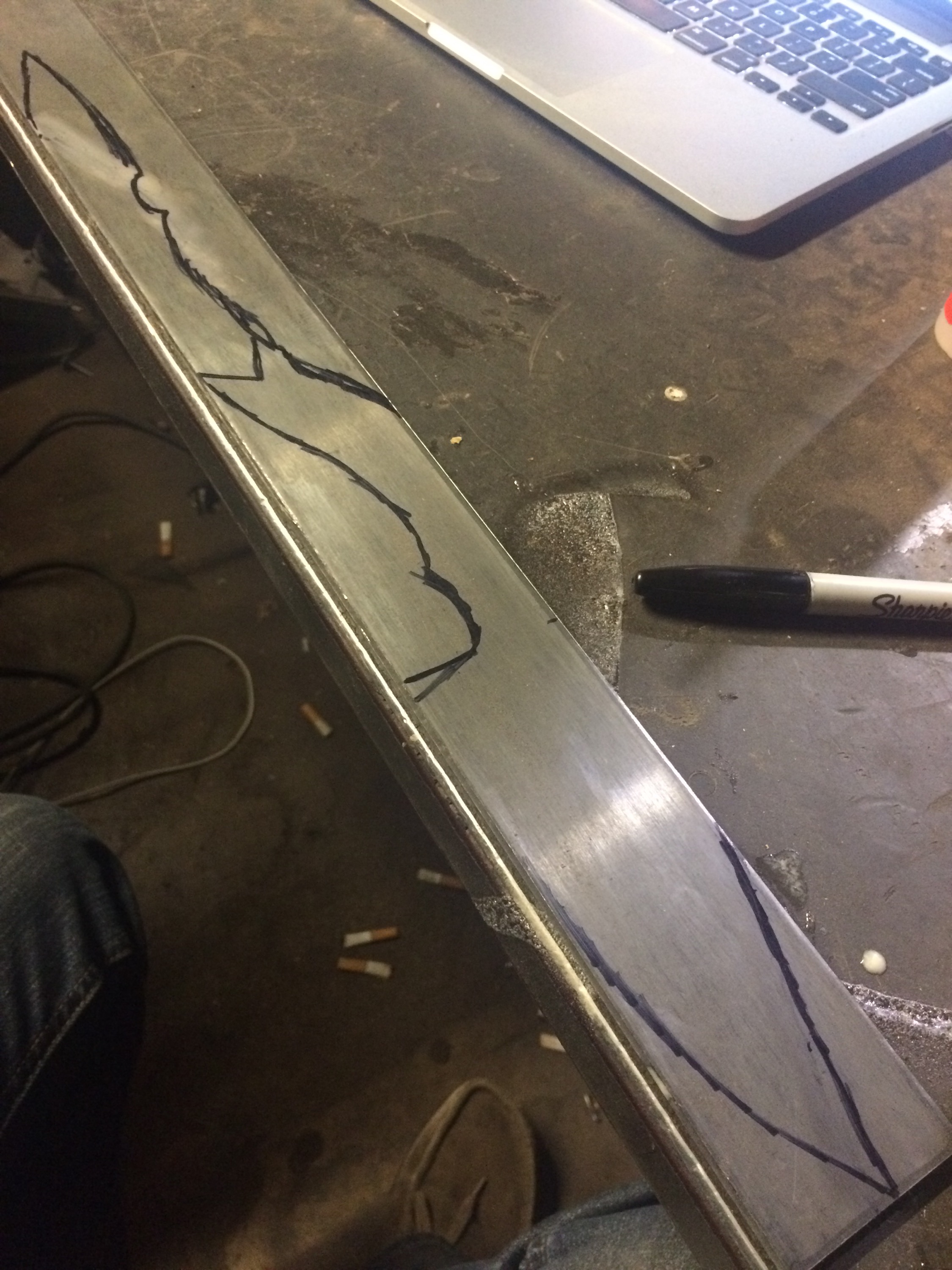
Cut.

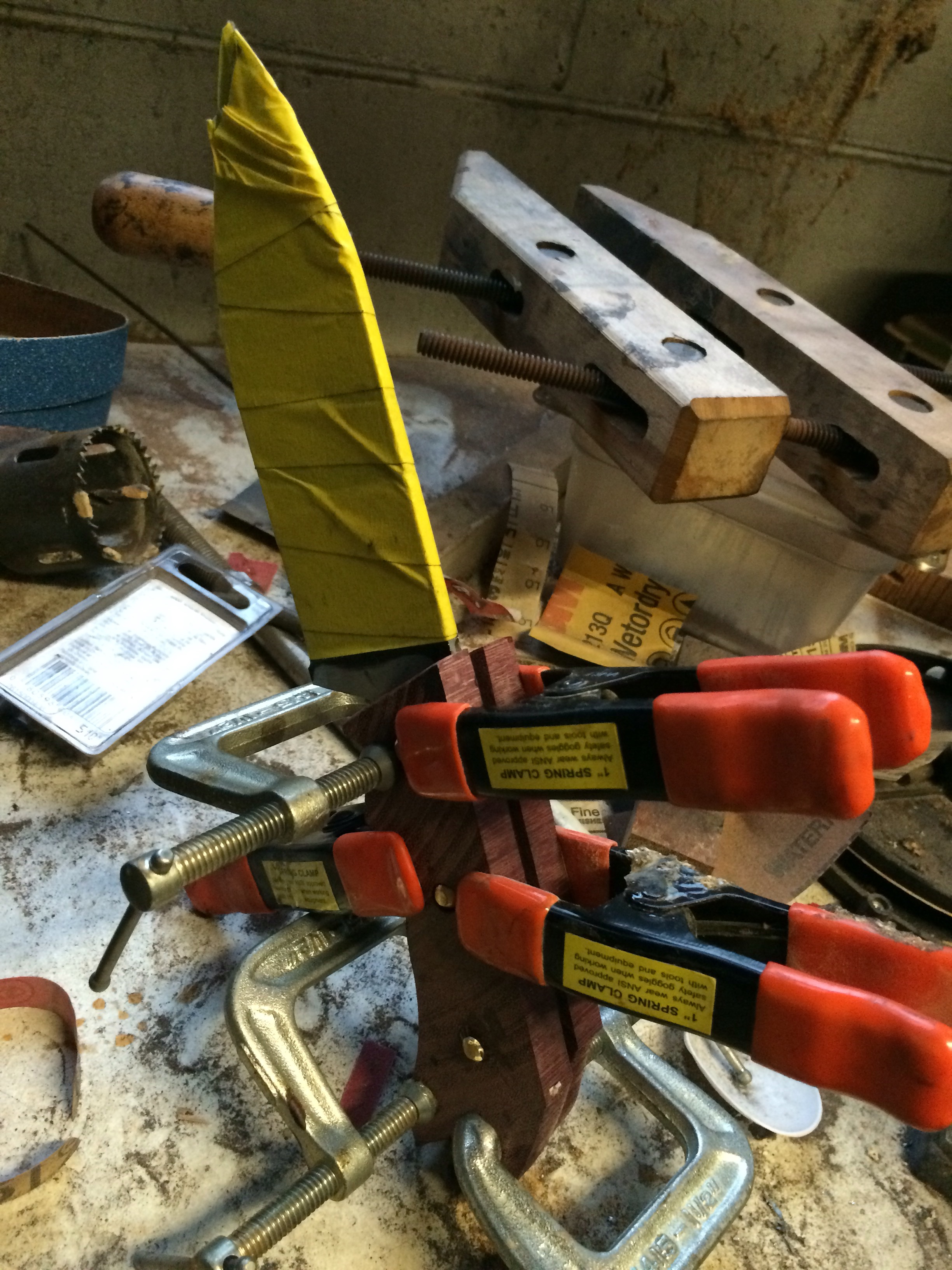
Glued.  This came apart soon after.  I tried to keep the brass cool when cutting it but it got too hot and melted the epoxy.  More steps, keep moving…

Clamped…finally

Glue is set.

Rough shaping.

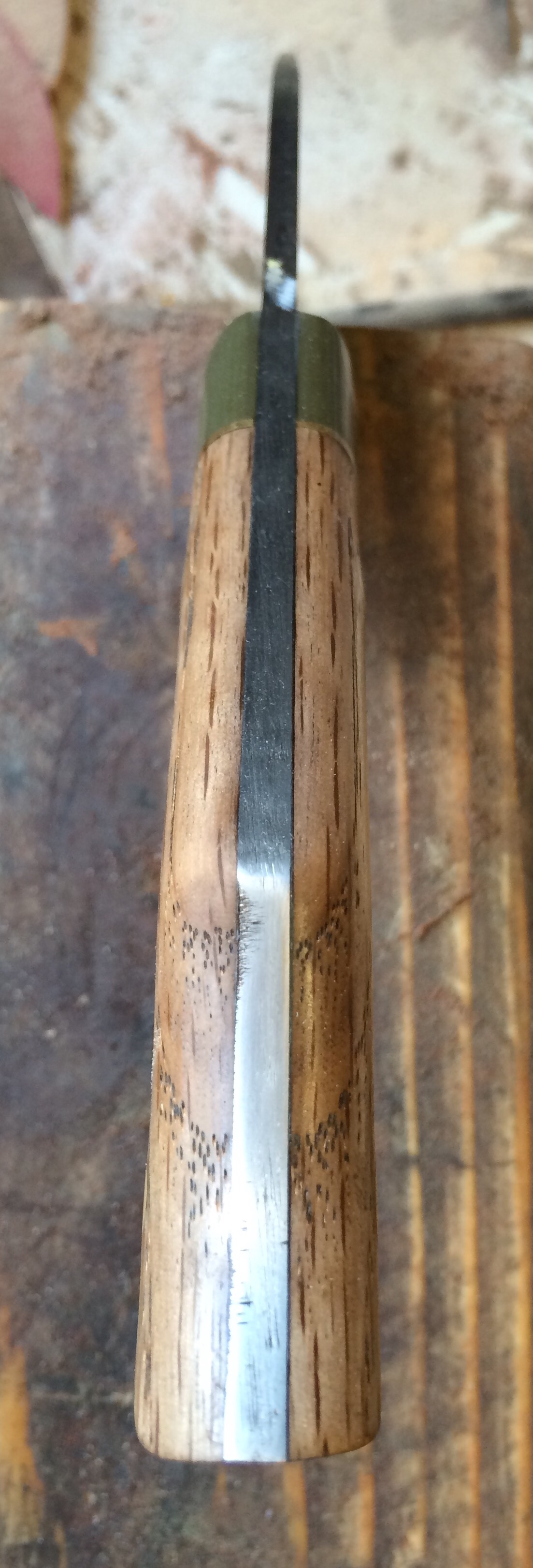
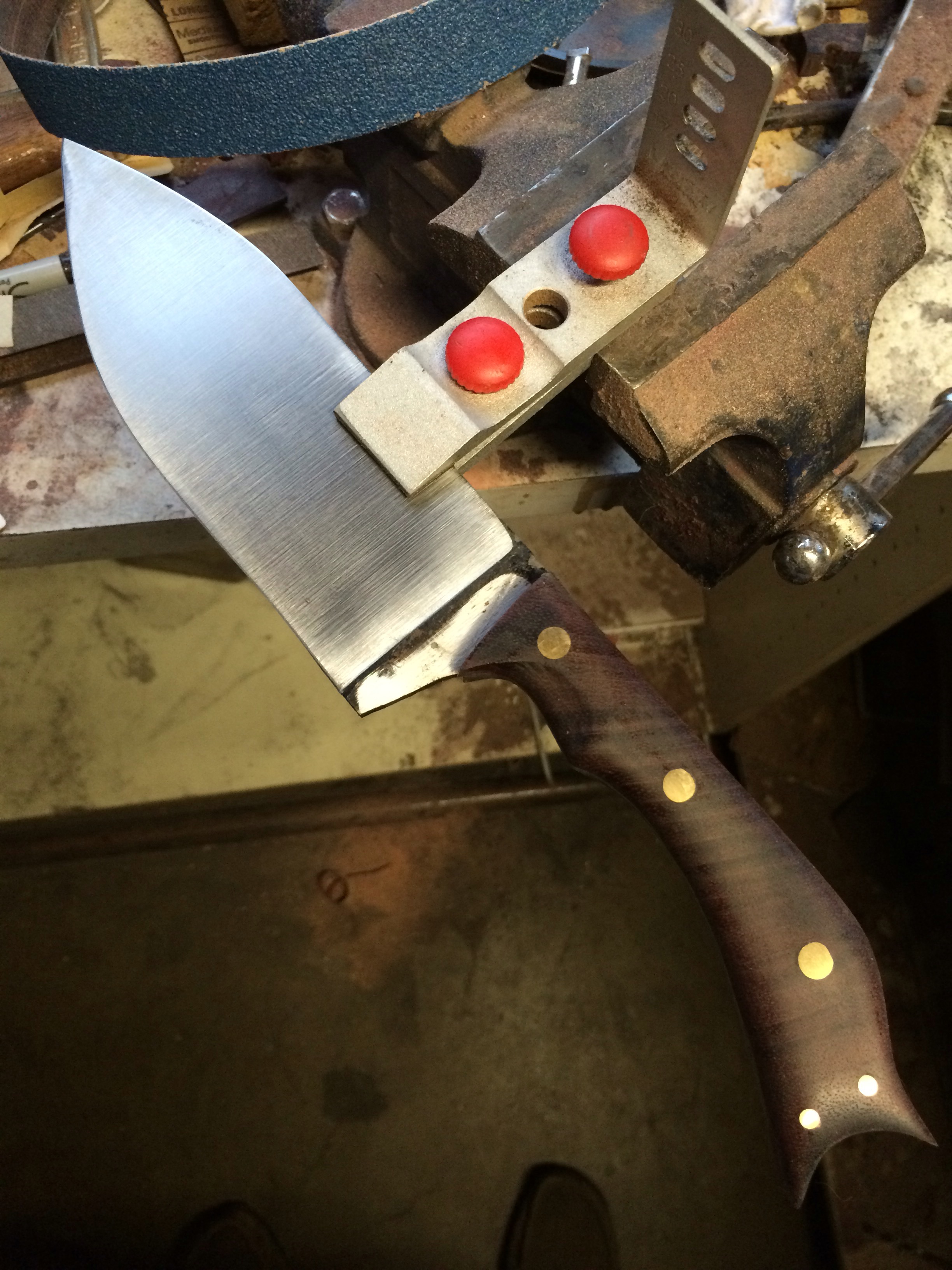
Cleaned up.  Now to sand…

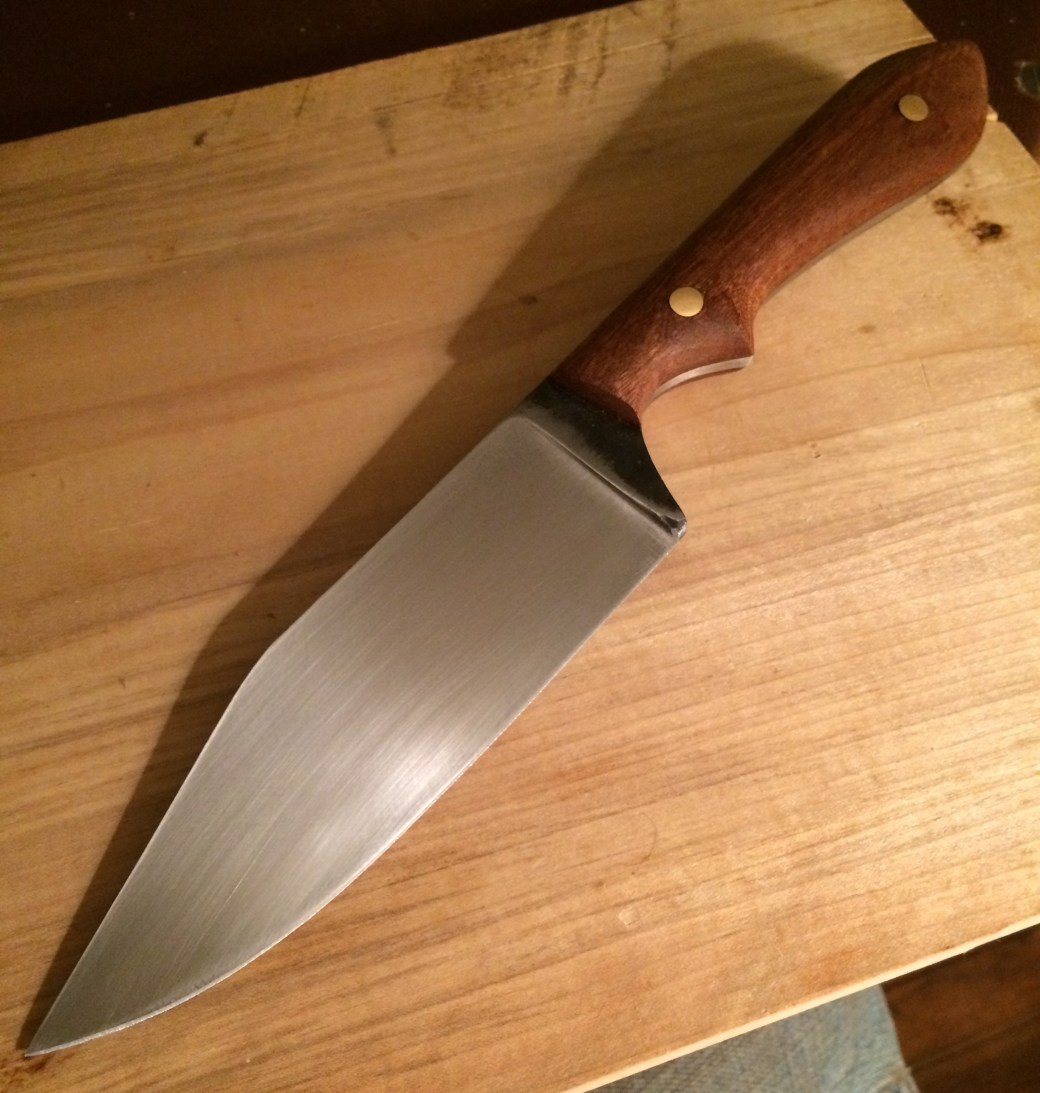
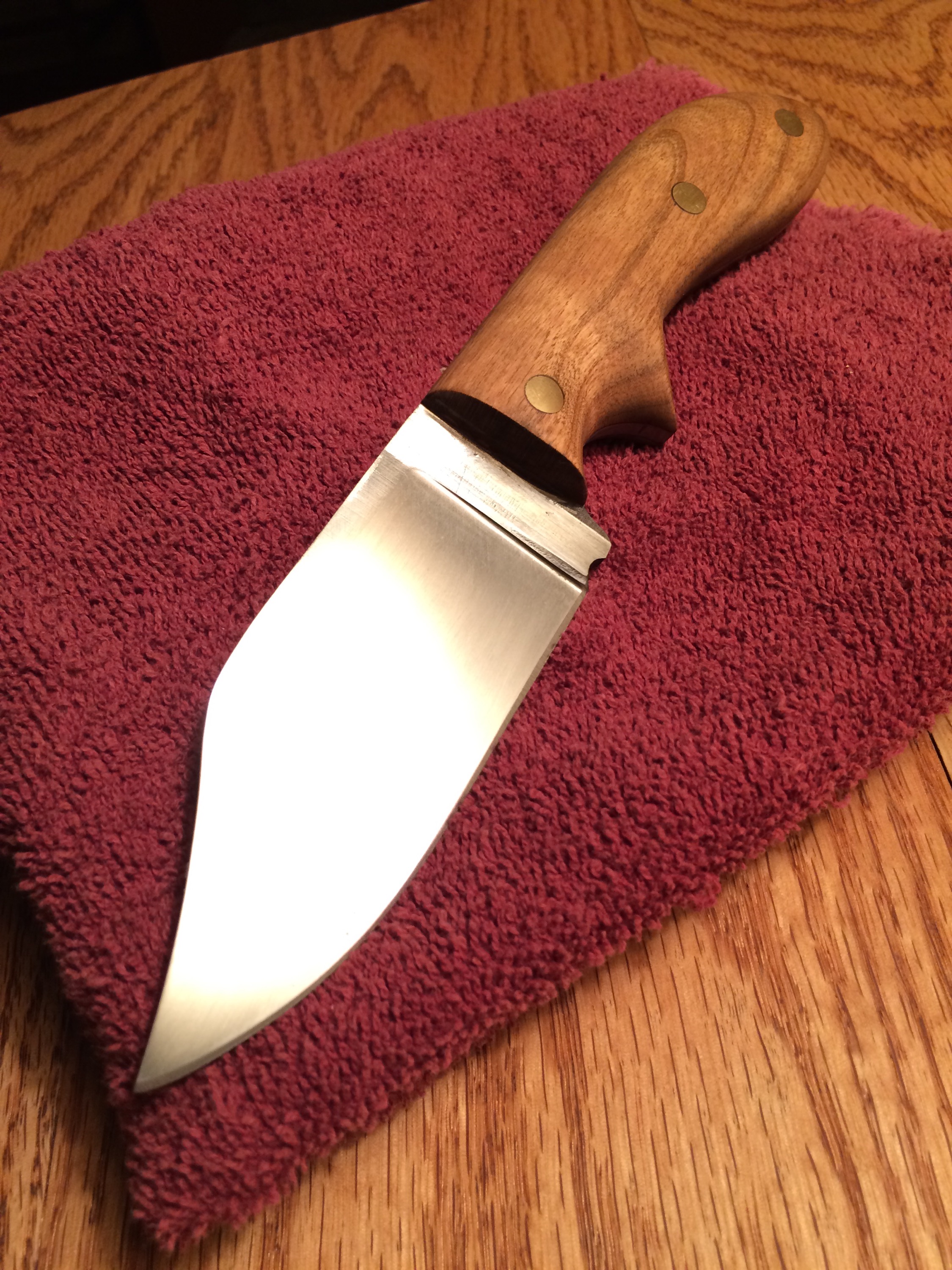
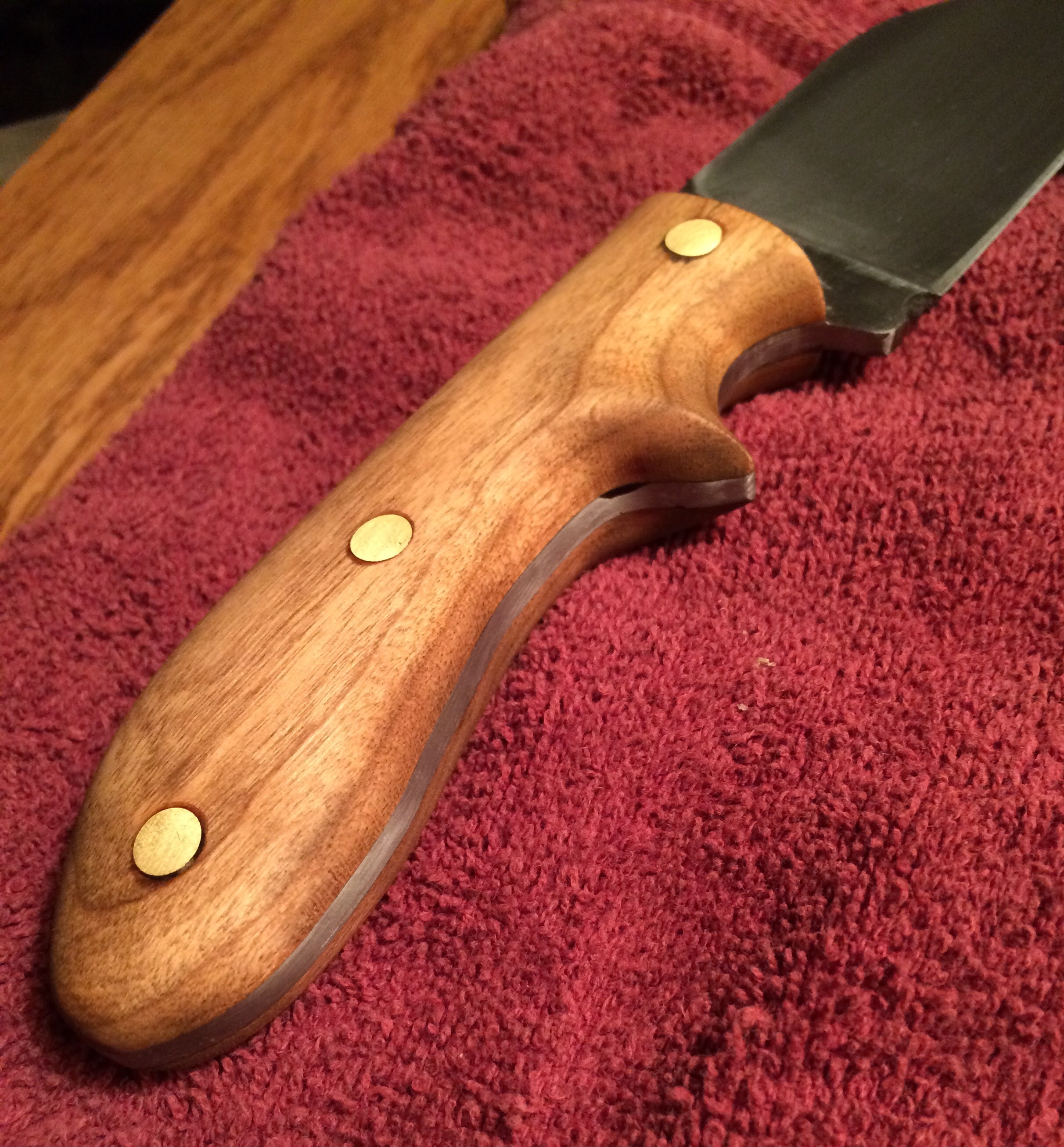
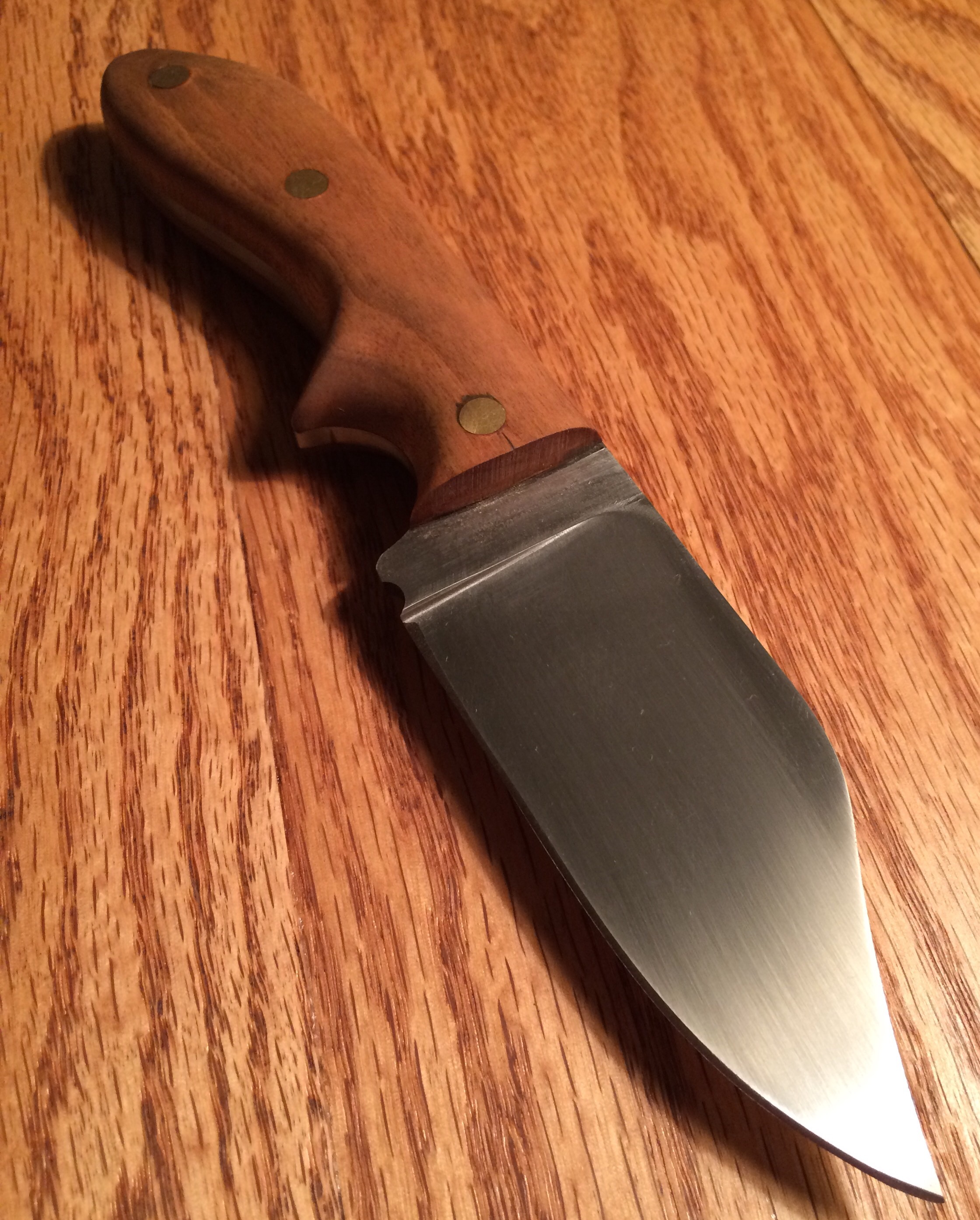
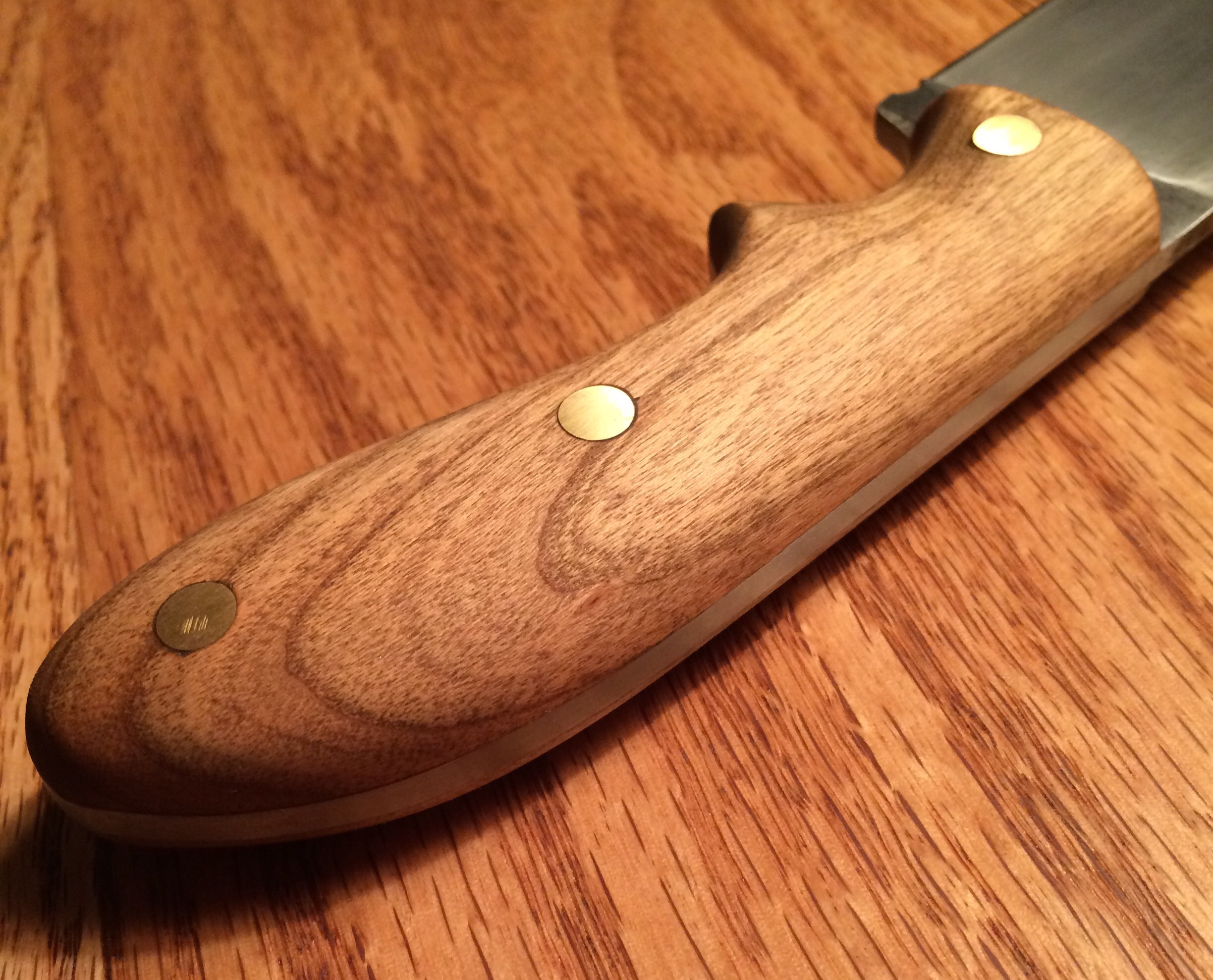
The Scout:


A little bit at a time.  Keep moving, even when it feels like everything is impossibly slow and it will never get done.  Challenge that, and walk your forest.  There’s plenty of time.

Knifemaking: playing your hand and The Wild Card

“Like I said, I’ve got mixed emotions about wild card games.  In one sense, they tend to bring out the gamble in your opponents.  They often create a carnival of excitement in which players give away a lot of money painlessly.  On the other hand, it’s hard to calculate a strategy for a game the dealer has just invented.”

Doyle Brunson- According to Doyle

I think the best definition of a wild card is something that can be what you need it to be, when you need it to be.  I have a friend like this- his name is Fred and I’ve written about him before.  I worked with Fred at the warehouse dealing with restaurant equipment.  During the tenure of our professional and personal relationship, Fred has set me on fire, twice, helped me fix my car, helped me fix my friends’ cars, helped me fix my girlfriend’s house, and showed me how to fix things I had no idea could be fixed.  The man has infuriated me beyond belief and has also made me laugh till I cried.  Fred is a wild card, a deus ex machina, the kind of person who can accomplish incredible things and can do it, most of the time, without having any sort of concrete plan.  Which makes it that much more infuriating to work with him and can also result in being set aflame…

I’ve always had this paradoxical sense of simultaneously feeling incredibly safe and slightly on edge whenever I worked with Fred.  We would go into jobs and everything that could go wrong would absolutely go wrong.  Somehow Fred would figure it out.  There was the time a one day job turned into three at a federal office building near downtown Washington DC.  A Japanese restaurant on the floor level of a building on Glebe Rd was going out of business and they had a very short amount of time to have everything removed.  The loading dock was in the basement and the bay door was two inches too short to get our tractor trailer in to load all the equipment out.  The only way to get everything out was through a single door at the front of the building onto the sidewalk.  We couldn’t get the truck there till two days later and we had to hot load it on the street, one of the busiest streets on the east coast.  The truck would be there at 3am.  In the mean time we had to dismantle everything in the restaurant, including a walk-in freezer, a walk-in cooler, fifty tables, and twenty hibachi grills.  I never want to move another hibachi table ever again.  Fred orchestrated the truck to get there half an hour after the door people removed the five thousand dollar custom glass door so we could get everything out of the building.  The truck was late and there was maybe two hours before the police would get there and make us move, but not before they asked up why we had a semi-truck, a forklift, and a truck with a tilt deck trailer in front of a government building with no permits.  Fortunately that didn’t happen and we got out of there in an hour and a half, smelling of old fish and rotten bok choy.

A lot of jobs happened this way.  None of this is an exact science.  On my better days I felt like a part of a black ops crack team.  On my not so better days I seriously questioned my life decisions.  None of it was ever boring, though.  Not with Fred.

There was an Italian man who had a few restaurants around town.  Crazy Frank we called him.  He had just opened up a new restaurant and had an emergency with his ice machine and a pizza oven we rebuilt for him.  Fred and I head over there at lunch.  The kitchen is insane.  I go over to the the oven and start to drill out holes on the door to put a handle on- bear in mind the oven is roaring at 600 degrees and has pizza in it.  Fred is reprogramming the thermostat on the ice machine.  It is the lunch rush and there are ten people running around, screaming in Italian.  Fred asked me if I had a ‘big ass college word’ to describe the situation.  I told him that I believed the word he was looking for was ‘asinine’.

“Right,” he says.  “This shit is asinine”

The most memorable job I was on with Fred was a three day bakery extraction.   Fred, myself, and our colleague and good friend Aaron were to fly to Nebraska, load an entire bakery into two tractor trailers, and then fly home.  Adventures started at the airport.  Fred and I are not fans of flying.  At the airport bar I had forty dollar margarita with a cornucopia of liquor in it and Fred had two double shots of Jack Daniels.  We got on the plane and promptly went to sleep.  We arrived in Nebraska that evening, picked up a swanky rental car and went to look at the job.

The first thing I noticed was that it was cold.  Like unbelievably cold.  It hadn’t really hit me at the airport.  This was January and I had never been anywhere that flat, windy, and cold before.  The second thing I noticed was a gigantic rotating bread oven.  Our client told us that it bakes 100 loaves an hour when loaded to capacity.  We would spend the majority of our time dismantling that hulking behemoth.  We got steaks for dinner, because that is what you do in Nebraska, and went to the hotel.

The next couple of days were stupidly cold.  The forklift we rented wouldn’t start most of the mornings until the sun came out.  We had to disconnect and extract the oven exhaust system, which meant going onto an icy sheet metal room.  We had to take that oven apart, which had nearly a thousand 3/4″ screws holding it together.  Fred was confident in his ability to get it all back together.

Everything went as it should, got loaded, and sent back to Virginia.  Our travels were slightly rockier.  There was an ice storm that closed the Chicago Midway Airport and we got diverted to Indianapolis where we sat on the tarmac for seven hours.  Seven hours of Fred without a cigarette.  Seven hours of Fred saying we should have rented a truck and driven to Nebraska.  Seven hours of Fred telling anyone who would listen that no one could keep him on that plane.  I was sitting next to a mother and her small child on their way to Disney World.  The husband and another little one were sitting behind me with Fred.  These little ones had a better grip on the situation than Fred.  Finally they let us off to catch a different flight, on a plane that wasn’t covered in ice.  It was all Aaron and I could do to keep Fred from using the company card to rent a truck and drive back to Virginia from Indianapolis.  Two double shots of Jack got Fred back on a plane.

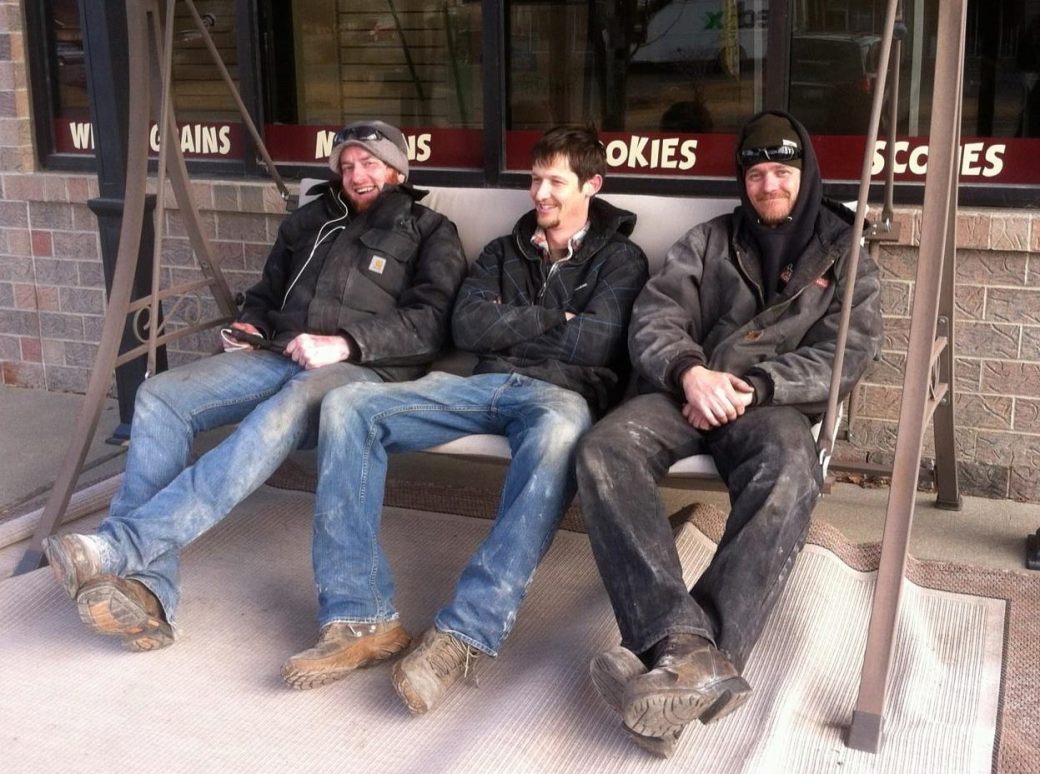
Left to right here is myself, Aaron, and Fred after three long, flour covered days in the cold.  Happy to be finished, thank you very much.

nebraska

Wild cards only work when you play them.  They do what you need them to do when you need them to be done.  This is Fred, and also the lesson of the Wild Card.  I wanted to build something to be sent in when the job needed to be done.

I started with a big hunk of 1095 spring steel- 3/16″ thick

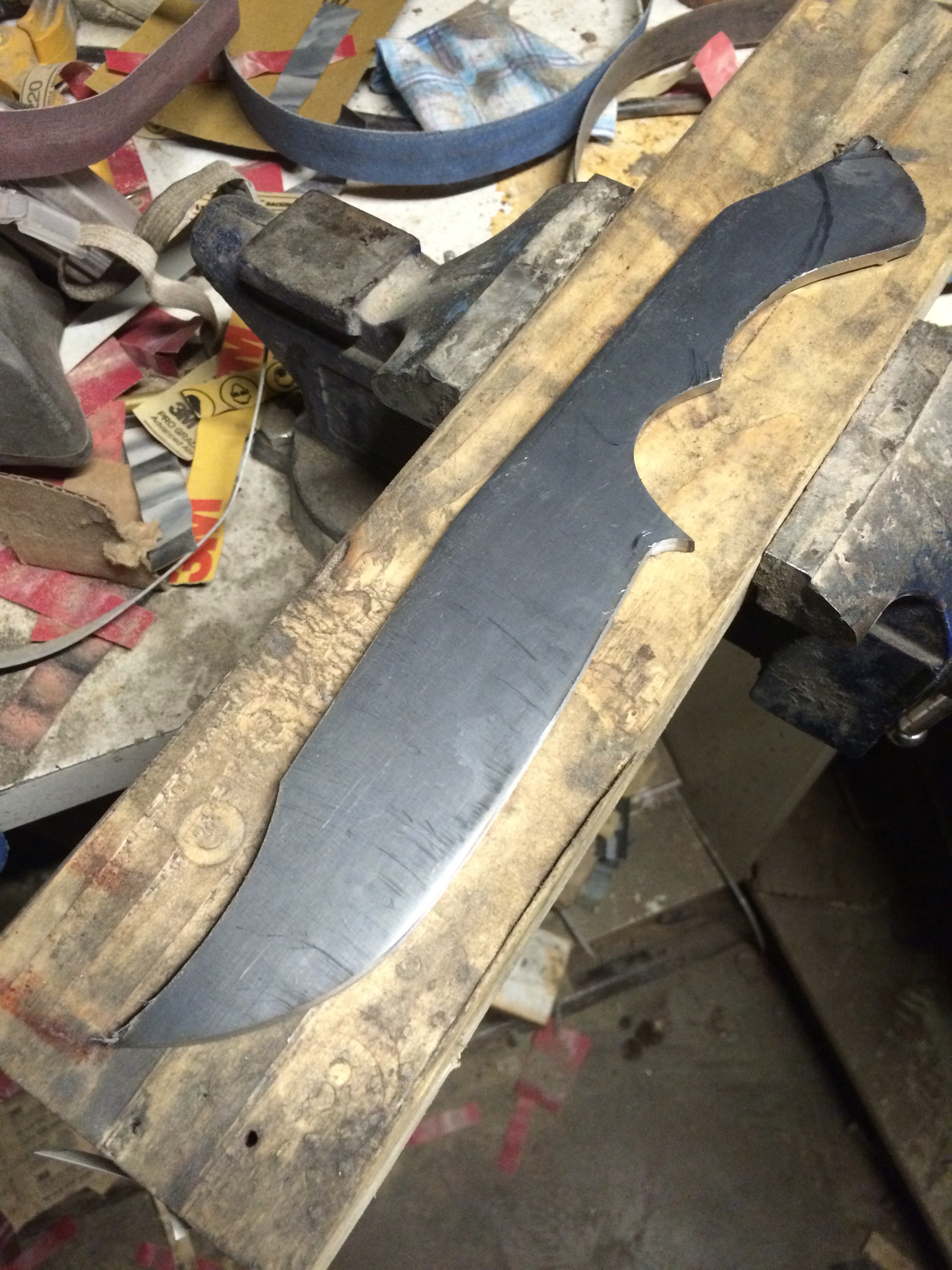
The blade is close to 8 inches long…
 Rough grind:   

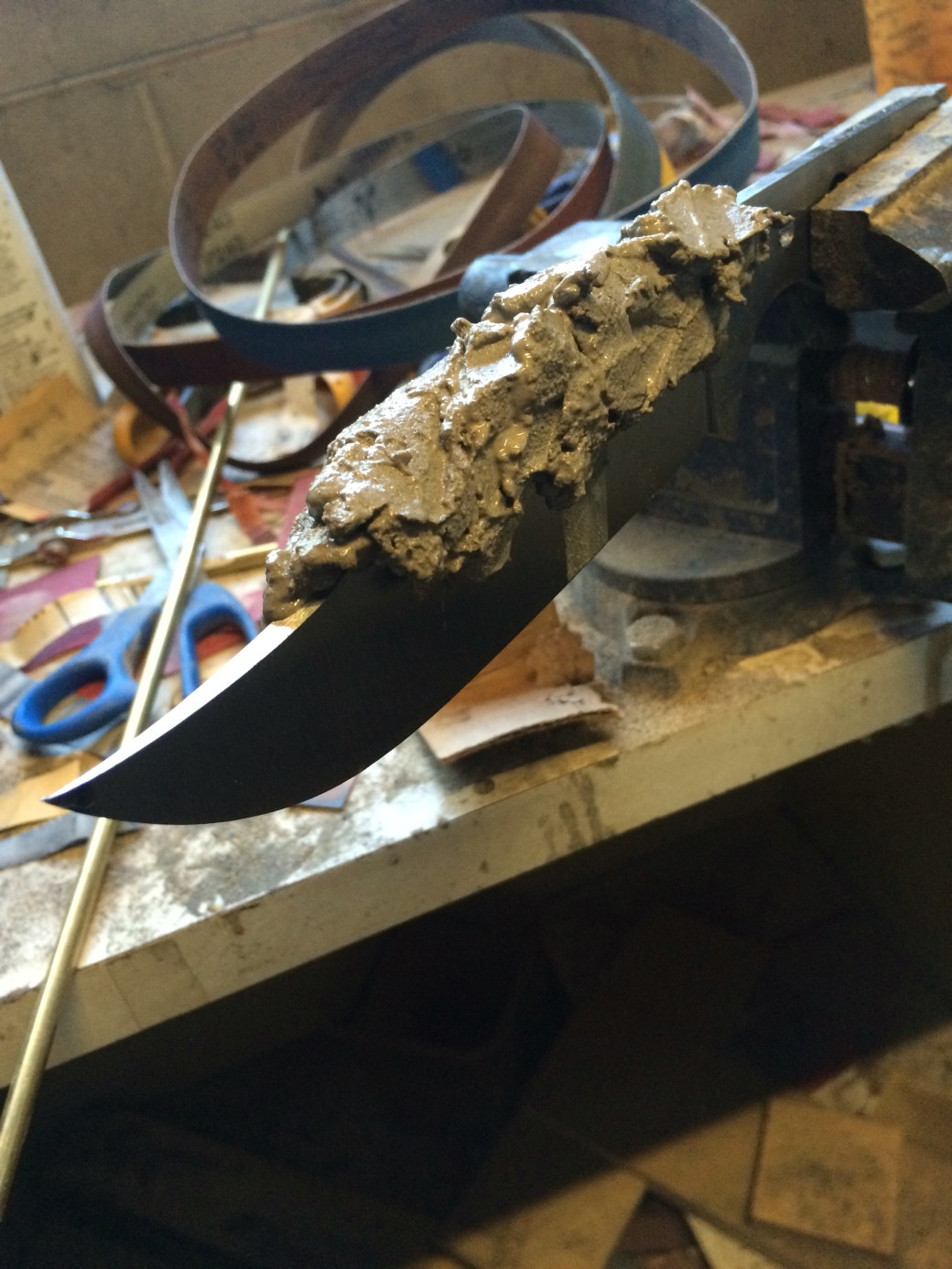
I used a clay hardening technique to create a Hamon

  Hardened…

…and tempered

Sanded to about 600 grit and ready to for a dip in the acid….

Curly Maple.  You can faintly see the wavy bits of curl…

Clamped.

To get the curls to burst I had to go through many cycles of sanding and staining and sanding again.  With each cycle the stain becomes more stable and prominent.

I cooked up a concoction using various finishes I have…

You can start to see the curls as the grain becomes more stable.  This is after maybe two cycles of sanding and staining

This is after maybe 8…

The Wild Card:

It’s always good to have a Wild Card in your hand- even when you want to kill them sometimes.

Thanks for the lessons, Fred.

Knifemaking: appearances, politics, and the Buffoon

‘Mr. Croup smiled. “You find us funny, Messire Marquis, do you not? A source of amusement. Is that not so? With our pretty clothes, and our convoluted circumlocutions—“

Mr. Vandemar murmured, “I haven’t got a circumlo . . . “

“—and our little sillinesses of manner and behavior. And perhaps we are funny.”

Mr. Croup raised one finger then, and waggled it at de Carabas. “But you must never imagine,” he continued, “that just because something is funny, Messire Marquis, it is not also dangerous.”

And Mr. Vandemar threw his knife at the marquis, hard and accurately. It hit him, hilt first, on the temple. His eyes rolled up in his head, and his knees buckled. “Circumlocution,” said Mr. Croup to Mr. Vandemar. “It’s a way of speaking around something. A digression. Verbosity.” ‘

Mssrs. Croup and Vandermar- from Neil Gaiman’s Neverwhere

1095 spring steel

  
I hardened this after grinding about 2/3rds of the way through.  I planned on grinding him rather thin and didn’t want to risk warping during hardening…
Deepening the plunge…

I have this buffoonish shirt that I don’t think I’ve ever worn…

img_3342

img_3345-1

After the fiberglass resin…

img_3353-1

img_3354-1img_3355-1

img_3356

IMG_3357

The Buffoon:  1095 spring steel, homebrewed linen Micarta handle scales, Kydex spacers, and brass hardware

IMG_3370

IMG_3367

IMG_3366

IMG_3371

buffoon

Be mindful of how we present ourselves to the world, and be wary of what those presentations may conceal.  There could be something deadly underneath.  This is the lesson of the Buffoon.

Knifemaking: going deep and the Kingfisher

When a needle falls into a deep well, many people will look into the well, but few will be ready to go down after it”

-African Proverb

I went to music school.  I was shown many ways to teach myself to be good at things.  I spent many hours in a practice room by myself, many more hours in front of a piano composing and arranging, and even more time listening.  To everything.  The education I got reached far beyond any classroom or practice space.  Life becomes those spaces.

Learning how to listen to things was the biggest lesson I learned.  When you listen, really listen, not just hear, your world opens up.  You notice all the nuanced bits of wonder.  As life gets busier and more complicated I still have to remind myself that it’s all still there, that it hasn’t and won’t go anywhere.  That within a world that holds a good deal of pain and sorrow for everyone there are also things that move and stir the soul, but they don’t always sit on the surface of our awareness…

There was one class that really opened things up and is sort of the inspiration for this writing.  It was called World Music, which is a rather vapid title for an experience that was so much more that.  It was taught by a very wonderful and kind man, one of the more enlightened people I’ve ever met.  Classes started off in silence and darkness, with the ringing of chimes.  Sometimes ambient music was played, or Tuvan throat singing, or guitar players from West Africa with rhythms I had never heard before.  There were many books to read, records to check out, and some of the most real discussions on being and the human condition that I have ever experienced.

It was during one of these discussions that something came up, and I don’t quite remember the context but it has stuck with me.  In the course of the discussion, it came up that our professor’s spirit animal was a dolphin.  He said that he was at the beach surfing when he was sixteen and nearly drowned and shortly thereafter found he related deeply with the dolphin.  The dolphin is able to dive very deep but always returns to the surface to breathe.  He told us he built his whole philosophy of teaching on that premise.

This is something that has been with me for awhile.  Sometimes you have to take a deep breath and go deep.  When you are exhausted, when it feels like life is more than you can handle, when you need to heal.  You can handle a lot more than you think you can but the tools and nourishment you need don’t always sit at the surface.  That doesn’t mean the process of finding these things doesn’t hurt like hell or isn’t terrifying at times.

Take the Kingfisher bird, for example.  To get the food it needs to sustain itself, it has to dive far beneath it’s comfort zone.  They sit on their perch overhanging the water and when they see their prey they dive, eyes closed, into the deep.  I think about this and wonder what is going through his little bird brain before he hits the water…

kingfisher

This is the lesson of the Kingfisher.  You close your eyes, you dive deep, and you come up with something nourishing.  Repeat as necessary, adding faith and a bit of courage as required.

I wanted to make a filet knife, something to help me dive.  I made her out of a thin piece of bedframe steel.  She has a 6in blade.

I initially ground two of these, but one didn’t turn out.  I left it soaking in the acid too long (for a deep etch) and there wasn’t much blade left….

My very dear friend James did the handle on this one.  She has Mora wood scales and brass hardware.


My good friends Mike and Jen using the Kingfisher to de-bone a goose… 

Sometimes you have go below the surface of things to find what you need.  This is the lesson of the Kingfisher.

Knifemaking: armor, mobility, and the Archer II

“ARMOR, n. The kind of clothing worn by a man whose tailor is a blacksmith.”

― Ambrose Bierce, The Unabridged Devil’s Dictionary

(you can read about the crafting of the original Archer here)

We all put on armor everyday.  Some of us put on more than others.  Sometimes it physically manifests.  Hard hats, steel toes, wingtips, neckties.  Some ladies refer to their makeup as war paint, another type of armor.  Other times it’s more subtle and subdued- the way we carry ourselves, our use of vernacular in particular situations, and the image of ourselves that we present to the world.  All these are things we do to protect ourselves.

A few years ago I had a temp job working construction over the summer.  The company I worked for had a contract to build all of the temporary structures for the Boy Scout National Jamboree.  I spent almost four months driving to a military base in the middle of nowhere.  I use the term base loosely.  It was really just a giant campground guarded by military police, and all of the campers carried semiautomatic weapons.  In four months I used a flushable toilet maybe three times.  The cast of characters I worked with were a colorful lot.

My boss was a Brazilian Jui Jitsu master.  He got to work before everyone else and ran five miles on base.  Some people have coffee before they start work.  Our mornings with him consisted of tapping out of sleeper holds, arm bars, half nelsons, and doling out mollywhops of a variety I’ve yet to experience again.

One of the other gentleman did a ten stretch for first degree murder, which nobody found out till the work contract was almost up.  The base knew he had a twenty year-old felony and vetted him for a base pass.  I’m not exactly sure what this means, but military bases generally don’t mess around.  He did good work and kept to himself.  He was married to a florist and had a house in the country.

Then there was the gentleman who had just gotten out of jail for beating the the hell out of a guy with a tire iron.  He was drunk and thought the guy was stealing his car.  He was there trying to pay off the lawsuit and lawyer’s fees.

Another gentleman I worked with had severe anger management issues and was there because he was dating the company owner’s daughter.  He had a degree in English and was trying to get into law school.

There was Jose from El Salvador who had four children and was still madly in love with his wife.  He taught me filthy things to say in Spanish.

There were two football players on break from a small conservative college.  They said they were there earning beer money.

Then there was me.  My car had died and I needed to buy a new one.

I spent four months with these guys, riding around in the back of a decommissioned deuce-and-a-half, building things, and hearing stories that I’m still not sure if I believe or not.  In these sorts of work environments a decent amount of posturing and exaggeration is to be expected from almost everyone.  Despite their checkered backgrounds, these guys were not terrible to work with.  Nothing felt unsafe except for the blistering heat, the bird-size mosquitos and the morning mollywhops to which I became adept at parrying.

Just to be safe I would put on some armor everyday- a bit of bravado, a bit of flash, a bit of the grandiose.  My nicknames reflected that.  The Viking.  Sledgehammer.  Red Devil.  I was lifting a lot of weights and I was not a small man.  It helped enforce some social boundaries.  At the end of the day I could usually take it off, or so I thought.

The type of armor a lot of these guys wore- they couldn’t take it off.  This was how they lived and you could feel that they had worn this armor for a very long time, so much so that it became a part of their being.   There were scuffles, gruff talking, machismo.  Everything was laced with an extra scoop of testosterone.

When you wear heavy armor you are shielded from many things that can hurt you.  The drawback is that you shield yourself from the things that help you as well.  You block out grief but you also block out the serenity that in time comes with it.  You block out pain but you are also blocking the healing that follows.  You can become a shell of yourself.  The armor becomes limiting.  You can’t move and you become horribly stuck.

What happens when you do decide to take the armor off?  When you aren’t hiding behind any sort of bravado or grandiosity or gestures or facades?  There comes a point where it becomes more painful to live with the armor on than off.  You take the armor off and let the world in.  All of it.  The world becomes overwhelming.  You’ve put on a different set of armor, something that allows you to breathe and move and serves you in a much deeper capacity.

This is the lesson of the Archer.  To lightly armor yourself so that you are protected, yet you can still hit your marks with a deadly precision.  You can move farther and faster and feel much more deeply.  You become more aware and but find that you require a different sort of care for yourself and this may feel foreign.  You feel pain more acutely but the healing becomes more available to you.  The things you put out into the world feel more genuine.

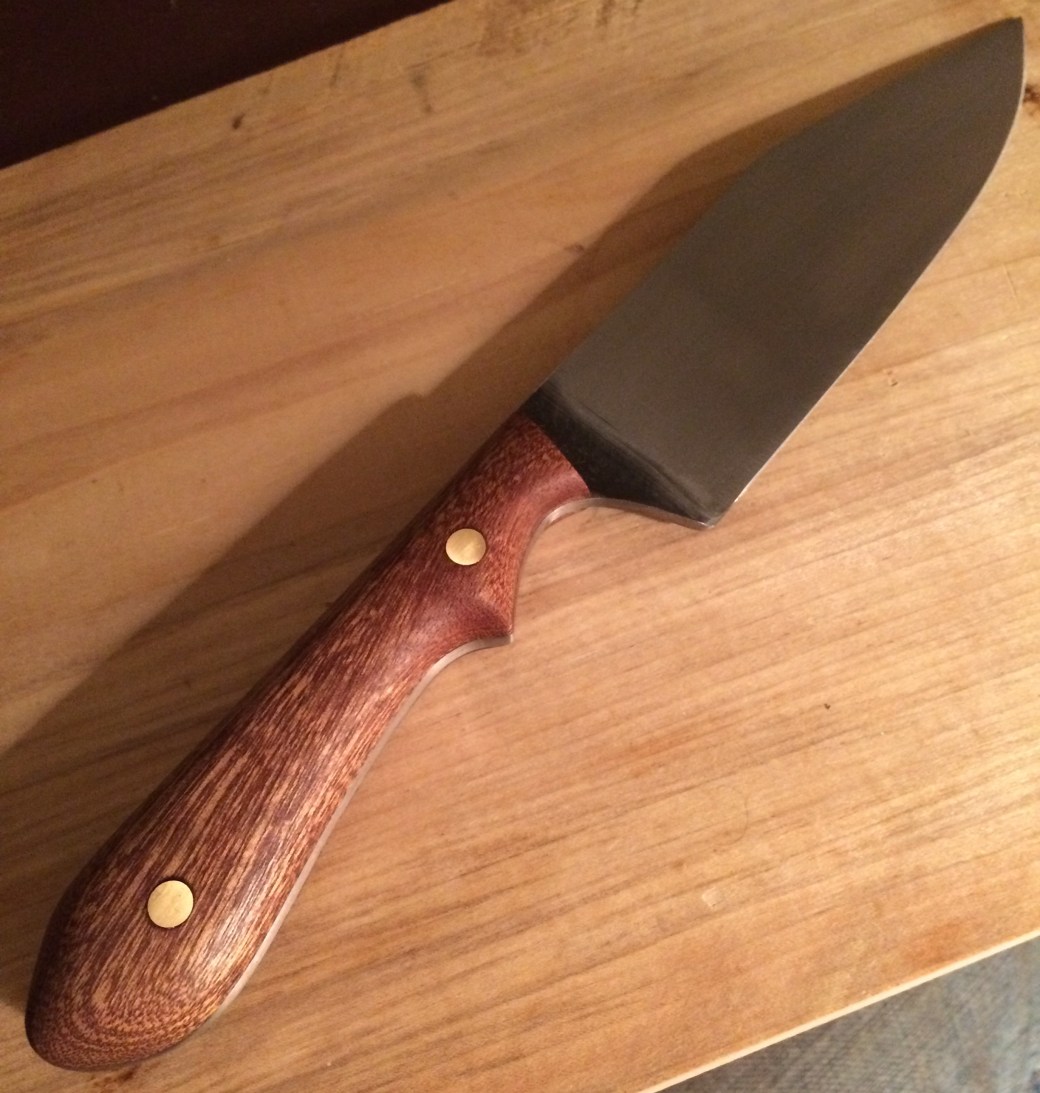
For this blade I wanted something long, sharp, and elegant.  I designed her for the kitchen.  She is ground thin and a bit more fragile- at one point I dropped her on the concrete floor and the tip blunted a bit.  After a bit of grinding she was alright.

FullSizeRender 7

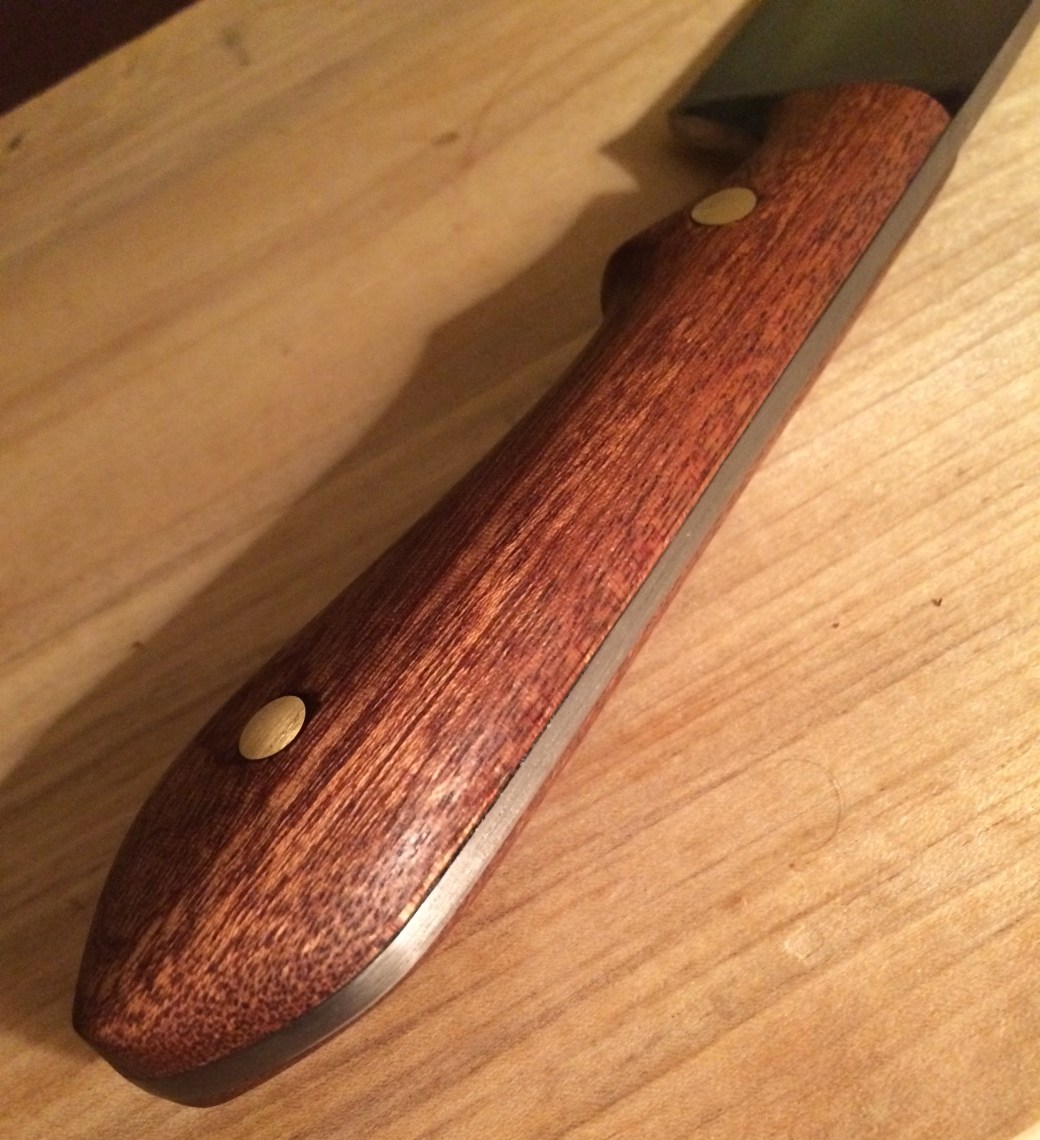
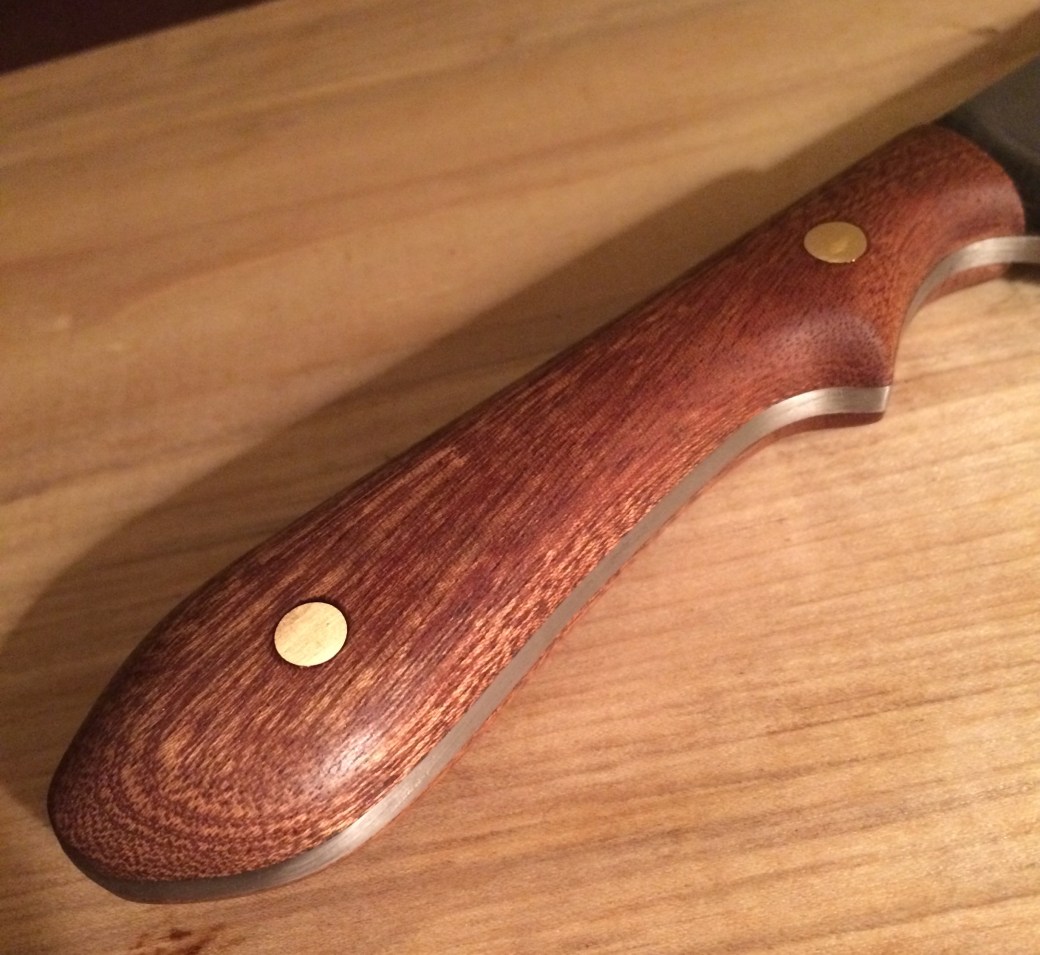
The Archer, Mark II: 1095 spring steel, Sapele handle, brass hardware

FullSizeRender 5

FullSizeRender 4

FullSizeRender 6

FullSizeRender 3

FullSizeRender 8

Take your time and adjust to this new armor as the world opens up to something beyond posturing and mollywhops.  This is the deeper lesson of the Archer.

Knifemaking: creating space and the Pas de Deux

“You want to make two knives that become one.  Or perhaps one knife that becomes two.”

Igor Antonov


Over the years I’ve quite a bit of production work for the ballet company in town.  Building things, running a shuttle, being part of a crew that makes something special happen.  My most favorite part of the work I’ve done is a program called Lecture Demonstrations.  This is a fancy name for kiddie shows; in-school performances, where the company puts on performances for the children.  The company manager would line up shows at elementary schools and take care of all the administrative details.  I would show up to the ballet, load up sound equipment, props, costumes, and half a dozen dancers into a minivan and go to an elementary school, chat with school administrators, set up the sound system, wire up the lead ballerina, start the show, and punch the mic and music cues.  After the show everything would get torn down, packed up, and loaded into the minivan along with myself and the dancers.  Then we went to the next one.

The performance was an adaptation of “Coppelia”, made easily digestible for second graders, complete with talky bits and a question and answer.  The kids enjoyed it.

I feel most people who have seen any sort of ballet video or performance have seen the lady in the tutu dancing with the man in tights.  This is called pas de deux- French for “step of two”.  Man and lady dancing together.  Very simple on the surface.

Over the course of a month and a half we did two of these a day, four days a week, plus rehearsals.  After watching about 60 of these shows, I found that I really looked forward to the two sections of pas de deux in the program.  I loved the balance of the masculine and the feminine.  I loved the interdependence of the dance- they are both separate entities.  The beauty comes when the feminine surrenders to the masculine.  The masculine leaves a certain space for her to shine, for her to be what she is.  In doing what she does, the feminine leaves space for the masculine to be what he is.  Trust permeates throughout.  They both have their own identity but together they do things that individually they could not.

I had an idea for a knife.  There is a wonderful Ukrainian gentleman on the artistic staff who would come to these performances and give notes and critiques to the dancers on how the performance could be better.  He also gave me critiques on the the technical side of things.  After one of these critiques I told him what I do and how to work the pas de deux into it.  “Ah,” he says, “You want to make two knives that become one.  Or perhaps one knife that becomes two.”  I had to think about that for a couple of months.

To flow seamlessly between separate and together- this is the lesson of the Pas de Deux.  To leave space for things to be what they are while maintaining one’s own identity.  It is in this space that intimacy exists and blossoms.  To be so secure in oneself that submission requires small effort.  Sometimes we hold on to things so tightly that there isn’t any space for the things we need.  Sometimes there is a great amount of space and everything may seem  to sprawl and lose form.   Always, at the end of it all, everything ends up where it is supposed to be.

I chose to make one knife that became two.

First the feminine…
Rough grind  Hardened 

Purple Heartwood  


Here is where I had to take the handle off and put a new one on.  I couldn’t quite get that little tail to bond to the tail of the tang.  In the next picture you see the new handle with two little brass rivets.

 Now the masculine…

Hardened

Tempered


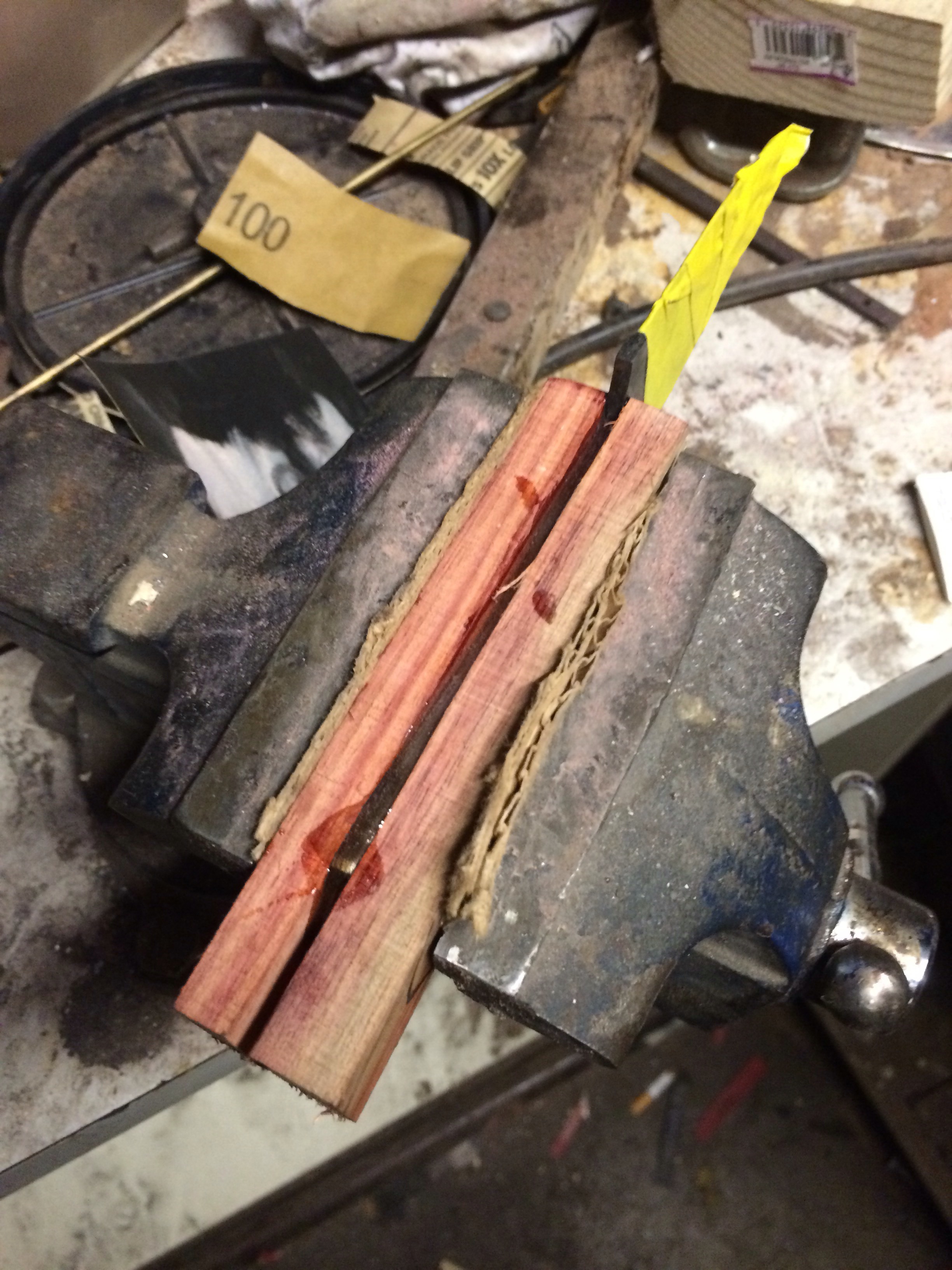
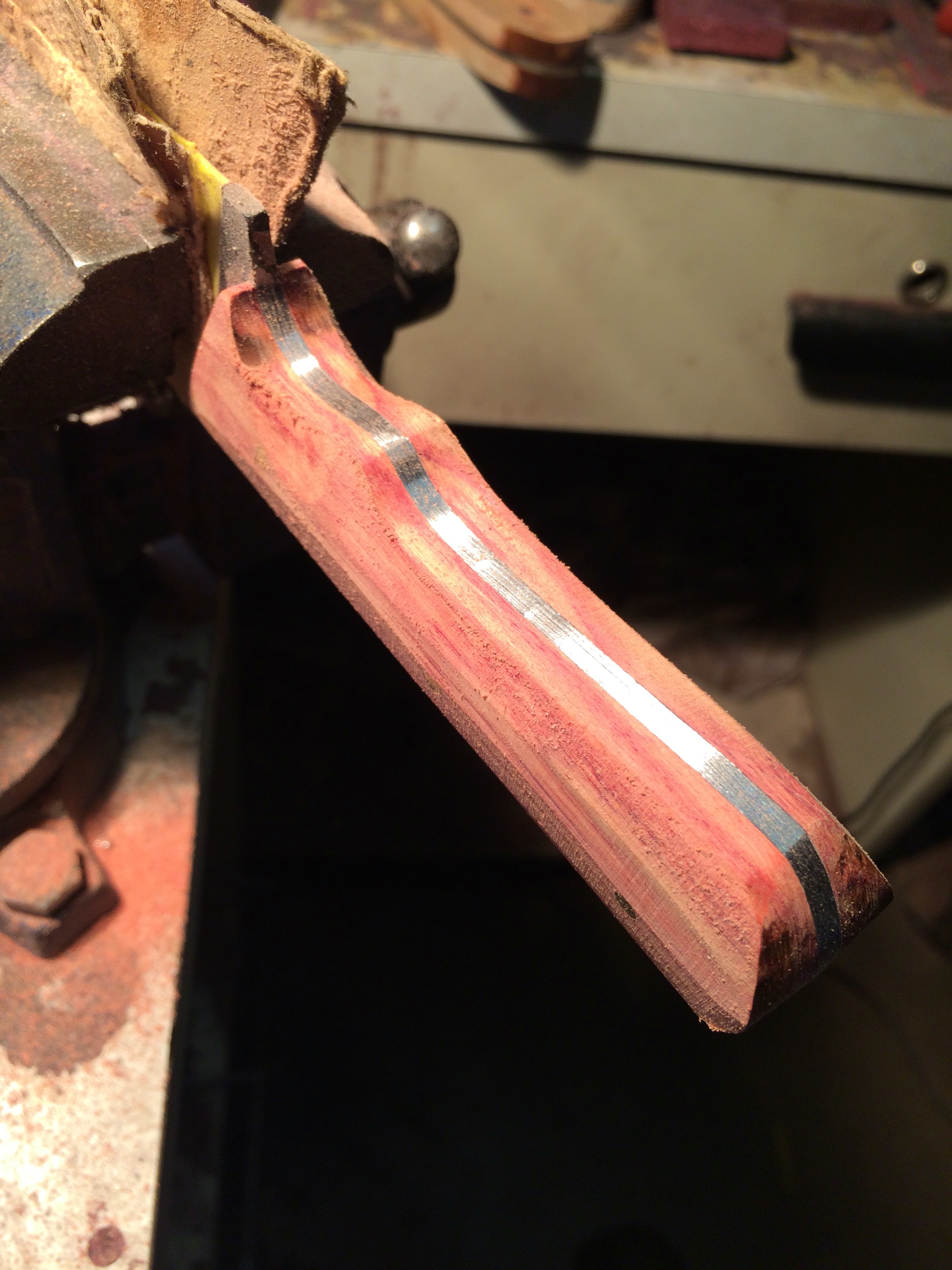
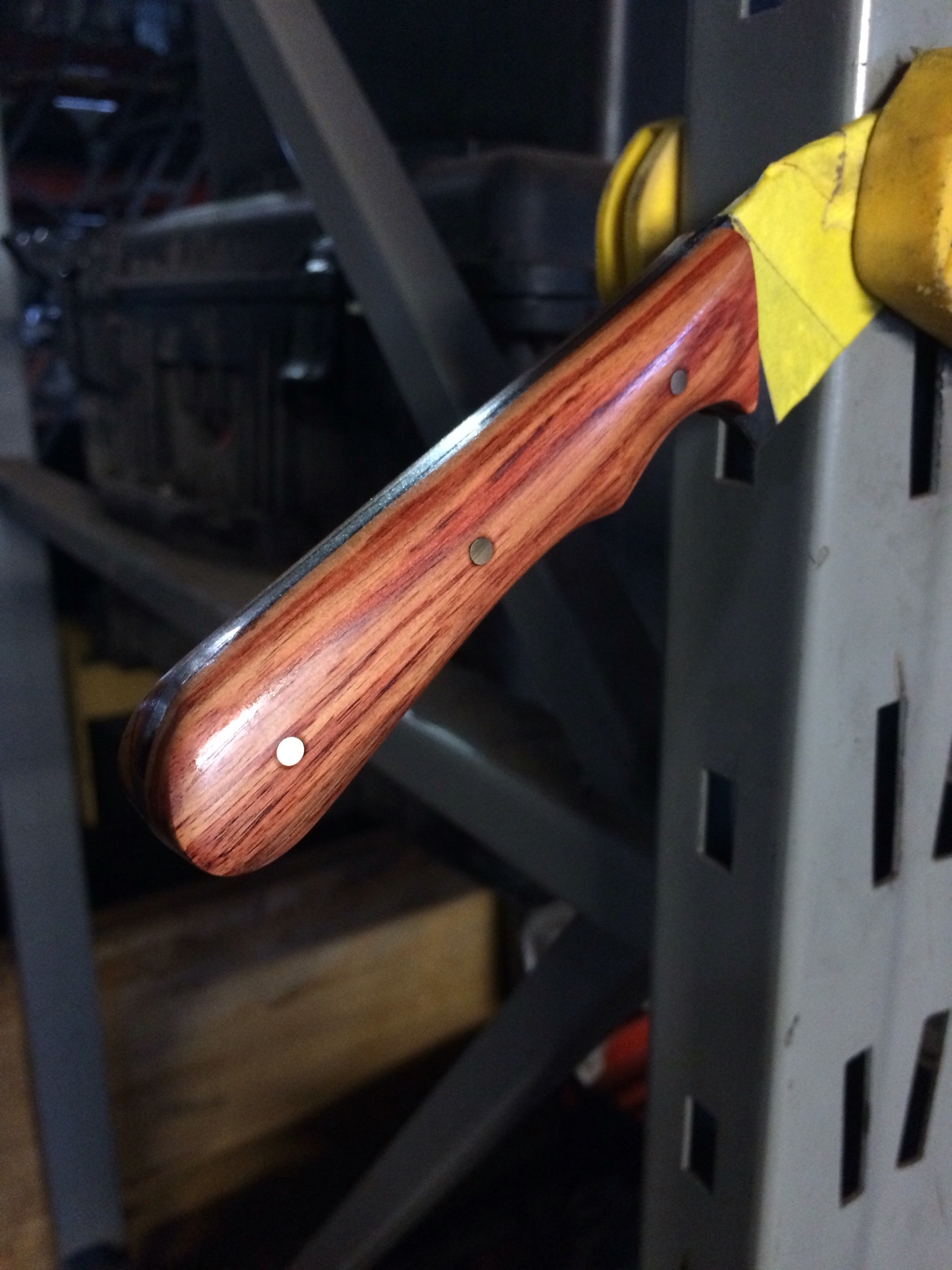
Tulipwood for him

Now the stinky part… 


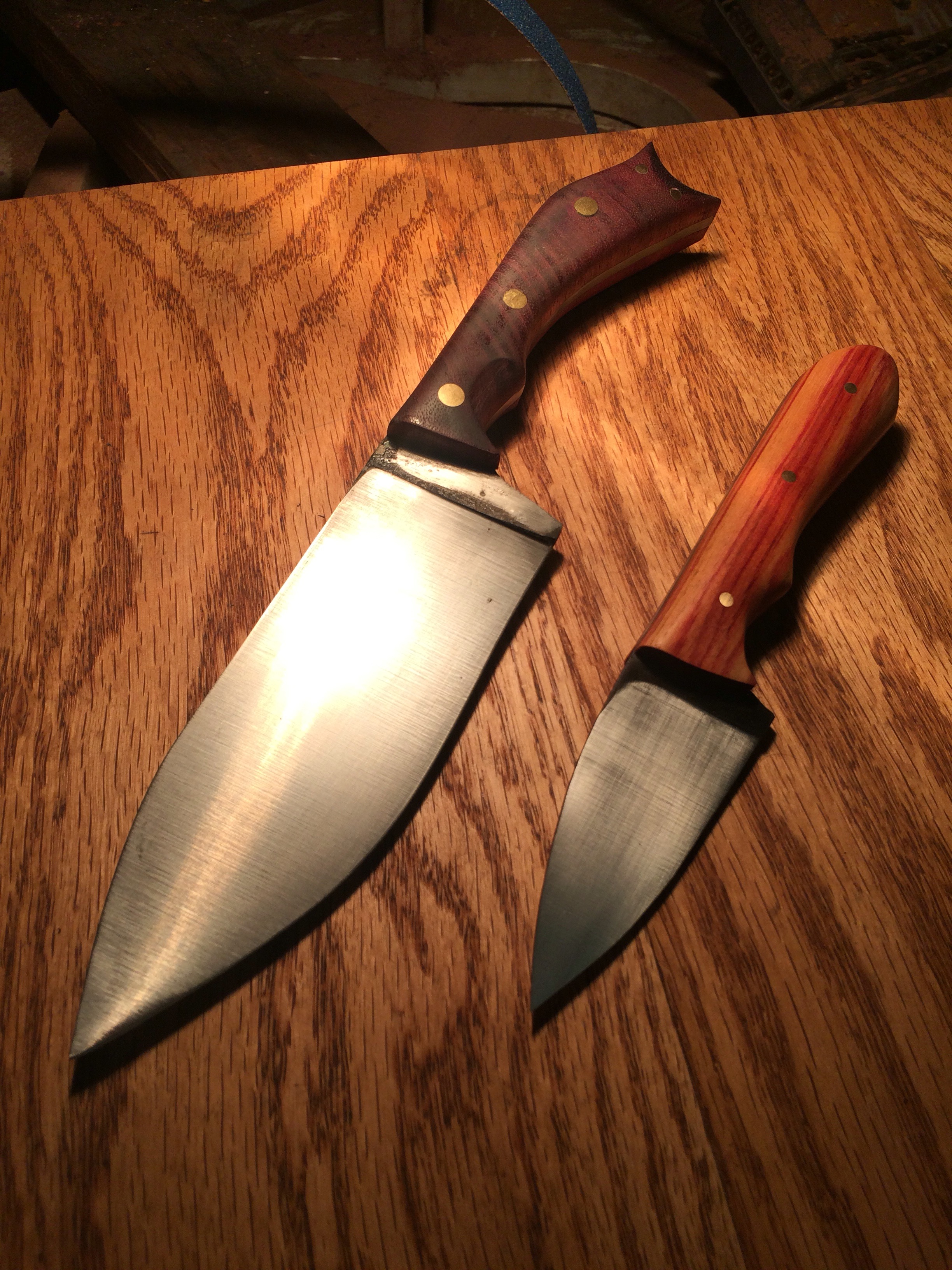
The Pas de Deux, a kitchen pair: 1095 spring steel

The feminine is Purple Heartwood with brass hardware

The masculine is Tulipwood with brass hardware


Embrace the space.  You and your partner, in whatever form they may take, will both shine.

Knifemaking: mistakes, tedium, pizza ovens, and the Cynewulf

“I’m not exactly sure what we’re doing here, so we’re going to figure this out by denial and error”

Frederick Pritchett, Jr.

I spent two years working in the warehouse of an auction company.  They specialize in used restaurant equipment.  All aspects, from tables and chair, mixers, slicers, refrigeration, the whole lot.  I kind of fell into this job and ended up managing the inventory and auctions.  But before that there was a lot of grease, dirt, rust, and burnt pizza…

A couple years ago I was in a tough place and I needed money.  A good friend of mine said I could come work for his auction company.  One of the first things they put me on was cleaning three commercial smokers.  They had spent three months festering in a hot warehouse and smelled of what I believe a sauna full of garbage trucks eating month old Vietnamese food would resemble.

It was here that I met Fred.  As I stood there with three stinking smokers, pondering my life’s decisions, the service tech came by and told me the best way to get those clean was to mix some bleach and ammonia together in a spray bottle and shake it till it got hot (“But don’t hold on to it for too long or it’s liable to explode”).  Then I was to saturate the interior, let it sit in the sun, and then hit it with the pressure washer that got up to two hundred degrees.  All while not breathing in the fumes.

I did all of these things and sure enough they got clean.  I hated myself a little bit.

The main thing I learned working here was that there are many ways to get things done.  Some ways are less insane than others, but then sometimes life calls for the insane.  Sometimes the insanity is all relative.

I also learned that in any sort of business one has to adapt to what makes money.  If that doesn’t happen then you’re dead.

One of the owners is second generation Italian and as it would follow many of the company’s customers were Italian.  They liked to support one of their own.  For awhile there were a lot of Italian restaurants opening up and these gentleman required pizza ovens.  Pizza ovens are heavy, expensive, and take up a lot of space.  Pizza stones for a double deck oven will set you back at least $600 and if not properly seasoned will crack or break.  It was decided that we would rebuild used ovens.

Here is where the adaptation of making a profit and the insane got together for a tumultuous marriage.  At first.  After awhile things settled in.  Fred was at the helm of this operation and we all moved bravely forward.

The first step was obtaining a used pizza oven.  We travelled far and wide.  One time Fred and I did a marathon drive to a closed restaurant in Florida, extracted a 3,000lb set of Baker’s Pride ovens, threw them on a trailer, and drove back.  Fred is really good at moving heavy things and makes it look effortless:  I’m pretty sure his ancestors built Stonehenge using nothing but Druid redneck ingenuity and several barrels of barley wine.

We would then strip it down to nothing.  Exterior paint was taken off and everything was sanded.  Everything.  For a solid month we cleaned out every Home Depot within a 20 mile radius of most of their abrasives.  Figuring out how to get the exterior paint off was tricky at first. Stripping the paint off the first oven we did was a bitch.  First we tried a blowtorch.  A pretty big one.  It didn’t work that well and made everyone smell of burnt pizza.  Then we tried every sort of angle grinder attachment known to the universe.  There was no quick way to do it.  All of the inner structural pieces had to be sanded as well.  Somebody would have to put on a paper suit and climb into the behemoth and sandblast it.

In the process of anything worth doing you encounter tedium at some point.  When tedium mixes with not knowing exactly what you are doing, self-doubt can settle in.  It becomes hard to focus and in this lapse of focus mistakes happen.  This is where many people either give up or figure it out.  We couldn’t give up because then nobody got paid.  Fred kept us all on task, for better or worse.

It is also in this tedium that you can find out a lot about yourself.  How you operate and what lies at the bottom of that self-doubt.  If you can be with that long enough you can start to blossom.  The things that used to hurt you start to help you.  I found myself making these really kick-ass playlists and began to appreciate the nuance of Barry Manilow.  When I got home completely covered in shit I would take a viking shower and cook myself something special.  All of the other side jobs I had became a pleasure.  I would see myself as a warrior, bravely defending the honor of the Oven of Pizza, and all of those who came before her.

I would go in and stare these things down everyday.  Sometimes it was overwhelming, sometimes time flew by.  Days of sanding, painting, polishing, going to the metal shop to have a piece refabricated, or having a special tap set ordered.  It was an adventure.  I’m glad Fred was in charge because I would have told the Italians to figure something else out.

Another area of tedium was polishing.  I spent many hours with a Scotch brite pad and 000 steel wool trying to make these things shine.  This was about the time Mr. Al joined us and as fate would reveal he is actually the Stainless Steel Whisperer….

10168183_783824618296889_6605906676728570069_n

After Fred put new burners and controls in they would be ready for delivery.  It was a sprawling process.  At the time I stopped working there, the process was down to a week and a half to two weeks, start to finish.  They ship them all over the country now.

 This is the lesson of the Cynewulf.  Life can be a sprawling, tedious process.  It can be hard to stick with something and not being able to see where it is taking you can make it harder.  Instead of seeing yourself as the warrior you start to see yourself as the oppressed.  Momentum can turn to stagnation and focus can lapse.  You begin to question your life decisions and maybe sometimes you hate yourself a little bit.

I find myself in these places more often than I’d like.  And what I’ve found is that it’s not necessarily a bad thing.

This blade took me on a journey.  I had to start over after I had spent quite a bit of time on it and I got really frustrated.  The name Cynewulf means “Royal Wolf”, which relates to the regal bearing and balance of this blade but also to the ability to not get stuck in one’s mistakes or complacent with one’s successes.  It’s quite large at 8 inches and 13 inches overall.  It was really tricky to heat treat in my little forge.  I hammered it through some 2×4’s just to make sure she was ready for the world.

1095 spring steel

A rough grind
Ready for the forge

Phosphoric acid etch…
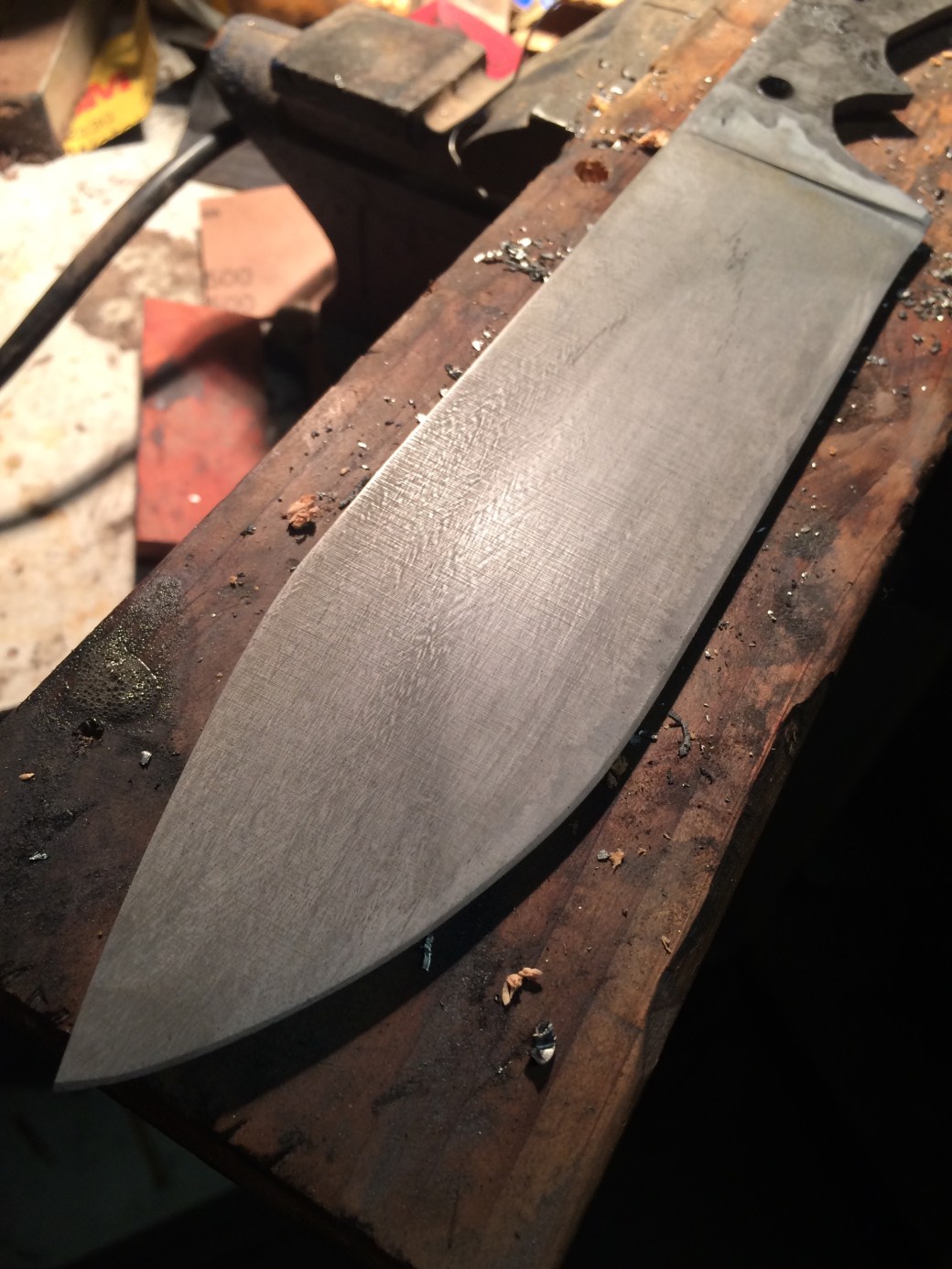
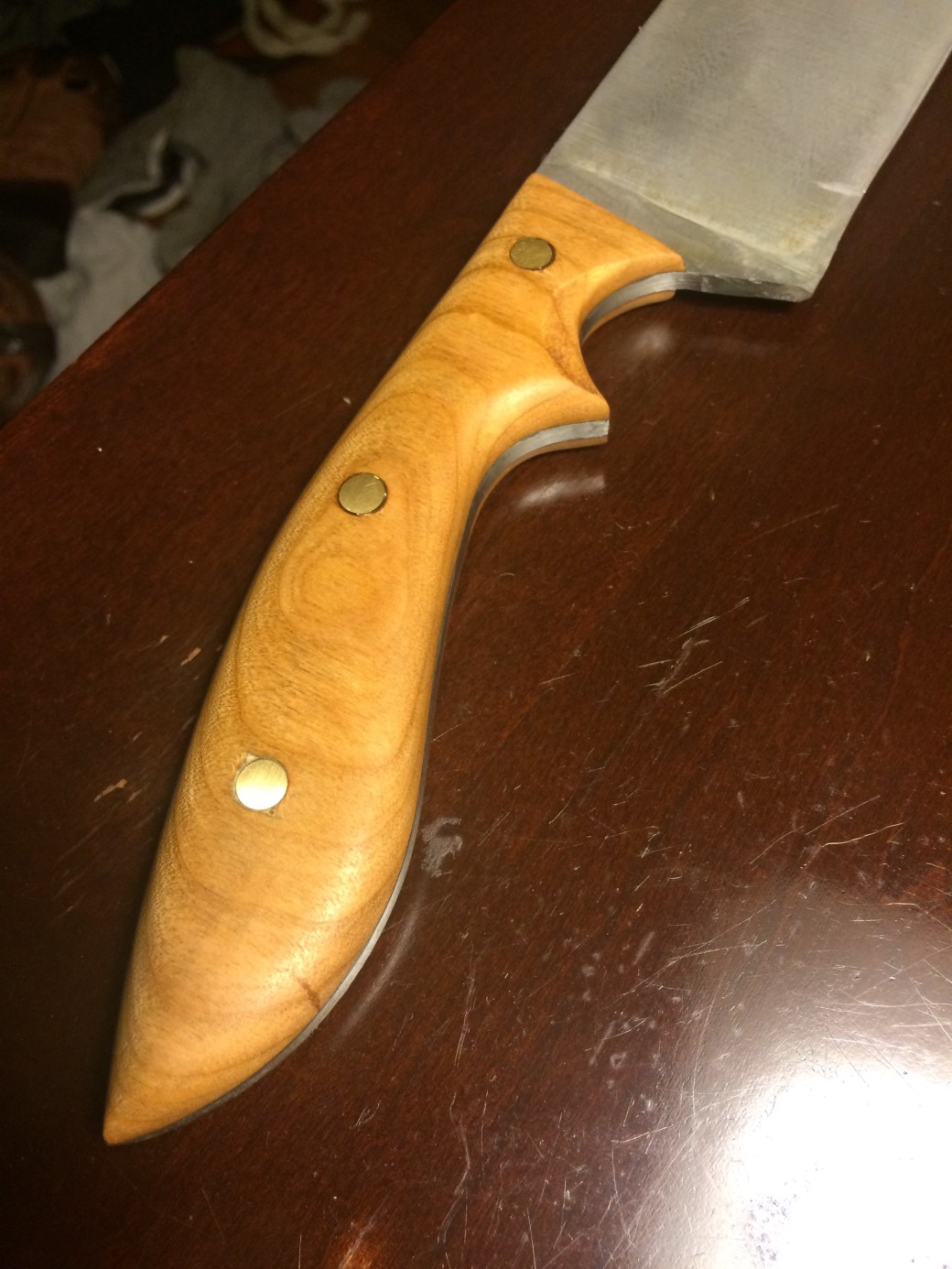
 The Cynewulf: 1095 spring steel with an acid etch, Cherry handle, and brass hardware. 


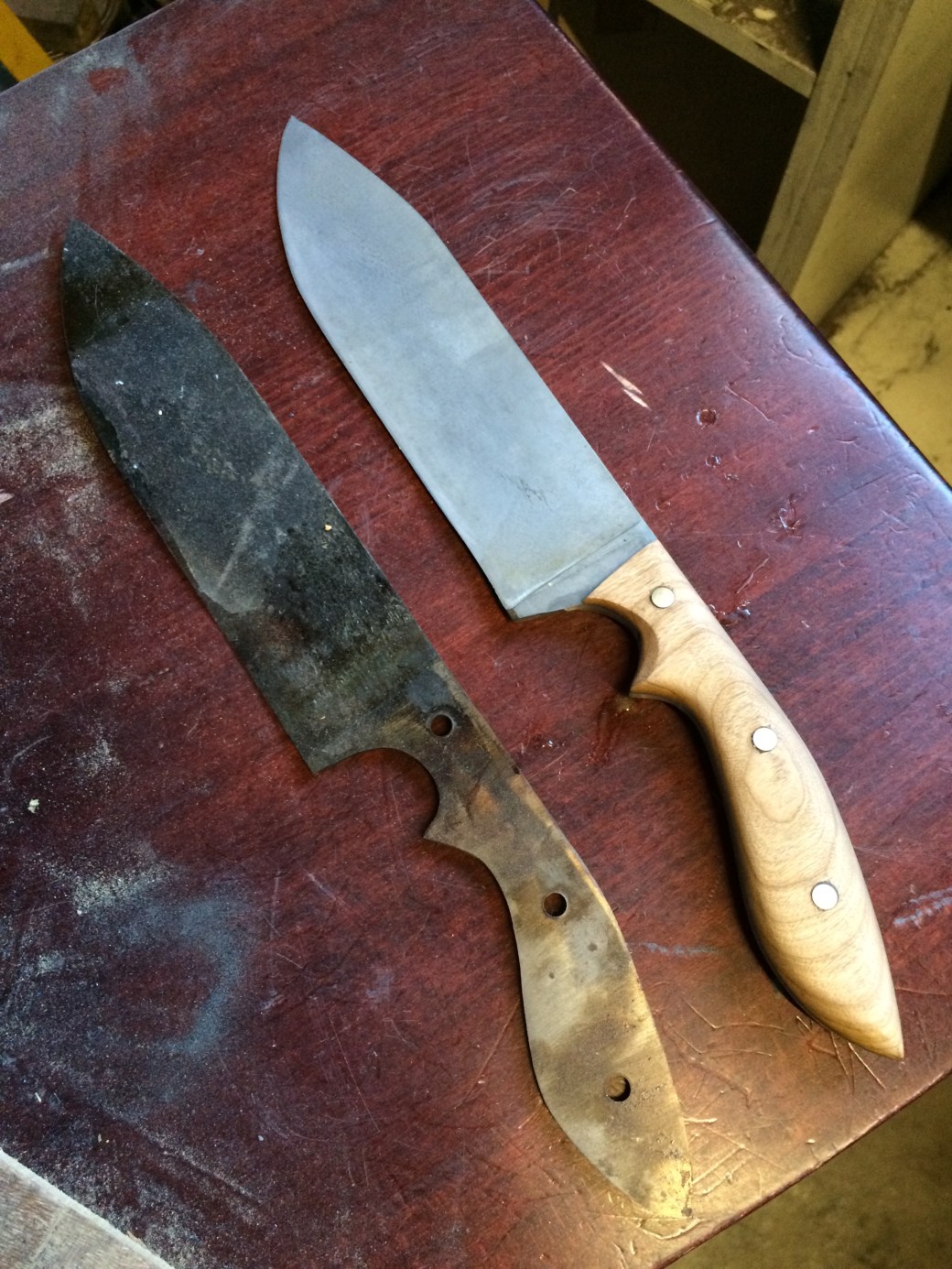
  The Cynewulf, with her fallen sister…

I gave this to my chef friend to try out and he ended up buying it on the condition that I customize it to his specifications, which I did.  You can already see the patina starting to reveal itself from the potatoes he sliced…
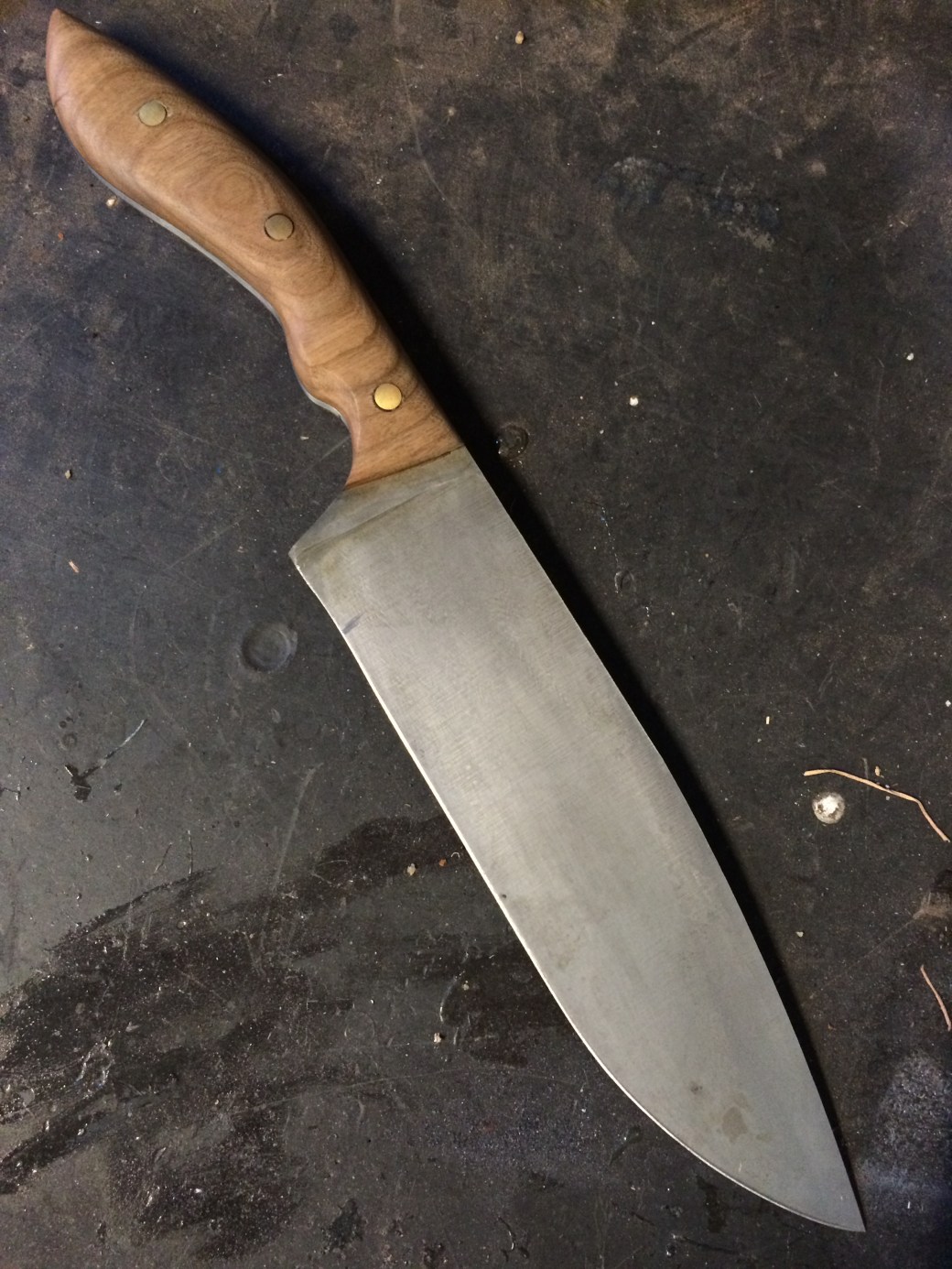
IMG_2887

Work through the tedium and pay attention your mistakes.  Even the kingliest and queenliest people make them and there are many possibilities in them.  There may be some pizza in it at the end…

Knifemaking: the courage to be and the Ace

“If you love something, you know what the best in the world actually looks like.”

James Altucher


This blade was a commission for a six-year old boy who lives on a farm.  His parents are close friends of mine.  They have several acres of property in Montpelier, which is about 40 minutes outside the city.

I go out there as often as I can, usually just to get away from the city.  They have goats, chickens, ducks, pigs, and other animals.  I keep turning down offers to hunt.  I’m not much for guns or shooting things but I have made knives for them to skin and clean with, and I will always eat whatever they brought back, provided it’s already dead.

I’ve known this little boy since he was about three.  He loves to play and is curious about almost everything.  He asks questions that I don’t really have the answers to but I always answer him as best I am able.   He is open and fearless and kind.  He loves his family and everyone close to him is a dear friend.  He sees the best in everyone and wants to help as much as he can.  I have to remember to watch my mouth when I spend time with him.

As an adult I see this as profound and courageous and often inspiring.  This what I would call the Courage to Be.  But as a little boy he is only doing what he knows how to do.  He just loves and in those moments I can feel that whatever he has going on is pretty much the best thing ever.  As a former little boy, I know this feeling well.

I was out there recently for dinner and he showed me where he had lost a tooth.  I asked him if the tooth fairy had visited him and he lost it and screamed “THERE IS NO TOOTH FAIRY” and ran out of the room.  Apparently, his mother explained, he had found out the tooth fairy does not exist.  She said he threw her two dollars at her and demanded his tooth back.

His little world was shaken and he wasn’t afraid to let the big people know how he felt.  Sometimes I wish I could get away with demanding my tooth back…

I was out there the other day and his father needed a hand installing a new washer and dryer.  I had this little boy help me while his father did chores.  He kept asking me when we were going to play and make things.  I couldn’t lie to him.  I told him I had to help his dad and I might not have time for play.  He wasn’t very fond of my games- break the water line with the channel locks, hold the door while I cart out the old dryer, hand me a screwdriver.  I thought we were having fun.  I like hanging out with this little being, even when there is much to do.

And then this little boy had a meltdown.  Tears and everything.  “All you do is work,” he says.  “Maybe you work and save some time for play and then maybe you won’t be so tired,” he says.

I asked him if he would like a hug, and he said yes.  I didn’t tell him I had come out there to have his mother help me with my resume.  I didn’t tell him that his parents work hard and sacrifice so he can play and learn and Be.  What I did do was put him on my shoulders and tell him to hold on tight.  He said he wasn’t scared.

This is the lesson of the Ace.  To find the Courage to Be, even when the grown-up world has dimmed your shine and made it painful to love without condition.  To know what the best in the world looks and feels like, even when you have trouble paying your bills, or sorrow makes you weary, or there are many moments when there isn’t enough of anything.  To know that while you are not going to get your tooth back, you don’t have to like it or settle for anything less than you believe you deserve.

I had traded a skinning knife and a small paring knife for some supplies from his parents.  This little boy found them and said he wanted one.  His parents found a two-foot machete in his play fort.  The little boy said it was for “keeping bad guys away.”  I have seen no bad guys in the vicinity so it must be working.  They asked me if I could make a small knife with a blunted edge for him to carry and learn with.  I then asked the little boy what kind of knife he would like.  I received a drawing and a strict set of parameters, the last of which required that it be a sword.  Right little man, I’ll get right on that…

This is what I came up with.  A blade for a smaller hand.  He’s an inch across at his widest point.  This is the smallest blade I’ve ever made.

full flat grind…

 …hardened and tempered…  
testing for handle fit…  

  The grip is a piece of Mahogany floorboard

The Ace: O1 tool steel with a satin finish, Mahogany handle and brass hardware.


I made a small leather sheath for him to carry it with.  The blade is blunted and I ground the tip down per his parents request.  He’ll grow into it and I’ll build him another one when he’s ready.

Take note of the little ones.  Try to find your Courage to Be.

Knifemaking: honor, integrity, and the Hound

Both sides of my family were landless sharecroppers and mountain people from as far back as I can remember…What did I receive from this lineage?  Things I believe to be very valuable: a good raw intellect and a good tough body…A sense of honor that results in a touchiness common to our people…When the only thing you own is your sense of personal honor, you tend to protect it at all costs.

Eric L. Haney, Inside Delta Force

This blade was initially a commission from another very dear friend of mine.  He asked for a knife that was based in a sort of old-world honor.  A sort of honor that is maybe not seen so much today, at least not on the surface of things.  Something that may get lost in performance reports and email threads.  Something that isn’t tied to how much money you do or do not make, what deity you do or do not pray to, what color your skin may or may not be, and completely independent of whatever gender with which you happen to identify.  A sort of goodness that comes from having a place in this world, of knowing deep within your being that you deserve to be here and that no one can take that away from you.  He asked that it be called the Hound and I got to work.

There are times in my life when I have felt empty and hollow, like something was missing.  I tried filling this with all sorts of things- material things, a busy schedule, pharmaceuticals, and overindulgences of food and drink.  What was actually missing at those times was a personal bearing.  In more difficult times I had traded my honor for things that were fleeting, for a sense of security, and for a feeling of belonging.  When you have something to ground yourself in and can carry yourself in esteem, the aforementioned things will find their way to you, though at times it may feel like you are a thousand miles away from any of them.  No one gives this feeling to you.  Some people have this from an early age, others have to find it, and still others go through hell and many trials by fire to figure out what it is for them.  Some people have been beaten down so far that they aren’t aware that it even exists- but still it can be theirs.

When you act and speak from this place it brings an integrity and truth to the things you do.  A resonance that permeates everything- like an orchestra, where a balance of intonation, volume, harmony, and depth of emotion makes a gorgeous sonic mass.  There may be chaos all around you but within you everything moves in synch, just like the bows of a symphony orchestra.

I “finished” this blade some months ago and was never quite happy with it.  I’ve since made a blade of the same bearing for my friend, the Hound Mark II (here is a picture).  I didn’t find the initial bevel work on this knife to be satisfactory and I didn’t come to this conclusion till after I had hardened the steel.  One has to be careful grinding on hardened steel: if it gets too hot the steel loses it’s temper.  So with a cup of ice water I took the bevel to where I was happy with it.

It’s important to not give away our honor, as it can be the thing that gets us through when there may not be anything else.  As it follows, I added a sturdy grip on the Hound.  I wanted it to melt into the hand and hold fast for times when holding anything may be challenging.  
  
Profiled, ground, and sanded  After hardening…
During tempering…    Roughing in contours…Cherrywood for balance….
Mostly sanded…  The Hound


The Hound was made from O1 tool steel with a Cherrywood handle and brass rivets.  Hold to your honor.

If you find you would like to purchase one of my blades or have me craft one for you, email me or check out my Etsy store.   It may end up on this blog…
Knifemaking: not taking things personally and the Persuader

“A true warrior can only serve others, not himself…When you become a mercenary, you’re just a bully with a gun.”

Evan Wright, Generation Kill

In the last semester or so of college I got a job building stages for a small production company.  When I say small, it was one gentleman who kept everything in his garage and had a box truck older than I was with no air conditioning.  Everything was rough and tumble.  Most of the jobs were second-rate: fashion shows at dilapidated event halls, seedy parties, Cinco de Mayo celebrations, weddings out in the boondocks, and community events in some of the rougher parts of town (for these I was told to carry a ‘stunt wallet’- a cheap velcro wallet with nothing but my ID and 5 or 6 bucks in it, in case we got mugged)  The biggest job he had was once a year at a county fair.  We would build a large stage, maybe 60ft by 30ft.  Then we set up 40ft by 20ft event tent on top of it.  The headlining act was an Elvis impersonator from North Carolina and for a county fair he could really draw the crowds.

These particular tents are a bit tricky.  They require at least four fit people to set up.  They are the sort of contraptions where there is a one right way to set it up and a thousand stupid ways to set it up.  There’s no in between.  There are several dozen aluminum poles ranging from 8 to 20ft.  They connect to form the frame through a series of elbow joints secured in place with cotter pins.  After you put the frame together, you ‘skin’ it with a weather treated canvas.  It’s all heavy as shit.

Invariably when you are putting the frame together some of the cotter pins won’t go in because the rivet holes in the poles won’t line up with elbow joints, usually due to uneven ground.  This was to be expected.  On these occasions we would bring out the Persuader.

The Persuader was an aptly-named baby sledge hammer for helping those cotter pins to go through the holes.  We weren’t trying to beat anything into submission or make anything do something it wasn’t meant to do.  There was no intimidation, no malice, nothing like that.  Sometimes things don’t quite go together as they were designed and in those instances they might need a bit of persuasion…of the forceful variety.

I find this when I get to the end of a project where there is something I’ve built and it’s almost finished but something isn’t quite going together as I had planned.  Do I start over?  Do I give up?  What usually happens is I percolate a cranky funk and try to wish it into submission.  Alas, wishing does not make it so….

This is where the lesson of the Persuader comes in.  The idea of helping something to do what it does.  Of taking action, manifesting intention, of letting go of the idea that things have to be perfect.  Sometimes I find myself so wrapped up in a project that when something doesn’t work I take it personally.  When that happens the project becomes about me instead of the idea I am trying to honor and serve.  When the cotter pins of Life won’t go through the rivet holes for which they were designed…give them a tap with the Persuader.  Not out of anger or frustration, but love taps.

It is from this place that I designed the Persuader blade.  Something you can pull out when you know where you want to end up but have challenges in your way.  When frustrations and doubts may close your heart.  When the goddamn cotter pin won’t go through the stupid rivet hole and the Elvis impersonator won’t have his tent and the sun melts his pomade and he can’t sing….right, deep breaths…everything is there, it just needs a little persuasion.

This blade started with a bar of 1095 spring steel.  I wanted something utilitarian, yet elegant.  For maximum blade strength and cutting ability I ground a sabre grind on the cutting edge.  For extra cutting utility I made a chisel grind on the top of the blade.

  Sabre grinds are difficult to do well.  I used my cheap little Chinese belt grinder as much as I could and then I evened it out on my filing jig.

  After heat treat and tempering….After lots of cleaning up and finishing work…

  
Some ornamental filework..,

  brass spacers and Sapele Mahogany
    Chisel grind up front…

 When it gets tough, go ahead and get frustrated and take it personally.  When you’re through with that, grab the Persuader.

  …now to clean all of this up…