Knifemaking: on the power of curiousity, and The Esperto Universale

Some may have, and some may not
God, I’m thankful for what I got

Warren Zevon- “Hasten Down the Wind”

Ever since I was a little boy, I was always interested in people who did things. Everyone likes to ask children what they want to be when they grew up, but when asked I never really had an answer. I always wanted to know how to do things and why things worked the way they did. I use to spend hours in the how-to section of the library, and record songs I liked off the radio to cassettes. I’d listen to them over and over again to see if I could figure out what made them move me so, all the while wondering how the person who wrote it pulled it out of themselves. For hours and hours I would listen. To nurture this, I was given painting and music lessons. As I got older, though I couldn’t have articulated it at the time, I realized I wanted to be a professional doer-of-things. Unfortunately, there is no specific vocation for that, no box that school guidance counselors can check off or program that they can put you in. I did my best to fit in and do as well as I could in school. School administrators want to see you be a productive member of society and we were all nudged toward that goal, but it all felt boring to me.

Fortunately the curious parts of me were nurtured by band directors, private music instructors, and Boy Scout leaders. I studied jazz and dissected chord changes and figured out what made things sound the way they did. I played in concert bands, jazz groups, and marching band. If it weren’t for marching band I never would have had any dates to school dances. On the weekends I’d go on camping trips and figure out different ways to set things on fire with a bunch of other wild ass kids. In the summer I would go to the local camp and sail boats, shoot guns, practice archery, and continue to set things on fire.

When most kids were saving up for beach week, I bought a Tascam 414 MkII four track cassette recorder. I taught myself guitar and wrote songs in a seven member rock outfit with metalheads, grungers, and punk rockers. Over the years we would play battle of the bands and anywhere that would have us. We rocked middle school dances like nobody’s business.

I went to college and studied music. In the summers I built commercial cabinets in a cabinet shop and tiled kitchens and bathroom working an apartment maintenance gig. Technically these could qualify as shit jobs but I really enjoyed seeing a re-done bathroom that was made nice by my own hands, or driving by a high-powered lawyer’s office and knowing I built all their reception desks. It’s empowering to know that it’s within your power to make beautiful things.

I graduated from college just shy of the 2008 financial collapse. I had figured I would land in some sort of interesting vocation and somebody would just hand me a bag of money, but the country was a wasteland for anyone getting out into the world at that time. People were losing everything they had worked for and the system couldn’t give less of a fuck about a whole batch of college grads who were ready and willing to be functioning members of society. Everything I had heard growing up about the metrics of success turned out to be out of sync with what the world was becoming. Suffice to say expectations were non-existent. I decided I would just continue to do things that I found interesting. If I was going to be poor, I might as well do the things that spoke to me.

I worked just about everything that seemed interesting. When you’re curious about things you tend to say yes to things that come your way. I played gigs and wrote and arranged music. I worked in operations for the local symphony, ballet, and various concert venues or arenas. I was a shipping clerk for a hot minute, a summer camp head of resident life, and managed a warehouse for an auction house. I don’t think I’ve ever been bored and met a lot of other curious people who had appreciation for the mystery of it all. People that you would call renaissance men (or women), who were off the beaten path. Universal spirits who understand the magic that comes from being curious and chasing the muse.

The Esperto Universale was built for one such man I met a few years ago. I was at a friend’s farm for thanksgiving, a potter and musician and overall curious man. He had some of his friends over who were also curious and interesting people. I struck up a conversation with a gentleman about working for Taylor Swift’s Red tour- it turns out he had built the steampunk piano for her show. He was neighbors with Michael McDonald and played porch concerts with him. He and his wife founded the Blackberry Jam Music Festival in Tennessee and perform on it as well. He’s also an inventor and has patents on products you can get at Home Depot.

There’s no roadmap for anything in this life and while I am use to being the odd man out in most situations, it’s always reassuring to meet others that have made being off the beaten path a successful lifestyle. In a brutal world, these sorts of souls you meet along the way help you to feel me connected and seen.

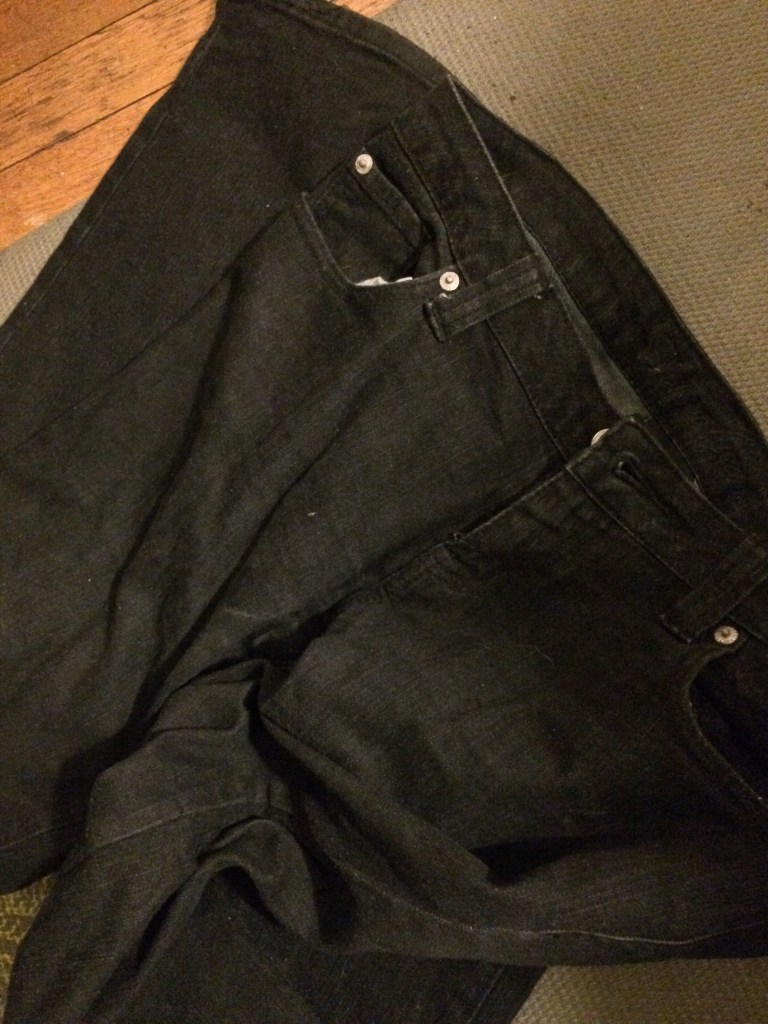
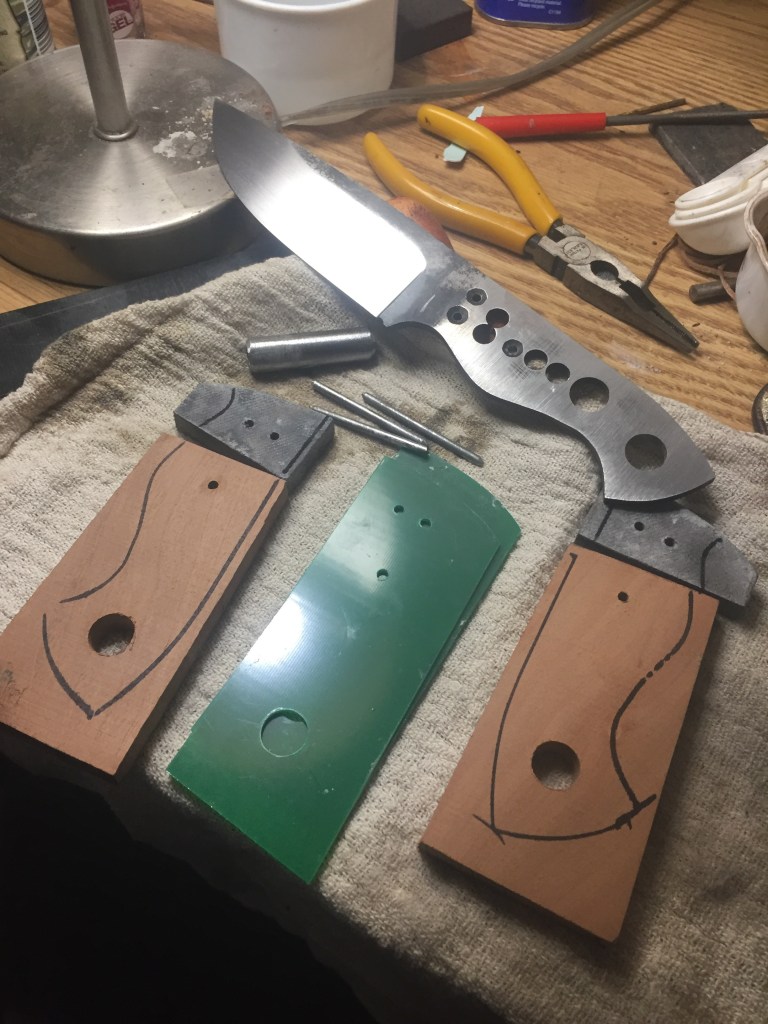
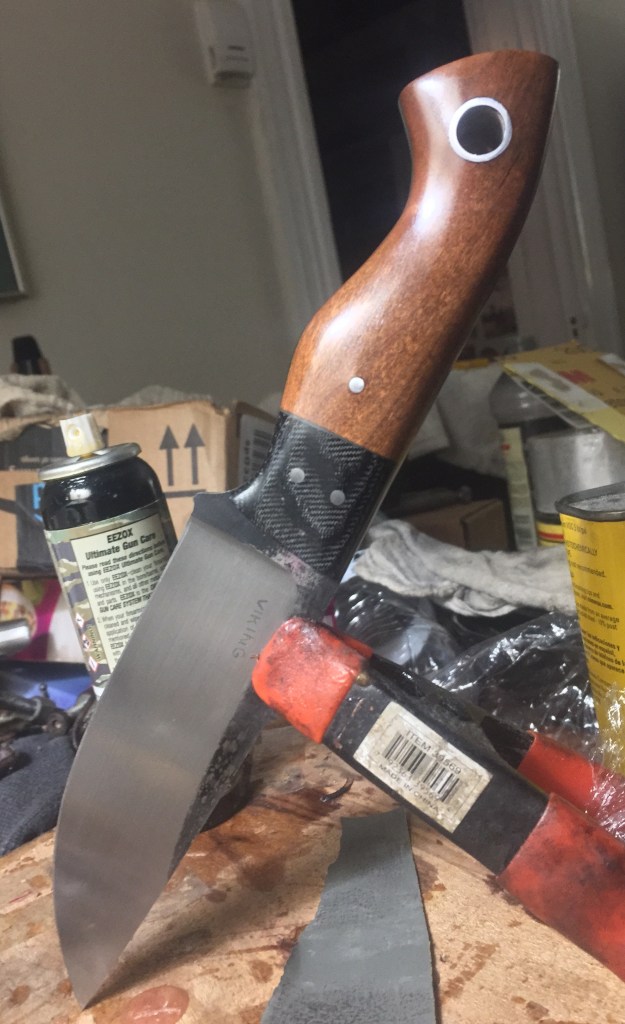
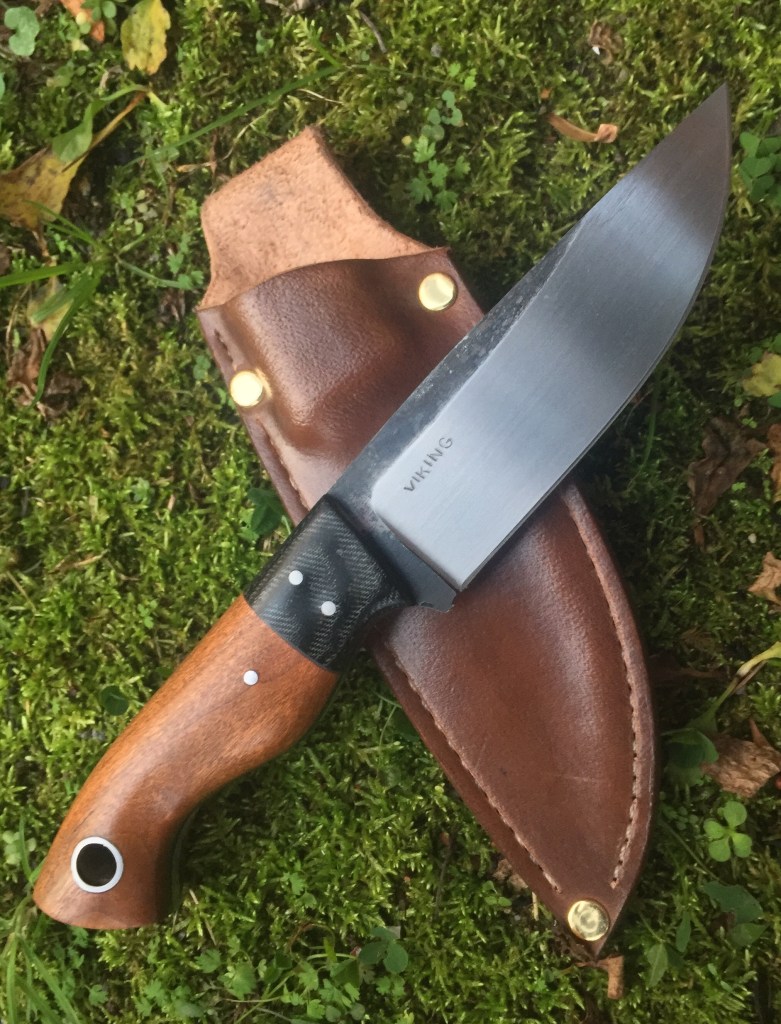
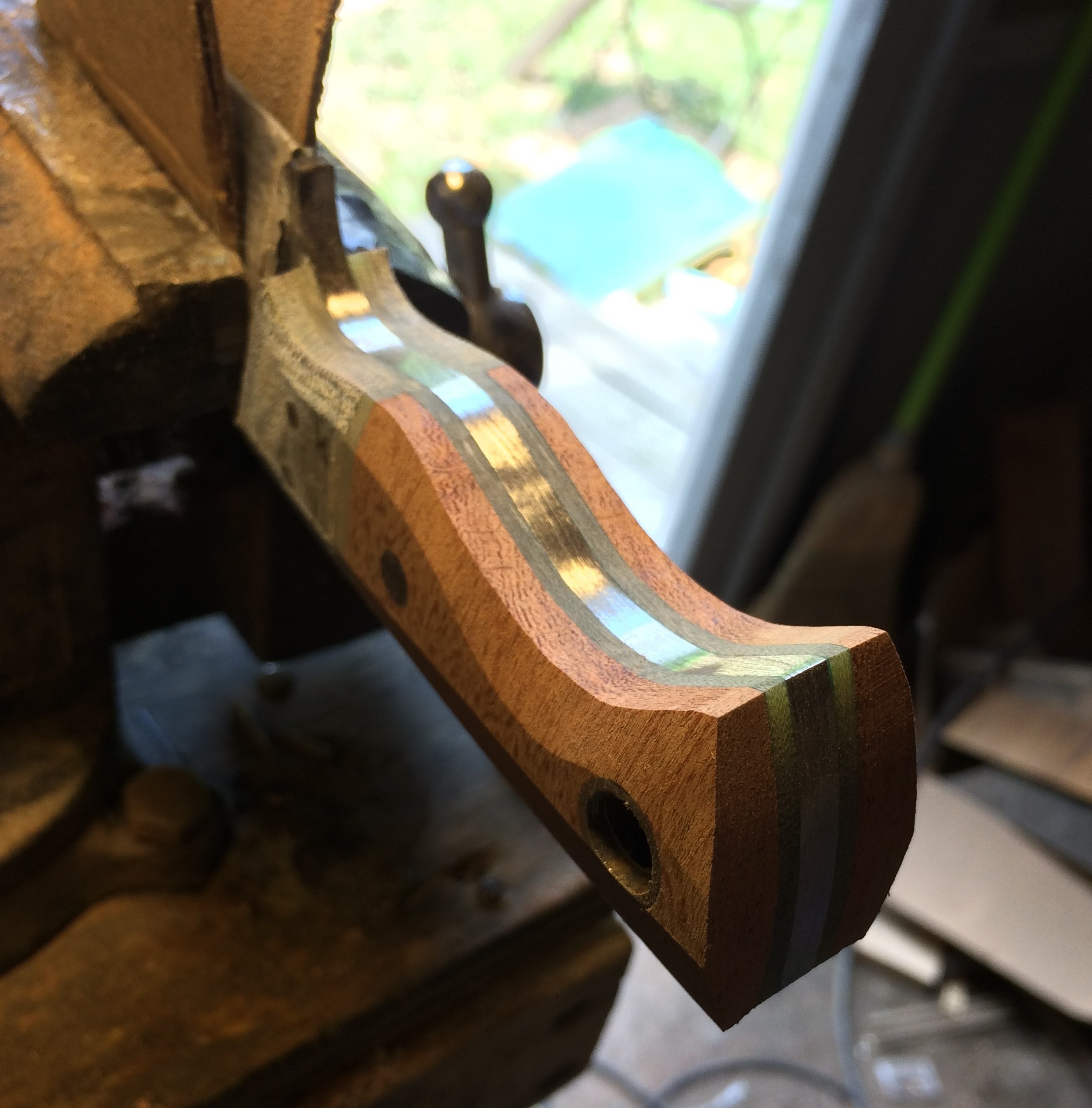
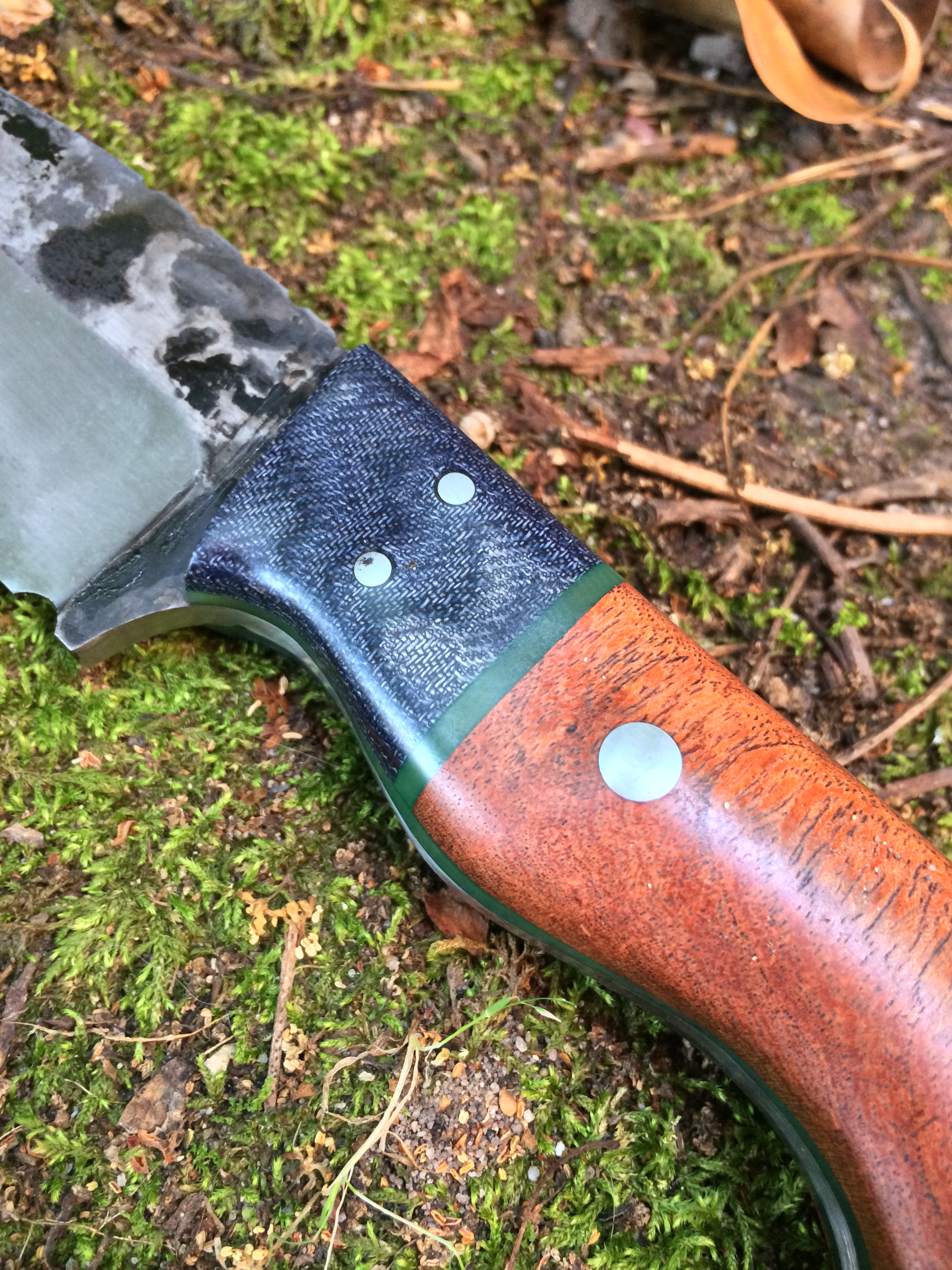
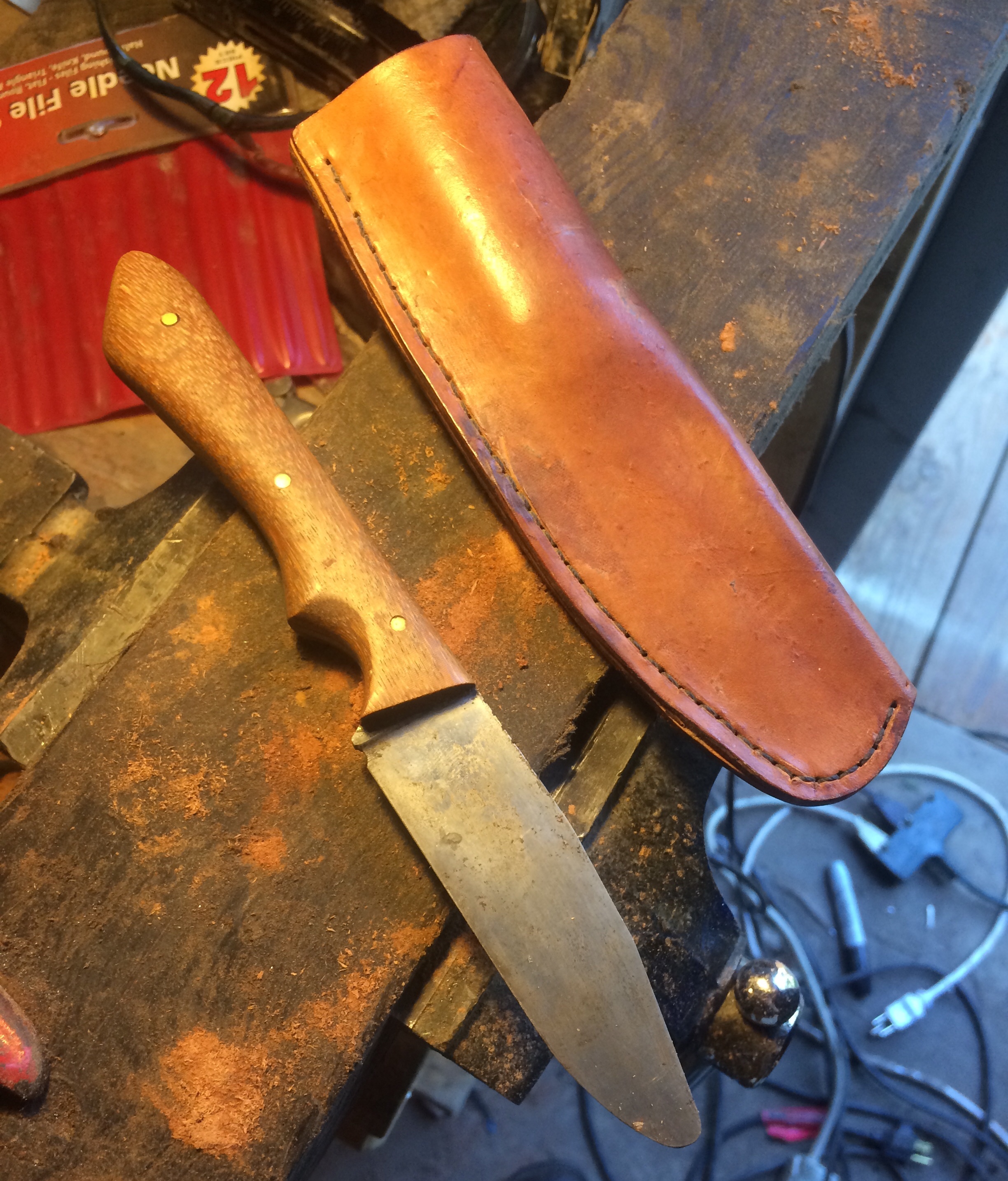
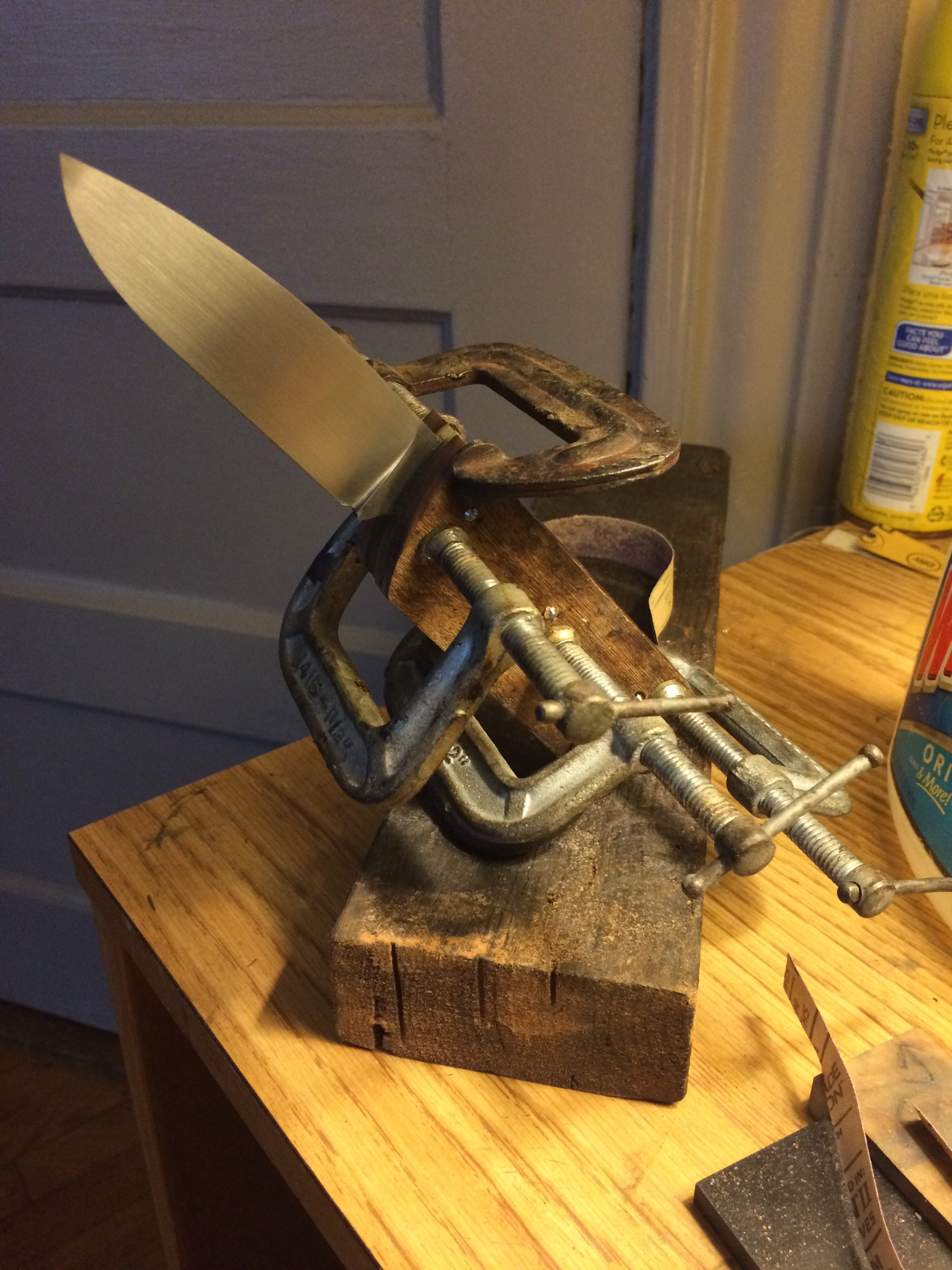
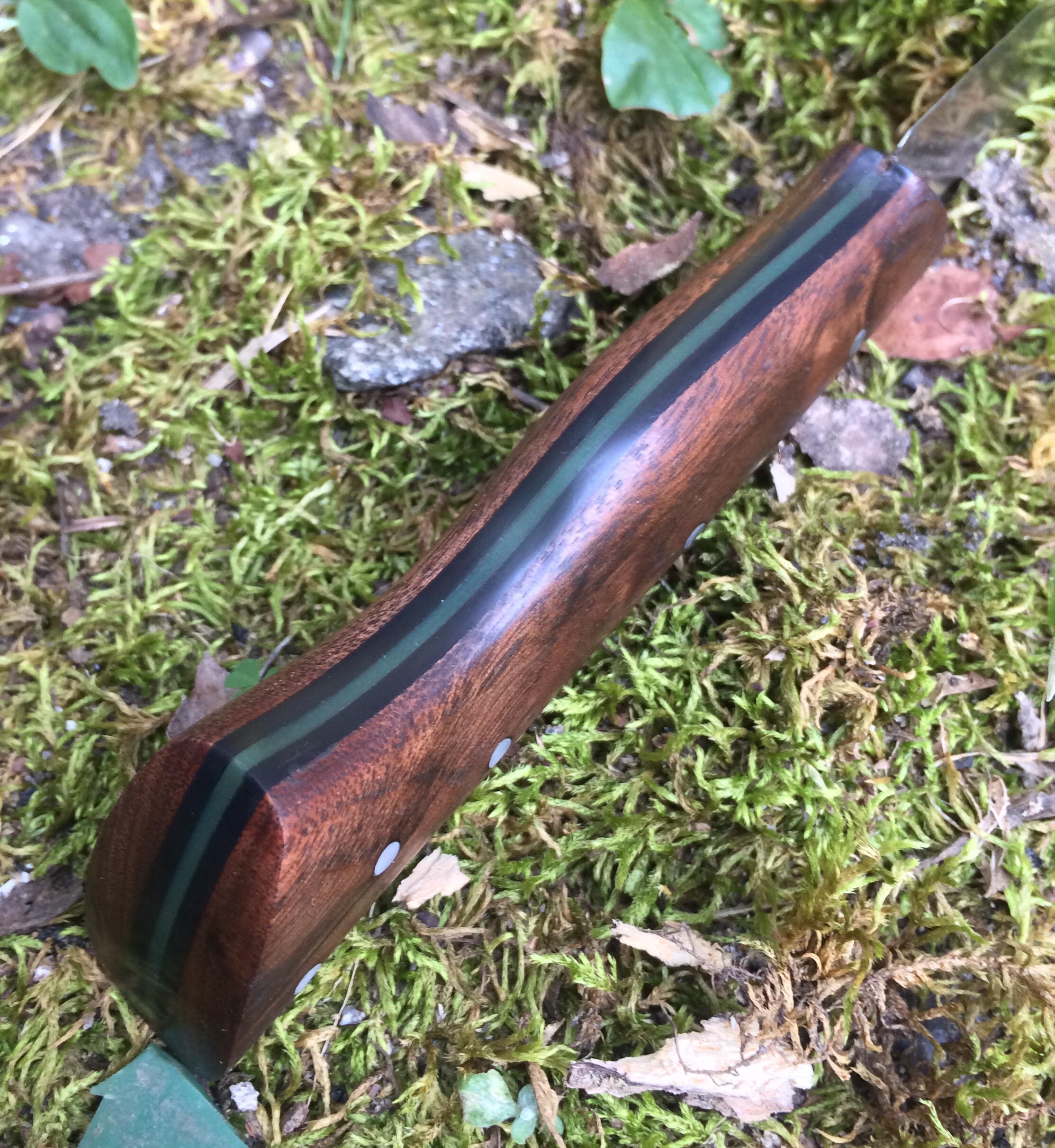
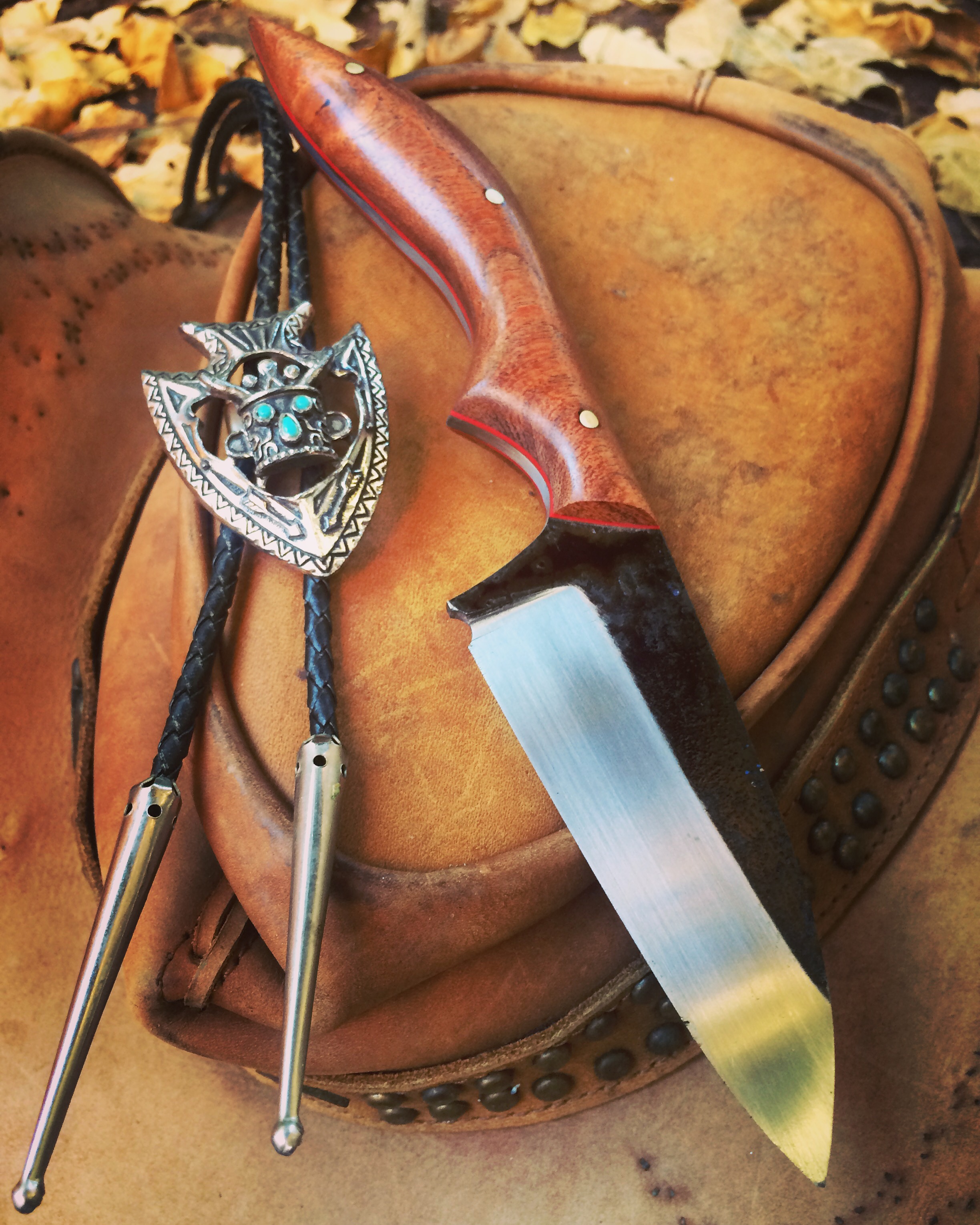
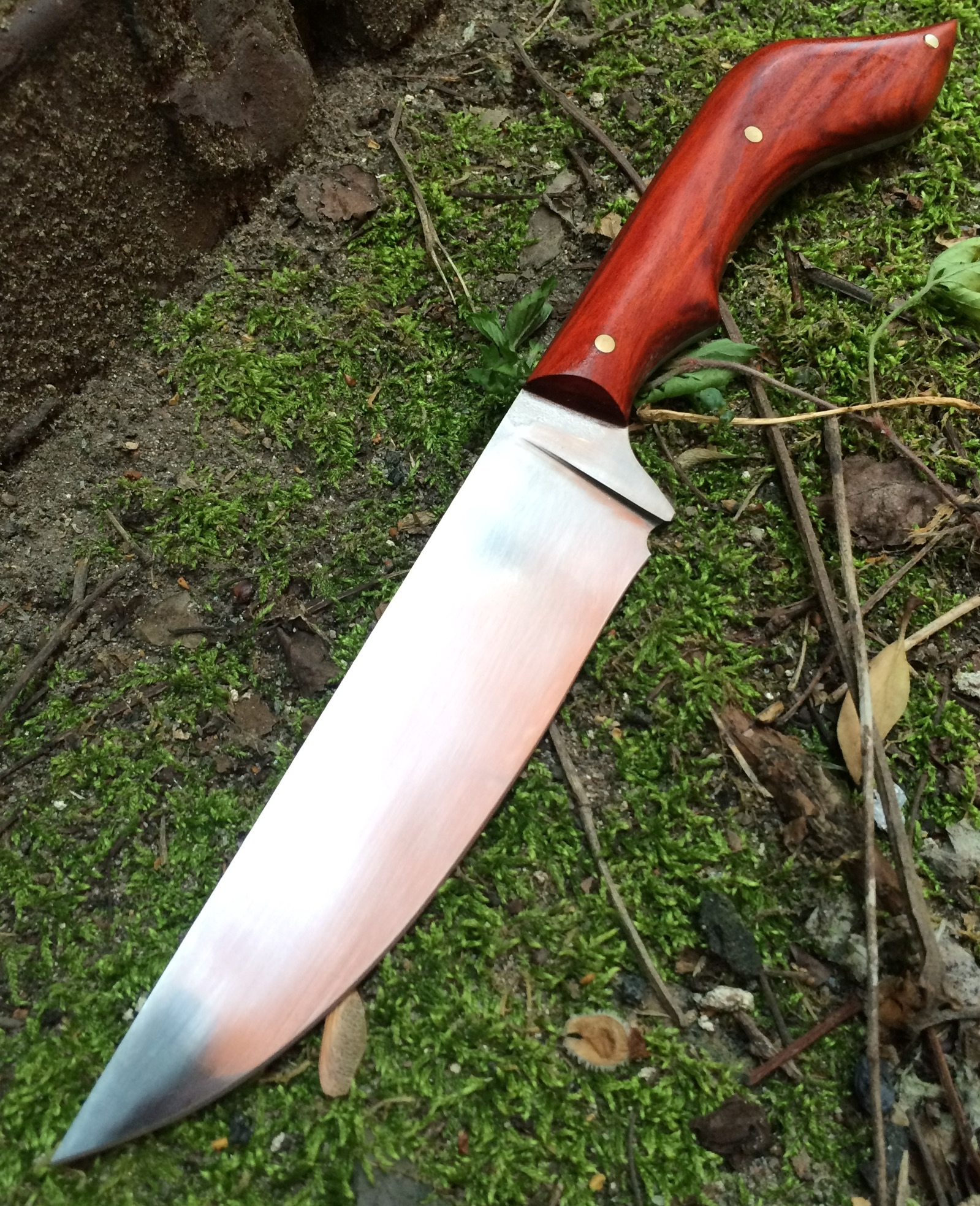
This knife was commissioned by his loving wife. This gentleman is a woodworker and musician, among other things, so I used some reclaimed Cherrywood that came off an old mantlepiece. The bolster is a micarta made from black jeans that I used to wear for a weekly big band gig. Something one of a kind for a unique man.

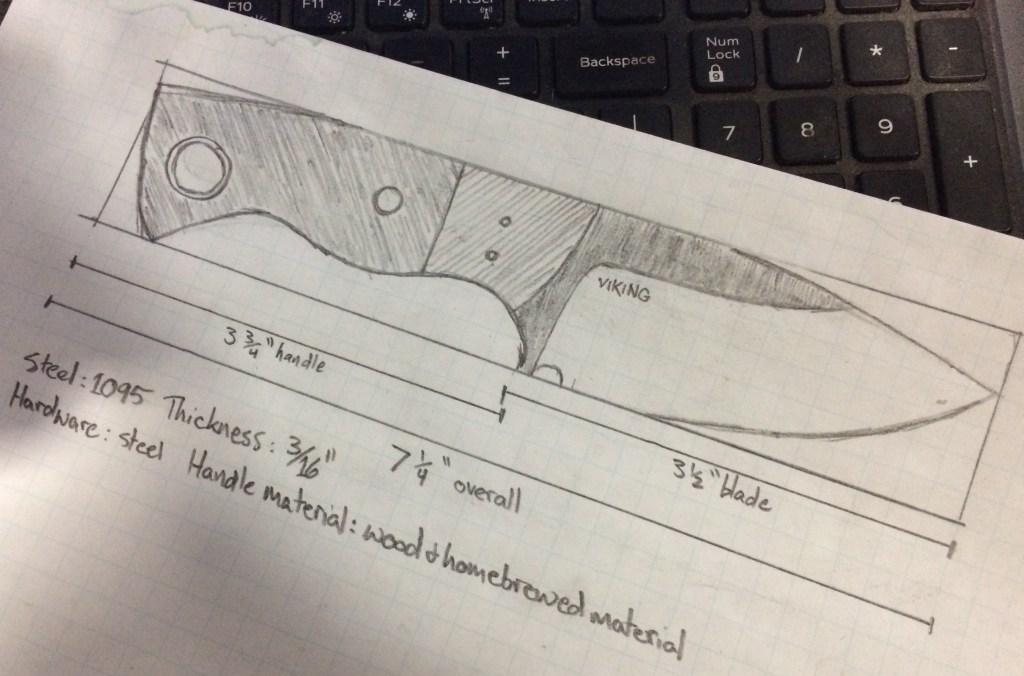
A quick sketch,
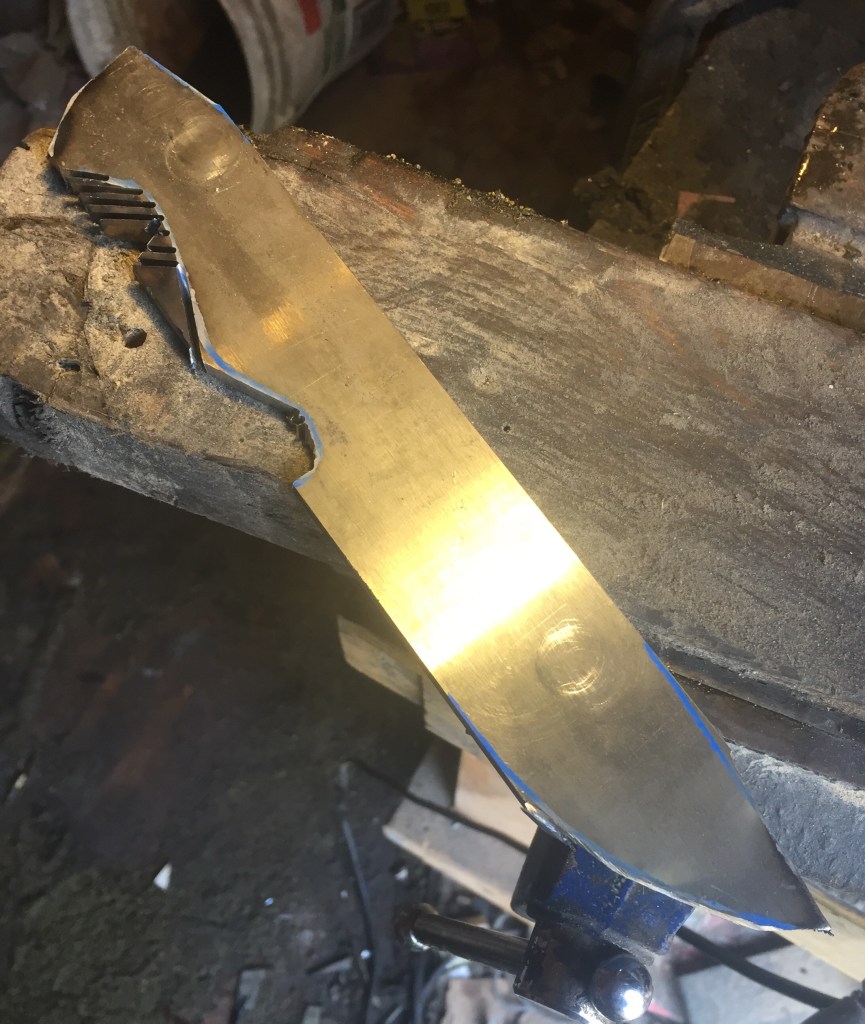
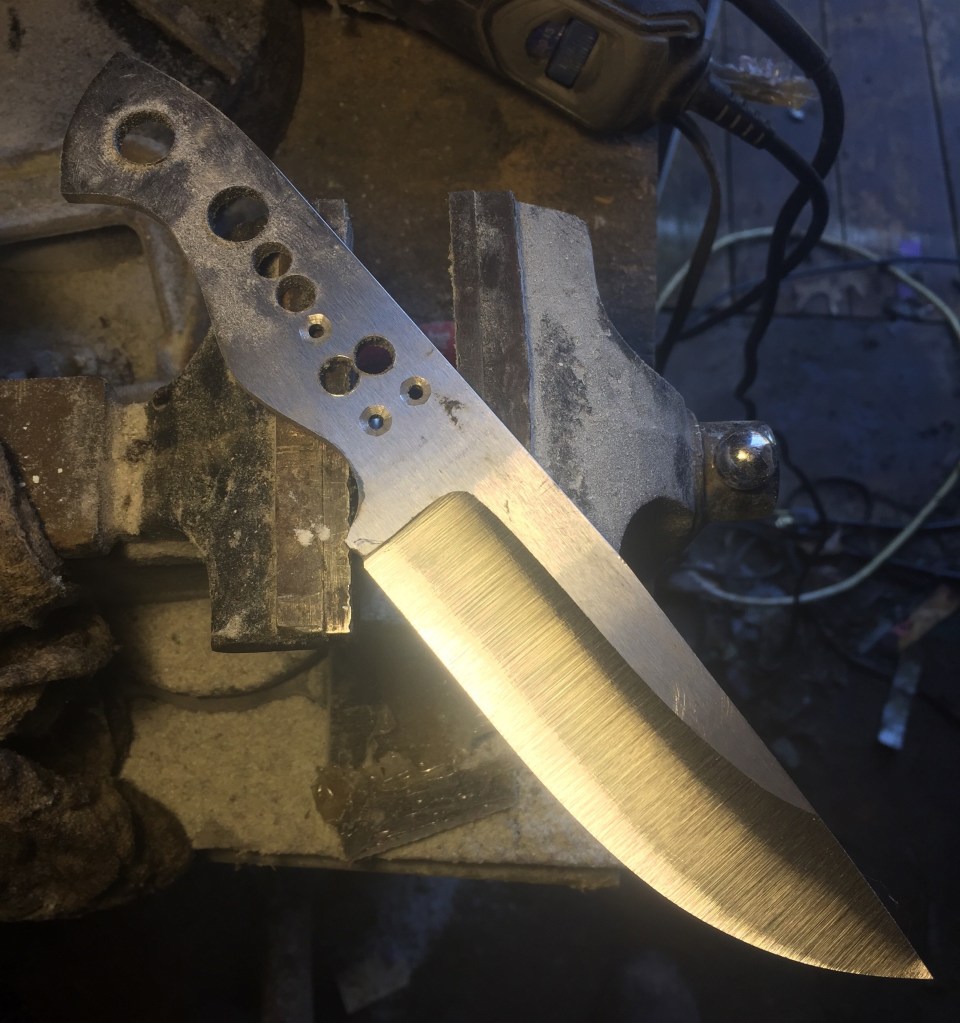
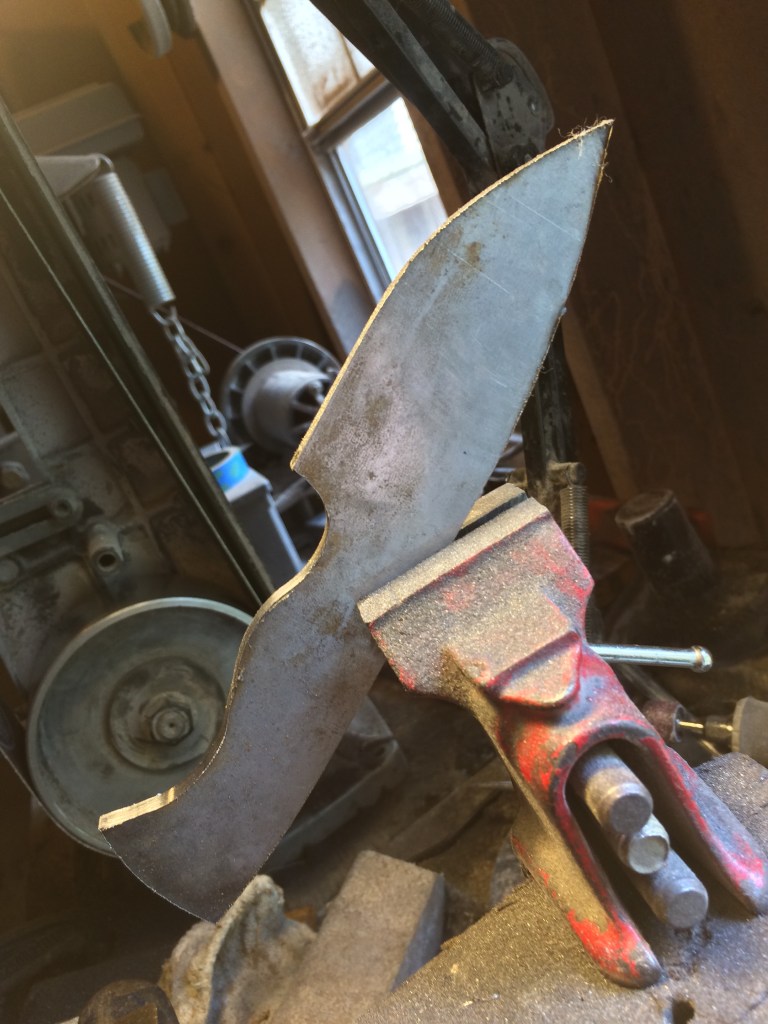
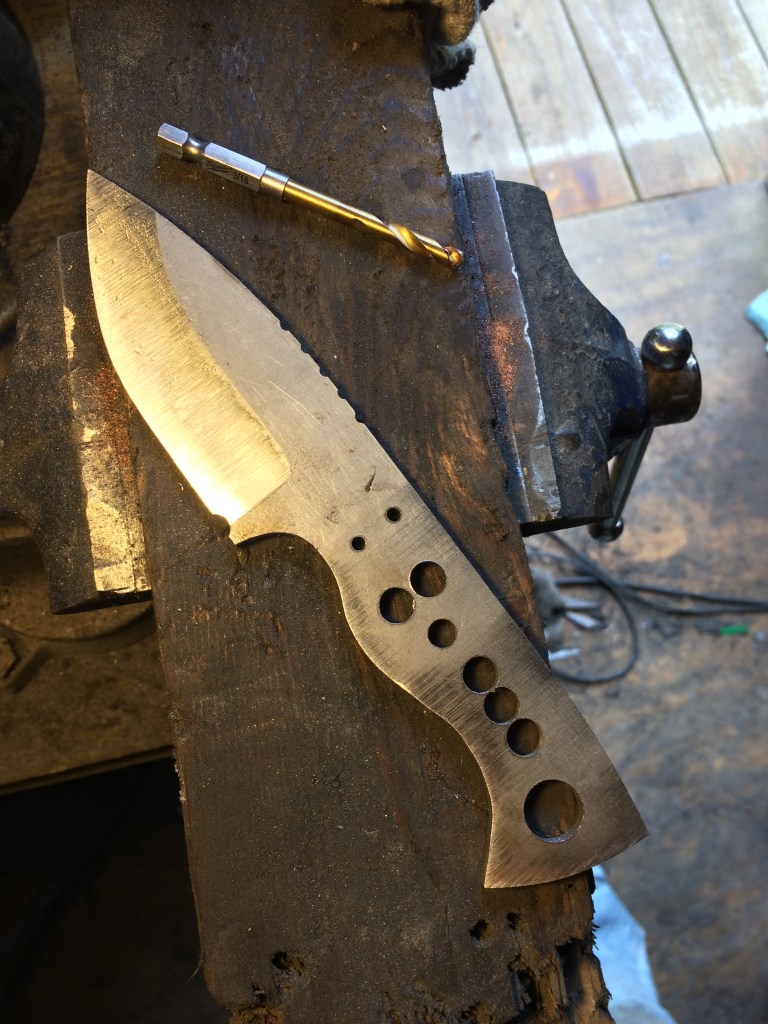
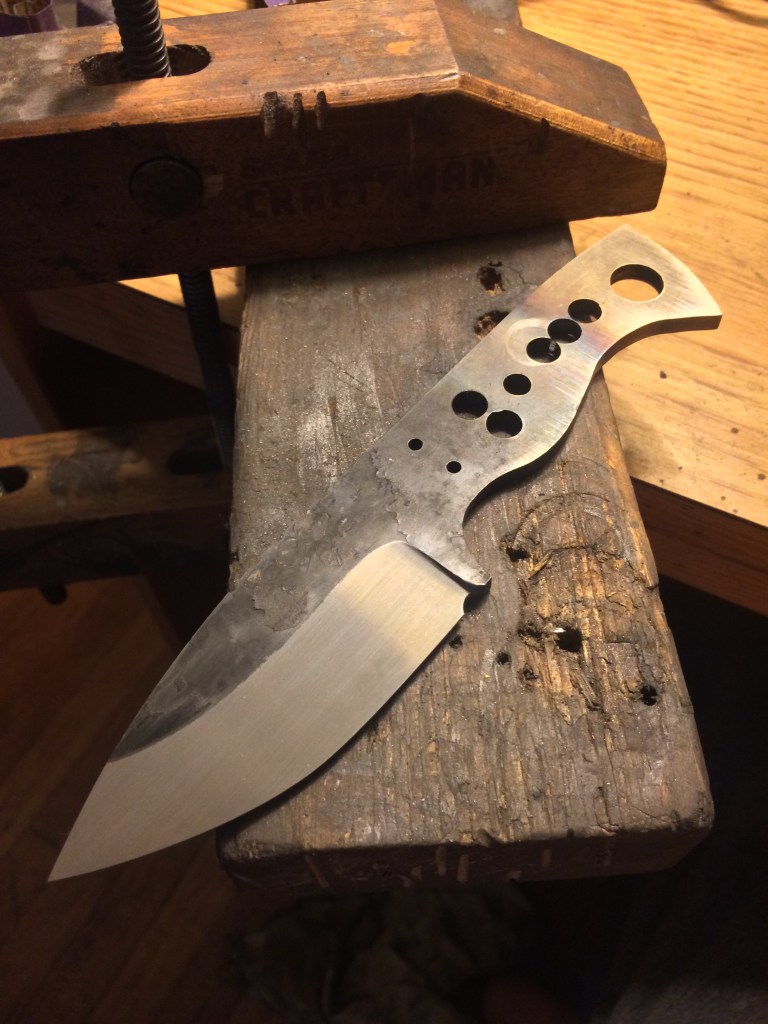
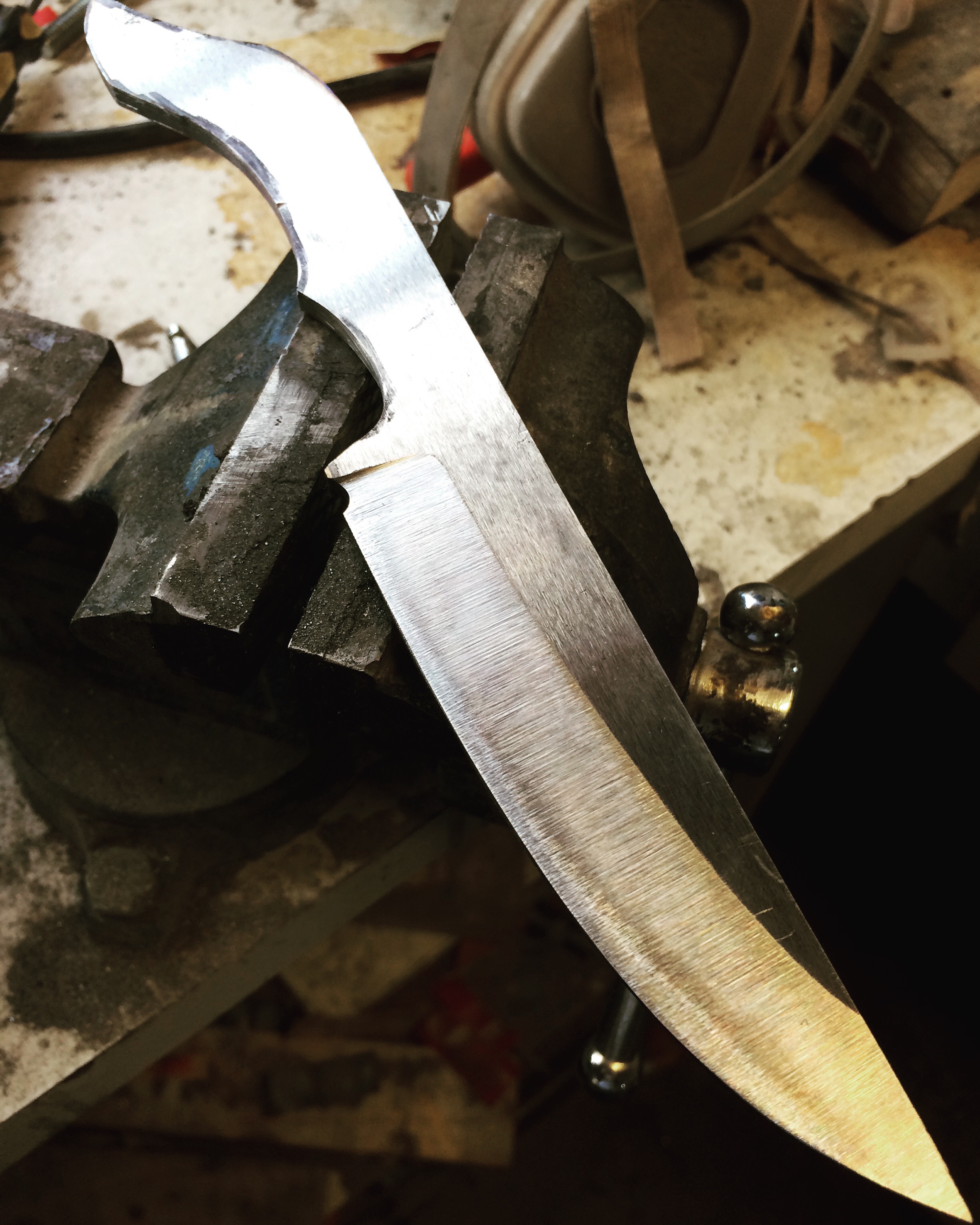
Profiled in O1 Tool Steel.
Refining the profile.
Ready to grind the bevels.
Bevels ground. The drawing showed a swedge, but that was out of concern that the tip would be too thick. The knife ended up not needing it.
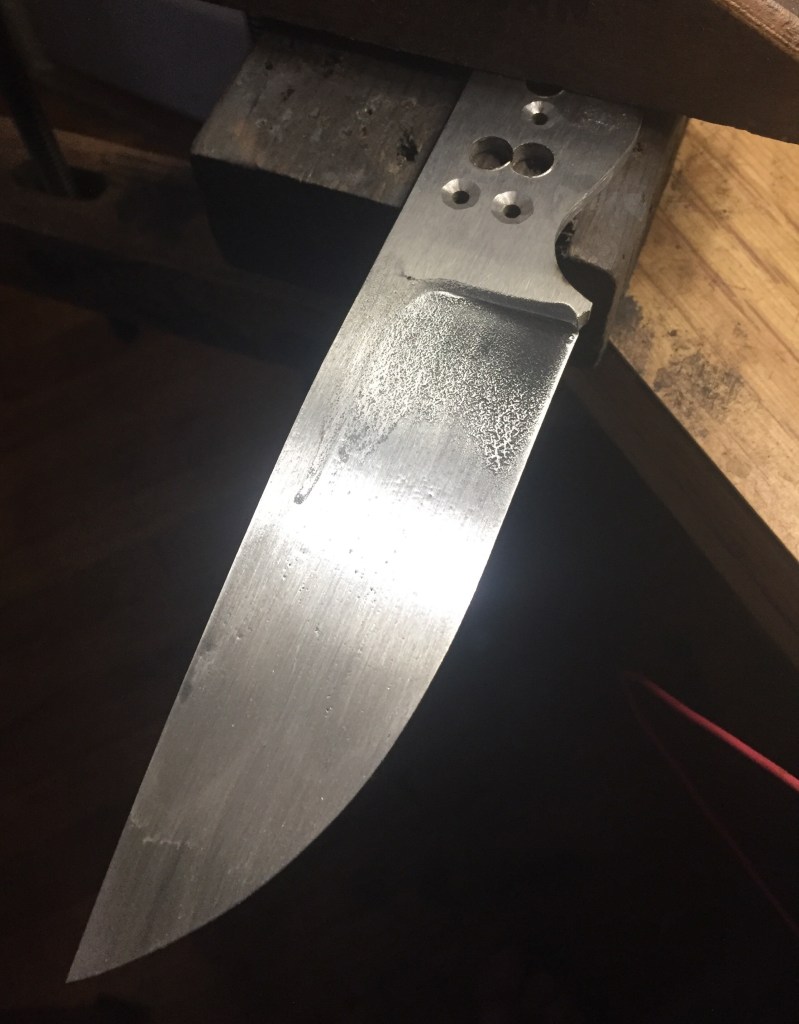
Removing the rough machine marks by hand before heat treatment
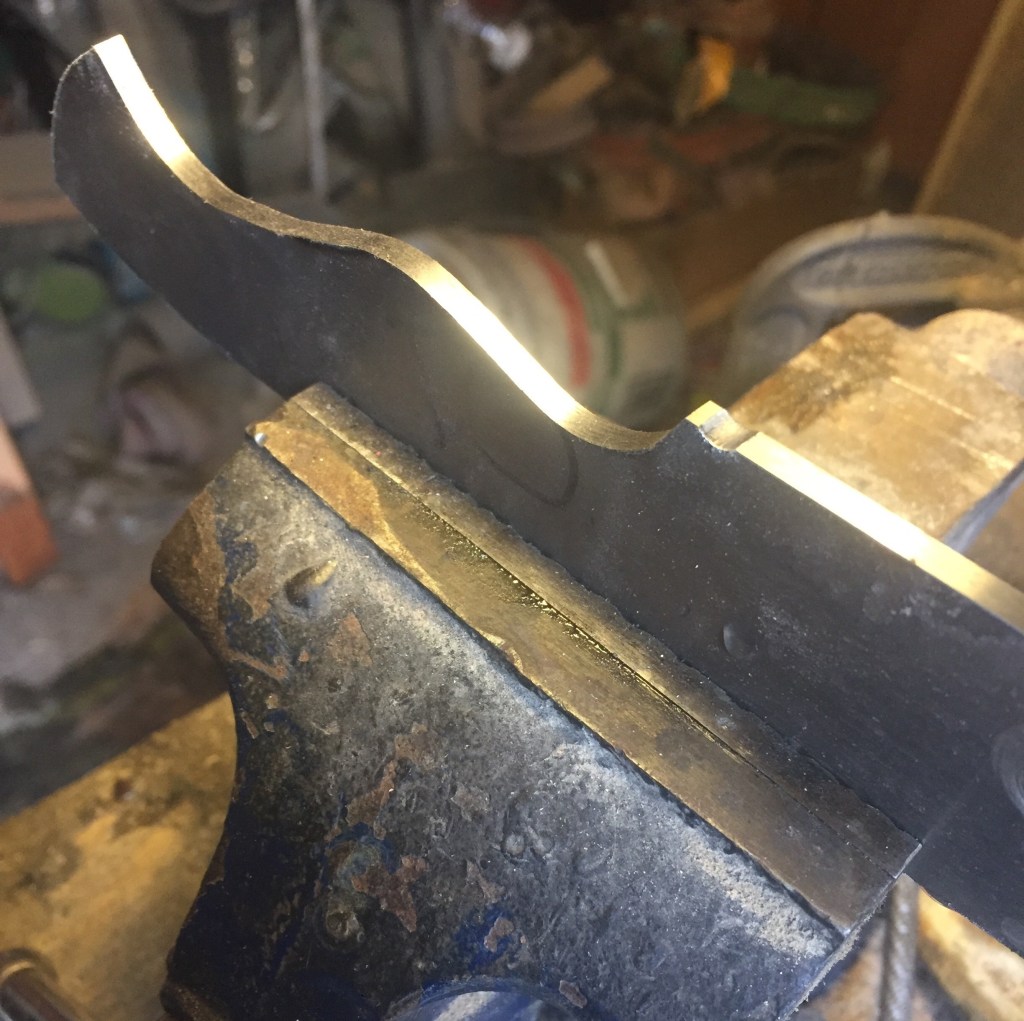
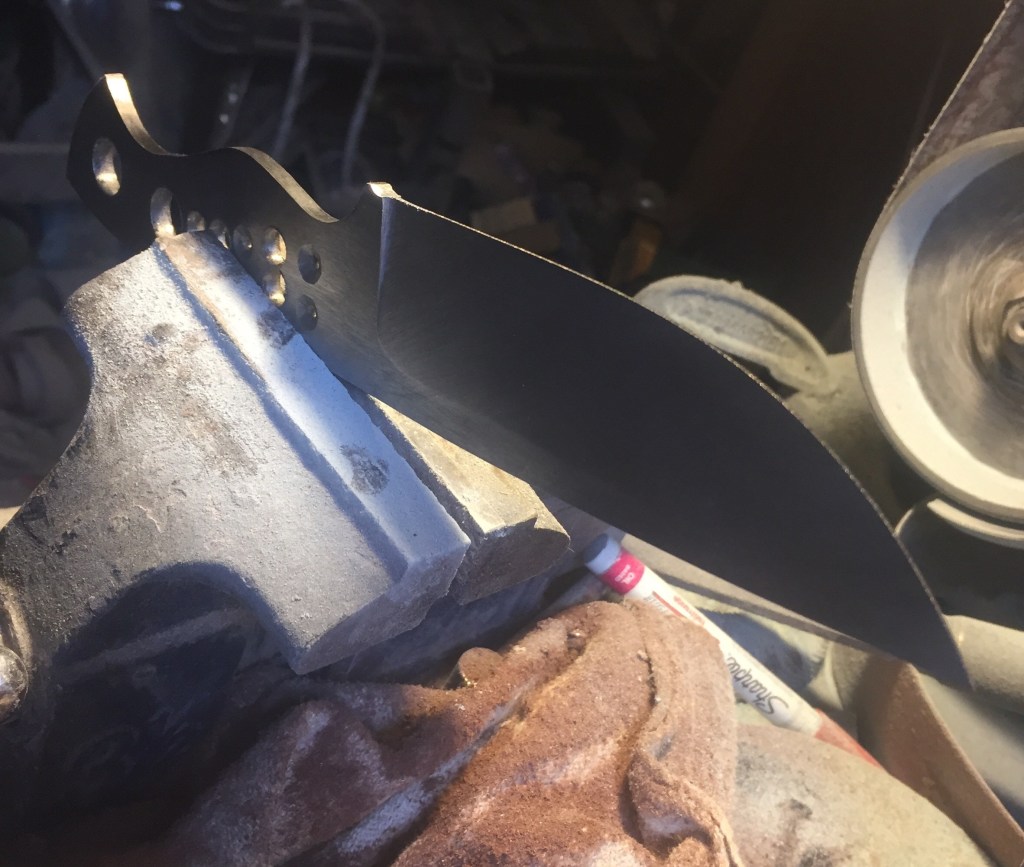
Final profiling before hardening
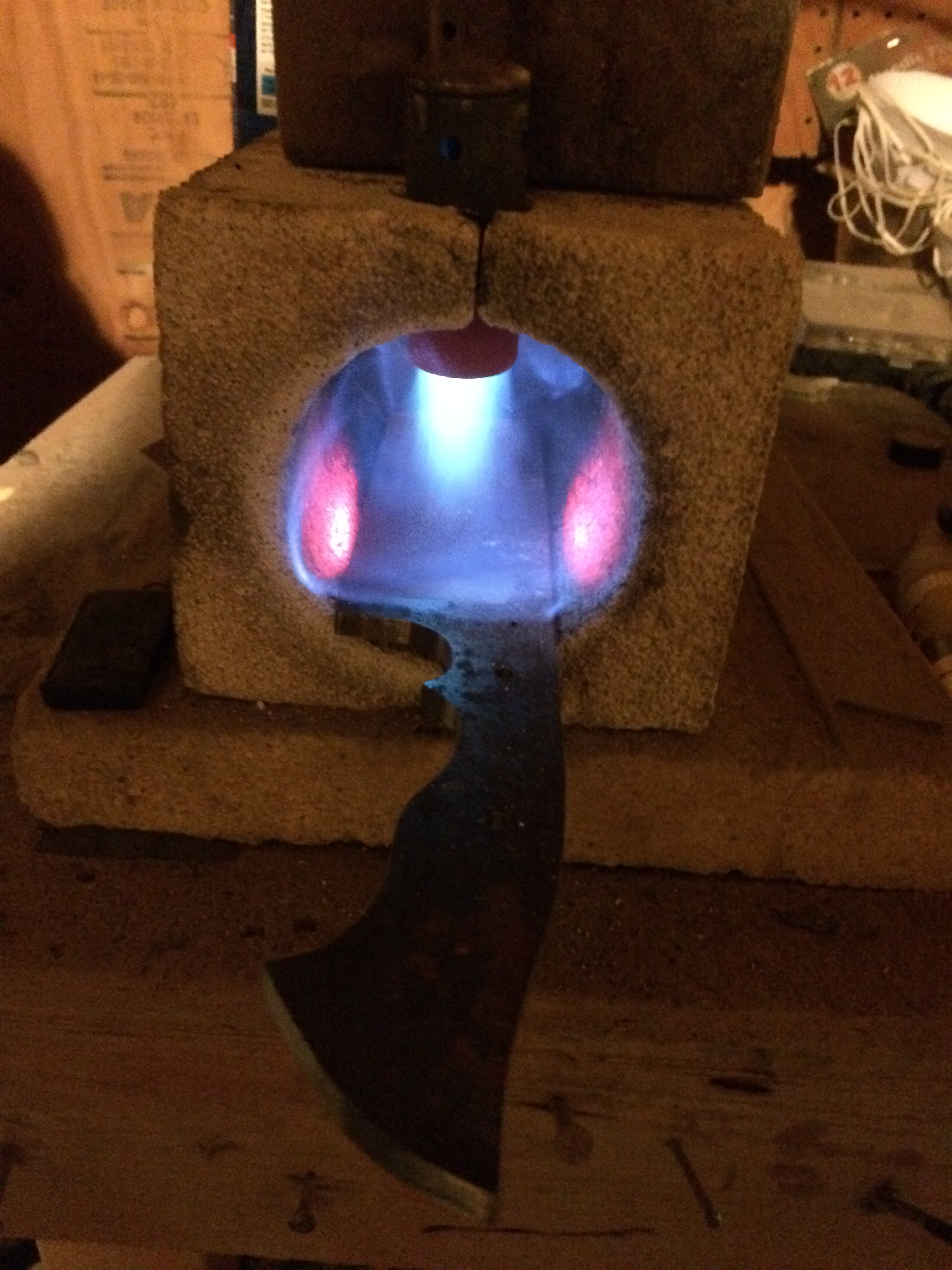
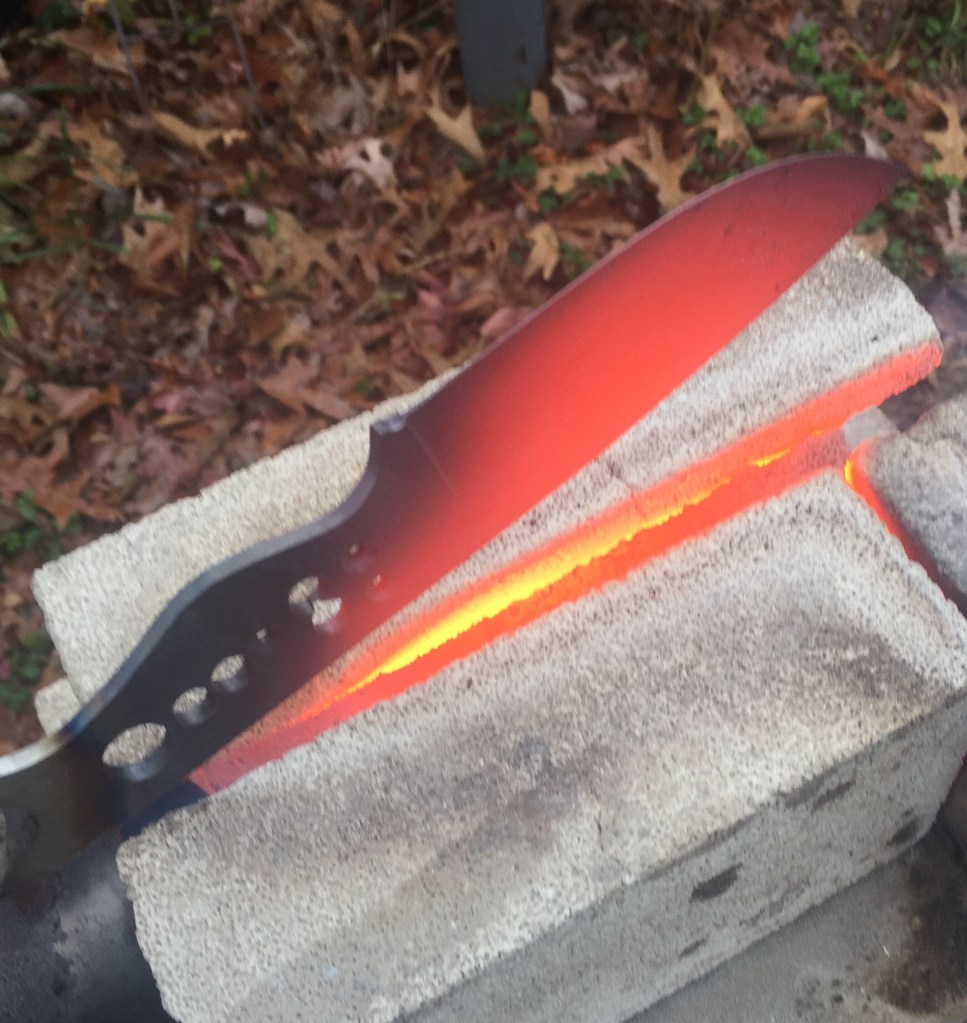
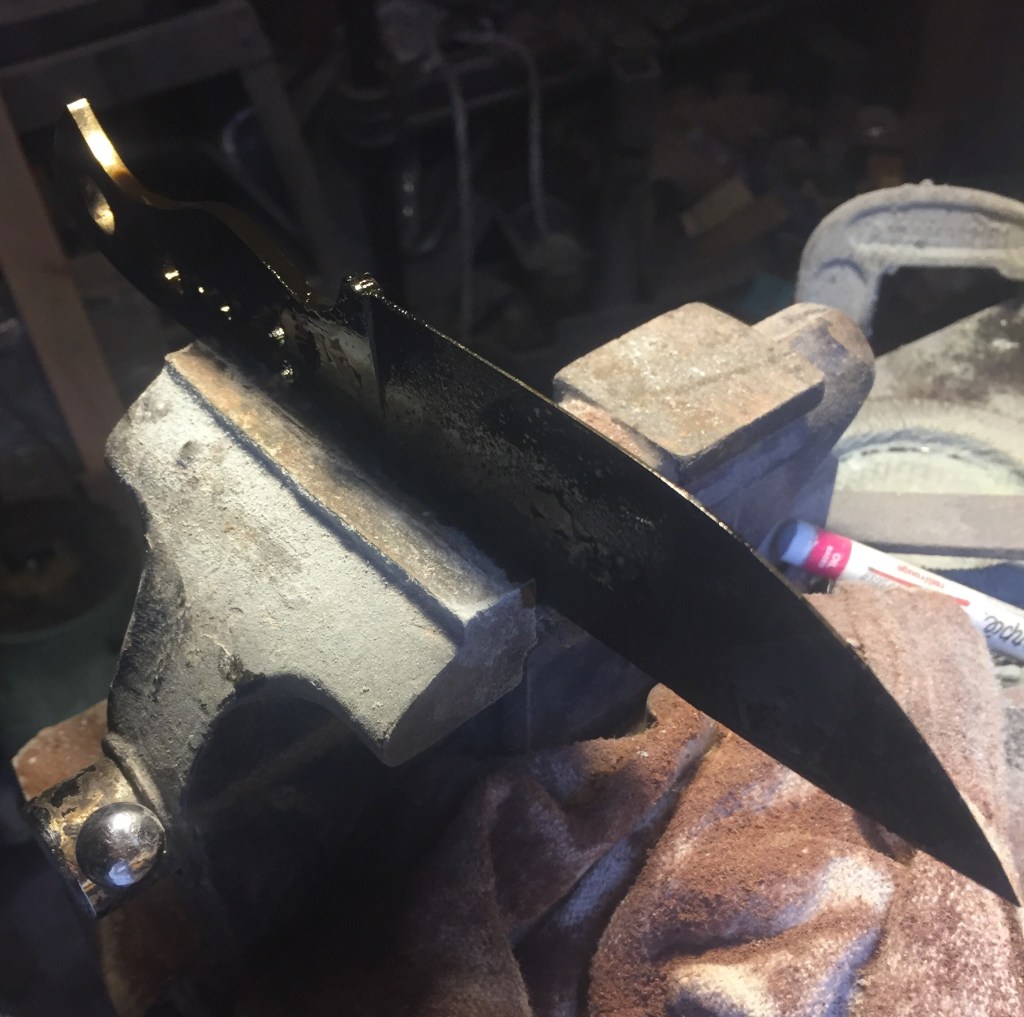
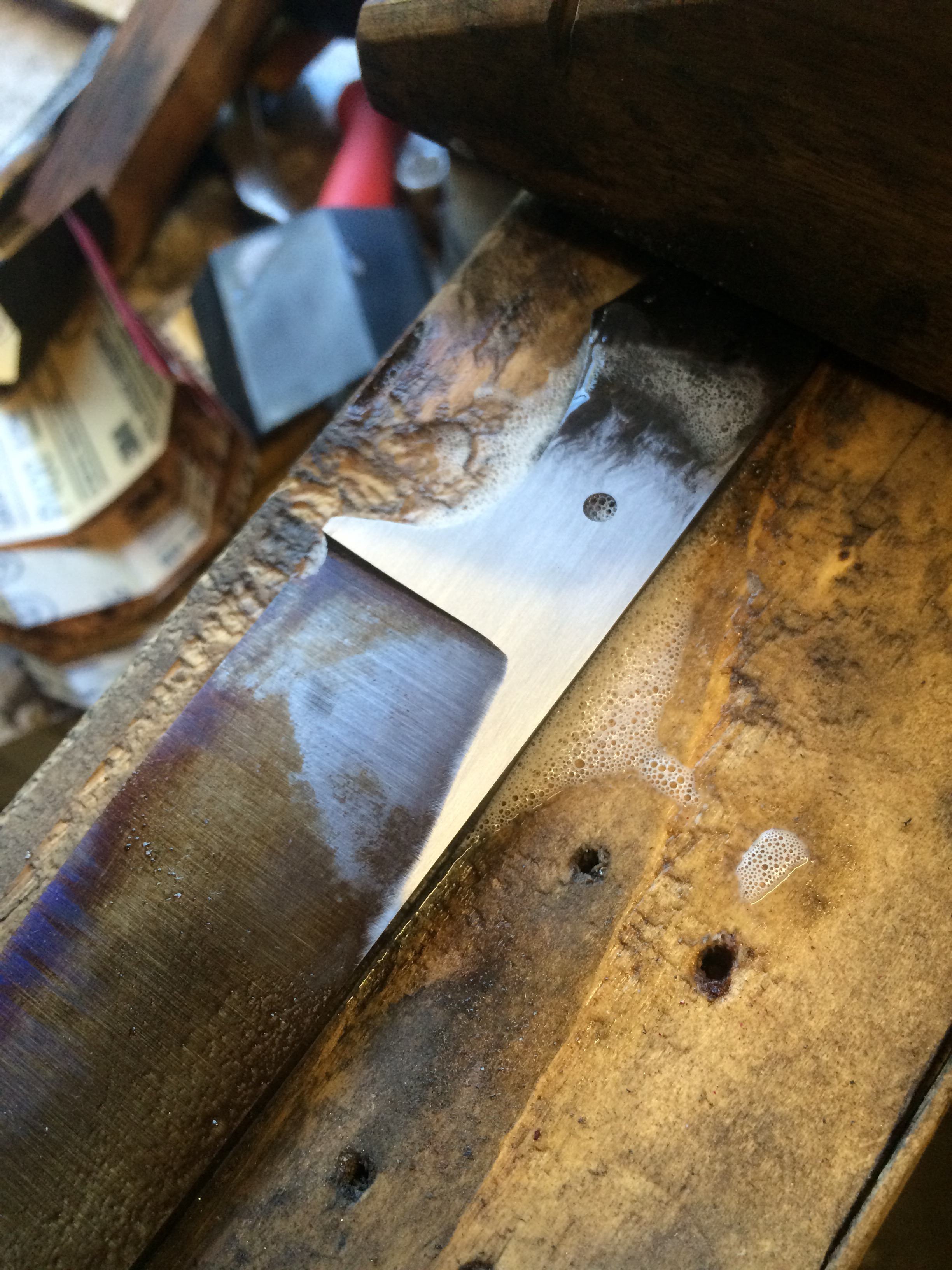
After the quench.
Tempered to remove stress from the steel after tempering.
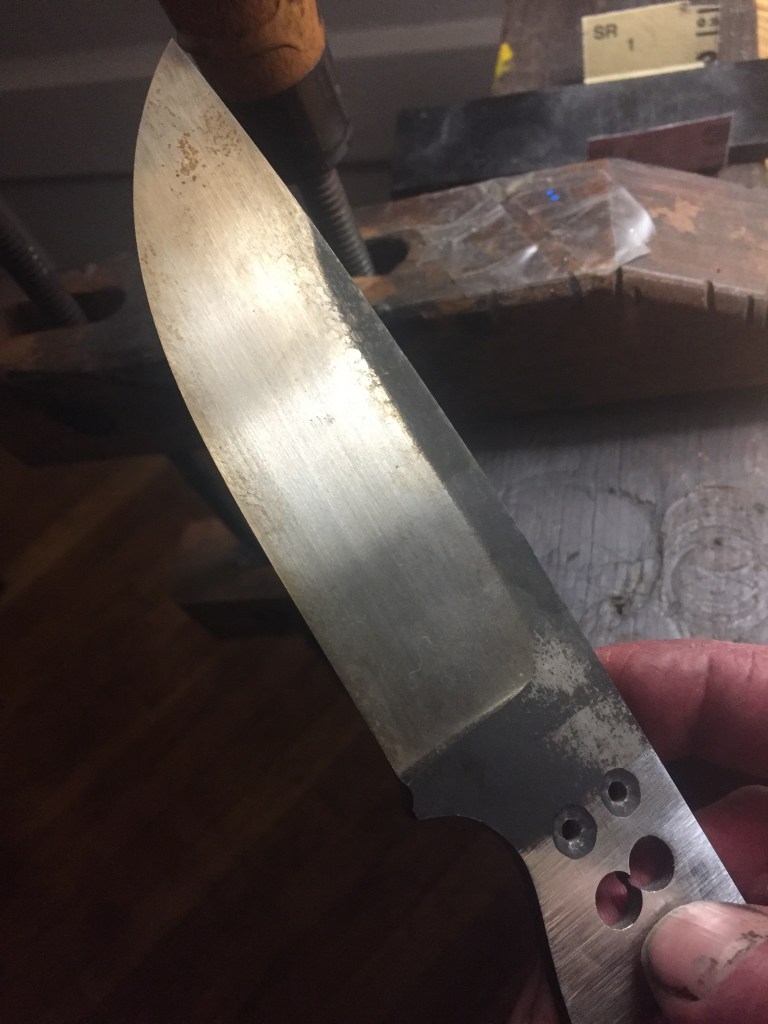
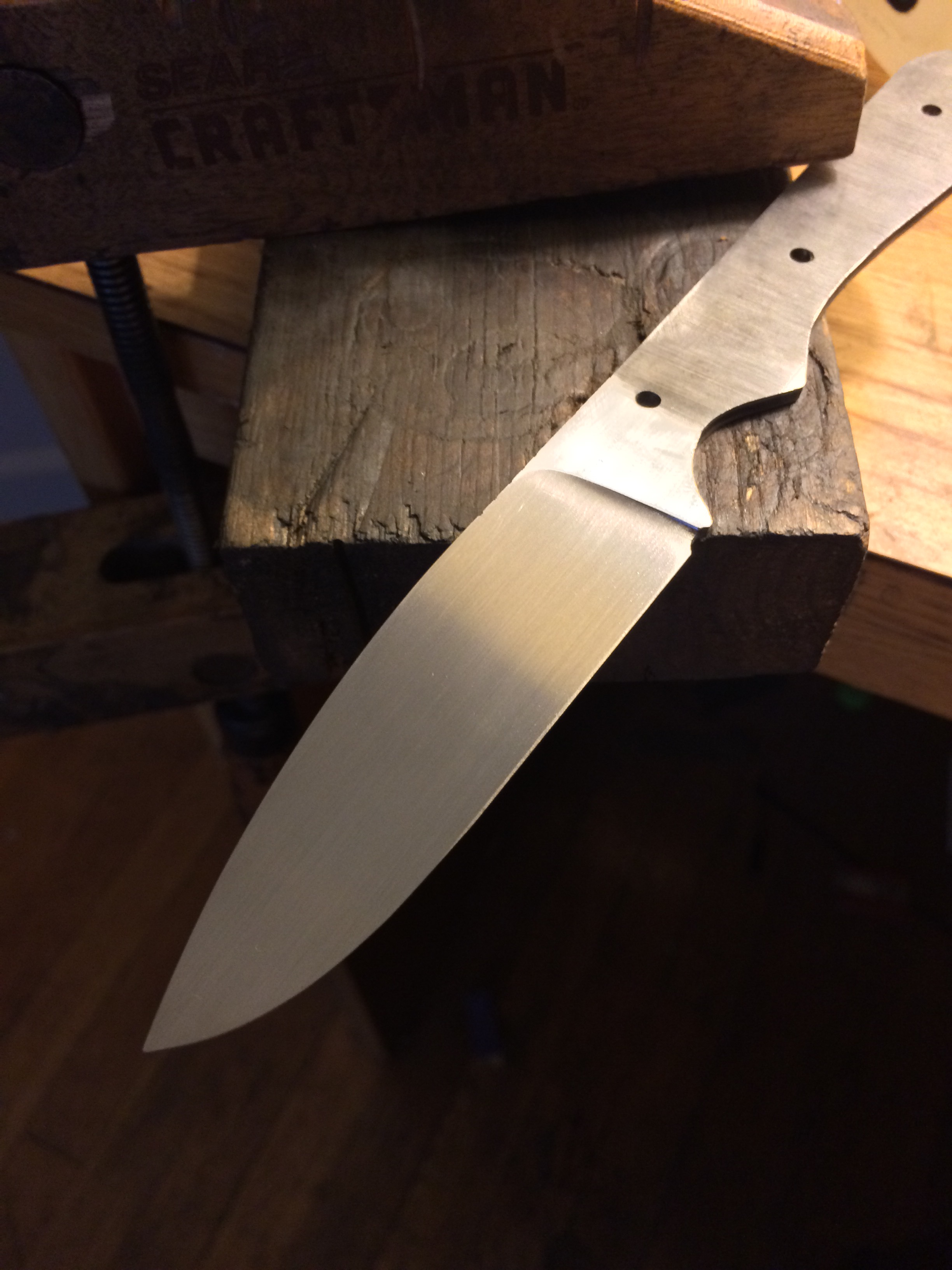
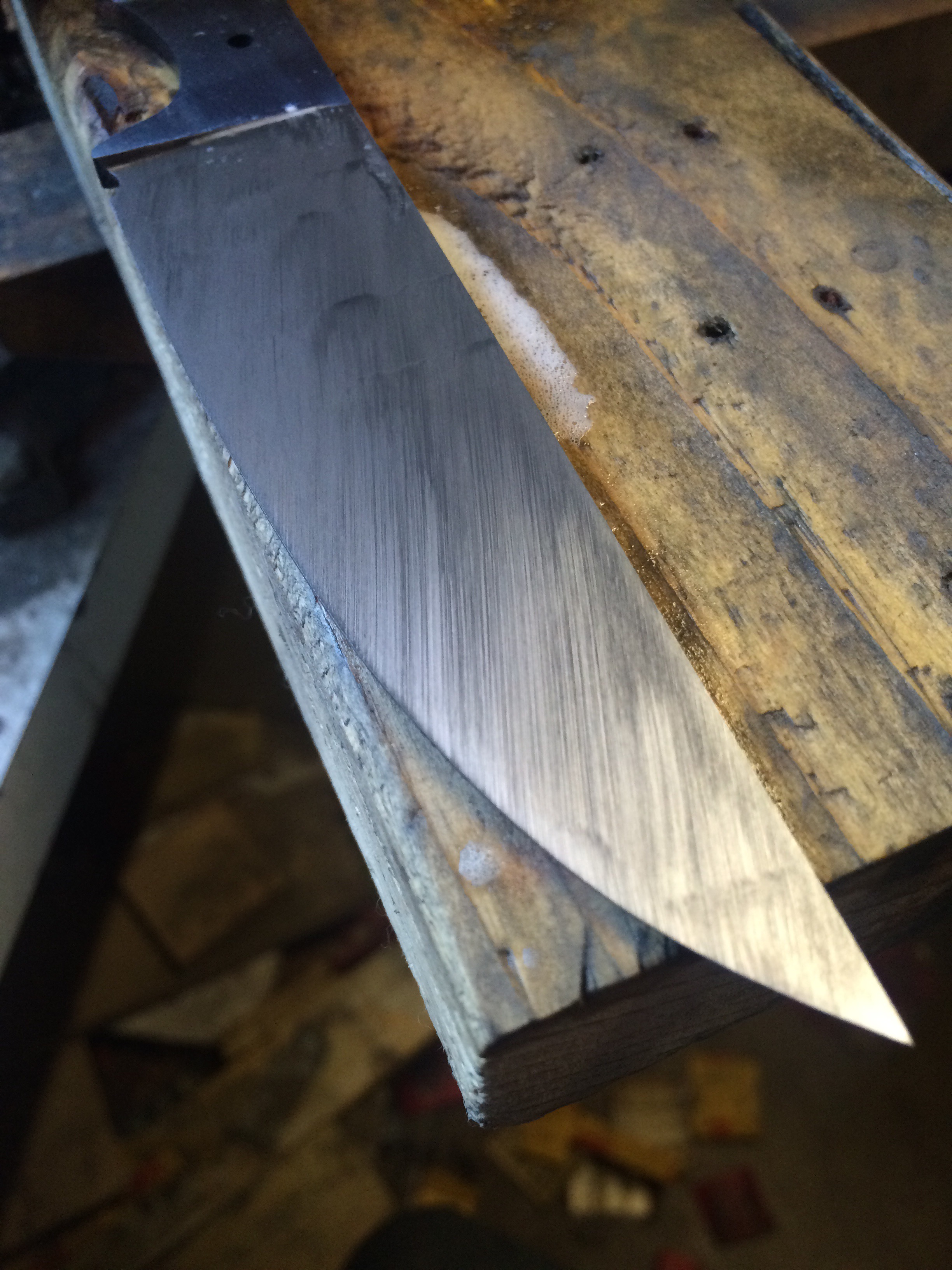
Satin finish.
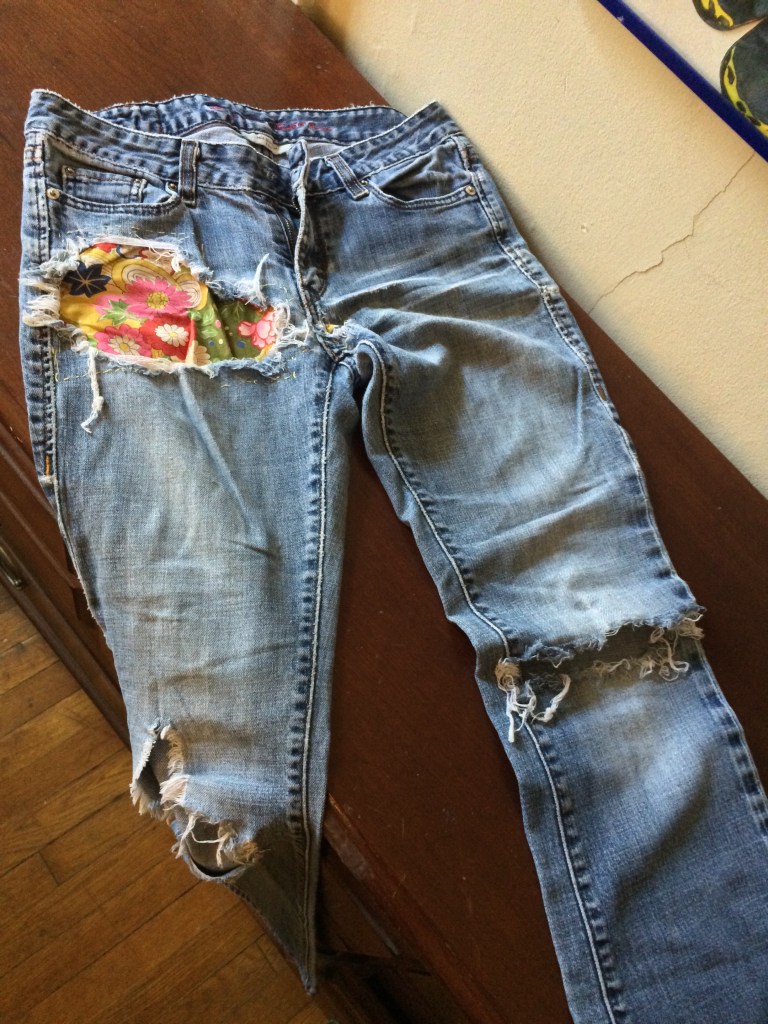
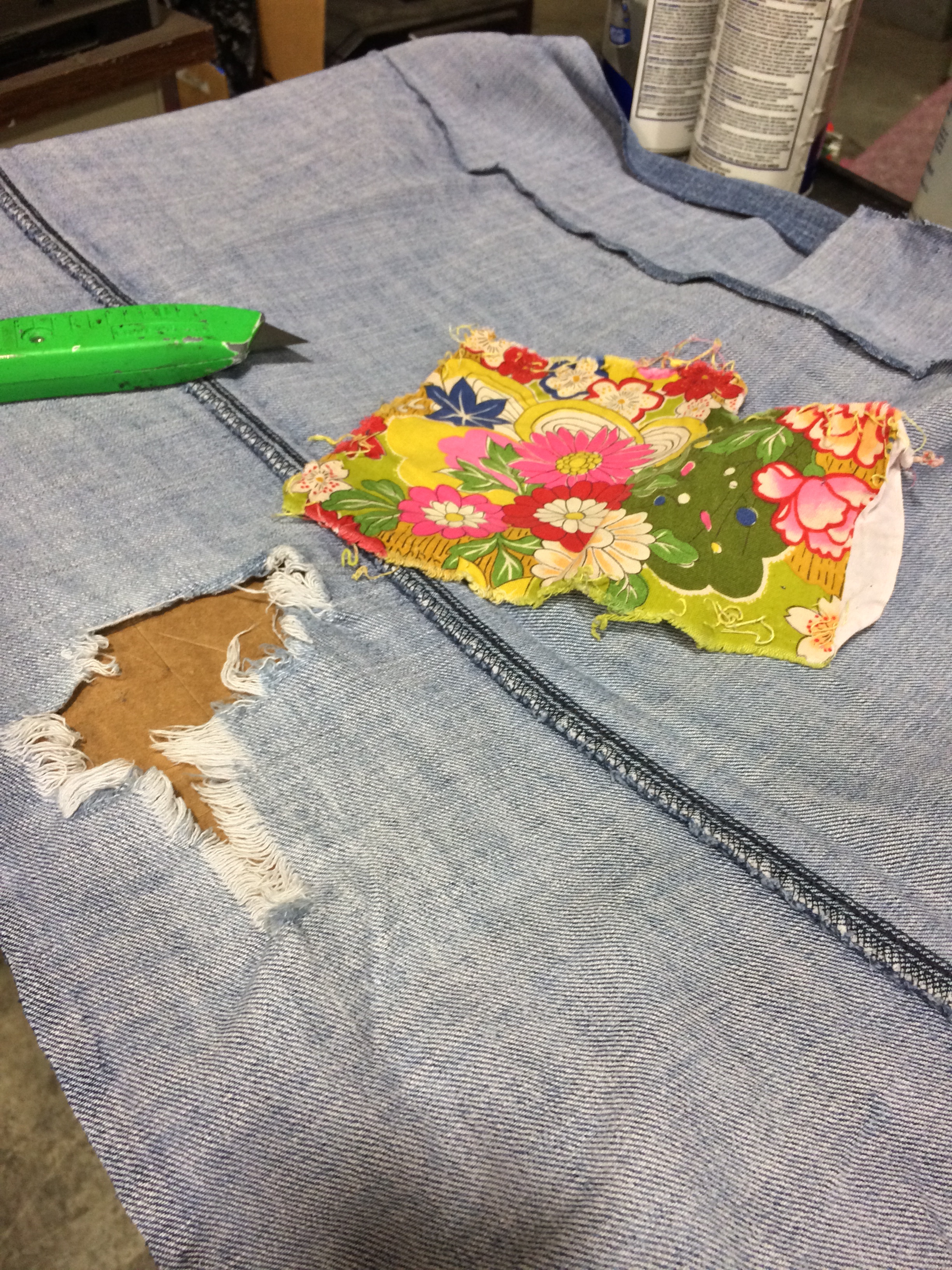
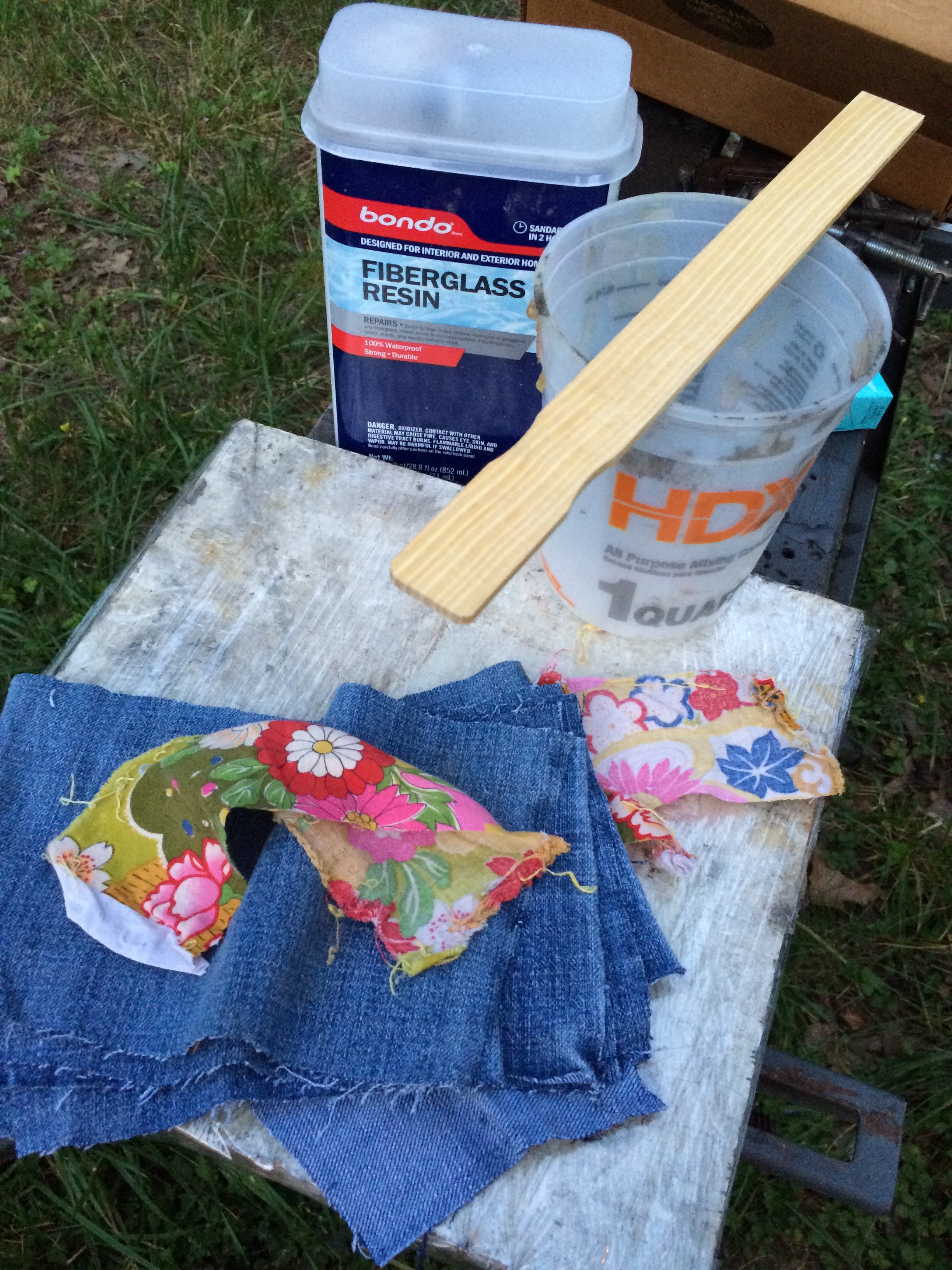
Gig pants to be cut up and layered in fiberglass resin.
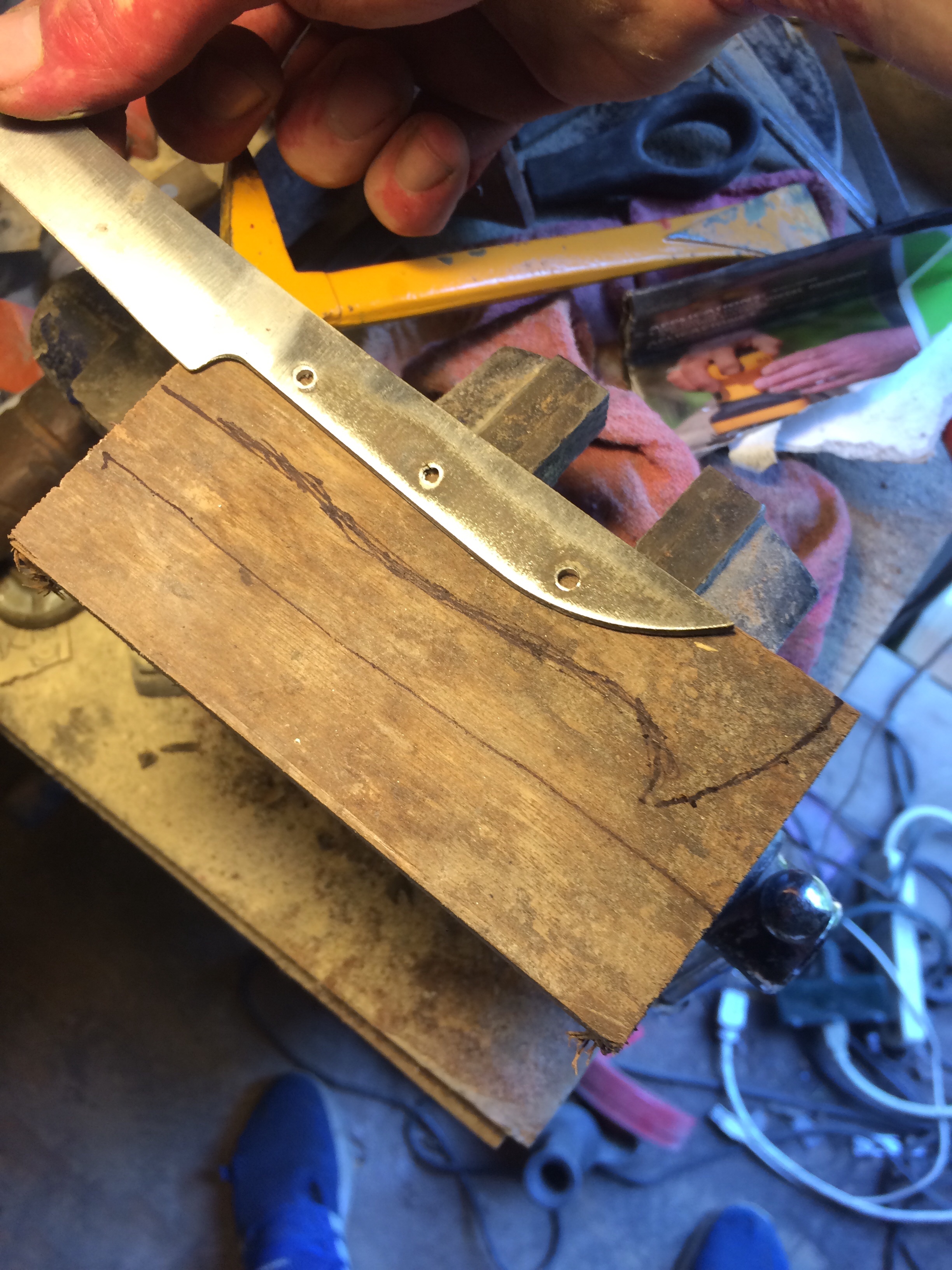
The raw material.
Furniture grade Cherry.
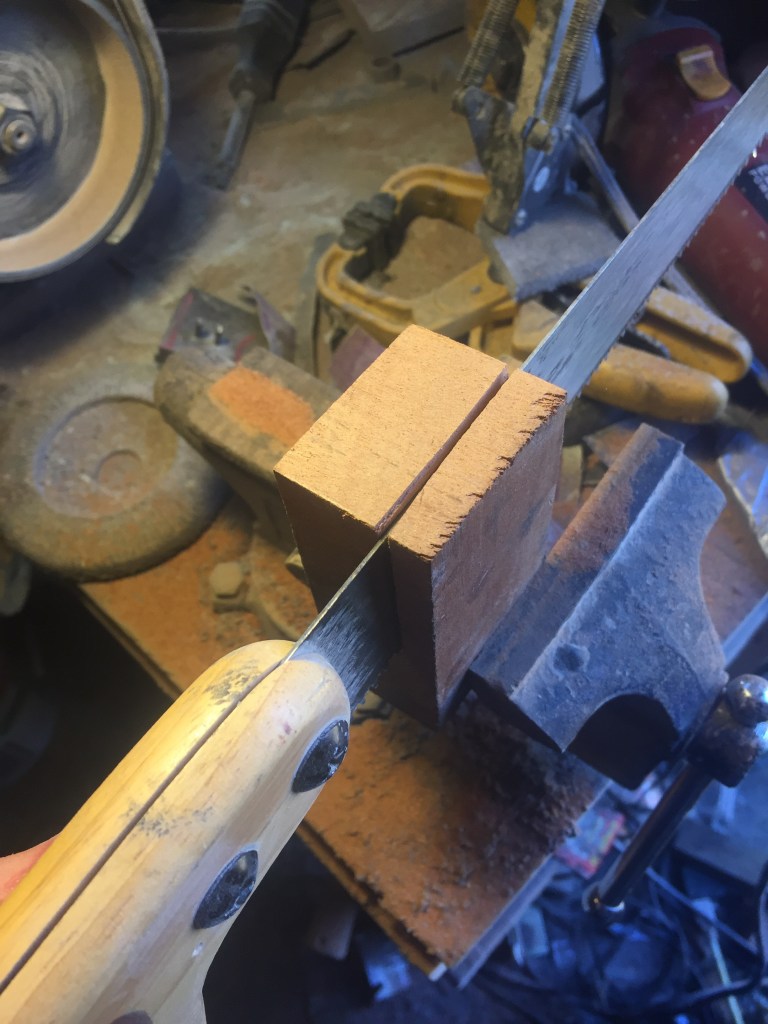
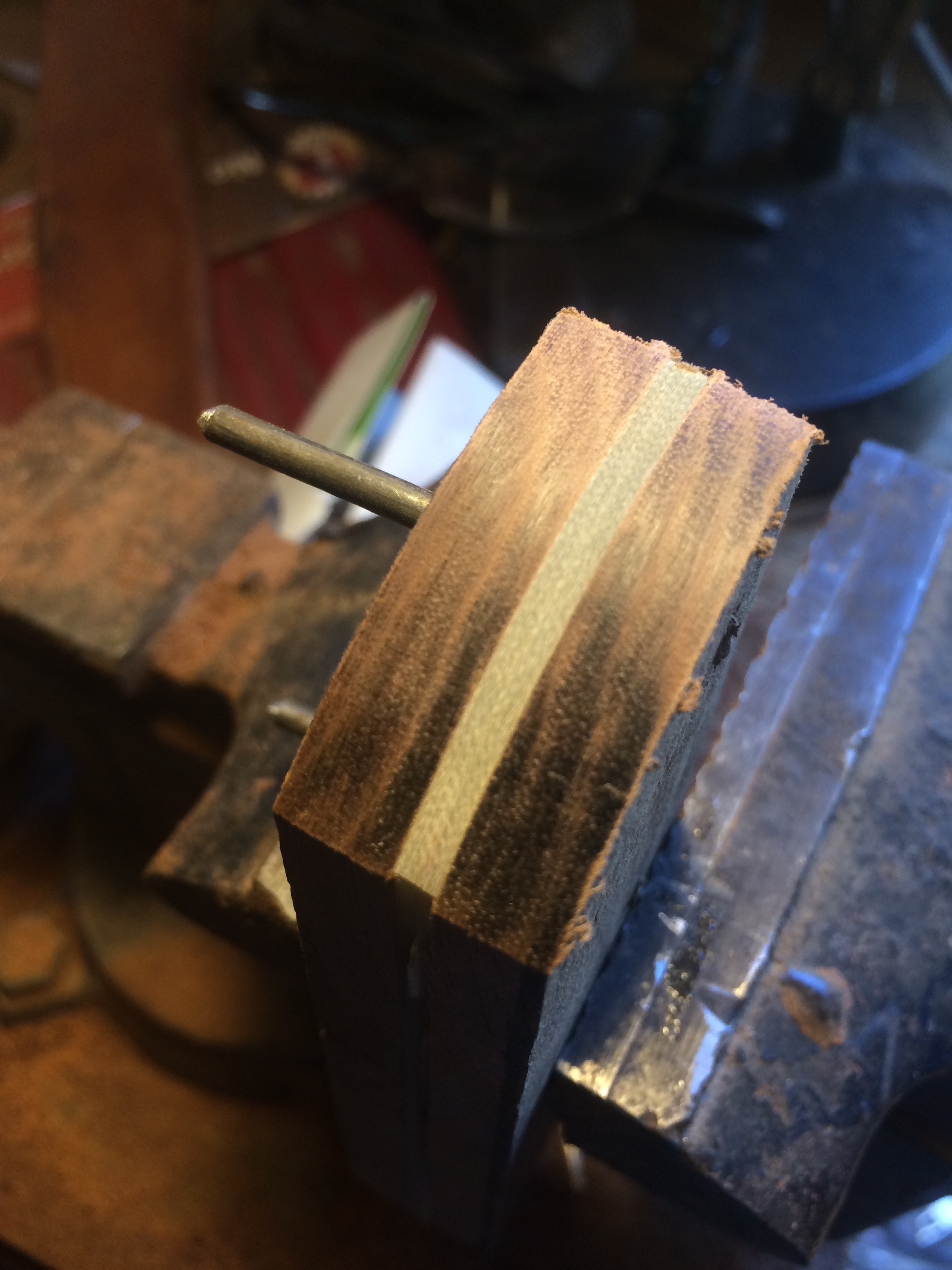
Bookmatched.
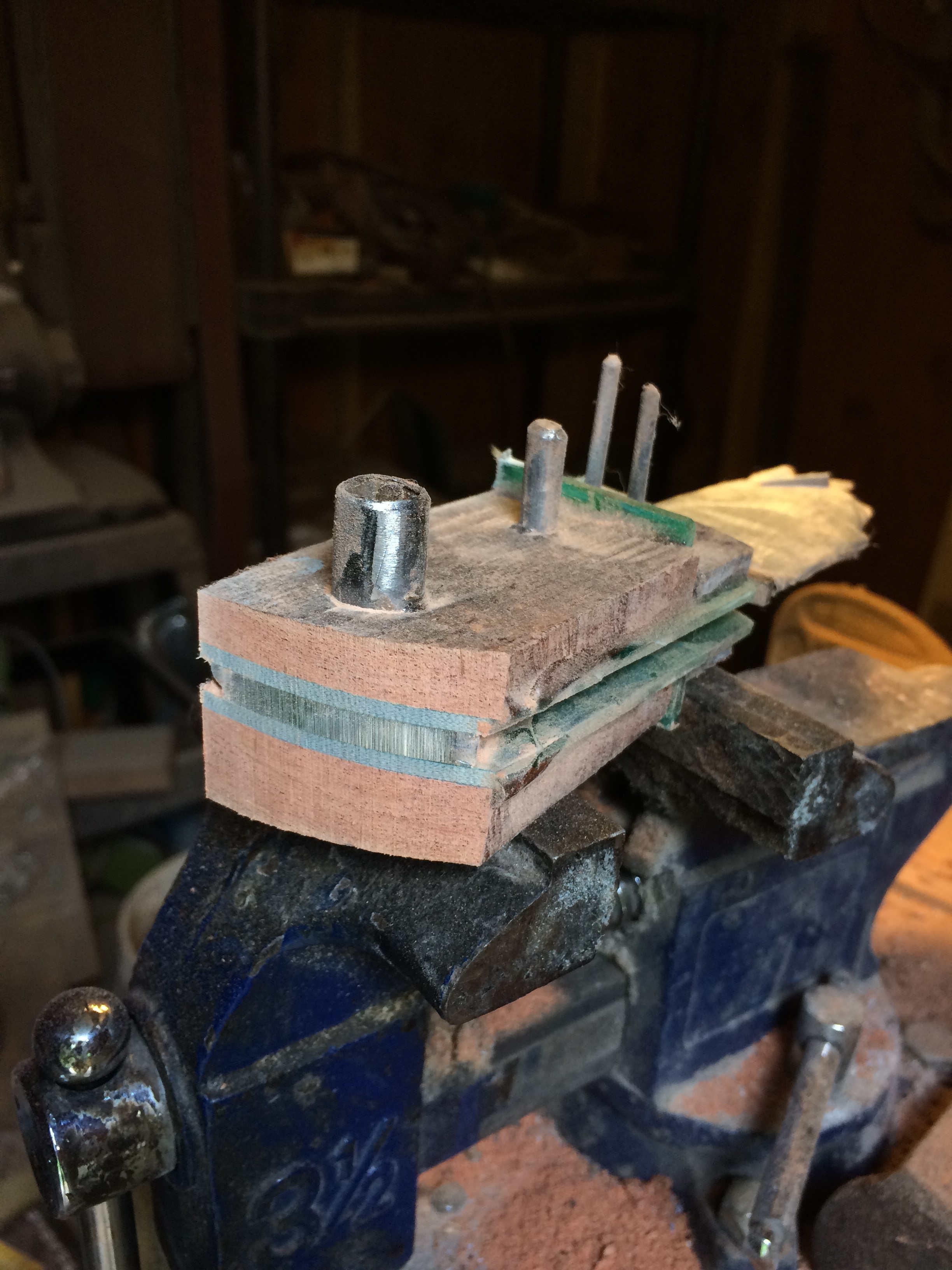
PCB board from network chassis. Rescued from a dumpster.
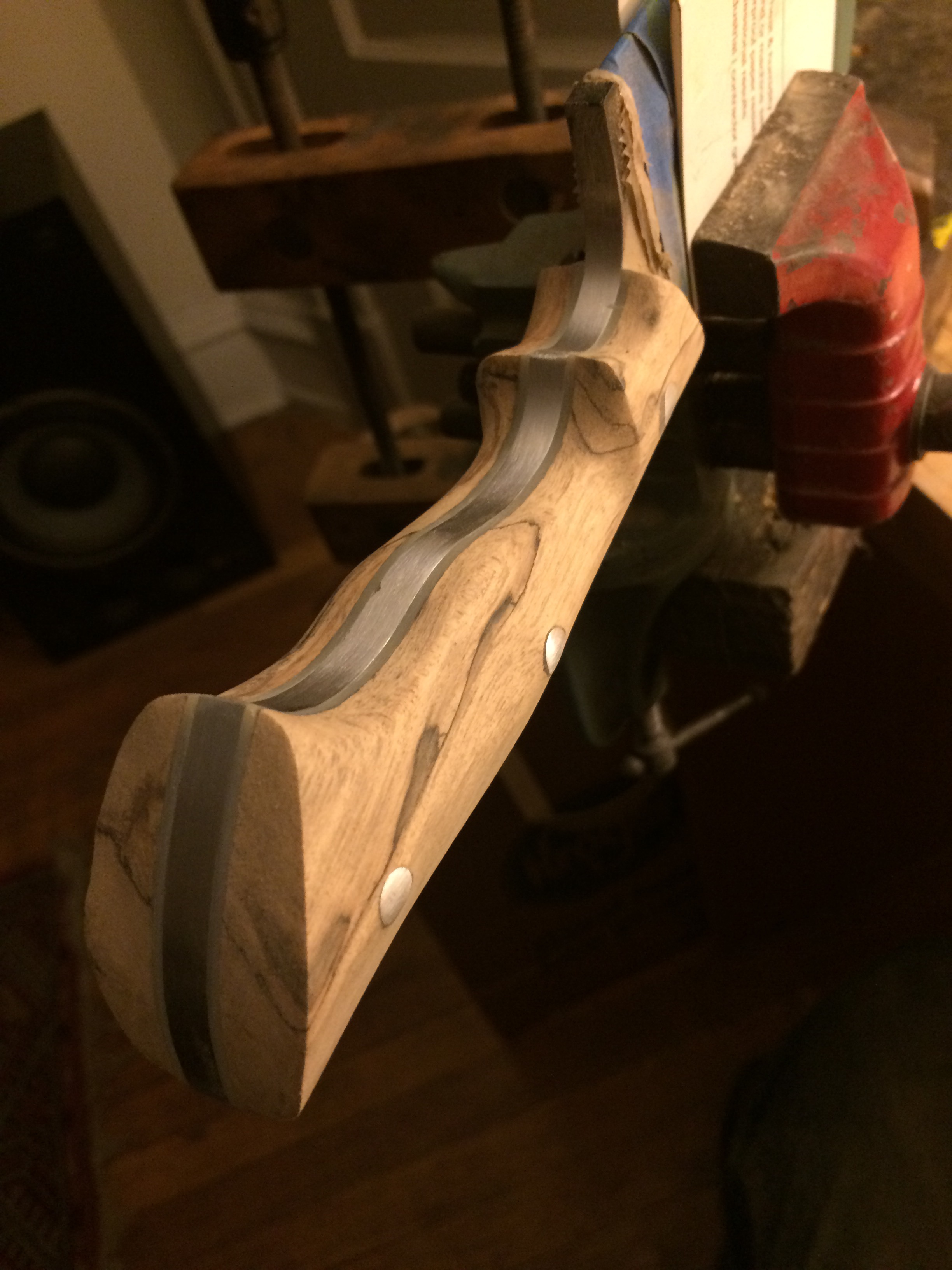
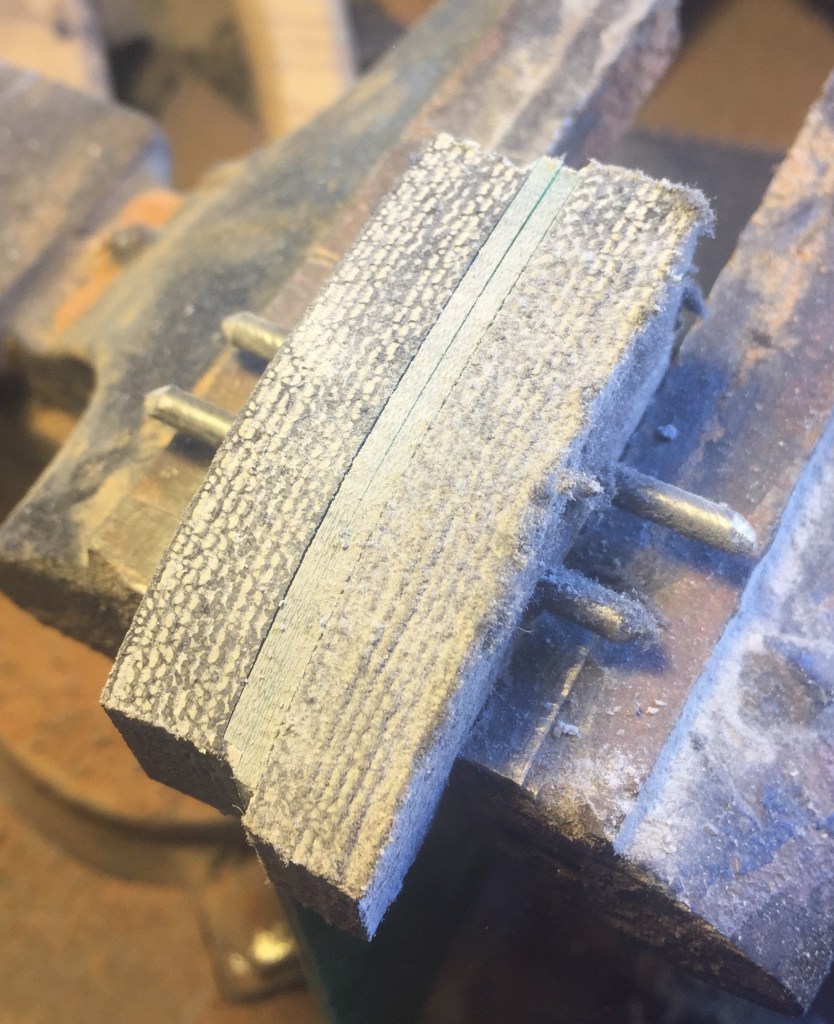
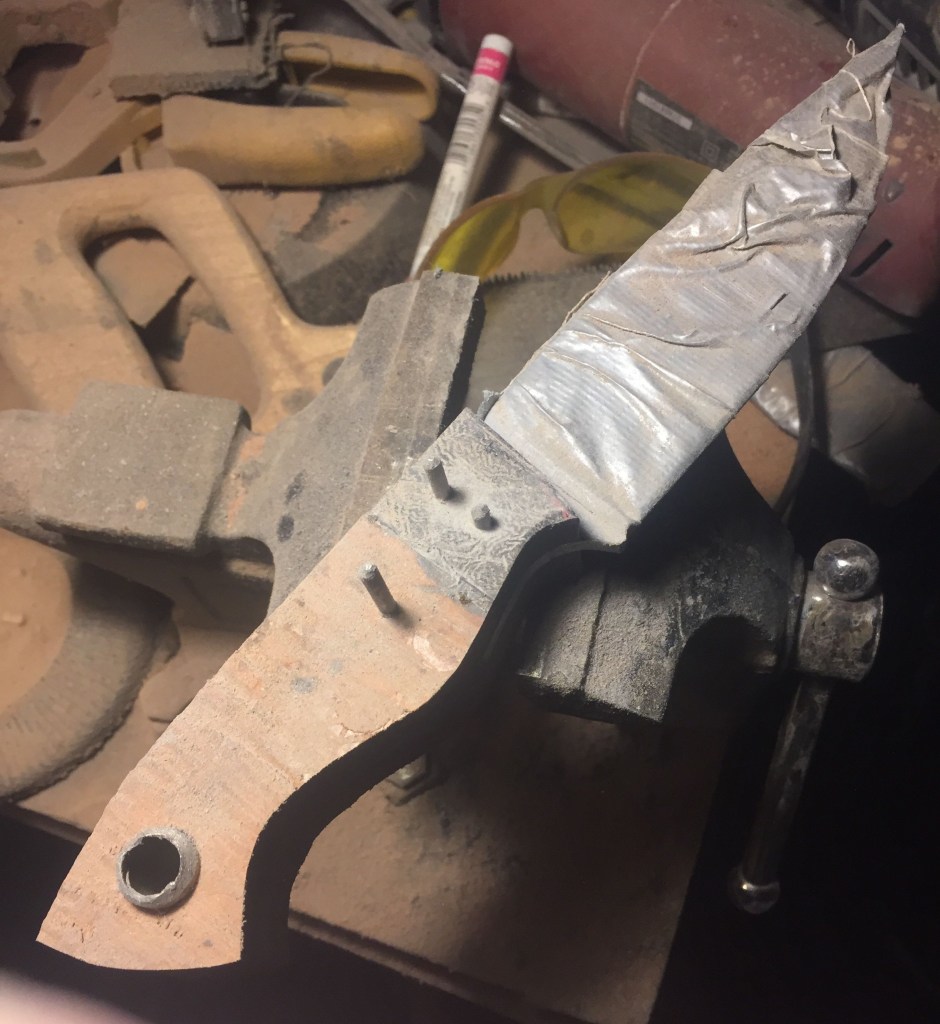
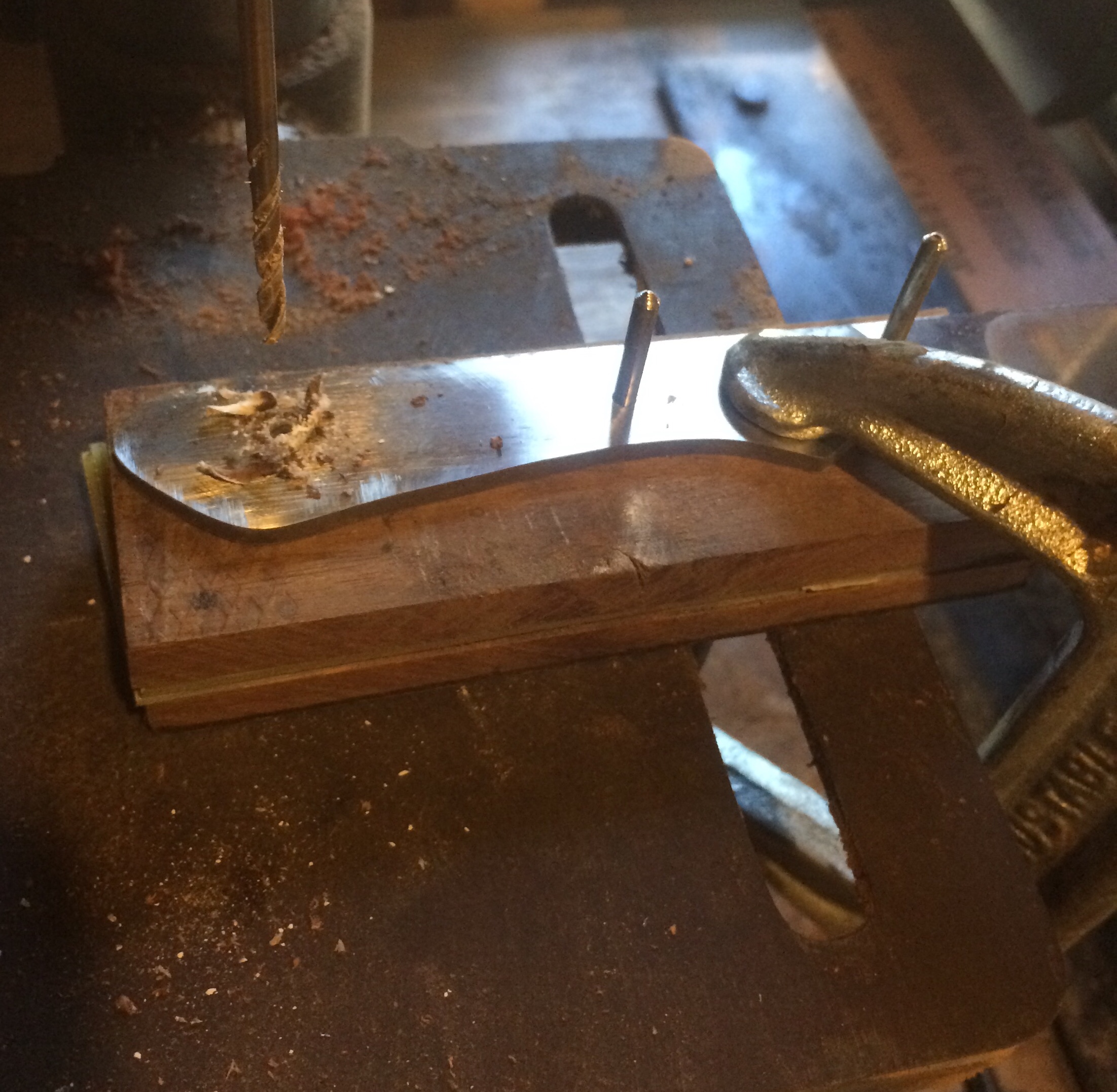
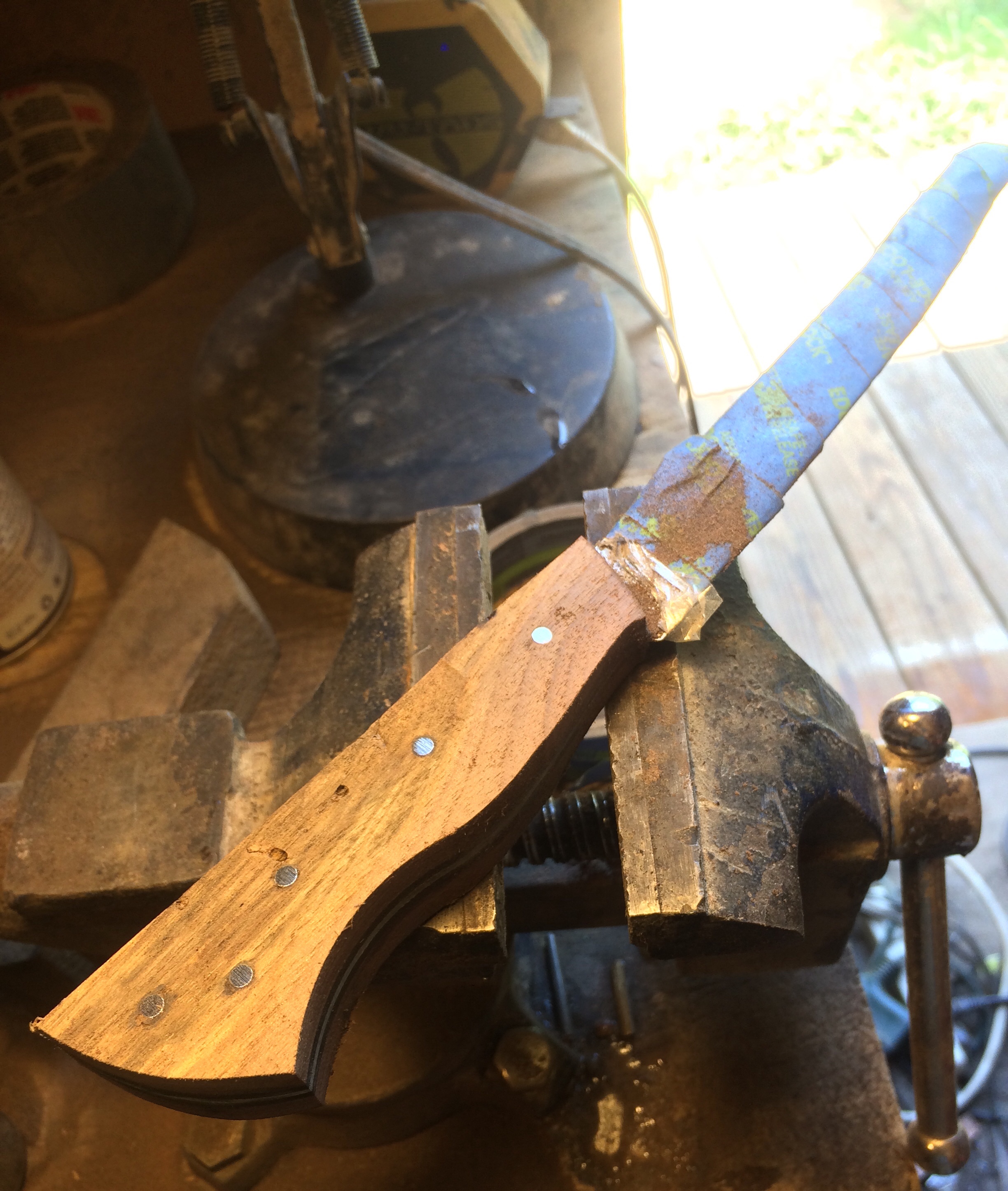
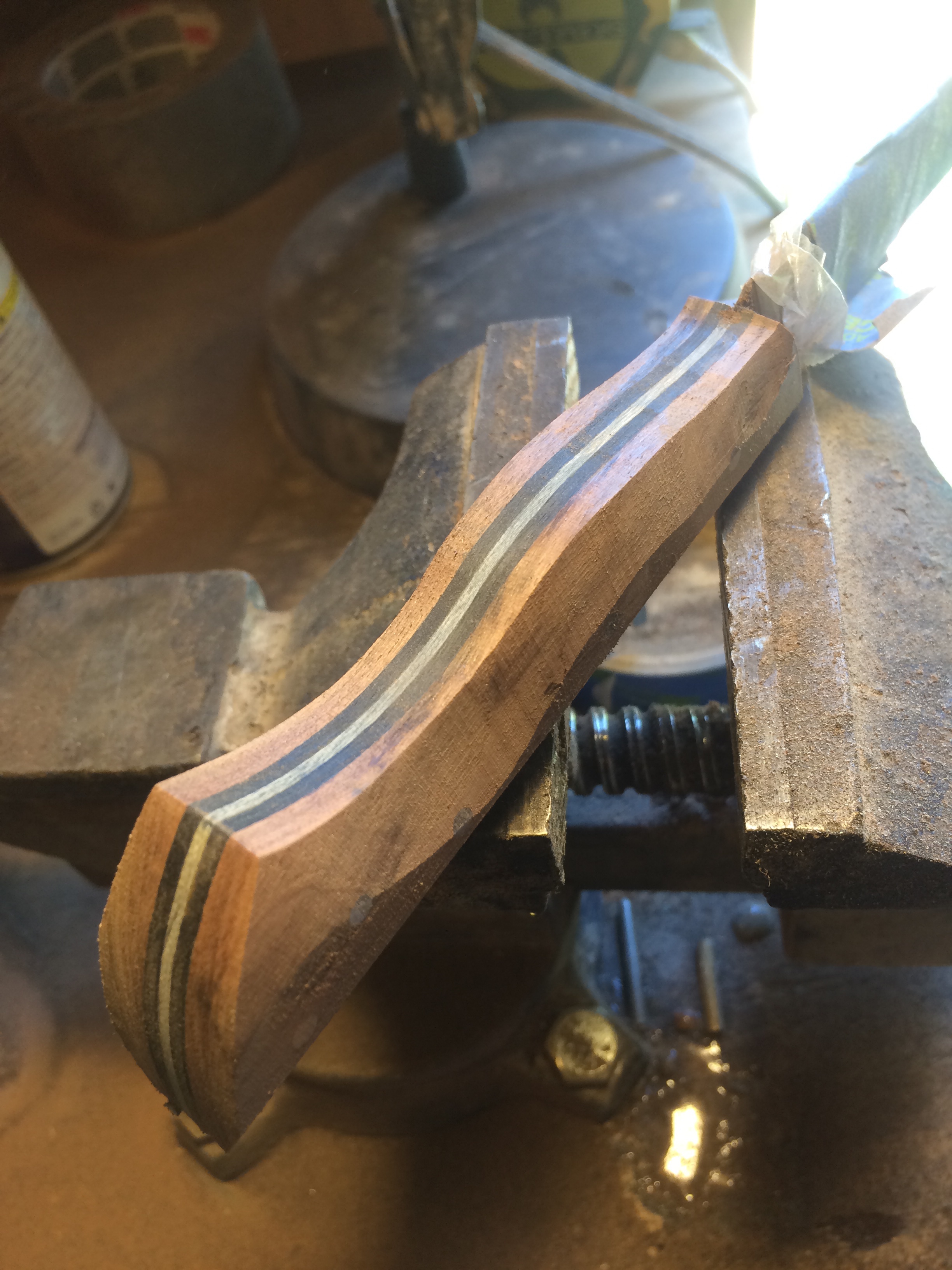
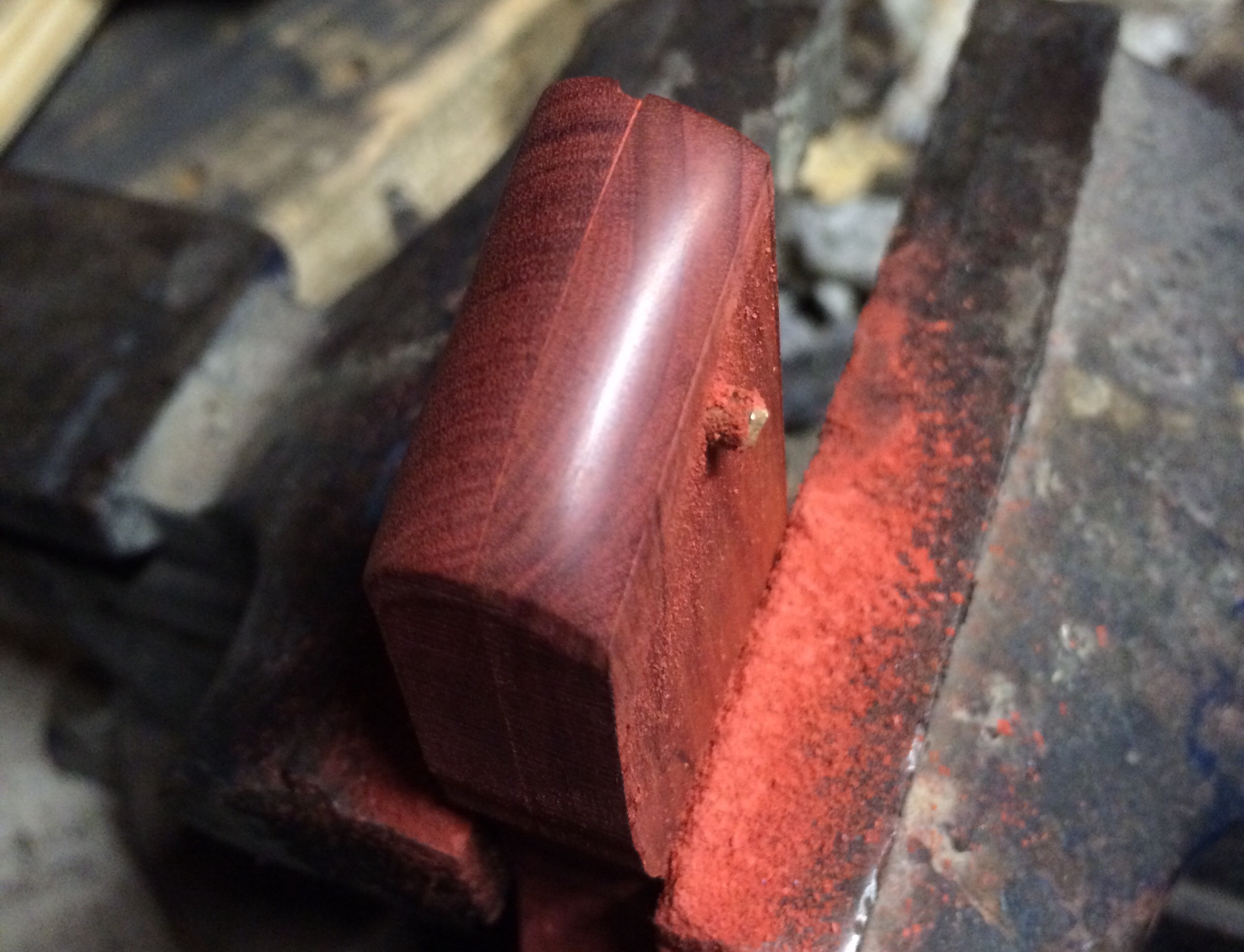
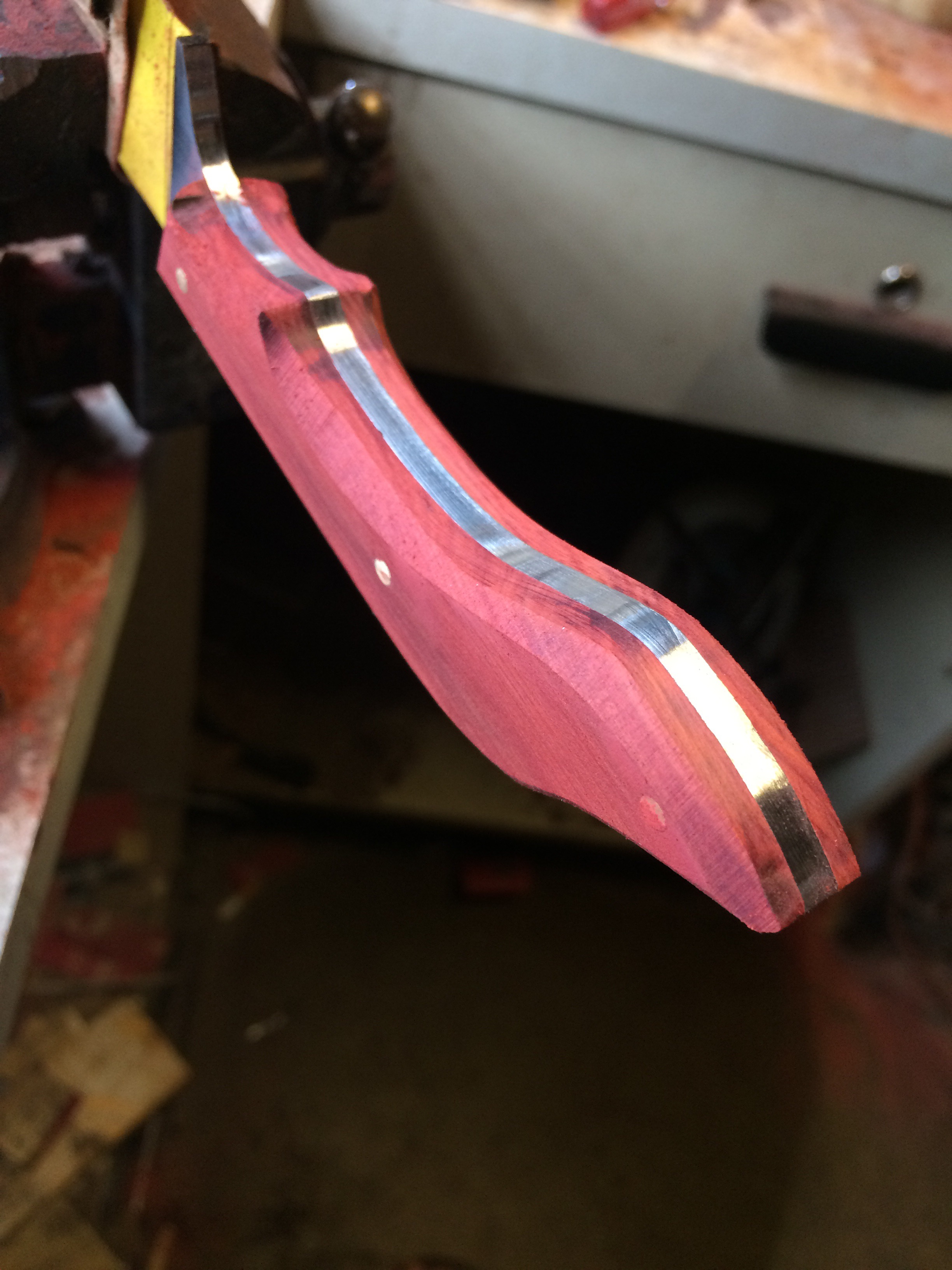
Finishing the handle.
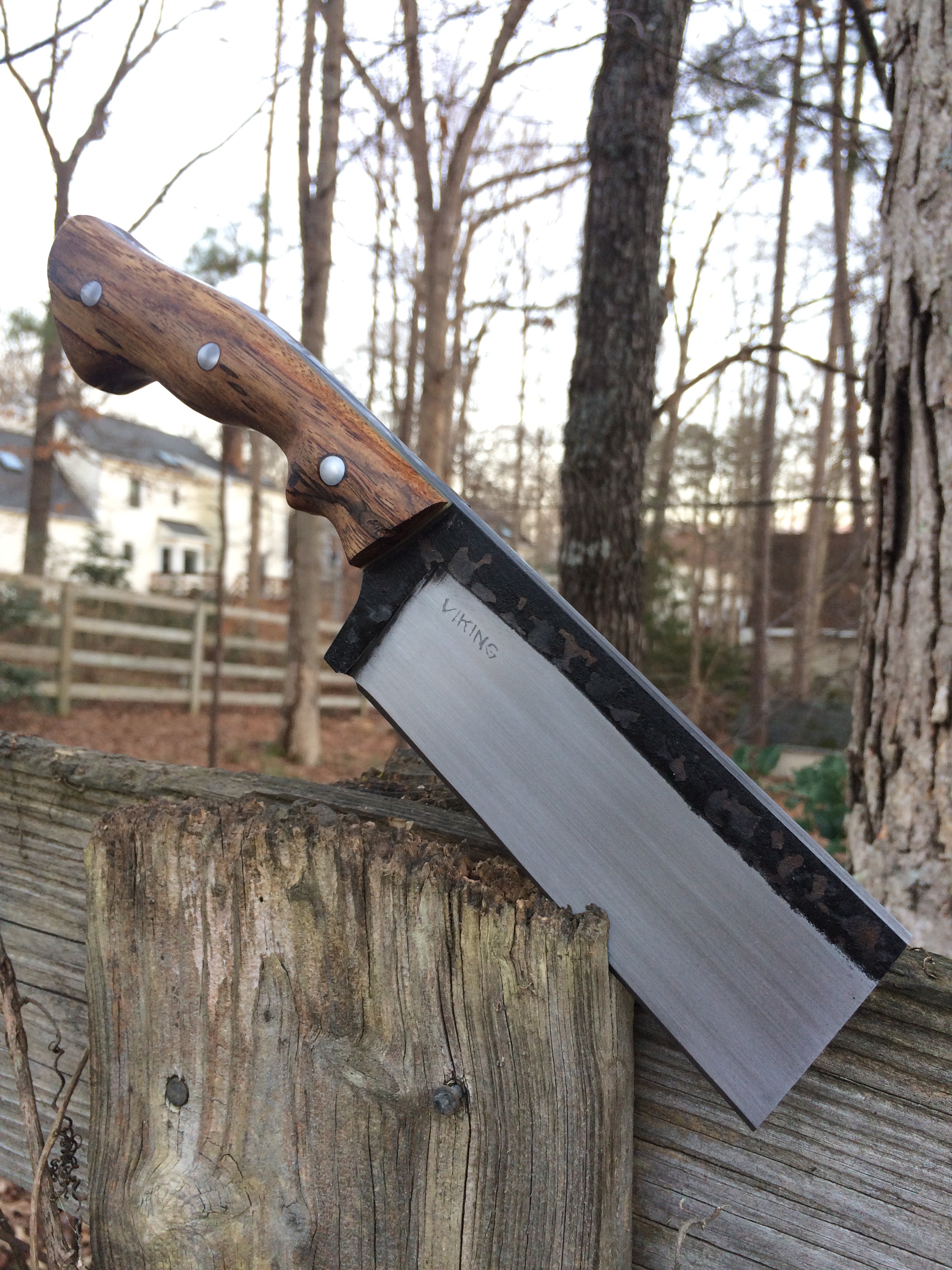
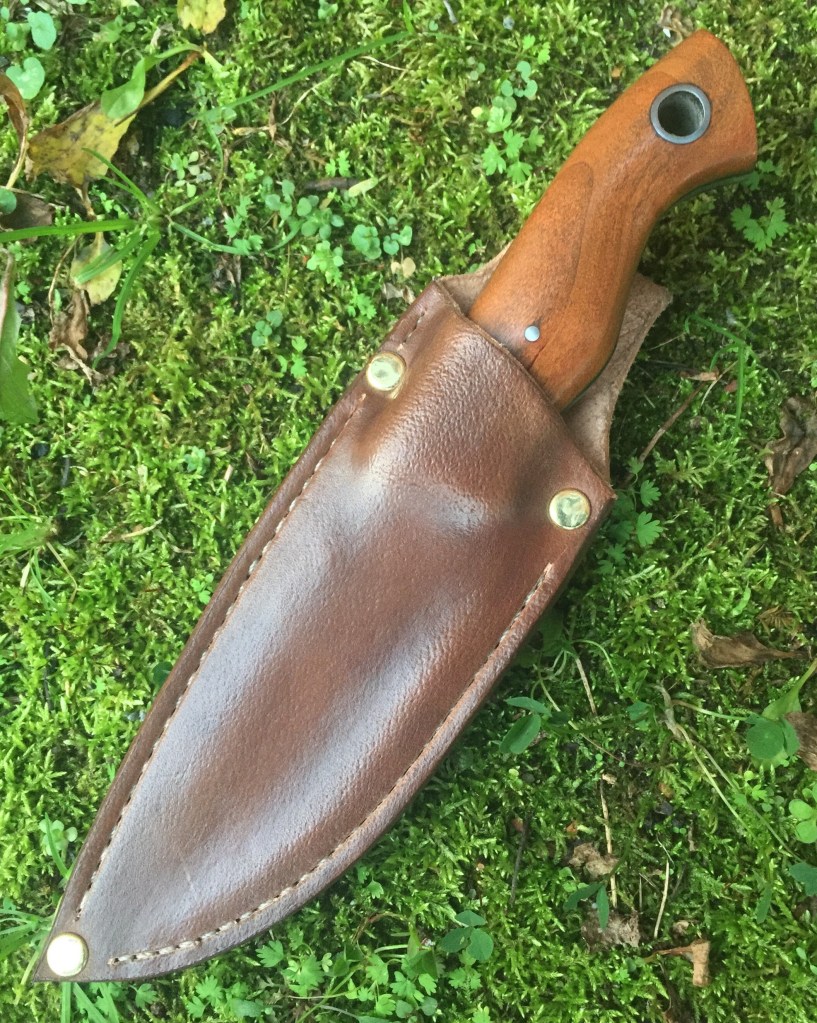
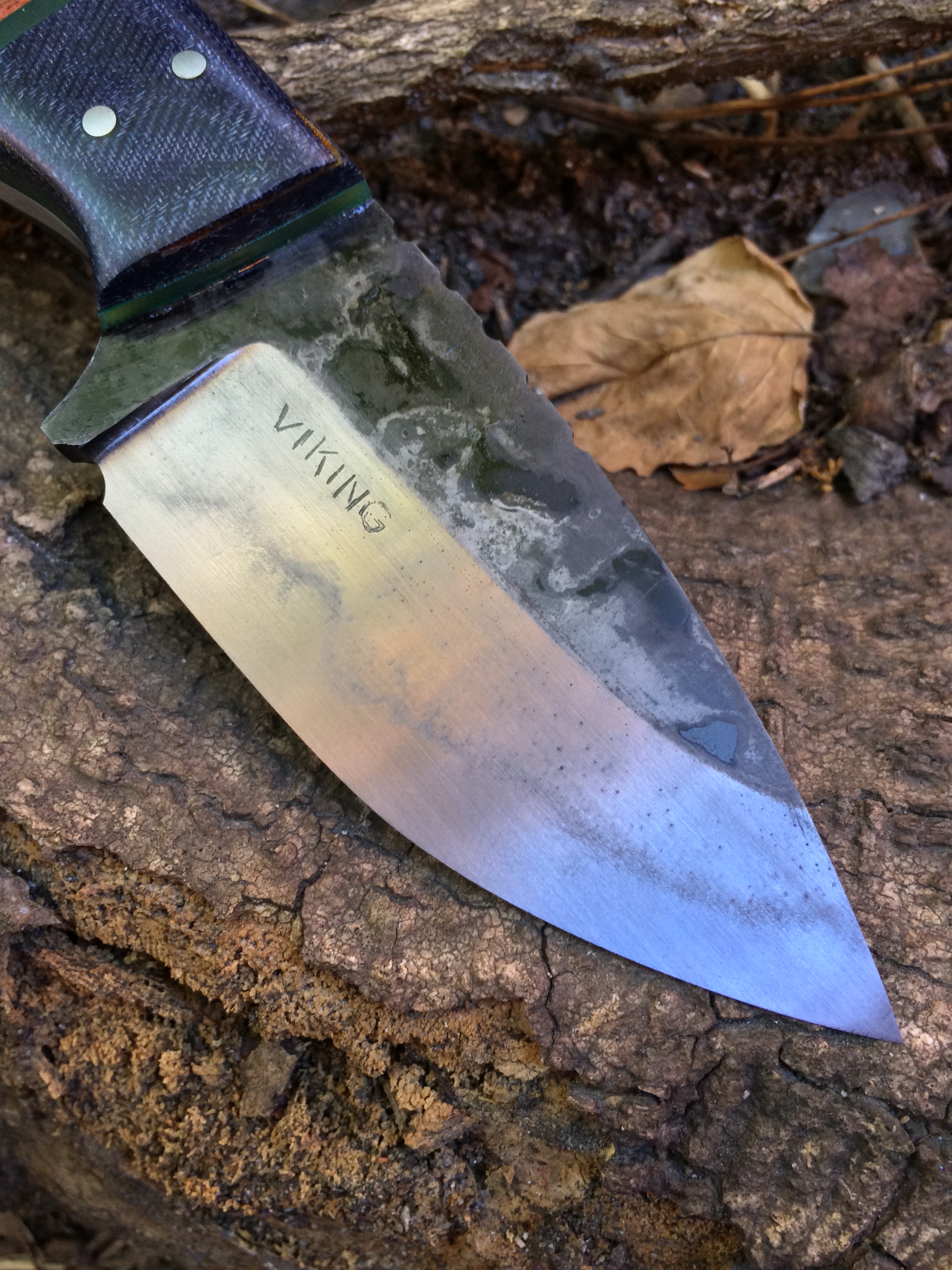
The Esperto Universale

The Esperto Universale is made of high carbon steel, which means it will take a keen edge, hold it a good while, and will be easy to sharpen. It will stain and patina and tell the stories of the places you’ve been- this natural and characteristic of the steel. Your knife is made to be used so don’t be shy about getting it dirty. Be sure to keep your knife clean and oiled when not in use. Should you find any unpleasant surface oxidization you can remove it easily with a lightly oiled bit of 0000 steel wool, or a coarse rag with a bit vinegar on it.

The Blackberry Jam Festival

Knifemaking: a commencement address (of sorts), and the Masilda

Dear Younger Person Whom I’ve Never Met Before:

Some very dear friends of mine asked me to make a knife for you.  These friends of mine are wonderful people that I have known for quite some time, and shared many adventures. They told me they have known your parents for a long time as well, so I can infer that your parents are wonderful people too. They have also known you since you were born and, if I may be so bold, I can only assume that you are a wonderful person as well, and that we are well met.

I was also told you have completed your secondary studies and are going out into the world- congratulations! My very dear friends asked me to make you something special, but also something that was functional and practical.  Something that would serve you well on outdoor adventures; an elegant tool and faithful companion.  Something to remind you of where you have grown up.  A security blanket that doubles as a prayer rosary and, if I may say so, a bold fashion statement.

As you may have noticed, Younger-Person-Whom-I’ve-Never-Met-Before, the situation of the world is a bit spicier than usual.  To be honest, the only thing that has gotten me out of the house most days in this great year of 2020 is knowing that I will be coming back home as soon as possible.  In spite of my trepidations of late, I’ve found that time marches on and life stops for no one, and there’s no point in staying home and being afraid while life passes you by.  The world cares not for our anxieties, worries, or fears, Younger-Person-Whom-I’ve-Never-Met-Before, and the sooner this is understood the freer we become.  Be sure to wear a mask, practice social distancing, and listen to the experts.  That is what they are here for.

I have designed and built you a bushcraft knife.  She is made from 1095 hi-carbon steel, which has been differentially hardened.  What this means is, while the whole blade is hardened, the cutting edge is the only part of the blade at full hardness and the spine is just slightly softer.  This offers durability and a slight bit of give, like a samurai sword.  There is a smoky line along the edge of the blade and a slight color change where you can see the differences in hardness.

The handle contains a piece of bookmatched Texas Mesquite.  It comes from a cousin of mine near Big Springs, milled on his property.  The bolster is made from a pair of lady jeans that belonged to my girlfriend- vintage Levi’s 501’s, something strong and deeply feminine.  Your knife is stout and sturdy; strong enough to baton firewood but lithe enough to prepare dinner. 

I named her Masilda, which is an old Romany-Traveller name that means ‘battle-ready’.  And while I am no authority on anything, your knife does contain a few truths and values in which I strongly believe.  Having a knife named battle-ready is no empty moniker and I have consolidated a trifecta of practices and that you may find useful in navigating a complicated world.  When you use your knife I hope that you think of them:

-Speak your truth.  The media says that we are in the post-truth era, an age of alternative facts, and other dressed-up horseshit designed to keep you from critically analyzing what’s going on around you.   The reality is that the truth always matters, and always will.  Make sure you know your own truths- the things you know to be right and good about yourself and how you see yourself in the world.  Clothe yourself in them.  Should you ever feel lost you’ll know exactly where they are- they will help you find your bearings.

-You can always make more money, but you can’t make more time.  Time is the currency of our terminal human experience.  While making a living is necessary, be aware of how much of your time you sell to a job that only cares about profit margins and what they can squeeze out of you.  If you ever have any doubts about what you should be doing with the time you have been given, refer to the above bullet point.  You’ll know what to do and you’ll be able to hold yourself in esteem while doing it.

Be kind.  It’s sounds cliche, like something written on a shoddy mass-market pressboard wall decoration in the Housewares Section of Target, but do your best to be kind.  It’s the connective fiber of our collective human experience during our brief time on this lovely little world.  If you can, you will find that the world opens up to you a bit easier, and is perhaps a bit richer and more vibrant.  There may be situations you need to tell someone to eat a big bag of shit.  Only do so out of kindness.

Wishing you many happy years with the Masilda.

The Masilda started with a drawing, a drop point style:

I had a bigger piece of steel than I thought, so the actual knife is a bit longer than the drawing:

Jimping- to prevent slipping when choking up on the blade:

Rough grinds:

Wet-sanding out the machine marks:

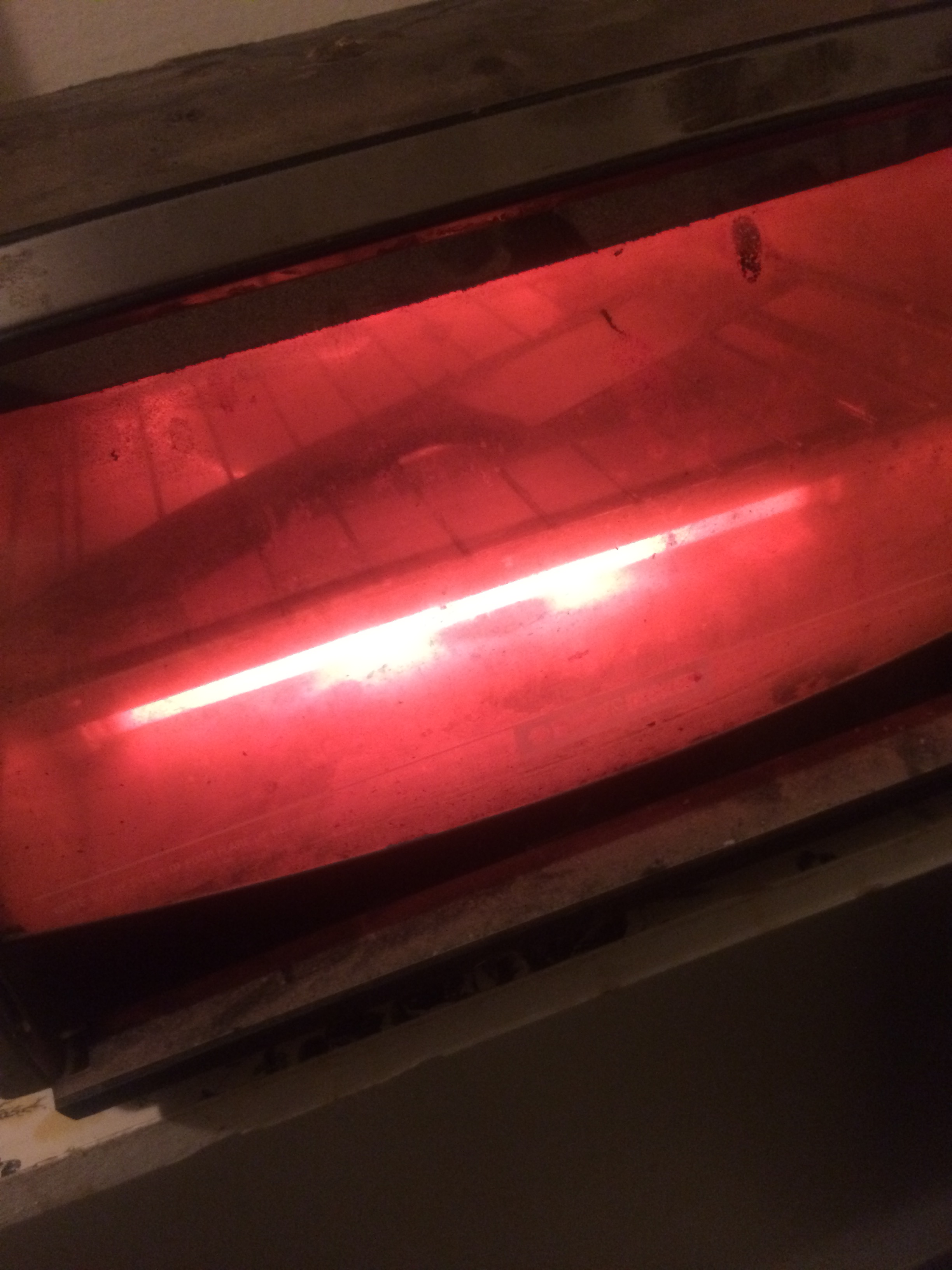
The hardening process:

After quench:

After tempering, a satin finish:

A pair of vintage lady jeans from my partner, deeply-loved and well-worn:

img_9238masildablog2

Fiberglass resin will be layered between pieces of denim, like a lasagna.  The pathc will go in as well:

blog1

Now smash the whole thing together:

blog2

The raw material:

blog3

Cut and drilled in, with the blade profile traced in so that i know where everything is:

blog4

Texas Mesquite:

img_7566

It smells really good:

blog5

Computer board blank rescued from a dumpster.  It’s just a thin piece of fiberglass board:

img_8132

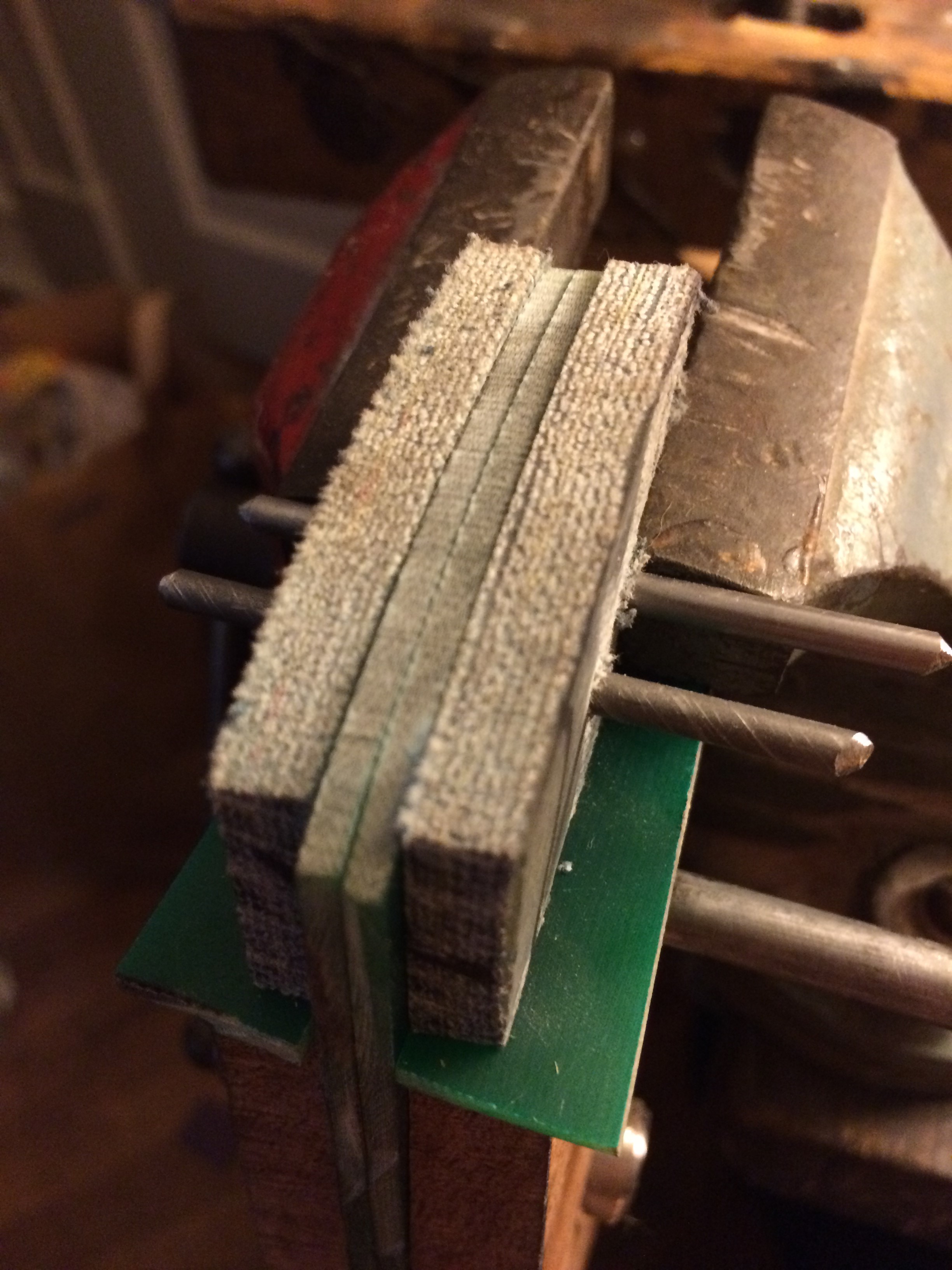
Denim and computer board at 60 grit:

blog6

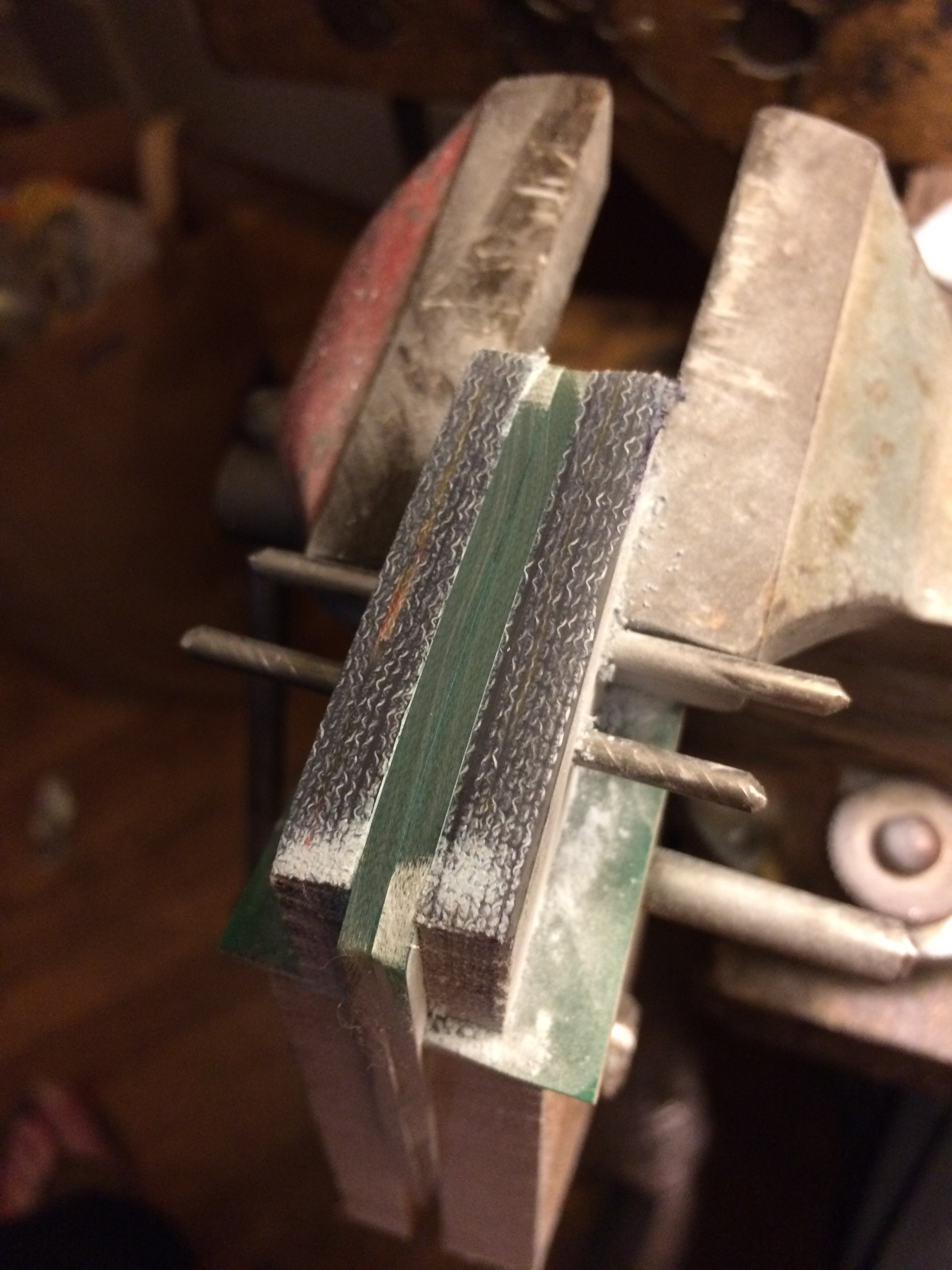
At 800:

blog7

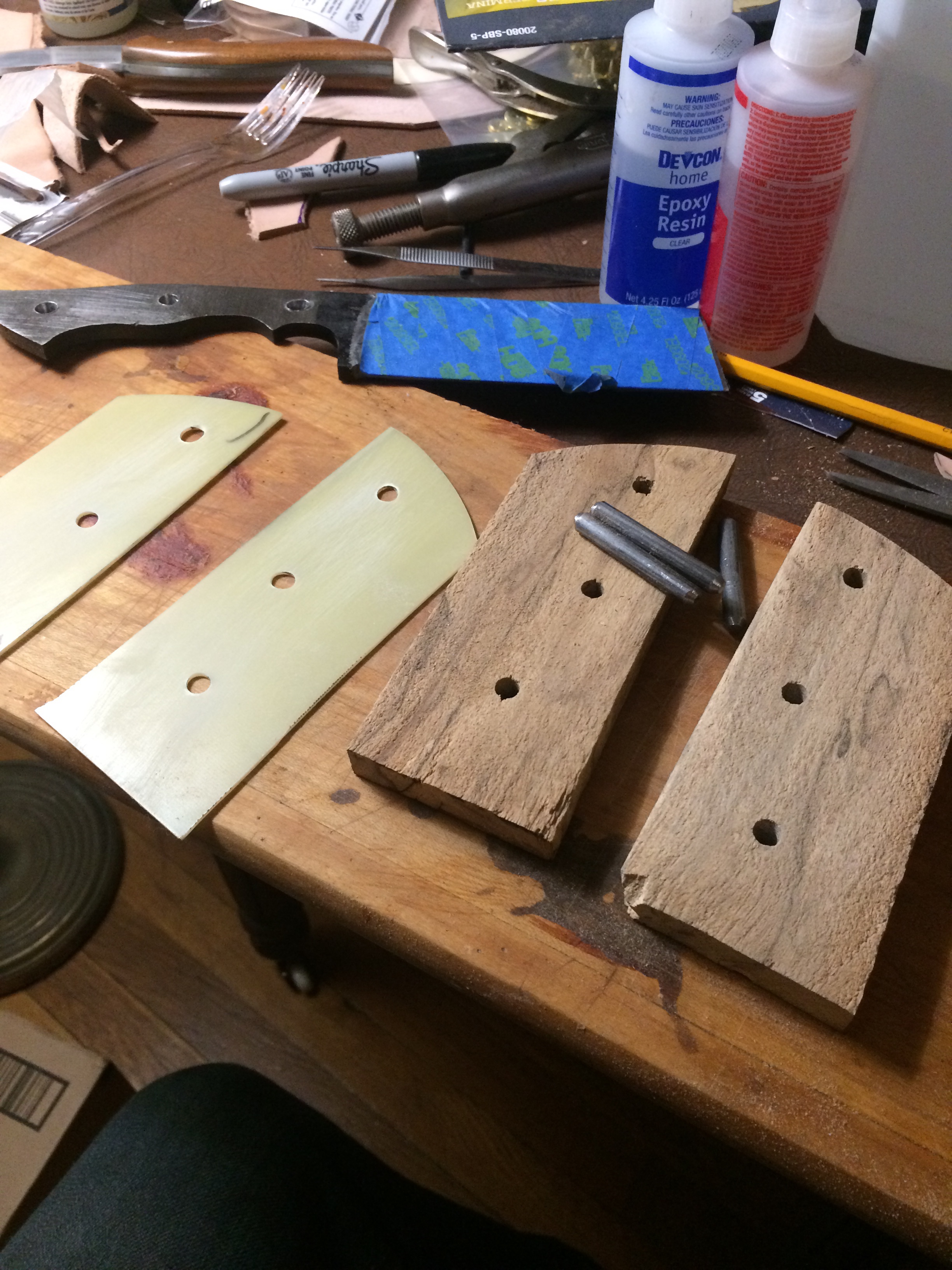
All ready for glue up:

blog8

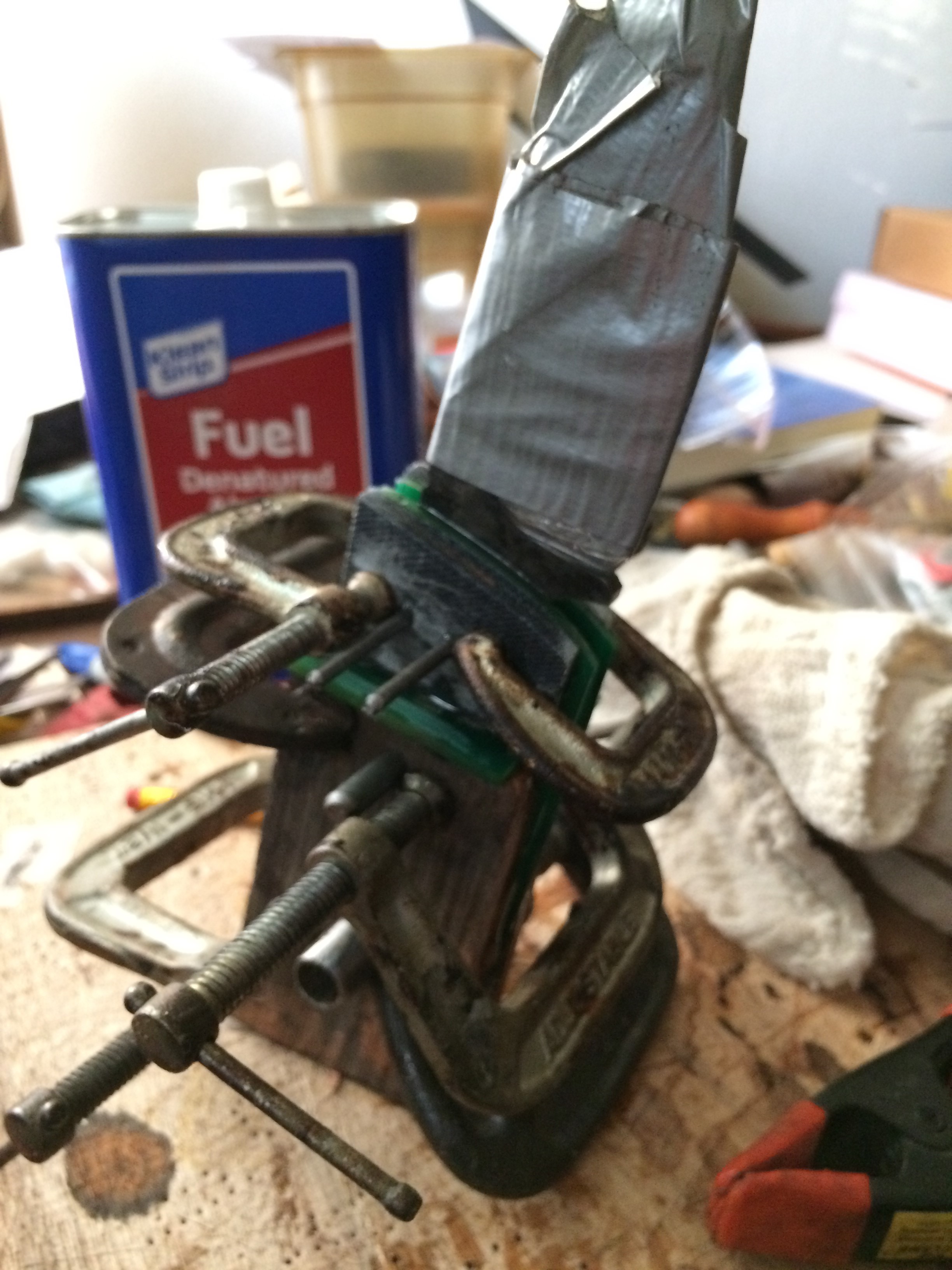
Glued and clamped

blog9

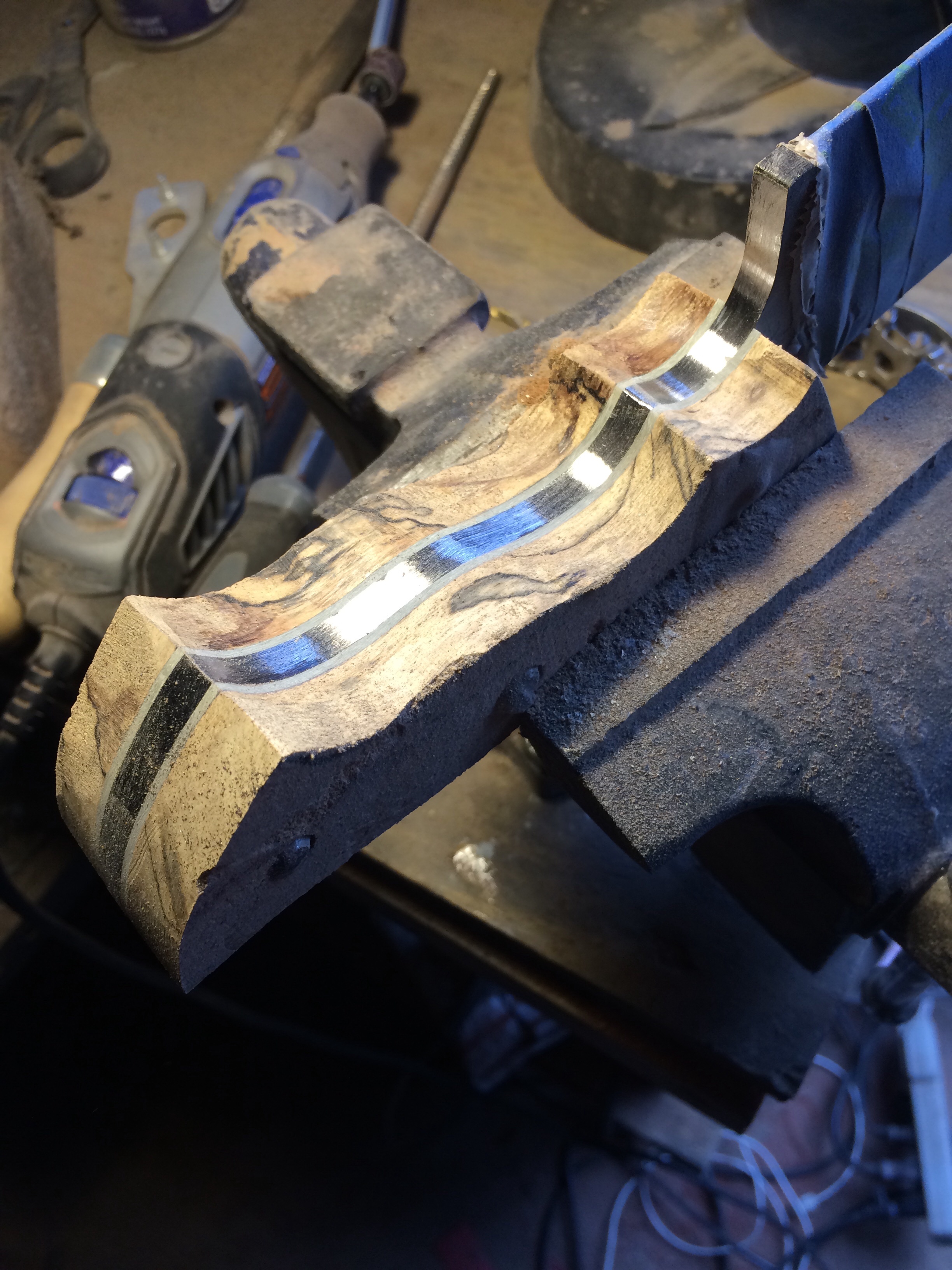
Shaping up:

blog10

From here, all the sanding is done by hand:

blog11

The higher the grit you go, the more pronounced the grain and fiber:

blog12

The Masilda:

masilda1

masilda2

masilda3

masilda4

Instructions for Care:

 Your knife is made of high carbon steel, which means it will take a keen edge, hold it a good while, and will be easy to sharpen.  It will stain and patina and tell the stories of the places you’ve been.  Be sure to keep your knife clean and oiled when not in use.  Should you find any unpleasant surface oxidization you can remove it easily with a lightly oiled bit of 0000 steel wool, or a coarse rag with a bit vinegar on it.  She is built to be used, so don’t be shy about getting her dirty.

Knifemaking: The Ace, revisited

“When we are children we seldom think of the future. This innocence leaves us free to enjoy ourselves as few adults can. The day we fret about the future is the day we leave our childhood behind.”

Patrick Rothfuss- The Name of the Wind

(you can read about the original crafting of this knife here)

As I approach early middle-age I find myself surrounded by the children of my close friends.  They are marvelous little beings, unfettered by the troubles of the world, and always see possibilities and wonder around every corner.  In watching many of them grow up I feel like I’m let in on a beautiful little secret as they walk, talk, and become more cognizant of everything going on around them.  Boldly pursuing their curiosities, there is a pronounced presence in their endeavors and the way they move through their little worlds.

This unfettered presence of being is a subtle reminder that as an adult I am always second-guessing myself.  “I wish I had done that better,” I will think to myself, or “I wish I had been kinder.”  Rumination at the end of a bad day can trouble my sleep, and the thought of facing the day the next morning can be daunting.  I will often judge harshly my perceived tumbling through the world and wonder if I am doing any of this right.  There are moments when I find it hard to get excited about anything.  Many of the adults I confide in are often thinking the same thing.  These are merely symptoms of being grown in an extremely complicated world, and as many therapists have assured me over the years, are completely normal feelings to have.

Much of this melts away when I spend time with the children of people I’m close to.  They don’t think about any of those things.  As someone crashing through adulthood, I find that to be deeply reassuring.  I am also reminded that I am in fact an adult- no, you can’t have cookies for dinner, you can’t use your Ipad in the bathtub, and yes I do have to leave (please don’t be sad, I’ll be back).  I’m not sure how such big feelings can be contained in such tiny people.

About four years ago I made a blunted knife for the oldest child of some good friends of mine.  They have a house on some property in the country about 45 minutes out of the city.  They grow mushrooms and berries and have animals and forests.  I know the place pretty well- I helped them move out there.

There are now four children at their home.  They are farm kids in the summer.  I saw all of them the other week when I was doing a side job delivering some water containers to his dad, who uses them to run his homestead.  While he was sorting out another visitor, I went in to say hello to the kids.  They were all confused, except for the oldest, and asked me who I was and why I was in their house.

I told them who I was and that I was there to help their dad.  I was then barraged with questions and chatter- the oldest shows me their puppy, the second oldest tells me she doesn’t remember me, the third oldest asked me why I was there a second time, the youngest doesn’t talk yet but eyes me suspiciously.  Dad comes in and clears everything up.  I don’t think there are too many visitors during a weekday, and I felt that my presence was a happy little gift.  I’ve found the most sincere thing a kid can do is talk to you.

Before their dad and I unload the truck I brought in the oldest, whom I’ve known since he was three, wants to show me his treasures.  He pulls a box out of his room and starts removing things- some small folding knives, a bit of paracord, and a compass.  He is immensely proud and can’t even contain it.  I’m a bit jealous.  As a large man when I get excited it usually scares people.  So I quietly and secretly took in his excitement with him. Whoever figures out how to concentrate little boy excitement and put it in supplement form will make a mint.

His dad and I went out back to unload the truck and this little boy received instructions to make lunch for his brothers and sisters.  A few minutes he comes out with a peanut butter and jelly sandwich for me.  His dad hands me his blunted knife I made a couple years ago and asked if I could make it into a real knife.   I tell him I sure can.

Because in the end, it’s not just a knife.

This little boy isn’t thinking about the bigger picture but I am.  In seeing his reworked knife, I hope this little boy will learn to see what it is to grow and improve as he figures things out.  I hope that he will learn to look back on where he’s been and feel satisfaction in seeing how far he’s come.  I hope he will see what it means to put beautiful work out into the world and the empowerment contained within speaking his truth.  Most of all I wish him to not fret about the future and to trust in his tireless human spirit.  This is the lesson of the Ace.

This was the knife I made him four years ago.  It is a hardened and tempered butter knife that allowed him to get comfortable with carrying a bladed tool. 

The handle was coming off- we’ll put a new one on.  Off with the old:

The blade is re-profiled so it has a point and will cut:

img_7485

Giving him a good polish:

IMG_2835

Satin:

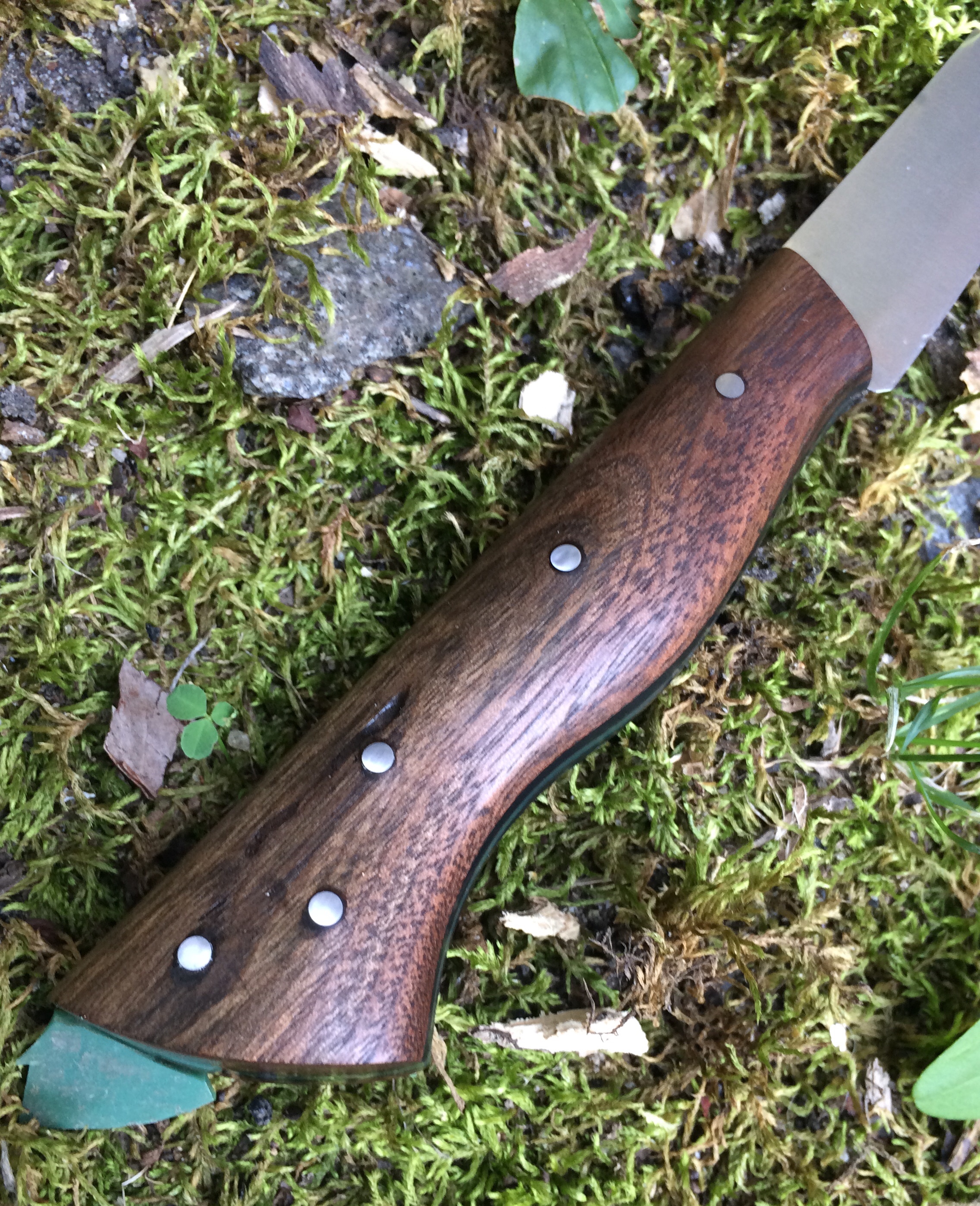
Black Walnut:

img_7486

img_7487

Computer board blank for spacing material.  Though it looks yellow, it will be green when fully polished:

img_7488

Drilling the rivet holes:

img_7489

The part of the handle that meets the ricasso is shaped and polished before glue-up:

img_7490

Glued:

img_7497

Profiled:

img_7505

Shaped.  From here on out it’s all hand work:

img_7506

The Ace, revisited:

img_7509


img_7511


Knifemaking: a restoration

“You didn’t get the quest you wanted, you got the one you could do.”
Lev Grossman, The Magician King

Every so often our shop will get calls to put a new handle on an old knife.  We always make every effort to do as many of these as we can.  

The ability to make something broken work in the way that it once did is a virtue.  This is especially true when the something that was broken is special to someone.  In most instances it’s pretty easy to replace what was broken, but the sentiment becomes lost.  Whenever possible I always try to fix what is broken, especially in the shop.

I treat these repair jobs as an exercise in incorporating as many broken or discarded things as possible into the finished product- it gives something totally unique back to the client.   Our jobs as craftsmen are to give a voice to our materials, allowing them to speak for themselves.  Many times we don’t choose what comes to us but nonetheless it is our job to turn what comes our way into something beautiful.  Making something better than it was before-this is the goal of a skilled craftsman.  For those in the know, these are the things that put the color in our world.

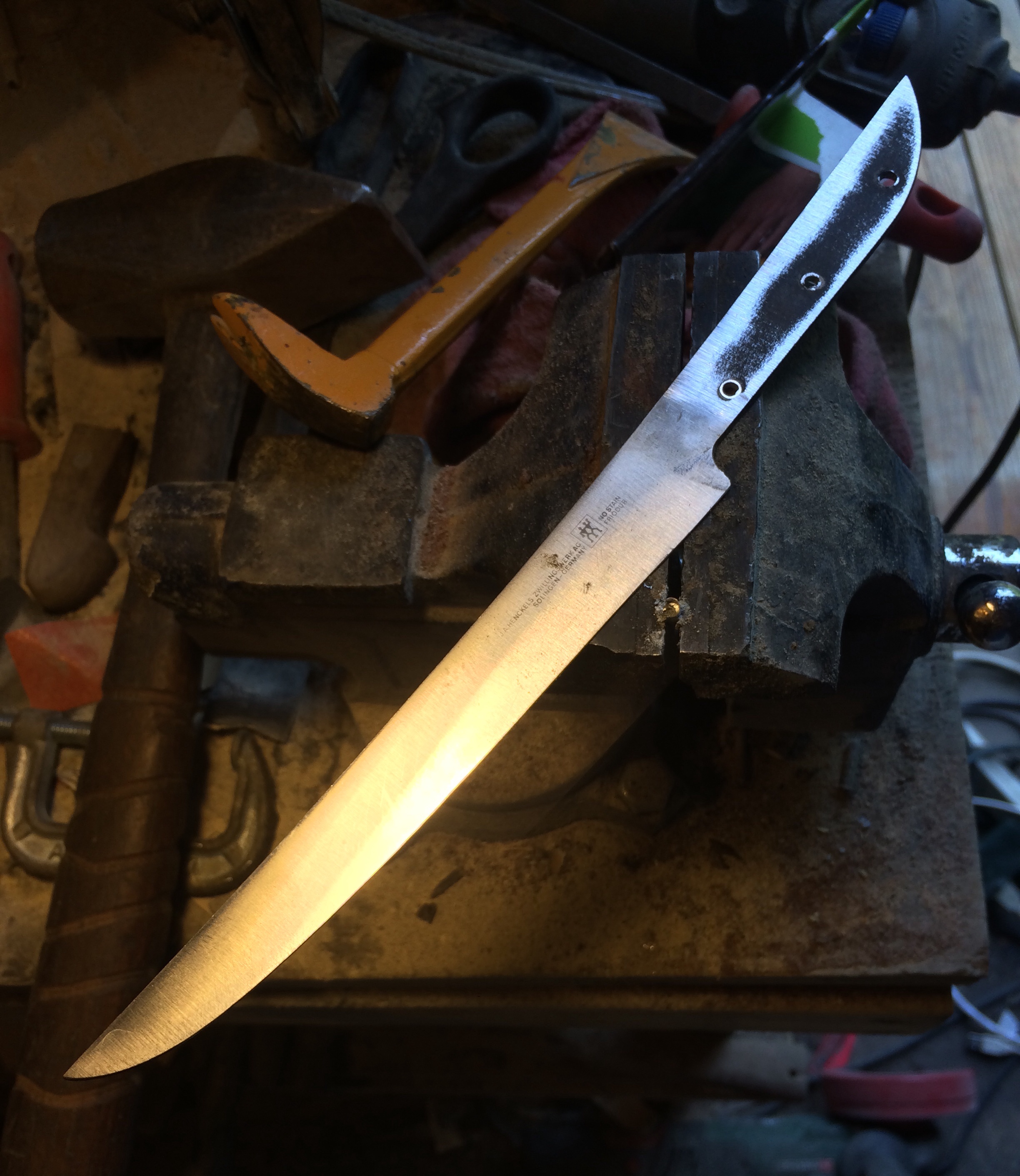
A gentlemen contacted us about re-handling an old boning knife he got in the 1970’s.  It was an old Zwilling knife, made from good Solingen steel, with Zwilling’s proprietary ‘Friodur’ subzero tempering process.  The handle had cracked, as natural materials tend to do over the years.

This one was partial tang, meaning the metal in the handle doesn’t run the complete length of the handle:

First, we remove the old handle and the rivets:

For the handle we’re going to use Black Walnut, which was formerly a baseboard salvaged from an abandoned house in North Carolina:

To extend the tang, we’re going to use a fiberglass computer board spacer which I dug out of a dumpster at one of my workplaces.  Though it looks yellow, it will turn green as it’s polished:

img_6337

Drilling the rivet holes.  The black spacing material is a heavy plastic that came from an office mail separator:

This is the top of the handle, closest to the ricasso of the blade, of the belt sander at 40 grit:

Sanded from 60 to 800 grit:

Ready for glue up:

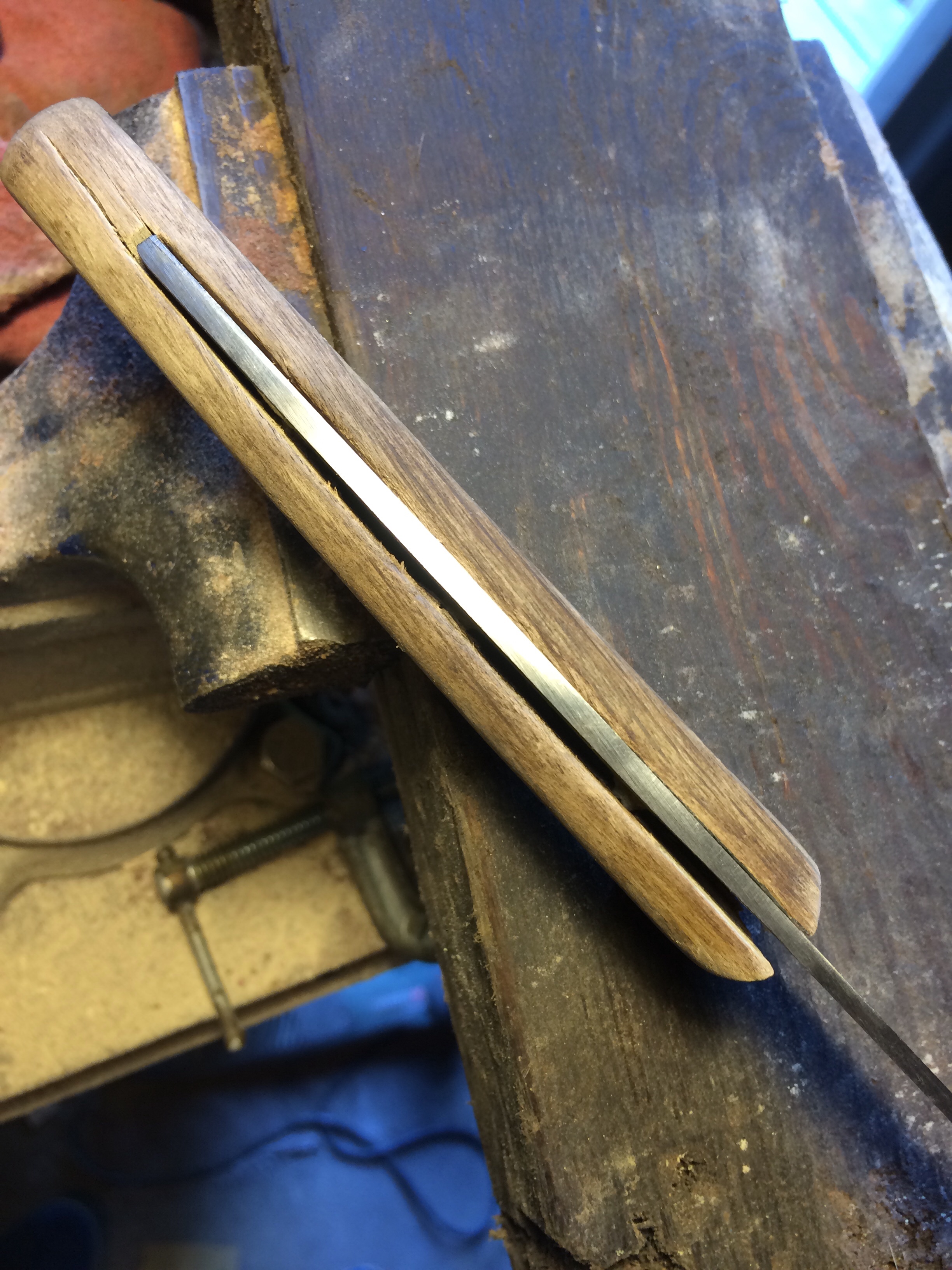
Glued and clamped:

Roughly profiled:

Shaped to the desired shape.  The rest of the work will be done by hand, starting with 80 grit sandpaper and going up to 2000 grit.

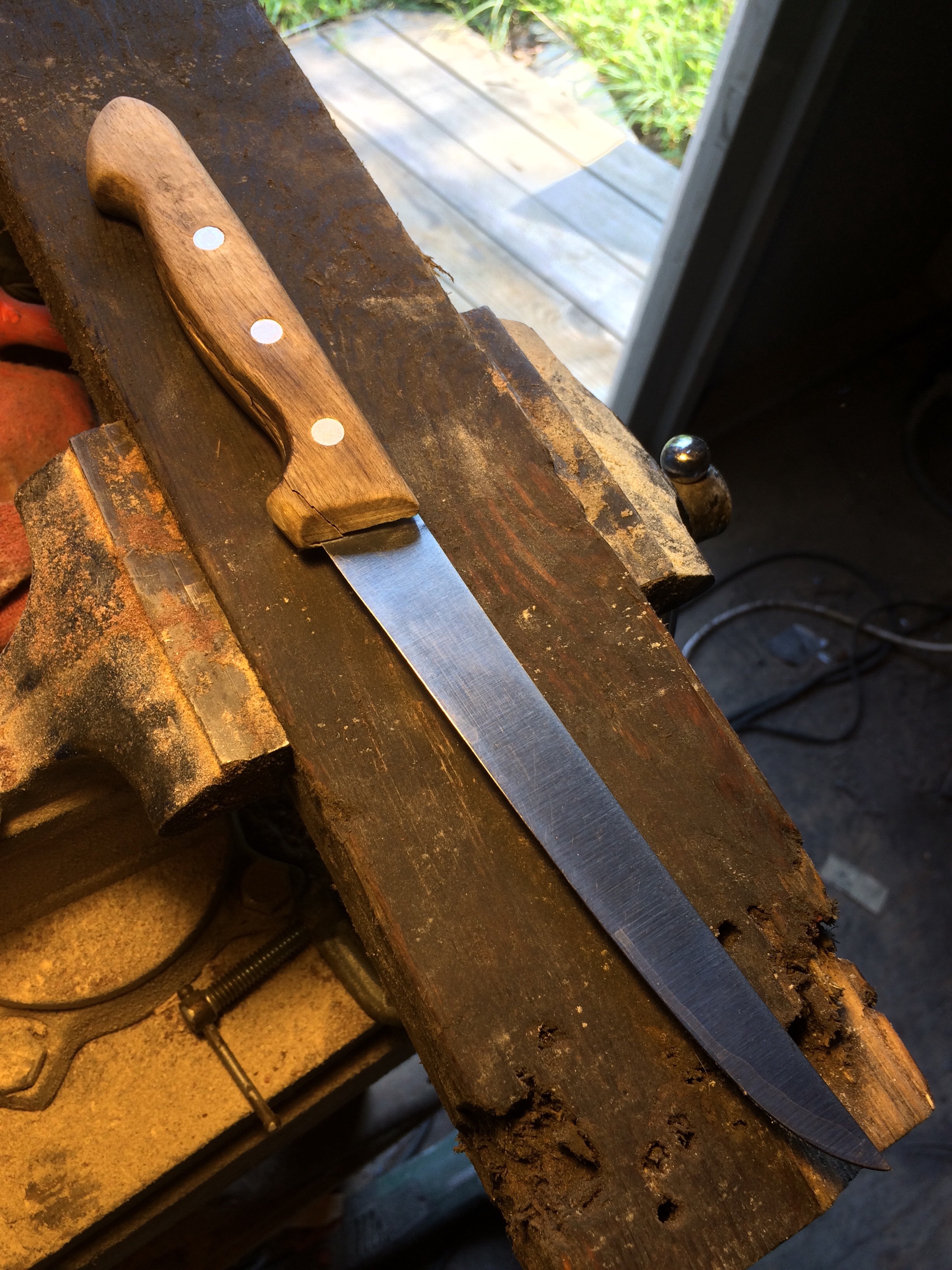
Finished, sealed, and oiled:

Always take the opportunity to create something beautiful.

Knifemaking: how I spent my summer vacation, and the Persuader, MkIII

“Warrior,

The bite marks soon will heal.

Warriors do not forget how it feels”

Stepdad- Warrior (Jungles Pt. 2)


(This is the second part of a story.  You can read the first part here).

On a late afternoon in mid July of 2018, three weeks after I nearly removed two of my fingers on a table saw, I found myself sitting with my girlfriend in a an empty group physical therapy room in a wing of the orthopedic center that had performed my surgery.  My hand had been repaired: a third of my thumb amputated and my index finger wired together to fuse the shattered bones and blown-out joints into one piece.

I had been ordered to physical therapy by my surgeon for two-part treatment.  The first part was wound care.  This would ensure that everything healed as it was supposed to, with no infection or complications, and to keep scar tissue to a minimum. The second part was the actual physical therapy, to regain as much use as possible in my injured hand, which which was currently completely bandaged with only my pinky and ring finger exposed.

I didn’t protest.  Nobody really talks about the aftermath of surviving something awful.  It will take the fight right out of you.  There is a truckload of emotional baggage that comes after the ‘get well’ flowers have wilted, the care cards have been boxed away, and normal life begins to resume.  Bills pile up and normal work responsibilities resume, but you are still fragile and adjusting and most likely carrying the weight of trauma.  Despair, depression, and existential crises of a behemoth magnitude are very real aftermaths of life-altering health emergencies as well as the emotional, physical, and financial burdens contained therein.  All of this greatly lowers your resistance, and I found myself more than willing to do what I was told.

This included a mountain of paperwork filled with verbiage of responsible parties, guarantors, and out-of-pocket maximums, essentially telling me that I would be paying for all of this for a very long time.  My girlfriend filled most of this out for me because I couldn’t even button my pants at that point much less sign my name.

In this room filled with all sorts of proprietary rehabilitative contraptions, I was introduced to Steve, an orthopedic hand therapist and educated hillbilly from West Virginia.  He was assisted by Justin, a former football player and mammoth of a man who was getting a Masters in Occupational Health and working in the office for the summer.  Normally this therapy room would be filled with patients but as it was late in the afternoon, it was just the four of us.

I found out, firstly, that hand therapists was a career that existed, and secondly, and paradoxically, they were the kindest sadists I had ever met.  As we sat down to remove my surgical dressings Steve told me that we would be spending a lot of time together and it was going to hurt a lot, starting immediately.   Boy he was right.  It took him half an hour to get the surgical dressing off as it had fused to my skin and surgical wounds with dried blood and other fluids and had two weeks to calcify to my skin and raw flesh.

Pain, as I would slowly learn, is an extraordinary teacher.  It reveals things about yourself that you most likely didn’t know were there, provided you lean into it a bit.  So I leaned in.  Steve was unrelenting and asked how I was doing.  I told him it hurt like a motherfucker.  “Great,” he said, “let’s keep going.”

When he finally disrobed my fingers I couldn’t look at them.  They looked like raw hamburger that had been stitched up.  I felt a little nauseous and so did my girlfriend.  Steve, however, said everything looked great and as it was supposed to look.  He bandaged my index finger and what was left of my thumb individually with inch-wide gauze dressing.  I was told to come back the next morning to get fitted for splints to protect my healing fingers and instructions for bandaging.

My girlfriend and I left and got Bojangles.  Bojangles chicken had become part of the healing process after one of my pre-operative visits several weeks before.  While the surgeon was concurrently examining my mangled hand, making a surgery plan, and giving me nerve block shots through massive syringes, my girlfriend was holding my other hand and staring away from the carnage and at a stack of magazines across the room.  There was a Southern Living magazine on a nearby table with biscuits on the cover.  “We need biscuits”, she whispered to me.  This was a welcoming distraction because I immediately stopped thinking about my hand and how much all of this was going to cost and thought about the glorious coming of biscuits and fried chicken.  From that moment on Bojangles became Orthopedic Trauma Chicken: the patron saint of reconstructive hand surgery, may her light ever shine upon us.

(Many months later one of her children broke their wrist and the other dislocated his knee.  They too learned of the virtues that Orthopedic Trauma Chicken offered.)

The next day I went back to the office early in the morning by myself.  Steve was waiting for me with some sterile wraps.  He explained to me that the bandages would serve as an infection barrier, but also to help my fingers to keep their shape as they healed, specifically my thumb.  In this early part of the healing process, he told me it was important to wrap them as he had shown me, as that was the desired shape that they would take.  I wasn’t to wash them or put any balms or ointments or disinfectants on them.  The body takes care of itself, he said, and I was to let my body do it’s thing.  Infection was a dangerous possibility and I was to call them if I showed any signs, but the 2,000 milligrams of antibiotics I took everyday kept that from happening.  I did exactly as I was told.  I left with two bright blue removable finger splints made from a thermo-setting plastic.  I could button my pants again.

I went there two or three times a week after work.  It was always in the late afternoon and usually only a couple people were in the therapy room.  Steve would unwrap my fingers and let them air out.  Justin would bring a small cup of water cut with peroxide that I would soak my fingers in for about half an hour.  Steve would then pick off the eschar with forceps to prevent scar tissue from forming.  Every few days he would remove a couple of stitches.  All of this was extremely painful and it went on for a month and a half but I was so glad for those two guys.  Steve would tell stories about the dumb things he did in the boonies of West Virginia growing up, and Justin would regale us with stories of dancing on the bar of a downtown drinking establishment.  Justin also had excellent playlists that he would have going over the speakers.  I came to really look forward to these appointments.

As I sat there soaking my fingers day in and day out I also noticed some other other patients there.  There were several gentleman with work injuries who were there on their company workman’s compensation.  There was a lady who had damaged a tendon in her hand with a kitchen knife, and a couple ladies and gentlemen with wrist injuries.  Steve and the gang tended to all of them.  There was one gentleman who stood out- a large muscular guy whose injury I couldn’t figure out.  I knew he wouldn’t be there if he hadn’t had something serious happen but I couldn’t discern what that was.  One day as I was sitting with my hand airing out waiting for Steve, I heard somebody tell me how good my fingers looked.  It was the large gentleman who came in everyday.  This surprised me because for one; I felt that despite what everyone at that office was telling me, my fingers did not look great and that I was a disaster, and for two; I wasn’t used to talking to anybody but the therapists outside of small pleasantries.

The large man then showed me his left hand and I saw that he only had four fingers.  His thumb was nothing but a nub and his index finger and the flesh immediately below was completely gone.   I had to look twice because it was so completely normal and comfortable for him that I didn’t notice at first.  Amazingly enough, that wasn’t even why he was there- he was an electrician by trade and had torn a major tendon in his bicep that had to be reattached.  His hand, he told me, had happened after an accident when he was nineteen years old.  The surgeon had saved his index finger, but he said he had it removed a month later because he was pissed off that it wouldn’t work right.   Young and dumb, he told me, and he wished he had kept the finger and learned to use it as it was.  He told me to figure out how to work through the pain and get as much use out of it as possible.

……..

While all this was happening I was going to work, and sorting out the massive stack of bills I had accumulated.  Even with insurance, this whole ordeal was phenomenally expensive.  I learned more about the financial workings of the healthcare industry than I ever cared to.  Shortly after the surgery, which was covered by my insurance, I got a $4,000 bill from the anesthesiologist, saying it was an out of network provider and not covered by my insurance.  After spending hours on the phone with the insurance company, the surgery center, and the anesthesiologist, I found out that it should have been lumped in with my surgery but wasn’t.  The reason for this was because the tax ID for the anesthesiologist’s claim was in-network, but the provider they sent wasn’t.  All three of them told me I was stuck with this bill and there wasn’t anything they could do for me.  Through some stroke of fate, I found that my neighbor worked in insurance and knew the billing manager of my surgery center and gave me her number.  I spoke with her once and I don’t know what she did but she waved her black magic healthcare wand and made it go away.  That was just one incident of many, but it was always a whiplash.  I renamed my mailbox the Mailbox of Doom because I never knew what fresh hell was going to be waiting for me.

As my hand healed, I got back into the shop a little bit.  Steve had told me that I would be able to do all the things I had done before, but I would definitely have to find different ways to do them.  Finding those different ways added up to teaching myself to make knives all over again.  I found myself thinking of a professor I had in music school.  The man was a brilliant concert pianist.   I didn’t find out till much later that he had suffered a stroke and had to teach himself to play piano all over again- I had no idea of this when I was taking class with him.  The man had since passed and I found myself wishing to be able to ask him about what the rehabilitative process looked like for him and how it felt.

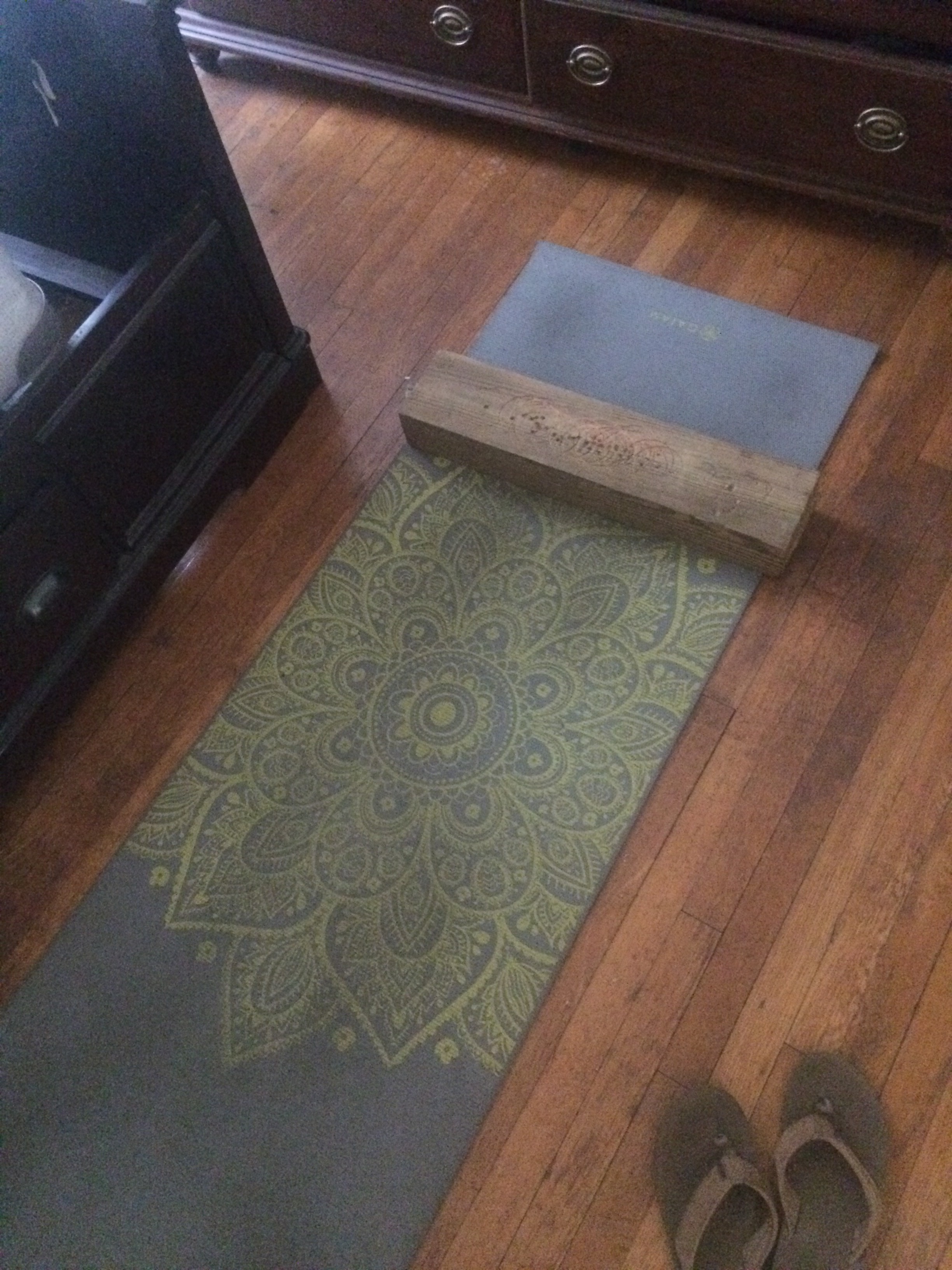
I also called my yoga teacher.  I missed being able to do yoga and asked Steve what I could and couldn’t do.  He told me I could put weight on my forearms, but not my hand.  I told this to my yoga teacher and she choreographed a modified Ashtanga series for me that I could do on my forearms.  She told me to get some yoga blocks to help facilitate this.  When I saw how much foam yoga blocks cost, I decided I would just use a piece of treated 4″x6″ lumber cutoff that I had in my truck.  I did Viking Recovery Yoga a couple times a week and it was brutally difficult.  I leaned into the pain.
……….

Slowly I eased into more physical therapy work and getting facility back into my hand.  Justin had gone back to college and I often met with another therapist, Kay, a lady from Puerto Rico.  She was fantastically kind and gentle, and always wore fiercely hip shoes.  Her husband was retired military and they went on wild adventures on the weekends.  She showed me pictures of a trip where they had taken visually impaired kids on a whitewater rafting trip- all the kids in the picture are tearing ass down river rapids and had on the giant sunglasses that you see the elderly wearing.  At first I wondered how she functioned in such a deeply masculine work environment but the reality was that she was probably the wildest of everyone.

With Steve, I always took a ‘make it suck more’ approach to physical therapy.  Make me do more, give me more things to work on at home, kick my ass a little harder, I’ve got to do better.  With him it was like being at the gym with a buddy.  While I was working through my brutal hand exercises, he would be timing me and telling me about his last bow hunting adventure.  One time he had me dig twenty marbles out of five pounds of silly putty with my two gimpy fingers while he went on a soliloquy about a regional restaurant chain in West Virginia with the best damn breakfast biscuits he had ever had.

With Kay everything was a little bit gentler.  I still pushed but the drive was more subdued.  Conversation was turned inward and bravado was dialed way back.  She asked about how things were going in the shop and I would do my best to articulate all the digital nuances I was navigating and modifying.  My type A disposition would be disarmed before I even knew it was happening and she would talk me through issues I was having.  It was a lot.  After I had spent forty-five minutes struggling with an exercise, she would always tell me I was doing really well.  I would then go sit in my car and cry before I drove home.

……..

 In December I had another smaller surgery to remove the hardware that had been in place while the bone in my index finger fused.  Compared to everything else it wasn’t that big of a deal.  In February of 2019 I had my last post-op follow-up with my surgeon.  Before he discharged me from his care and the care of the physical therapists, he told me I had healed very quickly and my results were not typical of people who sustained my severity of injury.  I told him that I didn’t have a gold plated insurance plan and zero workman’s compensation.  If I gave up I would just sink.  There was no other choice.

I also told him that there were a lot of people who had invested a tremendous amount of time and energy into a very expensive process to help me, and it would be a huge disservice to everyone, including myself, if I didn’t honor that by doing the best that I possibly could.

This was the first knife I completely finished after I was discharged.

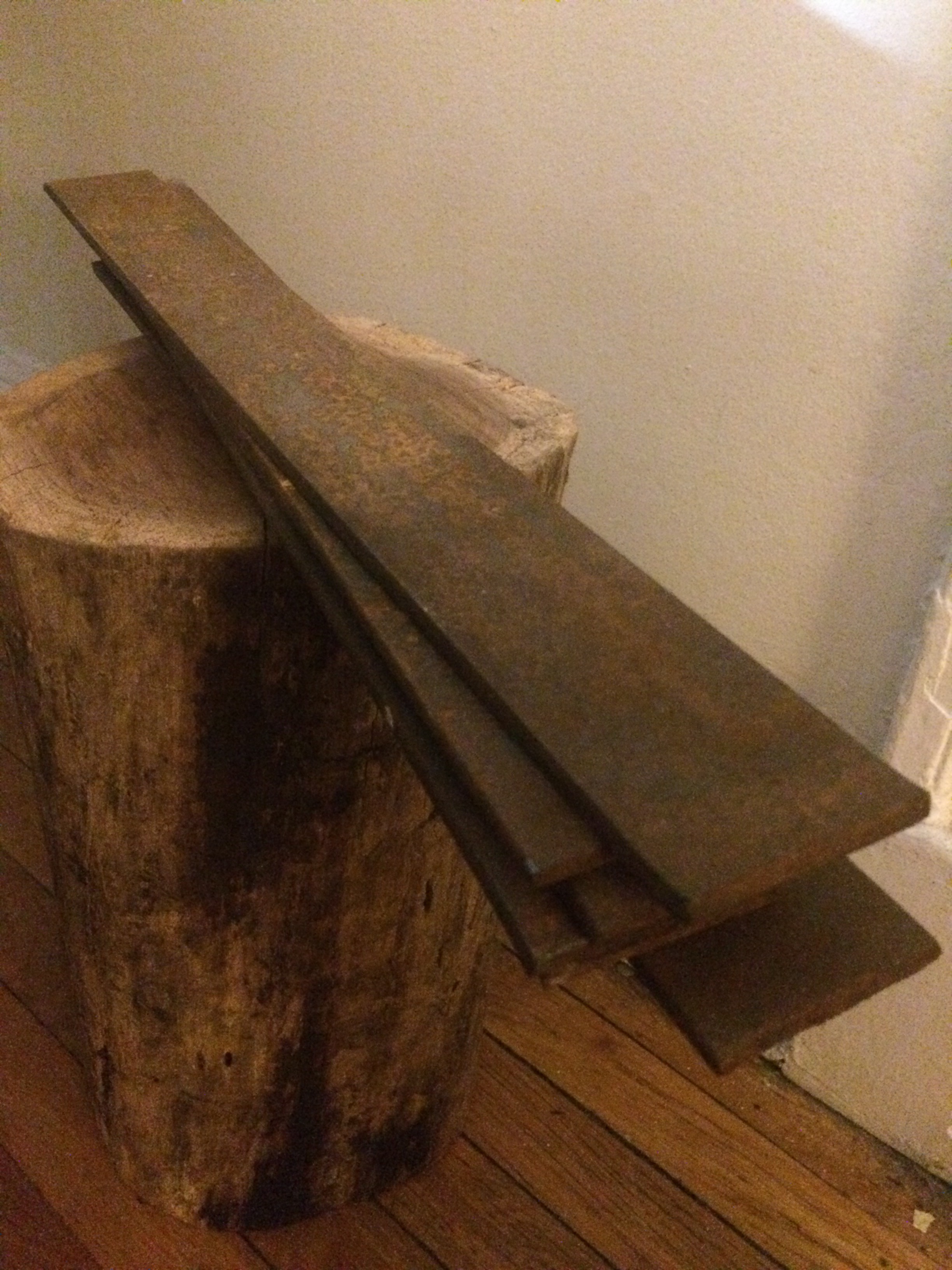
This steel came from a friend.  The man they bought their house from made lawnmower blades and they found these in the garage when they moved in.  This is a 1/4″ oil hardening steel:
persuader1

Rough grinding:

persuader2

Hand sanding before hardening:

persuader3

persuader4

Hardened

persuader5

Tempering:

persuader6

persuader7

Satin finish:

persuader8

Spalted Pecan from my cousin in Texas:
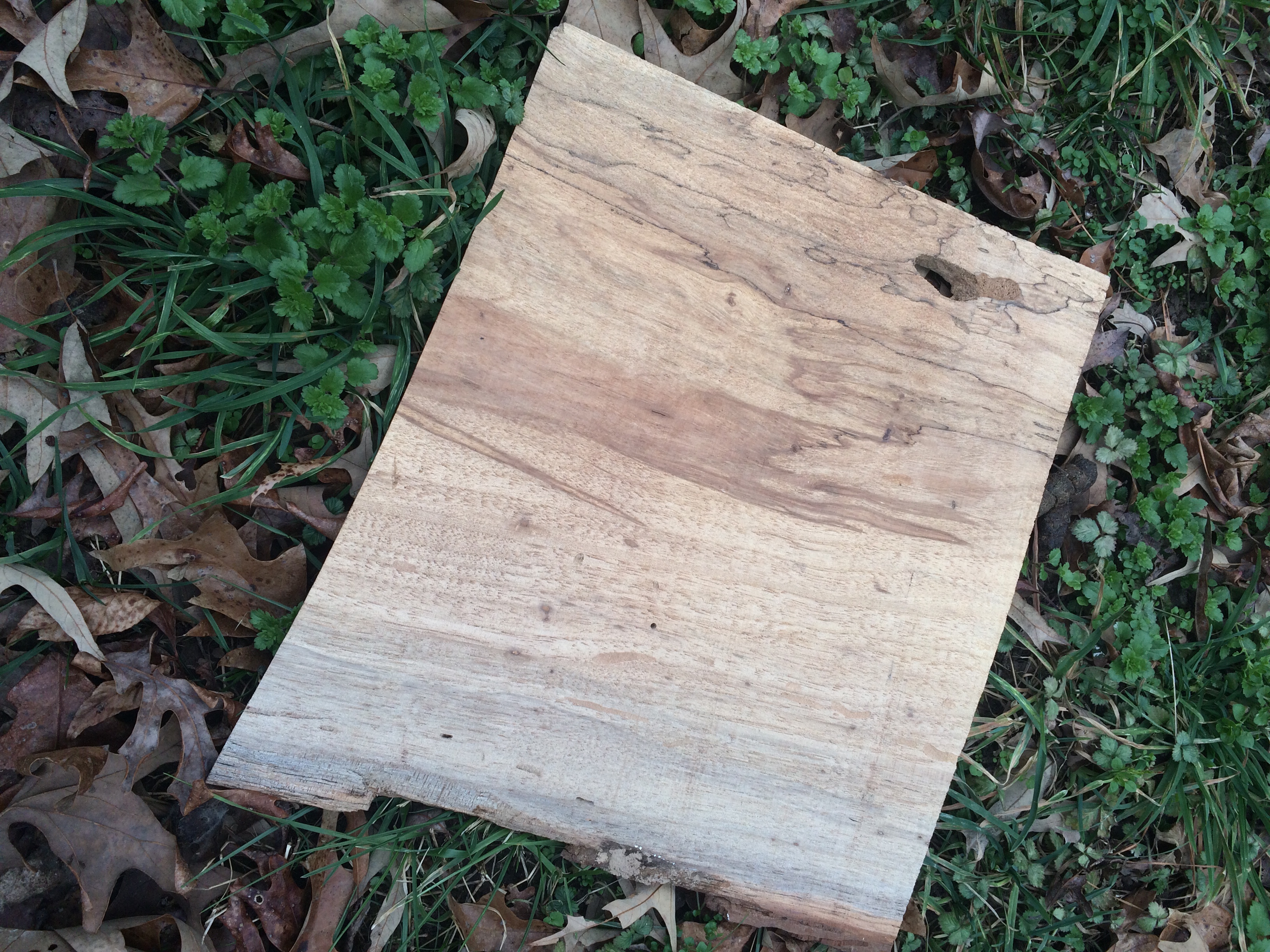
The black lines weaving their way through the grain is actually a fungus.  This fungus that injures the tree actually makes it more beautiful:

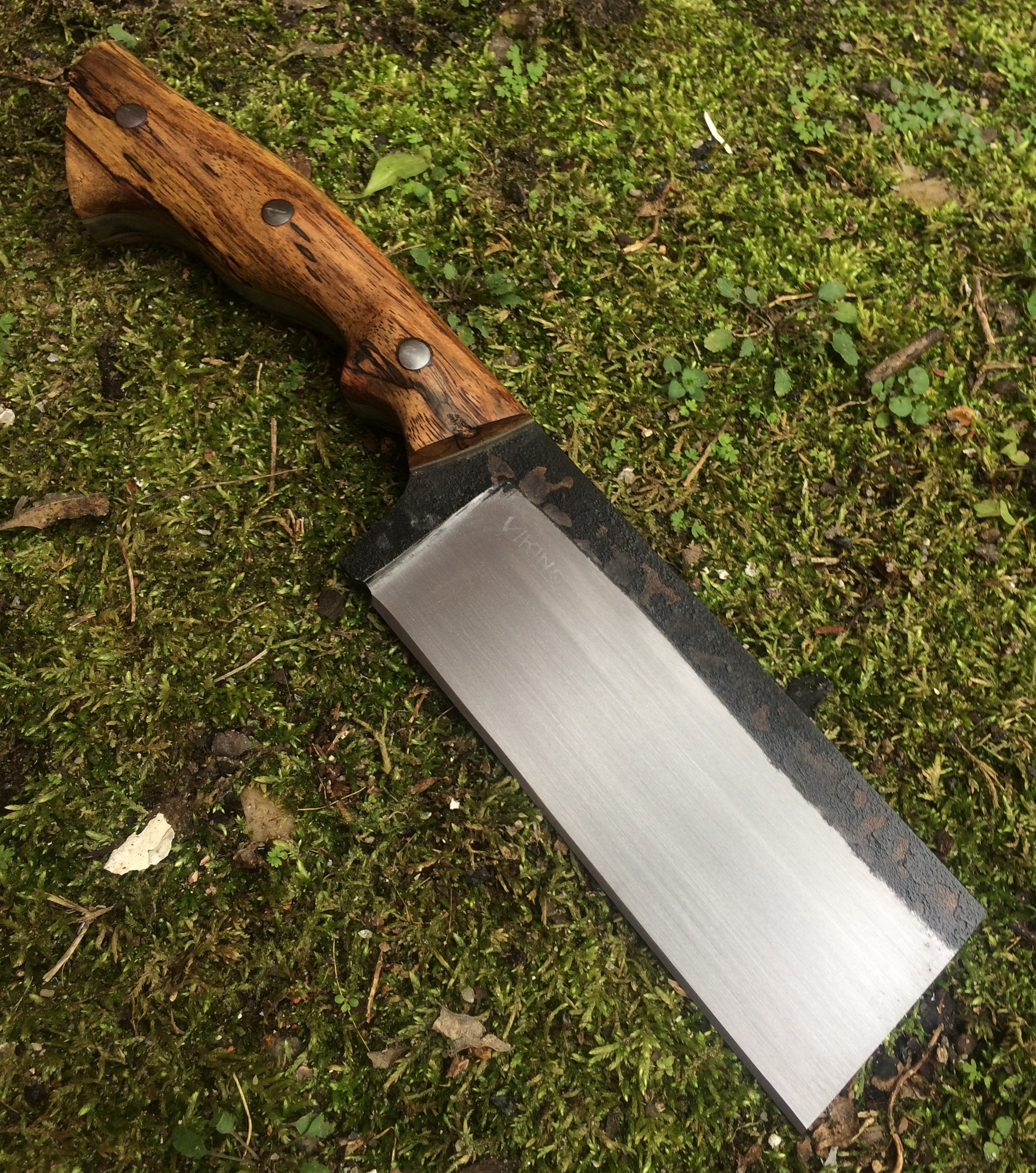
The Persuader:
img_6427.jpg

Move on, but don’t forget how it feels.


Knifemaking: making your mark and the Cuchilla Pequita

“Control what you can control, maggot!  Let everything else take a flying fuck at you and if you must go down, go down with your guns blazing.”

Cort the Gunslinger, from Stephen King’s The Drawing of the Three

The Gauchos were a group of cowboys who worked on the grasslands of South America during the 18th and 19th century. They were a people without boundaries, solitary, and existing on the Pampas of Argentina, Uruguay and Southern Brazil.  The Gauchos were a pretty wild bunch and had a lifestyle that was similar to the gypsies and travelers of Europe.  Always moving from place to place, job to job, and always on the hustle.  Most were nomadic and had few possessions. 

They were a solitary people, yes, but when they did run into other gauchos there was usually high-proof alcohol involved.  Also gambling.  And prostitutes.  Those three things made for a trifecta of machismo, and that usually resulted in conflict which manifested as duels.  Guns were expensive and hard to come by so the weapons of choice were usually knives.

When Gauchos dueled the objective was not to kill (although fatalities most definitely occurred); it was to leave a mark, preferably on the face.  A gaucho with a scar on his face had lost a duel, and all the other Gauchos knew this.  He would carry this scar for the rest of his life, but looking a little deeper one can find that scars are not always a badge of shame.
There is an inherent drive to leave your mark on the world but sometimes the world leaves its mark on you.  Things aren’t always the way we think they should be and in taking a risk to make a difference we can fail spectacularly.  We all lose duels everyday and some of us carry many scars, both seen and unseen.  Some of the most powerful and profound people I know carry scars that are both large and deep, yet these people shine brightly and leave their mark on the world everyday.  They are beautiful even though life has done its damnedest to leave its mark on them.  How is this possible?

I had a teacher once tell me that no one is in control.  This is something that is a bit of a struggle for me almost daily, even though I know that in the grand scheme of things my sphere of control is very small.  It comes down to choosing how to react to the things in our lives.

So there is a choice.  You can choose to not get pissy about the holiday Starbucks cup.  You can choose to not to feel like a victim because your candidate didn’t win.  You can choose connection over isolation.  You can choose to do something about situations that don’t serve you.  You can choose to wear your scars proudly because whatever left its mark on you wasn’t strong enough to take you down.  You can choose to let the things beyond your control take a flying fuck at you and fall as they may.  Though we can’t always control the circumstances in our lives, we can choose how we respond to them.  This is where we make our mark and is also the lesson of the Cuchilla Pequita.

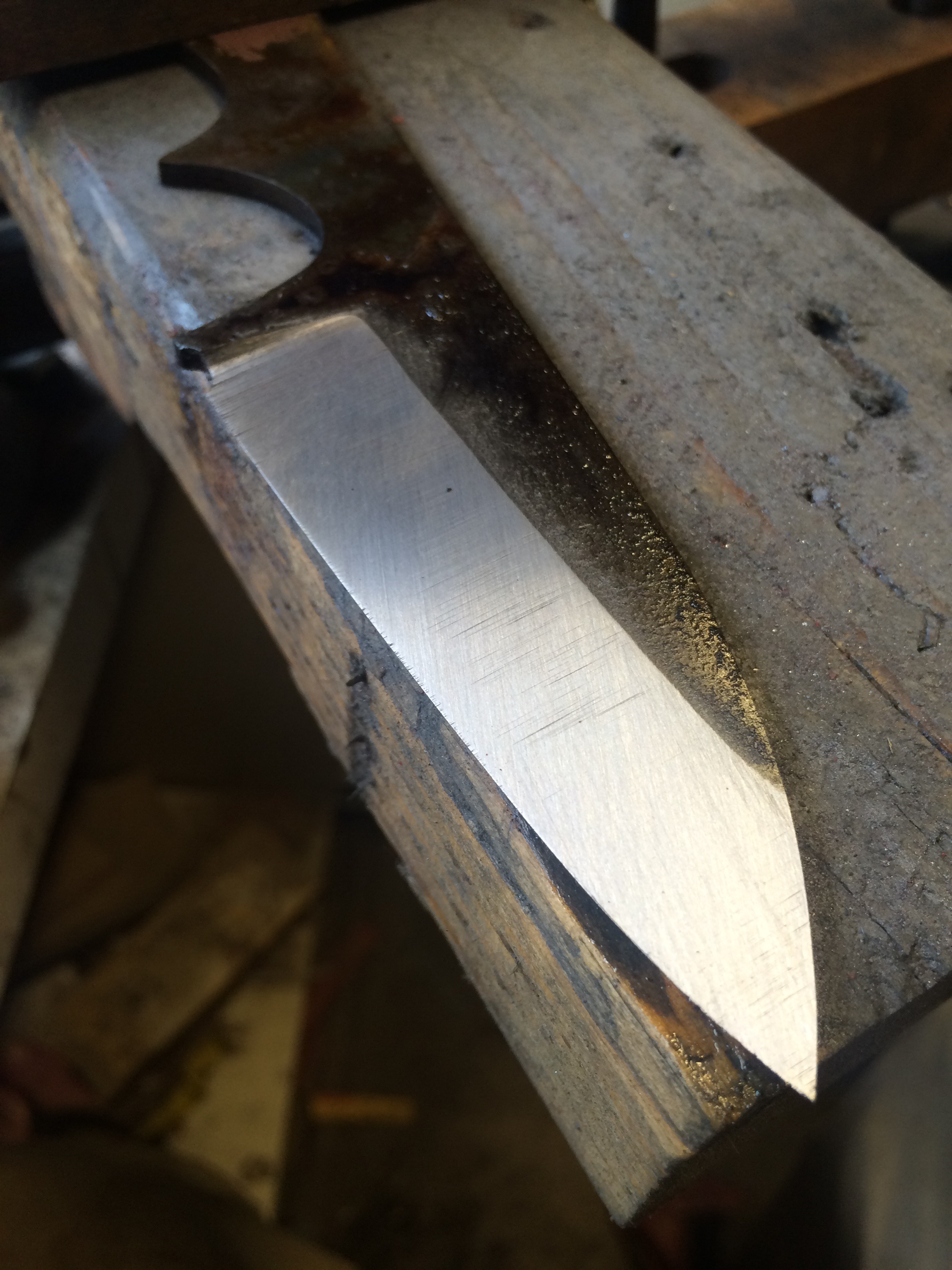
There are several types of knives carried by the Gauchos.  The Cuchilla Pequita is loosely based on the Cuchilla.  The Spanish word for knife is el cuchillo, a masculine noun in the vocabulary.  The Gauchos feminized cuchillo and applied it to their particular style of knives, which had a ‘pregnant’ blade belly and a slightly dropped point.  This design is based on that style and starts in 1095 spring steel:

After grinding and hardening:

Drilling rivet holes:

Texas Mesquite:

Fitting the handle:

Fiber spacers for a splash of contrast:

Clamped:

Profiled:

Sanded up to 2000 grit:

The Cuchilla Pequita:

How we choose to react in our lives affects the impact we can make.  This is the lesson of the Cuchilla Pequita

Here are some sources that were incredibly helpful:

A Short Essay About Gaucho Knives: Facón, Daga, Cuchilla and Puñal

Brittanica Online

Knifemaking: Conflict, Trust and the Vixen

Conflict is essential to evolution

-Paulo Coelho, Aleph

The thing is that love gives us a ringside seat on somebody else’s flaws, so of course you’re gonna spot some things that kinda need to be mentioned…

-Alain de Botton


Conflict is an inevitable part of life.  We find it in our professional and romantic relationships, in the work we do, in our places of joy and sorrow, and just about everywhere in between.  We even find it in ourselves. 

Merriam-Webster defines conflict as an “antagonistic state or action (as of divergent ideas, interests, or persons)”.  This sounds about right.

Depending on how we were raised, conflict can make us feel unsafe and insecure because we equated conflict to something being deeply wrong with us.  Often we’re raised to be agreeable, to not make a fuss, to put on a happy face, and to be seen and not heard.  Because of this there can be a tendency to submit to the incompatibles that arise and completely lose ourselves during moments of heated conflict.  We give away all of our power and ignore our needs for the sake of resolution.  There can also a tendency to run, to check out mentally and emotionally, and to avoid; all for the purpose of not having to deal with the conflict at all.  Ancient fears arise during conflict: fears of not having enough, fears of not being heard, fears of being seen as less than, fears of asking for help, or fears of our needs not being acknowledged or met.  Conflict can take us right back into the terror of our smaller selves.

Fear often makes us do the complete opposite of what is best for us.  But in a world of incompatibles, of yes’s and no’s that are always at odds with each other, conflict will always remain.  I’ve always wondered about this in the way I’ve wondered why deep sadness exists, and why pain and suffering are so prevalent.   

Conflict helps us to be active participants in our lives.  It seems counter-intuitive but conflict helps us to grow and be seen.  In the same way that deep sadness and pain can be teachers, conflict can take us to school on how to be a decent human being. 

Conflict in romantic relationships can be one of the more challenging arenas because it forces us to show and acknowledge things we may prefer to not acknowledge.  It occurs when any number of our maladjustments that we haven’t dealt with or are still processing rubs up against our partner’s.  Or when our partner’s maladjustments rub up against us.  In many instances things are simply going to rub us the wrong way and we may not be able to articulate exactly why.  

This is particularly unique to romantic conflict because there is nowhere to hide.  In other arenas we can veil ourselves with busy-ness and obligations.  We can keep our own counsel, hide our feelings, hold everything at a distance, and still uphold our responsibilities and navigate life somewhat successfully.  Doing this with someone whose heart you occupy is likely to be catastrophic.  The best thing to do is to let all of yourself be seen and work from there.

Though it may not feel like it, this is one of the healthiest things anyone can do.  We are built to be close to one another and we are all flawed.   To be able to say ‘I was only a jackass because I was deeply afraid and I’m working to be better because I care about this’ gains so much more mileage for trust and intimacy than pretending like nothing is wrong or powering through a conflict.   When someone you love knows where you are coming from it creates a sense of safety for that person, even though it may be uncomfortable for you.  Eventually you may find a sense of safety because in allowing all of yourself to be seen, it allows all of you to be loved.  Trust deepens on both ends and allows for everything to blossom.  This is something to stay on top of and it’s important to be ever mindful.

This blade was made after a conflict with someone I love.  It was a reminder to myself to lean into conflict.  Conflict is a Vixen, a lady in red, shining, beautiful, and also extremely sharp and ready to slice the hell out of you if you aren’t on top of it….

O1 tool steel, profiled:

Scribed for grinding the bevels, and a notched blade choil:

Rough grinding:

Full flat grind:

Hardened:

Sanding the ricasso after tempering:

Many hours later…

Redheart:

The Vixen:

IMG_3445_sRGB

Many things will often be at odds with each other but being able to be with all of them is at the heart of doing conflict well, and ultimately at navigating the world.  This is the lesson of the Vixen.